MARKS: 150 
TIME: 2½ hours 
NATIONAL 
SENIOR CERTIFICATE 
GRADE 12 
LIFE SCIENCES P2 
FEBRUARY/MARCH 2011 
This question paper consists of 12 pages. 
Copyright reserved Please turn over
Life Sciences/P2 DBE/Feb. – Mar. 2011 
2 
NSC 
INSTRUCTIONS AND INFORMATION 
Read the following instructions carefully before answering the questions. 
1. 
2. 
3. 
4. 
5. 
6. 
7. 
8. 
9. 
10. 
11. 
Answer ALL the questions. 
Write ALL the answers in the ANSWER BOOK. 
Start the answers to EACH question at the top of a NEW page. 
Number the answers correctly according to the numbering system used in this 
question paper. 
Present your answers according to the instructions at each question. 
Do ALL drawings in pencil and label them in blue or black ink. 
Draw diagrams or flow charts only when asked to do so. 
The diagrams in this question paper are NOT all drawn to scale. 
Do NOT use graph paper. 
You may use a non-programmable calculator, a protractor and a compass. 
Write neatly and legibly. 
Copyright reserved Please turn over
Life Sciences/P2 DBE/Feb. – Mar. 2011 
3 
NSC 
SECTION A 
QUESTION 1 
1.1 Various options are given as possible answers to the following questions. 
Choose the correct answer and write only the letter (A – D) next to the 
question number (1.1.1 – 1.1.5) in the ANSWER BOOK, for example 
1.1.6 D. 
1.1.1 The super-continent, that broke up into smaller land masses, is 
called ... 
A 
B 
C 
D 
Pangaea. 
Gondwanaland. 
continental drift. 
Laurasia. 
1.1.2 Which of the following are possible causes of extinction? 
1. Diseases 
2. Ice ages 
3. Meteorite striking the Earth 
4. Plate tectonics 
A 
1, 2 and 3 only 
B 
1, 2 and 4 only 
C 
1, 3 and 4 only 
D 
1, 2, 3 and 4 
1.1.3 Two individuals are most likely members of the same species 
if they … 
A 
B 
C 
D 
have a different number of chromosomes. 
can mate and produce fertile offspring. 
breed at the same time. 
are phenotypically different. 
1.1.4 Macroevolution is a term that describes … 
A 
B 
C 
D 
an increase in the size of individuals of a population over a 
long period of time. 
the process leading to the formation of new genera and 
families of organisms. 
a gradual change in the number of species found in the fossil 
record. 
changes that can be seen without the need of a microscope. 
Copyright reserved Please turn over
Life Sciences/P2 DBE/Feb. – Mar. 2011 
4 
NSC 
1.1.5 The following steps occur during eutrophication: 
1. Aquatic algae grow rapidly 
2. Bacteria use up oxygen 
3. Excess nitrate and phosphate discharged into the river 
4. Dead algae decomposed by bacteria 
5. Fish die of suffocation 
The correct order in which eutrophication occurs is … 
A 
B 
C 
D 
3 4 1 5 2 
5 3 2 4 1 
5 2 3 1 4 
3 1 4 2 5 (5 x 2) (10) 
1.2 Give the correct biological term for each of the following descriptions. Write 
only the term next to the question number (1.2.1 – 1.2.8) in the ANSWER 
BOOK. 
1.2.1 
1.2.2 
1.2.3 
1.2.4 
1.2.5 
1.2.6 
1.2.7 
1.2.8 
Waste that cannot be broken down by decomposers 
The study of fossils 
A branched diagram showing the evolutionary relationships 
between species 
The study of the distribution of living organisms found in different 
regions 
Species that are no longer found on Earth 
The era in which the genus Homo evolved 
Structures inherited from the ancestor that are small, poorly 
developed and have no useful function 
The variety of different species living in an area (8 x 1) (8) 
Copyright reserved Please turn over
Life Sciences/P2 DBE/Feb. – Mar. 2011 
5 
NSC 
1.3 Indicate whether each of the statements in COLUMN I applies to A ONLY, 
B ONLY, BOTH A AND B or NONE of the items in COLUMN II. Write A only, 
B only, both A and B, or none next to the question number (1.3.1 – 1.3.5) in 
the ANSWER BOOK. 
COLUMN I COLUMN II 
1.3.1 Organisms have an inherent/internal drive to 
change 
A: Lamarck 
B: Darwin 
1.3.2 Mutation(s) that lead to the death of the 
organism 
A: Neutral mutation 
B: Lethal mutation 
1.3.3 Australopithecines that were found in South 
Africa 
A: Little Foot 
B: Mrs Ples 
1.3.4 Dating of fossils by comparing the age of one 
fossil to another 
A: Relative dating 
B: Radiometric dating 
1.3.5 Evidence for evolution using comparative 
biochemistry 
A: Different metabolic pathways 
B: Identical protein synthesis 
(5 x 2) (10) 
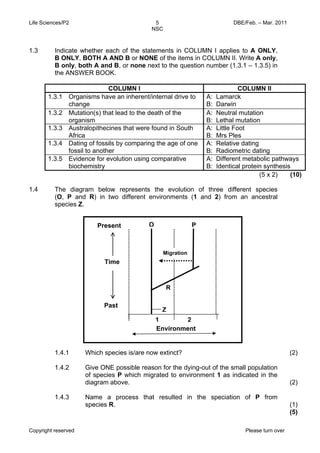
1.4 The diagram below represents the evolution of three different species 
(O, P and R) in two different environments (1 and 2) from an ancestral 
species Z. 
1.4.1 
1.4.2 
1.4.3 
O P 
Migration 
Z 
1 2 
Which species is/are now extinct? 
Give ONE possible reason for the dying-out of the small population 
of species P which migrated to environment 1 as indicated in the 
diagram above. 
Name a process that resulted in the speciation of P from 
species R. 
Copyright reserved Please turn over 
(2) 
(2) 
(1) 
(5) 
Environment 
Present 
Time 
Past 
R
Life Sciences/P2 DBE/Feb. – Mar. 2011 
6 
NSC 
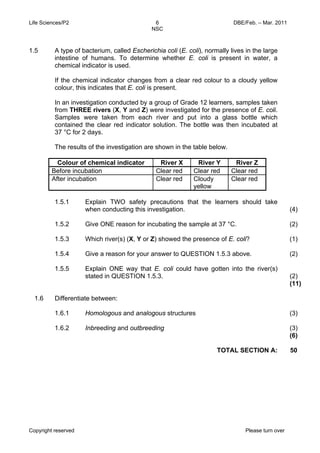
1.5 A type of bacterium, called Escherichia coli (E. coli), normally lives in the large 
intestine of humans. To determine whether E. coli is present in water, a 
chemical indicator is used. 
If the chemical indicator changes from a clear red colour to a cloudy yellow 
colour, this indicates that E. coli is present. 
In an investigation conducted by a group of Grade 12 learners, samples taken 
from THREE rivers (X, Y and Z) were investigated for the presence of E. coli. 
Samples were taken from each river and put into a glass bottle which 
contained the clear red indicator solution. The bottle was then incubated at 
37 °C for 2 days. 
The results of the investigation are shown in the table below. 
Colour of chemical indicator River X River Y River Z 
Before incubation Clear red Clear red Clear red 
After incubation Clear red Cloudy 
yellow 
Clear red 
1.5.1 
1.5.2 
1.5.3 
1.5.4 
1.5.5 
Explain TWO safety precautions that the learners should take 
when conducting this investigation. 
Give ONE reason for incubating the sample at 37 °C. 
Which river(s) (X, Y or Z) showed the presence of E. coli? 
Give a reason for your answer to QUESTION 1.5.3 above. 
Explain ONE way that E. coli could have gotten into the river(s) 
stated in QUESTION 1.5.3. 
Copyright reserved Please turn over 
(4) 
(2) 
(1) 
(2) 
(2) 
(11) 
1.6 Differentiate between: 
1.6.1 
1.6.2 
Homologous and analogous structures 
Inbreeding and outbreeding 
(3) 
(3) 
(6) 
TOTAL SECTION A: 50
Life Sciences/P2 DBE/Feb. – Mar. 2011 
7 
NSC 
SECTION B 
QUESTION 2 
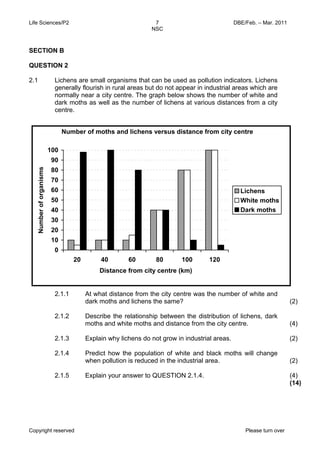
2.1 Lichens are small organisms that can be used as pollution indicators. Lichens 
generally flourish in rural areas but do not appear in industrial areas which are 
normally near a city centre. The graph below shows the number of white and 
dark moths as well as the number of lichens at various distances from a city 
centre. 
Number of moths and lichens versus distance from city centre 
100 
90 
80 
70 
60 
50 
40 
30 
20 
10 
0 
20 40 60 80 100 120 
Distance from city centre (km) 
Number of organisms 
Lichens 
White moths 
Dark moths 
2.1.1 
2.1.2 
2.1.3 
2.1.4 
2.1.5 
At what distance from the city centre was the number of white and 
dark moths and lichens the same? 
Describe the relationship between the distribution of lichens, dark 
moths and white moths and distance from the city centre. 
Explain why lichens do not grow in industrial areas. 
Predict how the population of white and black moths will change 
when pollution is reduced in the industrial area. 
Explain your answer to QUESTION 2.1.4. 
Copyright reserved Please turn over 
(2) 
(4) 
(2) 
(2) 
(4) 
(14)
Life Sciences/P2 DBE/Feb. – Mar. 2011 
8 
NSC 
2.2 Deforestation is the destruction of forests by the removal of trees in large 
numbers. The table below shows statistics related to deforestation in different 
regions from 1990 to 2000. 
Region Total land 
area (ha) 
Total 
forest 
cover 
(ha) 
Forest 
cover 
(%) 
Deforestation 
rate 
1990 – 2000 (%) 
Africa 2 978 394 649 866 21,8 0,8 
Asia 3 084 746 547 793 X 0,1 
North and 
2 136 966 549 304 25,7 0,1 
Central America 
Oceania and 
Australia 
849 096 197 623 23,3 0,2 
2.2.1 
2.2.2 
2.2.3 
2.2.4 
2.2.5 
Which region had the highest rate of deforestation in the 
10-year period? 
Calculate the forest cover (%) of Asia indicated as X. Show ALL 
working. 
Give any TWO reasons for deforestation. 
Describe TWO consequences of deforestation for the ecosystem. 
Explain THREE management strategies to reduce deforestation. 
Copyright reserved Please turn over 
(1) 
(3) 
(2) 
(4) 
(6) 
(16) 
[30]
Life Sciences/P2 DBE/Feb. – Mar. 2011 
9 
NSC 
QUESTION 3 
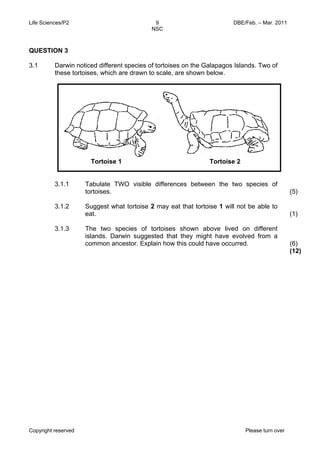
3.1 Darwin noticed different species of tortoises on the Galapagos Islands. Two of 
these tortoises, which are drawn to scale, are shown below. 
3.1.1 
3.1.2 
3.1.3 
Tabulate TWO visible differences between the two species of 
tortoises. 
Suggest what tortoise 2 may eat that tortoise 1 will not be able to 
eat. 
The two species of tortoises shown above lived on different 
islands. Darwin suggested that they might have evolved from a 
common ancestor. Explain how this could have occurred. 
Copyright reserved Please turn over 
(5) 
(1) 
(6) 
(12) 
Tortoise 1 Tortoise 2
Life Sciences/P2 DBE/Feb. – Mar. 2011 
10 
NSC 
3.2 The diagrams below represent the skulls of two organisms, namely a modern 
human and a gorilla. Each arrow indicates the position of the foramen 
magnum. Study the diagrams and answer the questions that follow. 
3.2.1 
3.2.2 
3.2.3 
3.2.4 
3.2.5 
Identify each of the organisms that are represented by A and B. 
Tabulate FOUR observable differences between the skulls of 
organisms A and B. 
Which organism is bipedal for most of its adult life? 
Explain TWO possible advantages of bipedalism to the organism 
referred to in QUESTION 3.2.3. 
Name any TWO similarities between organisms A and B. 
Copyright reserved Please turn over 
(2) 
(9) 
(1) 
(4) 
(2) 
(18) 
TOTAL SECTION B: 
[30] 
60 
Organism A Organism B
Life Sciences/P2 DBE/Feb. – Mar. 2011 
11 
NSC 
SECTION C 
QUESTION 4 
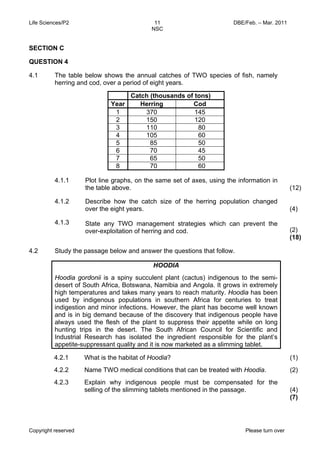
4.1 The table below shows the annual catches of TWO species of fish, namely 
herring and cod, over a period of eight years. 
Catch (thousands of tons) 
Year Herring Cod 
1 370 145 
2 150 120 
3 110 80 
4 105 60 
5 85 50 
6 70 45 
7 65 50 
8 70 60 
4.1.1 
4.1.2 
4.1.3 
Plot line graphs, on the same set of axes, using the information in 
the table above. 
Describe how the catch size of the herring population changed 
over the eight years. 
State any TWO management strategies which can prevent the 
over-exploitation of herring and cod. 
Copyright reserved Please turn over 
(12) 
(4) 
(2) 
(18) 
4.2 Study the passage below and answer the questions that follow. 
HOODIA 
Hoodia gordonii is a spiny succulent plant (cactus) indigenous to the semi-desert 
of South Africa, Botswana, Namibia and Angola. It grows in extremely 
high temperatures and takes many years to reach maturity. Hoodia has been 
used by indigenous populations in southern Africa for centuries to treat 
indigestion and minor infections. However, the plant has become well known 
and is in big demand because of the discovery that indigenous people have 
always used the flesh of the plant to suppress their appetite while on long 
hunting trips in the desert. The South African Council for Scientific and 
Industrial Research has isolated the ingredient responsible for the plant’s 
appetite-suppressant quality and it is now marketed as a slimming tablet. 
4.2.1 
4.2.2 
4.2.3 
What is the habitat of Hoodia? 
Name TWO medical conditions that can be treated with Hoodia. 
Explain why indigenous people must be compensated for the 
selling of the slimming tablets mentioned in the passage. 
(1) 
(2) 
(4) 
(7)
Life Sciences/P2 12 DBE/Feb. – Mar. 2011 
NSC 
Copyright reserved 
TOTAL SECTION C: 
GRAND TOTAL: 
40 
150 
4.3 Explain, with reasons, FOUR strategies you would use to manage solid waste 
if you were appointed as the head of the waste disposal division of your 
town/city. 
NOTE: NO marks will be awarded for answers in the form of flow charts or 
diagrams. (15)

Life sciences p2 feb march 2011 eng

  • 1.
    MARKS: 150 TIME:2½ hours NATIONAL SENIOR CERTIFICATE GRADE 12 LIFE SCIENCES P2 FEBRUARY/MARCH 2011 This question paper consists of 12 pages. Copyright reserved Please turn over
  • 2.
    Life Sciences/P2 DBE/Feb.– Mar. 2011 2 NSC INSTRUCTIONS AND INFORMATION Read the following instructions carefully before answering the questions. 1. 2. 3. 4. 5. 6. 7. 8. 9. 10. 11. Answer ALL the questions. Write ALL the answers in the ANSWER BOOK. Start the answers to EACH question at the top of a NEW page. Number the answers correctly according to the numbering system used in this question paper. Present your answers according to the instructions at each question. Do ALL drawings in pencil and label them in blue or black ink. Draw diagrams or flow charts only when asked to do so. The diagrams in this question paper are NOT all drawn to scale. Do NOT use graph paper. You may use a non-programmable calculator, a protractor and a compass. Write neatly and legibly. Copyright reserved Please turn over
  • 3.
    Life Sciences/P2 DBE/Feb.– Mar. 2011 3 NSC SECTION A QUESTION 1 1.1 Various options are given as possible answers to the following questions. Choose the correct answer and write only the letter (A – D) next to the question number (1.1.1 – 1.1.5) in the ANSWER BOOK, for example 1.1.6 D. 1.1.1 The super-continent, that broke up into smaller land masses, is called ... A B C D Pangaea. Gondwanaland. continental drift. Laurasia. 1.1.2 Which of the following are possible causes of extinction? 1. Diseases 2. Ice ages 3. Meteorite striking the Earth 4. Plate tectonics A 1, 2 and 3 only B 1, 2 and 4 only C 1, 3 and 4 only D 1, 2, 3 and 4 1.1.3 Two individuals are most likely members of the same species if they … A B C D have a different number of chromosomes. can mate and produce fertile offspring. breed at the same time. are phenotypically different. 1.1.4 Macroevolution is a term that describes … A B C D an increase in the size of individuals of a population over a long period of time. the process leading to the formation of new genera and families of organisms. a gradual change in the number of species found in the fossil record. changes that can be seen without the need of a microscope. Copyright reserved Please turn over
  • 4.
    Life Sciences/P2 DBE/Feb.– Mar. 2011 4 NSC 1.1.5 The following steps occur during eutrophication: 1. Aquatic algae grow rapidly 2. Bacteria use up oxygen 3. Excess nitrate and phosphate discharged into the river 4. Dead algae decomposed by bacteria 5. Fish die of suffocation The correct order in which eutrophication occurs is … A B C D 3 4 1 5 2 5 3 2 4 1 5 2 3 1 4 3 1 4 2 5 (5 x 2) (10) 1.2 Give the correct biological term for each of the following descriptions. Write only the term next to the question number (1.2.1 – 1.2.8) in the ANSWER BOOK. 1.2.1 1.2.2 1.2.3 1.2.4 1.2.5 1.2.6 1.2.7 1.2.8 Waste that cannot be broken down by decomposers The study of fossils A branched diagram showing the evolutionary relationships between species The study of the distribution of living organisms found in different regions Species that are no longer found on Earth The era in which the genus Homo evolved Structures inherited from the ancestor that are small, poorly developed and have no useful function The variety of different species living in an area (8 x 1) (8) Copyright reserved Please turn over
  • 5.
    Life Sciences/P2 DBE/Feb.– Mar. 2011 5 NSC 1.3 Indicate whether each of the statements in COLUMN I applies to A ONLY, B ONLY, BOTH A AND B or NONE of the items in COLUMN II. Write A only, B only, both A and B, or none next to the question number (1.3.1 – 1.3.5) in the ANSWER BOOK. COLUMN I COLUMN II 1.3.1 Organisms have an inherent/internal drive to change A: Lamarck B: Darwin 1.3.2 Mutation(s) that lead to the death of the organism A: Neutral mutation B: Lethal mutation 1.3.3 Australopithecines that were found in South Africa A: Little Foot B: Mrs Ples 1.3.4 Dating of fossils by comparing the age of one fossil to another A: Relative dating B: Radiometric dating 1.3.5 Evidence for evolution using comparative biochemistry A: Different metabolic pathways B: Identical protein synthesis (5 x 2) (10) 1.4 The diagram below represents the evolution of three different species (O, P and R) in two different environments (1 and 2) from an ancestral species Z. 1.4.1 1.4.2 1.4.3 O P Migration Z 1 2 Which species is/are now extinct? Give ONE possible reason for the dying-out of the small population of species P which migrated to environment 1 as indicated in the diagram above. Name a process that resulted in the speciation of P from species R. Copyright reserved Please turn over (2) (2) (1) (5) Environment Present Time Past R
  • 6.
    Life Sciences/P2 DBE/Feb.– Mar. 2011 6 NSC 1.5 A type of bacterium, called Escherichia coli (E. coli), normally lives in the large intestine of humans. To determine whether E. coli is present in water, a chemical indicator is used. If the chemical indicator changes from a clear red colour to a cloudy yellow colour, this indicates that E. coli is present. In an investigation conducted by a group of Grade 12 learners, samples taken from THREE rivers (X, Y and Z) were investigated for the presence of E. coli. Samples were taken from each river and put into a glass bottle which contained the clear red indicator solution. The bottle was then incubated at 37 °C for 2 days. The results of the investigation are shown in the table below. Colour of chemical indicator River X River Y River Z Before incubation Clear red Clear red Clear red After incubation Clear red Cloudy yellow Clear red 1.5.1 1.5.2 1.5.3 1.5.4 1.5.5 Explain TWO safety precautions that the learners should take when conducting this investigation. Give ONE reason for incubating the sample at 37 °C. Which river(s) (X, Y or Z) showed the presence of E. coli? Give a reason for your answer to QUESTION 1.5.3 above. Explain ONE way that E. coli could have gotten into the river(s) stated in QUESTION 1.5.3. Copyright reserved Please turn over (4) (2) (1) (2) (2) (11) 1.6 Differentiate between: 1.6.1 1.6.2 Homologous and analogous structures Inbreeding and outbreeding (3) (3) (6) TOTAL SECTION A: 50
  • 7.
    Life Sciences/P2 DBE/Feb.– Mar. 2011 7 NSC SECTION B QUESTION 2 2.1 Lichens are small organisms that can be used as pollution indicators. Lichens generally flourish in rural areas but do not appear in industrial areas which are normally near a city centre. The graph below shows the number of white and dark moths as well as the number of lichens at various distances from a city centre. Number of moths and lichens versus distance from city centre 100 90 80 70 60 50 40 30 20 10 0 20 40 60 80 100 120 Distance from city centre (km) Number of organisms Lichens White moths Dark moths 2.1.1 2.1.2 2.1.3 2.1.4 2.1.5 At what distance from the city centre was the number of white and dark moths and lichens the same? Describe the relationship between the distribution of lichens, dark moths and white moths and distance from the city centre. Explain why lichens do not grow in industrial areas. Predict how the population of white and black moths will change when pollution is reduced in the industrial area. Explain your answer to QUESTION 2.1.4. Copyright reserved Please turn over (2) (4) (2) (2) (4) (14)
  • 8.
    Life Sciences/P2 DBE/Feb.– Mar. 2011 8 NSC 2.2 Deforestation is the destruction of forests by the removal of trees in large numbers. The table below shows statistics related to deforestation in different regions from 1990 to 2000. Region Total land area (ha) Total forest cover (ha) Forest cover (%) Deforestation rate 1990 – 2000 (%) Africa 2 978 394 649 866 21,8 0,8 Asia 3 084 746 547 793 X 0,1 North and 2 136 966 549 304 25,7 0,1 Central America Oceania and Australia 849 096 197 623 23,3 0,2 2.2.1 2.2.2 2.2.3 2.2.4 2.2.5 Which region had the highest rate of deforestation in the 10-year period? Calculate the forest cover (%) of Asia indicated as X. Show ALL working. Give any TWO reasons for deforestation. Describe TWO consequences of deforestation for the ecosystem. Explain THREE management strategies to reduce deforestation. Copyright reserved Please turn over (1) (3) (2) (4) (6) (16) [30]
  • 9.
    Life Sciences/P2 DBE/Feb.– Mar. 2011 9 NSC QUESTION 3 3.1 Darwin noticed different species of tortoises on the Galapagos Islands. Two of these tortoises, which are drawn to scale, are shown below. 3.1.1 3.1.2 3.1.3 Tabulate TWO visible differences between the two species of tortoises. Suggest what tortoise 2 may eat that tortoise 1 will not be able to eat. The two species of tortoises shown above lived on different islands. Darwin suggested that they might have evolved from a common ancestor. Explain how this could have occurred. Copyright reserved Please turn over (5) (1) (6) (12) Tortoise 1 Tortoise 2
  • 10.
    Life Sciences/P2 DBE/Feb.– Mar. 2011 10 NSC 3.2 The diagrams below represent the skulls of two organisms, namely a modern human and a gorilla. Each arrow indicates the position of the foramen magnum. Study the diagrams and answer the questions that follow. 3.2.1 3.2.2 3.2.3 3.2.4 3.2.5 Identify each of the organisms that are represented by A and B. Tabulate FOUR observable differences between the skulls of organisms A and B. Which organism is bipedal for most of its adult life? Explain TWO possible advantages of bipedalism to the organism referred to in QUESTION 3.2.3. Name any TWO similarities between organisms A and B. Copyright reserved Please turn over (2) (9) (1) (4) (2) (18) TOTAL SECTION B: [30] 60 Organism A Organism B
  • 11.
    Life Sciences/P2 DBE/Feb.– Mar. 2011 11 NSC SECTION C QUESTION 4 4.1 The table below shows the annual catches of TWO species of fish, namely herring and cod, over a period of eight years. Catch (thousands of tons) Year Herring Cod 1 370 145 2 150 120 3 110 80 4 105 60 5 85 50 6 70 45 7 65 50 8 70 60 4.1.1 4.1.2 4.1.3 Plot line graphs, on the same set of axes, using the information in the table above. Describe how the catch size of the herring population changed over the eight years. State any TWO management strategies which can prevent the over-exploitation of herring and cod. Copyright reserved Please turn over (12) (4) (2) (18) 4.2 Study the passage below and answer the questions that follow. HOODIA Hoodia gordonii is a spiny succulent plant (cactus) indigenous to the semi-desert of South Africa, Botswana, Namibia and Angola. It grows in extremely high temperatures and takes many years to reach maturity. Hoodia has been used by indigenous populations in southern Africa for centuries to treat indigestion and minor infections. However, the plant has become well known and is in big demand because of the discovery that indigenous people have always used the flesh of the plant to suppress their appetite while on long hunting trips in the desert. The South African Council for Scientific and Industrial Research has isolated the ingredient responsible for the plant’s appetite-suppressant quality and it is now marketed as a slimming tablet. 4.2.1 4.2.2 4.2.3 What is the habitat of Hoodia? Name TWO medical conditions that can be treated with Hoodia. Explain why indigenous people must be compensated for the selling of the slimming tablets mentioned in the passage. (1) (2) (4) (7)
  • 12.
    Life Sciences/P2 12DBE/Feb. – Mar. 2011 NSC Copyright reserved TOTAL SECTION C: GRAND TOTAL: 40 150 4.3 Explain, with reasons, FOUR strategies you would use to manage solid waste if you were appointed as the head of the waste disposal division of your town/city. NOTE: NO marks will be awarded for answers in the form of flow charts or diagrams. (15)