LICHENS
AND
HUMAN WELFARE
Mamta Bhat,
Department of Botany,
School of Biosciences and Biotechnology,
BGSB University, Rajouri (J & K) K)
National Conference on Current Developments and Next Generation Lichenology
27 – 28 January, 2018
Lichens
More than 700 extra cellular secondary metabolites isolated from 5000 lichen species which are
very important in lichen systematics
Classical example of symbiosis where fungi (mycobiont) lives in intimate association with
green algae (photobiont) or cyanobacteria.
Pronounced lie’ken, derived from the Greek word Λειχήν meaning tree moss
Importance – as pioneers, paedogenesis, dyes, cosmetics, food and fodder, as Biomonitors,
yield a number of medicines and help in climate change studies
Resulting thallus neither resembles the two, lacks any protective, conductive and assimilatory
tissues such as epidermis, xylem, phloem and roots
30,000 lichen species reported worldwide covering 8% of land surface
Lichen
Algae Fungi
(Photobiont) (Mycobiont)
Fungi
Algae or Cyanobacteria
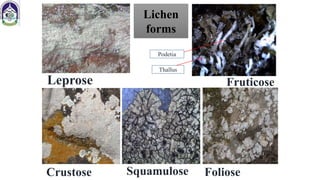
Crustose Squamulose
Leprose
Lichen
forms Fruticose
Fruticose
Foliose
Podetia
Thallus
antibiotics
allelochemicals
Antioxidants
Analgesic/
antipyretic
activity
UV B protection
Antiherbivore
activity
Metal
homeostasis
Cytotoxic,
antitumour,
antiviral activity
Allergens
Pollution
tolerance
Biological
activities
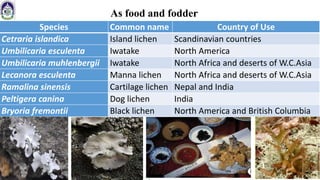
As food and fodder
Species Common name Country of Use
Cetraria islandica Island lichen Scandinavian countries
Umbilicaria esculenta Iwatake North America
Umbilicaria muhlenbergii Iwatake North Africa and deserts of W.C.Asia
Lecanora esculenta Manna lichen North Africa and deserts of W.C.Asia
Ramalina sinensis Cartilage lichen Nepal and India
Peltigera canina Dog lichen India
Bryoria fremontii Black lichen North America and British Columbia
Lichen in Siddha Medicine
Reference
Agathiar Gunappaadam
Basic Siddha Medicine book
explaining nature of herbs in the
form of Hymn
Siddha Vaithiya Pathaartha Guna Villakkam
Sri Kannusamy Pillai
B. Ratthina Nayakkar & Sons
26, Venkatrama St
Chennai 79
• Usnea species - hair problems, headache, malaria, toxic snake bites, thyroid
tumours and cancer therapy.
• Umbilicaria esculenta contains anti-HIV substances.
• Parmelia as blood nourishing herb, benefits vision defects, promote diuresis.
• Xanthoria parietina - jaundice.
• Peltigera canina - rabies.
• Cetraria islandica - cough remedy.
• Letharia vulpina (wolf lichen) - stomach disorders.
(Omnigran a. Granobil, Usnagren A and T, Lipo kinetix,
Ab solution plus, Lipoburn, Usno)
As medicines
LICHEN BASED PRODUCTS IN MARKET
As Dyes
• Roccella montagnei yields red and purple dyes (LITMUS PAPER).
• Pertusaria corallina and Ochrolechia tartarea yields purple dye.
• Parmelia omphalodes yields brown dye
Roccella montagnei
Ochrolechia tartarea
As Perfumeries
 Evernia prunastri (Oakmoss lichen)
 Pseudevernia furfuracea (Tree moss)
 Ramalina spp.
 ingredients in soaps
 cosmetics
 after shave lotions
 perfumes
Rajouri–Poonch belt constitutes peripheral part of the gigantic Pir–Panjal
mountain range and is largely montane
Challenges
• Inaccessibility of terrain.
• Insurgency and resultant insecurity.
• Lack of primary data to correlate with the data being
raised now.
Antimicrobial assay
Xanthoparmelia congensis Dermatocarpon vallereum
Findings of the study:
i) Acetone extracts of the Xanthoparmelia congensis possess antibacterial
potential against Staphylococcus aureus.
ii) The present work can be a reference point for such similar future studies in
the region. It could contribute to determine various antimicrobial agents
extracted from lichens to be used as therapeutic agents against various
pathogenic organisms.
THANK YOU

LICHENS AND HUMAN WELFARE

  • 1.
    LICHENS AND HUMAN WELFARE Mamta Bhat, Departmentof Botany, School of Biosciences and Biotechnology, BGSB University, Rajouri (J & K) K) National Conference on Current Developments and Next Generation Lichenology 27 – 28 January, 2018
  • 2.
    Lichens More than 700extra cellular secondary metabolites isolated from 5000 lichen species which are very important in lichen systematics Classical example of symbiosis where fungi (mycobiont) lives in intimate association with green algae (photobiont) or cyanobacteria. Pronounced lie’ken, derived from the Greek word Λειχήν meaning tree moss Importance – as pioneers, paedogenesis, dyes, cosmetics, food and fodder, as Biomonitors, yield a number of medicines and help in climate change studies Resulting thallus neither resembles the two, lacks any protective, conductive and assimilatory tissues such as epidermis, xylem, phloem and roots 30,000 lichen species reported worldwide covering 8% of land surface
  • 3.
  • 4.
  • 5.
  • 6.
    As food andfodder Species Common name Country of Use Cetraria islandica Island lichen Scandinavian countries Umbilicaria esculenta Iwatake North America Umbilicaria muhlenbergii Iwatake North Africa and deserts of W.C.Asia Lecanora esculenta Manna lichen North Africa and deserts of W.C.Asia Ramalina sinensis Cartilage lichen Nepal and India Peltigera canina Dog lichen India Bryoria fremontii Black lichen North America and British Columbia
  • 7.
    Lichen in SiddhaMedicine Reference Agathiar Gunappaadam Basic Siddha Medicine book explaining nature of herbs in the form of Hymn Siddha Vaithiya Pathaartha Guna Villakkam Sri Kannusamy Pillai B. Ratthina Nayakkar & Sons 26, Venkatrama St Chennai 79
  • 8.
    • Usnea species- hair problems, headache, malaria, toxic snake bites, thyroid tumours and cancer therapy. • Umbilicaria esculenta contains anti-HIV substances. • Parmelia as blood nourishing herb, benefits vision defects, promote diuresis. • Xanthoria parietina - jaundice. • Peltigera canina - rabies. • Cetraria islandica - cough remedy. • Letharia vulpina (wolf lichen) - stomach disorders. (Omnigran a. Granobil, Usnagren A and T, Lipo kinetix, Ab solution plus, Lipoburn, Usno) As medicines
  • 9.
  • 10.
    As Dyes • Roccellamontagnei yields red and purple dyes (LITMUS PAPER). • Pertusaria corallina and Ochrolechia tartarea yields purple dye. • Parmelia omphalodes yields brown dye Roccella montagnei Ochrolechia tartarea
  • 11.
    As Perfumeries  Everniaprunastri (Oakmoss lichen)  Pseudevernia furfuracea (Tree moss)  Ramalina spp.  ingredients in soaps  cosmetics  after shave lotions  perfumes
  • 12.
    Rajouri–Poonch belt constitutesperipheral part of the gigantic Pir–Panjal mountain range and is largely montane
  • 13.
    Challenges • Inaccessibility ofterrain. • Insurgency and resultant insecurity. • Lack of primary data to correlate with the data being raised now.
  • 14.
  • 15.
    Findings of thestudy: i) Acetone extracts of the Xanthoparmelia congensis possess antibacterial potential against Staphylococcus aureus. ii) The present work can be a reference point for such similar future studies in the region. It could contribute to determine various antimicrobial agents extracted from lichens to be used as therapeutic agents against various pathogenic organisms.
  • 16.

Editor's Notes

  • #6 Lichens produce a variety of extra-cellular secondary metabolites in either an amorphous form or as crystals. These compounds occur only in lichens and are known as lichen substances. More than 700 such compounds have now been isolated from nearly 5000 lichen species.
  • #7 As food and fodder: Dermatocarpon miniatum, Umbilicaria esculenta are used as soup or in salads. In Japan, it is considered a delicacy (Iwatake). Spices mixture of Parmelia, Heterodermia, Pyxine and Physcia are used as flavours to prepare Biryani from “Kashmir to Kanyakumari” Cladonia rangiferina, C. alperstris and C. sylvatica, Cetraria, Stereocaulon and Alectoria.
  • #9 1. Parmelia spp. are used in wound healing in parts of Eastern Ghats, India. 2. The Okanagan-Colville made a weak tea of Letharia vulpina to treat internal problems, and it was a Blackfoot remedy for stomach disorders
  • #10 Parmelia perlata -Antifungal, antibacterial and anti-inflammatory properties Confido* is a non-hormonal therapy acting through the neuro-endocrine pathway, regulates the process of ejaculation. 3. Speman promotes spermatogenesis by improving the testicular, seminal vesicle and epididymal functions. 4. V-Gel possesses antifungal, antibacterial and anti- inflammatory properties, effective in the treatment of vaginitis and cervicitis.
  • #11 0. Under the combined influence of ammonia and oxygen, lecanoric acid and erythrin in Roccella montagnei give orcin and subsequently orcein, which are the colouring matters of orchil and which, in the presence of sodium or potassium carbonates, form azolitmin and erythrolitmin (colouring matters of litmus) Lichen acids were the source of important dyes for cotton and wool in medieval Europe. 2. Two purple and red dyes, orchil and cudbear, were obtained from the lichens Roccella and Ochrolechia. 3. Lichen dyes were dissolved in human urine, and the yarns were immersed in this mixture. 4. Ammonia salts in the urine functioned as mordants to make the dyes permanent
  • #12 1. Harvested - south-central Europe, sent to France where it is used in the manufacture of fine perfumes. The lichen acts as a fixative for other scents, and also adds a subtle herbal fragrance of its own.
  • #15 Antimicrobial activity of the lichens Xanthoparmelia congensis and Dermatocarpon vallereum were determined on the basis of the presence and absence of the zone of inhibition against the test organisms. The areas of inhibited bacterial growth were observed as the clear zones around the disc dipped in a particular lichen extract placed on the bacterial culture. Antimicrobial activity was measured as the diameter of the zone of inhibition, excluding the diameter of the disc as given in table