LIBYA
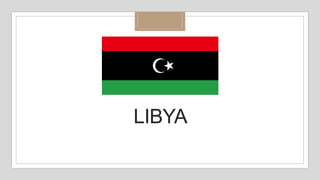
LIBYA
◦ Libya is the largest country in Africa region.
◦ The dictatorship rule lasted for 42 years by the former ruler Col Muammar Gaddafi and
ended in 2011.
◦ There are high levels of unemployment; lack of economic diversification, dependency on a
particular oil sectors, underdeveloped agricultural sector.
◦ Libya is the member of many organizations including African Union (AU), United Nations,
IMF; OPEC; UNESCO; UNCTAD; OIC.
ECONOMIC
◦ According to World Bank report; Libya is an upper middle-income economy.
◦ It is an oil rich country and the whole economy of Libya is highly dependent on the oil exports.
◦ After 2011 conflict, Libya faced large disruptions in oil production, and the economy contracted by more than 60 percent that year. Many foreign businesses shut
down due to the civil war in 2011. However, by the end of 2012, oil production was nearly back to pre-war levels, resulting in doubling of real GDP.
◦ GDP (purchasing power parity):
◦ $61.97 billion (2017 est.)
◦ $37.78 billion (2016 est.)
◦ GDP - real growth rate:
◦ 64% (2017 est.)
◦ -7.4% (2016 est.)
ECONOMIC (CONTINUED..)
◦ Gross national saving:
◦ 5% of GDP (2017 est.)
◦ GDP - composition, by end use:
◦ household consumption: 71.6% (2017 est.)
◦ government consumption: 19.4% (2017 est.)
◦ exports of goods and services: 38.8% (2017 est.)
◦ GDP - composition, by sector of origin:
◦ agriculture: 1.3% (2017 est.)
◦ industry: 52.3% (2017 est.)
◦ services: 46.4% (2017 est.)
◦ GDP - per capita (PPP):
◦ $9,600 (2017 est.)
SOCIAL AND
CULTURAL FACTORS
OF LIBYA:
◦ Being an Arab country, most of the population of
Libya is Muslim. Therefore, the social norms and
culture of Libya have substantial effect in their
organizational level practices.
◦ The following statistics by WHO show that the
social and economic factor of Libya are not well
developed yet.
Total population (2016) 6,293,000
Gross national income per capita (PPP
international $, 2009) 28,110
Life expectancy at birth m/f (years,
2016) 69/75
Probability of dying under five (per 1 000
live births, 2018) 12
Probability of dying between 15- and 60-
years m/f (per 1 000 population, 2016) 196/103
TECHNOLOGICAL & POLITICAL:
◦ Technology is improving the communication sector and education sector of Libya.
◦ Despite relative political calm, the country's security remains in jeopardy because of
continuing outbreaks of severe violence.
◦ The pattern of kidnapping and assassinations, continued for several months, point to a
systemic failure of the authorities to impose law and order in the wake of the war, thus it
is imperative that IOCs and other foreign investors keep side by side all the latest
political and security developments.
TUNISIA
POLITICAL
◦ From independence in 1956 until the end of 2010, Tunisia had only two presidents, and few elections were truly
democratic.
◦ The democratic leap since 2010, measured by the World Bank indicator of citizens’ capacity to participate in political life
as well as their freedom of expression and association, has been major.
◦ The Carthage Pact was concluded in July 2016 by nine political parties and representatives of the principal labor unions
and the employer associations.
◦ The essential components of this Pact are to combat terrorism and corruption, to speed growth and employment, to bring
the public finances under control, to implement an effective social policy, and to promote regional development.
SOCIAL
◦ The Code of Personal Status, adopted in 1956, makes Tunisia the most progressive country in the Arab world in terms of
women’s rights.
◦ The plan was launched by the President in mid-2017 to give men and women equal inheritance rights.
◦ Access to basic public services, such as electricity and water, is notably higher than in the majority of emerging countries.
◦ A system of social benefits for workers who lost their jobs for economic and technical reasons was introduced in 1997.
◦ A national program of cheap healthcare for poor and low-income families has been introduced. Tunisia is therefore more
favorably positioned than other emerging economies in terms of its population’s well-being, especially in the dimensions of
health, housing and basic infrastructure.
TECHNOLOGICAL
◦ According to the National Institute of Statistics, the information and communication
technologies sector contributes 7.5% of the GDP and employs around 86,000 people
(2018).
◦ Tunisia today has three ICT-oriented techno parks, the largest “Technopark El Ghazala”
as well as 18 cyberparks entirely dedicated to training and scientific and technological
research.
ECONOMIC
◦ Over the past decade, Tunisia had an average annual growth of around 5%.
◦ In 2019, GDP grew 1.5%, at a slower pace than 2018. This is mainly due to a slowdown
in agriculture and a contraction in industry (oil and gas, agrobusiness).
◦ The official unemployment rate, which had increased as a result of the crisis, reached
15.4% in 2018. The IMF does not publish any recent data.

Libya & Tunisia

  • 1.
  • 2.
    LIBYA ◦ Libya isthe largest country in Africa region. ◦ The dictatorship rule lasted for 42 years by the former ruler Col Muammar Gaddafi and ended in 2011. ◦ There are high levels of unemployment; lack of economic diversification, dependency on a particular oil sectors, underdeveloped agricultural sector. ◦ Libya is the member of many organizations including African Union (AU), United Nations, IMF; OPEC; UNESCO; UNCTAD; OIC.
  • 3.
    ECONOMIC ◦ According toWorld Bank report; Libya is an upper middle-income economy. ◦ It is an oil rich country and the whole economy of Libya is highly dependent on the oil exports. ◦ After 2011 conflict, Libya faced large disruptions in oil production, and the economy contracted by more than 60 percent that year. Many foreign businesses shut down due to the civil war in 2011. However, by the end of 2012, oil production was nearly back to pre-war levels, resulting in doubling of real GDP. ◦ GDP (purchasing power parity): ◦ $61.97 billion (2017 est.) ◦ $37.78 billion (2016 est.) ◦ GDP - real growth rate: ◦ 64% (2017 est.) ◦ -7.4% (2016 est.)
  • 4.
    ECONOMIC (CONTINUED..) ◦ Grossnational saving: ◦ 5% of GDP (2017 est.) ◦ GDP - composition, by end use: ◦ household consumption: 71.6% (2017 est.) ◦ government consumption: 19.4% (2017 est.) ◦ exports of goods and services: 38.8% (2017 est.) ◦ GDP - composition, by sector of origin: ◦ agriculture: 1.3% (2017 est.) ◦ industry: 52.3% (2017 est.) ◦ services: 46.4% (2017 est.) ◦ GDP - per capita (PPP): ◦ $9,600 (2017 est.)
  • 5.
    SOCIAL AND CULTURAL FACTORS OFLIBYA: ◦ Being an Arab country, most of the population of Libya is Muslim. Therefore, the social norms and culture of Libya have substantial effect in their organizational level practices. ◦ The following statistics by WHO show that the social and economic factor of Libya are not well developed yet. Total population (2016) 6,293,000 Gross national income per capita (PPP international $, 2009) 28,110 Life expectancy at birth m/f (years, 2016) 69/75 Probability of dying under five (per 1 000 live births, 2018) 12 Probability of dying between 15- and 60- years m/f (per 1 000 population, 2016) 196/103
  • 6.
    TECHNOLOGICAL & POLITICAL: ◦Technology is improving the communication sector and education sector of Libya. ◦ Despite relative political calm, the country's security remains in jeopardy because of continuing outbreaks of severe violence. ◦ The pattern of kidnapping and assassinations, continued for several months, point to a systemic failure of the authorities to impose law and order in the wake of the war, thus it is imperative that IOCs and other foreign investors keep side by side all the latest political and security developments.
  • 7.
  • 8.
    POLITICAL ◦ From independencein 1956 until the end of 2010, Tunisia had only two presidents, and few elections were truly democratic. ◦ The democratic leap since 2010, measured by the World Bank indicator of citizens’ capacity to participate in political life as well as their freedom of expression and association, has been major. ◦ The Carthage Pact was concluded in July 2016 by nine political parties and representatives of the principal labor unions and the employer associations. ◦ The essential components of this Pact are to combat terrorism and corruption, to speed growth and employment, to bring the public finances under control, to implement an effective social policy, and to promote regional development.
  • 9.
    SOCIAL ◦ The Codeof Personal Status, adopted in 1956, makes Tunisia the most progressive country in the Arab world in terms of women’s rights. ◦ The plan was launched by the President in mid-2017 to give men and women equal inheritance rights. ◦ Access to basic public services, such as electricity and water, is notably higher than in the majority of emerging countries. ◦ A system of social benefits for workers who lost their jobs for economic and technical reasons was introduced in 1997. ◦ A national program of cheap healthcare for poor and low-income families has been introduced. Tunisia is therefore more favorably positioned than other emerging economies in terms of its population’s well-being, especially in the dimensions of health, housing and basic infrastructure.
  • 10.
    TECHNOLOGICAL ◦ According tothe National Institute of Statistics, the information and communication technologies sector contributes 7.5% of the GDP and employs around 86,000 people (2018). ◦ Tunisia today has three ICT-oriented techno parks, the largest “Technopark El Ghazala” as well as 18 cyberparks entirely dedicated to training and scientific and technological research.
  • 11.
    ECONOMIC ◦ Over thepast decade, Tunisia had an average annual growth of around 5%. ◦ In 2019, GDP grew 1.5%, at a slower pace than 2018. This is mainly due to a slowdown in agriculture and a contraction in industry (oil and gas, agrobusiness). ◦ The official unemployment rate, which had increased as a result of the crisis, reached 15.4% in 2018. The IMF does not publish any recent data.