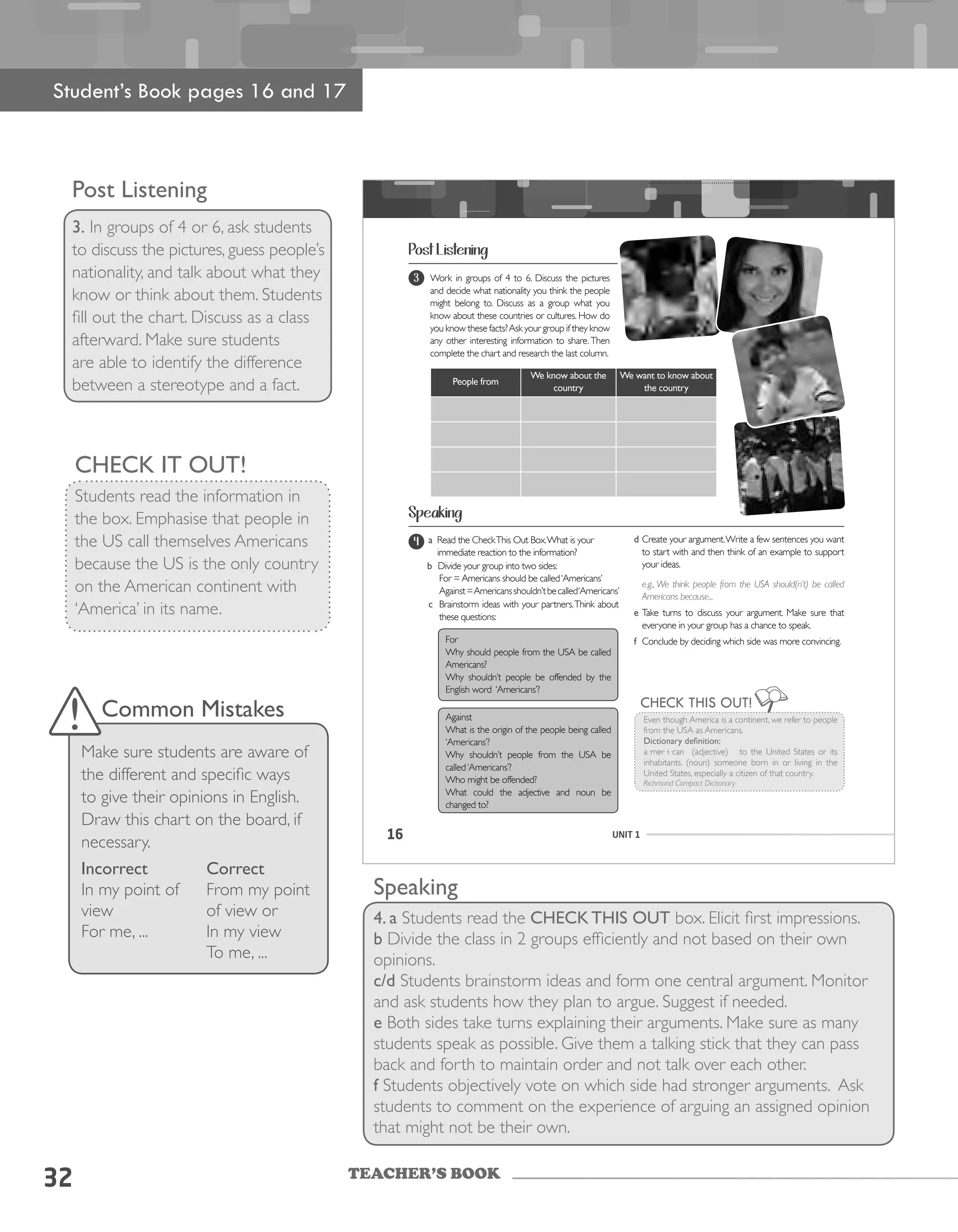
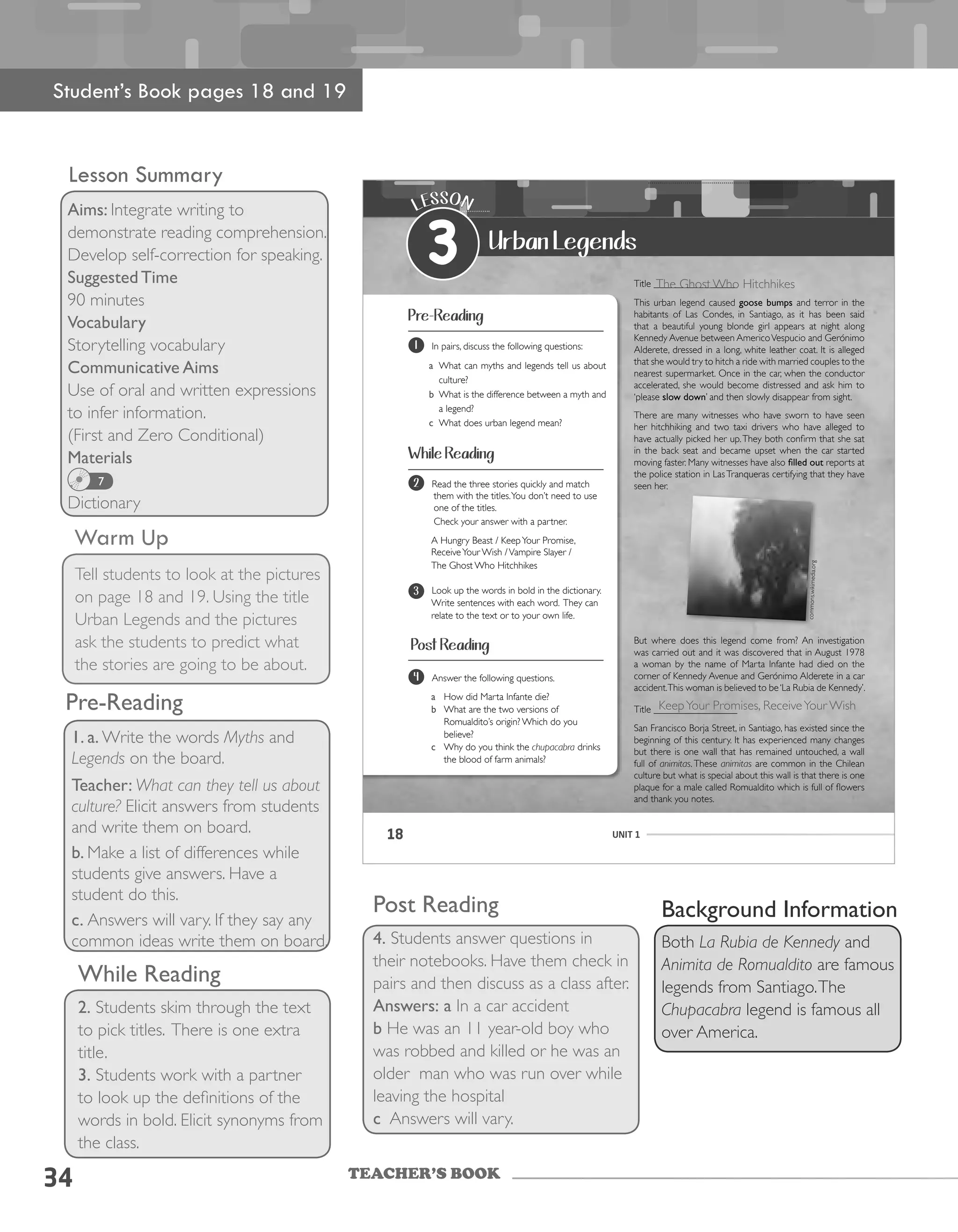
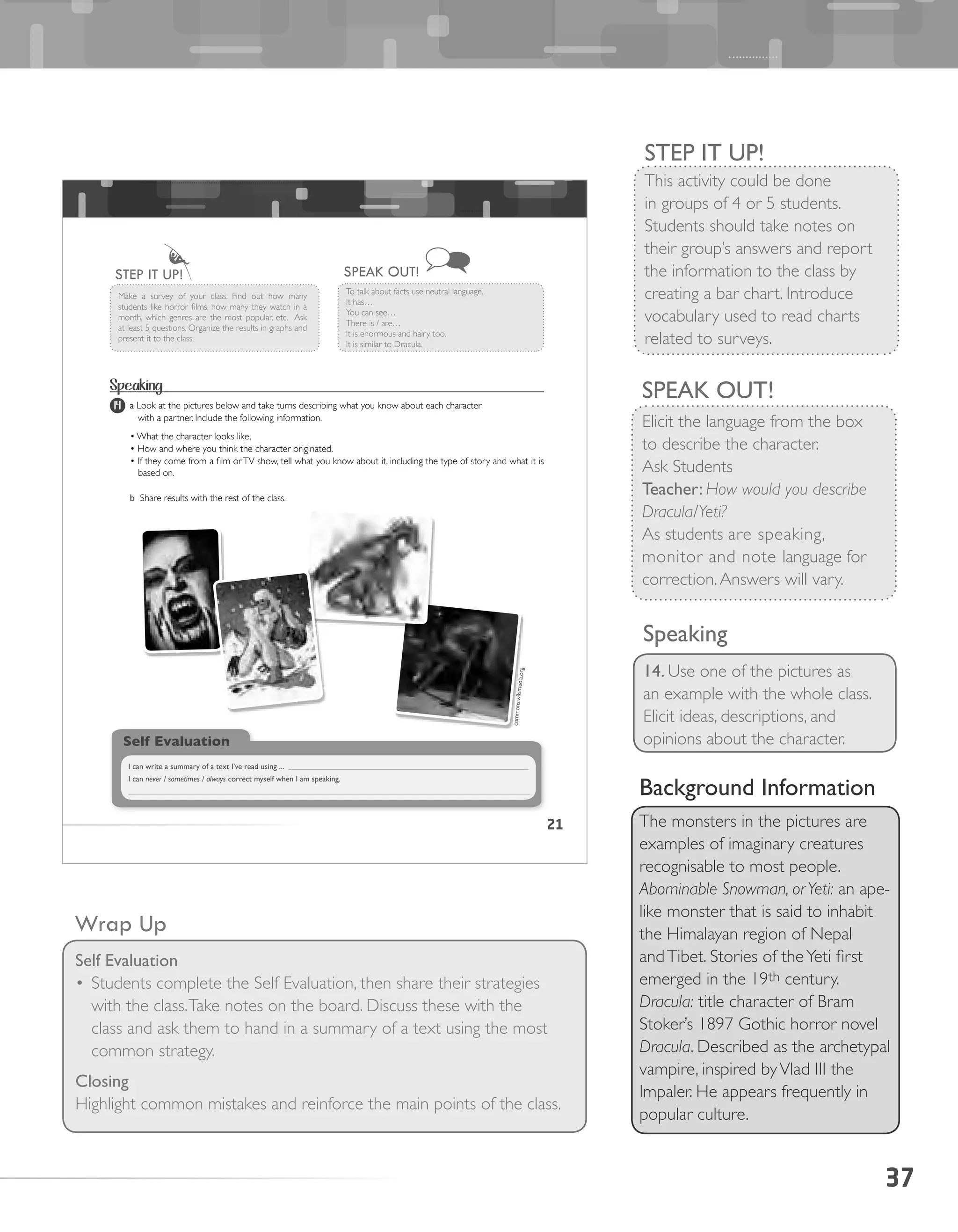
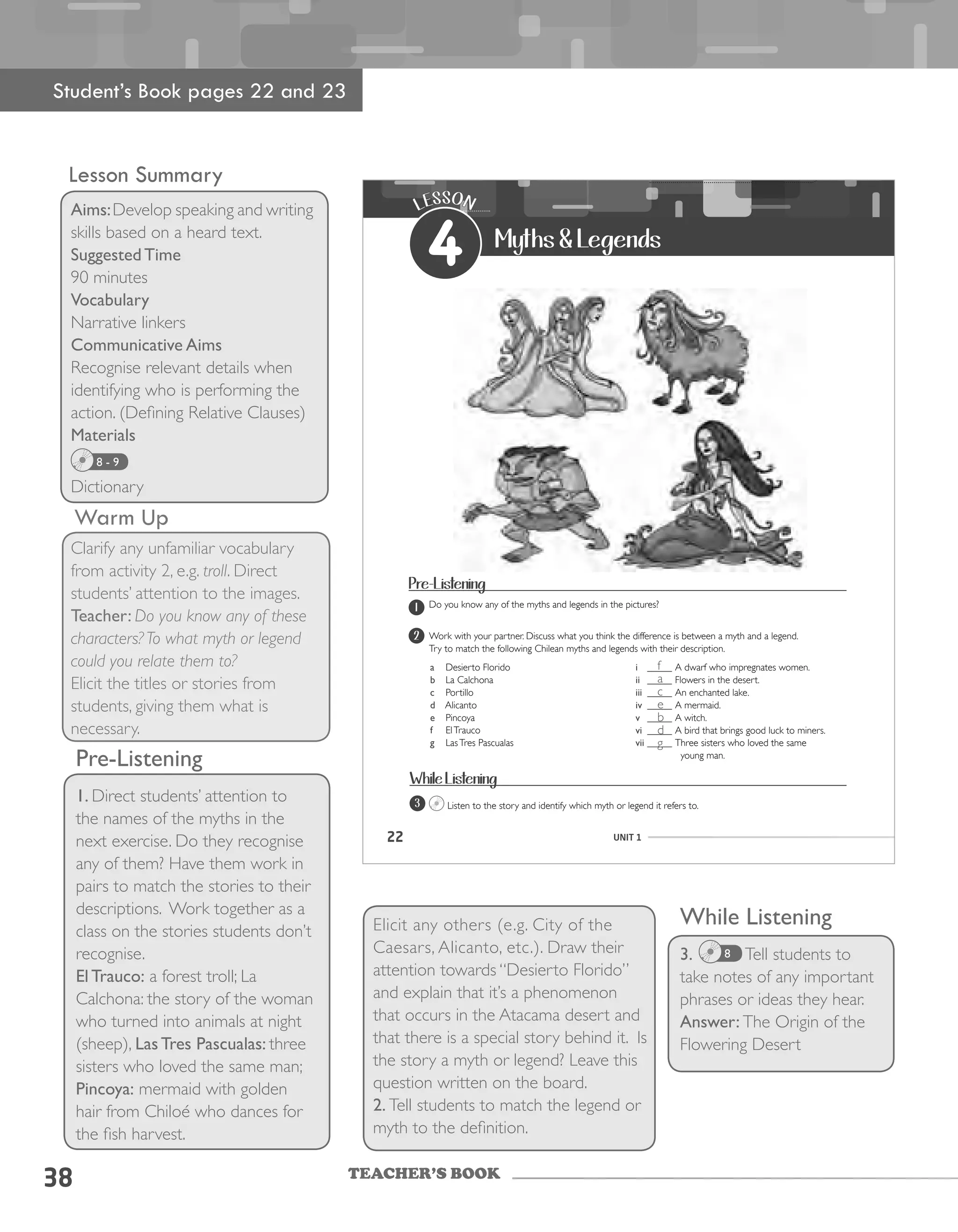
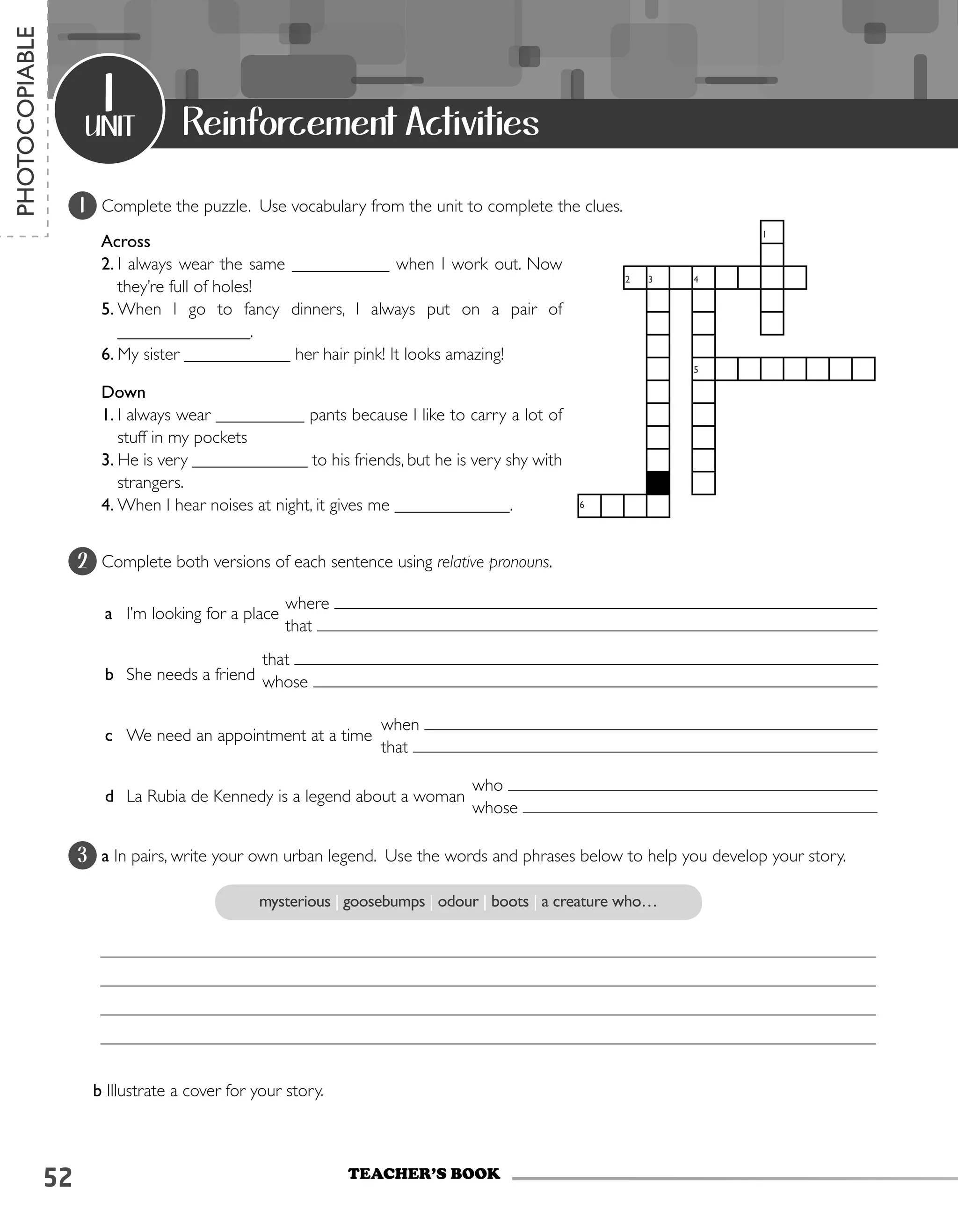
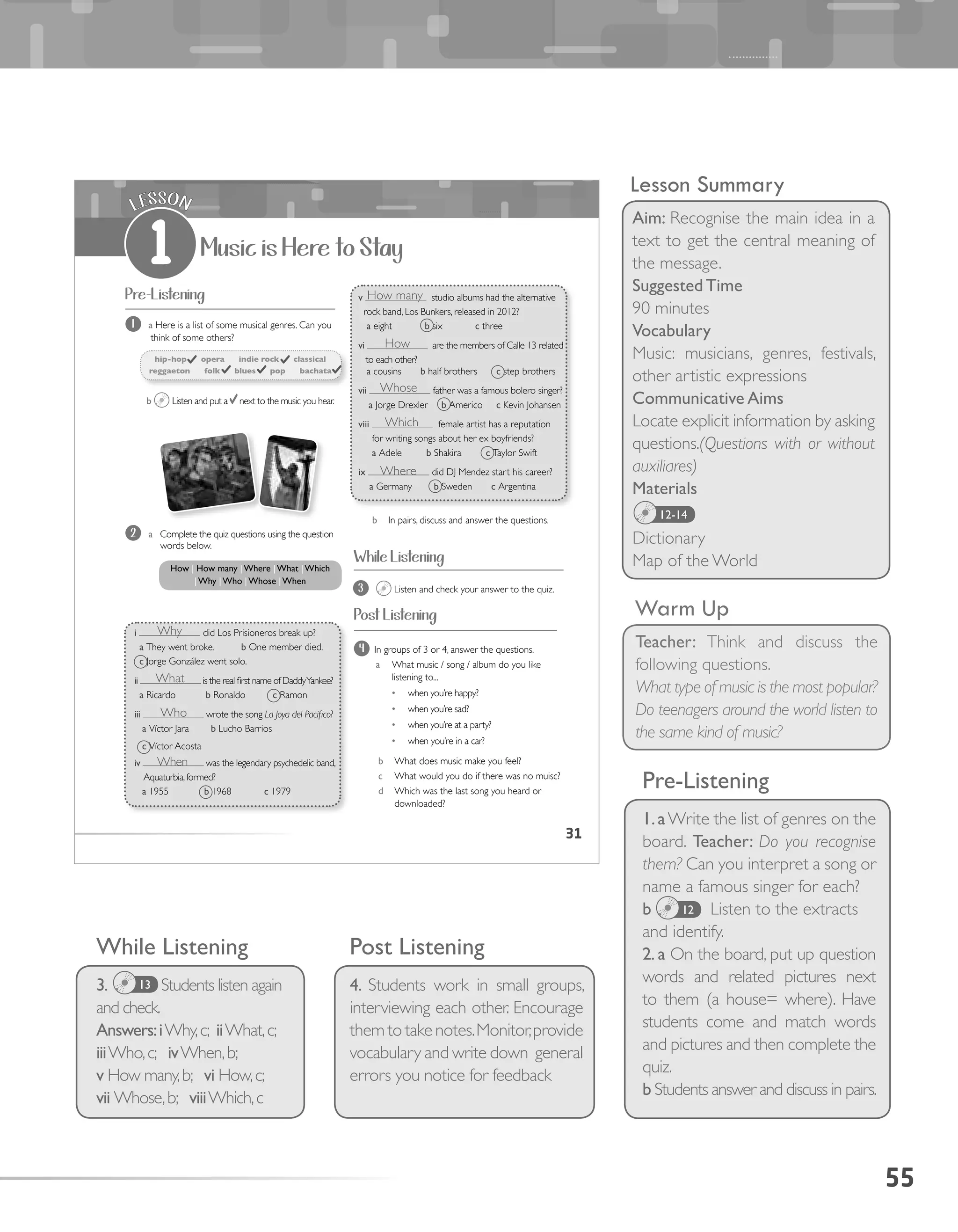
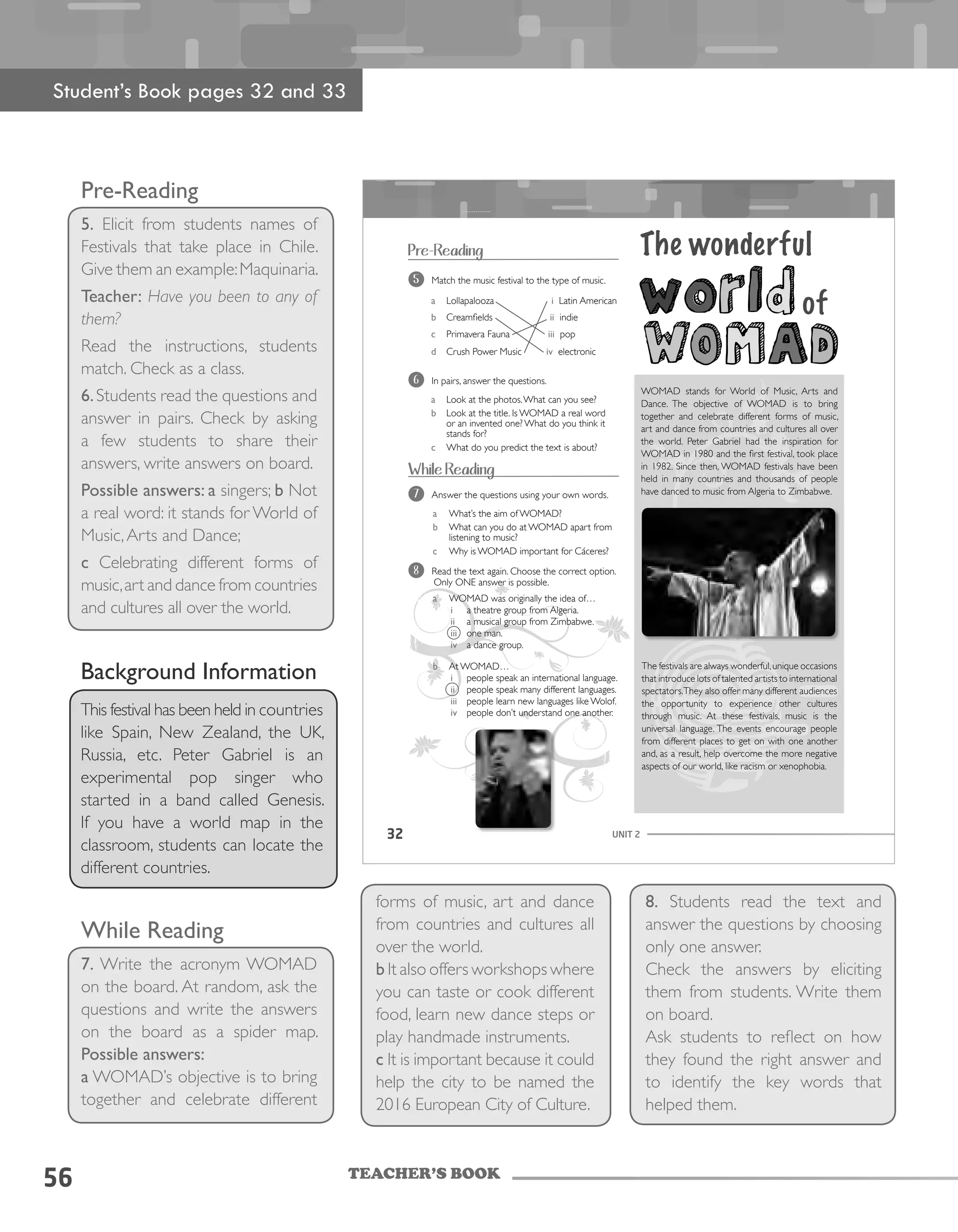
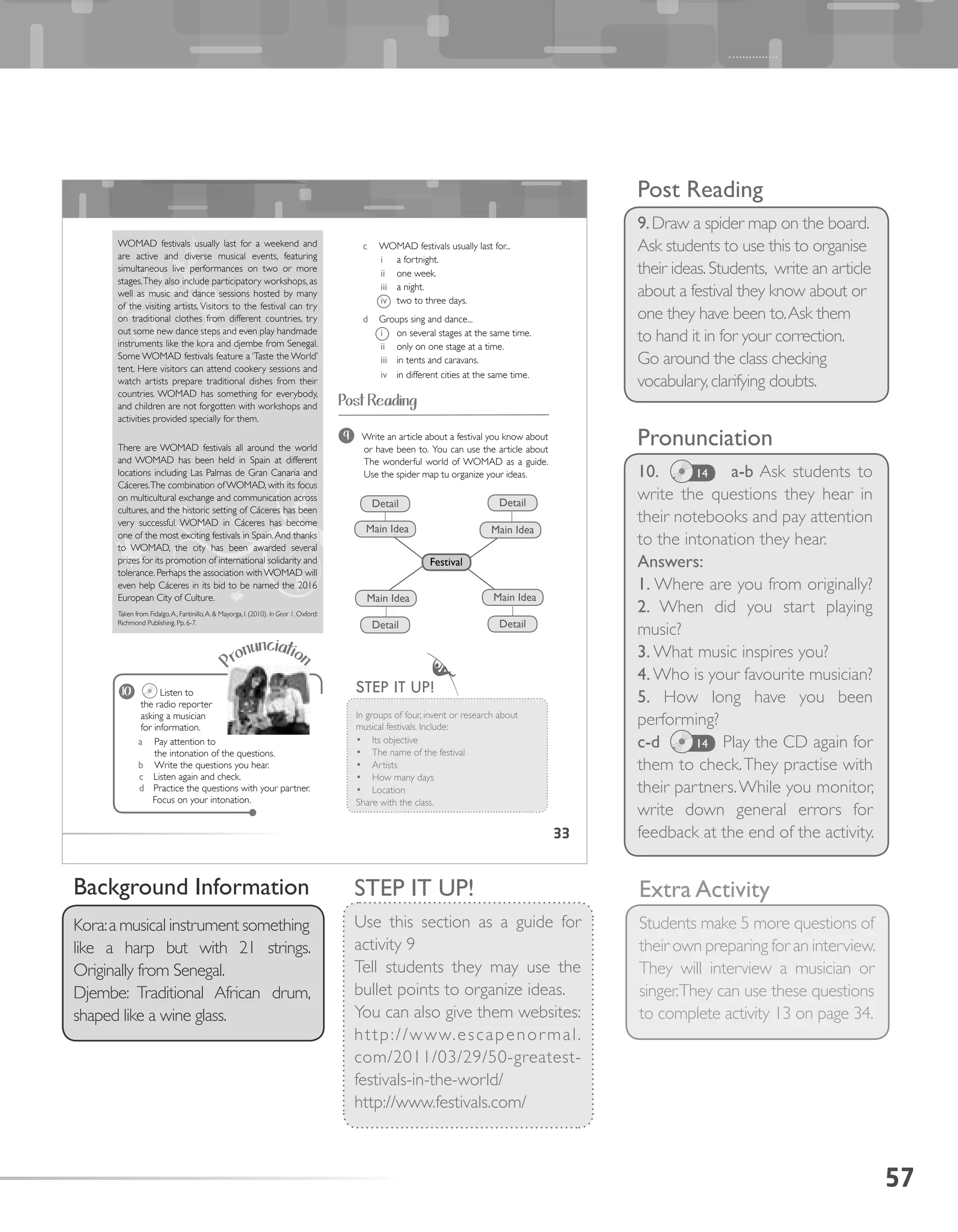
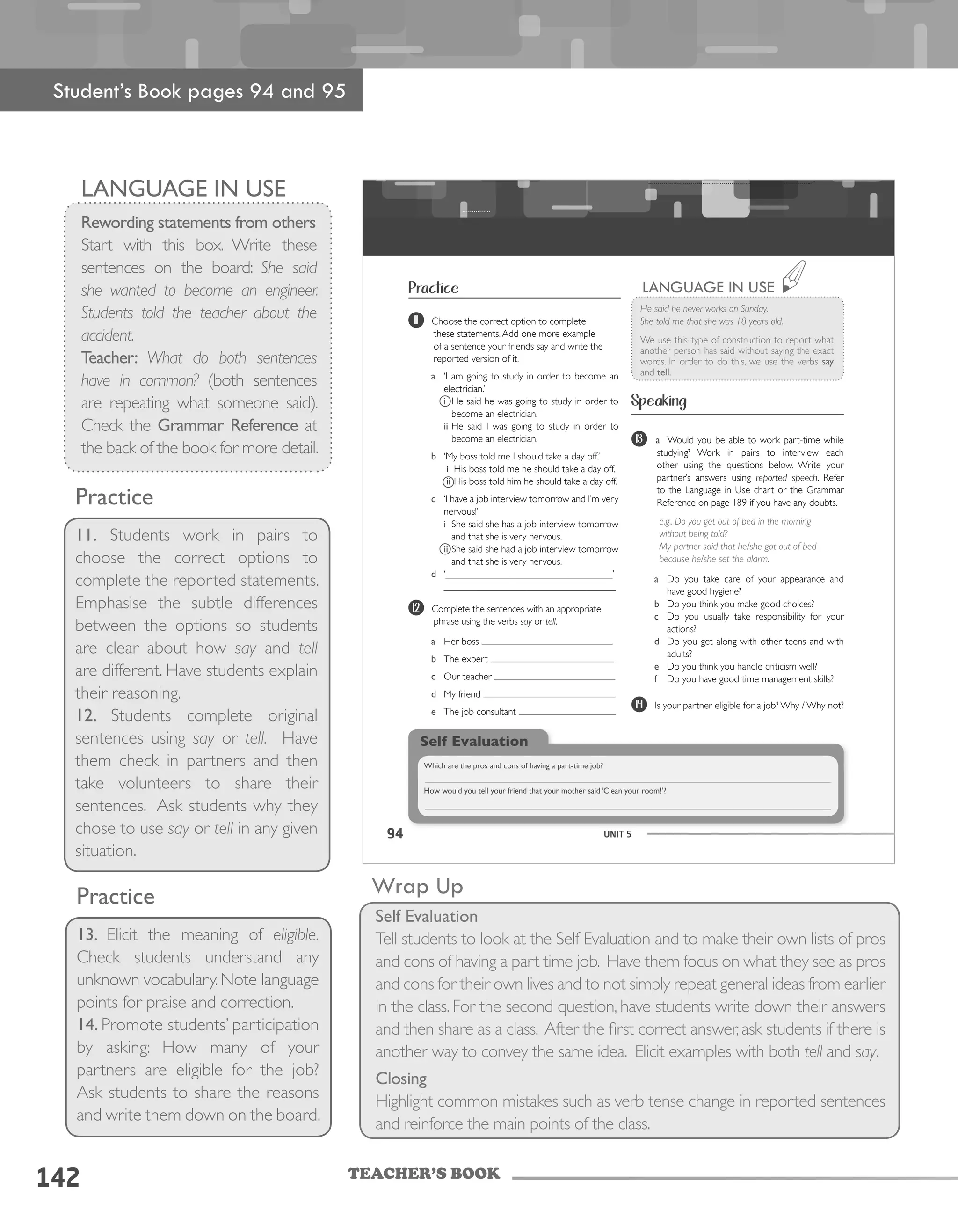
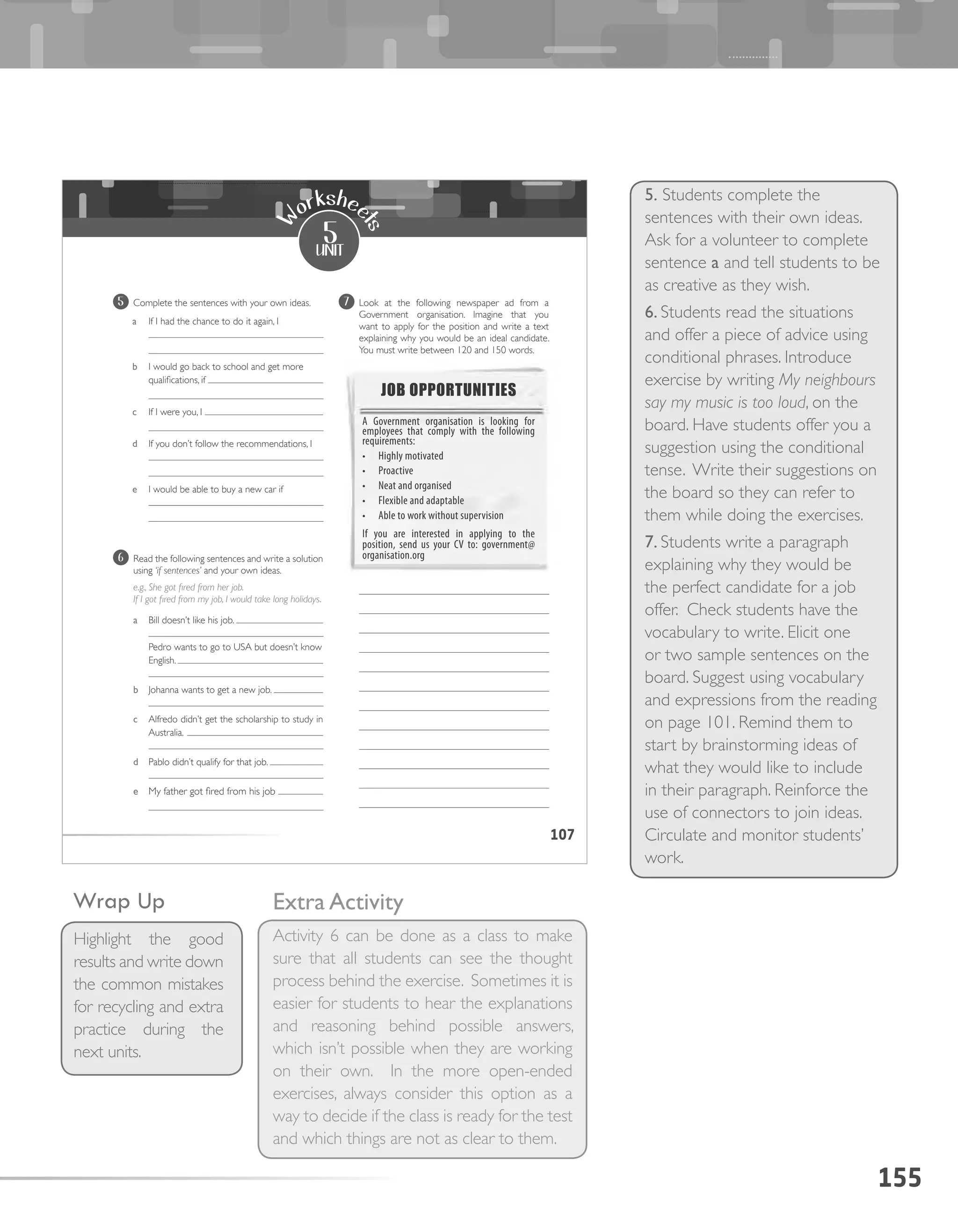
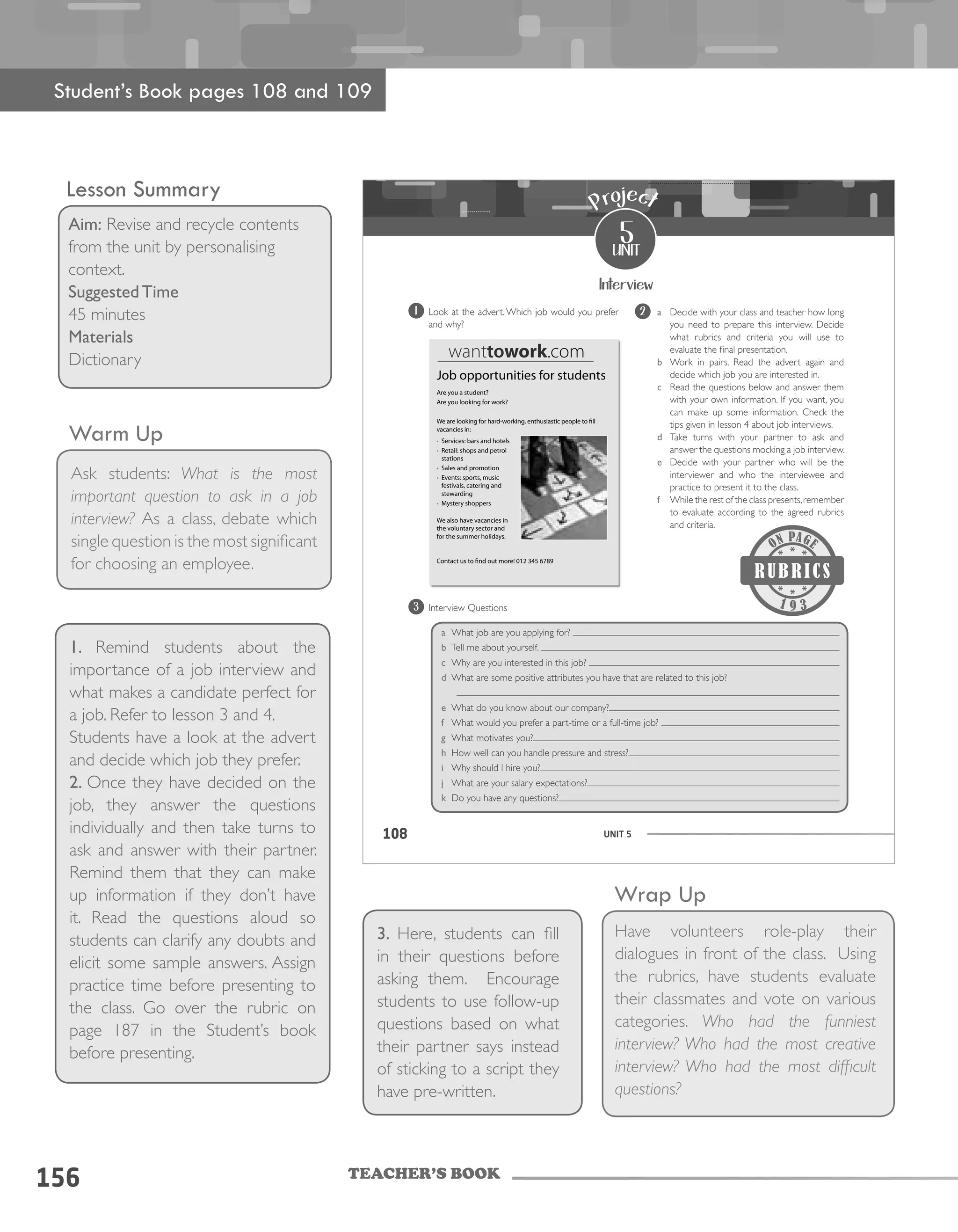
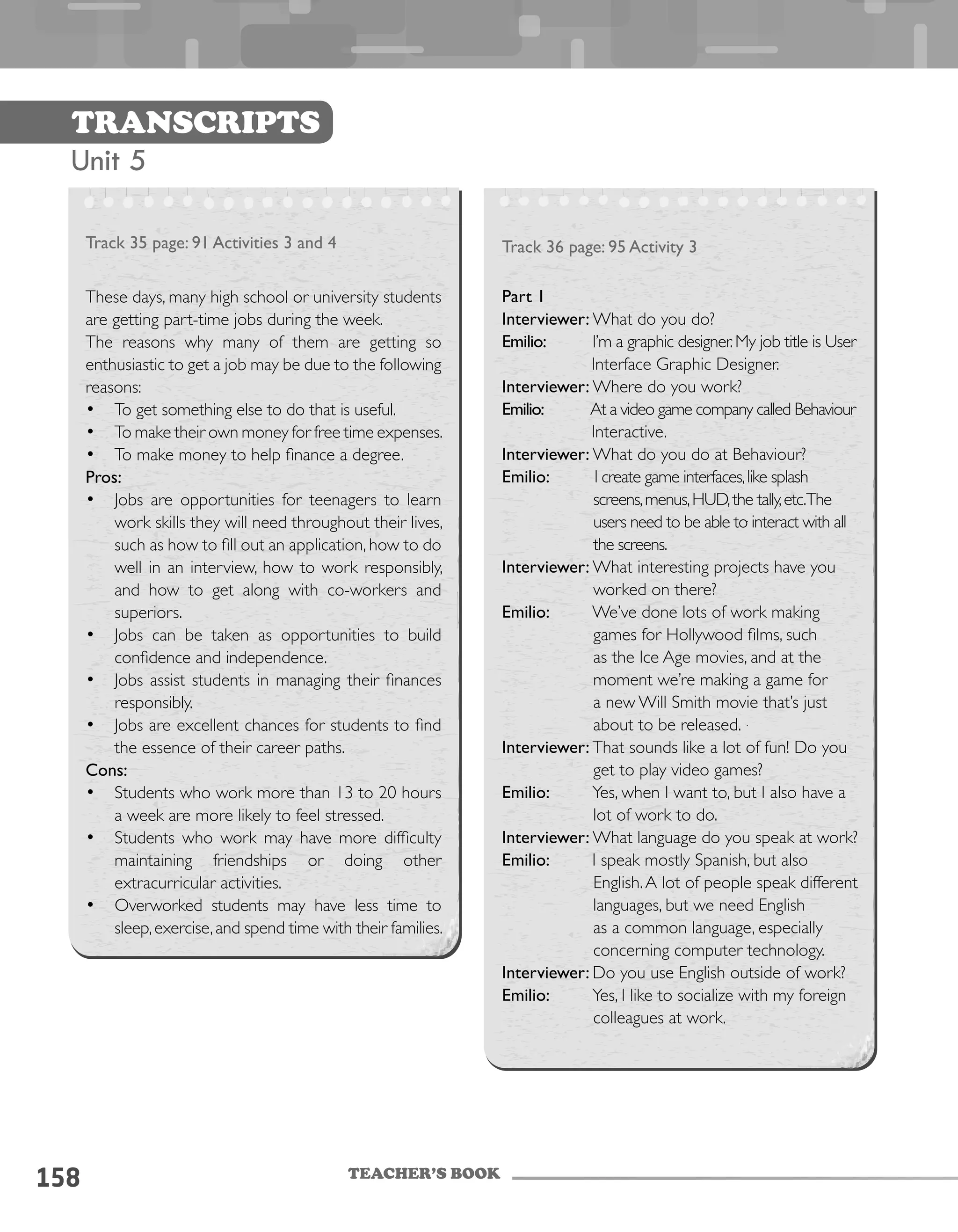
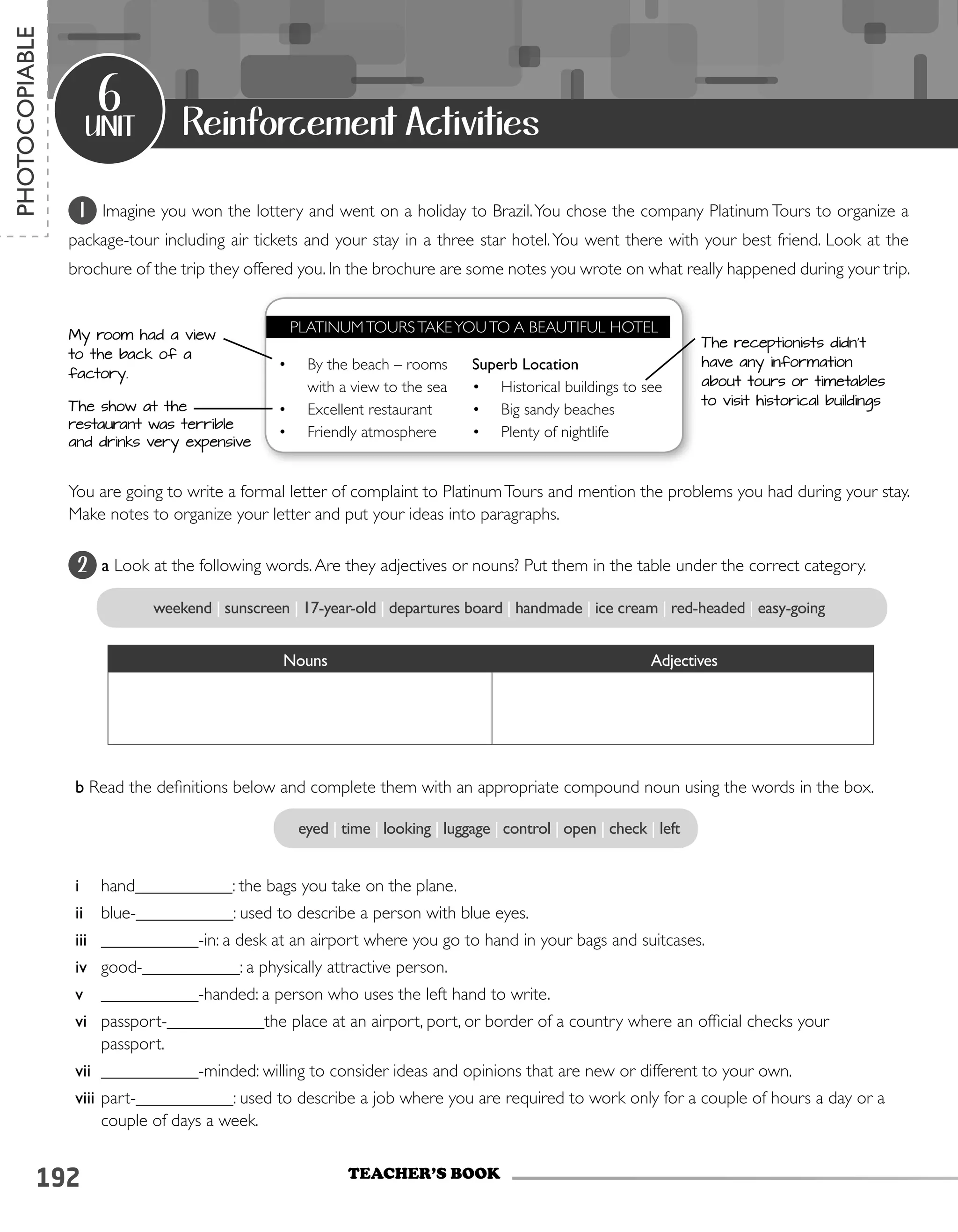
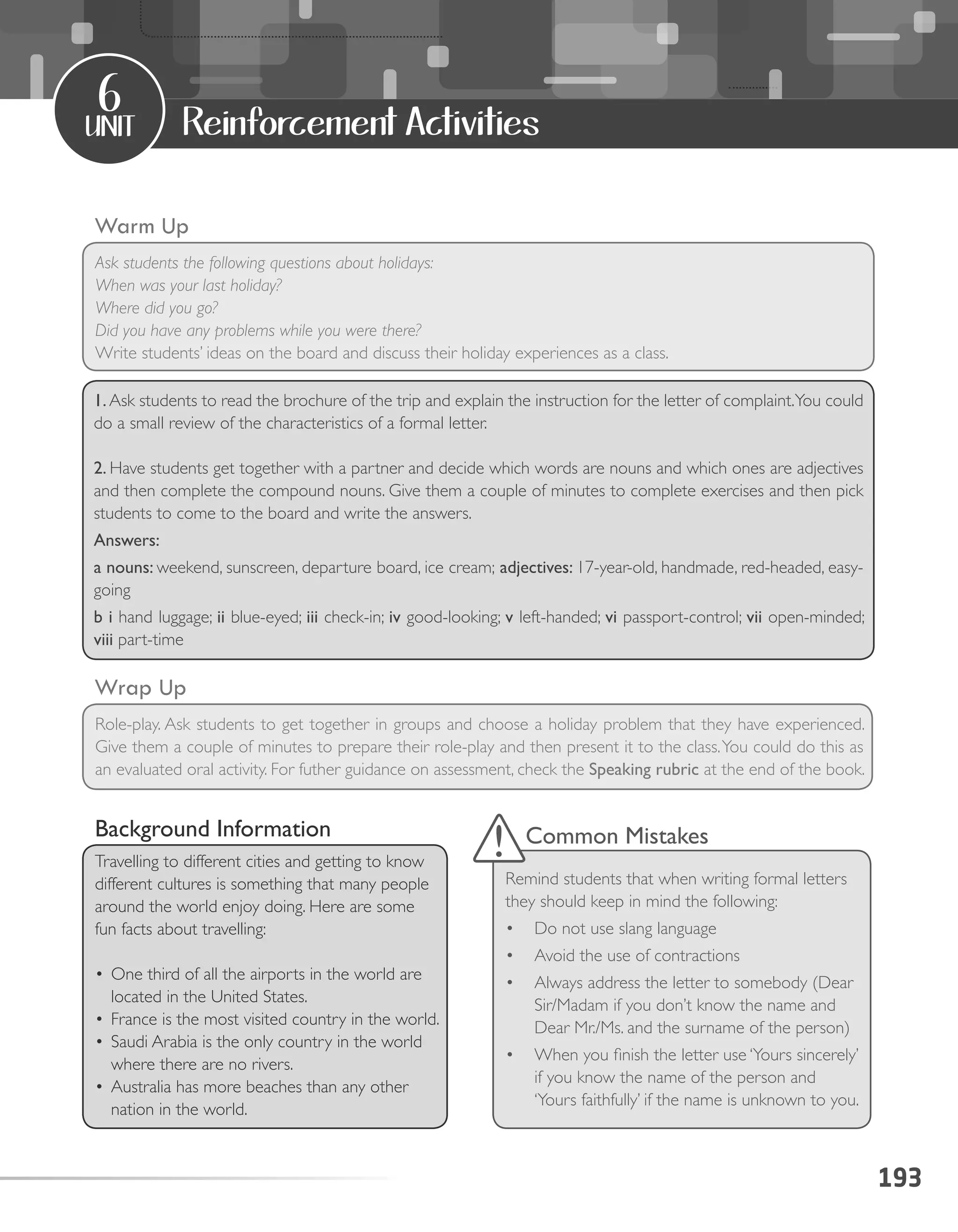
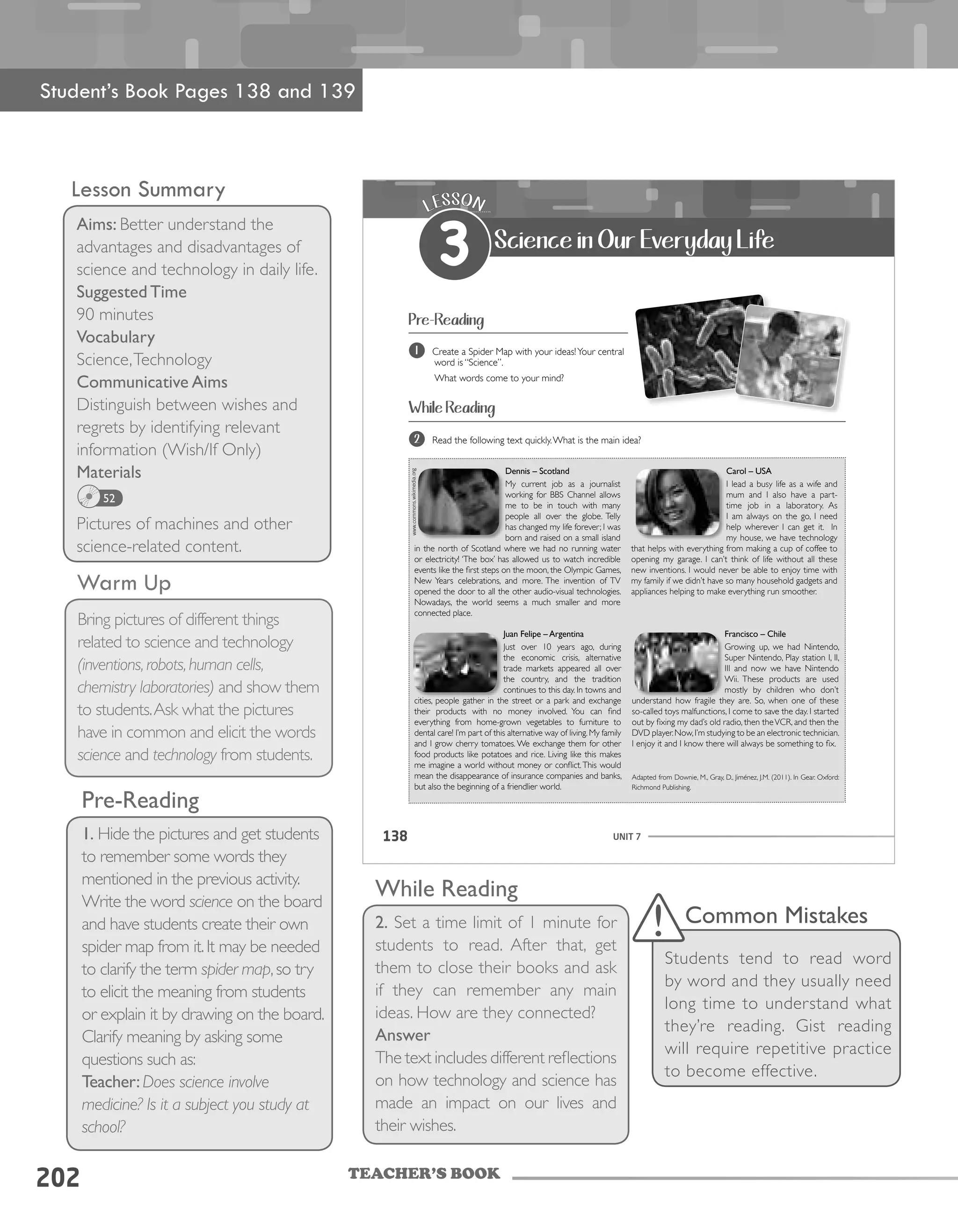
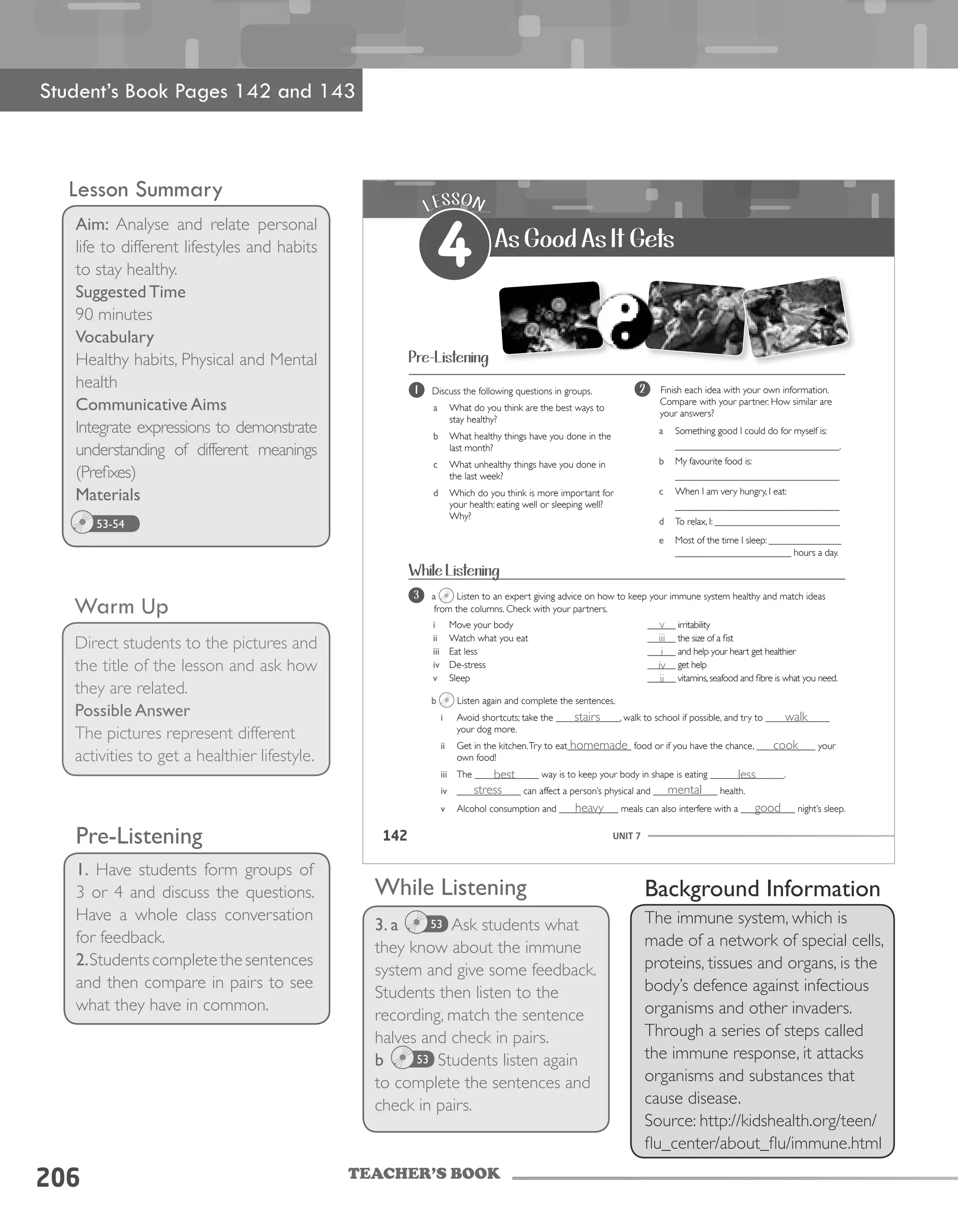
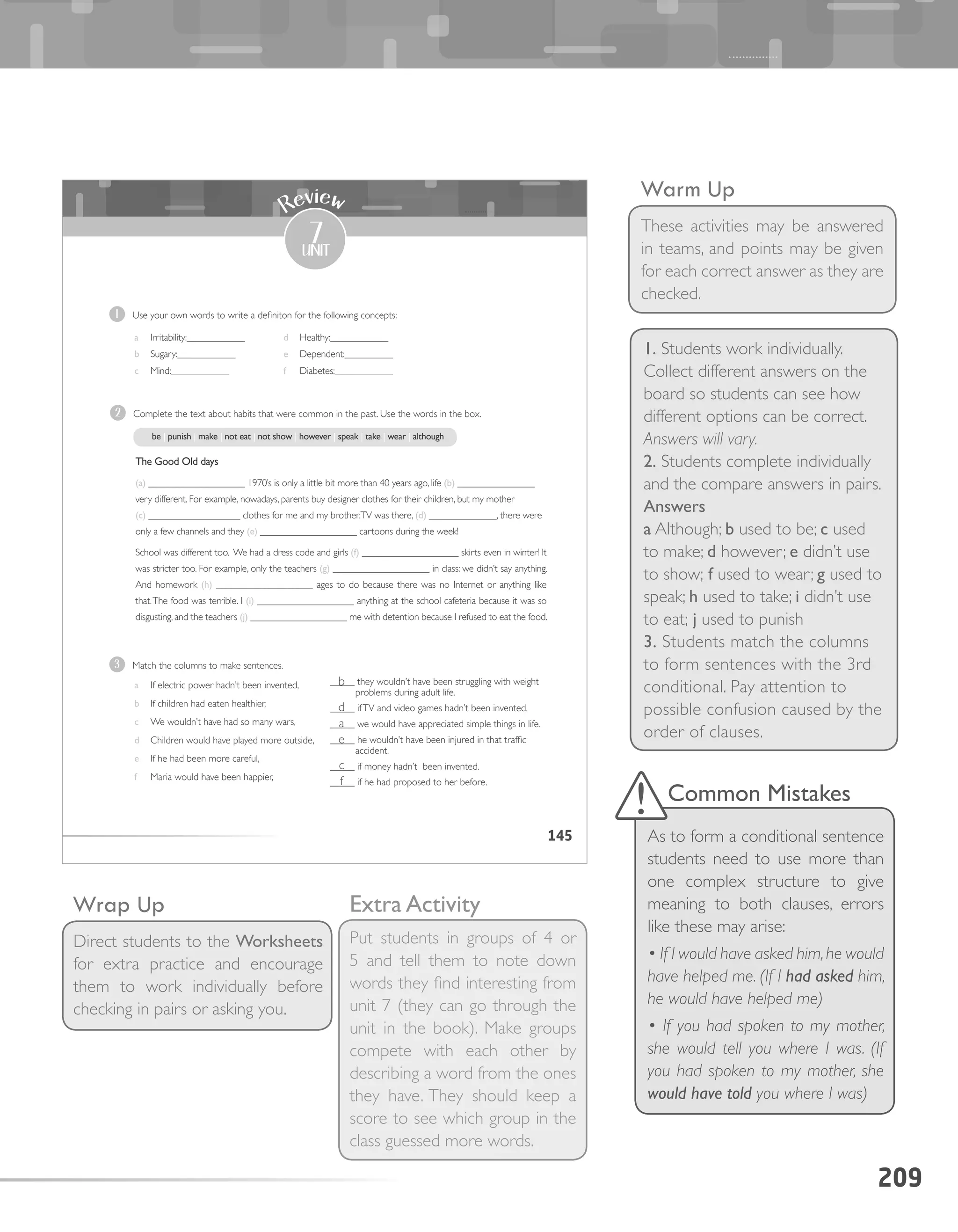
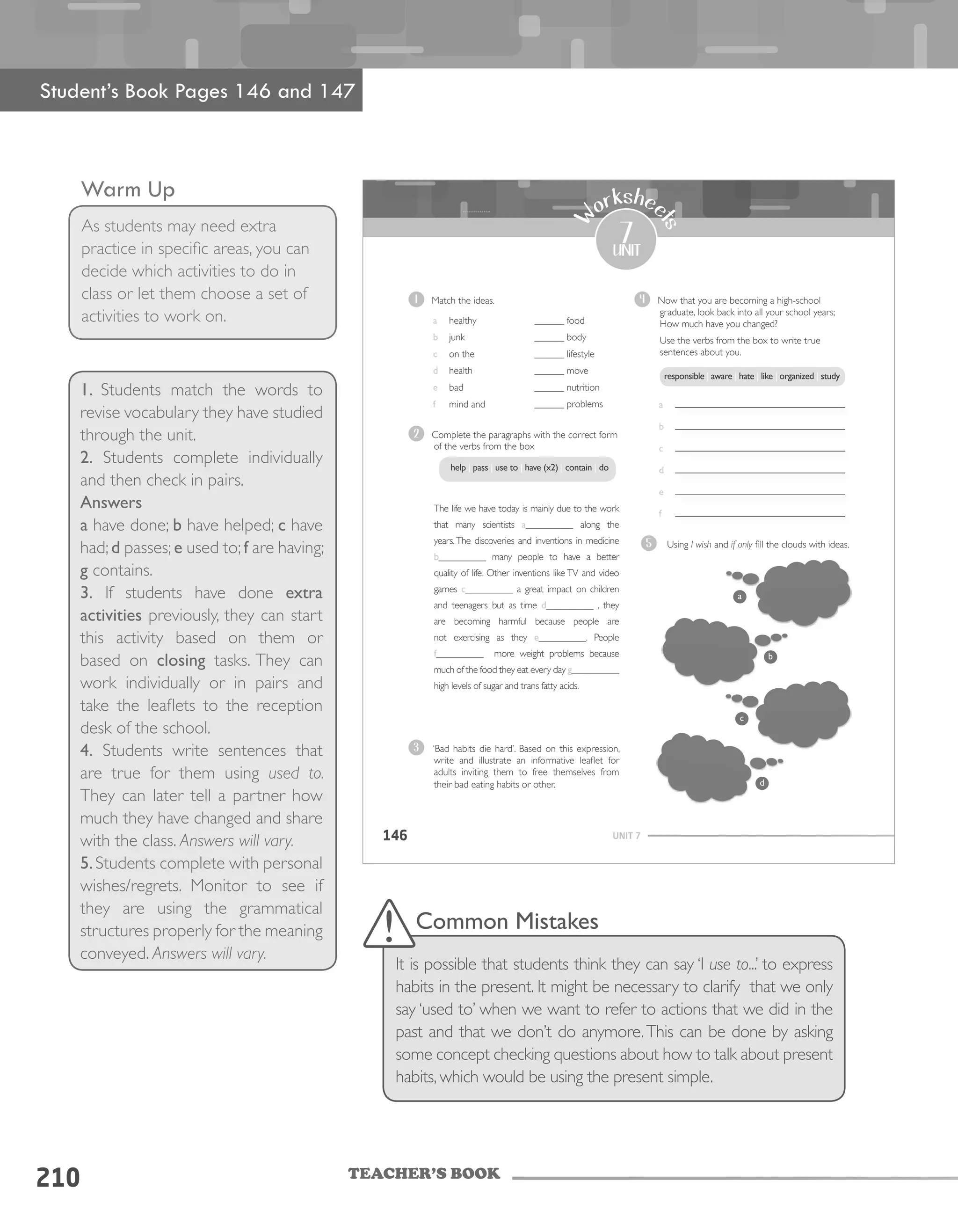
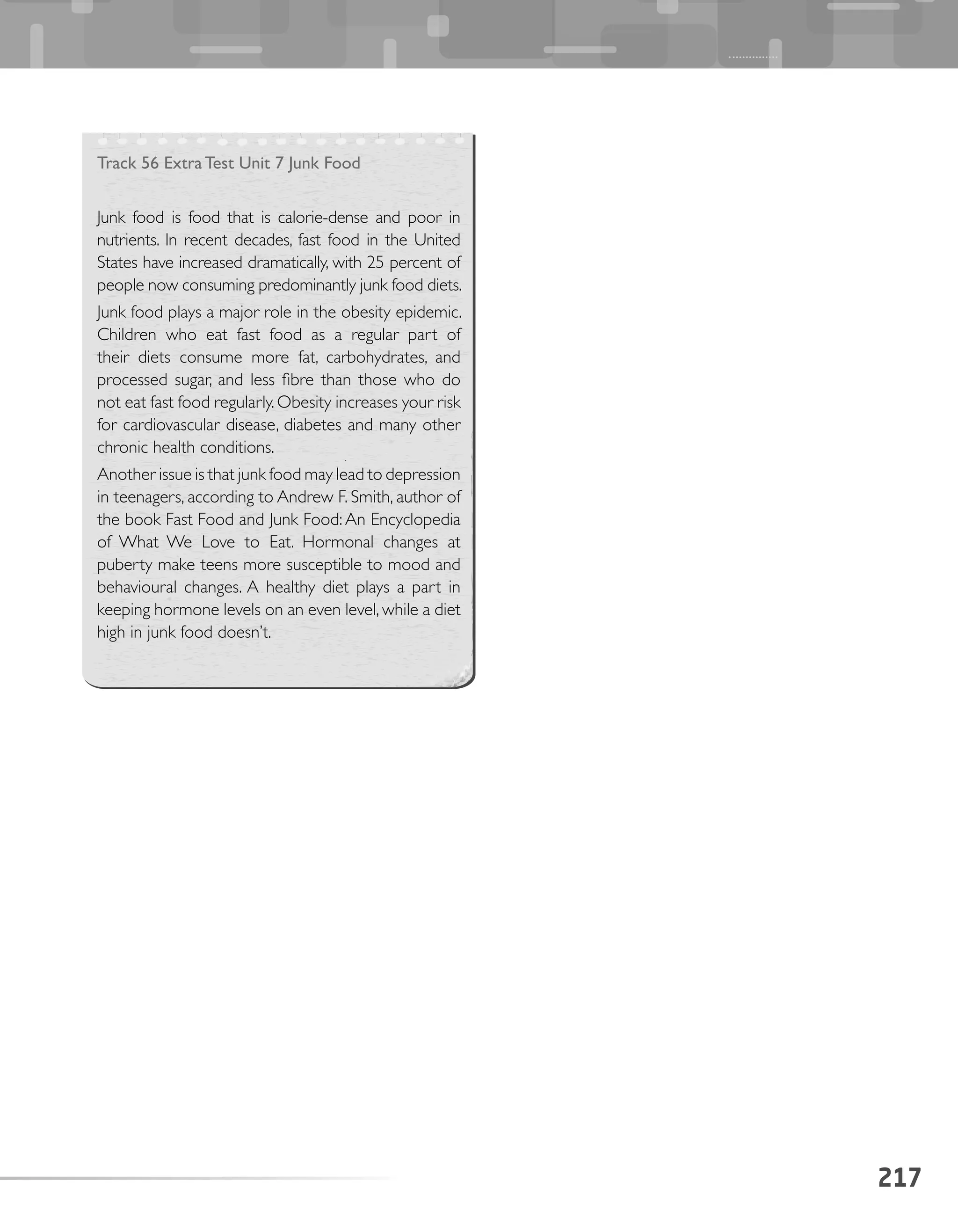
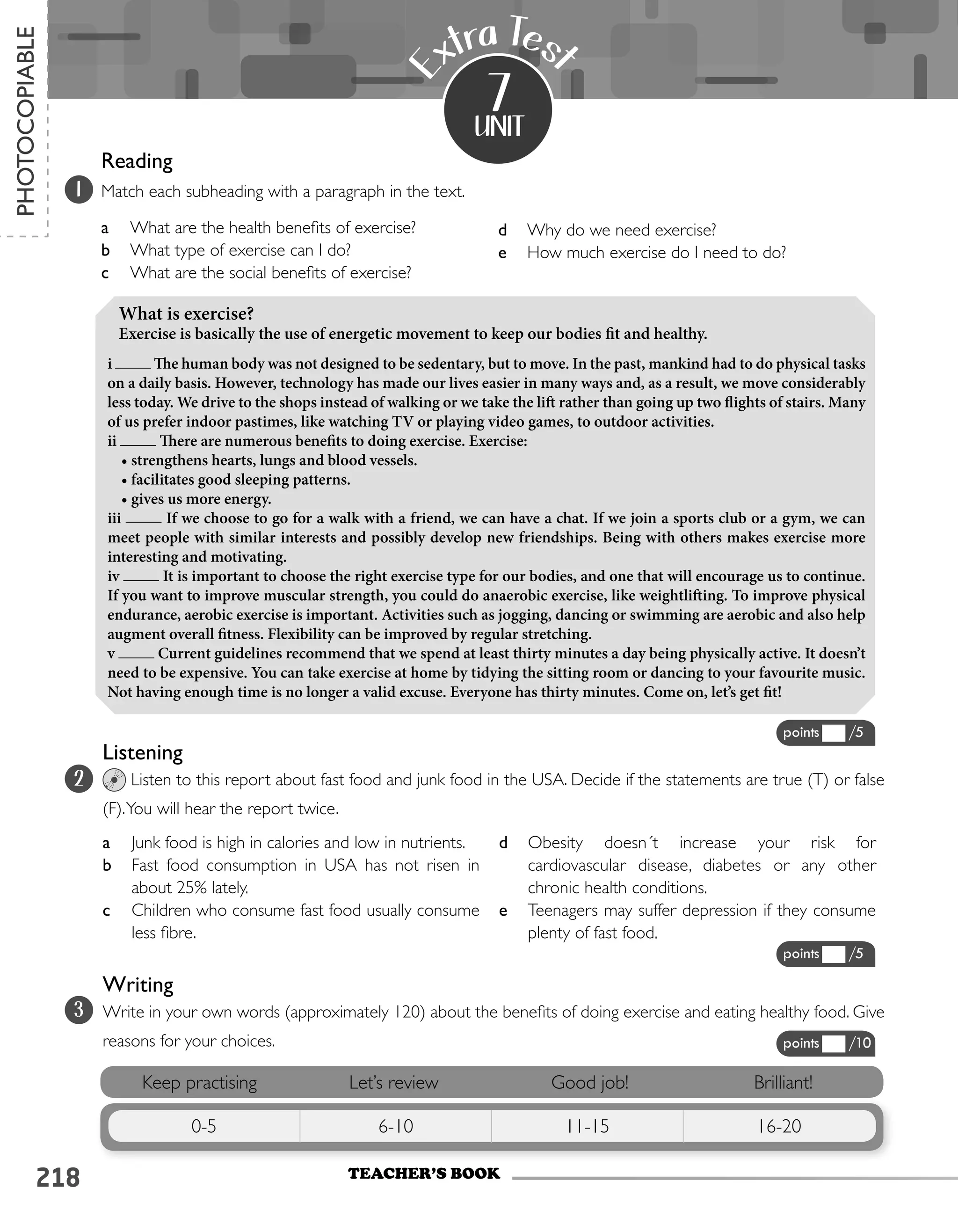
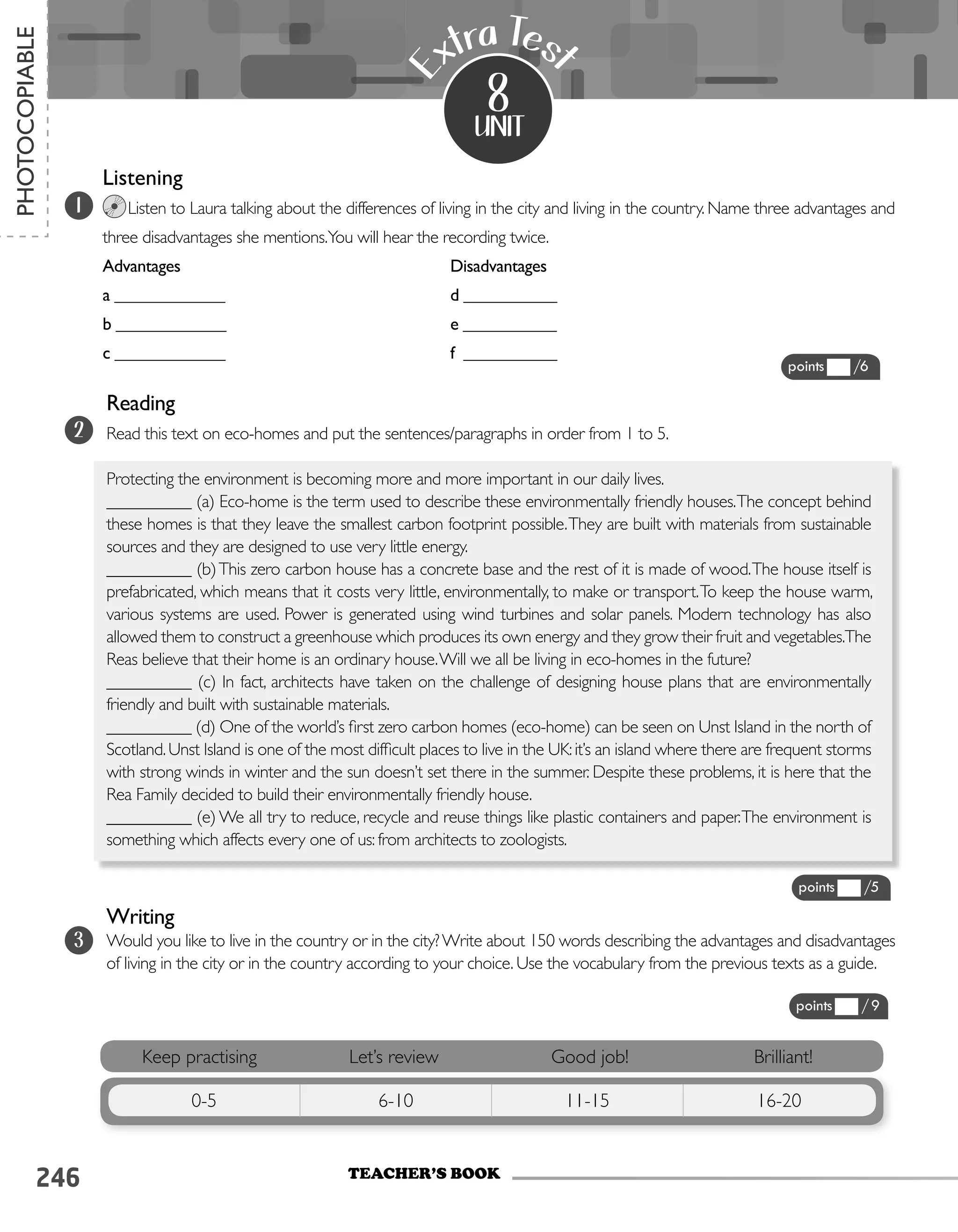
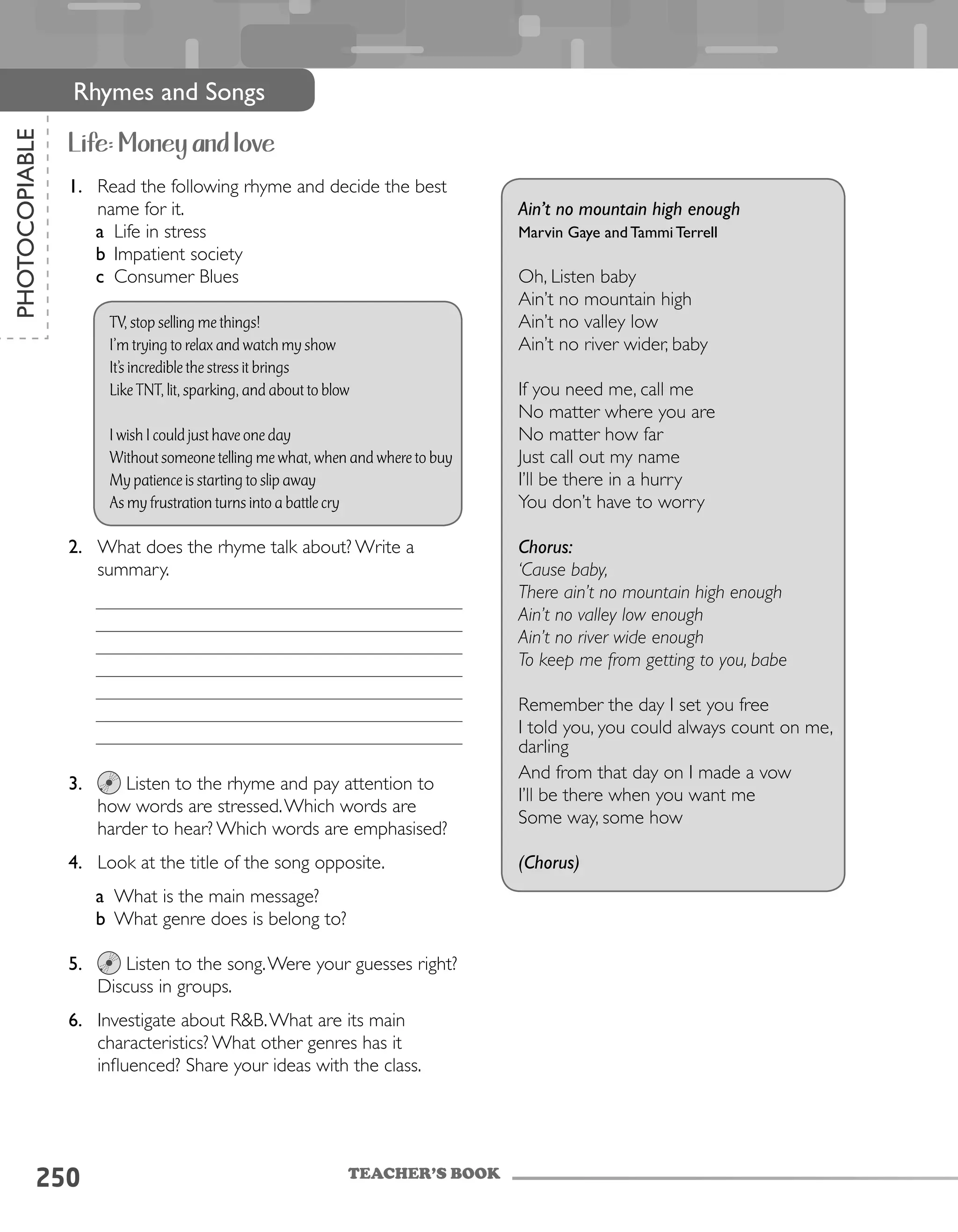
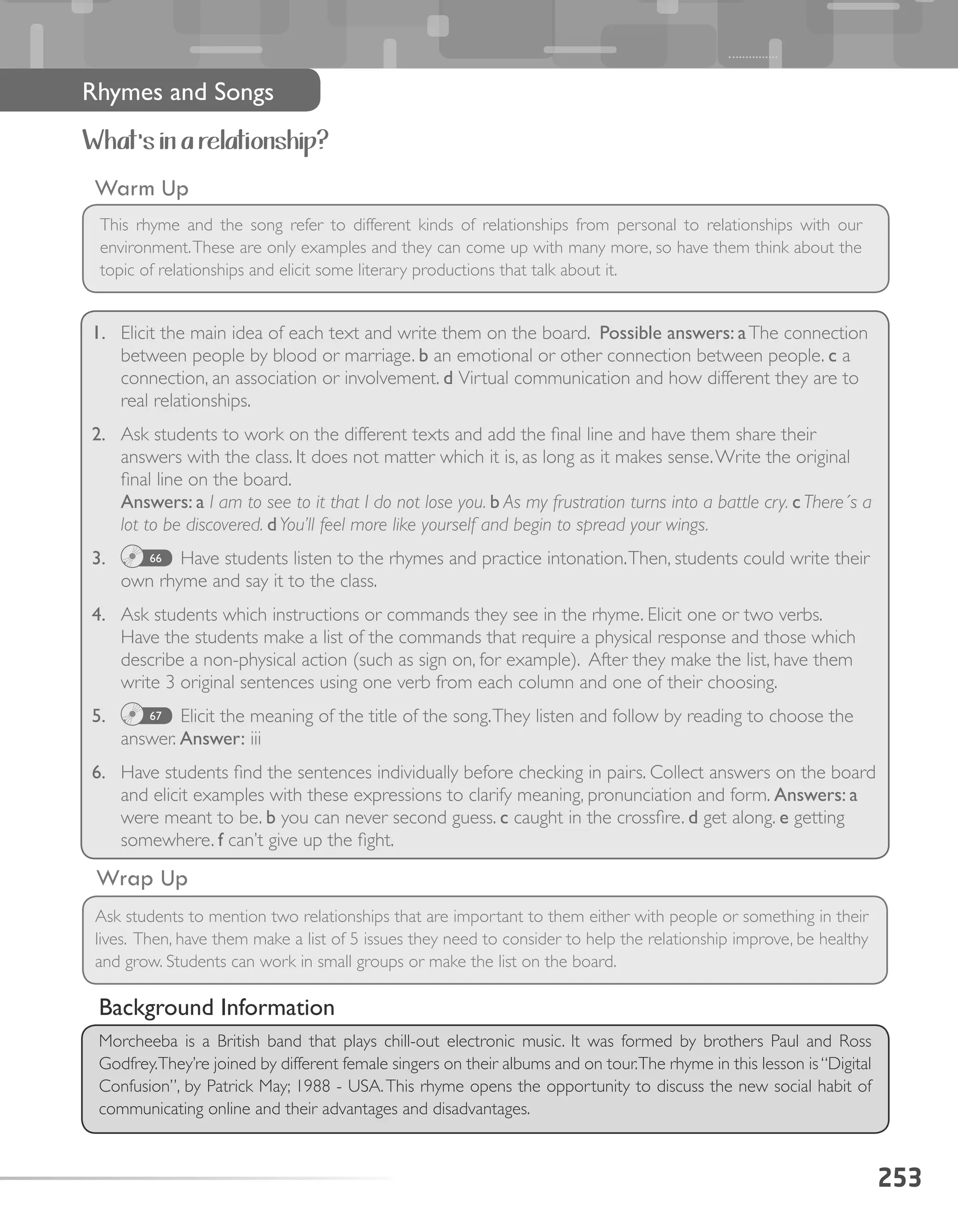
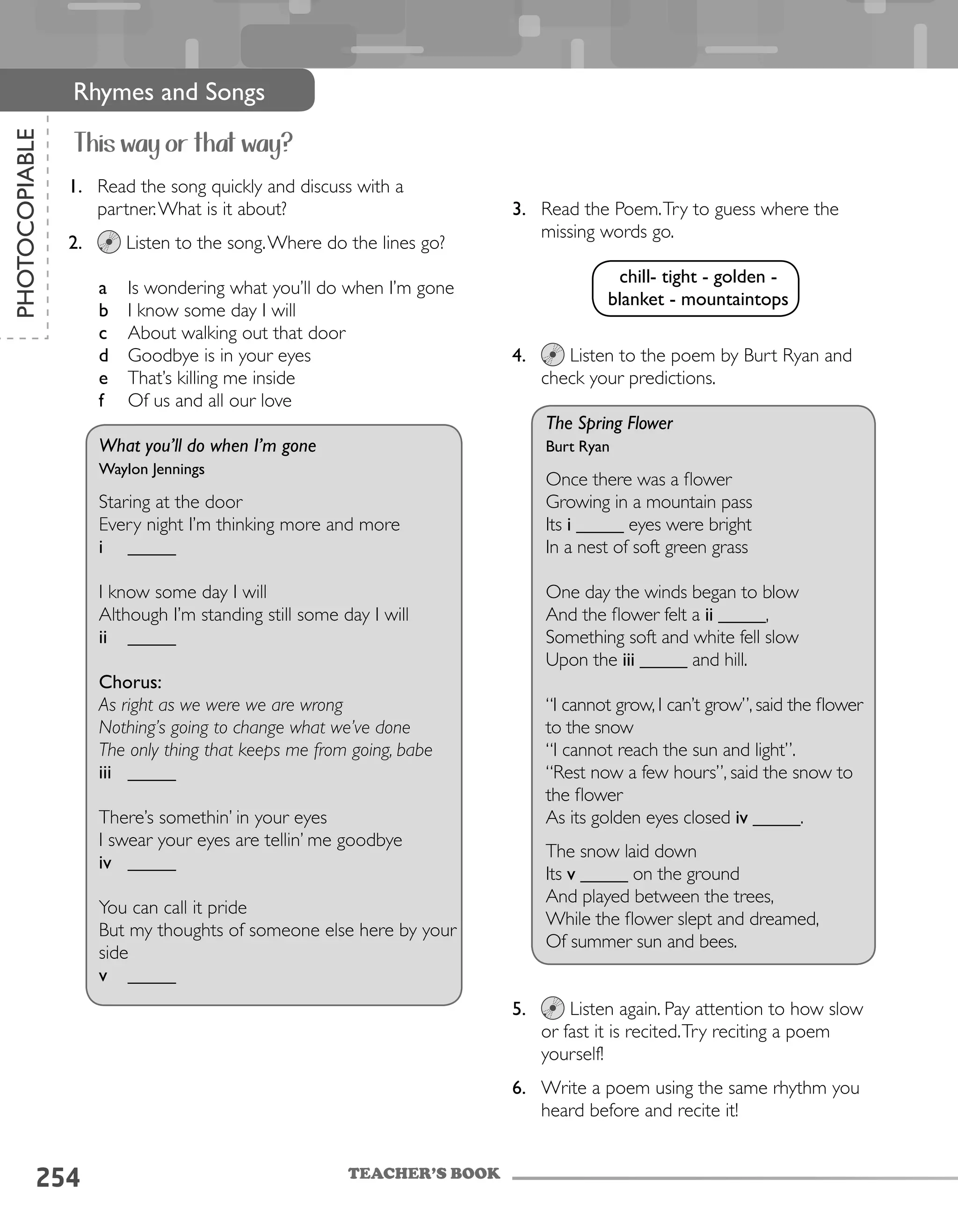

Teacher’s Book
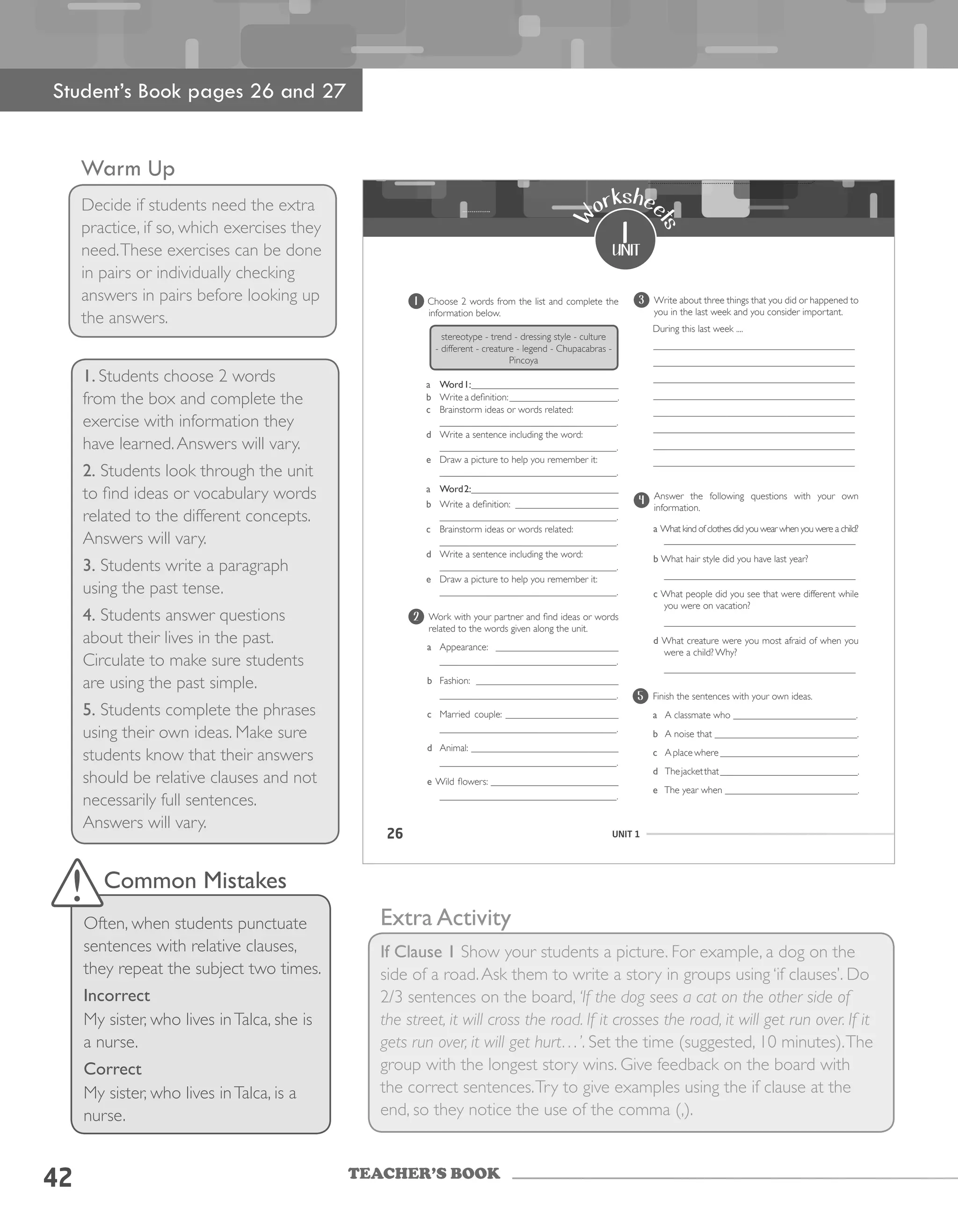
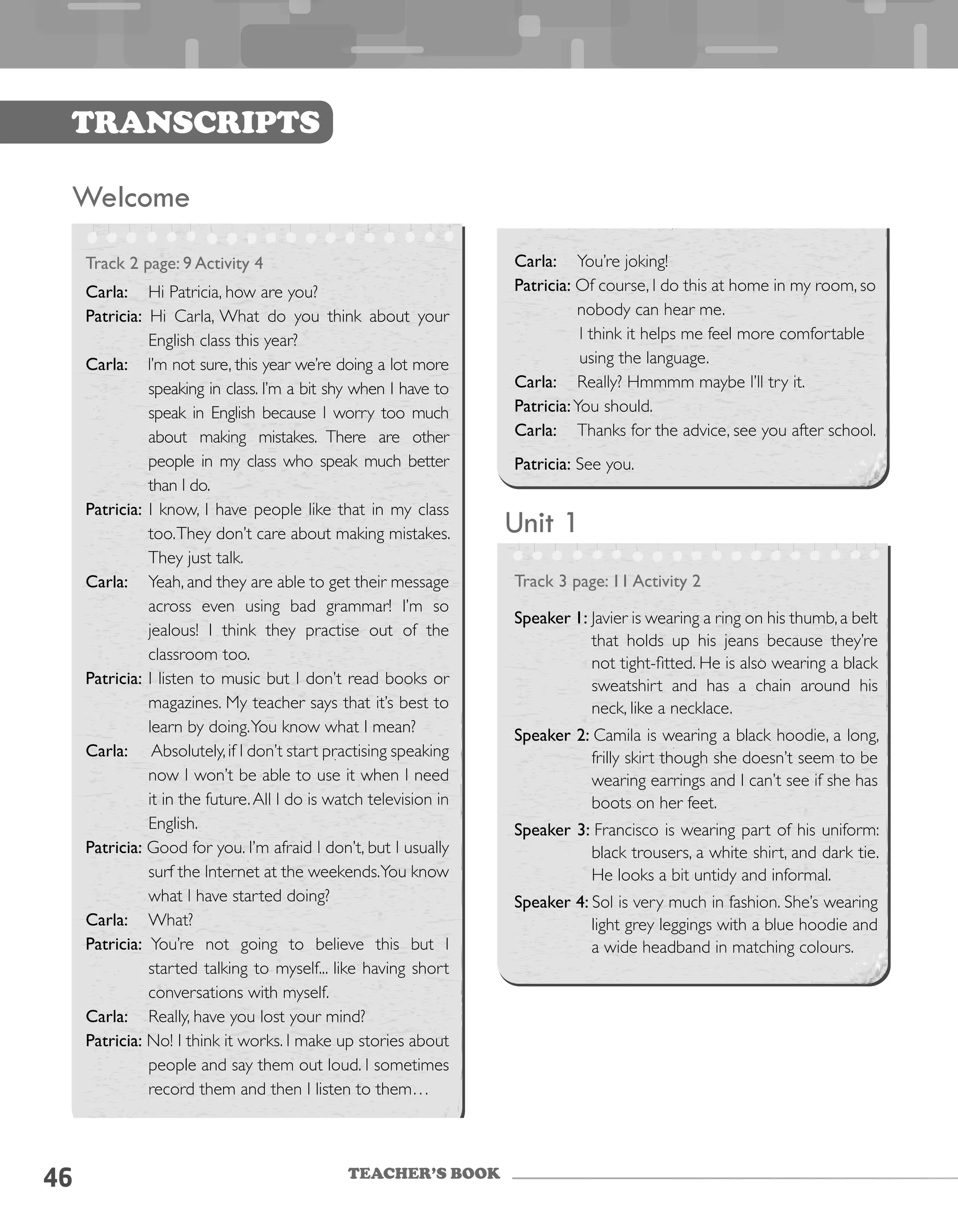
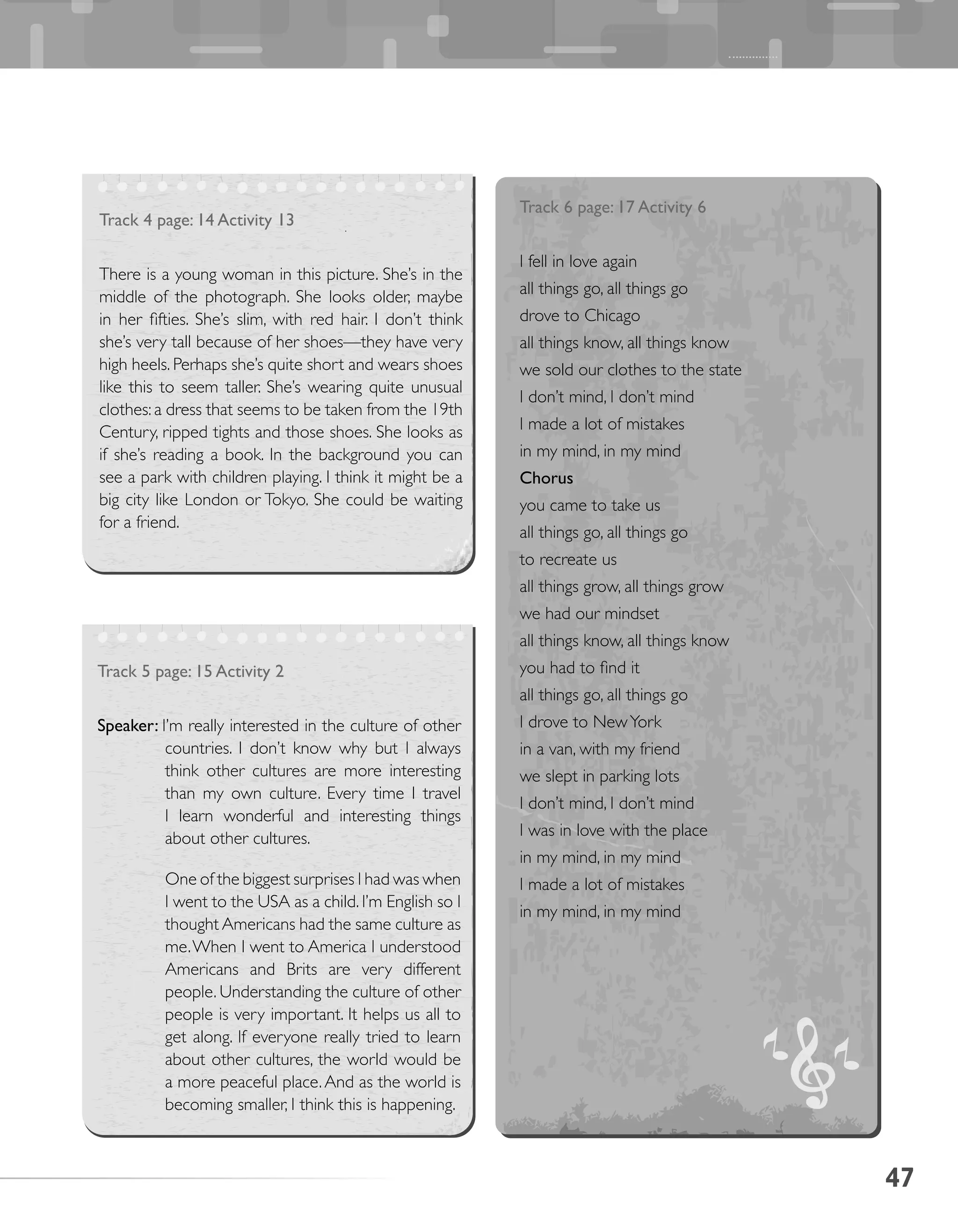
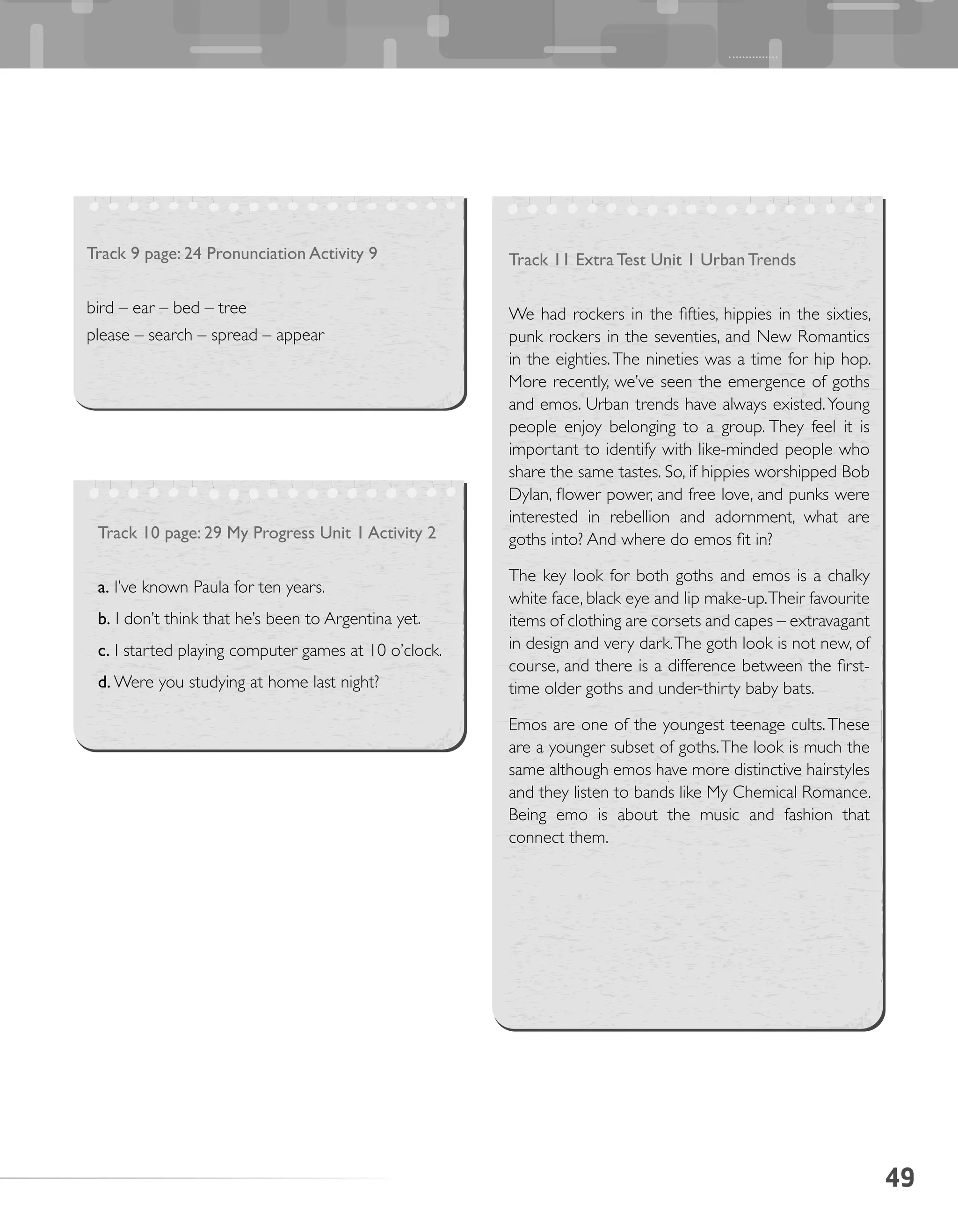
Edición Especial para
el Ministerio de Educación
Prohibida su comercialización
Grade12
Tune Up
Student’s Book
GobiernodeChile
Ministeriodeeducación
Edición Especial para
el Ministerio de Educación
Prohibida su comercialización
Grade
12
Adela Fidalgo Benayas
Alberto Fontanillo Carrascal
Inmaculada Mayorga Malvarez
Michael Downie
David Gray
Juan Manuel Jiménez
Robert Campbell
Gill Holley
Rob Metcalf
TuneUp
12thGradeStudent’sBook
Tune Up
Adela Fidalgo Benayas
Alberto Fontanillo Carrascal
Inmaculada Mayorga Malvarez
Michael Downie
David Gray
Juan Manuel Jiménez
Robert Campbell
Gill Holley
Rob Metcalf
Teacher’s Book
Edición Especial para
el Ministerio de Educación
Prohibida su comercialización
Teacher’s Book
Grade12
Student’s Book
GobiernodeChile
Ministeriodeeducación
Edición Especial para
el Ministerio de Educación
Prohibida su comercialización
Edición Especial para
el Ministerio de Educación
Prohibida su comercialización
Grade
12
Adela Fidalgo Benayas
Alberto Fontanillo Carrascal
Inmaculada Mayorga Malvarez
Michael Downie
David Gray
Juan Manuel Jiménez
Robert Campbell
Gill Holley
Rob Metcalf
TuneUp
12thGradeStudent’sBook
Tune Up
Adela Fidalgo Benayas
Alberto Fontanillo Carrascal
Inmaculada Mayorga Malvarez
Michael Downie
David Gray
Juan Manuel Jiménez
Robert Campbell
Gill Holley
Rob Metcalf
Teacher’s Book
Tune Up
2
The material for Tune Up Teacher’s Book 12th Grade, is a collective
work created and designed by the Richmond Publishing Department
of Education, under the direction of Rodolfo Hidalgo Caprile.
Publishing Deputy Director-Public Area: Marisol Flores Prado
Publishing Coordinator: Ly-Sen Lam Díaz
Methodological Support: Christine Jeppensen, Ronda Haverland,
Eugenia Contreras
Editors: Andrea Voigt, Logan Koch-Michael, Patrick May, Carmen
Neira, Halima Salinas, Sebastián Muñoz
Proofreading: Barnaby Wright, Regina Lam
Authors: Adela Fidalgo Benayas ,Alberto Fontanillo Carrascal,
Inmaculada Mayorga Malvarez, Michael Downie, David Gray, Juan
Manuel Jiménez, Robert Campbell, Gill Holley, Rob Metcalf.
Richmond Director: Jorge Tipiani Berríos
Content Advisors: Richmond Publishing
Documentation: Paulina Novoa Venturino
Graphic design has been executed under the general direction of
Verónica Roman
Design and Layout: Francisca Martin, Karina Arancibia
Photography: Richmond Publishing, Latinstock
Illustrations: Alvaro de la Vega
Cover: Francisca Martin
Every effort has been made to trace the Holders of copyright, but if any omissions
can be rectified, the publishers will be pleased to make the necessary arrangements.
All Rights reserved.
No part of this work may be reproduced stored in a retrieval system or
transmitted in any form, Electronic, mechanical, photocopying or otherwise
without the prior permission in metioned would be considered a violation
of the intellectual property (law N° 17.336).
©2013 by Santillana del Pacífico S.A. de Ediciones
Dr. Aníbal Ariztía 1444, Providencia, Santiago (Chile)
PRINTED IN CHILE
Impreso en Chile por Quad/Graphics
ISBN: 9789561523142965393
Inscripción Nº 237062
Se terminó de imprimir esta 1ª edición de 180.900 ejemplares, en el
mes de diciembre del año 2013.
www.santillana.cl
3
Scope and Sequence of your book	 4-5
Get to know your book
Student’s Book 		 6-7
Get to know your Book
Teacher’s Book 		 8-9
Introduction				 10-19
CD Index				 20
Functional Language			 21
Thematic Index				 22-23
Welcome				 24-25
Unit 1					 26
Transcripts				 46-49
ExtraTest				 50-51
Reinforcement Acticities 			 52-53
Unit 2					 54
Transcripts				 74-77
ExtraTest				 78-79
Reinforcement Activities			 80-81
Unit 3					 82
Transcripts				 102-105
ExtraTest				 106-107
Reinforcement Activities			 108-109
Unit 4					 110
Transcripts				 130-131
ExtraTest				 134-135
Reinforcement Activities			 136-137
Unit 5					 138
Transcripts				 158-161
ExtraTest				 162-163
Reinforcement Activities			 164-165
Unit 6					 166
Transcripts				 186-189
ExtraTest				 190-191
Reinforcement Activities			 192-193
Unit 7 					 194
Transcripts				 214-217
ExtraTest				 218-219
Reinforcement Activity			 220-221
Unit 8					 150
Transcripts				 242-245
ExtraTest				 246-247
Reinforcement Activities			 248-249
Songs and Rhymes			 250-255
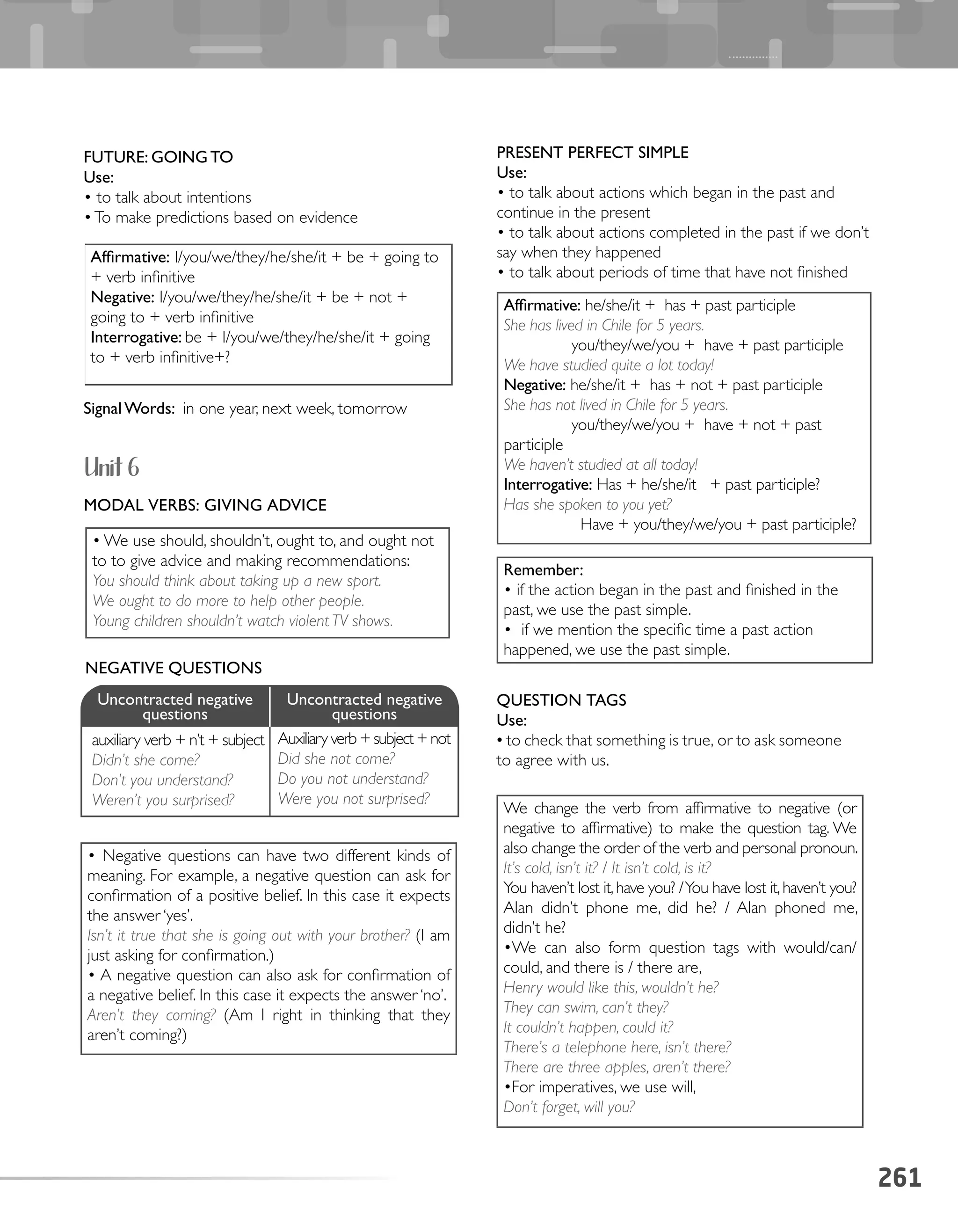
Grammar Reference			 256-263
Rubrics	for Skills Assessment		 264-265
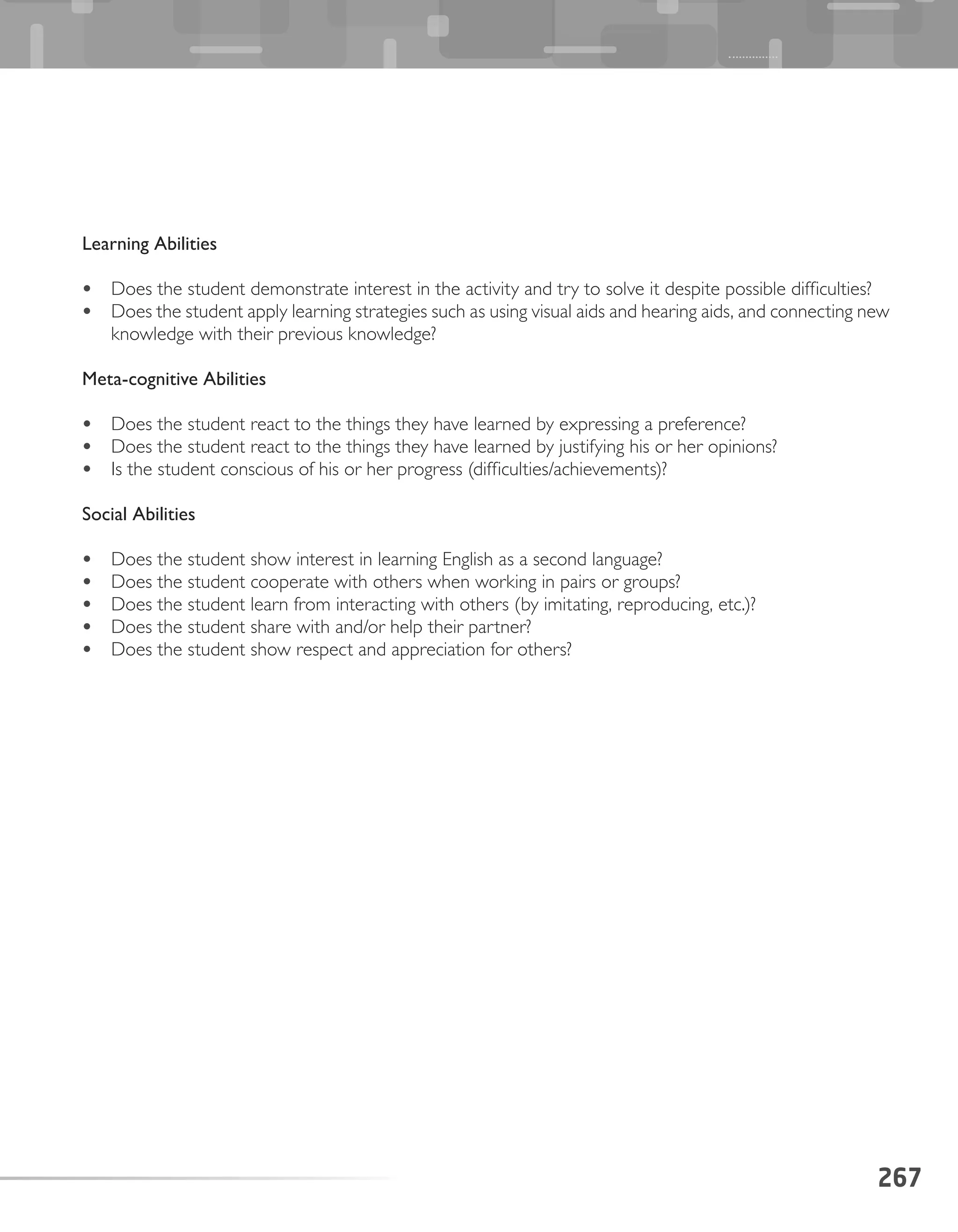
Question Bank				 266-267
Pronunciation Guide			 268
IrregularVerbs				 269
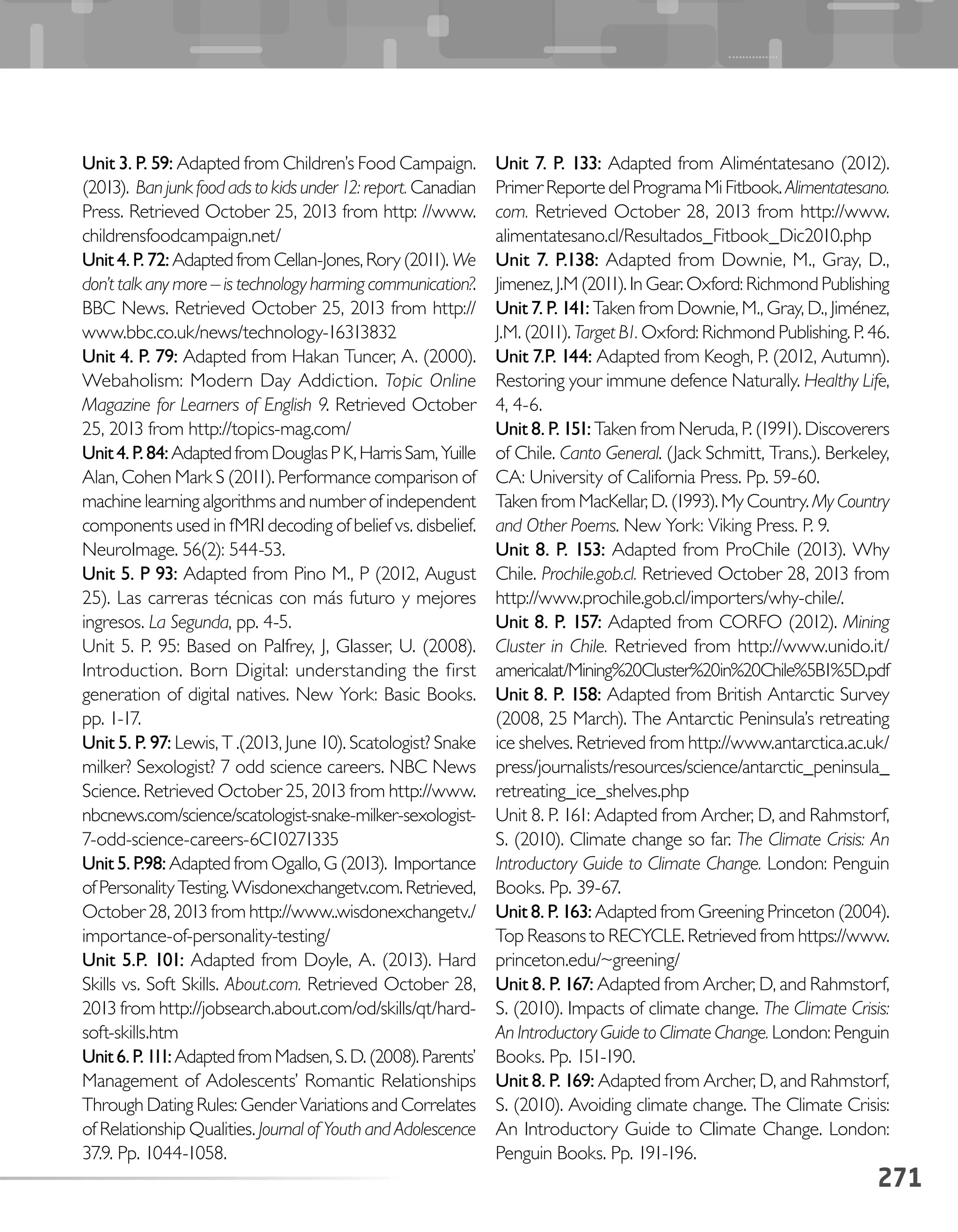
Bibliography				 270-271
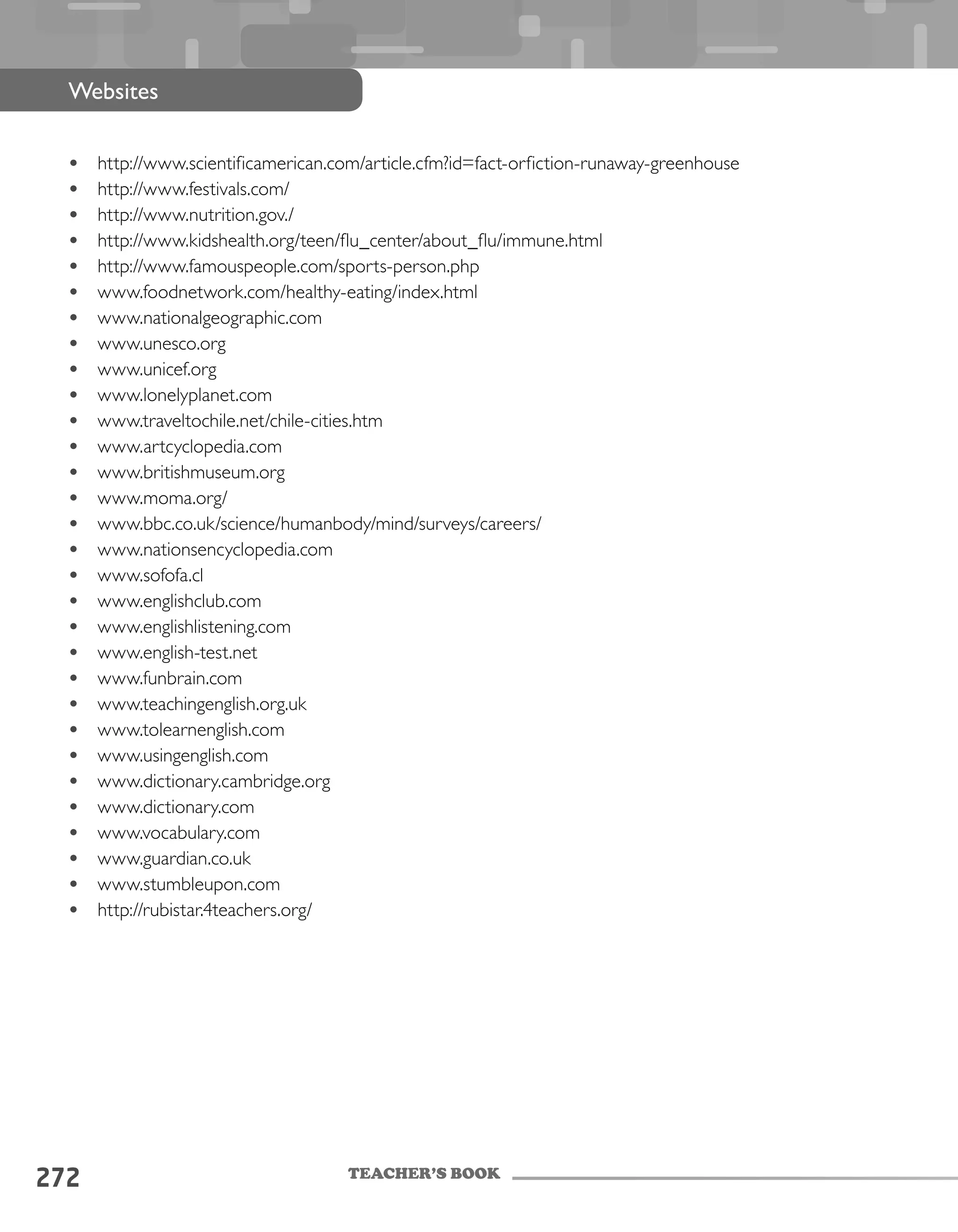
Websites				 272
INDEX
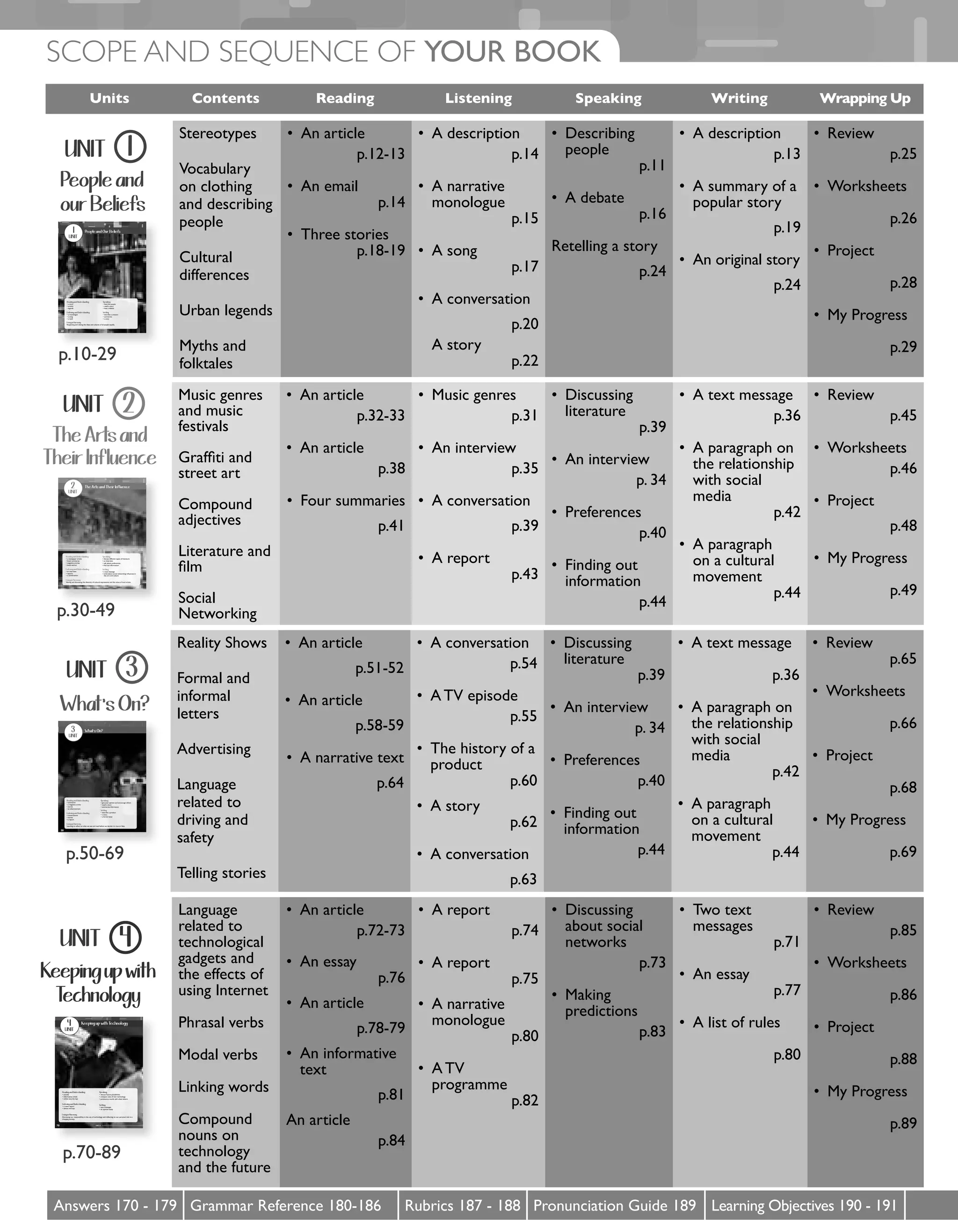
SCOPE AND SEQUENCE OF YOUR BOOK
Answers 170 - 179 Grammar Reference 180-186 Rubrics 187 - 188 Pronunciation Guide 189 Learning Objectives 190 - 191
Units Contents Reading Listening Speaking Writing Wrapping Up
Stereotypes
Vocabulary
on clothing
and describing
people
Cultural
differences
Urban legends
Myths and
folktales
•	 An article
p.12-13
•	 An email
p.14
•	 Three stories
p.18-19
•	 A description
p.14
•	 A narrative
monologue
p.15
•	 A song
p.17
•	 A conversation
p.20
A story
p.22
•	 Describing
people
p.11
•	 A debate
p.16
Retelling a story
p.24
•	 A description
p.13
•	 A summary of a
popular story
p.19
•	 An original story
p.24
•	 Review
p.25
•	 Worksheets
p.26
•	 Project
p.28
•	 My Progress
p.29
Music genres
and music
festivals
Graffiti and
street art
Compound
adjectives
Literature and
film
Social
Networking
•	 An article
p.32-33
•	 An article
p.38
•	 Four summaries
p.41
•	 Music genres
p.31
•	 An interview
p.35
•	 A conversation
p.39
•	 A report
p.43
•	 Discussing
literature
p.39
•	 An interview
p. 34
•	 Preferences
p.40
•	 Finding out
information
p.44
•	 A text message
p.36
•	 A paragraph on
the relationship
with social
media
p.42
•	 A paragraph
on a cultural
movement
p.44
•	 Review
p.45
•	 Worksheets
p.46
•	 Project
p.48
•	 My Progress
p.49
Reality Shows
Formal and
informal
letters
Advertising
Language
related to
driving and
safety
Telling stories
•	 An article
p.51-52
•	 An article
p.58-59
•	 A narrative text
p.64
•	 A conversation
p.54
•	 A TV episode
p.55
•	 The history of a
product
p.60
•	 A story
p.62
•	 A conversation
p.63
•	 Discussing
literature
p.39
•	 An interview
p. 34
•	 Preferences
p.40
•	 Finding out
information
p.44
•	 A text message
p.36
•	 A paragraph on
the relationship
with social
media
p.42
•	 A paragraph
on a cultural
movement
p.44
•	 Review
p.65
•	 Worksheets
p.66
•	 Project
p.68
•	 My Progress
p.69
Language
related to
technological
gadgets and
the effects of
using Internet
Phrasal verbs
Modal verbs
Linking words
Compound
nouns on
technology
and the future
•	 An article
p.72-73
•	 An essay
p.76
•	 An article
p.78-79
•	 An informative
text
p.81
An article
p.84
•	 A report
p.74
•	 A report
p.75
•	 A narrative
monologue
p.80
•	 A TV
programme
p.82
•	 Discussing
about social
networks
p.73
•	 Making
predictions
p.83
•	 Two text
messages
p.71
•	 An essay
p.77
•	 A list of rules
p.80
•	 Review
p.85
•	 Worksheets
p.86
•	 Project
p.88
•	 My Progress
p.89
Keeping up with
Technology
UNIT 4
UNIT 470
4
unit
Keeping up with Technology
Reading and Understanding
•	articles
•	informative	article
•	online	security	tips
Listening and Understanding
•	a	news	report
•	advice	and	tips
Speaking
•	discuss	future	possibilities	
•	compare	uses	of	new	technology
•	pronounce	words	with	silent	letters
Writing
•	text	messages
•	an	opinion	essay
Living in Harmony
Discussing	our	responsibility	in	the	use	of	technology	and	reflecting	on	our	personal	role	in	a	
changing	society.
People and
our Beliefs
UNIT 1
10 UNIT 1
People and Our Beliefs1
unit
Reading and Understanding
• a story
• articles
• legends
Listening and Understanding
• a monologue
• a song
• a myth
Speaking
• describe people
• retell a story
• have a debate
Writing
• describe a creature
• summaries
• a story
Living in Harmony
Respecting and valuing the ideas and cultures of all people equally.
10
p.10-29
The Arts and
Their Influence
UNIT 2
UNIT 230
2
unit
The Arts and Their Influence
Reading and Understanding
• a newspaper article
• book summaries
• magazine articles
• book extract
Listening and Understanding
• an interview
• reports
• a conversation
Speaking
• discuss different types of literature
• an interview
• talk about preferences
• find out information
Writing
• a text message
• write about social networking influences in
the arts and culture
Living in Harmony
Valuing and discussing the diversity of cultural expressions and the value of local artists.
p.30-49
What’s On?
UNIT 3
UNIT 350
3
unit
What’s On?
Reading and Understanding
• summaries
• a magazine article
• stories
• an advertisement
Listening and Understanding
• conversations
• stories
• a report
Speaking
• give your opinion and encourage others
• retell a story
• summarize information
Writing
• describe a product
• a story
• a formal letter
Living in Harmony
Learning to reflect on what we see and read before we decide it is true or false.
50
p.50-69
p.70-89
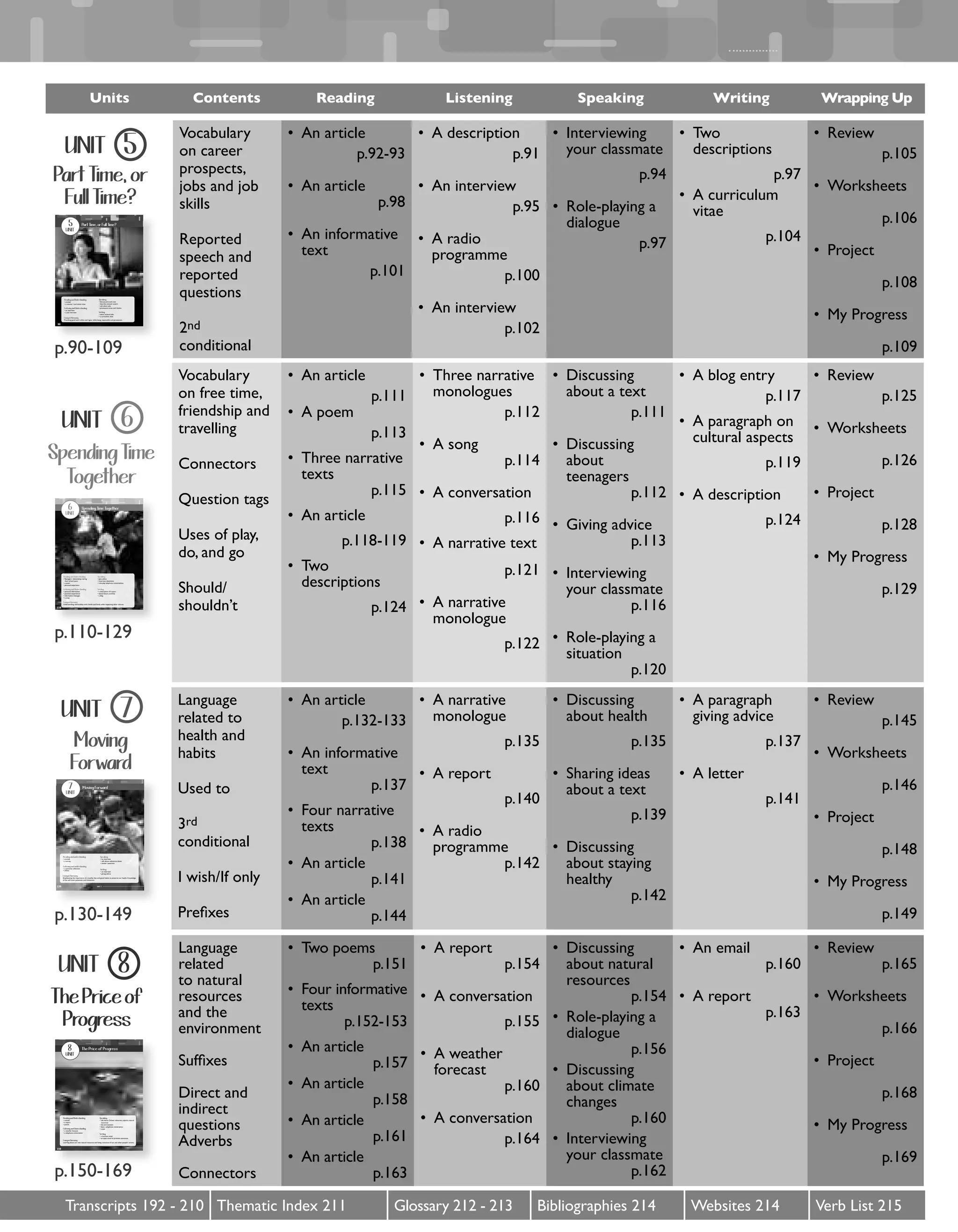
Transcripts 192 - 210 Thematic Index 211 Glossary 212 - 213 Bibliographies 214 Websites 214 Verb List 215
Units Contents Reading Listening Speaking Writing Wrapping Up
Vocabulary
on career
prospects,
jobs and job
skills
Reported
speech and
reported
questions
2nd
conditional
•	 An article
p.92-93
•	 An article
p.98
•	 An informative
text
p.101
•	 A description
p.91
•	 An interview
p.95
•	 A radio
programme
p.100
•	 An interview
p.102
•	 Interviewing
your classmate
p.94
•	 Role-playing a
dialogue
p.97
•	 Two
descriptions
p.97
•	 A curriculum
vitae
p.104
•	 Review
p.105
•	 Worksheets
p.106
•	 Project
p.108
•	 My Progress
p.109
Vocabulary
on free time,
friendship and
travelling
Connectors
Question tags
Uses of play,
do, and go
Should/
shouldn’t
•	 An article
p.111
•	 A poem
p.113
•	 Three narrative
texts
p.115
•	 An article
p.118-119
•	 Two
descriptions
p.124
•	 Three narrative
monologues
p.112
•	 A song
p.114
•	 A conversation
p.116
•	 A narrative text
p.121
•	 A narrative
monologue
p.122
•	 Discussing
about a text
p.111
•	 Discussing
about
teenagers
p.112
•	 Giving advice
p.113
•	 Interviewing
your classmate
p.116
•	 Role-playing a
situation
p.120
•	 A blog entry
p.117
•	 A paragraph on
cultural aspects
p.119
•	 A description
p.124
•	 Review
p.125
•	 Worksheets
p.126
•	 Project
p.128
•	 My Progress
p.129
Language
related to
health and
habits
Used to
3rd
conditional
I wish/If only
Prefixes
•	 An article
p.132-133
•	 An informative
text
p.137
•	 Four narrative
texts
p.138
•	 An article
p.141
•	 An article
p.144
•	 A narrative
monologue
p.135
•	 A report
p.140
•	 A radio
programme
p.142
•	 Discussing
about health
p.135
•	 Sharing ideas
about a text
p.139
•	 Discussing
about staying
healthy
p.142
•	 A paragraph
giving advice
p.137
•	 A letter
p.141
•	 Review
p.145
•	 Worksheets
p.146
•	 Project
p.148
•	 My Progress
p.149
Language
related
to natural
resources
and the
environment
Suffixes
Direct and
indirect
questions
Adverbs
Connectors
•	 Two poems
p.151
•	 Four informative
texts
p.152-153
•	 An article
p.157
•	 An article
p.158
•	 An article
p.161
•	 An article
p.163
•	 A report
p.154
•	 A conversation
p.155
•	 A weather
forecast
p.160
•	 A conversation
p.164
•	 Discussing
about natural
resources
p.154
•	 Role-playing a
dialogue
p.156
•	 Discussing
about climate
changes
p.160
•	 Interviewing
your classmate
p.162
•	 An email
p.160
•	 A report
p.163
•	 Review
p.165
•	 Worksheets
p.166
•	 Project
p.168
•	 My Progress
p.169
Part Time, or
Full Time?
UNIT 5
Part Time, or Full Time?5
unit
Reading and Understanding
• articles
• a resume / curriculum vitae
Listening and Understanding
• an interview
• a job interview
Speaking
• discuss pros and cons
• describe unusual careers
• talk about jobs
• pronounce stress and rhythm
Writing
• about unusual jobs
• a curriculum vitae
Living in Harmony
Practising good work ethics and rigour while being responsible and perseverant.
90
p.90-109
Spending Time
Together
UNIT 6
UNIT 6110
6
unit
Spending Time Together
Reading and Understanding
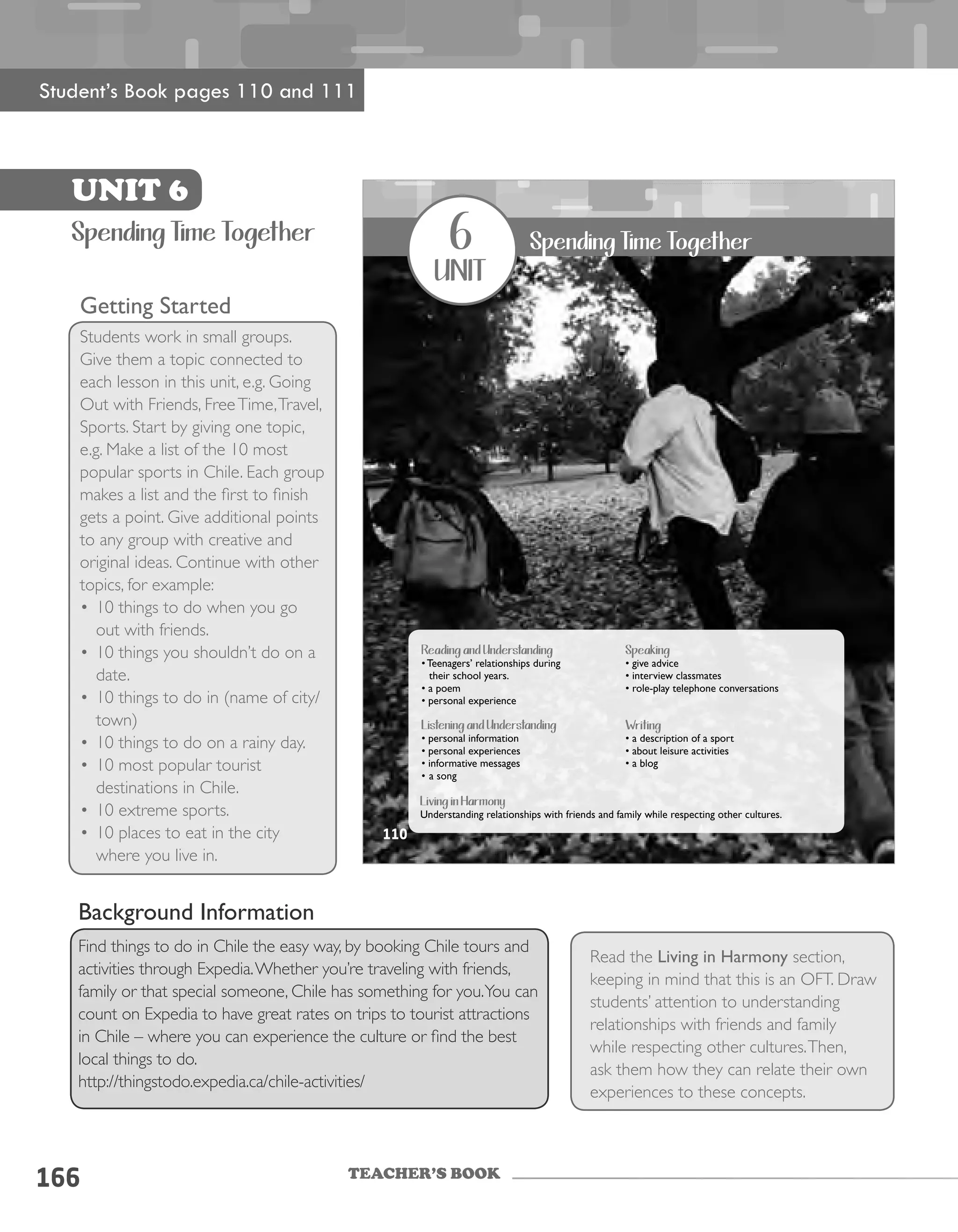
• Teenagers’ relationships during
their school years.
• a poem
• personal experience
Listening and Understanding
• personal information
• personal experiences
• informative messages
• a song
Speaking
• give advice
• interview classmates
• role-play telephone conversations
Writing
• a description of a sport
• about leisure activities
• a blog
Living in Harmony
Understanding relationships with friends and family while respecting other cultures.
110
p.110-129
Moving
Forward
UNIT 7
UNIT 7130
7
unit
Moving Forward
Reading and understanding
•	articles
•	a	survey
Listening and understanding
•	a	personal	reflection
•	advice
Speaking
•	an	interview
•	talk	about	substance	abuse
•	answer	questions
Writing
•	an	interview
•	giving	advice
Living in Harmony
Emphasizing	the	importance	of	a	healthy	diet	and	good	habits	to	preserve	our	health.	Knowledge	
of	the	self,	one’s	potentials	and	limitations.	
p.130-149
The Price of
Progress
UNIT 8
UNIT 8150
8
unit
The Price of Progress
Reading and Understanding
•	articles
•	a	report
•	poems
Listening and Understanding
•	a	weather	forecast
•	a	telephone	conversation
Speaking
•	talk	about	Chilean	industries,	exports,	natural	
resources	
•	the	environment
•	have	a	telephone	conversation
•	a	quiz
Writing
•	a	business	email	
•	an	open	email	to	promote	awareness
Living in Harmony
Learning	about	our	own	natural	resources	and	being	conscious	of	our	and	other	people’s	actions.	
150
p.150-169
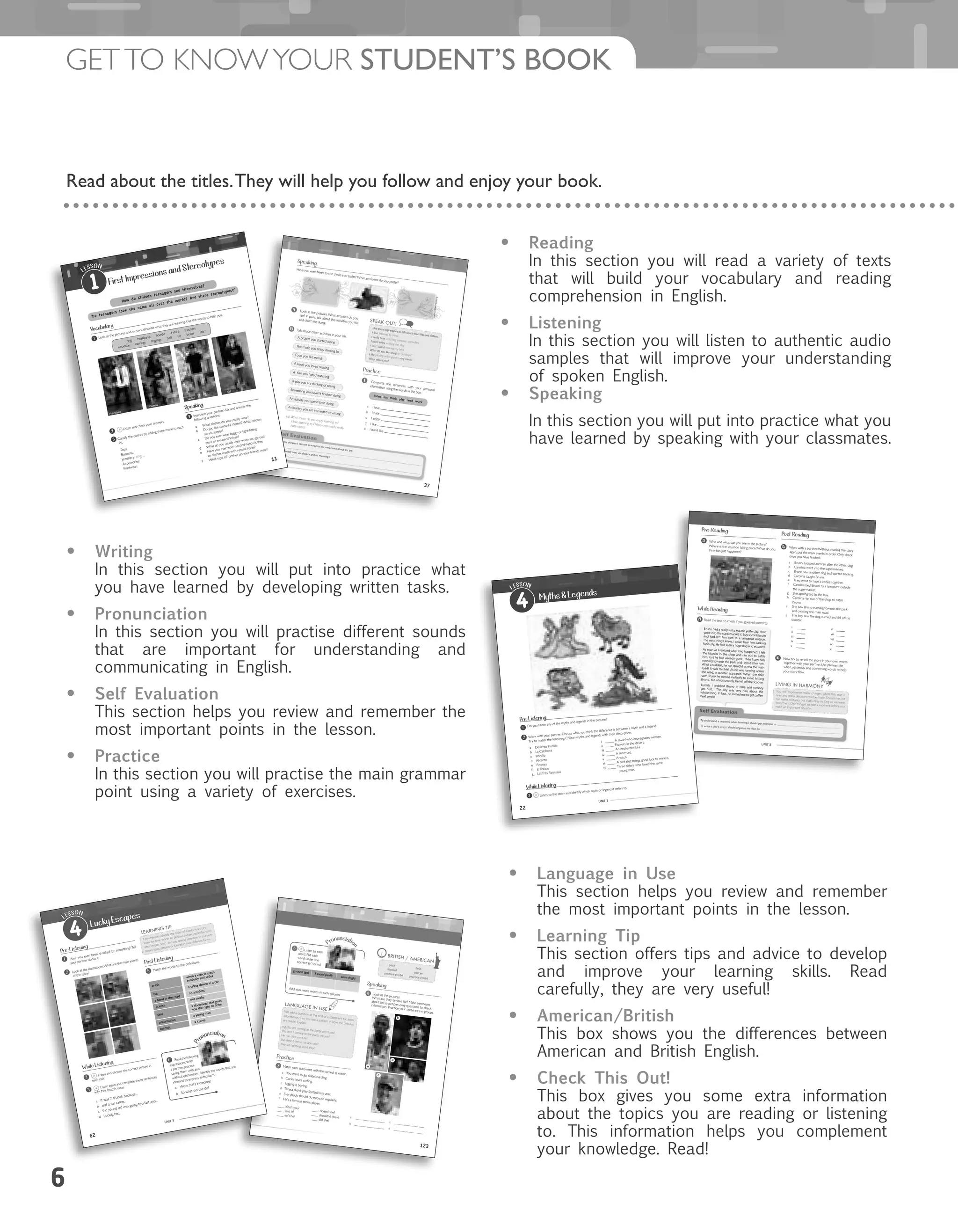
Getto knowyour STUDENT’S book
6
Read about the titles.They will help you follow and enjoy your book.
Get to know your book!
•	 Reading
In this section you will read a variety of texts
that will build your vocabulary and reading
comprehension in English.
•	 Listening
In this section you will listen to authentic audio
samples that will improve your understanding
of spoken English.
•	 Speaking
In this section you will put into practice what you
have learned by speaking with your classmates.
•	 Writing
In this section you will put into practice what
you have learned by developing written tasks.
•	 Pronunciation
In this section you will practise different sounds
that are important for understanding and
communicating in English.
•	 Self Evaluation
This section helps you review and remember the
most important points in the lesson.
•	 Practice
In this section you will practise the main grammar
point using a variety of exercises.
•	 Language in Use
This section helps you review and remember
the most important points in the lesson.
•	 Learning Tip
This section offers tips and advice to develop
and improve your learning skills. Read
carefully, they are very useful!
•	 American/British
This box shows you the differences between
American and British English.
•	 Check This Out!
This box gives you some extra information
about the topics you are reading or listening
to. This information helps you complement
your knowledge. Read!
37
Speaking
Practice
9 Look at the pictures.What activities do you
see? In pairs, talk about the activities you like
and don’t like doing.
10 Talk about other activities in your life.A project you started doing
The music you enjoy dancing to
Food you like eating
A book you loved reading
A film you hated watching
A play you are thinking of seeing
Something you haven’t finished doing
An activity you spend time doing
A country you are interested in visiting
Have you ever been to the theatre or ballet? What art forms do you prefer?
e.g.,What music do you enjoy listening to?I love listening to Chilean rock and I reallyhate opera.
Use these expressions to talk about your likes and dislikes.
I love listening to music.I really hate watching romantic comedies.I don’t enjoy walking the dog.I can’t stand making my bed.What do you like doing on Sundays?I like playing video games very much.What about you?
SPEAK OUT!
11 Complete the sentences with your personal
information using the words in the box.
a I love
b I hate
c I enjoy
d I like
e I don’t like
listen | eat | think | play | read | work
Self EvaluationSome phrases I can use to express my preference about art areTo identify new vocabulary and its meaning, I
commons.wikimedia.org
1111
First Impressions and Stereotypes
LESSON
1
1 Look at the pictures and, in pairs, describe what they are wearing. Use the words to help you.
Francisco
Camila
Javier
Sol
2
Listen and check your answers.
Classify the clothes by adding three more to each
list.
Tops:
Bottoms:
Jewellery: ring, ...
Accessories:
Footwear:
3
Speaking
4 Interview your partner.Ask and answer the
following questions:
a What clothes do you usually wear?
b Do you like colourful clothes? What colours
do you prefer?
c Do you ever wear baggy or tight-fitting
jeans or trousers? When?
d What do you usually wear when you go out?
e Have you ever worn second-hand clothes
or clothes made with natural fibres?
f What type of clothes do your friends wear?
Vocabulary
ring
headband hoodie
t-shirt trousers
necklace earrings
leggings
belt
tie boots shirt
‘Do teenagers look the same all over the world? Are there stereotypes?’
How do Chilean teenagers see themselves?
UNIT 3
64
Pre-Reading
While Reading
Post Reading
13 Who and what can you see in the picture?
Where is the situation taking place? What do youthink has just happened?
14
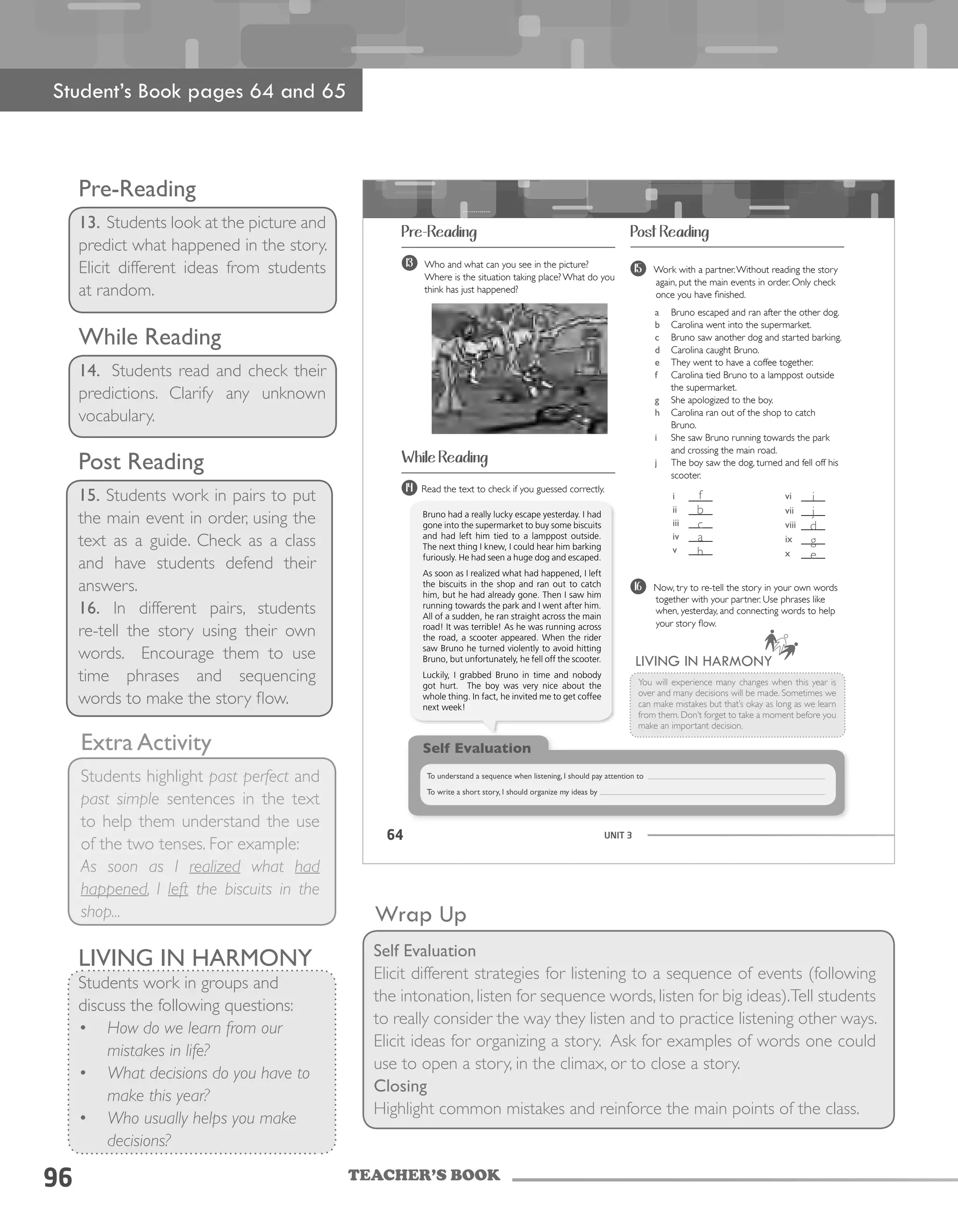
Bruno had a really lucky escape yesterday. I hadgone into the supermarket to buy some biscuitsand had left him tied to a lamppost outside.The next thing I knew, I could hear him barkingfuriously. He had seen a huge dog and escaped.
As soon as I realized what had happened, I leftthe biscuits in the shop and ran out to catchhim, but he had already gone. Then I saw himrunning towards the park and I went after him.All of a sudden, he ran straight across the mainroad! It was terrible! As he was running acrossthe road, a scooter appeared. When the ridersaw Bruno he turned violently to avoid hittingBruno, but unfortunately, he fell off the scooter.
Luckily, I grabbed Bruno in time and nobodygot hurt. The boy was very nice about thewhole thing. In fact, he invited me to get coffeenext week!
i ____
ii ____
iii ____
iv ____
v ____
vi ____
vii ____
viii ____
ix ____
x ____
Self Evaluation
To understand a sequence when listening, I should pay attention to
To write a short story, I should organize my ideas by
LIVING IN HARMONY
You will experience many changes when this year isover and many decisions will be made. Sometimes wecan make mistakes but that’s okay as long as we learnfrom them. Don’t forget to take a moment before youmake an important decision.
Read the text to check if you guessed correctly.
15 Work with a partner.Without reading the storyagain, put the main events in order. Only checkonce you have finished.
a Bruno escaped and ran after the other dog.b Carolina went into the supermarket.c Bruno saw another dog and started barking.d Carolina caught Bruno.
e They went to have a coffee together.
f Carolina tied Bruno to a lamppost outside
the supermarket.
g She apologized to the boy.
h Carolina ran out of the shop to catch
Bruno.
i She saw Bruno running towards the park
and crossing the main road.
j The boy saw the dog, turned and fell off hisscooter.
16 Now, try to re-tell the story in your own wordstogether with your partner. Use phrases likewhen, yesterday, and connecting words to helpyour story flow.
22
UNIT 1
Myths & Legends
LESSON
4
Pre-Listening
Do you know any of the myths and legends in the pictures?
2 Work with your partner. Discuss what you think the difference is between a myth and a legend.
Try to match the following Chilean myths and legends with their description.
3 Listen to the story and identify which myth or legend it refers to.
a Desierto Florido
b La Calchona
c Portillo
d Alicanto
e Pincoya
f ElTrauco
g LasTres Pascualas
i _____ A dwarf who impregnates women.
ii _____ Flowers in the desert.
iii _____ An enchanted lake.
iv _____ A mermaid.
v _____ A witch.
vi _____ A bird that brings good luck to miners.
vii _____ Three sisters who loved the same
young man.
1
While Listening
123
We add a question at the end of a statement to check
information. Can you see a pattern in how the phrases
are made? Explain.
e.g.,You are coming to the party, aren’t you?You aren’t coming to the party, are you?He can drive, can’t he?
She doesn’t own a car, does she?They will camping, won’t they?
LANGUAGE IN USE
Practice
7 Match each statement with the correct question.a You want to go skateboarding,b Carlos loves surfing,c Jogging is boring,
d Teresa didn’t play football last year,e Everybody should do exercise regularly,f He’s a famous tennis player,
____ don’t you?
____ doesn’t he?
____ isn’t it?
____ shouldn’t they?
____ isn’t he?
____ did she?
pitch
fieldfootball
soccerpractise (verb) practice (verb)
BRITISH / AMERICAN
8 Look at the pictures.What are they famous for? Make sentences
about these people using questions to check
information. Practice your sentences in groups.
Pronunciatio
n
Listen to each
word. Put each
word under the
correct ‘gh’ sound.
6
g sound (go) f sound (stuff)
silent (high)
Add two more words in each column.
a
b
c
d
a ___________________
b ___________________
c ___________________
d ___________________
Speaking
UNIT 3
62
crash
when a vehicle stops
suddenly and slides
lad
a safety device in a car
a bend in the road
an accident
licence
not awake
skid
a document that gives
you the right to drive
unconscious
a young man
seatbelt
a curve
LESSON
4 Lucky Escapes
Pre-Listening
Have you ever been shocked by something? Tell
your partner about it.1
Look at the illustrations.What are the main events
of the story?2
Listen and choose the correct picture in
each pair.
Listen again and complete these sentences
with Mrs Brady’s ideas.
a It was 7 o’clock because...
b and a car came...
c the young lad was going too fast and...
d Luckily, he...
3
4
If you need to identify the order of events in a story
listen for time words or phrases (when, yesterday, soon
after, before, next) and pay special attention to the verb
tenses (past, present or future) in their different forms.
LEARNING TIP
Post Listening
Match the words to the definitions.
5
Pr
onunciation
Readthefollowing
expressions.With
a partner, practice
saying them with and
without enthusiasm. Identify the words that are
stressed to express enthusiasm.
a Wow, that’s incredible!
b So what did she do?
6
While Listening
7
55
1 Look at the image.What is the name of the programme? Discuss the
questions below as a class.
•	 How is the family a satire?
•	 What types of values does the show critique?
•	 Do you think the social criticism of the US applies to Chile, too?
In what ways?
•	 Are the characters stereotypes? Explain why.
•	 If you were writing a similar show, what stereotypes would you
critique in Chilean society?
LESSON
2 Making Changes
Pre-Listening
mallet
spice rack
to sneak up
David
the press
spices
to change mind
powders with a strong taste or smell to use in cooking
to change opinion about something
a place to keep spices that are used in the kitchen
to go close to someone quietly so they don’t see you
a big hammer made of wood
a famous sculpture by Michaelangelo
thepeoplewhoworkinthemedia(tv,newspaper,magazine,etc.)
4 Look at the pictures and listen to the script again. Put the pictures in chronological order. Listen to the
phrases to check your answers.
2 Match the words with their meanings.
Listen to an episode where Marge blames aTV show for her daughter Maggie being violent.
In pairs, discuss:
a What happened to the cartoon programme after Marge started a movement against it?
b	 What can you infer about Marge’s opinion of the sculpture David?
c Do you think her actions were correct?
13
common
s.wikime
dia.org
Courtesy	of	Canal	13
While Listening
A
B
C
D
E
F
UNIT 3
68
3
unit
Project
Decide what position you are going to take on the
issue.Are you for or against it?
e.g., I think adverstising on TV is too much.
In my opinion, advertising on TV is informative.
With your team,brainstorm arguments to support
your point of view and make notes.
e.g., Advertising stops you from enjoying TV
programmes.
Films are interrupted every few minutes or so!
Take turns to give your opinions.Be confident and direct.
•I think…
•In my opinion…
•In my view…
•As far as I’m concerned…
Discuss what other people say, agree or disagree
with them, and prepare counter-arguments.
•Do you think so?
•I’m not sure (about that).
•Sorry, but I don’t agree.
You can agree to disagree in opinion at the end
2
Are You For or Against Advertising to Children?
3
4
5
6
Role - play your debate to the rest of the class.
Write a formal email to the advertising board
confirming your position on topic: advertising to
children.Write between 80 – 100 words.
7
8
Look at the advert. Who is it aimed at? Can you think of any Chilean adverts aimed at children on TV or
radio? On what programmes have you seen/heard them? Do you think they are adequate? What are the
children’s reactions when they see them? Do you think they are useful?
1
9 3
To interrupt a person when they are speaking
Hold on a minute
Wait a minute
One sec...
Excuse me...
Wait...
SPEAK OUT!
of the debate with some of the statements but
you must find counter-arguments also.
•	 Speak Out!
This section provides useful language to
help you improve your conversational
skills.
•	 Step it Up!
This section presents an extra activity
to challenge your English skills.
•	 Living in Harmony
This section asks you to reflect on
fundamental values that help us live
harmoniously within society and the
world around us.
•	 Review
In this section you will find activities to
help you review what you learned in each
unit. By totaling your score, you can see
where totalling you need more practice.
Just follow the suggestions for review in
the box at the bottom of the page.
•	 Worksheets
These pages provide a number of
exercises and word games to continue
building your English skills.
•	 Project
This is a hands-on project that allows you
to put all of your skills—Reading, Writing,
Speaking, and Listening—into practice.
•	 My Progress
You will take a test at the end of each unit,
which will help you measure how much you
have improved your English!
•	 CD
This indicates an audio track.
	
UNIT 244
Writing
Speaking
8 a Read the poem.What is it about?
b In pairs, discuss the poem. Do you
identify with the speaker? Explain why
or why not.
c Notice the quantifier words that go
before each word in bold.Why do we
use many in some cases and much in
others? Go to the Grammar Reference
on page 181 to check. Explain the rule
to a partner.
10 Write a paragraph about a cultural movement
you have learned about on the Internet. Use
the diagram to help you plan.
Some ideas are:
A new style of music | A fashion trend
A genre of film | An artistic movement
A social practice
9 Work in pairs.Ask and answer the questions.
a What’s more important in your life: the
internet,TV, music, literature or phone
conversations? Why?
b How much time do you spend on each
every week?
c Do you keep a diary? Why or why not?
d Do you tell your online friends all of your
problems? Why or why not?
e How can living your life online become
unhealthy?
Self Evaluation
Predicting ideas and vocabulary helps me _______________________________________________________
Many new words related to Internet are similar in Spanish and English, so I can
______________________________________________________________________________________
LIVING IN HARMONY
Social media makes everything easier, including
misinterpretation.We should always be careful of
how much we share on the Internet as well as aware
of who exactly can see our specific posts. Always
consider your audience online so you can avoid
misunderstandings and, most importantly, remember
that behind every post and ‘like’ is a living, breathing
person with feelings and opinions just like you, and
they deserve to be valued and respected.
I have too many things happening this year.
Too much homework and a lot of
problems with my peers.
When I surf on the net my problems disappear.
I can get lost,time flies,my mind becomes clear.
I can listen to many songs and
read a lot of books.
I can even learn many recipes
because I love to cook.
My parents say I spend too much time
chatting with my friend Brook
But I told them to try it and they’ll get hooked.
Subject
Where did
you hear
about it
Why is it
innovative?
Where
did it
start?
87
4
unit
W
orkshee
ts
5 Circle the correct option to complete the sentence.
Juan: I really want to learn English. But it’s too late now.You (a) have to / don’t have to start young to learna language.
Doris: That’s not true!You (b) have to / don’t have to be young. I started learning English when I was 16 andspeak it fluently now.
Juan: So what do I (c) have to / must do?
Doris: To start, buy a book and study it at home. You also (d) have to / don’t have to pay attention to yourteacher in class.
Juan: I don’t like my teacher at school.
Doris: You (e) have to / don’t have to like your teacher necessarily. You have to pay attention!Juan: I don’t know. I mean, I want to learn English. I (f) have to / don’t have to learn it for my future job.Doris: Well, I think you (g) have to / don’t have to work hard. But it’s fun, too!
6 Complete the following sentences using verbs
that express a possibility or things that you are
or aren’t able to do.
a Children
b Technology
c The football team
d It
e In the future
f Nowadays
7 Match the following words with the correct meaning.
a adapt
b gadget
c criticism
d interact
e warning
___ to communicate with
___ something that makes you understand
there is a possible danger
___ to change something to suit different
conditions
___ a small device with a particular purpose
___ giving your opinion about something or
someone
8 Using all the words from exercise 7, create a dialogue that talks about technology.
WELCOME
88
WELCOME
2 Talk to your partner for one minute then share with the class.
a	 Where	do	we	find	English	words	in	our	everyday	lives	
here in Chile?
b	 Where	have	you	seen	English?c	 Where	have	you	heard	English?d	 Do	you	listen	to	music	or	watch	video	clips	in	English?
e	 Do	you	ever	chat	with	people	in	other	countries	online?
I think…
What do you think?
In my opinion…
And your opinion?
Because…
But…
SPEAK OUT!
Speaking
3 a Look	how	easy	it	is	to	learn	English!Simple alphabet: The	girl	and	the	dog.	Easy plurals:	One	car	–	two	cars.	There	are	very	few	exceptions.	
Short words:	Most		basic	words	are	short,	for	example:	run, work, big, go, man.
Longer words are often shortened: fridge:	refrigerator,		PC:	personal	computer.	
Call everybody ‘you’: You	can	say	‘Do	you	speak	English?’	to	your	friend	or	to	your	teacher	
or	to	a	group	of	people.
b Write	down	two	more	easy	aspects	of	learning	English.	Then	think	about	what	you	find	difficult.	Share		
your ideas with your partner.
Which students do you identify with?
Daniel
Eva
Cris
Manu
I’m bad at learning
languages. I’ll neverimprove.
1
I don’t want to speakbecause I’m scared ofmaking mistakes.
I need to
study more
grammar. I need to
translate
every word.
69
3unit
M
y Progr
ess
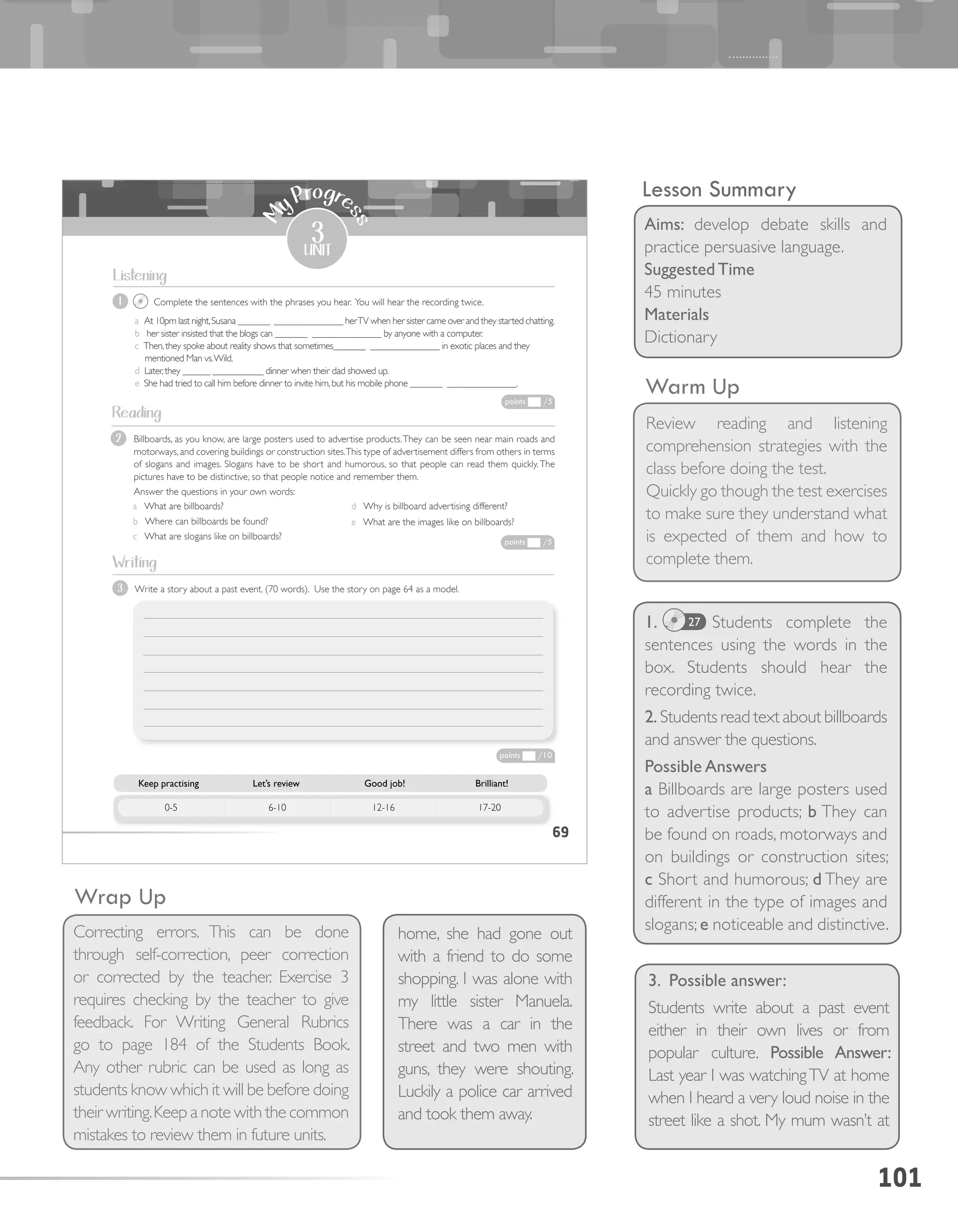
Complete the sentences with the phrases you hear. You will hear the recording twice.
a At 10pm last night,Susana _______ _______________ herTV when her sister came over and they started chatting.
b her sister insisted that the blogs can _______ _______________ by anyone with a computer.
c Then,they spoke about reality shows that sometimes_______ _______________ in exotic places and they
mentioned Man vs.Wild.d Later,they ______ ___________ dinner when their dad showed up.
e She had tried to call him before dinner to invite him,but his mobile phone _______ _______________.
1
Billboards, as you know, are large posters used to advertise products.They can be seen near main roads and
motorways, and covering buildings or construction sites.This type of advertisement differs from others in terms
of slogans and images. Slogans have to be short and humorous, so that people can read them quickly. The
pictures have to be distinctive, so that people notice and remember them.
Answer the questions in your own words:
2
Keep practising
Let’s review
Good job!
Brilliant!
0-5
6-10
12-16
17-20
points /5
points /5
points /10
Listening
Reading
Write a story about a past event. (70 words). Use the story on page 64 as a model.
3
Writing
a What are billboards?
b Where can billboards be found?c What are slogans like on billboards?
d Why is billboard advertising different?e What are the images like on billboards?
109109
5unit
3 Read about the most demanding careers and answer the questions.Write sentences describing the skills
needed for each job.
TOP JOBS FOR THE NEXT10YEARS.•	 Computer Programmer: Developing new operating systems and common code bases has allowed many
more industries to develop custom software solutions.
•	 Environmental Engineer: Environmental engineers are responsible for studying, evaluating and managing
the harmful effects of human activity on the environment.
•	 Networking Specialist: Different from a traditional computer programmer, a networking specialist is
responsible	for	installation,	configuration,	maintenance	and	support	of	networks	server	hardware,	network	
infrastructure, and network operating systems.
•	 ESL/EFL	Teacher:	Involves	teaching	students	of	all	ages	whose	first	language	is	not	English,	through	the
development of language skills to ultimately be able to communicate in English.
points /5
points /5
points /10
Keep practising
Let’s review
Good job!
Brilliant!
0-5
6-10
11-15
16-20
Listening
Writing
Reading
2 Write a brief summary about what you want to
do	when	you	finish	school.	Use	information	from	
the	Unit	to	do	so.	
1 Listen to a conversation between Sally and
Paul and circle the correct answer.a Sally’s mum wants her to….i become an engineer.ii travel around the worldiii study architecture in Italy.
b Paul wants to do an apprenticeship because…
i he hates the idea of going to university.
ii he wants to work and learn at the same
time.
iii his mum thinks it’s a good idea.c Paul has already spoken to…i some plumbers.ii an electrician.iii some friends.
d Sally plans to…
i tell her mum about her plans immediately.
ii give her mum different reasons for decision to
take a gap year.iii explain to her mum that she wants to live
permanently in Italy.
e Sally thinks her mother is…i too structured.ii not well organized.iii very chaotic.
a
b
c
d
M
y Progr
ess
Mixing Fun and WorkLESSON
2
Pre-Listening
Today’s teens spend more than 7 and 1/2 hours a day consuming media.
These include watchingTV,listening to music,surfing theWeb,social networking,
and playing video games.Teens today are known as the “digital natives” and
are part of the first generation to be so closely identified with technology.
When it comes to talking about video games, almost everyone would like to voice their opinion.The palette of
choices nowadays is almost infinite and that’s why design plays a very important role when choosing the “right
one”. Design is what makes the difference between software you have to use and software you want to use.
Emilio is a user interface designer. His job is to figure out how software and users interact with each other.When
you submit a form, what happens? How are users notified of errors? Does the form go to a new page, or submit
while staying on the current page? Pretty cool, huh?
Emilio lives in Santiago and works at a Canadian company called Behaviour, which is the largest independent
game development studio in Canada, specialising in the production of 2D and 3D action/adventure games for
Xbox3,Wii, PlayStation 3, PlayStation Portable and Nintendo DS.
Based on Palfrey, J, Glasser, U. (2008). Introduction.
Born Digital: understanding the first generation of digital natives. NewYork: Basic Books. pp. 1-17.
While Listening
a His interests
b He loves
c He doesn’t like
d His favourite
video games
e His future plans
f He thinks technology is
g His advice
95
3
Listen to part 1 of Emilio’s interview and
answer the following questions.
a What does Emilio do at Behaviour?
b What projects has he worked on there?
c Does he get to play a lot of video games?Why?
d Does he speak English outside work?Why?
4
Now listen to part 2 of Emilio’s interview and
complete the chart with the correct information.
com
m
ons.wikimedia.org
1 What kind of media consumer are you? How much time do you
spend online each day? Do you like playing video games?
2 Quickly skim through this text.What do you think would be the
best title? Write your suggestions on the board and choose the
one that fits best. Justify your answer.
20
CD INDEX
Track 1 Classroom Language
Welcome Unit
Track 2 page: 9 Activity 4.
Unit 1
Track 3 page: 11 Activity 2
Track 4 page: 14 Activity 13
Track 5 page: 15 Activity 2
Track 6 page: 17 Activity 6
Track 7 page: 20 Activities 8 and 9
Track 8 page: 22 Activities 3 and 4
Track 9 page: 24 Pronunciation Activity 9
Track 10 page: 29 My Progress Unit 1 Activity 2
Track 11 ExtraTest Unit 1 UrbanTrends
Unit 2
Track 12 page: 31 Activity 1b
Track 13 page: 31 Activity 3
Track 14 page: 33 Pronunciation Activity 10
Track 15 page: 35 Activity 3
Track 16 page: 36 Pronunciation Activity 8
Track 17 page: 39 Activity 8
Track 18 page: 43 Activities 5 and 6
Track 19 page: 49 My Progress Unit 2 Activity 1
Track 20 ExtraTest Unit 2YouTube
Unit 3
Track 21 page 54 Activity 11
Track 22 page: 55 Activities 3 and 4
Track 23 page: 60 Activity 11
Track 24 page: 61 Pronunciation Activity 14
Track 25 page: 62 Activities 3 and 4
Track 26 page: 63 Activities 8 and 9
Track 27 page: 69 My Progress Unit 3 Activity 1
Track 28 ExtraTest Unit 3 Marketing in the USA
Unit 4
Track 29 page: 74 Activities 16 and 17
Track 30 page: 75 Activities 3 and 4
Track 31 page: 80 Activity 8
Track 32 page: 82 Activities 2 and 3
Track 33 page: 89 My Progress Unit 4 Activity 2
Track 34 ExtraTest Unit 4 Social Networks
22
CLASSROOM LANGUAGE
Welcoming students
• Good morning everyone!
• Good afternoon everyone!
• How are you today?
• OK, let’s start today’s class.
Taking attendance
• OK everyone, your attention please.
• I’m going to call the roll.
Giving instructions
• Silence, please.
• Everyone, listen up.
• Now, listen.
• Listen carefully.
• Keep your voices down.
• Let’s calm down.
• Come to the board.
• Come to the front.
• Please, go back to your seats.
• Please, open your books to page…
• Close your books, please.
• Let’s go back to page…
• Pay attention, please.
•You cannot eat in the classroom.
• Everybody, let’s tidy up!
• Let’s clean up, please.
• Please repeat after me.
• Repeat, please.
• Raise your hand.
• Hands up!/Hands down!
• Thumbs up/Thumbs down.
• Check your answers.
• Wait for your turn.
• Work in pairs, please.
• Work in groups, please.
• Let’s sing a song!
• Let’s sing! Everybody, join in!
• Look at the picture.
• Mark with a check.
• Write your name.
• Let’s read.What does it say?
Checking for understanding
• Do you understand?
• Do you need help?
• Can I help you with this?
• Is that clear?
• Are you sure?
• Are there any questions?
• Can we continue?
• Are you done?
• Have you finished yet?
Encouragement
• Super!
• Well done!
• Excellent!
• Brilliant!
• Wonderful!
• Congratulations!
• Good job!
Going to recess
• Let’s go to recess.
• Time for a break.
Saying goodbye
• OK everyone, time’s up.
• Alright, that’s it for today.
• Class is over.
• See you next class.
• Have a nice day.
• Have a nice weekend.
• Goodbye, everybody.
23
THEMATIC INDEX
A
Art
C
Career prospects
Clothing
Cultural differences
E
Environment
F
Food
Folktales
Free time
Friendship
H
Health and Habits
I
Internet
J
Jobs
L
Legends
M
Music
Myths
N
Natural Resources
P
Personality
R
Reality Shows
S
Social Networks
Stereotypes
T
Technological gadgets
Travel
Getto knowyour Teacher’s book
•	 CD Index
In this section you will find all the audio tracks you need for the lessons
organised by page and unit and with their corresponding number.
•	 Classroom Language
In this section you will find useful expressions for proper classroom
management.
•	 Thematic Index 	 			 		
This is a glossary of the topics and themes you will find as you go through
the text.This section helps you to be prepared for each lesson.
•	 Transcripts
In this section you will find the transcripts for each track, which you may
use to correct activities and to prepare follow-ups or other related tasks.
•	 ExtraTest:
This is a photocopiable page for you to use as further evaluation, and see
the progress of students throughout the unit. It has a step-by-step guide
provided with answers.
•	 Suggested Questions
In each lesson you will find direct questions that will help you to guide
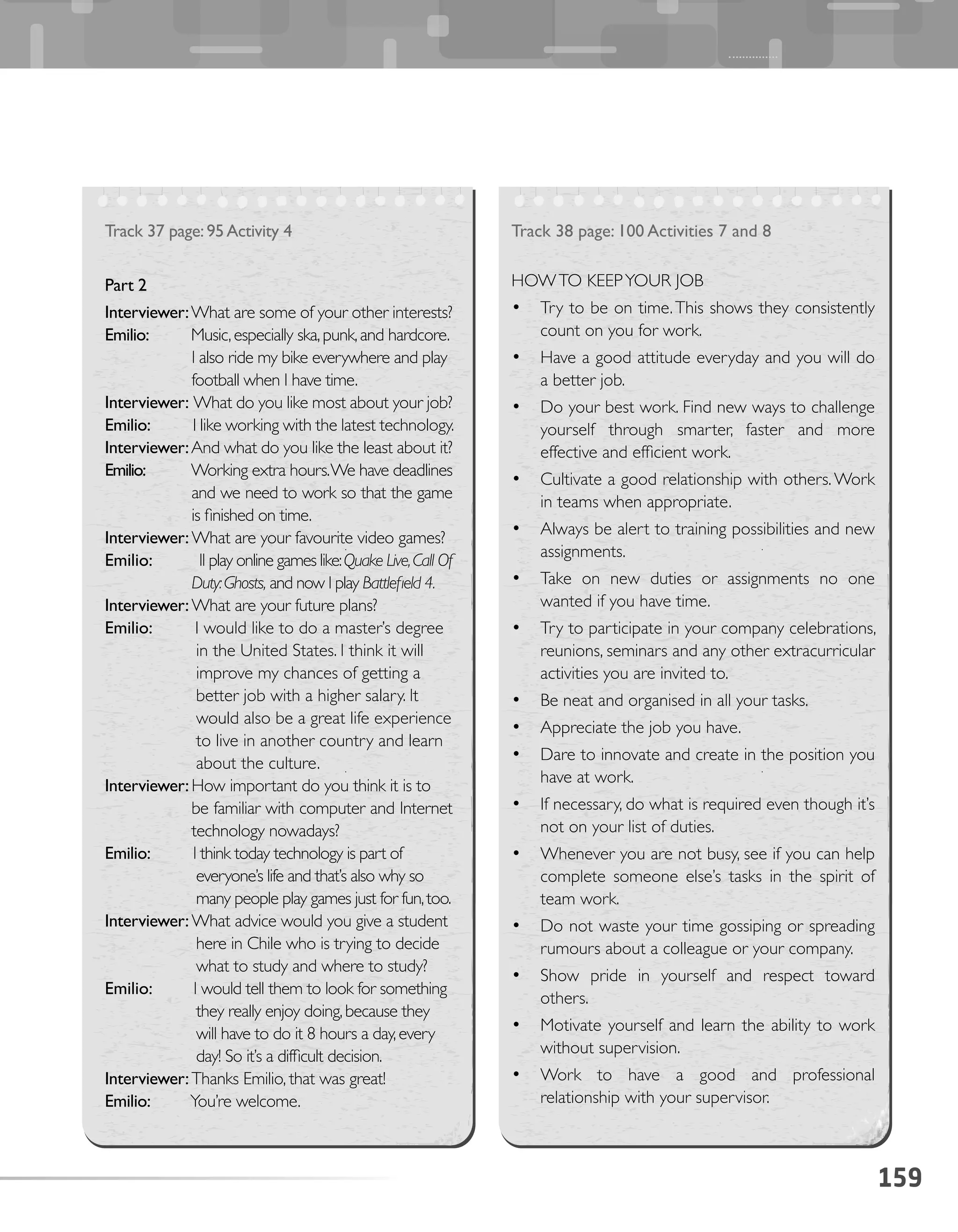
students through activities that need particular attention.
•	 Reinforcement Activities
This is a photocopiable set of remedial exercises which objective is to
help and support either weaker students or to provide further practice
and revision on core contents.
•	 Background Information
Section provided to help you with deeper information; tips or extra data
about the topics you will cover in each unit.This will help you for activities
that require further research.
8
20
CD INDEX
Track 1 Classroom Language
Welcome Unit
Track 2 page: 9 Activity 4.
Unit 1
Track 3 page: 11 Activity 2
Track 4 page: 14 Activity 13
Track 5 page: 15 Activity 2
Track 6 page: 17 Activity 6
Track 7 page: 20 Activities 8 and 9
Track 8 page: 22 Activities 3 and 4
Track 9 page: 24 Pronunciation Activity 9
Track 10 page: 29 My Progress Unit 1 Activity 2
Track 11 ExtraTest Unit 1 UrbanTrends
Unit 2
Track 12 page: 31 Activity 1b
Track 13 page: 31 Activity 3
Track 14 page: 33 Pronunciation Activity 10
Track 15 page: 35 Activity 3
Track 16 page: 36 Pronunciation Activity 8
Track 17 page: 39 Activity 8
Track 18 page: 43 Activities 5 and 6
Track 19 page: 49 My Progress Unit 2 Activity 1
Track 20 ExtraTest Unit 2YouTube
Unit 3
Track 21 page 54 Activity 11
Track 22 page: 55 Activities 3 and 4
Track 23 page: 60 Activity 11
Track 24 page: 61 Pronunciation Activity 14
Track 25 page: 62 Activities 3 and 4
Track 26 page: 63 Activities 8 and 9
Track 27 page: 69 My Progress Unit 3 Activity 1
Track 28 ExtraTest Unit 3 Marketing in the USA
Unit 4
Track 29 page: 74 Activities 16 and 17
Track 30 page: 75 Activities 3 and 4
Track 31 page: 80 Activity 8
Track 32 page: 82 Activities 2 and 3
Track 33 page: 89 My Progress Unit 4 Activity 2
Track 34 ExtraTest Unit 4 Social Networks
22
CLASSROOM LANGUAGE
Welcoming students
• Good morning everyone!
• Good afternoon everyone!
• How are you today?
• OK, let’s start today’s class.
Taking attendance
• OK everyone, your attention please.
• I’m going to call the roll.
Giving instructions
• Silence, please.
• Everyone, listen up.
• Now, listen.
• Listen carefully.
• Keep your voices down.
• Let’s calm down.
• Come to the board.
• Come to the front.
• Please, go back to your seats.
• Please, open your books to page…
• Close your books, please.
• Let’s go back to page…
• Pay attention, please.
•You cannot eat in the classroom.
• Everybody, let’s tidy up!
• Let’s clean up, please.
• Please repeat after me.
• Repeat, please.
• Raise your hand.
• Hands up!/Hands down!
• Thumbs up/Thumbs down.
• Check your answers.
• Wait for your turn.
• Work in pairs, please.
• Work in groups, please.
• Let’s sing a song!
• Let’s sing! Everybody, join in!
• Look at the picture.
• Mark with a check.
• Write your name.
• Let’s read.What does it say?
Checking for understanding
• Do you understand?
• Do you need help?
• Can I help you with this?
• Is that clear?
• Are you sure?
• Are there any questions?
• Can we continue?
• Are you done?
• Have you finished yet?
Encouragement
• Super!
• Well done!
• Excellent!
• Brilliant!
• Wonderful!
• Congratulations!
• Good job!
Going to recess
• Let’s go to recess.
• Time for a break.
Saying goodbye
• OK everyone, time’s up.
• Alright, that’s it for today.
• Class is over.
• See you next class.
• Have a nice day.
• Have a nice weekend.
• Goodbye, everybody.
23
THEMATIC INDEX
A
Art
C
Career prospects
Clothing
Cultural differences
E
Environment
F
Food
Folktales
Free time
Friendship
H
Health and Habits
I
Internet
J
Jobs
L
Legends
M
Music
Myths
N
Natural Resources
P
Personality
R
Reality Shows
S
Social Networks
Stereotypes
T
Technological gadgets
Travel
47
Track 4 page: 14 Activity 12
There is a young woman in this picture. She’s in the
middle of the photograph. She looks older, maybe
in her fifties. She’s slim, with red hair. I don’t think
she’s very tall because of her shoes—they have very
high heels. Perhaps she’s quite short and wears shoes
like this to seem taller. She’s wearing quite unusual
clothes: a dress that seems to be taken from the 19th
Century, ripped tights and those shoes. She looks as
if she’s reading a book. In the background you can
see a park with children playing. I think it might be in
a big city like London orTokyo. She could be waiting
for a friend.
Track 5 page: 15 Activity 2
Speaker: I’m really interested in the culture of other
countries. I don’t know why but I always
think other cultures are more interesting
than my own culture. Every time I travel
I learn wonderful and interesting things
about other cultures.
One of the biggest surprises I had was when
I went to the USA as a child. I’m English so I
thought Americans had the same culture as
me.When I went to America I understood
Americans and Brits are very different
people. Understanding the culture of other
people is very important. It helps us all to
get along. If everyone really tried to learn
about other cultures, the world would be
a more peaceful place.And as the world is
becoming smaller, I think this is happening.
Track 6 page: 17 Activity 6
I fell in love again
all things go, all things go
drove to Chicago
all things know, all things know
we sold our clothes to the state
I don’t mind, I don’t mind
I made a lot of mistakes
in my mind, in my mind
Chorus
you came to take us
all things go, all things go
to recreate us
all things grow, all things grow
we had our mindset
all things know, all things know
you had to find it
all things go, all things go
I drove to NewYork
in a van, with my friend
we slept in parking lots
I don’t mind, I don’t mind
I was in love with the place
in my mind, in my mind
I made a lot of mistakes
in my mind, in my mind
Chorus
if I was crying
in the van, with my friend
it was for freedom
from myself and from the land
I made a lot of mistakes
Chorus
TEACHER’S BOOK
24
WELCOME
Lesson Summary
Student’s Book pages 8 and 9
Aims: Motivate students to learn
English.
Suggested Time
45 minutes
Vocabulary
Learning English in different ways
Communicative Aims
Use context and relevant
information when asking simple
questions.
(Review Simple Questions)
Materials
Dictionary
2
Warm Up
1. Have students look at the
illustrations on page 8 and read
what each person says.Ask
questions in general. Use the
SPEAK OUT! box to help you.
Speaking
1.Students identify themselves with pictures and the information.
2. Students read the questions and answer in pairs.Then they share.
Write answers on the board in columns a, b, c, d, and e.
3. Ask students to complete the activity in their groups and to use the
SPEAK OUT! box to help them express opinions.
WELCOME88
WELCOME
2 Talk to your partner for one minute then share with the class.
a	 Where	do	we	find	English	words	in	our	everyday	lives	
here in Chile?
b	 Where	have	you	seen	English?
c	 Where	have	you	heard	English?
d	 Do	you	listen	to	music	or	watch	video	clips	in	English?
e	 Do	you	ever	chat	with	people	in	other	countries	online?
I think…
What do you think?
In my opinion…
And your opinion?
Because…
But…
SPEAK OUT!
Speaking
3 a Look	how	easy	it	is	to	learn	English!
Simple alphabet: The	girl	and	the	dog.	
Easy plurals:	One	car	–	two	cars.	There	are	very	few	exceptions.	
Short words:	Most		basic	words	are	short,	for	example:	run, work, big, go, man.
Longer words are often shortened: fridge:	refrigerator,		PC:	personal	computer.	
Call everybody ‘you’: You	can	say	‘Do	you	speak	English?’	to	your	friend	or	to	your	teacher	
or	to	a	group	of	people.
b Write	down	two	more	easy	aspects	of	learning	English.	Then	think	about	what	you	find	difficult.	Share		
your ideas with your partner.
Which students do you identify with?
Daniel
Eva
Cris
Manu
I’m bad at learning
languages. I’ll never
improve.
1
I don’t want to speak
because I’m scared of
making mistakes.
I need to
study more
grammar.
I need to
translate
every word.
SPEAK OUT!
Get students to talk about their
experience learning English in the
past and what are their expectations
for this year.
Teacher: What experience have you
had learning English? Has it been
dififcult? Easy? Interesting?
50
Reading	 	 	 	 	 	 	
Answer	the	questions	according	to	the	information	in	the	text.	Use	your	own	words.
a	What	did	the	young	people	walking	in	the	park	look	like?
b	Who	did	the	teenagers	attack	first?
c	What	made	the	gang	attack	the	woman?
unit
E
xtra Tes
t
1
Two teenage boys were recently imprisoned for life
for murdering a woman because she was dressed
as a goth. The woman, twenty, and her twenty-one-
year-old boyfriend (both of whom were wearing
black clothes and had piercings) were walking home
through a park when they met a group of teenagers.
At first, there was a good-natured and friendly
atmosphere between the young people, but this
conversation quickly became cruel as a group of
five youths attacked the twenty-one-year-old man.
He was suddenly knocked to the ground and kicked
about until he was unconscious.
As the girlfriend tried to stop the attack, holding
his head on her lap and calling for help, some of the
gang began kicking her. She was left lying by her
boyfriend’s side, unconscious. Police took them to
the nearest hospital and the woman was in a comma
for two weeks before she died. The boyfriend has
been out of his comma for a while now and claims
he finds the world a ‘terrifying place’ to live in.
The judge, who sentenced the attackers, said that
their behaviour seemed to be based solely on the
way the pair were dressed.
Keep	practising Let’s	review Good	job! Brilliant!
0-3 4-7 8-11 12-15
1 2
3
TEACHER’S BOOK
PHOTOCOPIABLE
points /5
points /5
points /5
d	Who	rescued	the	young	people?
e	What	does	‘solely’	mean	in	the	last	sentence?
Listening	 	 	 	 	 	
	
	Listen	to	the	reporter	talking	about	urban	groups	
and	decide	if	the	following	questions	are	True	(T)	or	
False	(F).	You	will	hear	the	recording	twice.
a	Punk	rockers	were	an	urban	group	in	the	eighties.
b	Young	 people	 enjoy	 identifying	 and	 sharing	 with	
others	who	have	the	same	tastes	and	lifestyle.
c	Hippies	loved	Bob	Dylan,	flower	power,	and	free	
love.
d	There	is	only	one	type	of	Goth.
e	Emos	have	an	identifiable	type	of	hairstyle.
Vocabulary	 	 	 	 	 	
	
Match	the	adjectives	in	column	A	with	their	opposite	
in	column	B.	
A
second-hand
introvert
baggy
straight
tall
thin
wonderful
B
new
awful
short
tight-fitting
extrovert
curly
fat
108
1 Choose a word from each column, if it corresponds and write five sentences. Complete them with your ideas.
You may use a word several times.
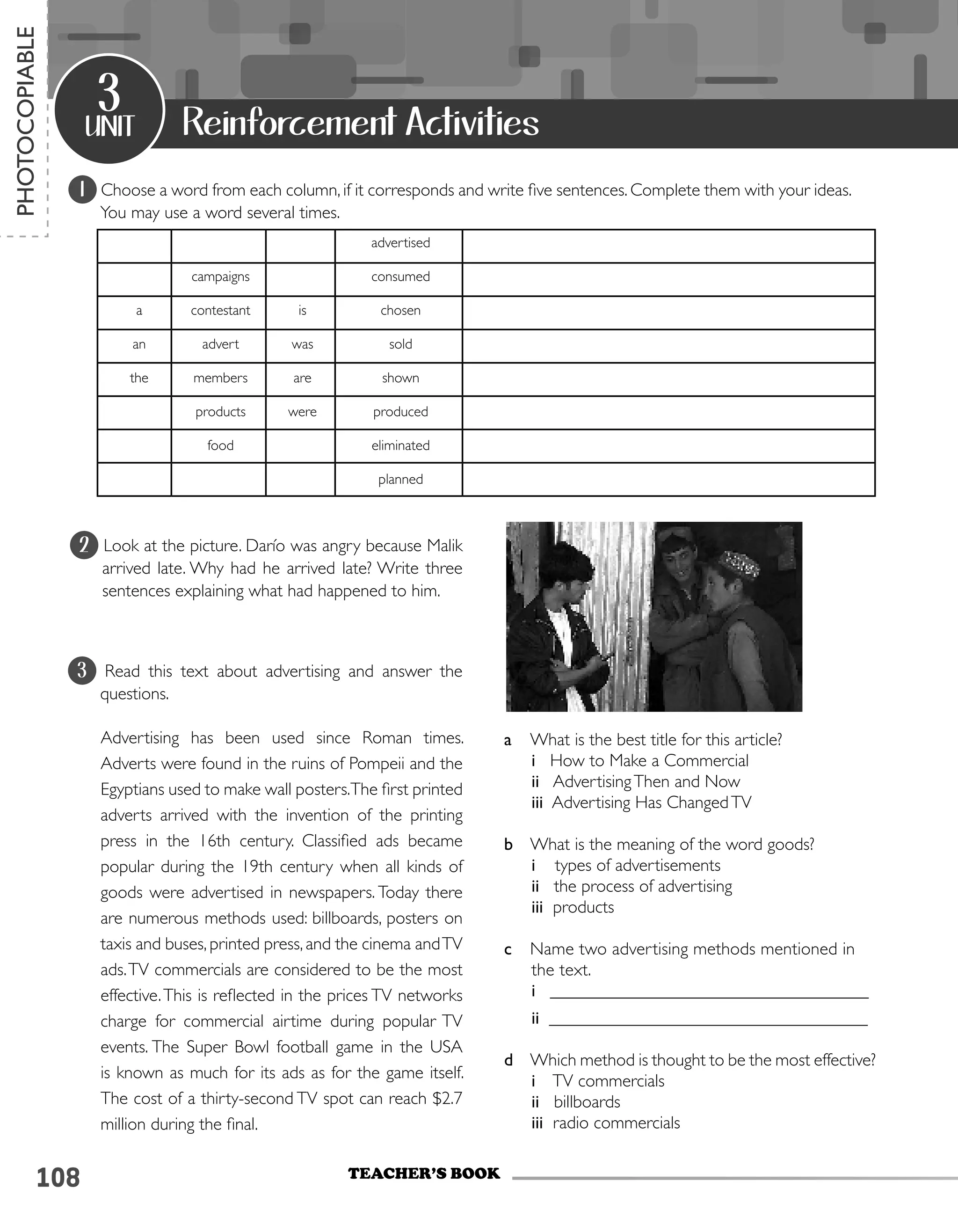
2 Look at the picture. Darío was angry because Malik
arrived late. Why had he arrived late? Write three
sentences explaining what had happened to him.
3 Read this text about advertising and answer the
questions.
a What is the best title for this article?
i How to Make a Commercial
ii AdvertisingThen and Now
iii Advertising Has ChangedTV
b What is the meaning of the word goods?
i types of advertisements
ii the process of advertising
iii products
c Name two advertising methods mentioned in
the text.
i ____________________________________
ii ____________________________________
d Which method is thought to be the most effective?
i TV commercials
ii billboards
iii radio commercials
unit
3
TEACHER’S BOOK
PHOTOCOPIABLE
Reinforcement Activities
advertised
campaigns consumed
a contestant is chosen
an advert was sold
the members are shown
products were produced
food eliminated
planned
Advertising has been used since Roman times.
Adverts were found in the ruins of Pompeii and the
Egyptians used to make wall posters.The first printed
adverts arrived with the invention of the printing
press in the 16th century. Classified ads became
popular during the 19th century when all kinds of
goods were advertised in newspapers. Today there
are numerous methods used: billboards, posters on
taxis and buses, printed press, and the cinema andTV
ads.TV commercials are considered to be the most
effective.This is reflected in the prices TV networks
charge for commercial airtime during popular TV
events. The Super Bowl football game in the USA
is known as much for its ads as for the game itself.
The cost of a thirty-second TV spot can reach $2.7
million during the final.
TEACHER’S BOOK
Lesson Summary
Aims: Develop reading
comprehension skills
SuggestedTime
90 minutes
Vocabulary
Travel and culture
Communicative Aims
Sequence sentences in a logical way
(Connectors)
Materials
Dictionary
45
Warm Up
Form groups of 10 students to sit
in circles with 9 chairs.The person
without a chair says a sentence
using ‘If you have…’. For example, If
you have been to the beach, change
chairs. The person without a chair
also finds a chair and sits down.
The person left without a chair
continues with a new sentence.
Student’s Book pages 118 and 119
Background Information
Cultural differences around the
world:
• Shaking the head in a horizontal
direction in most countries
means ‘no’, while in India it
means ‘yes’.
• Laughing is connoted in most
countries with happiness -
in Japan it is often a sign of
confusion, insecureness and
embarrassment.
Source: http://www.cicb.net/en/home/
examples
174
Pre-Reading
1. Students answer
the questions
individually.
2. Students calculate
their score and share
with their partner.
Encourage them
to ask follow up
questions.
While Reading
3. Elicit what students know about how some
cultures may do things differently from Chileans.
Students read the text and check their answers
for activity 3. Clarify any unknown vocabulary.
Answers:
a before 10pm.
b can pressure guests to eat and drink.
c bad manners in Dutch and Russian homes.
d the unlucky number.
e blood and anger connotations.
UNIT 6118
Pre- Reading
While Reading
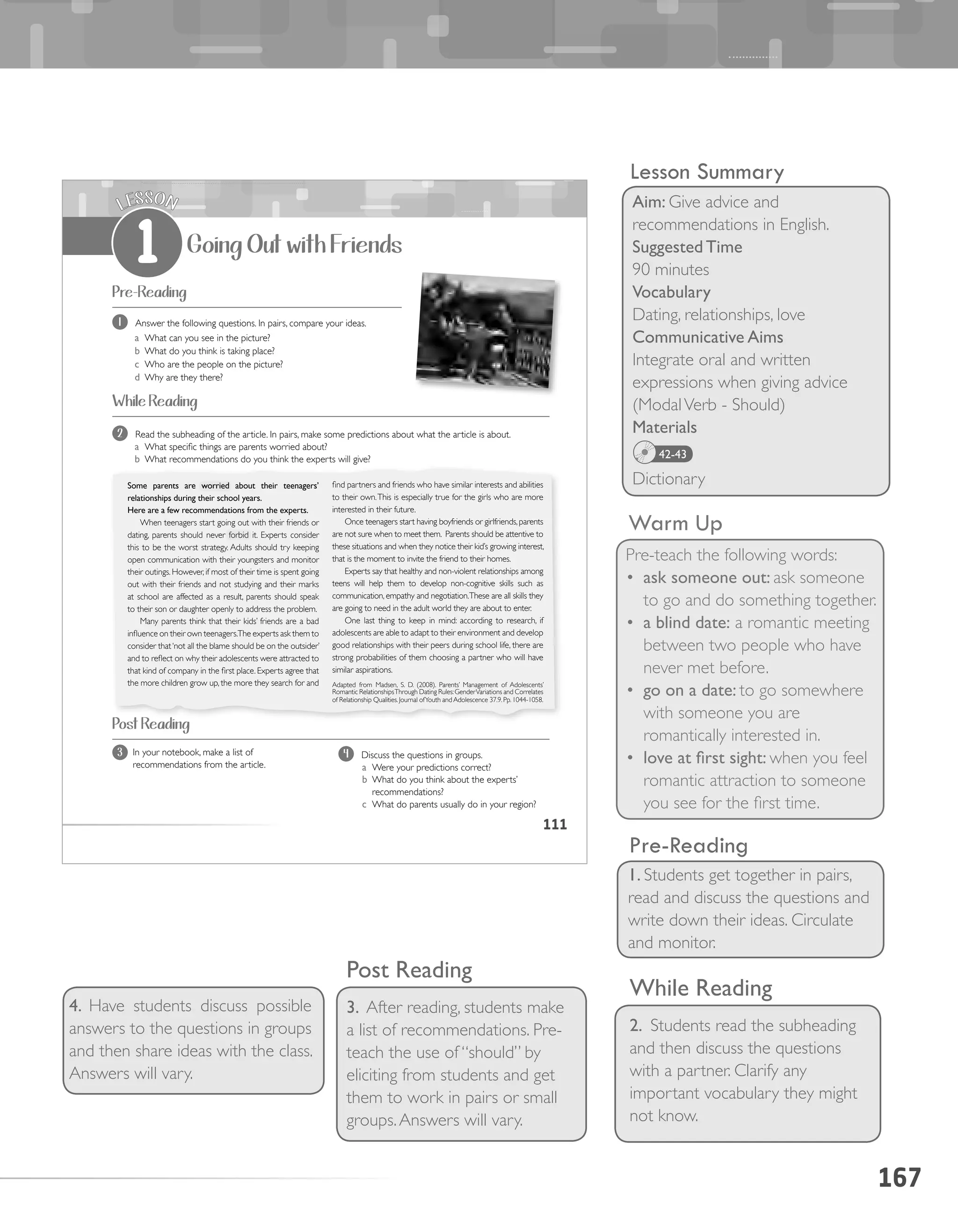
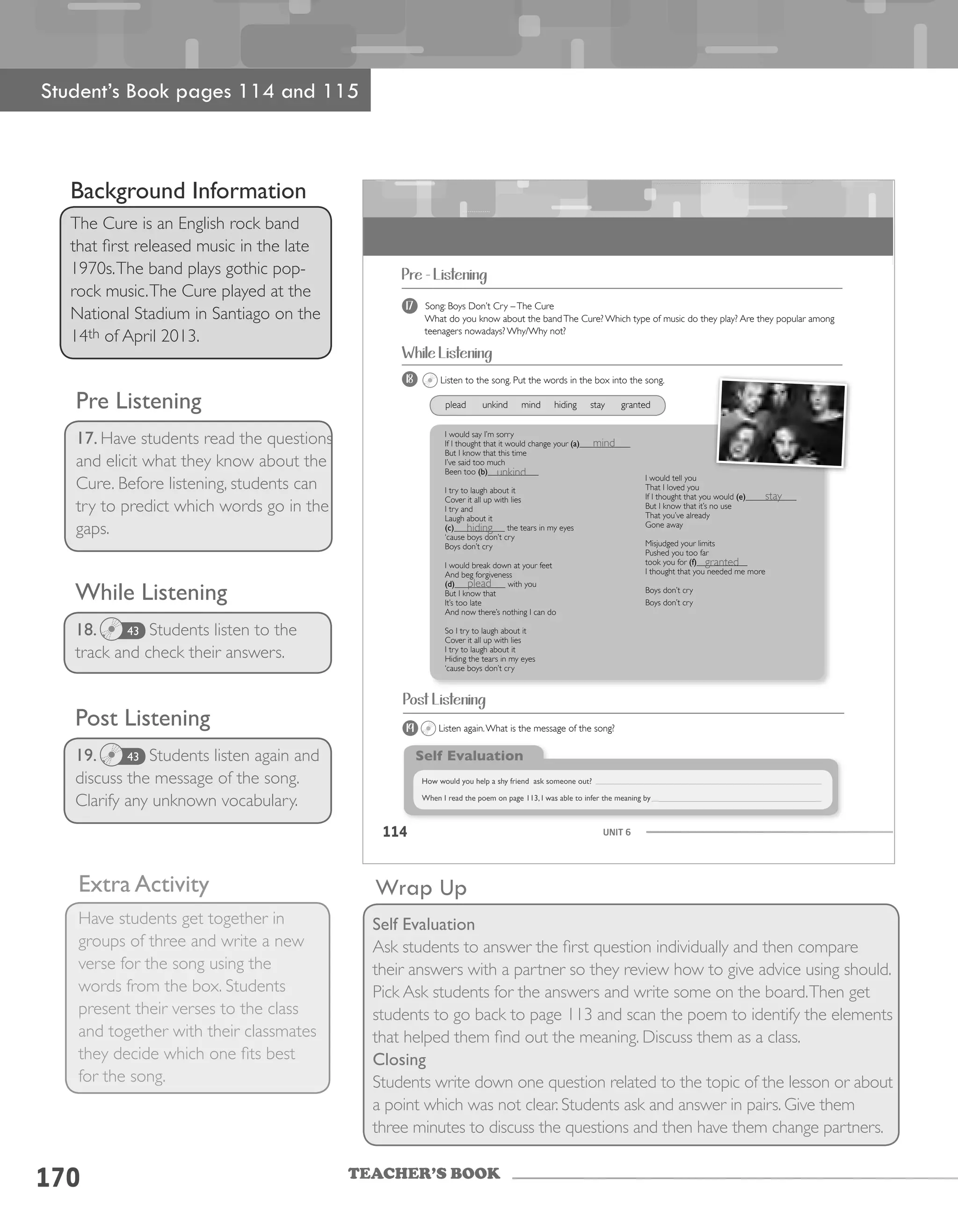
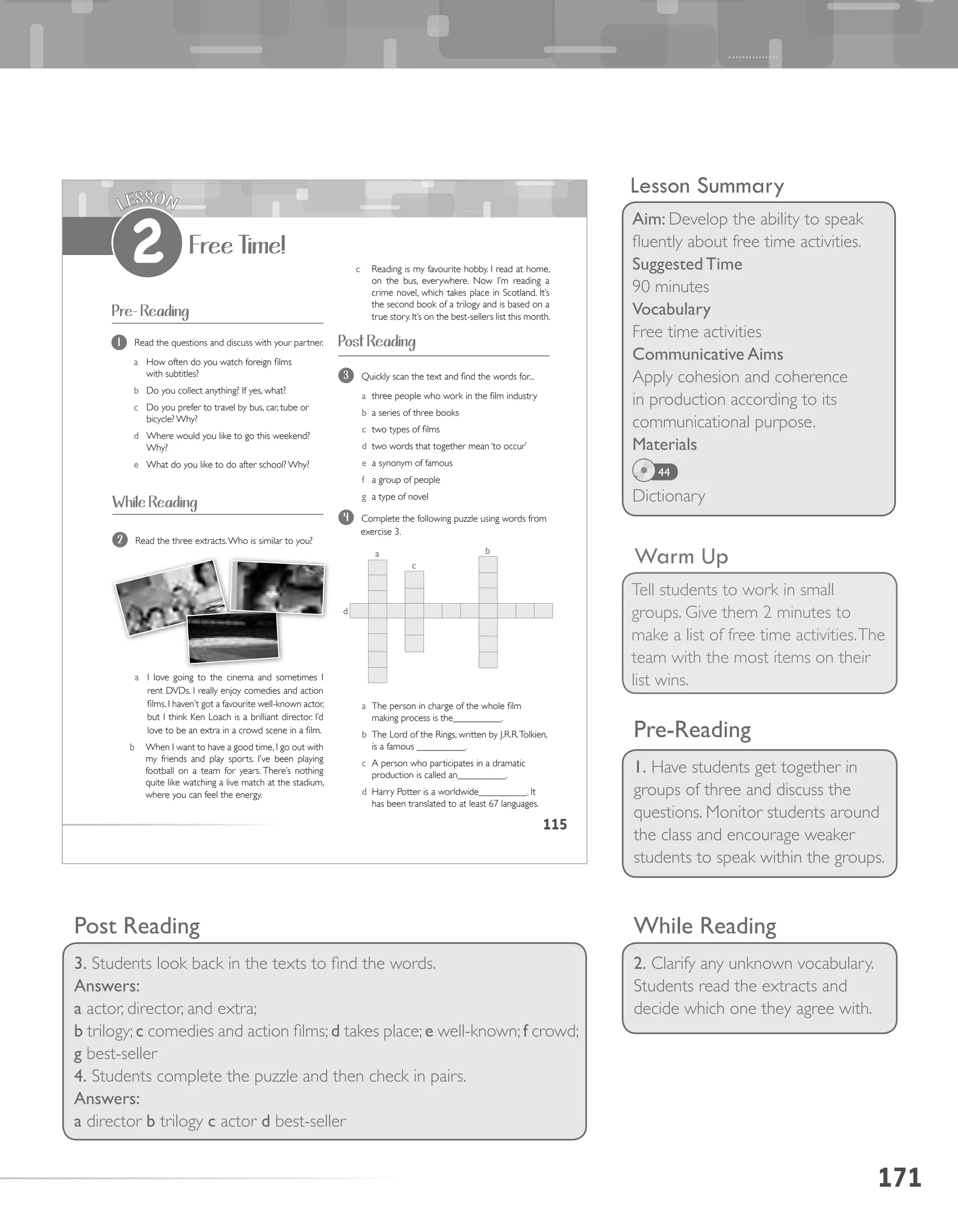
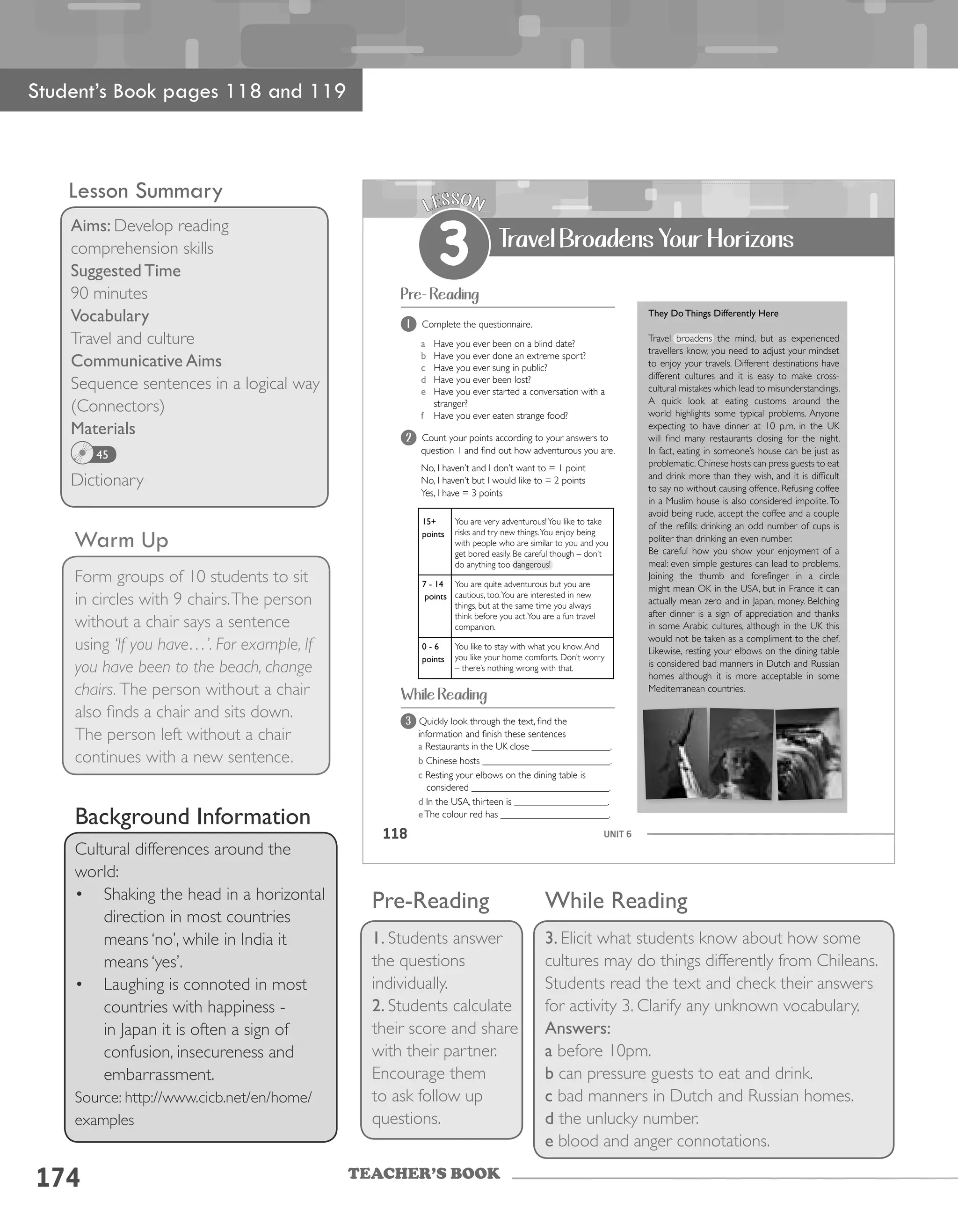
1 Complete the questionnaire.
a Have you ever been on a blind date?
b Have you ever done an extreme sport?
c Have you ever sung in public?
d Have you ever been lost?
e Have you ever started a conversation with a
stranger?
f Have you ever eaten strange food?
LESSON
3 Travel Broadens Your Horizons
2 Count your points according to your answers to
question 1 and find out how adventurous you are.
No, I haven’t and I don’t want to = 1 point
No, I haven’t but I would like to = 2 points
Yes, I have = 3 points
15+
points
You are very adventurous!You like to take
risks and try new things.You enjoy being
with people who are similar to you and you
get bored easily. Be careful though – don’t
do anything too dangerous!
7 - 14
points
You are quite adventurous but you are
cautious, too.You are interested in new
things, but at the same time you always
think before you act.You are a fun travel
companion.
0 - 6
points
You like to stay with what you know.And
you like your home comforts. Don’t worry
– there’s nothing wrong with that.
3 Quickly look through the text, find the
information and finish these sentences
a Restaurants in the UK close ________________.
b Chinese hosts __________________________.
c Resting your elbows on the dining table is
considered ____________________________.
d In the USA, thirteen is ___________________.
eThe colour red has ______________________.
They DoThings Differently Here
Travel broadens the mind, but as experienced
travellers know, you need to adjust your mindset
to enjoy your travels. Different destinations have
different cultures and it is easy to make cross-
cultural mistakes which lead to misunderstandings.
A quick look at eating customs around the
world highlights some typical problems. Anyone
expecting to have dinner at 10 p.m. in the UK
will find many restaurants closing for the night.
In fact, eating in someone’s house can be just as
problematic. Chinese hosts can press guests to eat
and drink more than they wish, and it is difficult
to say no without causing offence. Refusing coffee
in a Muslim house is also considered impolite.To
avoid being rude, accept the coffee and a couple
of the refills: drinking an odd number of cups is
politer than drinking an even number.
Be careful how you show your enjoyment of a
meal: even simple gestures can lead to problems.
Joining the thumb and forefinger in a circle
might mean OK in the USA, but in France it can
actually mean zero and in Japan, money. Belching
after dinner is a sign of appreciation and thanks
in some Arabic cultures, although in the UK this
would not be taken as a compliment to the chef.
Likewise, resting your elbows on the dining table
is considered bad manners in Dutch and Russian
homes although it is more acceptable in some
Mediterranean countries.
Pronunciation Guide
SyMBOL Examples
p
b
t
d
k
g
tʃ
dʒ
f
v
θ
ð
s
z
ʃ
ʒ
h
m
n
ŋ
l
w
r
j
pen, happy
back, but
two, talk
dog, do
came, key
game, girl
watch, chair
July, bridge
photograph, for
have
thing
the, this
see, city
please, goes
shirt, station
pleasure
hat, who
man, some
sun, know
sing
like
white, we
run, very
yes, you
SyMBOL Examples
/i:/
/ɪ/
/eɪ/
/e/
/æ/
/ɑ/
/ɔ/
/oʊ/
/ʊ/
/u/
/ʌ/
/ə/
/ɚ/
/aɪ/
/aʊ/
/ɔɪ/
/ɪr/
/ɛr/
/ɑr/
/ɔr/
/ʊr/
see, eat
did, city
day, eight
bed, dress
cat, bad
box, father
bought, dog
go, no
book, good
food, student
but, mother
banana, computer
shirt, hurt, her
buy, eye, my
how, now
boy
near, here
hair, there
bar
door
tour
Consonants Vowels
268 TEACHER’S BOOK
Grammar Reference
FUTURE SIMPLE:WILL
Use:
• a spontaneous decision
• an opinion, hope, uncertainty or assumption regarding
the future
• a promise
• an action in the future that cannot be influenced
Affirmative: I/you/we/they/he/she/it + will + verb
infinitive
Negative: I/you/we/they/he/she/it + will + not
(won’t) + verb infinitive
Interrogative: will+ I/you/we/they/he/she/it + verb
infinitive+?
SignalWords: in a year, next …, tomorrow
Expressions: I think, probably, perhaps
REPORTED SPEECH
Use:
• to repeat what a person has said
Unit 5
Direct Speech: ‘I am not going to school today,but I will
tomorrow’.
Reported Speech: She said that she wasn’t going to
school that day, but she would go the next day.
• We often omit that in reported speech, especially in
informal situations:
Direct Speech: ‘Tom’s been to London many times’
Reported Speech: She said (that) Tom had been to
London many times.
•We don’t use quotation marks (‘) in reported speech.Only
to indicate direct speech:
Direct Speech:‘I love travelling and meeting new people’
Reported Speech: She said (that) she loved travelling
and meeting new people.
Remember:
• We often use the verbs say and tell to introduce reported
speech.Tell is always followed by an object, but say is not:
She told me she was eighteen years old.
She said she was eighteen years old.
• When we report questions we make the same changes to
tenses, pronouns and references to time and place as we do
with statements:
Direct Speech:‘Do you often go to the cinema?’
Reported Speech: He asked us if we often went to the
cinema.
Direct Speech: ‘Why are you so serious?’
ReportedSpeech:HewantedtoknowwhyIwassoserious.
• We don’t use auxiliaries like do, does or did in reported
questions:
Direct Speech:‘What time did you go to bed?’
Reported Speech: He asked what time I had gone to
bed
• When we report yes/no questions, we use if or whether
in the reported question:
Direct Speech: ‘Do you like eating crisps?’
Reported Speech: He wanted to know if we liked
eating crisps.
Remember:
• We use affirmative and NOT interrogative, word order
in reported questions:
Direct Speech: ‘Why are you wearing red clothes
today?’
Reported Speech: She asked me why I was wearing
red clothes that day ( NOT why was I wearing..?)
• We can replace would with other modal verbs in
second conditional sentences:
We could go to the theatre tonight if you wanted to.
If we phoned Julie, she might come with us.
NOTE:
• We often use were and not was in second
conditional sentences with the pronouns I/he/she/ it:
If Sally were here, she would know what to do.
REPORTED QUESTIONS
CONDITIONAL: 2nd
Use:
•To talk about imaginary or improbable situations in
the present or the future
•To give advice
IF CLAUSE (CONDITION) MAIN CLAUSE (RESULT)
If + past simple would + infinitive verb
If you saved money, you would be able to
buy a house.
260 TEACHER’S BOOK
•	 Rubrics For Skills Assessment
Scales with criteria provided for the assessment of all four skills in
activities related to projects and individual or group presentations.
•	 Question Bank
This is a set of questions provided to help you in the construction of
guidelines needed for activities and projects.
•	 Pronunciation Guide
This section provides a phonological explanation that you may use in the
classroom for more specific or detailed practice of pronunciation in all
three levels: isolated sounds, stress and intonation.
•	 Irregular verbs
List of verb formation provided for corrections, assessment or as
guidance in what verbs are being used throughout the book.
•	 Bibliography
This section offers a variety of titles used in the text as well as
publications you may use for further research, methodology tips and
lesson preparation.
•	 Websites
In this section you will find a variety of websites which may help you in
the preparation specific topics for some lessons, further research or to
clarify information concerning functional language and everyday topics.
•	 Common Mistakes
Section provided to help you with the effective use of the language
through grammatical information concerning students’ usual errors.This
will help clarify problems with word and sentence order,punctuation and
tenses, as well as provide useful tips to make the practice of receptive
and productive skills more efficient.
•	 Grammar Reference
In this section you will find useful and simple grammatical explanations
for you to use in the classroom when students require quick and specific
details of use and formation of some structures.
9
Listening
2. 											Students	listen	to	the	recording	for	the	first	time	and	answer	individually.	Before	having	them	listen	
again, get them to check in pairs.After the second time they listen, have whole class feedback to check the correct
answers. Answers: a T;	b	F;	c	T;	d	F; eT
219
unit
E
xtra Tes
t
7
Warm Up
Wrap Up
Ask	students	what	do	they	remember	having	worked	on	unit	7	and	write	the	topics	on	the	board.	Have	students	
say out loud what they remember having read or listened about these topics and make some notes on the board
too.
This	stage	can	be	used	for	correction.	Have	students	switch	their	tests	with	partners	sitting	close	to	them.	Go	
through the answers with the whole class and clarify any doubts.
Background Information
Obesity is one of the most common illnesses
nowadays, and it is mainly caused by overeating
habits and lack of exercise. If you’re overeating often,
there are some things that might help you avoid
doing so. For example, instead of eating when you’re
not	hungry,	find	other	ways	to	keep	yourself	busy	
and don’t eat meals or snack while doing something
else, like watchingTV or doing homework.
Source:	http://kidshealth.org/teen/food_fitness/food_
fit_qa/expert_overeating.html
Common Mistakes
When students write, they tend to produce based
on spoken English, which leads to errors. Before
they go to the stage of writing revision, remind
them to focus on:
•	 Punctuation and Spelling
•	 Gammar accuracy and vocabulary in context
•	 Target audience and register
•	 Organisation of ideas
Reading
1. Go through the instructions and check students have understood by asking some questions such as ‘Do you
need to write anything?’ and ‘Do you need to match?’.You can also help them by explaining how to work in this type
of	activities,	in	which	they	should	first	read	quickly	for	a	general	idea	of	what	the	text	I	about	and	then	scan	for	
specific	information	that	links	each	paragraph	to	a	heading.	Students	read	and	match	individually	so	they	can	later	
check with a partner. Answers: a	ii;		b	iv;	c	iii;		d	i;	e v
Writing
3.Encourage students to plan their writing in order to save time and organise their ideas better.After writing,direct
students to the GeneralWriting Rubric with Descriptors on page 188 of the Student’s book so they can assess
their own written piece before handing it in and to follow the three stages of writing (planning-producing-revising).
56
Question Bank
Question Bank for the Construction ofValue Scales or Check Lists
(Alternative evaluation activities)
Listening Comprehension
•	 Does the student recognize sounds specific to the English language?
•	 Does the student understand the general meaning of a simple message within a specific linguistic context?
•	 Does the student follow simple oral instructions within a particular linguistic context?
•	 Does the student identify specific information associated to people, objects, and animals?
•	 Does the student use simple social expressions that he or she has learned throughout the year?
•	 Does the student make linguistic connections based on his or her previous knowledge?
•	 Does the student react to the texts he or she has heard by performing a related action or expressing
a preference?
•	 Does the student make personal connections through speech or using illustrations?
Oral Expression
•	 Does the student repeat chants, rhymes, and songs while recognizing the specific English sounds?
•	 Does the student reproduce short phrases while recognizing all of their sounds specific to English?
•	 Does the student express him or herself in brief dialogues with the help of a teacher and images about
topics they know?
•	 Does the student use and understand simple social expressions learned throughout the year?
•	 Can the student produce short phrases developed by the teacher?
•	 At the end of the year, can the student participate in short dialogues with their peers and teachers?
Reading Comprehension
•	 Can the student understand written words and simple sentences?
•	 Can the student understand the general message of brief and simple texts with the help of visual aids?
•	 Can the student identify explicit information linked to basic subjects (personal information, school, family,
clothing, animals, toys, the weather) in brief and simple texts with the help of visual aids?
•	 Can the student identify and understand commonly used expressions and vocabulary that has been
studied throughout year?
•	 Does the student react to the text at hand by expressing a preference and/or connecting it to personal
experiences either orally or through illustrations?
•	 Does the student use the strategies of pre-reading (by using their previous knowledge and visual elements),
reading (by using the visual aid), and post-reading (by re-reading or reading to others and drawing)?
•	 Can the student interpret individual words or groups of words in a simple text?
266 TEACHER’S BOOK
Rubrics for Skills Assessment
Writing
Speaking
7 / Outstanding 5.5 / Appropriate 4 / Borderline 2 / Insufficient
The content is completely
relevant for the task.Target
reader is informed in detail
Minor irrelevances are
presented.Target reader is
successfully informed.
Misinterpretation of
instructions leads to limited
information delivered to target
reader.
Content is irrelevant, which
impedes target reader from
being informed.
Attention of target reader
is held through the use of
engagement devices and
straightforward ideas, which
also makes the written piece
easy to understand.
Straightforward ideas are
communicated through the
proper use of writing strategies.
The written piece
communicates simple ideas in
simple ways.
Simple ideas are not properly
transmitted, as there is lack of
devices and use of strategies.
The text is well-organised and
coherent, thanks to linkers and
cohesive devices.
The text is connected and
coherent, using simple linkers
and only some cohesive
devices.
The text is connected using
common linkers, which does
not always assure coherence.
The text is not properly
connected, as lack of linkers
and useful expressions lead to
incoherence.
There is usage of a wide
range of everyday vocabulary
with little inappropriate use
of less common lexis and
good control of complex
grammatical forms. Errors do
not impede communication.
Everyday vocabulary is used
appropriately in general,
with occasional repetition of
common lexis.There is a good
control of simple grammatical
forms, and even though errors
are identifiable, meaning can
still be conveyed.
Only basic vocabulary is used
appropriately, there is some
control of simple grammatical
forms. Meaning may be
impeded to be conveyed
because of language errors.
There is poor control of simple
grammatical forms and basic
vocabulary is used in excessive
repetition. Meaning cannot be
conveyed because of constant
language errors.
7 / Outstanding 5.5 / Appropriate 4 / Borderline 2 / Insufficient
Good control of simple
grammatical forms and some
successful attempts to use
complex structures.Wide
range of vocabulary to express
different views of every day
topics.
Good control of simple
grammatical forms. Desired
range of vocabulary to express
ideas about every day topics.
Sufficient control of simple
grammatical forms. Limited
range of vocabulary to express
ideas about every day topics.
Poor control of simple
grammatical forms. Poor range
of vocabulary, which makes
difficult to express ideas about
every day topics.
Discourse is extended beyond
short utterances. Hesitation is
hard to detect. Contributions
are relevant, with almost no
repetition of ideas.A wide
range of cohesive devices are
used.
Discourse is extended beyond
short utterances despite
hesitation. Contributions are
relevant, but repetition of ideas
is detected. Basic cohesive
devices are used.
Discourse is characterised by
short phrases and constant
hesitation. Repetition of ideas
and digression from the topic
make contributions irrelevant
sometimes.
Excessive hesitation makes
short phrases almost
impossible to understand.
Digression from topic impedes
contributions to be expressed.
Comprehensible, thanks to the
use of appropriate intonation,
accurate stress of syllables and
clear articulation of individual
sounds.
Mostly comprehensible.
Correct control of phonological
features in simple utterances.
Comprehension is sometimes
obscured by the lack of control
of phonological features in
longer utterances.
Comprehension is obscured by
the constant lack of control of
phonological features in short
utterances.
Appropriate initiation of
conversations and response
to ideas from partners.
Maintenance and development
of a conversation is shown
through negotiation and
discussion of ideas.
Construction of questions and
answers to keep a conversation
going.Attention to partner’s
discourse is shown.
Simple exchange of information
despite some difficulty.
Prompting and support is
needed.
Exchange of information is
almost impossible, as prompting
and support are necessary for
the student to establish aids for
communication.
TEACHER’S BOOK
264
ContentCommunicationOrganisationLanguageUsageLanguage
Usage
Discourse
Management
PronunciationInteraction
Websites
•	 http://www.scientificamerican.com/article.cfm?id=fact-orfiction-runaway-greenhouse
•	 http://www.festivals.com/
•	 http://www.nutrition.gov./
•	 http://www.kidshealth.org/teen/flu_center/about_flu/immune.html
•	 http://www.famouspeople.com/sports-person.php
•	 www.foodnetwork.com/healthy-eating/index.html
•	 www.nationalgeographic.com
•	 www.unesco.org
•	 www.unicef.org
•	 www.lonelyplanet.com
•	 www.traveltochile.net/chile-cities.htm
•	 www.artcyclopedia.com
•	 www.britishmuseum.org
•	 www.moma.org/
•	 www.bbc.co.uk/science/humanbody/mind/surveys/careers/
•	 www.nationsencyclopedia.com
•	 www.sofofa.cl
•	 www.englishclub.com
•	 www.englishlistening.com
•	 www.english-test.net
•	 www.funbrain.com
•	 www.teachingenglish.org.uk
•	 www.tolearnenglish.com
•	 www.usingenglish.com
•	 www.dictionary.cambridge.org
•	 www.dictionary.com
•	 www.vocabulary.com
•	 www.guardian.co.uk
•	 www.stumbleupon.com
•	 http://rubistar.4teachers.org/
272 TEACHER’S BOOK
Bibliography
For theTeacher
•	 Alderson, J. C., and Urquhart, A. H. (1984).
Reading in a
Foreign Language. London: Longman.
•	 Alderson, J. C. Testing Reading Comprehension
Skills.
http://nflrc.hawaii.edu/RFL/PastIssues/rfl62anderson.pdf
•	 Alexander, L. (1995). Longman English Grammar
Practice
for Intermediate Students. New York: Longman.
•	 Campbell, C., and Kryszewska, H. (1992). Learner-
based
teaching. Oxford: Oxford University Press.
•	 Capel, A. (2008). Objective First Certificate
Student’s Book
withanswers+100TipsWritingBooklet.Cambridge:
Cambridge University Press.
•	 Finch, D. F., and Ortiz Lira, H (1982). A Course
in English
Phonetics for Spanish Speakers. London: Heinemann
Educational Books Ltd.
•	 Grellet, F. (1995). Developing Reading Skills (15th
ed.).
Cambridge. Cambridge University Press.
•	 Linda, S. (1996). Vocabulary Games for Intermediate
English Language Learners. New York: McGraw-Hill
Contemporary.
•	 Lowes, R. (1998). Helping Students to Learn: a
Guide to
Learner Autonomy. London: Richmond.
•	 Murphy, R. (1996). English Grammar in Use: a
self-study
ReferenceandPracticeBookforIntermediateStudents:
with answers (2. ed.). Cambridge: Cambridge
University
Press.
•	 Murphy, R. (2006). Essential Grammar in Use
Spanish
Edition. http://www.scribd.com/doc/29015505/
Essential-
Grammar-in-Use-Spanish-Edition
•	 Nam, J. TESL Canada Journal/Revue TESL du
Canada,
•	 Pineda, A. (1999). Helping Learners to Develop
Reading
and Listening Skills in English. Santiago: Ministerio de
Educacion, Programa MECE/Educacion.
•	 Richards, J. (2006). Communicative Language
Teaching
Today. New York: Cambridge University Press.
•	 Rost, M. (1991). Listening in Action: Activities for
Developing Listening in Language Teaching. New
York:
Prentice Hall.
•	 Ur, P. (1984). Teaching Listening Comprehension.
Cambridge: Cambridge University Press.
•	 Willis, J. (1996). A Framework for Task-based
Learning.
Harlow, Essex: Longman.
From Student’sText
Unit1.P.12: AdaptedfromLewin,K.(1999).TheComplete
Social Scientist: A Kurt Lewis Reader. Washington, D.C.:
American Psychological Association Press
Unit1.P.19:AdaptedfromCorrales,S.(1997).Chupacabras
and Other Mysteries. Sheffield: Greenleaf Publishing.
Unit 2. P. 23: Adapted from Pérez, F. (2012). Mitos y
leyendas de Chile.
Unit 2. P. 32-33: Taken from Fidalgo, A., Fantinillo, A.
& Mayorga, I. (2010). In Gear 1. Oxford: Richmond
Publishing. Pp. 6-7.
Unit 2. P. 35: Adapted from Roberts, L. (2013). Interview:
Inti Castro’s graffiti legacy in Chile’s port city. The
Santiago Times. Retrieved October 25, 2013, from http://
santiagotimes.cl/interview-inti-castros-graffiti-legacy-in-
chiles-port-city/
Unit 2. P. 38: Taken from Carrol, L. (1948). Alice’s
Adventures in Wonderland.
Unit 2. P. 38: Taken from Downie, M., Gray, D., Jiménez,
J.M. (2011). Target B1.
Unit 2. P. 41: Adapted from Rosemary Jackson (1981).
Fantasy: The Literature of Subversion.
Unit 3. P. 52: Adapted from Devolld, T. (2011). Reality
TV: An Insider’s Guide to TV’s Hottest Market. Los Angeles:
Michael Wiese Productions.
270 TEACHER’S BOOK
IrregularVerbs
be was/were been
beat beat beaten
become became become
begin began begun
bite bit bitten
break broke broken
bring brought brought
build built built
buy bought bought
catch caught caught
choose chose chosen
come came come
cost cost cost
cut cut cut
do did done
draw drew drawn
dream dreamt/dreamed dreamt/dreamed
drink drank drunk
drive drove driven
eat ate eaten
fall fell fallen
feed fed fed
feel felt felt
fight fought fought
find found found
fly flew flown
forget forgot forgotten
freeze froze frozen
get got got
give gave given
go went gone
grow grew grown
have had had
hear heard heard
hide hid hidden
hit hit hit
hold held held
keep kept kept
know knew known
lay laid laid
learn learnt/learned learnt/learned
leave left left
let let let
lose lost lost
make made made
mean meant meant
meet met met
pay paid paid
put put put
read read read
ride rode ridden
ring rang rung
run ran run
say said said
see saw seen
sell sold sold
send sent sent
shoot shot shot
show showed shown
shut shut shut
sing sang sung
sink sank sunk
sit sat sat
sleep slept slept
smell smelt/smelled smelt/smelled
speak spoke spoken
spend spent spent
stand stood stood
steal stole stolen
swim swam swum
take took taken
teach taught taught
tell told told
think thought thought
understand understood understood
wear wore worn
win won won
write wrote written
Infinitive Past simple Past participle Infinitive Past simple Past participle
269
10
1 Greetings
Tune Up 12th grade has been developed and written taking account the patterns and activities most relevant to the
effective learning process adequate for 12th grade students in Chile.
The book was created with the intention of giving the teacher a set of resources and guidelines that will facilitate
interactive, fun and interesting classes and achieve visible results. By giving students access to a variety of authentic
materials and orienting the lessons to encourage communication about real teenagers’ issues in Chile, the book
provides a wide range of possibilities for both teacher and student.
Language textbooks often prioritise grammar and closed-response activities, but the goal ofTune Up 12th grade
was to trust students’ ability to not only follow instructions, but also to expand and develop their own ideas and
opinions in English. By focusing on themes while giving functional examples of grammar, the book encourages
students to express themselves individually and recognise their own unique path towards mastering the English
language.
Language, at its most basic, is needed for communication and verbal exchange of ideas. Concepts, vocabulary and
grammar are irrelevant if they aren’t used to effectively express oneself.
INTRODUCTION
11
2 The learning process
2.1 Diversity in learning styles and multiple
intelligences
Tune Up 12th grade considers that teenagers’ learning
is not linear and that there is a complex relationship
between input and output as students engage in a
process of independent construction of meaning
through personal and collective analysis of what is new
to what is previously known.This is reflected in every
unit, and can be seen in many sections such as the Self
Evaluation, which gives the opportunity for learners to
express their ideas and analyse content according to
their individual tendencies, so the appeal to different
kinds of emergent learning styles is maximised.
By exposing students to language in a variety of
contexts, they will gain the opportunity to internalise,
acquire and use language in an organic way.
2.2 Learning autonomy
As every student is different and has different needs,
it is important that they have the opportunity to not
only identify their own learning styles, but exceed their
potential when applying critical thinking.
Critical thinking involves analysing and questioning the
topics as well as the language itself instead of merely
digesting and repeating it.
2.3 Fantasy and imagination
These aspects are essential in the world of every
person. Imagination will enable students to process
and understand their feelings and experience of the
world.They help develop a positive sense of self-
identity and aspects of emotional intelligence such
as empathy and understanding the predicaments of
others.
In projects and class discussions students should be
encouraged to use their emotional abilities to fulfil the
requirements of each activity in an integral way.
3 The teaching process
3.1 Skill-based lessons
InTune Up 12th grade the learning focus is on
effective communication in a wide range of situations
and contexts. In a practical sense, language is only
useful when it used in a functional way. Students need
to practise receptive and productive skills in order to
be able to communicate in several contexts that are
relevant for them as teenagers.
Through the receptive activities, students receive
information through reading and listening that can
then be used functionally in the productive activities of
speaking and writing. Both types of activities prepare
students not only for class evaluations, but also to
hold their own in the types of real world situations on
which the activities are based.
12
3.2 Teaching programme
In order to maximise the English class experience,
the teacher should be aware of the context in
which he/she is immersed.The location, age group,
socioeconomic status and individual characteristics of
students can all drastically affect the teaching process.
As each student is unique, each lesson should foster
the development of the different learning styles, taking
account that multiple intelligences are present in
each group.The teacher should always teach his/her
students and not just a lesson plan.
3.3 Lesson Organisation and experiential learning
As the educational theorist David A. Kolb says, In order
for optimal learning to take place, the knowledge
acquired in every stage of a lesson needs to be
followed by further processing in the next stage, in a
recursive cycle.
i Concrete experience
‘Something happened to me in the classroom’ which
involves intuitive feeling.
ii Reflective observation
‘Let me step back and look at what took place’ which
involves watching and perception.
iii Abstract conceptualisation
‘What principle or concept can I formulate which
will account for this event?’ which involves intellectual
thought.
iv Active experimentation
‘Let me try to implement this idea in practice’ which
involves real-time action that will entail further
concrete experience.
3.4 Aim of evaluation
The evaluations serve to measure the progress of each
student in both a quantitative and qualitative manner.
The idea is not to evaluate the results, but to look
back at the process which led to those results so the
contents can be revised and recycled in future lessons.
Beliefs about language
teaching and learning
Post-lessons:
Absorb and adapt new
information
Pre-lesson:
Draw on experience of
teaching and learner’s
responses and behaviour
Tactics:
Response to particular
learners’ behaviour in
specific teaching situations
Task:
Choose appropriate
learning experiences for
specific and general goals
MatchEvaluation
Strategy
TheoryPlanDecisions
(Adapted from Anning, 1988)
Concrete
experience
Abstract
conceptualisation
Reflective
observation
Active
experimentation
(based on D.A. Kolb, Experiential
Learning: Experience as the Source of
Learning and Development, Prentice
Hall, 1984, p. 42)
13
4 The book
4.1 Organisation of units
Tune Up consists of eight units, designed to address
different themes that are topical and in line with
Chilean teenagers’ interests.
Unit 1: People and Our Beliefs
The first unit focuses on diversity and belief systems.
The book begins by encouraging students to identify
stereotypes and to question their own biases while
also learning about traditional stories from many
cultures, including their own.With this as the starting
point,Tune Up encourages students to face the
material with sincerity and openness.
Unit 2: The Arts and Their Influence
The second unit focuses on art movements and
literature. It presents transversal topics such as music,
graffiti and classic literature. In Chile, the street art
scene is very developed and growing every day and it
is important that students see not just the value of art,
but also the importance of art that is flourishing in their
culture. Along with giving students the tools to discuss
different types of art, the unit pushes students to consider
the societal discourse behind the creation of this art and
what it says about opportunity and tradition.
Unit 3: What’s On?
This unit focuses on the media and its pervasive role
in our postmodern societies. Students discuss the
reality behind “reality” television as well as the role that
advertising plays in directing public attention. As well
as encouraging students to evaluate the truths that are
sold by the media, the unit gives students the tools to
tell their own stories.
Unit 4: Keeping up with Technology
The fourth unit is closely related to the life of present
day teenagers, most of whom spend much of their
day communicating with their thumbs rather than
their mouths. The lessons focus on text language,
social media, and future developments in technology.
The goal of the unit is both practical and critical, as it
gives students the language to discuss the topics they
would be discussing outside of class while also pushing
them to consider the potential problems with such a
plugged-in society.
Unit 5: Part Time, or Full Time?
The second half of the book focuses on topics that
are relevant to students who are about to leave
high school and become more independent. This
unit includes topics related to employment and
undergraduate programmes of study. Students will
practice language that will be valuable in the near
future while also considering how they would like to
shape that future.
Unit 6: Spending Time Together
This unit focuses on relationships between teenagers
and societal problems that affect them. It addresses
romantic relationships, friendship, and giving advice
about common teenage problems. Teenagers are
exceedingly preoccupied thinking about these aspects
of their lives and it is important to give students the
opportunity to discuss them.
Unit 7: Moving Forward
As students are growing up and moving to the next
step of their lives, it is crucial that they begin to see the
long term effects of their behaviour and the habits of
their culture. This unit pushes students to talk about
the health problems in Chile and the negative aspects
of the Chilean lifestyle that could prevent them from
being healthy in the future.The activities encourage
students to evaluate their routines and actively seek a
healthier, more balanced lifestyle.
14
Unit 8: The Price of Progress
This unit was designed to encourage students to
evaluate the changes that are happening to our planet
and the role that they play in the economy of Chile.
In a country with many valuable natural resources,
it is important that Chileans evaluate the practices
happening all over the world that could have severe
consequences related to the environment. Global
warming has become a global topic of discussion and
students will learn how to discuss its effects in their
own country and in the others that will be negatively
affected by extreme weather and depletion of
resources.
4.2 Sections and their role
i Lesson components
Pre-Reading / Listening
These sections encourage students to predict and
anticipate the information in the task before reading
or listening to it. This is a necessary step to practice
to increase comprehension, as proficient readers often
read ahead of their own pace as a way to predict what
might unfold in the story and native speakers often
talk over each other without missing any key points.
These activities are also designed to boost students’
confidence. Most are open-ended activities that
push students to predict content or vocabulary,
activating their prior knowledge. When the students
feel comfortable guessing and assuming based on
their own knowledge and creativity, their guards are
down and they are more receptive and more likely to
comprehend the task at hand.
While Reading / Listening
These tasks inTune Up are designed to test students’
ability to comprehend English in a real world context.
They range from a text message to a literary excerpt
to an interview. The variety of material forces
students to pay attention to the purpose behind the
activity. Some of the reading texts require skimming
while other activities ask students to find key details
within longer texts. Similarly, the listening tasks require
students to identify both specific details and greater
themes or narratives.
Post Reading / Listening
These sections push students to personalise or give
projection to the content of the reading or listening.
These tasks will generally ask students to speak or
write about the concepts of the text or audio, using
their production skills to affirm their comprehension.
These activities are more specific when they deal
with vocabulary and more open when dealing with
concepts. Students will find that they remember the
ideas more when they go back to the text to look for
specific words or examples to support their points.
Speaking
Tune Up offers students a variety of exercises to
express themselves through the productive skill of
speaking. The activities are based on both background
knowledge and production of sounds that lead to
pronunciation as native speakers. The activities
are focused on developing and expanding the
context in which students feel comfortable speaking.
Throughout the book, students practise debates, casual
conversations, reports, and storytelling, among other
skills. As most of the activities are open-ended, the
burden falls on the student to fully express him or
herself by going back to the text to develop ideas and
to clarify any doubts.
15
Writing
The writing sections inTune Up are designed to
maximise students’ ability to write in real life situations.
By 12th grade, students are moving past basic
functional language in their writing and must begin to
diversify the written style they feel comfortable with
or the one that is required for different purposes
according to a variety of contexts. Throughout
the book, students will write letters, text messages,
persuasive essays, stories, and descriptions, along other
types of writing. The variety of the exercises pushes
students to trust their instincts and to not rely on
standard language that they have repeated in the past.
They are proficient enough to take on from casual to
formal register when writing.
Check This Out!
These boxes offer facts and background information
on the topics presented in the lesson. They allow
students to look deeper into the topics and can serve
as a jumping off point for projects or discussions.
Step It Up!
These boxes offer a challenge or project for students
that allows them to further research certain topics
in the lesson. The activities can be used for extra
practice, homework assignments, or to carry with fast
finishers.
Learning Tip
These boxes offer support based on the language
points from each lesson. They highlight common
mistakes that students make and offer suggestions to
avoid errors in the activities that follow.
British / American
These boxes draw attention to the words or phrases
from the lesson that are pronounced or written
differently in the USA and the UK. Many words have
a slightly different spelling and many common words
are completely different in both countries. In their
lives, students will encounter both types of English
and it is important for them to get a full picture of the
language while also being able to identify the subtle
differences between American and British English.
Self-Evaluation
Each lesson ends with a self-evaluation that
encourages personal reflection on strategies and tools
that students can use to keep improving their English
abilities as the school year passes. The questions are
to be answered individually and lead students to look
at their own process of learning in a more objective
way. Many times, students say that they ‘can’t’ or that
the content is ‘hard’ without considering their actual
learning style and the strategies that can be used to
maximise their potential. By encouraging students to
look not only at the content that confuses them, but
also at the strategies they could use to better manage
that content, the class will come together as a unit and
the students will develop individually as learners.
Review and Worksheets
These pages are at the end of each unit and serve
as a summary of the important themes and language
points of the lesson. It is important to have a
summary of the material before the evaluation so that
students can identify which sections of the unit are still
not clear.
Project
Each unit contains a project for the students to
complete in groups. The collaborative effort allows
students to learn from each other and use their
individual skills to support their group members.
Before each project, the students and teacher decide
together on a rubric that will be used to evaluate
them. By including students in this process, the teacher
16
assures that they are fully informed on what the goals
of the project are, feel a greater sense of connection
to the work they are doing and see these goals as
something that they can achieve.The projects are
presented to the class and every student evaluates
each group. The evaluation should include different
categories depending on the type of project so that
more than one group is recognised for a job well
done.
My Progress
Tune Up contains 8 evaluations, one for each unit. This
part of the book allows the teacher to evaluate the
students’ learning processes. The evaluations include
closed-answer questions as well as more open-ended
activities that allow each student to express his or
her opinion or personal experience. In addition, the
teacher’s guide presents a set of extra tests to be used
for further evaluation of each unit.
ii Reference information
Grammar Reference
You can expand on unit content with the help of
the grammar reference section, which provides with
complementary explanations for the content covered
throughout the Student’s Book.
Rubrics
This section offers different rubrics that can be used
to evaluate the projects and skills practice revised in
each unit as well as other, more interactive activities
that the class participates in.
iii TheTeacher’s Book
TheTeacher’s Book has its own set of boxes designed
to orient the teacher during class and to direct his or
her attention to potential mistakes the students will
make or to activities and information that complement
the content of the units.
Warm Up / Wrap Up
These boxes offer ideas to open and close the class in
a cohesive way. They are generally a set of questions
or a short activity that are meant to be completed
without the Student’s Book. The Warm Up boxes
are to open the class and get the students thinking
about the themes of the lesson before working with
the contents in the book. The Wrap Up boxes contain
activities and questions to close the class and to assist
the difficulties students still have with the material
through on the spot and delayed correction moments.
Background Information
These boxes give the teacher extra information
related to the topic at hand. They can offer
biographical details of famous people discussed in the
book or greater exploration of the themes of each
lesson.
Common Mistakes
These boxes draw attention to the typical mistakes
made by students learning English as a second
language. There are many similarities between
Spanish and English and just as many instances where
language that appears to be similar in both languages
is actually quite different. By drawing the teacher’s
attention to the common mistakes related to meaning,
pronunciation and form,Tune Up attempts to minimise
long-term confusion and allow for students to
progress with steady foundation.
Extra Activity
These activities are included to be used when there
is extra time in the class or as alternatives to the
activities in the Student’s Book. They give the teacher
options on how to approach the material and
opportunities to keep fast finishers occupied if they
finish early.
17
Extra Tests
Each unit has a photocopiable extra test as teacher’s
resource for further evaluation of the contents.
Reinforcement Activities
These pages are designed to complement the material
by giving the teacher a different style of exercise to
further explore the same content. They are generally
more visual exercises, games, and rhymes that allow
students to practise the content of each unit from a
different angle, serving as remedial practice for the
teacher to carry.
In offering a great variety of approaches and ideas to
both teacher and student,Tune Up seeks to develop
and maximise the skills of 12th graders and send
them off into the world with a greater knowledge
of practical and personal English. By developing
their skills with content that is based in their own
reality, students will have the foundation to express
themselves and discuss important topics with
confidence and certainty.
Songs and Rhymes
This section is included at the end of the teacher’s
guide to give students a greater understanding of
lyrical English and the way poetry and rhyme can
elevate the meaning of simple ideas. When students
practise rhyming and singing in another language,
the subtlety of intonation and metaphor can open
their eyes to other types of communication that are
different, but just as effective, as the academic reports
and articles they are used to reading in school.
5 Classroom management
One of the essential jobs of the teacher is to
determine the conditions in which learning can take
place.This could define the complete success or failure
of a course, so it is important to consider the teacher’s
attitude and personality, his/her intentions and the
relationship with the learners. Simple organisational
techniques can effectively lead every lesson to the
expected results.
5.1 Time and active space
Lessons should be previously planned in terms of
timing of activities and the pace of the class. It is
paramount to establish certain amount of time for
each stage of the lesson so the teacher can make sure
the core contents are properly addressed and that the
lesson keeps a consistent, active pace.
The space in the classroom is not merely a location
to seat the students, but must be used proactively
during the class to activate students’ bodies as well
as their minds. By having students move around the
classroom, switch partners and seating, and use the
infrastructure available to expose their learning, the
lesson will be infinitely more successful.
18
5.2 Seating arrangement
The way students and the teacher sit in the classroom
will determine how they will be able to interact.That
is why this point will vary depending on the space
available and the amount of students.
5.3 Giving instructions
Even though the level of the students is proficient
enough to comprehend more complex language,
instructions should always be straightforward by using
simple words and direct commands. It is also useful to
get students total attention by chesting the book to
visually convey the necessary information to complete
each activity.
To make sure students are able to work on their own,
the teacher should first ask some instruction checking
questions (ICQs) and then model the first part of the
activity so students can continue on their own.
5.4 Monitoring
As students work, the teacher should move around
the classroom to assess students performance without
interfering with their independent process.
Monitoring is also useful for identifying instructions
or content that are not clear. It gives the teacher the
opportunity to clarify either during the activity or
afterward.
5.5 Eliciting and error correction
The best way for students to learn is by trusting
themselves and their previous knowledge. It is not
necessary to explain every aspect of the content, as
much of it will come from students’ analysis. Any piece
of information the teacher wishes to add to the class
should be elicited from the students before he/she
intervenes.
Error correction can be done in two ways:
i On the spot correction
In these instances, the correction is necessary for the
activity to advance as planned. The teacher interjects
in the moment of the error to keep students on track
and aware of potential inaccuracies in the rest of the
activity.
ii Delayed correction
In these instances, the teacher monitors and notes
the relevant mistakes that students are making. These
mistakes are more general and not as crucial for
completing the activities.When the activity is finished,
these errors are corrected as a class without attributing
them to specific students. This allows students to realise
their capacity to correct their own errors, which will
give them confidence in future activities.
separate tables
horseshoe
circle
orderly rows
= teacher
= board (Adapted from How to teach English, by Jeremy Harmer)
19
5.6 The teacher as a model
The teacher should demonstrate the importance of
learning English outside of the classroom. Through his/
her enthusiasm, the students should see the positive
effects that a second language can have on their
lives.The teacher is meant to be a cultural and social
ambassador to the language, not merely an instructor.
5.7 Use of English in the classroom
The classroom may be one of the only contexts in
which students come into contact with English. Clear
guidance on instructional and classroom language is
included in theTeacher’s Book so that the teacher
can create standardised language that teenagers
will quickly recognise without needing to translate
anymore.
As the dynamic of the class will have students in pure
contact with the second language, they will also be
able to respond using English organically.
5.8 Behavioural management
The interaction between students and between
them and the teacher should establish horizontal
communication. Seeing each other as equals will give
students confidence as learners as well as force them
to take responsibility for their actions.
As the activities in the book require a mature level
of thought and production from the students, it is
important that they see the teacher as an asset to
them and not a figure who merely gives instructions
and corrects.
The teacher must also establish clear rules that lead to
a better understanding of the topics at hand and the
use of English in general.
20
CD INDEX
Track 1 Classroom Language
Welcome Unit
Track 2 page: 9 Activity 4.
Unit 1
Track 3 page: 11 Activity 2
Track 4 page: 14 Activity 13
Track 5 page: 15 Activity 2
Track 6 page: 17 Activity 6 Song Chicago
Track 7 page: 20 Activities 10 and 11
Track 8 page: 22 Activities 3 and 4
Track 9 page: 24 Pronunciation Activity 9
Track 10 page: 29 My Progress Unit 1 Activity 2
Track 11 Extra Test Unit 1 Urban Trends
Unit 2
Track 12 page: 31 Activity 1b
Track 13 page: 31 Activity 3
Track 14 page: 33 Pronunciation Activity 10
Track 15 page: 35 Activity 3
Track 16 page: 36 Pronunciation Activity 8
Track 17 page: 39 Activity 8
Track 18 page: 43 Activities 5 and 6
Track 19 page: 49 My Progress Unit 2 Activity 1
Track 20 Extra Test Unit 2YouTube
Unit 3
Track 21 page 54 Activity 11
Track 22 page: 55 Activities 3 and 4
Track 23 page: 60 Activity 11
Track 24 page: 61 Pronunciation Activity 14
Track 25 page: 62 Activities 3 and 4
Track 26 page: 63 Activities 8 and 9
Track 27 page: 69 My Progress Unit 3 Activity 1
Track 28 Extra Test Unit 3 Marketing in the USA
Unit 4
Track 29 page: 74 Activities 16 and 17
Track 30 page: 75 Activities 3 and 4
Track 31 page: 80 Activity 8
Track 32 page: 82 Activities 2 and 3
Track 33 page: 89 My Progress Unit 4 Activity 2
Track 34 Extra Test Unit 4 Social Networks
21
Unit 5
Track 35 page: 91 Activities 3 and 4
Track 36 page: 95 Activity 3
Track 37 page: 95 Activity 4
Track 38 page: 100 Activities 7 and 8
Track 39 page: 102 Activities 3 and 4
Track 40 page: 109 My Progress Unit 5 Activity 1
Track 41 Extra Test Unit 5 An English Course
Unit 6
Track 42 page: 112 Activities 9 and 10
Track 43 page: 114 Activities 18 and 19 Song Boys don’t cry
Track 44 page: 116 Activities 6 and 7
Track 45 page: 121 Activity 12
Track 46 page: 122 Activity 2
Track 47 page: 123 Pronunciation Activity 6
Track 48 page: 129 My Progress Unit 6 Activity 2
Track 49 Extra Test Unit 6Yoga
Unit 7
Track 50 page: 134 Pronunciation Activity 13
Track 51 page: 135 Activities 2 and 3
Track 52 page: 140 Activities 8 and 9
Track 53 page: 142 Activity 3
Track 54 page: 143 Pronunciation Activity 7
Track 55 page: 149 My Progress Unit 7 Activity 1
Track 56 Extra Test Unit 7 Junk Food
Unit 8
Track 57 page: 154 Activity 12
Track 58 page: 155 Activity 3
Track 59 page: 160 Activities 9 and 10
Track 60 page: 160 Pronunciation Activities 13 and 14
Track 61 page: 164 Activities 9 and 10
Track 62 page: 169 My Progress Unit 8 Activity 1
Track 63 Extra Test Unit 8 The City or The Country
Rhyme and Songs
Track 64 Rhyme Consumer Blues by Patrick May
Track 65 Song Ain’t no mountain high enough
Track 66 Rhyme Digital Confusion by Patrick May
Track 67 Song Rome wasn’t built in a day
Track 68 Song What you’ll do when I’m gone
Track 69 A Poem The Spring Flower by Burt Ryan
22
Classroom Language
Welcoming students
• Good morning everyone!
• Good afternoon everyone!
• How are you today?
Taking attendance
• OK everyone, your attention please.
• I’m going to call the roll.
Giving instructions
• Silence, please.
• Listen carefully.
• Let’s calm down.
• Come to the board.
• Go back to your seats.
• Open your books to page…
• Close your books, please.
• Go back to page…
• Pay attention, please.
• Clean up, please.
• Repeat, please.
• Raise your hand.
• Check your answers.
• Wait for your turn.
• Work in pairs.
• Work in groups.
• Let’s sing a song!
• Look at the picture.
• Mark with a check.
• Write your name.
• Let’s read.
Checking for understanding
• Do you understand?
• Do you need help?
• Are there any questions?
• Have you finished yet?
Encouragement
• Excellent!
• Congratulations!
• Good job!
Going to recess
• Let’s go to recess.
•Time for a break.
Saying goodbye
• Everyone, time’s up.
•That’s it for today.
•The class is over.
• See you next class.
• Goodbye.
23
Thematic Index
A
Art
C
Career prospects
Clothing
Cultural differences
E
Environment
F
Food
Folktales
Free time
Friendship
H
Health and Habits
I
Internet
J
Jobs
p. 30-49
p. 90-109
p.10-29
p. 159-169
p. 130-149
p. 10-29
p. 110-129
p. 110-129
p. 130-149
p. 10-29
p. 110-129
p. 110-129
p. 130-149
p. 70-89
p. 90-109
p. 10-29
p.30-49
p.10-29
150-169
p.10-29
p.50-69
p.30-49
p.10-29
p.70-89
p.110-129
L
Legends
M
Music
Myths
N
Natural Resources
P
Personality
R
Reality Shows
S
Social Networks
Stereotypes
T
Technological gadgets
Travel
TEACHER’S BOOK
24
Welcome
Lesson Summary
Student’s Book pages 8 and 9
Aims: Motivate students to learn
English.
Suggested Time
45 minutes
Vocabulary
Learning English in different ways
Communicative Aims
Use context and relevant
information when asking simple
questions.
(Review Simple Questions)
Materials
Dictionary
2
Warm Up
1. Have students look at the
illustrations on page 8 and read
what each person says.Ask
questions in general. Use the
SPEAK OUT! box to help you.
Speaking
1.Students identify themselves with pictures and the information.
2. Students read the questions and answer in pairs.Then they share.
Write answers on the board in columns a, b, c, d, and e.
3. Ask students to complete the activity in their groups and to use the
SPEAK OUT! box to help them express opinions.
WELCOME88
WELCOME
2 Talk to your partner for one minute then share with the class.
a	 Where	do	we	find	English	words	in	our	everyday	lives	
here in Chile?
b	 Where	have	you	seen	English?
c	 Where	have	you	heard	English?
d	 Do	you	listen	to	music	or	watch	video	clips	in	English?
e	 Do	you	ever	chat	with	people	in	other	countries	online?
I think…
What do you think?
In my opinion…
And your opinion?
Because…
But…
SPEAK OUT!
Speaking
3 a Look	how	easy	it	is	to	learn	English!
Simple alphabet: The	girl	and	the	dog.	
Easy plurals:	One	car	–	two	cars.	There	are	very	few	exceptions.	
Short words:	Most		basic	words	are	short,	for	example:	run, work, big, go, man.
Longer words are often shortened: fridge:	refrigerator,		PC:	personal	computer.	
Call everybody ‘you’: You	can	say	‘Do	you	speak	English?’	to	your	friend	or	to	your	teacher	
or	to	a	group	of	people.
b Write	down	two	more	easy	aspects	of	learning	English.	Then	think	about	what	you	find	difficult.	Share		
your ideas with your partner.
Which students do you identify with?
Daniel
Eva
Cris
Manu
I’m bad at learning
languages. I’ll never
improve.
1
I don’t want to speak
because I’m scared of
making mistakes.
I need to
study more
grammar.
I need to
translate
every word.
SPEAK OUT!
Get students to talk about their
experience learning English in the
past and what are their expectations
for this year.
Teacher: What experience have you
had learning English? Has it been
dififcult? Easy? Interesting?
25
Listening
4. a Read the instructions as
a class and ask students to predict
what the conversation will be about.
Play the recording once and ask
them what they understood.
Teacher:What did the girls talk about?
Write the correct ideas on the board.
b Tell students they will listen
to the conversation again.While they
are listening,students should complete
the ideas.
Answers
i speaking in English / making mistakes
ii jealous
iii talking to herself
iv at home
v feel more comfortable using the 	
language
c Once they’ve finished.
Teacher: What did you find easy or
difficult in the listening activity? Ask if
they usually do any of the activities
mentioned in the conversation or if
they think they could be useful.
2
5. a Students put the questions in
order.Write the correct answers
on board.
Answers:
i	 Why do you think speaking and
writing in English is important?
ii	 How does learning English help
us access information?
iii	Does it help us communicate
with people in other countries?
iv	Does it help us get better jobs?
v	 What careers or jobs require
people who speak English?
vi	What kind of information would
you like to read or listen to?
b Students add their own ideas to
the chart.
Wrap Up
Close the class by playing a game,
Categories: Have the game charts prepared (divide the sheet in 6
columns: verb/city or country/famous person/anything/ food/ Score)Tell
students they will play a game they know as Bachillerato. Have a student
hand out the charts. Explain the rules; one student says the alphabet,
another says stop.The letter they stop at is the letter they use to start
writing words under each category.The first student who completes the
line yells stop!
Points: 50 points for a repeated word / 100 points for a word noone
else wrote.At the end students count their points.
2
9
5 a Work	in	groups	to	put	the	questions	in	order.	
i you	/	do	/	speaking	/	in	/	Why	/	important	/
					and	/	think	/	writing	/	English	/	is	/	?	
ii			help	/	does	/	learning	/	How	/	access	/			
				English	/	us	/	information	/	?
iii communicate / Does / in / it / other / help /
us / people / with / countries / ?
iv		get	/	Does	/	help	/	it	/	us	/	jobs	/	better	/	?
v			careers	/	What	/	people	/	or	/	require	/	jobs
				/	speak	/	who	/	English	/	?	
vi kind / would / information / of / What /
read / you / like / listen / to / or / to / ?
9
4 It’s	 the	 second	 day	 of	 school.	 Carla	 and	 Patricia	
are	friends	but	are	in	different	classes.	They	haven’t	
seen each other since December.They meet in the
middle of the hall.
a	 						Listen	to	the	main	ideas	of	the	conversation.				
Share	with	the	class.
b								Listen	again	and	complete	the	ideas.
i Carla is afraid of .
ii Carla feels of other students.
iii Patricia	has	started	 .
iv Patricia	does	this	 .
v Patricia	says	it	helps	her	 .
Listening
c								Share	your	answer	with	your	partner	
then	listen	again	to	check.
Speaking
b Add some new ideas to the table
English In Our Lives
We find English:
ex: internet
English can help us:
ex: understand…
English is important
because:
ex: improves our CV
What we would like
to do to improve our
English:
ex: learn how to…
listen to…
TEACHER’S BOOK
26
Getting Started
Write the word beliefs,stereotypes,
urban tribes, myths, and legends on
the board.
Teacher:
•	 What do these words mean?
•	 How are they related?
•	 What do you think the unit is
going to be about?
Direct students’ attention to the
photo. Teacher: ‘Where is the girl?’
‘What is she reading? Why?’
Background Information
Stereotype: a widely held but
oversimplified perception of a
person or group of people.
Legend: A traditional story,
sometimes historical but
unauthenticated.
Myth: A traditional story about
the early history of a people or
that explains some natural or
social phenomenon.
Urban tribe: groups of people in
an urban area closely associated
by similar lifestyles or activities.
Read the Living in Harmony section, keeping in mind that this is an OFT.
Draw students’ attention to valuing and respecting different ideas and
cultures.Then ask them how they can relate their own experiences to
these concepts.
UNIT 1
People and Our Beliefs
Student’s Book pages 10 and 11
10 UNIT 1
People and Our Beliefs1
unit
Reading and Understanding
• stories
• articles
• legends
Listening and Understanding
• a monologue
• a song
• a myth
Speaking
• describe people
• retell a story
• have a debate
Writing
• describe a creature
• summaries
• a story
Living in Harmony
Respecting and valuing the ideas and cultures of all people equally.
10
27
Lesson Summary
Aim: Develop skimming techniques
to understand main idea. Distinguish
between fact and opinion in a text.
Suggested Time
90 minutes
Vocabulary
Clothes and physical appearance
Communicative Aims
Integrate oral and written
expressions when refering to
routines. (Present Simple)
Materials
Dictionary
Warm Up
Write Facebook, smart phones, iPod
on the board.Then, elicit names of
current urban tribes from Chile.
Draw students’ attention to the
first questions in the unit.
Teacher:
•	How has technology influenced
your identity?
•	How are teenagers around the
world similar?
•	How are they different?
•Try to make mind maps on the
board with their ideas.
Vocabulary
Clarify any unfamiliar vocabulary.
1. In pairs, students use the
words in the box to describe the
people in the pictures.
Answers:
Francisco is wearing trousers, a
shirt, and a tie; Camila, a hoodie;
Javier, a belt, a t-shirt, a necklace;
and Sol is wearing a headband,
hoodie and leggings.
2. Students listen to track
and check their answers.
3. Check students understand the
meaning of the categories. Then
have them classify the clothes.
Answers:
Tops: hoodie, shirt, t-shirt.
Bottoms: trousers, leggings.
Jewellery: necklace, earrings.
Accessories: belt, tie.
Footwear: boots.
Speaking
Write the following words on the
board and check if students know
the meaning:baggy, tight-fitting, and
second-hand.
4. In pairs, students ask and answer
the questions. Monitor and write
down correct and incorrect phrases
to adress at the end of the class.
3-4
3
1111
First Impressions and Stereotypes
LESSON
1
1 	 Look	at	the	pictures	and,	in	pairs,	describe	what	they	are	wearing.	Use	the	words	to	help	you.
Francisco Camila Javier Sol
2 Listen and check your answers.
							Classify	the	clothes	by	adding	three	more	to	each	
list.
Tops:		 	 	
Bottoms:		 	 	
Jewellery: ring, ...
Accessories:	
Footwear:
3
Speaking
4 	 Interview	your	partner.	Ask	and	answer	the	
following	questions:
a What clothes do you usually wear?
b Do you like colourful clothes? What colours
do you prefer?
c		 Do	you	ever	wear	baggy	or	tight-fitting	
jeans	or	trousers?	When?
d		 What	do	you	usually	wear	when	you	go	out?
e		 Have	you	ever	worn	second-hand	clothes	
or	clothes	made	with	natural	fibres?
f What type of clothes do your friends wear?
Vocabulary
ring						headband						hoodie						t-shirt						trousers
necklace						earrings						leggings						belt						tie						boots						shirt
‘Do teenagers look the same all over the world? Are there stereotypes?’
How do Chilean teenagers see themselves?
TEACHER’S BOOK
28
Pre-Reading
5. Write Identity = Appearance on
the board.
Teacher: Is your identity reflected in
your appearance? Why or why not?
Students read the title and discuss
the topic.
While Reading
6. Students skim the article quickly
to get a general idea of the text and
answer the question.
The article is about stereotypes.
Fashion can influence stereotypes
and discrimination can result from
stereotyping.
7. Students read the text again
more carefully.Then they decide
if each question is true or false.
Remind them to underline or
highlight the information that
justifies their answers.
Post Reading
8. Students answer based on
their understanding of the text.
Encourage them to make reference
to the text in supporting their own
ideas.Answers will vary.
Background Information
Skimming is reading very quickly only to find the general
idea, usually focusing on the title, keywords, and the first
lines of each paragraph.
Scanning is searching an article for specific facts, dates,
statics, etc. Remind students they will scan to answer
specific questions.
British / American
Ask students what differences they can observe
between British andAmerican English.Explain that
there may be spelling or pronunciation differences
as well as different words for the same idea.
Ask students to find out any other words which
are spelt differently but have the same meaning.
Student’s Book pages 12 and 13
12 UNIT 1
ften	when	we	try	to	define	our	identity	we	get	
trapped in stereotypes. First impressions can
be	dangerous	because	you	can	be	categorized	
as a particular type of person which has
nothing	to	do	with	you.	Stereotypes	are	beliefs	about	
people	based	on	their	membership	in	a	particular	group.	
They	can	be	positive,	negative,	or	neutral.	Stereotypes	
based	on	gender,	ethnicity,	or	occupation	are	common	
in many societies.
The	tendency	is	to	believe	that	if	you	come	from	a	
tropical	climate	then	you	wear	multi-coloured	clothes,	
and	 you	 are	 often	 extroverted	 and	 love	 singing	 and	
dancing	in	the	street.	It	is	also	said	that	people	from	the	
cold	countries	are	very	reserved	and	don’t	show	their	
emotions easily.These people usually wear	extra	warm	
coats,	scarves,	gloves,	ear-muffs	and	all	kinds	of	hats	to	
keep	the	cold	out,	especially	in	winter.	So,	can	we	say	
they	are	old-fashioned	and	boring	because	they	are	not	
wearing	shorts	which	are	the	latest	fashion?
In some countries, people wear traditional dress in a
stylish modern way, like the women in India who wear
saris	with	sunglasses	and	the	many	new	styles	of	turban	
that	men	and	women	are	wearing	in	countries	where
6
What’s in our
Pre- Reading
5 Look at the title of the article. In pairs, discuss the key
aspects	we	notice	in	other	people’s	appearance.	Are	
you	 concerned	 with	 maintaining	 your	 appearance?	
What	does	the	word	‘stereotype’	mean?
While Reading
	 Read	the	article	quickly.	Is	the	article	about...
a fashion?
b stereotypes?
c discrimination?
Read	the	text	again.	Are	the	statements	True	(T) or
False	(F)?	Justify	your	answer	with	information	from	
the	text.	With	a	partner,	explain	your	answers	and	
your	reasoning.
a Forming	first	impressions	is	not	common.
b People	assume	that	weather	affects	personality.
c People	with	different	clothes	usually	have	very	
different interests.
d		Our	brains	can’t	classify	and	simplify	information	for	us.	
Post Reading
Answer	the	questions	using	your	own	words.
a	What	is	a	stereotype?	What	examples	can	you	give?
b	Are	first	impressions	dangerous?	Why/Why	not?
c What do you think your clothes say about you? Is
it	the	message	you	want	to	project	to	society?
d	Do	you	think	the	media	has	a	positive	or	negative	
effect on common stereotypes? Why?
BRITISH / AMERICAN
colour
behaviour
fibres
fringe
trousers
jewellery
color
behavior
fibers
bangs
pants
jewelry
6
7
8
commons.wikimedia.org
F
F
T
F
29
Vocabulary
9. Students look through the text
for description words. When
they are finished, elicit possible
answers and make a list on the
board for each of the categories.
Answers:
Hair: spiked, dyed, shaggy;
Clothes: multi-coloured, warm,
baggy, vintage;
People: extroverted, reserved,
old-fashioned, boring, tall, short,
slim, broad.
Speak Out!
Put up a picture of a famous
person/a teenager/a journalist/
other.Ask students to look at the
pictures. Teacher: What comes
to your mind when you look at
these pictures? Students describe
each person. Model some of the
phrases for students before asking
them to describe famous people.
After practising as a class, have
students work on activity 10 in pairs.
Writing
11. As a class, discuss the idea of a ‘societal construction.’ Elicit examples of typical
stereotypes that society perpetuates that can be easily invalidated, e.g.,All girls like
pink, all boys want to play with guns.
Students pick one of the groups of people and deconstruct the stereotype of this
type of person. Monitor for language as well as for good points to discuss as a class
after students are finished.
Ask groups to share their ideas. Focus on the ideas which could lead to a more
profound discussion of stereotypes and their origins.
Learning Tip
Explain the importance
of grouping new words
into categories since
it will help students
organise their learning
thematically.
SpeakING
10. Students discuss the question
in pairs. Monitor and write down
correct and incorrect phrases the
students say. Look at the
SPEAK OUT box as a class to
give students ideas.
13
Writing
11 Consider stereotypes as constructions of society
and	not	as	truths.	Use	the	vocabulary	from	the	
text	and	activities	you	have	done	to	describe	a	
stereotype you are familiar with. Choose from
one	of	the	following	groups:		
a person who works in the entertainment
area | a person from a different continent
|	a	person	from	an	ethnic	group	|	a	person	
from	an	urban	tribe	|	a	person	from	a	big	
city | a person from a rural area
In your description, mention...
•	 their	main	physical	appearance
•	 their	personality	characteristics
•	 what	they	are	‘supposed’	to	be	or	do
•	 why	you	think	the	stereotype	exists
•	 how	we	can	fight	against	this	stereotype
Speaking
10 	 In	 pairs,	 answer	 the	 question	 ‘Have	 you	 ever	
formed an opinion about somebody that was
completely	wrong?’		Tell	each	other	about	it.	
people	wrap	their	heads.	Some	people	prefer	natural	
fibres	and	others	prefer	more	industrial	fabrics.	Does	
this	mean	they	have	a	defined	personality	type?
What	about	young	people?	In	this	age	of	communication,	
youngsters	all	around	the	world	follow	their	own	trends	
and	you	will	find	a	teenager	with	spiked	dyed	hair	as	
well	as	piercings,	chatting	on	the	Internet	with	a	friend	
on	the	other	side	of	the	globe	who	is	wearing	baggy	
clothes	 and	 has	 a	 shaggy	 haircut.	 However,	 both	 are	
probably	wearing	trainers	on	their	feet	and	share	the	
same	musical	preferences.	Whatever	their	appearance,	
tall	or	short,	slim	or	broad	or	wearing	vintage	clothes,	
will	this	image	tell	us	about	someone’s	behaviour?	
We tend to form stereotypes simply because our
brains like to put information in order. It is easier
to	remember	things	or	people	if	we	put	them	into	
categories.	This	developmental	theory	however	should	
not	make	us	label	people	just	because	they	remind	
us	of	something	or	
someone.We need
to	get	to	know	the	
other person before
we form an opinion
of	them.	Have	
you	ever	formed	
an opinion about
somebody that was
completely	wrong?
Adapted	from	Lewin,	K.	(1999).	The	Complete	Social	Scientist:	A	Kurt	Lewis	Reader.	
Washington,	D.C.:	American	Psychological	Association	Press
Vocabulary
Find	words	in	the	text	that	describe	hair,	clothes,	and	
people.	Use	a	dictionary	if	you	don’t	understand	
some	of	the	words.	Complete	the	box.
appearance?
How	do	you	remember	new	vocabulary	words?
Put	the	words	in	categories.	Activity	9	is	an	example	of	a	
way	you	can	record	new	vocabulary	in	your	notebook.
LEARNING TIP
9
commons.wikimedia.org
We	use	these	expressions	to	describe	people.
He	/	She	is	/	was…	thin	/	tall,	etc.
He’s	/	was	wearing…	jeans.
They’re	/	were	dressed	in…
He	/	She	has	/	had…	long	hair
He	/	She	could	be…
He	/	She	looks	/	looked	…	an	extrovert	because….
SPEAK OUT!
hair clothes people
TEACHER’S BOOK
30
Pre-Listening
12. Students look at the
pictures and try to identify where
the people are from. Have them
focus on clothes, hair, and physical
appearance in general.
While Listening
13. Students listen to the audio
and note the differences between
the picture and the audio.
Answers: the girl does not look
older; she has black hair, not red;
she is on the phone, not reading;
there is no park behind her.
Post Listening
14. In pairs, students describe the
other picture. Suggest using the
transcript of the listening activity
and the phrases in the SPEAK
OUT on page 13 as a model.
Wrap Up
Self Evaluation
• Write FACT and FICTION on the board.
Elicit examples from students. Clarify doubts.
•Take notes on the strategies students give
you and choose one.Ask students to use
this strategy when reading the text on
Lesson 3.
Closing
• Highlight common mistakes and reinforce 	
the main points of the class.
4
Pre-Reading
15. Discuss the students’ ideas
about England. Before starting, ask.
Teacher: Are these ideas facts or
stereotypes?
16. a Students read email
b In pairs, students discuss the 	
two questions.
Answers:
He thought they were very reserved,
that they dressed traditionally and ate
fish and chips.He heard that from
other people.He discovered he was
wrong,because Great Britain is a
multicultural country.
17. In pairs, students
discuss the questions.Then,
students draw a sequence
map or diagram organising
and summarising the
information about Pablo’s
experience. Circulate
and monitor for language
points to note at the end
of the lesson.
Student’s Book pages 14 and 15
While Reading Post Reading
14 UNIT 1
Pre- Listening
Look at the 2 photographs.Where do you
think they come from? Why?
While Listening
Listen. List the differences between the
description and the photo.
What	do	you	know	about	England?	What’s	the	
capital	 city?	 Have	 you	 met	 an	 English	 person?	
What	 is	 a	 national	 dish?	 Do	 you	 think	 they’re	
extroverted	people?	What	is	Cambridge?
15
To:
From:
To:
From:
Hi Mark,
What a wonderful city London is. I had a totally
different idea of what I would find. Everybody says
that British people are very reserved, (that they
love their pets more than people!), that they dress
traditionally and eat fish and chips. To tell you the
truth I find them quite outgoing, polite and helpful.
I never imagined I would find such a large multi-
cultural city, people from all over the world wearing
incredible clothes; soft materials and very bright
colours in trousers and dresses, all shapes and sizes;
wonderful headdresses like the turbans and scarves
worn in so many different ways. I´m really living a
cultural shock but very pleased to be here. Hope to
see you soon in Cambridge.
Cheers, Pablo
Pablo
Mark
Work	with	your	partner	and	discuss	the	following	
questions.	
In	what	ways	was	Pablo	wrong	about	the	British	
people? With a partner, discuss why his trip to
London	changed	his	perception	of	British	people	
and	culture.	How	will	that	experience	affect	the	
way	he	thinks	about	other	foreign	cultures?
12
Post Listening
Work in pairs. Describe the other photo in
detail.	Try	to	use	at	least	4	new	words.		Use	the	
Speak	Out	on	page	13	to	help	you.	
e.g., He has short black hair.
17
a Quickly	read	this	email	from	Pablo	to	his	friend	
Mark.	 He	 has	 just	 arrived	 in	 London	 to	 study	
English	in	Cambridge.
b		Answer	the	following	questions.
•	 What	idea	did	Pablo	have	of	British	people?
•	 Why	did	he	have	that	idea?	Was	he	right?
Self Evaluation
How do I get the main idea of a text?
Can I distinguish between fact and fiction? How?
commons.wikimedia.org
While Reading
Pre- Reading
Post Reading
i ……………
ii ……………
iii ……………
iv ……………
13
14
16
31
Lesson Summary
Aim: Develop listening skills to
find specific information. Develop
comprehension by using previous
knowledge.
Suggested Time
90 minutes
Vocabulary
Cultural differences and nationalities
Communicative Aims
Distinguish between moments in a
sequence of events. (Past Simple)
Materials
Dictionary
5 - 6
Warm Up
Write hair style, clothes, jewellery,
glasses, short, tall, fair skinned, dark
skinned on the board.Then, ask
students to describe the pictures
using the words written on the board.
For example, in the first picture the
boy has got short hair, is fair skinned
and is not wearing any jewellery.
Draw students’ attention to the
question in the title of the lesson and
others related.
Teacher: Are we different?
Pre-Listening
1. Write the proverb on the board,
show a picture of Mahatma Gandhi.
Elicit information they might know
of this person. Discuss as a class.
Elicit the difference between think
and thoughts from students.
Teacher: How does culture shape
people’s lives? How do people shape
their own cultures?
Create a diagram with students
answers so they are able to see the
chain of positive or negative effects
culture has on people.
While Listening
2. Underline the phrases they hear from the list given.
a Encourage students to compare their answers with their partners.
b Listen again and check their answers.
Answers:the culture of other countries;other cultures are more interesting
than my own; every time I travel; things about other cultures; I went to the
USA as a child; Brits are very different people; tried to learn about other
cultures; I think this is happening.
5
15
Are We Different?
LESSON
2
Pre-Listening
1 	 Read	the	proverb.	How	do	you	think	culture	affects	people’s	lives?	In	groups	of	4,	discuss	the	meaning	of	
the	proverb.	Make	a	list	of	ideas	and	share	them	with	the	other	groups.
b Compare your answers with your partner. Are they the same?
c Now	listen	again	and	check	your	answers.
While Listening
2 a	 				Listen	to	a	person	talking	about	the	importance	of	knowing	other	cultures.	As	you	listen,	underline		
the phrases you hear from the list below.
• We may think there are differences between others and us.
• …the culture of other countries.
• … other cultures are more interesting than my own culture.
• …core values, beliefs and social attitudes that are typical to each particular race or ethnicity.
• Every time I travel…
• …things about other cultures.
• …I went to the USA as a child.
• …we could begin to notice these similarities.
• …Brits are very different people.
• …tried to learn about other cultures.
• …I think this is happening.
-Mahatma Gandhi
‘ ‘A man is but the product of his thoughts.
What he thinks, he becomes’ commons.wikimedia.org
TEACHER’S BOOK
32
Post Listening
3. In groups of 4 or 6, ask students
to discuss the pictures, guess people’s
nationality, and talk about what they
know or think about them. Students
fill out the chart. Discuss as a class
afterward. Make sure students
are able to identify the difference
between a stereotype and a fact.
CHECK IT OUT!
Students read the information in
the box. Emphasise that people in
the US call themselves Americans
because the US is the only country
on the American continent with
‘America’ in its name.
Speaking
4. a Students read the CHECK THIS OUT box. Elicit first impressions.
b Divide the class in 2 groups efficiently and not based on their own
opinions.
c/d Students brainstorm ideas and form one central argument. Monitor
and ask students how they plan to argue. Suggest if needed.
e Both sides take turns explaining their arguments. Make sure as many
students speak as possible. Give them a talking stick that they can pass
back and forth to maintain order and not talk over each other.
f Students objectively vote on which side had stronger arguments. Ask
students to comment on the experience of arguing an assigned opinion
that might not be their own.
Student’s Book pages 16 and 17
Common Mistakes
Make sure students are aware of
the different and specific ways
to give their opinions in English.
Draw this chart on the board, if
necessary.
Incorrect
In my point of
view
For me, ...
Correct
From my point
of view or
In my view
To me, ...
16 UNIT 1
Speaking
Even	though	America	is	a	continent,	we	refer	to	people	
from	the	USA	as	Americans.	
Dictionary definition:
a·mer·i·can		(adjective)			to	the	United	States	or	its	
inhabitants.	 (noun)	 someone	 born	 in	 or	 living	 in	 the	
United	States,	especially	a	citizen	of	that	country.
Richmond Compact Dictionary
CHECK THIS OUT!
Post Listening
Work	in	groups	of	4	to	6.	Discuss	the	pictures	
and decide what nationality you think the people
might	 belong	 to.	 Discuss	 as	 a	 group	 what	 you	
know	about	these	countries	or	cultures.	How	do	
you	know	these	facts?	Ask	your	group	if	they	know	
any	other	interesting	information	to	share.	Then	
complete the chart and research the last column.
3
People from
We know about the
country
We want to know about
the country
a a Read	the	Check	This	Out	Box.	What	is	your	
immediate reaction to the information?
b Divide	your	group	into	two	sides:
	 For	=	Americans	should	be	called	‘Americans’
	 Against	=	Americans	shouldn’t	be	called	‘Americans’
c Brainstorm ideas with your partners.Think about
these	questions:
For
Why	should	people	from	the	USA	be	called	
Americans?
Why	 shouldn’t	 people	 be	 offended	 by	 the	
English	word		‘Americans’?
Against	
What	is	the	origin	of	the	people	being	called	
‘Americans’?
Why	 shouldn’t	 people	 from	 the	 USA	 be	
called	‘Americans’?
Who	might	be	offended?
What	 could	 the	 adjective	 and	 noun	 be	
changed	to?
4 d	Create	your	argument.	Write	a	few	sentences	you	want	
to	start	with	and	then	think	of	an	example	to	support	
your ideas.
e.g., We think people from the USA should(n’t) be called
Americans because...
e	Take	 turns	 to	 discuss	 your	 argument.	 Make	 sure	 that
everyone	in	your	group	has	a	chance	to	speak.
f Conclude	by	deciding	which	side	was	more	convincing.
33
Pre-Listening
5. Discuss the questions as a class.
•What do singer-songwriters do?
•When did they first become 	 	
popular?
•What are their songs often about?
•What instruments do they typically 	
play?
Write students’ answers on the
board and then ask them to read
the text. Students contrast their
answers with the information in
the text.
Answers: aThey compose
melodies, write the lyrics and
perform their own songs. bThey
first became popular in the 1960’s
and 1970’s. cThey’re often about
their own experiences. dThey
typically play either a guitar or a
piano.
While Listening
6. Students listen and
read the song lyrics once.Then
they listen again and answer the
questions.
Answers: b He travelled in a van.
c He travelled with his friend.
dThey slept in parking lots.
Post Listening
7. Write the adjectives on board
and elicit meaning from students in
order to check that they recognise
the words.Then , they complete the
sentences using them. Check as a
class.
Teacher: what other adjectives would
you use to describe the song?
6
Wrap Up
Self Evaluation
•	Students complete the Self Evaluation.
•	Ask students to share their answers with class. Highlight the strategy
that is most repeated and ask them to use this strategy in the next
lesson.
•	After answering the questions, students talk about a personal
experience on first impressions and stereotypes.Write answers on
the board.
•	Students compare their answers in pairs.
Closing
Reinforce the main points of the class such as culture being everywhere.
17
Pre-Listening
Can you answer the questions? Read and check.
a What do singer-songwriters do?
b When did they first become popular?
c What are their songs often about?
d What instruments do they typically play?
I fell in love again
all things go, all things go
drove to Chicago
all things know, all things know
we sold our clothes to the state
I don’t mind, I don’t mind
I made a lot of mistakes
in my mind, in my mind
Chorus
you came to take us
all things go, all things go
to recreate us
all things grow, all things grow
we had our mindset
all things know, all things know
you had to find it
all things go, all things go
I drove to NewYork
in a van, with my friend
we slept in parking lots
I don’t mind, I don’t mind
I was in love with the place
in my mind, in my mind
I made a lot of mistakes
in my mind, in my mind
Listen to the song and answer the questions.
a What two places did the singer go to?
e.g., Chicago …
b How did he travel?
c Who did he travel with?
d Where did they sleep?
Which adjectives would you use to describe the song? Use the
remaining adjectives to describe other songs you know.
e.g., I think it’s a very...................................................song.
It’s got a.................................................................... feel.
original different laid-back commercial rebellious conventional
Singer-songwriter
A singer-songwriter composes the melodies, writes the lyrics and performs
their own songs. The first popular singer-songwriters appeared in the 1960s
and 1970s. They included Bob Dylan, Paul Simon, Joni Mitchell and Leonard Cohen.
Singer-songwriters usually write about their own experiences and often tell
stories through their songs. Many singer-songwriters use either a guitar or
piano to perform. Sufjan Stevens, however, is a multi-instrumentalist. This song
is from the album Illinois. Sufjan originally hoped to make a CD for each of
the American states. He hasn’t finished yet! You can hear parts of the song
‘Chicago’ in the film Little Miss Sunshine.
Sufjan Stevens
5
6
7
Self Evaluation
What strategy do I use to find specific information when listening?
Do I use what I already know to try and understand a listening activity? How?
While Listening
Post Listening
TEACHER’S BOOK
34
Lesson Summary
Aims: Integrate writing to
demonstrate reading comprehension.
Develop self-correction for speaking.
Suggested Time
90 minutes
Vocabulary
Storytelling vocabulary
Communicative Aims
Use of oral and written expressions
to infer information.
(First and Zero Conditional)
Materials
Dictionary
7
Warm Up
Tell students to look at the pictures
on page 18 and 19. Using the title
Urban Legends and the pictures
ask the students to predict what
the stories are going to be about.
Background Information
Both La Rubia de Kennedy and
Animita de Romualdito are famous
legends from Santiago.The
Chupacabra legend is famous all
over America.
While Reading
2. Students skim through the text
to pick titles. There is one extra
title.
3. Students work with a partner
to look up the definitions of the
words in bold. Elicit synonyms from
the class.
Post Reading
4. Students answer questions in
their notebooks. Have them check in
pairs and then discuss as a class after.
Answers: a In a car accident
b He was an 11 year-old boy who
was robbed and killed or he was an
older man who was run over while
leaving the hospital
c Answers will vary.
Student’s Book pages 18 and 19
1. a. Write the words Myths and
Legends on the board.
Teacher: What can they tell us about
culture? Elicit answers from students
and write them on board.
b. Make a list of differences while
students give answers. Have a
student do this.
c. Answers will vary. If they say any
common ideas write them on board.
Pre-Reading
18 UNIT 1
Urban Legends
LESSON
3
Pre-Reading
Title _________________
This	urban	legend	caused	goose bumps and terror in the
habitants	 of	 Las	 Condes,	 in	 Santiago,	 as	 it	 has	 been	 said	
that	 a	 beautiful	 young	 blonde	 girl	 appears	 at	 night	 along	
Kennedy	Avenue	between	Americo	Vespucio	and	Gerónimo	
Alderete,	dressed	in	a	long,	white	leather	coat.	It	is	alleged	
that she would try to hitch a ride with married couples to the
nearest supermarket. Once in the car, when the conductor
accelerated, she would become distressed and ask him to
‘please slow down’	and	then	slowly	disappear	from	sight.	
There	are	many	witnesses	who	have	sworn	to	have	seen	
her	 hitchhiking	 and	 two	 taxi	 drivers	 who	 have	 alleged	 to	
have	actually	picked	her	up.	They	both	confirm	that	she	sat	
in the back seat and became upset when the car started
moving	faster.	Many	witnesses	have	also	filled out reports at
the	police	station	in	Las	Tranqueras	certifying	that	they	have	
seen her.
But	 where	 does	 this	 legend	 come	 from?	An	 investigation	
was	carried	out	and	it	was	discovered	that	in	August	1978	
a woman by the name of Marta Infante had died on the
corner	of	Kennedy	Avenue	and	Gerónimo	Alderete	in	a	car	
accident.	This	woman	is	believed	to	be	‘La	Rubia	de	Kennedy’.
Title _________________
San	Francisco	Borja	Street,	in	Santiago,	has	existed	since	the	
beginning	of	this	century.	It	has	experienced	many	changes	
but there is one wall that has remained untouched, a wall
full of animitas.These animitas are common in the Chilean
culture but what is special about this wall is that there is one
plaque	for	a	male	called	Romualdito	which	is	full	of	flowers	
and thank you notes.
commons.wikimedia.org
While Reading
Post Reading
1 In	pairs,	discuss	the	following	questions:
a What	can	myths	and	legends	tell	us	about	
culture?
b What is the difference between a myth and
a	legend?
c	 What	does	urban	legend	mean?
2 Read	the	three	stories	quickly	and	match	
them	with	the	titles.	You	don’t	need	to	use	
one of the titles.
Check your answer with a partner.
A	Hungry	Beast	/	Keep	Your	Promise,	
Receive	Your	Wish	/	Vampire	Slayer	/	
The	Ghost	Who	Hitchhikes
3 Look up the words in bold in the dictionary.
Write sentences with each word. They can
relate	to	the	text	or	to	your	own	life.			
4 Answer	the	following	questions.
a How	did	Marta	Infante	die?
b What	are	the	two	versions	of	
Romualdito’s	origin?	Which	do	you	
believe?
c Why do you think the chupacabra drinks
the blood of farm animals?
The Ghost Who Hitchhikes
KeepYour Promises, ReceiveYour Wish
35
LEARNING TIP
Illustrate how to learn new
vocabulary. Show students
examples of what you personally
do and give suggestions:
•	Write new words in my
notebook and review them.
•	Make flashcards with words and
definitions/translations and then
use them to test myself.
•	Make lists of words that are
related, for example ‘food’,
‘clothes’,‘environment’, etc.
•	Create sentences or stories in
my head with new vocabulary
words.
•	Put words that I want to
remember on a post-it note and
then put them on the wall in my
room at home.
•	Other ideas
Ask students to look for two
words in the text and find two
synonyms for each,
e.g. distressed - anxious, nervous,
worried.Then have them discuss
the subtle differences between the
words and the situations where
each would be used.
Vocabulary
5. Ask students to scan the text
and find synonyms for the words
in the box. Expand this activity by
using the techniques and strategies
from the Learning Tip box.
Answers: a alleged; b driver;
c untouched; d report; e originate;
f sighted.
Writing
6. Students complete the story of La Rubia de Kennedy
Answers: One night, a driver picked her up and she got distressed
when the driver accelerated, so she asked him to go slower. But then,
very slowly, she would disappear.
7 This activity can be done individually or in pairs. Students can either
write summaries or summarise the legend by making a comic strip of
a legend from the text or one that they know.Ask them to brainstorm
vocabulary for each point before they start creating sentences. Monitor
and help them with vocabulary and sentence structure.
19
•	How	do	you	learn	new	vocabulary	words?
•	Try	to	think	of	synonyms	and	put	them	together.
LEARNING TIPThere	are	two	versions	of	
who	Romualdito	was.	Some	
say	that	he	was	an	11	year-
old boy who was robbed
and killed and others say
that	 he	 was	 a	 40	 year-old	
man	 who	 had	 just	 been	 released	 from	 the	 hospital	 across	
the road and had been run over.	However,	it	doesn’t	matter	
what	is	believed	as	people	started	visiting	him	and	asking	him	
favours	and,	by	miracle,	these	favours	would	be	granted.	
A	lady	who	cleans	the	plaques	on	the	wall	is	a	firm	believer	
in	Romualdito	and	says	that	he	will	grant	your	wishes	as	long	
as	you	keep	the	promise	you	made	to	him.	Juan	Gonzalez,	
another	 devotee	 of	 Romualdito	 usually	 visits	 him	 every	
Monday	for	six	months	when	a	wish	is	granted.	
Title _________________
The name Chupacabra	comes	from	the	beast’s	reported	habit	
of	attacking	and	drinking	the	blood	of	farm	animals,	especially	
goats,	similar	to	what	a	vampire	does.	
Physical	descriptions	of	the	creature	vary.	The	first	person	to	
see	it	said	it	had	a	‘reptilian	body,	oval	head,	bulging	red	eyes,	
fanged	teeth	and	a	long,	darting	tongue’.	In	other	reports,	its	
height	was	approximately	1	to	1.2m	high,	and	it	stood	and	
hopped	like	a	kangaroo.	It	also	made	hissing	sounds	and	had	
a terrible odour. Another	 description	 mentioned	 a	 heavy	
creature, like a small bear, with spikes from the neck to the tail.
Where	did	the	myth	originate?	The	world	first	heard	of	this	
new	vampire	beast	from	a	lady	in	Puerto	Rico	in	1995.	She	
reported	that	eight	of	her	sheep	died	with	bite	marks	and	
no	 blood	 left	 in	 their	 bodies.	 Other	 events	 in	 the	 country	
followed	and	finally,	a	comedian	spoke	about	the	chupacabras.
From	Maine,	in	the	north	of	the	USA	right	down	to	Chile	
in	 South	 America,	 including	 Argentina,	 Bolivia,	 Colombia,	
Honduras,	 El	 Salvador,	 Nicaragua,	 Panama,	 Peru,	 Brazil	 and	
Mexico,	this	modern	myth	is	spreading.		In	Chile	it	was	first	
seen	in	Calama,	where	500	sheep	were	killed.	It	has	also	been	
sighted	in	cities	such	as	Concepción	and	Puerto	Montt.
Adapted	from:
Corrales,	S.	(1997).	Chupacabras	and	Other	Mysteries.	Sheffield:	Greenleaf	Publishing.
Emmerich,	F.	(2004).	Leyendas	chilenas.	Santiago:	Pehuén	Editores
Writing
Read	the	following	summary	of	La Rubia de
Kennedy. Fill in the blanks with so, and, when,
or but.
The	legend	is	that	a	mysterious	blonde	
woman in a white leather coat would
appear	on	Kennedy	Avenue	in	Las	Condes	
neighborhood.		She	tried	to	get	cars	to	pick	
her	up.	One	night,	a	driver	picked	her	up	
____	she	got	distressed	____	the	driver	
accelerated	____	she	asked	him	to	go	
slower.	____		then,	very	slowly,	she	would	
disappear.	The	legend	originates	from	the	
story	of	a	girl	who	died	in	the	area.	
Write a summary for the other two urban
legends.	Include:
•	 The	main	points
•	 A	short	description	of	the	main	character
•	 Appropriate	transitions	to	link	the	ideas	
(so,	and,	but)
Vocabluary
Find	synonyms	in	the	text	for	the	following	
words:
claimed					conductor					not	changed				
descriptions come from seen
5
6
commons.wikimedia.org
7
A Hungry Beast
but when
so
and
TEACHER’S BOOK
36
Language in Use
Use of oral and written
expressions to infer information.
(First conditional and zero conditional)
Write these prompts on the board:
•If you heat water to 100°C…
•If I watch a horror film tonight, I…
Ask students to finish the sentences.
Ask the meaning of each sentence.
without writing the title of each
grammar structure, elicit the form
onto the board.
Zero Conditional
If + present simple + present simple
First Conditional
If + present simple + will + infinitive
Check the Grammar Reference at
the back of the book
Practice
8. Students use the verbs to create
their own sentences based on the
prompts given.Answers will vary.
Pre-Listening
9. Students discuss questions with
their partners.Circulate and monitor
for feedback later in the class.Check
if students comprehend meaning
and use of the word ‘spooky’. Elicit
some synonyms to make sure.
Writing
13. Elicit the names of
strange creatures and
write them on the board.
Ask students to brainstorm
ideas and make an outline
before they start writing
sentences. Monitor to help
them with vocabulary and
sentence structure.
Post Listening
12. Students fill in
the blanks to make
sentences that are true
for them.At random,
ask students to share
answers.
While Listening
10. Before listening, have students read the sentences
and try to predict what goes in the gaps. Students listen and
correct what they had predicted.
11.Allow students to check their answers with their partner
before they listen again. Use the transcripts at the back of
the book.
Answers: a you help me a little; b can I borrow it, please?;
c lend it to you; d ‘ll/will be able to write my summary for
tomorrow; e ‘ll/will go.
7
Student’s Book pages 20 and 21
20 UNIT 1
We use If... sentences to describe situations we think are
possible in the present or future, as well as to describe
general	truths.	
If you see a horror film, you will be scared.
If you drive slowly, you won’t arrive on time.
If you want it, I can lend it to you.
If you cook food with peanuts,I will have an allergic reaction.
LANGUAGE IN USE
Pre-Listening
9 		Discuss	the	questions	with	your	partner.
a What kind of stories do you prefer?
e.g., romantic, horror, science fiction, drama
b Why do you like them?
c What are spooky stories?
Complete	 the	 sentence	 using	 the	 correct	 form	
of	the	verbs	from	the	box	and	your	own	words.	
Include will or won’t where necessary.
a	 If	I	watch	a	scary	movie,	_________________.
b			____________________,	I	can’t	sleep	at	night.
c If I read a suspense book,________________.
d			If	I	don’t	go	to	bed	early,		______________.
e ____________, I will run as fast as I can.
8
10 						Listen	to	a	conversation	where	Sonia	and	
Richard	 are	 talking	 about	 a	 school	 project	 on	
spooky stories.
While you listen, complete these sentences.
a	 I	will	finish	the	project	if	you	____________.
b	 If	 you	 have	 a	 story	 about	 the	Yeti,	 can	 I	
________________?
c	 I	have	the	film.	If	you	want	it,	I	can	
______________ to you.
d If you watch it, you _________________
time to write your summary by tomorrow.
e If you want to see it, I ______________ and
get	it.
	 								Listen	again	to	check	your	answers.
Complete the sentences so they are true for you.
a	 If	I	have	a	project	due	next	week,	___________
b	 If	my	friend	needs	help	on	an	assignment,
___________________________________
c I’ll	only	be	late	for	class	if	_________________
Practice
commons.wikimedia.org
drink					see							have							get								be	able	to
While Listening
Post Listening
Writing
13 	 Describe	a	very	strange	creature.
	 Work	in	groups	of	three.	Write	a	description	
of	a	creature	using	a	minimum	of	5	new	words	
from	the	vocabulary	in	the	text	above.	Include	
if... sentences	in	your	description.	Use	the	
description	on	page	19	as	a	guide.	Consider:
a physical aspects.
b				where	it	lives.
c what it eats.
d what it does.
12
11
37
STEP IT UP!
This activity could be done
in groups of 4 or 5 students.
Students should take notes on
their group’s answers and report
the information to the class by
creating a bar chart. Introduce
vocabulary used to read charts
related to surveys.
SPEAK OUT!
Elicit the language from the box
to describe the character.
Ask Students
Teacher: How would you describe
Dracula/Yeti?
As students are speaking,
monitor and note language for
correction.Answers will vary.
Wrap Up
Self Evaluation
•	Students complete the Self Evaluation, then share their strategies
with the class.Take notes on the board. Discuss these with the
class and ask them to hand in a summary of a text using the most
common strategy.
Closing
Highlight common mistakes and reinforce the main points of the class.
Speaking
14. Use one of the pictures as
an example with the whole class.
Elicit ideas, descriptions, and
opinions about the character.
Background Information
The monsters in the pictures are
examples of imaginary creatures
recognisable to most people.
Abominable Snowman, orYeti: an ape-
like monster that is said to inhabit
the Himalayan region of Nepal
andTibet. Stories of theYeti first
emerged in the 19th century.
Dracula: title character of Bram
Stoker’s 1897 Gothic horror novel
Dracula. Described as the archetypal
vampire, inspired byVlad III the
Impaler. He appears frequently in
popular culture.
21
s
Make	 a	 survey	 of	 your	 class.	 Find	 out	 how	 many	
students	like	horror	films,	how	many	they	watch	in	a	
month,	which	genres	are	the	most	popular,	etc.		Ask	
at	least	5	questions.	Organize	the	results	in	graphs	and	
present it to the class.
STEP IT UP!
To	talk	about	facts	use	neutral	language.
It has…
You can see…
There is / are…
It is enormous and hairy, too.
It is similar to Dracula.
SPEAK OUT!
Speaking
a Look	at	the	pictures	below	and	take	turns	describing	what	you	know	about	each	character
			with	a	partner.	Include	the	following	information.
•	What	the	character	looks	like.
•	How	and	where	you	think	the	character	originated.
•	If	they	come	from	a	film	or	TV	show,	tell	what	you	know	about	it,	including	the	type	of	story	and	what	it	is		
based on.
b Share	results	with	the	rest	of	the	class.
Self Evaluation
I can write a summary of a text I’ve read using ...
I can never / sometimes / always correct myself when I am speaking.
commons.wikimedia.org
14
TEACHER’S BOOK
38
Lesson Summary
Aims:Develop speaking and writing
skills based on a heard text.
Suggested Time
90 minutes
Vocabulary
Narrative linkers
Communicative Aims
Recognise relevant details when
identifying who is performing the
action. (Defining Relative Clauses)
Materials
Dictionary
8 - 9
Warm Up
Clarify any unfamiliar vocabulary
from activity 2, e.g. troll. Direct
students’ attention to the images.
Teacher: Do you know any of these
characters? To what myth or legend
could you relate them to?
Elicit the titles or stories from
students, giving them what is
necessary.
Pre-Listening
1. Direct students’ attention to
the names of the myths in the
next exercise. Do they recognise
any of them? Have them work in
pairs to match the stories to their
descriptions. Work together as a
class on the stories students don’t
recognise.
El Trauco: a forest troll; La
Calchona: the story of the woman
who turned into animals at night
(sheep), Las Tres Pascualas: three
sisters who loved the same man;
Pincoya: mermaid with golden
hair from Chiloé who dances for
the fish harvest.
Elicit any others (e.g. City of the
Caesars, Alicanto, etc.). Draw their
attention towards “Desierto Florido”
and explain that it’s a phenomenon
that occurs in the Atacama desert and
that there is a special story behind it. Is
the story a myth or legend? Leave this
question written on the board.
2. Tell students to match the legend or
myth to the definition.
While Listening
3. Tell students to
take notes of any important
phrases or ideas they hear.
Answer: The Origin of the
Flowering Desert
8
Student’s Book pages 22 and 23
22 UNIT 1
Myths & Legends
LESSON
4
Pre-Listening
	 Do	you	know	any	of	the	myths	and	legends	in	the	pictures?	
2 	 Work	with	your	partner.	Discuss	what	you	think	the	difference	is	between	a	myth	and	a	legend.	
	 Try	to	match	the	following	Chilean	myths	and	legends	with	their	description.
3 Listen	to	the	story	and	identify	which	myth	or	legend	it	refers	to.	
a Desierto Florido
b La Calchona
c				Portillo
d Alicanto
e				Pincoya
f	 			El	Trauco	
g				Las	Tres	Pascualas
i _____	A	dwarf	who	impregnates	women.
ii _____ Flowers in the desert.
iii _____ An enchanted lake.
iv _____ A mermaid.
v _____ A witch.
vi _____	A	bird	that	brings	good	luck	to	miners.
vii _____	Three	sisters	who	loved	the	same
	 	 		young	man.
1
While Listening
f
a
c
e
b
d
g
39
4. Direct students’ attention
to the vocabulary box. Elicit
infinitive forms of the verbs and
students can look up words they
don’t know. Read the words aloud.
Students listen and repeat.
Students listen and read the text
to complete the gaps.
Answers: i were able;
ii searching for; iii revealed to;
iv seeking; v return; vi appeared; vii
grief; viii wept; ix remain; x spread;
xi bloom
8
Extra Activity
Write example(s) on board of
how to record new vocabulary.
You can also get a student or two
to do the same, e.g. Wept (verb) /
past form of weep (inf) / cry a lot /
llorar mucho
Post Listening
5. Ask some concept checking
questions to review and
summarise the story.
Answers: a He was looking for
gold. b No. c She died from grief,
extreme sadness. d So Añañuca
can always be close to the miner
and spread her love.
Teacher:
•	 What happened to the miner?
•	 Do the flowers still bloom in the
desert?
•	 Does ‘grief’ mean that she had a
disease?
Clarify any vocabulary doubts
students may have.
Language in Use
Recognise relevant details when identifying who is performing the action.
(Relative Clauses)
Write Añañuca on the board.Ask students who Añañuca is.
Write the prompt, ‘Añañuca is the woman who...’. Ask students to finish the
sentence. Point out answer from book. Give other examples in the same
manner.
A flower is a plant which smells nice and has leaves of different colours.
The desert is the place where it hardly ever rains.
Check the Grammar Reference at the back of the book.
23
Post Listening
5 	 Answer	the	following	questions.
a	 Why	did	the	young	miner	come	to	Añañuca’s village?
b	 Did	the	miner	find	the	gold	he	was	looking	for?
c	 How	did	Añañuca die?
d	 Why	do	the	flowers	bloom	in	the	desert	now,	
according	to	the	story?
Listen	again	while	you	read	the	text.	Complete	the	gaps	with	the	correct	words	or	phrases	from	the	box.
The Far North:The Origin of the Flowering Desert.
During	Spanish	rule,	there	was	a	beautiful,	young	woman	who	lived	in	a	small	
village	near	the	Limarí	River.		All	the	young	men	were	in	love	with	the	lovely	
Añañuca, but none of them (a) ___________	to	win	her	love.	One	day,	a	
handsome,	young	miner	came	through	town,	(b)__________	gold.	When	
he saw Añañuca,	he	fell	in	love	with	her	too,	and	this	time	she	loved	him	
back.	One	night,	the	miner	had	a	disturbing	dream,	in	which	a	mountain	
spirit (c)__________him	the	precise	location	of	the	gold	that	he	was	
(d)__________.	He	revived	his	search	for	the	gold,	promising	Añañuca that he
would (e) ___________ soon. Añañuca	waited	for	him	day	after	day,	but	her	miner	never	again	(f) ___________.
Añañuca’s	heart	was	broken	and,	inconsolable,	she	eventually	died	from	(g)	____________.		Her	funeral	was	on	
a	rainy	day	and	all	the	villagers	(h) ______________ for her.
The	next	day,	the	sun	warmed	the	valley	and	beautiful,	red	flowers	grew	from	the	(i) _____________where the
young	woman	had	died.	The	legend	says	that	Añañuca	became	a	flower	as	a	gesture	of	love,	so	that	she	could	
always (j)_____________close to him and (k)___________	her	love	everywhere.
Today, you can still see the Añañuca	flowers	(l)___________ in the area that is now known as the Atacama
Desert,	creating	spectacular	fields	of	wildflowers.		This	amazing	phenomenon	is	known	as	desierto florido, or
desert in bloom.
Adapted	from	Pérez,	F.	(2012).	Mitos	y	leyendas	de	Chile.	Santiago:	Zig-Zag
return						were	able						remain						searching	for						appeared						grief						
wept						bloom						revealed	to						spread		 			spot					seeking
4
commons.wikimedia.org
To	further	describe	a	person,	place	or	thing,	we	can	add	
a small phrase, or clause, to the noun.
The young woman who lived in a village.
‘who lived in a village’ is a defining relative clause. It tells us
which woman we are talking about.
The clause is often introduced by words such as, who,
which, that, but also when, where, and whose.
We can use who or that to talk about people.
We can use which or that	to	talk	about	things.
LANGUAGE IN USE
were able
searching for
revealed to
seeking
return appeared
grief
wept
spot
remain spread
bloom
TEACHER’S BOOK
40
Writing
7. Students create their own myth.
Go through the bullet points so
that the students have an idea
about the structure of their stories.
They can finish at home and hand
it in for homework.
8. Students complete the
sentences using relative clauses.
Answers: i. where (wild flowers
grow; ii. which/that (grows in the
desert); iii. which/that (people
attend to pay respects to a dead
person); iv. which/that (you have
when something sad happens
to you).
Pronunciation
9. Identify the ‘ea’ spelling.
Be sure students recognise the
different sounds. Play audio several
times.
9
Wrap Up
Self Evaluation
• Students complete the Self Evaluation.
• Students share the strategies they use
to organise information.Ask them to
summarise the information of this unit.
Closing
For reinforcement, paste 5 pictures of
a storyboard on the board. Divide the
class in 4 groups. Each has 2 minutes to
tell a story based only on the pictures.
SPEAK OUT!
Teacher: What linking words do you
use to tell a story?
Ask students to underline the
Linking words they find in the text.
Make sure students understand
use and meaning by writing some
examples on the board.
Speaking
6. In pairs, students make notes.
Model an example on the board so
students do not write full sentences.
With either the same partner or in
a group with new partners, students
take turns telling their version of
the story.
a Write the words please,-
search - spread - appear on
the board, students put them
under the correct sound.
b. Ask students to do the same
with the words in the box.
Answers:
bird
were
learn
ear
near
clear
bed
wept
red
tree
seek
me
Student’s Book pages 24 and 25
Practice
UNIT 124 UNIT 1
Pronunciation
7 	 Write	a	story	about	a	myth	or	legend	with	60	
words or more. You can choose one from this
lesson	or	invent	your	own	story.	Include	some	of	
the	following	words	or	phrases	to	connect	your	
ideas.	Use	the	description	in	the	text	on	page	21,		
or	the	model	on	page	19	activity	6	to	help	you.
								one	day	/	night	|	during	|	the	next	day	|	when	|
				soon	|	today	|	later	|	finally	|	in	the	end
Introduction: Who? Where? When?
Development... What happened?
During... The next day/week
When... but soon...
After that...
Conclusion: Finally...
The combination of
vowels	e and a can be
pronounced in many
different ways.
bird	
   ear bed	
   tree	


Listen	to	some	of	the	sounds:	like	bird, ear,
bed, tree.
a		Put	the	following	words,	spelled	with	ea,
									under	the	correct	column:	please,	search,	
spread, appear.
b Identify	the	same	sounds	in	the	following
								words	and	place	them	under	the	correct	sound:	
c Work	with	a	partner	and	add	3	more	words		
								to	each	column.	Use	a	dictionary	to	help	you.
Practice
Complete	the	following	sentences	using	who, that,
which, or where.
e.g.,A miner is a person who looks for gold and other
minerals.
a The Atacama Desert is a place _________
__________________________________.
b	 A	funeral	is	an	activity	________________
__________________________________.
c	 Grief	is	a	feeling	_____________________
__________________________________.
8
9
Self Evaluation
After reading a text I can organize the information to speak about it by using ...
I understand how to organize ideas to write a story or event by ...
were seek wept near learn me red clear
Speaking
6 	 In	pairs,	make	notes	to	create	a	summary	using	
the	vocabulary	from	the	box	in	activity	4.	Try	to	
tell the story in your own words.
The Flowering Desert
Who:	Añañuca, miner
What:		____________________________________
When:	____________________________________
Where:	___________________________________
Why:	_____________________________________
Writing
We use these words and expressions to help tell a story
First…	After			that…	Next…		As	soon	as…		Suddenly…		
In	the	end…	During…	While…
SPEAK OUT!
were near wept seek
learn clear red me
41
Warm Up
These exercises can be done
in pairs or individually checking
answers in pairs before looking up
the answers.
1. Students complete sentences.
The sentences are all about topics
from the unit.Answers will vary.
2. Students answer the questions
with their own ideas related to the
vocabulary of the unit.Answers will
vary.
3. Students complete if sentences.
Correct as a group. Clarify
doubts that students may have
about grammar structure.
Possible answers: a studies; b it
will become/be liquid/water; c
will put on weight/will have health
problems/will be overweight; d it is
placed in water (in its frozen state
it’s less dense than water)
4. Students write the first section of
the conditional sentences.Answers
will vary.
5. Students write sentences using
the words given and their ideas.
Answers will vary.
6. Students make sentences using
the vocabulary.Answers will vary.
Wrap Up
Results will allow you to
direct students to more
useful exercises on the
Worksheets.
For more examples and
explanations go to Grammar
Reference at the back of the
book.
Extra Activity
Students need to use the vocabulary
in context to remember it.To create
a puzzle or word search with specific
words, visit http://en.puzzlemaker.
com/ or any other of the websites
that offer free resources and you can
create your own material according
to students’ need.
REVIEW 25
5 	 Using	the	words	in	the	box	below,	identify	the	part	
of	speech	and	create	original	sentences.	
________________________________________
________________________________________
________________________________________
________________________________________
________________________________________
________________________________________
1
unit
Review
mysterious			dyed			appears			baggy			different	
4 Work with your partner and write a phrase with if...
to complete the sentence.
a ___________________________________,
we	will	have	a	wonderful	time.	
b ___________________________________,
I wear uniform.
c ___________________________________,
we can accept all styles.
d ___________________________________,
I	will	try	to	visit	Desierto Florido.
a
b
c
d
6 	 Write	sentences	with	the	following	words.
	 goose	bumps					run	over				culture					legends
2 	 Finish	the	following	sentences	with	your	own	ideas.	
a Stereotypes									are	_________________________.
b Clothes ______________________________.
c Places	________________________________.
d A	songwriter	is	__________________________.
e Acreature_____________________________.
3 	 Complete	the	following	situations	accordingly.	
a Ana will pass the test if she
b If ice melts, it
c If you always eat too much, you
d	 Ice	will	float	if	
1 Work with your partner and complete the sentences
with information that makes sense. All sentences are
related to the unit.
a 	 ________________	 have	 dyed their hair of
different	colour	_________________	all	over	
their body.
b ______________appears	at	night	and					
it’s	always	full	of	_____________________.
c The _____________ is a mysterious
________________ that ________________.
d ____________________ often tell stories in
their __________________.
TEACHER’S BOOK
Warm Up
Decide if students need the extra
practice, if so, which exercises they
need.These exercises can be done
in pairs or individually checking
answers in pairs before looking up
the answers.
1. Students choose 2 words
from the box and complete the
exercise with information they
have learned.Answers will vary.
2. Students look through the unit
to find ideas or vocabulary words
related to the different concepts.
Answers will vary.
3. Students write a paragraph
using the past tense.
4. Students answer questions
about their lives in the past.
Circulate to make sure students
are using the past simple.
5. Students complete the phrases
using their own ideas. Make sure
students know that their answers
should be relative clauses and not
necessarily full sentences.
Answers will vary.
Extra Activity
If Clause 1 Show your students a picture. For example, a dog on the
side of a road.Ask them to write a story in groups using ‘if clauses’. Do
2/3 sentences on the board, ‘If the dog sees a cat on the other side of
the street, it will cross the road. If it crosses the road, it will get run over. If it
gets run over, it will get hurt…’. Set the time (suggested, 10 minutes).The
group with the longest story wins. Give feedback on the board with
the correct sentences.Try to give examples using the if clause at the
end, so they notice the use of the comma (,).
42
Student’s Book pages 26 and 27
Common Mistakes
Often, when students punctuate
sentences with relative clauses,
they repeat the subject two times.
Incorrect
My sister, who lives inTalca, she is
a nurse.
Correct
My sister, who lives inTalca, is a
nurse.
26 UNIT 1
1
unit
W
orkshee
ts
1 	Choose	2	words	from	the	list	and	complete	the	
information below.
stereotype	-	trend	-	dressing	style	-	culture	
-	different	-	creature	-	legend	-	Chupacabras	-	
Pincoya
a Word1:______________________________
b	 Write	a	definition:	______________________.
c	 Brainstorm	ideas	or	words	related:	
____________________________________.
d	 Write	a	sentence	including	the	word:	
____________________________________.
e Draw	a	picture	to	help	you	remember	it:	
____________________________________.
a Word2:______________________________
b	 Write	a	definition:		_____________________
____________________________________.
c Brainstorm	ideas	or	words	related:
____________________________________.
d Write	a	sentence	including	the	word:	
____________________________________.
e	 Draw	a	picture	to	help	you	remember	it:	
____________________________________.
2 	 Work	with	your	partner	and	find	ideas	or	words	
related	to	the	words	given	along	the	unit.
a Appearance:		_________________________
____________________________________.
b Fashion:		_____________________________
____________________________________.
c	 Married	 couple:	 _______________________
____________________________________.
d Animal:	______________________________
____________________________________.
e Wild	flowers:	__________________________
____________________________________.
3 	 Write	about	three	things	that	you	did	or	happened	to	
you in the last week and you consider important.
							During	this	last	week	....
_________________________________________
_________________________________________
_________________________________________
_________________________________________
_________________________________________
_________________________________________
_________________________________________
_________________________________________
4
	 Answer	 the	 following	 questions	 with	 your	 own	
information.
a What kind of clothes did you wear when you were a child?
_______________________________________
b What	hair	style	did	you	have	last	year?
_______________________________________
c What people did you see that were different while
you	were	on	vacation?
_______________________________________
d What creature were you most afraid of when you
were a child? Why?
_______________________________________
5 Finish the sentences with your own ideas.
a A classmate who _________________________.
b A noise that _____________________________.
c Aplacewhere____________________________.
d The	jacket	that	____________________________.	
e The year when ___________________________.
43
6. Students complete questions
based on personal knowledge. They
can work in pairs or on their own.
7.Students complete the sentences
using first conditional.
8. Students answer questions using
the zero conditional. Answers will
vary.
Check activities 7 and 8 on the
board. Ask students to share their
answers, write them and correct
mistakes if necessary.
9. Students complete the sentences
using relative pronoun.
10. Students complete the
paragraph using the correct verb
tense.
Answers: 2 like; 3 listened; 4 plan;
5 haven’t got; 6 do you think; 7 go;
8 are; 9 closes; 10 takes
Extra Activity
Relative pronouns. In two columns
on the board write the following,
Divide students into pairs or small
groups and ask them to match the
first with the second columns (the
place –> where I feel happiest);
each half sentence should be used
only once.
Give a few minutes for this, then
feedback with the class and draw
lines connecting the possible
sentence halves.
Wrap Up
In pairs or groups ask them to talk about these topics (topics related
to the unit, myths, legends, stereotypes, appearances) giving reasons for
their choices. Give between five and ten minutes for this. Feedback by
asking individual students to share with the class one or two interesting
pieces of information about another person in their group.
Write down the common mistakes for recycling and extra practice
during the next units.
person I want to visit
place is my favourite
film I feel happiest
animal I feel closest to
sport I love the most
27
1
unit
W
orkshee
ts
7 	 Use	the	following	words	to	create	If... sentences.
a First	impression	/	wrong:		________________
___________________________________
b Clothes	/	unique	style:	__________________
___________________________________
c Culture	/	different:	_____________________
___________________________________
d San	Borja	street	/	animitas:	_______________
___________________________________
Work with your partner. Ask and answer the
questions	using	If...
a What	will	you	do	if	you	get	a	bad	grade	in	
the	following	English	test?
__________________________________
b If	I	like	the	movie	will	you	lend	it	to	me?
__________________________________
c Where	do	you	go	if	you	want	to	be	alone?
__________________________________
d If you meet a person from another country,
what will you talk about?
__________________________________
e Who		do	you	talk	to		if	you	have	a	problem?
__________________________________
6 	 Work	with	your	partner	and	answer	the	following	
questions.
a What food do you know that makes people
sleepy?
____________________________________
b What	friends	do	you	have	who	like	talking	a	lot?
____________________________________
c What person do you know who dresses
differently?
____________________________________
d What	place	do	you	know	where	you	can	go	
and	have	unusual	experiences?
____________________________________
8
Dear	Peter,
I	got	your	email	about	the	concert	yesterday.	Of	course	I	a
want (want)	to	go!	I	really	b
…	(like)	that	band.	In	fact,	
I c
…	(listen)	to	their	latest	CD	last	night	Lots	of	my	mates	from	school	d
…	(plan)	to	go	to	the	concert	too.	I	
e
…	(not/have	got)	a	ticket	yet!	I	hope	I	can	get	one.
What f
…	(you/think)	of	this	idea?	Let’s	meet	outside	your	school	and	g
…	(go)	to	buy	the	tickets	together	–	if	
there h
…	(be)	any	tickets	left!	We	need	to	meet	at	2.30	p.m.	because	the	ticket	office	i
…	(close)	at	3.00	p.m.	
Don’t	be	late:	it	j
…	(take)	fifteen	minutes	to	walk	there.
I	must	get	back	to	my	homework.	and	finish	my	Maths	before	we	go.
See	you,
David
Complete	David’s	email	using	the	correct	form	of	the	verbs	in	brackets.	10
9 	 Complete	these	sentences	with:	who, that, which,
where and your own ideas.
a Ateacherissomeone___________________
b A pet is an animal _____________________
c	 It	often	rains	in	the	spring,	_______________
d	 Going	to	the	cinema	is	an	activity___________
e	 My	family	are	going	to	Miami,	______________
TEACHER’S BOOK
44
Lesson Summary
Aims: Recycle descriptive
vocabulary from the Unit by
personalising context.
Suggested Time
45 minutes
Materials
Pictures of contemporary myths,
Rubrics and Dictionary.
Warm Up
Introduce the topic by
brainstorming different characters
from contemporary myths and
legends as a class.
1. Students look at the pictures
and answer the questions.Answers
will vary.
2. Go through the steps of the
project according to instructions in
the Student’s Book. Students can
either choose a known character
or create a new one. Set the
timing for the different stages and
make sure they keep to them.The
presentation should be a maximum
of 5 minutes. Recommend they
recycle vocabulary from other
lessons.
3. Ask students to read the boxes.
Check they have understood they
need to choose at least one of the
points from the box and include
it in their presentation. Define
criteria with students of what
and how the presentation will be
evaluated. Use Rubrics at the back
of the book.
4. Organise the presentations so
there is time for everyone.
Wrap Up
Write down common mistakes for
recycling and extra practice.Ask
students to share comments on the
other presentations.
5. Define how they are going to
vote for the best presentation. Use
different categories so that more than
one story gets recognised.
Student’s Book pages 28 and 29
BackgroundInformation
Find out more! Check these
websites: en.wikipedia.org/wiki/
List_of_legendary_creatures
library.thinkquest
org/06aug/01666/‎
UNIT 1
3 	 Make	sure	you	include	at	least	one	of	the	following	
items	in	your	presentation.	Put	a	check	✓ beside
the item.
Your	character	has	a	logical	origin.	____
Your	character	is	believable.	____
Your presentation includes a description of your
character. ____
There	is	a	moral	or	important	message.	____
4 	 Select	a	speaker	or	speaker(s)	from	your	group	
and	give	your	presentation.	
5 	 Now	 that	 everybody	 has	 presented,	 it’s	 your	
chance	to	vote.	
Who told…
•	 	the	most	creative	story?
• the nicest story?
• the scariest story?
• the saddest?
28
1
unit
Project
Describe a Character
1 	 Look	 at	 the	 pictures.	 Do	 you	 recognize	 any	 of	
them?	 Discuss	 the	 following	 in	 pairs	 or	 small	
groups.	
•	 What	are	some	myths	or	legends	that	are	not	
mentioned in the unit?
•	 Do	you	know	of	any	myths	or	legends	from	
different cultures? Research famous stories
from Africa and Asia.
•	 You	and	your	group	are	going	to	create	and	
present	one	of	the	following	descriptions:		
a				a	fictional	modern-day	urban	tribe	or
b a creature form a myth from another culture
2 	 Work	in	groups	of	4	or	5.	Use	your	imagination	
and discuss your ideas about a character with
your	group.	Together	decide	which	box	you	want	
your	original	character	to	come	from.	Choose	A	
or	B	from	activity	3.	
a	 Prepare	the	description	based	on	the	
requirements	in	box	3	according	to	which	
you	select.	Refer	to	the	text	on	page	19	for	a	
sample	of	a	descriptive	text.	
b Draw a picture of your character.
A PERSON FROM
MODERN URBANTRIBE
-adjectives	and	
vocabulary	from	the	unit	
related to appearance
and personality
-their	likes	and	dislikes,	
ex.	hobbies,	clothes,	etc.	
-typical	behaviours	or	
tendencies
-ideals	or	aims	of	the	
members
-phrases	using	who,	
which, where, whose,
and that
*Refer to lesson 1 for
descriptive adjectives
B CREATURE FROM A
MYTH FROM ANOTHER
CULTURE
-adjectives	from	the	unit	
to describe appearance
and personality
-what	the	creature	does,	
where and when it is
active,	ex.	routines,	
-the	origin	–	answer	
‘why’,	‘how’,	etc.	
-phrases	using	who,
which, where, whose, and
that
*Refer to lesson 1 for
descriptive adjectives
9 3
commons.wikimedia.org
45
Lesson Summary
Aims: Evaluate themes and
concepts of the unit
Suggested Time
45 minutes
Materials
Dictionary
Warm Up
Review reading and listening
comprehension strategies with
the class before doing the test.
Check that students understand
the instructions of each question.
1. Students read article about Britain
and answer questions.
Possible Answers: : a As diverse;
b In the way they dress, music they
listen to, and the way they enjoy
themselves; c Music (The Beatles),
pubs (a pint of beer), food (fish and
chips), London taxis, the red buses
and telephone booths, the Royal
Family and, of course, the BBC;
d BBC; e multicultural programmes
2. Students check the
sentence they hear. Play the audio
twice.
3. Students finish the sentences.
Possible answers: a I won’t go
skating; b a type of music that is
popular in Chile; c watchTV in
the evening; d a legend; e studied
History because today I have a test.
10
4. Students describe a character
or creature from the unit.
Make sure you remind them to
consider: physical aspect of the
character, place where it lives,
what it eats and does. If necessary,
write these points on board as a
reminder.
Wrap Up
Correcting errors.This can be
done with self-correction, peer
correction or reviewed by
the teacher. Exercises 3 and 4
require checking by the teacher
to give feedback. For evaluation
criteria check Rubrics at the
back of the book.
10
Reading
1 	 Read	the	text	about	British	culture	and	answer	the	questions.	
The British culture is very diverse.The UK is a multicultural society in which people from different ethnic, religious
and cultural backgrounds live together. In parks all over the United Kingdom you can see people, young and old,
wearing different clothes,listening to different music and enjoying themselves in different ways:from playing cricket
to skateboarding. If you ask many people who live outside the UK what they associate with Britain, they normally
mention the same things: music (The Beatles), pubs (a pint of beer), food (fish and chips), London taxis, the red
buses and telephone booths, the Royal Family and, of course, the BBC, with its multicultural programmes.
a	 How	does	the	writer	describe	British	society?
b In what ways do the people show they are different?
c	 What	do	people	who	don’t	live	in	the	UK	think	of	when	you	mention	it?
d	 What	kind	of	programmes	does	the	BBC	make?
Listening
2 Listen and check ✓ the correct sentence.
a	 I’ve	known	Paula	for	ten	years.		___
	 I	know	Paula	for	ten	years.	___
b	 I	don’t	think	that	he’s	been	to	Argentina	yet.	____
	 I	don’t	think	that	his	being	to	Argentina	yet.	___
c	 I	started	playing	computer	games	at	10	o’clock.	___
	 I	start	playing	computer	games	at	10	o’clock.	___
d	 Were	you	studying	at	home	last	night?	___
	 Where	you	studying	at	home	last	night?	___
Writing
3 Finish the sentences with your own words.
a If it rains tomorrow, ________________________________________.
b	 Reggaeton	is	_______________________________.		
c I often _______________________________________.
d A story that is incredible can also be described as _____________________.
e	 Last	night	I	______________________because____________________.
In	your	notebook,	describe	in	50/60	words	the	best	character	(real	or	fictional)	you	heard	or	read	about	in	
this unit.
-	Refer	to	the	text	on	page	19	for	a	sample	of	a	descriptive	text.
-	Remember	to	consider:	physical	aspect,	where	it	lives,	what	it	eats,	what	it	does.
29
1
unit
M
yProgre
ss
4
points /4
points /4
Keep practising Let’s review Good job! Brilliant!
0-5 6-10 11-15 16-20
points /5
points /7
TEACHER’S BOOK
46
Transcripts
Unit 1
Track 3 page: 11 Activity 2
Speaker 1: Javier is wearing a ring on his thumb,a belt
that holds up his jeans because they’re
not tight-fitted. He is also wearing a black
sweatshirt and has a chain around his
neck, like a necklace.
Speaker 2: Camila is wearing a black hoodie, a long,
frilly skirt though she doesn’t seem to be
wearing earrings and I can’t see if she has
boots on her feet.
Speaker 3: Francisco is wearing part of his uniform:
black trousers, a white shirt, and dark tie.
He looks a bit untidy and informal.
Speaker 4: Sol is very much in fashion. She’s wearing
light grey leggings with a blue hoodie and
a wide headband in matching colours.
Welcome
Track 2 page: 9 Activity 4
Carla:	 Hi Patricia, how are you?
Patricia: Hi Carla, What do you think about your
English class this year?
Carla: I’m not sure, this year we’re doing a lot more
speaking in class. I’m a bit shy when I have to
speak in English because I worry too much
about making mistakes. There are other
people in my class who speak much better
than I do.
Patricia: I know, I have people like that in my class
too.They don’t care about making mistakes.
They just talk.
Carla:	 Yeah, and they are able to get their message
across even using bad grammar! I’m so
jealous! I think they practise out of the
classroom too.
Patricia: I listen to music but I don’t read books or
magazines. My teacher says that it’s best to
learn by doing.You know what I mean?
Carla:	 Absolutely,if I don’t start practising speaking
now I won’t be able to use it when I need
it in the future.All I do is watch television in
English.
Patricia: Good for you. I’m afraid I don’t, but I usually
surf the Internet at the weekends.You know
what I have started doing?
Carla:	 What?
Patricia: You’re not going to believe this but I
started talking to myself... like having short
conversations with myself.
Carla:	 Really, have you lost your mind?
Patricia: No! I think it works. I make up stories about
people and say them out loud. I sometimes
record them and then I listen to them…
Carla:	 You’re joking!
Patricia: Of course, I do this at home in my room, so
nobody can hear me.
I think it helps me feel more comfortable
using the language.
Carla:	 Really? Hmmmm maybe I’ll try it.
Patricia:You should.
Carla:	 Thanks for the advice, see you after school.
Patricia: See you.
47
Track 4 page: 14 Activity 13
There is a young woman in this picture. She’s in the
middle of the photograph. She looks older, maybe
in her fifties. She’s slim, with red hair. I don’t think
she’s very tall because of her shoes—they have very
high heels. Perhaps she’s quite short and wears shoes
like this to seem taller. She’s wearing quite unusual
clothes: a dress that seems to be taken from the 19th
Century, ripped tights and those shoes. She looks as
if she’s reading a book. In the background you can
see a park with children playing. I think it might be a
big city like London or Tokyo. She could be waiting
for a friend.
Track 5 page: 15 Activity 2
Speaker: I’m really interested in the culture of other
countries. I don’t know why but I always
think other cultures are more interesting
than my own culture. Every time I travel
I learn wonderful and interesting things
about other cultures.
	 One of the biggest surprises I had was when
I went to the USA as a child. I’m English so I
thought Americans had the same culture as
me.When I went to America I understood
Americans and Brits are very different
people. Understanding the culture of other
people is very important. It helps us all to
get along. If everyone really tried to learn
about other cultures, the world would be
a more peaceful place.And as the world is
becoming smaller, I think this is happening.
Track 6 page: 17 Activity 6
I fell in love again
all things go, all things go
drove to Chicago
all things know, all things know
we sold our clothes to the state
I don’t mind, I don’t mind
I made a lot of mistakes
in my mind, in my mind
Chorus
you came to take us
all things go, all things go
to recreate us
all things grow, all things grow
we had our mindset
all things know, all things know
you had to find it
all things go, all things go
I drove to NewYork
in a van, with my friend
we slept in parking lots
I don’t mind, I don’t mind
I was in love with the place
in my mind, in my mind
I made a lot of mistakes
in my mind, in my mind
TEACHER’S BOOK
48
Track 8 page: 22 Activities 3 and 4
The Far North:The Origin of the Flowering Desert.
During Spanish rule, there was a beautiful, young
woman who lived in a small village near the Limarí
River.All the young men were in love with the lovely
Añañuca,but none of them were able to win her love.
One day, a handsome, young miner came through
town, searching for gold.When he saw Añañuca, he
fell in love with her too, and this time she loved him
back. One night, the miner had a disturbing dream, in
which a mountain spirit revealed to him the precise
location of the gold that he was seeking. He revived
his search for the gold, promising Añañuca that he
would return soon.Añañuca waited for him day after
day, but her miner never appeared again.
Añañuca’s heart was broken, and, inconsolable, she
eventually died from grief. Her funeral was on a rainy
day and all the villagers wept for her.
The next day,the sun warmed the valley and beautiful,
red flowers grew from the spot where the young
woman had died. The legend says that Añañuca
became a flower as a gesture of love, so that she
could always remain close to him and spread her
love everywhere.
Today, you can still see the Añañuca flowers bloom
in the area that is now known as the Elqui Valley,
creating spectacular fields of wildflowers. This
amazing phenomenon is known as ‘desierto florido’,
or desert in bloom.
Track 7 page: 20 Activity 10 and 11
Sonia: 	 Hi Richard. Have you finished your project
work for school?
Richard: 	Hey Sonia, I´ve nearly finished it but I´ll
finish sooner if you help me.
Sonia: 	 OK, How can I help you? Your project is
about spooky stories, isn´t it?
Richard: 	Yep, and I know you love them...Have you
got any story or film about the Yeti that I
can borrow please?
Sonia: 	 In fact I do... I have the latest zombie film. If
you want it, I can lend it to you.
Richard: 	Oh, that would be great Sonia. I have an
idea.Why don’t we watch it this evening?
Sonia: 	 Thanks Richard but I have to go to the
dentist this evening.You can watch it alone
a bit earlier so you’ll have time to write the
summary by tomorrow. If you’re decided,
then I’ll go and get it, it’s in my bedroom.
Richard: 	Oh... OK then.
Sonia: 	 Just wait a minute till I finish this and I’ll go
upstairs to get it.
Richard: 	Thanks Sonia, I’ll let you know how it turns
out in the end.
49
Track 9 page: 24 Pronunciation Activity 9
bird – ear – bed – tree
please – search – spread – appear
Track 10 page: 29 My Progress Unit 1 Activity 2
a. I’ve known Paula for ten years.
b. I don’t think that he’s been to Argentina yet.
c. I started playing computer games at 10 o’clock.
d. Were you studying at home last night?
Track 11 Extra Test Unit 1 Urban Trends
We had rockers in the fifties, hippies in the sixties,
punk rockers in the seventies, and New Romantics
in the eighties.The nineties was a time for hip hop.
More recently, we’ve seen the emergence of goths
and emos. Urban trends have always existed.Young
people enjoy belonging to a group. They feel it is
important to identify with like-minded people who
share the same tastes. So, if hippies worshipped Bob
Dylan, flower power, and free love, and punks were
interested in rebellion and adornment, what are
goths into? And where do emos fit in?
The key look for both goths and emos is a chalky
white face, black eye and lip make-up.Their favourite
items of clothing are corsets and capes – extravagant
in design and very dark.The goth look is not new, of
course, and there is a difference between the first-
time older goths and under-thirty baby bats.
Emos are one of the youngest teenage cults.These
are a younger subset of goths.The look is much the
same although emos have more distinctive hairstyles
and they listen to bands like My Chemical Romance.
Being emo is about the music and fashion that
connect them.
50
Reading							
Answer the questions according to the information in the text. Use your own words.
a What did the young people walking in the park look like?
b Who did the teenagers attack first?
c What made the gang attack the woman?
unit
E
xtra Tes
t
1
Two teenage boys were recently imprisoned for life
for murdering a woman because she was dressed
as a goth. The woman, twenty, and her twenty-one-
year-old boyfriend (both of whom were wearing
black clothes and had piercings) were walking home
through a park when they met a group of teenagers.
At first, there was a good-natured and friendly
atmosphere between the young people, but this
conversation quickly became cruel as a group of
five youths attacked the twenty-one-year-old man.
He was suddenly knocked to the ground and kicked
about until he was unconscious.
As the girlfriend tried to stop the attack, holding
his head on her lap and calling for help, some of the
gang began kicking her. She was left lying by her
boyfriend’s side, unconscious. Police took them to
the nearest hospital and the woman was in a comma
for two weeks before she died. The boyfriend has
been out of his comma for a while now and claims
he finds the world a ‘terrifying place’ to live in.
The judge, who sentenced the attackers, said that
their behaviour seemed to be based solely on the
way the pair were dressed.
Keep practising Let’s review Good job! Brilliant!
0-3 4-7 8-11 12-15
1 2
3
TEACHER’S book
PHOTOCOPIABLE
points /5
points /5
points /5
d Who rescued the young people?
eWhat does‘solely’ mean in the last sentence?
Listening						
	
Listen to the reporter talking about urban groups
and decide if the following questions areTrue (T) or
False (F).You will hear the recording twice.
a	Punk rockers were an urban group in the eighties.
b	Young people enjoy identifying and sharing with
others who have the same tastes and lifestyle.
c	Hippies loved Bob Dylan, flower power, and free
love.
d	There is only one type of Goth.
e	Emos have an identifiable type of hairstyle.
Vocabulary	 					
	
Match the adjectives in columnA with their opposite
in column B.
A
second-hand
introvert
baggy
straight
tall
thin
wonderful
B
new
awful
short
tight-fitting
extrovert
curly
fat
51
2.	 Students match words from column A with their opposite from column B	 	
Answers:
	 second hand/new; introvert/extrovert; baggy/tight-fitting; tall/short; wonderful/awful ; straight/curly; thin/fat
3.	 Students read a news report about a murder caused by stereotypes.They answer the questions based on the
information in the text.Answers will vary.
	 Possible answers:
	 a They both wore black clothes and had piercings. b They attacked the young man first. c She stayed with her
boyfriend and called for help. d The police. e It means ‘only’ or ‘just’.
unit
E
xtra Tes
t
1
Warm Up
Before the test, clarify doubts students might have. Review material related to grammar and vocabulary. Focus
on the activities the test is based on (sequencing events, antonyms).
Wrap Up
Have students switch their tests with their classmates in the same row. Go over the answers as a class. Play
the listening again and pause it where necessary if students don’t understand. When reviewing exercise 2, have
students give other examples of opposite words.
1.	 Students listen to the audio about youth culture trends.Have students read the statements and decide
if they areTrue or False (T or F). Play audio twice so that students do not feel they have to hear everything
in one take. Tell them in advance that they will have two opportunities to listen.
	 Answers:
	 a F; b T; c T; d F; e T
Common Mistakes
Students make mistakes when
choosing between an adjective
and an adverb.
For example:
I surf good on big waves.
The correct sentence is:
I surf well on big waves.
Background Information
Teenagers have been labeled jocks, nerds, preps and punks for decades,
but stereotyping isn’t usually productive or beneficial to a teen’s
mental or emotional development. Stereotyping is about judging an
individual based on real or imagined characteristics of a particular group,
according to some experts. It can be done by parents, teachers, coaches
and peers.When a teenager is stereotyped, he or she might assume he
or she has to measure up to certain standards. Stereotyping puts a teen
in a box, making little room for growth beyond society’s limited labels
and often unjustified expectations.
11
52
1 Complete the puzzle. Use vocabulary from the unit to complete the clues.
2 Complete both versions of each sentence using relative pronouns.
a	 I’m looking for a place
b	 She needs a friend
c	 We need an appointment at a time
d	 La Rubia de Kennedy is a legend about a woman
3 a In pairs, write your own urban legend. Use the words and phrases below to help you develop your story.
b Illustrate a cover for your story.
unit
1
TEACHER’S book
PHOTOCOPIABLE
Reinforcement Activities
1
2 3 4
5
6
Across
2.	I always wear the same ___________ when I work out. Now
they’re full of holes!
5.	When I go to fancy dinners, I always put on a pair of
_______________.
6.	My sister ____________ her hair pink! It looks amazing!
Down
1.	I always wear __________ pants because I like to carry a lot of
stuff in my pockets
3.	He is very _____________ to his friends, but he is very shy with
strangers.
4.	When I hear noises at night, it gives me _____________.
mysterious | goosebumps | odour | boots | a creature who…
where
that
that
whose
when
that
who
whose
53
unit
1
Reinforcement Activities
Warm Up
Wrap Up
Write,‘When I wear a suit, I always put on a nice ___________ and ___________’ on the board. Have students
guess which words could go in the blanks. Make a list of their suggestions. Direct their attention to the puzzle in
question 1 and show that the questions are similar.
Write 4 phrases on the board from students’ stories. 3 should have errors and 1 should be correct. Have students
identify which phrases are correct and which are incorrect. Elicit various ideas to improve the sentences. Fix the 3
incorrect sentences as a class, drawing attention to the errors.
1.	 Students fill in the blanks and complete the puzzle.When finished, have them check with a partner and then
check as a whole class.
1
2 3 4
5
2.	 Write ‘a woman who___________’ and ‘a woman whose
___________’ on the board. Elicit answers to fill in the
blanks. Ask students to explain their answers. Have
students complete the exercise as a review of relative
pronouns. Check in pairs and then as a whole class.
3.	 Ask students which of the urban legends they know the
best. Elicit main ideas (who, what, where, when) about
one of the legends from students. Direct their attention
to exercise 3.Working in pairs, have them write their
own urban legends using the words in the box. Once
finished, have students design a cover for their story.
Ask for student volunteers to share their stories with
the class. Note errors for correction later.
1. BAGGY
2. LEGGINGS
3. EXTROVERT
4. GOOSEBUMPS
5. EARRINGS
6. DYED
Background Information
Fact or Fiction?:We Can Push the Planet into a
Runaway Greenhouse Apocalypse
A new study suggests human activity could, in theory,
bring about the end of most life on Earth.
Ask students to read the article, give them the link:
http://www.scientificamerican.com/article.cfm?id=fact-or-
fiction-runaway-greenhouse discuss about this.
Common Mistakes
Students tend to get confused about whether
using “its” or “it’s” in a sentence.
“Its” is a possessive pronoun and “It’s” is the
contraction of It is.
Help Students identify this difference by
explaining that they can spell out It is and see if it
makes sense.
B
A
G
G
Y
E
X
T
R
O
V
E
R
T
G
O
O
S
E
B
U
M
P
S
L G I N S
A R R I N G S
D Y E D
TEACHER’S BOOK
54
UNIT 230
2
unit
The Arts and Their Influence
Reading and Understanding
• a newspaper article
• book summaries
• magazine articles
• book extract
Listening and Understanding
• an interview
• reports
• a conversation
Speaking
• discuss different types of literature
• an interview
• talk about preferences
• find out information
Writing
• a text message
• write about social networking influences in
the arts and culture
Living in Harmony
Valuing and discussing the diversity of cultural expressions and the value of local artists.
Getting Started
Brainstorm on the board different
art forms in general (painting, music,
dancing, literature, poetry, crafts).
Show pictures of them.Ask students
to work in small groups and think
of both traditional and modern
examples of these art forms as well
as naming the artists they know.
Background Information
Chilean authors have reached
international recognition.Apart
from the Nobel Prize winners
(P. Neruda and G. Mistral) there
are many more: Eduardo Barrio,
Joaquin Edwards, Manuel Rojas,
Fernando Alegria, Juan Emar, José
Donoso, Luis Sepúlveda, Isabel
Allende, etc.Vicente Huidobro and
Nicanor Parra as poets. Painters:
Claudio Bravo, MiguelVenegas;
Roberto Matta and Marta Colvin
as sculptors. Each region in Chile
has its craftsmen, musicians, poets,
painters, and authors. If students
are unfamiliar with these artists,
have them do research according
to the themes of each lesson.
Suggested activity:
Divide the areas on board and
write some names.
Read the LIVING IN HARMONY section, keeping in mind that this is
an OFT. Draw students’ attention to valuing and discussing the diversity
of cultural expressions and the value of local artists.Then ask them how
they can relate their own experiences to these concepts.
UNIT 2
The Arts & Their Influence
Student’s Book pages 30 and 31
31
Music is Here to Stay
LESSON
1
Pre-Listening
Post Listening
hip-hop opera indie rock classical
reggaeton folk blues pop bachata
1 a Here is a list of some musical genres. Can you
think of some others?
b Listen and put a next to the music you hear.
4 In groups of 3 or 4, answer the questions.
a What music / song / album do you like
listening to...
•	 when you’re happy?
•	 when you’re sad?
•	 when you’re at a party?
•	 when you’re in a car?
b What does music make you feel?
c What would you do if there was no muisc?
d Which was the last song you heard or
downloaded?
i did Los Prisioneros break up?
a They went broke. b One member died.
c Jorge González went solo.
ii is the real first name of DaddyYankee?
a Ricardo b Ronaldo c Ramon
iii wrote the song La Joya del Pacifico?
a Víctor Jara b Lucho Barrios
c Víctor Acosta
iv was the legendary psychedelic band,
Aquaturbia,formed?
a 1955 b 1968 c 1979
2 a Complete the quiz questions using the question
words below.
3 Listen and check your answer to the quiz.
b In pairs, discuss and answer the questions.
How | How many |Where |What |Which
|Why |Who |Whose |When
v studio albums had the alternative
rock band, Los Bunkers, released in 2012?
a eight b six c three
vi are the members of Calle 13 related
to each other?
a cousins b half brothers c step brothers
vii father was a famous bolero singer?
a Jorge Drexler b Americo c Kevin Johansen
viii female artist has a reputation
for writing songs about her ex boyfriends?
a Adele b Shakira c Taylor Swift
ix did DJ Mendez start his career?
a Germany b Sweden c Argentina
While Listening
55
Lesson Summary
Aim: Recognise the main idea in a
text to get the central meaning of
the message.
Suggested Time
90 minutes
Vocabulary
Music: musicians, genres, festivals,
other artistic expressions
Communicative Aims
Locate explicit information by asking
questions.(Questions with or without
auxiliares)
Materials
Dictionary
Map of the World
Warm Up
Teacher: Think and discuss the
following questions.
What type of music is the most popular?
Do teenagers around the world listen to
the same kind of music?
While Listening
3. Students listen again
and check.
Answers:iWhy,c; iiWhat,c;
iiiWho,c; ivWhen,b;
v How many,b; vi How,c;
vii Whose,b; viiiWhich,c
Post Listening
4. Students work in small groups,
interviewing each other. Encourage
them to take notes.Monitor,provide
vocabulary and write down general
errors you notice for feedback
12-14
Pre-Listening
1.aWrite the list of genres on the
board. Teacher: Do you recognise
them? Can you interpret a song or
name a famous singer for each?
b Listen to the extracts
and identify.
2. a On the board, put up question
words and related pictures next
to them (a house= where). Have
students come and match words
and pictures and then complete the
quiz.
b Students answer and discuss in pairs.
12
13
Why
How
Whose
Which
Where
How many
What
Who
When
UNIT 232
Pre-Reading
5 Match the music festival to the type of music.
a Lollapalooza i Latin American
b	 Creamfields																					ii		indie
c Primavera Fauna iii pop
d Crush Power Music iv electronic
6 In pairs, answer the questions.
a Look at the photos.What can you see?
b Look	at	the	title.	Is	WOMAD	a	real	word	
or	an	invented	one?	What	do	you think it
stands	for?
c What	do	you	predict	the	text	is	about?
7 Answer	the	questions	using	your	own	words.
a What’s the aim of WOMAD?
b What	can	you	do	at	WOMAD	apart	from	
listening to music?
c Why is WOMAD important for Cáceres?
The wonderful
WOMAD	 stands	 for	 World	 of	 Music,	 Arts	 and	
Dance.	 The	 objective	 of	 WOMAD	 is	 to	 bring	
together	 and	 celebrate	 different	 forms	 of	 music,	
art	and	dance	from	countries	and	cultures	all	over	
the	 world.	 Peter	 Gabriel	 had	 the	 inspiration	 for	
WOMAD	in	1980	and	the	first	festival,	took	place	
in	1982.	Since	then,	WOMAD	festivals	have	been	
held	 in	 many	 countries	 and	 thousands	 of	 people	
have	danced	to	music	from	Algeria	to	Zimbabwe.
of
8 	 	Read	the	text	again.	Choose	the	correct	option.	
Only	ONE	answer	is	possible.
a WOMAD	was	originally	the	idea	of…
i a theatre group from Algeria.
ii a	musical	group	from	Zimbabwe.
iii one man.
iv a	dance	group.
b At	WOMAD…
i people speak an international language.
ii people	speak	many	different	languages.
iii people learn new languages like Wolof.
iv people	don’t	understand	one	another.
The	festivals	are	always	wonderful,	unique	occasions	
that	introduce	lots	of	talented	artists	to	international	
spectators.	They	also	offer	many	different	audiences	
the	 opportunity	 to	 experience	 other	 cultures	
through music. At these festivals, music is the
universal language. The events encourage people
from	different	places	to	get	on	with	one	another	
and,	as	a	result,	help	overcome	the	more	negative	
aspects	of	our	world,	like	racism	or	xenophobia.
While Reading
TEACHER’S BOOK
56
Pre-Reading
5. Elicit from students names of
Festivals that take place in Chile.
Give them an example:Maquinaria.
Teacher: Have you been to any of
them?
Read the instructions, students
match. Check as a class.
6.Students read the questions and
answer in pairs. Check by asking
a few students to share their
answers, write answers on board.
Possible answers: a singers; b Not
a real word: it stands for World of
Music,Arts and Dance;
c Celebrating different forms of
music,art and dance from countries
and cultures all over the world.
While Reading
7. Write the acronym WOMAD
on the board. At random, ask the
questions and write the answers
on the board as a spider map.
Possible answers:
a WOMAD’s objective is to bring
together and celebrate different
Student’s Book pages 32 and 33
Background Information
This festival has been held in countries
like Spain, New Zealand, the UK,
Russia, etc. Peter Gabriel is an
experimental pop singer who
started in a band called Genesis.
If you have a world map in the
classroom, students can locate the
different countries.
forms of music, art and dance
from countries and cultures all
over the world.
b It also offers workshops where
you can taste or cook different
food, learn new dance steps or
play handmade instruments.
c It is important because it could
help the city to be named the
2016 European City of Culture.
8. Students read the text and
answer the questions by choosing
only one answer.
Check the answers by eliciting
them from students. Write them
on board.
Ask students to reflect on how
they found the right answer and
to identify the key words that
helped them.
33
a
c WOMAD festivals usually last for...
i a fortnight.
ii one week.
iii a night.
iv two to three days.
d Groups sing and dance...
i on several stages at the same time.
ii only on one stage at a time.
iii in tents and caravans.
iv in different cities at the same time.
9 Write an article about a festival you know about
or have been to. You can use the article about
The wonderful world of WOMAD as a guide.
Use the spider map tu organize your ideas.
Pronunciation
10 Listen to
the radio reporter
asking a musician
for information.
a Pay attention to
the intonation of the questions.
b Write the questions you hear.
c Listen again and check.
d Practice the questions with your partner.
Focus on your intonation.
WOMAD festivals usually last for a weekend and
are active and diverse musical events, featuring
simultaneous live performances on two or more
stages.They also include participatory workshops, as
well as music and dance sessions hosted by many
of the visiting artists.Visitors to the festival can try
on traditional clothes from different countries, try
out some new dance steps and even play handmade
instruments like the kora and djembe from Senegal.
Some WOMAD festivals feature a ‘Taste the World’
tent. Here visitors can attend cookery sessions and
watch artists prepare traditional dishes from their
countries. WOMAD has something for everybody,
and children are not forgotten with workshops and
activities provided specially for them.
There are WOMAD festivals all around the world
and WOMAD has been held in Spain at different
locations including Las Palmas de Gran Canaria and
Cáceres.The combination of WOMAD, with its focus
on multicultural exchange and communication across
cultures, and the historic setting of Cáceres has been
very successful. WOMAD in Cáceres has become
one of the most exciting festivals in Spain.And thanks
to WOMAD, the city has been awarded several
prizes for its promotion of international solidarity and
tolerance. Perhaps the association withWOMAD will
even help Cáceres in its bid to be named the 2016
European City of Culture.
Taken from Fidalgo,A., Fantinillo,A. & Mayorga, I. (2010). In Gear 1. Oxford:
Richmond Publishing. Pp. 6-7.
In groups of four, invent or research about
musical festivals. Include:
•	 Its objective
•	 The name of the festival
•	 Artists
•	 How many days
•	 Location
Share with the class.
sSTEP IT UP!
Post Reading
Festival
Detail
Detail Detail
Detail
Main IdeaMain Idea
Main Idea Main Idea
57
Post Reading
9.Draw a spider map on the board.
Ask students to use this to organise
their ideas.Students, write an article
about a festival they know about or
one they have been to.Ask them
to hand it in for your correction.
Go around the class checking
vocabulary,clarifying doubts.
Pronunciation
10. a-b Ask students to
write the questions they hear in
their notebooks and pay attention
to the intonation they hear.
Answers:
1. Where are you from originally?
2. When did you start playing
music?
3. What music inspires you?
4. Who is your favourite musician?
5. How long have you been
performing?
c-d Play the CD again for
them to check.They practise with
their partners.While you monitor,
write down general errors for
feedback at the end of the activity.
STEP IT UP!
Use this section as a guide for
activity 9
Tell students they may use the
bullet points to organize ideas.
You can also give them websites:
http://www.escapenormal.
com/2011/03/29/50-greatest-
festivals-in-the-world/
http://www.festivals.com/
Extra Activity
Students make 5 more questions of
their own preparing for an interview.
They will interview a musician or
singer.They can use these questions
to complete activity 13 on page 34.
Background Information
Kora:a musical instrument something
like a harp but with 21 strings.
Originally from Senegal.
Djembe: Traditional African drum,
shaped like a wine glass.
14
14
TEACHER’S BOOK
58
Practice
11. Read the instructions (ask a
student to do so). Use the example
to verify comprehension.
Answers
a Where is WOMAD held?
b What happens at a WOMAD
festival?
c Do the bands perform live?
d How often do you go to concerts
with your friends?
e Are you fond of jazz?
f Who is teaching you to play the
guitar?
12.Ask students to quickly go through
the questions and answers. Read the
instructions and draw their attention
towards the example. Students
complete the question using the
correct question word.
Answers
a Which b Where c How far
d When e Who f How many
Speaking
13.Divide students in small groups –
no more than 4. Ask them to think
of a band/musical group they’d like
to interview. Once they’ve decided,
ask them to go back to activity 10
(pronunciation) and look at the
questions they practised and made.
They decide who will be the
interviewer/interviewee and prepare
their roles.
Suggested time: 3-5 minutes.
Wrap Up
Self Evaluation
•	 Students complete the Self Evaluation.
•	 Students share their strategies with the class. Choose one and ask
them to use it to make a summary for the test.
Closing
Summarise this lesson by eliciting festival information from them. Speaking
activity as a group.
UNIT 234
Practice
11 Order the words to form questions.
e.g., you / studying / are / music / Why / ?
Why are you studying music?
a WOMAD / is / Where / held / ?
b at / What / WOMAD / happens / festival / a / ?
c Do / perform / the / bands / live / ?
d go / with / you / How often / to / concerts /
do / your / friends / ?
e of / fond / Are / you / jazz / ?
f is / teaching / to / Who / play / the / you /
guitar / ?
Speaking
13 Interview a famous musical group.
a In groups of 3 or 4, take turns playing the
role of interviewers and then members of a
musical group.
b The interviewer asks the questions, use
the questions you have practised in the
pronunciation activity to prepare the
interview.The members of a musical group
can answer with real or invented information.
Self Evaluation
Some strategies to review basic grammar concepts are
Some key phrases dealing with music are
12 Complete the questions based on the answers.
e.g., Do you enjoy going to concerts?
Yes, I love concerts and festivals.
a ... is your favourite festival?
It´s the largest festival in Chile .
b ... is it?
It´s inViña del Mar.
c ... isViña from here?
It’s about ….. kms.
d ... is the festival?
It´s always in February.
e ... was the most famous artist in 2013?
I think Miguel Bosé.
f ... artists take part?
Many, because there are different genres.
commons.wikimedia.org
Student’s Book pages 34 and 35
59
Lesson Summary
Aim: Express likes and dislikes using
suitable expressions
Suggested Time
90 minutes
Vocabulary
Multiple-word adjectives
Communicative Aims
Integrate oral and written expressions
when expressing personal tastes.
(Gerunds)
Materials
Pictures of graffiti
Dictionary
15-16
Warm Up
Put up a picture of a Graffiti – write
under the picture, good or bad?Ask
students their opinions.
Teacher: Have you ever done it?
Do you think it should be legal? Why
do people paint on the streets?
Possible answers: just for fun, to
express ideas, social protest, etc.
Pre-Listening
1. Students discuss the questions in
pairs.Ask some students to share
their opinions to the class.
2. Set a time limit (30 seconds) for
students to skim. Check by eliciting
the answer from students.
35
Pre-Listening
Interview: Inti Castro’s Graffiti Legacy in Chile’s Port City
A conversation with Chile’s most popular street artist, Inti Castro.
Do you recognize the mural in the picture? Where is it located? With your partner, discuss the different
types of street art.What do you think the artists’ motivations are?
If you were to see Inti Castro on the street inValparaiso,you would think he was just an average Chilean guy.He dresses
casually, has dreadlocks, and enjoys visiting with people in the neighbourhood of his hometown. However, Inti is, in fact,
a well-known street artist who never had any intention of becoming famous, nor even an artist when he first began
doing graffiti.
3 Listen to an interview with Inti Castro and take
notes on his ideas related to the following topics.
His first experiments with graffiti
Political and social commentary
Chile vs. Europe
Changes in street art
Read the introduction and circle the correct answer.
Why do you think Inti works as a graffiti artist?
a He wants to feel important.
b He wants to help the Chilean society.
c He is inspired by indigenous culture.
4 Look at the picture of the graffiti.
Using your words, explain what you think the
artist tried to reflect.
What comment do you think the images are
making about society?
Urban Art
LESSON
2
INTRODUCTION: Responsible for many beautiful works of art
painted on sky-high buildings around the world, Inti often includes
images of clowns, political slants, and symbols of religious idols in his
works.The enormous mural in the city ofValparaiso features two of
Inti’s popular trademarks:an open-mouthed character with a clown-
like face, and three bullets on a necklace hung around its neck. The
legs and feet of the figure span across three separate buildings, with
the upper half of the body disconnected from the rest.
There are also many signs of the indigenous Latin American
culture in the brightly-coloured mural, along with symbols that are
important to Inti. It tells the story of how his country continues to
struggle with poverty.
Adapted from: Roberts, L. (2013). Interview: Inti Castro’s
graffiti legacy in Chile’s port city.The SantiagoTimes.
Retrieved October 25, 2013, from http://santiagotimes.cl/
interview-inti-castros-graffiti-legacy-in-chiles-port-city/
1
While Listening
2
commons.wikimedia.org
original graffiti artist
While Listening
3. a Let students read the
sentences before listening. Students
read, listen and take notes
Answers
a He wanted to see his name on
the street. b He wants to make a
statement or give back to society.
c InValparaiso,you can see everything
in one place.
4. Ask students to look at the
pictures. Draw their attention
to the slight difference between
them. Teacher:Which one do you
think is the graffiti and which one is
the actual sign?
Elicit ideas and identify the graffiti
(the picture on the right).
Ask students to do the exercise.
If necessary ask them to do
some research.
15
Extra Activity
Put up or show pictures of graffiti
and ask students what they like/dislike
about them and what message they
think the artist is trying to express.
TEACHER’S BOOK
60
Post Listening
5. In pairs, students discuss questions
a and b. Go around the class and
monitor.Write down general errors
for feedback at the end of the activity.
Vocabulary
6. Write a hyphened compound
word on the board e.g., sugar-free
Explain the use of the hyphen symbol
(-), Students identify hyphened
adjectives in the text and write.
7. Show students your mobile
phone. Teacher: What can I do with
this besides making phone calls?
Elicit ideas.
Ask them to write a text message to
a classmate. Give them small pieces
of white cardboard; ask them to
draw the message’s format and to
write it. Collect the messages and
ask a student to be the mailman
and deliver them.
Students may share their messages.
UNIT 236
Post Listening
Vocabulary 7 Write a text message to your friend.Tell him/her
about some graffiti or interesting art you’ve seen
recently and what you were doing when you saw
it.Write about 80 words.6 The hyphen (-) symbol is often used to form
compound words. Identify the hyphenated adjectives
from the text and complete the gaps below.
e.g., well-known artists
a ___________ - ___________ buildings
b ___________ - ___________ character
c ___________ - ___________ face
d ___________ - ___________ murals
Pronunciation
The word stress in multiple-word adjectives or compound words is usually placed
within the second word and the intonation goes from high to low.
e.g., well-KNOWN.
a Listen to the words and repeat. Underline the stress.
b Now listen again and repeat with the noun.
a well-known artist / a brightly-coloured mural / an open-mouthed clown / a sky-high building /
a good-looking boy / an old-fashioned lady / an up-to-date CV
well-known | brightly-coloured | open-mouthed | sky-high | good-looking | old-fashioned | up-to-date
8
5 In pairs, discuss how graffiti can help a
community understand its identity.
a How does street art give a voice to people
who feel silenced in other areas of their lives?
b Look at the two pictures. How are the styles
different? What do you think motivated each
artist to create the piece?
commons.wikimedia.org
Pronunciation
Give a brief explanation:
Hyphensareusedinmanycompound
words to show that the component
words have a combined meaning or
that there is a relationship between
the words.
e.g., bad-tempered, quick-thinking.
Write examples on the board.
8. 16 a Write well-known on
the board. Underline the second
syllable and draw a slanted line
over the word showing how the
sound falls.Students listen,repeat and
underline the stressed word.
Extra Activity
Divide the class in two or three
groups.
Each group should come up with
a list of 5 multiple-word adjectives.
They have to test the other groups
in intonation and meaning.
Each participant of the group should
pronounce the word correctly and
invent a coherent sentence.
Student’s Book pages 36 and 37
Answers
well-known; brightly-coloured;
open-mouthed; sky-high; good-
looking;old-fashioned
b Students repeat and add a
noun to them.
sky
open
clown
brightly
high
mouthed
like
coloured
61
Speaking
9. Direct students’attention to the
pictures. Elicit the activities they
see (tango dancing, theatre, street
art). Ask for a show of hands for
the following questions:
Who has been to the theatre?
Who has tried tango dancing?
Who has done graffiti art?
Who has seen graffiti in Santiago?
Write and draw conclusions.
10. Modelactivity9byasking:Teacher:
Did you start any project recently?
Elicit an answer and respond
accordingly.This is a free-speaking
activity,but remind students to use
the proper tenses.
Practice
11.Write: He enjoys visiting people
in the neighbourhood. Elicit from
students the structure. Explain,
gerunds are verbs used as nouns by
adding –ing. Refer to the Grammar
Reference at the back of the book.
Possible answers:I love listening to
music; I hate reading poetry; I enjoy
eating avocado; etc.
Give students additional examples:
gerund as subject, Doing homework
isn’t easy; after prepositions, I dream
about living on a tropical island.
Wrap Up
Self Evaluation
•	 Students complete the Self Evaluation.
•	 Students share the strategy they use when identifying new vocabulary.
Try to get students to make a recommendation list on cardboard
and then paste on classroom walls.
Closing
Word game:Teacher says a word and the following student should say
another word using the last letter of the word said by the teacher, the
next student does the same and so on. Chain game!
37
Speaking
Practice
9 Look at the pictures.What activities do you
see? In pairs, talk about the activities you like
and don’t like doing.
10 Talk about other activities in your life.
A project you started doing
The music you enjoy dancing to
Food you like eating
A book you loved reading
A film you hated watching
A play you are thinking of seeing
Something you haven’t finished doing
An activity you spend time doing
A country you are interested in visiting
Have you ever been to the theatre or ballet? What art forms do you prefer?
e.g.,What music do you enjoy listening to?
I love listening to Chilean rock and I really
hate opera.
Use these expressions to talk about your likes and dislikes.
I love listening to music.
I really hate watching romantic comedies.
I don’t enjoy walking the dog.
I can’t stand making my bed.
What do you like doing on Sundays?
I like playing video games very much.
What about you?
SPEAK OUT!
11 Complete the sentences with your personal
information using the words in the box.
a I love
b I hate
c I enjoy
d I like
e I don’t like
listen | eat | think | play | read | work
Self Evaluation
Some phrases I can use to express my preference about art are
To identify new vocabulary and its meaning, I
commons.wikimedia.org
SPEAK OUT!
Write can’t stand on the board.Ask
Teacher: Who can give me a similar
verb , a synonym for can’t stand?
Tell students that they can use the
words in bold as prompts to do the
next speaking activity. Encourage
them to speak freely.
TEACHER’S BOOK
62
Lesson Summary
Aims: Express opinion about a
topic and identify the main idea.
from a text.
Suggested Time
90 minutes
Vocabulary
Books and literature
Adjectives
Communicative Aims
Recognise relevant details or
characteristics when talking about
people or expressing feelings.
Materials
Dictionary
17
Warm Up
Introduce topic by writing “Lewis
Carroll” on the board. Elicit ideas
about who this person is. Take
notes using a spider map. If a
student guesses correctly stop and
ask him/her to share information, if
not, say who he is by giving the title
of his most famous book.
Background Information
The extract is from the opening of the book Alice’s Adventures in
Wonderland by Lewis Carroll. It tells a story of a girl named Alice, who falls
down a rabbit hole into a fantasy world populated by strange creatures.
The tale plays with logic, which has made the story popular with adults
as well as children.The narrative structure, characters and imagery have
been influential in both popular culture and literature, especially in the
fantasy genre.
UNIT 238
2 Read the book extract. In pairs, discuss:
What do you think Alice thinks about books? What do you think makes books interesting for Alice? Do
you agree or disagree with Alice? Why?
Alice was beginning to get very tired of sitting by her sister on the bank and of having nothing to do: once or
twice she had peeped into the book her sister was reading, but it had no pictures or conversations in it, ‘what is
the use of a book,’ thought Alice, ‘without pictures or conversations?’
3 Skim the text to check your answers from question 1.
Alice’s Journey through Time
1 Complete the story quiz.
a Lewis Carroll was
i a singer.
ii a writer.
iii a footballer.
b He is famous for a story called Alice in…
i Wonderworld.
ii Wonderland.
iii Wonderful.
LESSON
3 What’s in a Story?
Taken from Carrol, L. (1948). Alice’s Adventures in Wonderland. Boston: International Pocket Library. 9.
Pre-Reading
Nearly one hundred and fifty years ago people were reading Alice inWonderland,
by Lewis Carroll. It tells the story of a girl called Alice who falls down a rabbit
hole into a fantasy world that is populated by strange and magical creatures.
When Alice inWonderland was first published in 1865 it was an instant success,
and even QueenVictoria became a fan. Since then, over one hundred editions
of the book have been published and it has sold hundreds of millions of copies
in countless languages.
But the success of Alice in Wonderland was not just limited to books.Walt Disney created a comic
of the story in the1950s and later made an animated film.The story also became aTV series and was made
into numerous films around the world.The most recent film adaptation was in 2010. Johnny Depp starred in
Tim Burton’s film version, which used a combination of live action and 3D animation.The film was extremely
successful with critics and with the public.
However, the story of Alice in Wonderland doesn’t stop there.Throughout its life new media have
taken the story and presented it in different ways. Originally a book, Alice in Wonderland has appeared in the
theatre, in comics, cartoons, films and in 3D. The latest and perhaps most revolutionary innovation is the
electronic book Alice for the iPad. In this version, when they touch or shake their iPad, readers can make Alice
grow or shrink, throw darts at the Queen, make the Mad Hatter even madder or swing the rabbit’s pocket
watch. Reading a good story has never been so much fun!
Taken from Downie, M., Gray, D., Jiménez, J.M. (2011). Target B1. Oxford: Richmond Publishing. 38.
While Reading
Pre-Reading
1. Students complete the story quiz.
2. Students read the extract then
discuss the questions in pairs.Answers
will vary.
Students predict the answers.
While Reading
3. Ask students to skim the text
quickly.Check answers for questions
1a and b. Ask them to highlight the
information in the text.
Student’s Book pages 38 and 39
63
4. Students read the text again
and answer the questions. Pairs
compare their answers.
Answers:
a It tells the story of a girl called
Alice who falls down a rabbit hole
into a fantasy world that is populated
by strange and magical creatures.
b QueenVictoria.
c Johnny Depp starred in Tim
Burton’s film version.
dThe film was extremely successful
with critics.
e Readers can make Alice grow
or become smaller, throw darts at
the Queen, make the Mad Hatter
even madder or swing the rabbit’s
pocket watch.
Post Reading
5.Write the questions on board.Ask
students to write a paragraph giving
their opinions. Introduce a simple
essay format so that they identify it in
further writing activities.
Students hand it in for correction.
6. Ask students to quickly skim the
text again and look for the words:
countless, starred, shrink, darts, swing;
tell them to guess the meaning without
using their dictionaries.
Students compare answers and check
in their dictionaries.
Elicit some answers from students.
Pre-Listening
7. Students discuss questions
in pairs or small groups. Fast
workers can do task in STEP
IT UP! box. Ask groups to
share their opinions, especially
on the last question.
While Listening
8. 17 Studentsdiscussthequestion
before listening.for unfamiliar vocabulary:
e.g. a waste of time, disappointing, I don’t
mind.
Students go through the text to
predict the order of the dialogue
before listening. Students listen twice.
39
Pre-Listening
While Listening
5 In your notebook, Write a paragraph giving your
opinion on the following questions: Are books
without pictures or conversations boring? Do
pictures always make books better or is it more fun
to imagine your version? Include the expressions
like, hate, enjoy and love in your paragraph.
Classify the parts of speech of these words from
the text. Do you know their meanings? If not,
use a dictionary to find the definitions.
countless
starred
shrink
darts
swing
7 Discuss these questions with a partner.
•	 Have you ever read Alice inWonderland or seen
the film?
•	 If you have,what did you think of it?Would you
prefer to read the book or watch the film?
•	 Do you think it is important to read a book
before seeing the movie version? Is one more
important than the other?
a			_____ 	 Monica:	What do you prefer to read:
comics or books?
b			_____ Roberto:	That’s true. Books are longer,
often too long.
c			_____ Monica:	Yes, but it’s not really a waste
of time.You just have to hope the next
book you read is better!
d			_____ Roberto:	 Maybe you’re right, but I still
prefer comics.
e			_____ Monica:	Why? Some people say that
comics are for lazy people.
f			_____ Roberto:	Yeah, but sometimes the
ending of a book is really disappointing.
I hate that.You feel like you’ve wasted a
lot of time...
g			_____ Monica:	I don’t mind a long book if it’s
good.When you get to the end of a
good book you feel you would like it to
go on...
h			_____ Roberto:	 I’m not lazy! Sometimes
books are complicated and have too
many characters. Comics are easier to
understand.
i			_____ Monica:	They are also shorter than
books!
j			_____ Roberto:	Oh comics, definitely!
Make a list of other book/film genres (comedy, thriller,
etc) that you like. Share your lists in groups of 5 and
decide which genre is the favourite. Is it the same for
the whole class?
sSTEP IT UP!
8 Do you prefer reading books or watching
films? Listen to the conversation between Roberto
and Monica and put it in the correct order.
4 Read the text again and answer the questions.
a When did Alice in Wonderland become
successful?
b Can you buy the book in other languages?
How many?
c Was the most recent film adaptation an
animated film?
d What role does technology play in the
newest book adaptation?
ry. 9.
6
Post Reading
1
6
9
10
3
8
7
4
5
2
TEACHER’S BOOK
64
Pre-Listening
9.Students circle the correct adjective
or adverb in each sentence according
to meaning.
Vocabulary
10. Put these sentences on the
board.
I was frightened by the monster.
Horror films are frightening.
Teacher: Why are these sentences
different?
Explain form and use of adjectives v/s
adverbs. Go over the pronunciation.
Clarify any doubts students may
have concerning the difference
between an adjective and an adverb.
Speaking
11. Students read the statements,
check the ones they agree with and
cross the ones they don’t agree
with.
Have students notice the words in
bold and consider their functions.
Divide the class (if possible) into
groups that agree and disagree with
a and c. Have them discuss/debate.
They must justify and defend their
position.
12.Ask students to create a dialogue
using activity 8 as a model and their
own experience as inspiration.
Give each pair a number. Following
the numbers,students should present
their dialogue.
Pre-Reading
13. Tell students to look at the
pictures on page 41. Teacher:Do
you recognise the pictures from
somewhere? Elicit answers.
Under each picture, write if it is
a book or a film. Can students
guess what they are about?
UNIT 240
Post Listening
9 Choose the correct adjective in each question.
a What’s the most exciting / excited book you’ve
ever read or film you’ve seen?
b What types of books or films are you
interesting / interested in?
c Have you ever been disappointing /
disappointed by the ending of a book or film?
d Do you always finish a book or film even if it’s
depressing / depressed?
e If you feel boring / bored at home, do you pick
up a book or do you turn on theTV?
Match the underlined adjectives to what they describe.
a I was frightened by the monster.
b Horror films are frightening.
i How someone is feeling.
ii The effect someone or something has on
other people.
11 In pairs, discuss the statements below. Check
(✓) the statements you agree with and cross
(x) the ones you don’t agree with.
Defend your opinion to your partner.
a Films are more entertaining than books.
b Books are cheaper than DVDs.
c Romantic novels are less interesting than
adventure stories.
d TheTwilight books/films are as good as
Harry Potter.
e The most exciting film I’ve ever seen isThe
Hunger Games.
f The longest book I’ve read is Don Quijote of
La Mancha.
13 Look at the pictures on page 41. Do you
recognize any of them? What book or film are
they from? Can you guess what they are about if
you don´t know them? Have you read the books
or seen the film? What genre are they?
Speaking
12 Use the conversation in activity 8 as a model.
Create a similar dialogue with a partner. Use
your own experiences as inspiration and create a
complete conversation.Then role-play it.
e.g., A: Have you seen the new Tarantino movie?
B: No, his movies are too violent, I prefer
romantic comedies.
A: Really? I have always thought that violent
movies are more entertaining.
B: I like to watch movies that are more
emotional and comforting.
10
Vocabulary
Pre-Reading
CourtesyofCinecolorFilms
Student’s Book pages 40 and 41
Extra Activity
Divide students into groups of 5.
Prepare/ bring a story with its
sentences written in different pieces
of paper.
Each group should have the same
story. In 3 minutes, each group
should try to organize and put the
story together.
The group that gets the most similar
result to the story wins points.
65
Wrap Up
Self Evaluation
•	 Students complete the Self
Evaluation.
•	 Encourage students to share
the description words they
found more useful and ask
them to say why.
•	 Ask them to share the
strategy they used when
reading a text.
Closing
Highlight common mistakes and
reinforce the main points of the
class.
While Reading
14. Read a, b and c.
Students read the summaries.
Ask them to match the letters with
their summaries.
Teacher:What happens in each story?
a Cold Feet
b Dracula
c Sense and Sensibility
Post Reading
15. Students answer the questions.
Answers will vary.
Elicit ideas from students.
Make a list of titles of books they
give you. You may then ask them
to read the most popular title and
encourage students to read in
English.
41
14 Read the summaries. Based on the following phrases, make a guess about what happens in the book.
a His invesitgation leads him to a theatre group with a very surprising final act.
b ...the Count has a terrible and bloody secret.
c ...the Dashwood sisters have very different ideas on love and marriage.
ATrip to the Stars
It is the year 2285. A spaceship has mysteriously disappeared.Your spaceship is sent to
investigate.During your journey through the galaxy you will learn a lot of interesting things
and meet some interesting aliens. Can you find your way back to Earth again? In this fun
and exciting puzzle book you participate in the story and you make the decisions. Can
you uncover the mystery?
Cold Feet
The city of Rosca is preparing for a presidential visit when the body of a young man
is found near the American consulate. He is very well dressed, but there is something
missing.Why isn’t he wearing any shoes? It is Rymer’s job to discover the man’s identity.His
investigation leads him to a theatre group with a very surprising final act.
Dracula
Jonathan Harker travels to Transylvania to visit his client, Count Dracula. While there,
he discovers that the Count has a terrible and bloody secret.When Dracula moves to
England, Jonathan’s friends and family are in danger of becoming his victims. Can they
destroy the evil Count before he wins control of their lives?They begin a desperate chase
across Europe in their mission to end the vampire’s reign.
Sense and Sensibility
This is the story of two sisters:one with good sense and the other with romantic sensibility.
Together with their mother they must make a life for themselves after the death of their
father.They are obliged to leave their home and have very little money to live on.Marriage
offers the best prospect of security, but the Dashwood sisters have very different ideas
on love and marriage.
Adapted from Rosemary Jackson (1981). Fantasy:The Literature of Subversion. London: Methuen Publishing.
Self Evaluation
The description words that I find most useful are
If I don’t understand a book in English, I can
commons.wikimedia.org
While Reading
15 In pairs, discuss these questions. Explain your answers.
a Which of these books would you like to read in school? Why?
b Which book does not interest you? Why not?
Post Reading
Background Information
Encourage your students to read:
Here are 6 reasons why reading is important:
1. Kids who read often and widely get better at it.
2. Reading relaxes the body and calms the mind.
3. Reading helps develop empathy.
4. Reading develops your imagination.
5. Reading improves vocabulary, leads to more highly-developed language
skills and improves the ability to write well.
6. Reading improves concentration.
TEACHER’S BOOK
66
Lesson Summary
Aims: Develop expression abilities
through the practice of productive
skills
90 minutes
Vocabulary
Social networking
Communicative Aims
Integrateoralandwrittenexpressions
in topics related to Social Network.
Materials
Dictionary
18
Warm Up
Write Internet, Facebook, Twitter,
e-mail, chats on the board. Draw
students’attention to the questions:
•	 Could you be able to live without
any of these?
•	 Which networking is your
favourite? Why?
•	 What does culture have to do
with social networking?
•	 Imagine your life without any of
these networks and show it in a
picture.
Write students’ answers on the
board to share with the class.
Speaking
1. Draw two columns on the board;
one with the word advantages
(smiley face) and the other with
the word disadvantages (sad face).
Ask students to form groups,
discuss the questions and fill the
columns.They compare how much
they already know about social
networking. Elicit some answers
from the class. Answers may vary.
Vocabulary
2.a Students look for the words
in the box in the dictionary.
bInpairs,theyidentifyhowthese
words are used and then write
sentences using them. They
should be able to recognise the
standard definition and the way
it is used on the internet.
Writing
3. Ask students to write a short
paragraph using the words and
concepts that are in the box.
They should express how social
interaction has been changing
and they should be able to give an
opinion on whether the changes
have been positive or negative.
If necessary, ask students to write
it on a separate sheet of paper
and hand it for correction.
UNIT 242
LESSON
4 Social Networking Across Cultures
1 Discuss these questions in a group. How much
do you already know?
3 Write a paragraph about your generation’s relationship with social media. Think about how social interactions are
changing. Do you think the changes are positive? Use all of the words and concepts below in your paragraph.
maliciousness | bonds | other cultures | relationships | workplace
Speaking Vocabulary
a What are two examples of social
networking?
b Which are your favourites? Why?
c Before social networks, do you know what
other forms of communication people used
the most?
d Can you name at least two advantages of
Twitter and Facebook in our culture?
e Can you think of any disadvantages?
2 a Use a dictionary or the Internet to look up
the words and phrases below.
search | site | post | tag | viral
risks | snoop | mob mentality
b With a partner, identify how the definitions
of the words are applied to social networks
and digital media.Write 2 sentences for each
word or phrase, using both the standard
definition and the way the words are used
on the Internet.
e.g., I had to search all over my house to find
my keys.
I searched the name of my favorite singer
and I found a lot of websites.
Writing
Student’s Book pages 42 and 43
67
Pre-Listening
4. a In pairs students dicuss how
social networking influences and
helps teenagers express themselves.
Elicit ideas from students.
bAsk students to predict the words
they are going to hear.Write them
on board so they can see them.
5. 18 Tell them they are going
to listen to a teenager talking about
social networking.
While they listen, they should tick
the words they hear on activity 4b.
Check if their predictions were
correct.
43
6 Listen carefully again and complete these sentences with the
words you hear.
a It’s a place to ___________________ , to talk about life.
b Blogs are also an ideal place to ______________ songs
c but many parents are ________________ and worried.
d and are _________________ them to be more careful.
e She does not _________________________ on them!
•	 _____ internet
•	 _____ to talk about life
•	 _____ literature
•	 _____ blog
•	 _____ twitter
•	 _____ emotions
•	 _____ instant messaging
•	 _____ display photos
•	 _____ pastimes
•	 _____ parents
•	 _____ viral
•	 _____ be more careful
•	 _____ upset
•	 _____ Facebook
Pre-Listening
4 a In pairs, discuss how social networking influences and helps teenagers express themselves.
b Predict the words you think you will hear and put a ✓.
5 Listen to a teenager talking about social networking and ✓ the words you hear. How many were right?
While Listening
Post Listening
7 Do a survey of your classmates. Find people who use social media in each of the ways described below.
Then, present your results to the class in a graph and explain. Give your opinion about it.
Who in your class...
...has his or her own blog? ______________________________________________________________
...discovers new music exclusively on the Internet? ____________________________________________
...is cautious about posting too much personal information? _____________________________________
...is friends with a parent on a social network?_______________________________________________
...snoops on a sibling or relative? __________________________________________________________
While Listening
6. 18 Tell students that they
will listen again. Before they do, ask
them to go through the sentences
so they know what to listen for.
Students listen and complete.
Answers
a,. meet up b. post c. anxious
d. encouraging e. snoop
Post Listening
7. Ask students to do a survey of
your classmates. They should go
around the classroom looking for
people who + the description.
They ask questions, make a graph
with the results and present. Paste
their graphs on the classroom walls.
Background Information
Teens favourite social networking sites.
Social networking site Main activities
Facebook create profiles-share photos/videos- online chat
YouTube upload, share, and view videos
MySpace listen to music-watch videos-play games-
create profiles
Twitter create/post 140-character messages=“tweets”
meet up
post
anxious
encouraging
snoop
TEACHER’S BOOK68
Speaking
9. Students take turns working in
pairs asking and answering questions.
Check students have the language
to answer the questions. Circulate
and monitor. Note language points
for correction.
Wrap Up
Self Evaluation
•	 Students complete the Self
Evaluation.
•	 Share ideas about the ways
social networks help value
cultural diversity and local artists.
Closing
Draw students’ attention towards
the LIVING IN HARMONY box.
8. a Students read the poem and
give ideas about its meaning.
The poem is about being a student.
b Students work in pairs and discuss
if they agree or disagree with poem’s
idea. Have them add another verse
to the poem. Share answers with
the class.
c Elicit the difference between the
use of many and much.
Ask students to invent a rule and
share it with their partner.
Writing
10.Teacher: What cultural movements
do you know about? Details.
Write ideas on board so they
visualize the names of movements
they might not know of.
Students write a paragraph about a
cultural movement they researched
on the Internet. They can use the
diagram to organise their ideas.
If necessary, ask them to hand it in
for correction.
UNIT 244
Writing
Speaking
8 a Read the poem.What is it about?
b In pairs, discuss the poem. Do you
identify with the speaker? Explain why
or why not.
c Notice the quantifier words that go
before each word in bold.Why do we
use many in some cases and much in
others? Go to the Grammar Reference
on page 181 to check. Explain the rule
to a partner.
10 Write a paragraph about a cultural movement
you have learned about on the Internet. Use
the diagram to help you plan.
Some ideas are:
A new style of music | A fashion trend
A genre of film | An artistic movement
A social practice
9 Work in pairs.Ask and answer the questions.
a What’s more important in your life: the
internet,TV, music, literature or phone
conversations? Why?
b How much time do you spend on each
every week?
c Do you keep a diary? Why or why not?
d Do you tell your online friends all of your
problems? Why or why not?
e How can living your life online become
unhealthy?
Self Evaluation
Predicting ideas and vocabulary helps me _______________________________________________________
Many new words related to Internet are similar in Spanish and English, so I can
______________________________________________________________________________________
LIVING IN HARMONY
Social media makes everything easier, including
misinterpretation.We should always be careful of
how much we share on the Internet as well as aware
of who exactly can see our specific posts. Always
consider your audience online so you can avoid
misunderstandings and, most importantly, remember
that behind every post and ‘like’ is a living, breathing
person with feelings and opinions just like you, and
they deserve to be valued and respected.
I have too many things happening this year.
Too much homework and a lot of
problems with my peers.
When I surf on the net my problems disappear.
I can get lost,time flies,my mind becomes clear.
I can listen to many songs and
read a lot of books.
I can even learn many recipes
because I love to cook.
My parents say I spend too much time
chatting with my friend Brook
But I told them to try it and they’ll get hooked.
Subject
Where did
you hear
about it
Why is it
innovative?
Where
did it
start?
Student’s Book pages 44 and 45
LIVING IN HARMONY
Use this box to close the unit.
Let students know that they
should be aware of the dangers
there are when using social
media.
Ask them to make posters
showing the do’s and don’ts
when talking about social media.
69
Warm Up
Ask two students to go up front.
Ask the class to compare them
using a set of words you give them.
Write suitable words (adjectives-
adverbs- compound words) on
board. Elicit sentences from students.
1.Before completing the activity, start
by asking students some questions
about themselves to model.Teacher:
How old are you?Where were you born?
What colour are your eyes?
Answers will vary
2. Students complete the sentences
below using their own ideas.
Answers will vary.
3. Students complete the sentences
with their own information making
themtrueforthem.Showanexample.
e.g., When I was 5 years old, I spent
my afternoons watching T.V
Answers will vary.
4. Complete a on the board and
ask students to make a sentence.
Review what a compound adjective
is and how it’s formed. Then they
complete the rest in pairs.
Write answers up on the board.
5. Students write a brief description
of their best friend.They should use
as many phrases as they can from
activity.
Ask students to hand it in for
correction.
Wrap Up
Word Game
Divide the board in columns (5 or as many rows your class has). Each
column is a group. In 3 minutes, each group should write as many words
as they can using the last letter of the word before.
Rules.
Words must not be repeated in the same row or in others.
The group that writes more words, wins!
45
2
unit
Review
1 Look at the chart below. Make sentences
comparing Johanna and Pedro
2 Complete the sentences below using your own ideas.
3 Make the sentences true for you.
a When I was 5 years old, I spent my afternoons
b In elementary school I was very good at
c I hate
d
is one of my favourite weekend activities.
e
Is something I want to do in the future.
a Why ?
b What ?
c When ?
d Where ?
e How much ?
f How many ?
Name Pedro Johanna
Age 16 17
Height 1.68 m 1.65 m
Languages Native
Spanish
Native English
and a little bit of
Spanish
Place they
live
Concepción Santiago
Eyes Black Hazel
4 Match the columns to form compound adjectives.
a old-
b easy-
c brand-
d well-
e part-
f short-
g good-
i ____ going
ii ____ time
iii ____ fashioned
iv ____ sleeved
v ____ behaved
vi ____ new
vii ____ looking
5 Write a description of your best friend. Use as
many phrases as possible from above.
b
e
a
f
d
c
g
TEACHER’S BOOK
Warm Up
Get students to write. Write a
sentence on a piece of paper, fold it
and give it to the first student who
is sitting in the first seat in the first
row. The paper must go around
the class, each student writes a
sentence and folds the paper. At
the end, you will have a fan filled
with sentences, open it and read it
like if it were a story.
While the paper goes around, elicit
information from the unit.
1.Verify vocabulary with students.
Students finish the sentences adding
an appropriate word or phrase +
a gerund.
Possible answers
a running; screaming b listening to
music; c swimming
d Going ; e shouting; f finishing; g
Writing
2.Students complete the sentences
using their own ideas (Adjectives-
adverbs).Answers may vary.
3.Review adjectives and their forms
by writing sentences related to the
students or the school.
e.g., Our classrooms are colder than
the classrooms of the school next
door.
Clarify doubts.
Students make sentences using
the words given + comparative/
superlative forms. Answers will vary.
Circulate and monitor.
4. Draw the mind map on the board to
explain the activity. Students complete
the map with ideas related to the
central topic.They present and explain
their mind maps justifying the points
the highlighted.
Circulateandmonitor.Notelanguage
points for correction.
5. Students complete the paragraph
using and, but or so.
Check as a class, elicit answers
from random students and write
them on board.
70
UNIT 246
2
unit
W
orkshee
ts
1 Finish the following sentences with an
appropriate word or phrase.
a My little brother keeps on _____________!
b I really enjoy ________________________.
c She loves __________________________.
d _______________ to different places
during summer holidays is what I enjoy the
most.
e Stop ____________________ like that!You
will wake up the baby.
f She likes starting projects but she rarely
likes ______________________________.
g _____________________ is what a writer
does for a living.
3 Create sentences based on the words in the box.
a North / South of Chile ________________
b English / Chinese ____________________
c Building / my city ____________________
d Maths / Biology _____________________
e Life / in the past _____________________
2 Complete the sentence with your own ideas.
a I think the painting is
b Graffiti is
c It’s important to read
d In my city
e My culture
f The most interesting
5 Complete the paragraph with but, and, or so.
My sister is a musical prodigy, ______(a) she only listens toTop 40 radio. That type of music is repetitive
______(b) simple, not like the type of music she plays on her violin. She says that she always plays classical
music, ______(c) when she is relaxing she wants something simple. This makes sense, ______(d) I will
never understand how someone who can play such complicated, ______(e) also subtle rhythyms would
want to listen to generic pop music. She says I am judgemental ______(f) small-minded, ______(g) I try
not to make fun of her. Maybe I should remember that art ______(h) expression are different for every
person, ______(i) there is no way to judge someone else’s tastes.
4 Complete the concept map with ideas about
art from the unit. Present and explain your
mind map to the class.
ART Is found...
Reflects...
Comes in
many forms,
like...
Helps
people by... Is
important
because...
interesting | comfortable | tall | warm | difficult | easy
Student’s Book pages 46 and 47
but
and
and
and
so
so
but but
but
71
6. Students identify the correct
tense and complete the dialogue.
Clarify doubts related to grammar
tenses.
Possible answers
a went b did you see c saw
d Did you like e was f think
g go h prefer i read j went
7. Students complete the chart
with the corresponding word in
each column. Elicit the first two
answers:
• How much..? water
• How many..? students
Circulate and monitor.
8. Students read the sentences,
find the errors and correct the
mistakes.
Answers
a. goes; got
b. went
c. arrived; started
d. plays; stayed
9. Elicit two words taken from the
unit and ask students to write them
in the correct column. For example:
graffiti (Art), writer (Literature)
Students look through Unit 2 and
find 5 words or phrases related
to art, music or literature. Check
students understand vocabulary to
carry out the activity. Circulate and
monitor.
Answers will vary:
Art: artist, colour, mural, paint
Music: hip hop, pop, reggaeton,
blues, Dj
Literature: story, character,
published, comics, cartoons
Wrap Up
Class speaking activity. Divide the class in 4 groups, one group on each
corner of the class, give each one a card with a topic: art, music, social
media, and literature.
Ask them to summarise the topic using words and other learned in
the unit. Give them 10 minutes and then each group presents their
summaries.
47
2
unit
W
orkshee
ts
6 Complete the following dialogue, then role-play
it with your partner.Think about activities you
like doing and places you like going to.
Francisca: I ____________ to ____________
last night.
Sebastian:What _______________
Francisca: I ________________
Sebastian: Really? __________________
Francisca: It ________________. I suggest
you______________
Sebastian:You know, I never_______________
but I prefer_______________
and my favourite _______________ because
_________________
Francisca:Well, ___________________
but__________________
7 Classify the following nouns under the correct
question phrase.Write 2 questions once you
are finished.
9 Look through Unit 2 and find at least 5 words
or phrases related to:
8 Find and correct the error in the sentence.
a Every day Loreto went to work by bus.
Yesterday, she gets up up early and decided
to go by car.
b Last week, Mr. Gonzalez bought a new flat
near his office. Every day, he arrives at the
office at 9 o’clock. He usually has lunch
there too, but yesterday he goes to the
restaurant across the street.
c Mary likes going to the cinema very much.
Last weekend, she invited her friend Nina
to go and watch Violeta Se Fue a Los Cielos.
They arrive at the cinema around 8:30 and
the film starts at 8:45.
d Once a week, John played tennis. But last
week, he stays at home and he played
PlayStation 2 with his son.
How much…? How many…?
a a
b b
c c
d d
e e
ART MUSIC LITERATURE
a
b
c
d
e
a
b
c
d
e
a
b
c
d
e
students | artists | water | coffee | exams |
marks | time | books | money | homework
water
coffee
time
money
homework
students
artists
exams
books
marks
TEACHER’S BOOK
72
Warm Up
Teacher: Do you believe anybody can
be an artist? What do you know
about graffiti? What do street artists
use to colour? (spray paint); What is a
graffiti tag? (signature) Elicit answers.
1. Tell students to study the graffiti
pictures anddeterminewhatsymbols
or meaning are in them.
2. Students discuss the questions in
their groups.
3. Students plan their projects,
following the list of requirements.
Students choose who in their group
will be responsible for drawing/
painting,writing,and presenting.
Remind students to work as a team
and decide on the purpose of their
Wrap Up
Encourage students to
discover their artistic side
in them.
As a group, discuss what
they liked or disliked about
the unit and the project.
Praise the entire group
for their performance and
good work.
UNIT 248
2
unit
Project
Express Yourself with Graffiti
1 Look at the following graffiti made in Santiago.
2 Think about the motivation of the artists.
Is it the same in each piece? Does the
neighborhood change the context?
4 a While the other groups are presenting you
must use the agreed criteria to evaluate
them.
b When everyone has presented, it’s your
chance to vote for the most creative
and attractive drawing according to your
evaluation. Good luck!
3 Group Work
a Form groups of 3 or 4 students.
b Prepare a presentation of no more than 5
minutes about a piece of art that represents your
group.
c Before you start working: define with the
rest of the class what criteria you will use to
evaluate your presentation and the piece of
art you created or chose.
d Your presentation must include a 100-word
summary including:
• a drawing or image that represents your
group’s ideas.
• a title for your drawing.
• three or four ideas that describe your
drawing or image using comparisons.
• name of place where you would post/paint
your drawing.
• how your drawing reflects your feelings and
experiences.
We use these expressions to talk about art:
It’s interesting!
It’s very colourful!
The colours are rather dull.
The message is not clear to me.
I wonder what it means?
SPEAK OUT!
9 3
Lesson Summary
Aims: Create a drawing which
symbolises a message.
Suggested Time
45 minutes
Materials
Blank paper (tabloid size or similar)
Paints, markers, pens, pencils,
crayons, etc.
Student’s Book pages 48 and 49
SPEAK OUT!
Teacher:What expressions do we
use to talk about art? Students use it
when speaking in their groups during
the project.
Ensure students comprehend the
meaning of the phrases,especially I
wonder what it means!’’(I am curious
and want to know the meaning
of __);dull (lacks colour,boring)
drawing, Teacher: Is it to make a political
statement, to rebel, or to show what is
important to you?
4. Each group takes turns presenting
their work to the class, five minutes
each. They can be graded on content,
team-work, language use, creativity, and
professionalism.
All art work should be displayed either
outside for everyone to see or in the
classroom walls.
73
Warm Up
Prepare students for the progress
test. Ask to answer it as if it was a
test, individual work.
Wrap Up
Ask students to switch books,peer correction.Check answers by eliciting
them from students. Each student corrects their classmate’s work and
gives them points.
Use this correction to verify there aren’t any doubts about the unit.
49
2
unit
M
y Progre
ss
1 Listen to Sean Beaville, a British ESL teacher,
talking about literature. Put the ideas in the
correct order.
a ____He says that literature educates you,
makes you happy, makes you sad and
inspires you.
b ____Literature is one thing that makes him
very happy.
c ____When he was small he liked books of
all kinds.
d ____According to him literature helps us
understand other cultures.
e ____He says that literature can change your
life.
2 Write questions using the following question words.
a How long: __________________________
__________________________________
b How many: _________________________
__________________________________
c Which: ____________________________
__________________________________
d Why: _____________________________
__________________________________
e Whose: ____________________________
__________________________________
Listening Writing
points /5
points /10
points /5
Keep practising Let’s review Good job! Brilliant!
0-5 6-10 11-15 16-20
3 Anamaría Merino Tijoux was born in France in 1977. Her parents were Chilean exiles living in the city of
Lille. She returned to Chile in 1993 and dove head-first into the hip hop music scene in the capital. In 1997,
she became well-known through her collaborations on Los Tetas’ first album. Since then, she has released 4
solo albums and has played concerts all over the world. Her artistic point of view is unique; she speaks two
languages and grew up in a culture far-removed from her own. Her parents experience as exiles informs her
socially conscious lyrics as well as her challenge to find where she belongs. The search for identity is a common
theme in hip hop, which is traditionally the music of the voiceless, andTijoux has indeed found her place, being
named the best “New Female Emcee Rocking Mics Everywhere” by MTV in 2012. A young mother with an
international, social perspective,Tijoux is the perfect example of the 21st century youth that is pushing the
world in new and creative directions.
Finish the ideas about Anamaría MerinoTijoux . Use complete sentences.
a Anamaría MerinoTijoux is ___________________________________________________________
b She is influenced by ________________________________________________________________
c Her beginnings ____________________________________________________________________
d She was recognised by MTV for ______________________________________________________
e She represents ____________________________________________________________________
Reading
Lesson Summary
Aims: Evaluate concepts and
themes of the unit.
Suggested Time
45 minutes
Materials
Dictionary
19
Listening
1. 19 Tell students they are
going to listen to Sean Beaville,
who is a British ESL teacher, talking
about literature.
Ask them to read the sentences
once.
Students listen, put the sentences
in the correct order.
Play the audio twice.
Writing
2. Students write questions using
the following question words given.
Answers will vary.
Reading
3. Students read the paragraph
about Anamaria MerinoTijoux and
complete the sentences.
Clarify any vocabulary doubts.
4
2
1
5
3
TEACHER’S BOOK
74
Transcripts
Unit 2
Track 12 page: 31 Activity 1b
1	 blues
2	 bachata
3	 indie rock
4	 folk
5	 hip hop
Track 14 page: 33 Pronunciation Activity 10
a	 Where are you from originally?
b	 When did you start playing music?
c	 What music inspires you?
d	 Who is your favourite musician?
e	 How long have you been performing?
Track 13 page: 31 Activity 3
A: Welcome to the show! Today we have a special
music quiz for all our listeners.We are going to test
your knowledge of Latin American Music… Let’s
see… starting with the first contestant. Question
1:Why did Los Prisioneros break up?
B: Because Jorge González went solo.
A: Alright, Question 2:What is the real first name of
DaddyYankee?
B: It´s Ramon!
A: And who wrote the song La Joya del Pacifico?
B: Hmmm...Victor Acosta wrote it.
A: OK, fourth question:What year was the legendary
psychedelic band,Aguaturbia, formed?
B: It was 1968, I think.
A: And how many studio albums had the alternative
rock band, Los Bunkers, released by 2012?
B: Six
A: Question 6: How are the members of Calle 13
related to each other?
B: They are step brothers.
A:OK, and whose father was a famous bolero singer?
B: Americo´s father.
A: Which female artist has a reputation for writing
songs about her ex boyfriends?
B: I thinkTaylor Swift does.
A: And finally, question 9: where did DJ Mendez start
his career?
B: He started it in Sweden.
A: Alright, Thanks! Let’s move on to the next
contestant…
75
Track 15 page: 35 Activity 3
Interviewer:Inti, How did you become an artist?
Interviewee: I began in Valparaíso at the age of 14. I
started with small sketches and graffiti
tags in the streets, but later I studied
painting.
Interviewer:Why did you decide to start doing graffiti?
Interviewee: When you start as a kid, you have no
conscious of what you’re doing.You just
want to see your name in the streets,
invade spaces to make them your own.
Interviewer:Did your goals change when you grew up?
Interviewee:Yes.When you get older,you see that what
you are doing touches other people, that
it has a political and social background.
Now I use it to say something or give
something back to society.
Interviewer:Where does your inspiration come from?
Interviewee: Latin American people and the cultures
before the Spanish invasion.
Interviewer: Why do you always include food, shelter,
music, and alcohol in your art?
Interviewee: Because they are things I never want to
live without.
Interviewer:What does your name‘’Inti’’ stand for?
Interviewee:It means sun’ in the Incan language.
Interviewer: Do you prefer to paint in Chile or in
Europe?
Interviewee: In Europe the process to get permission
is too bureaucratic. Here, you just ask
the owner of the house to paint on their
walls.
Interviewer: You are very passionate about your work.
Do you enjoy other forms of artistic
expression?
Interviewee: I see art in everything—in music, in
people, in the streets. It’s all art to me.
Interviewer: Street art is more common nowadays.
Do you think that the messages and
images behind the art have gained
importance?
Interviewee:I see influence in the long term,especially
with politics. What we can cultivate
today is not for tomorrow. It grows
slowly. Over generations it can change
and influence.
Interviewer: Graffiti has been seen as a form of
protest and rebellion against the system
and status quo. Is there less opposition
to street art around the world today?
Interviewee: Now that there is world-wide fame of
street artists, people’s perspectives are
changing. It is now viewed as legitimate
art with commercial value. In fact, artists
areoftencontractedandpaidtoproduce
paintings in the streets and in galleries,
especially in Europe.The progression of
underground to commercialized art is
slower in Latin America.
Interviewer:How is street art changing?
Interviewee: Many years ago people were painting
for ideology. Now, everyone is working
for their own individual ideals. Chile has
been a centre for radical propaganda
painting since 1940. Today, there is an
art explosion in the streets of Latin
America. Chile is leading the innovation.
I did not know my art would have an
impact when I began, but I will continue
to create and bring LatinAmerica to the
world.
TEACHER’S BOOK
76
Track 16 page: 36 Pronunciation Activity 8
well-known| brightly-coloured | open-mouthed |
sky-high | good-looking | old-fashioned | up-to-date
Track 18 page: 43 Activities 5 and 6
For today’s teenagers the Internet is as much a part of
life asTV or music.It’s a place to meet up,to talk about
life, to search for new friends and to get support.
Yasna, a 15-year-old from Concepción, uses her blog
to communicate with friends and as a way to express
her emotions. She finds it easier to say things in blogs
that she could never say in public.
Blogs are also an ideal place to post songs, display
photos or write about everyday life. Some teens use
their blogs to reveal their most private thoughts or to
explore their deepest emotions.
Innocent pastimes, you might think; but many parents
are worried.
The police have warned teenagers that posting
too much information about themselves could be
dangerous, and are encouraging them to be more
careful. The risks don’t end there. Recently, Yasna
found her younger sister and her dad reading her blog.
She was upset. She felt like family and close friends
shouldn’t be reading her diary in secret. She said they
should tell her. She does not snoop on them!
Track 17 page: 39 Activity 8
Monica: What do you prefer to read: comics or
books?
Roberto: Oh comics, definitely!
Monica: Why? Some people say that comics are for
lazy people.
Roberto: I’m not lazy! Sometimes books are
complicated and have too many characters.
Comics are easier to understand.
Monica: They are also shorter than books!
Roberto: That’s true. Books are longer, often too long.
Monica: I don’t mind a long book if it’s good.When
you get to the end of a good book you feel
like you would like it to go on…
Roberto: Yeah, but sometimes the ending of a book
is really disappointing. I hate that.You feel
like you’ve wasted a lot of time…
Monica: Yes,but it’s not really a waste of time.You just
have to hope the next book you read is better!
Roberto: Maybe you’re right, but I still prefer comics.
77
Track 19 page: 49 My Progress Unit 2 Activity 1
Literature is one thing that makes me very happy.I have
loved books of all kinds since I was very small. I don’t
know what I would do in life without novels, poems
and plays. It’s amazing how literature can change your
life. It educates you, makes you happy, makes you sad,
and inspires you. I think I’d be a completely different
person without it. Literature has been a big influence
on my life, perhaps, as much as my friends, and I think
it’s really powerful; it can help us understand other
cultures. Recently I have read a lot of Indian literature,
in English of course. The books I read have totally
changed my image of India and Indians, my experience
has really made me want to read more books from
other countries.
Track 20 Extra Test Unit 2YouTube
I’m sure most of you have logged in to YouTube and
watched, or even uploaded a video. You might have
chosen the most-viewed video of the week, watched
extracts from TV shows, music videos and even films,
not to mention the thousands of homemade videos
users upload.
YouTube came into existence in February 2005,
when Chad Hurley, Steve Chen and Jawed Karim got
working on an idea to make video sharing easy.
In fact, Karim starred in one of the first videos shown.
They couldn’t have possibly thought that in November
2006 they would sell their project to Google for $1.65
billion! Organizations like the BBC and MGM allow
some of their materials to be broadcast, subject to
licensing agreements.
YouTube has been criticized by many sources.
Copyright has been a big issue for the website.
Although unauthorised videos are not permitted,there
are videos on the website which have been put there
without the permission of their creators. For me, one
of the benefits of digital technologies is the YouTube
Symphony Orchestra. The orchestra, composed of
over ninety people from over thirty countries, played
in NewYork in April 2009.What fascinates me about
this orchestra is not the quality of the music, but the
fact that the musicians were selected from theYouTube
videos they uploaded. If videos and technology are
used appropriately,they can bring people from around
the world together.
78
Vocabulary	 						
a Complete the sentences below using one of the words or phrase from the list.
a	 Lollapalooza is ______________________.
b	 Chancho en Piedra is a _______________.
c	 Facebook is ________________________.
d	 __________________ is someone who paints murals.
e	 __________________ of this book have been successfully published.
f	 __________________ book of Alice in Wonderland for iPad.
b Use the extra words to write sentences using your own ideas.
g	 ______________________________________________________
h	 ______________________________________________________
Writing	 						
Choose one of the following topics and then write a paragraph of no more than 50 words giving your opinion
on the topic.
•	 Being creative
•	 Skills of my own
•	 Love and hate about art
unit
E
xtra Tes
t
2
Keep practising Let’s review Good job! Brilliant!
0-5 6-10 11-15 16-20
1
2
3
TEACHER’S BOOK
PHOTOCOPIABLE
points /5
points /5
points /10
social network - editions –festival – street artist– electronic version –band – popularity –Twitter
Listening
Listen to someone speak about the advantages and disadvantages of YouTube. Complete the sentences.You
will hear the recording twice.
a	 You can watch____________________
b	 Three people who got together to ____________________________ were________________________,
______________and _____________________.
c	 The Project was sold______________________
d	 For the speaker, one of the biggest benefits was____________________________
e	 Musician were selected___________________________
Vocabulary
2. Students complete the sentences using the words in the box.Then, they write two more sentences using the
extra words.
Answers
a. festival b. band c. social network d. street artist e. editions f. electronic version
Extra words: popularity / twitter
79
unit
E
xtra Tes
t
2
Warm Up
Wrap Up
Before students answer the ExtraTest, ask them to play the alphabet game just to get them to start thinking in the
second language. One student says a letter, another says a different letter, they do the same one at a time. Rules,
they can’t repeat the letter, students must be concentrated on what the rest of the students are saying.
Correct activities 1 and 2 as a group. Ask students to switch their sheets with their partner. Elicit answers from
random students, then ask them to hand the sheets in.
Background Information
Auditioning for a professional orchestra is a huge commitment.
To make the audition process, follow these steps:
-Make sure you are familiar with the audition process.
-Get the necessary repertoire, scales, and learn them.
-Get a good night’s sleep the day before the audition.
-Walk into the room confidently.
-If there is an interview, answer all questions to the best of
your knowledge.
Common Mistakes
•	 Use commas when appropriate.
•	 Use a comma to separate main
clauses
•	 Set off parenthetical material
within commas.
•	 Avoid unnecesarry commas
Listening
1. 20 Students go through the sentences once.They listen and complete the sentences with ideas from the
audio. Play the audio twice so that students do not feel they have to hear everything in one take.Tell them in
advance that they will have two opportunities to listen.
Answers
a. extracts fromTV shows, music videos and even films, not to mention the thousands of homemade videos that
users upload onto the site
b. to make video sharing/ Chad Hurley, Steve Chen and Jawed Karim
c. Google
d. YouTube Symphony Orchestra.
e. from theYouTube videos they uploaded
Writing
3. Students choose one of the three topics and write a paragraph of no more than 50 words giving their opinion.
If necessary, give them an extra sheet of paper to write the paragraph. Monitor the activity.
80
1 In the outer circle you must write words expressing how these words relate to your personal life.
Now write a paragraph about the internet with your ideas + the words given in the circle.
2 Complete sentences with your personal information. Use the following words.
a	 Like:_______
b	 enjoy:______
c	 love: ______
d	 really hate_______
e	 I can’t stand:_________
3 Match the words to form compound adjectives.Then write a sentence for each one.
hot
minded
behaved
time common
too
unit
2
TEACHER’S BOOK
PHOTOCOPIABLE
Reinforcement Activities
internet
Facebook
privacy viral
search public post
blogging
+
well
open
terribly
81
unit
2
Reinforcement Activities
Warm Up
Wrap Up
Do a quick review of certain points you think students need to clarify. Once you have done this, give students
the Extra Activity sheet. Read the instructions as a group so you may verify they know what to do in each
activity.
Ask students to revise their own Activity sheet and to later hand it in for correction.
Background Information
What IsTwitter & Who InventedTwitter
It is‘a free social messaging tool that lets people stay
connected through brief text message updates up
to 140 characters in length called tweets.’ Inventor
Jack Dorsey, wanted to use his cellphone to send
text messages to a service and have the message
distributed to all his friends. At the time, most of
his friend’s didn’t have text-enabled cellphones and
spent a lot of time on their computers.Twitter was
born of a need to enable text messaging to have a
cross platform capacity, work on phone, computers,
and other devices.
Common Mistakes
Compound v/s verb phrases
Here are a few compound words that can cause
students some problems.
They change in meaning and shape when they are
used as a verb, adjective, or noun.
-The verb form usually consists in two words:
I need to back up my WordPress site.
Did you set up the camera?
-The compound usually serves as an adjective:
Do you have a backup copy of your site?
I lost the setup instructions.
-Or the compound can serve as a noun:
I wish I had a backup of my site.
That was a setup.
1. Go through the instructions again. Monitor the activity by moving around the class and verifying students know
the use and meaning of the words. If necessary, provide them with an extra sheet of paper that they can then hand
in for correction.
2. Students make sentences that are true for them using the words given.Answers will vary.
3.Students match the words forming compound adjectives.Then, they write sentences using them.Answers will vary.
TEACHER’S BOOK
82
UNIT 350
3
unit
What’s On?
Reading and Understanding
• summaries
• a magazine article
• stories
• an advertisement
Listening and Understanding
• conversations
• stories
• a report
Speaking
• give your opinion and encourage others
• retell a story
• summarize information
Writing
• describe a product
• a story
• a formal letter
Living in Harmony
Learning to reflect on what we see and read before we decide it is true or false.
50
Getting Started
Write the word beliefs, stereotypes,
urban tribes, myths, and legends on
the board.Ask students, Put the
titles of the lessons on the board:
Are Reality Shows Real? Making
Changes,Advertising, Lucky Escape.
Students speculate about the
content of the lessons. Elicit words
and phrases around each title
forming mind maps.
Background Information
‘What’s on?’ is used to mean ‘what
is happening?’ As the OFT for this
section relates to reality and fiction,
the idea is that students begin to
question what they have been told
is ‘on.’
Statistically, people believe most of
what the television or newspaper
tells them simply because it is easier
for our brains to digest information
rather than invesitigating for
clarification. Our brains prefer
to accept information we receive
as truth unless it is too incredible
to be immediately taken as fact.
Make students aware that many
things they assume to be true are,
in fact, distinct world views that
are confirmed by the media even
though they may be a twist or
exaggeration of the truth.
Read the Living in Harmony section, keeping in mind that this is an OFT.
Draw students’ attention to health and making life decisions.Then ask
them how they can relate their own experiences to these concepts.
UNIT 3
What’s on?
Student’s Book Pages 50 and 51
51
Are Reality Shows Real?
LESSON
1
Pre-Reading
In pairs discuss the following questions.
•	 What	was	the	first	reality	show	you	watched?
•	 What	reality	show	is	the	most	popular	of	all	
time	in	Chile?	What	do	you	think	of	it?
Read the beginning of the article.
a	 What	 are	 the	 main	 characteristics	 of	 reality	
shows?	
b	 Can	you	think	of	any	more	characteristics?
3
Listed	below	are	a	few	key	words	for	talking	about	
reality	shows.	One	word	in	each	group	does	not	
belong.	Which	one?	Explain	why.
e.g., Member doesn’t belong because it means only
one person, while both team and tribe are groups of
people.
a	 a	member,	a	team,	a	tribe
b	 a	contestant,	a	participant,	an	audience
c	 a	task,	a	range,	a	chore
d	 elliminate,	vote	off,	join
e	 divide,	perform,	showcase
2
1
TOP REALITY TV SHOWS OF ALL TIME
RealityTV is a category of television programming
which supports unscripted content and true
events.This genre covers a wide range of formats
based on competitions, game shows, talent
showcasing etc. In the early 2000’s reality shows
gained a lot of popularity with TV audiences
when production companies started introducing
new programmes.
Form	groups	of	three	(student	A,	B	and	C).	Each	of	
you	is	going	to	read	about	3	different	reality	shows.	
Take	notes	and	answer:
•	 What	is	the	objective	of	the	show?
•	 How	are	participants	eliminated?
4
While Reading
STUDENT A
a	 Contestants	 are	 taken	 to	 an	 unknown	
location,	 usually	 an	 isolated	 island,	 and	 divided	
into	 tribes.	They	 are	 made	 to	 compete	 with	
each	 other	 individually	 or	 in	 tribes	 for	 money	
and	 elimination.	The	 show	 follows	 a	 system	
of	 successive	 eliminations	 where	 contestants	
eliminate	other	members	of	the	show	until	one	
remains	who	is	titled	the	winner.
b	 As	a	singing	competition,	it	has	elements	of	
mass	auditioning	and	a	judging	panel	in	search	of	
a new star. The contestants are selected during
the	auditions	and	showcase	their	musical	talent	
along	the	show’s	duration.	The	main	element	is	
the audience who decides which contestant can
continue	further	and	finally	win.
c	 A	group	of	people	live	together	in	a	house	for	a	
period	of	three	months	where	they	are	constantly	
filmed.	The	contestants	cannot	have	contact	with	
the outside world and do household chores along
with	the	tasks	assigned	by	Big	Brother,	an	amplified	
voice.	A	contestant	is	eliminated	every	week	by	
the	others	until	only	one	remains.	
83
Lesson Summary
Aim: develop note-taking skills.
Suggested Time
90 minutes
Vocabulary
Reality shows
Communicative Aims
Identify relevant details to
communicate the main point
(PassiveVoice)
Materials
Poster paper, markers, dictionary
Warm Up
Give students one minute to make
a list of reality shows. In groups, one
student speaks for a minute about
one of the reality shows on the list.
Pre-Reading
1. Students discuss the questions.
Close the activity by asking what
is the most popular reality show
in Chile. Circulate and monitor.
Note language points for praise
and correction.
2. Do the example with the whole
class. Elicit the difference between
a member, a team, and a tribe.Ask
students to explain their answers
using examples.
While Reading
3. Students read the beginning of
the article and answer questions.
a Have students share answers in
pairs. On the board, have them
21
create a collective mind map with
“Reality Show characteristics” as
the main idea. One member of
each pair should write something
up on the board.Answers will vary.
b Help students name some
characteristics of reality shows:type
of elimination, competitions, etc.
4. This is a jigsaw reading
activity where each student
reads a different text, takes
notes on specific points, and
shares them with the rest of
the group.
The answers are highlighted
in the text.
UNIT 352
a The show is hosted by Bear Grylls who is left alone
in a region.The format follows his effort to use his
survival skills to find his way back to civilization.
Bear Grylls talks about survival strategies in a
particular region and shows the viewers the best
way to make use of the surrounding resources.
b There are many versions of the format of this
competitive cooking show: the main series, but
others involve celebrities, professionals or kids.
This show also follows a format of progressive
elimination where a contestant is eliminated each
week by a judging panel.
c A fashion based reality show where 10-25
contestants compete in a modeling competition
where the winner receives a contract with major
modelling agencies along with cover shoots and
fashion spreads in magazines.
Adapted from Devolld, T. (2011). Reality TV: An Insider’s Guide to TV’s
Hottest Market. Los Angeles: Michael Wiese Productions.
STUDENT C
CHECK THIS OUT!
The number one reality show is...
The Real World: One of the longest running MTV shows,
it is credited with launching the modern reality TV genre.
It deals with subjects relevant to its main audience: young
adults. Issues like prejudice, sexuality, AIDS, and substance
abuse are covered on the show.
Pronunciation
Look at the two sentences.
Practice saying them
while stressing different
words.How does the
meaning change when the
description words are emphasised?
a Those people are very talented.
b Those people are ridiculous.
6
a A sports dare reality show where contestants
compete against each other in a range of activities
for a grand prize.
b The show pairs professional dancers with
celebrities and each pair has to compete by
performing different dance styles every week.
The pair with the lowest score given by the
judges and audience vote is eliminated on a
weekly basis.
c Teams of two people race around the world
to compete with other people. The teams
travel to multiple countries in various modes of
transportation where they perform tasks and
challenges related to the culture of the country.
Teams are eliminated progressively until three
are left.The team that arrives first in the grand
finale wins the prize.
Post Reading
5 a Using your notes, share the information with
your group.
b Now try to guess the name of each show. Have
you seen any of these? What are the negative or
positive aspects of this kind of programme? Why
do you think people follow these programs?
STUDENT B
commons.wikimedia.org
TEACHER’S BOOK
84
Post Reading
5. Students describe the shows
they read about focusing on the
two points they took notes on.
Some of the descriptions (Student
B, letter a and Student C, letters
a and c do not describe the type
of elimination)The other students
in the group can guess the title of
the show.
Answers: Student A: a Survivor;
b American Idol, X Factor; c Big
Brother Student B: a Fear Factor;
b Dancing with the Stars; c The
Amazing Race Student C: a Man
vs. Wild; b Master Chef; c Next
Top Model.
Student’s Book Pages 52 and 53
CHECK IT OUT!
Ask students if they have seen this
show or if they know of a similar one.
Pronunciation
6. Draw students’ attention to the
two phrases. Say both one time,
emphasizing the adjective. Ask
students: Is there another way to
say these sentences that will change
the meaning? Elicit changes in stress
from the students without telling
them specifically how the meaning
has changed. In groups, have them
underline different words to stress
in the sentences and have them
take notes on how the meaning
changes. Discuss as a class and
model different pronunciation for
the students to replicate.
Extra Activity
Changing the stressed words in sentences transforms the meaning of
the whole utterance. In the first sentence the speaker is emphasizing the
agent (who), i.e. these or those people. In the second sentence, the level
of talent is the focus and not the agent.Write the phrase ‘My sister is very
smart’ on the board and have students say it different ways, emphasising
different words. Have them identify the different changes in meaning
when different words are stressed.
53
Choose the best option in each sentence.
a Everyone on the team made / was made to eat
insects.
b Their costumes designed / are designed by famous
designers.
c The audience participated / was participated in the
activity.
d One team member eliminates / is eliminated at the
end of every show.
e The show filmed / was filmed near Ovalle.
Practice
Speaking
7
8
The contestants are voted off.
The contestants are taken to an unknown location.
We use the passive voice when we want to give greater
importance to the action and its object than to the agent
who performs the action.
LANGUAGE IN USE
Don’t tell your partners the title of the show. Use the diagram below to give a complete description Can
they guess which show it is?
commons.wikimedia.org
Who...
is the host? is the audience?
Is...
the show popular? there a winner? the show still on the air?
What...
channel is it on? is the format?
85
PRACTICE
7. Do a together with the whole
class.Ask students why was made
is correct. Have them complete
the activity on their own. Check
together as a class.
SPEAKING
8. Students think of a Chilean
reality show they know and use
the diagram to describe it to a
partner without giving the name.
The partner must guess and then
describe a show of his or her
choosing. If the activity moves
too fast, have the students repeat
it with other pairs or groups or
as a whole.
Language in Use
Identify relevant details to
communicate the main point
Put the example sentence on the
board. Students underline examples
of passive voice in the reading text
on page 51.
•The show is filmed…
• They are made to compete with
each other…
Show them an example of the same
sentence in active and passive voice.
• People take the contestants to an
unknown location…
• The contestants are taken to an
unknown location
Ask why the passive is used. Check
the Grammar Reference at the
back of the book for more detail.
Background Information
In 2003, the first Chilean reality show, Protagonistas de la fama, premiered
on Canal 13. It was a mixture of Real World-style documentary and
competitions. The public played a large part in the voting and the
winners won a car and a spot on a Canal 13 series.
Today, every summer there is a reality show that lasts for a few months
and has a new episode every weeknight. The people on these shows are
recycled from other reality shows or they are B-list famous people. In
recent years, Chilean popular culture has been dominated by these types
of shows and people remain fascinated by their love lives and scandals.
TEACHER’S BOOK
86
Pre-Listening
9. a Students discuss their opinions
of reality shows in groups. Then,
have them debate as a class, asking
one member of each group to
participate.
b Students match the vocabulary
words to their synonyms. Make
sure to tell them that these words
can be used in other contexts.
Teacher: If I get attached to
something, does that mean I am next
to it? If my sister works hard and
receives a bonus, does she deserve
it? In what situation would she not
deserve it?
While Listening
10. 21 Students listen to two
people discussing reality shows.
Have them read the questions
before and take notes while
listening.
Post Listening
11. Students write down their
reasons for liking or disliking
Chilean reality shows. Elicit some
answers from students.
Writing
12. Students write a letter to a
reality TV addicted friend. Elicit
the basic structure of a letter
and some key phrases for giving
advice. Encourage them to use the
vocabulary from activity 10.
Teacher: Which words from above
would be useful in this letter? Why?
Wrap Up
Self Evaluation
Ask students to write down one strategy for each of the questions. Elicit
answers and write them on the board.Take a poll of the class to see how
many students use the same strategies. Discuss how different strategies
can help students locate information in long texts (scanning to find specific
words, reading topic sentences of each paragraph, etc.) and remember
how to pronounce their sentences correctly (copying an example they’ve
memorized, imitating a famous English speaker, etc.)
Closing
Highlight common mistakes and reinforce the main points of the class.
UNIT 354
Imagine that your best friend is a reality television
addict.Write him or her a letter explaining the
dangers of spending one’s life watching reality
instead of living it. Use the vocabulary from
activity 10 to support your arguments.
Pre-Listening
a Discuss the following:
•	What is your general opinion about reality
shows?
•	What Chilean reality shows do you like/
dislike? Why?
b Before you listen, match the following
phrases or words to their synonyms.You
may use a dictionary.This will help you
understand the recording:
Listen to two people talk about reality shows.
Which speaker:
a believes that some shows can be damaging to
society? ______________________________
b	 feels that shows where the contestants have a
purpose are interesting?__________________
Writing
12
9
Write 3 reasons why your you like/dislike a Chilean
Reality show using 5 words from Activity 10.
_______________________________________
_______________________________________
_______________________________________
11
Self Evaluation
To	locate	specific	information	in	long	texts,	I	can	
My	strategy	for	remembering	to	put	stress	on	the	correct	words	is
While Listening
10
Post Listening
get attached
resources
despise
lack
harm
deserves
purpose
hate
hurt
feel empathy
objective
possibility
don’t have
merits
commons.wikimedia.org
Student’s Book Pages 54 and 55
speaker 2
speaker 1
87
Lesson Summary
Aim: understand sequence when
telling and listening to stories.
Suggested Time
90 minutes
Vocabulary
Formal email language
Communicative Aims
Sequence ideas in a logical way,
with cohesion and coherence for
communicational purposes
(Past Continuous)
Materials
Dictionary
22
Warm Up
As a class, discuss some of the
themes fromThe Simpsons.
Teacher: What does the word satire
mean?
Do you think social criticism is
easier to make through cartoons, as
opposed to real people?
2. Students match the definitions to
the words or phrases.Use the script
in the back of the book for context.
Students look at the picture.
Elicit the name ofThe Simpsons
characters.
Teacher: What makes the Simpsons
a cartoon for adults?What other adult
cartoons do you know?
While Listening
3. Students predict the type
of answers the activity might have.
Pre-teach the word blame. Then
listen, answer, and discuss the
questions.
Answers:a It became more tame and
boring; b She thinks it is important
and has respect for it as a famous
work of art; c Answers will vary.
4. Students listen again
and put the pictures in order.
Play track just once. Have
students read the transcript
along with the CD to help
them.
2222
55
1 Look at the image.What is the name of the programme? Discuss the
questions below as a class.
•	 How is the family a satire?
•	 What types of values does the show critique?
•	 Do you think the social criticism of the US applies to Chile, too?
In what ways?
•	 Are the characters stereotypes? Explain why.
•	 If you were writing a similar show, what stereotypes would you
critique in Chilean society?
LESSON
2 Making Changes
Pre-Listening
mallet
spice rack
to sneak up
David
the press
spices
to change mind
powders with a strong taste or smell to use in cooking
to change opinion about something
a place to keep spices that are used in the kitchen
to go close to someone quietly so they don’t see you
a big hammer made of wood
a famous sculpture by Michaelangelo
thepeoplewhoworkinthemedia(tv,newspaper,magazine,etc.)
4 Look at the pictures and listen to the script again. Put the pictures in chronological order. Listen to the
phrases to check your answers.
2 Match the words with their meanings.
Listen to an episode where Marge blames aTV show for her daughter Maggie being violent.
In pairs, discuss:
a What happened to the cartoon programme after Marge started a movement against it?
b	 What can you infer about Marge’s opinion of the sculpture David?
c Do you think her actions were correct?
13
commons.wikimedia.org
Courtesy	of	Canal	13
While Listening
A B C D E F
TEACHER’S BOOK
88
Post Listening
5. Students use the pictures in
activity 4 to re-tell the story to a
partner.
6. a Students put illustrations in
order based on what they see.
Have them check with a partner
and then discuss as a class.
b Students compare their answers.
If there are any differences, have
them explain their thought process.
UNIT 356
Complete these sentences so that they make sense.
a I was studying all night so...
b We were talking about the test when...
c They were playing football when suddenly...
d Arturo fell and ... while he was...
8
Pronunciation
Markthestressinthesentences.
Practice them with a partner.
What happens to the verb to
be in these sentences?
e.g., Marge was cooking soup.
He was working in his workshop.
They were doing boring things.
The family weren’t watching the programme.
He wasn’t looking.
The movement was protesting other things.
Work with a partner. Retell the story of Itchy,
Scratchy, and Marge using the pictures from
activity 4.
e.g., Marge was cooking soup in the kitchen.
5
CHECK THIS OUT!
Did you know thatThe Simpsons
has been on TV for twenty years?
In September 2013, it began
its 25th season! The Simpsons
has won awards such as Emmy
awards and even Environmental
Media awards. Can you think
of any other series in Chile or
Latin America that have been
successful?
6
7
b Now compare your story with your partner.
Is it the same?
A B
C D
i ______
ii ______
iii ______
iv ______
a Look at the images below. Put them in order
and tell your story
Post Listening
Student’s Book Pages 56 and 57
Pronunciation
7. Say the sentences out loud
for students and have them
mark the stress. When they have
done that, repeat the sentences
and have students focus on the
pronunciation of to be. After they
have identified the way that be is
reduced to a smaller sound, drill
them on the pronunciation of to be
in continous phrases.
CHECK THIS OUT!
Students read about the Simpsons
and discuss the questions as a class.
8. Students complete the
sentences. Do the first sentence
together as a class as a model of
the rhythym and stress students
should use. Have them play
with their pronunciation, putting
the stress on different words to
change the meaning of the phrase.
Common Mistakes
Language students sometimes have difficulty hearing the intonation in
phrases and they tend to give each word equal weight. In order to make
sure that students understand the way that a continuous phrase sounds,
drill these sentences.
I was going to the store.
My mum was eating dinner.
We were hanging out.
Emphasise the pronunciation of to be and how it almost disappears from
the phrase, but is understood through context.
C
D
A
B
89
Vocabulary
9. Students read the text and
decide the purpose of the email
and whether it is formal or
informal.Ask for evidence that it is
a formal email, e.g. no contractions
(do not), passive voice (Trainers
are prohibited...), ‘Dear Sir…’, etc.
Clarify any unfamiliar vocabulary.
Answers: a Dear Sir; b I am
writing; c We would like; d I look
forward to hearing from you;
e Yours faithfully
Writing
10. This activity can be done
in pairs. Students choose an
issue, brainstorm ideas, make an
outline, and then write an email.
Monitor as students are working
to help them with vocabulary,
structure, and format.
Teacher:Why is it important to voice
our opinions about unfair policies?
Wrap Up
Self Evaluation
Ask students to write down a strategy for listening for main ideas. Elicit strategies from the class at random.Take a poll
to see how many students share the same process. Suggest that they try a new strategy in the next class.
Elicit some of the key phrases they have written about TV shows. Teacher: Why is it important to memorize certain
phrases? Direct the conversation toward the fact that everyone begins by copying and using key phrases when they
learn to speak as a baby. It helps you to speak from experience and knowledge and to not over-think speech.
Closing
Highlight common mistakes and reinforce the main points of the class.
57
Vocabularyation
I am writing /Yours faithfully, / Dear Sir, / I look forward to hearing from you / We would like
________________(a),
___________________(b) because my classmates and I do not like the policy about
shoes and the school uniform.Trainers are prohibited and we have to wear the uniform
black shoes instead, which are ugly, uncomfortable, and even unsafe.
The other day, I was walking to school in the uncomfortable uniform shoes when I fell
and hurt my knee because the shoes were so slippery. These shoes are dangerous!
________________ (c) the policy to be amended so that trainers can be permitted
and the uniform shoes can be optional. I really think this is the best solution for everyone.
_________________________________(d).
_______________(e),
Carolina MariaValenzuela Goméz
School Uniform
Writing
Self Evaluation
While listening, I can recognize the main points by
To talk about TV shows, some key phrases I can use are
9 Complete the email with the words in the box.
10 Write an email to an authority about something you would
like to change.Choose from one of the following issues.Use
the vocabulary from activity 9 to make your email formal.
unfair policy (For example, no music in the classroom)
a broken toilet/window, etc.
b immoral content on the Internet orTV
c political issue
TEACHER’S BOOK
90
Lesson Summary
Aims: develop an opinion about
the influence of advertising.
Suggested Time
90 minutes
Vocabulary
Advertising
Communicative Aims
Self correct and reword statements
(PassiveVoice)
Materials
Dictionary
23-24
Warm Up
Put these words phrases on the
board: beautiful people, celebrities,
colour, free gifts, humour, a jingle,
music, promotions, a slogan.
Teacher: What makes a good
advert? Students work in pairs or
small groups to discuss the words
and justify their opinions. Clarify
any unknown vocabulary.
3. Students read the text again and
write answers to the questions.
Answers: a from manufacture’s
websites; b that crisps were
healthier than apples, sugary
foods were a good source of
carbohydrates; c schools promise
to broadcast its twelve-minute daily
programmes; d schools offer firms
a fantastic opportunity to reach an
UNIT 358
What do you already know about advertising?
Answer the questions.
a What kinds of products are advertised to
children and young people?
b Where are they advertised? OnTV, on the
radio, in magazines, etc.?
c What do you think about advertising onTV?
d Is advertising allowed in your school?
Read the text quickly.What products are
advertised in schools?
Read the text again and answer the questions
using your own words.
a Where can teachers obtain commercially
produced teaching materials?
b Give two examples of inaccurate information
found in worksheets.
c What do schools agree to do in order to
receive equipment from Channel One?
d Why are schools attractive to companies and
advertisers?
Choose the correct option. Only ONE answer
is possible.
a In Maths lessons, students…
i learn how to cook a pizza.
ii discuss healthy and unhealthy foods.
iii cut up pizzas to learn about fractions.
b Twenty percent of Channel One broadcasting
is dedicated to…
i advertising.
ii the news.
iii sports.
1
Advertising
LESSON
3
Pre-Reading
2
Teachers and parents are increasingly worried
that commercially produced teaching materials
advertise products to children during school hours.
These materials, which can be downloaded from
manufacturers’ websites or sent directly to schools,
contain lessons featuring well-known products and
personalities from television advertisements.
A recent survey by the Children’s Food Campaign
found that curriculum packs produced by food
companies often contained many misleading
statements.Worksheets suggested that crisps were
healthier than apples,but without mentioning the fat
Advertising in schools
3
4
While Reading
Student’s Book Pages 58 and 59
Pre-Reading
1. Students discuss questions and
answer in pairs.Answers will vary.
While Reading
2. Students read the text quickly
and list the products that are
advertised in school.To make sure
students read for gist, you might
turn this into a competition or set
a time limit.
Answers: crisps, pizza, soft drinks,
breakfast cereals, junk foods, dairy
products, toys.
audience of millions of students
who are potential consumers
of their products.
4. Students carefully read every
statement and eliminate the
wrong ones.Then search for
information in the text to justify
the answers. Circulate and
monitor. Note language points
for praise and correction.
91
Post Reading
5. Students read opinions about
advertising and write whether they
agree or disagree. Have them do
this activity on their own.
6. Students put the letters from
number 5 in the correct box based
on their opinions. Put them in pairs
to compare answers and identify
any differences of opinion to open
the subject up to a class discussion.
Remind them to use expressions
for agreeing and disagreeing from
the SPEAK OUT! box. Circulate
and monitor. Note language points
for praise and correction.
Extra Activity
Arrange students in small groups and
assign them roles: teacher, director of a
school, representative of Channel One and
concerned parent. Explain that the school
does not have enough money to pay for
new equipment and materials and that the
director is considering employing the services
of Channel One. Students carry out the role-
play and report what the director of each
school decides to do in the end.
59
Post Reading
Agreeing or Disagreeing
I disagree with you because...
I agree because...
You’re absolutely right!
No way!
I totally disagree...
SPEAK OUT!
CHECK THIS OUT!
Advertising companies study your behaviour by
trying to match the ads to your interests while
your surf the Internet. It is known as ‘interest-
based advertising’ and they collect this data by
using cookies (stored data on a web browser).
and salt crisps contain, and claimed that sugary foods
were a good source of carbohydrates. Soft drinks,
breakfast cereals, junk foods, dairy products and even
toys all featured heavily in the activities and materials
found in teaching packs.For example,in Maths classes,
students learnt about fractions by dividing pizzas into
portions without discussing whether or not pizza is
a healthy food.
One of the clearest examples of advertising in schools
is Channel One, an American television channel.The
TV station lends schools televisions and audio-visual
equipmentand,inreturn,schoolspromisetobroadcast
its twelve-minute daily programmes. It sounds like a
good arrangement for schools, but researchers at
the Center for Commercial-free Public Education
point out that by supplying schools with satellite dishes
andTV sets, Channel One can advertise to over eight
million school students.What’s more, the content of
the programmes the channel produces is open to
criticism too. Investigators found that only twenty
per cent of the material broadcast by Channel One
is dedicated to news coverage. The rest is devoted
to advertising, sports or the weather.While Channel
One is playing, teachers cannot change the channel,
turn the sound down or turn the television off.
Why would the food and drinks industry want to
produce teaching materials? Why is Channel One so
attractive to advertisers? The reason is that schools
offerfirmsafantasticopportunitytoreachanaudience
of millions of students who are potential consumers
of their products. Of course, manufacturers and
advertisers would argue that they are not advertising,
but educating. However, more and more teachers
and parents believe that schools should teach young
people about the power of advertising rather than
present them with products to purchase.
Adapted from Children’s Food Campaign. (2013). Ban junk food ads to kids
under 12: report. Canadian Press. Retrieved October 25, 2013 from http: //www.
childrensfoodcampaign.net/www.childrensfoodcampaign.net/
5 Read the opinions about advertising.Do you agree
or disagree? Why?
a Some adverts contain misleading or
inaccurate information. I agree because...
b Advertising in schools is good for students if
it helps them learn.
c I would like to watch Channel One in my
school.
d I often buy something because I have seen it
advertised onTV.
6 Write your opinions in the two columns then
share with your class. Use the expression in the
Speak Out box to help you give reasons.
Agree Disagree
CHECK THIS OUT!
Students read the information in
the box and discuss the positive
and negative effects ‘interest-
based advertising’ has on their
lives. Encourage students to
look at the ads that pop up on
the sides of their social network
profiles. Have them make a list
of things that were advertised to
them for the next class. Discuss
as a class the type of things that
each student was advertised and
why he or she thinks a company
would target his or her profile.
SPEAK OUT!
Make sure that students understand
and use the phrases in the speaking
activities. No way! has connotations
from disagreement to disbelief.
Teacher: What would you say to a
friend who told you a crazy story?
What other phrases do you know for
agreeing and disagreeing?
TEACHER’S BOOK92
7. Students look at the vocabulary
words and choose the odd one out.
Do the first set as a class so that
students are prepared to defend
their choices. Have them check in
pairs and then discuss each answer
as a class, focusing on why it is
different from the other words.
Practice
8. Look at the example with
the whole class. Have students
underline the verb that shows the
tense and write the name of the
tense. Check answers as a class.
9. Write the example sentence on
the board. Highlight the differences
between the passive and active
voices. Check answers as a class.
Answers: a Young sports stars like
Rafael Nadal are being hired by
large companies.; b The future of
advertising will be changed by the
internet.; c The decision has already
been made by the director.; d The
new advert was being filmed in
the park by the crew.; e Very young
children should not be targeted by
companies with unhealthy products. While Listening
11. Give students
time to read the prompts
and options. Play audio more
than once if necessary.
Pre-Listening
10. Elicit answers from the class as
a whole.Use exercise to encourage
students to share their knowledge
openly without restrictions.
UNIT 360
Practice
Look at the example sentences and underline
the word(s) that indicate the tense.
e.g., Coke is consumed by a billion people a day.
present simple
a Coke was first sold in 1886.
b Television advertising was being used
throughout the 1960s.
c Young consumers could be targeted using
popular musicians.
d The commercial has recently been shown
onTV.
8
In your notebook, rewrite the sentences below
in the passive.
e.g.,Advertising agencies are planning hundreds of
campaigns right now.
Hundreds of campaigns are being planned right
now.
a Large companies hire young sports stars like
Rafael Nadal.
b The internet will change the future of
advertising.
c The director has already made the decision.
d The crew were filming the new advert in
the park.
e Companies should not target very young
children with unhealthy products.
9
10 Are there soft drinks that are made in Chile? Which
are they?
Which soft drink do you like the most? Why?
What slogans do you remember that advertise soft
drinks?
Which do you like the best? Why?
Pre-Listening
11 Listen to the history of Coke and circle the
correct answer.
a Coke was invented by...
i Doctor Julia Pemberton.
ii Doctor John Pemberton.
iii Doctor John Pharmacist.
b Coke is consumed by over...
i one million people a day.
ii one billion people a year.
iii one billion people a day.
c Coke first sponsored aTV programme...
i in 1850.
ii in 1955.
iii in 1950.
d There was a period of political uncertainty...
i in the seventies.
ii in the 17th century.
iii in the eighties.
e A new Coke was introduced in the...
i early eighties.
ii mid-eighties.
iii late eighties.
Which word is the odd one out? Why?
a lessons, classes, worksheets
b fat, salt, sugary
c soft drinks, breakfast cereals, dairy foods
d companies, firms, consumers
7
While Listening
Student’s Book Pages 60 and 61
23
Background Information
Soft drink campaigns are not just for
entertainers these days, but for events
and institutions. Most private university
campuses in the United States are
sponsored by a soft drink company that
provides all types of food to the student
population. Even the Olympics,an event
supposedly based on sport and health,is
sponsored by soft drink companies.
past
past continuous
infinitive
present perfect
93
Wrap Up
Self Evaluation
Elicit different ways to show that you agree with something. Tell
students to practice these because people rarely say “I agree” in real
conversations.
Ask students to think about the second question and to mention that
topic sentences should contain the main ideas of the paragraph.This
will help them in their own writing.
Closing
Highlight common mistakes and reinforce the main points of the class.
Post Listening
12. Students work in pairs.
aThey write 5 sentences describing
a product without naming it
specifically. Monitor the pairs as
they write their sentences. Write
down any problems students have
with passive voice.
b Students share with another pair
and try to guess which product
they are describing.
Speaking
13. Allow students to choose their
side of the argument and prepare
debate arguments. Focus on
debate structure. Encourage more
motivated students to choose the
side they don’t agree with as a way
to practice critical thinking in English.
61
Pronunciation
a Do you hear
/s/ or /z/ in the
following words?
teachers - parents – knows – advertise – was
– is – has - purchase – present – misleading –
used – broadcast - criticism
/s/ /z/
parents used
Post Listening
a Now it’s your turn to describe a product. Look
at the example in the box and use it as a model.
Choose a product and write 5 sentences about
it. Don’t write the name of the product.
b Read your description to your partner. Can they
guess what product it is?
12
Speaking
Does advertising influence what you buy? In
groups of 4 or 6, have a debate. One side will
argue that advertising always influences people
and the other will argue that advertising does not
affect them. Use phrases from the Speak Out box
on page 59 to support your ideas. Follow the
structure below.
For
Against
For
Against
Which side was more convincing?
13
14
Self Evaluation
Instead of just saying ‘I agree’ or ‘I disagree’, I can say
If I read the first sentence of each paragraph in a long text, I
b Listen again and put them in the right
column.
c Say the sentences aloud with the correct
pronunciation of ‘s’.
d Listen to check if you got it right.
It is advertised all over the world. This product
can be found in supermarkets, stadiums, schools,
offices, etc. Some people are addicted to it. It can
be drunk from a bottle or a can.
Introduction with main points
Specific arguments with details
Specific arguments with details Pronunciation
14. a Help students notice
the difference between the two
sounds by saying the example
words and exaggerate and
lengthen the target sounds. Ask if
they can feel the vibration in the
/z/ sound.
b Students listen and put
the words into the right category
based on their sounds. c Repeat
the sentences to practice the /s/
and /z/ sounds.
d Ask students which words
were more difficult to categorize
and which they don’t hear as a
clearly.
Answers: /s/ teachers, purchase,
misleading, broadcast
/z/ advertise, knows, was, is, has,
present, use, criticism.
24
24
24
Unit 394 TEACHER’S BOOK
94
Lesson Summary
Aims: develop storytelling skills.
Suggested Time
90 minutes
Vocabulary
Storytelling
Communicative Aims
Sequence sentences in a logical,
cohesive way (Past Perfect)
Materials
Dictionary
Map of the World
25-26
Warm Up
Write Lucky Escapes on the board
and have students work in groups
to write a short, silly story about a
lucky escape.
Pre-Listening
1. Tell students a story about a
shocking experience that you have
had. Students do the same with
their partner.
2. Students look at the picture
and decide what they think the
story is about.
While Listening
3. Students check their
predictions from exercise 2 and
decide which pictures represent the
story.
4. Students listen again for
details. Have them check their
answers with the script on page 198.
Post Listening
5. Students match the vocabulary
to the definitions.
25
25
UNIT 362
crash
when a vehicle stops
suddenly and slides
lad a safety device in a car
a bend in the road an accident
licence not awake
skid
a document that gives
you the right to drive
unconscious a young man
seatbelt a curve
LESSON
4 Lucky Escapes
Pre-Listening
Have you ever been shocked by something? Tell
your partner about it.
1
Look at the illustrations.What are the main events
of the story?
2
Listen and choose the correct picture in
each pair.
Listen again and complete these sentences
with Mrs Brady’s ideas.
a It was 7 o’clock because...
b and a car came...
c the young lad was going too fast and...
d Luckily, he...
3
4
If you need to identify the order of events in a story
listen for time words or phrases (when, yesterday, soon
after, before, next) and pay special attention to the verb
tenses (past, present or future) in their different forms.
LEARNING TIP
Post Listening
Match the words to the definitions.5
Pronunciation
Readthefollowing
expressions.With
a partner, practice
saying them with and
without enthusiasm. Identify the words that are
stressed to express enthusiasm.
a Wow, that’s incredible!
b So what did she do?
6
While Listening
Student’s Book pages 62 and 63
LEARNING TIP
Students read the advice from the
box. When students check their
answers in the script have them
highlight the tenses that signal time
of the events in the story.
Pronunciation
6. Say each of the phrases
once out loud, emphasizing the
words that’s and did.
Teacher: Is there a way to make
these phrases more enthusiastic?
Which words would you stress?
Elicit ideas from students and
drill them on both sentences.
9595
Pre-Listening
7. Elicit ways in which we show
enthusiasm when we are involved
in a conversation. Teacher: How
would you act if someone gave you a
free trip to Europe?
How would you show your friend that
you like his new car?
8.	 Listen to the audio once.
Ask students how the boy shows
interest and enthusiasm. Focus
more on intonation and energy
than on specific words and phrases.
9.	 Listen again and have
students mark the specific
expressions they hear.
10. a Pairs work together to put
the expressions into the different
categories. Model one of the
expressions and ask students to
categorize it.
Answers:
Asking for information – What
happened?; So what did she do?
Echoing- Screaming?
Encouraging the speaker to
continue-Go on
Using adjectives and exclamations-
Yeah
Asking for clarification- No, what?;
What do you mean?
b Students add two phrases to
the list from their own knowledge.
Elicit various examples from the
class and have the students model
them.
11. a Students work in pairs to
create an end to the story from
activity 9.
b Students role-play the dialogue
together. Choose volunteers to act
out their dialogue in front of the class.
Language in Use
Sequence sentences in a logical,cohesive way
Put the example sentence on the white
board. Highlight the two verbs in the
sentence. Draw a timeline and elicit
which actions happened first in the
sentence. Students practice describing
this situation using the correct grammar.
Focus more on the form of the sentence
and less on the grammatical names and
technicalities.
63
Practice
12 Complete the dialogue.
Carlos: What (a)______________ you
(b)_______________ (do) yesterday after you
had finished work?
Javier: I went home and (c) _________________
(watch)The Simpsons. I thought that I (d)
____________ (see) all the episodes, but I was
wrong.
Carlos: Which one (e)_________ you ________
(watch/negative) before?
Javier: The one where Homer (f)
________________ (escape) from a fat farm.
Carlos: Is that the one where Marge had brown
hair because she (g) _______________ (burn)
her hair with an iron?
Pre-Listening
7 How can you show interest when you listen?
Remember the pronunciation activity on page 62.
Listen to a girl and a boy talking. How does
the boy show interest?
Listen again.Mark the expressions that you hear.
• Really?
• What happened?
• What, the dangerous one?
• Wow, that’s incredible!
• Screaming?
• Go on.
• No, what?
• Yeah.
• Oh no!
• So what did she do?
• What do you mean?
• What a story!
8
a Look at the expressions in activity 9. List examples
of the following:
Asking for information
Echoing
Encouraging the speaker to continue
Using adjectives and exclamations
Asking for clarification
e.g.,What happened?
b Add one more option to each column.
10
a Work with your partner and finish the story the
girl started in activity 8.
b Role play the story with using the expressions
from activity 9 a.
11
9
While Listening
Post Listening
Here are some ways to talk about events in the past in order.
The boy had just passed his driving test so he wasn’t an
experienced driver.
I had seen the movie before, but I went with my boyfriend again.
We had finished our homework when we realized we had done
it all wrong!
LANGUAGE IN USE
26
26
Practice
12. Students complete
the dialogue using the
verbs in parentheses.
did
do
watched
had seen
hadn’t watched
escapes
burned
TEACHER’S BOOK96
Post Reading
15. Students work in pairs to put
the main event in order, using the
text as a guide. Check as a class
and have students defend their
answers.
16. In different pairs, students
re-tell the story using their own
words. Encourage them to use
time phrases and sequencing
words to make the story flow.
Wrap Up
Self Evaluation
Elicit different strategies for listening to a sequence of events (following
the intonation, listen for sequence words, listen for big ideas).Tell students
to really consider the way they listen and to practice listening other ways.
Elicit ideas for organizing a story. Ask for examples of words one could
use to open a story, in the climax, or to close a story.
Closing
Highlight common mistakes and reinforce the main points of the class.
Extra Activity
Students highlight past perfect and
past simple sentences in the text
to help them understand the use
of the two tenses. For example:
As soon as I realized what had
happened, I left the biscuits in the
shop...
Pre-Reading
13. Students look at the picture and
predict what happened in the story.
Elicit different ideas from students
at random.
While Reading
14. Students read and check their
predictions. Clarify any unknown
vocabulary.
UNIT 364
Pre-Reading
While Reading
Post Reading
13 Who and what can you see in the picture?
Where is the situation taking place? What do you
think has just happened?
14
Bruno had a really lucky escape yesterday. I had
gone into the supermarket to buy some biscuits
and had left him tied to a lamppost outside.
The next thing I knew, I could hear him barking
furiously. He had seen a huge dog and escaped.
As soon as I realized what had happened, I left
the biscuits in the shop and ran out to catch
him, but he had already gone. Then I saw him
running towards the park and I went after him.
All of a sudden, he ran straight across the main
road! It was terrible! As he was running across
the road, a scooter appeared. When the rider
saw Bruno he turned violently to avoid hitting
Bruno, but unfortunately, he fell off the scooter.
Luckily, I grabbed Bruno in time and nobody
got hurt. The boy was very nice about the
whole thing. In fact, he invited me to get coffee
next week!
i ____
ii ____
iii ____
iv ____
v ____
vi ____
vii ____
viii ____
ix ____
x ____
Self Evaluation
To understand a sequence when listening, I should pay attention to
To write a short story, I should organize my ideas by
LIVING IN HARMONY
You will experience many changes when this year is
over and many decisions will be made. Sometimes we
can make mistakes but that’s okay as long as we learn
from them. Don’t forget to take a moment before you
make an important decision.
Read the text to check if you guessed correctly.
15 Work with a partner.Without reading the story
again, put the main events in order. Only check
once you have finished.
a Bruno escaped and ran after the other dog.
b Carolina went into the supermarket.
c Bruno saw another dog and started barking.
d Carolina caught Bruno.
e They went to have a coffee together.
f Carolina tied Bruno to a lamppost outside
the supermarket.
g She apologized to the boy.
h Carolina ran out of the shop to catch
Bruno.
i She saw Bruno running towards the park
and crossing the main road.
j The boy saw the dog, turned and fell off his
scooter.
16 Now, try to re-tell the story in your own words
together with your partner. Use phrases like
when, yesterday, and connecting words to help
your story flow.
Student’s Book pages 64 and 65
LIVING IN HARMONY
Students work in groups and
discuss the following questions:
•	 How do we learn from our
mistakes in life?
•	 What decisions do you have to
make this year?
•	 Who usually helps you make
decisions?
f
b
c
a
h
i
j
d
g
e
97
Warm Up
Have students go through the
LANGUAGE IN USE boxes of the
unit and to write one sentence for
each grammar point. Explain that
these will help them answer the
following activities as well as help
them remember all the different
types of phrases that have been
covered in the unit.
Wrap Up
Results will reveal weaknesses
and strengths and allow you
to plan which exercises in the
Worksheets on the following
pages need to be completed.
For more examples and
explanations go to Grammar
Reference at the back of the
book.
65
3
unit
Review
1 Write a story about an incident that happened to you or to someone you know. Include the vocabulary in
the box. Make sure your story has an interesting start, a climax and a resolution at the end.
_____________________________________________________________________________________
______________________________________________________________________________________
______________________________________________________________________________________
______________________________________________________________________________________
______________________________________________________________________________________
______________________________________________________________________________________
2 Write sentences about yourself. What were you doing yesterday at...?
a 6am ______________________________________________________________________
b 8am ______________________________________________________________________
c 2pm ______________________________________________________________________
d 6pm ______________________________________________________________________
e 10pm _____________________________________________________________________
3 Put the story in order. Fill in the blanks with
your own ideas to complete the story.
Last year I went to the zoo.
The tigers were walking around in
circles looking very hungry.
I was climbing out of the cage as fast as
I could.
My friends were laughing at first, but…
4 Choose from the words in the box to match the
definitions.There are two extra words.
a ____________ a job or assignment.
b ____________ a legal document that gives you
the right to do something.
c ____________ a device used for safety in a car,
airplane, or bus.
d ____________ used to add flavour to food.
e ____________ a group of people.
f ____________ the industry that produces
information directed to the public.
g ____________ to do something in front of
people in a theatre or on television.
h ___________ to transmit aTV or radio program.
tribe task perform audience spices
broadcast advertising crash seatbelt licence
sneak up crash change mind unconscious despise deserve
1. Students write a short story
using the vocabulary in the box.
Emphasize that the story doesn’t
have to be long, but it should have
a clear beginning, middle and end.
2. Students make their own phrases
based on the prompts given.
Encourage them to be creative and
to not write simple sentences.
3. Students read the different
phrases from the story and put
them in order. Afterwards, they
complete the story in the empty
boxes.
4. Students review vocabulary
from the unit.
When they are finished, elicit the
two words that were not needed
in the exercise (audience and
crash). Have each student write an
original sentence with those words
and share them as a class.
Extra Activity
Have students use all the words in the
box to create a dialogue and practise
their speaking skills. Split the students
into groups and give each group a set
of characters to play, for instance:
•	 Parents and teenagers
•	 A group of friends
•	 A group of grandparents
•	 Characters of students’ choosing
task
licence
seatbelt
spices
tribe
advertising
perform
broadcast
TEACHER’S BOOK
Warm Up
Write the following sentences
on the board and ask students
to identify the tense as present
perfect or past perfect:
• Meryl Streep has won many Oscars.
• I had cooked some stew for dinner,
but nobody liked it so I prepared
other plates.
98
UNIT 366
3
unit
W
orkshee
tsa I had to turn fast because I didn’t see the
______ in the road.
b I drive slowly because my ______ is expired
c My grandather always tells me stories about
when he was a ______
d I stopped fast on my bike and it made me
______ into another car.
e There was a big _______ in the center of
town.All the roads are closed.
f My little sister always insists that I put on my
_________in the car.
4
Read the sentences with a partner. In which sentence the message is more efective? Explain why in the line
underneath.
a Football is played everywhere. / People in every country play football.
____________________________________________________________________________________
b He lost some money at the casino. / Money was lost at the casino
____________________________________________________________________________________
c The army recognizes that mistakes were made. /The army recognizes that generals and soldiers made mistakes.
____________________________________________________________________________________
d A letter was sent to parents. / Parents of the students received a letter.
____________________________________________________________________________________
1
Use the information below to write passive sentences.
a English – speak
____________________________________
b Books – write – famous writers
____________________________________
c Michael Jackson - Cool songs – sing
_________________________________
d Teachers – tell – stories
____________________________________
3
2 Find the word that does not fit with the others.
a crash, skid, seatbelt
b contestant, winner, applicant
c audience, fan, performer
d unconscious, exhausted, stubborn
e licence, certificate, paperwork
English is spoken in most European countries.
Find the vocabulary words in the puzzle. Fill in the
blanks with to discover the words.
Student’s Book pages 66 and 67
1. Students read and choose the
sentence that makes more sense.
They must write a justification for
the answer. Do the first question
as a class to model the level of
detail necessary in the answers.
Both sentences are correct, so the
students should focus more on
defending their reasoning rather than
looking for the right answer.
a Football is played everywhere- this
sentence gives more weight to the
popularity of the sport, and not to
the people who play it.
People in every country play football-
this sentence gives more attention
to the people playing than the sport
itself.
b He lost some money at the casino –
this sentence gives more emphasis to
the person who lost the money
Money was lost at the casino- this
phrase gives more emphasis to the
money that was lost.
c The army recognizes that mistakes
were made- this sentence emphasizes
the mistakes that were made, and not
the actors.
The army recognizes that generals and
soldiers made mistakes- this sentences
places the focus on the agents.
d A letter was sent to parents- this
sentence emphasizes the letter
and the action of sending
Parents of the students received a
letter- this sentence focuses on
the people who received the
letter and not the letter itself.
2. Students circle the odd one
out. Invite them to discuss the
reasoning behind their answers
3. Students use the prompts to
write passive sentences about
each topic.
4. Students complete the
sentences with the correct
vocabulary and then locate the
words in the puzzle. Inform them
that the words can go backwards,
diagonal, straight across or up and
down.
99
5. Students create a story using
the words in the box and the
sequencing words. Make sure
that they pay attention to the
sequencing words when framing
their stories, but it’s their decision
if they choose to ignore them.
6. Students choose an answer
based on the standards of formal
and informal letters.
7. Students separate the
language into formal and informal
categories.Afterwards, have them
write a formal letter in their
notebooks to aTV station that
they have complaints about.
Answers: Formal letters. Opening:
Dear Ms Hennessy, Dear Sir or
Madam,To whom it may concern.
Within the letter: I found our
meeting most interesting; did not.
Closing: I look forward to hearing
from you, Please do not hesitate
to contact me again, Best Wishes.
Informal letters. Opening: Dear
Vicky, Hi Sally. Within: Thanks for,
didn’t, It was great to see you.
Closing: Let me know, Love from,
See you soon.
Extra Activity
Working in small groups, students
choose a celebrity or cartoon
character and write a letter to
the editor of the newspaper
on a topic that would concern
that character, e.g., if they write
a letter about Batman, the topic
could be crime and corruption in
Gotham city.
Wrap Up
Praise language when necessary
and write down some common
mistakes you have seen.
Correct them as a class.
67
3
unit
W
orkshee
ts
Create a story using the vocabulary words in the box.
Yesterday
Then,
When
Finally,
5
6 Circle the correct options to complete the rules.
We useYours sincerely andYours faithfully to close formal / informal letters.We useYours sincerely when we
open a letter with / without the name of the person we are writing to, e.g. Dear Miss Gladstone.
We close a letter with Yours faithfully /Yours sincerely when we open it with Dear Sir or Madam.
Complete the table with the words and expressions in the box. Use the expressions to write a formal letter to
aTV station complaining about the quality of its programming.
Best wishes, Dear Ms Hennessy, Dear Sir or Madam, DearVicky, did not didn’t Hi Sally,
I found our meeting most interesting… It was great to see you… Let me know…
I look forward to hearing from you. Love from, Please do not hesitate to contact me again.
See you soon. Thanks for… To whom it may concern…
7
Formal letters Informal letters
Opening a letter
Within the letter
Closing a letter
crash lad a bend in the road licence skid unconscious seatbelt
Common Mistakes
Past participles of irregular verbs
are difficult to remember. Practice
in context, for instance, with
a narrative text or a listening
exercise in which they can read
the transcript, that way, they can
be aware of the spelling as well.
TEACHER’S BOOK
100
Warm Up
The class shares ideas aboutTV
and radio adverts.Which adverts
can they name that are interesting,
boring, convincing or useless? Why?
1. Briefly talk about the picture and
decide what the message is and who
it’s for. Compare with local versions.
2. Divide students in groups of 6.
Three ‘for’ and three ‘against’.
Set criteria for evaluating debates
and the scale.
Suggestions for rubrics: Language
used to present; interesting examples;
clarity in answers and interruptions.
3. Set the timing for them to
brainstorm and take notes according
to their position.
4,5 and 6 Students review language
they’ll need (in Lesson 3) and decide
which points they are going to talk about.
Monitor groups and supply
vocabulary when needed or correct
sentence structures.Approximately
20 to 30 minutes.
Before setting up the debate you
might want to check some general
rules for debates. Each debate should
not last more than 5-7 minutes giving
each member a chance to say his or
her parts.
UNIT 368
3
unit
Project
Decide what position you are going to take on the
issue.Are you for or against it?
e.g., I think adverstising on TV is too much.
In my opinion, advertising on TV is informative.
With your team,brainstorm arguments to support
your point of view and make notes.
e.g., Advertising stops you from enjoying TV
programmes.
Films are interrupted every few minutes or so!
Take turns to give your opinions.Be confident and direct.
•I think…
•In my opinion…
•In my view…
•As far as I’m concerned…
Discuss what other people say, agree or disagree
with them, and prepare counter-arguments.
•Do you think so?
•I’m not sure (about that).
•Sorry, but I don’t agree.
You can agree to disagree in opinion at the end
2
Are You For or Against Advertising to Children?
3
4
5
6
Role - play your debate to the rest of the class.
Write a formal email to the advertising board
confirming your position on topic: advertising to
children.Write between 80 – 100 words.
7
8
Look at the advert. Who is it aimed at? Can you think of any Chilean adverts aimed at children on TV or
radio? On what programmes have you seen/heard them? Do you think they are adequate? What are the
children’s reactions when they see them? Do you think they are useful?
1
9 3
To interrupt a person when they are speaking
Hold on a minute
Wait a minute
One sec...
Excuse me...
Wait...
SPEAK OUT!
of the debate with some of the statements but
you must find counter-arguments also.
Student’s Book pages 68 and 69
Wrap Up
8. Have some students volunteer to read their
letters and discuss their ideas with the class. Who
had the best ideas?Who made the best argument?
SPEAK OUT!
Ask students to use the language in the box to
interrupt their peers during the debate.
Teacher:Do we use these phrases to begin a point?
Lesson Summary
Aims: develop debate skills and
practice persuasive language.
Suggested Time
45 minutes
Materials
Dictionary
7. While one of the
groups role-play their
debate, the other
groups can complete
the evaluation chart
with the previously
agreed criteria and
rubrics.All receive a
clap for their effort.
101
Warm Up
Review reading and listening
comprehension strategies with the
class before doing the test.
Quickly go though the test exercises
to make sure they understand what
is expected of them and how to
complete them.
1. Students complete the
sentences using the words in the
box. Students should hear the
recording twice.
2. Students read text about billboards
and answer the questions.
Possible Answers
a Billboards are large posters used
to advertise products; b They can
be found on roads, motorways and
on buildings or construction sites;
c Short and humorous; d They are
different in the type of images and
slogans; e noticeable and distinctive.
27
3. Possible answer:
Students write about a past event
either in their own lives or from
popular culture. Possible Answer:
Last year I was watchingTV at home
when I heard a very loud noise in the
street like a shot. My mum wasn’t at
Wrap Up
Correcting errors. This can be done
through self-correction, peer correction
or corrected by the teacher. Exercise 3
requires checking by the teacher to give
feedback. For Writing General Rubrics
go to page 184 of the Students Book.
Any other rubric can be used as long as
students know which it will be before doing
their writing.Keep a note with the common
mistakes to review them in future units.
69
3
unit
M
y Progre
ss
Complete the sentences with the phrases you hear. You will hear the recording twice.
a At 10pm last night,Susana _______ _______________ herTV when her sister came over and they started chatting.
b her sister insisted that the blogs can _______ _______________ by anyone with a computer.
c Then,they spoke about reality shows that sometimes_______ _______________ in exotic places and they
mentioned Man vs.Wild.
d Later,they ______ ___________ dinner when their dad showed up.
e She had tried to call him before dinner to invite him,but his mobile phone _______ _______________.
1
Billboards, as you know, are large posters used to advertise products.They can be seen near main roads and
motorways, and covering buildings or construction sites.This type of advertisement differs from others in terms
of slogans and images. Slogans have to be short and humorous, so that people can read them quickly. The
pictures have to be distinctive, so that people notice and remember them.
Answer the questions in your own words:
2
Keep practising Let’s review Good job! Brilliant!
0-5 6-10 12-16 17-20
points /5
points /5
points /10
Listening
Reading
Write a story about a past event. (70 words). Use the story on page 64 as a model.3
Writing
a What are billboards?
b Where can billboards be found?
c What are slogans like on billboards?
d Why is billboard advertising different?
e What are the images like on billboards?
Lesson Summary
Aims: develop debate skills and
practice persuasive language.
Suggested Time
45 minutes
Materials
Dictionary
home, she had gone out
with a friend to do some
shopping. I was alone with
my little sister Manuela.
There was a car in the
street and two men with
guns, they were shouting.
Luckily a police car arrived
and took them away.
TEACHER’S BOOK
102
Transcripts
Unit 3
Track 21 page: 54 Activity 11
Speaker 1: Reality TV shows... do you like them? I
used to love American Idol, like back
when Fantasia Barrino was on it. And
I started watching Project Runway
recently. I like those shows because
they are about things like singing and
making cool clothes. The people on
the shows are talented.
Speaker 2: The ones I despise are those that
glamourize sexual promiscuity, lack
morals, or have abusive verbal or
physical behaviour.To me, these cause
even more harm to society. I don’t
think any contestant deserves an
award for losing their dignity and self-
respect for money.Those people are
ridiculous!
Track 22 page: 55 Activities 3 and 4
Marge Simpson doesn’t like cooking very much.
One day, Marge was cooking soup in the kitchen
when Homer walked in and noticed she didn’t
have a spice rack to keep her spices in. Homer
decided to build a spice rack for Marge.While he
was working in his workshop, Maggie sneaked up
behind Homer, quietly, when he wasn’t looking and
she hit Homer on the head with a mallet.
At first they were shocked about Maggie’s bad
behaviour. Marge realized that it was because she
had mimicked the violent cartoon programme,The
Itchy and Scratchy Show. Marge wrote a letter to the
producers of the programme and asked them to
tone down the violence, but they didn’t.
Then Marge formed a group and started a
movement to protest against the programme and
many angry letters were sent to the press and to
the producers. Finally, the producers conceded and
changed the actions of the characters, Itchy and
Scratchy, so they were doing only boring things.
Marge was happy, but the rest of the family wasn’t
watching the programme anymore.
Meanwhile, the group was protesting about other
things they considered offensive, including an
exhibition of the beautiful Michelangelo sculpture,
David.The movement, except for Marge, believed
that the sculpture was offensive because David
was nude. In the end, Marge changed her mind
about censorship.
103
Track 24 page: 61 Pronunciation Activity 14
teachers - parents – knows – advertise – was –
is – has purchase – present misleading – used –
broadcast – criticism
Track 23 page: 60 Activity 11
Coke was first sold in May 1886 by its inventor,
Doctor John Pemberton, a pharmacist from
Atlanta, Georgia.
Nowadays, 1.3 billion Cokes are sold every day all
over the world.
Advertising has always been crucial to Coke’s
success. The first adverts were attractive
posters with catchy slogans, but things soon got
sophisticated. The first television programme
sponsored by Coke was broadcast in 1950.
Both radio and television advertising were being
used throughout the 1960’s with the Things Go
Better with Coke slogan becoming very popular.
Marketing personnel soon realized that younger
consumers could be targeted by using popular
musicians like Roy Orbison and Ray Charles.During
the mid-1970’s, the political uncertainty in the
United States made them change their campaigns
to make Americans feel better.The strategy was a
great success and sales kept on rising. In early 1982,
Coke launched its most memorable campaign with
the slogan Coke Is It!
Coke has not been completely without problems!
When the company introduced a new taste for it
in North America in 1985, the public demanded
the return of the traditional drink so insistently,that
the company was forced to bring it back!
TEACHER’S BOOK
104
Track 25 page: 62 Activities 3 and 4
News Host: And for our last story tonight, we’re
going over to Simon with a story of a
lucky escape. Simon?
Simon: Hello. I’m here with Mrs Barbara Brady,
who had a lucky escape this evening. Mrs
Brady, can you tell us what happened?
Mrs Brady: I was in my living room, waiting for my
favourite TV programme to start: it’s on
at seven o’clock. I had just made a cup of
tea and sat down...
Simon: I see...
Mrs Brady: Well, I’d just sat down when there was
a tremendous crash and a car came
through the sitting room wall.
Simon: A car came through your wall?
Mrs Brady:That’s right, it just appeared, right there in
my living room.
Simon: That’s incredible! What happened?
Mrs Brady: Apparently the driver, a young lad, had
been going too fast and my house is on
a bend, and…
Simon: Go on...
Mrs Brady: He lost control of the car on the bend,
it skidded, hit my house and came right
through the wall.
Simon: What did you do?
Mrs Brady: Well, I was really shocked, I can tell you.
Simon: But you reacted quickly, didn’t you?
Mrs Brady: Yes, I went outside and went over to
the car. I thought he was unconscious
at first...
Simon: He wasn’t moving?
Mrs Brady: No, at first, no, but then he shook his
head and started to get out of the car
slowly. Luckily, he’d been wearing his
seat belt. Then I dialled 999 and the
police came with the ambulance.
105
Track 26 page: 63 Activities 8 and 9
Girl: I had a really scary experience last week.
Boy: Really? What happened?
Girl:Well,I was on my way home and I was crossing
the bridge…
Boy: What, the one over the railway?
Girl: That’s right, yeah. I was half way across when I
suddenly heard this woman screaming and she
was pointing, pointing at something behind me.
Boy: Go on….
Track 27 page: 69 My Progress Unit 3 Activity 1
Susana had a lot of visitors to her new apartment.
At 10pm last night, Susana was cleaning her
TV when her sister came over and they started
chatting. They were discussing the newest post
on a popular gossip blog. Susana believed the
post was completely true, but her sister insisted
that the blogs can be written by anyone with a
computer. Then, they spoke about reality shows
that sometimes take place in exotic places and they
mentioned Man vs. Wild. Susana’s sister insisted
that this show, also, was fiction. Later, they were
eating dinner when their dad showed up. They
were excited to see him, and Susana wanted to
make it a family affair, so she called up her brother,
José. She had tried to call him before dinner to
invite him, but his mobile phone had died.
Track 28 Extra Test Unit 3 Marketing in the USA
Presenter: Welcome everyone!Today we have
a special guest, a journalist from the New
YorkTimes, Logan Koch-Michael.
Journalist: Good Morning everyone!Today I’m going
to tell you a little bit about a study we did.
This generation of kids in the USA is
growing up to be the most materialistic
societywehaveeverhad.Worstofall,many
of the things that are advertised for teens
do not promote healthy development. In
this society, kids have too much money,
and the things they buy are usually luxury
items, like clothes, electronics, and music.
Marketers use advertising in magazines,
movies, TV shows, and on the Internet.
Companies get important demographic
information about kids’ spending habits
from apparently innocent Internet‘quizzes’
and ‘surveys’. Marketing comes at kids
from all directions, twenty-four seven.
Advertising companies know how to
capitalize on important teenage issues and
anxieties,like body image,peer acceptance,
coolness,and a need for power.Marketers
also often use themes and attitudes
that parents might find inappropriate or
offensive, like sex or alcohol and drug use,
further escalating the ‘coolness factor’ of
the product.
106
Listening							
Listen to a journalist speaking about marketing in the USA and decide if the questions are True (T) or False
(F).You will hear the recording twice.
a	 The journalist doesn’t consider the USA society as materialistic.
b	 He says kids have too much money to spend on luxury items.
c	 Marketers advertise their products for kids in newspapers.
d	 Companies find information about kids by supposedly surveying in an innocent form on the Internet.
e	 Advertising companies sometimes use themes and attitudes that parents don’t agree with.
Reading	 						
Read the text and decide which would be the best title for this paragraph.
a	 False Solutions
b	 Parents and advertising.
c	 Advertising and the media.
Writing							
Write a paragraph answering the following questions. Use 70/100 words.
Is society similar in USA and Chile according to the texts? Do marketers in Chile use the same strategies that are
mentioned in the reading text? What is your recommendation?
unit
E
xtra Tes
t
3
According to the experts, advertising works best
when it creates insecurity in people, such as our
appearance or something we’ve taken from granted.
A successful ad convinces the viewer that they have
a problem that needs fixing, and then it offers the
solution that just happens to be the product they
are selling.
The message is that teens aren’t good enough the
way they are. Many kids ‘buy’ that message, and as
a result, end up being hypercritical of themselves
because they feel they don’t fit a certain ‘image’
that they believe is necessary for their happiness.
My recommendation is that teens need to become
more critical viewers of advertising. Adults should
help them recognize what’s behind the ads. Help
them identify the themes the advertiser is using to
try to connect with them. Ask them to point out
what ‘need’ is being projected that the product can
supposedly ‘fill’. Is the product really going to have
the impact that the ad implies?
Keep practising Let’s review Good job! Brilliant!
0-5 6-10 12-16 17-20
1
2
3
TEACHER’S BOOK
PHOTOCOPIABLE
points /5
points /10
points /5
107
unit
E
xtra Tes
t
3
Warm Up
Write,Advertising is in all areas of life and I advertise myself on the board. Discuss these ideas as a class. How are
people transforming themselves into products through social media and personal style? Have students make a list
in groups of the subtle advertising that they see in their daily lives.
Wrap Up
Have students swap their tests with the person in front of them. Go over the answers as a class and clear up any
doubts the students might have. Play the audio again if students have doubts about its contents. Poll the class to
see what the most difficult part of the test was.As a group, decide on strategies that students can use to improve
in that particular area. Collect the tests to correct the writing section.
Background Information
There are many strategies that companies use to
sell to young people. Here are some of the more
successful ones.
•	 Taking advantage of teenage angst and how
teenagers feel misunderstood by older,‘uncool’
generations.
•	 Targeting a specific section of youth culture
instead of treating all young people as one
unified group; they aren’t.
•	 Constant innovation.Young people are aware
of culture changes ages before middle-aged
advertising executives.
Common Mistakes
When students are asked to choose the best title
for a text, there are some common mistakes to
avoid, such as…
•	 Reading the text too thoroughly the first
time. It’s better to scan the text the first time
and then go back to look for information to
support the answer your gut tells you is right.
•	 Thinking all the answers are right or wrong.
Here, the answer is False Solutions, but
students may be tempted to choose the
other two because they include words that
appear in the text.Make sure students identify
a good title and not a general idea that is not
the central argument of the text.
1. 28 Students listen to the report on materialism and advertising. Play audio two times. Students identify if the
statements are true or false.
Answers: a F; bT; c F; dT; eT
2. Students read the article and decide the best title.
Answer: False Solutions
3. Students write a paragraph answering questions based on the article.
Listening
Reading
Writing
108
1 Choose a word from each column, if it corresponds and write five sentences. Complete them with your ideas.
You may use a word several times.
2 Look at the picture. Darío was angry because Malik
arrived late. Why had he arrived late? Write three
sentences explaining what had happened to him.
3 Read this text about advertising and answer the
questions.
a	 What is the best title for this article?
i How to Make a Commercial
ii AdvertisingThen and Now
iii Advertising Has ChangedTV
b	 What is the meaning of the word goods?
i types of advertisements
ii the process of advertising
iii products
c	 Name two advertising methods mentioned in
the text.
i ____________________________________
ii ____________________________________
d	 Which method is thought to be the most effective?
i TV commercials
ii billboards
iii radio commercials
unit
3
TEACHER’S BOOK
PHOTOCOPIABLE
Reinforcement Activities
advertised
campaigns consumed
a contestant is chosen
an advert was sold
the members are shown
products were produced
food eliminated
planned
Advertising has been used since Roman times.
Adverts were found in the ruins of Pompeii and the
Egyptians used to make wall posters.The first printed
adverts arrived with the invention of the printing
press in the 16th century. Classified ads became
popular during the 19th century when all kinds of
goods were advertised in newspapers. Today there
are numerous methods used: billboards, posters on
taxis and buses, printed press, and the cinema andTV
ads.TV commercials are considered to be the most
effective.This is reflected in the prices TV networks
charge for commercial airtime during popular TV
events. The Super Bowl football game in the USA
is known as much for its ads as for the game itself.
The cost of a thirty-second TV spot can reach $2.7
million during the final.
109
unit
3
Reinforcement Activities
Warm Up
Wrap Up
Write Coke is sold in most countries and Most stores sell Coke on the board. Ask students to change the passive
sentence to active and the active to passive. Ask students to discuss how Coke is the universal product in all
communities. Do they agree or disagree?
Write the phrases you have noted throughout the class on the board. First, identify the advanced or creative
responses for praise. Then, write some of the weaker responses on the board and, as a class, identify the mistakes
and correct them. Try to find various examples so the students don’t feel singled out.
Background Information
Advertising underwent a big change in the
1960’s as the post-WWII generation grew up.
Before, advertising was dominated by need. In
a post-war society, people wanted products to
do things and fulfil needs. The next generation
wanted products to make them feel a certain
way. This legacy continues today, where
advertisements are more about selling you an
attractive or aspirational image of yourself as
opposed to selling you something useful. Back
then, they sold you a product. Today, they sell
you a better you.
Common Mistakes
The most common mistakes with the passive voice
are incorrectly conjugating the verb or adding to be
unnecessarily.
•	 The movie was opened last night.
Students are often confused by sentences with no
agent.They are passive, but use a different form
•	 We were questioning by the immigration officer
at the airport.
It is common to see to be before the verb and
immediately assume that it is a continuous phrase.
Pay close attention to this when going over
students’ answers.
1 Students choose a word from each column and write sentences in the passive. Circulate and note creative
sentences to share when they are finished.
2 Have students look at the picture and read the instructions with students. Elicit a few possible answers to
the question so that students understand how to form their own answers. Again, circulate and note creative
or advanced responses for praise as well as Peak answers for correction as a class.
3 Have students read the article quickly and have them answer a.Then, have them re-read the article more in
depth in order to complete the rest of the questions. Have them check in pairs and then review as a class.
Answers: a AdvertisingThen and Now
b products
c Answers will vary
d..TV commercials
TEACHER’S BOOK
110
Getting Started
Tell students to think of the ways
individuals use technology in
every day life. Write the following
headings on the board: Medicine,
Media, Business, Entertainment, Food,
Security, Other. Elicit ideas from
students and write them under
appropriate category.
Students vote on the following: the
category that they consider the
most useful for society; and, the
category they believe will continue
to develop the fastest.
Read the Living in Harmony. Draw students’ attention to our
responsibility in the use of technology and tell them to consider what
our personal roles are in the way society is changing. Ask them to
relate their own experiences to modern life.
UNIT 4
Keeping up with Technology
Student’s Book pages 70 and 71
Background Information
Social Media
Web-based media used for social
interaction which uses highly
accessible publishing techniques.
It differs from traditional media
in regard to reach, frequency,
immediacy, and permanence. It
has initiated substantial change
in communication between
organisations, individuals, and
communities. Some of the
technologies include blogs, wikis,
social networks, internet forums,
photographs or pictures, and videos.
UNIT 4UNIT 470
4
unit
Keeping up with Technology
Reading and Understanding
•	articles
•	informative	article
•	online	security	tips
Listening and Understanding
•	a	news	report
•	advice	and	tips
Speaking
•	discuss	future	possibilities	
•	compare	uses	of	new	technology
•	pronounce	words	with	silent	letters
Writing
•	text	messages
•	an	opinion	essay
Living in Harmony
Discussing	our	responsibility	in	the	use	of	technology	and	reflecting	on	our	personal	role	in	a	
changing	society.
111
Warm Up
Direct students’ attention to the
images.Ask: What are the forms of
communication? Elicit answers to
board.
Possible answers: Webcam, Skype,
post cards, conversations, etc.
1. Take a poll of the class to see
what forms of communication are
most popular, preferred, and not
used at all in Chile.
2. Students make at list.
3. Ask students if they think it’s
okay to change the way we write
words in text.
Teacher: Is it okay to shorten
words? What are the long term
consequences?
4. Students discuss in pairs then
compare answers to those of
another pair.
5. Students remain in the same
groups to identify the verb that
doesn’t go with the others.
Lesson Summary
Aim: Talk about technology and
social media.
Suggested Time
90 minutes
Vocabulary
phrasal verbs
Communicative Aims
Locate expressions and
fixed phrases associated to
communicative function
(May/Might/Could)
Materials
Dictionary
29
6. Students can use similar, informal style as activity 3 to complete
messages.
Writing
Background Information
Examples ofText Language:
lol - laughing out loud / smh - shaking my head / omg - oh my god!
71
Effects of Social Media
LESSON
1
a
b
c
What are the advantages and disadvantages of text
language? Work in groups and make a list.
Can you understand the text messages?
How do you communicate? What forms of communication do you normally use? Why? Which form of
communication listed below you think is the best/worst? Why?
Hi	Sara,	hru?	Wanna	come	
2	the	cinema	2nite?	cud	
meet	@	Burger	Bar	b4.	
Txt	bck.	Luv,	A
Pete,	Maths	xam	2moro.	
Can	u	help	me,	plz?	Come	
around	this	eve.	Thx
Jen,	I	can’t	go	2	ur	party	
Sat.	av	2	go	shoppin	w/	
mum.	CUL8R.	xxx
1
2
3
4
5
Writing
6 Write two text messages in English about a
future plan to a friend or family member. Give
them to your partner to read.
notes	|	postcards	|	birthday	cards	|	blogs	|	e-cards	|	emails	|	face-to-face	|	instant	messaging	|	MMS	|	SMS
In pairs, discuss what’s the best way to…
a arrange a time to meet a friend?
b break up with a girlfriend or boyfriend?
c discuss personal problems?
d look for a summer job?
e gossip about someone you know?
f meet new people?
g share photos and videos?
Which verb is the odd one out? Why?
a speak, talk, whisper
b shout, scream, talk
c cry, laugh, smile
d argue, discuss, talk about
e present, introduce, say goodbye
TEACHER’S BOOK
112
Pre-Reading
7. Ask students: What networks are
best for socializing? Which ones are
best for meeting new people? Elicit
answers and write them on the
board (possible ASK.FM, Facebook,
twitter).
While Reading
8. Pre-teach vocabulary: naked,
convey, clues, intrusive. Set time limit
(2 minutes) for students to read.
Answers: advantages: better for
conversation because you can tell
how people are feeling and develop
conversation schools; negative
effects: more insular society, harder
to get a good job or meet future
mates, we’re too dependent.
9. Students read the text again and
circle the correct answer. Check in
pairs and then as a class.
LEARNING TIP
Put the word turn on the board.
Ask for a definition.Then add on
to the verb and ask for definition.
Continue with other particles:
off, up, down, around, etc. Focus
on box. Students write their own
example sentence using two of
the new phrasal verbs.
Student’s Book pages 72 and 73
Extra Activity
As an alternative to the reading activity, you can do a running dictation
exercise. Put students in groups of 8. Paste copies of text on the board,
one for each team. One student is set at a desk in back while another
member runs to the board to read part of the text and run back to tell
the writer who takes the dictation. Another member can monitor the
dictation to provide help while the rest of the team queues for their turn.
Blow a whistle to change after every minute.At the end, the team checks
for mistakes.
UNIT 472
LEARNING TIP
One way to remember phrasal verbs is to write sentences using
them in different grammar tenses in the context of every day life.
e.g., take part in – I took part in a theatre play last year
I have taken part in a football game.
Pre-Reading
While Reading
7 Social networks are the new meeting place of the
digital age.How do you participate in a social network?
Do you spend more time communicating online or
face to face? Why? Discuss with your partners. Make a
list of advantages and disadvantages of social networks.
An English university is offering a master’s degree
in social networking sites such as Facebook,Twitter
and Bebo, and how to set	up blogs and podcasts.
Critics of the course believe that young people
feel naked without their gadgets and already spend
too much time using social networking sites.They
say that this reliance on technology has nothing
to do with the art of conversation and is actually
doing	away	with it. Studies have shown that due
to our busy, individualistic lifestyles, seventy per
cent of people prefer to text than to write a letter
or take	part	in a face-to-face discussion, which is
leading to a more insular society.
Textingdoesnotconveywhatnormalconversation
does.We cannot easily notice if a person is feeling
happy, angry, romantic or sarcastic in an email.We
need to hear rhythm and intonation; we need to
see someone’s face, too, as body language gives us
priceless clues as to somebody’s mood. By sitting
on a bus, listening to an MP3 player and texting,
how can we interact with the world around us?
How can we get a decent job or meet our future
mates if we don’t develop our conversation skills?
In offices, people now send emails to colleagues
8 Read and answer the questions according to the
information in the text. Use your own words.
• What advantages does traditional communication
have over texting and emailing?
• What negative effects is new technology having
on our lifestyles?
Read the following statements and choose the correct
option according to the text.Only ONE option is possible.
a Those that are against a master’s degree in social
networking…
i feel there is too much reliance on technology.
ii say texting can sometimes help people to
communicate effectively.
iii feel these courses are to blame for ineffective
communication.
b Texting and similar forms of communication…
i will never replace traditional ways of
communicating.
ii will one day replace traditional forms of
communicating.
iii should be used as well as traditional
communication.
9
Is Technology
Destroying
Conversation?
113
Speaking
13. Students form groups to
discuss the questions. Encourage
them to develop more complex
ideas and build off of the ideas of
their partners.
Post Reading
10. a Students write down two
situations where they prefer online
communication and two situations
where they prefer face-to-face
communication. b Students find
differences in online behaviour
between Chile and the UK.
Vocabulary
11. Students match the highlighted
phrasal verbs from the text with
the words in the activity.
12. Students fill in the blanks with
the vocabulary from the previous
exercise.
Teacher: How do you set up a
Facebook account? What things do
you take part in outside of school?
Extra Activity
Teacher: Do you think before you
post pictures or comments online?
Show students this webpage
as a humorous way to discuss
the speed at which one image
can be seen by millions of
people. http://www.buzzfeed.
com/ryanhatesthis/a-fifth-grade-
teacher-wanted-to-show-her-
students-what-happe
Background Information
Today, the speed at which information can travel has made
communication more efficient, but also less trustworthy. Many news
stories are published by online news sources without any fact-checking.
Websites prefer clicks over content, and, as a result, they give users
a constant stream of interesting material that may or may not be
true. Discuss viral videos and viral articles with students as well as the
importance of truth in reporting.
73
Post Reading
Vocabulary
Speaking
10 a Write down two reasons for using online
communication in your life and two where you
prefer face to face communication.
b Is reality in Chile the same as in Britain? Find
two differences, and share your answers with
the rest of the class.
12 Fill in the sentences with the correct phrasal verb
from exercise 11.
a When you ____________ your Facebook
account you have to put your personal details.
b When I __________ in the morning I check
my emails.
c I always __________ in our classes discussions
about technology.
d We need to ___________ with so much
chatting on line and have more face to face
conversations.
13 Work in groups. Discuss the questions as a class
afterward.
• If people continue to use social networking as
their preferred form of communication, what are
the potential negative consequences to society?
sitting on the other side of the room, when it
would take less time to get	up and go to speak
to them. Three hundred teenagers in Italy tried
to survive without their mobiles for two weeks.
Some reported a loss in confidence, a lack of
appetite and nearly half felt isolated from the ‘real
world’.
However, texting is less intrusive and time-
consuming than a normal conversation, and uses
new, more concise language which is constantly
changing. The rules of grammar, spelling and
punctuation are being wiped	out, and we need
to adapt accordingly. It would be a disaster if
exchanging dialogue with someone face-to-face
were to disappear. Perhaps there is room for both
types of communication in the world?
Adapted from Cellan-Jones, Rory (2011). We don’t talk any more – is
technology harming communication?. BBC News. Retrieved October
25, 2013 from http://www.bbc.co.uk/news/technology-16313832
Match the definitions with the highlighted phrasal
verbs in the text. Try to guess the meaning by
looking at the complete sentence.Use a dictionary
to help you if necessary.
a participate
b eliminated
c create
d destroying
e rise
11
• What are the differences between sending an
email and a text message?
e.g., People may lack proper social skills when face to
face with others.
set up
take part in
wiped out
set up
do away with
get up
get up
take part
do away
TEACHER’S BOOK
114
Student’s Book pages 74 and 75
Practice
14. Students complete the
sentences with the modal verbs in
the box. Have them check their
answers in pairs and then discuss
the statements as a class. Does
everyone agree? If there are other
opinions, have a class discussion.
While Listening
16. Students listen to the
audio to choose the best title.
Make sure that they read the
possible titles before listening so
that they have them in mind.
17. Students listen again
and mark the ideas that are
mentioned in the audio. Again,
have them read the statements
over before listening so that they
will more easily identify the topics.
29
Language in Use
Expressions and fixed phrases
associated with communicative
function. Tell students that these
modal verbs are used when
discussing future possible plans or
predictions or ideas (possibilities).
Explain that may/might are
interchangeable in this context.
Refer to the Grammar Reference
at the back of the book.
Pre-Listening
15. Students discuss uploading
videos online.
29
Post Listening
18. Using the
sentences they marked
in the previous
exercise, students
write a summary of
the audio. Have them
check in partners for
things they may have
missed.
Wrap Up
Present this situation: Your friend invites you a
concert on Saturday night, but you have a family
lunch in the afternoon. How would you tell him
or her that you might not be able to go? Share
as a class.Are students reading every word?
Skimming?Tell them to try different strategies.
Closing
Highlight common mistakes and reinforce the
main points of the class.
UNIT 474
Self Evaluation
If	you	make	tentative	plans,	what	phrases	would		
you	use	to	tell	a	friend	that	you	cannot	commit	100%?	
To	understand	a	text	when	I	read	it	for	the	first	time	I	pay	attention	to	
You might be in danger if you go down that alley.
You must try this wine. It’s excellent.
You have to visit us while you’re in town.
In order to persuade somebody of doing something we
can use might, must or have to followed by an infinitive
form.
LANGUAGE IN USE
Practice
14 Complete the sentences with the words in the table.
might	not	|	don’t	|	might	|	have	to	
a People nowadays________take much part in
face to face communication.
b You_________realise how someone is feeling
through text-messaging.
c Text messages________cause
misunderstandings in communication.
d We________adapttothechangesoflanguage
if we want to communicate succesfully.
Work in groups of 4. Answer these questions.
a Do you ever watch videos online? Where?
When?
b Have you ever uploaded a video to a website?
Which one?
c Did people watch your video? If so, what do
you think attracted them to it. If not, why do
you think it wasn’t a hit? Write a summary on the report you have heard
using the sentences you marked in activity 17.
Use a minimum of 100 words.
Listen and choose the best title.
a How to Make aVideo forYouTube
b YouTube:Why Use it?
c Under Control:YouTube and Governments
Listen again. Which ideas are mentioned in
the recording? Mark them with a .
a ___ Millions of people around the world use
YouTube.
b ___YouTube has been a huge success in a
short period of time.
c ___You can watch a variety of videos on
YouTube.
d ___ Criticisms ofYouTube centre on issues of
copyright and content.
e ___ Sometimes people upload their personal
videos.
f ___ Some BBC programmes are shown on
YouTube.
Pre-Listening
While Listening
Post Listening
15
18
16
17
don’t
might not
might
have to
115
Lesson Summary
Aim: Debate the pros and cons of
technology
Suggested Time
90 minutes
Vocabulary
gadgets, computers, linkers
Communicative Aims
Express possibility and ability
(Can, Could, Be able to)
Materials
Dictionary
30
Warm Up
Focus on the title.Ask students to
define a gadget. Teacher: Define a
tablet.What different kinds are there?
What are the key features? Elicit
vocabulary related to gadgets and
write it on the board.
Pre-Listening
2. aTell students to take turns
describing an object of their choice,
incorporating the new vocabulary.
Have them brainstorm a list of words
related to all areas of technology.
b Students compare and contrast
the objects they have described.
Focus on the question about the
advantages and disadvantages of the
gadgets.
Vocabulary
1. Set time limit (30 seconds) for
student’s to complete. Review as
a class after in case the students
haven’t completed the whole
exercise or they have questions
about the vocabulary.
While Listening
3. Students listen for
answer only main idea. Have
them take notes on the purpose
that technology serves to young
people.
Answer: to arrange meetings with
friends or entertaining (TV, radio)
4. Students listen again and
choose the correct answer from
the options given.
30
30
Post Listening
5. a Students look up cognates
in the transcript on page 199.
If students don’t know what a
cognate is, explain its definition
and how it is easy to confuse
words.
b Students pick 3 of the
cognates and use them to write
original sentences.
75
LESSON
2 What are Gadgets?
Vocabulary
1 Complete the text with the words on the table.
If necessary, use your dictionary to look up any
words that you do not know.
download	|	batteries	|	handheld	|	message		
headphones	|	touch	|	keyboard	|	rechargeable
A tablet computer is a small	(a)______________
computer with a flat (b)_____________ screen.
The most popular are iPads and Androids, which
allow users to access the web, (c)___________
applications, view photos and videos, play games
and read eBooks, newspapers, and anything
on the Internet. You can also plug in external
(d)____________ and listen to music. All tablets
have (e)___________ ___________, with an
average life of about ten hours in standby mode so
it isn’t necessary to switch off the power button.
Tablets do not usually have a (f)____________; if
you want to write a (g)_____________, you tap
letters and symbols on the screen.You don’t need
to set up the tablet when you first open the box
– just turn it on.
While Listening
Post Listening
3
Listen again. Choose the correct option.
a Teenagers are called ‘the thumb generation’
because...
i they don’t use their fingers very much.
ii they always hang out in pairs.
iii they use a lot of handheld devices.
b The research was commissioned by...
i a television channel.
ii a newspaper.
iii a youth organization.
c While teenagers are watching television, they
often...
i make phone calls.
ii eat junk food.
iii do several other things.
d Teenagers sometimes send text messages to...
i more than one person at a time.
ii a person who is with them.
iii a person they don’t know.
4
Listen to this news report about the
relationship that young people have with new
technology.What purpose(s) do technological
devices serve to young people?
Pre-Listening
2
5
a Work with a partner. Describe some
technological objects to your partner.
•	 What do they look like? When and how do
you use them?
b Compare and contrast the uses of the different
objects you’ve described. Use these questions.
•	 How useful are these objects for you?
•	 Why you would use them?
•	 Can you use them to communicate? When?
•	 Which are the advantages and disadvantages
of using these objects?
a Go to the tapescript in the back of the book
and find 8 cognates.These words can help you
to understand a text.
e.g., generation
b Choose three of these words and write
sentences that are true to you.
handheld
touch
clownload
headphones
rechargeble batteries
keyboard
message
TEACHER’S BOOK
116
While Reading
9. Students complete text with phrases from exercise
10. Have them check with partners.
Answers: a in the near future everybody will be using one;
b mobile phones are able to be used in emergencies; c who live in
isolated areas as well; d Besides, we can use even the cheapest mobile
phones for many different tasks; eYou can take photographs and
send them to a friend too.; f I would say that mobile phones are very
useful gadgets
Student’s Book pages 76 and 77
Practice
6. Students fill in the blanks using
the correct form of be able to.
7. Students work independently,
check with partner.
Answers: a could/was able to; b
can/is able to; c be able to; d can;
e can’t
Language in Use
Explain that can and be able to have
the same meaning. Be able to is used
when we are trying to say we can
or cannot do things in the future.
Give examples for clarification:
I can dance salsa
I will be able to dance salsa after
my class.
Grammar Reference at the back of
the book.
Pre-Reading
8. Students discuss their mobile
phone use in pairs. Ask class
which pair had the biggest
difference in habits. Is there a
student who doesn’t like to use his
or her mobile?
Background Information
Students may not be aware of the
different words to describe phones.
Explain that there are many ways
and show them the British and the
American way.
British - mobile
verify vowel sound /mobail/
American – cell or cell phone
UNIT 476
Practice
6
7
While Reading
Pre-Reading
9
10
8 In pairs, answer the following questions: Do you
have a mobile phone? When do you use it? Do
you leave it on all the time? Why/Why not? What
do you use it for?
Can,	could,	be	able	to	
I won’t be able to finish my homework.
I could help you tomorrow.
We use these types of verbs to talk about possible
situations or things you are or aren’t able to do.
LANGUAGE IN USE
Read the essay.What does the writer think about
mobile phones?
Mobile phones are one of the best inventions in recent
times. Many people use their mobile phones every day and
I think that (a)__________
First of all, mobiles allow us to communicate with other
people no matter where we are. Parents can call their
children at any time, which is very useful. What is more,
(b)__________ such as car crashes or
natural disasters to save people’s lives. In addition, they
can be used by people (c)__________
Secondly, mobile phones are cheap to buy.
(d)__________ We can send short messages
which are cheaper than calling.
We can check our email with them, too. Most mobile
phones also allow you to surf the net and get the latest
news. (e)__________
In conclusion, (f)__________ and they have
become an important part of people’s lives. As with any
other piece of technology, we should use mobiles in a
sensible way, so that we do not annoy other people.
Use the phrases to complete the text in exercise 9.
•	 mobile phones can be used in emergencies,
•	 Besides, we can use even the cheapest mobile
phones for many different tasks.
•	 in the near future everybody will be using one.
•	 who live in isolated areas as well.
•	 I would say that mobile phones are very useful
gadgets
•	 You can take photographs and send them to a
friend, too.
Complete with the correct form of be able to.
e.g., (+) Teenagers are able to conduct as many as
five activities at the same time as they are watching
TV.
a (-) I ___________________ use my mobile
phone in the underground.
b (?) ________ you_______________ help me
with my homework later?
c (+) When I save my allowance for three
months, I _________________ buy a new
laptop computer.
Complete the following sentences with
appropriate phrases. Use can, can’t, could, or
couldn’t or a form of be able to.
a When I bought my new phone I__________
b My mother has a new digital camera so now
___________________________________
c After you send this message you _________
d If you are interviewed, you ______________
e The thumb generation _________________
commons.wikimedia.org
‘m not able
Are able
‘ll be able
117
Post Reading
11. Focus on box. Tell students to
look at examples of ‘’linkers’’ in the
text from the text.
Answers:
To make additions – also, and, as
well, besides, in addition, what is
more, too
To give reasons and conclusions –
first of all, secondly, in conclusion
To give opinions – I think, I would
say
LEARNING TIP
Examples are used to support
opinion.They do not have to be
substantiated by fact. It is based
on personal information known
to the writer.
Wrap Up
Self Evaluation
Ask students about exercise 2. Was it helpful to have a list of related
words before listening? Why? Take a poll of students to see how many
felt more confident listening after writing about the topic.
Teacher: Why do we learn vocabulary? Why do people say vocabulary is
the most important component of language? Elicit ideas related to the
importance of vocabulary.
Closing
Highlight common mistakes and reinforce the main points of the class.
12. Tell students that they are
going to plan an essay on the
topic. Students discuss their
opinions with a partner. Have
them discuss whether they agree
with the title or not.
13. Students complete the
chart with their own ideas. Have
them focus on brainstorming
and connecting their ideas with
examples, rather than following a
specific structure.
14. Students decide on a position
to take in pairs. Have them use the
ideas from exercise 13 and put
them into an essay outline. Have
them choose some of the linkers
to include in their essay.
15. Students should each write
their own separate essay, focusing
on the four-paragraph structure.
Writing
77
Post Reading
Writing
11 Write these phrases and linkers from the text
under the correct category.
12
13
Look at the essay title.What’s your opinion?
Playing	Video	Games	is	Better	than	Watching	TV.
Work in pairs. Choose a side of the argument
below to defend. Brainstorm ideas for (+) your
opinion and against (-) the opposing opinion.
To make additions To give reasons
and conclusions
To give opinions
Reason 1 Why + Why -
Reason 2 Why + Why -
also	|	and	|	as	well	|	besides	|	first	of	all	|	I	think	|	I	would	say	
in	addition	|	in	conclusion	|	secondly	|	too	|	what	is	more
14
15
LEARNING TIP
When writing a persuasive essay, its important to argue
why your position is correct, but also why the opposing
position is wrong.
In this case, if you are supporting the idea that watching
TV is better than playing Video Games, you need discuss
the benefits of TV and also the negative aspects ofVideo
Games.
Playing	Video	Games	is	Better	
than	Watching	TV
Paragraph 1: your opinion
Opinion: I (don’t) think...
In my opinion,...
I believe...
Paragraph 2: your first reason
Main: First of all,...
Firstly,...
Supporting examples:
Paragraph 3: your second reason
Main: Secondly,...
Supporting examples:
Paragraph 4: your conclusion
Conclusion and comment:
To sum up,...
In conclusion,...
Use your ideas from activity 13. Put them into the
outline below.
Write your essay based on your outline.Write at
least 4 sentences for the intro and 5 sentences in
the supporting pargraphs.
Self Evaluation
If	I	brainstorm	words	and	ideas	that	I	know	related	to	a	topic	before	listening,	I
By	practising	new	vocabulary	in	sentences	when	speaking,	I
TEACHER’S BOOK
Lesson Summary
Aims: Understand texts about
technology addiction.
Suggested Time
90 minutes
Vocabulary
technology
Communicative Aims
Functional language dealing with
obligation and prohibition
(ModalVerbs)
Materials
Dictionary
31
Warm Up
Focus on title.Ask students what
they think it means.Ask what
type of technology people can be
addicted to.
Possible answers: internet searching,
using mobile phones, etc.
Student’s Book pages 78 and 79
118
Pre-Reading
1. Students work in small groups
to form the questions.
Answers: b Do your friends or
family think you spend too much
time online? c Do you get angry if
a website is slow?
d Does it bother you if you are
away from the internet for more
than a day? e How many online
friends do you have? f Do you
waste time on the internet when
you should be doing homework?
Students ask 10 or more people
the questions.
2. Tell students to find the words in bold and check the meaning. Have
them draw a table similar to the one in in the book in their notebooks to
organise the part of speech and definition of each word.
Answers : update – to make something current; gadget - a small
mechanical device; look up - search; device – a thing made for a
particular task; warning – cautionary advice; sensible – adjective to
describe a person who is rational or reasonable
3. Students read the text again and make a list of habits of webaholics.
Answers: update blogs, visit social networks sites instead of studying
UNIT 478
LESSON
3 Addicted to Technology
Do you feel anxious to constantly be connected to the
Internet? Do you spend hours browsing web pages
without noticing? Do you sleep for less than five hours
because you prefer to surf the
net? If you answer ‘yes’ to these
questions, then you might be
suffering from webaholism: an
addiction to the Internet.
Twenty years ago, no one could
have predicted that consulting
the Internet would become
addictive. There is, however, evidence which suggests
that people can develop a compulsive need to be
online, to check emails constantly, to update blogs daily
or to visit social network sites when they should be
studying. Normal behaviour, you might say, but Internet
Find somebody who: Name
a checks his/her email or social network sites before doing anything else in the morning.
b has friends or family who think he/she spends too much time online.
c usually gets angry if a website is slow.
d doesn’t like to stay away from the internet for more than a day.
e has lots of online only friends.
f wastes time on the internet when he/she should be doing other things such as homework.
2 Look at the words in the text that are in bold.	
Draw the table below in your notebook and
complete it with rest of the words. Work with
a partner, and use a dictionary if necessary.
e.g., browsing – Browse is a verb that means
search.
3 Make a list of the signs that indicate
webaholism mentioned in the text.
e.g., Check emails constantly
Webaholism:
Pre-Reading
1 Change the statements into questions.Then, go around the classroom and write down the names of people
who answer yes.You need to ask at least 8 different people. Keep track of the questions that receive the most
answers. After, compare as a class and discuss the most common online habits of the class.
e.g., Do you check your email every morning before you do anything else?
a new addiction
Word Part	of	speech Definition
browse verb search, look through
119
While Reading
4. Students read the prompts and
then read the text thoroughly to
find the answers.Tell them to circle
any words that they don’t know
and continue reading to the end.
Students can go back to the words
and try to understand the meaning
based on context. If they have time,
they can look up the word(s) in the
dictionary or ask for the meaning.
Ensure students ask the question
in English. ‘’What does _______
mean?’’
Take care that students understand
the word sensible, which looks like
the Spanish word.It means practical
in English, not sensitive.
Students have 6-10 minutes to
read the complete text.
Check answers with a partner.
Extra Activity
Time permitting, ask students if any
of them have an internet addiction
or if they know anyone else who is
addicted to the web. Ask them for
ideas to try to resolve this addiction.
Write some of their solutions to
the board.
Background Information
Addiction is defined as a compulsive need for and use of a habit-forming
substance.
In Germany, researchers were studying addictive substances as well as
social media and they came to some shocking conclusions. The desire to
check social media was stronger among the participants than the desire to
have a smoke or a drink. People today are more focused on participating
in social media for fear of missing something than they are on their own
personal vices. Perhaps it is a new social addiction, one which thrives off
of others’ perceptions of us instead of our own need to feel good, which
is what motivates other, more toxic addictions.
79
4 Read the text and choose the correct option.
Only ONE answer is possible.
a Twenty years ago...
i it was easy to predict that consulting the
Internet would become addictive.
ii lots of people predicted that consulting
the Internet would become addictive.
iii it was impossible to predict that consulting
the Internet would become addictive.
iv consulting the Internet became addictive.
b A telephone survey from the Stanford School
of Medicine found that...
i eight percent of the people they
interviewed were addicted to the
Internet.
ii one percent of the people they
interviewed were addicted to the
Internet.
iii everyone they interviewed was addicted
to the Internet.
iv some of the people they interviewed had
problems linked to Internet misuse.
c Spending hours online makes you overtired
and this...
i can cause you problems at work and
school.
ii might help you to become a leader at
work or school.
iii may help you with schoolwork.
iv means you can solve problems at work
or school more easily.
d People can access the Internet more easily...
i thanks to new telephone lines.
ii because of modern technology gadgets.
iii because computers have lots of new
gadgets.
iv because they use the Internet at work.
addiction is a serious condition and might be more
common than you think. A recent telephone survey
from the Stanford School of Medicine found that one
in eight people interviewed could be experiencing
problems related to the misuse of the Internet.
Spending more hours online means that users are
overtired, leading to problems at work or school. But
perhaps the social implications of webaholism are even
more serious. People share feelings and experiences
with online friends they have never met because they
feel more confident, but avoid meeting real friends.
Webaholism is not only a problem for computer
users. Newer technology gadgets make it easier for
everyone to access the Internet wherever they are.
Take the case of smart phones. ComScore, an online
marketing research company, found that smart-phone
users regularly use the Internet to send email, check
football scores and look	up facts. Interestingly, it seems
that iPhone users are more likely to go online than
others. Of course, not all of us have a smart phone,
but as these new devices become more accessible, the
situation may worsen in the near future.It has also been
suggested that seventy-one percent of office workers
abuse the Internet during working hours.
What can be done to prevent Internet addiction?
Experts are warning	parents that the more time their
children spend online, the faster they
can develop compulsive
behaviour. The best advice
is to make sensible	 use of
computers and the Internet.
They make our lives easier
in many ways; however,
we should use them with
moderation. We must
make sure that when the
time comes to turn the
computer off, we go out
into the real world.
Adapted from HakanTuncer,A. (2000).Webaholism: Modern Day Addiction.
Topic Online Magazine for Learners of English 9. Retrieved October 25, 2013
from http://topics-mag.com/
While Reading
TEACHER’S BOOK
120
Post Reading
5. Students work in partners.
Teacher: What do your parents think
of all this new technology?
Are they as connected as you all
are? Why do you think that is?
Students write a dialogue focusing
on generational differences related
to technology. Have some groups
perform their dialogue for the class.
Practice
6. Students match the rules in
the LANGUAGE IN USE box
to sentences that demonstrate a
specific rule dealing with obligation
and prohibition. Have them discuss
their reasoning in pairs.
Student’s Book pages 80 and 81
Extra Activity
Students write sentences that are
true for them, using one modal
verb from each rule. Put a modal
sentence on the board. Examples: I
don’t have to get up early on Sundays.
We mustn’t speak Spanish in class.
LANGUAGE IN USE
Functional language dealing with
obligation and prohibition
Have students read the information
in the box. Tell them that they will
need it for the next activity.
Pre-Listening
7. Put students in groups of 3 or
4 and have them discuss their
history with computers. Ask the
students who have more unique
experiences to share them with
the class. Monitor and note
language for praise and correction.
Wile Listening
8. Students
read the questions
first and then listen
to the audio.
Answers: a she took
a course; b chatting
and meeting
people; c becoming
addicted.
Post Listening
9. Students work in
partners or in groups
and discuss the question.
Encourage stronger
students to argue that
it is impossible for
older people to learn
new technologies,
even though they may
disagree.
31
Writing
10. Have students use
the Language in
Use box to make a list
of suggestions to avoid
webaholism. Have
students post their lists
around the room so
that everyone can read
the suggestions.
UNIT 480
Obligation	and	Prohibition
e.g.,We don’t have to misuse the Internet, it is not good for
our health.
I’ll have to learn how to use my new smart phone when I
buy it.
a We use must, need to, and have to to talk about
obligation.
b We use mustn’t to talk about prohibition.
c We use don’t have to and	don’t need to, or needn’t to
talk about no obligation.
Remember that, to talk about obligation or no obligation
in the past or future, we use have to.
LANGUAGE IN USE
Practice
Post Reading
6
5
In groups, match the following sentences to the
rules in the Langague in Use box above (a, b, and c).
Explain your reasoning and then discuss as a class.
a I need to buy a new computer; my old one is
too slow.
b That smart phone is too expensive; I mustn’t
spend too much money.
c These days you don’t have to spend a lot for
a smart phone.
d The software must be installed before you can
use it.
e The instruction manual needn’t be included
because you can get it online.
With a partner, make a list of the advantages and
disadvantages of using technology. Then, role-play
a dialogue as parent and child. The parent should
defend the simpler times before technology and
the child should argue for the opposite.Write
your dialogue out and perform it for the class.
10
9
While Listening
8 Listen to a man speaking about his mother
and answer the questions.
a How did the speaker’s mother start using the
Internet?
b What does she love to do on the internet?
c What does she need to be careful about?
Work with a partner. Create a list of rules on the following: How NOT to be a Webaholic. Use the box of
Language in Use box and the vocabulary from the text to help you. Post your lists around the classroom and
vote on who has the best ideas.
Read the following statement and decide whether
you agree or disagree. After you have taken a
position, discuss your ideas with your partner.
It is impossible for old people to learn how to use
new technologies.
Writing
Post Listening
www.commons.wikimedia.org
Pre-Listening
7 When did you learn how to use a computer?
Was it at school or at home?
Does anybody else in your family use a
computer?
Who? What do they use it for?
a
b
c
a
c
121
Pre-Reading
11. Ask students if they have ever
bought anything online or if they
know someone else who has
bought things online.Ask: What
products or services did you/they buy?
Possible answers: tickets, food,
furniture.
While Reading
12.Students read the text
completely and circle / underline
any words or phrases they don’t
understand to refer back to later.
Go over any vocabulary that
students aren’t sure about.Ask
concept-checking questions.
Teacher: Is a ‘’closed padlock’’ a
physical device? Where will you
find a closed padlock?
Wrap Up
Self Evaluation
Draw students’ attention to the vocabulary activity on page 78. Ask them
to consider why it is helpful to identify the key words and ideas of a text.
How does it help them read in the moment? How does it help them
remember the main ideas afterward? Give them a situation to consider:
Your friend keeps calling you for advice late at night when you are sleeping.
How would you tell him or her to stop? Write the phrases they say on the
board and drill the students on the intonation.
Closing
Highlight common mistakes and reinforce the main points of the class.
Post Reading
13. Put students in pairs or
groups and have them make
a list of the advantages and
disadvantages of online shopping.
Have them share with the class.
If no one mentions identify theft,
write the phrase on the board
and ask the students if they are
familiar with it.
81
Self Evaluation
Identifying	key	words	in	a	text	(page	78	for	example)	
helps	me	
How	would	you	express	to	a	friend	that	you	want	him	to	
stop	doing	something?	
i print out other information you may need
ii make sure there is a closed padlock
iii there have been many complaints
iv online store in minutes
v know what to expect
vi Check to see that the contact information
vii get what we ask for
viii before doing business
While Reading
Pre-Reading
Post Reading
Tips for Online Shopping
12 Read the text about Internet security. Complete the text by deciding which part of the text (i-viii) belongs
in each gap (a-h).
11 Have you ever shopped on the Internet? Do you think it is dangerous? Why?/Why not? Justify your answers.
13 Work with a partner. Discuss the positive and negative aspects of online shopping.Write down your ideas in a
table with 2 columns, one for advantages and the other for disadvantages. Share the ideas as a class afterward.
Tip 1
Make sure you are using a secure server and browser with industry security standards before you enter credit
card information online. First look at the address in the address bar and check that it starts with‘https’.Then look
at the bottom of the Internet window and (a)________.
Tip 2
Use known companies. Anyone can open an (b)_________ and be gone tomorrow. Here are some things to
research (c)_________ with a company you don’t know. (d)________ for the company compares with the
information from the domain register. Check to see if (e)__________.
Tip 3
When online shopping, we all hope that we (f)_________ but sometimes there are problems. Check the return
policy before you order so you will	(g)_________.
Tip 4
Keep information about your order.Also (h)______, such as return policies, company information, specific product
information, and warranty information.Trust your instincts. If it sounds too good to be true, it probably is.
ii
iv
vivii
iii
vi
v
i
TEACHER’S BOOK
122
Lesson Summary
Suggested Time
90 minutes
Vocabulary
compound nouns
Communicative Aims
Use experience or evidence to
justify simple inferences
(Future Simple)
Materials
32
Warm Up
Write on board Life in 2050.Ask
students: What do you think will be
different in Chile in 2050? What
will be different about cars, phones,
schools, jobs? Elicit ideas from the
class and write on the board.
Pre-Listening
1. Have students read the
statements and circle their
predictions for the future.This
could be done individually or as
a class.
Student’s Book pages 82 and 83
32
3. Give students a few moments to read the questions first.Tell
them to take notes and that they will have time to copy the answers into
their books after they listen.
Answers: a a scanning device will let you in; b solar panels on the roof; c
special contact lenses will stream images from the internet; d a personal
virtual representation of yourself called an avatar will attend work; e
sightseeing tours, shopping trips abroad, Siberia,Antarctica, outer space.
32
2.a Students listen for the
answers. Discuss them as a class.
Ask them how many they got
right. Who predicted 6 answers
correctly? Who predicted 5? etc.
b Read text then listen again to
complete gap fill.
Answers: b air conditioning;
c contact lenses; d microchip;
e blood pressure; f sightseeing tours
While Listening UNIT 482
Pre-Listening
While Listening
LESSON
4 Visions of a Near Future
1 Read the sentences below and circle one of the options
based on your predictions for the future.
2 a Listen to the text and check your answers.
b Listen again. Complete the gaps in the phrases with the compound nouns.
contact	lenses	|	sightseeing	tours	|	traffic	jam	|	microchips	|	air	conditioning	|	blood	pressure
a Cars will / won’t be using other forms of fuel.
b Houses will / won’t produce all the energy
they need.
c The way we eat will / won’t change.
d We will / won’t have to visit the doctor’s
surgery when we are ill.
e We will / won’t travel to distant places.
f Technology will / won’t be very important to us.
a On a typical evening you will drive through a _______________ in your hydrogen-powered car.
b As you walk in, your movement will activate a sensor and the lights and _______________ will come on.
c You will then watchTV using a pair of special __________________ which stream images directly from
the Internet.
d A ________________ under your skin will allow your doctor to check your _______________ and other
body functions.
e There will still be beach holidays, __________________ and shopping trips abroad.
3 Listen again and answer the questions.
a How will you get into your house?
b Where will you get the energy you need for your home from?
c What alternative way of watchingTV is suggested?
d How can you meet people at work without leaving your home?
e What different types of holidays are mentioned in the text?
traffic jam
www.commons.wikimedia.org
microchips
123
Post Listening
4. Write the word tea cup on
the board. Teacher: What type of
word is tea? What type of word is
cup? Elicit noun. If they need more
help, identify the words in this
sentence. Write Santiago is a big
city. Help students identify every
word (proper noun, verb, article,
adjective, noun)
Explain that a noun phrase is
when a noun is modified by
another attributive noun to form a
compound noun.
Focus on the example from the
task. Reinforce that both the
words traffic and jam are nouns.
Students complete task.
5. Students use the compound
nouns from above and write their
own sentences. Encourage them
to be as creative as possible.
Vocabulary
6. Students match the words to
create compound nouns. Give
them a short amount of time.
When they finish, match the
words sun and screen as ask them
if they know what it means. Use
this as an example of the many
different combinations possible to
make compound nouns.
Teacher: What is a wind screen
made of? What are some things you
can use a pen knife for? Are traffic
lights on the side of big roads?
Speaking
7. a Focus on the pictures in
activity Students discuss how these
technologies will change our life style
in 2025.
b Place students in groups and have
them make a poster and share
their ideas with the class. Have a
discussion about whether these
changes are universally positive or
negative or if there is grey area.
Common Mistakes
Students may confuse the
use of will regarding plans.
Emphasize that we usually
use present continuous or
going to for plans unless
we make a spontaneous
decision at the moment of
speaking.
83
alarm
burglar
lip
pedestrian
pen
school
sun
traffic
wind	
youth
alarm
bag
clock
crossing
glasses
hostel
knife
lights
screen
stick
Post Listening
Vocabulary Speaking
4 Find compound nouns in the text.Then, match them with their meanings below.
a long line of vehicles on a road that cannot move traffic jam
b a system that makes the air in buildings colder
c small pieces of plastic you put in your eyes to see clearly
d a very small part of a computer
e the force with which blood travels around your body
f short trips to visit famous or interesting places
6 Make compound nouns to label the pictures. a How you think technology will change the
way we live in 2025? Brainstorm some ideas
considering the following aspects:
e.g., Energy will come from sources like wind
turbines and solar power.
b Get together in groups and compare your
ideas. Make a small poster to share with the
rest of the class.
5 Choose three compound nouns and write sentences that are true to you.
a
b
c
a traffic lights b c d
f g h i
e
j
7
housing	|	transportation	|	energy	|	communication		
eating	habits	|	media	|	education	
air conditioning
contact lenses
microchip
blood pressure
sightseeing
wind screen youth hostel lip stick pedestrian crossing
school bag burglar alarm pen knife sun glasses alarm clock
TEACHER’S BOOK
124
While Reading
9. Students read the text and
answer the questions individually.
Afterward, put them in groups of
3 to share their answers.
Pre-Reading
8. Write on the board: You are
thinking about.... Tell students: I bet
I can guess what you’re thinking!
Choose a couple students and try
to guess what they are thinking. You
are thinking about lunch (etc.)! Am I
right?
Ask students if they think it’s
possible to read people’s minds.
Student’s Book pages 84 and 85
CHECK THIS OUT!
Ask students if they know the
company IBM.Ask them what IBM
stands for.
Answer: International Business
Machines.Ask students why Watson
could have made such a prediction?
What were computers like then?
Post Reading
10. Have students write a simple,
3-paragraph essay about the
effects of technology on the
future. Invite students to share
their essays with the class when
they are done. Give them 20
minutes maximum to write.
LIVING IN HARMONY
Focus on the text. Give students
a few moments to read it. Be sure
they understand the word wisely.
Ask them for examples of how we
can act conscientiously.
Wrap Up
Self Evaluation
Draw students’ attention back to the text and ask them: How do you know
this text is talking about the present? Have them make lists individually and
then share them with the class.
Elicit strategies for remembering vocabulary. What are the easiest compound
nouns to remember? Why? Which are the most commonly used?
Closing
Highlight common mistakes and reinforce the main points of the class.
UNIT 484
Self Evaluation
I	can	identify	if	a	text	relates	to	the	past,	present,	or	future	by
A	good	way	to	remember	some	key	compound	adjectives	is
T.J. Watson, the head of IBM in 1943, said ‘I think there
may be a market for five computers in total in the
world.’ Today, over 45 million personal computers are
sold every year in the USA alone.
CHECK THIS OUT!
Pre-Reading
9 Read the text and answer the following questions.
a Which are the advancements being made in
the field of bioinformatics?
b In what way will you be able to communicate
with somebody in the future?
c How can this technology be useful in the
medical field?
8 Read and discuss the following questions.
• Do you think mind reading is a scientific issue
or is it just intuition?
• If the development of technology in the
future allows people to read somebody else’s
mind, what are the potential risks or benefits?
10 Write about what effects you believe new
technology will have on the future.Write a short,
3-paragraph essay following this model.
LIVING IN HARMONY
Technology has quickly become an important part
of our lives. Having access to social networks creates
connections between people in ways that were never
before possible. Even though this can be fun, we have
to learn to act conscientiously and use our technology
wisely.
Mind reading is closer to reality than you may
think. Scientists in the field of bioinformatics
are researching how to link your brain to
devices, such as a computer or a smart phone.
They have designed headsets with advanced
sensors to read electrical brain activity that can
recognize facial expressions, excitement and
concentration levels, and the simple thoughts
of a person. .You will only need to think about
calling someone, in order to contact them. Or
you can control the cursor on a computer
screen just by thinking about where you want
to move it.You won’t need to take any physical
actions to do these things.
According to experts, we will begin to see
early signs of this technology in the gaming and
entertainment industry within only a few years.
Moreover, doctors could use the technology
to test brain patterns, which could help in
rehabilitation from strokes and maybe even
understand brain disorders, such as autism.
Adapted from Douglas P K, Harris Sam, Yuille Alan, Cohen
Mark S (2011). Performance comparison of machine
learning algorithms and number of independent components
used in fMRI decoding of belief vs. disbelief. NeuroImage.
56(2): 544-53.
Post Reading
While Reading
Postive	effects	
Negative	effects
Conclusion
125
Warm Up
These exercises can be done
in pairs or individually checking
answers in pairs before looking up
the answers.
Wrap Up
Results will allow detecting weaknesses and strengths and plan which
exercises in the Worksheets on the following pages need to be
completed.
For more examples and explanations go to Grammar Reference at the
back of the book.
1. Students read the sentences
and identify if the phrasal verbs
are used correctly. If they aren’t,
students must write their own
sentence using them correctly.
Answers: a incorrect; b correct;
c incorrect; d correct.
2. Students rearrange the words
to complete the dialogue.
3. Students write sentences
using may, might or could.
Encourage them to complete the
conversation however they see fit
and to not rely on default, generic
phrases that they have heard
before.
4. Students match the words to
their definitions.
5. Students choose a topic
and write a short essay (3-4
paragraphs). Have them structure
the essay as they did earlier in the
unit and have them include the
linking words in their outlines.
85
4
unit
Review
1 Read the following sentences and check if the
phrasal verbs are used correctly. If not, write down a
new sentence using them appropriately.
a Blogs are good way to	get up your thoughts.
b New technologies are doing	away	with	
traditional forms of communication.
c Mobile phones can take	part	in drivers causing
accidents.
d I had to help my father to set	up his Facebook
account.
3 Write sentences with may, might, or could and
your own ideas.
a What are you doing on Saturday evening?
I’m not sure, __________________________
____________________________________
b Where are you going on holiday next
summer?
I haven’t decided yet. ___________________
___________________________________
c What are you going to buy your mum for her
birthday?
I don’t know yet. ______________________
____________________________________
2 Rearrange the words to make sentences in order
to complete the dialogue.
e.g., connection / fast / is / my / Internet / very
My Internet connection is very fast.
A: buy / latest / smartphone / want / I / to / the
B: sister / really? / my / it / has
A: work / how / it / ? / does
B: system / too / is / slow / told / the / me / she
A: wait / the / model / next / out / comes / maybe
/ I / should / until
4 a Match the words to their meanings.
i take part in a small machine
ii handheld rise
iii get up participate
iv rechargeable something small
enough to be held in your
hand
v gadget someone that acts on good
judgement
vi sensible something able to be
recharged
b Write down six sentences using the previous
words.
5 Write a short text about one of the following topics. Include at least four words from the box. Use the essay
structure on page 71 to make your argument more persuasive and cohesive.
•	 Children spend too much time on Facebook.
•	 Social networks are bad for society.
•	 People might live on the moon one day.
too	|	besides	|	in	conclusion	|	also	|	in	
fact	|	even	though	|	provided	that	|	as	well			
I want to buy the latest smarphone.
Really? My sister has it.
How does it work?
She told me the system is too slow.
Maybe I should wait until the next model
comes out.
TEACHER’S BOOK
Warm Up
Decide if students need the extra
practice, if so, which they need.
These exercises can be done
in pairs or individually checking
answers in pairs before looking up
the answers.
Extra Activity
Working in pairs ask students to
design a day in their lives in the
year 2025.They must consider
what their home and job will be.
What their responsibilities will
be and what they would like to
do in their free time, as well as
what they won´t have to do.Ask
students for examples using the
modals from the unit.
126
Student’s Book pages 86 and 87
1. Have students identify the errors
in the sentences and write their
own sentences explaining why the
compound noun is used wrong.
a alarm clock is different from
school bell, one is used in the
house and the other exclusively in
schools
b sightseeing tours show tourists
the most famous aspects of a city
c a traffic jam is when there is a lot
of traffic, a car crash is when two
cars hit each other.
dTraffic lights give directions to
cars, street lights illuminate public
spaces.
e Microchips are in cellphones and
computers, chocolate chips are in
cookies.
2. Students complete the dialogue
with their own ideas.
3. Students rewrite the sentences
using may, might or could.
4. Students rewrite the phrases in
the negative. Make sure to clarify
that may not has two meanings,
one dealing with possibility and the
other dealing with prohibition.
Extra Activity
Brainstorm obligations students
have in their everyday lives on the
board.Working in pairs students
make a list of 5 things they have
to do now then compare to
when they were 5 years old.They
share their results in a small group.
Example: I must study at home
for my lessons but when I was 5 I
didn´t have to.
UNIT 486
1 Identify the compound nouns in the sentences.Why are they used incorrectly?
a The sound of the alarm clock let the students know school was over.
b Sightseeing tours show tourists the most unknown and surprising aspects of a city.
c I got into a traffic jam yesterday; my car is destroyed.
d The traffic lights lit up the park at night so the children could play.
e I just made cookies with chocolate microchips.
2 Complete the following dialogue.
A:		What do you think cities
?
B:			I think air pollution
	 .
A: So, how do you imagine the future?
.
B: Well, people and
cities .
A: Wow! Life will .
.
3 Write sentences with may / might / could
a It’s possible that she loves me.
b It’s possible that I’ll buy a digital radio.
c It’s possible that my mobile phone is broken.
d It’s possible that he’ll want to borrow my tablet.
e It’s possible that my parents will buy me a
games console.
She might love me.
4 Re-write the sentences in exercise 3 in the negative.
a
b
c
d
4
unit
W
orkshee
ts
127
5. Students circle the correct for of
have to to complete the sentence.
6. Students complete the sentences
with their own ideas. Focus on the
different meanings the phrases
can have. They can express both
possibility and inability. Encourage
students to write sentences with
different meanings.
7. Match the vocabulary words to
their definitions. Check in groups
and then as a class.
8. Students use all the words from
the previous exercise to write an
original dialogue about technology.
Give them freedom to write it
however they choose. Encourage
students to share with the class and
invite other students to perform
their dialogue with them.
Wrap Up
Highlight the
good results and
write down the
common mistakes
for recycling and
extra practice
during the next
units.
Common Mistakes
The use of “could”
Could for POSSIBILITY
John could/couldn´t be the
person who came yesterday (can
be replaced with may, might)
Could for PAST ABILITY
I could/couldn´t run very fast
when I was 10 years old (can be
replaced with able to)
Could for SUGGESTIONS
We could go to the mall
tomorrow. (no negative form)
Could for POLITE REQUESTS
Could I have water please ( can
be replaced by can, may, might)
Could as CONDITIONAL OF CAN
If I had more money, I could travel to another
country.
“Could not” vs.“Might not”
“Could not” suggests that it is impossible for
something to happen.“Might not” suggests you
do not know if something happens. ex Jack
might not have the key. (Maybe he has it). Jack
could not have the key. (It is impossible).
87
4
unit
W
orkshee
ts
5 Circle the correct option to complete the sentence.
Juan: I really want to learn English. But it’s too late now.You (a) have to / don’t have to start young to learn
a language.
Doris: That’s not true!You (b)	have to / don’t have to be young. I started learning English when I was 16 and
speak it fluently now.
Juan: So what do I (c)	have to / must do?
Doris: To start, buy a book and study it at home. You also (d)	have to / don’t have to pay attention to your
teacher in class.
Juan: I don’t like my teacher at school.
Doris: You (e)	have to / don’t have to like your teacher necessarily. You have to pay attention!
Juan: I don’t know. I mean, I want to learn English. I (f)	have to / don’t have to learn it for my future job.
Doris: Well, I think you (g)	have to / don’t have to work hard. But it’s fun, too!
6 Complete the following sentences using verbs
that express a possibility or things that you are
or aren’t able to do.
a Children
b Technology
c The football team
d It
e In the future
f Nowadays
7 Match the following words with the correct meaning.
a adapt
b gadget
c criticism
d interact
e warning
___ to communicate with
___ something that makes you understand
there is a possible danger
___ to change something to suit different
conditions
___ a small device with a particular purpose
___ giving your opinion about something or
someone
8 Using all the words from exercise 7, create a dialogue that talks about technology.
d
e
a
b
c
TEACHER’S BOOK
128
Warm Up
Introduction: whole class share
ideas about the gadgets they use
and which they find are the most
useful.
1. a Briefly students identify the
gadgets in the pictures and say what
they are for.
b Students read the statements and
decide which of the gadgets pictured
can be categorized in that way.
2. Separate students into groups of
3 or 4 to design a gadget.As a class,
look over the rubrics in the back of
the book and decide which will be
the best to evaluate the project.
3. Have students delegate roles
within the group so that each team
member contributes something.
4. Students design the gadget. Have
them select certain team members
to draw it, create a marketing slogan
and discuss the ideal customer.
Other students can design its
features and discuss how it will be
used.
5. a Have each group present their
gadget. The presentations should
be no more than 5 minutes and
everyone on the team should speak
about his or her role in the project.
b Decide which project fulfills the
most criteria as a class.
Wrap Up
Ask students to share their evaluations and come to a conclusion as to
the highest evaluated gadget. Have students focus on a variety of criteria
so that more than one winner can be chosen. Who has the most
creative idea?The most innovative design?The most practical gadget?
Which one would students want to buy?
Close the class by highlighting the good language you have heard in the
presentations as well as noting some recurring mistakes.
Student’s Book pages 88 and 89
Lesson Summary
Aims: Use the vocabulary and themes
of the unit in a creative presentation
SuggestedTime
45 minutes
Materials
Poster board, dictionary
UNIT 4UNIT 488
Invent a Gadget
1 a Work in pairs. Name the electronic devices in
the photos.What can you use them for?
b Read the following statements, discuss
with your partner and decide which of the
objects can be characterised according to the
statements.
It’s educational.
You can listen to music on it.
You can watch movies on it.
It’s a good way to stay in contact.
You can play games on it.
It’s small and easy to carry.
You can tell the time with it.
It’s useful in emergencies.
You can take photos with it.
You can save information on it.
3 Assign roles among the group.Give each team member
a specific role,such as designing the gadget,writing a
description or thinking of the marketing slogan.
a Draw a picture of this gadget.
b Write a description of it.
•	 Describe the functions and how to use it.
•	 Say why this gadget could be a benefit to
society / people.
•	 Check the organization of the description.
•	 Try to use technology terms.
a Now present your gadget to your class.
b Evaluate your classmates’ presentations
according to the chosen rubrics and criteria.
4
unit
Project
9 3
In groups of 3 or 4,design a new and innovative gadget
or robot.This could be a type of mobile phone,a
computer,or any device that can do a function that will
make life easier or better in some way.Decide on the
rubrics that will be used to evaluate the project and the
time limit as a class before starting.
2
4
5
129
Warm Up
Review reading and listening
comprehension strategies with
the class before doing the test.
Quickly go through the test
exercises to make sure they
understand what is expected of
them and how to complete them.
Remind students that the final
mark will be part of their monthly
markings or will be averaged with
others accordingly.
Wrap Up
Correcting errors.This can be
done through self-correction,
peer correction or corrected by
the teacher. Exercise 3 requires
checking by the teacher to give
feedback.Any rubric can be
used as long as students know
which it will be before doing
their writing. Keep a note with
the common mistakes to review
them in future units.
Reading
1. Students read the text and
answer the questions based on their
understanding. Answers will vary.
Listening
2. Students listen and take
notes. Play the audio twice.
Possible answers:
a Domestic robots will do all the
boring jobs; b Robots will do the
dangerous jobs. c Jobs such as
doctors, pilots and scientists. d We
won’t be able to control them.
e Robots will destroy the human
race and possibly the entire planet.
33
Writing
3. Students write a short paragraph
using the vocabulary in the box.
Possible answer:
I use my touch-phone every day
to send messages by typing on
the keyboard. I also download
music and listen to it with my
headphones. I don’t have another
handheld electronic gadget.The only
problem is that the batteries are not
rechargeable.
Lesson Summary
Aims: Evaluate themes and concepts
from the unit.
SuggestedTime
45 minutes
Materials
Dictionary
89
1 Read the text and answer the questions.
Social media refers to blogs, forums, networks, wikis, and many other online sites and services.The main
idea behind social media is that people around the world can easily and instantly share information and
ideas through social interaction.
However, some people dislike social media. These opponents believe that blogs, emails and text
messages, etc. create an information overload. In other words, there is too much information to read
and understand.There is a constant fight for people’s attention.
In today’s world, social media has become an important part of society, mostly because of cheap
Internet, cell phones that let users surf the Internet and send emails, and a wide range of other services
to share information. Even if we take into account the negative aspects, it’s not likely to disappear.
a In what way can we communicate internationally?
b What do you understand by information overload?
c Social media has become an important part of society. Do you agree or disagree with this statement?Why?
d According to the author, will this tendency continue?
e What title would you give to this paragraph?
2 Listen to Max talking about what might
happen in the future.Answer the questions based
on his ideas.
a Why will there be fewer accidents in the
future?
b What kinds of jobs will robots be able to do?
c What is a possible negative consequence
about robots in the future?
d What are the most extreme predictions?
3 Write a paragraph about technology using each of
the following words.
______________________________________
______________________________________
______________________________________
______________________________________
download	|	batteries	|	handheld	|	message	
headphones	|	touch	|	keyboard	|	rechargeable
4
unit
M
y Progre
ss
Reading
Listening Writing
Keep practising Let’s review Good job! Brilliant!
0-5 6-10 11-15 16-20
points /7.5
points /6.5points /6
TEACHER’S BOOK
130
Transcripts
Unit 4
Track 29 page: 74 Activities 16 and 17
I’m sure most of you have logged on to YouTube and
watched, or even uploaded a video. Millions of people
do every day.
You might have chosen the most-viewed video of the
week or searched for something different.After all, you
can watch extracts from TV shows, music videos, and
even films,not to mention the thousands of homemade
videos that users upload onto the site.Teachers use it
to show clips in class, office workers to have a laugh in
their coffee breaks,and there is a growing list of people
who have become famous after being spotted on the
video-sharing website. I wonder if the founders of the
site had any idea what they had started!
Track 30 page: 75 Activities 3 and 4
These days, teenagers are called the thumb generation
because they spend all day using their thumbs: to send
text messages, to play hand-held games, to listen to
music on MP3s and MP4s or to exchange photographs
in real time.You name it, they use their thumbs to do it!
Recently, Channel 4 TV commissioned research into
the relationship that young people, between the ages
of twelve and twenty-four, have with new technology.
Youths own an average of eight digital devices.These
include MP3s, mobile phones, game consoles, PCs, and
digital cameras.
Most young people are expert multitaskers.This means
they can conduct as many as five activities at the same
time as they are watchingTV.And as an interesting fact,
twenty-five percent of the interviewees admitted that
they sometimes send a text message to friends they
are actually with at the time.
131
Track 31 page: 80 Activity 8
Last year my mother said she was too old to start
using computers. Since she hated using them, she
obviously wasn’t used to sending emails. However,
recently in a course for pensioners she began to chat
and she hasn’t stopped since!
She says she loves meeting new people on the
Internet, although, sometimes she would prefer to
have a coffee with them. Last week she asked me to
help her create her own web page.She said that after
so long without Internet, now she felt like learning as
much as she could. I told her that she’d better stop
spending so much time online. Using the Internet for
longer than you had planned can be a symptom of
becoming a webaholic.
TEACHER’S BOOK
132
Track 32 page: 82 Activities 2 and 3
Have you ever wondered what your life will be like
in the year 2025? On a typical evening you will drive
through a traffic jam in your hydrogen-powered car.
Your home will have the very latest technology, which
means that you won’t need a key to open the front
door: putting your finger on a scanning device will let
you in. As you walk in, your movement will activate a
sensor and the lights and air conditioning will come
on. All the energy that your house needs will come
from solar panels on the roof. A robot will offer you a
drink and you will then watchTV using a pair of special
contact lenses which stream images directly from the
Internet. Your dinner will be a healthy pill. If you feel
unwell, you won’t have to leave the house to go to the
doctor’s. A microchip under your skin will allow your
doctor to check your blood pressure and other body
functions.Holidays will take you to unusual destinations.
There will still be beach holidays, sightseeing tours and
shopping trips abroad, but you will also want to try
places like Siberia,Antarctica and maybe outer space.
Track 33 page: 89 My Progress Unit 4 Activity 2
Are you tired of cleaning the house and taking out
the garbage? Don’t worry. Soon, domestic robots will
do all the boring jobs while you relax. But will this new
technology be a positive or negative change? Some
scientists believe that robots will make the world a
better place because they will do all the dangerous and
difficult jobs. Life will be safer with fewer accidents. In
addition, they think that inventors will develop robots
that are highly intelligent and that will do the jobs of
doctors, pilots, and scientists. However, other scientists
have serious worries about robot technology. They
believe that intelligent robots will be difficult to control.
The most extreme predictions say that robots will
destroy the human race and possibly the entire planet.
133
Track 34 Extra Test Unit 4 Social Networks
A study, conducted by an Internet analytics company,
ComScore, suggests that Chileans spend up to a third
of their time online using social networks.
Analysts believe that the average Chilean web user
spends around 8.7 hours per day on social networking
sites compared to the worldwide average of 5.4 hours
per day. In fact, it is estimated that 9 out of 10 Chilean
Internet users are members of Facebook.The second
most popular site in Chile is Windows Live Messenger,
andTwitter is the third, with 1,000,116 visits, although it
remains a long way behind Facebook in terms of usage.
134
Listening							
Listen to a media analyst speaking about Chileans and the usage of social networks.Answer the questions.You will
hear the recording twice.
a How does the text describe Chilean workers’ relationship with social networks?
b Does ComScore suggest that Chileans spend two thirds of their time using social networks?
c According to analysts, how many hours per day do Chileans spend on social networks?
dWhat is the worldwide average per day for people using social networks?
eWhich is the most popular site in Chile?
unit
E
xtra Tes
t
4
Businesses and companies in Chile, according to
ComScore media analysts, are worried because workers
are high users of social media sites. According to their
research, 7 out of 10 companies have blocked social
media sites such as Facebook, Youtube, and Twitter in
their offices due to security threats. The main concerns
of Chilean businesses include the increased risk of
malware through social networking sites, and security
threats to company information.
Com Score also speculates that these sites have played
a key role in the organization of student protests as it is
a better method of communication than the traditional
word of mouth. A university student explained that
communication via text message is expensive and
inefficient; however, Twitter messages can be sent to all
those involved instantaneously and cheaply, which is
very important in improving cohesion and exchanging
opinions.
Keep practising Let’s review Good job! Brilliant!
0-5 6-10 12-16 17-20
1
2
PHOTOCOPIABLE
points /5
points /10
points /5
Reading
Read this text about a research that a media analysis company carried out in Chile.Then answer the questions.
3
Writing
Write a paragraph about the use of social networks in Chile. Use 100/120 words.
Do you believe what the analysts of ComScore say in activity 1 & 2? How many hours do you and your friends
spend on social networks? Give examples of how you use them. Do you use text messages orTwitter? What is your
conclusion?
aWhat is the name of the business that analyses the usage of social media?
bWhy have businesses blocked social media sites?
c According to ComScore; how were social networks important in the organization of student protests?
dWhat did a student say about text messages?
eWhy isTwitter efficient?
TEACHER’S BOOK
135
unit
E
xtra Tes
t
4
Warm Up
Present students with the following situation:
You are the boss, and your employees need to use the Internet for work. Will you block access to social media sites?
Why or why not?
Discuss the advantages and disadvantages of having an Internet connection at work or school. What does it
make easier? What does it make harder?
Wrap Up
Have students swap their tests with the person in front of them. Go over the answers as a class and clear up
any doubts the students might have. Play the audio again if students have doubts about its contents. Poll the
class to see what the most difficult part of the test was.As a group, decide on strategies that students can use
to improve in that particular area. Collect the tests to correct the writing section.
Listening
1. Students read an article about social networks in the workplace and answer the questions.
Answers:
a	 Chile has the fifth highest usage of social networking sites in the world.
b	 No, it says they use one third of their time on social networking sites.
c	 8.7 hours a day.
d	 5.4 hours a day.
e	 Facebook
Reading
2. Students read about social media habits around the world and answer the questions.
Answers:
a ComScore.
b	 Companies have blocked social media sites because of security risks.
c	 Social networks help people communicate faster and to a wider audience,making it easier to organize mass
events.
d	 The student said text messaging was expensive and inefficient.
e	 Twitter sends a message to everyone who cares to look for it, which is much faster than sending individual
messages.
Writing
3.	 Students write paragraph describing their usage of social networks compared to the data about Chileans in
general. Encourage students to set up a comparisson in the structure of their sentences. e.g., The text says
that____________, but in my life _____________________.
34
136
1 InternetVocabulary. Complete the following basic
internet vocabulary quiz.
a	 HTML is an acronym of
i HighTech Markup Language	
ii HowTo Markup Language
iii HyperText Markup Language	
iv HoT MeaL
b	 URL is
i Unique Routing Link		
ii Uniform Resource Locator
iii Universal Resource Locator	
iv Unix Real Link
c	 HTTP is short for
i HyperTextTransfer Protocol	
ii HyperTextTransfer Process
iii HomepageTextTalk Protocol	
iv HomepageTextTransfer Protocol
d	 WWW stands for
i Wild Weird Web			
ii Wide & Wet Web
iiiWorld Working Web		
ivWorld Wide Web
2 Technology PhrasalVerbs. Complete the crossword
with the correct word.
unit
4
TEACHER’S BOOK
PHOTOCOPIABLE
Reinforcement Activities
put together- close down | pick out | set up |
turn off | look up | switch on
Across
2. Select,identify
3. Start a machine
4. Stop a machine
5. Prepare for use
6. Close by force
Down
1.Try to find
2.Assemble
3 Modern Life Technology. Complete the following text with one of the words given
catching | installed | computers | crime | cameras | equipment | technological | preventing
One of the latest (a) _____________ developments is the camera, which has been used for many years, especially
to fight against (b) ____________. First, cameras have started to be (c)_____________ in public places such as car
parks and shopping centres where the number of the staff isn’t enough to prevent theft.
Recent surveys have shown that theft has decreased in the places where (d) ______________ are installed.
Cameras have also been used in schools, colleges and office lifts to prevent the theft of valuable (e) ____________
such as (f) _____________. Secondly, cameras are helpful in (g) ______________ hooligans from spoiling the
pleasure of the majority at some social events like football matches.They film people at large sporting events so it
is easy to distinguish the people who are hooligans. Finally, cameras are used outside our houses as it is a good way
of (h) ____________thieves.To conclude, it is possible to reduce crime and feel more secure by means of cameras.
1 2
3
4
5
6
137
unit
4
Reinforcement Activities
Warm Up
Ask students: How many of you are familiar with Internet language? Write www.gob.cl on the board. Ask students
about the different parts of the web address. What does www mean?What about .cl? Discuss other things students
might know about programming or making websites.
Wrap Up
Write vocabulary words from the activity on the board and elicit sentences from the students. Make sure the
students understand the meaning of the words in both the digital and real world contexts. If a student uses
the word wrong, decide as a class how to fix his or her error. For homework, have students write their own
paragraphs using words of their choice.
Background Information
HyperText Markup Language (HTML) is the main
markup language for creating web pages and other
information that can be displayed in a web browser.
HTML elements form the building blocks of all
websites. HTML allows images and objects to be
embedded and can be used to create interactive
forms. It provides a means to create structured
documents by denoting structural semantics for
text such as headings, paragraphs, lists, links, quotes
and other items.
Down
1. Look up
2. Put together
Common Mistakes
Many words we use to describe Internet behaviors
are words with other meanings.
Surf: the name of a sport and also a verb meaning
browse the internet
Set up:A verb that means to build something
physically as well as digitally
Look up: A verb that means to look for information.
Most commonly used with the dictionary or with
search engines on the Internet.
1. Students complete the quiz on Internet words. Encourage them to make educated guesses if they are not
familiar with the material. Do a as a class to demonstrate the way students should be thinking through their
answers.
Answers:
a iii ; b ii ; c i ; d iv ; e i
2.	 Students complete the crossword puzzle. Have them try first on their own before helping them with the
vocabulary. Encourage them to use process of elimination to figure out the definition of words that are new
to them.
Answers:
Down
1. Search
2. Put together
3. 	Students complete the paragraph using the technology words.As in the previous exercise,allow them to guess
before giving them the definitions of the words.
Answers:
a technological ; b crime ; c installed ; d cameras ; e equipment ; f computers ; g preventing ; h catching
Across
2. Pick out
3. Switch on
4.Turn off
5. Set up
6. Close down
TEACHER’S BOOK
138
Part Time or Full Time?5
unit
Reading and Understanding
• articles
• a resume / curriculum vitae
Listening and Understanding
• an interview
• a job interview
Speaking
• discuss pros and cons
• describe unusual careers
• talk about jobs
• pronounce stress and rhythm
Writing
• about unusual jobs
• a curriculum vitae
Living in Harmony
Practising good work ethics and rigour while being responsible and perseverant.
90
Getting Started
Write the words job, work, full-time
job, part-time job, interview, recruit,
candidate on the board. Clarify
their meaning by asking some
concept checking questions.
Direct students’ attention to the
photo.Ask them:
Teacher: Where do you think the
girl is? What is she thinking? What
position do you think she holds?
Background Information
Job: the regular work that a person
does to earn money.
Work: an activity, such as a job, that
a person uses physical or mental
effort to do, usually for money.
Full-time job: done for the whole of
a working week
Part-time job: work for only some of
the day or the week:
Interview: a meeting in which
someone asks you questions to
see if you are suitable for a job or
course.
Recruit: to persuade someone to
work for a company
Candidate: a person who is
competing to get a job.
Read the Living in Harmony section, keeping in mind that this is an OFT.
Draw students’attention to practising good work ethics and rigour while
being responsible and perseverant.Then ask them how they can relate
their own experiences to these concepts.
UNIT 5
Part Time, or Full Time?
Student’s Book pages 90 and 91
91
Future Jobs?
LESSON
1
While Listening
Post Listening
If you’ve got some spare time at the weekends
or you don’t mind getting up early during the
week, there is lots of work out there waiting
for you! Take on one of these jobs and make
some money of your own!
Newspaper deliveries – weekdays or weekends, start 7 a.m.
Shop work – stacking shelves, afternoons or evenings
Babysitting – weekends and some evenings
Washing cars – Saturdays and Sundays
Waiting tables – wait tables in fast food restaurants and
cafés, weekends
Need some extra cash?
Pre-Listening
2 Look at the following pictures and discuss them.
Make predictions about the text you are going to
hear and write them down on your notebook.
1 Look at the newspaper add and fill in the table with the advantages and disadvantages of each job.
Job Advantages Disadvantages
newspaper deliveries
shop work
babysitting
washing cars
waiting tables
5 Look at the following statements and decide if
you agree with them or not. Write down your
ideas and discuss them with your partner.
a All teenagers should work while they are
studying.
b If you start working while you are at school
you will become more independant.
c A job will help you to manage your finances.
4 Listen again and answer the following
questions.
a Why are students getting part-time jobs
during the week?
b Which skills can you learn while you work?
c What can happen with students who
overwork during the week?
3 Listen to a person describing the pros and cons
of students’jobs and write down 2 pros and 2 cons.
Compare with a classmate. Listen again and check.
139
Lesson Summary
Aim: develop reading
comprehension skills.
Suggested Time
90 minutes
Vocabulary
Career prospects and jobs
Communicative Aims
Self-correct and reword questions
(Reported Speech)
Materials
Dictionary
Warm Up
Students look at the 4 pictures
next to the title and answer the
question. Teacher: What do these
people do? Would you like one of
these jobs? Why or why not?
Pre-Listening
1. Students review the information
andfillinthechartwiththeadvantages
and disadvantages of each job.
2.Tell students that the illustrations
are related to the listening. Have
them make some general predictions
about what they will hear.
Teacher: Looking at the pictures, what
do you think this listening will be about?
What types of words do you think they
will use?
Post Listening
5. Students read the statements
with a partner and decide if they
agree or disagree.
While Listening
3. Students listen and
write down 2 pros and 2 cons of
the jobs. Encourage students to
compare their answers with their
35
35
partner. Listen again and check
their answers as a class.
4. Students listen again and answer
the questions.
Answers:
a make money, friends, and fill free
time.
b fill out application, interview well,
work with colleagues and superiors.
c become stressed, overtired, and
distracted in other areas.
92 UNIT 5
Pre-Reading
While Reading Shorter, less expensive, (i)_________________ and
projection are just some of the reasons why technical
careers are becoming choices in high demand for high
school graduates and working people in Chile.
Mario is only 25 and already owns a computer
recycling company that has reported sales of over
50 million pesos. He can pay salaries, still leaving a
generous (ii)__________________ to reinvest. Mario
has worked since he was 17 in jobs related to computer
science.He knows,from experience,that big companies
recruit technicians who have specific competences and
skills in programming.
In fact, just like Mario, around 56% of high
school graduates enrol in -year-long technical
programmes. Less than 10 years ago, there were
around 2,000 technical programmes offered by
(iii)_________________.Today,there are almost 4,000.
The advantages and interest in these programmes
are justified: they are less expensive to pursue, take
less time to study, and are job-study compatible. Also,
at most of the insitutions where these programmes
are taught, they have (iv)_______________ making
finding a job easier.
TECHNICAL PROGRAMMES WITH
BEST PROSPECTS IN CHILE
6 In pairs discuss the following questions.
a What are your favourite subjects at school?
b What type of jobs are compatible with your
favorite school subject?
c Are you going to university or to a technical
college? Which one?
d If you have decided to work, what company
do you have in mind?
e Have you talked to your parents about your
decisions? Do they agree with your choice?
7 Read the text and put the missing phrases into
the paragraphs according to the context.
a technical assistance
b better employability
c educational institutions
d good insertion
e profit margin
f connections with companies
g dependable and competent
8 Answer the following questions.
a Why are electricians and mechanics good
choices if you want to work in the mining area?
____________________________________
____________________________________
b How has computer science become more
important?
____________________________________
____________________________________
c Why do you think renewable energy and
conflict mediation are becoming high demand
programmes ?
____________________________________
____________________________________
TEACHER’S BOOK
140
Pre-Reading
6. Promote participation by
discussing the first question.
Elicit possible careers based
on students’ favourite subjects.
Write some opinions on the
board. Students discuss in pairs.
Teacher: How can you translate
your favourite subjects to a career?
Do you think its better to study
based on what you love or to be
practical?
Student’s Book pages 92 and 93
While Reading
7.Students read text once and then
fill in the blanks with the phrases.
Clarify the meaning of some key
words in the text before reading.
8. Ask students to answer the
questions with their partner and
then check their answers on the
board.
Answers: a Because they are well-
paid, and are high demanding for
maintenance. b Most companies
need a technician to provide
technical assistance. c (suggested
answer)There is a need for
getting new fuels that are as
efficient as oil but environmentally
friendly. Many institutions
and companies are requiring
more external staff for conflict
management and problem solving.
Background Information
Recently, with the help of LaGuardia Community College in New
York, Chile opened its first community college. Community College of
Santiago has become an attractive alternative to students who don’t
have the time or the money to study in a private university. With shorter
programmes and more focus on the technical areas, this college has
allowed for many Chileans to achieve upward mobility in an education
system that seems to be constantly stacked against them.
b
e
c
f
93
What’s Next?
Be alert because other areas such
as those related to renewable
energy and conflict mediation are
becoming high demand too.
Have in mind that graduating
from a technical programme does
not necessarily mean earning
1,000,000 pesos right away. As
long as graduates are able to keep
a network of contacts and are
viewedas(vii)_______________
candidates, their prospects
improve.
Adapted from Pino M., P (2012,August 25).
Las carreras técnicas con más futuro y mejores
ingresos. La Segunda, pp. 4-5.
Post Reading
COMPUTER SCIENCE: THE SAFE AREA
Among the safest technical areas with regards to finding employment are those
related to IT (information technology). Almost every company works with
computerised networks and none of these, as Mario assures, could work without
a technician, who specialises in providing (v)_________________.
ELECTRICITY AND MECHANICS: THE BEST PAID
Companies are recruiting people who can fix and programme engines. These
programmes allow graduates to earn a salary close to 700,000 pesos and, after
5 years, they can earn up to 1,300,000 pesos.
These fields also have a (vi)_________________ in mining in general.There’s
an increasing incorporation of automatised mechanisms in this area and
technicians play a paramount role in carrying out maintenance tasks as these
companies cannot afford stopping their productive processes.
Think of a job that may be in high demand in the future.Write down three responsibilites this job has and
share them with the class.
sSTEP IT UP!
a prospect
b recruit
c compatible
d insertion
e paramount
f fields
g dependable
i employ
ii well-suited
iii possibility
iv reliable
v vital
vi introduction
vii areas
9 Match the following words with their synonyms. Go back to the
text again for references and look for the keywords that will help
you understand the vocabulary. Use a dictionary when necessary.
10 a Find three words in the text that you don’t understand. Look for
them in a dictionary and write a synonym for each.
i
ii
iii
b Choose 5 words from this activity and the previous one and write
sentences about your dream job.
141
Post Reading
9. Students match the words in the
columns with their corresponding
synonyms.
Teacher: Does compatible apply to
humans as well as technology? How?
What concerns in your life would you
describe as paramount?
10. a Encourage students to
rescan the text and write three
words they don’t understand.
Elicit the synonym if dictionaries
are not available. Another option
is to look up the synonyms online.
Answers will vary.
b Students choose 5 words from
this activity and the previous one
and write 5 sentences about their
dream jobs.
STEP IT UP!
Stimulate participation by eliciting
an example. One example of a
high demanding career in the
future may be: Systems software
developer: create everything from
word-processing programs to apps
for tablets and smart phones
Extra Activity
A newspaper in Boston recently published a list of the jobs that are
growing in demand. They include physical therapists, manicurists,
dental assistants, marriage and family therapists, social workers, forensic
technicians and theatrical make-up artists. Have students pick one of
these occupations and write a cover letter describing why they are
perfect for the job. They can feel free to invent a persona or speak
from personal experience.
a
d
g
TEACHER’S BOOK
142
Practice
11. Students work in pairs to
choose the correct options to
complete the reported statements.
Emphasise the subtle differences
between the options so students
are clear about how say and tell
are different. Have students explain
their reasoning.
12. Students complete original
sentences using say or tell. Have
them check in partners and then
take volunteers to share their
sentences. Ask students why they
chose to use say or tell in any given
situation.
Practice
13. Elicit the meaning of eligible.
Check students understand any
unknown vocabulary.Note language
points for praise and correction.
14. Promote students’ participation
by asking: How many of your
partners are eligible for the job?
Ask students to share the reasons
and write them down on the board.
Wrap Up
Self Evaluation
Tell students to look at the Self Evaluation and to make their own lists of pros
and cons of having a part time job. Have them focus on what they see as pros
and cons for their own lives and to not simply repeat general ideas from earlier
in the class. For the second question, have students write down their answers
and then share as a class. After the first correct answer,ask students if there is
another way to convey the same idea. Elicit examples with both tell and say.
Closing
Highlight common mistakes such as verb tense change in reported sentences
and reinforce the main points of the class.
94 UNIT 5
Practice
He said he never works on Sunday.
She told me that she was 18 years old.
We use this type of construction to report what
another person has said without saying the exact
words. In order to do this, we use the verbs say
and tell.
LANGUAGE IN USE
Speaking
11 Choose the correct option to complete
these statements.Add one more example
of a sentence your friends say and write the
reported version of it.
a ‘I am going to study in order to become an
electrician.’
i He said he was going to study in order to
become an electrician.
ii He said I was going to study in order to
become an electrician.
b ‘My boss told me I should take a day off.’
i His boss told me he should take a day off.
ii His boss told him he should take a day off.
c ‘I have a job interview tomorrow and I’m very
nervous!’
i She said she has a job interview tomorrow
and that she is very nervous.
ii She said she had a job interview tomorrow
and that she is very nervous.
d ‘__________________________________’
___________________________________
12 Complete the sentences with an appropriate
phrase using the verbs say or tell.
a Her boss
b The expert
c Our teacher
d My friend
e The job consultant
13 a Would you be able to work part-time while
studying? Work in pairs to interview each
other using the questions below. Write your
partner’s answers using reported speech. Refer
to the Language in Use chart or the Grammar
Reference on page 189 if you have any doubts.
e.g., Do you get out of bed in the morning
without being told?
My partner said that he/she got out of bed
because he/she set the alarm.
a Do you take care of your appearance and
have good hygiene?
b Do you think you make good choices?
c Do you usually take responsibility for your
actions?
d Do you get along with other teens and with
adults?
e Do you think you handle criticism well?
f Do you have good time management skills?
14 Is your partner eligible for a job? Why / Why not?
Self Evaluation
Which are the pros and cons of having a part-time job?
How would you tell your friend that your mother said ‘Clean your room!’?
Student’s Book pages 94 and 95
Language in Use
Rewording statements from others
Start with this box. Write these
sentences on the board: She said
she wanted to become an engineer.
Students told the teacher about the
accident.
Teacher: What do both sentences
have in common? (both sentences
are repeating what someone said).
Check the Grammar Reference at
the back of the book for more detail.
143
Lesson Summary
Aim: To gain fluency when talking
about jobs.
Suggested Time
90 minutes
Vocabulary
Terms related to professions and
unusual jobs
Communicative Aims
Self-correct and reword questions
(Reported Questions)
Materials
Dictionary
36-37
Warm Up
1. Students share their answers with
the class.You may draw a question
chart on the board to record some
of the students’ answers.
2. Clarify any unknown vocabulary.
After reading, write students’ ideas
for title on the board. Answers will
vary.
Teacher: Would you like to have
Emilio’s job? Why/ Why not? What
would be a good title for this article?
Write fun, work, media, technology
on the board and ask students:
How are these words related?
While Listening
3. Students read the
questions and then listen to part
1 of Emilio’s interview. Encourage
students to answer the questions in
Pre-Listening
36
Mixing Fun and Work
LESSON
2
Pre-Listening
Today’s teens spend more than 7 and 1/2 hours a day consuming media.
These include watchingTV,listening to music,surfing theWeb,social networking,
and playing video games.Teens today are known as the “digital natives” and
are part of the first generation to be so closely identified with technology.
When it comes to talking about video games, almost everyone would like to voice their opinion.The palette of
choices nowadays is almost infinite and that’s why design plays a very important role when choosing the “right
one”. Design is what makes the difference between software you have to use and software you want to use.
Emilio is a user interface designer. His job is to figure out how software and users interact with each other.When
you submit a form, what happens? How are users notified of errors? Does the form go to a new page, or submit
while staying on the current page? Pretty cool, huh?
Emilio lives in Santiago and works at a Canadian company called Behaviour, which is the largest independent
game development studio in Canada, specialising in the production of 2D and 3D action/adventure games for
Xbox3,Wii, PlayStation 3, PlayStation Portable and Nintendo DS.
Based on Palfrey, J, Glasser, U. (2008). Introduction.
Born Digital: understanding the first generation of digital natives. NewYork: Basic Books. pp. 1-17.
While Listening
a His interests
b He loves
c He doesn’t like
d His favourite
video games
e His future plans
f He thinks technology is
g His advice
95
3 Listen to part 1 of Emilio’s interview and
answer the following questions.
a What does Emilio do at Behaviour?
b What projects has he worked on there?
c Does he get to play a lot of video games?Why?
d Does he speak English outside work?Why?
4 Now listen to part 2 of Emilio’s interview and
complete the chart with the correct information.
commons.wikimedia.org
1 What kind of media consumer are you? How much time do you
spend online each day? Do you like playing video games?
2 Quickly skim through this text.What do you think would be the
best title? Write your suggestions on the board and choose the
one that fits best. Justify your answer.
pairs. Listen again and check their
answers.
Answers:a He is a graphic designer.
bHehasmadegamesforHollywood
films. c Yes, he does. When he has
time.
d Yes, he does because he likes to
socialise with his colleagues.
4. Listen to part 2 of Emilio’s
interview to complete the chart.
37
Answers: His interests: music,
bikes, football; He loves: working
with the latest technology; He
doesn’t like: extra hours; His
favourite video games: FPS,
Quake live, Call of Duty; Future
plans: Masters degree in USA;
He thinks technology is: part of
everyone’s life; His advice: do
something you enjoy.
TEACHER’S BOOK
144
Post Listening
5. Students choose the best
answer to report the questions
and explain their reasoning to a
partner.
6. Students re-write the reporter’s
questions using reported speech.
Draw their attention to the
example as a model. Answers:
a The reporter asked Emilio if
Behaviour was a Chilean company.
b The reporter asked Emilio
what his future plans were. c The
reporter asked Emilio if he used
English outside work.
Pronunciation
7. Choose a strong student to
model the conversation. Elicit
reasons why certain words are
stressed. Model the sentences
with different word stress. How
do they change?
Vocabulary
8. Check students understand the
occupations shown in the chart
such as professor, consultant, field
engineer and development manager.
words that give significance to the
sentence and carry the content of
the sentence.
96 UNIT 5
Post Listening
He asked us if we went to the cinema often.
He asked what time I usually went to bed.
When we report questions we make the same
changes to tenses, pronouns and references to
time and place as we do with statements.
LANGUAGE IN USE Pronunciation
Role-play the 2
dialogues. Which words
are stressed? Why?
A: Yolanda will be back on Friday.
B: No, she won’t. She will be back onThursday.
A: I hear Derek passed his French exam.
B: French? No, he passed his Maths exam.
7
5 Choose the correct question. Write a sentence
for each to explain why the answer you chose is
correct and the other option is incorrect.
a ‘What language do you speak at work?’
i She asked if he spoke language at work.
ii She asked what language he spoke at work.
b ‘Do you get to play video games at work?’
i She asked him if he got to play video games
at work.
ii She asked him what do you get to play
video games at work.
c ‘What do you like about your work?’
i She asked him what liked about his work
ii She asked him what he liked about his work
Vocabulary
Legal x1
Energy x2
Mining x1
Teaching x1
Information
Technology x2
Banking x2
Engineering x2
Electric Operations Manager
Professor
Business Administrator
Legal Services Manager
Consultant
Exploration Manager
Field Engineer
Business Analyst
Development Manager
Mining Engineer
Electrical Engineering Manager
8 Look at the best paying jobs in Chile and place
them in the categories below.
6 Rewrite some of Emilio’s questions reporting
the information. Use the following example as
a model:
e.g., ‘What do you do?’
The reporter asked Emilio what he does.
a ‘Is Behaviour a Chilean company?’
b ‘What are your future plans?’
c ‘Do you use English outside work?’
Student’s Book pages 96 and 97
Language in Use
Rewording questions with the
intention of repeating them to
someone else (reported speech)
Write these sentences on the
board: The teacher asked if we
knew the answer. Students asked
where the teacher was. Ask
students: What do both sentences
have in common? (the word asked
and that they are statements
not questions) Elicit examples of
direct questions and ask students
to change them into reported
questions.
• What you are doing? Jenny asked.
•When is your birthday?The teacher
asked me.
Remind students that reported
questions are actually statements.
Make sure they are aware that
there are two types of reported
questions as shown in the
examples. Check the Grammar
Reference at the back of the book.
145
Writing
9. Check students understand any
unknown vocabulary. Write Snake
Milker and Laugher Therapist on the
board. Ask students to brainstorm
ideas on what they think these
jobs are about. Students read the
descriptions and share their answers
with their partner.
10. Elicit a few unusual jobs. Ask
students to use the diagram and
complete it with the information
from the prompts.Answers will vary.
Speaking
11. Model the dialogue to the class
with a volunteer.Then, ask students
to practice the dialogue with a
partner.
12. Tell students to make their own
conversation using the model in
activity 11. This time they will use
the information from activity 10.
Give them some time to practice
with their partners.Then ask some
pairs to perform the conversation
to the class. Circulate and monitor.
Note language points for praise and
correction.
Wrap Up
Self Evaluation
Have students write a description of their perfect job. This can be a paragraph or a list of characteristics. It can be as
specific as students want.
For the second question, have them describe the differences between technical colleges and universities. Again, it
can be a paragraph or a list or any other type of diagram that expresses the students’ opinions. Afterwards, have a
conversation about both questions.
Teacher: Is a perfect job more about the actual work or the work environment?
Closing
Highlight common mistakes such as the sentence order in reported questions and reinforce the main points of the
class such as finding a career that you can enjoy.
97
Snake Milker
You’ve heard the phrase:‘What doesn’t kill you makes you stronger.’ In this case, what
doesn’t kill you may prove to be a life-saving substance. Snake venom is a bodily
poison and at the same time, the primary ingredient in serums that cure snakebites.
In areas where poisonous snakes are common, animal care specialists employed to
extract venom by “milking” the reptile’s fangs are crucial.
Couch, C. (n.d.). Odd Jobs and Crazy Careers. ClassesUSA. Retrieved October 25, 2013 from http://www.wate.com/story/5427244/odd
Writing
Laughter Therapist
If laughter truly is the best medicine, then a psychologist and Laughter Leader/
Joyologist is the doctor for you.Built on the philosophy that giggles,chuckles and belly
laughs is good for us,laughter therapists work with clients to help incorporate a smile
into patients’daily lives.Regular doses of laughter are proven to alleviate stress,boost
the body’s immune system, and reduce the signs of aging.
Lewis,T .(2013, June 10). Scatologist? Snake milker? Sexologist? 7 odd science careers. NBC News Science.
Retrieved October 25, 2013 from http://www.nbcnews.com/science/scatologist-snake-milker-sexologist-7-odd-science-careers-6C10271335
Speaking
Self Evaluation
How would you describe the perfect job?
What are the differences of studying at a technical college vs. studying at the university?
10 Think of 2 unusual jobs you know or have read
about and write a description of each.If you don’t
know any, then make up the information. Use the
following diagram to help you:
11 To talk about job and professions we
use the following language. Practise the
dialogue in pairs.
A: What do you do for a living? What
is your occupation?
B: I’m a mechanic.
A: A mechanic?That must be a lot
of work.
B: It is. I fix cars every day.
A: How interesting. How many cars can you fix
a day?
B: I can fix about 5 cars every day, depending
on how complicated the problem is.
12 Talk about jobs and profession using the following
expressions in the conversation.
9 UNUSUAL CAREERS
Read the following paragraphs about very unusual jobs.Which job would you be willing to work in? Why?
Share your decision with your partner.
Name of the job
Where can you
train for this job?
Where can
you work?
What is
it about?
TEACHER’S BOOK
146
Lesson Summary
Aims: develop reading
comprehension skills and strategies
for fluent reading.
Suggested Time
90 minutes
Vocabulary
Language related to skills,
personality, workplace and advice.
Communicative Aims
Use context and relevant ideas to
communicate specific information.
(Second Conditional)
Materials
Dictionary
38
Warm Up
Write positive, successful, personality
on the board. Then, ask students:
What words come to your mind
when thinking of these words? For
example: positive: nice, smile, happy,
optimistic, etc. Write some of
their answers on the board. Draw
students’ attention to the question:
How are these three words related?
Write some of their ideas on the
board.
98 UNIT 5
Positive and Successful
LESSON
3
1 Match the following words to a definition or related idea. Can you predict the content of the text by looking
at these words?
a profile
b success
c figure out
d requirement
e relationship
f misunderstanding
g satisfying
Pre-Reading
an occasion when someone does not understand something correctly.
the way in which two things or people are connected.
a short description of someone’s life, work, character, etc.
the achieving of the results wanted or hoped for.
to finally understand something or someone,or find the solution to a problem.
making you feel happy and satisfied.
something that you must do or something you need.
There are many different personality profile tests around
and if you take one, they will always help you to reflect
on who you are. It is important to keep in mind that
these tests should not be used to standardise ourselves
or other people,or to make people feel it’s not possible
to change; they can be useful to try to understand
important preferences for interaction. Here are the
answers to some frequently asked questions:
How important is a personality evaluation in a
job choice?
Ifyouarethinkingofprofessionalsuccessthenpersonality
is an important factor to consider. Frequently, people
choose a job because they want to do “something”
while they figure out what to do.The problem is that
they may find themselves trapped in a job or developing
a career they didn’t like in the first place. People who
are successful in their careers are highly motivated and
find their jobs energizing.Their job is not a chore; it’s a
challenge.
Could employers, who use personality tests,
stereotype applicants at some point?
Yes, they could. However, competent and intelligent
employers use personality tests as one of the many
steps of the selection process.
They also use it to filter when
they have too many applicants.
If you knew all the requirements for
the job you would be more successful.
Can personality affect your new relationships?
Yes, it certainly can. You need to identify the personality
of your supervisor/boss, realise how they understand what
you say and how they react to what you do. If you did
that you would probably avoid many misunderstandings
that happen due to misinterpretations of your actions or
intentions.
Can your personality help you to be more successful
in a new job?
Yes. Sure. Whenever you decide to change your job, you
have an opportunity to start your work life differently,
finding something that fits you better. The first step is to
understand yourself and find out what makes you really
happy.If you went job-hunting in these conditions you would
find more satisfactory jobs as you would look for a job that
matches your competences,preferences and talents.
Adapted from Ogallo, G. (2013). Importance of Personality Testing.
Wisdomexchangetv.com. Retrieved, October 28, 2013 from http://www.
wisdomexchangetv.com/importance-of-personality-testing/
PERFECT JOB BY PERSONALITY
Student’s Book pages 98 and 99
Pre-Reading
1. Encourage students to infer the
meanings of the words they don’t
know. Students match the words
with the definitions.
Check the answers with the
class and ask them to predict the
content of the text below. Write
some of their ideas on the board.
Background Information
You can find some career personality tests on the following links:
http://www.careertest.net/cgi-bin/q.plhttp://www.quizrocket.com/career-
personality-test
You can project the test on the board and complete it with the class.
f
e
a
b
c
g
d
147
While Reading
2. Students use the information form
the reading to match the adjectives
to the possible jobs. Check
students understand any unknown
vocabulary.There are many possible
answers, what’s important is the
explanation they give.
Post Reading
3. Have students read the
LEARNING TIP and do each of
the strategy exercises to practice
reading in different ways. Monitor to
make sure students are performing
each task.
Practice
4.Have students match the
conditional clauses to create
sentences. Do the first
question as a class so that
the students have a model to
follow.
99
2
a caring magazine editor
b patient veterinarian
c funny teacher
d demanding ski instructor
a ____________________________________
b ____________________________________
c ____________________________________
d ____________________________________
While Reading
Practice
If you knew all the requirements for the job, you
would be more successful.
We use ‘if sentences’ to describe situations that
are imaginary or unreal.
LANGUAGE IN USE
4 Match the columns to make ‘if sentences’.
a My boss would fire me...
b If I had talent for music...
c I would quit my job...
d If I had to take a personality test...
e If I found myself trapped in a job I didn’t like...
f I would be very dissapointed..
___ I would be a rockstar.
___ I would stop doing it.
___ if I came late to work again.
___ I would try to be as honest as possible.
___ if I couldn’t find a job.
___ if I had to work overtime every day.
5 Now complete the following ‘if sentences’ using
your own words.
a If I went job-hunting _______________
b If I had my own company ___________
c I would be a millionaire _____________
d If I had problems at work ___________
e I would tell my colleague off _________
Post Reading
3 Read the LearningTip. Do you use
any of these strategies to improve your reading?
If you don’t, practice them now.
a Highlight at least five chunks in the text.
b Time your reading of the text for the first time.
Then re-read the text twice. Time yourself
again.Was there a difference?
c Read a paragraph aloud to your partner.Was
it clear? Did it have the right stress? Listen to
your partner now doing the same.
d What are your personal strategies in order to
improve your reading?
LEARNING TIP
These are some fluency strategies you can use to
become a more proficient and self-confident reader.
•Phrasing: the ability to read several words together
before pausing, as opposed to word-by-word reading.
e.g., Reading chunks of information.
•Rereading: When students repeat their reading,
their amount of word recognition errors decreases,
their reading speed increases, and their oral reading
expression improves.
e.g., Reading pattern-oriented books or texts.
Based on the information in the reading, match
the personality traits to the job that best suits
them. Below, write explanations for your choices.
Language in Use
Coming to conclusions based on
unreal situations
Write these sentences on the
board: If I liked my job, I would be
more motivated. I would be happier
at work if my boss understood me.
Teacher: Does the person like their
job? Are these phrases based in real
or unreal situations? Ask students
to identify the form. Students read
the example in the box.
LEARNING TIP
For future readings, have students
practice these strategies.
These strategies, especially re-
reading texts, will help students to
grasp language visually and start to
see patterns that will help them
read faster without thinking about
each word individually.
5. Students complete the
sentences. Ask for volunteers
to give possibilities for option
a. Have them share with
a partner and then ask for
answers for each option. As
a class, decide if the answer
is correct.
b
e
a
d
f
c
TEACHER’S BOOK
148
Pre-Listening
6. Students discuss ways to keep a
job.Encourage them to think beyond
the obvious ways like arriving on
time and being focused. Share as a
class afterward.
While Listening
7. Have students read over
the words and clarify any unknown
vocabulary. Listen to the audio and
have students mark the phrases or
words they hear.
8. Have students take notes
on advice to keep a job. Have them
compare with a partner afterward
and then go over the activity as a
class. Play audio more than once
so that students can hear all the
different advice given and not just
the 5 ideas they wrote down.
Post Listening
9. Elicit the structure of a letter
from the class. Draw a model on
the board. Then, have students
work individually to write a letter
to a friend about their future plans.
Tell them to use the diagram to
brainstorm various ideas before
writing. Brainstorm ideas for a
fictional character first as a class
so that students understand that
they should be taking notes and
not writing complete sentences.
Their loose ideas will then be put
into letter format. After they have
developed their ideas, monitor to
make sure each student is using the
letter structure.
Pre-Reading
10. Students read the title and the
sub-sections of the text. Elicit ideas
about the content of the text.
Teacher: What do you think hard
and soft skills are? Can you give an
example of each?Why is it important
to identify your specific skills?
100 UNIT 5
Pre-Listening
While Listening
Post Listening
6 If you had a good job, how would you keep it?
Discuss with your partner and write down the
three most important ideas.
a
b
c
7 Listen to a person giving advice on how to
keep your job and the words and phrases you
hear. Listen again and check.
a ...consistently
b ...mission statement
c ...good attitude
d ...take initiative
e ...challenge yourself
f ...a good relationship with others
g ...appreciate
h ...neat and organised
i ...thankful
j ...gossip
k ...rumours
l ...derogatory terms
m ...work without supervision
n ...a good and professional relationship.
8 Listen to the text again and take notes on 5
pieces of advice you should keep in mind for a
future job.Share your ideas with your partner.Do
you have the same advice?
a
b
c
d
e
Pre-Reading
10 Look at the title and subtitles of these texts. Can
you predict what the texts are about? Share
your ideas with your partners and check: Do you
understand all the subtitles? Use a dictionary to
help you.
9 Work in pairs. Based on what you have read and
heard in this Unit and your own ideas write a letter
to a friend telling him/her what you plan to do
when you finish school. Use the following diagram
to organise your ideas and consider the questions.
a What would you do to find out what career
path to take?
b If you could choose an ideal job,what would it be?
c What features of your personality would you
choose to get a job?
d What would you do at work if you needed to
show team work?
To find out my career
path I would...
My ideal job
would be...
When I finish school I...
Student’s Book pages 100 and 101
38
38
149
Wrap Up
Self Evaluation
Encourage students to answer the first question without much explanation. They should use the conditional
tense to describe an imaginary situation. Elicit answers from the students and write various examples on the
board for students to see the different possibilities.
The second question is more open ended. Tell students to think about how they can express their ideas using
English. When they don’t know the words, what strategies do they use? When they are trying to make a specific
point, how do they make sure it is clear?
Closing
Highlight common mistakes such as the tense and structure in Second conditional and reinforce the main points of
the class such as hard and soft skills and personality traits as important factors to get the right job.
While Reading
11.Have students skim the text
using the reading strategies from
the previous text. Were their
predictions correct? Check students
understand application,problem
solving,advantages,challenges,
feedback,recruiters and wisely.
Read the text aloud as they follow.
Then ask them again if they understand
what soft and hard skills are.
Post Reading
12.Students write down one
example of each skill. Before the
activity, ask why each skill is defined
as hard or soft.
Possible answers:
N° 1:You have a look at the
information given and take only
what is useful for the project.
N° 2:You need to make the
presentation because your
colleague is absent.
N° 3:You ask some of your
colleagues opinions and
participation to complete the
project proposal.
N° 4:You deliver the project
proposal on time to my supervisor.
101
VOICESOF
NEWSTUDENTS MMXI
VOICESOF
NEWSTUDENTS MMXI
MOST IMPORTANT HARD JOB SKILLS
Hard skills are specific and the good news is that
they are abilities we can learn. These may be
required in a job application.The following skills are
found in 9 out of the 10 most demanding jobs.
•	 No. 1 CriticalThinking:The process of thinking
carefully about a subject or idea, without
allowing feelings or opinions to affect you.Try
to identify the strengths and weaknesses of
different solutions to problems.
•	 No. 2 Complex Problem Solving: Identifying
complex problems and revising information
related to figuring out options and finding
solutions.
•	 No.3 Judgment and Decision-Making:Weighing
the advantages and challenges of the possible
actions to choose the ones that fit the best.
•	 No. 4 Active Listening: Being able to actually
listen to what the other person is saying,
understanding without interrupting while
speaking and asking questions or giving feedback
as appropriate.
While Reading
Post Reading
MOST IMPORTANT SOFT SKILLS
Most job recruiters value soft skills because they
can be as important as hard skills. Some of the most
common soft skills employers are looking for are the
following:
•	 No.1.Strongworkethic:Motivationanddedication
to get the job done no matter what challenges
come along are some of the characteristics of this
soft skill. Doing the best work you can and being
careful also counts.
•	 No. 2. Time management abilities: It has to do
with figuring out which tasks need to be done first
and how able the person is to work on different
projects at the same time managing time assigned
wisely.
•	 No. 3. Acting as a team player: A person with
this skill is keen on working with other people in
groups or teams and will be cooperative and take
the leader role when necessary.
•	 No.4.Ability to accept and learn from criticism:If
the person takes criticism as a way of learning,then
he will be able to grow better as a professional.
• No.5.Flexibility/Adaptability:The person should be
able to adapt to new situations and challenges.
Adapted from Doyle,A. (2013). Hard Skills vs. Soft Skills.About.com.
Retrieved October 28, 2013 from http://jobsearch.about.com/od/skills/
qt/hard-soft-skills.htm
HARD AND SOFT SKILLS
TO CONSIDER FOR A JOB
Self Evaluation
If I want to tell a friend about an unreal or imaginary
situation, I...
I can express my ideas through writing by using
11 Scan the texts carefully.Remember to use all your
reading skills and highlight the main ideas. Were
your predictions correct? Which were different?
12 Write one thing you could do to use each of
the following skills.
•	 No. 1 CriticalThinking:
.
•	 No. 2 Complex Problem Solving:
.
•	 No. 3 Judgement and Decision-Making
.
•	 No. 4Time Management:
.
TEACHER’S BOOK
150
Lesson Summary
Aims: develop listening
comprehension skills
Suggested Time
90 minutes
Vocabulary
CV, application letter terms,
attitudes.
Communicative Aims
Master expressions and fixed phrases
related to specific communicative
functions (Future- Going to)
Materials
Dictionary
Map of the World
39
Warm Up
Write attitude, motivation, excellence,
job interview on the board. Then, ask
students: How are these words related?
Ask students to discuss the question
with their partner.Write some of their
responses on the board and tick the
onesthatstudentsagreethemostwith.
102 UNIT 5
Excellence is an Attitude
LESSON
4
Pre-Listening
•	 a	good	attitude	
•	 being	alert,	
motivated	and	
enthusiastic.
•	 good	manners	
•	 punctuality	
•	 self-confidence	
•	 making	eye-contact
While Listening Post Listening
1 Discuss	the	following	questions	with	your	class.	
•	What	does	it	mean	to	have	a	good	attitude?	
•	Do	you	consider	yourself	a	person	with	good	manners?
•	Why	should	you	show	both	a	good	attitude	and	good	manners	at	a	job	interview?
2 Read	the	following	features	necessary	for	a
successful	job	interview.	Which	of	these	features	
do	 you	 possess?	 	 Mark	 them	 and	 ask	 your	
partners	to	find	out	if	they	think	the	same.	
4 Listen	to	the	interview	again	and	complete
the	missing	information.	
a Mr.	Pérez	worked	for	Smart	Computers	for	
______________________________	years.	
b The	 person	 for	 this	 job	 should	 know	
about	 operating	 systems	 such	 as	Windows,	
____________	,	and	__________________.
c The	interviewer	is	looking	for	someone	who	
is	_________________	and	CSS	validators	
to	___________	and	manage	the	website.	
d Mr.	Pérez	really	likes	playing	_____________.	
3 Listen	to	a	job	interview	and	decide	if	the
following	statements	are	True	(T)	or	False	(F).	
a ____	Mr.	Pérez	had	worked	at	a	computer	
company	before.	
b ____	Mr.	Pérez	knows	a	lot	about	operating	
systems.
c ____	Mr.	Pérez		is	competent	in	building	web	
pages.
d ____	Mr.	Pérez	specializes	in	editing	films	and	
video	games.
e ____	Mr.	Pérez	thinks	Adobe	is	something	to
	eat	or	drink.
f ____	The	interviewer	is	going	to	consider	Mr.
Pérez	for	the	job.	
5 a		Work	with	a	partner.	Imagine	you	want	the	job
Mr.	 Pérez	 was	 interviewed	 for.	 Rewrite	 the	
interview	according	to	this	information.
b		Use	the	newspaper	ad	and	these	sentences	to	
help	you.	
Personnel Manager:	 Good	 morning	 Mr/Mrs/
Miss...	Let´s	start	immediately.	First	of	all,	tell	me	
about	your	last	job.
You:		_________________________________
Personnel Manager:	Ok,	and	what	__________
_____________________________________?
You:	I	have	experience	with	_______________
Personnel Manager:	What	are	_____________
_____________________________________?
You:	_________________________________
c		Role-play	the	situation	with	your	partner	using	
the	information	from	the	box	in	exercise	2	to	help	
you	improve	the	interview.	
VACANCY ANNOUNCEMENT
The company Web Business is looking for an
employee who fulfills the following requirements:
•	 Knowledge about computer networks and
operating systems
•	 Skilled at HTML and CSS validators
•	 Experience using Adobe
Pre-Listening
1. Check students understand
good attitude, good manners. Ask
students to discuss the questions in
pairs Write some of their answers
on the board and tick the best
ones. Circulate and monitor. Note
language points for praise and
correction.
2. Check students understand
features, self-confidence.To answer
the question, they tick the features
in the box on the right. Share
answers with their partner.
While Listening
3. Students listen and
decide if the statements are
true or false.
4. Students listen to the
job interview again with more
detail and complete with the
missing information.
partner.
5. Using the previous exercise
as a reference, students read
the notice and complete the
sentences in the job interview.
Afterward, students role-play
the interview in groups, taking
turns playing the interviewer
and the interviewee.
Student’s Book pages 102 and 103
39
39
T
F
F
F
T
F
five (5)
Mac OS X Linux
skilled at HTML
computer games
create
151
Vocabulary
6. Have students read over the
vocabulary and have a discussion
about applying for a job in a foreign
country. To start, write this phrase
on the board as a model:Where
in the world would you apply
for a job? Monitor to make sure
students are using the vocabulary
correctly.
7. Students look at the vocabulary
words in the boxes and fill the
sentences in with the correct
words.
8. Draw students’ attention to the
chart. Have students match the
jobs to the qualities. Make sure
students recognise that they are
looking for traits that are NOT
necessarily ideal for each job. If
students have trouble coming up
with ideas, start a class discussion
about how some positive
characteristics are not necessary
for every job and some negative
characteristics are not detrimental
to every job. For instance, a
person who has bad attention
to detail will thrive in more
creative positions, while a neat and
organised person might find such
positions overwhelming.
b Students role-play the dialogue
together. Choose volunteers to act
out their dialogue in front of the class.
103
CHECK THIS OUT!
These are real interview situations.What do you
think about these candidates behaviour?
•“She wore an MP3 player and said she could listen
to me and the music at the same time.”
•“...announced she hadn’t had lunch and
proceeded to eat a hamburger and French fries
in the interviewer’s office.”
•“...said he wasn’t interested because the position
paid too much.”
•“An applicant came in wearing only one shoe.She
explained that the other shoe was stolen off her
foot in the bus.”
Vocabulary
6 Look at the following vocabulary. In pairs, talk
about applying for a job in a foreign country of
your choice.Think about how it might be different
from applying to a job in Chile.
• inquire: to ask about something.
• qualify: to be suited, to have the necessary
training.
• application: a form with questions you must
answer when applying for a job.
• references: persons who can give information
about someone else.
7 Look at the following sentences and use the appropriate form of the words from the table in order to complete them.
8
recruit | paramount | overwork | wait tables | free time expenses | insertion
a John still hasn’t been able to find a job related
to his field of expertise so he has been
_________________ at a restaurant.
b I have just started working for this company
and my salary isn’t very high so I can’t really
afford______________.
c Job_____________ in the field of psychology
is very difficult because there are a lot
professionals in the area.
d I saw a newspaper add that said a company
needed to ______________ employees.You
should apply for it.
e The woman had been ___________ for
a long time so she began to have health
problems.
f It is ______________ that you don’t arrive
late for your job interview. It doesn’t project a
good image of yourself.
a _______________________________________________________________________________
b _______________________________________________________________________________
c _______________________________________________________________________________
d _______________________________________________________________________________
Jobs
artist
babysitter
salespersonprofessor
company
manager
competent
detail oriented
structured
short attention
span
visual
Personality Traits
Look at the following diagrams. Combine words from the two diagrams to form sentences about personality
traits which are NOT ideal for specific jobs.Try and use some of the words in the box from exercise 7.
e.g. Babysitters shouldn’t have a short attention span because it is paramount that they are watching the children at
all times.
Extra Activity
Have students play the role of an angry boss. Have them write a
letter reprimanding an employee who is not performing well. This can
be a babysitter or a more official position. Encourage them to use
different tenses to describe how the employee was when they started
working and how his or her performance has become worse over
time. Tell them to use the words on the diagram as references, but
also encourage them to use the dictionary to find more specific words
related to the specific problem.
waiting tables
free time expenses
insertion
recruit
overworked
paramount
TEACHER’S BOOK152
Wrap Up
Self Evaluation
For the first question, students use their own ideas and learned throughout
the unit. Tell them to focus on what they would describe as important aspects
of an interview, not what the book has suggested.
The second question is also open ended. Have students focus on the benefits
they see when they learn new topics and vocabulary.
Elicit answers from students and have a class discussion about both questions.
Closing
Highlight common mistakes and correct target language.
Writing
9. Ask students if they have ever
made a CV. What job were they
applying for? Have students discuss
the key components of a good CV
based on the example below.
10. Draw students’ attention to the
CV format and content. Have them
fill out a description of each section
of a good CV based on what they
can see on the example. Make sure
that they use their own words to
describe the sections.
11. Have students complete their
own CV based on their experience.
If they have no work experience,
have them make a CV for a famous
character or person (see Extra
Activity).
104 UNIT 5104
JUAN PABLO LEMUS PÉREZ
43824 Álamos Street
Temuco
Education
Liceo Ines Matte Pérez
Puerto Montt, Región de los Lagos
Graduated December 2010
Work Experience
5/2011 – 10/2012
Mechanic Assistant, Kauffmann,Temuco, Región
Araucanía
Part time job: Operated cash register and handled
tools, car parts and money.
5/2010 – 12/ 2010
Sales assistant, One: car parts, Puerto Montt, Región
de los Lagos
PartTime job:Assisted in car repairs, operated car
repair machines and other car repair related duties.
01/2009 – 4/2010
Job shadowing, Derco, Puerto Montto, Región de los
Lagos
Every other week. Learned from car mechanics duties
and car field related duties.
Skills
Office programmes user’s management
Holds English level B1 certificate
References
Available upon request
Self Evaluation
Imagine you are going to your first job interview.
What are the most important aspects that you have to bear in mind?
If I can relate new topics and words to my own life, it helps me
9 What is the purpose of a CV or resume?
Have you ever written your own CV? Which are
the characteristics that a CV should have? Use
the model below to talk about writing a good CV.
10 Look at the CV carefully and write the
description for each of the sections. Think about
what is important to include in each. Is it the
same for every job?
a Skills:________________________________
____________________________________
____________________________________
b Education:___________________________
____________________________________
____________________________________
c References:___________________________
____________________________________
____________________________________
d Work Experience:_____________________
____________________________________
____________________________________
11 Design your CV now based on the sample given.
Writing
LIVING IN HARMONY
Draw students’ attention to the
importance of being responsible
in order to become independent.
Highlight the importance of being
accountable for our actions, take
care of our duties and answer
for our actions. Then ask them
how they can relate their own
experiences to these concepts.
Elicit some examples if possible.
To close this activity, you could
have students personalise the OFT
by forming groups and making a
poster on the topic ‘how to be
responsible at school’ with a list of
tips for themselves to remember.
Student’s Book pages 104 and 105
153
Warm Up
These exercises can be done in
pairs or individually, but checking
answers in pairs before whole class
feedback. Have students decide
which they prefer and have them
defend their positions in order
to get them thinking about their
learning process and the benefits
of working alone vs. with a partner.
Wrap Up
Results will allow detecting
weaknesses and strengths
and plan which exercises
in the Worksheets on the
following pages need to be
completed.
For more examples and
explanations go to Grammar
Reference at the back of the
book.
105105
5
unit
Review
1 Write original sentences using the words given.
regularly CV personality compatible rumours technician
a _______________________________________________________________________________.
b _______________________________________________________________________________.
c _______________________________________________________________________________.
d _______________________________________________________________________________.
e _______________________________________________________________________________.
f _______________________________________________________________________________.
4 Complete the following sentences using ‘if sentences’.
a If I get the job at that company, I
b I would quit my job if
c If I was the company manager, I
3 Circle the correct choice for reporting information.
a ‘I work from Monday through Friday’.
i She said she work from Monday through
Friday.
ii She said she worked from Monday through
Friday.
b ‘I am a computer programmer and I work at ICM’.
i He said he was a computer programmer
and he worked at ICM.
ii He said he was a computer programmer
and he works at ICM.
2 Read the following paragraph and rewrite it in
your own words.
My first job interview was a total disaster.The
night before, my phone died and I woke up
very late. I didn’t have time to take a shower
so I just threw my clothes on and ran to the
bus stop. The drivers were on a strike and
there were no buses on the street so I had
to take a cab. I arrived one hour late and the
employer didn’t want to see me.Next time I’ll
make sure my phone is plugged in.
1. Check students understand the
words in the table and have them
write original sentences.
2. Students read the story once.
Encourage them to take notes to
make sure that they do not repeat
the language of the story when the
rewrite it. Have students volunteer
to share their versions of the story
to the class.
3.Review the structure of reported
questions with the class by asking
them to change this sentence
into reported speech: I have class
tomorrow.
Students circle the correct sentence.
4. Students complete the conditional
sentences using words of their
choosing. When they are finished,
ask for volunteers to share their
answers. Make note of phrases for
praise and correction and the end
of the class.
Extra Activity
Have students write a story that is similar
to the one in activity 2. Tell them to pay
attention to the construction of the
story and the words that signify different
changes in tone. Once they are done,
they read their story to a partner, who
must repeat it back.The students who
are listening may take notes on their
partners’ stories and get 3 clarification
questions before speaking.
TEACHER’S BOOK
Warm Up
Decide if students need the extra
practice, if so, which they need.
These exercises can be done in
pairs or individually, but always
checking answers in pairs before
whole class feedback.
154
106 UNIT 5
5
unit
W
orkshee
ts
a apply for
b neat and
c technical
d positive
e job
f self -
_____ attitude
_____ confidence
_____ a job
_____ hunting
_____ organized
_____ career
b Write six sentences that are true to you using
all the word groups.
a
b
c
d
e
f
1 Complete the sentences with one of the words
given.
a People who look for candidates for a job are
.
b Schools that are financed by parents and
government: .
c Something someone tells you as a suggestion
is a piece of .
d Information technology involves jobs like
.
3 Circle the correct answer.
a ‘I can’t concentrate’. - I told her, that ...
i I could not concentrate.
ii I was able to concentrate.
iii I would not can concentrate.
b ‘You’ve got nothing to worry about’. - They
told me that ...
i you had nothing to worry about.
ii I had nothing to worry about.
iii I would have anything to worry about.
c ‘I believed in Richard’.- Her excuse was,that...
i she did believed in him.
ii she had believed in him.
iii she had had believed in him.
d ’I am an optimist’ - He said ...
i he was an optimist.
ii he would be an optimist.
iii he had been an optimist.
4 Complete the dialogue with phrases in reported
speech. Be creative!
A: I just went to a job interview, it was crazy,
the manager screamed,‘Everyone has to
stay 3 hours extra!”
B: She really said ______________________?
A: Yeah, unbelievable, right?
B: Once my boss started screaming like that.
A: I remember you told me he said ________
__________________________________
B: Yeah,I’m so happy I found a new job since then.
A: We are lucky, I was talking to my father
about the job situation when he was
younger and he said _________________.
B: I know! my mum always tells me ________
__________________________________
2 a Match the columns to complete the word groups.
advice recruiters programmers subsidized
Student’s Book pages 106 and 107
1.Students complete the sentences
with the words from the table.
Check students understand the
meaning of words and context in
sentences.
2. a Students match the words and
phrases to complete the job word
groups. Do this activity as a class
so they understand that these are
general phrases and not concrete
vocabulary words.
b Students write six original
sentences using the phrases.
3. Students circle the correct
reported sentence based on the
prompt. Have them check in pairs
afterward.
4. Students complete the dialogue
using reported speech. Review
as a class afterward and ask
for volunteers to role-play the
dialogue as a class.Answers will
vary. Extra Activity
Using the dialogue in activity 4 as an example, have students create their
own dialogues using the vocabulary words from activity 2. Encourage
them to think outside the box and create a dialogue that is different from
the employer-employee dialogues that they have seen throughout the
unit. When possible, always encourage students to use the vocabulary
from the units in other contexts so that they avoid repeating things from
the unit.
d
f
a
e
b
c
155
5. Students complete the
sentences with their own ideas.
Ask for a volunteer to complete
sentence a and tell students to be
as creative as they wish.
6. Students read the situations
and offer a piece of advice using
conditional phrases. Introduce
exercise by writing My neighbours
say my music is too loud, on the
board. Have students offer you a
suggestion using the conditional
tense. Write their suggestions on
the board so they can refer to
them while doing the exercises.
7. Students write a paragraph
explaining why they would be
the perfect candidate for a job
offer. Check students have the
vocabulary to write. Elicit one
or two sample sentences on the
board. Suggest using vocabulary
and expressions from the reading
on page 101. Remind them to
start by brainstorming ideas of
what they would like to include
in their paragraph. Reinforce the
use of connectors to join ideas.
Circulate and monitor students’
work.
Extra Activity
Activity 6 can be done as a class to make
sure that all students can see the thought
process behind the exercise. Sometimes it is
easier for students to hear the explanations
and reasoning behind possible answers,
which isn’t possible when they are working
on their own. In the more open-ended
exercises, always consider this option as a
way to decide if the class is ready for the test
and which things are not as clear to them.
Wrap Up
Highlight the good
results and write down
the common mistakes
for recycling and extra
practice during the
next units.
107
5
unit
W
orkshee
ts
5 Complete the sentences with your own ideas.
a If I had the chance to do it again, I
b I would go back to school and get more
qualifications, if
c If I were you, I
d If you don’t follow the recommendations, I
e I would be able to buy a new car if
7 Look at the following newspaper ad from a
Government organisation. Imagine that you
want to apply for the position and write a text
explaining why you would be an ideal candidate.
You must write between 120 and 150 words.
6 Read the following sentences and write a solution
using ‘if sentences’ and your own ideas.
e.g., She got fired from her job.
If I got fired from my job, I would take long holidays.
a Bill doesn’t like his job.
Pedro wants to go to USA but doesn’t know
English.
b Johanna wants to get a new job.
c Alfredo didn’t get the scholarship to study in
Australia.
d Pablo didn’t qualify for that job.
e My father got fired from his job
JOB OPPORTUNITIES
A Government organisation is looking for
employees that comply with the following
requirements:
•	 Highly motivated
•	 Proactive
•	 Neat and organised
•	 Flexible and adaptable
•	 Able to work without supervision
If you are interested in applying to the
position, send us your CV to: government@
organisation.org
TEACHER’S BOOK
156
Wrap Up
Have volunteers role-play their
dialogues in front of the class. Using
the rubrics, have students evaluate
their classmates and vote on various
categories. Who had the funniest
interview? Who had the most creative
interview? Who had the most difficult
questions?
108 UNIT 5108
Interview
5
unit
Project
a Decide with your class and teacher how long
you need to prepare this interview. Decide
what rubrics and criteria you will use to
evaluate the final presentation.
b Work in pairs. Read the advert again and
decide which job you are interested in.
c Read the questions below and answer them
with your own information. If you want, you
can make up some information. Check the
tips given in lesson 4 about job interviews.
d Take turns with your partner to ask and
answer the questions mocking a job interview.
e Decide with your partner who will be the
interviewer and who the interviewee and
practice to present it to the class.
f While the rest of the class presents,remember
to evaluate according to the agreed rubrics
and criteria.
2
a What job are you applying for?
b Tell me about yourself.
c Why are you interested in this job?
d What are some positive attributes you have that are related to this job?
e What do you know about our company?
f What would you prefer a part-time or a full-time job?
g What motivates you?
h How well can you handle pressure and stress?
i Why should I hire you?
j What are your salary expectations?
k Do you have any questions?
Job opportunities for students
Are you a student?
Are you looking for work?
We are looking for hard-working, enthusiastic people to fill
vacancies in:
• Services: bars and hotels
• Retail: shops and petrol
stations
• Sales and promotion
• Events: sports, music
festivals, catering and
stewarding
• Mystery shoppers
We also have vacancies in
the voluntary sector and
for the summer holidays.
Contact us to find out more! 012 345 6789
wanttowork.com
9 3
1 Look at the advert. Which job would you prefer
and why?
3 Interview Questions
Student’s Book pages 108 and 109
Lesson Summary
Aim: Revise and recycle contents
from the unit by personalising
context.
Suggested Time
45 minutes
Materials
Dictionary
Warm Up
1. Remind students about the
importance of a job interview and
what makes a candidate perfect for
a job. Refer to lesson 3 and 4.
Students have a look at the advert
and decide which job they prefer.
2. Once they have decided on the
job, they answer the questions
individually and then take turns to
ask and answer with their partner.
Remind them that they can make
up information if they don’t have
it. Read the questions aloud so
students can clarify any doubts and
elicit some sample answers. Assign
practice time before presenting to
the class. Go over the rubric on
page 187 in the Student’s book
before presenting.
3. Here, students can fill
in their questions before
asking them. Encourage
students to use follow-up
questions based on what
their partner says instead
of sticking to a script they
have pre-written.
Ask students: What is the most
important question to ask in a job
interview? As a class, debate which
single question is the most significant
for choosing an employee.
157
Wrap Up
Check students’ answers on
the board and elicit correct
answers when applicable.
Try to give positive feedback
to students based on what
they achieved, reinforcing the
importance of lesson and
practice time.
109109
5
unit
3 Read about the most demanding careers and answer the questions.Write sentences describing the skills
needed for each job.
TOP JOBS FOR THE NEXT10YEARS.
•	 Computer Programmer: Developing new operating systems and common code bases has allowed many
more industries to develop custom software solutions.
•	 Environmental Engineer: Environmental engineers are responsible for studying, evaluating and managing
the harmful effects of human activity on the environment.
•	 Networking Specialist: Different from a traditional computer programmer, a networking specialist is
responsible	for	installation,	configuration,	maintenance	and	support	of	networks	server	hardware,	network	
infrastructure, and network operating systems.
•	 ESL/EFL	Teacher:	Involves	teaching	students	of	all	ages	whose	first	language	is	not	English,	through	the
development of language skills to ultimately be able to communicate in English.
points /5
points /5
points /10
Keep practising Let’s review Good job! Brilliant!
0-5 6-10 11-15 16-20
Listening
Writing
Reading
2 Write a brief summary about what you want to
do	when	you	finish	school.	Use	information	from	
the	Unit	to	do	so.	
1 Listen to a conversation between Sally and
Paul and circle the correct answer.
a Sally’s mum wants her to….
i become an engineer.
ii travel around the world
iii study architecture in Italy.
b Paul wants to do an apprenticeship because…
i he hates the idea of going to university.
ii he wants to work and learn at the same
time.
iii his mum thinks it’s a good idea.
c Paul has already spoken to…
i some plumbers.
ii an electrician.
iii some friends.
d Sally plans to…
i tell her mum about her plans immediately.
ii give her mum different reasons for decision to
take a gap year.
iii explain to her mum that she wants to live
permanently in Italy.
e Sally thinks her mother is…
i too structured.
ii not well organized.
iii very chaotic.
a
b
c
d
M
y Progre
ss
Lesson Summary
Aim: Assess performance of
students in themes and concepts
revised in the unit.
Suggested Time
45 minutes
Materials
Dictionary
40
Warm Up
You may ask students to complete
this section individually or in pairs.
Listening
1. Students listen to a
conversation and circle the correct
answer. Play the audio twice.
Writing
2. Students write a summary
about what they want to do when
they finish school. Ask them to
write on a separate sheet of paper.
It’s suggested to assign time to
carry out these types of activities.
Checkstudentshavethevocabulary
to write. Elicit one or two sample
sentences on the board. Suggest
students to use vocabulary and
expressions from lessons along the
unit. Remind them as well, to start
with a brainstorming of ideas of
what they would like to include in
their summary. Reinforce the use
of connectors to join ideas.
Circulate and monitor to answer
students’ doubts.
Writing
3. Students read a paragraph about
the most demanding careers
in the next 10 years and write
a sentence describing the skills
needed for each job. Remind
them about the soft and hard skills
text from earlier in the unit.
40
TEACHER’S BOOK
158
Transcripts
Unit 5
Track 35 page: 91 Activities 3 and 4
These days, many high school or university students
are getting part-time jobs during the week.
The reasons why many of them are getting so
enthusiastic to get a job may be due to the following
reasons:
•	 To get something else to do that is useful.
•	 To make their own money for free time expenses.
•	 To make money to help finance a degree.
Pros:
•	 Jobs are opportunities for teenagers to learn
work skills they will need throughout their lives,
such as how to fill out an application, how to do
well in an interview, how to work responsibly,
and how to get along with co-workers and
superiors.
•	 Jobs can be taken as opportunities to build
confidence and independence.
•	 Jobs assist students in managing their finances
responsibly.
•	 Jobs are excellent chances for students to find
the essence of their career paths.
Cons:
•	 Students who work more than 13 to 20 hours
a week are more likely to feel stressed.
•	 Students who work may have more difficulty
maintaining friendships or doing other
extracurricular activities.
•	 Overworked students may have less time to
sleep,exercise,and spend time with their families.
Track 36 page: 95 Activity 3
Part 1
Interviewer: What do you do?
Emilio: I’m a graphic designer.My job title is User
Interface Graphic Designer.
Interviewer: Where do you work?
Emilio: At a video game company called Behaviour
Interactive.
Interviewer: What do you do at Behaviour?
Emilio: I create game interfaces,like splash
screens,menus,HUD,the tally,etc.The
users need to be able to interact with all
the screens.
Interviewer: What interesting projects have you
worked on there?
Emilio: We’ve done lots of work making
games for Hollywood films, such
as the Ice Age movies, and at the
moment we’re making a game for
a new Will Smith movie that’s just
about to be released.
Interviewer: That sounds like a lot of fun! Do you
get to play video games?
Emilio: Yes, when I want to, but I also have a
lot of work to do.
Interviewer: What language do you speak at work?
Emilio: I speak mostly Spanish, but also
English.A lot of people speak different
languages, but we need English
as a common language, especially
concerning computer technology.
Interviewer: Do you use English outside of work?
Emilio: Yes, I like to socialize with my foreign
colleagues at work.
159
Track 38 page: 100 Activities 7 and 8
HOWTO KEEPYOUR JOB
•	 Try to be on time.This shows they consistently
count on you for work.
•	 Have a good attitude everyday and you will do
a better job.
•	 Do your best work. Find new ways to challenge
yourself through smarter, faster and more
effective and efficient work.
•	 Cultivate a good relationship with others.Work
in teams when appropriate.
•	 Always be alert to training possibilities and new
assignments.
•	 Take on new duties or assignments no one
wanted if you have time.
•	 Try to participate in your company celebrations,
reunions, seminars and any other extracurricular
activities you are invited to.
•	 Be neat and organised in all your tasks.
•	 Appreciate the job you have.
•	 Dare to innovate and create in the position you
have at work.
•	 If necessary, do what is required even though it’s
not on your list of duties.
•	 Whenever you are not busy, see if you can help
complete someone else’s tasks in the spirit of
team work.
•	 Do not waste your time gossiping or spreading
rumours about a colleague or your company.
•	 Show pride in yourself and respect toward
others.
•	 Motivate yourself and learn the ability to work
without supervision.
•	 Work to have a good and professional
relationship with your supervisor.
Track 37 page:95Activity 4
Part 2
Interviewer:What are some of your other interests?
Emilio: Music,especially ska,punk,and hardcore.
I also ride my bike everywhere and play
football when I have time.
Interviewer: What do you like most about your job?
Emilio: I like working with the latest technology.
Interviewer:And what do you like the least about it?
Emilio: Working extra hours.We have deadlines
and we need to work so that the game
is finished on time.
Interviewer:What are your favourite video games?
Emilio: II play online games like:Quake Live,Call Of
Duty:Ghosts, and now I play Battlefield 4.
Interviewer:What are your future plans?
Emilio: I would like to do a master’s degree
in the United States. I think it will
improve my chances of getting a
better job with a higher salary. It
would also be a great life experience
to live in another country and learn
about the culture.
Interviewer:How important do you think it is to
be familiar with computer and Internet
technology nowadays?
Emilio: I think today technology is part of
everyone’s life and that’s also why so
many people play games just for fun,too.
Interviewer:What advice would you give a student
here in Chile who is trying to decide
what to study and where to study?
Emilio: I would tell them to look for something
they really enjoy doing,because they
will have to do it 8 hours a day,every
day! So it’s a difficult decision.
Interviewer:Thanks Emilio, that was great!
Emilio: You’re welcome.
TEACHER’S BOOK
160
Track 39 page: 102 Activities 3 and 4
Man: Okay, Mr. Pérez. First of all, tell me about your
last job.
Mr. Pérez: Well, I worked for five years at Smart
Computers.
Man: Okay. Smart Computers. And what do you
know about computer networks and
operating systems including Windows,
Mac OS X, Linux?
Mr. Pérez: Well, let me see. I don’t know those films
but I can tell you for sure that I did use
computers to watch free movies every
night at my last job.
Man: Right. And how about tools and skills for
building web pages? We are looking for
someone who is skilled at HTML and
CSS validators, link checkers, and an
understanding of content on the web to
create and manage our site.
Mr. Pérez: Umm . . . uh, web page, web page. Huh . . . I
don’t think I’ve watched that film or is it a
book…and I’m afraid I’ve never used those
HTML things.
Man: Huh?! And what about Adobe?
Mr.Pérez:Well . . . I think I’ve tried Adobe at a foreign
friend’s home or one time but I didn’t
like it very much! It tasted weird, if that’s
what you mean.
Man: Okay, Mr. Pérez, I believe I don’t have any more
questions for you. Your information has
been very clear!
Mr. Pérez: Oh, and I don’t only watch films I also play
computer games.
Man: Right, right.Thanks Mr. Pérez. Please don’t call
us, we will call you.
Track 40 page: 109 My Progress Unit 5 Activity 1
Sally: Hello Paul, are you here to see the career
counsellor too?
Paul: I am. I’m surprised to see you, though. Your
mother told my mother that you were going to
study Aeronautic Engineering at university next
year.
Sally: That’s my mother’s plan! I want to take a gap
year and travel to Italy and Spain.
Paul: Goodness! I’m planning to become an
apprentice. It’s the best of both worlds.You get
paid and learn at the same time. I’ve already
spoken to a local electrician. He works with a
team of apprentices. I start in July.
Sally: Sounds good! You can learn a lot, and you’ll
always have work!
Paul:How are you planning to convince your mother
about your gap year idea? She’ll go mad.
Sally: Well, my next argument is that twenty per cent
of the people who finish a degree course never
work in that field in their life. I think many young
people and their parents are too structured.
They think you have to go automatically from
primary education, to secondary education to
university, and then to work. Other cultures
don’t think the same way. I can go to university
at any point in my life – not that I will ever want
to be an engineer!
Paul:Um, I’m convinced, but knowing your mother…
Sally: Then I’ll remind her of my cousin Alfred. He
studied for nine years and after he left university
he opened an Internet café!
161
Track 41 Extra Test Unit 5 An English Course
Ian: Blarney Language Centre,Cork.Ian speaking.
Yvonne: Good morning. My name isYvonne and
I’m from Chile and I want to take an
English course this summer.
Ian: Good! Now, how can I help you?
Yvonne: Well, I need some advice about what
course to take.
Ian: All our courses are for small groups of
adult students.We offer good-quality classes,
great teachers and a social programme with
interesting cultural activities.
Yvonne: I’d like to have some classes and some fun,too.
Ian: Then I’d recommend our three-week General
English course.
Yvonne: OK.
Ian: Classes are held in the mornings from
Monday to Friday and run from 8.30 until
2.15. Usually you have two teachers.
Yvonne: What are the teachers like?
Ian: Most of our teachers have been with us
for a few years.They are all fully qualified
and very experienced.
Yvonne: What activities can students do?
Ian: The activity programme starts with a tour
of the city so you can meet the other
students and see around.
Yvonne: That’s good! How much is it?
Ian: For the three-week course I’ve described,
including classes, activities and
accommodation, the price is €1,000.
Yvonne: And where do I go when I arrive at the
airport?
Ian: You don’t need to worry about that
because we collect all our students at the
airport.
Yvonne: That’s wonderful! I’ll fill in the registration
form today!Thanks for your help.
Ian: No, thank you!
162
Listening							
Listen toYvonne, who is from Chile speaking to Ian in Ireland.Yvonne wants to study English in Cork, a city in
Ireland.You will hear the conversation twice.
Take notes on what Ian says about the following things:
a	 the classes
b	 the teachers
c	 the activities
d	 price
e	 arriving in Cork
Reading	 						
Read this article about a very lazy man and hard-working wife.Then answer the questions below.
a	 Have Jon and his wife been together for over two decades?
b	 What does Jon do for a living?
c	 What does Margaret do at home?
d	 Who does Jon have his meals with?
e	 How does Jon walk the dog?
Writing							
Would you study English in a place like the language centre described above? Write approximately 120 words on
the advantages and disadvantages. Mention the benefits for your CV.
unit
E
xtra Tes
t
5
A recent United Nations report states that South African men work on average just four-and-a-half hours a
day. However, they are workaholics in comparison to Jon Ecclestone from England.
The man, who has been married for twenty-two years, makes his wife and two children do everything around
the home. He hardly ever does anything to help.
His wife, Margaret, takes a cooked breakfast to him in bed every morning before he leaves for his job as a
mechanic. “Then, it’s a rush to get all his washing and ironing done before starting on the chores around the
home. I do all the DIY jobs, like painting the garden fence and fixing the taps in the kitchen and bathroom.
And that’s as well as all the vacuuming and dusting. I also work outside the home of course” she says.
Jon hopes his dinner will be on a tray waiting for him when he gets home so that he can take it upstairs to
eat on the bed while watching TV. He never buys his family birthday or Christmas presents. Instead he gives
them a ten-pound note each from his wallet, if he remembers! ‘I haven’t bought myself any clothes since we’ve
been married,’ he says. ‘My wife buys me everything. I don’t even know my size.’ Jon is so lazy that instead of
walking the dog, he holds the leash out of the car window as his son drives the car slowly round the block.
Keep practising Let’s review Good job! Brilliant!
0-5 6-10 11-15 16-20
1
2
3
TEACHER’S BOOK
PHOTOCOPIABLE
points /7.5
points /7.5
points /5
163
Listening	 						
1. 41 Have students listen to the conversation and take notes on specific points while they listen. Encourage
them to listen more casually the first time the audio is played to see if they can follow the flow of the
conversation.
Reading	 						
2. Students read the article about a couple. Set a time limit for them to read (10 minutes)
Answer: False Solutions
Writing 	 						
3. Students write about the pros and cons of studying in a language centre like the one described in the listening.
unit
E
xtra Tes
t
5
Warm Up
Ask students: Would you ever take a private English class? Would you like to travel to an English speaking country?
Which one? Why? Have a discussion about how travel can help people improve their English skills.
Wrap Up
Have students swap their tests with the person in front of them. Go over the answers as a class
and clear up any doubts the students might have. Play the audio again if students have doubts about its
contents. Poll the class to see what the most difficult part of the test was.As a group, decide on strategies that
students can use to improve in that particular area. Collect the tests to correct the writing section.
Background Information
In Chile, more and more women are entering the
workforce and helping to provide for their families.
In the article, the woman states that she “also works
outside the home, of course.” This is an increasingly
relevant problem to discuss in a classroom, as a many
Chilean women are faced with both a job and an
entire house to run. Many men have risen to the
occasion and divide the work equally, but it is still very
common for men to assume that they do not have to
help out in the house merely because of their gender.
If there is extra time, talk with students about a way
to change this pattern.
Common Mistakes
Some common note taking mistakes are
Poor labelling: Students tend to write everything
they here without thinking about how they will
find information later.
No numbering or emphasis: A key element of
note taking is putting emphasis on the main ideas.
When students write every word and do not
organize their notes in a clear way, they are not
as helpful and can end up confusing the student
more.
164
1 a Add 3 adjectives to the box. 2 should be negative.
Careful, interesting, clever, cool, confident, pessimistic, polite, quiet,
bThink of a person you admire and use three of these words to describe the person
c Choose 5 words to describe yourself. Use a dictionary if necessary.
2 Choose a word from each circle. In three minutes write as many phrases as possible. eg., earn a salary
3 a Look at the table.Which adjectives apply to the people who are good at the job? Share with your partner
b Choose five and write about the skills the people need to do a good job.
e.g., Pilots need to be very responsible and well organized to follow all the safety procedures.
unit
5
TEACHER’S BOOK
PHOTOCOPIABLE
Reinforcement Activities
Jobs
Actors
Artists
Doctors
Nurses
Waiters
Farmers
Pilots
Miners
Lawyers
Carpenters
Bricklayers
Police officers
Journalists
Undertakers
Receptionists
Adjectives
Confident
Decisive
Motivated
Creative
Organized
Strong
Honest
Flexible
Hard-working
Responsible
Capable
Inspirational
Patient
fill out – recruit
earn - do - take
VERBS
get – ask for
look like - write
a CV - a photo
a salary - your father
NOUNS
a reference - an exam
a form – a job employees
165
unit
5
Reinforcement Activities
1. a Students add 3 words to the box, 2 of which must be negative. Answers will vary.
b Students use three of the words to describe a person that they admire. Remind them that the negative
words can also apply to someone admirable; no one is perfect.
c Students use either the words from the activity or other words from the dictionary to describe themselves.
This can be in paragraph form or in 5 separate sentences.
					
2. Time students for three minutes while they match 2 phrases from each circle and write as many different
sentences as possible. Ask students to share their best sentences.
Answers: fill out a form– recruit employees – earn a salary - do an exam – take photos - get a job – ask
for a reference - look like my father – write a CV
Warm Up
Wrap Up
Draw students attention to the list of jobs in activity 3 and place them into groups. Have them pick jobs for
the other people in their group and describe why they chose them.
Have students share some of their answers to activity 3 and start a discussion about skills and jobs. Ask
students: These are all positive qualities, but what about the negative qualities people have? Is there a way to adapt
your flaws to your job? What are some examples? Elicit ideas about how to make your flaws work for you in
every aspect of life. What strategies can the students offer you?
Background Information
Learning, for visual-spatial learners,
takes place all at once, with large chunks of
information grasped in intuitive leaps, rather
than in the gradual collection of isolated facts,
habits gained through practice.
In these exercises,the information is presented
in a visual way to benefit not only the students
who can memorize facts, but also those who
need to see the content as a whole before
breaking it down into sections. Pay attention
to the students who gravitate more to this
material so you can be aware of the different
learning patterns of each student.
Common Mistakes
Language students tend to literally translate phrases
they do not know how to say in their second
language. In Spanish, this happens all the time with
phrases such as, practice sport and make a party.
Make sure students are using the correct word
groups to talk about jobs.
Pay attention to:
Earn, make – in Spanish, people win their salary or
living.
Take – in Spanish, people give an academic test.
Look like- in Spanish,people appear like their parents.
TEACHER’S BOOK
166
Getting Started
Students work in small groups.
Give them a topic connected to
each lesson in this unit, e.g. Going
Out with Friends, FreeTime,Travel,
Sports. Start by giving one topic,
e.g. Make a list of the 10 most
popular sports in Chile. Each group
makes a list and the first to finish
gets a point. Give additional points
to any group with creative and
original ideas. Continue with other
topics, for example:
•	10 things to do when you go
out with friends.
•	10 things you shouldn’t do on a
date.
•	10 things to do in (name of city/
town)
•	10 things to do on a rainy day.
•	10 most popular tourist
destinations in Chile.
•	10 extreme sports.
•	10 places to eat in the city
where you live in.
Read the Living in Harmony section,
keeping in mind that this is an OFT. Draw
students’ attention to understanding
relationships with friends and family
while respecting other cultures.Then,
ask them how they can relate their own
experiences to these concepts.
UNIT 6
Spending Time Together
Student’s Book pages 110 and 111
Background Information
Find things to do in Chile the easy way, by booking Chile tours and
activities through Expedia.Whether you’re traveling with friends,
family or that special someone, Chile has something for you.You can
count on Expedia to have great rates on trips to tourist attractions
in Chile – where you can experience the culture or find the best
local things to do.
http://thingstodo.expedia.ca/chile-activities/
UNIT 6110
6
unit
Spending Time Together
Reading and Understanding
• Teenagers’ relationships during
their school years.
• a poem
• personal experience
Listening and Understanding
• personal information
• personal experiences
• informative messages
• a song
Speaking
• give advice
• interview classmates
• role-play telephone conversations
Writing
• a description of a sport
• about leisure activities
• a blog
Living in Harmony
Understanding relationships with friends and family while respecting other cultures.
110
167
Warm Up
Pre-teach the following words:
•	 ask someone out: ask someone
to go and do something together.
•	 a blind date: a romantic meeting
between two people who have
never met before.
•	 go on a date: to go somewhere
with someone you are
romantically interested in.
•	 love at first sight: when you feel
romantic attraction to someone
you see for the first time.
While Reading
2. Students read the subheading
and then discuss the questions
with a partner. Clarify any
important vocabulary they might
not know.
4. Have students discuss possible
answers to the questions in groups
and then share ideas with the class.
Answers will vary.
Lesson Summary
Aim: Give advice and
recommendations in English.
Suggested Time
90 minutes
Vocabulary
Dating, relationships, love
Communicative Aims
Integrate oral and written
expressions when giving advice
(ModalVerb - Should)
Materials
Dictionary
42-43
Post Reading
3. After reading, students make
a list of recommendations. Pre-
teach the use of “should” by
eliciting from students and get
them to work in pairs or small
groups.Answers will vary.
1. Students get together in pairs,
read and discuss the questions and
write down their ideas. Circulate
and monitor.
Pre-Reading
111
Going Out with Friends
LESSON
1
Pre-Reading
While Reading
find partners and friends who have similar interests and abilities
to their own.This is especially true for the girls who are more
interested in their future.
Once teenagers start having boyfriends or girlfriends,parents
are not sure when to meet them. Parents should be attentive to
these situations and when they notice their kid’s growing interest,
that is the moment to invite the friend to their homes.
Experts say that healthy and non-violent relationships among
teens will help them to develop non-cognitive skills such as
communication, empathy and negotiation.These are all skills they
are going to need in the adult world they are about to enter.
One last thing to keep in mind: according to research, if
adolescents are able to adapt to their environment and develop
good relationships with their peers during school life, there are
strong probabilities of them choosing a partner who will have
similar aspirations.
Adapted from Madsen, S. D. (2008). Parents’ Management of Adolescents’
Romantic RelationshipsThrough Dating Rules:GenderVariations and Correlates
of Relationship Qualities.Journal ofYouth and Adolescence 37.9.Pp.1044-1058.
In your notebook, make a list of
recommendations from the article.
3
Some parents are worried about their teenagers’
relationships during their school years.
Here are a few recommendations from the experts.
When teenagers start going out with their friends or
dating, parents should never forbid it. Experts consider
this to be the worst strategy. Adults should try keeping
open communication with their youngsters and monitor
their outings. However, if most of their time is spent going
out with their friends and not studying and their marks
at school are affected as a result, parents should speak
to their son or daughter openly to address the problem.
Many parents think that their kids’ friends are a bad
influence on their own teenagers.The experts ask them to
consider that‘not all the blame should be on the outsider’
and to reflect on why their adolescents were attracted to
that kind of company in the first place. Experts agree that
the more children grow up, the more they search for and
Post Reading
1 Answer the following questions. In pairs, compare your ideas.
a What can you see in the picture?
b What do you think is taking place?
c Who are the people on the picture?
d Why are they there?
2 Read the subheading of the article. In pairs, make some predictions about what the article is about.
a What specific things are parents worried about?
b What recommendations do you think the experts will give?
4 Discuss the questions in groups.
a Were your predictions correct?
b What do you think about the experts’
recommendations?
c What do parents usually do in your region?
TEACHER’S BOOK
168
Writing
5. Read and explain the topic of
the article to students and have
them brainstorm their ideas on
paper before writing.
Pronunciation
6. Elicit examples of contractions
in English, e.g., it’s, he’ll, isn’t, etc.
Students rewrite the sentences
using contractions.
Answers: a I don’t like people who
are egocentric. b I wouldn’t go
out on a blind date. c I have a few
friends and they’re like family to
me. d I can’t see the point in speed
dating. e It doesn’t bother me if my
friends call me all the time.
7. Wait for students to work
together and correct each other.
Then have whole class feedback
for clarification.
STEP IT UP
Use this section for extra practice
or for fast learners. Students think of
examples of cognate words, as well as
false cognates.
False cognates:
actual: real, fact
la asistencia: attendance
la red: network, net
sensible: sensitive
Student’s Book pages 112 and 113
Pre-Listening
8. Read and explain the questions
to students and then have them
get together in pairs and take
notes of their ideas in order
to share them with the class.
Incorporate the LEARNINGTIP
box for this activity as well.
While Listening
9. Students listen to the
track and write down the answers.
Answers: a She’s too shy to ask her
friend out. b He’s stressed because
he started going to a new school.
c She wants to help her brother
but he always gets angry.
10. Have students read the
sentences first and complete. Play
the track again so that students can
check.
42
42
Post Listening
11. Have students get
together in pairs and discuss
the advice they would give.
UNIT 6112
8 In pairs, discuss these questions.
• What kind of problems do teenagers have?
• Have you ever asked for advice?Why/why not?
• What was your problem?
11 What advice would you give the teens about their
problems? Discuss in pairs.
While Listening
9 Listen to teenagers asking for advice.What
are their problems?
a __________________________________
b __________________________________
c __________________________________
10 Listen again and complete the sentences.
a The first caller’s friend is quite popular; he
gets good ______________ and he’s very
athletic.
b She thinks that if she asks him out, it might
ruin their __________________.
c The second caller is quite
_______________.
d He can’t sleep at night and gets terrible
__________________.
e The last caller’s brother doesn’t accept
__________________ from her.
f She thinks her brother needs to
___________________ more.
Pronunciation
Post Listening
Pre- Listening
STEP IT UP!sDo these words have the same or different meaning in
English as in Spanish? Find 5 more words that have the
same characteristic.
• relation
• popular
• result
• negative
• adolescent
These words are called cognates and will usually help
you understand a text. But be careful with the false
cognates. e.g., Compromiso means commitment not to
compromise.
Writing
5 Write an article (100 / 120 words). Give your
parents advice on how to act when meeting
your boyfriend/girlfriend for the first time. Use
a diagram to organize your ideas and put the
information in several paragraphs.
6 Rewrite these
sentences
with contractions.
a I do not like
people who are egocentric.
b I would not go out on a blind date.
c I have a few friends and they are like family
to me.
d I cannot see the point in speed dating.
e It does not bother me if my friends call me
all the time.
Work in pairs. Say the sentences with
contractions.
7
marks
friendship
shy
headaches
any help
relax
169
SPEAK OUT!
Draw students’ attention to these
alternatives for giving advice.As a
class, discuss one of the problems
from the listening activity on
page 112 and offer advice. Elicit
examples using the prompts.
Teacher: Which expression sounds
more familiar to you? In which cases
would you use it?
While Reading
14. Students read the poem and
decide on a title in pairs.Ask for
volunteers to share their titles and
to write them on the board. Decide
as a class which is the best title.
15. Have students discuss the
questions in pairs.Answers will vary.
CHECK THIS OUT!
Students read the information in
the box. Discuss with the class
what is acceptable in Chile.
SpeakING
12. Students work in pairs
and think of problems they or
someone else may have and ask
their partner what advice they
would give. Monitor to check
they use “should” and other
structures to give advice from the
SPEAK OUT box. Make notes of
utterances for delayed correction.
Answers will vary.
Pre-Reading
13. Write the expression ‘fall head
over heels’ on the board, then ask
students to look at the picture
of the couple and relate it to the
expression.
Post Reading
16. Students match the
definitions with the words and
phrases.Then they check with
their partner to see if they have
the same answers.
113
12 Think of three problems that you or someone you
know has at the moment.Take turns asking your
partner for advice and giving advice.
Speaking
Giving advice:
•You should/shouldn’t
• It’s a good idea to...
• My suggestion/advice is (to)...
• If I were (you, him, her) I’d...
• Have you tried + verb-ing...?
SPEAK OUT!
Pre- Reading
While Reading
I never dreamed I could love
someone like you
In my wildest dreams did I think
I´d meet you
But one sunny day, you walked into my life
And I fell head over heels in love with you
I had never been in love before
Until the moment I met you
and opened my eyes
To all those wonderful things in my life
I thought my first love would last forever.
But here I am with my thoughts
Gone are your smiles, gone is your love
Wondering where you are now
What is the cure for so much hurt?
Theresa - 18
CHECK THIS OUT!
Public displays of affection (PDA) are acts of physical
intimacy in the view of others. What is an acceptable
display of affection may be different depending on
the culture and context. In some cultures people are
offended by displays of affection in public places, such
as the street or a park. Some organizations even have
rules limiting or prohibiting public displays of affection.
What are your country’s norms or laws on displays of
public affection? 15 Discuss the questions with your partner.
a What is the poem about?
b What is the best advice for someone who
has a broken heart as in the poem?
16 Match the words and phrases with the definition.
a in my wildest dreams
b fall head over heels
c last forever
d the cure
___ the remedy or something that helps you
recover
___ never-ending
___ unbelievable
___ be infatuated
13 What do you think the expression ‘fall head over
heels’ means?
14 Read the poem.What do you think the
title is?With a partner,give the poem a title.
Post Reading
commons.wikimedia.org
d
c
a
b
TEACHER’S BOOK
170
While Listening
18. Students listen to the
track and check their answers.
Wrap Up
Self Evaluation
Ask students to answer the first question individually and then compare
their answers with a partner so they review how to give advice using should.
Pick Ask students for the answers and write some on the board.Then get
students to go back to page 113 and scan the poem to identify the elements
that helped them find out the meaning. Discuss them as a class.
Closing
Students write down one question related to the topic of the lesson or about
a point which was not clear. Students ask and answer in pairs. Give them
three minutes to discuss the questions and then have them change partners.
Student’s Book pages 114 and 115
Background Information
The Cure is an English rock band
that first released music in the late
1970s.The band plays gothic pop-
rock music.The Cure played at the
National Stadium in Santiago on the
14th of April 2013.
Pre Listening
17. Have students read the questions
and elicit what they know about the
Cure. Before listening, students can
try to predict which words go in the
gaps.
43
Post Listening
19. Students listen again and
discuss the message of the song.
Clarify any unknown vocabulary.
43
Extra Activity
Have students get together in
groups of three and write a new
verse for the song using the
words from the box. Students
present their verses to the class
and together with their classmates
they decide which one fits best
for the song.
UNIT 6114
Pre - Listening
17 Song: Boys Don’t Cry –The Cure
What do you know about the bandThe Cure? Which type of music do they play? Are they popular among
teenagers nowadays? Why/Why not?
18 Listen to the song. Put the words in the box into the song.
I would say I’m sorry
If I thought that it would change your (a)____________
But I know that this time
I’ve said too much
Been too (b)____________
I try to laugh about it
Cover it all up with lies
I try and
Laugh about it
(c)____________ the tears in my eyes
‘cause boys don’t cry
Boys don’t cry
I would break down at your feet
And beg forgiveness
(d)____________ with you
But I know that
It’s too late
And now there’s nothing I can do
So I try to laugh about it
Cover it all up with lies
I try to laugh about it
Hiding the tears in my eyes
‘cause boys don’t cry
I would tell you
That I loved you
If I thought that you would (e)____________
But I know that it’s no use
That you’ve already
Gone away
Misjudged your limits
Pushed you too far
took you for (f)____________
I thought that you needed me more
Boys don’t cry
Boys don’t cry
Self Evaluation
How would you help a shy friend ask someone out?
When I read the poem on page 113, I was able to infer the meaning by
While Listening
plead unkind mind hiding stay granted
19 Listen again.What is the message of the song?
Post Listening
mind
unkind
hiding
granted
plead
stay
171
Lesson Summary
Aim: Develop the ability to speak
fluently about free time activities.
Suggested Time
90 minutes
Vocabulary
Free time activities
Communicative Aims
Apply cohesion and coherence
in production according to its
communicational purpose.
Materials
Dictionary
44
Warm Up
Tell students to work in small
groups. Give them 2 minutes to
make a list of free time activities.The
team with the most items on their
list wins.
While Reading
2. Clarify any unknown vocabulary.
Students read the extracts and
decide which one they agree with.
Pre-Reading
1. Have students get together in
groups of three and discuss the
questions. Monitor students around
the class and encourage weaker
students to speak within the groups.
Post Reading
3. Students look back in the texts to find the words.
Answers:
a actor, director, and extra;
b trilogy; c comedies and action films; d takes place; e well-known; f crowd;
g best-seller
4. Students complete the puzzle and then check in pairs.
Answers:
a director b trilogy c actor d best-seller
115
Pre- Reading
1 Read the questions and discuss with your partner.
a How often do you watch foreign films
with subtitles?
b Do you collect anything? If yes, what?
c Do you prefer to travel by bus, car, tube or
bicycle? Why?
d Where would you like to go this weekend?
Why?
e What do you like to do after school? Why?
Free Time!
LESSON
2
2 Read the three extracts.Who is similar to you?
a I love going to the cinema and sometimes I
rent DVDs. I really enjoy comedies and action
films. I haven’t got a favourite well-known actor,
but I think Ken Loach is a brilliant director. I’d
love to be an extra in a crowd scene in a film.
b When I want to have a good time, I go out with
my friends and play sports. I’ve been playing
football on a team for years. There’s nothing
quite like watching a live match at the stadium,
where you can feel the energy.
While Reading
Post Reading
3 Quickly scan the text and find the words for...
a three people who work in the film industry
b a series of three books
c two types of films
d two words that together mean ‘to occur’
e a synonym of famous
f a group of people
g a type of novel
4 Complete the following puzzle using words from
exercise 3.
c Reading is my favourite hobby. I read at home,
on the bus, everywhere. Now I’m reading a
crime novel, which takes place in Scotland. It’s
the second book of a trilogy and is based on a
true story. It’s on the best-sellers list this month.
a The person in charge of the whole film
making process is the__________.
b The Lord of the Rings, written by J.R.R.Tolkien,
is a famous __________.
c A person who participates in a dramatic
production is called an__________.
d Harry Potter is a worldwide__________. It
has been translated to at least 67 languages.
a b
c
d
TEACHER’S BOOK
172
Pre-Listening
5. Students look at the photos
and predict the topics of the two
dialogues.
Post Listening
8. a Students get together in
groups of four and complete the
chart with the classmates’ answers.
b Have them create their own bar
chart and then share the results
with the rest of the class.
Teacher: Why do you think this
hobby is the most popular? Did you
get useful information from your
partners?
Student’s Book pages 116 and 117
While Listening
6. Have students listen to
the dialogues and take notes in
the chart.
Answers:
Annie: listening to music often, on
the bus, at home, doing exercise;
Mario: skateboarding and surfing,
in the evenings, once a week,
park, beach; Ruth: photography,
whenever but mainly weekends.
7. Students should try to
answer the questions in their own
words before listening again.
Possible Answers:
aThey worry about her safety at
concerts and going to concerts.
bThe Great Band concert.
c It depends on the weather.
d Buildings in city centres,
especially in winter.
eYes
44
44
Speaking
9. Students present their results to
the class. Find out with students what
is the most popular free time activity
among the class and ask.
Teacher: Why do you think this activity
is so popular among the class? Would
you say that this activity is carried out
by the majority of teens at your age?
Why? Discuss with the class.
Extra Activity
Pictionary: Students can play
in small groups. One person
in the group thinks of a free
time activity and draws it as the
others in the group try to guess
the activity.
UNIT 6116
Pre-Listening
While Listening
Post Listening
5 Look at the photos.What do you think the people
are doing?
8 a In groups of 4, interview 4 classmates each. Fill
in the table with the answers.
b Using the information from the surveys. Make
a bar chart.
6 Ben is conducting a survey.Listen to his results
and complete the table.
7 Listen again. Answer the questions using your
own words.
a What do Annie’s parents worry about?
b Where does Annie want to go at the end of
the month?
c Why is it difficult for Mario to go surfing?
d What does Ruth take photos of?
e Was Ruth’s camera expensive?
Speaking
9 Using the information your group gathered in
exercise 7, present the results.
e.g.,
We interviewed 4 classmates...
We asked...
The results were...
Name Hobby? When? Where?
Annie
Mario
Ruth
Name Hobby? When? Where?
e.g.,
Class Survey
sport
art
music
literature
other
173
Writing
10. Students look at the pictures
and predict what they think the
blog is about. Elicit answers.Then,
have them read the text and check
their answers. Clarify any unknown
vocabulary.
Wrap Up
Self Evaluation
Ask students to form groups of 4 and adopt a position on the statement.
Have them write three arguments supporting the statement or against it.
Make a debate between groups with opposite positions.After that, students
complete the statement and share in their groups. Remind students that
they should be careful with the difference in meaning of words that sound
similar in English and in Spanish (false cognates).Ask for examples.
Closing
Ask students to create a ‘cheat sheet’ summarizing the main points of the
lesson. Encourage them to use diagrams and word maps to organize the
information.
STEP IT UP!
Elicit ideas from students about how
to create a blog. Refer them to the
box and have them create a sketch
of what they would like a blog to
look like. Remind students that these
sketches are called wireframes, and
that they are an essential step in
web design.You could bring some
pictures of wireframes so students
can get inspiration.
11. Have a class discussion about
using blogs.Ask them if they
regularly read any blogs or if they
have their own blog. Have students
suggest topics you could include
in the class blog and later create it
online on http://www.blogger.com/
or http://edublogs.org/ following the
steps presented.This can become
a regular feature of your lessons if
you create a class blog and you can
have students post interesting pieces
every week. Make sure you check
the content and language of their
posts before uploading them.
117
Writing
10 Read Jane’s blog.What is it about? What do you
like about it? What would you change?
11 Together with the teacher create a class blog and
decide on a list of topics (e.g., free time activities,
movies that you like, books you are reading,
current issues of the country) to write about and
publish your entries every week.
Jane’s Blog
Saturday, 28 March
Is there anyone out there?
My name is Jane and I am seventeen
years old. I’m in my final year of high
school. I want to study at a university
in the United States, but I need to get
a scholarship first.
I plan to become a journalist so I
can travel the world; going wherever
the news is. It seems like an amazing
job at the moment. The perfect combination of my three
passions: writing, travel, and current events. So you never
know, maybe I will see my name in a headline of a big
news story one day. I am crossing my fingers.
I live in New Zealand, which is very far from absolutely
everywhere - the middle of nowhere!! I love it, though,
because it’s a really beautiful country and people are
always friendly.
Tuesday, 31 March
Bad news
I got a bad score on my maths test today. I’m a little
worried, but I believe that everything happens for a
reason. In fact, when I went to the school guidance
councelor to talk about my options, I met a cute boy. I
hope he asks me out sometime.
Jane’s Blog
Jane’s Blog
Self Evaluation
Doctors, psychologists and other specialists say that varying your daily activities make you a happier person.
Do you agree or disagree with this statement? Why?
Finding words that have a similar meaning allows me
STEP IT UP!sRead the following tips. Discuss in pairs.
• The topic is important, but so is the design.
Your blog must be attractive and easy to read.
Keep things simple with a clear font and a white
background.You shouldn’t make blog entries too
long, and you must use paragraphs. It isn’t a good
idea to update your blog every day because your
followers may get a bit bored of it. Make it more
interesting to read.
• You should be careful about what you post on
your blog. Anyone with Internet access can read
what you write.This means your parents, teachers
and your employers if you work. Remember
there are some very unpleasant people using
the Internet too. Make sure you use the privacy
settings available on your blog to choose who can
read it and who can write comments. Only give
your URL to people you know and trust.
commons.wikimedia.org
TEACHER’S BOOK
Lesson Summary
Aims: Develop reading
comprehension skills
Suggested Time
90 minutes
Vocabulary
Travel and culture
Communicative Aims
Sequence sentences in a logical way
(Connectors)
Materials
Dictionary
45
Warm Up
Form groups of 10 students to sit
in circles with 9 chairs.The person
without a chair says a sentence
using ‘If you have…’. For example, If
you have been to the beach, change
chairs. The person without a chair
also finds a chair and sits down.
The person left without a chair
continues with a new sentence.
Student’s Book pages 118 and 119
Background Information
Cultural differences around the
world:
•	 Shaking the head in a horizontal
direction in most countries
means ‘no’, while in India it
means ‘yes’.
•	 Laughing is connoted in most
countries with happiness -
in Japan it is often a sign of
confusion, insecureness and
embarrassment.
Source: http://www.cicb.net/en/home/
examples
174
Pre-Reading
1. Students answer
the questions
individually.
2. Students calculate
their score and share
with their partner.
Encourage them
to ask follow up
questions.
While Reading
3. Elicit what students know about how some
cultures may do things differently from Chileans.
Students read the text and check their answers
for activity 3. Clarify any unknown vocabulary.
Answers:
a before 10pm.
b can pressure guests to eat and drink.
c bad manners in Dutch and Russian homes.
d the unlucky number.
e blood and anger connotations.
UNIT 6118
Pre- Reading
While Reading
1 Complete the questionnaire.
a Have you ever been on a blind date?
b Have you ever done an extreme sport?
c Have you ever sung in public?
d Have you ever been lost?
e Have you ever started a conversation with a
stranger?
f Have you ever eaten strange food?
LESSON
3 Travel Broadens Your Horizons
2 Count your points according to your answers to
question 1 and find out how adventurous you are.
No, I haven’t and I don’t want to = 1 point
No, I haven’t but I would like to = 2 points
Yes, I have = 3 points
15+
points
You are very adventurous!You like to take
risks and try new things.You enjoy being
with people who are similar to you and you
get bored easily. Be careful though – don’t
do anything too dangerous!
7 - 14
points
You are quite adventurous but you are
cautious, too.You are interested in new
things, but at the same time you always
think before you act.You are a fun travel
companion.
0 - 6
points
You like to stay with what you know.And
you like your home comforts. Don’t worry
– there’s nothing wrong with that.
3 Quickly look through the text, find the
information and finish these sentences
a Restaurants in the UK close ________________.
b Chinese hosts __________________________.
c Resting your elbows on the dining table is
considered ____________________________.
d In the USA, thirteen is ___________________.
eThe colour red has ______________________.
They Do Things Differently Here
Travel broadens the mind, but as experienced
travellers know, you need to adjust your mindset
to enjoy your travels. Different destinations have
different cultures and it is easy to make cross-
cultural mistakes which lead to misunderstandings.
A quick look at eating customs around the
world highlights some typical problems. Anyone
expecting to have dinner at 10 p.m. in the UK
will find many restaurants closing for the night.
In fact, eating in someone’s house can be just as
problematic. Chinese hosts can press guests to eat
and drink more than they wish, and it is difficult
to say no without causing offence. Refusing coffee
in a Muslim house is also considered impolite.To
avoid being rude, accept the coffee and a couple
of the refills: drinking an odd number of cups is
politer than drinking an even number.
Be careful how you show your enjoyment of a
meal: even simple gestures can lead to problems.
Joining the thumb and forefinger in a circle
might mean OK in the USA, but in France it can
actually mean zero and in Japan, money. Belching
after dinner is a sign of appreciation and thanks
in some Arabic cultures, although in the UK this
would not be taken as a compliment to the chef.
Likewise, resting your elbows on the dining table
is considered bad manners in Dutch and Russian
homes although it is more acceptable in some
Mediterranean countries.
175
4. Remind students how to scan
for details in a text.When you
discuss the answers ask them to
provide evidence for their answers.
Answers:
a Because cross cultural mistakes
can lead to misunderstandings;
b an odd number; c OK in the
USA, zero in France, money in
Japan; d Arabic cultures; e when in
Rome, do as the Romans do.
Writing
6. Ask students to scan the text
quickly and identify all the linking
words. Then students place the
connectors in the chart under the
appropriate category.
7. Have students brainstorm ideas
in groups of 3 and then write their
paragraphs. This could be set as
homework.
Post Reading
5. Students get together in pairs
and discuss the differences.Monitor
around the class and encourage
weaker students to express their
opinions orally.
Extra Activity
Students get in groups of 5 and
think of a situation that involves
a cultural misunderstanding. Ask
them to prepare a role-play and
then present it to the class.
Background Information
Cultural differences between Americans and Europeans:
•	 Europeans are more likely to be found eating as a family around the
dinner table than many Americans who prefer the convenience of
eating in front of the television.
•	 Grocery delivery is very common in England, while it is still only
seen occasionally in the US.
•	 In the U.S. the four major sports are Baseball,American Football,
Basketball, and Hockey, whereas in England they are Football,
Cricket, Rugby, andTennis.
119
Even number and colour associations change from
culture to culture.You will find thatAmerican hotels
do not have a thirteenth floor, while in Korea and
Vietnam four is thought to be the unlucky number.
Red, the colour of good luck and fortune in China,
is often associated with blood and anger in many
Western societies.For many Europeans,black is the
colour of sadness. However, for the Massai people
in Kenya andTanzania, black represents rain clouds
and is a very lucky colour.
So what is the best advice for travellers facing
cultural confusion? Perhaps the most useful thing
to remember is the old proverb: when in Rome, do
as the Romans do. Be prepared and enjoy your trip.
4 Scan the text to find the answers to the
questions.
a Why should travellers be aware of cultural
differences?
b How many cups of coffee should you drink in
a Muslim house?
c What are the different connotations of joining
your thumb and forefinger?
d Where is it acceptable to belch after a meal?
e How can travellers avoid cultural confusion?
6 Choose the correct option for the following
connectors. Some of these words can be used for
different purposes. Put them in the correct box
according to how they are used in the text.
in fact | likewise | however | although
but | and | also
adds similar
information
adds contrasting
information
7 Write a short paragraph about different cultural
aspects that you found interesting in the text.
Use connectors to join or introduce ideas.
Writing
5 In pairs or groups, discuss the article and make
a list of cultural differences between Chile and the
countries mentioned in the text using a diagram.
Post Reading
in fact
likewise
and
also
however
although
but
TEACHER’S BOOK
176
Vocabulary
8. Have students read all the words
from the box and ask the class to
explain the concepts using their
own words. Then students must
complete the exercise. Check the
answers with the class.
Speaking
9. As a class, elicit ideas to develop
the role-play activity using basic
questions, e.g., Why are you going
to Peru?,What are you going to
do there?, etc. Have them write
the dialogues first so that you
can monitor and help them
with vocabulary or structures.
One way to role-play telephone
conversations is to have students
sit back to back, which helps
develop communication without
gestures, lip reading, or visual aids.
Student’s Book pages 120 and 121
Practice
10. Ask students to indicate the
function of each connector without
looking at the previous page.Then
have students read and choose
the most adequate connector.Ask
them to justify their answer and
check the results on the board.
Teacher: Why should we use
‘however’ and not ‘so’ in this case?
Which one sound better to you?
Extra Activity
Based on the vocabulary from exercise 8, ask students to write a
letter to a friend who has never travelled by plane before.They should
indicate step by step what the person has to do from the moment they
arrive to the airport until they get into the plane.
UNIT 6120
Speaking
9 Role-play the following situation in pairs. One of
you is flying to Peru this morning and the other
friend is phoning to ask him/her where they are and
what they have done already. Choose American or
British English for your questions. Use vocabulary
words form exercise 8.
e.g., Have you checked your bags? / Did you check
your bags?
10 Complete the sentences by circling the correct
option.
a This was a last minute decision, so / however
we had thought about it for quite a long time
during the last years.
b I was watching the telly and / although they
started showing a documentary on Chile.
c Therefore / But I immediately phoned my
husband and asked him if he could take his
holidays during the following month.
d He came home that evening with some shiny
brochures also / and we sat down to look at them.
e We decided it was time to take a long holiday,
in fact / even, we hadn’t had one for several years.
f The next week we were nearly set, the travel
agent had taken care of everything, however /
even the transfer from the airport to the hotel.
g Having booked everything, our next step was
to check if we needed any shots and / however,
check our passports were in order.
h We are very pleased to be going, likewise /
although it is obviously going to be one of the
most expensive holidays we’ve ever planned.
Vocabulary
8 Write a paragraph using at least 5 words from the
box. Use a dictionary if necessary.
boarding pass gate board carry-on
departure lounge flight check in
______________________________________
______________________________________
______________________________________
______________________________________
______________________________________
______________________________________
______________________________________
Practice
commons.wikimedia.org
177
Pre-Listening
11. Have students look at the
pictures and discuss them.Ask
students if they ever had any
problems when they were on
holiday.You can also tell a story
about an experience you have
had.Ask students to describe
the problem and if they found a
solution to it.
While Listening
12. 	 Have students scan
the paragraphs and put them in
the correct order.Then listen and
check the answers.
Answers: 1 d; 2 c; 3 e; 4 a; 5 b
45
13. Have students go back to the
text and use evidence to explain
their answers.
Answers: a It was a mix of good
and bad things. bThey began to
worry about the weather forecast.
c Go home before the storm
arrived. dThey flew home 3 days
early. eThe storm had avoided the
island and the people they had met
were unharmed.
14. Students get together in pairs
and create a tourist leaflet.You
can encourage them to write
about the city where they live in
or a touristic destination that they
would like to visit in the future.
Ask for volunteers to present their
brochures to the rest of the class.
Extra Activity
Refer students back to
the problems discussed
at the beginning of the
lesson. Elicit different
problems that happen on
holidays. Students choose
which problems to write
about. Monitor and help
students as they write
their recommendations.
Wrap Up
Self Evaluation
Students brainstorm the strategies for both
questions in groups.Ask the class which are
the most used strategies and discuss with
the students how you can apply them.
Closing
Students write down a short TV spot
including the main points of the lesson in
groups. Ask for volunteers to present their
spot to the rest of the class.
Post Listening
121
12 Listen to Amalia talking about her holiday and
put the paragraphs in the correct order.
Our Holiday Adventure
a Finally, we got a phone call from our national
airline who offered to fly us home three days
early. The weather had been getting worse all
week, but on our last day it was terrible. Before
getting on the plane, it had been raining heavily
all morning and the wind was blowing strongly.
When I was walking to the taxi, I was nearly
lifted off the ground by a powerful gust. I was
unbelievably lucky; I was carrying my suitcase
and the weight of it kept me on the ground.
b We arrived home safely after a nine-hour flight.
We didn’t feel completely calm until we heard
that the hurricane had avoided the island and all
the lovely people we had met were unharmed.
c The weather forecast predicted powerful
hurricanes for the last day on the island. My
friends and I were terrified.The first thing we
did was speak to our hotel manager about the
situation on the island. He advised us to return
home before the storm arrived.
d I’ll never forget my holiday in Cuba.It was a time
of contrasts: fun and fright, relaxation and panic,
sun and rain. I had gone there with my friends.
We spent our time on amazing beaches, going
to discos, and eating delicious local cuisine.We
had been having a fantastic time until the end
of the first week.
Pre-Listening
13 Answer the questions in your own words.
a Why was the Amalia’s holiday a time of
contrasts?
b What happened at the end of the first week?
c What did the manager advise them to do?
d How did they get home?
e What was the best news?
14 In pairs, create a leaflet with 4 recommendations
you must consider when you are going to travel
and while you are travelling. Share!
11 Look at the pictures. Can you guess where the
pictures were taken? Where do they use that
mode of transport?
Post Listening
e Then we called our travel agent to see if we
could change our flights and go home early. It
was a very difficult time.We spent most of our
time making lots of phone calls and not doing
the things we had arranged to do.
Self Evaluation
By reading a specific text on a topic (page 119 for example), I can
If I use linkers and connectors to express my ideas, I will
While Listening
TEACHER’S BOOK
178
Lesson Summary
Aims: Develop listening
comprehension skills
Suggested Time
90 minutes
Vocabulary
Sport
Communicative Aims
Locate evidence that allows to ask for
more information (Question tags)
Materials
Dictionary
46-47
Warm Up
Give groups one minute to make
a list of sports. Then ask them to
make sub-lists of sports that are
popular, boring, dangerous, etc.
Pre-Listening
1.Students work in pairs answering
the questions about their personal
experience.
Student’s Book pages 122 and 123
While Listening
2. Before listening, have
students skim the options. Clarify
any unknown vocabulary.As you
play the CD, pause it occasionally
and ask students to predict what
the speaker will say next.
Post Listening
3. Ask students to write down the
key elements of Alex’s story and
elaborate a short summary.Then
have students get together in pairs
and tell the story to each other.
46
Vocabulary
4. Ask students to name different sports and write them on the board
in three columns (go, play, do). Do not tell the students why there are
different columns.Ask students if they can see any pattern with the sports
in each column.Then, draw their attention to the diagram.
5. a Students complete the rules for using do, go and play.
b Students write a paragraph considering their own experiences and
giving their opinion.
UNIT 6122
surfing volleyball basketball
cycling football gymnastics
hockey jogging skateboarding
swimming yoga
LESSON
4 We Love Sports
Pre- Listening
Post Listening
1 Do you know how to swim? Can you remember
the first time you went swimming? In pairs, ask
and answer the questions.
a When was it?
b Was it in the ocean, a lake or a swimming
pool?
c Who did you go with?
d What happened?
3 Write a short version of what happened to Alex
the first day he went swimming.
While Listening
2 Listen to Alex describe the first time he went
swimming. Choose the correct options.
a eight / nine years old
b drove / walked to the local public pool
c really worried / excited
d the instructor / my dad was waiting
e I jumped / ran away
f my feet / my hands didn’t touch the bottom
g I was swimming / sinking
h I was splashing my arms / moving my legs
i Someone pushed me down / pulled me up
j exhausted / scared
Vocabulary
4 Look at the diagrams and complete with the
sports from the box.
5 a Complete the rules for using play, do or go before
a sport.
i We use ____________ with ball sports.
ii We use ____________ with sporting
activities ending in –ing.
iii We use ____________ with other sports.
b Using the verbs from the previous activity, write
a short paragraph about sports you have
practised giving your opinion about them.
climbinggoskiing
karatedojudo
golfplaytennis
play
go
do
cycling
swimming
surfing
skateboarding
jogging
volleyball
football
basketball
hockey
yogagymnastics
179
Pronunciation
6. Before students listen; say
the example words to demonstrate
the sound.Draw students’attention
to how the target sound is made,
especially the /f/. Then, drill the
words so that students can hear
and notice the differences. After
listening, elicit the words and write
them on the board so that students
can correct their spelling and notice
the various sounds of words with
-gh, e.g. ghetto, tough, tight.
47
Language in Use
Locate evidence that allows to
ask for more information
(Question tags)
Write the following sentences on
the board: You did your homework,
didn’t you?You didn’t do your
homework, did you? Use one of these
question tags in a conversation with
one of the students. For further
explanation check the Grammar
Reference at the back of the book.
Teacher: Did I ask the question
because I didn’t know the answer? Or
was I checking information that I was
quite certain about? Highlight the
form on the board.
Practice
7. Students match the statement
with the appropriate question tag.
BRITISH / AMERICAN
Draw students’ attention to the
different words and spelling.
Speaking
8. Draw students’ attention to
the pictures. Ask if they know
who the people on the pictures
are and to tell what they know
about them.
Students interview each other in
pairs or groups.This activity can
be extended into a presentation
or a written assignment.
Background Information
Serena Williams is a tennis
superstar, from the United States
who has been ranked World
No.1 in singles six times in her
career. She has won 17 Grand
Slam titles. Her older sisterVenus
is also a highly ranked professional
tennis player.They have competed
together in doubles as well as
against each other in singles.
123
We add a question at the end of a statement to check
information. Can you see a pattern in how the phrases
are made? Explain.
e.g.,You are coming to the party, aren’t you?
You aren’t coming to the party, are you?
He can drive, can’t he?
She doesn’t own a car, does she?
They will camping, won’t they?
LANGUAGE IN USE
Practice
7 Match each statement with the correct question.
a You want to go skateboarding,
b Carlos loves surfing,
c Jogging is boring,
d Teresa didn’t play football last year,
e Everybody should do exercise regularly,
f He’s a famous tennis player,
____ don’t you? ____ doesn’t he?
____ isn’t it? ____ shouldn’t they?
____ isn’t he? ____ did she?
pitch field
football soccer
practise (verb) practice (verb)
BRITISH / AMERICAN
8 Look at the pictures.
What are they famous for? Make sentences
about these people using questions to check
information. Practice your sentences in groups.
Pronunciation
Listen to each
word. Put each
word under the
correct ‘gh’ sound.
6
g sound (go) f sound (stuff) silent (high)
Add two more words in each column.
a
b
c
d
a ___________________
b ___________________
c ___________________
d ___________________
Speaking
ghost
cough
laugh
eight
thought
weigh
a
f
c
b
e
d
TEACHER’S BOOK
180
While Reading
10. Students read the two texts
and guess the sports. Elicit the
evidence from the class.
Answers: a rugby; b bowling
11. Students skim the text and
highlight the key words or phrases
in each paragraph.Write down
the main ideas on the board.
Wrap Up
Self Evaluation
Write these question on the board: don’t you, isn’t it, have they?, didn’t she?
Students create sentences. Elicit the rule for question tags (we use them to
check information). Students discuss the benefits of team sports in groups
and then tell the class.
Closing
Prepare questions related to the lesson and divide the class in two groups.
Read the questions and wait for answers.The group that answers more
questions correctly wins.
Pre-Reading
9. Students read the questions
from the survey and then interview
5 classmates.After they have the
results, they compare them with
their partner.
Student’s Book pages 124 and 125
Post Reading
12. Students work in pairs
describing the sports. Compare
the different descriptions from
the whole class.
Answers:
a sand boarding; b zorbing; c
bungee jumping; d coasteeering
Writing
13. In pairs students decide which
sport to describe.As students
write, check the accuracy of their
work.This activity can be extended
by posting the descriptions on the
walls around the room and having
students guess the sports.
STEP IT UP!
Students can look up on the
Internet to find what extreme
sports are popular in Chile and
prepare an oral presentation
in groups.
UNIT 6124
Pre-Reading
While Reading
10 Read the descriptions and guess what sports they are.
a This sport was first developed in England in the
19th century.It is played by two teams of 13 to15
players.The match is played outdoors on a pitch
with goal posts at either end.The object of the
game is to run with an oval shaped ball in the
player’s arms across the opponent’s goal line or
kick the ball through the goal posts.The players
cannot pass the ball in a forward direction and
there are no time-outs.
b This is a sport in which a player rolls a heavy
ball down a wooden lane.The object is to score
points by knocking down as many pins as possible.
The earliest version of the game was seen in
Egypt in 3200 B.C., but the modern version was
developed in Germany in the mid-19th century
when competitive clubs were created and it is
now very popular all over the world.
11 Indicate words, phrases or sentences in the text
that helped you decide what sport it was.
13 In pairs,research about a sport and write a description
of it in at least 100 words. Include the following
information:
• When and where did the sport originate?
• How many players?
• Where can you do this sport? (court, pitch,
track, etc.)
• How do you play?
• What equipment do you need?
• In what country is it popular?
Find out what extreme sport is popular in Chile
and where people meet to do them.
sSTEP IT UP!
Post Reading
Writing
Self Evaluation
A simple rule for remembering how to use question tags is
Three benefits of team sports are
What is your favourite sport?
How often do you play it?
Do you enjoy watching sports on TV?
Which famous athlete do you admire?
9 Answer the questions in the sports survey.
a b
c d
12 a Look at the images. Can you explain what they
are doing in each one?
b Match the names to the pictures.
i bungee jumping
ii zorbing
iii sandboarding
iv coasteering.
181
Warm Up
Organise students into teams.
Briefly remind them how to
complete question tags. Have a
prepared set of sentences with
missing tags. Say the sentence and
give students 30 seconds to write
a question tag on the board.The
team with the most points at the
end of the game is the winner.
Wrap Up
Use the review to assess
the students’ strengths
and weaknesses and
plan which exercises
to emphasize in the
Worksheets. For
more examples and
explanations go to the
Grammar Reference on
page 180 in the Student’s
Book.
1. Students write a list of three
items for each point. Have them
compare with a partner. Extend
the activity by comparing answers
as a class and clarifying any doubts.
a fall in love, broken heart, go out
with; b check in, get your boarding
pass, wait in the departure
lounge; c skateboarding, canoeing,
swimming; d but, however,
although.
2. Students fill in the blanks with
the correct form of the verb.
3. Students complete the
sentences with the correct word.
4. Students respond to the
negative questions with an answer
according to the symbol. Extend
the activity by having students
practice the mini dialogues in
pairs, noting the importance of
intonation.
5. Students finish the sentences
with a question tag. Mention to
students that question tags are
more common in British English
and not very much used in
American English.
6. I’ve seen that film. We use present perfect
to talk about life experiences. I saw that
film last week. We use past simple to talk
about events that happened in the past at
definite times. b They’ve been going out for
two years.This action started in the past and
will perhaps continue into the future. They
went out for two years. They are not together
anymore. c He’s been to the stadium. He went
to the stadium and has already returned. He’s
gone to the stadium. He’s still at the stadium.
125
6
unit
Review
1 Make a list of three...
a expressions about love and relationships.
b things you do in the airport before a trip.
c sports that end in -ing.
d connectors used to show a contrast.
2 How sporty are you? Complete the sentences
with the correct form of play, do and go. For letters
e,f and g,write your own sentences using the verbs.
a Do you prefer to _______________
cycling or to _______________ karate?
b Can you _______________ basketball?
c Which is more exciting: to _______________
skiing or to _______________ snowboarding?
d What is the most dangerous sport you
_______________?
e ____________________________________
f ____________________________________
g ____________________________________
4 Respond to the negative questions with a positive
or negative answer.
a Don’t you want something to eat?
(+) ________________________________.
b Weren’t you at the party last night?
(-) _________________________________.
c Isn’t that the best song?
(+) ________________________________.
d Wouldn’t you like to do more homework?
(-) _________________________________.
e Doesn’t that cake look delicious?
(+) ________________________________.
5 Finish the sentence with a question.
a That party wasn’t bad, _________________?
b You’d like to go to the beach, ___________?
c Everybody went home early, ____________?
d Your brother’s going to go, _____________?
e They haven’t been there before, _________?
6 Explain what is the difference between the two
sentences to your partner.
a I’ve seen that film.
I saw that film last week.
b They’ve been going out for two years.
They went out for two years.
3 Complete the sentences with the correct form of
the word from the box.
a If you want to travel abroad, you need to have
a __________________________________.
b The first thing you need to do in the airport is
go to the ____________________________.
c You can wait for your flight in the
____________________________________.
d Before you board the airplane, you need to
show your ___________________________.
torpssap kcehc ni retnuoc erutraped
egnuol gnidraob ssap
	 go
do
play
go
do
have done
passport
arrive
check in counter
departure lounge
was it
wouldn’t you
didn’t they
isn’t he?
have they
TEACHER’S BOOK
Warm Up
Decide if students need the extra
practice, and if so, which exercises
they should do.These exercises
can be done in pairs or individually.
Students can check their answers
in pairs before looking them up in
the answer key.
Extra Activity
Students work in pairs creating
a dialogue between two
teenagers using at least three
negative questions.They can
choose the topic from any
of the lessons of this unit.
Go around monitoring and
correcting.The winners will be
the first to finish and role-play
their dialogue. Set time limit.
182
Student’s Book pages 126 and 127
1.Students fill in the gaps with the
relationship expressions. Have them
refer back to Lesson 1 if they
need help.
2. Students fill in the blanks with a
form of should, and then have them
check their answers in pairs. Extend
the activity by asking them to role-
play the problems and to continue
the dialogue in their own way.
3. Students complete the questions
and then respond according to the
prompt. Responses to the questions
may vary.
a Didn’t you hear what she said? (+)
Yes I did. b Haven’t we met before?
(-) No we haven’t. c Wasn’t that a
beautiful goal? (+)Yes, it was.
d Don’t we have football practice
tomorrow? (-) No, we don’t.
e Aren’t you going toValparaiso this
weekend? (+)Yes, I am.
4.This activity could be done in
groups.Take 5 slips of paper for each
group.Write the different problems
on the papers. Put them face down
in the centre of the group.Ask
them to take turns reading out
their problem while the rest of
the students offer suggestions or
recommendations.
Extra Activity
Group work. Each group writes
5 sentences related to the
unit. Monitor and correct.Then
students transform them into
‘jumbled sentences’, which they
hand over to another group that
will have to write the original
sentences out.Winners are the
first to complete the task and
whose sentences are correct.
UNIT 6126
6
unit
W
orkshee
ts
1 Using the expressions from the text on page 111, fill in the gaps.
a Are you going to ______ Diego ______? I think you would like him.You should go to the cinema.
b I went on a ______ ______ last night with my cousin’s friend. I had never met her before.
c I don’t believe in _______ ___ ______ ________, because I think you need to really know someone
before you can fall in love.
d Did you _______ _____ ______ with Enrique last weekend? Where did you go?
2 Fill in the gaps with an advice.
a I’m really tired. I _______________________
b I think they are too young.They ___________
____________________________________
c If you want to feel better, you ____________
____________________________________
d You can’t always trust him.You ____________
____________________________________
e I failed all my tests. I_____________________
____________________________________
3 Put the words in order to make negative questions
Then respond with a positive or negative answer.
a what / hear / didn’t / hear / you / she / said /?
(+) _______________________________.
b we / before / met / / haven’t / ?
(-) _______________________________.
c goal / beautiful / that / wasn’t / a / ?
(+) _______________________________.
d practice / football / don’t / have / tomorrow
/ we / ?
(-) _______________________________.
e you / aren’t / to / going /Valparaiso /
weekend / this / ?
(+) _______________________________.
4 Give advice for each problem.
a I bought a new backpack but the zipper is broken.
b My tooth hurts.
c I want to lose weight.
d I’m getting bad marks.
e Cycling in the city can be dangerous.
ask out
blind date
love at first sight
go out with
183
5. Students complete the sentences
with the past simple or present
perfect simple. If students have
difficulty, draw their attention to time
indicators and the tenses they usually
go with.
6. Students complete the text with
words from the box.
7. Students complete the sentence
with the correct connector.
8. Students create an interrogative
sentence using question tags.
Answers
a	Fred looks sick, doesn’t he?
b	It is very hot, isn’t it?
c	Mario is from Concepción, isn’t he?
d	You don’t want to go shopping,
do you?
e	Pablo is on holiday, isn’t he?
Wrap Up
Have students get in
pairs and check their
answers. Discuss as a
class and write down
the common mistakes
for recycling and
extra practice during
the next units.
Common Mistakes
Past Simple vs. Present perfect
I visited Paris in 2004.I went to
Paris a few years ago.
Note that the moment in time is
specific—in 2004, a few years ago.
I’ve been to Paris.I’ve visited Paris.
In this case, the moment of my
visit is not specific. I am speaking
about an experience that I have
had in my life up to this moment
in time.
Extra Activity
Make a worksheet for the song ‘I still haven’t
found what I’m looking for’ by U2.
Ask for and write the past participle for the
following verbs: climb, scale, feel, run find,
speak, crawl, kiss, hold.
Then, students listen and complete the lyrics.
Afterwards, talk about the meaning
considering the verb tenses involved.
127
6
unit
W
orkshee
ts
5 Using the words given,write sentences about the past.
a Javier / Santiago / last week:
b Fran and I / since 2008:
c We/ project / yet:
d mobile phone / June 2013
e breakfast / this morning:
6 Complete the text with words from the box.
When you go to the airport, you first need to
(a)_____________. For international flights, you
are required to present your (b)_____________,
When you reserved your ticket, you probably
got a confirmation number.The airline agent will
ask if you want to check(c) _____________
or if you only have a (d) _____________. You
should check your large luggage, but you can
carry smaller suitcases on the plane. The agent
will then give you your (e) _____________ and
tell you which (f) _____________ number your
flight leaves from. Next you go through security.
After that you can buy any last minute souvenirs
or have a coffee in the (g) _____________
before you (h) _____________ the aeroplane.
7 Create your own sentences using the following
connectors.
a
b
c
d
e
8 Read the situation.Write a question to check
information.
a Fred doesn’t look good. He looks sick.
b Kate is wearing a sweater and it’s very hot.
c Mario is studying in Santiago but he’s from
Concepcion.
d You are very tired and don’t want to go
shopping.
e Pablo isn’t at the office, he’s probably on
holiday.
passport boarding pass check-in
board gate carry-on bag
luggage departure lounge
therefore although but
in fact even
check in
	 passport
		 luggage
carry-on bag
	 boarding pass
	 gate
	 departure lounge
board
TEACHER’S BOOK
184
Warm Up
Introduce the subject by
brainstorming different kinds of
holiday plans that students know
about. Mention examples of Un
Techo para Chile, reconstruction
after the earthquake, etc. Share
ideas with the whole class.
1. In pairs students read the ads
and match them with the pictures.
Share results and ask them to
imagine a full day in each of the
projects.Write ideas on the board.
2. Divide students in groups of 4
to work on their project.Ask them
to choose from the following
possibilities:
3. Ask each group to define the
location and then find out about
geographical characteristics, the
climate, the people who live there,
their culture, etc.This can be set
as homework. Each member of
the group should find specific
information.
Wrap Up
Students present their projects to the rest
of the class in not more than 5 minutes.
The most interesting can be voted
according criteria you need to define with
the students previously. If you have a small
group of students who enjoy working on
the computer, they could edit a magazine
including all the projects on a blog.
4.To do their plan, they
must add what they’ll do
in their free time as well
as preparations for the
trip.They can add a few
basic rules for their stay:
responsibilities of each
member, how to respect
each other, etc.
Student’s Book pages 128 and 129
Lesson Summary
Aims: Revise and recycle contents
from the unit by personalising
context.
Suggested Time
45 minutes
Materials
Pictures of charity activities
Dictionary
UNIT 6128
6
unit
Project
A Holiday Trip with a Purpose
Community Service
Volunteers (CSV)
Spend time in the UK providing social care to people in need: university
students with disabilities; working parents of children with special needs;
people in hostels for the homeless. Free food and accommodation with
weekly allowances.
www.csv.org.uk
Project Trust
Placement in twenty four destinations lasting a full year. Assignments range
from running a newspaper in Namibia to working in the children’s ward of a
hospital in South Africa.
www.projecttrust.org.uk
1
2
Summer Sports
Help run childen’s sports projects in Africa and Latin America: football
instructor courses and professional training at golf, rugby, cricket and
scuba academies.
www.summersports.co.in
3
a
b
c
1 Read the following adverts and match them
with the photos.
2 In groups of four, create a project that you can do
during your school holidays.
Choose one of the following topics:
• help a community in need.
• take part in an environmental campaign.
• run sports camps.
Decide:What? Where? When? Why? How?
4 Plan tour trip:
• transport
• housing
• meals
• Schedule
•
5 Present your project to the class.Use a PPT
presentation including music,sounds and pictures.
3
9 3
185
Warm Up
Review reading and listening
comprehension strategies with the
class before doing the test. Quickly
go through the test exercises to
make sure students understand
what is expected of them and
how to complete the activities.
Wrap Up
Correcting errors.This can be done through self-correction, peer
correction or corrected by the teacher. Exercise 3 needs to be checked
by the teacher to give feedback. For General Writing Rubrics, go to
page 187 of the Student’s Book.Any other rubric can be used as long
as students know which it will be before doing their writing. Keep a
note with the common mistakes for review in future units.
Answers:
1 a Students read and answer
questions.Answers: a It’s on the
Welsh coast between Great Orme,
Little Orme and the sea. bThe local
people speak two languages: English
and Welsh, which is nothing like
English. c Lewis Carroll spent some
time there and it’s where he met his
wife,Alice. dVisitors can spend time
on the beach sunbathing, swimming
or surfing. Hiking up and skiing
down the Great Orme (on the dry
ski slope) is another possibility.
e Because Llandudno has something
for everyone.
2. Read the sentences
together with the students and then
play the track twice.
3. Ask students to brainstorm ideas
related to their favourite free time
activity. Encourage the use of linking
words and the vocabulary of the unit.
48
Lesson Summary
Aims: Assess performance of
students in themes and concepts
revised in the unit.
Suggested Time
45 minutes
Materials
Dictionary
48
129
6
unit
M
y Progres
s
1 Read the description and answer the questions.
a Where is Llandudno?
b What is special about the local people?
c Why was Llandudno important to Lewis
Carroll?
d What can you do and see in Llandudno?
e Why does the writer recommend
Llandudno?
points /5
My favourite place is a town called Llandudno. It’s
on the Welsh coast between Great Orme, Little
Orme and the sea. Llandudno has a long history
as a mining and fishing town. It’s famous for its
incredible Bronze Age copper mines.Visitors can
see how the mining process was during that time.
In 1854, Llandudno became a seaside resort for
Victorian tourists. Today, it maintains its Victorian
buildings and is still a popular tourist town. The
local people speak two languages: English and
Welsh, which is nothing like English. One of the
most interesting stories about Llandudno is that
the writer, Lewis Carroll, spent some time there
and it’s where he met his wife,Alice. He based his
most famous book,Alice inWonderland, on his wife,
and some of the Llandudno scenery is described in
scenes of the book.I really recommend Llandudno
because there is lots to see and do. Visitors can
spend time on the beach sunbathing, swimming or
surfing.Hiking up and skiing down the Great Orme
(on the dry ski slope) is another possibility. If that’s
too much exercise, you can enjoy the views from
Britain’s longest cable car system. Llandudno has
something for everyone.
2 Listen to Mandy and Alistair talking about
football. Put Alistair’s statements in the order you
hear them.You will hear the recording twice.
a _____ Both sides had scored three goals.
b _____ Liverpool and AC Milan.
c _____ Liverpool won the cup for the fifth
time.
d _____The matches are boring these days.
e _____ Well the second half was brilliant.
3 Write a paragraph about an activity that you
do in your free time (100-120 words). Use the
questions to help you. Organize the information
in at least 3 paragraphs.
points /5
points /10
Writing
Keep practicing Let’s review Good job! Brilliant!
0-5 6-10 11-15 16-20
Reading Listening
How often?
WHY?
With who? WHERE?
WHEN?
Since
When?
ACTIVITY
4
2
5
1
3
TEACHER’S BOOK
186
Transcripts
Unit 6
Track 42 page: 112 Activities 9 and 10
Caller 1: I really like the boy next door. We’ve
known each other for five years and we are friends.
He’s quite popular: he gets good marks at school
and he’s very athletic.The problem is I’d like to go
out with him. But I’m not sure if he likes me in that
way. I’d love to ask him out, but I don’t want to ruin
our friendship.
Caller 2: I started a new school last week and as
I’m quite shy, I find it difficult to make friends. I
can’t sleep at night, and I’ve been getting very bad
headaches. I find it hard to concentrate when I’m in
class.What can I do to feel less stressed?
Caller 3: My brother is doing his exams and every
time I talk to him he gets angry and shouts at me.
He doesn’t want to accept any help or advice from
me. I can’t understand him! I think he needs to relax
more.What should I do to help him?
Track 43 page: 114 Activities 18 and 19
I would say I’m sorry
If I thought that it would change your mind
But I know that this time
I’ve said too much
Been too unkind
I try to laugh about it
Cover it all up with lies
I try and
Laugh about it
Hiding the tears in my eyes
‘cause boys don’t cry
Boys don’t cry
I would break down at your feet
And beg forgiveness
Plead with you
But I know that
It’s too late
And now there’s nothing I can do
So I try to laugh about it
Cover it all up with lies
I try to laugh about it
Hiding the tears in my eyes
‘cause boys don’t cry
I would tell you
That I loved you
If I thought that you would stay
But I know that it’s no use
That you’ve already
Gone away
Misjudged your limits
Pushed you too far
took you for granted
I thought that you needed me more
187
Track 44 page: 116 Activities 6 and 7
Conversation 1
Ben: Hi,Annie. I’m doing a survey on hobbies and
I’d like to ask you a few questions.
Annie: OK.
Ben: What do you like doing in your free time?
Annie: I’m really keen on listening to music.
Ben: I see.Where do you listen to music?
Annie: Everywhere I can: on the bus, at home, doing
exercise...
Ben: Do you ever listen to music with your friends?
Annie: Oh yes, we go to each other’s houses and
listen to music together there. My friends also go
to concerts, but I can’t go with them because my
parents worry a lot about safety, the people there
and transport to and from the concert.
Ben: It sounds difficult.
Annie: It is, and I’d really like to go to the Great
Band concert at the end of the month and I don’t
know what to do so my parents will let me go!
Ben: Oh, Good luck with your parents!Thanks for
answering my questions Annie.
Annie: Bye Ben
Conversation 2
Ben: Hello to both of you. I’m doing a survey on
teen hobbies. Can you answer a few questions?
Mario: OK, but we haven’t got much time.
Ben: It will only take a few minutes Mario.The first
question is for you then: How do you spend your
free time?
Mario: I’m mad about skateboarding and surfing.
Ben:Do you skate and surf often?
Mario:Not very often. My friends and I meet up in the
evenings and go skating in the park. It isn’t easy to go
surfing: you have to go to the beach and it depends on
the weather. I normally go about once a week.
Ben: And what about you Ruth? Do you like surfing?
Ruth: Not really, no. I’m not mad about sports. My
favourite hobby is photography.
Ben: Great! and what types of photos do you like taking?
Ruth: I love taking photos of buildings in city centres.
And, of course, I take lots of photos of my friends.
Ben: When do you take your photos?
Ruth: Mainly at weekends.
Ben: What a great hobby! Is it expensive?
Ruth: I spent a lot of money on my camera, but
other than that, you just need time and patience.
Ben: OK.Thanks for answering my questions.
Ruth: No problem. Bye.
Mario: Bye Ben, see you around.
Track 45 page: 121 Activity 12
I´ll never forget my holiday in Cuba. It was a time of
contrasts: fun and fright, relaxation and panic, sun and
rain. I had gone there with my friends.We spent our
time on amazing beaches, going to discos, and eating
delicious local cuisine.We had been having a fantastic
time until the end of the first week.
The weather forecast predicted powerful hurricanes
for the last day on the island. My friends and I were
terrified. The first thing we did was speak to our
hotel manager about the situation on the island. He
advised us to return home before the storm arrived.
Then we called our travel agent to see if we could
change our flights and go home early. It was a very
difficult time. We spent most of our time making
lots of phone calls and not doing the things we had
arranged to do.
Finally, we got a phone call from our national airline
who offered to fly us home three days early. The
weather had been getting worse all week, but on our
last day it was very bad. Before getting on the plane,
TEACHER’S BOOK
188
Track 46 page: 122 Activity 2
The first time I went swimming I was eight years old
and I went with the school.We all walked to the local
public pool.
When we arrived, my best friend was very relaxed,
but I was really nervous.This was my first time.The
instructor was waiting for us. ‘Jump in!’ he shouted.
There were thirty of us. I looked nervously at the
water and jumped. My feet didn’t touch the bottom
and I realised I was sinking in the water. I panicked
and I started splashing my arms frantically but I was
still sinking, when suddenly someone pulled me up. It
was my best friend. ‘What are you doing?’ he asked
me. I was exhausted, but coughed back,‘Swimming...I
think!’We both laughed.
Track 47 page: 123 Pronunciation Activity 6
eight ghost cough laugh thought weigh ghetto
Track 48 page: 129 My Progress Unit 6 Activity 2
Mandy: Did you see the game last night?
Alastair: No, the matches are boring these days.
Mandy: What was your favourite game then?
Alastair: I think Liverpool and AC Milan in the 2005
UEFA Championship.
Mandy: Was it good?
Alastair:Yes! AC Milan scored three goals in the first
half of the match.
Mandy:In the first half?What a bad start for Liverpool!
Alastair: That’s what everybody thought. I mean,
Liverpool needed to score four goals to win, but
well, the second half was brilliant. Liverpool scored
their first goal nine minutes into the second half and
then they scored another.
Mandy: So that was three goals for AC Milan, but
only two for Liverpool.
Alastair: Yeah, but Liverpool scored again! Both
sides had scored three goals. It was so exciting -The
atmosphere was incredible, even onTV!
Mandy: But why? Liverpool hadn’t won.
Alastair: No, but the game went to penalties and
that’s when Liverpool won.
Mandy: It sounds like an exciting match!
Alastair: It was! Liverpool won the cup for the fifth time.
Mandy: Five times.That’s a lot of cups.
Alastair: Well, AC Milan weren’t too unhappy –
they’ve won the competition six times!
it had been raining heavily all morning and the wind
was blowing strongly. When I was walking to the
taxi, I was nearly lifted off the ground by a powerful
gust. I was unbelievably lucky: I was carrying my
suitcase and the weight of it kept me on the ground.
We arrived home safely after a nine-hour flight.We
didn´t feel completely calm until we heard that the
hurricane had avoided the island and all the lovely
people we had met were unharmed.
189
Track 49 Extra TestYoga
Presenter: Hello!Today we’re talking toTom, who
teaches yoga to teenagers.Welcome to the show.
Tom: Good morning. It’s good to be here.
Presenter: Yoga seems to be increasingly popular in
gyms and now even in schools.Why is that?
Tom: Well, yoga is an ancient activity. Images of yoga
postures have been found in regions of present-day
Pakistan and India from over 5,000 years ago.
Presenter: And what’s the point of yoga?
Tom: Well, for most people, yoga is a form of
exercise, but there is a bit more to it.Yoga is really
about balancing body and mind; in fact, yoga means
‘union’.
Presenter: I see.AndTom, if I decided to take up
yoga, where should I start?
Tom: The most common form of yoga in the west is
hatha yoga. It focuses on movements, postures, and
breathing techniques, known as pranayama.
Presenter: And what’s a yoga class like?
Tom: A typical class might start off with breathing
techniques and then move on to exercises that
stretch and work your entire body.
Presenter: It sounds like hard work.
Tom: It is! But yoga keeps you fit and prevents many
things like heart attacks and depression.
Presenter: But, what are the benefits for teenagers
then, as they don’t tend to suffer from heart
disease?
Tom: Well, the main benefit of yoga for teenagers
is that it’s an anti stress exercise. So learning about
breathing and relaxation helps teenagers deal with it.
Presenter: And what advice would you give to our
teenage listeners?
Tom: I’d say that if you want to be healthier, yoga will
help you! Give it a try!
Presenter: Thanks for your advice and for being
with us,Tom.
Tom: No problem!
190
Listening							
Listen to a person speaking toTom.Tom is a yoga teacher. Choose the correct option. Only ONE answer is possible.
1 Yoga is…
a more popular now.		 b less popular now.		 c not popular in schools.
2 Early images of yoga postures…
a are 500 years old.		 b are 5,000 years old.	 	 c were found in China.
3 The word yoga means…
a exercise. 			 b separation. 			 c union.
4 Hatha yoga focuses on…
a movements and postures. b breathing techniques known as pranayama. c both a and b.
5 A yoga class begins with…
a a run around the gym.	 b breathing techniques.		 c singing and dancing.
6 Yoga can help teenagers with…
a heart disease and back pain.	b depression and chronic conditions. c stress and body control.
unit
E
xtra Tes
t
6
21 Harewood Road
Waterford
Ireland
30 September 2012
Dear Katie,
How are you? Sorry for taking so long to write back to you,
but I’ve been really busy since I got back from America.
You asked me about my job in Arizona in your letter. It
was great! Looking after so many kids was a lot of hard
work, but I really enjoyed it. I also made a lot of new
friends there. We spent a week in San Diego before
coming home. San Diego is a great city to visit and the
beaches are beautiful. The ocean waves are enormous. I
even tried surfing! It was great. As Mexico is so near, we
crossed the border and spent a day in Tijuana. Tijuana is
really touristy, but it was good to see a different culture.
You should go there some day. How was your summer?
Did you enjoy your summer job in the café?
Since I’ve come home, Dani and I have broken up. He met
somebody else while I was away. I am very upset. I really
liked him and we always had a good time together. I’ve
stopped going out as much because I don’t want to see
him. I don’t know what to do to get my life back to normal.
Can you help me? What do you think I should do?
Write back soon.
Lots of love, Vanessa
Keep practising Let’s review Good job! Brilliant!
0-5 6-10 11-15 16-20
1
2
TEACHER’S BOOK
PHOTOCOPIABLE
points /6
points /11
points /3
Reading
ReadVanessa’s letter and then answer the questions below
Which paragraph…
a introduces the letter?
b tells us about the writer’s problem?
c answers the questions from a previous letter?
3
Writing
You are alsoVanessa’s friend and she has written a similar letter to you.AnswerVanessa’s letter telling her what you
have been doing and suggest what she may do to feel better.Write approximately 120 words.
Writing
Reading
191
unit
E
xtra Tes
t
6
Warm Up
Before the test, clarify any doubts that students have related to the contents of the lessons.You could ask
them the previous class to write their questions down on a piece of paper and hand it to you. Review
contents related to grammar and vocabulary from the lessons and focus on the activities the test is based on
(listening and reading comprehension, writing).
Wrap Up
Have students switch the letters they have written with their partners. Give them a couple of minutes to check
the work of their classmate and then encourage a discussion based on the changes that they would make.Ask
students to justify their corrections to their peers.
Common Mistakes
Remind students that when writing informal letters they
should keep in mind the following:
•	 It’s always convenient to write the date
•	 You can use colloquial language
•	 Address the letter to somebody
•	 Use a paragraph to describe why you are writing
or to answer what you’ve been asked in a previous
letter and another one to describe your message in
detail and to ask what you want to know.
•	 When you finish the letter use ‘Lots of love’,
‘Cheers!’,‘Take Care’ or other informal sentences to
say goodbye.
Background Information
Did you know that yoga can help you
develop your physical strength and
flexibility as well as your mental control?
Here are some of the benefits that you can
get if you do it!
•	Improve your sleep quality, posture and
coordination
•	Energize your body
•	Normalize your weight
•	Increase your cardiovascular efficiency
1. Give students one minute to scan through the questions. Play the recording two times and tell them in
advance they will have two opportunities to listen.
Answers: 1 a; 2 b; 3 c; 4 c; 5 b; 6 c
2. Ask students to read the questions and then skim quickly through the text in order to find the answers.
Answers:
a the first b the third c the second
3. Students read the text carefully and write a response toVanessa’s letter.You could review the features of an
informal letter by doing a quick oral brainstorming with the students. Highlight that they should develop one
idea per paragraph and the use of linking words. Go to page 188 for a General Writing Rubric
Listening
192
2 a Look at the following words.Are they adjectives or nouns? Put them in the table under the correct category.
unit
6
TEACHER’S BOOK
PHOTOCOPIABLE
Reinforcement Activities
weekend | sunscreen | 17-year-old | departures board | handmade | ice cream | red-headed | easy-going
Nouns			 		 Adjectives
eyed | time | looking | luggage | control | open | check | left
b Read the definitions below and complete them with an appropriate compound noun using the words in the box.
i	 hand___________: the bags you take on the plane.
ii	 blue-___________: used to describe a person with blue eyes.
iii	 ___________-in: a desk at an airport where you go to hand in your bags and suitcases.
iv	 good-___________: a physically attractive person.
v	 ___________-handed: a person who uses the left hand to write.
vi	 passport-___________the place at an airport, port, or border of a country where an official checks your
passport.
vii	 ___________-minded: willing to consider ideas and opinions that are new or different to your own.
viii	part-___________: used to describe a job where you are required to work only for a couple of hours a day or a
couple of days a week.
1 Imagine you won the lottery and went on a holiday to Brazil.You chose the company Platinum Tours to organize a
package-tour including air tickets and your stay in a three star hotel.You went there with your best friend. Look at the
brochure of the trip they offered you. In the brochure are some notes you wrote on what really happened during your trip.
You are going to write a formal letter of complaint to PlatinumTours and mention the problems you had during your stay.
Make notes to organize your letter and put your ideas into paragraphs.
My room had a view
to the back of a
factory.
The receptionists didn’t
have any information
about tours or timetables
to visit historical buildingsThe show at the
restaurant was terrible
and drinks very expensive
•	 By the beach – rooms
with a view to the sea
•	 Excellent restaurant
•	 Friendly atmosphere
PLATINUMTOURSTAKEYOUTO A BEAUTIFUL HOTEL
Superb Location
•	 Historical buildings to see
•	 Big sandy beaches
•	 Plenty of nightlife
193
unit
6
Reinforcement Activities
Warm Up
Ask students the following questions about holidays:
When was your last holiday?
Where did you go?
Did you have any problems while you were there?
Write students’ ideas on the board and discuss their holiday experiences as a class.
Wrap Up
Role-play. Ask students to get together in groups and choose a holiday problem that they have experienced.
Give them a couple of minutes to prepare their role-play and then present it to the class.You could do this as
an evaluated oral activity. For futher guidance on assessment, check the Speaking rubric at the end of the book.
1. Ask students to read the brochure of the trip and explain the instruction for the letter of complaint.You could
do a small review of the characteristics of a formal letter.
2. Have students get together with a partner and decide which words are nouns and which ones are adjectives
and then complete the compound nouns. Give them a couple of minutes to complete exercises and then pick
students to come to the board and write the answers.
Answers:
a nouns: weekend, sunscreen, departure board, ice cream; adjectives: 17-year-old, handmade, red-headed, easy-
going
b i hand luggage; ii blue-eyed; iii check-in; iv good-looking; v left-handed; vi passport-control; vii open-minded;
viii part-time
Background Information
Travelling to different cities and getting to know
different cultures is something that many people
around the world enjoy doing. Here are some
fun facts about travelling:
•	One third of all the airports in the world are
located in the United States.
•	France is the most visited country in the world.
•	Saudi Arabia is the only country in the world
where there are no rivers.
•	Australia has more beaches than any other
nation in the world.
Common Mistakes
Remind students that when writing formal letters
they should keep in mind the following:
•	 Do not use slang language
•	 Avoid the use of contractions
•	 Always address the letter to somebody (Dear
Sir/Madam if you don’t know the name and
Dear Mr./Ms. and the surname of the person)
•	 When you finish the letter use ‘Yours sincerely’
if you know the name of the person and
‘Yours faithfully’ if the name is unknown to you.
TEACHER’S BOOK
194
UNIT 7130
7
unit
Moving Forward
Reading and Understanding
•	articles
•	a	survey
Listening and Understanding
•	a	personal	reflection
•	advice
Speaking
•	an	interview
•	talk	about	substance	abuse
•	answer	questions
Writing
•	an	interview
•	giving	advice
Living in Harmony
Emphasizing	the	importance	of	a	healthy	diet	and	good	habits	to	preserve	our	health.	Knowledge	
of	the	self,	one’s	potentials	and	limitations.	
Getting Started
Write ‘Moving Forward’ on the
board and check that students
understand what this expression
means. Elicit the meaning by
asking concept questions. Teacher:
‘If I move forward, am I making
progress? Am I doing something
better? Am I moving from one place
to another?’.
Ask students in which aspects
of their lives should they move
forward as teenagers and make
a list on the board. Some aspects
may be:
•	 Family
•	 Friends
•	 Relationships
•	 School
•	 Lifestyle (Health/Fitness)
Get students to work in groups
of four and discuss how they can
move forward in some of the
aspects mentioned before.
Read the LIVING IN HARMONY section, keeping in mind that this is
an OFT. Draw students’ attention to understanding the importance of a
healthy diet and good habits to preserve our health.Then, ask them how
they can move forward in this aspect of life.
UNIT 7
Moving Forward
Student’s Book Pages 130 and 131
Background Information
9 Ways to Keep Moving Forward:
•	 Forget regret.
•	 Learn from failure.
•	 Ask for help.
•	 Believe you are worthy.
•	 Take 100% responsibility.
•	 Know what you want.
•	 Trust.
•	 Want it more.
•	 Keep the faith.
•	 See the bright side of life.
131
I Feel Good!
LESSON
1
1 Think of the last 7 days and mark the statements that are true for you.
2 How many of your answers are bad habits?
Compare your answers with your partner. How
many are the same?
3 Make a list of the food you have eaten and
activities you have done in the last 7 days.Discuss
with your partner which food and activities in
your lists could be classified as healthy.
a ______I exercised at least one hour a day.
b ______I exercised at least one hour during
the last weekend.
c ______I watchedTV for more than one
hour a day.
d ______I was busy this last weekend.
e ______I had nothing to do this last weekend.
f ______I had butter, margarine and /or
mayonnaise in my meals.
g ______I included many vegetables in my meals.
h ______I had sugary food such as ice-creams,
cakes, biscuits, candies, etc.
i ______I had fried food or oily food such as
sopaipillas, French fries, fried chicken,
bacon, etc.
j ______I had breakfast every day.
k ______I skipped lunch.
l ______I had dinner.
m ______I snacked a lot.
n ______I ate fast.
o ______I ate while watchingTV or playing on
my phone.
p ______I ate small bites.
q ______I don’t eat unless I am very hungry.
r ______I ate until I felt full.
s ______Once or twice, I ate after I saw a
food spot onTV.
t ______I just ate because I had to.
u ______I ate because I was bored.
v ______I ate because I was mad.
w ______I ate because I was sad, depressed or
stressed.
x ______I ate a lot in a short period of time.
y ______I felt I was eating out of control but I
didn’t care.
Food Activities
Speaking
195
Lesson Summary
Aim: Analyse and discuss about
health in terms of food and
activities.
Suggested Time
90 minutes
Vocabulary
Nutrition, Healthy/Unhealthy Food
and Activities
Communicative aims
Use expressions to talk about past
habits (Used to)
Materials
Dictionary
Warm Up
Ask students what they eat on a
regular day and see what eating
habits they have in common. Discuss
with the class if these eating habits
are good or bad and why.
1. Students mark the statements
that are true for them and then
compare with a partner.
Speaking
2. Ask different pairs of students
to share the habits they have in
common with the class. As pairs
expose their habits, a list can be
made on the board and the rest
of the class can say if they have
that habit or not, to see which are
the most popular.
50
3. Get students to complete the table and then to discuss with their
partner what food and activities they both consider healthy. Each pair
should be asked to share their answers with the class by coming to the
board and making a list of healthy food and activities.
This list could be also done on a big piece of poster board, which can
be put up on the walls of the classroom, as many habits may be similar
among the students.
UNIT 7132
Pre-Reading A LIFE ON THE MOVE:
LOOKING BETTER, FEELING BETTER4 In pairs, answer these questions:
•	 How much do you exercise weekly?
•	 How many meals do you eat daily?
•	 How much do you snack?
•	 Do you like sugary food? Why?
5 a Scan the text and find the words from
the list. Can you infer the meaning of
the words in context? Check with your
partners if they know the meaning. If not,
look them up in a dictionary.
b With your partner, predict which of these
words would be essential to give the text
meaning.Why?
c Read the text carefully and check your
predictions in activity 5b.
6 Answer the following questions.
a	 What does research say about Chilean
teenagers’ diet?
b	 Why aren’t Chilean teenagers exercising as
much as they used to?
c	 How is sugary food becoming a problem
among Chilean children and teenagers?
d	 What should the government do to help
teenagers have a healthier lifestyle?
e	 Name two reasons for leading a healthier
lifestyle.
f	 Which of the activities mentioned in the
text do you actually do?
i	 on the move
ii	 average
iii	 concern
iv	 major illness
v	 increase
vi	 enhance
vii	 prevent
viii	 diseases
ix	 procrastinate
x	 once in a blue moon
xi	 legumes
xii	 in the long run
According to some research done on Chilean teenagers,
proper nutrition does not count as one of their priorities.
Only 4% of them eat well, 60% have an average nutrition
and around 36% do not eat well at all! A few years ago it
used to be different but lifestyles
have changed.
Currently,only 15% of teenagers
have a healthy lifestyle. Young
people used to do regular
exercise but this has almost
been forgotten.With the arrival
of new and more exciting
technology, more time is spent
on sedentary activities such as
watching TV, playing computer games, surfing the net and
other related activities.What makes the situation worse is
that most of these sedentary activities include food and not
just any food:junk food.
Another concern has to do with the high amounts of sugar
children and teenagers are consuming these days. Research
has shown that around 50% consume excessive sugar and
sugary foods and drinks. If this continues, diabetes may
become a major illness for Chilean teenagers in the next
few years.
Some experts claim that
the government should
be more straightforward
with these problems in
schools by educating
and informing parents,
teachers and teenagers
themselves so that they
become aware of the
problem and find ways
to confront it.
But not all is lost!
You can still live a life on the move, looking and feeling
better by adopting an improved lifestyle. But the
question is, why should you do it?
• You’ll notice an increase in your strengths and energy.
• You will enhance your self-confidence and will feel
more confident in your abilities.
• You will be able to prevent obesity and heart-related
diseases.
• You will also be able to share more quality time with
your friends and even make new friends.
While Reading
TEACHER’S BOOK
196
Pre-Reading
4. Students ask each other the
questions and see how similar
their answers are. Each student
is asked to tell the class about
the information they’ve learnt
from their partner. Vocabulary
clarification may be needed for
words such as meal and sugary
food. Elicit the meaning from the
class and help them with examples
(sweets and chocolate are sugary
food).
While Reading
5. a Remind students that looking
for words in context will help
them to understand their meaning.
If students can’t get the meaning,
they should ask partners or find
the meaning in a monolingual
dictionary. If students struggle
to find the meanings, elicit by
directing students to the text and
with examples of similar contexts
for the word.
b Students read the title of the
text and tell what they think it is
about.They should then discuss in
pairs which words are essential for
understanding the text.Ask each
pair to choose one of the essential
words for them and to come and
write it on the board.
c Students read the text and then
check together.
6. Students answer the questions
and compare their answers in pairs.
Student’s Book Pages 132 and 133
Possible Answers:
a Chileans have a poor / bad nutrition. b Today, they spend more time
watching TV, surfing the net and playing video games. c Diabetes may
become a major problem as children and teenagers consume excessive
amounts of sugary food. d They should directly reach parents, teachers
and teenagers themselves to work out the problem.e Suggested answers:
Exercise more and have a balanced diet.
133
7 Write reasons why you should or should not eat
the following food:
a chips, sodas, ice-cream because...
__________________________________.
b fruit and vegetables because...
__________________________________.
c snacks whenever I feel like it because...
__________________________________.
8 Look at the following word groups taken from
the text and write another one changing the
adjective only.
e.g.,Proper nutrition = healthy nutrition
a Healthy lifestyle:
b Sedentary activities:
c Junk food:
d Sugary foods:
e Quality time:
Some activities you can carry out
with your friends (and family too!)
are as follows:
• join after-school sport
programmes in your school or
neighbourhood.
• try not to procrastinate.
Participate in your regular physical
education classes at school.
• if your school or places you
regularly go to are not that far away from home, then walk
or ride your bike.
• practise the old fashioned way, too. Make a habit of
walking up and down stairs instead of taking the elevator.
Some tips for a healthier and better life are as follows:
• be aware that chips,sodas,ice-cream and candies are high
in fat, sugar and salt.Try to consume them only once in a
blue moon.
• enjoy fruit and salads daily as they are full of essential
vitamins and minerals vital for our bodies to be healthy.
• fish and legumes are excellent for you. Fish contains
omega 3 which is excellent for the heart and legumes are
rich in fibre.Have them at least twice a week.
• try to “respect” meal time.Too much snacking becomes
damaging in the long run.It can mean eating more food and
eating more of the wrong food.
• on days with more vigorous activities, you can eat more.
On the other hand, if you have been seated or only doing
moderate activities,then you should eat less.
Always remember that physical activity in which you
move your whole body, helps you develop your abilities of
coordination,flexibility,balance,strength (inside and outside)
and speed.
Adapted from Aliméntatesano (2012).Primer Reporte del Programa
Mi Fitbook.Alimentatesano.com.Retrieved October 28,2013 from
http://www.alimentatesano.cl/Resultados_Fitbook_Dic2010.php
9 Match the word groups.
a proper
b regular
c young
d junk
e self-
f heart
g make
h twice
i will have to
i ______ disease
ii ______ food
iii ______ nutrition
iv ______ new friends
v ______ exercising
vi ______ a week
vii ______ people
viii ______ confidence
ix ______ eat less
Make a list of activities you do that are unhealthy.
Compare with your partner and give each other
advice on what you should do to change your
lifestyle.
sSTEP IT UP!
Post Reading
10 Work with a partner.Go to http://www.nutrition.
gov/ and research about the components of a
healthy meal. After you’ve gathered the data,
present your results in a pie chart like the
following:
Work with a partner.
e.g.,
43%
27%
25%
5%
197
9. Students match the word groups
individually and then check in pairs.
10. This can be set for homework,
as it requires Internet access.Ask
students to work in pairs and
investigate about proper nutrition.
Students should bring the chart
the following class. Give students
some useful websites such as
http://www.nutrition.gov/ and  
http://www.nutrition.org.uk/
Post Reading
7. Students answer with a
partner and then compare their
reasons with another pair.
Possible Answers
a Shouldn’t, they are high in fat,
sugar and salt.
b Should, they are full of vitamins
and minerals.
c Shouldn’t, we can eat more
food than we need or the wrong
food.
8. Students work individually
and check a dictionary if they
have problems to find the right
synonyms. Remind them that they
can only change the adjectives,
so they have to find a new word
which is also an adjective.
Possible Answers:
a good/active lifestyle; b  lazy/
inert activities; c fast food; d
sweet food; e good time
STEP IT UP!
Students can take the activities
they wrote in exercise 3 as
reference and complete with
other unhealthy activities.Then,
students compare their answers
and in pairs they give advice to
each other about how to change
their unhealthy habits.
Common Mistakes
Students may find a variety of
synonyms in dictionaries and
thesauruses, but they must
see which fit the context the
word is in.
f
d
a
g
b
h
c
e
i
TEACHER’S BOOK
198
11. Students may bring a PPT
presentation with the chart or a
drawing on a piece of poster board
to present to the class.
Pronunciation
13. 50 Students listen once and
discuss in pairs. Ask students how
they knew which one was positive
and which one was negative (tone
of voice). Check with the class by
getting students to think of and
say out loud some positive and
negative sentences.
Practice
12. Students work individually and
then check in pairs.Answers may vary.
Wrap Up
Self Evaluation
Ask students if they remember the recommendations made in the text
on page 132. Refer them to the text and ask them to think of an answer
to the first question in groups of 3. Then students answer the second
question individually and compare in pairs.
Closing
Get students in groups of 4 or 5 and ask them to think about ways to
encourage the rest of the students in school to have a healthier lifestyle.
Students produce a list of 5 to 10 ideas, decorate it and put it up around
the school.
UNIT 7134
To talk about a habit that used to be common but isn’t
anymore, we say:
Young people used to do regular exercise but this has
almost been forgotten.
I didn’t use to like eating vegetables but I love them now!
LANGUAGE IN USE
Practice
12 Make sentences that are true to you with
used to.
11 Explain your pie chart to the class.
Use the food pyramid to defend your meal.
•	This chart shows...
•	The percentage of....
•	The perfect amount of....
•	The reasons we have...
•	We could say...
•	If a person is able to...
•	Their health will be...
a	 I / live in a flat when I was a child.
b	 We / go to the beach every summer
c	 My friend / exercise/ in primary school
d	 When I was ten years old I
e	 My mother
f	 The person sitting next to me
Pronunciation
13 Listen to the
following sentences
and underline the
words you hear the
speaker emphasize.
How can you tell if a sentence has positive
or negative content? Listen again and repeat.
Practise with your partner.
a	 But not all is lost and you can still live a life
on the move, looking and feeling better by
adopting an improved lifestyle.
b	 What makes the situation worse is that
most of these sedentary activities include
food. Junk food.
Self Evaluation
What strategy would you employ in schools to help students be aware of what a healthy meal is?
As you grow up your eating habits change,make a list of what you used to or didn’t use to eat.
Student’s Book Pages 134 and 135
Language in Use
Use expressions to talk about
past habits (Used to)
Draw a timeline on the board with
two moments.Moment 1 should be in
the past and moment 2 in the present.
Write ‘play with toys’ under moment
1 and ‘don’t play with toys’ under
moment 2. Ask concept questions
such as
Teacher: Did I play with toys in
the past? Do I play with toys now? Then
ask How can I say both things in one
sentence?’ Wait for students to say
‘with used to’ or give them clues until
they get the answer.
DirectstudentstotheLANGUAGEIN
USE box and check the rules together.
For further explanation check the
Grammar Reference at the back of
the book.
199
Lesson Summary
Aim: Analyse and give opinion about
frequent physical and mental illnesses
in teenagers.
Suggested Time
90 minutes
Vocabulary
Illnesses, Medicine
Communicative Aims
Integrate expressions of hypothetical
situations in a past time frame (Third
conditional)
Materials
Dictionary
51
Warm Up
Ask students to tell the class about
moments when they have felt ill.
Put them in pairs and get them to
discuss and decide the best thing to
do when each situation takes place.
Pre-Listening
1.aTell students to work in pairs
and decide which words from the
list are problems and which are
potential solutions. Clarify unknown
vocabulary by eliciting meaning
from the class. Students then work
individually and choose which ideas
are familiar to them or which they
have experienced.They compare
answers in pairs and tell each other
about their experiences.
b students work together and talk
about how some ideas from activity
a are related. For example: bad
nutrition and wrong eating habits may
lead to obesity. Conduct a whole class
feedback session to get students to
share the ideas they discussed in pairs.
135
Not Feeling So Well?
LESSON
2
Pre-Listening
While Listening
1 a Read the following list and underline the ideas
that sound familiar to you. Compare with
your partner. Do you have the same?
2 a Listen to a person give his opinion on how Chilean people are in regards to their health. How is this
	 						reflection	similar	to	the	reasons	you	discussed	in	activity	1b?	Take	notes!
b Listen	again	and	check.	
3 Listen again and answer the following questions.
a What	does	the	speaker	say	Chileans	are	becoming	famous	for?
________________________________________________________________________________.
b The	speaker	says,	‘we need to do something about it.’ What does ‘it’ refer to?
________________________________________________________________________________.
c How	does	the	speaker	describe	people	feeling	stressed	out?
________________________________________________________________________________.
d Apart	from	the	system,	why	should	we	blame	ourselves	for	giving	in	to	stress?
________________________________________________________________________________.
e What	reasons	does	the	speaker	give	for	the	body	and	the	mind	to	be	taken	care	of	equally?	
________________________________________________________________________________.
f In	your	own	opinion,	how	is	politeness	important	for	your	health?
________________________________________________________________________________.
b Look	at	the	list	again	and	talk	to	your	partner	about	the	reasons	why	some	of	these	ideas	are	closely		
	 related.	Share	your	ideas	with	the	class.	
i depression
ii bad	nutrition
iii stress
iv obesity
v angry all the time
vi a lot of things to do
vii in a hurry
viii psychologist
ix psychiatrist
x eating	habits
xi physical	activity
xii polite
xiii smile	back
xiv ‘Right	now’	comfort
While Listening
2. a Students listen to the
recording and take notes
individually. When the recording
finishes, they check in pairs.
b Students listen again to check
what they previously compared
with their partner and a whole
class feedback is carried out.
3. Students listen to the
recording again and check in
pairs. Answers: a Bad nutrition
and mental illness. b Bad quality
lifestyle becoming an epidemic.
c Always in a hurry and in a bad
mood.dBecausewehaveneglected
our eating habits and physical activity.
e By exercising the body, the mind
produces good energy.The body is
closely tied to the mind.
51
51
TEACHER’S BOOK
200
Post Listening
4. Start by asking students how
nutrition is related to commitment
(for example balanced diet, will to
lose some weight). Students continue
brainstorming ideas in pairs to relate
nutrition to the other concepts.
5. Ask students to remember the
recording and elicit the type of
‘balance’ people need to have in
order to be healthy (body-mind).
Elicit some ideas of a sequence of
actions that may be done to achieve
this balance and write some of the
ideas on the board. Students work
in pairs and complete the sequence
map together.
6.Students find arguments to justify
their sequence map according to
the analysis carried out in exercise 4.
UNIT 7136
Post Listening
4 In pairs, brainstorm ideas related to nutrition
that connect to the concepts or words below.
e.g., Bad nutrition: fatty food, junk food, too much
snacking, etc.
5 Work with a partner. Make a sequence map
explaining what you would do to keep your
body and mind healthy.
6 Discuss your sequence map with your classmate.
Justify your ideas. Use the concepts from activity
4 in your discussion.
Explain:
•	What you are going to do
•	Why you decided to do it
•	How you intend to put this into action
•	When you are going to start and for how
long you are going to do it.
We use If sentences to describe situations in the past
that did not happen.
If we had been more careful, we would have prevented
this from happening.
She would have answered if she hadn’t been so busy.
Can you see its form? Can you explain it?
LANGUAGE IN USE
Commitment
Stress
Fast Food lifestyle
Good energy
7 Finish the If sentences with your own ideas.
a	 He would have come to the party
if
b	 If I had eaten all that pizza, I
c	 If her grandfather had gone to the doctor, he
d	 would do more exercise every day
if
e	 If we hadn’t been so stressed, we
HEALTH
BODY MIND
COMMON
IDEAS
Student’s Book Pages 136 and 137
Language in Use
Integrate expressions of hypothetical
situations in a past time frame
(Third conditional)
Lead students to the box and ask
some concept questions Integrate
expressions of hypothetical
situations in a past time frame.
Teacher: Was the person careful?
Could they prevent something from
happening? Why? (for the first
sentence) and Did she answer?
Was she relaxing? (for the second
sentence). Draw students’ attention
to the board and ask for help to
write the form, getting them to
identify each part of the sentences
and the order they follow.
For further explanation check the
Grammar Reference at the back of
the book.
7. Students work individually
in the activity and then check
in pairs. Conduct a whole
class feedback to check
problems with sentence
order and verb forms.
Answers may vary.
Extra Activity
Get students in groups of 6, and
have them create 6 sentences,
separating them in halves with
if clauses, and halves with main
clauses. Groups exchange
sentence halves with other groups
and match the ones they receive.
201
Pre-Reading
8. Ask students how often they
go to the doctor and if they go
only when they have accidents
or also when they feel ill. Have
students make a list of reasons
for going to the doctor and then
compare with a partner.
While Listening
9. For this activity, remind
students that skimming is a
strategy that allows them to
get the main idea of a text and
speed up their reading. Set a
time limit of 30 to 45 seconds
for students to read and answer
the question.
Possible Answer:
Illnesses and accidents that make
teenagers need a doctor.
10. Students discuss the question
and then share their ideas with
the class.
Post Reading
11. Students choose three of the
problems from the text to write
short paragraphs giving advice.
Encourage them to write at least
four sentences for each problem
and to use the vocabulary and
grammatical structures from the
unit.
Wrap Up
Self Evaluation
Elicit names of eating disorders from students. Get them to talk about
what can teenagers do about them and direct them to both questions.
Closing
Ask students to anonymously write a medical problem they have had on
a piece of paper. Collect the pieces of paper and read some out loud.
Have a whole class discussion on what they would do if this happened
to them.
137
While Reading
Pre-Reading
9 Look at the words in bold.What are these health problems about? Skim the text to find out.
8 What do you think are the main reasons that teenagers go to the doctor? Make a list.
10 Which of these problems do you think you or somebody you know is suffering from or is likely to suffer in
the near future? Why?
11 Choose three of the above problems and write a paragraph giving practical and everyday strategies to
avoid them. Use your experience or use information you have read in books or the net, heard from friends
or watched onTV. Suggest how the people who have this problem could try to improve their health.
Include vocabulary from the lesson, from pages 136, 135, 133 (lesson 1) and if sentences.
Post Reading
TOP REASONSWHYTEENAGERS GOTOTHE DOCTOR’S OFFICE
The most common health problems teenagers suffer from are:
a Drug abuse:this experimentation phase can lead a teenager to have contact with illegal
drugs.Dealing with this problem is one of the most determining moments for teenagers
and parents.
b Traffic accidents:many young people get injured or die each year in accidents caused by
reckless driving and alcohol.
c Diabetes:it can be inherited but it is also caused by bad nutrition habits.
d Hypertension:the number of teenagers that have high blood pressure is increasing day by day.
e Stress:due to hormonal and psychological changes during this phase,many teenagers are
likely to suffer from stress which leads to other physical pathologies.
f Acne:this happens basically because hormones are adapting to the new adult body.It can take years to become
balanced again.
g Anorexia:the social pressure for looking slim and attractive drives many teenage
girls and boys to lose excessive weight so that they can fit into a social group.
This damages them not only physically but psychologically,too.
h Obesity:this is mainly caused because of bad nutrition and excessive consumption
of junk and sugary food. The worst news is that obesity brings other diseases along.
i Sport injuries:these types of injuries are common among teenagers since they
are more exposed to high risk sports and activities at school during this phase of life.
Self Evaluation
If we teach children to love themselves and love their bodies, would there still be problems such as anorexia, obesity, etc.
What do you think?
If I had noticed these health problems, I
TEACHER’S BOOK
202
Lesson Summary
Aims: Better understand the
advantages and disadvantages of
science and technology in daily life.
Suggested Time
90 minutes
Vocabulary
Science,Technology
Communicative Aims
Distinguish between wishes and
regrets by identifying relevant
information (Wish/If Only)
Materials
Pictures of machines and other
science-related content.
52
Warm Up
Bring pictures of different things
related to science and technology
(inventions,robots,human cells,
chemistry laboratories) and show them
to students.Ask what the pictures
have in common and elicit the words
science and technology from students.
UNIT 7138
Pre-Reading
While Reading
1 Create a Spider Map with your ideas!Your central
word is “Science”.
What words come to your mind?
2 Read the following text quickly.What is the main idea?
LESSON
3 Science in Our Everyday Life
Juan Felipe – Argentina
Just over 10 years ago, during
the economic crisis, alternative
trade markets appeared all over
the country, and the tradition
continues to this day. In towns and
cities, people gather in the street or a park and exchange
their products with no money involved. You can find
everything from home-grown vegetables to furniture to
dental care! I’m part of this alternative way of living. My family
and I grow cherry tomatoes. We exchange them for other
food products like potatoes and rice. Living like this makes
me imagine a world without money or conflict.This would
mean the disappearance of insurance companies and banks,
but also the beginning of a friendlier world.
Francisco – Chile
Growing up, we had Nintendo,
Super Nintendo, Play station I, II,
III and now we have Nintendo
Wii. These products are used
mostly by children who don’t
understand how fragile they are. So, when one of these
so-called toys malfunctions, I come to save the day. I started
out by fixing my dad’s old radio, then theVCR, and then the
DVD player.Now,I’m studying to be an electronic technician.
I enjoy it and I know there will always be something to fix.
Adapted from Downie, M., Gray, D., Jiménez, J.M. (2011). In Gear. Oxford:
Richmond Publishing.
Dennis – Scotland
My current job as a journalist
working for BBS Channel allows
me to be in touch with many
people all over the globe. Telly
has changed my life forever; I was
born and raised on a small island
in the north of Scotland where we had no running water
or electricity! ‘The box’ has allowed us to watch incredible
events like the first steps on the moon, the Olympic Games,
New Years celebrations, and more. The invention of TV
opened the door to all the other audio-visual technologies.
Nowadays, the world seems a much smaller and more
connected place.
Carol – USA
I lead a busy life as a wife and
mum and I also have a part-
time job in a laboratory. As
I am always on the go, I need
help wherever I can get it. In
my house, we have technology
that helps with everything from making a cup of coffee to
opening my garage. I can’t think of life without all these
new inventions. I would never be able to enjoy time with
my family if we didn’t have so many household gadgets and
appliances helping to make everything run smoother.
Pre-Reading
1. Hide the pictures and get students
to remember some words they
mentioned in the previous activity.
Write the word science on the board
and have students create their own
spider map from it.It may be needed
to clarify the term spider map,so try
to elicit the meaning from students
or explain it by drawing on the board.
Clarify meaning by asking some
questions such as:
Teacher:Does science involve
medicine? Is it a subject you study at
school?
While Reading
2. Set a time limit of 1 minute for
students to read. After that, get
them to close their books and ask
if they can remember any main
ideas. How are they connected?
Answer
The text includes different reflections
on how technology and science has
made an impact on our lives and
their wishes.
Student’s Book Pages 138 and 139
Common Mistakes
Students tend to read word
by word and they usually need
long time to understand what
they’re reading. Gist reading
will require repetitive practice
to become effective.
203
Post Reading
3. Students answer the questions
individually and then work in pairs
asking each other some questions
to see how similar their answers
are. Answers may vary. Have a
whole class feedback to share
answers and generate discussion.
Practice
5. Students complete individually
and then check in pairs. Have
whole class feedback to check
grammatical accuracy.
Answers will vary.
6. Students work in pairs and make
sentences. Have a whole class
feedback to see what different
ideas arise from each picture.
Speaking
4. Students discuss the questions
in pairs. Monitor closely and write
down some relevant mistakes
students make.Then, write the
sentences with mistakes on the
board and have students correct
them. Remind students that it is not
important who made the mistake,
but the fact that they can correct
themselves, as this means they know
how to do it, but they just need to
practice spoken production.
139
Post Reading
Speaking
Practice
3 Answer these questions in your own words.
a How has television helped us understand
history?
__________________________________
b What would we do to obtain food without
money?
__________________________________
c How would our lives be different if
electronic devices such as Nintendo or
Nintendo Wii hadn’t been invented?
__________________________________
d How do you think your grandmother
managed doing everything at home without
any household appliances?
__________________________________
4 In pairs, discuss the following questions:
a Do you agree with Juan Felipe?Why?Why not?
b Would life be harder without your favourite
gadgets? Why?
c Why do you think the disappearance of
money would be disastrous for banks?
d Can you think of any scientific advances
made or invented in Chile?
e What is something you wish science had
never developed or invented? Why?
5 Complete the sentences so that they make sense to you.
a She has no money. I wish
__________________________________.
b Her friends have gone on holiday. If only
I_________________________________.
c She didn’t save any money for the holiday. If
only ______________________________.
d She spent all her money on clothes. I wish
__________________________________.
e His mother won’t give him more money. I
wish ______________________________.
6 Look at the pictures. In pairs, make sentences
with wish and if only.
I wish / If only
Sometimes I wish I didn’t have aTV because it distracts me.
If only I didn’t have aTV to distract me.
We use I wish and if only to talk about situations we want
to change.
I wish I had been born with a simpler lifestyle.
If only I hadn’t been born in such a complicated lifestyle.
We use them to express regrets about the past.
I wish that money would disappear.
If only money disappeared.
We also use them to complain about something/one else.
LANGUAGE IN USE
a
c
b
d
www.commons.wikimedia.org
Extra Activity
Give students a piece of paper
where they can write a problem
they have. Collect them and give
them to a different student, who
will read the sentence out loud
and complete with a wish.
Check student’s utterances by
asking the class.
Teacher:Is that a wish or a regret?
How do you know?
Language in Use
Distinguish between wishes and
regrets by identifying relevant
information (Wish/If Only)
Get students to close their books.
Write four headings on the board
(wishes/situations we want to change/
regrets/complaints) and ask for a
sentence to complete each topic.
Ask concept questions to check
students have understood the
different uses of wish/if only and
then have them open their books
and check the Language in Use box.
For further explanation check the
Grammar Reference at the back of
the book.
TEACHER’S BOOK
204
Pre-Listening
7.Students choose one object from
the classroom in pairs and then
they describe it to the class.There
could be a whole class discussion
on what the development process
was like.
While Listening
8. Students listen to the
recording and check the words
they can hear. Get them to check
in pairs and have a whole class
feedback to see how many words
they managed to identify.
9. Students listen again,
complete the list and then compare
their answers in pairs.Answers will vary.
Post Listening
10. a Students discuss the question
in pairs and they tell the class their
reasons. Remind them to think of
an invention.
b After students have made their
lists, get some students to go to
the board and write one of the
questions they have to make a
whole class list.
Pre-Reading
11. Answer the questions as a class.
Encourage the students to open up
about their sleeping habits and why
they sleep too much or too little.
12. Set a time limit of 1 minute for
students to skim the text and direct
them to the questions, which can
be answered out loud as a whole
class session.
While Reading
13. Tell students that now they
will have more time to read the
text in detail and answer the
questions.
Answers:
b Experts suggest that school
should start later.
c They reported that they were
sleepy during the day and even
needed a daytime nap.
d Teenagers need more sleep
than they are getting.
UNIT 7140
8 Listen to a person talking about science and how to understand it better. Check the words you hear.
7    Look around your classroom; Can you see anything that has been scientifically developed? What do you 
think the development process was like?
9 Listen to the text again and write 3 reasons
why science is so useful in our everyday lives. 
Share your ideas with your partner. Do you
have the same?
microscope
experiment
knowledge
process
reason
discovering
powerful
reliable
global
mistake
electricity
gadget
modern
medicine
improve
scientific
robot
explanation
applied
surgeon
overview 
revise 
tools
observe
investigate
sceptical
microchip
evidence
creatively
researchers
Pre- Listening
While Reading
While Listening
10 With your partner:
a Discuss the following question:
What do you think has been the greatest 
accomplishment of science? Explain why.
b If you had the oportunity to interview the 
person who accomplished this invention, 
what would you ask him/her? Make a list of 
ideas for your interview and then write the 
questions.
Post Listening
Science is useful because:
13 Read the text and answer the questions. Find
evidence in the text to support your answers.
a What are some experts now suggesting?
b What did nearly half the teenagers tell 
the Denver researcher?
c What are the writer’s conclusions?
11 In pairs, ask and answer the questions.
a How long do you sleep at night?
b Do you think that you get enough sleep?
12 Skim the article quickly. Where is it from?
a A fashion magazine.
b A general interest magazine.
Pre-Reading
52
52
Student’s Book Pages 140 and 141
205
Wrap Up
Self Evaluation
Ask students how much television they watch and make a list on the
board of the advantages and disadvantages of watchingTV.
Direct students to the statement and get them to answer both
questions. Once they have finished, they can compare their answers in
groups of four to generate discussion.
Closing
Have students make groups of 4 or 5.Tell them to discuss how science
and technology could help them improve the quality of their education in
school. Each group could make a list on a piece of card and put it up on
the walls around the school.
Post Reading
14. Ask the whole class for the
answer to the question out loud
and ask how they know it is
an article (it has a title, it gives a
description of something, it could be
found in a magazine or newspaper)
15. Ask students how an article is
different from a letter or a report.
Elicit ideas of how to write a letter
properly and write these ‘tips’ on
the board. Have students check
their own writing according to the
tips from the board.
141
14 What type of text is this? Explain your answer. 15 Write a letter to your parents telling them how
important it is for you to sleep and what is your
commitment in organizing your schedule to get
enough sleep and do all your chores. Use the
information from the text.
Post Reading
The way we sleep changes a lot during our teenage
years. Many teens have the energy to play computer
games until late at night but can’t find the energy to
get out of bed in time for school. This may be more
than just laziness and bad behaviour.
Scientists have found out why adolescents love to lie
in bed late at weekends. They say teen sleep patterns
are different from those of adults or children and
that teenagers don’t get as much rest as they need
during the week. One problem is school start times.
Some experts are now suggesting a later start to the
school day because teenagers find it too difficult to
wake up early in the morning.
A research project in Denver, Colorado, which
studied 729 young people between the ages of
twelve and seventeen, found that teenagers need
more sleep than they may be getting. Nearly half
of the people interviewed reported significant
daytime sleepiness and many needed a daytime
nap. The project suggested that sleeping late at
weekends may be a result of sleep deprivation
during the week. Dr Kathryn Reid said, ‘We found
that teenagers sleep, on average, 8.5 hours during
the week and more than 9.5 hours at weekends.’
Other research suggests that getting enough sleep is
important for teenagers because it is while they are
sleeping that they release a hormone that is essential
for growth. When teenagers do not sleep enough,
levels of the growth hormone are reduced, and
teens start to feel depressed and unmotivated.
So it seems that teenagers need more sleep
than both children and adults, but that they
get less than either. Not only that, but many of
the aspects of teen behaviour which adults find
annoying may be a direct result of teenagers not
getting enough sleep.
Taken from Downie, M., Gray, D., Jiménez, J.M. (2011). Target B1.
Oxford: Richmond Publishing. P. 46.
Teens need sleep
a a report
b an essay
c a letter
d an article
Self Evaluation
There are a few teaching methods which believe that television prevents developing problem solving skills.
Would you agree with this? Why? Why not?
Do you think technology affects education
in a positive or a negative way?
Common Mistakes
Students may find it difficult to
identify the different types of text
and why they can’t use the same
structure for all of them.
Present to students some
sample writings, using authentic
material so they can better
understand and compare the
different structures used for
different purposes.You could
also have them work in pairs
and have each of them write a
different type of text, so they
can later compare them and
correct each other.Another
problem students might face is
appropriate language and register
for each type of writing. Prepare
some useful language for the
different types of texts and have
students tell you what type of
text they are used in.You can
later make them re-write their
text and include some of these
expressions.
TEACHER’S BOOK
206
Lesson Summary
Aim: Analyse and relate personal
life to different lifestyles and habits
to stay healthy.
Suggested Time
90 minutes
Vocabulary
Healthy habits, Physical and Mental
health
Communicative Aims
Integrate expressions to demonstrate
understanding of different meanings
(Prefixes)
Materials
53-54
Warm Up
Direct students to the pictures and
the title of the lesson and ask how
they are related.
Possible Answer
The pictures represent different
activities to get a healthier lifestyle.
Pre-Listening
1. Have students form groups of
3 or 4 and discuss the questions.
Have a whole class conversation
for feedback.
2.Studentscompletethesentences
and then compare in pairs to see
what they have in common.
While Listening
3. a Ask students what
they know about the immune
system and give some feedback.
Students then listen to the
recording, match the sentence
halves and check in pairs.
b Students listen again
to complete the sentences and
check in pairs.
53
53
UNIT 7142
LESSON
4 As Good As It Gets
1 Discuss the following questions in groups.
a What do you think are the best ways to
stay healthy?
b What healthy things have you done in the
last month?
c What unhealthy things have you done in
the last week?
d Which do you think is more important for
your health: eating well or sleeping well?
Why?
2 Finish each idea with your own information.
Compare with your partner. How similar are
your answers?
a Something good I could do for myself is:
__________________________________.
b My favourite food is:
__________________________________
c When I am very hungry, I eat:
__________________________________
d To relax, I: __________________________
e Most of the time I sleep: _______________
________________________ hours a day.
Pre-Listening
3 a Listen to an expert giving advice on how to keep your immune system healthy and match ideas
from the columns. Check with your partners.
b Listen again and complete the sentences.
i Avoid shortcuts; take the _____________, walk to school if possible, and try to _____________
your dog more.
ii Get in the kitchen.Try to eat_____________ food or if you have the chance, ____________ your
own food!
iii The _____________ way is to keep your body in shape is eating _______________.
iv _____________ can affect a person’s physical and _____________ health.
v Alcohol consumption and ____________ meals can also interfere with a ___________ night’s sleep.
i Move your body
ii Watch what you eat
iii Eat less
iv De-stress
v Sleep
______ irritability
______ the size of a fist
______ and help your heart get healthier
______ get help
______ vitamins,seafood and fibre is what you need.
While Listening
Student’s Book Pages 142 and 143
Background Information
The immune system, which is
made of a network of special cells,
proteins, tissues and organs, is the
body’s defence against infectious
organisms and other invaders.
Through a series of steps called
the immune response, it attacks
organisms and substances that
cause disease.
Source: http://kidshealth.org/teen/
flu_center/about_flu/immune.html
v
iii
i
iv
ii
stairs
homemade
best
stress
heavy good
mental
less
cook
walk
207
Post-Listening
4.Tell students to make a list of the
words that come to their mind and
then compare with a partner.
143
Post Listening
Odd Facts about Science and Health
•	 Drinking	water faster than your body can eliminate it
can kill you.
•	 Whale	waste	is	extremely	valuable. It may look like a
rock weathered by the sea, but it is actually ambergris
which,depending on age,can sell for thousands of dollars.
•	 Taking	out	half	of	a	child’s	brain seems not to affect their
personality but can prevent dangerous seizure disorders.
source: http://www.scientificamerican.com
CHECK THIS OUT!
Prefix	
un + healthy = not healthy
non + smoker = doesn’t smoke
Prefixes are added to the __________ of a word to
modify it or change its meaning.
LANGUAGE IN USE
5 Match the prefix with the meanings.
6 Make five more words with the prefixes and
write sentences with them. Use your dictionary
to help you.
e.g., Unhappy – He is really unhappy with his weight.
a supermarket
b anti-virus
c unrealistic
d underestimate
e ex-instructor
f microchip
g overeat
h pro-sports
i not
ii very large
iii former
iv too little
v against
vi too much
vii in favour of
viii miniature
Practice
b Think of 5 other words that have prefixes.
Practise their pronunciation with your partner.
Pronunciation
When prefixes are
added to root words,
the word stress
sometimes changes.
7 a Listen to
the following words and repeat them. How
is the stress changed?
i agree
ii regular
iii virus
iv smoking
disagree
irregular
antivirus
non-smoking
4 What words would describe your eating and exercise habits better? Compare your answers with your
partner. How different are your answers?
Practice
5. Students work individually and
then check in pairs. Carry whole
class feedback to check doubts
in meaning and elicit some other
examples of words with each
prefix. (superpowers, antibiotic,
unreal, underwear, ex-boyfriend,
microbus, oversleep, pro-life)
Pronunciation
7. a You can use
strong students to model the
words. Elicit the difference in
pronunciation have students
complete the activity.
b After students have
practised enough, elicit some
words that many groups had
in common to check their
pronunciation with the class.
6. Have students find more
words with the prefixes studied,
monitoring in case new meanings
may arise.
Language in Use
Integrateexpressionstodemonstrate
understanding of different meanings
(Prefixes)
Write the word healthy on the board
and ask students what is the opposite
of that word.Elicit the word unhealthy
and ask students how do they know it
is the opposite (because of the prefix
-un ) Ask some concept questions to
check that students understand the
use of prefixes such as:
Teacher: Can we only use a prefix to
form opposites? Or can we use them to
change the meaning of words?. Direct
students to the LANGUAGE IN USE
box and have them complete the rule
of form.For further explanation check
the Grammar Reference at the back
of the book.
CHECK THIS OUT
This section may be used only
with fast finishers. Ask students to
read the three facts and ask them
to think of others that may seem
unreal, but are true. Let   them
find interesting facts about human
beings and nature and share them
with the class. You can suggest
some websites such as http://www.
interestingfacts.net/ and http://
www.todayifoundout.com/
54
TEACHER’S BOOK208
Post Reading
10. Tell students that they should
always plan their writing before
startingit.Getthemtoplanbynoting
what ideas they want to include and
how the structure will be.
Wrap Up
Self Evaluation
Ask students what healthy habits they see every day and how are habits
changing in Chile. Direct them to the questions and have a whole class
feedback session. Encourage students to consider the second question in
terms of their own habits, not what they should be doing.
Closing
Put students in groups of 4 or 5 and have them think of ideas to make
Chilean teenagers’ habits healthier. Students then make a poster to show
their ideas to the rest of the school.
Pre-Reading
8. Elicit the meaning of the
expression from students and ask
them to think of local sayings and
share with the class.
While Reading
9. Direct students to the heading
of the article and ask them what
they think the text is about. Give
them enough time to read in detail
so they can choose the key words/
phrases and then ask them if their
predictions about the text were
correct.
UNIT 7144
Pre-Reading
Post Reading
While Reading
8 ‘An apple a day keeps the doctor away’;What do you think this expression means? Is there a similar
expression in Chile? Share ideas with your partner.
9 Read the following text and underline or highlight key words and phrases. Remember that key words are
those that give the text meaning. Compare with your partner.
10 Write a paragraph expressing in your own words what this text tells us about our bodies. Include
connectors such as although, however, even though, etc.You must write at least 100 words.
An apple a day keeps the doctor away.
Have you heard of this saying before? You probably have, but in the Spanish version.
This saying refers to keeping a healthier immune system so that you don’t get sick easily.
Here you are some strategies to achieve this:
Exercise: Physical activity helps to support the work of the lymphatic system. The
lymphatic system is a series of vessels and glands that transport immune cells and
collect waste products from the body.The lymphatic system needs the body to move
to help transport immune cells and collect bodily waste.
Think Happy Thoughts: Immunity has a very strong connection with the mind. Stress
and depression are known to lower immunity. It is important that when one feels
overwhelmed to find comfort with comfort phrases, or employing some relaxation
techniques. Usually a little humour makes things look easier, smile, laugh as much as you can.
Include more Colourful Vegetables in your Meals: Believe it or not, plants have their own immune system,
known as photochemicals. Photochemicals are what gives fruit and vegetables their rich colours.The more
coloured fruit and veggies you eat, the more immunity boost your body receives. Good choices of colourful
fruit and vegetables are tomatoes, watermelon, grapefruit, grapes, pomegranates, blueberries, carrots, squash,
and sweet potatoes.
Favour Aromatic Herbs: According to traditional Chinese medicine aromatic herbs strengthen your body’s
chee energy. Aromatic herbs are garlic, ginger, and scallions.These herbs help to open up sinuses and they
cause light perspiration which helps you sweat out any flu.
Adapted from Keogh, P. (2012,Autumn). Restoring your immune defence Naturally. Healthy Life, 4, 4-6.
Self Evaluation
Chileans do not eat healthy or exercise regularly.This is a fact, but it is slowly changing. In the streets and parks, more people
are getting out and moving.
What do you think are the reasons for this change? Give 3 reasons.
What type of words do you use to help you connect ideas?
Student’s Book Pages 144 and 145
Background Information
Planning your writing is useful for
the following reasons:
• It helps you save time when
writing.
•You are more likely to remember
everything you want to include.
•You can put things in order so
they make sense before writing
the final version.
• It’s a chance to correct mistakes
before you do the writing.
Source: http://www.bbc.co.uk/
skillswise/topic/planning-your-writing
209
Warm Up
These activities may be answered
in teams, and points may be given
for each correct answer as they are
checked.
1. Students work individually.
Collect different answers on the
board so students can see how
different options can be correct.
Answers will vary.
2. Students complete individually
and the compare answers in pairs.
Answers
a Although; b used to be; c used
to make; d however; e didn’t use
to show; f used to wear; g used to
speak; h used to take; i didn’t use
to eat; j used to punish
3. Students match the columns
to form sentences with the 3rd
conditional. Pay attention to
possible confusion caused by the
order of clauses.
Wrap Up
Direct students to the Worksheets
for extra practice and encourage
them to work individually before
checking in pairs or asking you.
145
7
unit
Review
1 Use your own words to write a definiton for the following concepts:
3 Match the columns to make sentences.
a If electric power hadn’t been invented,
b If children had eaten healthier,
c We wouldn’t have had so many wars,
d Children would have played more outside,
e If he had been more careful,
f Maria would have been happier,
_____ they wouldn’t have been struggling with weight
problems during adult life.
_____ ifTV and video games hadn’t been invented.
_____ we would have appreciated simple things in life.
_____ he wouldn’t have been injured in that traffic
accident.
_____ if money hadn’t been invented.
_____ if he had proposed to her before.
2 Complete the text about habits that were common in the past. Use the words in the box.
The Good Old days
(a) ____________________ 1970’s is only a little bit more than 40 years ago, life (b) ________________
very different. For example, nowadays, parents buy designer clothes for their children, but my mother
(c) ___________________ clothes for me and my brother.TV was there, (d) ______________, there were
only a few channels and they (e) ____________________ cartoons during the week!
School was different too. We had a dress code and girls (f) ____________________ skirts even in winter! It
was stricter too. For example, only the teachers (g) ____________________ in class: we didn’t say anything.
And homework (h) ____________________ ages to do because there was no Internet or anything like
that.The food was terrible. I (i) ____________________ anything at the school cafeteria because it was so
disgusting, and the teachers (j) ____________________ me with detention because I refused to eat the food.
be | punish | make | not eat | not show | however | speak | take | wear | although
a Irritability:____________
b Sugary:____________
c Mind:____________
d Healthy:____________
e Dependent:__________
f Diabetes:____________
Common Mistakes
As to form a conditional sentence
students need to use more than
one complex structure to give
meaning to both clauses, errors
like these may arise:
• If I would have asked him,he would
have helped me. (If I had asked him,
he would have helped me)
• If you had spoken to my mother,
she would tell you where I was. (If
you had spoken to my mother, she
would have told you where I was)
Extra Activity
Put students in groups of 4 or
5 and tell them to note down
words they find interesting from
unit 7 (they can go through the
unit in the book). Make groups
compete with each other by
describing a word from the ones
they have. They should keep a
score to see which group in the
class guessed more words.
b
d
a
e
c
f
TEACHER’S BOOK
Warm Up
As students may need extra
practice in specific areas, you can
decide which activities to do in
class or let them choose a set of
activities to work on.
1. Students match the words to
revise vocabulary they have studied
through the unit.
2. Students complete individually
and then check in pairs.
Answers
a have done; b have helped; c have
had;d passes;e used to;f are having;
g contains.
3. If students have done extra
activities previously, they can start
this activity based on them or
based on closing tasks. They can
work individually or in pairs and
take the leaflets to the reception
desk of the school.
4. Students write sentences that
are true for them using used to.
They can later tell a partner how
much they have changed and share
with the class. Answers will vary.
5.Students complete with personal
wishes/regrets. Monitor to see if
they are using the grammatical
structures properly for the meaning
conveyed. Answers will vary.
210
UNIT 7146
7
unit
W
orkshee
ts
1 Match the ideas.
a healthy
b junk
c on the
d health
e bad
f mind and
______ food
______ body
______ lifestyle
______ move
______ nutrition
______ problems
2 Complete the paragraphs with the correct form
of the verbs from the box
The life we have today is mainly due to the work
that many scientists a__________ along the
years.The discoveries and inventions in medicine
b__________ many people to have a better
quality of life. Other inventions like TV and video
games c__________ a great impact on children
and teenagers but as time d__________ , they
are becoming harmful because people are
not exercising as they e__________. People
f__________ more weight problems because
much of the food they eat every day g__________
high levels of sugar and trans fatty acids.
4 Now that you are becoming a high-school
graduate, look back into all your school years;
How much have you changed?
Use the verbs from the box to write true
sentences about you.
a
b
c
d
e
f
3 ‘Bad habits die hard’. Based on this expression,
write and illustrate an informative leaflet for
adults inviting them to free themselves from
their bad eating habits or other.
help | pass | use to | have (x2) | contain | do
responsible | aware | hate | like | organized | study
5 Using I wish and if only fill the clouds with ideas.


a
b
c
d
Student’s Book Pages 146 and 147
Common Mistakes
It is possible that students think they can say ‘I use to...’ to express
habits in the present. It might be necessary to clarify that we only
say ‘used to’ when we want to refer to actions that we did in the
past and that we don’t do anymore.This can be done by asking
some concept checking questions about how to talk about present
habits, which would be using the present simple.
211
6. Students rewrite the
information given to complete the
sentences individually. Encourage
to compare answers with a
partner if doubts arise before
asking you.
Answers
aThey wish he talked slower.
b He wishes he found a better job.
cThe children wish school didn’t
start too early.
d She wishes she hadn’t begun
that project.
7. Students decide the meaning
of each prefix and then check in
pairs.Whole class feedback may
be needed to clarify any doubts
and expand the possibilities where
they can use each prefix.
Answers
a against; b former; c miniature; d
too much; e in favour of; f again; g
very large; h too little; i not
8. Refer students to the sequence
map on page 137, exercise 5 and
have then plan their writing using
that information. Help them to
structure the information into
letter format.
Extra Activity
Divide the class in 4 or 5 groups and have them share the letters they have
written in the previous exercise. Considering the information from the letters, get
students to create a Health magazine, in which they will write articles, design the
front and back cover and some ads. Each student should have a role, which you
can decide and put them on the board along with specific instructions or which
can be defined by each group according to their needs. Possible roles are: article
writer, cover designer, advertiser. More than one student will take the same role
as it is required.
Wrap Up
Take a poll of the class to
decide which activities were
the most challenging. Based
on students’ answers, review
the material as a class.
147
7
unit
W
orkshee
ts
6 Complete the sentences using the information given.
a Sam talks so fast that they don’t understand what he says.
They wish ____________________________________________________________________
b He doesn’t like his job. He wants to find a better job.
He wishes ____________________________________________________________________
c School starts at 8:00 o’clock, which the children consider too early.
The children wish ______________________________________________________________
d She should never have begun that project.
She wishes she ________________________________________________________________
8 Write a letter to a magazine editor telling him/her about your current lifestyle concerning health and
nutrition and ways you intend to follow to improve it. (100-120 words)
Use the information from activity 5 page 136.
Dear Editor,
Sincerely,
7 Write the meaning of the prefix.
a anti-war __________
b ex-husband __________
c microchip __________
d overeat __________
e pro-government ________
f rewrite __________
g superpower __________
h underfed __________
i unhappy __________
again | against | too much | former | in favour of | miniature | not | too little | very large
TEACHER’S BOOK
212
Warm Up
Direct students to the pictures
and ask them what they have in
common and how can they be
related to immortality.
1. Students discuss the questions
in pairs and then share their ideas
with the class.Answers will vary.
2. If students did the Extra Activity
from the Worksheets they will
know what a magazine should
include. Refer students to the topics
their magazine should include and
get them to start working as a
team (establishing roles). Monitor
around the classroom as students
work to clarify any doubts they
may have about instructions,
organisation of tasks and language
and to make sure each member of
the group is working.
3. Organise the order of
presentation randomly, but let
every group know when they
present. Remind students of the
criteria that will be used to assess
the project.And encourage them
to assess their classmates as they
present by writing notes on their
performance.
Wrap Up
If possible, arrange seats so students can look at everybody (a semi-circle
is convenient). Have a whole class conversation on the performance of
the groups in the presentations and encourage students to give advice
to other groups. Monitor the conversation, making sure it takes place in
a comfortable atmosphere.
UNIT 7148
7
unit
Project
Immortality
1 What do you think about being immortal? Do you
like the idea? What do you think the disadvantages
would be?Why/Why not?
2 Work in pairs or in groups of 4 and prepare a
magazine that talks about achieving immortality.
Do research and include images, questions and
answers about the topic, quotes from experts
and other sources of information. Remember
to give you and your partners a role in the
project and to manage your time wisely.
Consider the following aspects in your magazine:
i Nutrition
ii Exercising
iii Medicine
iv Everyday practical aspects like housing
and friends.
3 When your magazine is ready,you will have to
present it to the rest of the class.Consider the
following aspects:
a You will have a maximum of 5 minutes to
present to the class.
b Organise it so that you take turns to show
your visual aids while performing or ask
someone else.
c Take care of pronunciation and intonation
when performing.
d Speak loud and clearly towards the class, so
that everyone hears what you are saying.
Scientists claim that by 2045 immortality could be a possibility.The idea is that stem cells are extracted from your body so
that scientists and doctors can generate new organs.This way,you will be able to live longer,and longer,and longer...
9 3
Student’s Book Pages 148 and 149
Lesson Summary
Aims: Revise and recycle contents
from the unit by personalising
context.
Suggested Time
45 minutes
Materials
Pictures of healthy/unhealthy
food and activities, computers
and projector.
213
Warm Up
Ask students what strategies they
remember for reading and listening
and write them on the board,
so they can use them during the
lesson.
1. Students listen to the
recording and answer individually.
Before they listen again, have them
check their answers in pairs.After
the second time they listen, have a
whole class feedback session.
2. Students read and answer
individually.Then, get them to
compare answers with a partner.
Possible Answers:
a His diet is not very healthy and
he walks to school.
b He should eat more fruit,
vegetables and do more exercise.
3. Encourage students to plan
their writing by deciding and
noting down the situation and
some sentences that describe it
before doing the final version.
Wrap Up
This stage can be focused on
error correction and language
clarification. For detailed guidelines
on correcting writing you can check
the Writing rubric at the back of
the book.To clarify language from
the unit, you can elicit form rules
and use of tenses from students
and write them on the board.
149
7
unit
M
y Progre
ss
Listening
Writing
1 Listen to this radio programme called Science
World with Martha Connolly as the host this week
and circle the correct answer.
3 Write a paragraph about a past situation that you
wish had never happened.Include sentences using I
wish / If only and connectors to organise your ideas.
You must write at least 100 words.
_____________________________________
_____________________________________
_____________________________________
_____________________________________
_____________________________________
_____________________________________
_____________________________________
_____________________________________
_____________________________________
_____________________________________
_____________________________________
a Martha Connolly is _________ of a science
magazine.
i a photographer
ii a writer
iii a researcher
iv an editor
b The transistor measures _________ nanometres.
i fifteen
ii fifty
iii five hundred
iv five thousand
c The new transistor is:
i cylindrical
ii flat
iii vertical
iv horizontal
d The new transistor has _________.
i no gates
ii one gate
iii two gates
iv lots of gates
e Martha thinks the new transistor _________.
i will never replace the old ones
ii will replace the old ones immediately
iii will eventually replace the old ones
iv will continue to exist alongside the old ones
points /5
Reading
2 Read the conversation.Answer the questions.
DOCTOR: Now, what can I do for you?
TEENAGER:I feel tired all day.
DOCTOR: Are you eating properly?
TEENAGER: Oh yes! I eat lots of chocolate, crisps
and other snacks to keep me going.
DOCTOR: You shouldn’t eat so much junk food!
Why don’t you eat more fruit or
vegetables?
TEENAGER:Mmm...
DOCTOR:And how much exercise do you do?
TEENAGER: I walk to school!
a Give two reasons why the boy is tired.
b Write three suggestions to help the boy
feel better.
points /5
points /10
Keep practising Let’s review Good job! Brilliant!
0-5 6-10 11-15 16-20
Lesson Summary
Aim: Assess performance of
students in themes and concepts
revised in the unit.
Suggested Time
45 minutes
Materials
Dictionary
55
55
Extra Activity
As a whole class,have students
give you ideas of wishes they
have. Collect on the board
the ones students have in
common and have them make
a poster to put up on the wall.
TEACHER’S BOOK
214
Transcripts
Unit 7
Track 50 page: 134 Pronunciation Activity 13
a.	 But not all is lost and you can still live a life on the
move, looking and feeling better by adopting an
improved lifestyle.
b.	 What makes the situation worse is that most of
these sedentary activities include food. Junk food.
Track 51 page: 135 Activities 2 and 3
Not careful enough with our own health?
Rumour has it that we, Chilean people, are
becoming “famous” for bad nutrition and mental
illnesses such as depression, stress and eating
disorders.
We know we are not the only country in a
situation like this, but this is our country and we
need to do something about it.
If you take the Metro, get on any public
transportation or even drive your own car, you
will see, hear and feel people of all ages acting
stressed out.They seem to be angry all the time,
making everyone around feel useless because
they are the only ones who have problems, have
a lot of things to do or are always in a hurry to
be successful. It’s alarming that many 9 year-old
children in Chile have already been diagnosed
with stress.
We should not only blame the system, which
is helping us collapse, but consider we have
neglected our eating habits and physical activity
too. Unhappily, we seem to have developed
ineffective lifestyles.
Mind and body need to be balanced. Physical
Education and Sport should be considered as core
subjects in schools like Maths and Language are.
Mind and body need to be fed and exercised
regularly. Remember that by exercising our body
we help our mind produce “good” energy.
How many people do you see running or riding
their bikes in the early morning? You will probably
see some, but not enough.
A recommendation: be as polite as you can, try
to smile. Notice how many smile back in return.
Another healthy habit to consider.
215
Track 52 page: 140 Activities 8 and 9
If you think science doesn’t matter much to you,
think again. Science affects us all, all through our life.
The modern world would not be modern at all
without the advancements of science.
Science affects us all, every day of the year. Just
try imagining a day without scientific progress.
Electricity for example. Without science, there
would be no way to use electricity.There would be
no plastic,modern agriculture or modern medicine.
In fact, without science, many people alive today
would have died of diseases that are now easily
treated. Scientific knowledge can improve the
quality of life at many different levels: from the
routine work of our everyday lives to global issues.
Think science! Because many aspects of scientific
thinking are just extensions of the way you
probably think everyday. Have you ever seen
something surprising and tried to figure out how it
happened, or looked for more evidence to come
up with a new explanation for a mystery? These
might seem like trivial examples, but in fact, they
represent scientific habits of the mind applied to
an everyday situation. Scientists use these ways of
thinking to revise their topics of study and you can
use the same tools in your own life.
Track 53 page: 142 Activity 3
Did you know that you have many opportunities
to do something good for yourself, from the time
you wake up to the time you go to bed?
Here we show you 5 ways to improve your health.
1. Move your body to make your heart healthier.
• Avoid shortcuts, take the stairs, walk to school if
possible, and try to walk your dog more.
2. Watch what you eat.
• Get in the kitchen.Try to eat homemade food or
if you have the chance, cook your own food!
3. Eat less.
The best way to keep your body healthy is eating
less.As simple as that.
• Use portion control. Limit your serving size to
the size of your fist, really.
• Get real. It’s better to find a level of dieting and
exercise that you can maintain all along than eating
soup the rest of your life or going through awful
diets.
4. De-stress
• Related with everything from headaches to
heart disease, stress can affect a person’s physical
and mental health.To keep the harmful effects of
stress away. Yoga, meditation and deep breathing
techniques help diffuse stress.
5. Sleep. Yes, true. Not sleeping enough hours
causes irritability, depression and
high blood pressure.
• Put nicotine and caffeine away, as they are
stimulants and shouldn’t be consumed before
sleeping. Alcohol consumption and heavy meals
can also interfere with a good night’s sleep.
TEACHER’S BOOK
216
Track 54 page: 143 Pronunciation Activity 7
i.	 agree 	 disagree
ii.	 regular 	 irregular
iii.	 virus		 antivirus
iv.	 smoking	 non-smoking
Track 55 page: 149 My Progress Unit 7 Activity 1
Simon: Today we are very happy to welcome
Martha Connolly. Martha is an editor of
the science magazine What’s new? and
she’s come along today to tell us about
the world’s smallest transistor radio.Hello
Martha.Welcome to the programme.
Martha: Thank you, Simon. It’s a pleasure to be
here.
Simon: So how small is “small”, Martha? I’m sure
our listeners will be interested in the
dimensions of this transistor.
Martha:Well,we are talking about nanotechnology
so everything is already pretty small.This
is a fifty-nanometre transistor, which
means more or less one two-thousandth
(1/2,000) the width of a human hair.
Simon: That’s small!
Martha: Yes! The transistor is special not only
because of its size, but also because all
of its components are built on top of a
silicon sheet.It’s called a“vertical”transistor
because of this. Up until now transistors
have been horizontal. The fact that this is
vertical means it occupies much less space.
Simon:So, this kind of creation has never been seen
before, has it?
Martha: That’s right. In fact, it has several novelties.
One important difference is that with a
conventional transistor you only have one
“gate” which switches the current on and
off.The new transistor has a gate on each
side. In real terms, having two gates makes
the processing faster. So everything is twice
as fast.
Simon:So, tell us Martha, is this new transistor going
to replace the traditional transistors?
Martha: I think so, yes. But it might take some time.
I can’t see companies replacing expensive
existing transistors immediately. But when
they need a new transistor, it makes sense
to develop a vertical one.
Simon: So Martha, what about the...
217
Track 56 Extra Test Unit 7 Junk Food
Junk food is food that is calorie-dense and poor in
nutrients. In recent decades, fast food in the United
States have increased dramatically, with 25 percent of
people now consuming predominantly junk food diets.
Junk food plays a major role in the obesity epidemic.
Children who eat fast food as a regular part of
their diets consume more fat, carbohydrates, and
processed sugar, and less fibre than those who do
not eat fast food regularly.Obesity increases your risk
for cardiovascular disease, diabetes and many other
chronic health conditions.
Another issue is that junk food may lead to depression
in teenagers, according to Andrew F. Smith, author of
the book Fast Food and Junk Food: An Encyclopedia
of What We Love to Eat. Hormonal changes at
puberty make teens more susceptible to mood and
behavioural changes. A healthy diet plays a part in
keeping hormone levels on an even level, while a diet
high in junk food doesn’t.
218
Listening	 						
Listen to this report about fast food and junk food in the USA. Decide if the statements are true (T) or false
(F).You will hear the report twice.
Writing	 						
Write in your own words (approximately 120) about the benefits of doing exercise and eating healthy food. Give
reasons for your choices.
unit
E
xtra Tes
t
7
Keep practising Let’s review Good job! Brilliant!
0-5 6-10 11-15 16-20
1
2
3
TEACHER’S BOOK
PHOTOCOPIABLE
points /5
points /5
points /10
Reading
Match each subheading with a paragraph in the text.
a	 What are the health benefits of exercise?
b	 What type of exercise can I do?
c	 What are the social benefits of exercise?
d	 Why do we need exercise?
e	 How much exercise do I need to do?
i The human body was not designed to be sedentary, but to move. In the past, mankind had to do physical tasks
on a daily basis. However, technology has made our lives easier in many ways and, as a result, we move considerably
less today. We drive to the shops instead of walking or we take the lift rather than going up two flights of stairs. Many
of us prefer indoor pastimes, like watching TV or playing video games, to outdoor activities.
ii There are numerous benefits to doing exercise. Exercise:
• strengthens hearts, lungs and blood vessels.
• facilitates good sleeping patterns.
• gives us more energy.
iii If we choose to go for a walk with a friend, we can have a chat. If we join a sports club or a gym, we can
meet people with similar interests and possibly develop new friendships. Being with others makes exercise more
interesting and motivating.
iv It is important to choose the right exercise type for our bodies, and one that will encourage us to continue.
If you want to improve muscular strength, you could do anaerobic exercise, like weightlifting. To improve physical
endurance, aerobic exercise is important. Activities such as jogging, dancing or swimming are aerobic and also help
augment overall fitness. Flexibility can be improved by regular stretching.
v Current guidelines recommend that we spend at least thirty minutes a day being physically active. It doesn’t
need to be expensive. You can take exercise at home by tidying the sitting room or dancing to your favourite music.
Not having enough time is no longer a valid excuse. Everyone has thirty minutes. Come on, let’s get fit!
What is exercise?
Exercise is basically the use of energetic movement to keep our bodies fit and healthy.
a	 Junk food is high in calories and low in nutrients.
b	 Fast food consumption in USA has not risen in
about 25% lately.
c	 Children who consume fast food usually consume
less fibre.
d	 Obesity doesn´t increase your risk for
cardiovascular disease, diabetes or any other
chronic health conditions.
e	 Teenagers may suffer depression if they consume
plenty of fast food.
Listening
2.            Students listen to the recording for the first time and answer individually. Before having them listen
again, get them to check in pairs.After the second time they listen, have whole class feedback to check the correct
answers. Answers: a T; b F; cT; d F; eT
219
unit
E
xtra Tes
t
7
Warm Up
Wrap Up
Ask students what do they remember having worked on unit 7 and write the topics on the board. Have students
say out loud what they remember having read or listened about these topics and make some notes on the board
too.
This stage can be used for correction. Have students switch their tests with partners sitting close to them. Go
through the answers with the whole class and clarify any doubts.
Background Information
Obesity is one of the most common illnesses
nowadays, and it is mainly caused by overeating
habits and lack of exercise. If you’re overeating often,
there are some things that might help you avoid
doing so. For example, instead of eating when you’re
not hungry, find other ways to keep yourself busy
and don’t eat meals or snack while doing something
else, like watchingTV or doing homework.
Source: http://kidshealth.org/teen/food_fitness/food_
fit_qa/expert_overeating.html
Common Mistakes
When students write, they tend to produce based
on spoken English, which leads to errors. Before
they go to the stage of writing revision, remind
them to focus on:
•	 Punctuation and Spelling
•	 Gammar accuracy and vocabulary in context
•	 Target audience and register
•	 Organisation of ideas
Reading
1. Go through the instructions and check students have understood by asking some questions such as ‘Do you
need to write anything?’ and ‘Do you need to match?’.You can also help them by explaining how to work in this type
of activities, in which they should first read quickly for a general idea of what the text I about and then scan for
specific information that links each paragraph to a heading. Students read and match individually so they can later
check with a partner. Answers: a ii;  b iv; c iii;  d i; e v
Writing
3.Encourage students to plan their writing in order to save time and organise their ideas better.After writing,direct
students to the GeneralWriting Rubric with Descriptors on page 188 of the Student’s book so they can assess
their own written piece before handing it in and to follow the three stages of writing (planning-producing-revising).
56
220
1 Complete the diagram with more words that according to your opinion fit in each category.
2 Interview a partner. Use the answers to make the questions and then complete each answer with your partner’s
information.
a.	 ?
	 When I was 5 years old I used to
b.	 ?
	 I wish
c.	 ?
	 If I hadn’t entered this school
3 Work in pairs.Think about the healthiest person you both know and write a paragraph about her/him describing
their lifestyle and why she/he is inspiring to you.
unit
7
TEACHER’S BOOK
PHOTOCOPIABLE
Reinforcement Activities
healthy
unhealthy
nasty nice
lettuce
cheese
221
unit
7
Reinforcement Activities
Warm Up
Wrap Up
Write the words healthy and unhealthy on the board and elicit words that students think are related to these
concepts.
Ask students which people they wrote about. Make a list on the board and choose the top three or four by having
students vote.Then, divide the class in as many groups as top people you have (three or four) and get students to
make a poster that represents how healthy this person is.
Background Information
Play a few games and get fame and fortune in return;
who wouldn’t love that? Athletes and sportsmen, and
women, have always been a great sour of inspiration
for everyone.A few examples that would come
to mind would be people like Michael Jordan, who
was actually denied the opportunity to play on the
varsity basketball team because he was too short.
Great athletes, whether they be cricketers, basketball
or baseball players, formula 1 drivers, footballers or
rugby players put in a substantial amount of their
time and energy in perfecting their skills.
Source: http://www.thefamouspeople.com/sports-
persons.php
Common Mistakes
As students will be working in more than one
grammatical form in activity 2, they may get
confused with formation. Monitor closely in case
weak students struggle to make the questions and
help them by eliciting from them and their partner
the correct form.
1. Students complete the diagram with words that fit each category (nasty-healthy, healthy-nice, nice-unhealthy,
and unhealthy-nasty).They should then compare in pairs and see what words from their partner are interesting
for them to note down.Answers will vary.
					
2. Students choose a partner to interview. This partner may choose another one to interview, but make sure
everyone is interviewing and being interviewed.Answers will vary.
							
3. Ask students what jobs healthy people do (usually sports). Get them to work in pairs and choose one person
who is inspiring to write about.They can tell the class later who they chose and why.
TEACHER’S BOOK
222
Getting Started
Refer students to the picture and
ask them what they think it shows.
Direct them to the box with
topics from the unit and ask them
how they think they are related to
the picture.Then, have them read
the title of the unit and ask them:
Teacher: So, What is the Price of
Progress?, Does progress imply a
better world? Why?
Get students to discuss in groups
in order to define the advantages
and disadvantages of a world
in progress. Encourage them to
talk about global and local issues
related. Clarify any vocabulary
doubts that appear by drawing
students’ attention to the board
and elicit meaning, pronunciation
and form.
Read the Living in Harmony section, keeping in mind that this is an
OFT. Draw students’ attention to understanding the importance of
consciousness towards the environment.Then, ask them how they and
others can cooperate to make the world a better place.
UNIT 8
The Price of Progress
Student’s Book pages 150 and 151
Background Information
Acción RSE is a nonprofit
organization that works with
member companies towards
Corporate Social Responsibility and
sustainable development in Chile.
Accion RSE helps companies to
improve their competiveness and
sustainability through projects,
services, networking activities,
capacity building, studies and
publicity of their business case and
CSR activities.
http://www.accionrse.cl/
UNIT 8150
8
unit
The Price of Progress
Reading and Understanding
•	articles
•	a	report
•	poems
Listening and Understanding
•	a	weather	forecast
•	a	telephone	conversation
Speaking
•	talk	about	Chilean	industries,	exports,	natural	
resources	
•	the	environment
•	have	a	telephone	conversation
•	a	quiz
Writing
•	a	business	email	
•	an	open	email	to	promote	awareness
Living in Harmony
Learning	about	our	own	natural	resources	and	being	conscious	of	our	and	other	people’s	actions.	
150
223
Warm Up
Refer students to the title of the
lesson and get them to work in
small groups, by noting down three
situations of contrast in Chile such
as The north is very hot and the south
is very cold.
Lesson Summary
Aim: Develop receptive and
productive skills in the context of
natural features of Chile and its
industry.
Suggested Time
90 minutes
Vocabulary
Chile, nature, industrial production
Communicative Aims
Integrate expressions to
demonstrate understanding of
different meanings (Suffixes)
Materials
Dictionary
57
Pre - Reading
1. a Students discuss in pairs if the
pictures show the same as the
opinions they have about Chile.
Answer: Different regions of Chile.
b Pairs now try to find the meanings
using their own words. Have them
check with other pairs before whole
class feedback.Answers will vary.
While Reading
2. Students work individually and
then tell a partner the reasons for
their answers.
Answer: a The second poem. b and
c will vary.
Post Reading
3. Allow students to choose one or two industries after they discuss
about them all, so they can present what they investigated about.
Suggest some websites where they can find useful information such as
https://www.cia.gov/library/publications/the-world-factbook/geos/ci.html,
http://www.sofofa.cl/sofofa/index.aspx?channel=3593 and http://www.
nationsencyclopedia.com/Americas/Chile-INDUSTRY.html
STEP IT UP!
Use this section as extra practice for fast finishers. Have students
investigate by consulting books from the school library or the Internet.
151
Chile, a Country of Contrasts
LESSON
1
Post Reading
Pre-Reading
While Reading
3
2
1
Do you know what Chile produces and
manufactures?
Work in groups of 4 or 5. Look at the following
list and discuss what you know about the various
industries. Do an Internet research on the topics
that are less familiar to you.
- processed salmon and trout
- petrol, fuel oils, and lubricants
- Chilean wine
- timber and pulp
- methanol
- fishmeal
- copper wire
- nitrate products
Read the two poems about Australia and Chile.
a	 Which one is about Chile?
b	 What similarities are there between these two
countries?
c	 How are a country’s geographical features
important for its progress and economy?
a Look at the pictures.What do they show
about Chile?
b In pairs discuss what you think the following means:
- sun burnt country
- jewel sea
- sea beard
- mysterious kisses
I love a sun burnt country,
A land of sweeping plains,
Of ragged mountain ranges,
Of droughts and flooding rains.
I love her far horizons,
I love her jewel-sea,
Her beauty and her terror -
The wide brown land for me!
-Dorothea Mackellar
Taken from MacKellar, D. (1993). My Country. My Country
and Other Poems. NewYork:Viking Press. P. 9.
Night, snow and sand
make up the form of
my narrow country,
all the silence is in its long line,
all the foam rises from its sea beard
all the coal fills it with mysterious kisses.
Like a hot coal the gold burns in its
fingers,
and the silver lights like a green moon
its hardened form of a gloomy planet.
-Pablo Neruda
Taken from Neruda, P. (1991). Discoverers of Chile. Canto General. (Jack
Schmitt,Trans.). Berkeley, CA: University of California Press. Pp. 59-60.
commons.wikimedia.org
Search the net and make a list of at least 5 agricultural
raw materials and 5 manufactured food products in
Chile exports.
sSTEP IT UP!
TEACHER’S BOOK
224
Vocabulary
4. Students match the columns
and then check in pairs. Clarify
vocabulary as needed.
Pre-Reading
5. Direct students to the picture
and the headings of the text.Ask
them what they think the text will
be about and write some ideas
on the board. Get students to
discuss the questions in pairs and
then check with the whole class.
Answers will vary.
CHECK THIS OUT!
Put students in small groups
and have them discuss
whether they knew these
facts or not.Then get
each group to investigate
something interesting
about Chile and make a
question for the class. Collect
questions and have a class
quiz with score.
Student’s Book pages 152 and 153
While Reading
6. Set a time limit of 1 minute for
students to read the text to get
the main idea.
Answer: a a report
7. Encourage students to read
the text in detail this time and
have them answer the questions
individually. Get them to check in
pairs when they finish and have
whole class feedback.
Answers: a food production and
textile industry; b environmental
factors, low birth rate; c more
women are joining the workforce;
d talented farmers and excellent
technology used.
Common Mistakes
Give the opportunity to students
to give their answers of skills
development activities with
confidence and remind them that
even if their answers are not exactly
the same as the answer key, they
may have expressed the same idea
with different words. Encourage
them to see variety of language as
an asset and not as a mistake.
UNIT 8152
Vocabulary
4 Match the columns to complete the ideas.
a	 mineral resources
b	 agricultural raw materials
c	 forestry
d	 local challenges
e	 adequate labour levels
f	 protected country
CHECK THIS OUT!
•Chile has about 500 volcanoes considered active;
60 of them have recorded eruptions in the last
450 years.
•Chile’s lowest point: Pacific Ocean (0 m) and
highest point: Nevado Ojos del Salado (6,880 m)
•Only 3% of Chile’s land is arable, which means it
can be cultivated for agriculture.
•The driest desert in the world is theAtacama Desert.
Pre-Reading
While Reading
Text	1:		Chile’s	Industry	
Going to Chile does not only mean encountering
nice and generous people but also a great range
of natural resources.The industrial sector mainly
consists of local mineral resources being exploited
in various ways, agricultural raw materials either
manufactured or exported directly, and forestry
which has made Chile world famous. Although
Chile is small in area, its natural resources are
abundant and diverse. This includes current
industries like copper refining, nitrate products,
iron smelting and steel production, oil refining,
cement, chemicals, timber and pulp, furniture, and
various wood products. Emerging areas are the
textile sectors, clothing, and the leather industry
concentrated mainly in the urban centres. Doing
business with Chile has become very profitable.
In pairs, discuss the following questions:
•	 What do the words‘import’ and‘export’ mean
to you?
•	 Do you know a company that does one of
these two? Which one?
Read the texts quickly. These texts are part of...
a	 a report
b	 a story
c	 a biography
Read the texts again.Answer the following questions:
a	 Which areas in Chile’s industries are emerging?
b	 What factors can affect Chile’s economic growth?
c	 Why are women mentioned in the text?
d	 Why has the food industry become so successful?
____ eucalyptus and pine wood
____ energy and water supplies
____ apples and pears
____The Andes Mountains
____ women
____ copper refining
6
5
7
c
d
b
f
e
a
225
SPEAK OUT
Direct students to the expressions
in the box and ask:
Teacher: What would you say to
complete the first sentence? How do
you know it’s a fact? Write some
examples on the board so they can
follow them as guide and decide
in pairs what ideas they could use
to complete the sentences. Have a
whole class discussion to see what
ideas they have in common and to
get them to use the expressions in
spoken English.
Post Reading
8. a Ask students to remember
what they always have to do
before writing (planning) and
elicit useful ways of doing it such
as lists, mind maps, diagrams and
flowcharts. Have them make
their own spider map individually.
Answers will vary.
b Students compare their spider
maps and give ideas to each other
on how to improve them.
9. Have students write the
sentences in pairs and clarify the
use of make and do to the whole
class afterwards.Answers will vary.
Common Mistakes
When student produce spoken language they may have problems to
express their ideas using the correct grammatical structures.A good way
of helping them is to carry on-the-spot correction, by interrupting students
gently when they make relevant mistakes and eliciting correction from
themselves and the rest of the class.This should be done first with most
confident students, as they can lead the rest to see correction as a way of
improving. Help yourself with useful phrases such as ‘Remember the only
way of getting better is by making mistakes’.
Extra Activity
Have students revise their spider
map from activity 8 and get
them to form pairs with the
same partner they worked with
in that exercise. Each pair makes
a brochure which they can later
leave at the reception desk of
the school for people to see.
153
Scan the texts about Chilean manufacturing again
and find 4 expressions with make and do. Write
them down. Compare your answers with your
partner.
a	 __________________________________
b	 __________________________________
c	 __________________________________
d	 __________________________________
9
Text	2:		Long-Term	Outlook	
From my point of view, despite the economic trends
in the rest of the world, generally, Chile is doing well.
However, we must be aware of the fact that Chile
faces some domestic challenges that could slow its
growth, such as the effects of environmental issues,
like the provision of energy and water supplies. In
addition, a low birth rate and an aging population
will affect the future working force not so far in the
future. I think we should find more effective ways of
making progress without overusing our natural and
sometimes non-renewable resources.
	Text	3:	Unemployment	
While employment levels have been rising throughout
LatinAmerica,Chile has achieved the best figure in the
last few years. It is also seeing a significant rise in the
number of women entering the work force. Women
are an important factor to maintain adequate labour
levels and alleviate shortages, although currently less
than 40% of women participate in the workforce.
Last year Chile’s unemployment rate dropped by
1.1%, reaching 7.2%, the lowest rate in 13 years.
Currently, the unemployment rate is 6.7%. While
youth unemployment remains high, it also fell a
few years ago. The regions showing the greatest
employment increases year-on-year are Los Ríos,
Coquimbo and La Araucanía.
Text	4:	Food	Production
Thanks to its length and its amazingly diverse
geography, Chile’s soil and climate is optimal for
producing award-winning food products. Chile
exports a huge range of high-quality food products to
approximately 150 countries around the world. Due
to the knowledge of Chile’s farmers and the top-end
technology that they use, the food industry has fast
become the second most important exporting area.
Adapted from ProChile (2013).Why Chile. Prochile.gob.cl. Retrieved
October 28, 2013 from http://www.prochile.gob.cl/importers/why-chile/.
8 a If you had to promote Chile to foreign countries,
how would you do it?
Make a spider map with your ideas.
b With a partner, explain each of your main ideas.
If you have similar ideas, talk about the different
details you could use to support them. Use the
Speak Out! box to help you.
Here	is	an	example	of	a	spider	map:
Detail
Detail
Detail
Detail
Main	Idea
Main	Idea
Main	Idea
Main	Idea
Main	topic	
or	theme
Talking	about	facts.
• According to an article I read recently...
• I just heard that...
• Did you know that...?
• I’d like to share an amazing fact with you...
• I’d like to present an interesting figure to you..
SPEAK OUT!
Post Reading
TEACHER’S BOOK
226
Wrap Up
Self Evaluation
Have students discuss in pairs what is that Chile has that makes it attractive
to tourists and if Chileans appreciate it or not. Students then answer both
questions and compare with a partner.
Closing
Students form groups of 3 and choose their favourite place in Chile.
Encourage them to do some research on the location chosen so they can
make a leaflet with useful information for tourists.
Student’s Book pages 154 and 155
LANGUAGE IN USE
Integrate expressions to
demonstrate understanding of
different meanings
(Suffixes)
Elicit the concept of ‘prefix’ by
asking students to remember a
grammar point from unit 7. Ask
students what the opposite of a
prefix is (suffix) and elicit the way
to use it by asking some concept
questions such as:
Teacher: Does a suffix change the
meaning of a word like a prefix
does? If you put a prefix before a
word, where do you put the suffix?
For further explanation check the
Grammar Reference at the back of
the book.
10. Encourage students to use the
text to find the words so they
practise their reading skills and
can paraphrase when writing the
new sentences if they don’t have
new ideas. Answers: a agricultural;
b forestry; c cleaner; d effective; e
refining. Complete answers will vary.
Pre-Listening
11. Ask students what distinctive
natural features Chile has in
contrast with other countries.
Students discuss the questions and
tell the class.Answers will vary.
While Listening
12. Students listen to the
monologue and complete the table.
57
Post Listening
13. Students discuss in pairs and
then share with the class.
UNIT 8154
Suffixes
Create new words by modifying the _______ of the word.
e.g., care + ful: careful (adjective)
careful + ly: carefully (adverb)
Various	suffixes:	
-able -ible, -al, -ial, -en, -er, -ful, -ic, -ing, -sion, -tion, -ity, -ty,
-less, -ment, -ness, -ly, -ive, -ous, -y, -age
ex.beautiful hotter organisation easily
LANGUAGE IN USE
10
11
Add the correct suffixes to the following words to
form nouns or adjectives.
The words can be found in the text. Make a new
sentence using the word.
e.g., employ: employment
The employment levels in Chile are high.
a	 agriculture:
b	 forest:
c	 clean:
d	 effect:
e	 refine:
In pairs, ask and answer the following questions:
a	 Where are there vineyards in Chile?
b	 Are there any in your region?
c	 Why are they there?
d	 Do you know anyone who works or has
worked in a vineyard?
While Listening
12 Listen to a person describing the
advantages Chile has as a wine producer and
complete the chart.
Post Listening
Pre Listening 13 Work with your partner and discuss the following,
based on the ideas in activity 12.
a	 Two items Chile already produces or may
produce in the future.
b	 How geography favours the production /
manufacturing of these items.
c	 How climate may help the production/
manufacturing of these items.
d	 Advantages of producing/ manufacturing
these items.
e	 Challenges the companies may face during
the process.
Self Evaluation
Geography	that	
favours	wine	
production
Climate	that	
helps	produce	
organic	wine
Advantages	
of	the	Pacific	
Currents	in	
wine	production
Chile	is	known	for	its	natural	resources.
What	would	you	do	to	make	Chileans	more	aware	of	them?_____________________________________________
What	language	would	you	use	to	ask	a	foreigner	about	the	natural	resources	in	their	country?		
_________________________________________________________________________________________	
The natural
barriers,
including
The Andes
Mountains,
Atacama
desert,
Patagonian
ice fields
The natural
barriers and
the
Mediterranean
climate
The climate
has a cooling
effect
ending
227
Lesson Summary
Aim: Practise and produce language
in the context of global trading.
Suggested Time
90 minutes
Vocabulary
International relations
Communicative Aims
Use context to determine what
register to use (Direct and indirect
questions)
Materials
Dictionary
58
Warm Up
Ask students what differences can
they think of between Chile and the
rest of the world.Write the concept
of ‘Global Trade’ on the board and ask
students to help you make a mind
map by saying words that come to
their minds that are related to that
concept. Make sure you get the
words ‘importations’ and ‘exportations’
as they will be useful to link content
to the next activity.
While Listening
3. Tell students they’re going
to listen twice.They should work
individually during the first listening.
After this, ask who managed to
answer both questions and get
students to check in pairs. Play the
recording again and have whole
class feedback.
Possible Answers: a No, he isn’t.
b Custom procedures for the
containers and freight.
Pre-Listening
1. a Have students make the list on
their own before consulting lesson
1. Go through the questions with
the whole class.
b Students work individually before
checking in pairs and with the rest
of the class.Vocabulary clarification
might be needed when you give
feedback.
2. Students complete individually.
Have them check in pairs before
whole class feedback.
58
Common Mistakes
When students are told they
are to listen more than once,
they tend to avoid answering
all the questions during the first
listening as they prefer to focus
on some questions during each
time they listen. Encourage them
to answer as much as they can
during the first time they listen,
and then to check.
155
LESSON
2 Global Trade
Pre-Listening
1 a Use your notes from lesson 1 to list 5 products that Chile exports.
•	 What do you know about import/export procedures?
•	 Which are the main ports in Chile? Are there any in your region?
b Put the following vocabulary under the correct category in the box.
2 Write the vocabulary from activity 1 next to the
correct definition.
a	 goods or products that are being transported,
cargo ____________
b	 a list of goods and shipping instructions; bill of
lading ____________
c	 officials who collect tax on imported goods
____________
d	 someone who represents a ship or ships at a
port ____________
e	 to send or transport by land, sea, or air
____________
f	 a huge box to hold goods for transport
____________
g	 a list sent with goods to show that they have
been checked ____________
3 Listen to the telephone conversation between
Maria José and the buyer,GlobalTrade,and answer
the following questions.
a	 Is Jason concerned with changes in shipping
procedures? _________________________
b	 Whichprocedurescouldbeaffectedbythenew
regulations? __________________________
While Listening
people verb documents					 objects
declare
	
c	
	
on
shipping agents – freight – customs – containers – waybills – packing slip – ship – declare
commons.wikimedia.org
shipping agents
customs
waybills
packing slip
freight
containership
freight
waybills
customs
shipping agent
ship
container
packing slip
TEACHER’S BOOK
228
4. Students guess the meanings of
the expressions.Answers will vary.
Take notes of students’ relevant
mistakes when speaking to use
them in the LEARNINGTIP section.
Post Listening
5. Encourage students to practice
the script and personalise it if they
want. Groups can present to the
rest of the class.
6. Students form new groups and
create a new script for the role
play, practise and then present to
the class.
Student’s Book pages 156 and 1567
LEARNING TIP
Refer students to the box and tell
them that now they are going to
have the possibility of checking
their own mistakes. Do not tell the
name of the person who made the
mistake and go through each of
them with the class.
SPEAK OUT
Have them think of questions they
have about the lesson so far, so
they can ask partners and use the
expressions to check they have
understood.They could also come
to you for clarification.
Teacher: Do you use these
expressions if you completely believe
what people tell you? What are you
asking for with these expressions?
LANGUAGE IN USE
Use context to determine what
register to use
(Direct and indirect questions)
Write on the board some
questions that students used in
the SPEAK OUT activity and
elicit whether they are direct or
indirect. For further explanation
check the Grammar Reference at
the back of the book.
Practice
7. Students work individually
and then compare answers with
a partner. Carry whole class
feedback to correct grammatical
mistakes.
Answers:
a Do you know at what time
Walmart opens?; b Can you tell
me where the toilets are?; c Do
you know if Miguel is at work
today?; d Can you remember
where we parked the car?
UNIT 8156
Post Listening
3 Read the listening script from activity 3 on page
208. In groups of 3, practice the dialogue. Take
turns playing the different roles.
Get together in groups of three. Imagine that you
are a group of new entrepreneurs planning to start
your own business.You need to contact a Chinese
company in order to import your products.Create
a dialogue in which you have to negotiate with
the company. Practise and role-play your dialogue
together and then share it with the class.
5
6
LEARNING TIP
Don’t	be	afraid!
Never be afraid to try speaking to other people, even
if you aren’t completely confident.They will appreciate
your efforts and you might surprise yourself!
Checking	Facts
If you have a doubt about something use these
phrases to clarify:
Let me get this straight.
You mean… ?
If I understand you correctly, ...
So you’re saying that...?
SPEAK OUT!
Which question is more direct?
What is your name?
Could I ask you what your name is?
By making a question less direct, it becomes more
formal. Indirect questions are used when you are talking
to strangers or being polite.
LANGUAGE IN USE
Practice
3 Change the first question into a less direct question.
e.g.,What’s the time?
Could you tell me what the time is?
a	 What time does Walmart open?
__________________________________?
b	 Where are the toilets?
__________________________________?
c	 Is Miguel at work today?
__________________________________?
d	 Where did we park the car?
__________________________________?
7
4 Turn your page to the listening script from activity
3 on page 208 and underline the following phrases.
In pairs, discuss what you think they mean.
put	someone	through
look	over
touch	base
have	a	grasp	on	something
puts	a	mind	at	ease
do	you	mind?
go	ahead
let	someone	know	
commons.wikimedia.org
229
Pre-Reading
8. Tell students to remember the
mind map the whole class did
about ‘GlobalTrade’ so they can
use the related concepts in their
definitions. Have them compare
answers with a partner before
whole class feedback.
Wrap Up
Self Evaluation
Elicit what is the mineral that
Chile produces and direct
students to discuss the statement
in their groups before answering
the questions individually. Have
them compare their answers
and tell the class how similar or
different they were.
Closing
Students form groups of 4 or 5 and
think about a Chilean product they
all like.Then, they make a poster
that tells what strategies would the
use to export it to the world.
Background Information
An export strategy is an essential component of a business plan. Keep
it simple, but make sure everyone involved in achieving export results
is aware of the plan and has a sense of engagement with it. Developing
an export strategy helps you define your export aims and match your
resources to those aims.
Sources: http://www.austrade.gov.au/Export/About-Exporting/Export-
strategy and http://export.gov/basicguide/eg_main_043072.asp
While Reading
9. Allow students enough time
to read in detail and answer the
question. Get them to compare
with a partner and ask the class for
different ideas.Answers may vary.
Post Reading
10. a Students discuss the questions
and share their ideas with the class.
b Students complete the diagram
individually.Answers will vary.
c Students compare with their
partners and tell the class their
conclusions.
157
Pre- Reading Post Reading
While Reading
9
8
Chile, like most countries, has a wide range of natural
resources within its borders. These
natural resources are used both
internally for manufacturing and
are also exported in their raw
state. They play a large role in
the development of the country,
bringing in over US $80 billion in
money and investment every year.
Chile is responsible for more than one third of the
world’s copper. It is also one of the largest exporters of
salmon in the world and is the fifth largest global exporter
of wines. Along with minerals
like silver and gold, agriculture
and forestry products like
pulp and pinewood bring in
billions of dollars annually.
Its 21 trading arrangements with 58 countries give Chile
preferential access to markets encompassing over 4.2
billion consumers.This gives Chile business opportunities
for goods and supplies as well as services in consulting,
engineering, and maintenance.
In addition,because of strong domestic demand in terms
of both investment and consumption, Chile also imports
approximately US$70 billion a year.
Adapted from CORFO (2012). Mining Cluster in Chile. Retrieved from http://
www.unido.it/americalat/Mining%20Cluster%20in%20Chile%5B1%5D.pdf
3 a Discuss the following questions in groups of 3 or 4.
• What things do you own (shoes, mobiles, etc.)
and where do they come from?
• What products would you like to see imported
into Chile? Why?
• Do you believe that there are any negative
consequences to global trading? If yes, what?
• What other products does Chile have the
potential to produce and export?
b		Using your answers and ideas, complete the
diagram below.
c		Exchange information with your partners. Do
you have the same conclusions?
10
Self Evaluation
Chile	and	Global	Trade
Read the text.What can you infer about Chile’s
economic position? Give 3 ideas.
Define ‘Global Trading’ using your own words.
Compare your definition with your partner.
for against
Common	
features
Global	Trading	in	Chile
When	you	read:	‘Chile	is	responsible	for	more	than	
one	third	of	the	world’s	copper’.	
What	comes	to	your	mind?____________________
Would	you	say	that	this	is	positive	or		negative	for	
your	country?______________________________
TEACHER’S BOOK
Lesson Summary
Aims: Analyse and produce
language in the context of climate
Suggested Time
90 minutes
Vocabulary
Climate, environment
Communicative Aims
Integrate expressions to describe
actions (Adverbs)
Materials
Dictionary
59-60
Warm Up
Ask students about the weather
in Chile throughout the year.
Ask how much they think it has
changed in time and why this is
happening.
Student’s Book pages 158 and 159
230
Pre-Reading
1. Direct students to the articles
and predict all together what the
text may be about. Students decide
which words the text will contain
and check in pairs before whole
class feddback.
2. Set a time limit of 45 seconds for
students to read for gist. Have them
compare answers in pairs and then
check with them.
Extra Activity
Ask each student to write one to three words related to the topic of the
lesson. Collect the pieces of paper and put students in groups. Go group
by group and give them a minute for one of them to describe as many
words as they can and the others to guess. If they do not guess, they
will have to put the word back into the pile so the next group has the
change to guess it. Carry a count of the score on the board to see which
group wins after all the words have been guessed.
UNIT 8158
LESSON
3 Climate Change
Pre- Reading
1 Read the title of the article.Which of the words in the box will the text contain?
adventure | conference | disaster | experiments | global warming | holiday |
researchers | skiers | spacecraft | species | surfing | threat | tsunami | ice sheet
2 Skim the article and check.Were you right? Highlight the words you find.Do your classmates have the same answers?
Ice	could	
collapse,	
say	scientists
B
ritish scientists revealed a new threat to
the world at a recent conference about the
environment. Researchers from the British
Antarctic Survey (BAS) in Cambridge announced
yesterday that a huge Antarctic ice sheet may be
starting to melt as a result of global warming.
For several years scientists thought that the
West Antarctic Ice Sheet (WAIS) was stable. Now
they have learnt that it has started to disintegrate	
and could eventually collapse. If this happens, sea
levels around the world will rise by more than five
metres. Professor Chris Riley, the director of the
BAS, said, ‘After the previous United Nations report
on climate change our view was that the WAIS
would not collapse before the year 2100. This news
has come much sooner than we expected. It is a
real concern.’
The former UK Environment Secretary, Margaret
Beckett, added another very worrying prediction
when she spoke at the conference. Ms Beckett
started her speech by saying that it will be almost
impossible to prevent major damage that will be
caused by global warming over the next twenty to
thirty years. Scientists and senior climate researchers
agree that the level of global warming in the future
will be enough to threaten the survival of many
ecosystems and wildlife species such as penguins.
Teams from the BAS are carrying out
experiments in remote parts of the WAIS, where
they have discovered that ice is flowing into the
sea at the enormous rate of 250 cubic kilometres
a year. It is calculated that this is	raising global sea
levels by 0.20 millimetres every year.
The collapse of the WAIS would be a disaster.
It would put large areas of low-lying, extremely
poor countries such as Bangladesh under water, as
well as much of southern England. An emergency
conference has been arranged for next month to
bring governments and scientists together to discuss
their plans.
AntArctic StudieS 68
5
10
15
20
25
30
35
40
Adapted from British Antarctic Survey (2008, 25 March). The
Antarctic Peninsula’s retreating ice shelves. Retrieved from
231
Post Reading
5. Students look for the words
or phrases individually and then
compare with a partner.
Answers: a revealed; b threat;
c eventually; d disintegrate; e
concern; f prevent; g remote; h rate;
i is raising
6. Encourage students to plan their
writing with a diagram and remind
them that concepts from the test
may be useful to note down.
While Reading
3. Allow students enough time to
go through the text in detail and
answer the questions by scanning it.
Answers: a Researchers from the
British Antarctic Survey (BAS).
bThat the ice sheet was stable.
c Becket thinks it will be almost
impossible to prevent major
damage caused by global warming.
dThe existence of the penguin
species are threatened. e 250 cubic
kilometers a year. f A disaster: some
areas would be flooded (under
water).
4. Students work individually and
then check in pairs.
LANGUAGE IN USE
Integrate expressions to describe
actions (Adverbs)
Write a model sentence on the
board that includes the four parts
of speech (noun, verb, adjective and
adverb) such as ‘The big ball bounces
repeatedly’ and ask students to help
you identify them. Clarify what is
the use of each word and how they
are related. For further explanation
check the Grammar Reference at
the back of the book.
Practice
7. Have students check in pairs
if they have formed the adverb
correctly before writing their
sentences.Ask questions to check
they have understand such as:
Teacher: Are we describing an
object or person? Are we describing
an action? How do you know?
What are the clues?
Common Mistakes
Students may think that any noun
or adjective can be used to form
and adverb by adding –ly. Clarify
that even when this is the most
common formation pattern, there
are some irregular adverbs too
and give common examples such
as good-well; fast-fast; daily-daily;
wrong-wrong/wrongly.
159
3 Answer the questions.
a	 Who has discovered that the WAIS is melting?
b	 What did scientists use to think about theWAIS?
c	 What is Margaret Beckett’s opinion?
d	 What effect will global warming have on
penguins?
e	 How much ice is entering the sea each year
from the WAIS?
f	 What could happen if the ice sheet collapsed?
3
Post Reading
5 Find words or phrases in the text to match these
definitions:
a	 made public
b	 danger
c	 at an unspecified future time
d	 break into smaller pieces
e	 worry
f	 stop
g	 distant / isolated
h	 speed
i	 increasing
6 Write a paragraph using the words from exercise
5 explaining the consequences of climate change.
You must write at least 100 words.
Read the topic sentences and choose which one
is the best summary of the text.
a	 Scientists have discovered that the West
Antarctic Ice Sheet is melting and that this
could flood many low-lying countries.
b	 Politicians have discovered that global warming
cannot be stopped and are very concerned.
c	 Scientists and politicians agree that the
damage caused by global warming cannot
be prevented.
4
Adverbs	
e.g.,The ice sheet could eventually collapse.
Circle the correct alternative(s).
a.Adverbs are usually formed by adding / -ly/, /-est/ or
/-er/ to an adjective.
b.They can modify nouns / adjectives / verbs or /other
adverbs.
c. and can be one word / a phrase.
LANGUAGE IN USE
Practice
While Reading
3 Write the adverb form of the following adjectives
and create a sentence.
possible possibly
It will possibly rain tomorrow.
sad
obvious
very good (irregular)
extreme
healthy
7
commons.wikimedia.org
TEACHER’S BOOK
232
Pre-Listening
8. Ask students how the pictures
are related and clarify unknown
vocabulary.
While Listening
9. Students work individually
and check answers in pairs.
Answers: showers, snow and fog.
10. Students listen once for
this exercise. Have them compare
with a partner and go through
whole class feedback.
Answers: showers, snow and fog.
Student’s Book pages 160 and 161
Post Listening
11. Encourage students to choose
someone they know that would
find the letter interesting and
write to them.
12. Have students create their
forecast based on the investigation
they did.
59
59
CHECK THIS OUT!
Direct student to the box and ask
if they knew about the fact. Have
students do some research on the
subject and share some other facts
with the class.
Suggest some useful websites such
as http://www.climate-zone.com/
climate/chile/, http://www.chile.
travel/en/about-chile/weather-and-
geography.html, http://traveltips.
usatoday.com/weather-climate-
chile-14796.html
Pronunciation
13. Elicit two words that have
the same vowel sounds to set an
example for the task. During whole
class feedback have students model
the sounds and correct them with
gestures.
14. Students now listen and
check their answers.
60
Pre-Reading
15. Have students discuss in small
groups and then collect information
from the whole class.
UNIT 8160
Pre -Listening
3 Look at the pictures. Match the picture with the
weather words in the box.
a fog b	 smog c		a flood d	a hurricane
e	a tornado f	heavy snow
8
9 Listen to the weather forecast. Put a check
(✓) next to the pictures that you hear.
Listen again and number the pictures in the
correct order as you listen.
10
Pronunciation
Underline the
words that have the
same sound.
Listen and check.
13
14
CHECK THIS OUT!
The southern part of Chile is considered to witness
the most amount of rainfall globally.
15 Discuss the following:
What is the climate like in your area?
Is it the same in every part of your country?
What are the advantages and disadvantages of
your local climate?
What kind of changes have you noticed in the
climate in recent years?
While Listening
Pre- Reading
12 In groups of 4, create a weather forecast in
which you best represent your region. Record it!
Post Listening
11
Dear	Friend,	
Did	you	know……	
If	you	care	about	the	Earth,	you	will	want	to	
improve	it.	Here	are	some	practical	ideas.	
•	 Try	to….
•	 Don’t….
•	 If	we….
Write an open email to people telling them
about the negative impact we humans are having
on our natural resources. Use the example
below to help you.
a	 blow
b	 weather
c	 flood
d	 ice
e	 sunny
snow
heat
cool
wind
humid
showers
heavy
loose
sky
up
below
eventually
typhoon
lightening
thunder
i ii
iii iv
v vi
e
a
d
b
f
c
233
While Reading
16. Encourage students to scan
the text in order to find the
information they need.
Answer: Greenhouse gases may
cause floods, storms, droughts, and
heat waves, and some species are
in danger of becoming extinct.
17. Have students read individually
and then get them to discuss with
a partner. Collect suggestions in
whole class feedback.
18. Tell students that they can
read the text again if they need
to find more specific information.
Have them go through the
questions first so they know what
information to look for.
Wrap Up
Self Evaluation
Students work in pairs. Have them analyse the statement and draw a
flowchart with the information of the cycle presented. Students then
answer the questions individually and compare with a partner. Have
whole class feedback to emphasise gist reading for main ideas.
Closing
From the information given in the SELF EVALUATION section and the
solutions that students thought about, have them form groups of 4 or
5 and make a new flowchart or diagram in a big piece of card in which
they should include some solutions they gave.The diagrams should go in
a poster to be decorated and put up on the wall.
Common Mistakes
It is paramount to clarify that the
best option to identify what a text
is about, or its main idea is gist
reading, which does not involve
scanning or reading in detail, as
this techniques will lead students
to better understand only specific
pieces of information in a text.You
can contrast the uses of skimming
and scanning on the board.
161
While Reading
3 Read the first paragraph of the article. Name at least three negative consequences of climate change.16
Over the last few years our weather has obviously
changedandithasbroughtdisastertomanycommunities.
Records show that the average temperature has
increased by about 0.6ºC in the 20th century. Although
the planet’s climate is constantly changing,some scientists
believe that the extreme climate events could be a result
of human activity. Studies indicate that the increase of
man-made greenhouse gases in the atmosphere may
cause conditions like floods, storms, droughts, and heat
waves. Furthermore, we are aware that some species
on our planet, such as polar bears, are in danger of
becoming extinct.Many of us will not be alive to see the
more drastic changes, but our grandchildren will, unless
we change our lifestyles. Therefore, ask yourself what
you can do to ensure that they enjoy what you enjoy
in your life.
Facts
1 Automobiles are the biggest source of
atmospheric pollution, contributing to 14% of
the world’s carbon dioxide emissions.
2 At least 90% of the energy consumed by washing
clothes and dishes is just to heat the water.
3 It takes between 24 and 36 trees to absorb the
CO2 emissions from just one house.
4 Many political parties now make it a priority to
combat climate change.
Read the facts stated in the article. What can be
done to solve some of the problems associated
with climate change? Discuss in pairs and make at
least three suggestions.
17
18
5 Buses and trains are much less harmful to the
ozone layer than planes.
6 Typically, the amount of electricity a computer
uses in: between 65 and 250 watts, while a TV
can use up to 200 watts.
7 One bath can use up to 190 litres of water.
Adapted from Archer, D, and Rahmstorf, S. (2010). Climate change so far.The
Climate Crisis:An Introductory Guide to Climate Change. London: Penguin Books.
Pp. 39-67.
Climate	Change	–	
How	can	YOU	help?	
Match the following solutions to the facts about
climate change.
e.g., Plant trees. 3
a	 Walk or ride a bike or use public transport. ____
b	 Fly less.___
c	 Use cold water to clean.___
d	 Put your computer on standby or switch it off,
along with all of your electronic devices.___
e	 Choose to take a shower.____
f	 Vote‘green’.___
Self Evaluation
Global	warming	is	a	big	chain	reaction.	The	sea	rises,	
water	covers	lowlands	and	drowns	plants.	When	
they	die,	animals	lose	a	source	of	food	and	habitat.	
The	animals	who	don’t	adapt	also	die.	As	a	result,	the	
ecosystem	is	completely	changed.		
Follow	the	chain	back	to	the	beginning	and	think	of	a	
solution.________________________________
______________________________________
What	is	the	best	way	to	find	the	main	idea	of	a	long	
reading	passage?	
______________________________________
Post Reading
1
5
2
6
7
4
TEACHER’S BOOK
234
Lesson Summary
Aims: Develop productive skills
from input in the context of
environmental issues.
Suggested Time
90 minutes
Vocabulary
Environment, recycling
Communicative Aims
Signal intention to receive
clarification of information.
Materials
Dictionary
Warm Up
Write the word eco-friendly on the
board and elicit its meaning.Ask
students to help you build a list of
things people have to do in order
to be considered friendly to the
environment.
Student’s Book pages 162 and 163
Speaking
1. Students complete the quiz by
asking their partner for answers.
Have them compare their results to
see who is more environmentally
friendly. 2. Students compare
answers in pairs. Clarify any
unknown vocabulary.
Answers: a 2; b 7; c 5; d 1; e 4; f 3; g 6
61
SPEAK OUT!
Ask students if there is something from the previous activities
they haven’t understood so far. Direct them to the box and have
them think of questions using the expression presented.Ask
questions to encourage them such as:
Teacher: Do you have any doubt with vocabulary from the text?
Can you form sentences to give your opinion?
3. Have students check the quiz from activity 1 to find ideas for
their opinions. Students work in pairs exchanging roles.
Common Mistakes
Students may tend to speak with
intonation from their mother tongue.This
happens particularly in questions, in which
the intonation usually falls.A good idea
is to go through some statements and
questions and use arrows to show their
intonation pattern on the board.
UNIT 8162
LESSON
4 Going Green
Speaking
1 With a partner,complete the quiz and discuss your
answers.Who takes better care of the environment?
2 Match the opinions with the questions in the quiz.
a I don’t think you should use so many batteries.
e.g., 3
b I think air travel causes pollution.
c If I were you, I would take showers.
d In my opinion, we should conserve energy as
much as possible.
e It’s wrong to waste water.
f You should turn your computer off when you
finish using it.
g You should walk to school.
Asking	for	clarification
I don’t understand.
I’m sorry, I don’t follow you.
What do you mean?
Can you explain that?
Could you give me an example?
SPEAK OUT!
3 Work in pairs. Student A: Express the opinions in
activity 1. Student B:Ask for clarification.
e.g.,
A: I don’t think you should use so many batteries.
B: I’m sorry, I don’t follow you.
A: Well, batteries contain heavy metals that are
dangerous for the environment. If you use batteries
and then throw them away, these materials can
cause pollution.
Are you
Conclusions
If	you	chose	a	more	than	b	or	c	you	need	to	think	more	about	
protecting	the	environment.	
If	you	chose	b	more	than	a	or	c	you	are	more	environmentally	
friendly,	but	you	could	still	improve.
If	you	chose	c	more	than	a	or	b	you	are	a	real	eco-warrior.	
Keep	up	the	good	work!
Check the things you do.
1 When I leave an empty room
at night, I…
a leave the lights on.
b don’t turn the lights off if
I’m coming back soon.
c always turn the lights off.
2 When I finish with
my computer, I…
a leave it on.
b put it on standby.
c turn it off.
3 When batteries
run out, I…
a throw them in the bin.
b put them in a cupboard.
c take them to be recycled.
4 When I have a wash in
the morning, I…
a leave the tap water running.
b fill the basin.
c half fill the basin.
5 I take…
a a bath every day.
b a bath sometimes but
I prefer showers.
c showers.
6 I usually…
a come to school by car.
b take public transport.
c walk to school.
7 If I were going to Mendoza,
I would go by…
a aeroplane.
b bus.
c train.
environmentally	friendly?
235
Pre-Reading
4. Ask the class who recycles at
home and why they do it.Ask
the whole class for examples of
environmentally friendly actions.
Post Reading
6. Have students underline the
connectors and ask the whole
class what they can use these
expressions for (giving structure and
cohesion to a text).
7. Students work individually and
follow each step in order to plan
before writing. Monitor for doubts
and help students with ideas.As
students get to the writing part,
lead their attention to the board
and teach the structure of a report.
Background Information
To have students write reports
properly, there are some tips they
should follow:
•Use rather formal language.
•Divide text into sections
(introduction, description, conclusion
with recommendations) by having
each section in a paragraph with its
heading.
•Do not write a title for your report.
While Reading
5. Students read the text
individually, to find specific
information.
Answers: a throw away, recycle; b
produce greenhouse gases, using
large amounts of energy, and
burying rubbish produces pollution
and reduces quality of life;
d recycle, reduce consumption,
reuse packaging.
Extra Activity
Have each student think of 1 to 3 words related to the lesson. Students
will form groups of 4 or 5 and they will play a game against the other
groups in three rounds. Round 1: a student from each group (in turns
of one minute) takes words from the pile and describe as many as
they can to their group. Different groups take turns until all the words
are guessed. Round 2:All the words are put back in the pile, and now
another student from each group will mime the words. Round 3:
Instead of miming, students now can say only one word as a clue for
the concept that the group needs to guess. Keep score on board to see
what group is the winner.
163
Pre- Reading
While Reading
Have	you	seen	the	symbol	for	the	three	Rs	in	
Chile?	If	you	have,	do	you	remember	where?		
A common problem we face today is rubbish, and
what to do with it. Practically everything we buy
comes in packaging which we are forced to throw
away. In fact, the average person throws away their
own weight in rubbish every three months. For
example, bottles, paper, cardboard and plastic, could
all be recycled.People make excuses for not recycling
and say that there are no recycling containers near
their homes. However, this is not true in many cases.
Rubbish which cannot be recycled is incinerated
or buried; both of these methods are bad for the
environment. Firstly, incinerating rubbish produces
greenhouse gases and uses large amounts of energy.
Secondly, burying rubbish in landfill sites produces
pollution and reduces the quality of life for people
living near the sites.
In conclusion, what can we do about rubbish? The
golden rule according to environmental groups
is to reduce, reuse, and recycle. If we reduced
consumption,we would produce less packaging.If we
reused packaging like plastic bags, we would produce
less rubbish. If we recycled more, we wouldn’t need
to bury or incinerate so much rubbish.
Adapted from Greening Princeton (2004).Top Reasons to RECYCLE.
Retrieved from https://www.princeton.edu/~greening/
5
4
a What are the two most common methods of
rubbish disposal?
b What are the negative consequences of
incinerating or burying rubbish?
c Based on the statistics about the amount of
rubbish we throw away, how much do you,
personally, throw away?
d What are suggested solutions for the rubbish
problem?
Do you recycle at home? Do you reuse your
clothes or repurpose old items instead of throwing
them away? Give an example of how you are
environmentally friendly.
6 Read the article again and underline the following
linking words and phrases.
In fact For example However
Firstly Secondly In conclusion
7 Write a report on one of the following issues.
•	 Governments should do more to protect the
environment.
•	 Young people can help the environment.
•	 Pollution is a problem in Chile.
a	 Look for information.
b	 Organize it using a fishbone organizer
c	 Write. Include linking words from exercise 6.
Post Reading
Read the article and answer the questions.
Who?
Where?
Summary Main	Idea
What?
How?
When?
Why?
TEACHER’S BOOK
236
While Reading
9. Play the recording once
and ask the whole class for
answers.
Answer: The granddaughter is
against the ring road and the
grandfather is in favour.
10. Students answer
individually and then check in
pairs.
Answers: a Girl; b Grandfather;
c Grandfather; d Grandfather;
e Girl; f Grandfather; g Girl; h Girl
Wrap Up
Self Evaluation
Taking the concept of the 3 Rs, ask students what people do to be
friendlier to the environment in their neighbourhoods. Direct students to
the questions and have them work in pairs.
Closing
Students form groups of 5. Have each group share their ideas of recycling
plans they put in the Self Evaluation section. Each group should then create
a detailed plan and make a PPT presentation to present to other classes.
Pre-Listening
8. Students work in pairs to answer
the question together.Answers
will vary.
Student’s Book pages 164 and 165
Post Listening
11. Ask students what they can
remember from both speakers
from previous exercise. Have
students decide in pairs.
Answer: c
12. Students work individually as
the preparation of the last activity
will be useful this time to write
about the grandfather. Students
can discuss in pairs before each
one writes the summary.Answers
will vary.
STEP IT UP!
Have students discuss in pairs and
then put them in groups so each
pair can share their opinions.
13. Students work in groups and
put their posters on the wal.
61
61
UNIT 8164
Pre- Listening
While Listening
Post Listening
8 Imagine you saw this
leaflet in your town.
What would your
reaction be?
a	 to find out more
b	 to support it
c	 to ignore it
d	 to disagree with it
9 Listen to a teenager and her grandfather.
Who is in favour of the ring road and who is
against it?
10 Listen again.Who mentions the following ideas?
a	 Cutting down trees will destroy the town’s
environment.
b	 The new road will make travel easier.
c	 It is easy to get around the town at present.
d	 Construction work and road building create
jobs.
e	 Outdoor activities like horse riding are
popular.
f	 A new nature park could create jobs.
g	 Progress is inevitable.
h	 The mines were closed down.
11
13
Choose the best sentence to summarise the girls
position.
a	 It is easy to get to college and a new road is
not needed.
b	 Everyone should do more outdoor activities
like horseback riding.
c	 We can protect the environment and create
new jobs at the same time.
a Create a slogan using the 3Rs:Reuse-Reduce-Recycle.
b Now make a poster you can hang in your
school’s walls.
12 Summarise the grandfather’s position.
______________________________________
______________________________________
______________________________________
______________________________________
______________________________________
Choose an environmental problem and discuss it with
your partner.
• drought
• air pollution
• deforestation
• water shortage
sSTEP IT UP!
Self Evaluation
In	some	communities	in	Santiago,	people	leave	their	extra	or	unwanted	items	in	the	street	on	a	specific	day	so	they	can	be	
collected	or	re-used.
Create	a	similar	plan	for	your	school:____________________________________________________________
Three	different	phrases	to	give	my	opinion	are:_____________________________________________________
237
Warm Up
These activities may be answered
in teams, and points may be given
for each correct answer as they
are checked.
Wrap Up
Direct students to the Worksheets for extra practice and encourage them
to work individually before checking in pairs or asking you.
1. Refer students to activities from
the unit in which they can find the
information they need. Have them
work individually and then check
in pairs.
2. Have students work in pairs,
as they may need to use will
for predictions, and this was not
studied in the unit.
3. Have students work individually
before checking in pairs. Draw
students’ attention to the board
and elicit meaning, pronunciation
and form to clarify unknown
expressions.
Answers: a iii; b ii; c i; d iv
4. Students work individually and
then check in pairs.Answers will
vary.
5. Encourage students to look
through the unit to find the
answers they need.This may be an
effective way of revising contents.
Answers will vary.
Extra Activity
Ask students to close their
books. In small groups, have them
remember as much as they can
of what they have learnt.Then
go around the classroom and
make each group choose one
content and get them to prepare
a clarification session to present
to the class.
165
2
Write words using the following suffixes.
a ful
b tion
c able
d ible
e ment
f ness
g er
h ly
Organize the words from the box by setting up the correct sequence to follow when importing or exporting
a product. Use the sequence diagram.
5
1
Predict the weather.Write a one sentence
prediction for each:
a ___________________________________
b ___________________________________
c ___________________________________
d ___________________________________
Using words from box A + a word from box B,
write sentences.
4
8
unit
Review
3 Match each phrase with its meaning.
a Is it okay?
b contact
c revise
d connect
i look over
ii touch base
iii do you mind?
iv put someone through
never
slowly
nearly
hardly
obviously
A
reduce
pollution
plastic bags
recycle
rubbish
B
shipping agents – freight – customs – containers – waybills – packing slip – ship – declare
freight	 waybills shipping agents container
declare	 packing slip customs 	 ship
TEACHER’S BOOK
Warm Up
As students may need extra
practice in specific areas, you can
decide which activities to do in
class or let them choose a set of
activities to work on.
238
Student’s Book pages 166 and 167
1.Students work individually and
then exchange their writing with
a partner to correct each other.
It will be useful for them to check
the General Writing Rubric with
Descriptors on page 188 of the
Student’s book.
2. Students work individually and
then check in pairs. Carry whole
class feedback to clarify unknown
words.Answers: discussion, confirm,
arrived, shipped, information,
managed
3. Students work individually
and then form groups of 4 and
compare their definitions.You can
have them think of definitions as
a group based on their individual
work.
4. Have students work in pairs, so
they can discuss the correct way
of changing direct questions into
indirect. Clarify with the whole
class afterwards.
Answers: a Could you tell me
what it says?; b Do you know when
the party is?; c Do you know if
the bank is open yet?; d Can you
remember if Isidora has the book?
5. Have students discuss some
ideas in pairs and then complete
individually. Have whole class
feedback to share ideas.
Common Mistakes
Students may still have problems with parts of speech, as they usually
find it hard to discriminate between adjectives and adverbs. Make
sure that when going through activities that include language analysis
and transformation, meaning, pronunciation and form are clarified in
that order.
UNIT 8166
1 Add a suffix that best completes each word and
copy an example from the dictionary. Using all
the words with the suffixes, write a paragraph
describing your relationship with the environment.
Take into consideration aspects such as recycling
and the use of electricity.You must write at least
100 words.
a Careful :
b Kind:
c Head:
d Polite:
e Relation:
f Know:
8
unit
W
orkshee
ts
Read the email below and change the underlined
words to the correct form.
Date: January 3, 2014
From; Jimmy Chan
To: rod.espina@winegroup.com
Subject: Shipment
Hi Rod,
How are things in Chile? I hope you are
enjoying the weather this time of year.
Following our discuss,this is to confirmation
that we believe that we have found the
waybill for the 200 cases of Casa Silva Gran
Reserva Cabernet wine,but the freight has
not arrival yet. Can you please let me know
the date that the container was shipping?
Also, we received some inform about
the regulation changes. We believe that
everything is being management well.
Looking forward to hearing from you.
Regards,
Jimmy
Write a short definition of what each R means.
Give an example for each one.
2
3
Practice
Reuse
Recycle Reduce
Complete the questions to form less direct ones.
a What does it say?
Could you tell me ?
b When is the party?
Do you know ?
c Is the bank open yet?
Do you know ?
d Does Isidora have the book?
Can you remember ?
4
Write one sentence on each of the following topics
based on the information learned in this unit.
•	 Things I can do to be environmentally friendly.
____________________________________
•	 Chilean natural resources.
____________________________________
•	 What does Chile export?
____________________________________
5
carefully
kindness
headache
politeness
relationship
knowledge
239
6. Set a time limit of 1 minute and
have students read the text for
the main idea and discuss with the
class.Then, students should read
the text in detail to find out about
the ideas from each paragraph
and how they can be linked to
the topic sentences.
Answers: a d; b a; c b; d c
7. Students now scan the text for
specific information and answer
the questions individually. Have
them check in pairs and then
carry whole class feedback.+
Answers: aThe destruction of the
Amazon rainforest has harmful
effects on the environment. It
contains millions of insects, plant
species, birds and mammals that
live there.The rainforest contains
20% of the world’s water and
many of our food and medicines
originally come from the forest.
b Every second, almost one
hectare of forest disappears and
this affects all forest life.
c Burning trees increases
levels of carbon dioxide and
other greenhouse gases in the
atmosphere.
d Farmers use it to provide food
for their animals or to grow crops
and mining causes even more
deforestation across large areas.
eTo introduce protected areas
and controlled logging schemes
to ensure that only legal
companies can sell wood.They
also promote the use of recycled
paper and discourage people
from buying furniture made from
rare, tropical wood.
Wrap Up
Take a poll of the class to decide which activities were the most challenging.
Based on students’ answers, review the material as a class.
167
Match the topic sentences with the paragraphs.
a Deforestation, or the clearing of trees by bulldozers, chainsaws and fire, happens very quickly.
b You might ask why companies are allowed to fell trees if they are so important.
c Environmental groups like Greenpeace and WWF are working to save the rainforest.
d The Amazon rainforest, often called ‘the lungs of the world’, is under threat.
6
7 Write the full answers to the following questions in reference to the text.
a Why is theAmazon rainforest so important for the Earth?
b How quickly is it being destroyed?
c What are the consequences of burning the rainforest?
d How is the cleared land used?
e What are environmental groups trying to do?
15-20% of the forest,
which covers 5% of the
Earth’s surface, has been
lost due to deforestation.
Studies estimate that
the forest could be
completely destroyed
within forty years. As the
rainforest is so big – it
measures about 7 million
square kilometres – it
may not seem important
that some trees are
cut down. However,
the Amazon rainforest
doesn’t only contain
trees. There are 2.5
million
insect species, tens
of thousands of plant
species, and over 2,000
types of birds and
mammals living there.
The rainforest contains
20% of the world’s water
and much of our food
and medicine originally
comes from its plants.
Every second, one-
and-a-half acres of
forest disappear and
this affects all forest life;
137 plant and animal
species have become
extinct and the
indigenous population
has been reduced
from 10 million people
to 200,000. It is not
only the people living
in the nine countries
with tropical rainforest
who are affected by
deforestation. As a
planet, our biggest
source of oxygen is
being reduced, while
burning trees increases
levels of carbon
dioxide and other
greenhouse gases in
the atmosphere.
As 60-80% of logging
work is illegal, it is
difficult to stop them.
These companies clear
the forest and sell
wood to the paper
industry or to furniture
manufacturers. Once
the land is cleared,
farmers use it to
provide grazing for their
cattle or to grow crops
like soybeans. Mining
causes even more
deforestation across
large areas of the forest.
They want governments
to introduce protected
areas and controlled
logging schemes to
ensure that only legal
companies can sell
wood. In addition, their
consumer awareness
programmes promote
the use of recycled
paper and discourage
people from buying
furniture made from
rare, tropical wood.
Sadly, pressure from
environmental groups is
not enough to save the
rainforest; governments
must be forced to take
action too.
A B C D
Can ‘the lungs of the world’ keep breathing?
8
unit
W
orkshee
ts
Adapted from Archer, D, and Rahmstorf, S. (2010). Impacts of climate change.The Climate Crisis:
An Introductory Guide to Climate Change. London: Penguin Books. Pp. 151-190.
TEACHER’S BOOK
240
Warm Up
Ask students if they remember any
debate they watched on television
or on the Internet.Ask them to
give you some details on what
debates are about, how people
interact and what the purpose of
these activities is.
1. Refer students to the notice
board and have them read it and
discuss the question in pairs. Get
them to share with the class their
answers and get them to think
about how it would be to take
part in a debating society.
2. Form groups of 4 to 6 students
and have them establish their
point of view and decide who will
be the chairperson.
3. Have students prepare their
arguments and make notes for the
debate.
4. Have students define their
causes and effects on the issue to
debate and listen as they say them
for some on-the-spot correction.
5. Monitor as students work and
make notes of relevant mistakes
for delayed correction.
Wrap Up
Remind students that the best way of improving is by correcting
themselves and carry a delayed correction session where they can
notice and correct their own mistakes.
Student’s Book pages 168 and 169
Lesson Summary
Aims: Revise and recycle contents
from the unit by personalising
context.
Suggested Time
45 minutes
Materials
Dictionary
UNIT 8168
Debate
Look at the school notice board. Do you have a society like this in your school?
DEBATING SOCIETY
The debating society invites students to our next debate. If you would
like to join the debate, contact the club president, Tomas Hall, by
tomorrow afternoon.
Topics:
The positive and negative effects of the mining industry in Chile.
Is climate change a natural occurrence or is it being enhanced by
humans?
Does recycling really have an impact on the environment or should
we be focusing on other issues?
1
2
3
Decide which topic your group would like to
debate.Then divide the group into the two sides
of the argument.The teacher or one student will
be nominated as the chairperson*.
*A chairperson is the person who controls
the debate by deciding who gets to speak and
maintaining order during the debate.
Brainstorm your argument.Take notes.
• What points are the most important? What is
the cause and effect of the issue?
• Think of examples to support your argument.
• Make sure that you consider the other side
of the argument, so that you have a counter-
argument.
The debate starts with each side defining the
main causes and effects of the chosen issue.
After the initial statements, each side take turns to
debate each proposed point.
8
unit
Project
9 3
1
2
3
4
5
commons.wikimedia.org
241
Warm Up
Ask students to remember what
were the easiest and the most
difficult contents from the unit.
They could check their books if
they don’t remember well. For the
most repeated contents, ask them
why they found them difficult and
what they think they could do to
improve.Write a list of tips for
self-study sessions on the board
so they can take that information
home.
Wrap Up
This stage can be focused on
error correction and language
clarification. For detailed guidelines
on correcting writing you can
check the Writing General Rubrics
at the back of the book.To clarify
language from the unit, you can
elicit form rules and use of tenses
from students and write them on
the board.
Lesson Summary
Aims: Assess performance of
students in themes and concepts
revised in the unit.
Suggested Time
45 minutes
Materials
Dictionary
62
1. Students listen once, then
check in pairs and have a second
listening if they need so.
Answers:
Speaker 1: plastics and packaging;
Speaker 2: recycling;
Speaker 3: traffic;
Speaker 4: water shortages
2. Before students complete the
activity, refer them to the title and
discuss together what the text
might be about.
Answers: a people will live longer
b not enough natural resources,
food scarcity, climate change and
possibly global warming, 9 billion
people on earth c worse
3. Before students star writing
ask them if they remember how
to write a report.You can check
the Background Information
section on page 235 for more
information.
169
1 Listen to four speakers and match them with the terms in the box.There are two extra topics.
A	Dangerous	Time	for	Earth?
There are reasons to be optimistic about the future of the planet, but many scientists warn us that the changes will be for the
worse. One example of a negative change is in the world’s population.There are more than 7 billion people on this planet but
the population is projected to grow to 9 billion by 2050.This increase puts huge pressure on natural resources.The challenge of
feeding the growing population will be made worse by a second major concern: climate change. Carbon dioxide concentration
levels are expected to reach twice the pre-industrial level by around 2050.A higher carbon dioxide concentration means more
global warming and a greater chance of terrible and irreversible damage. A third possible negative change is that the human
lifespan could be greatly extended which could cause even further problems.
What 2050 looks like depends on the choices we make today. Idealistic scientists, environmentalists, and humanists can use the
knowledge and technology of the twenty-first century to make prudent and ethical decisions, but they should also work on
influencing politics so the right choices can be made.
Adapted from Archer, D, and Rahmstorf, S. (2010).Avoiding climate change.
The Climate Crisis:An Introductory Guide to Climate Change. London: Penguin Books. Pp. 191-196.
Answer the questions according to the information in the text. Use your own words.
a What does the line‘human lifespan could be greatly extended’ infer? ______________________________
b What changes will we see by 2050? ______________________________________________________
c Does the text indicate that the world will be a better or worse place in 2050? _______________________
Listening
points /4
points /6
points /10
Write a mini report about ‘Natural Resources’.
•	 Use the report on page 163 as a guide.
•	 Linking words are important. Use the ones from page 136 to organize your ideas.
•	 Use around 50 words.
•	 Organize the information in at least 2 paragraphs.
3
Reading
Writing
2
Speaker 1 _______________
Speaker 2 _______________
Speaker 3 _______________
Speaker 4 _______________
plastics and packaging recycling traffic food production water shortages office equipment
8
unit
M
y Progre
ss
Keep	practising Let’s	review Good	job! Brilliant!
0-5 6-10 11-15 16-20
TEACHER’S BOOK
242
Transcripts
Unit 8
Track 57 page: 154 Activity 12
Chile’s geographic barriers—the Atacama Desert
to the north, the Andes Mountains to the east,
the Patagonian ice fields to the south, and the
Pacific Ocean to the west make Chile an authentic
agricultural island.Together they help maintain healthy
conditions and protect vineyards against pests and
disease. And with geography as diverse as Chile’s,
the combination of beneficial natural barriers and a
generous mediterranean climate make sustainability
and organics a true choice in Chilean winegrowing. In
wine production, Chile’s climate is highly influenced
by the cooling effect of the Pacific Ocean and the
Humboldt Current.
Track 58 page:155Activity 3
Receptionist: Good morning, GlobalTrade.
Maria José: Good morning. May I talk to Jason, please?
It’s Maria José calling from Mining Exports
in Copiapó, Chile.
Receptionist: Sure, I’ll put you through.
Jason: Hello Maria José! What can I help you with?
Maria José: Well, the reason for my call is that I want
to touch base about the new regulations
coming into effect next month. Could you
tell me if you have had a chance to look
them over yet?
Jason:I have only taken a quick look,but I believe most
of the new regulations won’t be applicable
to us when we ship.There should be no
need to worry as long as our shipping
agents are well informed of the changes
and the certificates of origin are in order.
Maria José: That’s great. However, do you know what
the different procedures for customs
will be? As I understand it, the regulation
changes could affect how we use particular
containers and the way we transport our
freight.
Jason: No, luckily for us, all we need to do is put some
additional information on our waybills and
make sure our packing lists reflect the
same information.
Maria José: What a relief! That really puts my mind at
ease.
Jason: Good, I’m glad you called then.
243
Track 59 page: 160 Activities 9 and 10
This is the weather forecast for the U.K. for the next
24 hours.
Most of the country will start the day overcast with
a few moderate showers. Over the mountain range,
you can expect heavy snow above 2,000 meters.
Near the western coasts there will be isolated
patches of fog.
During the afternoon sunnier weather will extend
gradually eastwards but these clear conditions
aren’t expected to reach southeast England before
midnight. However, in the evening, the weather will
become windy and cloudy and temperatures will
drop to 15 degrees.
Track 61 page: 164 Activities 9 and 10
Grandfather: What are you looking at?
Granddaughter:It’s a leaflet about the demonstration
on Saturday. I’m going with some friends.
Grandfather: Ah, so you’re against the ring road?
Granddaughter: Yes, I am. If we keep destroying the
woods, we won’t have any trees left!
Grandfather: But people need to move around the
town and get to work faster. If they build the new
road, it will be a lot easier.
Granddaughter: It isn’t just about getting to work.
And anyway, I have to travel to college everyday and
I don’t have any problems.
Grandfather:Building new roads creates employment
too.Have you anti-road protesters thought about that?
Granddaughter: Protecting the environment can
mean jobs as well. If we had a natural park or nature
reserve, we would have space for outdoor activities
like trekking, cycling and horse riding, which are all
really popular in town.
Grandfather: But the ring road is progress for the
town, you can’t stop progress!
Granddaughter: Come on Grandpa! That’s what
people said about closing the mines. And you
protested then!
Grandfather: That was different...anyway, they closed
the mines.
Track 60 page:160 PronunciationActivities 13 and 14
a blow snow showers below
b weather heat heavy eventually
c flood cool loose typhoon
d ice wind sky lightening
e sunny humid up thunder
TEACHER’S BOOK
244
Track 62 page: 169 My Progress Unit 8 Activity 1
Speaker 1: Nowadays, plastic bags and bottles
are everywhere. I try not to buy things in plastic
containers and I tell shop assistants not to put my
fruit and vegetables into plastic bags and I pop them
straight into the trolley!
Speaker 2: I recycle all my paper,glass,and containers
like milk cartons or yoghurt pots.There are recycling
containers near the house, so it’s easy for me.
Speaker 3:My family uses public transport!We travel
by bus and metro as much as possible. It’s annoying
when the bus arrives late or the metro is busy, but
there’s no way to avoid that.
Speaker 4: Water is a big problem in my country. I
always have a shower and not a bath. I make sure the
washing machine is full before I use it, and I never
brush my teeth with the tap running!
245
Track 63 ExtraTest Unit 8The City orThe Country
Laura: For centuries, people have moved from the
countryside to cities to find work and a new life.
Cities have got something for everyone. However,
cities aren’t perfect and they can be difficult places
to live.
On the one hand, more jobs are available in
cities than in the countryside. People living in
cities sometimes spend less time travelling to and
from work. Cities also offer lots of amenities, like
shopping centres, restaurants, museums, theatres,
etc.These things aren’t available in the countryside.
On the other hand, there are also disadvantages
to living in cities.As there are so many people
living there, cities can be very noisy. Despite having
large populations, it can be difficult to get to know
people.With so many cars, buildings and people,
pollution is another problem. However, this isn’t a
problem in the countryside where there is fresh air.
Although cities are not for everyone, I love them
and I don’t want to live anywhere else. People will
continue moving to the cities in the future because
of all of the possibilities they offer. I would be very
lonely living in the countryside.
246
Listening							
Listen to Laura talking about the differences of living in the city and living in the country. Name three advantages and
three disadvantages she mentions.You will hear the recording twice.
Advantages					 Disadvantages
a _____________ 				 d ___________
b _____________				 e ___________
c _____________				 f ___________
unit
E
xtra Tes
t
8
Keep practising Let’s review Good job! Brilliant!
0-5 6-10 11-15 16-20
1
2
TEACHER’S BOOK
PHOTOCOPIABLE
points /6
points /9
points /5
Reading
Read this text on eco-homes and put the sentences/paragraphs in order from 1 to 5.
Protecting the environment is becoming more and more important in our daily lives.
__________ (a) Eco-home is the term used to describe these environmentally friendly houses.The concept behind
these homes is that they leave the smallest carbon footprint possible.They are built with materials from sustainable
sources and they are designed to use very little energy.
__________ (b)This zero carbon house has a concrete base and the rest of it is made of wood.The house itself is
prefabricated, which means that it costs very little, environmentally, to make or transport.To keep the house warm,
various systems are used. Power is generated using wind turbines and solar panels. Modern technology has also
allowed them to construct a greenhouse which produces its own energy and they grow their fruit and vegetables.The
Reas believe that their home is an ordinary house.Will we all be living in eco-homes in the future?
__________ (c) In fact, architects have taken on the challenge of designing house plans that are environmentally
friendly and built with sustainable materials.
__________ (d) One of the world’s first zero carbon homes (eco-home) can be seen on Unst Island in the north of
Scotland.Unst Island is one of the most difficult places to live in the UK:it’s an island where there are frequent storms
with strong winds in winter and the sun doesn’t set there in the summer. Despite these problems, it is here that the
Rea Family decided to build their environmentally friendly house.
__________ (e) We all try to reduce, recycle and reuse things like plastic containers and paper.The environment is
something which affects every one of us: from architects to zoologists.
3
Writing
Would you like to live in the country or in the city?Write about 150 words describing the advantages and disadvantages
of living in the city or in the country according to your choice. Use the vocabulary from the previous texts as a guide.
Writing
Reading
247
unit
E
xtra Tes
t
8
Warm Up
Ask students what do they remember having worked on unit 8 and write the topics on the board. Have
students say out loud what they remember having read or listened about these topics and make some notes
on the board too.After this, have them check if their predictions were correct by looking through the book.
Wrap Up
This stage can be used for correction. Have students switch their tests with partners sitting close to them. Go
through the answers with the whole class and clarify any doubts.
Common Mistakes
Sometimes, students find it hard to define what
type of text they should produce according
to the information they want to show and
the way they want to show it (description,
arguments, and recommendations. Before each
writing activity, brainstorm with the class what
are the objectives of the writing and the target
audience, so you can help them detect when to
write each type of text.
Background Information
After the reading, students could go through a follow-
up speaking activity related to sustainability. Engage
them to the topic by providing some background
information like the following:
“Sustainability is based on a simple principle:
Everything that we need for our survival and well-
being depends, either directly or indirectly, on our
natural environment. Sustainability creates and
maintains the conditions under which humans and
nature can exist in productive harmony, which
permits fulfilling the social, economic and other
requirements of present and future generations.”
Source: http://www.epa.gov/sustainability/basicinfo.htm
1. Let students know that they will listen to the recording twice.Encourage them to follow the strategies
they’ve learnt for listening, especially to use both times they listen to answer as much as they can.
Possible Answers: a more jobs; b sometimes less travelling time; c more amenities for shopping and cultural
activities; d noisy; e pollution; f lonely or difficult to meet people.
Listening
2. Help students with the opening paragraph, by having them read paragraphs quickly and discuss with the
whole class which one should go first. Students then continue individually and later check in pairs.
Answers: 1 e; 2 c; 3 a; 4 d; 5 b
3.After writing, direct students to the GeneralWriting Rubric with Descriptors on page 188 of the Student’s
book so they can assess their own written piece before handing it in.
63
248
2 Imagine you have been invited to a national congress about the environment, with the mission of interviewing a	
‘green celebrity’.Think of 5 questions you would ask and then make them indirect, as it is a formal event.
unit
8
TEACHER’S BOOK
PHOTOCOPIABLE
Reinforcement Activities
Direct question			 Indirect question
Write a report to your local government telling them what you know about the environmental situation of your
city.You can use the ideas from activity 1 to help you. Remember to describe the situation in detail and to give
recommendations in your conclusion. Use 100 or more words and follow the structure given.
INTRODUCTION
CONCLUSION
1 Look back at unit 8 and for each lesson, choose a topic that called your attention. For each topic, note down some
words you find important or interesting. Use a spider map to organise your ideas and to see how words are related.
Here is an example:
3
Chile and
the price of
progress
pollution
cars
mining
industries
fertilisers
249
unit
8
Reinforcement Activities
Warm Up
Have students close their books.Together, have them tell you the different topics covered in the unit and write
them on the board. Get them to talk about what they remember from each topic and write some important
ideas next to the topic.
Wrap Up
Refer students back to activity 2. Have them investigate about the person they choose and make a poster with
information about their life in environmental activism.
1.Students can use the ideas from the board to get started. Monitor to check they are properly doing the spider
map and allow them to discuss ideas together.Answers will vary.
2.Give students some information about‘green celebrities’.For this,you can use the website from the Background
Information section.Allow them to do some research about the person they choose if they need before starting.
Answers will vary.
3. Before students star writing, tell them about the three stages of writing (planning-writing-checking), so they
know what steps to follow for this activity. Help them with the structure and register of a report, and have them
exchange books with a partner for the checking stage.Answers will vary.
Background Information
A green celebrity is someone famous that is
known to be in constant activity to help the
environment. Some of the most famous are Brad
Pitt, Cameron Diaz, Leonardo Dicaprio, Orlando
Bloom and Natalie Portman.
Source: http://www.thedailygreen.com/
environmental-news/latest/green-celebrities-
actors-actresses-0323#slide-1
Common Mistakes
In indirect questions formation, students
may have problems with word orden even
when they know what structures to use. Pay
attention to their production, as these typical
mistakes may appear:
•Direct: ‘Have you ever been to London?’ (direct)
•Indirect: ‘I would like to know if have you ever
been to London’. Should be ‘I would like to know if
you have ever been to London’
250
PHOTOCOPIABLE
Rhymes and Songs
Life: Money and love
1.	 Read the following rhyme and decide the best
name for it.
a	 Life in stress
b	 Impatient society
c	 Consumer Blues
TV, stop selling me things!
I’m trying to relax and watch my show
It’s incredible the stress it brings
Like TNT, lit, sparking, and about to blow
I wish I could just have one day
Without someone telling me what, when and where to buy
My patience is starting to slip away
As my frustration turns into a battle cry
2.	 What does the rhyme talk about? Write a
summary.
3.	 Listen to the rhyme and pay attention to
how words are stressed.Which words are
harder to hear? Which words are emphasised?
4.	 Look at the title of the song opposite.
a	 What is the main message?
b	 What genre does is belong to?
5.	 Listen to the song.Were your guesses right?
Discuss in groups.
6.	 Investigate about R&B.What are its main
characteristics? What other genres has it
influenced? Share your ideas with the class.
Ain’t no mountain high enough
Marvin Gaye and Tammi Terrell
Oh, Listen baby
Ain’t no mountain high
Ain’t no valley low
Ain’t no river wider, baby
If you need me, call me
No matter where you are
No matter how far
Just call out my name
I’ll be there in a hurry
You don’t have to worry
Chorus:
‘Cause baby,
There ain’t no mountain high enough
Ain’t no valley low enough
Ain’t no river wide enough
To keep me from getting to you, babe
Remember the day I set you free
I told you, you could always count on me,
darling
And from that day on I made a vow
I’ll be there when you want me
Some way, some how
(Chorus)
TEACHER’S BOOK
251
Rhymes and Songs
Life: Money and love
1.	 Before directing students to the activity, ask:
Teacher: Have you got a favourite song or poem? Have you ever written or received one? Get students
to work in pairs and to think of a name for the rhyme. Answer: c
2.	 Students can discuss in pairs and then write their own summary.Tell them they could write it as a
rhyme but using their own words in case they want to and that they can also include their opinion.
Have them check in pairs or groups. Possible Answer: The rhyme talks about consumerism and
how stressful it can make your life.
3.	 64 Students listen to the rhyme and write down on their notebooks some words that they
think are emphasised and the ones they can barely hear. If necessary, go verse by verse stopping
the recording to give them more time to analyse.Write one of the verses on the board and elicit
the right sentence stress.
4.	 Direct students to the title of the song and the singers and ask them if they know anything about
them. Students answer individually or in pairs and then share ideas with the class.
Possible answers: a It tells about a love from the past and how he/she continues loving him/her
after breaking up (setting free) and will stand to his/her promise (vow) b R&B (Rhythm and Blues)
5.	 65 Students listen to the song and check their predictions in small groups.
6.	 Ask students what they know about R&B and have them investigate to find the answers.This could
be set as homework to work in groups.
Warm Up
Refer students to the title of the page and ask them what they think it represents. Give them some clues and
encourage class discussion.Tell students that love and money are considered an essential part of life nowadays
and ask how important both aspects are for them.You can have a mind map on the board that connects money
and love to ideas from students.
Wrap Up
In this case activity 6 is set for homework, encourage them to prepare a class presentation that includes
information, music and graphic resources to tell about R&B. Students could even wear costumes and have a
music fair for other classes too.
Background Information
Rhythm and blues (R&B) was born in the 1940s. It was a combination of jazz and blues with a strong rhythm
for dancing too. 1950s rock and roll has its origins in R&B, and R&B influenced soul in the 1960s and funk in the
1970s. Contemporary R&B has hip-hop and pop influences, and Mariah Carey, Destiny’s Child and Usher are
some of its biggest names.
252
PHOTOCOPIABLE
Rhymes and Songs
What’s in a relationship?
1.	 Look at this rhyme and the song opposite.
Define what relationships they refer to.What
are their main ideas?
2.	 Add a last line to the rhyme and share your
ideas with a partner.
Log in, sign on, chat, like, post
Mold yourself, sell yourself, do the most
Update them and me at lightening speed
Who do you get to with your Internet feed?
And when do you talk, converse, or laugh?
From a keyboard, ideas and opinions get cut in half
Nothing will ever replace a face or a glance
The megabytes and pixels have us all in a trance
Stand up, move around, go outside
Behind a screen, it’s easy to hide
But when faced with real people, real life, real things
You’llfeelmorelikeyourselfandbegintospreadyourwings
3.	 Listen to Digital Confusion, a rhyme by
Patrick May and practise its intonation.Then,
write your own rhyme.
4.	 Make a list of the instructions in the rhyme.
Below, put them into 2 groups: 3 for physical
actions and 9 for non-physical actions..Write
3 sentences below using one verb from each
column and a third of your choice.
5.	 Read and listen to the song.What does the
title mean? Do you know a similar meaning in
Spanish? What’s its message?
i	 it takes a long time to build a city
ii	 people should stop fighting
iii	 it takes time to make a relationship work
Rome wasn’t built in a day
Morcheeba
Chorus:
You and me we’re meant to be
Walking free in harmony
One fine day we’ll fly away
Don’t you know that Rome wasn’t built in a day,
hey hey hey
In this day and age it’s so easy to stress
‘Cause people are strange and you can never
second guess
In order to love child we got to be strong
I’m caught in the crossfire why can’t we get along
(Chorus)
6.	 Read the song again and find phrases that mean
the same as:
a	 Were made for each other
b	 You don’t know how people will react
c	 In the middle of a fight/argument
d	 Have a good relationship
Physical Action Non-Physical Action
•	
•	
•	
•	
•	
•	
•	
•	
•	
•	
•	
•	
TEACHER’S BOOK
253
Rhymes and Songs
What’s in a relationship?
1.	 Elicit the main idea of each text and write them on the board. Possible answers: aThe connection
between people by blood or marriage. b an emotional or other connection between people. c a
connection, an association or involvement. d Virtual communication and how different they are to
real relationships.
2.	 Ask students to work on the different texts and add the final line and have them share their
answers with the class. It does not matter which it is, as long as it makes sense.Write the original
final line on the board.
Answers: a I am to see to it that I do not lose you. b As my frustration turns into a battle cry. c There´s a
lot to be discovered. dYou’ll feel more like yourself and begin to spread your wings.
3.	 66 Have students listen to the rhymes and practice intonation.Then, students could write their
own rhyme and say it to the class.
4.	 Ask students which instructions or commands they see in the rhyme. Elicit one or two verbs.
Have the students make a list of the commands that require a physical response and those which
describe a non-physical action (such as sign on, for example). After they make the list, have them
write 3 original sentences using one verb from each column and one of their choosing.
5.	 67 Elicit the meaning of the title of the song.They listen and follow by reading to choose the
answer. Answer: iii
6.	 Have students find the sentences individually before checking in pairs. Collect answers on the board
and elicit examples with these expressions to clarify meaning, pronunciation and form. Answers: a
were meant to be. b you can never second guess. c caught in the crossfire. d get along. e getting
somewhere. f can’t give up the fight.
Warm Up
This rhyme and the song refer to different kinds of relationships from personal to relationships with our
environment.These are only examples and they can come up with many more, so have them think about the
topic of relationships and elicit some literary productions that talk about it.
Wrap Up
Ask students to mention two relationships that are important to them either with people or something in their
lives. Then, have them make a list of 5 issues they need to consider to help the relationship improve, be healthy
and grow. Students can work in small groups or make the list on the board.
Background Information
Morcheeba is a British band that plays chill-out electronic music. It was formed by brothers Paul and Ross
Godfrey.They’re joined by different female singers on their albums and on tour.The rhyme in this lesson is“Digital
Confusion”, by Patrick May; 1988 - USA.This rhyme opens the opportunity to discuss the new social habit of
communicating online and their advantages and disadvantages.
254
PHOTOCOPIABLE
Rhymes and Songs
This way or that way?
1.	 Read the song quickly and discuss with a
partner.What is it about?
2.	 Listen to the song.Where do the lines go?
a	 Is wondering what you’ll do when I’m gone
b	 I know some day I will
c	 About walking out that door
d	 Goodbye is in your eyes
e	 That’s killing me inside
f	 Of us and all our love
What you’ll do when I’m gone
Waylon Jennings
Staring at the door
Every night I’m thinking more and more
i	 _____
I know some day I will
Although I’m standing still some day I will
ii	 _____
Chorus:
As right as we were we are wrong
Nothing’s going to change what we’ve done
The only thing that keeps me from going, babe
iii	 _____
There’s somethin’ in your eyes
I swear your eyes are tellin’ me goodbye
iv	 _____
You can call it pride
But my thoughts of someone else here by your
side
v	 _____
3.	 Read the Poem.Try to guess where the
missing words go.
4.	 Listen to the poem by Burt Ryan and
check your predictions.
The Spring Flower
Burt Ryan
Once there was a flower
Growing in a mountain pass
Its i _____ eyes were bright
In a nest of soft green grass
One day the winds began to blow
And the flower felt a ii _____,
Something soft and white fell slow
Upon the iii _____ and hill.
“I cannot grow, I can’t grow”, said the flower
to the snow
“I cannot reach the sun and light”.
“Rest now a few hours”, said the snow to
the flower
As its golden eyes closed iv _____.
The snow laid down
Its v _____ on the ground
And played between the trees,
While the flower slept and dreamed,
Of summer sun and bees.
5.	 Listen again. Pay attention to how slow
or fast it is recited.Try reciting a poem
yourself!
6.	 Write a poem using the same rhythm you
heard before and recite it!
TEACHER’S BOOK
chill- tight - golden -
blanket - mountaintops
255
Rhymes and Songs
This way or that way?
1.	 Ask the class what the title of the song infers and have a discussion. Possible Answer: the
composer talks of the day when the relationship will be broken up and how he will feel about the
possibility of his wife having a new boyfriend (jealousy)
2.	 68 Have students listen for the first time and check their answers in pairs. If many could not
get all answers play the song again. Answers: i c; ii b; iii a; iv e; v d.
3.	 Introduce the topic of poetry by asking the students what famous poets they know and whether
they like their work or not.You can use the Background Information section for help.Then, ask
students to try to complete the poem using the words from the box. Answers: i golden; ii chill;
iii mountaintops; iv tight; v blanket.
4.	 69 Tell students they will listen to someone recite the poem. Students listen and complete the
poem.Ask them to compare answers with their classmate.
5.	 Students listen to the poem again and then think of the pace to recite it.
6.	 Have students write a poem of their own using the same rhythm they heard before .Ask students
to recite it. If you believe it is necessary, do the same activity in pairs.As an extra activity, you may
ask them to write on a piece of cardboard and then hang them on the classroom walls.
Warm Up
The following texts are about decisions and choices.Brainstorm on the board the different choices and decisions
the students have to make and see which ones they have in common and why.
Wrap Up
Have students think about their favourite song or poem.They should write a description of its message musical
style. Get each student to give the description of their favourite song/poem so the rest of the class can guess the
name and author.
Background Information
Poetry uses forms and conventions to suggest differential interpretation to words,or to evoke emotive responses.
Devices such as assonance, alliteration, onomatopoeia and rhythm are sometimes used to achieve musical or
incantatory effects.The use of ambiguity, symbolism, irony and other stylistic elements of poetic diction often
leave a poem open to multiple interpretations. Similarly, metaphor, simile and metonymy create a resonance
between otherwise disparate images—a layering of meanings, forming connections previously not perceived.
Kindred forms of resonance may exist, between individual verses, in their patterns of rhyme or rhythm.
Grammar Reference
PRESENT SIMPLE
Use:
• Habits
• Facts, general truths
• Routines
Affirmative:
• I/you/we/they + verb infinitive
I get up at 7:00 o’ clock every morning.
• He/she/it + verb + s/es
She gets up at 7:00 o’ clock every morning.
He watches TV after school.
Negative:
• I/you/we/they + don’t + verb infinitive
They don’t work much at the factory.
• He/she/it + doesn’t + verb infinitive
He doesn’t work much at the factory.
Interrogative/Question:
• Do + I/you/we/they +verb infinitive + ?
Do you play video games on weekends?
• Wh+ do + I/you/we/they + verb infinitive + ?
What do you do on weekends?
• Does + He/she/it + verb infinitive + ?
Does she chat with her friends on Facebook?
• Wh+ does + He/she/it + verb infinitive + ?
Where does she go after school?
Unit 1
PAST SIMPLE
Use:
• Action finished in the past
• Action happened in the past
• Past event
Affirmative:
• I/you/we/they/he/she/it + verb in past (2nd
column of verbs)
I went to a party last night.
He ate a big hamburger at the restaurant.
Negative:
• I/you/we/they/he/she/it + didn’t + verb infinitive
They didn’t travel because of the bad weather.
She didn’t arrive to school on time.
Interrogative/Question:
• Did + I/you/we/they/he/she/it + verb infinitive +?
Did you do your homework?
• Wh+ did + I/you/we/they/he/she/it + verb
infinitive +?
What did he say about the plan?
Signal Words: last ..., ... ago, in 1990, yesterday
CONDITIONAL: Zero
Use:
• to talk about things which are always true; such as
scientific facts and general truths
IF CLAUSE (CONDITION) MAIN CLAUSE (RESULT)
If + present simple present simple
If you heat water at 100°C, It boils.
If the sun rises in the east, it sets in the west.
CONDITIONAL: 1st
Use:
• For real situations.
• Possible condition and its probable result.
IF CLAUSE (CONDITION) MAIN CLAUSE (RESULT)
If + present simple will + infinitive verb
If you study, grade in the test. you will get a good
If you make a mistake, no one will notice.
256
TEACHER’S BOOK
Signal Words: every day/week, sometimes , always ,
often, usually, seldom, never, first ... then
Unit 2
RELATIVE CLAUSES
Use:
•To give additional information about something
without starting another sentence.
•To make a text more fluent and avoid repeating
certain words.
Relative pronoun
Who Subject or object pronoun for people:
I told you about the woman who lives next door.
Which Subject or object pronoun for animals and
things:
Do you see that guy next to the door?
Which Referring to a whole sentence:
He didn’t believe in Chupacabras which
surprised me.
Whose Possession for people animals and things:
Do you know the boy whose girlfriend has a
tattoo?
Whom Object pronoun for people, especially in
non-defining relative clauses:
I talked to the guy whom I met yesterday.
That Subject or object pronoun for people,
animals and things in defining relative
clauses (who or which are also possible):
I don’t like piercings that are big.
Defining
Relative
clauses
Give detailed information defining a
general term or expression. Defining
relative clauses are not put in commas.
Do you know the girl who is talking to Tom?
Non-
Defining
Relative
clauses
Give additional information on something,
but do not define it. Non-defining relative
clauses are put in commas.
Jim, who we met yesterday, is very nice.
Remember:
Who’s, who is or who has is not the same as whose.
Who’s that boy? He is John.
Whose pencil is this? It’s Jenny’s.
With auxiliary:
Question word + auxiliary + subject + verb+?
Where do you go during the summer?
What did you do last night?
Without auxiliary:
When the question word is the subject there is no
auxiliary verb and the verb agrees with the subject.
Question Word + verb + object
Who wrote Romeo and Juliet?
Who won the World Cup?
What happened?
•A gerund is a noun made from a verb by adding -ing.
•The gerund form of the verb read is reading.You can
use a gerund as the subject, the complement, or the
object of a sentence.
-Subject of sentence: Reading helps you learn English.
-Complement of sentence: Her favourite hobby is reading.
-Object of sentence: I enjoy reading.
•Gerunds can be made negative by adding not.
He enjoys not working.
The best thing for your health is not smoking.
•We use gerunds with verbs that express likes and
dislikes:
can’t stand - enjoy – dislike – don’t mind –
hate – like – love – prefer
Do you like playing computer games?
GERUNDS
QUESTIONS WITH AND WITHOUT AUXILIARIES
257
Grammar Reference
COMPARATIVES AND SUPERLATIVES
Adjective form Comparative Superlative
Only one syllable, ending
in e: wide, fine, cute.
Add -r: wider, finer, cuter
My baby bother is cuter than yours.
Add -st: widest, finest, cutest
My baby brother is the cutest baby here.
Only one syllable, with
one vowel and one
consonant at the end:
hot, big, fat.
Double the consonant, and add -er: hotter,
bigger, fatter
The mural in Metro U. de Chile is bigger than
the one in my street.
Double the consonant, and add -est:
hottest, biggest, fattest
The mural in Metro U. de Chile is the
biggest of all Metros.
Only one syllable, with
more than one vowel or
more than one consonant
at the end: light, neat, fast.
Add -er: lighter, neater, faster
People in Chile speak faster than in
Argentina.
Add -est: lightest, neatest, fastest
My best friend, Carmen, is the fastest
runner I know.
Two syllables, ending inY:
happy, silly, lonely.
Change y to i, then add -er: happier, sillier,
lonelier
My sister looks happier than yesterday.
Change y to i, then add -est: happiest,
silliest, loneliest
You are the happiest person I know!
Two syllables or more,
not ending inY: modern,
interesting, beautiful
Use “more” before the adjective: more
modern, more interesting, more beautiful
Valparaiso is more interesting than La Serena.
Use “most” before the adjective: most
modern, most interesting, most beautiful.
The most interesting artist I know is Inti Castro.
QUANTIFIERS
Use:
• to give information about the number of something:
how much or how many.
• Sometimes we use a quantifier in the place of a determiner:
Most students start school at 8:00 o´clock.
There are some beautiful paintings in Bellas Artes Museum.
We saw lots of singers in Lollapalooza. .
•We use these quantifiers with both countable and
uncountable nouns:
all – any – enough – less – a lot of – lots of – more –
most – no – none of – some
Less than 50% of students got a bad grade in the test.
• Some more colloquial forms:
plenty of – a load of – tons of
There are plenty of activities to do in MIM.
• Some quantifiers can be used only with countable nouns:
both – each – a few – few – many - several
• Some more colloquial forms:
a couple of – hundreds of – thousands of
There were hundreds of people at the party!
• Some quantifiers can be used only with uncountable nouns:
a little – little – (not) much – a bit of
We have little time to read the book.The test is tomorrow.
PASSIVE VOICE
Use:
• to give more importance to the action being performed
not the subject.
• when we don’t know who or what performed the
action or it’s irrelevant.
• Present Simple:
Active: People speak English all over the world.
Passive: English is spoken all over the world
• Present Continuous:
Active: They are launching a new range of jeans.
Passive: A new range of jeans is being launched.
• Past Simple:
Active: Levi Strauss manufactured the first jeans
Passive: The first jeans were manufactured by Levi Strauss.
• Past Perfect:
Active: Cowboys had worn jeans for years before they
became popular.
Passive: Jeans had been worn by cowboys for years before
they became popular.
• Present Perfect:
Active:Someone has stolen my jeans from the washing machine!
Passive:My jeans have been stolen from the washing machine!
Unit 3
258
TEACHER’S BOOK
• Going to:
Active:They are going to reduce the price of jeans in the sale.
Passive: The price of jeans is going to be reduced in the sale.
•Will:
Active: They will appreciate a good pair of jeans.
Passive: A good pair of jeans will be appreciated.
• Modals:
Active: You should not wash your jeans with white clothes.
Passive: Your jeans should not be washed with white clothes.
• We use past continuous to talk about actions in
progress in the past:
Nobody was dancing at the party.They were all watching
the Reality show in my bedroom.
•To describe the scene, when we are telling a story:
The sun was shining and all the guests were wearing
their best clothes.
• With the past simple to talk about interrupted
activities:
Pedro was having a lot of fun when his parents arrived
and saw the party mess.
PAST CONTINUOUS
PAST SIMPLE AND CONTINUOUS
Use:
• to talk about interrupted activities
• the past continuous tells us which activity was in
progress and the past simple tells us which activity
interrupted it.
I was getting ready for school when my friend called.
• We use when with the past simple and as or while
with the past continuous.
As/While I was getting ready for school, my friend called.
• Use the past perfect simple to talk about past
events which happened before others:
Classes had started when we arrived to school.
• Use the past perfect simple to talk about events
which happened before a specific time.
By the time the Reality show was over, everyone in my
family had seen it at least once.
• With the expression the first/second/third time (that):
It was the first time my mother had followed aTV series.
PAST PERFECT SIMPLE
SignalWords: ever, never, already, just, still, yet, for and since.
MODALS VERBS
Modals of Possibility and Certainty:
• We use could, might and may with an infinitive to
talk about possibility in the present.
I think my cell phone might be lost
It could be somewhere in your bedroom.
It may be under your bed or pillow.
• We use can’t and must with an infinitive to talk
about the present.
It can’t be in my room. I didn’t sleep there last night.
It must be somewhere else in the house.I haven’t gone anywhere.
Modals of Ability and Permission:
•We use can and can’t to talk about ability in the present:
Can you play the piano?
My dad can’t swim
•We use could and couldn´t to talk about ability in the past.
My nephew could play video games before going to
school. But he couldn’t read until he was 7!
• We use can to talk about permission in the present
and could to talk about permission in the past:
You can’t chat in class!
Students couldn’t log in their Facebook until they finished school.
•To talk about ability and permission in the past
or the future, we use the verbs be able to and be
allowed to:
I have never been able to run a kilometre in one minute.
Will you be allowed to go on holiday this summer?
Modals of Obligation and Prohibition:
•We use must and mustn’t to talk about obligation and
prohibition.
You must log out of your e-mail account correctly.
You mustn’t download music without paying.
•We can also use the verbs have to and need to to talk
about obligation but not prohibition.
We have to update our antivirus software regularly.
Remember:
•We often use have to to indicate an external legal
obligation:
You have to wear a helmet when you ride a motorbike.
• And we use must to indicate an internal,personal
obligation:
I must remember it’s Elizabeth’s birthday tomorrow.
•We use don’t have to to express lack of obligation:
You don’t have to be a professional cyclist to enter the race.
Unit 4
259
Grammar Reference
FUTURE SIMPLE:WILL
Use:
• a spontaneous decision
• an opinion, hope, uncertainty or assumption regarding
the future
• a promise
• an action in the future that cannot be influenced
Affirmative: I/you/we/they/he/she/it + will + verb
infinitive
Negative: I/you/we/they/he/she/it + will + not
(won’t) + verb infinitive
Interrogative: will+ I/you/we/they/he/she/it + verb
infinitive+?
Signal Words: in a year, next …, tomorrow
Expressions: I think, probably, perhaps
REPORTED SPEECH
Use:
• to repeat what a person has said
Unit 5
Direct Speech: ‘I am not going to school today, but I will
tomorrow’.
Reported Speech: She said that she wasn’t going to
school that day, but she would go the next day.
• We often omit that in reported speech, especially in
informal situations:
Direct Speech: ‘Tom’s been to London many times’
Reported Speech: She said (that) Tom had been to
London many times.
•We don’t use quotation marks (‘) in reported speech.Only
to indicate direct speech:
Direct Speech:‘I love travelling and meeting new people’
Reported Speech: She said (that) she loved travelling
and meeting new people.
Remember:
• We often use the verbs say and tell to introduce reported
speech.Tell is always followed by an object, but say is not:
She told me she was eighteen years old.
She said she was eighteen years old.
• When we report questions we make the same changes to
tenses, pronouns and references to time and place as we do
with statements:
Direct Speech:‘Do you often go to the cinema?’
Reported Speech: He asked us if we often went to the
cinema.
Direct Speech: ‘Why are you so serious?’
ReportedSpeech:HewantedtoknowwhyIwassoserious.
• We don’t use auxiliaries like do, does or did in reported
questions:
Direct Speech:‘What time did you go to bed?’
Reported Speech: He asked what time I had gone to
bed
• When we report yes/no questions, we use if or whether
in the reported question:
Direct Speech: ‘Do you like eating crisps?’
Reported Speech: He wanted to know if we liked
eating crisps.
Remember:
• We use affirmative and NOT interrogative, word order
in reported questions:
Direct Speech: ‘Why are you wearing red clothes
today?’
Reported Speech: She asked me why I was wearing
red clothes that day ( NOT why was I wearing..?)
• We can replace would with other modal verbs in
second conditional sentences:
We could go to the theatre tonight if you wanted to.
If we phoned Julie, she might come with us.
NOTE:
• We often use were and not was in second
conditional sentences with the pronouns I/he/she/ it:
If Sally were here, she would know what to do.
REPORTED QUESTIONS
CONDITIONAL: 2nd
Use:
•To talk about imaginary or improbable situations in
the present or the future
•To give advice
IF CLAUSE (CONDITION) MAIN CLAUSE (RESULT)
If + past simple would + infinitive verb
If you saved money, you would be able to
buy a house.
260 TEACHER’S BOOK
Unit 6
FUTURE: GOING TO
Use:
• to talk about intentions
•To make predictions based on evidence
Affirmative: I/you/we/they/he/she/it + be + going to
+ verb infinitive
Negative: I/you/we/they/he/she/it + be + not +
going to + verb infinitive
Interrogative: be + I/you/we/they/he/she/it + going
to + verb infinitive+?
Signal Words: in one year, next week, tomorrow
MODAL VERBS: GIVING ADVICE
• We use should, shouldn’t, ought to, and ought not
to to give advice and making recommendations:
You should think about taking up a new sport.
We ought to do more to help other people.
Young children shouldn’t watch violent TV shows.
NEGATIVE QUESTIONS
Uncontracted negative
questions
Uncontracted negative
questions
auxiliary verb + n’t + subject
Didn’t she come?
Don’t you understand?
Weren’t you surprised?
Auxiliary verb + subject + not
Did she not come?
Do you not understand?
Were you not surprised?
PRESENT PERFECT SIMPLE
Use:
• to talk about actions which began in the past and
continue in the present
• to talk about actions completed in the past if we don’t
say when they happened
• to talk about periods of time that have not finished
• Negative questions can have two different kinds of
meaning. For example, a negative question can ask for
confirmation of a positive belief. In this case it expects
the answer ‘yes’.
Isn’t it true that she is going out with your brother? (I am
just asking for confirmation.)
• A negative question can also ask for confirmation of
a negative belief. In this case it expects the answer ‘no’.
Aren’t they coming? (Am I right in thinking that they
aren’t coming?)
Affirmative: he/she/it + has + past participle
She has lived in Chile for 5 years.
you/they/we/you + have + past participle
We have studied quite a lot today!
Negative: he/she/it + has + not + past participle
She has not lived in Chile for 5 years.
you/they/we/you + have + not + past
participle
We haven’t studied at all today!
Interrogative: Has + he/she/it + past participle?
Has she spoken to you yet?
Have + you/they/we/you + past participle?
Remember:
• if the action began in the past and finished in the
past, we use the past simple.
• if we mention the specific time a past action
happened, we use the past simple.
QUESTION TAGS
Use:
• to check that something is true, or to ask someone
to agree with us.
We change the verb from affirmative to negative (or
negative to affirmative) to make the question tag. We
also change the order of the verb and personal pronoun.
It’s cold, isn’t it? / It isn’t cold, is it?
You haven’t lost it,have you? /You have lost it,haven’t you?
Alan didn’t phone me, did he? / Alan phoned me,
didn’t he?
•We can also form question tags with would/can/
could, and there is / there are,
Henry would like this, wouldn’t he?
They can swim, can’t they?
It couldn’t happen, could it?
There’s a telephone here, isn’t there?
There are three apples, aren’t there?
•For imperatives, we use will,
Don’t forget, will you?
261
Grammar Reference
WISH and IF ONLY
• We use wish and If only with a clause to talk about
situations we want to change.
• We use wish and If only with the past simple or
past continuous to express a wish in the present:
I wish I didn’t have to get up early tomorrow.
If only we were spending more time together.
• We use wish and If only with the past perfect to
express regrets about the past:
I wish we had gone to the party last night.
If only the teachers hadn’t taken that test!
• We use wish and If only with would and an
infinitive to complain about somebody else:
I wish she wouldn’t speak so loud.
If only the students would come on time to class.
Unit 7
FUTURE: GOING TO
Use:
• to talk about intentions
•To make predictions based on evidence
Affirmative:I used to love watching horror movies but
now they scare me!
Negative: I didn’t use to listen to rock.Now we do.
Question: Did you use to wear bright colours as a child?
NOTE:There is no present tense equivalent of used to.
•We can replace would have with could have or might
have in third conditional sentences:
If you had told me about the concert, we could have
bought the tickets.
Phil might have come with us if he had known about the party.
NOTE: The contracted form of both had and would is
‘d. Be careful not to confuse the words:
If he’d (had) remembered my birthday, he’d (would) have
bought me a present.
IF CLAUSE (CONDITION) MAIN CLAUSE (RESULT)
If + past perfect, would + present perfect
If you had saved money, you would have bought a
			 house.
CONDITIONAL:3rd
Use:
•To talk about impossible hypothetical conditions in the past
•To talk about situations we regret
PREFIXES
• a word,or letter(s) placed at the beginning of another word
(a base word) to adjust or qualify its usage or meaning
ADVERBS
Use:
• to modify a verb, adjective, or another adverb
Most common prefixes
Prefix		 Meaning		 Example
anti- 		 against 		 antifreeze
de- 		 opposite 		 defrost
dis-		 not, opposite of 	 disagree
en-, em- 	 cause to 		 encode, embrace
fore- 		 before 		 forecast
in-, im- 		 in 		 infield
in-, im-, il-, ir- 	 not 		 injustice, impossible
inter- 		 between 		 interact
mid- 		 middle 		 midway
mis- 		 wrongly 		 misfire
non- 		 not 		 nonsense
over- 		 over 		 overlook
pre- 		 before 		 prefix
re-		 again 		 return
semi- 		 half 		 semicircle
sub- 		 under 		 submarine
super- 		 above 		 superstar
trans- 		 across 		 transport
un-		 not 		 unfriendly
SUFFIXES
• A suffix is an affix that is added to the end of a word
that conditions its usage or meaning in an inflectional or
derivational way:
• Inflectional (grammatical): for example, changing
singular to plural (dog > dogs), or changing present
tense to past tense (walk > walked). In this case, the
basic meaning of the word does not change.
• Derivational (the new word has a new meaning,
“derived” from the original word): for example, teach >
teacher or care > careful
Unit 8
262 TEACHER’S BOOK
Most common suffixes
Prefix		 Meaning		 Example
-able,-ible 	 can be done 	 comfortable
-al,-ial 		 having characteristics of	 personal
-ed 		 past-tense verbs 		 hopped
-en 		 made of 			 wooden
-er 		 comparative 		 higher
-er,		 one who 			 worker
-est 		 comparative 		 biggest
-ful 		 full of 			 careful
-ion,-tion,	act,process 		 occasion
-ity,-ty 		 state of 			 infinity
-ive,-ative,-itive adjective form of a noun	 plaintive
-less 		 without 			 fearless
-ly		 characteristic of 		 quickly
-ment 		 action or process 	 enjoyment
-ness 		 state of,condition of 	 kindness
-ous,-eous,-ious possessing the qualities of	 joyous
-s,-es 		 more than one 	 books,boxes
-y 		 characterized by 		 happy
Most (but not all) adverbs end in -ly
The rabbit jumped quickly. In this example, quickly is an
adverb because it is used to modify the verb jumped.
Albert Einstein was a very smart mathematician. In
this example, very is an adverb because it is used to
modify the adjective smart.
It started to rain just after the clouds appeared. In this
example, just is an adverb because it is used to modify
the conjunction after.
Jonas usually does his homework. In this example, usually
is a (frequency) adverb because it is used to modify
the verb does.
ARTICLES: THE, NO ARTICLE
NO ARTICLE THE ARTICLE
General words (indefinite). General words (definite).
Life in a clean environment is better. I've read a book on the life of people living in polluted environments.
Names of people on the singular, relatives. Family names in the plural.
Francisca and Maria are my classmates. The Pérez family I know lives in San Bernardo.
Public buildings, institutions, means of transport
(indefinite).
Public buildings, institutions, means of transport (definite).
Most students go to public schools in Chile. The school that is on Apoquindo Avenue is not public.
Names of countries in the singular; summits of
mountains; continents; towns.
Names of countries in the plural; mountain ranges; regions.
Germany, France, Chile,
Mount Whitney
Africa, Europe;
Cairo, NewYork
The United States of America, the Netherlands; the Highlands, the
Rocky Mountains, the Alps; the Middle East, the west of Australia
Parks; lakes; streets. Name with of-phrase; oceans; seas; rivers.
Central Park, Hyde Park;
Lake Michigan, Loch Ness;
42nd Street, Oxford Street
The Statue of Liberty, theTower (of London), the Atlantic (Ocean);
42nd Street, Oxford Street The Statue of Liberty, theTower (of London), the Atlantic (Ocean);
the Mediterranean (Sea);
the Nile, the Rhine, the Suez Canal
263
Rubrics for Skills Assessment
Writing
Speaking
7 / Outstanding 5.5 / Appropriate 4 / Borderline 2 / Insufficient
The content is completely
relevant for the task.Target
reader is informed in detail
Minor irrelevances are
presented.Target reader is
successfully informed.
Misinterpretation of
instructions leads to limited
information delivered to target
reader.
Content is irrelevant, which
impedes target reader from
being informed.
Attention of target reader
is held through the use of
engagement devices and
straightforward ideas, which
also makes the written piece
easy to understand.
Straightforward ideas are
communicated through the
proper use of writing strategies.
The written piece
communicates simple ideas in
simple ways.
Simple ideas are not properly
transmitted, as there is lack of
devices and use of strategies.
The text is well-organised and
coherent, thanks to linkers and
cohesive devices.
The text is connected and
coherent, using simple linkers
and only some cohesive
devices.
The text is connected using
common linkers, which does
not always assure coherence.
The text is not properly
connected, as lack of linkers
and useful expressions lead to
incoherence.
There is usage of a wide
range of everyday vocabulary
with little inappropriate use
of less common lexis and
good control of complex
grammatical forms. Errors do
not impede communication.
Everyday vocabulary is used
appropriately in general,
with occasional repetition of
common lexis.There is a good
control of simple grammatical
forms, and even though errors
are identifiable, meaning can
still be conveyed.
Only basic vocabulary is used
appropriately, there is some
control of simple grammatical
forms. Meaning may be
impeded to be conveyed
because of language errors.
There is poor control of simple
grammatical forms and basic
vocabulary is used in excessive
repetition. Meaning cannot be
conveyed because of constant
language errors.
7 / Outstanding 5.5 / Appropriate 4 / Borderline 2 / Insufficient
Good control of simple
grammatical forms and some
successful attempts to use
complex structures.Wide
range of vocabulary to express
different views of every day
topics.
Good control of simple
grammatical forms. Desired
range of vocabulary to express
ideas about every day topics.
Sufficient control of simple
grammatical forms. Limited
range of vocabulary to express
ideas about every day topics.
Poor control of simple
grammatical forms. Poor range
of vocabulary, which makes
difficult to express ideas about
every day topics.
Discourse is extended beyond
short utterances. Hesitation is
hard to detect. Contributions
are relevant, with almost no
repetition of ideas.A wide
range of cohesive devices are
used.
Discourse is extended beyond
short utterances despite
hesitation. Contributions are
relevant, but repetition of ideas
is detected. Basic cohesive
devices are used.
Discourse is characterised by
short phrases and constant
hesitation. Repetition of ideas
and digression from the topic
make contributions irrelevant
sometimes.
Excessive hesitation makes
short phrases almost
impossible to understand.
Digression from topic impedes
contributions to be expressed.
Comprehensible, thanks to the
use of appropriate intonation,
accurate stress of syllables and
clear articulation of individual
sounds.
Mostly comprehensible.
Correct control of phonological
features in simple utterances.
Comprehension is sometimes
obscured by the lack of control
of phonological features in
longer utterances.
Comprehension is obscured by
the constant lack of control of
phonological features in short
utterances.
Appropriate initiation of
conversations and response
to ideas from partners.
Maintenance and development
of a conversation is shown
through negotiation and
discussion of ideas.
Construction of questions and
answers to keep a conversation
going.Attention to partner’s
discourse is shown.
Simple exchange of information
despite some difficulty.
Prompting and support is
needed.
Exchange of information is
almost impossible, as prompting
and support are necessary for
the student to establish aids for
communication.
TEACHER’S BOOK
264
ContentCommunicationOrganisationLanguageUsage
Language
Usage
Discourse
Management
PronunciationInteraction
Reading
Listening
7 / Outstanding 5.5 / Appropriate 4 / Borderline 2 / Insufficient
Total control of a variety of
strategies according to the type
of text presented. Main idea is
inferred from gist reading and a
wide set of details are detected
by scanning.
Reading strategies are applied
to better understand content.
Main idea of a text can be
inferred from gist reading.
Some details are detected
when scanning.
Reading strategies are
sometimes applied, as time is
not well managed. Main idea is
sometimes successfully inferred
by scanning.
No reading strategies are
applied. Main idea is only
predicted from pictures or
headings.
Accurate and extended
language is produced based on
the information understood.
Facts are described in detail
and opinion is justified by
making link to input content.
Accurate information is clearly
produced based on main
points of the text. Facts are
described appropriately and
opinion is expressed based on
input content.
Correct information is
produced in general terms with
some inaccuracies in some
facts. Opinion is expressed
based on personal belief
without link to input content.
Production is impeded,
demonstrating poor
comprehension of input
content.
Input content is successfully
extrapolated to new personal
production without base,
showing awareness of main
ideas and specific information
from content previously
revised.
Input content is successfully
extrapolated to new personal
production without base
despite some deviations from
topics previously revised.
Input content is extrapolated
to new personal production
with difficulty caused by
some deviation from topics
previously revised.
Input content cannot be
extrapolated to new personal
production because of constant
deviation and unawareness of
content previously revised.
7 / Outstanding 5.5 / Appropriate 4 / Borderline 2 / Insufficient
Total control of a variety of
strategies according to the
type of listening presented.
Main idea is inferred from
gist listening and a wide set
of details are detected by
repetition.
Listening strategies are applied
to better understand content.
Main idea of a recording can
be inferred from gist listening.
Some details are detected
when repeating the recording.
Listening strategies are
sometimes applied, as attention
is not focused on a particular
achievement. Main idea is
sometimes successfully inferred
by repetition.
No strategies are applied.
Main idea is only predicted
from pictures or headings.
Poor comprehension does not
allow students to understand
content.
Accurate and extended
language is produced based on
the information understood.
Facts are described in detail
and opinion is justified by
making link to input content.
Accurate information is clearly
produced based on main
points of the recording. Facts
are described appropriately
and opinion is expressed based
on input content.
Correct information is
produced in general terms with
some inaccuracies in some
facts. Opinion is expressed
based on personal belief
without link to input content.
Production is impeded,
demonstrating poor
comprehension of input
content.
Input content is successfully
extrapolated to new personal
production without base,
showing awareness of main
ideas and specific information
from content previously
revised.
Input content is successfully
extrapolated to new personal
production without base
despite some deviations from
topics previously revised.
Input content is extrapolated
to new personal production
with difficulty caused by
some deviation from topics
previously revised.
Input content cannot be
extrapolated to new personal
production because of constant
deviation and unawareness of
content previously revised.
265
ComprehensionComprehension
Follow-up
Response
Follow-up
Response
FurtherContent
Projection
FurtherContent
Projection
Question Bank
Question Bank for the Construction ofValue Scales or Check Lists
(Alternative evaluation activities)
Listening Comprehension
•	 Does the student recognize sounds specific to the English language?
•	 Does the student understand the general meaning of a simple message within a specific linguistic context?
•	 Does the student follow simple oral instructions within a particular linguistic context?
•	 Does the student identify specific information associated to people, objects, and animals?
•	 Does the student use simple social expressions that he or she has learned throughout the year?
•	 Does the student make linguistic connections based on his or her previous knowledge?
•	 Does the student react to the texts he or she has heard by performing a related action or expressing
a preference?
•	 Does the student make personal connections through speech or using illustrations?
Oral Expression
•	 Does the student repeat chants, rhymes, and songs while recognizing the specific English sounds?
•	 Does the student reproduce short phrases while recognizing all of their sounds specific to English?
•	 Does the student express him or herself in brief dialogues with the help of a teacher and images about
topics they know?
•	 Does the student use and understand simple social expressions learned throughout the year?
•	 Can the student produce short phrases developed by the teacher?
•	 At the end of the year, can the student participate in short dialogues with their peers and teachers?
Reading Comprehension
•	 Can the student understand written words and simple sentences?
•	 Can the student understand the general message of brief and simple texts with the help of visual aids?
•	 Can the student identify explicit information linked to basic subjects (personal information, school, family,
clothing, animals, toys, the weather) in brief and simple texts with the help of visual aids?
•	 Can the student identify and understand commonly used expressions and vocabulary that has been
studied throughout year?
•	 Does the student react to the text at hand by expressing a preference and/or connecting it to personal
experiences either orally or through illustrations?
•	 Does the student use the strategies of pre-reading (by using their previous knowledge and visual elements),
reading (by using the visual aid), and post-reading (by re-reading or reading to others and drawing)?
•	 Can the student interpret individual words or groups of words in a simple text?
266 TEACHER’S BOOK
Learning Abilities
•	 Does the student demonstrate interest in the activity and try to solve it despite possible difficulties?
•	 Does the student apply learning strategies such as using visual aids and hearing aids, and connecting new
knowledge with their previous knowledge?
Meta-cognitive Abilities
•	 Does the student react to the things they have learned by expressing a preference?
•	 Does the student react to the things they have learned by justifying his or her opinions?
•	 Is the student conscious of his or her progress (difficulties/achievements)?
Social Abilities
•	 Does the student show interest in learning English as a second language?
•	 Does the student cooperate with others when working in pairs or groups?
•	 Does the student learn from interacting with others (by imitating, reproducing, etc.)?
•	 Does the student share with and/or help their partner?
•	 Does the student show respect and appreciation for others?
267
Pronunciation Guide
Symbol Examples
p
b
t
d
k
g
tʃ
dʒ
f
v
θ
ð
s
z
ʃ
ʒ
h
m
n
ŋ
l
w
r
j
pen, happy
back, but
two, talk
dog, do
came, key
game, girl
watch, chair
July, bridge
photograph, for
have
thing
the, this
see, city
please, goes
shirt, station
pleasure
hat, who
man, some
sun, know
sing
like
white, we
run, very
yes, you
Symbol Examples
/i:/
/ɪ/
/eɪ/
/e/
/æ/
/ɑ/
/ɔ/
/oʊ/
/ʊ/
/u/
/ʌ/
/ə/
/ɚ/
/aɪ/
/aʊ/
/ɔɪ/
/ɪr/
/ɛr/
/ɑr/
/ɔr/
/ʊr/
see, eat
did, city
day, eight
bed, dress
cat, bad
box, father
bought, dog
go, no
book, good
food, student
but, mother
banana, computer
shirt, hurt, her
buy, eye, my
how, now
boy
near, here
hair, there
bar
door
tour
Consonants Vowels
268 TEACHER’S BOOK
IrregularVerbs
be was/were been
beat beat beaten
become became become
begin began begun
bite bit bitten
break broke broken
bring brought brought
build built built
buy bought bought
catch caught caught
choose chose chosen
come came come
cost cost cost
cut cut cut
do did done
draw drew drawn
dream dreamt/dreamed dreamt/dreamed
drink drank drunk
drive drove driven
eat ate eaten
fall fell fallen
feed fed fed
feel felt felt
fight fought fought
find found found
fly flew flown
forget forgot forgotten
freeze froze frozen
get got got
give gave given
go went gone
grow grew grown
have had had
hear heard heard
hide hid hidden
hit hit hit
hold held held
keep kept kept
know knew known
lay laid laid
learn learnt/learned learnt/learned
leave left left
let let let
lose lost lost
make made made
mean meant meant
meet met met
pay paid paid
put put put
read read read
ride rode ridden
ring rang rung
run ran run
say said said
see saw seen
sell sold sold
send sent sent
shoot shot shot
show showed shown
shut shut shut
sing sang sung
sink sank sunk
sit sat sat
sleep slept slept
smell smelt/smelled smelt/smelled
speak spoke spoken
spend spent spent
stand stood stood
steal stole stolen
swim swam swum
take took taken
teach taught taught
tell told told
think thought thought
understand understood understood
wear wore worn
win won won
write wrote written
Infinitive Past simple Past participle Infinitive Past simple Past participle
269
Bibliography
For the Teacher
•	 Alderson, J. C., and Urquhart, A. H. (1984).
Reading in a
Foreign Language. London: Longman.
•	 Alderson, J. C. Testing Reading Comprehension
Skills.
http://nflrc.hawaii.edu/RFL/PastIssues/rfl62anderson.pdf
•	 Alexander, L. (1995). Longman English Grammar
Practice
for Intermediate Students. New York: Longman.
•	 Campbell, C., and Kryszewska, H. (1992). Learner-
based
teaching. Oxford: Oxford University Press.
•	 Capel, A. (2008). Objective First Certificate
Student’s Book
withanswers+100TipsWritingBooklet.Cambridge:
Cambridge University Press.
•	 Finch, D. F., and Ortiz Lira, H (1982). A Course
in English
Phonetics for Spanish Speakers. London: Heinemann
Educational Books Ltd.
•	 Grellet, F. (1995). Developing Reading Skills (15th
ed.).
Cambridge. Cambridge University Press.
•	 Linda, S. (1996). Vocabulary Games for Intermediate
English Language Learners. New York: McGraw-Hill
Contemporary.
•	 Lowes, R. (1998). Helping Students to Learn: a
Guide to
Learner Autonomy. London: Richmond.
•	 Murphy, R. (1996). English Grammar in Use: a
self-study
ReferenceandPracticeBookforIntermediateStudents:
with answers (2. ed.). Cambridge: Cambridge
University
Press.
•	 Murphy, R. (2006). Essential Grammar in Use
Spanish
Edition. http://www.scribd.com/doc/29015505/
Essential-
Grammar-in-Use-Spanish-Edition
•	 Nam, J. TESL Canada Journal/Revue TESL du
Canada,
•	 Pineda, A. (1999). Helping Learners to Develop
Reading
and Listening Skills in English. Santiago: Ministerio de
Educacion, Programa MECE/Educacion.
•	 Richards, J. (2006). Communicative Language
Teaching
Today. New York: Cambridge University Press.
•	 Rost, M. (1991). Listening in Action: Activities for
Developing Listening in Language Teaching. New
York:
Prentice Hall.
•	 Ur, P. (1984). Teaching Listening Comprehension.
Cambridge: Cambridge University Press.
•	 Willis, J. (1996). A Framework for Task-based
Learning.
Harlow, Essex: Longman.
From Student’s Text
Unit 1.P. 12: Adapted from Lewin, K. (1999). The Complete
Social Scientist: A Kurt Lewis Reader. Washington, D.C.:
American Psychological Association Press
Unit1.P.19:AdaptedfromCorrales,S.(1997).Chupacabras
and Other Mysteries. Sheffield: Greenleaf Publishing.
Unit 2. P. 23: Adapted from Pérez, F. (2012). Mitos y
leyendas de Chile.
Unit 2. P. 32-33: Taken from Fidalgo, A., Fantinillo, A.
& Mayorga, I. (2010). In Gear 1. Oxford: Richmond
Publishing. Pp. 6-7.
Unit 2. P. 35: Adapted from Roberts, L. (2013). Interview:
Inti Castro’s graffiti legacy in Chile’s port city. The
Santiago Times. Retrieved October 25, 2013, from http://
santiagotimes.cl/interview-inti-castros-graffiti-legacy-in-
chiles-port-city/
Unit 2. P. 38: Taken from Carrol, L. (1948). Alice’s
Adventures in Wonderland.
Unit 2. P. 38: Taken from Downie, M., Gray, D., Jiménez,
J.M. (2011). Target B1.
Unit 2. P. 41: Adapted from Rosemary Jackson (1981).
Fantasy: The Literature of Subversion.
Unit 3. P. 52: Adapted from Devolld, T. (2011). Reality
TV: An Insider’s Guide to TV’s Hottest Market. Los Angeles:
Michael Wiese Productions.
270 TEACHER’S BOOK
Unit 3. P. 59: Adapted from Children’s Food Campaign.
(2013). Ban junk food ads to kids under 12: report. Canadian
Press. Retrieved October 25, 2013 from http: //www.
childrensfoodcampaign.net/
Unit4.P.72:AdaptedfromCellan-Jones,Rory(2011).We
don’t talk any more – is technology harming communication?.
BBC News. Retrieved October 25, 2013 from http://
www.bbc.co.uk/news/technology-16313832
Unit 4. P. 79: Adapted from Hakan Tuncer, A. (2000).
Webaholism: Modern Day Addiction. Topic Online
Magazine for Learners of English 9. Retrieved October
25, 2013 from http://topics-mag.com/
Unit4.P.84:AdaptedfromDouglasPK,HarrisSam,Yuille
Alan, Cohen Mark S (2011). Performance comparison of
machine learning algorithms and number of independent
components used in fMRI decoding of belief vs. disbelief.
NeuroImage. 56(2): 544-53.
Unit 5. P 93: Adapted from Pino M., P (2012, August
25). Las carreras técnicas con más futuro y mejores
ingresos. La Segunda, pp. 4-5.
Unit 5. P. 95: Based on Palfrey, J, Glasser, U. (2008).
Introduction. Born Digital: understanding the first
generation of digital natives. New York: Basic Books.
pp. 1-17.
Unit 5. P. 97: Lewis, T .(2013, June 10). Scatologist? Snake
milker? Sexologist? 7 odd science careers. NBC News
Science. Retrieved October 25, 2013 from http://www.
nbcnews.com/science/scatologist-snake-milker-sexologist-
7-odd-science-careers-6C10271335
Unit 5. P.98: Adapted from Ogallo, G (2013). Importance
ofPersonalityTesting.Wisdonexchangetv.com.Retrieved,
October 28, 2013 from http://www..wisdonexchangetv./
importance-of-personality-testing/
Unit 5.P. 101: Adapted from Doyle, A. (2013). Hard
Skills vs. Soft Skills. About.com. Retrieved October 28,
2013 from http://jobsearch.about.com/od/skills/qt/hard-
soft-skills.htm
Unit6.P.111:AdaptedfromMadsen,S.D.(2008).Parents’
Management of Adolescents’ Romantic Relationships
Through Dating Rules: Gender Variations and Correlates
of Relationship Qualities. Journal of Youth and Adolescence
37.9. Pp. 1044-1058.
Unit 7. P. 133: Adapted from Aliméntatesano (2012).
Primer Reporte del Programa Mi Fitbook. Alimentatesano.
com. Retrieved October 28, 2013 from http://www.
alimentatesano.cl/Resultados_Fitbook_Dic2010.php
Unit 7. P.138: Adapted from Downie, M., Gray, D.,
Jimenez, J.M (2011). In Gear. Oxford: Richmond Publishing
Unit 7. P. 141: Taken from Downie, M., Gray, D., Jiménez,
J.M. (2011). Target B1. Oxford: Richmond Publishing. P. 46.
Unit 7.P. 144: Adapted from Keogh, P. (2012, Autumn).
Restoring your immune defence Naturally. Healthy Life,
4, 4-6.
Unit 8. P. 151: Taken from Neruda, P. (1991). Discoverers
of Chile. Canto General. (Jack Schmitt, Trans.). Berkeley,
CA: University of California Press. Pp. 59-60.
Taken from MacKellar, D. (1993). My Country. My Country
and Other Poems. New York: Viking Press. P. 9.
Unit 8. P. 153: Adapted from ProChile (2013). Why
Chile. Prochile.gob.cl. Retrieved October 28, 2013 from
http://www.prochile.gob.cl/importers/why-chile/.
Unit 8. P. 157: Adapted from CORFO (2012). Mining
Cluster in Chile. Retrieved from http://www.unido.it/
americalat/Mining%20Cluster%20in%20Chile%5B1%5D.pdf
Unit 8. P. 158: Adapted from British Antarctic Survey
(2008, 25 March). The Antarctic Peninsula’s retreating
ice shelves. Retrieved from http://www.antarctica.ac.uk/
press/journalists/resources/science/antarctic_peninsula_
retreating_ice_shelves.php
Unit 8. P. 161: Adapted from Archer, D, and Rahmstorf,
S. (2010). Climate change so far. The Climate Crisis: An
Introductory Guide to Climate Change. London: Penguin
Books. Pp. 39-67.
Unit 8. P. 163: Adapted from Greening Princeton (2004).
Top Reasons to RECYCLE. Retrieved from https://www.
princeton.edu/~greening/
Unit 8. P. 167: Adapted from Archer, D, and Rahmstorf,
S. (2010). Impacts of climate change. The Climate Crisis:
An Introductory Guide to Climate Change. London: Penguin
Books. Pp. 151-190.
Unit 8. P. 169: Adapted from Archer, D, and Rahmstorf,
S. (2010). Avoiding climate change. The Climate Crisis:
An Introductory Guide to Climate Change. London:
Penguin Books. Pp. 191-196.
271
Websites
•	 http://www.scientificamerican.com/article.cfm?id=fact-orfiction-runaway-greenhouse
•	 http://www.festivals.com/
•	 http://www.nutrition.gov./
•	 http://www.kidshealth.org/teen/flu_center/about_flu/immune.html
•	 http://www.famouspeople.com/sports-person.php
•	 www.foodnetwork.com/healthy-eating/index.html
•	 www.nationalgeographic.com
•	 www.unesco.org
•	 www.unicef.org
•	 www.lonelyplanet.com
•	 www.traveltochile.net/chile-cities.htm
•	 www.artcyclopedia.com
•	 www.britishmuseum.org
•	 www.moma.org/
•	 www.bbc.co.uk/science/humanbody/mind/surveys/careers/
•	 www.nationsencyclopedia.com
•	 www.sofofa.cl
•	 www.englishclub.com
•	 www.englishlistening.com
•	 www.english-test.net
•	 www.funbrain.com
•	 www.teachingenglish.org.uk
•	 www.tolearnenglish.com
•	 www.usingenglish.com
•	 www.dictionary.cambridge.org
•	 www.dictionary.com
•	 www.vocabulary.com
•	 www.guardian.co.uk
•	 www.stumbleupon.com
•	 http://rubistar.4teachers.org/
272 TEACHER’S BOOK
Edición Especial para
el Ministerio de Educación
Prohibida su comercialización
Edición Especial para
el Ministerio de Educación
Prohibida su comercialización

Gd tune up

  • 1.
    Teacher’s Book Edición Especialpara el Ministerio de Educación Prohibida su comercialización Grade12 Tune Up Student’s Book GobiernodeChile Ministeriodeeducación Edición Especial para el Ministerio de Educación Prohibida su comercialización Grade 12 Adela Fidalgo Benayas Alberto Fontanillo Carrascal Inmaculada Mayorga Malvarez Michael Downie David Gray Juan Manuel Jiménez Robert Campbell Gill Holley Rob Metcalf TuneUp 12thGradeStudent’sBook Tune Up Adela Fidalgo Benayas Alberto Fontanillo Carrascal Inmaculada Mayorga Malvarez Michael Downie David Gray Juan Manuel Jiménez Robert Campbell Gill Holley Rob Metcalf Teacher’s Book
  • 2.
    Edición Especial para elMinisterio de Educación Prohibida su comercialización Teacher’s Book Grade12 Student’s Book GobiernodeChile Ministeriodeeducación Edición Especial para el Ministerio de Educación Prohibida su comercialización Edición Especial para el Ministerio de Educación Prohibida su comercialización Grade 12 Adela Fidalgo Benayas Alberto Fontanillo Carrascal Inmaculada Mayorga Malvarez Michael Downie David Gray Juan Manuel Jiménez Robert Campbell Gill Holley Rob Metcalf TuneUp 12thGradeStudent’sBook Tune Up Adela Fidalgo Benayas Alberto Fontanillo Carrascal Inmaculada Mayorga Malvarez Michael Downie David Gray Juan Manuel Jiménez Robert Campbell Gill Holley Rob Metcalf Teacher’s Book Tune Up
  • 3.
    2 The material forTune Up Teacher’s Book 12th Grade, is a collective work created and designed by the Richmond Publishing Department of Education, under the direction of Rodolfo Hidalgo Caprile. Publishing Deputy Director-Public Area: Marisol Flores Prado Publishing Coordinator: Ly-Sen Lam Díaz Methodological Support: Christine Jeppensen, Ronda Haverland, Eugenia Contreras Editors: Andrea Voigt, Logan Koch-Michael, Patrick May, Carmen Neira, Halima Salinas, Sebastián Muñoz Proofreading: Barnaby Wright, Regina Lam Authors: Adela Fidalgo Benayas ,Alberto Fontanillo Carrascal, Inmaculada Mayorga Malvarez, Michael Downie, David Gray, Juan Manuel Jiménez, Robert Campbell, Gill Holley, Rob Metcalf. Richmond Director: Jorge Tipiani Berríos Content Advisors: Richmond Publishing Documentation: Paulina Novoa Venturino Graphic design has been executed under the general direction of Verónica Roman Design and Layout: Francisca Martin, Karina Arancibia Photography: Richmond Publishing, Latinstock Illustrations: Alvaro de la Vega Cover: Francisca Martin Every effort has been made to trace the Holders of copyright, but if any omissions can be rectified, the publishers will be pleased to make the necessary arrangements. All Rights reserved. No part of this work may be reproduced stored in a retrieval system or transmitted in any form, Electronic, mechanical, photocopying or otherwise without the prior permission in metioned would be considered a violation of the intellectual property (law N° 17.336). ©2013 by Santillana del Pacífico S.A. de Ediciones Dr. Aníbal Ariztía 1444, Providencia, Santiago (Chile) PRINTED IN CHILE Impreso en Chile por Quad/Graphics ISBN: 9789561523142965393 Inscripción Nº 237062 Se terminó de imprimir esta 1ª edición de 180.900 ejemplares, en el mes de diciembre del año 2013. www.santillana.cl
  • 4.
    3 Scope and Sequenceof your book 4-5 Get to know your book Student’s Book 6-7 Get to know your Book Teacher’s Book 8-9 Introduction 10-19 CD Index 20 Functional Language 21 Thematic Index 22-23 Welcome 24-25 Unit 1 26 Transcripts 46-49 ExtraTest 50-51 Reinforcement Acticities 52-53 Unit 2 54 Transcripts 74-77 ExtraTest 78-79 Reinforcement Activities 80-81 Unit 3 82 Transcripts 102-105 ExtraTest 106-107 Reinforcement Activities 108-109 Unit 4 110 Transcripts 130-131 ExtraTest 134-135 Reinforcement Activities 136-137 Unit 5 138 Transcripts 158-161 ExtraTest 162-163 Reinforcement Activities 164-165 Unit 6 166 Transcripts 186-189 ExtraTest 190-191 Reinforcement Activities 192-193 Unit 7 194 Transcripts 214-217 ExtraTest 218-219 Reinforcement Activity 220-221 Unit 8 150 Transcripts 242-245 ExtraTest 246-247 Reinforcement Activities 248-249 Songs and Rhymes 250-255 Grammar Reference 256-263 Rubrics for Skills Assessment 264-265 Question Bank 266-267 Pronunciation Guide 268 IrregularVerbs 269 Bibliography 270-271 Websites 272 INDEX
  • 5.
    SCOPE AND SEQUENCEOF YOUR BOOK Answers 170 - 179 Grammar Reference 180-186 Rubrics 187 - 188 Pronunciation Guide 189 Learning Objectives 190 - 191 Units Contents Reading Listening Speaking Writing Wrapping Up Stereotypes Vocabulary on clothing and describing people Cultural differences Urban legends Myths and folktales • An article p.12-13 • An email p.14 • Three stories p.18-19 • A description p.14 • A narrative monologue p.15 • A song p.17 • A conversation p.20 A story p.22 • Describing people p.11 • A debate p.16 Retelling a story p.24 • A description p.13 • A summary of a popular story p.19 • An original story p.24 • Review p.25 • Worksheets p.26 • Project p.28 • My Progress p.29 Music genres and music festivals Graffiti and street art Compound adjectives Literature and film Social Networking • An article p.32-33 • An article p.38 • Four summaries p.41 • Music genres p.31 • An interview p.35 • A conversation p.39 • A report p.43 • Discussing literature p.39 • An interview p. 34 • Preferences p.40 • Finding out information p.44 • A text message p.36 • A paragraph on the relationship with social media p.42 • A paragraph on a cultural movement p.44 • Review p.45 • Worksheets p.46 • Project p.48 • My Progress p.49 Reality Shows Formal and informal letters Advertising Language related to driving and safety Telling stories • An article p.51-52 • An article p.58-59 • A narrative text p.64 • A conversation p.54 • A TV episode p.55 • The history of a product p.60 • A story p.62 • A conversation p.63 • Discussing literature p.39 • An interview p. 34 • Preferences p.40 • Finding out information p.44 • A text message p.36 • A paragraph on the relationship with social media p.42 • A paragraph on a cultural movement p.44 • Review p.65 • Worksheets p.66 • Project p.68 • My Progress p.69 Language related to technological gadgets and the effects of using Internet Phrasal verbs Modal verbs Linking words Compound nouns on technology and the future • An article p.72-73 • An essay p.76 • An article p.78-79 • An informative text p.81 An article p.84 • A report p.74 • A report p.75 • A narrative monologue p.80 • A TV programme p.82 • Discussing about social networks p.73 • Making predictions p.83 • Two text messages p.71 • An essay p.77 • A list of rules p.80 • Review p.85 • Worksheets p.86 • Project p.88 • My Progress p.89 Keeping up with Technology UNIT 4 UNIT 470 4 unit Keeping up with Technology Reading and Understanding • articles • informative article • online security tips Listening and Understanding • a news report • advice and tips Speaking • discuss future possibilities • compare uses of new technology • pronounce words with silent letters Writing • text messages • an opinion essay Living in Harmony Discussing our responsibility in the use of technology and reflecting on our personal role in a changing society. People and our Beliefs UNIT 1 10 UNIT 1 People and Our Beliefs1 unit Reading and Understanding • a story • articles • legends Listening and Understanding • a monologue • a song • a myth Speaking • describe people • retell a story • have a debate Writing • describe a creature • summaries • a story Living in Harmony Respecting and valuing the ideas and cultures of all people equally. 10 p.10-29 The Arts and Their Influence UNIT 2 UNIT 230 2 unit The Arts and Their Influence Reading and Understanding • a newspaper article • book summaries • magazine articles • book extract Listening and Understanding • an interview • reports • a conversation Speaking • discuss different types of literature • an interview • talk about preferences • find out information Writing • a text message • write about social networking influences in the arts and culture Living in Harmony Valuing and discussing the diversity of cultural expressions and the value of local artists. p.30-49 What’s On? UNIT 3 UNIT 350 3 unit What’s On? Reading and Understanding • summaries • a magazine article • stories • an advertisement Listening and Understanding • conversations • stories • a report Speaking • give your opinion and encourage others • retell a story • summarize information Writing • describe a product • a story • a formal letter Living in Harmony Learning to reflect on what we see and read before we decide it is true or false. 50 p.50-69 p.70-89
  • 6.
    Transcripts 192 -210 Thematic Index 211 Glossary 212 - 213 Bibliographies 214 Websites 214 Verb List 215 Units Contents Reading Listening Speaking Writing Wrapping Up Vocabulary on career prospects, jobs and job skills Reported speech and reported questions 2nd conditional • An article p.92-93 • An article p.98 • An informative text p.101 • A description p.91 • An interview p.95 • A radio programme p.100 • An interview p.102 • Interviewing your classmate p.94 • Role-playing a dialogue p.97 • Two descriptions p.97 • A curriculum vitae p.104 • Review p.105 • Worksheets p.106 • Project p.108 • My Progress p.109 Vocabulary on free time, friendship and travelling Connectors Question tags Uses of play, do, and go Should/ shouldn’t • An article p.111 • A poem p.113 • Three narrative texts p.115 • An article p.118-119 • Two descriptions p.124 • Three narrative monologues p.112 • A song p.114 • A conversation p.116 • A narrative text p.121 • A narrative monologue p.122 • Discussing about a text p.111 • Discussing about teenagers p.112 • Giving advice p.113 • Interviewing your classmate p.116 • Role-playing a situation p.120 • A blog entry p.117 • A paragraph on cultural aspects p.119 • A description p.124 • Review p.125 • Worksheets p.126 • Project p.128 • My Progress p.129 Language related to health and habits Used to 3rd conditional I wish/If only Prefixes • An article p.132-133 • An informative text p.137 • Four narrative texts p.138 • An article p.141 • An article p.144 • A narrative monologue p.135 • A report p.140 • A radio programme p.142 • Discussing about health p.135 • Sharing ideas about a text p.139 • Discussing about staying healthy p.142 • A paragraph giving advice p.137 • A letter p.141 • Review p.145 • Worksheets p.146 • Project p.148 • My Progress p.149 Language related to natural resources and the environment Suffixes Direct and indirect questions Adverbs Connectors • Two poems p.151 • Four informative texts p.152-153 • An article p.157 • An article p.158 • An article p.161 • An article p.163 • A report p.154 • A conversation p.155 • A weather forecast p.160 • A conversation p.164 • Discussing about natural resources p.154 • Role-playing a dialogue p.156 • Discussing about climate changes p.160 • Interviewing your classmate p.162 • An email p.160 • A report p.163 • Review p.165 • Worksheets p.166 • Project p.168 • My Progress p.169 Part Time, or Full Time? UNIT 5 Part Time, or Full Time?5 unit Reading and Understanding • articles • a resume / curriculum vitae Listening and Understanding • an interview • a job interview Speaking • discuss pros and cons • describe unusual careers • talk about jobs • pronounce stress and rhythm Writing • about unusual jobs • a curriculum vitae Living in Harmony Practising good work ethics and rigour while being responsible and perseverant. 90 p.90-109 Spending Time Together UNIT 6 UNIT 6110 6 unit Spending Time Together Reading and Understanding • Teenagers’ relationships during their school years. • a poem • personal experience Listening and Understanding • personal information • personal experiences • informative messages • a song Speaking • give advice • interview classmates • role-play telephone conversations Writing • a description of a sport • about leisure activities • a blog Living in Harmony Understanding relationships with friends and family while respecting other cultures. 110 p.110-129 Moving Forward UNIT 7 UNIT 7130 7 unit Moving Forward Reading and understanding • articles • a survey Listening and understanding • a personal reflection • advice Speaking • an interview • talk about substance abuse • answer questions Writing • an interview • giving advice Living in Harmony Emphasizing the importance of a healthy diet and good habits to preserve our health. Knowledge of the self, one’s potentials and limitations. p.130-149 The Price of Progress UNIT 8 UNIT 8150 8 unit The Price of Progress Reading and Understanding • articles • a report • poems Listening and Understanding • a weather forecast • a telephone conversation Speaking • talk about Chilean industries, exports, natural resources • the environment • have a telephone conversation • a quiz Writing • a business email • an open email to promote awareness Living in Harmony Learning about our own natural resources and being conscious of our and other people’s actions. 150 p.150-169
  • 7.
    Getto knowyour STUDENT’Sbook 6 Read about the titles.They will help you follow and enjoy your book. Get to know your book! • Reading In this section you will read a variety of texts that will build your vocabulary and reading comprehension in English. • Listening In this section you will listen to authentic audio samples that will improve your understanding of spoken English. • Speaking In this section you will put into practice what you have learned by speaking with your classmates. • Writing In this section you will put into practice what you have learned by developing written tasks. • Pronunciation In this section you will practise different sounds that are important for understanding and communicating in English. • Self Evaluation This section helps you review and remember the most important points in the lesson. • Practice In this section you will practise the main grammar point using a variety of exercises. • Language in Use This section helps you review and remember the most important points in the lesson. • Learning Tip This section offers tips and advice to develop and improve your learning skills. Read carefully, they are very useful! • American/British This box shows you the differences between American and British English. • Check This Out! This box gives you some extra information about the topics you are reading or listening to. This information helps you complement your knowledge. Read! 37 Speaking Practice 9 Look at the pictures.What activities do you see? In pairs, talk about the activities you like and don’t like doing. 10 Talk about other activities in your life.A project you started doing The music you enjoy dancing to Food you like eating A book you loved reading A film you hated watching A play you are thinking of seeing Something you haven’t finished doing An activity you spend time doing A country you are interested in visiting Have you ever been to the theatre or ballet? What art forms do you prefer? e.g.,What music do you enjoy listening to?I love listening to Chilean rock and I reallyhate opera. Use these expressions to talk about your likes and dislikes. I love listening to music.I really hate watching romantic comedies.I don’t enjoy walking the dog.I can’t stand making my bed.What do you like doing on Sundays?I like playing video games very much.What about you? SPEAK OUT! 11 Complete the sentences with your personal information using the words in the box. a I love b I hate c I enjoy d I like e I don’t like listen | eat | think | play | read | work Self EvaluationSome phrases I can use to express my preference about art areTo identify new vocabulary and its meaning, I commons.wikimedia.org 1111 First Impressions and Stereotypes LESSON 1 1 Look at the pictures and, in pairs, describe what they are wearing. Use the words to help you. Francisco Camila Javier Sol 2 Listen and check your answers. Classify the clothes by adding three more to each list. Tops: Bottoms: Jewellery: ring, ... Accessories: Footwear: 3 Speaking 4 Interview your partner.Ask and answer the following questions: a What clothes do you usually wear? b Do you like colourful clothes? What colours do you prefer? c Do you ever wear baggy or tight-fitting jeans or trousers? When? d What do you usually wear when you go out? e Have you ever worn second-hand clothes or clothes made with natural fibres? f What type of clothes do your friends wear? Vocabulary ring headband hoodie t-shirt trousers necklace earrings leggings belt tie boots shirt ‘Do teenagers look the same all over the world? Are there stereotypes?’ How do Chilean teenagers see themselves? UNIT 3 64 Pre-Reading While Reading Post Reading 13 Who and what can you see in the picture? Where is the situation taking place? What do youthink has just happened? 14 Bruno had a really lucky escape yesterday. I hadgone into the supermarket to buy some biscuitsand had left him tied to a lamppost outside.The next thing I knew, I could hear him barkingfuriously. He had seen a huge dog and escaped. As soon as I realized what had happened, I leftthe biscuits in the shop and ran out to catchhim, but he had already gone. Then I saw himrunning towards the park and I went after him.All of a sudden, he ran straight across the mainroad! It was terrible! As he was running acrossthe road, a scooter appeared. When the ridersaw Bruno he turned violently to avoid hittingBruno, but unfortunately, he fell off the scooter. Luckily, I grabbed Bruno in time and nobodygot hurt. The boy was very nice about thewhole thing. In fact, he invited me to get coffeenext week! i ____ ii ____ iii ____ iv ____ v ____ vi ____ vii ____ viii ____ ix ____ x ____ Self Evaluation To understand a sequence when listening, I should pay attention to To write a short story, I should organize my ideas by LIVING IN HARMONY You will experience many changes when this year isover and many decisions will be made. Sometimes wecan make mistakes but that’s okay as long as we learnfrom them. Don’t forget to take a moment before youmake an important decision. Read the text to check if you guessed correctly. 15 Work with a partner.Without reading the storyagain, put the main events in order. Only checkonce you have finished. a Bruno escaped and ran after the other dog.b Carolina went into the supermarket.c Bruno saw another dog and started barking.d Carolina caught Bruno. e They went to have a coffee together. f Carolina tied Bruno to a lamppost outside the supermarket. g She apologized to the boy. h Carolina ran out of the shop to catch Bruno. i She saw Bruno running towards the park and crossing the main road. j The boy saw the dog, turned and fell off hisscooter. 16 Now, try to re-tell the story in your own wordstogether with your partner. Use phrases likewhen, yesterday, and connecting words to helpyour story flow. 22 UNIT 1 Myths & Legends LESSON 4 Pre-Listening Do you know any of the myths and legends in the pictures? 2 Work with your partner. Discuss what you think the difference is between a myth and a legend. Try to match the following Chilean myths and legends with their description. 3 Listen to the story and identify which myth or legend it refers to. a Desierto Florido b La Calchona c Portillo d Alicanto e Pincoya f ElTrauco g LasTres Pascualas i _____ A dwarf who impregnates women. ii _____ Flowers in the desert. iii _____ An enchanted lake. iv _____ A mermaid. v _____ A witch. vi _____ A bird that brings good luck to miners. vii _____ Three sisters who loved the same young man. 1 While Listening 123 We add a question at the end of a statement to check information. Can you see a pattern in how the phrases are made? Explain. e.g.,You are coming to the party, aren’t you?You aren’t coming to the party, are you?He can drive, can’t he? She doesn’t own a car, does she?They will camping, won’t they? LANGUAGE IN USE Practice 7 Match each statement with the correct question.a You want to go skateboarding,b Carlos loves surfing,c Jogging is boring, d Teresa didn’t play football last year,e Everybody should do exercise regularly,f He’s a famous tennis player, ____ don’t you? ____ doesn’t he? ____ isn’t it? ____ shouldn’t they? ____ isn’t he? ____ did she? pitch fieldfootball soccerpractise (verb) practice (verb) BRITISH / AMERICAN 8 Look at the pictures.What are they famous for? Make sentences about these people using questions to check information. Practice your sentences in groups. Pronunciatio n Listen to each word. Put each word under the correct ‘gh’ sound. 6 g sound (go) f sound (stuff) silent (high) Add two more words in each column. a b c d a ___________________ b ___________________ c ___________________ d ___________________ Speaking UNIT 3 62 crash when a vehicle stops suddenly and slides lad a safety device in a car a bend in the road an accident licence not awake skid a document that gives you the right to drive unconscious a young man seatbelt a curve LESSON 4 Lucky Escapes Pre-Listening Have you ever been shocked by something? Tell your partner about it.1 Look at the illustrations.What are the main events of the story?2 Listen and choose the correct picture in each pair. Listen again and complete these sentences with Mrs Brady’s ideas. a It was 7 o’clock because... b and a car came... c the young lad was going too fast and... d Luckily, he... 3 4 If you need to identify the order of events in a story listen for time words or phrases (when, yesterday, soon after, before, next) and pay special attention to the verb tenses (past, present or future) in their different forms. LEARNING TIP Post Listening Match the words to the definitions. 5 Pr onunciation Readthefollowing expressions.With a partner, practice saying them with and without enthusiasm. Identify the words that are stressed to express enthusiasm. a Wow, that’s incredible! b So what did she do? 6 While Listening
  • 8.
    7 55 1 Look atthe image.What is the name of the programme? Discuss the questions below as a class. • How is the family a satire? • What types of values does the show critique? • Do you think the social criticism of the US applies to Chile, too? In what ways? • Are the characters stereotypes? Explain why. • If you were writing a similar show, what stereotypes would you critique in Chilean society? LESSON 2 Making Changes Pre-Listening mallet spice rack to sneak up David the press spices to change mind powders with a strong taste or smell to use in cooking to change opinion about something a place to keep spices that are used in the kitchen to go close to someone quietly so they don’t see you a big hammer made of wood a famous sculpture by Michaelangelo thepeoplewhoworkinthemedia(tv,newspaper,magazine,etc.) 4 Look at the pictures and listen to the script again. Put the pictures in chronological order. Listen to the phrases to check your answers. 2 Match the words with their meanings. Listen to an episode where Marge blames aTV show for her daughter Maggie being violent. In pairs, discuss: a What happened to the cartoon programme after Marge started a movement against it? b What can you infer about Marge’s opinion of the sculpture David? c Do you think her actions were correct? 13 common s.wikime dia.org Courtesy of Canal 13 While Listening A B C D E F UNIT 3 68 3 unit Project Decide what position you are going to take on the issue.Are you for or against it? e.g., I think adverstising on TV is too much. In my opinion, advertising on TV is informative. With your team,brainstorm arguments to support your point of view and make notes. e.g., Advertising stops you from enjoying TV programmes. Films are interrupted every few minutes or so! Take turns to give your opinions.Be confident and direct. •I think… •In my opinion… •In my view… •As far as I’m concerned… Discuss what other people say, agree or disagree with them, and prepare counter-arguments. •Do you think so? •I’m not sure (about that). •Sorry, but I don’t agree. You can agree to disagree in opinion at the end 2 Are You For or Against Advertising to Children? 3 4 5 6 Role - play your debate to the rest of the class. Write a formal email to the advertising board confirming your position on topic: advertising to children.Write between 80 – 100 words. 7 8 Look at the advert. Who is it aimed at? Can you think of any Chilean adverts aimed at children on TV or radio? On what programmes have you seen/heard them? Do you think they are adequate? What are the children’s reactions when they see them? Do you think they are useful? 1 9 3 To interrupt a person when they are speaking Hold on a minute Wait a minute One sec... Excuse me... Wait... SPEAK OUT! of the debate with some of the statements but you must find counter-arguments also. • Speak Out! This section provides useful language to help you improve your conversational skills. • Step it Up! This section presents an extra activity to challenge your English skills. • Living in Harmony This section asks you to reflect on fundamental values that help us live harmoniously within society and the world around us. • Review In this section you will find activities to help you review what you learned in each unit. By totaling your score, you can see where totalling you need more practice. Just follow the suggestions for review in the box at the bottom of the page. • Worksheets These pages provide a number of exercises and word games to continue building your English skills. • Project This is a hands-on project that allows you to put all of your skills—Reading, Writing, Speaking, and Listening—into practice. • My Progress You will take a test at the end of each unit, which will help you measure how much you have improved your English! • CD This indicates an audio track. UNIT 244 Writing Speaking 8 a Read the poem.What is it about? b In pairs, discuss the poem. Do you identify with the speaker? Explain why or why not. c Notice the quantifier words that go before each word in bold.Why do we use many in some cases and much in others? Go to the Grammar Reference on page 181 to check. Explain the rule to a partner. 10 Write a paragraph about a cultural movement you have learned about on the Internet. Use the diagram to help you plan. Some ideas are: A new style of music | A fashion trend A genre of film | An artistic movement A social practice 9 Work in pairs.Ask and answer the questions. a What’s more important in your life: the internet,TV, music, literature or phone conversations? Why? b How much time do you spend on each every week? c Do you keep a diary? Why or why not? d Do you tell your online friends all of your problems? Why or why not? e How can living your life online become unhealthy? Self Evaluation Predicting ideas and vocabulary helps me _______________________________________________________ Many new words related to Internet are similar in Spanish and English, so I can ______________________________________________________________________________________ LIVING IN HARMONY Social media makes everything easier, including misinterpretation.We should always be careful of how much we share on the Internet as well as aware of who exactly can see our specific posts. Always consider your audience online so you can avoid misunderstandings and, most importantly, remember that behind every post and ‘like’ is a living, breathing person with feelings and opinions just like you, and they deserve to be valued and respected. I have too many things happening this year. Too much homework and a lot of problems with my peers. When I surf on the net my problems disappear. I can get lost,time flies,my mind becomes clear. I can listen to many songs and read a lot of books. I can even learn many recipes because I love to cook. My parents say I spend too much time chatting with my friend Brook But I told them to try it and they’ll get hooked. Subject Where did you hear about it Why is it innovative? Where did it start? 87 4 unit W orkshee ts 5 Circle the correct option to complete the sentence. Juan: I really want to learn English. But it’s too late now.You (a) have to / don’t have to start young to learna language. Doris: That’s not true!You (b) have to / don’t have to be young. I started learning English when I was 16 andspeak it fluently now. Juan: So what do I (c) have to / must do? Doris: To start, buy a book and study it at home. You also (d) have to / don’t have to pay attention to yourteacher in class. Juan: I don’t like my teacher at school. Doris: You (e) have to / don’t have to like your teacher necessarily. You have to pay attention!Juan: I don’t know. I mean, I want to learn English. I (f) have to / don’t have to learn it for my future job.Doris: Well, I think you (g) have to / don’t have to work hard. But it’s fun, too! 6 Complete the following sentences using verbs that express a possibility or things that you are or aren’t able to do. a Children b Technology c The football team d It e In the future f Nowadays 7 Match the following words with the correct meaning. a adapt b gadget c criticism d interact e warning ___ to communicate with ___ something that makes you understand there is a possible danger ___ to change something to suit different conditions ___ a small device with a particular purpose ___ giving your opinion about something or someone 8 Using all the words from exercise 7, create a dialogue that talks about technology. WELCOME 88 WELCOME 2 Talk to your partner for one minute then share with the class. a Where do we find English words in our everyday lives here in Chile? b Where have you seen English?c Where have you heard English?d Do you listen to music or watch video clips in English? e Do you ever chat with people in other countries online? I think… What do you think? In my opinion… And your opinion? Because… But… SPEAK OUT! Speaking 3 a Look how easy it is to learn English!Simple alphabet: The girl and the dog. Easy plurals: One car – two cars. There are very few exceptions. Short words: Most basic words are short, for example: run, work, big, go, man. Longer words are often shortened: fridge: refrigerator, PC: personal computer. Call everybody ‘you’: You can say ‘Do you speak English?’ to your friend or to your teacher or to a group of people. b Write down two more easy aspects of learning English. Then think about what you find difficult. Share your ideas with your partner. Which students do you identify with? Daniel Eva Cris Manu I’m bad at learning languages. I’ll neverimprove. 1 I don’t want to speakbecause I’m scared ofmaking mistakes. I need to study more grammar. I need to translate every word. 69 3unit M y Progr ess Complete the sentences with the phrases you hear. You will hear the recording twice. a At 10pm last night,Susana _______ _______________ herTV when her sister came over and they started chatting. b her sister insisted that the blogs can _______ _______________ by anyone with a computer. c Then,they spoke about reality shows that sometimes_______ _______________ in exotic places and they mentioned Man vs.Wild.d Later,they ______ ___________ dinner when their dad showed up. e She had tried to call him before dinner to invite him,but his mobile phone _______ _______________. 1 Billboards, as you know, are large posters used to advertise products.They can be seen near main roads and motorways, and covering buildings or construction sites.This type of advertisement differs from others in terms of slogans and images. Slogans have to be short and humorous, so that people can read them quickly. The pictures have to be distinctive, so that people notice and remember them. Answer the questions in your own words: 2 Keep practising Let’s review Good job! Brilliant! 0-5 6-10 12-16 17-20 points /5 points /5 points /10 Listening Reading Write a story about a past event. (70 words). Use the story on page 64 as a model. 3 Writing a What are billboards? b Where can billboards be found?c What are slogans like on billboards? d Why is billboard advertising different?e What are the images like on billboards? 109109 5unit 3 Read about the most demanding careers and answer the questions.Write sentences describing the skills needed for each job. TOP JOBS FOR THE NEXT10YEARS.• Computer Programmer: Developing new operating systems and common code bases has allowed many more industries to develop custom software solutions. • Environmental Engineer: Environmental engineers are responsible for studying, evaluating and managing the harmful effects of human activity on the environment. • Networking Specialist: Different from a traditional computer programmer, a networking specialist is responsible for installation, configuration, maintenance and support of networks server hardware, network infrastructure, and network operating systems. • ESL/EFL Teacher: Involves teaching students of all ages whose first language is not English, through the development of language skills to ultimately be able to communicate in English. points /5 points /5 points /10 Keep practising Let’s review Good job! Brilliant! 0-5 6-10 11-15 16-20 Listening Writing Reading 2 Write a brief summary about what you want to do when you finish school. Use information from the Unit to do so. 1 Listen to a conversation between Sally and Paul and circle the correct answer.a Sally’s mum wants her to….i become an engineer.ii travel around the worldiii study architecture in Italy. b Paul wants to do an apprenticeship because… i he hates the idea of going to university. ii he wants to work and learn at the same time. iii his mum thinks it’s a good idea.c Paul has already spoken to…i some plumbers.ii an electrician.iii some friends. d Sally plans to… i tell her mum about her plans immediately. ii give her mum different reasons for decision to take a gap year.iii explain to her mum that she wants to live permanently in Italy. e Sally thinks her mother is…i too structured.ii not well organized.iii very chaotic. a b c d M y Progr ess Mixing Fun and WorkLESSON 2 Pre-Listening Today’s teens spend more than 7 and 1/2 hours a day consuming media. These include watchingTV,listening to music,surfing theWeb,social networking, and playing video games.Teens today are known as the “digital natives” and are part of the first generation to be so closely identified with technology. When it comes to talking about video games, almost everyone would like to voice their opinion.The palette of choices nowadays is almost infinite and that’s why design plays a very important role when choosing the “right one”. Design is what makes the difference between software you have to use and software you want to use. Emilio is a user interface designer. His job is to figure out how software and users interact with each other.When you submit a form, what happens? How are users notified of errors? Does the form go to a new page, or submit while staying on the current page? Pretty cool, huh? Emilio lives in Santiago and works at a Canadian company called Behaviour, which is the largest independent game development studio in Canada, specialising in the production of 2D and 3D action/adventure games for Xbox3,Wii, PlayStation 3, PlayStation Portable and Nintendo DS. Based on Palfrey, J, Glasser, U. (2008). Introduction. Born Digital: understanding the first generation of digital natives. NewYork: Basic Books. pp. 1-17. While Listening a His interests b He loves c He doesn’t like d His favourite video games e His future plans f He thinks technology is g His advice 95 3 Listen to part 1 of Emilio’s interview and answer the following questions. a What does Emilio do at Behaviour? b What projects has he worked on there? c Does he get to play a lot of video games?Why? d Does he speak English outside work?Why? 4 Now listen to part 2 of Emilio’s interview and complete the chart with the correct information. com m ons.wikimedia.org 1 What kind of media consumer are you? How much time do you spend online each day? Do you like playing video games? 2 Quickly skim through this text.What do you think would be the best title? Write your suggestions on the board and choose the one that fits best. Justify your answer.
  • 9.
    20 CD INDEX Track 1Classroom Language Welcome Unit Track 2 page: 9 Activity 4. Unit 1 Track 3 page: 11 Activity 2 Track 4 page: 14 Activity 13 Track 5 page: 15 Activity 2 Track 6 page: 17 Activity 6 Track 7 page: 20 Activities 8 and 9 Track 8 page: 22 Activities 3 and 4 Track 9 page: 24 Pronunciation Activity 9 Track 10 page: 29 My Progress Unit 1 Activity 2 Track 11 ExtraTest Unit 1 UrbanTrends Unit 2 Track 12 page: 31 Activity 1b Track 13 page: 31 Activity 3 Track 14 page: 33 Pronunciation Activity 10 Track 15 page: 35 Activity 3 Track 16 page: 36 Pronunciation Activity 8 Track 17 page: 39 Activity 8 Track 18 page: 43 Activities 5 and 6 Track 19 page: 49 My Progress Unit 2 Activity 1 Track 20 ExtraTest Unit 2YouTube Unit 3 Track 21 page 54 Activity 11 Track 22 page: 55 Activities 3 and 4 Track 23 page: 60 Activity 11 Track 24 page: 61 Pronunciation Activity 14 Track 25 page: 62 Activities 3 and 4 Track 26 page: 63 Activities 8 and 9 Track 27 page: 69 My Progress Unit 3 Activity 1 Track 28 ExtraTest Unit 3 Marketing in the USA Unit 4 Track 29 page: 74 Activities 16 and 17 Track 30 page: 75 Activities 3 and 4 Track 31 page: 80 Activity 8 Track 32 page: 82 Activities 2 and 3 Track 33 page: 89 My Progress Unit 4 Activity 2 Track 34 ExtraTest Unit 4 Social Networks 22 CLASSROOM LANGUAGE Welcoming students • Good morning everyone! • Good afternoon everyone! • How are you today? • OK, let’s start today’s class. Taking attendance • OK everyone, your attention please. • I’m going to call the roll. Giving instructions • Silence, please. • Everyone, listen up. • Now, listen. • Listen carefully. • Keep your voices down. • Let’s calm down. • Come to the board. • Come to the front. • Please, go back to your seats. • Please, open your books to page… • Close your books, please. • Let’s go back to page… • Pay attention, please. •You cannot eat in the classroom. • Everybody, let’s tidy up! • Let’s clean up, please. • Please repeat after me. • Repeat, please. • Raise your hand. • Hands up!/Hands down! • Thumbs up/Thumbs down. • Check your answers. • Wait for your turn. • Work in pairs, please. • Work in groups, please. • Let’s sing a song! • Let’s sing! Everybody, join in! • Look at the picture. • Mark with a check. • Write your name. • Let’s read.What does it say? Checking for understanding • Do you understand? • Do you need help? • Can I help you with this? • Is that clear? • Are you sure? • Are there any questions? • Can we continue? • Are you done? • Have you finished yet? Encouragement • Super! • Well done! • Excellent! • Brilliant! • Wonderful! • Congratulations! • Good job! Going to recess • Let’s go to recess. • Time for a break. Saying goodbye • OK everyone, time’s up. • Alright, that’s it for today. • Class is over. • See you next class. • Have a nice day. • Have a nice weekend. • Goodbye, everybody. 23 THEMATIC INDEX A Art C Career prospects Clothing Cultural differences E Environment F Food Folktales Free time Friendship H Health and Habits I Internet J Jobs L Legends M Music Myths N Natural Resources P Personality R Reality Shows S Social Networks Stereotypes T Technological gadgets Travel Getto knowyour Teacher’s book • CD Index In this section you will find all the audio tracks you need for the lessons organised by page and unit and with their corresponding number. • Classroom Language In this section you will find useful expressions for proper classroom management. • Thematic Index This is a glossary of the topics and themes you will find as you go through the text.This section helps you to be prepared for each lesson. • Transcripts In this section you will find the transcripts for each track, which you may use to correct activities and to prepare follow-ups or other related tasks. • ExtraTest: This is a photocopiable page for you to use as further evaluation, and see the progress of students throughout the unit. It has a step-by-step guide provided with answers. • Suggested Questions In each lesson you will find direct questions that will help you to guide students through activities that need particular attention. • Reinforcement Activities This is a photocopiable set of remedial exercises which objective is to help and support either weaker students or to provide further practice and revision on core contents. • Background Information Section provided to help you with deeper information; tips or extra data about the topics you will cover in each unit.This will help you for activities that require further research. 8 20 CD INDEX Track 1 Classroom Language Welcome Unit Track 2 page: 9 Activity 4. Unit 1 Track 3 page: 11 Activity 2 Track 4 page: 14 Activity 13 Track 5 page: 15 Activity 2 Track 6 page: 17 Activity 6 Track 7 page: 20 Activities 8 and 9 Track 8 page: 22 Activities 3 and 4 Track 9 page: 24 Pronunciation Activity 9 Track 10 page: 29 My Progress Unit 1 Activity 2 Track 11 ExtraTest Unit 1 UrbanTrends Unit 2 Track 12 page: 31 Activity 1b Track 13 page: 31 Activity 3 Track 14 page: 33 Pronunciation Activity 10 Track 15 page: 35 Activity 3 Track 16 page: 36 Pronunciation Activity 8 Track 17 page: 39 Activity 8 Track 18 page: 43 Activities 5 and 6 Track 19 page: 49 My Progress Unit 2 Activity 1 Track 20 ExtraTest Unit 2YouTube Unit 3 Track 21 page 54 Activity 11 Track 22 page: 55 Activities 3 and 4 Track 23 page: 60 Activity 11 Track 24 page: 61 Pronunciation Activity 14 Track 25 page: 62 Activities 3 and 4 Track 26 page: 63 Activities 8 and 9 Track 27 page: 69 My Progress Unit 3 Activity 1 Track 28 ExtraTest Unit 3 Marketing in the USA Unit 4 Track 29 page: 74 Activities 16 and 17 Track 30 page: 75 Activities 3 and 4 Track 31 page: 80 Activity 8 Track 32 page: 82 Activities 2 and 3 Track 33 page: 89 My Progress Unit 4 Activity 2 Track 34 ExtraTest Unit 4 Social Networks 22 CLASSROOM LANGUAGE Welcoming students • Good morning everyone! • Good afternoon everyone! • How are you today? • OK, let’s start today’s class. Taking attendance • OK everyone, your attention please. • I’m going to call the roll. Giving instructions • Silence, please. • Everyone, listen up. • Now, listen. • Listen carefully. • Keep your voices down. • Let’s calm down. • Come to the board. • Come to the front. • Please, go back to your seats. • Please, open your books to page… • Close your books, please. • Let’s go back to page… • Pay attention, please. •You cannot eat in the classroom. • Everybody, let’s tidy up! • Let’s clean up, please. • Please repeat after me. • Repeat, please. • Raise your hand. • Hands up!/Hands down! • Thumbs up/Thumbs down. • Check your answers. • Wait for your turn. • Work in pairs, please. • Work in groups, please. • Let’s sing a song! • Let’s sing! Everybody, join in! • Look at the picture. • Mark with a check. • Write your name. • Let’s read.What does it say? Checking for understanding • Do you understand? • Do you need help? • Can I help you with this? • Is that clear? • Are you sure? • Are there any questions? • Can we continue? • Are you done? • Have you finished yet? Encouragement • Super! • Well done! • Excellent! • Brilliant! • Wonderful! • Congratulations! • Good job! Going to recess • Let’s go to recess. • Time for a break. Saying goodbye • OK everyone, time’s up. • Alright, that’s it for today. • Class is over. • See you next class. • Have a nice day. • Have a nice weekend. • Goodbye, everybody. 23 THEMATIC INDEX A Art C Career prospects Clothing Cultural differences E Environment F Food Folktales Free time Friendship H Health and Habits I Internet J Jobs L Legends M Music Myths N Natural Resources P Personality R Reality Shows S Social Networks Stereotypes T Technological gadgets Travel 47 Track 4 page: 14 Activity 12 There is a young woman in this picture. She’s in the middle of the photograph. She looks older, maybe in her fifties. She’s slim, with red hair. I don’t think she’s very tall because of her shoes—they have very high heels. Perhaps she’s quite short and wears shoes like this to seem taller. She’s wearing quite unusual clothes: a dress that seems to be taken from the 19th Century, ripped tights and those shoes. She looks as if she’s reading a book. In the background you can see a park with children playing. I think it might be in a big city like London orTokyo. She could be waiting for a friend. Track 5 page: 15 Activity 2 Speaker: I’m really interested in the culture of other countries. I don’t know why but I always think other cultures are more interesting than my own culture. Every time I travel I learn wonderful and interesting things about other cultures. One of the biggest surprises I had was when I went to the USA as a child. I’m English so I thought Americans had the same culture as me.When I went to America I understood Americans and Brits are very different people. Understanding the culture of other people is very important. It helps us all to get along. If everyone really tried to learn about other cultures, the world would be a more peaceful place.And as the world is becoming smaller, I think this is happening. Track 6 page: 17 Activity 6 I fell in love again all things go, all things go drove to Chicago all things know, all things know we sold our clothes to the state I don’t mind, I don’t mind I made a lot of mistakes in my mind, in my mind Chorus you came to take us all things go, all things go to recreate us all things grow, all things grow we had our mindset all things know, all things know you had to find it all things go, all things go I drove to NewYork in a van, with my friend we slept in parking lots I don’t mind, I don’t mind I was in love with the place in my mind, in my mind I made a lot of mistakes in my mind, in my mind Chorus if I was crying in the van, with my friend it was for freedom from myself and from the land I made a lot of mistakes Chorus TEACHER’S BOOK 24 WELCOME Lesson Summary Student’s Book pages 8 and 9 Aims: Motivate students to learn English. Suggested Time 45 minutes Vocabulary Learning English in different ways Communicative Aims Use context and relevant information when asking simple questions. (Review Simple Questions) Materials Dictionary 2 Warm Up 1. Have students look at the illustrations on page 8 and read what each person says.Ask questions in general. Use the SPEAK OUT! box to help you. Speaking 1.Students identify themselves with pictures and the information. 2. Students read the questions and answer in pairs.Then they share. Write answers on the board in columns a, b, c, d, and e. 3. Ask students to complete the activity in their groups and to use the SPEAK OUT! box to help them express opinions. WELCOME88 WELCOME 2 Talk to your partner for one minute then share with the class. a Where do we find English words in our everyday lives here in Chile? b Where have you seen English? c Where have you heard English? d Do you listen to music or watch video clips in English? e Do you ever chat with people in other countries online? I think… What do you think? In my opinion… And your opinion? Because… But… SPEAK OUT! Speaking 3 a Look how easy it is to learn English! Simple alphabet: The girl and the dog. Easy plurals: One car – two cars. There are very few exceptions. Short words: Most basic words are short, for example: run, work, big, go, man. Longer words are often shortened: fridge: refrigerator, PC: personal computer. Call everybody ‘you’: You can say ‘Do you speak English?’ to your friend or to your teacher or to a group of people. b Write down two more easy aspects of learning English. Then think about what you find difficult. Share your ideas with your partner. Which students do you identify with? Daniel Eva Cris Manu I’m bad at learning languages. I’ll never improve. 1 I don’t want to speak because I’m scared of making mistakes. I need to study more grammar. I need to translate every word. SPEAK OUT! Get students to talk about their experience learning English in the past and what are their expectations for this year. Teacher: What experience have you had learning English? Has it been dififcult? Easy? Interesting? 50 Reading Answer the questions according to the information in the text. Use your own words. a What did the young people walking in the park look like? b Who did the teenagers attack first? c What made the gang attack the woman? unit E xtra Tes t 1 Two teenage boys were recently imprisoned for life for murdering a woman because she was dressed as a goth. The woman, twenty, and her twenty-one- year-old boyfriend (both of whom were wearing black clothes and had piercings) were walking home through a park when they met a group of teenagers. At first, there was a good-natured and friendly atmosphere between the young people, but this conversation quickly became cruel as a group of five youths attacked the twenty-one-year-old man. He was suddenly knocked to the ground and kicked about until he was unconscious. As the girlfriend tried to stop the attack, holding his head on her lap and calling for help, some of the gang began kicking her. She was left lying by her boyfriend’s side, unconscious. Police took them to the nearest hospital and the woman was in a comma for two weeks before she died. The boyfriend has been out of his comma for a while now and claims he finds the world a ‘terrifying place’ to live in. The judge, who sentenced the attackers, said that their behaviour seemed to be based solely on the way the pair were dressed. Keep practising Let’s review Good job! Brilliant! 0-3 4-7 8-11 12-15 1 2 3 TEACHER’S BOOK PHOTOCOPIABLE points /5 points /5 points /5 d Who rescued the young people? e What does ‘solely’ mean in the last sentence? Listening Listen to the reporter talking about urban groups and decide if the following questions are True (T) or False (F). You will hear the recording twice. a Punk rockers were an urban group in the eighties. b Young people enjoy identifying and sharing with others who have the same tastes and lifestyle. c Hippies loved Bob Dylan, flower power, and free love. d There is only one type of Goth. e Emos have an identifiable type of hairstyle. Vocabulary Match the adjectives in column A with their opposite in column B. A second-hand introvert baggy straight tall thin wonderful B new awful short tight-fitting extrovert curly fat 108 1 Choose a word from each column, if it corresponds and write five sentences. Complete them with your ideas. You may use a word several times. 2 Look at the picture. Darío was angry because Malik arrived late. Why had he arrived late? Write three sentences explaining what had happened to him. 3 Read this text about advertising and answer the questions. a What is the best title for this article? i How to Make a Commercial ii AdvertisingThen and Now iii Advertising Has ChangedTV b What is the meaning of the word goods? i types of advertisements ii the process of advertising iii products c Name two advertising methods mentioned in the text. i ____________________________________ ii ____________________________________ d Which method is thought to be the most effective? i TV commercials ii billboards iii radio commercials unit 3 TEACHER’S BOOK PHOTOCOPIABLE Reinforcement Activities advertised campaigns consumed a contestant is chosen an advert was sold the members are shown products were produced food eliminated planned Advertising has been used since Roman times. Adverts were found in the ruins of Pompeii and the Egyptians used to make wall posters.The first printed adverts arrived with the invention of the printing press in the 16th century. Classified ads became popular during the 19th century when all kinds of goods were advertised in newspapers. Today there are numerous methods used: billboards, posters on taxis and buses, printed press, and the cinema andTV ads.TV commercials are considered to be the most effective.This is reflected in the prices TV networks charge for commercial airtime during popular TV events. The Super Bowl football game in the USA is known as much for its ads as for the game itself. The cost of a thirty-second TV spot can reach $2.7 million during the final. TEACHER’S BOOK Lesson Summary Aims: Develop reading comprehension skills SuggestedTime 90 minutes Vocabulary Travel and culture Communicative Aims Sequence sentences in a logical way (Connectors) Materials Dictionary 45 Warm Up Form groups of 10 students to sit in circles with 9 chairs.The person without a chair says a sentence using ‘If you have…’. For example, If you have been to the beach, change chairs. The person without a chair also finds a chair and sits down. The person left without a chair continues with a new sentence. Student’s Book pages 118 and 119 Background Information Cultural differences around the world: • Shaking the head in a horizontal direction in most countries means ‘no’, while in India it means ‘yes’. • Laughing is connoted in most countries with happiness - in Japan it is often a sign of confusion, insecureness and embarrassment. Source: http://www.cicb.net/en/home/ examples 174 Pre-Reading 1. Students answer the questions individually. 2. Students calculate their score and share with their partner. Encourage them to ask follow up questions. While Reading 3. Elicit what students know about how some cultures may do things differently from Chileans. Students read the text and check their answers for activity 3. Clarify any unknown vocabulary. Answers: a before 10pm. b can pressure guests to eat and drink. c bad manners in Dutch and Russian homes. d the unlucky number. e blood and anger connotations. UNIT 6118 Pre- Reading While Reading 1 Complete the questionnaire. a Have you ever been on a blind date? b Have you ever done an extreme sport? c Have you ever sung in public? d Have you ever been lost? e Have you ever started a conversation with a stranger? f Have you ever eaten strange food? LESSON 3 Travel Broadens Your Horizons 2 Count your points according to your answers to question 1 and find out how adventurous you are. No, I haven’t and I don’t want to = 1 point No, I haven’t but I would like to = 2 points Yes, I have = 3 points 15+ points You are very adventurous!You like to take risks and try new things.You enjoy being with people who are similar to you and you get bored easily. Be careful though – don’t do anything too dangerous! 7 - 14 points You are quite adventurous but you are cautious, too.You are interested in new things, but at the same time you always think before you act.You are a fun travel companion. 0 - 6 points You like to stay with what you know.And you like your home comforts. Don’t worry – there’s nothing wrong with that. 3 Quickly look through the text, find the information and finish these sentences a Restaurants in the UK close ________________. b Chinese hosts __________________________. c Resting your elbows on the dining table is considered ____________________________. d In the USA, thirteen is ___________________. eThe colour red has ______________________. They DoThings Differently Here Travel broadens the mind, but as experienced travellers know, you need to adjust your mindset to enjoy your travels. Different destinations have different cultures and it is easy to make cross- cultural mistakes which lead to misunderstandings. A quick look at eating customs around the world highlights some typical problems. Anyone expecting to have dinner at 10 p.m. in the UK will find many restaurants closing for the night. In fact, eating in someone’s house can be just as problematic. Chinese hosts can press guests to eat and drink more than they wish, and it is difficult to say no without causing offence. Refusing coffee in a Muslim house is also considered impolite.To avoid being rude, accept the coffee and a couple of the refills: drinking an odd number of cups is politer than drinking an even number. Be careful how you show your enjoyment of a meal: even simple gestures can lead to problems. Joining the thumb and forefinger in a circle might mean OK in the USA, but in France it can actually mean zero and in Japan, money. Belching after dinner is a sign of appreciation and thanks in some Arabic cultures, although in the UK this would not be taken as a compliment to the chef. Likewise, resting your elbows on the dining table is considered bad manners in Dutch and Russian homes although it is more acceptable in some Mediterranean countries.
  • 10.
    Pronunciation Guide SyMBOL Examples p b t d k g tʃ dʒ f v θ ð s z ʃ ʒ h m n ŋ l w r j pen,happy back, but two, talk dog, do came, key game, girl watch, chair July, bridge photograph, for have thing the, this see, city please, goes shirt, station pleasure hat, who man, some sun, know sing like white, we run, very yes, you SyMBOL Examples /i:/ /ɪ/ /eɪ/ /e/ /æ/ /ɑ/ /ɔ/ /oʊ/ /ʊ/ /u/ /ʌ/ /ə/ /ɚ/ /aɪ/ /aʊ/ /ɔɪ/ /ɪr/ /ɛr/ /ɑr/ /ɔr/ /ʊr/ see, eat did, city day, eight bed, dress cat, bad box, father bought, dog go, no book, good food, student but, mother banana, computer shirt, hurt, her buy, eye, my how, now boy near, here hair, there bar door tour Consonants Vowels 268 TEACHER’S BOOK Grammar Reference FUTURE SIMPLE:WILL Use: • a spontaneous decision • an opinion, hope, uncertainty or assumption regarding the future • a promise • an action in the future that cannot be influenced Affirmative: I/you/we/they/he/she/it + will + verb infinitive Negative: I/you/we/they/he/she/it + will + not (won’t) + verb infinitive Interrogative: will+ I/you/we/they/he/she/it + verb infinitive+? SignalWords: in a year, next …, tomorrow Expressions: I think, probably, perhaps REPORTED SPEECH Use: • to repeat what a person has said Unit 5 Direct Speech: ‘I am not going to school today,but I will tomorrow’. Reported Speech: She said that she wasn’t going to school that day, but she would go the next day. • We often omit that in reported speech, especially in informal situations: Direct Speech: ‘Tom’s been to London many times’ Reported Speech: She said (that) Tom had been to London many times. •We don’t use quotation marks (‘) in reported speech.Only to indicate direct speech: Direct Speech:‘I love travelling and meeting new people’ Reported Speech: She said (that) she loved travelling and meeting new people. Remember: • We often use the verbs say and tell to introduce reported speech.Tell is always followed by an object, but say is not: She told me she was eighteen years old. She said she was eighteen years old. • When we report questions we make the same changes to tenses, pronouns and references to time and place as we do with statements: Direct Speech:‘Do you often go to the cinema?’ Reported Speech: He asked us if we often went to the cinema. Direct Speech: ‘Why are you so serious?’ ReportedSpeech:HewantedtoknowwhyIwassoserious. • We don’t use auxiliaries like do, does or did in reported questions: Direct Speech:‘What time did you go to bed?’ Reported Speech: He asked what time I had gone to bed • When we report yes/no questions, we use if or whether in the reported question: Direct Speech: ‘Do you like eating crisps?’ Reported Speech: He wanted to know if we liked eating crisps. Remember: • We use affirmative and NOT interrogative, word order in reported questions: Direct Speech: ‘Why are you wearing red clothes today?’ Reported Speech: She asked me why I was wearing red clothes that day ( NOT why was I wearing..?) • We can replace would with other modal verbs in second conditional sentences: We could go to the theatre tonight if you wanted to. If we phoned Julie, she might come with us. NOTE: • We often use were and not was in second conditional sentences with the pronouns I/he/she/ it: If Sally were here, she would know what to do. REPORTED QUESTIONS CONDITIONAL: 2nd Use: •To talk about imaginary or improbable situations in the present or the future •To give advice IF CLAUSE (CONDITION) MAIN CLAUSE (RESULT) If + past simple would + infinitive verb If you saved money, you would be able to buy a house. 260 TEACHER’S BOOK • Rubrics For Skills Assessment Scales with criteria provided for the assessment of all four skills in activities related to projects and individual or group presentations. • Question Bank This is a set of questions provided to help you in the construction of guidelines needed for activities and projects. • Pronunciation Guide This section provides a phonological explanation that you may use in the classroom for more specific or detailed practice of pronunciation in all three levels: isolated sounds, stress and intonation. • Irregular verbs List of verb formation provided for corrections, assessment or as guidance in what verbs are being used throughout the book. • Bibliography This section offers a variety of titles used in the text as well as publications you may use for further research, methodology tips and lesson preparation. • Websites In this section you will find a variety of websites which may help you in the preparation specific topics for some lessons, further research or to clarify information concerning functional language and everyday topics. • Common Mistakes Section provided to help you with the effective use of the language through grammatical information concerning students’ usual errors.This will help clarify problems with word and sentence order,punctuation and tenses, as well as provide useful tips to make the practice of receptive and productive skills more efficient. • Grammar Reference In this section you will find useful and simple grammatical explanations for you to use in the classroom when students require quick and specific details of use and formation of some structures. 9 Listening 2. Students listen to the recording for the first time and answer individually. Before having them listen again, get them to check in pairs.After the second time they listen, have whole class feedback to check the correct answers. Answers: a T; b F; c T; d F; eT 219 unit E xtra Tes t 7 Warm Up Wrap Up Ask students what do they remember having worked on unit 7 and write the topics on the board. Have students say out loud what they remember having read or listened about these topics and make some notes on the board too. This stage can be used for correction. Have students switch their tests with partners sitting close to them. Go through the answers with the whole class and clarify any doubts. Background Information Obesity is one of the most common illnesses nowadays, and it is mainly caused by overeating habits and lack of exercise. If you’re overeating often, there are some things that might help you avoid doing so. For example, instead of eating when you’re not hungry, find other ways to keep yourself busy and don’t eat meals or snack while doing something else, like watchingTV or doing homework. Source: http://kidshealth.org/teen/food_fitness/food_ fit_qa/expert_overeating.html Common Mistakes When students write, they tend to produce based on spoken English, which leads to errors. Before they go to the stage of writing revision, remind them to focus on: • Punctuation and Spelling • Gammar accuracy and vocabulary in context • Target audience and register • Organisation of ideas Reading 1. Go through the instructions and check students have understood by asking some questions such as ‘Do you need to write anything?’ and ‘Do you need to match?’.You can also help them by explaining how to work in this type of activities, in which they should first read quickly for a general idea of what the text I about and then scan for specific information that links each paragraph to a heading. Students read and match individually so they can later check with a partner. Answers: a ii; b iv; c iii; d i; e v Writing 3.Encourage students to plan their writing in order to save time and organise their ideas better.After writing,direct students to the GeneralWriting Rubric with Descriptors on page 188 of the Student’s book so they can assess their own written piece before handing it in and to follow the three stages of writing (planning-producing-revising). 56 Question Bank Question Bank for the Construction ofValue Scales or Check Lists (Alternative evaluation activities) Listening Comprehension • Does the student recognize sounds specific to the English language? • Does the student understand the general meaning of a simple message within a specific linguistic context? • Does the student follow simple oral instructions within a particular linguistic context? • Does the student identify specific information associated to people, objects, and animals? • Does the student use simple social expressions that he or she has learned throughout the year? • Does the student make linguistic connections based on his or her previous knowledge? • Does the student react to the texts he or she has heard by performing a related action or expressing a preference? • Does the student make personal connections through speech or using illustrations? Oral Expression • Does the student repeat chants, rhymes, and songs while recognizing the specific English sounds? • Does the student reproduce short phrases while recognizing all of their sounds specific to English? • Does the student express him or herself in brief dialogues with the help of a teacher and images about topics they know? • Does the student use and understand simple social expressions learned throughout the year? • Can the student produce short phrases developed by the teacher? • At the end of the year, can the student participate in short dialogues with their peers and teachers? Reading Comprehension • Can the student understand written words and simple sentences? • Can the student understand the general message of brief and simple texts with the help of visual aids? • Can the student identify explicit information linked to basic subjects (personal information, school, family, clothing, animals, toys, the weather) in brief and simple texts with the help of visual aids? • Can the student identify and understand commonly used expressions and vocabulary that has been studied throughout year? • Does the student react to the text at hand by expressing a preference and/or connecting it to personal experiences either orally or through illustrations? • Does the student use the strategies of pre-reading (by using their previous knowledge and visual elements), reading (by using the visual aid), and post-reading (by re-reading or reading to others and drawing)? • Can the student interpret individual words or groups of words in a simple text? 266 TEACHER’S BOOK Rubrics for Skills Assessment Writing Speaking 7 / Outstanding 5.5 / Appropriate 4 / Borderline 2 / Insufficient The content is completely relevant for the task.Target reader is informed in detail Minor irrelevances are presented.Target reader is successfully informed. Misinterpretation of instructions leads to limited information delivered to target reader. Content is irrelevant, which impedes target reader from being informed. Attention of target reader is held through the use of engagement devices and straightforward ideas, which also makes the written piece easy to understand. Straightforward ideas are communicated through the proper use of writing strategies. The written piece communicates simple ideas in simple ways. Simple ideas are not properly transmitted, as there is lack of devices and use of strategies. The text is well-organised and coherent, thanks to linkers and cohesive devices. The text is connected and coherent, using simple linkers and only some cohesive devices. The text is connected using common linkers, which does not always assure coherence. The text is not properly connected, as lack of linkers and useful expressions lead to incoherence. There is usage of a wide range of everyday vocabulary with little inappropriate use of less common lexis and good control of complex grammatical forms. Errors do not impede communication. Everyday vocabulary is used appropriately in general, with occasional repetition of common lexis.There is a good control of simple grammatical forms, and even though errors are identifiable, meaning can still be conveyed. Only basic vocabulary is used appropriately, there is some control of simple grammatical forms. Meaning may be impeded to be conveyed because of language errors. There is poor control of simple grammatical forms and basic vocabulary is used in excessive repetition. Meaning cannot be conveyed because of constant language errors. 7 / Outstanding 5.5 / Appropriate 4 / Borderline 2 / Insufficient Good control of simple grammatical forms and some successful attempts to use complex structures.Wide range of vocabulary to express different views of every day topics. Good control of simple grammatical forms. Desired range of vocabulary to express ideas about every day topics. Sufficient control of simple grammatical forms. Limited range of vocabulary to express ideas about every day topics. Poor control of simple grammatical forms. Poor range of vocabulary, which makes difficult to express ideas about every day topics. Discourse is extended beyond short utterances. Hesitation is hard to detect. Contributions are relevant, with almost no repetition of ideas.A wide range of cohesive devices are used. Discourse is extended beyond short utterances despite hesitation. Contributions are relevant, but repetition of ideas is detected. Basic cohesive devices are used. Discourse is characterised by short phrases and constant hesitation. Repetition of ideas and digression from the topic make contributions irrelevant sometimes. Excessive hesitation makes short phrases almost impossible to understand. Digression from topic impedes contributions to be expressed. Comprehensible, thanks to the use of appropriate intonation, accurate stress of syllables and clear articulation of individual sounds. Mostly comprehensible. Correct control of phonological features in simple utterances. Comprehension is sometimes obscured by the lack of control of phonological features in longer utterances. Comprehension is obscured by the constant lack of control of phonological features in short utterances. Appropriate initiation of conversations and response to ideas from partners. Maintenance and development of a conversation is shown through negotiation and discussion of ideas. Construction of questions and answers to keep a conversation going.Attention to partner’s discourse is shown. Simple exchange of information despite some difficulty. Prompting and support is needed. Exchange of information is almost impossible, as prompting and support are necessary for the student to establish aids for communication. TEACHER’S BOOK 264 ContentCommunicationOrganisationLanguageUsageLanguage Usage Discourse Management PronunciationInteraction Websites • http://www.scientificamerican.com/article.cfm?id=fact-orfiction-runaway-greenhouse • http://www.festivals.com/ • http://www.nutrition.gov./ • http://www.kidshealth.org/teen/flu_center/about_flu/immune.html • http://www.famouspeople.com/sports-person.php • www.foodnetwork.com/healthy-eating/index.html • www.nationalgeographic.com • www.unesco.org • www.unicef.org • www.lonelyplanet.com • www.traveltochile.net/chile-cities.htm • www.artcyclopedia.com • www.britishmuseum.org • www.moma.org/ • www.bbc.co.uk/science/humanbody/mind/surveys/careers/ • www.nationsencyclopedia.com • www.sofofa.cl • www.englishclub.com • www.englishlistening.com • www.english-test.net • www.funbrain.com • www.teachingenglish.org.uk • www.tolearnenglish.com • www.usingenglish.com • www.dictionary.cambridge.org • www.dictionary.com • www.vocabulary.com • www.guardian.co.uk • www.stumbleupon.com • http://rubistar.4teachers.org/ 272 TEACHER’S BOOK Bibliography For theTeacher • Alderson, J. C., and Urquhart, A. H. (1984). Reading in a Foreign Language. London: Longman. • Alderson, J. C. Testing Reading Comprehension Skills. http://nflrc.hawaii.edu/RFL/PastIssues/rfl62anderson.pdf • Alexander, L. (1995). Longman English Grammar Practice for Intermediate Students. New York: Longman. • Campbell, C., and Kryszewska, H. (1992). Learner- based teaching. Oxford: Oxford University Press. • Capel, A. (2008). Objective First Certificate Student’s Book withanswers+100TipsWritingBooklet.Cambridge: Cambridge University Press. • Finch, D. F., and Ortiz Lira, H (1982). A Course in English Phonetics for Spanish Speakers. London: Heinemann Educational Books Ltd. • Grellet, F. (1995). Developing Reading Skills (15th ed.). Cambridge. Cambridge University Press. • Linda, S. (1996). Vocabulary Games for Intermediate English Language Learners. New York: McGraw-Hill Contemporary. • Lowes, R. (1998). Helping Students to Learn: a Guide to Learner Autonomy. London: Richmond. • Murphy, R. (1996). English Grammar in Use: a self-study ReferenceandPracticeBookforIntermediateStudents: with answers (2. ed.). Cambridge: Cambridge University Press. • Murphy, R. (2006). Essential Grammar in Use Spanish Edition. http://www.scribd.com/doc/29015505/ Essential- Grammar-in-Use-Spanish-Edition • Nam, J. TESL Canada Journal/Revue TESL du Canada, • Pineda, A. (1999). Helping Learners to Develop Reading and Listening Skills in English. Santiago: Ministerio de Educacion, Programa MECE/Educacion. • Richards, J. (2006). Communicative Language Teaching Today. New York: Cambridge University Press. • Rost, M. (1991). Listening in Action: Activities for Developing Listening in Language Teaching. New York: Prentice Hall. • Ur, P. (1984). Teaching Listening Comprehension. Cambridge: Cambridge University Press. • Willis, J. (1996). A Framework for Task-based Learning. Harlow, Essex: Longman. From Student’sText Unit1.P.12: AdaptedfromLewin,K.(1999).TheComplete Social Scientist: A Kurt Lewis Reader. Washington, D.C.: American Psychological Association Press Unit1.P.19:AdaptedfromCorrales,S.(1997).Chupacabras and Other Mysteries. Sheffield: Greenleaf Publishing. Unit 2. P. 23: Adapted from Pérez, F. (2012). Mitos y leyendas de Chile. Unit 2. P. 32-33: Taken from Fidalgo, A., Fantinillo, A. & Mayorga, I. (2010). In Gear 1. Oxford: Richmond Publishing. Pp. 6-7. Unit 2. P. 35: Adapted from Roberts, L. (2013). Interview: Inti Castro’s graffiti legacy in Chile’s port city. The Santiago Times. Retrieved October 25, 2013, from http:// santiagotimes.cl/interview-inti-castros-graffiti-legacy-in- chiles-port-city/ Unit 2. P. 38: Taken from Carrol, L. (1948). Alice’s Adventures in Wonderland. Unit 2. P. 38: Taken from Downie, M., Gray, D., Jiménez, J.M. (2011). Target B1. Unit 2. P. 41: Adapted from Rosemary Jackson (1981). Fantasy: The Literature of Subversion. Unit 3. P. 52: Adapted from Devolld, T. (2011). Reality TV: An Insider’s Guide to TV’s Hottest Market. Los Angeles: Michael Wiese Productions. 270 TEACHER’S BOOK IrregularVerbs be was/were been beat beat beaten become became become begin began begun bite bit bitten break broke broken bring brought brought build built built buy bought bought catch caught caught choose chose chosen come came come cost cost cost cut cut cut do did done draw drew drawn dream dreamt/dreamed dreamt/dreamed drink drank drunk drive drove driven eat ate eaten fall fell fallen feed fed fed feel felt felt fight fought fought find found found fly flew flown forget forgot forgotten freeze froze frozen get got got give gave given go went gone grow grew grown have had had hear heard heard hide hid hidden hit hit hit hold held held keep kept kept know knew known lay laid laid learn learnt/learned learnt/learned leave left left let let let lose lost lost make made made mean meant meant meet met met pay paid paid put put put read read read ride rode ridden ring rang rung run ran run say said said see saw seen sell sold sold send sent sent shoot shot shot show showed shown shut shut shut sing sang sung sink sank sunk sit sat sat sleep slept slept smell smelt/smelled smelt/smelled speak spoke spoken spend spent spent stand stood stood steal stole stolen swim swam swum take took taken teach taught taught tell told told think thought thought understand understood understood wear wore worn win won won write wrote written Infinitive Past simple Past participle Infinitive Past simple Past participle 269
  • 11.
    10 1 Greetings Tune Up12th grade has been developed and written taking account the patterns and activities most relevant to the effective learning process adequate for 12th grade students in Chile. The book was created with the intention of giving the teacher a set of resources and guidelines that will facilitate interactive, fun and interesting classes and achieve visible results. By giving students access to a variety of authentic materials and orienting the lessons to encourage communication about real teenagers’ issues in Chile, the book provides a wide range of possibilities for both teacher and student. Language textbooks often prioritise grammar and closed-response activities, but the goal ofTune Up 12th grade was to trust students’ ability to not only follow instructions, but also to expand and develop their own ideas and opinions in English. By focusing on themes while giving functional examples of grammar, the book encourages students to express themselves individually and recognise their own unique path towards mastering the English language. Language, at its most basic, is needed for communication and verbal exchange of ideas. Concepts, vocabulary and grammar are irrelevant if they aren’t used to effectively express oneself. INTRODUCTION
  • 12.
    11 2 The learningprocess 2.1 Diversity in learning styles and multiple intelligences Tune Up 12th grade considers that teenagers’ learning is not linear and that there is a complex relationship between input and output as students engage in a process of independent construction of meaning through personal and collective analysis of what is new to what is previously known.This is reflected in every unit, and can be seen in many sections such as the Self Evaluation, which gives the opportunity for learners to express their ideas and analyse content according to their individual tendencies, so the appeal to different kinds of emergent learning styles is maximised. By exposing students to language in a variety of contexts, they will gain the opportunity to internalise, acquire and use language in an organic way. 2.2 Learning autonomy As every student is different and has different needs, it is important that they have the opportunity to not only identify their own learning styles, but exceed their potential when applying critical thinking. Critical thinking involves analysing and questioning the topics as well as the language itself instead of merely digesting and repeating it. 2.3 Fantasy and imagination These aspects are essential in the world of every person. Imagination will enable students to process and understand their feelings and experience of the world.They help develop a positive sense of self- identity and aspects of emotional intelligence such as empathy and understanding the predicaments of others. In projects and class discussions students should be encouraged to use their emotional abilities to fulfil the requirements of each activity in an integral way. 3 The teaching process 3.1 Skill-based lessons InTune Up 12th grade the learning focus is on effective communication in a wide range of situations and contexts. In a practical sense, language is only useful when it used in a functional way. Students need to practise receptive and productive skills in order to be able to communicate in several contexts that are relevant for them as teenagers. Through the receptive activities, students receive information through reading and listening that can then be used functionally in the productive activities of speaking and writing. Both types of activities prepare students not only for class evaluations, but also to hold their own in the types of real world situations on which the activities are based.
  • 13.
    12 3.2 Teaching programme Inorder to maximise the English class experience, the teacher should be aware of the context in which he/she is immersed.The location, age group, socioeconomic status and individual characteristics of students can all drastically affect the teaching process. As each student is unique, each lesson should foster the development of the different learning styles, taking account that multiple intelligences are present in each group.The teacher should always teach his/her students and not just a lesson plan. 3.3 Lesson Organisation and experiential learning As the educational theorist David A. Kolb says, In order for optimal learning to take place, the knowledge acquired in every stage of a lesson needs to be followed by further processing in the next stage, in a recursive cycle. i Concrete experience ‘Something happened to me in the classroom’ which involves intuitive feeling. ii Reflective observation ‘Let me step back and look at what took place’ which involves watching and perception. iii Abstract conceptualisation ‘What principle or concept can I formulate which will account for this event?’ which involves intellectual thought. iv Active experimentation ‘Let me try to implement this idea in practice’ which involves real-time action that will entail further concrete experience. 3.4 Aim of evaluation The evaluations serve to measure the progress of each student in both a quantitative and qualitative manner. The idea is not to evaluate the results, but to look back at the process which led to those results so the contents can be revised and recycled in future lessons. Beliefs about language teaching and learning Post-lessons: Absorb and adapt new information Pre-lesson: Draw on experience of teaching and learner’s responses and behaviour Tactics: Response to particular learners’ behaviour in specific teaching situations Task: Choose appropriate learning experiences for specific and general goals MatchEvaluation Strategy TheoryPlanDecisions (Adapted from Anning, 1988) Concrete experience Abstract conceptualisation Reflective observation Active experimentation (based on D.A. Kolb, Experiential Learning: Experience as the Source of Learning and Development, Prentice Hall, 1984, p. 42)
  • 14.
    13 4 The book 4.1Organisation of units Tune Up consists of eight units, designed to address different themes that are topical and in line with Chilean teenagers’ interests. Unit 1: People and Our Beliefs The first unit focuses on diversity and belief systems. The book begins by encouraging students to identify stereotypes and to question their own biases while also learning about traditional stories from many cultures, including their own.With this as the starting point,Tune Up encourages students to face the material with sincerity and openness. Unit 2: The Arts and Their Influence The second unit focuses on art movements and literature. It presents transversal topics such as music, graffiti and classic literature. In Chile, the street art scene is very developed and growing every day and it is important that students see not just the value of art, but also the importance of art that is flourishing in their culture. Along with giving students the tools to discuss different types of art, the unit pushes students to consider the societal discourse behind the creation of this art and what it says about opportunity and tradition. Unit 3: What’s On? This unit focuses on the media and its pervasive role in our postmodern societies. Students discuss the reality behind “reality” television as well as the role that advertising plays in directing public attention. As well as encouraging students to evaluate the truths that are sold by the media, the unit gives students the tools to tell their own stories. Unit 4: Keeping up with Technology The fourth unit is closely related to the life of present day teenagers, most of whom spend much of their day communicating with their thumbs rather than their mouths. The lessons focus on text language, social media, and future developments in technology. The goal of the unit is both practical and critical, as it gives students the language to discuss the topics they would be discussing outside of class while also pushing them to consider the potential problems with such a plugged-in society. Unit 5: Part Time, or Full Time? The second half of the book focuses on topics that are relevant to students who are about to leave high school and become more independent. This unit includes topics related to employment and undergraduate programmes of study. Students will practice language that will be valuable in the near future while also considering how they would like to shape that future. Unit 6: Spending Time Together This unit focuses on relationships between teenagers and societal problems that affect them. It addresses romantic relationships, friendship, and giving advice about common teenage problems. Teenagers are exceedingly preoccupied thinking about these aspects of their lives and it is important to give students the opportunity to discuss them. Unit 7: Moving Forward As students are growing up and moving to the next step of their lives, it is crucial that they begin to see the long term effects of their behaviour and the habits of their culture. This unit pushes students to talk about the health problems in Chile and the negative aspects of the Chilean lifestyle that could prevent them from being healthy in the future.The activities encourage students to evaluate their routines and actively seek a healthier, more balanced lifestyle.
  • 15.
    14 Unit 8: ThePrice of Progress This unit was designed to encourage students to evaluate the changes that are happening to our planet and the role that they play in the economy of Chile. In a country with many valuable natural resources, it is important that Chileans evaluate the practices happening all over the world that could have severe consequences related to the environment. Global warming has become a global topic of discussion and students will learn how to discuss its effects in their own country and in the others that will be negatively affected by extreme weather and depletion of resources. 4.2 Sections and their role i Lesson components Pre-Reading / Listening These sections encourage students to predict and anticipate the information in the task before reading or listening to it. This is a necessary step to practice to increase comprehension, as proficient readers often read ahead of their own pace as a way to predict what might unfold in the story and native speakers often talk over each other without missing any key points. These activities are also designed to boost students’ confidence. Most are open-ended activities that push students to predict content or vocabulary, activating their prior knowledge. When the students feel comfortable guessing and assuming based on their own knowledge and creativity, their guards are down and they are more receptive and more likely to comprehend the task at hand. While Reading / Listening These tasks inTune Up are designed to test students’ ability to comprehend English in a real world context. They range from a text message to a literary excerpt to an interview. The variety of material forces students to pay attention to the purpose behind the activity. Some of the reading texts require skimming while other activities ask students to find key details within longer texts. Similarly, the listening tasks require students to identify both specific details and greater themes or narratives. Post Reading / Listening These sections push students to personalise or give projection to the content of the reading or listening. These tasks will generally ask students to speak or write about the concepts of the text or audio, using their production skills to affirm their comprehension. These activities are more specific when they deal with vocabulary and more open when dealing with concepts. Students will find that they remember the ideas more when they go back to the text to look for specific words or examples to support their points. Speaking Tune Up offers students a variety of exercises to express themselves through the productive skill of speaking. The activities are based on both background knowledge and production of sounds that lead to pronunciation as native speakers. The activities are focused on developing and expanding the context in which students feel comfortable speaking. Throughout the book, students practise debates, casual conversations, reports, and storytelling, among other skills. As most of the activities are open-ended, the burden falls on the student to fully express him or herself by going back to the text to develop ideas and to clarify any doubts.
  • 16.
    15 Writing The writing sectionsinTune Up are designed to maximise students’ ability to write in real life situations. By 12th grade, students are moving past basic functional language in their writing and must begin to diversify the written style they feel comfortable with or the one that is required for different purposes according to a variety of contexts. Throughout the book, students will write letters, text messages, persuasive essays, stories, and descriptions, along other types of writing. The variety of the exercises pushes students to trust their instincts and to not rely on standard language that they have repeated in the past. They are proficient enough to take on from casual to formal register when writing. Check This Out! These boxes offer facts and background information on the topics presented in the lesson. They allow students to look deeper into the topics and can serve as a jumping off point for projects or discussions. Step It Up! These boxes offer a challenge or project for students that allows them to further research certain topics in the lesson. The activities can be used for extra practice, homework assignments, or to carry with fast finishers. Learning Tip These boxes offer support based on the language points from each lesson. They highlight common mistakes that students make and offer suggestions to avoid errors in the activities that follow. British / American These boxes draw attention to the words or phrases from the lesson that are pronounced or written differently in the USA and the UK. Many words have a slightly different spelling and many common words are completely different in both countries. In their lives, students will encounter both types of English and it is important for them to get a full picture of the language while also being able to identify the subtle differences between American and British English. Self-Evaluation Each lesson ends with a self-evaluation that encourages personal reflection on strategies and tools that students can use to keep improving their English abilities as the school year passes. The questions are to be answered individually and lead students to look at their own process of learning in a more objective way. Many times, students say that they ‘can’t’ or that the content is ‘hard’ without considering their actual learning style and the strategies that can be used to maximise their potential. By encouraging students to look not only at the content that confuses them, but also at the strategies they could use to better manage that content, the class will come together as a unit and the students will develop individually as learners. Review and Worksheets These pages are at the end of each unit and serve as a summary of the important themes and language points of the lesson. It is important to have a summary of the material before the evaluation so that students can identify which sections of the unit are still not clear. Project Each unit contains a project for the students to complete in groups. The collaborative effort allows students to learn from each other and use their individual skills to support their group members. Before each project, the students and teacher decide together on a rubric that will be used to evaluate them. By including students in this process, the teacher
  • 17.
    16 assures that theyare fully informed on what the goals of the project are, feel a greater sense of connection to the work they are doing and see these goals as something that they can achieve.The projects are presented to the class and every student evaluates each group. The evaluation should include different categories depending on the type of project so that more than one group is recognised for a job well done. My Progress Tune Up contains 8 evaluations, one for each unit. This part of the book allows the teacher to evaluate the students’ learning processes. The evaluations include closed-answer questions as well as more open-ended activities that allow each student to express his or her opinion or personal experience. In addition, the teacher’s guide presents a set of extra tests to be used for further evaluation of each unit. ii Reference information Grammar Reference You can expand on unit content with the help of the grammar reference section, which provides with complementary explanations for the content covered throughout the Student’s Book. Rubrics This section offers different rubrics that can be used to evaluate the projects and skills practice revised in each unit as well as other, more interactive activities that the class participates in. iii TheTeacher’s Book TheTeacher’s Book has its own set of boxes designed to orient the teacher during class and to direct his or her attention to potential mistakes the students will make or to activities and information that complement the content of the units. Warm Up / Wrap Up These boxes offer ideas to open and close the class in a cohesive way. They are generally a set of questions or a short activity that are meant to be completed without the Student’s Book. The Warm Up boxes are to open the class and get the students thinking about the themes of the lesson before working with the contents in the book. The Wrap Up boxes contain activities and questions to close the class and to assist the difficulties students still have with the material through on the spot and delayed correction moments. Background Information These boxes give the teacher extra information related to the topic at hand. They can offer biographical details of famous people discussed in the book or greater exploration of the themes of each lesson. Common Mistakes These boxes draw attention to the typical mistakes made by students learning English as a second language. There are many similarities between Spanish and English and just as many instances where language that appears to be similar in both languages is actually quite different. By drawing the teacher’s attention to the common mistakes related to meaning, pronunciation and form,Tune Up attempts to minimise long-term confusion and allow for students to progress with steady foundation. Extra Activity These activities are included to be used when there is extra time in the class or as alternatives to the activities in the Student’s Book. They give the teacher options on how to approach the material and opportunities to keep fast finishers occupied if they finish early.
  • 18.
    17 Extra Tests Each unithas a photocopiable extra test as teacher’s resource for further evaluation of the contents. Reinforcement Activities These pages are designed to complement the material by giving the teacher a different style of exercise to further explore the same content. They are generally more visual exercises, games, and rhymes that allow students to practise the content of each unit from a different angle, serving as remedial practice for the teacher to carry. In offering a great variety of approaches and ideas to both teacher and student,Tune Up seeks to develop and maximise the skills of 12th graders and send them off into the world with a greater knowledge of practical and personal English. By developing their skills with content that is based in their own reality, students will have the foundation to express themselves and discuss important topics with confidence and certainty. Songs and Rhymes This section is included at the end of the teacher’s guide to give students a greater understanding of lyrical English and the way poetry and rhyme can elevate the meaning of simple ideas. When students practise rhyming and singing in another language, the subtlety of intonation and metaphor can open their eyes to other types of communication that are different, but just as effective, as the academic reports and articles they are used to reading in school. 5 Classroom management One of the essential jobs of the teacher is to determine the conditions in which learning can take place.This could define the complete success or failure of a course, so it is important to consider the teacher’s attitude and personality, his/her intentions and the relationship with the learners. Simple organisational techniques can effectively lead every lesson to the expected results. 5.1 Time and active space Lessons should be previously planned in terms of timing of activities and the pace of the class. It is paramount to establish certain amount of time for each stage of the lesson so the teacher can make sure the core contents are properly addressed and that the lesson keeps a consistent, active pace. The space in the classroom is not merely a location to seat the students, but must be used proactively during the class to activate students’ bodies as well as their minds. By having students move around the classroom, switch partners and seating, and use the infrastructure available to expose their learning, the lesson will be infinitely more successful.
  • 19.
    18 5.2 Seating arrangement Theway students and the teacher sit in the classroom will determine how they will be able to interact.That is why this point will vary depending on the space available and the amount of students. 5.3 Giving instructions Even though the level of the students is proficient enough to comprehend more complex language, instructions should always be straightforward by using simple words and direct commands. It is also useful to get students total attention by chesting the book to visually convey the necessary information to complete each activity. To make sure students are able to work on their own, the teacher should first ask some instruction checking questions (ICQs) and then model the first part of the activity so students can continue on their own. 5.4 Monitoring As students work, the teacher should move around the classroom to assess students performance without interfering with their independent process. Monitoring is also useful for identifying instructions or content that are not clear. It gives the teacher the opportunity to clarify either during the activity or afterward. 5.5 Eliciting and error correction The best way for students to learn is by trusting themselves and their previous knowledge. It is not necessary to explain every aspect of the content, as much of it will come from students’ analysis. Any piece of information the teacher wishes to add to the class should be elicited from the students before he/she intervenes. Error correction can be done in two ways: i On the spot correction In these instances, the correction is necessary for the activity to advance as planned. The teacher interjects in the moment of the error to keep students on track and aware of potential inaccuracies in the rest of the activity. ii Delayed correction In these instances, the teacher monitors and notes the relevant mistakes that students are making. These mistakes are more general and not as crucial for completing the activities.When the activity is finished, these errors are corrected as a class without attributing them to specific students. This allows students to realise their capacity to correct their own errors, which will give them confidence in future activities. separate tables horseshoe circle orderly rows = teacher = board (Adapted from How to teach English, by Jeremy Harmer)
  • 20.
    19 5.6 The teacheras a model The teacher should demonstrate the importance of learning English outside of the classroom. Through his/ her enthusiasm, the students should see the positive effects that a second language can have on their lives.The teacher is meant to be a cultural and social ambassador to the language, not merely an instructor. 5.7 Use of English in the classroom The classroom may be one of the only contexts in which students come into contact with English. Clear guidance on instructional and classroom language is included in theTeacher’s Book so that the teacher can create standardised language that teenagers will quickly recognise without needing to translate anymore. As the dynamic of the class will have students in pure contact with the second language, they will also be able to respond using English organically. 5.8 Behavioural management The interaction between students and between them and the teacher should establish horizontal communication. Seeing each other as equals will give students confidence as learners as well as force them to take responsibility for their actions. As the activities in the book require a mature level of thought and production from the students, it is important that they see the teacher as an asset to them and not a figure who merely gives instructions and corrects. The teacher must also establish clear rules that lead to a better understanding of the topics at hand and the use of English in general.
  • 21.
    20 CD INDEX Track 1Classroom Language Welcome Unit Track 2 page: 9 Activity 4. Unit 1 Track 3 page: 11 Activity 2 Track 4 page: 14 Activity 13 Track 5 page: 15 Activity 2 Track 6 page: 17 Activity 6 Song Chicago Track 7 page: 20 Activities 10 and 11 Track 8 page: 22 Activities 3 and 4 Track 9 page: 24 Pronunciation Activity 9 Track 10 page: 29 My Progress Unit 1 Activity 2 Track 11 Extra Test Unit 1 Urban Trends Unit 2 Track 12 page: 31 Activity 1b Track 13 page: 31 Activity 3 Track 14 page: 33 Pronunciation Activity 10 Track 15 page: 35 Activity 3 Track 16 page: 36 Pronunciation Activity 8 Track 17 page: 39 Activity 8 Track 18 page: 43 Activities 5 and 6 Track 19 page: 49 My Progress Unit 2 Activity 1 Track 20 Extra Test Unit 2YouTube Unit 3 Track 21 page 54 Activity 11 Track 22 page: 55 Activities 3 and 4 Track 23 page: 60 Activity 11 Track 24 page: 61 Pronunciation Activity 14 Track 25 page: 62 Activities 3 and 4 Track 26 page: 63 Activities 8 and 9 Track 27 page: 69 My Progress Unit 3 Activity 1 Track 28 Extra Test Unit 3 Marketing in the USA Unit 4 Track 29 page: 74 Activities 16 and 17 Track 30 page: 75 Activities 3 and 4 Track 31 page: 80 Activity 8 Track 32 page: 82 Activities 2 and 3 Track 33 page: 89 My Progress Unit 4 Activity 2 Track 34 Extra Test Unit 4 Social Networks
  • 22.
    21 Unit 5 Track 35page: 91 Activities 3 and 4 Track 36 page: 95 Activity 3 Track 37 page: 95 Activity 4 Track 38 page: 100 Activities 7 and 8 Track 39 page: 102 Activities 3 and 4 Track 40 page: 109 My Progress Unit 5 Activity 1 Track 41 Extra Test Unit 5 An English Course Unit 6 Track 42 page: 112 Activities 9 and 10 Track 43 page: 114 Activities 18 and 19 Song Boys don’t cry Track 44 page: 116 Activities 6 and 7 Track 45 page: 121 Activity 12 Track 46 page: 122 Activity 2 Track 47 page: 123 Pronunciation Activity 6 Track 48 page: 129 My Progress Unit 6 Activity 2 Track 49 Extra Test Unit 6Yoga Unit 7 Track 50 page: 134 Pronunciation Activity 13 Track 51 page: 135 Activities 2 and 3 Track 52 page: 140 Activities 8 and 9 Track 53 page: 142 Activity 3 Track 54 page: 143 Pronunciation Activity 7 Track 55 page: 149 My Progress Unit 7 Activity 1 Track 56 Extra Test Unit 7 Junk Food Unit 8 Track 57 page: 154 Activity 12 Track 58 page: 155 Activity 3 Track 59 page: 160 Activities 9 and 10 Track 60 page: 160 Pronunciation Activities 13 and 14 Track 61 page: 164 Activities 9 and 10 Track 62 page: 169 My Progress Unit 8 Activity 1 Track 63 Extra Test Unit 8 The City or The Country Rhyme and Songs Track 64 Rhyme Consumer Blues by Patrick May Track 65 Song Ain’t no mountain high enough Track 66 Rhyme Digital Confusion by Patrick May Track 67 Song Rome wasn’t built in a day Track 68 Song What you’ll do when I’m gone Track 69 A Poem The Spring Flower by Burt Ryan
  • 23.
    22 Classroom Language Welcoming students •Good morning everyone! • Good afternoon everyone! • How are you today? Taking attendance • OK everyone, your attention please. • I’m going to call the roll. Giving instructions • Silence, please. • Listen carefully. • Let’s calm down. • Come to the board. • Go back to your seats. • Open your books to page… • Close your books, please. • Go back to page… • Pay attention, please. • Clean up, please. • Repeat, please. • Raise your hand. • Check your answers. • Wait for your turn. • Work in pairs. • Work in groups. • Let’s sing a song! • Look at the picture. • Mark with a check. • Write your name. • Let’s read. Checking for understanding • Do you understand? • Do you need help? • Are there any questions? • Have you finished yet? Encouragement • Excellent! • Congratulations! • Good job! Going to recess • Let’s go to recess. •Time for a break. Saying goodbye • Everyone, time’s up. •That’s it for today. •The class is over. • See you next class. • Goodbye.
  • 24.
    23 Thematic Index A Art C Career prospects Clothing Culturaldifferences E Environment F Food Folktales Free time Friendship H Health and Habits I Internet J Jobs p. 30-49 p. 90-109 p.10-29 p. 159-169 p. 130-149 p. 10-29 p. 110-129 p. 110-129 p. 130-149 p. 10-29 p. 110-129 p. 110-129 p. 130-149 p. 70-89 p. 90-109 p. 10-29 p.30-49 p.10-29 150-169 p.10-29 p.50-69 p.30-49 p.10-29 p.70-89 p.110-129 L Legends M Music Myths N Natural Resources P Personality R Reality Shows S Social Networks Stereotypes T Technological gadgets Travel
  • 25.
    TEACHER’S BOOK 24 Welcome Lesson Summary Student’sBook pages 8 and 9 Aims: Motivate students to learn English. Suggested Time 45 minutes Vocabulary Learning English in different ways Communicative Aims Use context and relevant information when asking simple questions. (Review Simple Questions) Materials Dictionary 2 Warm Up 1. Have students look at the illustrations on page 8 and read what each person says.Ask questions in general. Use the SPEAK OUT! box to help you. Speaking 1.Students identify themselves with pictures and the information. 2. Students read the questions and answer in pairs.Then they share. Write answers on the board in columns a, b, c, d, and e. 3. Ask students to complete the activity in their groups and to use the SPEAK OUT! box to help them express opinions. WELCOME88 WELCOME 2 Talk to your partner for one minute then share with the class. a Where do we find English words in our everyday lives here in Chile? b Where have you seen English? c Where have you heard English? d Do you listen to music or watch video clips in English? e Do you ever chat with people in other countries online? I think… What do you think? In my opinion… And your opinion? Because… But… SPEAK OUT! Speaking 3 a Look how easy it is to learn English! Simple alphabet: The girl and the dog. Easy plurals: One car – two cars. There are very few exceptions. Short words: Most basic words are short, for example: run, work, big, go, man. Longer words are often shortened: fridge: refrigerator, PC: personal computer. Call everybody ‘you’: You can say ‘Do you speak English?’ to your friend or to your teacher or to a group of people. b Write down two more easy aspects of learning English. Then think about what you find difficult. Share your ideas with your partner. Which students do you identify with? Daniel Eva Cris Manu I’m bad at learning languages. I’ll never improve. 1 I don’t want to speak because I’m scared of making mistakes. I need to study more grammar. I need to translate every word. SPEAK OUT! Get students to talk about their experience learning English in the past and what are their expectations for this year. Teacher: What experience have you had learning English? Has it been dififcult? Easy? Interesting?
  • 26.
    25 Listening 4. a Readthe instructions as a class and ask students to predict what the conversation will be about. Play the recording once and ask them what they understood. Teacher:What did the girls talk about? Write the correct ideas on the board. b Tell students they will listen to the conversation again.While they are listening,students should complete the ideas. Answers i speaking in English / making mistakes ii jealous iii talking to herself iv at home v feel more comfortable using the language c Once they’ve finished. Teacher: What did you find easy or difficult in the listening activity? Ask if they usually do any of the activities mentioned in the conversation or if they think they could be useful. 2 5. a Students put the questions in order.Write the correct answers on board. Answers: i Why do you think speaking and writing in English is important? ii How does learning English help us access information? iii Does it help us communicate with people in other countries? iv Does it help us get better jobs? v What careers or jobs require people who speak English? vi What kind of information would you like to read or listen to? b Students add their own ideas to the chart. Wrap Up Close the class by playing a game, Categories: Have the game charts prepared (divide the sheet in 6 columns: verb/city or country/famous person/anything/ food/ Score)Tell students they will play a game they know as Bachillerato. Have a student hand out the charts. Explain the rules; one student says the alphabet, another says stop.The letter they stop at is the letter they use to start writing words under each category.The first student who completes the line yells stop! Points: 50 points for a repeated word / 100 points for a word noone else wrote.At the end students count their points. 2 9 5 a Work in groups to put the questions in order. i you / do / speaking / in / Why / important / and / think / writing / English / is / ? ii help / does / learning / How / access / English / us / information / ? iii communicate / Does / in / it / other / help / us / people / with / countries / ? iv get / Does / help / it / us / jobs / better / ? v careers / What / people / or / require / jobs / speak / who / English / ? vi kind / would / information / of / What / read / you / like / listen / to / or / to / ? 9 4 It’s the second day of school. Carla and Patricia are friends but are in different classes. They haven’t seen each other since December.They meet in the middle of the hall. a Listen to the main ideas of the conversation. Share with the class. b Listen again and complete the ideas. i Carla is afraid of . ii Carla feels of other students. iii Patricia has started . iv Patricia does this . v Patricia says it helps her . Listening c Share your answer with your partner then listen again to check. Speaking b Add some new ideas to the table English In Our Lives We find English: ex: internet English can help us: ex: understand… English is important because: ex: improves our CV What we would like to do to improve our English: ex: learn how to… listen to…
  • 27.
    TEACHER’S BOOK 26 Getting Started Writethe word beliefs,stereotypes, urban tribes, myths, and legends on the board. Teacher: • What do these words mean? • How are they related? • What do you think the unit is going to be about? Direct students’ attention to the photo. Teacher: ‘Where is the girl?’ ‘What is she reading? Why?’ Background Information Stereotype: a widely held but oversimplified perception of a person or group of people. Legend: A traditional story, sometimes historical but unauthenticated. Myth: A traditional story about the early history of a people or that explains some natural or social phenomenon. Urban tribe: groups of people in an urban area closely associated by similar lifestyles or activities. Read the Living in Harmony section, keeping in mind that this is an OFT. Draw students’ attention to valuing and respecting different ideas and cultures.Then ask them how they can relate their own experiences to these concepts. UNIT 1 People and Our Beliefs Student’s Book pages 10 and 11 10 UNIT 1 People and Our Beliefs1 unit Reading and Understanding • stories • articles • legends Listening and Understanding • a monologue • a song • a myth Speaking • describe people • retell a story • have a debate Writing • describe a creature • summaries • a story Living in Harmony Respecting and valuing the ideas and cultures of all people equally. 10
  • 28.
    27 Lesson Summary Aim: Developskimming techniques to understand main idea. Distinguish between fact and opinion in a text. Suggested Time 90 minutes Vocabulary Clothes and physical appearance Communicative Aims Integrate oral and written expressions when refering to routines. (Present Simple) Materials Dictionary Warm Up Write Facebook, smart phones, iPod on the board.Then, elicit names of current urban tribes from Chile. Draw students’ attention to the first questions in the unit. Teacher: • How has technology influenced your identity? • How are teenagers around the world similar? • How are they different? •Try to make mind maps on the board with their ideas. Vocabulary Clarify any unfamiliar vocabulary. 1. In pairs, students use the words in the box to describe the people in the pictures. Answers: Francisco is wearing trousers, a shirt, and a tie; Camila, a hoodie; Javier, a belt, a t-shirt, a necklace; and Sol is wearing a headband, hoodie and leggings. 2. Students listen to track and check their answers. 3. Check students understand the meaning of the categories. Then have them classify the clothes. Answers: Tops: hoodie, shirt, t-shirt. Bottoms: trousers, leggings. Jewellery: necklace, earrings. Accessories: belt, tie. Footwear: boots. Speaking Write the following words on the board and check if students know the meaning:baggy, tight-fitting, and second-hand. 4. In pairs, students ask and answer the questions. Monitor and write down correct and incorrect phrases to adress at the end of the class. 3-4 3 1111 First Impressions and Stereotypes LESSON 1 1 Look at the pictures and, in pairs, describe what they are wearing. Use the words to help you. Francisco Camila Javier Sol 2 Listen and check your answers. Classify the clothes by adding three more to each list. Tops: Bottoms: Jewellery: ring, ... Accessories: Footwear: 3 Speaking 4 Interview your partner. Ask and answer the following questions: a What clothes do you usually wear? b Do you like colourful clothes? What colours do you prefer? c Do you ever wear baggy or tight-fitting jeans or trousers? When? d What do you usually wear when you go out? e Have you ever worn second-hand clothes or clothes made with natural fibres? f What type of clothes do your friends wear? Vocabulary ring headband hoodie t-shirt trousers necklace earrings leggings belt tie boots shirt ‘Do teenagers look the same all over the world? Are there stereotypes?’ How do Chilean teenagers see themselves?
  • 29.
    TEACHER’S BOOK 28 Pre-Reading 5. WriteIdentity = Appearance on the board. Teacher: Is your identity reflected in your appearance? Why or why not? Students read the title and discuss the topic. While Reading 6. Students skim the article quickly to get a general idea of the text and answer the question. The article is about stereotypes. Fashion can influence stereotypes and discrimination can result from stereotyping. 7. Students read the text again more carefully.Then they decide if each question is true or false. Remind them to underline or highlight the information that justifies their answers. Post Reading 8. Students answer based on their understanding of the text. Encourage them to make reference to the text in supporting their own ideas.Answers will vary. Background Information Skimming is reading very quickly only to find the general idea, usually focusing on the title, keywords, and the first lines of each paragraph. Scanning is searching an article for specific facts, dates, statics, etc. Remind students they will scan to answer specific questions. British / American Ask students what differences they can observe between British andAmerican English.Explain that there may be spelling or pronunciation differences as well as different words for the same idea. Ask students to find out any other words which are spelt differently but have the same meaning. Student’s Book pages 12 and 13 12 UNIT 1 ften when we try to define our identity we get trapped in stereotypes. First impressions can be dangerous because you can be categorized as a particular type of person which has nothing to do with you. Stereotypes are beliefs about people based on their membership in a particular group. They can be positive, negative, or neutral. Stereotypes based on gender, ethnicity, or occupation are common in many societies. The tendency is to believe that if you come from a tropical climate then you wear multi-coloured clothes, and you are often extroverted and love singing and dancing in the street. It is also said that people from the cold countries are very reserved and don’t show their emotions easily.These people usually wear extra warm coats, scarves, gloves, ear-muffs and all kinds of hats to keep the cold out, especially in winter. So, can we say they are old-fashioned and boring because they are not wearing shorts which are the latest fashion? In some countries, people wear traditional dress in a stylish modern way, like the women in India who wear saris with sunglasses and the many new styles of turban that men and women are wearing in countries where 6 What’s in our Pre- Reading 5 Look at the title of the article. In pairs, discuss the key aspects we notice in other people’s appearance. Are you concerned with maintaining your appearance? What does the word ‘stereotype’ mean? While Reading Read the article quickly. Is the article about... a fashion? b stereotypes? c discrimination? Read the text again. Are the statements True (T) or False (F)? Justify your answer with information from the text. With a partner, explain your answers and your reasoning. a Forming first impressions is not common. b People assume that weather affects personality. c People with different clothes usually have very different interests. d Our brains can’t classify and simplify information for us. Post Reading Answer the questions using your own words. a What is a stereotype? What examples can you give? b Are first impressions dangerous? Why/Why not? c What do you think your clothes say about you? Is it the message you want to project to society? d Do you think the media has a positive or negative effect on common stereotypes? Why? BRITISH / AMERICAN colour behaviour fibres fringe trousers jewellery color behavior fibers bangs pants jewelry 6 7 8 commons.wikimedia.org F F T F
  • 30.
    29 Vocabulary 9. Students lookthrough the text for description words. When they are finished, elicit possible answers and make a list on the board for each of the categories. Answers: Hair: spiked, dyed, shaggy; Clothes: multi-coloured, warm, baggy, vintage; People: extroverted, reserved, old-fashioned, boring, tall, short, slim, broad. Speak Out! Put up a picture of a famous person/a teenager/a journalist/ other.Ask students to look at the pictures. Teacher: What comes to your mind when you look at these pictures? Students describe each person. Model some of the phrases for students before asking them to describe famous people. After practising as a class, have students work on activity 10 in pairs. Writing 11. As a class, discuss the idea of a ‘societal construction.’ Elicit examples of typical stereotypes that society perpetuates that can be easily invalidated, e.g.,All girls like pink, all boys want to play with guns. Students pick one of the groups of people and deconstruct the stereotype of this type of person. Monitor for language as well as for good points to discuss as a class after students are finished. Ask groups to share their ideas. Focus on the ideas which could lead to a more profound discussion of stereotypes and their origins. Learning Tip Explain the importance of grouping new words into categories since it will help students organise their learning thematically. SpeakING 10. Students discuss the question in pairs. Monitor and write down correct and incorrect phrases the students say. Look at the SPEAK OUT box as a class to give students ideas. 13 Writing 11 Consider stereotypes as constructions of society and not as truths. Use the vocabulary from the text and activities you have done to describe a stereotype you are familiar with. Choose from one of the following groups: a person who works in the entertainment area | a person from a different continent | a person from an ethnic group | a person from an urban tribe | a person from a big city | a person from a rural area In your description, mention... • their main physical appearance • their personality characteristics • what they are ‘supposed’ to be or do • why you think the stereotype exists • how we can fight against this stereotype Speaking 10 In pairs, answer the question ‘Have you ever formed an opinion about somebody that was completely wrong?’ Tell each other about it. people wrap their heads. Some people prefer natural fibres and others prefer more industrial fabrics. Does this mean they have a defined personality type? What about young people? In this age of communication, youngsters all around the world follow their own trends and you will find a teenager with spiked dyed hair as well as piercings, chatting on the Internet with a friend on the other side of the globe who is wearing baggy clothes and has a shaggy haircut. However, both are probably wearing trainers on their feet and share the same musical preferences. Whatever their appearance, tall or short, slim or broad or wearing vintage clothes, will this image tell us about someone’s behaviour? We tend to form stereotypes simply because our brains like to put information in order. It is easier to remember things or people if we put them into categories. This developmental theory however should not make us label people just because they remind us of something or someone.We need to get to know the other person before we form an opinion of them. Have you ever formed an opinion about somebody that was completely wrong? Adapted from Lewin, K. (1999). The Complete Social Scientist: A Kurt Lewis Reader. Washington, D.C.: American Psychological Association Press Vocabulary Find words in the text that describe hair, clothes, and people. Use a dictionary if you don’t understand some of the words. Complete the box. appearance? How do you remember new vocabulary words? Put the words in categories. Activity 9 is an example of a way you can record new vocabulary in your notebook. LEARNING TIP 9 commons.wikimedia.org We use these expressions to describe people. He / She is / was… thin / tall, etc. He’s / was wearing… jeans. They’re / were dressed in… He / She has / had… long hair He / She could be… He / She looks / looked … an extrovert because…. SPEAK OUT! hair clothes people
  • 31.
    TEACHER’S BOOK 30 Pre-Listening 12. Studentslook at the pictures and try to identify where the people are from. Have them focus on clothes, hair, and physical appearance in general. While Listening 13. Students listen to the audio and note the differences between the picture and the audio. Answers: the girl does not look older; she has black hair, not red; she is on the phone, not reading; there is no park behind her. Post Listening 14. In pairs, students describe the other picture. Suggest using the transcript of the listening activity and the phrases in the SPEAK OUT on page 13 as a model. Wrap Up Self Evaluation • Write FACT and FICTION on the board. Elicit examples from students. Clarify doubts. •Take notes on the strategies students give you and choose one.Ask students to use this strategy when reading the text on Lesson 3. Closing • Highlight common mistakes and reinforce the main points of the class. 4 Pre-Reading 15. Discuss the students’ ideas about England. Before starting, ask. Teacher: Are these ideas facts or stereotypes? 16. a Students read email b In pairs, students discuss the two questions. Answers: He thought they were very reserved, that they dressed traditionally and ate fish and chips.He heard that from other people.He discovered he was wrong,because Great Britain is a multicultural country. 17. In pairs, students discuss the questions.Then, students draw a sequence map or diagram organising and summarising the information about Pablo’s experience. Circulate and monitor for language points to note at the end of the lesson. Student’s Book pages 14 and 15 While Reading Post Reading 14 UNIT 1 Pre- Listening Look at the 2 photographs.Where do you think they come from? Why? While Listening Listen. List the differences between the description and the photo. What do you know about England? What’s the capital city? Have you met an English person? What is a national dish? Do you think they’re extroverted people? What is Cambridge? 15 To: From: To: From: Hi Mark, What a wonderful city London is. I had a totally different idea of what I would find. Everybody says that British people are very reserved, (that they love their pets more than people!), that they dress traditionally and eat fish and chips. To tell you the truth I find them quite outgoing, polite and helpful. I never imagined I would find such a large multi- cultural city, people from all over the world wearing incredible clothes; soft materials and very bright colours in trousers and dresses, all shapes and sizes; wonderful headdresses like the turbans and scarves worn in so many different ways. I´m really living a cultural shock but very pleased to be here. Hope to see you soon in Cambridge. Cheers, Pablo Pablo Mark Work with your partner and discuss the following questions. In what ways was Pablo wrong about the British people? With a partner, discuss why his trip to London changed his perception of British people and culture. How will that experience affect the way he thinks about other foreign cultures? 12 Post Listening Work in pairs. Describe the other photo in detail. Try to use at least 4 new words. Use the Speak Out on page 13 to help you. e.g., He has short black hair. 17 a Quickly read this email from Pablo to his friend Mark. He has just arrived in London to study English in Cambridge. b Answer the following questions. • What idea did Pablo have of British people? • Why did he have that idea? Was he right? Self Evaluation How do I get the main idea of a text? Can I distinguish between fact and fiction? How? commons.wikimedia.org While Reading Pre- Reading Post Reading i …………… ii …………… iii …………… iv …………… 13 14 16
  • 32.
    31 Lesson Summary Aim: Developlistening skills to find specific information. Develop comprehension by using previous knowledge. Suggested Time 90 minutes Vocabulary Cultural differences and nationalities Communicative Aims Distinguish between moments in a sequence of events. (Past Simple) Materials Dictionary 5 - 6 Warm Up Write hair style, clothes, jewellery, glasses, short, tall, fair skinned, dark skinned on the board.Then, ask students to describe the pictures using the words written on the board. For example, in the first picture the boy has got short hair, is fair skinned and is not wearing any jewellery. Draw students’ attention to the question in the title of the lesson and others related. Teacher: Are we different? Pre-Listening 1. Write the proverb on the board, show a picture of Mahatma Gandhi. Elicit information they might know of this person. Discuss as a class. Elicit the difference between think and thoughts from students. Teacher: How does culture shape people’s lives? How do people shape their own cultures? Create a diagram with students answers so they are able to see the chain of positive or negative effects culture has on people. While Listening 2. Underline the phrases they hear from the list given. a Encourage students to compare their answers with their partners. b Listen again and check their answers. Answers:the culture of other countries;other cultures are more interesting than my own; every time I travel; things about other cultures; I went to the USA as a child; Brits are very different people; tried to learn about other cultures; I think this is happening. 5 15 Are We Different? LESSON 2 Pre-Listening 1 Read the proverb. How do you think culture affects people’s lives? In groups of 4, discuss the meaning of the proverb. Make a list of ideas and share them with the other groups. b Compare your answers with your partner. Are they the same? c Now listen again and check your answers. While Listening 2 a Listen to a person talking about the importance of knowing other cultures. As you listen, underline the phrases you hear from the list below. • We may think there are differences between others and us. • …the culture of other countries. • … other cultures are more interesting than my own culture. • …core values, beliefs and social attitudes that are typical to each particular race or ethnicity. • Every time I travel… • …things about other cultures. • …I went to the USA as a child. • …we could begin to notice these similarities. • …Brits are very different people. • …tried to learn about other cultures. • …I think this is happening. -Mahatma Gandhi ‘ ‘A man is but the product of his thoughts. What he thinks, he becomes’ commons.wikimedia.org
  • 33.
    TEACHER’S BOOK 32 Post Listening 3.In groups of 4 or 6, ask students to discuss the pictures, guess people’s nationality, and talk about what they know or think about them. Students fill out the chart. Discuss as a class afterward. Make sure students are able to identify the difference between a stereotype and a fact. CHECK IT OUT! Students read the information in the box. Emphasise that people in the US call themselves Americans because the US is the only country on the American continent with ‘America’ in its name. Speaking 4. a Students read the CHECK THIS OUT box. Elicit first impressions. b Divide the class in 2 groups efficiently and not based on their own opinions. c/d Students brainstorm ideas and form one central argument. Monitor and ask students how they plan to argue. Suggest if needed. e Both sides take turns explaining their arguments. Make sure as many students speak as possible. Give them a talking stick that they can pass back and forth to maintain order and not talk over each other. f Students objectively vote on which side had stronger arguments. Ask students to comment on the experience of arguing an assigned opinion that might not be their own. Student’s Book pages 16 and 17 Common Mistakes Make sure students are aware of the different and specific ways to give their opinions in English. Draw this chart on the board, if necessary. Incorrect In my point of view For me, ... Correct From my point of view or In my view To me, ... 16 UNIT 1 Speaking Even though America is a continent, we refer to people from the USA as Americans. Dictionary definition: a·mer·i·can (adjective) to the United States or its inhabitants. (noun) someone born in or living in the United States, especially a citizen of that country. Richmond Compact Dictionary CHECK THIS OUT! Post Listening Work in groups of 4 to 6. Discuss the pictures and decide what nationality you think the people might belong to. Discuss as a group what you know about these countries or cultures. How do you know these facts? Ask your group if they know any other interesting information to share. Then complete the chart and research the last column. 3 People from We know about the country We want to know about the country a a Read the Check This Out Box. What is your immediate reaction to the information? b Divide your group into two sides: For = Americans should be called ‘Americans’ Against = Americans shouldn’t be called ‘Americans’ c Brainstorm ideas with your partners.Think about these questions: For Why should people from the USA be called Americans? Why shouldn’t people be offended by the English word ‘Americans’? Against What is the origin of the people being called ‘Americans’? Why shouldn’t people from the USA be called ‘Americans’? Who might be offended? What could the adjective and noun be changed to? 4 d Create your argument. Write a few sentences you want to start with and then think of an example to support your ideas. e.g., We think people from the USA should(n’t) be called Americans because... e Take turns to discuss your argument. Make sure that everyone in your group has a chance to speak. f Conclude by deciding which side was more convincing.
  • 34.
    33 Pre-Listening 5. Discuss thequestions as a class. •What do singer-songwriters do? •When did they first become popular? •What are their songs often about? •What instruments do they typically play? Write students’ answers on the board and then ask them to read the text. Students contrast their answers with the information in the text. Answers: aThey compose melodies, write the lyrics and perform their own songs. bThey first became popular in the 1960’s and 1970’s. cThey’re often about their own experiences. dThey typically play either a guitar or a piano. While Listening 6. Students listen and read the song lyrics once.Then they listen again and answer the questions. Answers: b He travelled in a van. c He travelled with his friend. dThey slept in parking lots. Post Listening 7. Write the adjectives on board and elicit meaning from students in order to check that they recognise the words.Then , they complete the sentences using them. Check as a class. Teacher: what other adjectives would you use to describe the song? 6 Wrap Up Self Evaluation • Students complete the Self Evaluation. • Ask students to share their answers with class. Highlight the strategy that is most repeated and ask them to use this strategy in the next lesson. • After answering the questions, students talk about a personal experience on first impressions and stereotypes.Write answers on the board. • Students compare their answers in pairs. Closing Reinforce the main points of the class such as culture being everywhere. 17 Pre-Listening Can you answer the questions? Read and check. a What do singer-songwriters do? b When did they first become popular? c What are their songs often about? d What instruments do they typically play? I fell in love again all things go, all things go drove to Chicago all things know, all things know we sold our clothes to the state I don’t mind, I don’t mind I made a lot of mistakes in my mind, in my mind Chorus you came to take us all things go, all things go to recreate us all things grow, all things grow we had our mindset all things know, all things know you had to find it all things go, all things go I drove to NewYork in a van, with my friend we slept in parking lots I don’t mind, I don’t mind I was in love with the place in my mind, in my mind I made a lot of mistakes in my mind, in my mind Listen to the song and answer the questions. a What two places did the singer go to? e.g., Chicago … b How did he travel? c Who did he travel with? d Where did they sleep? Which adjectives would you use to describe the song? Use the remaining adjectives to describe other songs you know. e.g., I think it’s a very...................................................song. It’s got a.................................................................... feel. original different laid-back commercial rebellious conventional Singer-songwriter A singer-songwriter composes the melodies, writes the lyrics and performs their own songs. The first popular singer-songwriters appeared in the 1960s and 1970s. They included Bob Dylan, Paul Simon, Joni Mitchell and Leonard Cohen. Singer-songwriters usually write about their own experiences and often tell stories through their songs. Many singer-songwriters use either a guitar or piano to perform. Sufjan Stevens, however, is a multi-instrumentalist. This song is from the album Illinois. Sufjan originally hoped to make a CD for each of the American states. He hasn’t finished yet! You can hear parts of the song ‘Chicago’ in the film Little Miss Sunshine. Sufjan Stevens 5 6 7 Self Evaluation What strategy do I use to find specific information when listening? Do I use what I already know to try and understand a listening activity? How? While Listening Post Listening
  • 35.
    TEACHER’S BOOK 34 Lesson Summary Aims:Integrate writing to demonstrate reading comprehension. Develop self-correction for speaking. Suggested Time 90 minutes Vocabulary Storytelling vocabulary Communicative Aims Use of oral and written expressions to infer information. (First and Zero Conditional) Materials Dictionary 7 Warm Up Tell students to look at the pictures on page 18 and 19. Using the title Urban Legends and the pictures ask the students to predict what the stories are going to be about. Background Information Both La Rubia de Kennedy and Animita de Romualdito are famous legends from Santiago.The Chupacabra legend is famous all over America. While Reading 2. Students skim through the text to pick titles. There is one extra title. 3. Students work with a partner to look up the definitions of the words in bold. Elicit synonyms from the class. Post Reading 4. Students answer questions in their notebooks. Have them check in pairs and then discuss as a class after. Answers: a In a car accident b He was an 11 year-old boy who was robbed and killed or he was an older man who was run over while leaving the hospital c Answers will vary. Student’s Book pages 18 and 19 1. a. Write the words Myths and Legends on the board. Teacher: What can they tell us about culture? Elicit answers from students and write them on board. b. Make a list of differences while students give answers. Have a student do this. c. Answers will vary. If they say any common ideas write them on board. Pre-Reading 18 UNIT 1 Urban Legends LESSON 3 Pre-Reading Title _________________ This urban legend caused goose bumps and terror in the habitants of Las Condes, in Santiago, as it has been said that a beautiful young blonde girl appears at night along Kennedy Avenue between Americo Vespucio and Gerónimo Alderete, dressed in a long, white leather coat. It is alleged that she would try to hitch a ride with married couples to the nearest supermarket. Once in the car, when the conductor accelerated, she would become distressed and ask him to ‘please slow down’ and then slowly disappear from sight. There are many witnesses who have sworn to have seen her hitchhiking and two taxi drivers who have alleged to have actually picked her up. They both confirm that she sat in the back seat and became upset when the car started moving faster. Many witnesses have also filled out reports at the police station in Las Tranqueras certifying that they have seen her. But where does this legend come from? An investigation was carried out and it was discovered that in August 1978 a woman by the name of Marta Infante had died on the corner of Kennedy Avenue and Gerónimo Alderete in a car accident. This woman is believed to be ‘La Rubia de Kennedy’. Title _________________ San Francisco Borja Street, in Santiago, has existed since the beginning of this century. It has experienced many changes but there is one wall that has remained untouched, a wall full of animitas.These animitas are common in the Chilean culture but what is special about this wall is that there is one plaque for a male called Romualdito which is full of flowers and thank you notes. commons.wikimedia.org While Reading Post Reading 1 In pairs, discuss the following questions: a What can myths and legends tell us about culture? b What is the difference between a myth and a legend? c What does urban legend mean? 2 Read the three stories quickly and match them with the titles. You don’t need to use one of the titles. Check your answer with a partner. A Hungry Beast / Keep Your Promise, Receive Your Wish / Vampire Slayer / The Ghost Who Hitchhikes 3 Look up the words in bold in the dictionary. Write sentences with each word. They can relate to the text or to your own life. 4 Answer the following questions. a How did Marta Infante die? b What are the two versions of Romualdito’s origin? Which do you believe? c Why do you think the chupacabra drinks the blood of farm animals? The Ghost Who Hitchhikes KeepYour Promises, ReceiveYour Wish
  • 36.
    35 LEARNING TIP Illustrate howto learn new vocabulary. Show students examples of what you personally do and give suggestions: • Write new words in my notebook and review them. • Make flashcards with words and definitions/translations and then use them to test myself. • Make lists of words that are related, for example ‘food’, ‘clothes’,‘environment’, etc. • Create sentences or stories in my head with new vocabulary words. • Put words that I want to remember on a post-it note and then put them on the wall in my room at home. • Other ideas Ask students to look for two words in the text and find two synonyms for each, e.g. distressed - anxious, nervous, worried.Then have them discuss the subtle differences between the words and the situations where each would be used. Vocabulary 5. Ask students to scan the text and find synonyms for the words in the box. Expand this activity by using the techniques and strategies from the Learning Tip box. Answers: a alleged; b driver; c untouched; d report; e originate; f sighted. Writing 6. Students complete the story of La Rubia de Kennedy Answers: One night, a driver picked her up and she got distressed when the driver accelerated, so she asked him to go slower. But then, very slowly, she would disappear. 7 This activity can be done individually or in pairs. Students can either write summaries or summarise the legend by making a comic strip of a legend from the text or one that they know.Ask them to brainstorm vocabulary for each point before they start creating sentences. Monitor and help them with vocabulary and sentence structure. 19 • How do you learn new vocabulary words? • Try to think of synonyms and put them together. LEARNING TIPThere are two versions of who Romualdito was. Some say that he was an 11 year- old boy who was robbed and killed and others say that he was a 40 year-old man who had just been released from the hospital across the road and had been run over. However, it doesn’t matter what is believed as people started visiting him and asking him favours and, by miracle, these favours would be granted. A lady who cleans the plaques on the wall is a firm believer in Romualdito and says that he will grant your wishes as long as you keep the promise you made to him. Juan Gonzalez, another devotee of Romualdito usually visits him every Monday for six months when a wish is granted. Title _________________ The name Chupacabra comes from the beast’s reported habit of attacking and drinking the blood of farm animals, especially goats, similar to what a vampire does. Physical descriptions of the creature vary. The first person to see it said it had a ‘reptilian body, oval head, bulging red eyes, fanged teeth and a long, darting tongue’. In other reports, its height was approximately 1 to 1.2m high, and it stood and hopped like a kangaroo. It also made hissing sounds and had a terrible odour. Another description mentioned a heavy creature, like a small bear, with spikes from the neck to the tail. Where did the myth originate? The world first heard of this new vampire beast from a lady in Puerto Rico in 1995. She reported that eight of her sheep died with bite marks and no blood left in their bodies. Other events in the country followed and finally, a comedian spoke about the chupacabras. From Maine, in the north of the USA right down to Chile in South America, including Argentina, Bolivia, Colombia, Honduras, El Salvador, Nicaragua, Panama, Peru, Brazil and Mexico, this modern myth is spreading. In Chile it was first seen in Calama, where 500 sheep were killed. It has also been sighted in cities such as Concepción and Puerto Montt. Adapted from: Corrales, S. (1997). Chupacabras and Other Mysteries. Sheffield: Greenleaf Publishing. Emmerich, F. (2004). Leyendas chilenas. Santiago: Pehuén Editores Writing Read the following summary of La Rubia de Kennedy. Fill in the blanks with so, and, when, or but. The legend is that a mysterious blonde woman in a white leather coat would appear on Kennedy Avenue in Las Condes neighborhood. She tried to get cars to pick her up. One night, a driver picked her up ____ she got distressed ____ the driver accelerated ____ she asked him to go slower. ____ then, very slowly, she would disappear. The legend originates from the story of a girl who died in the area. Write a summary for the other two urban legends. Include: • The main points • A short description of the main character • Appropriate transitions to link the ideas (so, and, but) Vocabluary Find synonyms in the text for the following words: claimed conductor not changed descriptions come from seen 5 6 commons.wikimedia.org commons.wikimedia.org 7 A Hungry Beast but when so and
  • 37.
    TEACHER’S BOOK 36 Language inUse Use of oral and written expressions to infer information. (First conditional and zero conditional) Write these prompts on the board: •If you heat water to 100°C… •If I watch a horror film tonight, I… Ask students to finish the sentences. Ask the meaning of each sentence. without writing the title of each grammar structure, elicit the form onto the board. Zero Conditional If + present simple + present simple First Conditional If + present simple + will + infinitive Check the Grammar Reference at the back of the book Practice 8. Students use the verbs to create their own sentences based on the prompts given.Answers will vary. Pre-Listening 9. Students discuss questions with their partners.Circulate and monitor for feedback later in the class.Check if students comprehend meaning and use of the word ‘spooky’. Elicit some synonyms to make sure. Writing 13. Elicit the names of strange creatures and write them on the board. Ask students to brainstorm ideas and make an outline before they start writing sentences. Monitor to help them with vocabulary and sentence structure. Post Listening 12. Students fill in the blanks to make sentences that are true for them.At random, ask students to share answers. While Listening 10. Before listening, have students read the sentences and try to predict what goes in the gaps. Students listen and correct what they had predicted. 11.Allow students to check their answers with their partner before they listen again. Use the transcripts at the back of the book. Answers: a you help me a little; b can I borrow it, please?; c lend it to you; d ‘ll/will be able to write my summary for tomorrow; e ‘ll/will go. 7 Student’s Book pages 20 and 21 20 UNIT 1 We use If... sentences to describe situations we think are possible in the present or future, as well as to describe general truths. If you see a horror film, you will be scared. If you drive slowly, you won’t arrive on time. If you want it, I can lend it to you. If you cook food with peanuts,I will have an allergic reaction. LANGUAGE IN USE Pre-Listening 9 Discuss the questions with your partner. a What kind of stories do you prefer? e.g., romantic, horror, science fiction, drama b Why do you like them? c What are spooky stories? Complete the sentence using the correct form of the verbs from the box and your own words. Include will or won’t where necessary. a If I watch a scary movie, _________________. b ____________________, I can’t sleep at night. c If I read a suspense book,________________. d If I don’t go to bed early, ______________. e ____________, I will run as fast as I can. 8 10 Listen to a conversation where Sonia and Richard are talking about a school project on spooky stories. While you listen, complete these sentences. a I will finish the project if you ____________. b If you have a story about the Yeti, can I ________________? c I have the film. If you want it, I can ______________ to you. d If you watch it, you _________________ time to write your summary by tomorrow. e If you want to see it, I ______________ and get it. Listen again to check your answers. Complete the sentences so they are true for you. a If I have a project due next week, ___________ b If my friend needs help on an assignment, ___________________________________ c I’ll only be late for class if _________________ Practice commons.wikimedia.org drink see have get be able to While Listening Post Listening Writing 13 Describe a very strange creature. Work in groups of three. Write a description of a creature using a minimum of 5 new words from the vocabulary in the text above. Include if... sentences in your description. Use the description on page 19 as a guide. Consider: a physical aspects. b where it lives. c what it eats. d what it does. 12 11
  • 38.
    37 STEP IT UP! Thisactivity could be done in groups of 4 or 5 students. Students should take notes on their group’s answers and report the information to the class by creating a bar chart. Introduce vocabulary used to read charts related to surveys. SPEAK OUT! Elicit the language from the box to describe the character. Ask Students Teacher: How would you describe Dracula/Yeti? As students are speaking, monitor and note language for correction.Answers will vary. Wrap Up Self Evaluation • Students complete the Self Evaluation, then share their strategies with the class.Take notes on the board. Discuss these with the class and ask them to hand in a summary of a text using the most common strategy. Closing Highlight common mistakes and reinforce the main points of the class. Speaking 14. Use one of the pictures as an example with the whole class. Elicit ideas, descriptions, and opinions about the character. Background Information The monsters in the pictures are examples of imaginary creatures recognisable to most people. Abominable Snowman, orYeti: an ape- like monster that is said to inhabit the Himalayan region of Nepal andTibet. Stories of theYeti first emerged in the 19th century. Dracula: title character of Bram Stoker’s 1897 Gothic horror novel Dracula. Described as the archetypal vampire, inspired byVlad III the Impaler. He appears frequently in popular culture. 21 s Make a survey of your class. Find out how many students like horror films, how many they watch in a month, which genres are the most popular, etc. Ask at least 5 questions. Organize the results in graphs and present it to the class. STEP IT UP! To talk about facts use neutral language. It has… You can see… There is / are… It is enormous and hairy, too. It is similar to Dracula. SPEAK OUT! Speaking a Look at the pictures below and take turns describing what you know about each character with a partner. Include the following information. • What the character looks like. • How and where you think the character originated. • If they come from a film or TV show, tell what you know about it, including the type of story and what it is based on. b Share results with the rest of the class. Self Evaluation I can write a summary of a text I’ve read using ... I can never / sometimes / always correct myself when I am speaking. commons.wikimedia.org 14
  • 39.
    TEACHER’S BOOK 38 Lesson Summary Aims:Developspeaking and writing skills based on a heard text. Suggested Time 90 minutes Vocabulary Narrative linkers Communicative Aims Recognise relevant details when identifying who is performing the action. (Defining Relative Clauses) Materials Dictionary 8 - 9 Warm Up Clarify any unfamiliar vocabulary from activity 2, e.g. troll. Direct students’ attention to the images. Teacher: Do you know any of these characters? To what myth or legend could you relate them to? Elicit the titles or stories from students, giving them what is necessary. Pre-Listening 1. Direct students’ attention to the names of the myths in the next exercise. Do they recognise any of them? Have them work in pairs to match the stories to their descriptions. Work together as a class on the stories students don’t recognise. El Trauco: a forest troll; La Calchona: the story of the woman who turned into animals at night (sheep), Las Tres Pascualas: three sisters who loved the same man; Pincoya: mermaid with golden hair from Chiloé who dances for the fish harvest. Elicit any others (e.g. City of the Caesars, Alicanto, etc.). Draw their attention towards “Desierto Florido” and explain that it’s a phenomenon that occurs in the Atacama desert and that there is a special story behind it. Is the story a myth or legend? Leave this question written on the board. 2. Tell students to match the legend or myth to the definition. While Listening 3. Tell students to take notes of any important phrases or ideas they hear. Answer: The Origin of the Flowering Desert 8 Student’s Book pages 22 and 23 22 UNIT 1 Myths & Legends LESSON 4 Pre-Listening Do you know any of the myths and legends in the pictures? 2 Work with your partner. Discuss what you think the difference is between a myth and a legend. Try to match the following Chilean myths and legends with their description. 3 Listen to the story and identify which myth or legend it refers to. a Desierto Florido b La Calchona c Portillo d Alicanto e Pincoya f El Trauco g Las Tres Pascualas i _____ A dwarf who impregnates women. ii _____ Flowers in the desert. iii _____ An enchanted lake. iv _____ A mermaid. v _____ A witch. vi _____ A bird that brings good luck to miners. vii _____ Three sisters who loved the same young man. 1 While Listening f a c e b d g
  • 40.
    39 4. Direct students’attention to the vocabulary box. Elicit infinitive forms of the verbs and students can look up words they don’t know. Read the words aloud. Students listen and repeat. Students listen and read the text to complete the gaps. Answers: i were able; ii searching for; iii revealed to; iv seeking; v return; vi appeared; vii grief; viii wept; ix remain; x spread; xi bloom 8 Extra Activity Write example(s) on board of how to record new vocabulary. You can also get a student or two to do the same, e.g. Wept (verb) / past form of weep (inf) / cry a lot / llorar mucho Post Listening 5. Ask some concept checking questions to review and summarise the story. Answers: a He was looking for gold. b No. c She died from grief, extreme sadness. d So Añañuca can always be close to the miner and spread her love. Teacher: • What happened to the miner? • Do the flowers still bloom in the desert? • Does ‘grief’ mean that she had a disease? Clarify any vocabulary doubts students may have. Language in Use Recognise relevant details when identifying who is performing the action. (Relative Clauses) Write Añañuca on the board.Ask students who Añañuca is. Write the prompt, ‘Añañuca is the woman who...’. Ask students to finish the sentence. Point out answer from book. Give other examples in the same manner. A flower is a plant which smells nice and has leaves of different colours. The desert is the place where it hardly ever rains. Check the Grammar Reference at the back of the book. 23 Post Listening 5 Answer the following questions. a Why did the young miner come to Añañuca’s village? b Did the miner find the gold he was looking for? c How did Añañuca die? d Why do the flowers bloom in the desert now, according to the story? Listen again while you read the text. Complete the gaps with the correct words or phrases from the box. The Far North:The Origin of the Flowering Desert. During Spanish rule, there was a beautiful, young woman who lived in a small village near the Limarí River. All the young men were in love with the lovely Añañuca, but none of them (a) ___________ to win her love. One day, a handsome, young miner came through town, (b)__________ gold. When he saw Añañuca, he fell in love with her too, and this time she loved him back. One night, the miner had a disturbing dream, in which a mountain spirit (c)__________him the precise location of the gold that he was (d)__________. He revived his search for the gold, promising Añañuca that he would (e) ___________ soon. Añañuca waited for him day after day, but her miner never again (f) ___________. Añañuca’s heart was broken and, inconsolable, she eventually died from (g) ____________. Her funeral was on a rainy day and all the villagers (h) ______________ for her. The next day, the sun warmed the valley and beautiful, red flowers grew from the (i) _____________where the young woman had died. The legend says that Añañuca became a flower as a gesture of love, so that she could always (j)_____________close to him and (k)___________ her love everywhere. Today, you can still see the Añañuca flowers (l)___________ in the area that is now known as the Atacama Desert, creating spectacular fields of wildflowers. This amazing phenomenon is known as desierto florido, or desert in bloom. Adapted from Pérez, F. (2012). Mitos y leyendas de Chile. Santiago: Zig-Zag return were able remain searching for appeared grief wept bloom revealed to spread spot seeking 4 commons.wikimedia.org To further describe a person, place or thing, we can add a small phrase, or clause, to the noun. The young woman who lived in a village. ‘who lived in a village’ is a defining relative clause. It tells us which woman we are talking about. The clause is often introduced by words such as, who, which, that, but also when, where, and whose. We can use who or that to talk about people. We can use which or that to talk about things. LANGUAGE IN USE were able searching for revealed to seeking return appeared grief wept spot remain spread bloom
  • 41.
    TEACHER’S BOOK 40 Writing 7. Studentscreate their own myth. Go through the bullet points so that the students have an idea about the structure of their stories. They can finish at home and hand it in for homework. 8. Students complete the sentences using relative clauses. Answers: i. where (wild flowers grow; ii. which/that (grows in the desert); iii. which/that (people attend to pay respects to a dead person); iv. which/that (you have when something sad happens to you). Pronunciation 9. Identify the ‘ea’ spelling. Be sure students recognise the different sounds. Play audio several times. 9 Wrap Up Self Evaluation • Students complete the Self Evaluation. • Students share the strategies they use to organise information.Ask them to summarise the information of this unit. Closing For reinforcement, paste 5 pictures of a storyboard on the board. Divide the class in 4 groups. Each has 2 minutes to tell a story based only on the pictures. SPEAK OUT! Teacher: What linking words do you use to tell a story? Ask students to underline the Linking words they find in the text. Make sure students understand use and meaning by writing some examples on the board. Speaking 6. In pairs, students make notes. Model an example on the board so students do not write full sentences. With either the same partner or in a group with new partners, students take turns telling their version of the story. a Write the words please,- search - spread - appear on the board, students put them under the correct sound. b. Ask students to do the same with the words in the box. Answers: bird were learn ear near clear bed wept red tree seek me Student’s Book pages 24 and 25 Practice UNIT 124 UNIT 1 Pronunciation 7 Write a story about a myth or legend with 60 words or more. You can choose one from this lesson or invent your own story. Include some of the following words or phrases to connect your ideas. Use the description in the text on page 21, or the model on page 19 activity 6 to help you. one day / night | during | the next day | when | soon | today | later | finally | in the end Introduction: Who? Where? When? Development... What happened? During... The next day/week When... but soon... After that... Conclusion: Finally... The combination of vowels e and a can be pronounced in many different ways. bird   ear bed   tree     Listen to some of the sounds: like bird, ear, bed, tree. a Put the following words, spelled with ea, under the correct column: please, search, spread, appear. b Identify the same sounds in the following words and place them under the correct sound: c Work with a partner and add 3 more words to each column. Use a dictionary to help you. Practice Complete the following sentences using who, that, which, or where. e.g.,A miner is a person who looks for gold and other minerals. a The Atacama Desert is a place _________ __________________________________. b A funeral is an activity ________________ __________________________________. c Grief is a feeling _____________________ __________________________________. 8 9 Self Evaluation After reading a text I can organize the information to speak about it by using ... I understand how to organize ideas to write a story or event by ... were seek wept near learn me red clear Speaking 6 In pairs, make notes to create a summary using the vocabulary from the box in activity 4. Try to tell the story in your own words. The Flowering Desert Who: Añañuca, miner What: ____________________________________ When: ____________________________________ Where: ___________________________________ Why: _____________________________________ Writing We use these words and expressions to help tell a story First… After that… Next… As soon as… Suddenly… In the end… During… While… SPEAK OUT! were near wept seek learn clear red me
  • 42.
    41 Warm Up These exercisescan be done in pairs or individually checking answers in pairs before looking up the answers. 1. Students complete sentences. The sentences are all about topics from the unit.Answers will vary. 2. Students answer the questions with their own ideas related to the vocabulary of the unit.Answers will vary. 3. Students complete if sentences. Correct as a group. Clarify doubts that students may have about grammar structure. Possible answers: a studies; b it will become/be liquid/water; c will put on weight/will have health problems/will be overweight; d it is placed in water (in its frozen state it’s less dense than water) 4. Students write the first section of the conditional sentences.Answers will vary. 5. Students write sentences using the words given and their ideas. Answers will vary. 6. Students make sentences using the vocabulary.Answers will vary. Wrap Up Results will allow you to direct students to more useful exercises on the Worksheets. For more examples and explanations go to Grammar Reference at the back of the book. Extra Activity Students need to use the vocabulary in context to remember it.To create a puzzle or word search with specific words, visit http://en.puzzlemaker. com/ or any other of the websites that offer free resources and you can create your own material according to students’ need. REVIEW 25 5 Using the words in the box below, identify the part of speech and create original sentences. ________________________________________ ________________________________________ ________________________________________ ________________________________________ ________________________________________ ________________________________________ 1 unit Review mysterious dyed appears baggy different 4 Work with your partner and write a phrase with if... to complete the sentence. a ___________________________________, we will have a wonderful time. b ___________________________________, I wear uniform. c ___________________________________, we can accept all styles. d ___________________________________, I will try to visit Desierto Florido. a b c d 6 Write sentences with the following words. goose bumps run over culture legends 2 Finish the following sentences with your own ideas. a Stereotypes are _________________________. b Clothes ______________________________. c Places ________________________________. d A songwriter is __________________________. e Acreature_____________________________. 3 Complete the following situations accordingly. a Ana will pass the test if she b If ice melts, it c If you always eat too much, you d Ice will float if 1 Work with your partner and complete the sentences with information that makes sense. All sentences are related to the unit. a ________________ have dyed their hair of different colour _________________ all over their body. b ______________appears at night and it’s always full of _____________________. c The _____________ is a mysterious ________________ that ________________. d ____________________ often tell stories in their __________________.
  • 43.
    TEACHER’S BOOK Warm Up Decideif students need the extra practice, if so, which exercises they need.These exercises can be done in pairs or individually checking answers in pairs before looking up the answers. 1. Students choose 2 words from the box and complete the exercise with information they have learned.Answers will vary. 2. Students look through the unit to find ideas or vocabulary words related to the different concepts. Answers will vary. 3. Students write a paragraph using the past tense. 4. Students answer questions about their lives in the past. Circulate to make sure students are using the past simple. 5. Students complete the phrases using their own ideas. Make sure students know that their answers should be relative clauses and not necessarily full sentences. Answers will vary. Extra Activity If Clause 1 Show your students a picture. For example, a dog on the side of a road.Ask them to write a story in groups using ‘if clauses’. Do 2/3 sentences on the board, ‘If the dog sees a cat on the other side of the street, it will cross the road. If it crosses the road, it will get run over. If it gets run over, it will get hurt…’. Set the time (suggested, 10 minutes).The group with the longest story wins. Give feedback on the board with the correct sentences.Try to give examples using the if clause at the end, so they notice the use of the comma (,). 42 Student’s Book pages 26 and 27 Common Mistakes Often, when students punctuate sentences with relative clauses, they repeat the subject two times. Incorrect My sister, who lives inTalca, she is a nurse. Correct My sister, who lives inTalca, is a nurse. 26 UNIT 1 1 unit W orkshee ts 1 Choose 2 words from the list and complete the information below. stereotype - trend - dressing style - culture - different - creature - legend - Chupacabras - Pincoya a Word1:______________________________ b Write a definition: ______________________. c Brainstorm ideas or words related: ____________________________________. d Write a sentence including the word: ____________________________________. e Draw a picture to help you remember it: ____________________________________. a Word2:______________________________ b Write a definition: _____________________ ____________________________________. c Brainstorm ideas or words related: ____________________________________. d Write a sentence including the word: ____________________________________. e Draw a picture to help you remember it: ____________________________________. 2 Work with your partner and find ideas or words related to the words given along the unit. a Appearance: _________________________ ____________________________________. b Fashion: _____________________________ ____________________________________. c Married couple: _______________________ ____________________________________. d Animal: ______________________________ ____________________________________. e Wild flowers: __________________________ ____________________________________. 3 Write about three things that you did or happened to you in the last week and you consider important. During this last week .... _________________________________________ _________________________________________ _________________________________________ _________________________________________ _________________________________________ _________________________________________ _________________________________________ _________________________________________ 4 Answer the following questions with your own information. a What kind of clothes did you wear when you were a child? _______________________________________ b What hair style did you have last year? _______________________________________ c What people did you see that were different while you were on vacation? _______________________________________ d What creature were you most afraid of when you were a child? Why? _______________________________________ 5 Finish the sentences with your own ideas. a A classmate who _________________________. b A noise that _____________________________. c Aplacewhere____________________________. d The jacket that ____________________________. e The year when ___________________________.
  • 44.
    43 6. Students completequestions based on personal knowledge. They can work in pairs or on their own. 7.Students complete the sentences using first conditional. 8. Students answer questions using the zero conditional. Answers will vary. Check activities 7 and 8 on the board. Ask students to share their answers, write them and correct mistakes if necessary. 9. Students complete the sentences using relative pronoun. 10. Students complete the paragraph using the correct verb tense. Answers: 2 like; 3 listened; 4 plan; 5 haven’t got; 6 do you think; 7 go; 8 are; 9 closes; 10 takes Extra Activity Relative pronouns. In two columns on the board write the following, Divide students into pairs or small groups and ask them to match the first with the second columns (the place –> where I feel happiest); each half sentence should be used only once. Give a few minutes for this, then feedback with the class and draw lines connecting the possible sentence halves. Wrap Up In pairs or groups ask them to talk about these topics (topics related to the unit, myths, legends, stereotypes, appearances) giving reasons for their choices. Give between five and ten minutes for this. Feedback by asking individual students to share with the class one or two interesting pieces of information about another person in their group. Write down the common mistakes for recycling and extra practice during the next units. person I want to visit place is my favourite film I feel happiest animal I feel closest to sport I love the most 27 1 unit W orkshee ts 7 Use the following words to create If... sentences. a First impression / wrong: ________________ ___________________________________ b Clothes / unique style: __________________ ___________________________________ c Culture / different: _____________________ ___________________________________ d San Borja street / animitas: _______________ ___________________________________ Work with your partner. Ask and answer the questions using If... a What will you do if you get a bad grade in the following English test? __________________________________ b If I like the movie will you lend it to me? __________________________________ c Where do you go if you want to be alone? __________________________________ d If you meet a person from another country, what will you talk about? __________________________________ e Who do you talk to if you have a problem? __________________________________ 6 Work with your partner and answer the following questions. a What food do you know that makes people sleepy? ____________________________________ b What friends do you have who like talking a lot? ____________________________________ c What person do you know who dresses differently? ____________________________________ d What place do you know where you can go and have unusual experiences? ____________________________________ 8 Dear Peter, I got your email about the concert yesterday. Of course I a want (want) to go! I really b … (like) that band. In fact, I c … (listen) to their latest CD last night Lots of my mates from school d … (plan) to go to the concert too. I e … (not/have got) a ticket yet! I hope I can get one. What f … (you/think) of this idea? Let’s meet outside your school and g … (go) to buy the tickets together – if there h … (be) any tickets left! We need to meet at 2.30 p.m. because the ticket office i … (close) at 3.00 p.m. Don’t be late: it j … (take) fifteen minutes to walk there. I must get back to my homework. and finish my Maths before we go. See you, David Complete David’s email using the correct form of the verbs in brackets. 10 9 Complete these sentences with: who, that, which, where and your own ideas. a Ateacherissomeone___________________ b A pet is an animal _____________________ c It often rains in the spring, _______________ d Going to the cinema is an activity___________ e My family are going to Miami, ______________
  • 45.
    TEACHER’S BOOK 44 Lesson Summary Aims:Recycle descriptive vocabulary from the Unit by personalising context. Suggested Time 45 minutes Materials Pictures of contemporary myths, Rubrics and Dictionary. Warm Up Introduce the topic by brainstorming different characters from contemporary myths and legends as a class. 1. Students look at the pictures and answer the questions.Answers will vary. 2. Go through the steps of the project according to instructions in the Student’s Book. Students can either choose a known character or create a new one. Set the timing for the different stages and make sure they keep to them.The presentation should be a maximum of 5 minutes. Recommend they recycle vocabulary from other lessons. 3. Ask students to read the boxes. Check they have understood they need to choose at least one of the points from the box and include it in their presentation. Define criteria with students of what and how the presentation will be evaluated. Use Rubrics at the back of the book. 4. Organise the presentations so there is time for everyone. Wrap Up Write down common mistakes for recycling and extra practice.Ask students to share comments on the other presentations. 5. Define how they are going to vote for the best presentation. Use different categories so that more than one story gets recognised. Student’s Book pages 28 and 29 BackgroundInformation Find out more! Check these websites: en.wikipedia.org/wiki/ List_of_legendary_creatures library.thinkquest org/06aug/01666/‎ UNIT 1 3 Make sure you include at least one of the following items in your presentation. Put a check ✓ beside the item. Your character has a logical origin. ____ Your character is believable. ____ Your presentation includes a description of your character. ____ There is a moral or important message. ____ 4 Select a speaker or speaker(s) from your group and give your presentation. 5 Now that everybody has presented, it’s your chance to vote. Who told… • the most creative story? • the nicest story? • the scariest story? • the saddest? 28 1 unit Project Describe a Character 1 Look at the pictures. Do you recognize any of them? Discuss the following in pairs or small groups. • What are some myths or legends that are not mentioned in the unit? • Do you know of any myths or legends from different cultures? Research famous stories from Africa and Asia. • You and your group are going to create and present one of the following descriptions: a a fictional modern-day urban tribe or b a creature form a myth from another culture 2 Work in groups of 4 or 5. Use your imagination and discuss your ideas about a character with your group. Together decide which box you want your original character to come from. Choose A or B from activity 3. a Prepare the description based on the requirements in box 3 according to which you select. Refer to the text on page 19 for a sample of a descriptive text. b Draw a picture of your character. A PERSON FROM MODERN URBANTRIBE -adjectives and vocabulary from the unit related to appearance and personality -their likes and dislikes, ex. hobbies, clothes, etc. -typical behaviours or tendencies -ideals or aims of the members -phrases using who, which, where, whose, and that *Refer to lesson 1 for descriptive adjectives B CREATURE FROM A MYTH FROM ANOTHER CULTURE -adjectives from the unit to describe appearance and personality -what the creature does, where and when it is active, ex. routines, -the origin – answer ‘why’, ‘how’, etc. -phrases using who, which, where, whose, and that *Refer to lesson 1 for descriptive adjectives 9 3 commons.wikimedia.org
  • 46.
    45 Lesson Summary Aims: Evaluatethemes and concepts of the unit Suggested Time 45 minutes Materials Dictionary Warm Up Review reading and listening comprehension strategies with the class before doing the test. Check that students understand the instructions of each question. 1. Students read article about Britain and answer questions. Possible Answers: : a As diverse; b In the way they dress, music they listen to, and the way they enjoy themselves; c Music (The Beatles), pubs (a pint of beer), food (fish and chips), London taxis, the red buses and telephone booths, the Royal Family and, of course, the BBC; d BBC; e multicultural programmes 2. Students check the sentence they hear. Play the audio twice. 3. Students finish the sentences. Possible answers: a I won’t go skating; b a type of music that is popular in Chile; c watchTV in the evening; d a legend; e studied History because today I have a test. 10 4. Students describe a character or creature from the unit. Make sure you remind them to consider: physical aspect of the character, place where it lives, what it eats and does. If necessary, write these points on board as a reminder. Wrap Up Correcting errors.This can be done with self-correction, peer correction or reviewed by the teacher. Exercises 3 and 4 require checking by the teacher to give feedback. For evaluation criteria check Rubrics at the back of the book. 10 Reading 1 Read the text about British culture and answer the questions. The British culture is very diverse.The UK is a multicultural society in which people from different ethnic, religious and cultural backgrounds live together. In parks all over the United Kingdom you can see people, young and old, wearing different clothes,listening to different music and enjoying themselves in different ways:from playing cricket to skateboarding. If you ask many people who live outside the UK what they associate with Britain, they normally mention the same things: music (The Beatles), pubs (a pint of beer), food (fish and chips), London taxis, the red buses and telephone booths, the Royal Family and, of course, the BBC, with its multicultural programmes. a How does the writer describe British society? b In what ways do the people show they are different? c What do people who don’t live in the UK think of when you mention it? d What kind of programmes does the BBC make? Listening 2 Listen and check ✓ the correct sentence. a I’ve known Paula for ten years. ___ I know Paula for ten years. ___ b I don’t think that he’s been to Argentina yet. ____ I don’t think that his being to Argentina yet. ___ c I started playing computer games at 10 o’clock. ___ I start playing computer games at 10 o’clock. ___ d Were you studying at home last night? ___ Where you studying at home last night? ___ Writing 3 Finish the sentences with your own words. a If it rains tomorrow, ________________________________________. b Reggaeton is _______________________________. c I often _______________________________________. d A story that is incredible can also be described as _____________________. e Last night I ______________________because____________________. In your notebook, describe in 50/60 words the best character (real or fictional) you heard or read about in this unit. - Refer to the text on page 19 for a sample of a descriptive text. - Remember to consider: physical aspect, where it lives, what it eats, what it does. 29 1 unit M yProgre ss 4 points /4 points /4 Keep practising Let’s review Good job! Brilliant! 0-5 6-10 11-15 16-20 points /5 points /7
  • 47.
    TEACHER’S BOOK 46 Transcripts Unit 1 Track3 page: 11 Activity 2 Speaker 1: Javier is wearing a ring on his thumb,a belt that holds up his jeans because they’re not tight-fitted. He is also wearing a black sweatshirt and has a chain around his neck, like a necklace. Speaker 2: Camila is wearing a black hoodie, a long, frilly skirt though she doesn’t seem to be wearing earrings and I can’t see if she has boots on her feet. Speaker 3: Francisco is wearing part of his uniform: black trousers, a white shirt, and dark tie. He looks a bit untidy and informal. Speaker 4: Sol is very much in fashion. She’s wearing light grey leggings with a blue hoodie and a wide headband in matching colours. Welcome Track 2 page: 9 Activity 4 Carla: Hi Patricia, how are you? Patricia: Hi Carla, What do you think about your English class this year? Carla: I’m not sure, this year we’re doing a lot more speaking in class. I’m a bit shy when I have to speak in English because I worry too much about making mistakes. There are other people in my class who speak much better than I do. Patricia: I know, I have people like that in my class too.They don’t care about making mistakes. They just talk. Carla: Yeah, and they are able to get their message across even using bad grammar! I’m so jealous! I think they practise out of the classroom too. Patricia: I listen to music but I don’t read books or magazines. My teacher says that it’s best to learn by doing.You know what I mean? Carla: Absolutely,if I don’t start practising speaking now I won’t be able to use it when I need it in the future.All I do is watch television in English. Patricia: Good for you. I’m afraid I don’t, but I usually surf the Internet at the weekends.You know what I have started doing? Carla: What? Patricia: You’re not going to believe this but I started talking to myself... like having short conversations with myself. Carla: Really, have you lost your mind? Patricia: No! I think it works. I make up stories about people and say them out loud. I sometimes record them and then I listen to them… Carla: You’re joking! Patricia: Of course, I do this at home in my room, so nobody can hear me. I think it helps me feel more comfortable using the language. Carla: Really? Hmmmm maybe I’ll try it. Patricia:You should. Carla: Thanks for the advice, see you after school. Patricia: See you.
  • 48.
    47 Track 4 page:14 Activity 13 There is a young woman in this picture. She’s in the middle of the photograph. She looks older, maybe in her fifties. She’s slim, with red hair. I don’t think she’s very tall because of her shoes—they have very high heels. Perhaps she’s quite short and wears shoes like this to seem taller. She’s wearing quite unusual clothes: a dress that seems to be taken from the 19th Century, ripped tights and those shoes. She looks as if she’s reading a book. In the background you can see a park with children playing. I think it might be a big city like London or Tokyo. She could be waiting for a friend. Track 5 page: 15 Activity 2 Speaker: I’m really interested in the culture of other countries. I don’t know why but I always think other cultures are more interesting than my own culture. Every time I travel I learn wonderful and interesting things about other cultures. One of the biggest surprises I had was when I went to the USA as a child. I’m English so I thought Americans had the same culture as me.When I went to America I understood Americans and Brits are very different people. Understanding the culture of other people is very important. It helps us all to get along. If everyone really tried to learn about other cultures, the world would be a more peaceful place.And as the world is becoming smaller, I think this is happening. Track 6 page: 17 Activity 6 I fell in love again all things go, all things go drove to Chicago all things know, all things know we sold our clothes to the state I don’t mind, I don’t mind I made a lot of mistakes in my mind, in my mind Chorus you came to take us all things go, all things go to recreate us all things grow, all things grow we had our mindset all things know, all things know you had to find it all things go, all things go I drove to NewYork in a van, with my friend we slept in parking lots I don’t mind, I don’t mind I was in love with the place in my mind, in my mind I made a lot of mistakes in my mind, in my mind
  • 49.
    TEACHER’S BOOK 48 Track 8page: 22 Activities 3 and 4 The Far North:The Origin of the Flowering Desert. During Spanish rule, there was a beautiful, young woman who lived in a small village near the Limarí River.All the young men were in love with the lovely Añañuca,but none of them were able to win her love. One day, a handsome, young miner came through town, searching for gold.When he saw Añañuca, he fell in love with her too, and this time she loved him back. One night, the miner had a disturbing dream, in which a mountain spirit revealed to him the precise location of the gold that he was seeking. He revived his search for the gold, promising Añañuca that he would return soon.Añañuca waited for him day after day, but her miner never appeared again. Añañuca’s heart was broken, and, inconsolable, she eventually died from grief. Her funeral was on a rainy day and all the villagers wept for her. The next day,the sun warmed the valley and beautiful, red flowers grew from the spot where the young woman had died. The legend says that Añañuca became a flower as a gesture of love, so that she could always remain close to him and spread her love everywhere. Today, you can still see the Añañuca flowers bloom in the area that is now known as the Elqui Valley, creating spectacular fields of wildflowers. This amazing phenomenon is known as ‘desierto florido’, or desert in bloom. Track 7 page: 20 Activity 10 and 11 Sonia: Hi Richard. Have you finished your project work for school? Richard: Hey Sonia, I´ve nearly finished it but I´ll finish sooner if you help me. Sonia: OK, How can I help you? Your project is about spooky stories, isn´t it? Richard: Yep, and I know you love them...Have you got any story or film about the Yeti that I can borrow please? Sonia: In fact I do... I have the latest zombie film. If you want it, I can lend it to you. Richard: Oh, that would be great Sonia. I have an idea.Why don’t we watch it this evening? Sonia: Thanks Richard but I have to go to the dentist this evening.You can watch it alone a bit earlier so you’ll have time to write the summary by tomorrow. If you’re decided, then I’ll go and get it, it’s in my bedroom. Richard: Oh... OK then. Sonia: Just wait a minute till I finish this and I’ll go upstairs to get it. Richard: Thanks Sonia, I’ll let you know how it turns out in the end.
  • 50.
    49 Track 9 page:24 Pronunciation Activity 9 bird – ear – bed – tree please – search – spread – appear Track 10 page: 29 My Progress Unit 1 Activity 2 a. I’ve known Paula for ten years. b. I don’t think that he’s been to Argentina yet. c. I started playing computer games at 10 o’clock. d. Were you studying at home last night? Track 11 Extra Test Unit 1 Urban Trends We had rockers in the fifties, hippies in the sixties, punk rockers in the seventies, and New Romantics in the eighties.The nineties was a time for hip hop. More recently, we’ve seen the emergence of goths and emos. Urban trends have always existed.Young people enjoy belonging to a group. They feel it is important to identify with like-minded people who share the same tastes. So, if hippies worshipped Bob Dylan, flower power, and free love, and punks were interested in rebellion and adornment, what are goths into? And where do emos fit in? The key look for both goths and emos is a chalky white face, black eye and lip make-up.Their favourite items of clothing are corsets and capes – extravagant in design and very dark.The goth look is not new, of course, and there is a difference between the first- time older goths and under-thirty baby bats. Emos are one of the youngest teenage cults.These are a younger subset of goths.The look is much the same although emos have more distinctive hairstyles and they listen to bands like My Chemical Romance. Being emo is about the music and fashion that connect them.
  • 51.
    50 Reading Answer the questionsaccording to the information in the text. Use your own words. a What did the young people walking in the park look like? b Who did the teenagers attack first? c What made the gang attack the woman? unit E xtra Tes t 1 Two teenage boys were recently imprisoned for life for murdering a woman because she was dressed as a goth. The woman, twenty, and her twenty-one- year-old boyfriend (both of whom were wearing black clothes and had piercings) were walking home through a park when they met a group of teenagers. At first, there was a good-natured and friendly atmosphere between the young people, but this conversation quickly became cruel as a group of five youths attacked the twenty-one-year-old man. He was suddenly knocked to the ground and kicked about until he was unconscious. As the girlfriend tried to stop the attack, holding his head on her lap and calling for help, some of the gang began kicking her. She was left lying by her boyfriend’s side, unconscious. Police took them to the nearest hospital and the woman was in a comma for two weeks before she died. The boyfriend has been out of his comma for a while now and claims he finds the world a ‘terrifying place’ to live in. The judge, who sentenced the attackers, said that their behaviour seemed to be based solely on the way the pair were dressed. Keep practising Let’s review Good job! Brilliant! 0-3 4-7 8-11 12-15 1 2 3 TEACHER’S book PHOTOCOPIABLE points /5 points /5 points /5 d Who rescued the young people? eWhat does‘solely’ mean in the last sentence? Listening Listen to the reporter talking about urban groups and decide if the following questions areTrue (T) or False (F).You will hear the recording twice. a Punk rockers were an urban group in the eighties. b Young people enjoy identifying and sharing with others who have the same tastes and lifestyle. c Hippies loved Bob Dylan, flower power, and free love. d There is only one type of Goth. e Emos have an identifiable type of hairstyle. Vocabulary Match the adjectives in columnA with their opposite in column B. A second-hand introvert baggy straight tall thin wonderful B new awful short tight-fitting extrovert curly fat
  • 52.
    51 2. Students matchwords from column A with their opposite from column B Answers: second hand/new; introvert/extrovert; baggy/tight-fitting; tall/short; wonderful/awful ; straight/curly; thin/fat 3. Students read a news report about a murder caused by stereotypes.They answer the questions based on the information in the text.Answers will vary. Possible answers: a They both wore black clothes and had piercings. b They attacked the young man first. c She stayed with her boyfriend and called for help. d The police. e It means ‘only’ or ‘just’. unit E xtra Tes t 1 Warm Up Before the test, clarify doubts students might have. Review material related to grammar and vocabulary. Focus on the activities the test is based on (sequencing events, antonyms). Wrap Up Have students switch their tests with their classmates in the same row. Go over the answers as a class. Play the listening again and pause it where necessary if students don’t understand. When reviewing exercise 2, have students give other examples of opposite words. 1. Students listen to the audio about youth culture trends.Have students read the statements and decide if they areTrue or False (T or F). Play audio twice so that students do not feel they have to hear everything in one take. Tell them in advance that they will have two opportunities to listen. Answers: a F; b T; c T; d F; e T Common Mistakes Students make mistakes when choosing between an adjective and an adverb. For example: I surf good on big waves. The correct sentence is: I surf well on big waves. Background Information Teenagers have been labeled jocks, nerds, preps and punks for decades, but stereotyping isn’t usually productive or beneficial to a teen’s mental or emotional development. Stereotyping is about judging an individual based on real or imagined characteristics of a particular group, according to some experts. It can be done by parents, teachers, coaches and peers.When a teenager is stereotyped, he or she might assume he or she has to measure up to certain standards. Stereotyping puts a teen in a box, making little room for growth beyond society’s limited labels and often unjustified expectations. 11
  • 53.
    52 1 Complete thepuzzle. Use vocabulary from the unit to complete the clues. 2 Complete both versions of each sentence using relative pronouns. a I’m looking for a place b She needs a friend c We need an appointment at a time d La Rubia de Kennedy is a legend about a woman 3 a In pairs, write your own urban legend. Use the words and phrases below to help you develop your story. b Illustrate a cover for your story. unit 1 TEACHER’S book PHOTOCOPIABLE Reinforcement Activities 1 2 3 4 5 6 Across 2. I always wear the same ___________ when I work out. Now they’re full of holes! 5. When I go to fancy dinners, I always put on a pair of _______________. 6. My sister ____________ her hair pink! It looks amazing! Down 1. I always wear __________ pants because I like to carry a lot of stuff in my pockets 3. He is very _____________ to his friends, but he is very shy with strangers. 4. When I hear noises at night, it gives me _____________. mysterious | goosebumps | odour | boots | a creature who… where that that whose when that who whose
  • 54.
    53 unit 1 Reinforcement Activities Warm Up WrapUp Write,‘When I wear a suit, I always put on a nice ___________ and ___________’ on the board. Have students guess which words could go in the blanks. Make a list of their suggestions. Direct their attention to the puzzle in question 1 and show that the questions are similar. Write 4 phrases on the board from students’ stories. 3 should have errors and 1 should be correct. Have students identify which phrases are correct and which are incorrect. Elicit various ideas to improve the sentences. Fix the 3 incorrect sentences as a class, drawing attention to the errors. 1. Students fill in the blanks and complete the puzzle.When finished, have them check with a partner and then check as a whole class. 1 2 3 4 5 2. Write ‘a woman who___________’ and ‘a woman whose ___________’ on the board. Elicit answers to fill in the blanks. Ask students to explain their answers. Have students complete the exercise as a review of relative pronouns. Check in pairs and then as a whole class. 3. Ask students which of the urban legends they know the best. Elicit main ideas (who, what, where, when) about one of the legends from students. Direct their attention to exercise 3.Working in pairs, have them write their own urban legends using the words in the box. Once finished, have students design a cover for their story. Ask for student volunteers to share their stories with the class. Note errors for correction later. 1. BAGGY 2. LEGGINGS 3. EXTROVERT 4. GOOSEBUMPS 5. EARRINGS 6. DYED Background Information Fact or Fiction?:We Can Push the Planet into a Runaway Greenhouse Apocalypse A new study suggests human activity could, in theory, bring about the end of most life on Earth. Ask students to read the article, give them the link: http://www.scientificamerican.com/article.cfm?id=fact-or- fiction-runaway-greenhouse discuss about this. Common Mistakes Students tend to get confused about whether using “its” or “it’s” in a sentence. “Its” is a possessive pronoun and “It’s” is the contraction of It is. Help Students identify this difference by explaining that they can spell out It is and see if it makes sense. B A G G Y E X T R O V E R T G O O S E B U M P S L G I N S A R R I N G S D Y E D
  • 55.
    TEACHER’S BOOK 54 UNIT 230 2 unit TheArts and Their Influence Reading and Understanding • a newspaper article • book summaries • magazine articles • book extract Listening and Understanding • an interview • reports • a conversation Speaking • discuss different types of literature • an interview • talk about preferences • find out information Writing • a text message • write about social networking influences in the arts and culture Living in Harmony Valuing and discussing the diversity of cultural expressions and the value of local artists. Getting Started Brainstorm on the board different art forms in general (painting, music, dancing, literature, poetry, crafts). Show pictures of them.Ask students to work in small groups and think of both traditional and modern examples of these art forms as well as naming the artists they know. Background Information Chilean authors have reached international recognition.Apart from the Nobel Prize winners (P. Neruda and G. Mistral) there are many more: Eduardo Barrio, Joaquin Edwards, Manuel Rojas, Fernando Alegria, Juan Emar, José Donoso, Luis Sepúlveda, Isabel Allende, etc.Vicente Huidobro and Nicanor Parra as poets. Painters: Claudio Bravo, MiguelVenegas; Roberto Matta and Marta Colvin as sculptors. Each region in Chile has its craftsmen, musicians, poets, painters, and authors. If students are unfamiliar with these artists, have them do research according to the themes of each lesson. Suggested activity: Divide the areas on board and write some names. Read the LIVING IN HARMONY section, keeping in mind that this is an OFT. Draw students’ attention to valuing and discussing the diversity of cultural expressions and the value of local artists.Then ask them how they can relate their own experiences to these concepts. UNIT 2 The Arts & Their Influence Student’s Book pages 30 and 31
  • 56.
    31 Music is Hereto Stay LESSON 1 Pre-Listening Post Listening hip-hop opera indie rock classical reggaeton folk blues pop bachata 1 a Here is a list of some musical genres. Can you think of some others? b Listen and put a next to the music you hear. 4 In groups of 3 or 4, answer the questions. a What music / song / album do you like listening to... • when you’re happy? • when you’re sad? • when you’re at a party? • when you’re in a car? b What does music make you feel? c What would you do if there was no muisc? d Which was the last song you heard or downloaded? i did Los Prisioneros break up? a They went broke. b One member died. c Jorge González went solo. ii is the real first name of DaddyYankee? a Ricardo b Ronaldo c Ramon iii wrote the song La Joya del Pacifico? a Víctor Jara b Lucho Barrios c Víctor Acosta iv was the legendary psychedelic band, Aquaturbia,formed? a 1955 b 1968 c 1979 2 a Complete the quiz questions using the question words below. 3 Listen and check your answer to the quiz. b In pairs, discuss and answer the questions. How | How many |Where |What |Which |Why |Who |Whose |When v studio albums had the alternative rock band, Los Bunkers, released in 2012? a eight b six c three vi are the members of Calle 13 related to each other? a cousins b half brothers c step brothers vii father was a famous bolero singer? a Jorge Drexler b Americo c Kevin Johansen viii female artist has a reputation for writing songs about her ex boyfriends? a Adele b Shakira c Taylor Swift ix did DJ Mendez start his career? a Germany b Sweden c Argentina While Listening 55 Lesson Summary Aim: Recognise the main idea in a text to get the central meaning of the message. Suggested Time 90 minutes Vocabulary Music: musicians, genres, festivals, other artistic expressions Communicative Aims Locate explicit information by asking questions.(Questions with or without auxiliares) Materials Dictionary Map of the World Warm Up Teacher: Think and discuss the following questions. What type of music is the most popular? Do teenagers around the world listen to the same kind of music? While Listening 3. Students listen again and check. Answers:iWhy,c; iiWhat,c; iiiWho,c; ivWhen,b; v How many,b; vi How,c; vii Whose,b; viiiWhich,c Post Listening 4. Students work in small groups, interviewing each other. Encourage them to take notes.Monitor,provide vocabulary and write down general errors you notice for feedback 12-14 Pre-Listening 1.aWrite the list of genres on the board. Teacher: Do you recognise them? Can you interpret a song or name a famous singer for each? b Listen to the extracts and identify. 2. a On the board, put up question words and related pictures next to them (a house= where). Have students come and match words and pictures and then complete the quiz. b Students answer and discuss in pairs. 12 13 Why How Whose Which Where How many What Who When
  • 57.
    UNIT 232 Pre-Reading 5 Matchthe music festival to the type of music. a Lollapalooza i Latin American b Creamfields ii indie c Primavera Fauna iii pop d Crush Power Music iv electronic 6 In pairs, answer the questions. a Look at the photos.What can you see? b Look at the title. Is WOMAD a real word or an invented one? What do you think it stands for? c What do you predict the text is about? 7 Answer the questions using your own words. a What’s the aim of WOMAD? b What can you do at WOMAD apart from listening to music? c Why is WOMAD important for Cáceres? The wonderful WOMAD stands for World of Music, Arts and Dance. The objective of WOMAD is to bring together and celebrate different forms of music, art and dance from countries and cultures all over the world. Peter Gabriel had the inspiration for WOMAD in 1980 and the first festival, took place in 1982. Since then, WOMAD festivals have been held in many countries and thousands of people have danced to music from Algeria to Zimbabwe. of 8 Read the text again. Choose the correct option. Only ONE answer is possible. a WOMAD was originally the idea of… i a theatre group from Algeria. ii a musical group from Zimbabwe. iii one man. iv a dance group. b At WOMAD… i people speak an international language. ii people speak many different languages. iii people learn new languages like Wolof. iv people don’t understand one another. The festivals are always wonderful, unique occasions that introduce lots of talented artists to international spectators. They also offer many different audiences the opportunity to experience other cultures through music. At these festivals, music is the universal language. The events encourage people from different places to get on with one another and, as a result, help overcome the more negative aspects of our world, like racism or xenophobia. While Reading TEACHER’S BOOK 56 Pre-Reading 5. Elicit from students names of Festivals that take place in Chile. Give them an example:Maquinaria. Teacher: Have you been to any of them? Read the instructions, students match. Check as a class. 6.Students read the questions and answer in pairs. Check by asking a few students to share their answers, write answers on board. Possible answers: a singers; b Not a real word: it stands for World of Music,Arts and Dance; c Celebrating different forms of music,art and dance from countries and cultures all over the world. While Reading 7. Write the acronym WOMAD on the board. At random, ask the questions and write the answers on the board as a spider map. Possible answers: a WOMAD’s objective is to bring together and celebrate different Student’s Book pages 32 and 33 Background Information This festival has been held in countries like Spain, New Zealand, the UK, Russia, etc. Peter Gabriel is an experimental pop singer who started in a band called Genesis. If you have a world map in the classroom, students can locate the different countries. forms of music, art and dance from countries and cultures all over the world. b It also offers workshops where you can taste or cook different food, learn new dance steps or play handmade instruments. c It is important because it could help the city to be named the 2016 European City of Culture. 8. Students read the text and answer the questions by choosing only one answer. Check the answers by eliciting them from students. Write them on board. Ask students to reflect on how they found the right answer and to identify the key words that helped them.
  • 58.
    33 a c WOMAD festivalsusually last for... i a fortnight. ii one week. iii a night. iv two to three days. d Groups sing and dance... i on several stages at the same time. ii only on one stage at a time. iii in tents and caravans. iv in different cities at the same time. 9 Write an article about a festival you know about or have been to. You can use the article about The wonderful world of WOMAD as a guide. Use the spider map tu organize your ideas. Pronunciation 10 Listen to the radio reporter asking a musician for information. a Pay attention to the intonation of the questions. b Write the questions you hear. c Listen again and check. d Practice the questions with your partner. Focus on your intonation. WOMAD festivals usually last for a weekend and are active and diverse musical events, featuring simultaneous live performances on two or more stages.They also include participatory workshops, as well as music and dance sessions hosted by many of the visiting artists.Visitors to the festival can try on traditional clothes from different countries, try out some new dance steps and even play handmade instruments like the kora and djembe from Senegal. Some WOMAD festivals feature a ‘Taste the World’ tent. Here visitors can attend cookery sessions and watch artists prepare traditional dishes from their countries. WOMAD has something for everybody, and children are not forgotten with workshops and activities provided specially for them. There are WOMAD festivals all around the world and WOMAD has been held in Spain at different locations including Las Palmas de Gran Canaria and Cáceres.The combination of WOMAD, with its focus on multicultural exchange and communication across cultures, and the historic setting of Cáceres has been very successful. WOMAD in Cáceres has become one of the most exciting festivals in Spain.And thanks to WOMAD, the city has been awarded several prizes for its promotion of international solidarity and tolerance. Perhaps the association withWOMAD will even help Cáceres in its bid to be named the 2016 European City of Culture. Taken from Fidalgo,A., Fantinillo,A. & Mayorga, I. (2010). In Gear 1. Oxford: Richmond Publishing. Pp. 6-7. In groups of four, invent or research about musical festivals. Include: • Its objective • The name of the festival • Artists • How many days • Location Share with the class. sSTEP IT UP! Post Reading Festival Detail Detail Detail Detail Main IdeaMain Idea Main Idea Main Idea 57 Post Reading 9.Draw a spider map on the board. Ask students to use this to organise their ideas.Students, write an article about a festival they know about or one they have been to.Ask them to hand it in for your correction. Go around the class checking vocabulary,clarifying doubts. Pronunciation 10. a-b Ask students to write the questions they hear in their notebooks and pay attention to the intonation they hear. Answers: 1. Where are you from originally? 2. When did you start playing music? 3. What music inspires you? 4. Who is your favourite musician? 5. How long have you been performing? c-d Play the CD again for them to check.They practise with their partners.While you monitor, write down general errors for feedback at the end of the activity. STEP IT UP! Use this section as a guide for activity 9 Tell students they may use the bullet points to organize ideas. You can also give them websites: http://www.escapenormal. com/2011/03/29/50-greatest- festivals-in-the-world/ http://www.festivals.com/ Extra Activity Students make 5 more questions of their own preparing for an interview. They will interview a musician or singer.They can use these questions to complete activity 13 on page 34. Background Information Kora:a musical instrument something like a harp but with 21 strings. Originally from Senegal. Djembe: Traditional African drum, shaped like a wine glass. 14 14
  • 59.
    TEACHER’S BOOK 58 Practice 11. Readthe instructions (ask a student to do so). Use the example to verify comprehension. Answers a Where is WOMAD held? b What happens at a WOMAD festival? c Do the bands perform live? d How often do you go to concerts with your friends? e Are you fond of jazz? f Who is teaching you to play the guitar? 12.Ask students to quickly go through the questions and answers. Read the instructions and draw their attention towards the example. Students complete the question using the correct question word. Answers a Which b Where c How far d When e Who f How many Speaking 13.Divide students in small groups – no more than 4. Ask them to think of a band/musical group they’d like to interview. Once they’ve decided, ask them to go back to activity 10 (pronunciation) and look at the questions they practised and made. They decide who will be the interviewer/interviewee and prepare their roles. Suggested time: 3-5 minutes. Wrap Up Self Evaluation • Students complete the Self Evaluation. • Students share their strategies with the class. Choose one and ask them to use it to make a summary for the test. Closing Summarise this lesson by eliciting festival information from them. Speaking activity as a group. UNIT 234 Practice 11 Order the words to form questions. e.g., you / studying / are / music / Why / ? Why are you studying music? a WOMAD / is / Where / held / ? b at / What / WOMAD / happens / festival / a / ? c Do / perform / the / bands / live / ? d go / with / you / How often / to / concerts / do / your / friends / ? e of / fond / Are / you / jazz / ? f is / teaching / to / Who / play / the / you / guitar / ? Speaking 13 Interview a famous musical group. a In groups of 3 or 4, take turns playing the role of interviewers and then members of a musical group. b The interviewer asks the questions, use the questions you have practised in the pronunciation activity to prepare the interview.The members of a musical group can answer with real or invented information. Self Evaluation Some strategies to review basic grammar concepts are Some key phrases dealing with music are 12 Complete the questions based on the answers. e.g., Do you enjoy going to concerts? Yes, I love concerts and festivals. a ... is your favourite festival? It´s the largest festival in Chile . b ... is it? It´s inViña del Mar. c ... isViña from here? It’s about ….. kms. d ... is the festival? It´s always in February. e ... was the most famous artist in 2013? I think Miguel Bosé. f ... artists take part? Many, because there are different genres. commons.wikimedia.org Student’s Book pages 34 and 35
  • 60.
    59 Lesson Summary Aim: Expresslikes and dislikes using suitable expressions Suggested Time 90 minutes Vocabulary Multiple-word adjectives Communicative Aims Integrate oral and written expressions when expressing personal tastes. (Gerunds) Materials Pictures of graffiti Dictionary 15-16 Warm Up Put up a picture of a Graffiti – write under the picture, good or bad?Ask students their opinions. Teacher: Have you ever done it? Do you think it should be legal? Why do people paint on the streets? Possible answers: just for fun, to express ideas, social protest, etc. Pre-Listening 1. Students discuss the questions in pairs.Ask some students to share their opinions to the class. 2. Set a time limit (30 seconds) for students to skim. Check by eliciting the answer from students. 35 Pre-Listening Interview: Inti Castro’s Graffiti Legacy in Chile’s Port City A conversation with Chile’s most popular street artist, Inti Castro. Do you recognize the mural in the picture? Where is it located? With your partner, discuss the different types of street art.What do you think the artists’ motivations are? If you were to see Inti Castro on the street inValparaiso,you would think he was just an average Chilean guy.He dresses casually, has dreadlocks, and enjoys visiting with people in the neighbourhood of his hometown. However, Inti is, in fact, a well-known street artist who never had any intention of becoming famous, nor even an artist when he first began doing graffiti. 3 Listen to an interview with Inti Castro and take notes on his ideas related to the following topics. His first experiments with graffiti Political and social commentary Chile vs. Europe Changes in street art Read the introduction and circle the correct answer. Why do you think Inti works as a graffiti artist? a He wants to feel important. b He wants to help the Chilean society. c He is inspired by indigenous culture. 4 Look at the picture of the graffiti. Using your words, explain what you think the artist tried to reflect. What comment do you think the images are making about society? Urban Art LESSON 2 INTRODUCTION: Responsible for many beautiful works of art painted on sky-high buildings around the world, Inti often includes images of clowns, political slants, and symbols of religious idols in his works.The enormous mural in the city ofValparaiso features two of Inti’s popular trademarks:an open-mouthed character with a clown- like face, and three bullets on a necklace hung around its neck. The legs and feet of the figure span across three separate buildings, with the upper half of the body disconnected from the rest. There are also many signs of the indigenous Latin American culture in the brightly-coloured mural, along with symbols that are important to Inti. It tells the story of how his country continues to struggle with poverty. Adapted from: Roberts, L. (2013). Interview: Inti Castro’s graffiti legacy in Chile’s port city.The SantiagoTimes. Retrieved October 25, 2013, from http://santiagotimes.cl/ interview-inti-castros-graffiti-legacy-in-chiles-port-city/ 1 While Listening 2 commons.wikimedia.org original graffiti artist While Listening 3. a Let students read the sentences before listening. Students read, listen and take notes Answers a He wanted to see his name on the street. b He wants to make a statement or give back to society. c InValparaiso,you can see everything in one place. 4. Ask students to look at the pictures. Draw their attention to the slight difference between them. Teacher:Which one do you think is the graffiti and which one is the actual sign? Elicit ideas and identify the graffiti (the picture on the right). Ask students to do the exercise. If necessary ask them to do some research. 15 Extra Activity Put up or show pictures of graffiti and ask students what they like/dislike about them and what message they think the artist is trying to express.
  • 61.
    TEACHER’S BOOK 60 Post Listening 5.In pairs, students discuss questions a and b. Go around the class and monitor.Write down general errors for feedback at the end of the activity. Vocabulary 6. Write a hyphened compound word on the board e.g., sugar-free Explain the use of the hyphen symbol (-), Students identify hyphened adjectives in the text and write. 7. Show students your mobile phone. Teacher: What can I do with this besides making phone calls? Elicit ideas. Ask them to write a text message to a classmate. Give them small pieces of white cardboard; ask them to draw the message’s format and to write it. Collect the messages and ask a student to be the mailman and deliver them. Students may share their messages. UNIT 236 Post Listening Vocabulary 7 Write a text message to your friend.Tell him/her about some graffiti or interesting art you’ve seen recently and what you were doing when you saw it.Write about 80 words.6 The hyphen (-) symbol is often used to form compound words. Identify the hyphenated adjectives from the text and complete the gaps below. e.g., well-known artists a ___________ - ___________ buildings b ___________ - ___________ character c ___________ - ___________ face d ___________ - ___________ murals Pronunciation The word stress in multiple-word adjectives or compound words is usually placed within the second word and the intonation goes from high to low. e.g., well-KNOWN. a Listen to the words and repeat. Underline the stress. b Now listen again and repeat with the noun. a well-known artist / a brightly-coloured mural / an open-mouthed clown / a sky-high building / a good-looking boy / an old-fashioned lady / an up-to-date CV well-known | brightly-coloured | open-mouthed | sky-high | good-looking | old-fashioned | up-to-date 8 5 In pairs, discuss how graffiti can help a community understand its identity. a How does street art give a voice to people who feel silenced in other areas of their lives? b Look at the two pictures. How are the styles different? What do you think motivated each artist to create the piece? commons.wikimedia.org Pronunciation Give a brief explanation: Hyphensareusedinmanycompound words to show that the component words have a combined meaning or that there is a relationship between the words. e.g., bad-tempered, quick-thinking. Write examples on the board. 8. 16 a Write well-known on the board. Underline the second syllable and draw a slanted line over the word showing how the sound falls.Students listen,repeat and underline the stressed word. Extra Activity Divide the class in two or three groups. Each group should come up with a list of 5 multiple-word adjectives. They have to test the other groups in intonation and meaning. Each participant of the group should pronounce the word correctly and invent a coherent sentence. Student’s Book pages 36 and 37 Answers well-known; brightly-coloured; open-mouthed; sky-high; good- looking;old-fashioned b Students repeat and add a noun to them. sky open clown brightly high mouthed like coloured
  • 62.
    61 Speaking 9. Direct students’attentionto the pictures. Elicit the activities they see (tango dancing, theatre, street art). Ask for a show of hands for the following questions: Who has been to the theatre? Who has tried tango dancing? Who has done graffiti art? Who has seen graffiti in Santiago? Write and draw conclusions. 10. Modelactivity9byasking:Teacher: Did you start any project recently? Elicit an answer and respond accordingly.This is a free-speaking activity,but remind students to use the proper tenses. Practice 11.Write: He enjoys visiting people in the neighbourhood. Elicit from students the structure. Explain, gerunds are verbs used as nouns by adding –ing. Refer to the Grammar Reference at the back of the book. Possible answers:I love listening to music; I hate reading poetry; I enjoy eating avocado; etc. Give students additional examples: gerund as subject, Doing homework isn’t easy; after prepositions, I dream about living on a tropical island. Wrap Up Self Evaluation • Students complete the Self Evaluation. • Students share the strategy they use when identifying new vocabulary. Try to get students to make a recommendation list on cardboard and then paste on classroom walls. Closing Word game:Teacher says a word and the following student should say another word using the last letter of the word said by the teacher, the next student does the same and so on. Chain game! 37 Speaking Practice 9 Look at the pictures.What activities do you see? In pairs, talk about the activities you like and don’t like doing. 10 Talk about other activities in your life. A project you started doing The music you enjoy dancing to Food you like eating A book you loved reading A film you hated watching A play you are thinking of seeing Something you haven’t finished doing An activity you spend time doing A country you are interested in visiting Have you ever been to the theatre or ballet? What art forms do you prefer? e.g.,What music do you enjoy listening to? I love listening to Chilean rock and I really hate opera. Use these expressions to talk about your likes and dislikes. I love listening to music. I really hate watching romantic comedies. I don’t enjoy walking the dog. I can’t stand making my bed. What do you like doing on Sundays? I like playing video games very much. What about you? SPEAK OUT! 11 Complete the sentences with your personal information using the words in the box. a I love b I hate c I enjoy d I like e I don’t like listen | eat | think | play | read | work Self Evaluation Some phrases I can use to express my preference about art are To identify new vocabulary and its meaning, I commons.wikimedia.org SPEAK OUT! Write can’t stand on the board.Ask Teacher: Who can give me a similar verb , a synonym for can’t stand? Tell students that they can use the words in bold as prompts to do the next speaking activity. Encourage them to speak freely.
  • 63.
    TEACHER’S BOOK 62 Lesson Summary Aims:Express opinion about a topic and identify the main idea. from a text. Suggested Time 90 minutes Vocabulary Books and literature Adjectives Communicative Aims Recognise relevant details or characteristics when talking about people or expressing feelings. Materials Dictionary 17 Warm Up Introduce topic by writing “Lewis Carroll” on the board. Elicit ideas about who this person is. Take notes using a spider map. If a student guesses correctly stop and ask him/her to share information, if not, say who he is by giving the title of his most famous book. Background Information The extract is from the opening of the book Alice’s Adventures in Wonderland by Lewis Carroll. It tells a story of a girl named Alice, who falls down a rabbit hole into a fantasy world populated by strange creatures. The tale plays with logic, which has made the story popular with adults as well as children.The narrative structure, characters and imagery have been influential in both popular culture and literature, especially in the fantasy genre. UNIT 238 2 Read the book extract. In pairs, discuss: What do you think Alice thinks about books? What do you think makes books interesting for Alice? Do you agree or disagree with Alice? Why? Alice was beginning to get very tired of sitting by her sister on the bank and of having nothing to do: once or twice she had peeped into the book her sister was reading, but it had no pictures or conversations in it, ‘what is the use of a book,’ thought Alice, ‘without pictures or conversations?’ 3 Skim the text to check your answers from question 1. Alice’s Journey through Time 1 Complete the story quiz. a Lewis Carroll was i a singer. ii a writer. iii a footballer. b He is famous for a story called Alice in… i Wonderworld. ii Wonderland. iii Wonderful. LESSON 3 What’s in a Story? Taken from Carrol, L. (1948). Alice’s Adventures in Wonderland. Boston: International Pocket Library. 9. Pre-Reading Nearly one hundred and fifty years ago people were reading Alice inWonderland, by Lewis Carroll. It tells the story of a girl called Alice who falls down a rabbit hole into a fantasy world that is populated by strange and magical creatures. When Alice inWonderland was first published in 1865 it was an instant success, and even QueenVictoria became a fan. Since then, over one hundred editions of the book have been published and it has sold hundreds of millions of copies in countless languages. But the success of Alice in Wonderland was not just limited to books.Walt Disney created a comic of the story in the1950s and later made an animated film.The story also became aTV series and was made into numerous films around the world.The most recent film adaptation was in 2010. Johnny Depp starred in Tim Burton’s film version, which used a combination of live action and 3D animation.The film was extremely successful with critics and with the public. However, the story of Alice in Wonderland doesn’t stop there.Throughout its life new media have taken the story and presented it in different ways. Originally a book, Alice in Wonderland has appeared in the theatre, in comics, cartoons, films and in 3D. The latest and perhaps most revolutionary innovation is the electronic book Alice for the iPad. In this version, when they touch or shake their iPad, readers can make Alice grow or shrink, throw darts at the Queen, make the Mad Hatter even madder or swing the rabbit’s pocket watch. Reading a good story has never been so much fun! Taken from Downie, M., Gray, D., Jiménez, J.M. (2011). Target B1. Oxford: Richmond Publishing. 38. While Reading Pre-Reading 1. Students complete the story quiz. 2. Students read the extract then discuss the questions in pairs.Answers will vary. Students predict the answers. While Reading 3. Ask students to skim the text quickly.Check answers for questions 1a and b. Ask them to highlight the information in the text. Student’s Book pages 38 and 39
  • 64.
    63 4. Students readthe text again and answer the questions. Pairs compare their answers. Answers: a It tells the story of a girl called Alice who falls down a rabbit hole into a fantasy world that is populated by strange and magical creatures. b QueenVictoria. c Johnny Depp starred in Tim Burton’s film version. dThe film was extremely successful with critics. e Readers can make Alice grow or become smaller, throw darts at the Queen, make the Mad Hatter even madder or swing the rabbit’s pocket watch. Post Reading 5.Write the questions on board.Ask students to write a paragraph giving their opinions. Introduce a simple essay format so that they identify it in further writing activities. Students hand it in for correction. 6. Ask students to quickly skim the text again and look for the words: countless, starred, shrink, darts, swing; tell them to guess the meaning without using their dictionaries. Students compare answers and check in their dictionaries. Elicit some answers from students. Pre-Listening 7. Students discuss questions in pairs or small groups. Fast workers can do task in STEP IT UP! box. Ask groups to share their opinions, especially on the last question. While Listening 8. 17 Studentsdiscussthequestion before listening.for unfamiliar vocabulary: e.g. a waste of time, disappointing, I don’t mind. Students go through the text to predict the order of the dialogue before listening. Students listen twice. 39 Pre-Listening While Listening 5 In your notebook, Write a paragraph giving your opinion on the following questions: Are books without pictures or conversations boring? Do pictures always make books better or is it more fun to imagine your version? Include the expressions like, hate, enjoy and love in your paragraph. Classify the parts of speech of these words from the text. Do you know their meanings? If not, use a dictionary to find the definitions. countless starred shrink darts swing 7 Discuss these questions with a partner. • Have you ever read Alice inWonderland or seen the film? • If you have,what did you think of it?Would you prefer to read the book or watch the film? • Do you think it is important to read a book before seeing the movie version? Is one more important than the other? a _____ Monica: What do you prefer to read: comics or books? b _____ Roberto: That’s true. Books are longer, often too long. c _____ Monica: Yes, but it’s not really a waste of time.You just have to hope the next book you read is better! d _____ Roberto: Maybe you’re right, but I still prefer comics. e _____ Monica: Why? Some people say that comics are for lazy people. f _____ Roberto: Yeah, but sometimes the ending of a book is really disappointing. I hate that.You feel like you’ve wasted a lot of time... g _____ Monica: I don’t mind a long book if it’s good.When you get to the end of a good book you feel you would like it to go on... h _____ Roberto: I’m not lazy! Sometimes books are complicated and have too many characters. Comics are easier to understand. i _____ Monica: They are also shorter than books! j _____ Roberto: Oh comics, definitely! Make a list of other book/film genres (comedy, thriller, etc) that you like. Share your lists in groups of 5 and decide which genre is the favourite. Is it the same for the whole class? sSTEP IT UP! 8 Do you prefer reading books or watching films? Listen to the conversation between Roberto and Monica and put it in the correct order. 4 Read the text again and answer the questions. a When did Alice in Wonderland become successful? b Can you buy the book in other languages? How many? c Was the most recent film adaptation an animated film? d What role does technology play in the newest book adaptation? ry. 9. 6 Post Reading 1 6 9 10 3 8 7 4 5 2
  • 65.
    TEACHER’S BOOK 64 Pre-Listening 9.Students circlethe correct adjective or adverb in each sentence according to meaning. Vocabulary 10. Put these sentences on the board. I was frightened by the monster. Horror films are frightening. Teacher: Why are these sentences different? Explain form and use of adjectives v/s adverbs. Go over the pronunciation. Clarify any doubts students may have concerning the difference between an adjective and an adverb. Speaking 11. Students read the statements, check the ones they agree with and cross the ones they don’t agree with. Have students notice the words in bold and consider their functions. Divide the class (if possible) into groups that agree and disagree with a and c. Have them discuss/debate. They must justify and defend their position. 12.Ask students to create a dialogue using activity 8 as a model and their own experience as inspiration. Give each pair a number. Following the numbers,students should present their dialogue. Pre-Reading 13. Tell students to look at the pictures on page 41. Teacher:Do you recognise the pictures from somewhere? Elicit answers. Under each picture, write if it is a book or a film. Can students guess what they are about? UNIT 240 Post Listening 9 Choose the correct adjective in each question. a What’s the most exciting / excited book you’ve ever read or film you’ve seen? b What types of books or films are you interesting / interested in? c Have you ever been disappointing / disappointed by the ending of a book or film? d Do you always finish a book or film even if it’s depressing / depressed? e If you feel boring / bored at home, do you pick up a book or do you turn on theTV? Match the underlined adjectives to what they describe. a I was frightened by the monster. b Horror films are frightening. i How someone is feeling. ii The effect someone or something has on other people. 11 In pairs, discuss the statements below. Check (✓) the statements you agree with and cross (x) the ones you don’t agree with. Defend your opinion to your partner. a Films are more entertaining than books. b Books are cheaper than DVDs. c Romantic novels are less interesting than adventure stories. d TheTwilight books/films are as good as Harry Potter. e The most exciting film I’ve ever seen isThe Hunger Games. f The longest book I’ve read is Don Quijote of La Mancha. 13 Look at the pictures on page 41. Do you recognize any of them? What book or film are they from? Can you guess what they are about if you don´t know them? Have you read the books or seen the film? What genre are they? Speaking 12 Use the conversation in activity 8 as a model. Create a similar dialogue with a partner. Use your own experiences as inspiration and create a complete conversation.Then role-play it. e.g., A: Have you seen the new Tarantino movie? B: No, his movies are too violent, I prefer romantic comedies. A: Really? I have always thought that violent movies are more entertaining. B: I like to watch movies that are more emotional and comforting. 10 Vocabulary Pre-Reading CourtesyofCinecolorFilms Student’s Book pages 40 and 41 Extra Activity Divide students into groups of 5. Prepare/ bring a story with its sentences written in different pieces of paper. Each group should have the same story. In 3 minutes, each group should try to organize and put the story together. The group that gets the most similar result to the story wins points.
  • 66.
    65 Wrap Up Self Evaluation • Students complete the Self Evaluation. • Encourage students to share the description words they found more useful and ask them to say why. • Ask them to share the strategy they used when reading a text. Closing Highlight common mistakes and reinforce the main points of the class. While Reading 14. Read a, b and c. Students read the summaries. Ask them to match the letters with their summaries. Teacher:What happens in each story? a Cold Feet b Dracula c Sense and Sensibility Post Reading 15. Students answer the questions. Answers will vary. Elicit ideas from students. Make a list of titles of books they give you. You may then ask them to read the most popular title and encourage students to read in English. 41 14 Read the summaries. Based on the following phrases, make a guess about what happens in the book. a His invesitgation leads him to a theatre group with a very surprising final act. b ...the Count has a terrible and bloody secret. c ...the Dashwood sisters have very different ideas on love and marriage. ATrip to the Stars It is the year 2285. A spaceship has mysteriously disappeared.Your spaceship is sent to investigate.During your journey through the galaxy you will learn a lot of interesting things and meet some interesting aliens. Can you find your way back to Earth again? In this fun and exciting puzzle book you participate in the story and you make the decisions. Can you uncover the mystery? Cold Feet The city of Rosca is preparing for a presidential visit when the body of a young man is found near the American consulate. He is very well dressed, but there is something missing.Why isn’t he wearing any shoes? It is Rymer’s job to discover the man’s identity.His investigation leads him to a theatre group with a very surprising final act. Dracula Jonathan Harker travels to Transylvania to visit his client, Count Dracula. While there, he discovers that the Count has a terrible and bloody secret.When Dracula moves to England, Jonathan’s friends and family are in danger of becoming his victims. Can they destroy the evil Count before he wins control of their lives?They begin a desperate chase across Europe in their mission to end the vampire’s reign. Sense and Sensibility This is the story of two sisters:one with good sense and the other with romantic sensibility. Together with their mother they must make a life for themselves after the death of their father.They are obliged to leave their home and have very little money to live on.Marriage offers the best prospect of security, but the Dashwood sisters have very different ideas on love and marriage. Adapted from Rosemary Jackson (1981). Fantasy:The Literature of Subversion. London: Methuen Publishing. Self Evaluation The description words that I find most useful are If I don’t understand a book in English, I can commons.wikimedia.org While Reading 15 In pairs, discuss these questions. Explain your answers. a Which of these books would you like to read in school? Why? b Which book does not interest you? Why not? Post Reading Background Information Encourage your students to read: Here are 6 reasons why reading is important: 1. Kids who read often and widely get better at it. 2. Reading relaxes the body and calms the mind. 3. Reading helps develop empathy. 4. Reading develops your imagination. 5. Reading improves vocabulary, leads to more highly-developed language skills and improves the ability to write well. 6. Reading improves concentration.
  • 67.
    TEACHER’S BOOK 66 Lesson Summary Aims:Develop expression abilities through the practice of productive skills 90 minutes Vocabulary Social networking Communicative Aims Integrateoralandwrittenexpressions in topics related to Social Network. Materials Dictionary 18 Warm Up Write Internet, Facebook, Twitter, e-mail, chats on the board. Draw students’attention to the questions: • Could you be able to live without any of these? • Which networking is your favourite? Why? • What does culture have to do with social networking? • Imagine your life without any of these networks and show it in a picture. Write students’ answers on the board to share with the class. Speaking 1. Draw two columns on the board; one with the word advantages (smiley face) and the other with the word disadvantages (sad face). Ask students to form groups, discuss the questions and fill the columns.They compare how much they already know about social networking. Elicit some answers from the class. Answers may vary. Vocabulary 2.a Students look for the words in the box in the dictionary. bInpairs,theyidentifyhowthese words are used and then write sentences using them. They should be able to recognise the standard definition and the way it is used on the internet. Writing 3. Ask students to write a short paragraph using the words and concepts that are in the box. They should express how social interaction has been changing and they should be able to give an opinion on whether the changes have been positive or negative. If necessary, ask students to write it on a separate sheet of paper and hand it for correction. UNIT 242 LESSON 4 Social Networking Across Cultures 1 Discuss these questions in a group. How much do you already know? 3 Write a paragraph about your generation’s relationship with social media. Think about how social interactions are changing. Do you think the changes are positive? Use all of the words and concepts below in your paragraph. maliciousness | bonds | other cultures | relationships | workplace Speaking Vocabulary a What are two examples of social networking? b Which are your favourites? Why? c Before social networks, do you know what other forms of communication people used the most? d Can you name at least two advantages of Twitter and Facebook in our culture? e Can you think of any disadvantages? 2 a Use a dictionary or the Internet to look up the words and phrases below. search | site | post | tag | viral risks | snoop | mob mentality b With a partner, identify how the definitions of the words are applied to social networks and digital media.Write 2 sentences for each word or phrase, using both the standard definition and the way the words are used on the Internet. e.g., I had to search all over my house to find my keys. I searched the name of my favorite singer and I found a lot of websites. Writing Student’s Book pages 42 and 43
  • 68.
    67 Pre-Listening 4. a Inpairs students dicuss how social networking influences and helps teenagers express themselves. Elicit ideas from students. bAsk students to predict the words they are going to hear.Write them on board so they can see them. 5. 18 Tell them they are going to listen to a teenager talking about social networking. While they listen, they should tick the words they hear on activity 4b. Check if their predictions were correct. 43 6 Listen carefully again and complete these sentences with the words you hear. a It’s a place to ___________________ , to talk about life. b Blogs are also an ideal place to ______________ songs c but many parents are ________________ and worried. d and are _________________ them to be more careful. e She does not _________________________ on them! • _____ internet • _____ to talk about life • _____ literature • _____ blog • _____ twitter • _____ emotions • _____ instant messaging • _____ display photos • _____ pastimes • _____ parents • _____ viral • _____ be more careful • _____ upset • _____ Facebook Pre-Listening 4 a In pairs, discuss how social networking influences and helps teenagers express themselves. b Predict the words you think you will hear and put a ✓. 5 Listen to a teenager talking about social networking and ✓ the words you hear. How many were right? While Listening Post Listening 7 Do a survey of your classmates. Find people who use social media in each of the ways described below. Then, present your results to the class in a graph and explain. Give your opinion about it. Who in your class... ...has his or her own blog? ______________________________________________________________ ...discovers new music exclusively on the Internet? ____________________________________________ ...is cautious about posting too much personal information? _____________________________________ ...is friends with a parent on a social network?_______________________________________________ ...snoops on a sibling or relative? __________________________________________________________ While Listening 6. 18 Tell students that they will listen again. Before they do, ask them to go through the sentences so they know what to listen for. Students listen and complete. Answers a,. meet up b. post c. anxious d. encouraging e. snoop Post Listening 7. Ask students to do a survey of your classmates. They should go around the classroom looking for people who + the description. They ask questions, make a graph with the results and present. Paste their graphs on the classroom walls. Background Information Teens favourite social networking sites. Social networking site Main activities Facebook create profiles-share photos/videos- online chat YouTube upload, share, and view videos MySpace listen to music-watch videos-play games- create profiles Twitter create/post 140-character messages=“tweets” meet up post anxious encouraging snoop
  • 69.
    TEACHER’S BOOK68 Speaking 9. Studentstake turns working in pairs asking and answering questions. Check students have the language to answer the questions. Circulate and monitor. Note language points for correction. Wrap Up Self Evaluation • Students complete the Self Evaluation. • Share ideas about the ways social networks help value cultural diversity and local artists. Closing Draw students’ attention towards the LIVING IN HARMONY box. 8. a Students read the poem and give ideas about its meaning. The poem is about being a student. b Students work in pairs and discuss if they agree or disagree with poem’s idea. Have them add another verse to the poem. Share answers with the class. c Elicit the difference between the use of many and much. Ask students to invent a rule and share it with their partner. Writing 10.Teacher: What cultural movements do you know about? Details. Write ideas on board so they visualize the names of movements they might not know of. Students write a paragraph about a cultural movement they researched on the Internet. They can use the diagram to organise their ideas. If necessary, ask them to hand it in for correction. UNIT 244 Writing Speaking 8 a Read the poem.What is it about? b In pairs, discuss the poem. Do you identify with the speaker? Explain why or why not. c Notice the quantifier words that go before each word in bold.Why do we use many in some cases and much in others? Go to the Grammar Reference on page 181 to check. Explain the rule to a partner. 10 Write a paragraph about a cultural movement you have learned about on the Internet. Use the diagram to help you plan. Some ideas are: A new style of music | A fashion trend A genre of film | An artistic movement A social practice 9 Work in pairs.Ask and answer the questions. a What’s more important in your life: the internet,TV, music, literature or phone conversations? Why? b How much time do you spend on each every week? c Do you keep a diary? Why or why not? d Do you tell your online friends all of your problems? Why or why not? e How can living your life online become unhealthy? Self Evaluation Predicting ideas and vocabulary helps me _______________________________________________________ Many new words related to Internet are similar in Spanish and English, so I can ______________________________________________________________________________________ LIVING IN HARMONY Social media makes everything easier, including misinterpretation.We should always be careful of how much we share on the Internet as well as aware of who exactly can see our specific posts. Always consider your audience online so you can avoid misunderstandings and, most importantly, remember that behind every post and ‘like’ is a living, breathing person with feelings and opinions just like you, and they deserve to be valued and respected. I have too many things happening this year. Too much homework and a lot of problems with my peers. When I surf on the net my problems disappear. I can get lost,time flies,my mind becomes clear. I can listen to many songs and read a lot of books. I can even learn many recipes because I love to cook. My parents say I spend too much time chatting with my friend Brook But I told them to try it and they’ll get hooked. Subject Where did you hear about it Why is it innovative? Where did it start? Student’s Book pages 44 and 45 LIVING IN HARMONY Use this box to close the unit. Let students know that they should be aware of the dangers there are when using social media. Ask them to make posters showing the do’s and don’ts when talking about social media.
  • 70.
    69 Warm Up Ask twostudents to go up front. Ask the class to compare them using a set of words you give them. Write suitable words (adjectives- adverbs- compound words) on board. Elicit sentences from students. 1.Before completing the activity, start by asking students some questions about themselves to model.Teacher: How old are you?Where were you born? What colour are your eyes? Answers will vary 2. Students complete the sentences below using their own ideas. Answers will vary. 3. Students complete the sentences with their own information making themtrueforthem.Showanexample. e.g., When I was 5 years old, I spent my afternoons watching T.V Answers will vary. 4. Complete a on the board and ask students to make a sentence. Review what a compound adjective is and how it’s formed. Then they complete the rest in pairs. Write answers up on the board. 5. Students write a brief description of their best friend.They should use as many phrases as they can from activity. Ask students to hand it in for correction. Wrap Up Word Game Divide the board in columns (5 or as many rows your class has). Each column is a group. In 3 minutes, each group should write as many words as they can using the last letter of the word before. Rules. Words must not be repeated in the same row or in others. The group that writes more words, wins! 45 2 unit Review 1 Look at the chart below. Make sentences comparing Johanna and Pedro 2 Complete the sentences below using your own ideas. 3 Make the sentences true for you. a When I was 5 years old, I spent my afternoons b In elementary school I was very good at c I hate d is one of my favourite weekend activities. e Is something I want to do in the future. a Why ? b What ? c When ? d Where ? e How much ? f How many ? Name Pedro Johanna Age 16 17 Height 1.68 m 1.65 m Languages Native Spanish Native English and a little bit of Spanish Place they live Concepción Santiago Eyes Black Hazel 4 Match the columns to form compound adjectives. a old- b easy- c brand- d well- e part- f short- g good- i ____ going ii ____ time iii ____ fashioned iv ____ sleeved v ____ behaved vi ____ new vii ____ looking 5 Write a description of your best friend. Use as many phrases as possible from above. b e a f d c g
  • 71.
    TEACHER’S BOOK Warm Up Getstudents to write. Write a sentence on a piece of paper, fold it and give it to the first student who is sitting in the first seat in the first row. The paper must go around the class, each student writes a sentence and folds the paper. At the end, you will have a fan filled with sentences, open it and read it like if it were a story. While the paper goes around, elicit information from the unit. 1.Verify vocabulary with students. Students finish the sentences adding an appropriate word or phrase + a gerund. Possible answers a running; screaming b listening to music; c swimming d Going ; e shouting; f finishing; g Writing 2.Students complete the sentences using their own ideas (Adjectives- adverbs).Answers may vary. 3.Review adjectives and their forms by writing sentences related to the students or the school. e.g., Our classrooms are colder than the classrooms of the school next door. Clarify doubts. Students make sentences using the words given + comparative/ superlative forms. Answers will vary. Circulate and monitor. 4. Draw the mind map on the board to explain the activity. Students complete the map with ideas related to the central topic.They present and explain their mind maps justifying the points the highlighted. Circulateandmonitor.Notelanguage points for correction. 5. Students complete the paragraph using and, but or so. Check as a class, elicit answers from random students and write them on board. 70 UNIT 246 2 unit W orkshee ts 1 Finish the following sentences with an appropriate word or phrase. a My little brother keeps on _____________! b I really enjoy ________________________. c She loves __________________________. d _______________ to different places during summer holidays is what I enjoy the most. e Stop ____________________ like that!You will wake up the baby. f She likes starting projects but she rarely likes ______________________________. g _____________________ is what a writer does for a living. 3 Create sentences based on the words in the box. a North / South of Chile ________________ b English / Chinese ____________________ c Building / my city ____________________ d Maths / Biology _____________________ e Life / in the past _____________________ 2 Complete the sentence with your own ideas. a I think the painting is b Graffiti is c It’s important to read d In my city e My culture f The most interesting 5 Complete the paragraph with but, and, or so. My sister is a musical prodigy, ______(a) she only listens toTop 40 radio. That type of music is repetitive ______(b) simple, not like the type of music she plays on her violin. She says that she always plays classical music, ______(c) when she is relaxing she wants something simple. This makes sense, ______(d) I will never understand how someone who can play such complicated, ______(e) also subtle rhythyms would want to listen to generic pop music. She says I am judgemental ______(f) small-minded, ______(g) I try not to make fun of her. Maybe I should remember that art ______(h) expression are different for every person, ______(i) there is no way to judge someone else’s tastes. 4 Complete the concept map with ideas about art from the unit. Present and explain your mind map to the class. ART Is found... Reflects... Comes in many forms, like... Helps people by... Is important because... interesting | comfortable | tall | warm | difficult | easy Student’s Book pages 46 and 47 but and and and so so but but but
  • 72.
    71 6. Students identifythe correct tense and complete the dialogue. Clarify doubts related to grammar tenses. Possible answers a went b did you see c saw d Did you like e was f think g go h prefer i read j went 7. Students complete the chart with the corresponding word in each column. Elicit the first two answers: • How much..? water • How many..? students Circulate and monitor. 8. Students read the sentences, find the errors and correct the mistakes. Answers a. goes; got b. went c. arrived; started d. plays; stayed 9. Elicit two words taken from the unit and ask students to write them in the correct column. For example: graffiti (Art), writer (Literature) Students look through Unit 2 and find 5 words or phrases related to art, music or literature. Check students understand vocabulary to carry out the activity. Circulate and monitor. Answers will vary: Art: artist, colour, mural, paint Music: hip hop, pop, reggaeton, blues, Dj Literature: story, character, published, comics, cartoons Wrap Up Class speaking activity. Divide the class in 4 groups, one group on each corner of the class, give each one a card with a topic: art, music, social media, and literature. Ask them to summarise the topic using words and other learned in the unit. Give them 10 minutes and then each group presents their summaries. 47 2 unit W orkshee ts 6 Complete the following dialogue, then role-play it with your partner.Think about activities you like doing and places you like going to. Francisca: I ____________ to ____________ last night. Sebastian:What _______________ Francisca: I ________________ Sebastian: Really? __________________ Francisca: It ________________. I suggest you______________ Sebastian:You know, I never_______________ but I prefer_______________ and my favourite _______________ because _________________ Francisca:Well, ___________________ but__________________ 7 Classify the following nouns under the correct question phrase.Write 2 questions once you are finished. 9 Look through Unit 2 and find at least 5 words or phrases related to: 8 Find and correct the error in the sentence. a Every day Loreto went to work by bus. Yesterday, she gets up up early and decided to go by car. b Last week, Mr. Gonzalez bought a new flat near his office. Every day, he arrives at the office at 9 o’clock. He usually has lunch there too, but yesterday he goes to the restaurant across the street. c Mary likes going to the cinema very much. Last weekend, she invited her friend Nina to go and watch Violeta Se Fue a Los Cielos. They arrive at the cinema around 8:30 and the film starts at 8:45. d Once a week, John played tennis. But last week, he stays at home and he played PlayStation 2 with his son. How much…? How many…? a a b b c c d d e e ART MUSIC LITERATURE a b c d e a b c d e a b c d e students | artists | water | coffee | exams | marks | time | books | money | homework water coffee time money homework students artists exams books marks
  • 73.
    TEACHER’S BOOK 72 Warm Up Teacher:Do you believe anybody can be an artist? What do you know about graffiti? What do street artists use to colour? (spray paint); What is a graffiti tag? (signature) Elicit answers. 1. Tell students to study the graffiti pictures anddeterminewhatsymbols or meaning are in them. 2. Students discuss the questions in their groups. 3. Students plan their projects, following the list of requirements. Students choose who in their group will be responsible for drawing/ painting,writing,and presenting. Remind students to work as a team and decide on the purpose of their Wrap Up Encourage students to discover their artistic side in them. As a group, discuss what they liked or disliked about the unit and the project. Praise the entire group for their performance and good work. UNIT 248 2 unit Project Express Yourself with Graffiti 1 Look at the following graffiti made in Santiago. 2 Think about the motivation of the artists. Is it the same in each piece? Does the neighborhood change the context? 4 a While the other groups are presenting you must use the agreed criteria to evaluate them. b When everyone has presented, it’s your chance to vote for the most creative and attractive drawing according to your evaluation. Good luck! 3 Group Work a Form groups of 3 or 4 students. b Prepare a presentation of no more than 5 minutes about a piece of art that represents your group. c Before you start working: define with the rest of the class what criteria you will use to evaluate your presentation and the piece of art you created or chose. d Your presentation must include a 100-word summary including: • a drawing or image that represents your group’s ideas. • a title for your drawing. • three or four ideas that describe your drawing or image using comparisons. • name of place where you would post/paint your drawing. • how your drawing reflects your feelings and experiences. We use these expressions to talk about art: It’s interesting! It’s very colourful! The colours are rather dull. The message is not clear to me. I wonder what it means? SPEAK OUT! 9 3 Lesson Summary Aims: Create a drawing which symbolises a message. Suggested Time 45 minutes Materials Blank paper (tabloid size or similar) Paints, markers, pens, pencils, crayons, etc. Student’s Book pages 48 and 49 SPEAK OUT! Teacher:What expressions do we use to talk about art? Students use it when speaking in their groups during the project. Ensure students comprehend the meaning of the phrases,especially I wonder what it means!’’(I am curious and want to know the meaning of __);dull (lacks colour,boring) drawing, Teacher: Is it to make a political statement, to rebel, or to show what is important to you? 4. Each group takes turns presenting their work to the class, five minutes each. They can be graded on content, team-work, language use, creativity, and professionalism. All art work should be displayed either outside for everyone to see or in the classroom walls.
  • 74.
    73 Warm Up Prepare studentsfor the progress test. Ask to answer it as if it was a test, individual work. Wrap Up Ask students to switch books,peer correction.Check answers by eliciting them from students. Each student corrects their classmate’s work and gives them points. Use this correction to verify there aren’t any doubts about the unit. 49 2 unit M y Progre ss 1 Listen to Sean Beaville, a British ESL teacher, talking about literature. Put the ideas in the correct order. a ____He says that literature educates you, makes you happy, makes you sad and inspires you. b ____Literature is one thing that makes him very happy. c ____When he was small he liked books of all kinds. d ____According to him literature helps us understand other cultures. e ____He says that literature can change your life. 2 Write questions using the following question words. a How long: __________________________ __________________________________ b How many: _________________________ __________________________________ c Which: ____________________________ __________________________________ d Why: _____________________________ __________________________________ e Whose: ____________________________ __________________________________ Listening Writing points /5 points /10 points /5 Keep practising Let’s review Good job! Brilliant! 0-5 6-10 11-15 16-20 3 Anamaría Merino Tijoux was born in France in 1977. Her parents were Chilean exiles living in the city of Lille. She returned to Chile in 1993 and dove head-first into the hip hop music scene in the capital. In 1997, she became well-known through her collaborations on Los Tetas’ first album. Since then, she has released 4 solo albums and has played concerts all over the world. Her artistic point of view is unique; she speaks two languages and grew up in a culture far-removed from her own. Her parents experience as exiles informs her socially conscious lyrics as well as her challenge to find where she belongs. The search for identity is a common theme in hip hop, which is traditionally the music of the voiceless, andTijoux has indeed found her place, being named the best “New Female Emcee Rocking Mics Everywhere” by MTV in 2012. A young mother with an international, social perspective,Tijoux is the perfect example of the 21st century youth that is pushing the world in new and creative directions. Finish the ideas about Anamaría MerinoTijoux . Use complete sentences. a Anamaría MerinoTijoux is ___________________________________________________________ b She is influenced by ________________________________________________________________ c Her beginnings ____________________________________________________________________ d She was recognised by MTV for ______________________________________________________ e She represents ____________________________________________________________________ Reading Lesson Summary Aims: Evaluate concepts and themes of the unit. Suggested Time 45 minutes Materials Dictionary 19 Listening 1. 19 Tell students they are going to listen to Sean Beaville, who is a British ESL teacher, talking about literature. Ask them to read the sentences once. Students listen, put the sentences in the correct order. Play the audio twice. Writing 2. Students write questions using the following question words given. Answers will vary. Reading 3. Students read the paragraph about Anamaria MerinoTijoux and complete the sentences. Clarify any vocabulary doubts. 4 2 1 5 3
  • 75.
    TEACHER’S BOOK 74 Transcripts Unit 2 Track12 page: 31 Activity 1b 1 blues 2 bachata 3 indie rock 4 folk 5 hip hop Track 14 page: 33 Pronunciation Activity 10 a Where are you from originally? b When did you start playing music? c What music inspires you? d Who is your favourite musician? e How long have you been performing? Track 13 page: 31 Activity 3 A: Welcome to the show! Today we have a special music quiz for all our listeners.We are going to test your knowledge of Latin American Music… Let’s see… starting with the first contestant. Question 1:Why did Los Prisioneros break up? B: Because Jorge González went solo. A: Alright, Question 2:What is the real first name of DaddyYankee? B: It´s Ramon! A: And who wrote the song La Joya del Pacifico? B: Hmmm...Victor Acosta wrote it. A: OK, fourth question:What year was the legendary psychedelic band,Aguaturbia, formed? B: It was 1968, I think. A: And how many studio albums had the alternative rock band, Los Bunkers, released by 2012? B: Six A: Question 6: How are the members of Calle 13 related to each other? B: They are step brothers. A:OK, and whose father was a famous bolero singer? B: Americo´s father. A: Which female artist has a reputation for writing songs about her ex boyfriends? B: I thinkTaylor Swift does. A: And finally, question 9: where did DJ Mendez start his career? B: He started it in Sweden. A: Alright, Thanks! Let’s move on to the next contestant…
  • 76.
    75 Track 15 page:35 Activity 3 Interviewer:Inti, How did you become an artist? Interviewee: I began in Valparaíso at the age of 14. I started with small sketches and graffiti tags in the streets, but later I studied painting. Interviewer:Why did you decide to start doing graffiti? Interviewee: When you start as a kid, you have no conscious of what you’re doing.You just want to see your name in the streets, invade spaces to make them your own. Interviewer:Did your goals change when you grew up? Interviewee:Yes.When you get older,you see that what you are doing touches other people, that it has a political and social background. Now I use it to say something or give something back to society. Interviewer:Where does your inspiration come from? Interviewee: Latin American people and the cultures before the Spanish invasion. Interviewer: Why do you always include food, shelter, music, and alcohol in your art? Interviewee: Because they are things I never want to live without. Interviewer:What does your name‘’Inti’’ stand for? Interviewee:It means sun’ in the Incan language. Interviewer: Do you prefer to paint in Chile or in Europe? Interviewee: In Europe the process to get permission is too bureaucratic. Here, you just ask the owner of the house to paint on their walls. Interviewer: You are very passionate about your work. Do you enjoy other forms of artistic expression? Interviewee: I see art in everything—in music, in people, in the streets. It’s all art to me. Interviewer: Street art is more common nowadays. Do you think that the messages and images behind the art have gained importance? Interviewee:I see influence in the long term,especially with politics. What we can cultivate today is not for tomorrow. It grows slowly. Over generations it can change and influence. Interviewer: Graffiti has been seen as a form of protest and rebellion against the system and status quo. Is there less opposition to street art around the world today? Interviewee: Now that there is world-wide fame of street artists, people’s perspectives are changing. It is now viewed as legitimate art with commercial value. In fact, artists areoftencontractedandpaidtoproduce paintings in the streets and in galleries, especially in Europe.The progression of underground to commercialized art is slower in Latin America. Interviewer:How is street art changing? Interviewee: Many years ago people were painting for ideology. Now, everyone is working for their own individual ideals. Chile has been a centre for radical propaganda painting since 1940. Today, there is an art explosion in the streets of Latin America. Chile is leading the innovation. I did not know my art would have an impact when I began, but I will continue to create and bring LatinAmerica to the world.
  • 77.
    TEACHER’S BOOK 76 Track 16page: 36 Pronunciation Activity 8 well-known| brightly-coloured | open-mouthed | sky-high | good-looking | old-fashioned | up-to-date Track 18 page: 43 Activities 5 and 6 For today’s teenagers the Internet is as much a part of life asTV or music.It’s a place to meet up,to talk about life, to search for new friends and to get support. Yasna, a 15-year-old from Concepción, uses her blog to communicate with friends and as a way to express her emotions. She finds it easier to say things in blogs that she could never say in public. Blogs are also an ideal place to post songs, display photos or write about everyday life. Some teens use their blogs to reveal their most private thoughts or to explore their deepest emotions. Innocent pastimes, you might think; but many parents are worried. The police have warned teenagers that posting too much information about themselves could be dangerous, and are encouraging them to be more careful. The risks don’t end there. Recently, Yasna found her younger sister and her dad reading her blog. She was upset. She felt like family and close friends shouldn’t be reading her diary in secret. She said they should tell her. She does not snoop on them! Track 17 page: 39 Activity 8 Monica: What do you prefer to read: comics or books? Roberto: Oh comics, definitely! Monica: Why? Some people say that comics are for lazy people. Roberto: I’m not lazy! Sometimes books are complicated and have too many characters. Comics are easier to understand. Monica: They are also shorter than books! Roberto: That’s true. Books are longer, often too long. Monica: I don’t mind a long book if it’s good.When you get to the end of a good book you feel like you would like it to go on… Roberto: Yeah, but sometimes the ending of a book is really disappointing. I hate that.You feel like you’ve wasted a lot of time… Monica: Yes,but it’s not really a waste of time.You just have to hope the next book you read is better! Roberto: Maybe you’re right, but I still prefer comics.
  • 78.
    77 Track 19 page:49 My Progress Unit 2 Activity 1 Literature is one thing that makes me very happy.I have loved books of all kinds since I was very small. I don’t know what I would do in life without novels, poems and plays. It’s amazing how literature can change your life. It educates you, makes you happy, makes you sad, and inspires you. I think I’d be a completely different person without it. Literature has been a big influence on my life, perhaps, as much as my friends, and I think it’s really powerful; it can help us understand other cultures. Recently I have read a lot of Indian literature, in English of course. The books I read have totally changed my image of India and Indians, my experience has really made me want to read more books from other countries. Track 20 Extra Test Unit 2YouTube I’m sure most of you have logged in to YouTube and watched, or even uploaded a video. You might have chosen the most-viewed video of the week, watched extracts from TV shows, music videos and even films, not to mention the thousands of homemade videos users upload. YouTube came into existence in February 2005, when Chad Hurley, Steve Chen and Jawed Karim got working on an idea to make video sharing easy. In fact, Karim starred in one of the first videos shown. They couldn’t have possibly thought that in November 2006 they would sell their project to Google for $1.65 billion! Organizations like the BBC and MGM allow some of their materials to be broadcast, subject to licensing agreements. YouTube has been criticized by many sources. Copyright has been a big issue for the website. Although unauthorised videos are not permitted,there are videos on the website which have been put there without the permission of their creators. For me, one of the benefits of digital technologies is the YouTube Symphony Orchestra. The orchestra, composed of over ninety people from over thirty countries, played in NewYork in April 2009.What fascinates me about this orchestra is not the quality of the music, but the fact that the musicians were selected from theYouTube videos they uploaded. If videos and technology are used appropriately,they can bring people from around the world together.
  • 79.
    78 Vocabulary a Completethe sentences below using one of the words or phrase from the list. a Lollapalooza is ______________________. b Chancho en Piedra is a _______________. c Facebook is ________________________. d __________________ is someone who paints murals. e __________________ of this book have been successfully published. f __________________ book of Alice in Wonderland for iPad. b Use the extra words to write sentences using your own ideas. g ______________________________________________________ h ______________________________________________________ Writing Choose one of the following topics and then write a paragraph of no more than 50 words giving your opinion on the topic. • Being creative • Skills of my own • Love and hate about art unit E xtra Tes t 2 Keep practising Let’s review Good job! Brilliant! 0-5 6-10 11-15 16-20 1 2 3 TEACHER’S BOOK PHOTOCOPIABLE points /5 points /5 points /10 social network - editions –festival – street artist– electronic version –band – popularity –Twitter Listening Listen to someone speak about the advantages and disadvantages of YouTube. Complete the sentences.You will hear the recording twice. a You can watch____________________ b Three people who got together to ____________________________ were________________________, ______________and _____________________. c The Project was sold______________________ d For the speaker, one of the biggest benefits was____________________________ e Musician were selected___________________________
  • 80.
    Vocabulary 2. Students completethe sentences using the words in the box.Then, they write two more sentences using the extra words. Answers a. festival b. band c. social network d. street artist e. editions f. electronic version Extra words: popularity / twitter 79 unit E xtra Tes t 2 Warm Up Wrap Up Before students answer the ExtraTest, ask them to play the alphabet game just to get them to start thinking in the second language. One student says a letter, another says a different letter, they do the same one at a time. Rules, they can’t repeat the letter, students must be concentrated on what the rest of the students are saying. Correct activities 1 and 2 as a group. Ask students to switch their sheets with their partner. Elicit answers from random students, then ask them to hand the sheets in. Background Information Auditioning for a professional orchestra is a huge commitment. To make the audition process, follow these steps: -Make sure you are familiar with the audition process. -Get the necessary repertoire, scales, and learn them. -Get a good night’s sleep the day before the audition. -Walk into the room confidently. -If there is an interview, answer all questions to the best of your knowledge. Common Mistakes • Use commas when appropriate. • Use a comma to separate main clauses • Set off parenthetical material within commas. • Avoid unnecesarry commas Listening 1. 20 Students go through the sentences once.They listen and complete the sentences with ideas from the audio. Play the audio twice so that students do not feel they have to hear everything in one take.Tell them in advance that they will have two opportunities to listen. Answers a. extracts fromTV shows, music videos and even films, not to mention the thousands of homemade videos that users upload onto the site b. to make video sharing/ Chad Hurley, Steve Chen and Jawed Karim c. Google d. YouTube Symphony Orchestra. e. from theYouTube videos they uploaded Writing 3. Students choose one of the three topics and write a paragraph of no more than 50 words giving their opinion. If necessary, give them an extra sheet of paper to write the paragraph. Monitor the activity.
  • 81.
    80 1 In theouter circle you must write words expressing how these words relate to your personal life. Now write a paragraph about the internet with your ideas + the words given in the circle. 2 Complete sentences with your personal information. Use the following words. a Like:_______ b enjoy:______ c love: ______ d really hate_______ e I can’t stand:_________ 3 Match the words to form compound adjectives.Then write a sentence for each one. hot minded behaved time common too unit 2 TEACHER’S BOOK PHOTOCOPIABLE Reinforcement Activities internet Facebook privacy viral search public post blogging + well open terribly
  • 82.
    81 unit 2 Reinforcement Activities Warm Up WrapUp Do a quick review of certain points you think students need to clarify. Once you have done this, give students the Extra Activity sheet. Read the instructions as a group so you may verify they know what to do in each activity. Ask students to revise their own Activity sheet and to later hand it in for correction. Background Information What IsTwitter & Who InventedTwitter It is‘a free social messaging tool that lets people stay connected through brief text message updates up to 140 characters in length called tweets.’ Inventor Jack Dorsey, wanted to use his cellphone to send text messages to a service and have the message distributed to all his friends. At the time, most of his friend’s didn’t have text-enabled cellphones and spent a lot of time on their computers.Twitter was born of a need to enable text messaging to have a cross platform capacity, work on phone, computers, and other devices. Common Mistakes Compound v/s verb phrases Here are a few compound words that can cause students some problems. They change in meaning and shape when they are used as a verb, adjective, or noun. -The verb form usually consists in two words: I need to back up my WordPress site. Did you set up the camera? -The compound usually serves as an adjective: Do you have a backup copy of your site? I lost the setup instructions. -Or the compound can serve as a noun: I wish I had a backup of my site. That was a setup. 1. Go through the instructions again. Monitor the activity by moving around the class and verifying students know the use and meaning of the words. If necessary, provide them with an extra sheet of paper that they can then hand in for correction. 2. Students make sentences that are true for them using the words given.Answers will vary. 3.Students match the words forming compound adjectives.Then, they write sentences using them.Answers will vary.
  • 83.
    TEACHER’S BOOK 82 UNIT 350 3 unit What’sOn? Reading and Understanding • summaries • a magazine article • stories • an advertisement Listening and Understanding • conversations • stories • a report Speaking • give your opinion and encourage others • retell a story • summarize information Writing • describe a product • a story • a formal letter Living in Harmony Learning to reflect on what we see and read before we decide it is true or false. 50 Getting Started Write the word beliefs, stereotypes, urban tribes, myths, and legends on the board.Ask students, Put the titles of the lessons on the board: Are Reality Shows Real? Making Changes,Advertising, Lucky Escape. Students speculate about the content of the lessons. Elicit words and phrases around each title forming mind maps. Background Information ‘What’s on?’ is used to mean ‘what is happening?’ As the OFT for this section relates to reality and fiction, the idea is that students begin to question what they have been told is ‘on.’ Statistically, people believe most of what the television or newspaper tells them simply because it is easier for our brains to digest information rather than invesitigating for clarification. Our brains prefer to accept information we receive as truth unless it is too incredible to be immediately taken as fact. Make students aware that many things they assume to be true are, in fact, distinct world views that are confirmed by the media even though they may be a twist or exaggeration of the truth. Read the Living in Harmony section, keeping in mind that this is an OFT. Draw students’ attention to health and making life decisions.Then ask them how they can relate their own experiences to these concepts. UNIT 3 What’s on? Student’s Book Pages 50 and 51
  • 84.
    51 Are Reality ShowsReal? LESSON 1 Pre-Reading In pairs discuss the following questions. • What was the first reality show you watched? • What reality show is the most popular of all time in Chile? What do you think of it? Read the beginning of the article. a What are the main characteristics of reality shows? b Can you think of any more characteristics? 3 Listed below are a few key words for talking about reality shows. One word in each group does not belong. Which one? Explain why. e.g., Member doesn’t belong because it means only one person, while both team and tribe are groups of people. a a member, a team, a tribe b a contestant, a participant, an audience c a task, a range, a chore d elliminate, vote off, join e divide, perform, showcase 2 1 TOP REALITY TV SHOWS OF ALL TIME RealityTV is a category of television programming which supports unscripted content and true events.This genre covers a wide range of formats based on competitions, game shows, talent showcasing etc. In the early 2000’s reality shows gained a lot of popularity with TV audiences when production companies started introducing new programmes. Form groups of three (student A, B and C). Each of you is going to read about 3 different reality shows. Take notes and answer: • What is the objective of the show? • How are participants eliminated? 4 While Reading STUDENT A a Contestants are taken to an unknown location, usually an isolated island, and divided into tribes. They are made to compete with each other individually or in tribes for money and elimination. The show follows a system of successive eliminations where contestants eliminate other members of the show until one remains who is titled the winner. b As a singing competition, it has elements of mass auditioning and a judging panel in search of a new star. The contestants are selected during the auditions and showcase their musical talent along the show’s duration. The main element is the audience who decides which contestant can continue further and finally win. c A group of people live together in a house for a period of three months where they are constantly filmed. The contestants cannot have contact with the outside world and do household chores along with the tasks assigned by Big Brother, an amplified voice. A contestant is eliminated every week by the others until only one remains. 83 Lesson Summary Aim: develop note-taking skills. Suggested Time 90 minutes Vocabulary Reality shows Communicative Aims Identify relevant details to communicate the main point (PassiveVoice) Materials Poster paper, markers, dictionary Warm Up Give students one minute to make a list of reality shows. In groups, one student speaks for a minute about one of the reality shows on the list. Pre-Reading 1. Students discuss the questions. Close the activity by asking what is the most popular reality show in Chile. Circulate and monitor. Note language points for praise and correction. 2. Do the example with the whole class. Elicit the difference between a member, a team, and a tribe.Ask students to explain their answers using examples. While Reading 3. Students read the beginning of the article and answer questions. a Have students share answers in pairs. On the board, have them 21 create a collective mind map with “Reality Show characteristics” as the main idea. One member of each pair should write something up on the board.Answers will vary. b Help students name some characteristics of reality shows:type of elimination, competitions, etc. 4. This is a jigsaw reading activity where each student reads a different text, takes notes on specific points, and shares them with the rest of the group. The answers are highlighted in the text.
  • 85.
    UNIT 352 a Theshow is hosted by Bear Grylls who is left alone in a region.The format follows his effort to use his survival skills to find his way back to civilization. Bear Grylls talks about survival strategies in a particular region and shows the viewers the best way to make use of the surrounding resources. b There are many versions of the format of this competitive cooking show: the main series, but others involve celebrities, professionals or kids. This show also follows a format of progressive elimination where a contestant is eliminated each week by a judging panel. c A fashion based reality show where 10-25 contestants compete in a modeling competition where the winner receives a contract with major modelling agencies along with cover shoots and fashion spreads in magazines. Adapted from Devolld, T. (2011). Reality TV: An Insider’s Guide to TV’s Hottest Market. Los Angeles: Michael Wiese Productions. STUDENT C CHECK THIS OUT! The number one reality show is... The Real World: One of the longest running MTV shows, it is credited with launching the modern reality TV genre. It deals with subjects relevant to its main audience: young adults. Issues like prejudice, sexuality, AIDS, and substance abuse are covered on the show. Pronunciation Look at the two sentences. Practice saying them while stressing different words.How does the meaning change when the description words are emphasised? a Those people are very talented. b Those people are ridiculous. 6 a A sports dare reality show where contestants compete against each other in a range of activities for a grand prize. b The show pairs professional dancers with celebrities and each pair has to compete by performing different dance styles every week. The pair with the lowest score given by the judges and audience vote is eliminated on a weekly basis. c Teams of two people race around the world to compete with other people. The teams travel to multiple countries in various modes of transportation where they perform tasks and challenges related to the culture of the country. Teams are eliminated progressively until three are left.The team that arrives first in the grand finale wins the prize. Post Reading 5 a Using your notes, share the information with your group. b Now try to guess the name of each show. Have you seen any of these? What are the negative or positive aspects of this kind of programme? Why do you think people follow these programs? STUDENT B commons.wikimedia.org TEACHER’S BOOK 84 Post Reading 5. Students describe the shows they read about focusing on the two points they took notes on. Some of the descriptions (Student B, letter a and Student C, letters a and c do not describe the type of elimination)The other students in the group can guess the title of the show. Answers: Student A: a Survivor; b American Idol, X Factor; c Big Brother Student B: a Fear Factor; b Dancing with the Stars; c The Amazing Race Student C: a Man vs. Wild; b Master Chef; c Next Top Model. Student’s Book Pages 52 and 53 CHECK IT OUT! Ask students if they have seen this show or if they know of a similar one. Pronunciation 6. Draw students’ attention to the two phrases. Say both one time, emphasizing the adjective. Ask students: Is there another way to say these sentences that will change the meaning? Elicit changes in stress from the students without telling them specifically how the meaning has changed. In groups, have them underline different words to stress in the sentences and have them take notes on how the meaning changes. Discuss as a class and model different pronunciation for the students to replicate. Extra Activity Changing the stressed words in sentences transforms the meaning of the whole utterance. In the first sentence the speaker is emphasizing the agent (who), i.e. these or those people. In the second sentence, the level of talent is the focus and not the agent.Write the phrase ‘My sister is very smart’ on the board and have students say it different ways, emphasising different words. Have them identify the different changes in meaning when different words are stressed.
  • 86.
    53 Choose the bestoption in each sentence. a Everyone on the team made / was made to eat insects. b Their costumes designed / are designed by famous designers. c The audience participated / was participated in the activity. d One team member eliminates / is eliminated at the end of every show. e The show filmed / was filmed near Ovalle. Practice Speaking 7 8 The contestants are voted off. The contestants are taken to an unknown location. We use the passive voice when we want to give greater importance to the action and its object than to the agent who performs the action. LANGUAGE IN USE Don’t tell your partners the title of the show. Use the diagram below to give a complete description Can they guess which show it is? commons.wikimedia.org Who... is the host? is the audience? Is... the show popular? there a winner? the show still on the air? What... channel is it on? is the format? 85 PRACTICE 7. Do a together with the whole class.Ask students why was made is correct. Have them complete the activity on their own. Check together as a class. SPEAKING 8. Students think of a Chilean reality show they know and use the diagram to describe it to a partner without giving the name. The partner must guess and then describe a show of his or her choosing. If the activity moves too fast, have the students repeat it with other pairs or groups or as a whole. Language in Use Identify relevant details to communicate the main point Put the example sentence on the board. Students underline examples of passive voice in the reading text on page 51. •The show is filmed… • They are made to compete with each other… Show them an example of the same sentence in active and passive voice. • People take the contestants to an unknown location… • The contestants are taken to an unknown location Ask why the passive is used. Check the Grammar Reference at the back of the book for more detail. Background Information In 2003, the first Chilean reality show, Protagonistas de la fama, premiered on Canal 13. It was a mixture of Real World-style documentary and competitions. The public played a large part in the voting and the winners won a car and a spot on a Canal 13 series. Today, every summer there is a reality show that lasts for a few months and has a new episode every weeknight. The people on these shows are recycled from other reality shows or they are B-list famous people. In recent years, Chilean popular culture has been dominated by these types of shows and people remain fascinated by their love lives and scandals.
  • 87.
    TEACHER’S BOOK 86 Pre-Listening 9. aStudents discuss their opinions of reality shows in groups. Then, have them debate as a class, asking one member of each group to participate. b Students match the vocabulary words to their synonyms. Make sure to tell them that these words can be used in other contexts. Teacher: If I get attached to something, does that mean I am next to it? If my sister works hard and receives a bonus, does she deserve it? In what situation would she not deserve it? While Listening 10. 21 Students listen to two people discussing reality shows. Have them read the questions before and take notes while listening. Post Listening 11. Students write down their reasons for liking or disliking Chilean reality shows. Elicit some answers from students. Writing 12. Students write a letter to a reality TV addicted friend. Elicit the basic structure of a letter and some key phrases for giving advice. Encourage them to use the vocabulary from activity 10. Teacher: Which words from above would be useful in this letter? Why? Wrap Up Self Evaluation Ask students to write down one strategy for each of the questions. Elicit answers and write them on the board.Take a poll of the class to see how many students use the same strategies. Discuss how different strategies can help students locate information in long texts (scanning to find specific words, reading topic sentences of each paragraph, etc.) and remember how to pronounce their sentences correctly (copying an example they’ve memorized, imitating a famous English speaker, etc.) Closing Highlight common mistakes and reinforce the main points of the class. UNIT 354 Imagine that your best friend is a reality television addict.Write him or her a letter explaining the dangers of spending one’s life watching reality instead of living it. Use the vocabulary from activity 10 to support your arguments. Pre-Listening a Discuss the following: • What is your general opinion about reality shows? • What Chilean reality shows do you like/ dislike? Why? b Before you listen, match the following phrases or words to their synonyms.You may use a dictionary.This will help you understand the recording: Listen to two people talk about reality shows. Which speaker: a believes that some shows can be damaging to society? ______________________________ b feels that shows where the contestants have a purpose are interesting?__________________ Writing 12 9 Write 3 reasons why your you like/dislike a Chilean Reality show using 5 words from Activity 10. _______________________________________ _______________________________________ _______________________________________ 11 Self Evaluation To locate specific information in long texts, I can My strategy for remembering to put stress on the correct words is While Listening 10 Post Listening get attached resources despise lack harm deserves purpose hate hurt feel empathy objective possibility don’t have merits commons.wikimedia.org Student’s Book Pages 54 and 55 speaker 2 speaker 1
  • 88.
    87 Lesson Summary Aim: understandsequence when telling and listening to stories. Suggested Time 90 minutes Vocabulary Formal email language Communicative Aims Sequence ideas in a logical way, with cohesion and coherence for communicational purposes (Past Continuous) Materials Dictionary 22 Warm Up As a class, discuss some of the themes fromThe Simpsons. Teacher: What does the word satire mean? Do you think social criticism is easier to make through cartoons, as opposed to real people? 2. Students match the definitions to the words or phrases.Use the script in the back of the book for context. Students look at the picture. Elicit the name ofThe Simpsons characters. Teacher: What makes the Simpsons a cartoon for adults?What other adult cartoons do you know? While Listening 3. Students predict the type of answers the activity might have. Pre-teach the word blame. Then listen, answer, and discuss the questions. Answers:a It became more tame and boring; b She thinks it is important and has respect for it as a famous work of art; c Answers will vary. 4. Students listen again and put the pictures in order. Play track just once. Have students read the transcript along with the CD to help them. 2222 55 1 Look at the image.What is the name of the programme? Discuss the questions below as a class. • How is the family a satire? • What types of values does the show critique? • Do you think the social criticism of the US applies to Chile, too? In what ways? • Are the characters stereotypes? Explain why. • If you were writing a similar show, what stereotypes would you critique in Chilean society? LESSON 2 Making Changes Pre-Listening mallet spice rack to sneak up David the press spices to change mind powders with a strong taste or smell to use in cooking to change opinion about something a place to keep spices that are used in the kitchen to go close to someone quietly so they don’t see you a big hammer made of wood a famous sculpture by Michaelangelo thepeoplewhoworkinthemedia(tv,newspaper,magazine,etc.) 4 Look at the pictures and listen to the script again. Put the pictures in chronological order. Listen to the phrases to check your answers. 2 Match the words with their meanings. Listen to an episode where Marge blames aTV show for her daughter Maggie being violent. In pairs, discuss: a What happened to the cartoon programme after Marge started a movement against it? b What can you infer about Marge’s opinion of the sculpture David? c Do you think her actions were correct? 13 commons.wikimedia.org Courtesy of Canal 13 While Listening A B C D E F
  • 89.
    TEACHER’S BOOK 88 Post Listening 5.Students use the pictures in activity 4 to re-tell the story to a partner. 6. a Students put illustrations in order based on what they see. Have them check with a partner and then discuss as a class. b Students compare their answers. If there are any differences, have them explain their thought process. UNIT 356 Complete these sentences so that they make sense. a I was studying all night so... b We were talking about the test when... c They were playing football when suddenly... d Arturo fell and ... while he was... 8 Pronunciation Markthestressinthesentences. Practice them with a partner. What happens to the verb to be in these sentences? e.g., Marge was cooking soup. He was working in his workshop. They were doing boring things. The family weren’t watching the programme. He wasn’t looking. The movement was protesting other things. Work with a partner. Retell the story of Itchy, Scratchy, and Marge using the pictures from activity 4. e.g., Marge was cooking soup in the kitchen. 5 CHECK THIS OUT! Did you know thatThe Simpsons has been on TV for twenty years? In September 2013, it began its 25th season! The Simpsons has won awards such as Emmy awards and even Environmental Media awards. Can you think of any other series in Chile or Latin America that have been successful? 6 7 b Now compare your story with your partner. Is it the same? A B C D i ______ ii ______ iii ______ iv ______ a Look at the images below. Put them in order and tell your story Post Listening Student’s Book Pages 56 and 57 Pronunciation 7. Say the sentences out loud for students and have them mark the stress. When they have done that, repeat the sentences and have students focus on the pronunciation of to be. After they have identified the way that be is reduced to a smaller sound, drill them on the pronunciation of to be in continous phrases. CHECK THIS OUT! Students read about the Simpsons and discuss the questions as a class. 8. Students complete the sentences. Do the first sentence together as a class as a model of the rhythym and stress students should use. Have them play with their pronunciation, putting the stress on different words to change the meaning of the phrase. Common Mistakes Language students sometimes have difficulty hearing the intonation in phrases and they tend to give each word equal weight. In order to make sure that students understand the way that a continuous phrase sounds, drill these sentences. I was going to the store. My mum was eating dinner. We were hanging out. Emphasise the pronunciation of to be and how it almost disappears from the phrase, but is understood through context. C D A B
  • 90.
    89 Vocabulary 9. Students readthe text and decide the purpose of the email and whether it is formal or informal.Ask for evidence that it is a formal email, e.g. no contractions (do not), passive voice (Trainers are prohibited...), ‘Dear Sir…’, etc. Clarify any unfamiliar vocabulary. Answers: a Dear Sir; b I am writing; c We would like; d I look forward to hearing from you; e Yours faithfully Writing 10. This activity can be done in pairs. Students choose an issue, brainstorm ideas, make an outline, and then write an email. Monitor as students are working to help them with vocabulary, structure, and format. Teacher:Why is it important to voice our opinions about unfair policies? Wrap Up Self Evaluation Ask students to write down a strategy for listening for main ideas. Elicit strategies from the class at random.Take a poll to see how many students share the same process. Suggest that they try a new strategy in the next class. Elicit some of the key phrases they have written about TV shows. Teacher: Why is it important to memorize certain phrases? Direct the conversation toward the fact that everyone begins by copying and using key phrases when they learn to speak as a baby. It helps you to speak from experience and knowledge and to not over-think speech. Closing Highlight common mistakes and reinforce the main points of the class. 57 Vocabularyation I am writing /Yours faithfully, / Dear Sir, / I look forward to hearing from you / We would like ________________(a), ___________________(b) because my classmates and I do not like the policy about shoes and the school uniform.Trainers are prohibited and we have to wear the uniform black shoes instead, which are ugly, uncomfortable, and even unsafe. The other day, I was walking to school in the uncomfortable uniform shoes when I fell and hurt my knee because the shoes were so slippery. These shoes are dangerous! ________________ (c) the policy to be amended so that trainers can be permitted and the uniform shoes can be optional. I really think this is the best solution for everyone. _________________________________(d). _______________(e), Carolina MariaValenzuela Goméz School Uniform Writing Self Evaluation While listening, I can recognize the main points by To talk about TV shows, some key phrases I can use are 9 Complete the email with the words in the box. 10 Write an email to an authority about something you would like to change.Choose from one of the following issues.Use the vocabulary from activity 9 to make your email formal. unfair policy (For example, no music in the classroom) a broken toilet/window, etc. b immoral content on the Internet orTV c political issue
  • 91.
    TEACHER’S BOOK 90 Lesson Summary Aims:develop an opinion about the influence of advertising. Suggested Time 90 minutes Vocabulary Advertising Communicative Aims Self correct and reword statements (PassiveVoice) Materials Dictionary 23-24 Warm Up Put these words phrases on the board: beautiful people, celebrities, colour, free gifts, humour, a jingle, music, promotions, a slogan. Teacher: What makes a good advert? Students work in pairs or small groups to discuss the words and justify their opinions. Clarify any unknown vocabulary. 3. Students read the text again and write answers to the questions. Answers: a from manufacture’s websites; b that crisps were healthier than apples, sugary foods were a good source of carbohydrates; c schools promise to broadcast its twelve-minute daily programmes; d schools offer firms a fantastic opportunity to reach an UNIT 358 What do you already know about advertising? Answer the questions. a What kinds of products are advertised to children and young people? b Where are they advertised? OnTV, on the radio, in magazines, etc.? c What do you think about advertising onTV? d Is advertising allowed in your school? Read the text quickly.What products are advertised in schools? Read the text again and answer the questions using your own words. a Where can teachers obtain commercially produced teaching materials? b Give two examples of inaccurate information found in worksheets. c What do schools agree to do in order to receive equipment from Channel One? d Why are schools attractive to companies and advertisers? Choose the correct option. Only ONE answer is possible. a In Maths lessons, students… i learn how to cook a pizza. ii discuss healthy and unhealthy foods. iii cut up pizzas to learn about fractions. b Twenty percent of Channel One broadcasting is dedicated to… i advertising. ii the news. iii sports. 1 Advertising LESSON 3 Pre-Reading 2 Teachers and parents are increasingly worried that commercially produced teaching materials advertise products to children during school hours. These materials, which can be downloaded from manufacturers’ websites or sent directly to schools, contain lessons featuring well-known products and personalities from television advertisements. A recent survey by the Children’s Food Campaign found that curriculum packs produced by food companies often contained many misleading statements.Worksheets suggested that crisps were healthier than apples,but without mentioning the fat Advertising in schools 3 4 While Reading Student’s Book Pages 58 and 59 Pre-Reading 1. Students discuss questions and answer in pairs.Answers will vary. While Reading 2. Students read the text quickly and list the products that are advertised in school.To make sure students read for gist, you might turn this into a competition or set a time limit. Answers: crisps, pizza, soft drinks, breakfast cereals, junk foods, dairy products, toys. audience of millions of students who are potential consumers of their products. 4. Students carefully read every statement and eliminate the wrong ones.Then search for information in the text to justify the answers. Circulate and monitor. Note language points for praise and correction.
  • 92.
    91 Post Reading 5. Studentsread opinions about advertising and write whether they agree or disagree. Have them do this activity on their own. 6. Students put the letters from number 5 in the correct box based on their opinions. Put them in pairs to compare answers and identify any differences of opinion to open the subject up to a class discussion. Remind them to use expressions for agreeing and disagreeing from the SPEAK OUT! box. Circulate and monitor. Note language points for praise and correction. Extra Activity Arrange students in small groups and assign them roles: teacher, director of a school, representative of Channel One and concerned parent. Explain that the school does not have enough money to pay for new equipment and materials and that the director is considering employing the services of Channel One. Students carry out the role- play and report what the director of each school decides to do in the end. 59 Post Reading Agreeing or Disagreeing I disagree with you because... I agree because... You’re absolutely right! No way! I totally disagree... SPEAK OUT! CHECK THIS OUT! Advertising companies study your behaviour by trying to match the ads to your interests while your surf the Internet. It is known as ‘interest- based advertising’ and they collect this data by using cookies (stored data on a web browser). and salt crisps contain, and claimed that sugary foods were a good source of carbohydrates. Soft drinks, breakfast cereals, junk foods, dairy products and even toys all featured heavily in the activities and materials found in teaching packs.For example,in Maths classes, students learnt about fractions by dividing pizzas into portions without discussing whether or not pizza is a healthy food. One of the clearest examples of advertising in schools is Channel One, an American television channel.The TV station lends schools televisions and audio-visual equipmentand,inreturn,schoolspromisetobroadcast its twelve-minute daily programmes. It sounds like a good arrangement for schools, but researchers at the Center for Commercial-free Public Education point out that by supplying schools with satellite dishes andTV sets, Channel One can advertise to over eight million school students.What’s more, the content of the programmes the channel produces is open to criticism too. Investigators found that only twenty per cent of the material broadcast by Channel One is dedicated to news coverage. The rest is devoted to advertising, sports or the weather.While Channel One is playing, teachers cannot change the channel, turn the sound down or turn the television off. Why would the food and drinks industry want to produce teaching materials? Why is Channel One so attractive to advertisers? The reason is that schools offerfirmsafantasticopportunitytoreachanaudience of millions of students who are potential consumers of their products. Of course, manufacturers and advertisers would argue that they are not advertising, but educating. However, more and more teachers and parents believe that schools should teach young people about the power of advertising rather than present them with products to purchase. Adapted from Children’s Food Campaign. (2013). Ban junk food ads to kids under 12: report. Canadian Press. Retrieved October 25, 2013 from http: //www. childrensfoodcampaign.net/www.childrensfoodcampaign.net/ 5 Read the opinions about advertising.Do you agree or disagree? Why? a Some adverts contain misleading or inaccurate information. I agree because... b Advertising in schools is good for students if it helps them learn. c I would like to watch Channel One in my school. d I often buy something because I have seen it advertised onTV. 6 Write your opinions in the two columns then share with your class. Use the expression in the Speak Out box to help you give reasons. Agree Disagree CHECK THIS OUT! Students read the information in the box and discuss the positive and negative effects ‘interest- based advertising’ has on their lives. Encourage students to look at the ads that pop up on the sides of their social network profiles. Have them make a list of things that were advertised to them for the next class. Discuss as a class the type of things that each student was advertised and why he or she thinks a company would target his or her profile. SPEAK OUT! Make sure that students understand and use the phrases in the speaking activities. No way! has connotations from disagreement to disbelief. Teacher: What would you say to a friend who told you a crazy story? What other phrases do you know for agreeing and disagreeing?
  • 93.
    TEACHER’S BOOK92 7. Studentslook at the vocabulary words and choose the odd one out. Do the first set as a class so that students are prepared to defend their choices. Have them check in pairs and then discuss each answer as a class, focusing on why it is different from the other words. Practice 8. Look at the example with the whole class. Have students underline the verb that shows the tense and write the name of the tense. Check answers as a class. 9. Write the example sentence on the board. Highlight the differences between the passive and active voices. Check answers as a class. Answers: a Young sports stars like Rafael Nadal are being hired by large companies.; b The future of advertising will be changed by the internet.; c The decision has already been made by the director.; d The new advert was being filmed in the park by the crew.; e Very young children should not be targeted by companies with unhealthy products. While Listening 11. Give students time to read the prompts and options. Play audio more than once if necessary. Pre-Listening 10. Elicit answers from the class as a whole.Use exercise to encourage students to share their knowledge openly without restrictions. UNIT 360 Practice Look at the example sentences and underline the word(s) that indicate the tense. e.g., Coke is consumed by a billion people a day. present simple a Coke was first sold in 1886. b Television advertising was being used throughout the 1960s. c Young consumers could be targeted using popular musicians. d The commercial has recently been shown onTV. 8 In your notebook, rewrite the sentences below in the passive. e.g.,Advertising agencies are planning hundreds of campaigns right now. Hundreds of campaigns are being planned right now. a Large companies hire young sports stars like Rafael Nadal. b The internet will change the future of advertising. c The director has already made the decision. d The crew were filming the new advert in the park. e Companies should not target very young children with unhealthy products. 9 10 Are there soft drinks that are made in Chile? Which are they? Which soft drink do you like the most? Why? What slogans do you remember that advertise soft drinks? Which do you like the best? Why? Pre-Listening 11 Listen to the history of Coke and circle the correct answer. a Coke was invented by... i Doctor Julia Pemberton. ii Doctor John Pemberton. iii Doctor John Pharmacist. b Coke is consumed by over... i one million people a day. ii one billion people a year. iii one billion people a day. c Coke first sponsored aTV programme... i in 1850. ii in 1955. iii in 1950. d There was a period of political uncertainty... i in the seventies. ii in the 17th century. iii in the eighties. e A new Coke was introduced in the... i early eighties. ii mid-eighties. iii late eighties. Which word is the odd one out? Why? a lessons, classes, worksheets b fat, salt, sugary c soft drinks, breakfast cereals, dairy foods d companies, firms, consumers 7 While Listening Student’s Book Pages 60 and 61 23 Background Information Soft drink campaigns are not just for entertainers these days, but for events and institutions. Most private university campuses in the United States are sponsored by a soft drink company that provides all types of food to the student population. Even the Olympics,an event supposedly based on sport and health,is sponsored by soft drink companies. past past continuous infinitive present perfect
  • 94.
    93 Wrap Up Self Evaluation Elicitdifferent ways to show that you agree with something. Tell students to practice these because people rarely say “I agree” in real conversations. Ask students to think about the second question and to mention that topic sentences should contain the main ideas of the paragraph.This will help them in their own writing. Closing Highlight common mistakes and reinforce the main points of the class. Post Listening 12. Students work in pairs. aThey write 5 sentences describing a product without naming it specifically. Monitor the pairs as they write their sentences. Write down any problems students have with passive voice. b Students share with another pair and try to guess which product they are describing. Speaking 13. Allow students to choose their side of the argument and prepare debate arguments. Focus on debate structure. Encourage more motivated students to choose the side they don’t agree with as a way to practice critical thinking in English. 61 Pronunciation a Do you hear /s/ or /z/ in the following words? teachers - parents – knows – advertise – was – is – has - purchase – present – misleading – used – broadcast - criticism /s/ /z/ parents used Post Listening a Now it’s your turn to describe a product. Look at the example in the box and use it as a model. Choose a product and write 5 sentences about it. Don’t write the name of the product. b Read your description to your partner. Can they guess what product it is? 12 Speaking Does advertising influence what you buy? In groups of 4 or 6, have a debate. One side will argue that advertising always influences people and the other will argue that advertising does not affect them. Use phrases from the Speak Out box on page 59 to support your ideas. Follow the structure below. For Against For Against Which side was more convincing? 13 14 Self Evaluation Instead of just saying ‘I agree’ or ‘I disagree’, I can say If I read the first sentence of each paragraph in a long text, I b Listen again and put them in the right column. c Say the sentences aloud with the correct pronunciation of ‘s’. d Listen to check if you got it right. It is advertised all over the world. This product can be found in supermarkets, stadiums, schools, offices, etc. Some people are addicted to it. It can be drunk from a bottle or a can. Introduction with main points Introduction with main points Specific arguments with details Specific arguments with details Pronunciation 14. a Help students notice the difference between the two sounds by saying the example words and exaggerate and lengthen the target sounds. Ask if they can feel the vibration in the /z/ sound. b Students listen and put the words into the right category based on their sounds. c Repeat the sentences to practice the /s/ and /z/ sounds. d Ask students which words were more difficult to categorize and which they don’t hear as a clearly. Answers: /s/ teachers, purchase, misleading, broadcast /z/ advertise, knows, was, is, has, present, use, criticism. 24 24 24
  • 95.
    Unit 394 TEACHER’SBOOK 94 Lesson Summary Aims: develop storytelling skills. Suggested Time 90 minutes Vocabulary Storytelling Communicative Aims Sequence sentences in a logical, cohesive way (Past Perfect) Materials Dictionary Map of the World 25-26 Warm Up Write Lucky Escapes on the board and have students work in groups to write a short, silly story about a lucky escape. Pre-Listening 1. Tell students a story about a shocking experience that you have had. Students do the same with their partner. 2. Students look at the picture and decide what they think the story is about. While Listening 3. Students check their predictions from exercise 2 and decide which pictures represent the story. 4. Students listen again for details. Have them check their answers with the script on page 198. Post Listening 5. Students match the vocabulary to the definitions. 25 25 UNIT 362 crash when a vehicle stops suddenly and slides lad a safety device in a car a bend in the road an accident licence not awake skid a document that gives you the right to drive unconscious a young man seatbelt a curve LESSON 4 Lucky Escapes Pre-Listening Have you ever been shocked by something? Tell your partner about it. 1 Look at the illustrations.What are the main events of the story? 2 Listen and choose the correct picture in each pair. Listen again and complete these sentences with Mrs Brady’s ideas. a It was 7 o’clock because... b and a car came... c the young lad was going too fast and... d Luckily, he... 3 4 If you need to identify the order of events in a story listen for time words or phrases (when, yesterday, soon after, before, next) and pay special attention to the verb tenses (past, present or future) in their different forms. LEARNING TIP Post Listening Match the words to the definitions.5 Pronunciation Readthefollowing expressions.With a partner, practice saying them with and without enthusiasm. Identify the words that are stressed to express enthusiasm. a Wow, that’s incredible! b So what did she do? 6 While Listening Student’s Book pages 62 and 63 LEARNING TIP Students read the advice from the box. When students check their answers in the script have them highlight the tenses that signal time of the events in the story. Pronunciation 6. Say each of the phrases once out loud, emphasizing the words that’s and did. Teacher: Is there a way to make these phrases more enthusiastic? Which words would you stress? Elicit ideas from students and drill them on both sentences.
  • 96.
    9595 Pre-Listening 7. Elicit waysin which we show enthusiasm when we are involved in a conversation. Teacher: How would you act if someone gave you a free trip to Europe? How would you show your friend that you like his new car? 8. Listen to the audio once. Ask students how the boy shows interest and enthusiasm. Focus more on intonation and energy than on specific words and phrases. 9. Listen again and have students mark the specific expressions they hear. 10. a Pairs work together to put the expressions into the different categories. Model one of the expressions and ask students to categorize it. Answers: Asking for information – What happened?; So what did she do? Echoing- Screaming? Encouraging the speaker to continue-Go on Using adjectives and exclamations- Yeah Asking for clarification- No, what?; What do you mean? b Students add two phrases to the list from their own knowledge. Elicit various examples from the class and have the students model them. 11. a Students work in pairs to create an end to the story from activity 9. b Students role-play the dialogue together. Choose volunteers to act out their dialogue in front of the class. Language in Use Sequence sentences in a logical,cohesive way Put the example sentence on the white board. Highlight the two verbs in the sentence. Draw a timeline and elicit which actions happened first in the sentence. Students practice describing this situation using the correct grammar. Focus more on the form of the sentence and less on the grammatical names and technicalities. 63 Practice 12 Complete the dialogue. Carlos: What (a)______________ you (b)_______________ (do) yesterday after you had finished work? Javier: I went home and (c) _________________ (watch)The Simpsons. I thought that I (d) ____________ (see) all the episodes, but I was wrong. Carlos: Which one (e)_________ you ________ (watch/negative) before? Javier: The one where Homer (f) ________________ (escape) from a fat farm. Carlos: Is that the one where Marge had brown hair because she (g) _______________ (burn) her hair with an iron? Pre-Listening 7 How can you show interest when you listen? Remember the pronunciation activity on page 62. Listen to a girl and a boy talking. How does the boy show interest? Listen again.Mark the expressions that you hear. • Really? • What happened? • What, the dangerous one? • Wow, that’s incredible! • Screaming? • Go on. • No, what? • Yeah. • Oh no! • So what did she do? • What do you mean? • What a story! 8 a Look at the expressions in activity 9. List examples of the following: Asking for information Echoing Encouraging the speaker to continue Using adjectives and exclamations Asking for clarification e.g.,What happened? b Add one more option to each column. 10 a Work with your partner and finish the story the girl started in activity 8. b Role play the story with using the expressions from activity 9 a. 11 9 While Listening Post Listening Here are some ways to talk about events in the past in order. The boy had just passed his driving test so he wasn’t an experienced driver. I had seen the movie before, but I went with my boyfriend again. We had finished our homework when we realized we had done it all wrong! LANGUAGE IN USE 26 26 Practice 12. Students complete the dialogue using the verbs in parentheses. did do watched had seen hadn’t watched escapes burned
  • 97.
    TEACHER’S BOOK96 Post Reading 15.Students work in pairs to put the main event in order, using the text as a guide. Check as a class and have students defend their answers. 16. In different pairs, students re-tell the story using their own words. Encourage them to use time phrases and sequencing words to make the story flow. Wrap Up Self Evaluation Elicit different strategies for listening to a sequence of events (following the intonation, listen for sequence words, listen for big ideas).Tell students to really consider the way they listen and to practice listening other ways. Elicit ideas for organizing a story. Ask for examples of words one could use to open a story, in the climax, or to close a story. Closing Highlight common mistakes and reinforce the main points of the class. Extra Activity Students highlight past perfect and past simple sentences in the text to help them understand the use of the two tenses. For example: As soon as I realized what had happened, I left the biscuits in the shop... Pre-Reading 13. Students look at the picture and predict what happened in the story. Elicit different ideas from students at random. While Reading 14. Students read and check their predictions. Clarify any unknown vocabulary. UNIT 364 Pre-Reading While Reading Post Reading 13 Who and what can you see in the picture? Where is the situation taking place? What do you think has just happened? 14 Bruno had a really lucky escape yesterday. I had gone into the supermarket to buy some biscuits and had left him tied to a lamppost outside. The next thing I knew, I could hear him barking furiously. He had seen a huge dog and escaped. As soon as I realized what had happened, I left the biscuits in the shop and ran out to catch him, but he had already gone. Then I saw him running towards the park and I went after him. All of a sudden, he ran straight across the main road! It was terrible! As he was running across the road, a scooter appeared. When the rider saw Bruno he turned violently to avoid hitting Bruno, but unfortunately, he fell off the scooter. Luckily, I grabbed Bruno in time and nobody got hurt. The boy was very nice about the whole thing. In fact, he invited me to get coffee next week! i ____ ii ____ iii ____ iv ____ v ____ vi ____ vii ____ viii ____ ix ____ x ____ Self Evaluation To understand a sequence when listening, I should pay attention to To write a short story, I should organize my ideas by LIVING IN HARMONY You will experience many changes when this year is over and many decisions will be made. Sometimes we can make mistakes but that’s okay as long as we learn from them. Don’t forget to take a moment before you make an important decision. Read the text to check if you guessed correctly. 15 Work with a partner.Without reading the story again, put the main events in order. Only check once you have finished. a Bruno escaped and ran after the other dog. b Carolina went into the supermarket. c Bruno saw another dog and started barking. d Carolina caught Bruno. e They went to have a coffee together. f Carolina tied Bruno to a lamppost outside the supermarket. g She apologized to the boy. h Carolina ran out of the shop to catch Bruno. i She saw Bruno running towards the park and crossing the main road. j The boy saw the dog, turned and fell off his scooter. 16 Now, try to re-tell the story in your own words together with your partner. Use phrases like when, yesterday, and connecting words to help your story flow. Student’s Book pages 64 and 65 LIVING IN HARMONY Students work in groups and discuss the following questions: • How do we learn from our mistakes in life? • What decisions do you have to make this year? • Who usually helps you make decisions? f b c a h i j d g e
  • 98.
    97 Warm Up Have studentsgo through the LANGUAGE IN USE boxes of the unit and to write one sentence for each grammar point. Explain that these will help them answer the following activities as well as help them remember all the different types of phrases that have been covered in the unit. Wrap Up Results will reveal weaknesses and strengths and allow you to plan which exercises in the Worksheets on the following pages need to be completed. For more examples and explanations go to Grammar Reference at the back of the book. 65 3 unit Review 1 Write a story about an incident that happened to you or to someone you know. Include the vocabulary in the box. Make sure your story has an interesting start, a climax and a resolution at the end. _____________________________________________________________________________________ ______________________________________________________________________________________ ______________________________________________________________________________________ ______________________________________________________________________________________ ______________________________________________________________________________________ ______________________________________________________________________________________ 2 Write sentences about yourself. What were you doing yesterday at...? a 6am ______________________________________________________________________ b 8am ______________________________________________________________________ c 2pm ______________________________________________________________________ d 6pm ______________________________________________________________________ e 10pm _____________________________________________________________________ 3 Put the story in order. Fill in the blanks with your own ideas to complete the story. Last year I went to the zoo. The tigers were walking around in circles looking very hungry. I was climbing out of the cage as fast as I could. My friends were laughing at first, but… 4 Choose from the words in the box to match the definitions.There are two extra words. a ____________ a job or assignment. b ____________ a legal document that gives you the right to do something. c ____________ a device used for safety in a car, airplane, or bus. d ____________ used to add flavour to food. e ____________ a group of people. f ____________ the industry that produces information directed to the public. g ____________ to do something in front of people in a theatre or on television. h ___________ to transmit aTV or radio program. tribe task perform audience spices broadcast advertising crash seatbelt licence sneak up crash change mind unconscious despise deserve 1. Students write a short story using the vocabulary in the box. Emphasize that the story doesn’t have to be long, but it should have a clear beginning, middle and end. 2. Students make their own phrases based on the prompts given. Encourage them to be creative and to not write simple sentences. 3. Students read the different phrases from the story and put them in order. Afterwards, they complete the story in the empty boxes. 4. Students review vocabulary from the unit. When they are finished, elicit the two words that were not needed in the exercise (audience and crash). Have each student write an original sentence with those words and share them as a class. Extra Activity Have students use all the words in the box to create a dialogue and practise their speaking skills. Split the students into groups and give each group a set of characters to play, for instance: • Parents and teenagers • A group of friends • A group of grandparents • Characters of students’ choosing task licence seatbelt spices tribe advertising perform broadcast
  • 99.
    TEACHER’S BOOK Warm Up Writethe following sentences on the board and ask students to identify the tense as present perfect or past perfect: • Meryl Streep has won many Oscars. • I had cooked some stew for dinner, but nobody liked it so I prepared other plates. 98 UNIT 366 3 unit W orkshee tsa I had to turn fast because I didn’t see the ______ in the road. b I drive slowly because my ______ is expired c My grandather always tells me stories about when he was a ______ d I stopped fast on my bike and it made me ______ into another car. e There was a big _______ in the center of town.All the roads are closed. f My little sister always insists that I put on my _________in the car. 4 Read the sentences with a partner. In which sentence the message is more efective? Explain why in the line underneath. a Football is played everywhere. / People in every country play football. ____________________________________________________________________________________ b He lost some money at the casino. / Money was lost at the casino ____________________________________________________________________________________ c The army recognizes that mistakes were made. /The army recognizes that generals and soldiers made mistakes. ____________________________________________________________________________________ d A letter was sent to parents. / Parents of the students received a letter. ____________________________________________________________________________________ 1 Use the information below to write passive sentences. a English – speak ____________________________________ b Books – write – famous writers ____________________________________ c Michael Jackson - Cool songs – sing _________________________________ d Teachers – tell – stories ____________________________________ 3 2 Find the word that does not fit with the others. a crash, skid, seatbelt b contestant, winner, applicant c audience, fan, performer d unconscious, exhausted, stubborn e licence, certificate, paperwork English is spoken in most European countries. Find the vocabulary words in the puzzle. Fill in the blanks with to discover the words. Student’s Book pages 66 and 67 1. Students read and choose the sentence that makes more sense. They must write a justification for the answer. Do the first question as a class to model the level of detail necessary in the answers. Both sentences are correct, so the students should focus more on defending their reasoning rather than looking for the right answer. a Football is played everywhere- this sentence gives more weight to the popularity of the sport, and not to the people who play it. People in every country play football- this sentence gives more attention to the people playing than the sport itself. b He lost some money at the casino – this sentence gives more emphasis to the person who lost the money Money was lost at the casino- this phrase gives more emphasis to the money that was lost. c The army recognizes that mistakes were made- this sentence emphasizes the mistakes that were made, and not the actors. The army recognizes that generals and soldiers made mistakes- this sentences places the focus on the agents. d A letter was sent to parents- this sentence emphasizes the letter and the action of sending Parents of the students received a letter- this sentence focuses on the people who received the letter and not the letter itself. 2. Students circle the odd one out. Invite them to discuss the reasoning behind their answers 3. Students use the prompts to write passive sentences about each topic. 4. Students complete the sentences with the correct vocabulary and then locate the words in the puzzle. Inform them that the words can go backwards, diagonal, straight across or up and down.
  • 100.
    99 5. Students createa story using the words in the box and the sequencing words. Make sure that they pay attention to the sequencing words when framing their stories, but it’s their decision if they choose to ignore them. 6. Students choose an answer based on the standards of formal and informal letters. 7. Students separate the language into formal and informal categories.Afterwards, have them write a formal letter in their notebooks to aTV station that they have complaints about. Answers: Formal letters. Opening: Dear Ms Hennessy, Dear Sir or Madam,To whom it may concern. Within the letter: I found our meeting most interesting; did not. Closing: I look forward to hearing from you, Please do not hesitate to contact me again, Best Wishes. Informal letters. Opening: Dear Vicky, Hi Sally. Within: Thanks for, didn’t, It was great to see you. Closing: Let me know, Love from, See you soon. Extra Activity Working in small groups, students choose a celebrity or cartoon character and write a letter to the editor of the newspaper on a topic that would concern that character, e.g., if they write a letter about Batman, the topic could be crime and corruption in Gotham city. Wrap Up Praise language when necessary and write down some common mistakes you have seen. Correct them as a class. 67 3 unit W orkshee ts Create a story using the vocabulary words in the box. Yesterday Then, When Finally, 5 6 Circle the correct options to complete the rules. We useYours sincerely andYours faithfully to close formal / informal letters.We useYours sincerely when we open a letter with / without the name of the person we are writing to, e.g. Dear Miss Gladstone. We close a letter with Yours faithfully /Yours sincerely when we open it with Dear Sir or Madam. Complete the table with the words and expressions in the box. Use the expressions to write a formal letter to aTV station complaining about the quality of its programming. Best wishes, Dear Ms Hennessy, Dear Sir or Madam, DearVicky, did not didn’t Hi Sally, I found our meeting most interesting… It was great to see you… Let me know… I look forward to hearing from you. Love from, Please do not hesitate to contact me again. See you soon. Thanks for… To whom it may concern… 7 Formal letters Informal letters Opening a letter Within the letter Closing a letter crash lad a bend in the road licence skid unconscious seatbelt Common Mistakes Past participles of irregular verbs are difficult to remember. Practice in context, for instance, with a narrative text or a listening exercise in which they can read the transcript, that way, they can be aware of the spelling as well.
  • 101.
    TEACHER’S BOOK 100 Warm Up Theclass shares ideas aboutTV and radio adverts.Which adverts can they name that are interesting, boring, convincing or useless? Why? 1. Briefly talk about the picture and decide what the message is and who it’s for. Compare with local versions. 2. Divide students in groups of 6. Three ‘for’ and three ‘against’. Set criteria for evaluating debates and the scale. Suggestions for rubrics: Language used to present; interesting examples; clarity in answers and interruptions. 3. Set the timing for them to brainstorm and take notes according to their position. 4,5 and 6 Students review language they’ll need (in Lesson 3) and decide which points they are going to talk about. Monitor groups and supply vocabulary when needed or correct sentence structures.Approximately 20 to 30 minutes. Before setting up the debate you might want to check some general rules for debates. Each debate should not last more than 5-7 minutes giving each member a chance to say his or her parts. UNIT 368 3 unit Project Decide what position you are going to take on the issue.Are you for or against it? e.g., I think adverstising on TV is too much. In my opinion, advertising on TV is informative. With your team,brainstorm arguments to support your point of view and make notes. e.g., Advertising stops you from enjoying TV programmes. Films are interrupted every few minutes or so! Take turns to give your opinions.Be confident and direct. •I think… •In my opinion… •In my view… •As far as I’m concerned… Discuss what other people say, agree or disagree with them, and prepare counter-arguments. •Do you think so? •I’m not sure (about that). •Sorry, but I don’t agree. You can agree to disagree in opinion at the end 2 Are You For or Against Advertising to Children? 3 4 5 6 Role - play your debate to the rest of the class. Write a formal email to the advertising board confirming your position on topic: advertising to children.Write between 80 – 100 words. 7 8 Look at the advert. Who is it aimed at? Can you think of any Chilean adverts aimed at children on TV or radio? On what programmes have you seen/heard them? Do you think they are adequate? What are the children’s reactions when they see them? Do you think they are useful? 1 9 3 To interrupt a person when they are speaking Hold on a minute Wait a minute One sec... Excuse me... Wait... SPEAK OUT! of the debate with some of the statements but you must find counter-arguments also. Student’s Book pages 68 and 69 Wrap Up 8. Have some students volunteer to read their letters and discuss their ideas with the class. Who had the best ideas?Who made the best argument? SPEAK OUT! Ask students to use the language in the box to interrupt their peers during the debate. Teacher:Do we use these phrases to begin a point? Lesson Summary Aims: develop debate skills and practice persuasive language. Suggested Time 45 minutes Materials Dictionary 7. While one of the groups role-play their debate, the other groups can complete the evaluation chart with the previously agreed criteria and rubrics.All receive a clap for their effort.
  • 102.
    101 Warm Up Review readingand listening comprehension strategies with the class before doing the test. Quickly go though the test exercises to make sure they understand what is expected of them and how to complete them. 1. Students complete the sentences using the words in the box. Students should hear the recording twice. 2. Students read text about billboards and answer the questions. Possible Answers a Billboards are large posters used to advertise products; b They can be found on roads, motorways and on buildings or construction sites; c Short and humorous; d They are different in the type of images and slogans; e noticeable and distinctive. 27 3. Possible answer: Students write about a past event either in their own lives or from popular culture. Possible Answer: Last year I was watchingTV at home when I heard a very loud noise in the street like a shot. My mum wasn’t at Wrap Up Correcting errors. This can be done through self-correction, peer correction or corrected by the teacher. Exercise 3 requires checking by the teacher to give feedback. For Writing General Rubrics go to page 184 of the Students Book. Any other rubric can be used as long as students know which it will be before doing their writing.Keep a note with the common mistakes to review them in future units. 69 3 unit M y Progre ss Complete the sentences with the phrases you hear. You will hear the recording twice. a At 10pm last night,Susana _______ _______________ herTV when her sister came over and they started chatting. b her sister insisted that the blogs can _______ _______________ by anyone with a computer. c Then,they spoke about reality shows that sometimes_______ _______________ in exotic places and they mentioned Man vs.Wild. d Later,they ______ ___________ dinner when their dad showed up. e She had tried to call him before dinner to invite him,but his mobile phone _______ _______________. 1 Billboards, as you know, are large posters used to advertise products.They can be seen near main roads and motorways, and covering buildings or construction sites.This type of advertisement differs from others in terms of slogans and images. Slogans have to be short and humorous, so that people can read them quickly. The pictures have to be distinctive, so that people notice and remember them. Answer the questions in your own words: 2 Keep practising Let’s review Good job! Brilliant! 0-5 6-10 12-16 17-20 points /5 points /5 points /10 Listening Reading Write a story about a past event. (70 words). Use the story on page 64 as a model.3 Writing a What are billboards? b Where can billboards be found? c What are slogans like on billboards? d Why is billboard advertising different? e What are the images like on billboards? Lesson Summary Aims: develop debate skills and practice persuasive language. Suggested Time 45 minutes Materials Dictionary home, she had gone out with a friend to do some shopping. I was alone with my little sister Manuela. There was a car in the street and two men with guns, they were shouting. Luckily a police car arrived and took them away.
  • 103.
    TEACHER’S BOOK 102 Transcripts Unit 3 Track21 page: 54 Activity 11 Speaker 1: Reality TV shows... do you like them? I used to love American Idol, like back when Fantasia Barrino was on it. And I started watching Project Runway recently. I like those shows because they are about things like singing and making cool clothes. The people on the shows are talented. Speaker 2: The ones I despise are those that glamourize sexual promiscuity, lack morals, or have abusive verbal or physical behaviour.To me, these cause even more harm to society. I don’t think any contestant deserves an award for losing their dignity and self- respect for money.Those people are ridiculous! Track 22 page: 55 Activities 3 and 4 Marge Simpson doesn’t like cooking very much. One day, Marge was cooking soup in the kitchen when Homer walked in and noticed she didn’t have a spice rack to keep her spices in. Homer decided to build a spice rack for Marge.While he was working in his workshop, Maggie sneaked up behind Homer, quietly, when he wasn’t looking and she hit Homer on the head with a mallet. At first they were shocked about Maggie’s bad behaviour. Marge realized that it was because she had mimicked the violent cartoon programme,The Itchy and Scratchy Show. Marge wrote a letter to the producers of the programme and asked them to tone down the violence, but they didn’t. Then Marge formed a group and started a movement to protest against the programme and many angry letters were sent to the press and to the producers. Finally, the producers conceded and changed the actions of the characters, Itchy and Scratchy, so they were doing only boring things. Marge was happy, but the rest of the family wasn’t watching the programme anymore. Meanwhile, the group was protesting about other things they considered offensive, including an exhibition of the beautiful Michelangelo sculpture, David.The movement, except for Marge, believed that the sculpture was offensive because David was nude. In the end, Marge changed her mind about censorship.
  • 104.
    103 Track 24 page:61 Pronunciation Activity 14 teachers - parents – knows – advertise – was – is – has purchase – present misleading – used – broadcast – criticism Track 23 page: 60 Activity 11 Coke was first sold in May 1886 by its inventor, Doctor John Pemberton, a pharmacist from Atlanta, Georgia. Nowadays, 1.3 billion Cokes are sold every day all over the world. Advertising has always been crucial to Coke’s success. The first adverts were attractive posters with catchy slogans, but things soon got sophisticated. The first television programme sponsored by Coke was broadcast in 1950. Both radio and television advertising were being used throughout the 1960’s with the Things Go Better with Coke slogan becoming very popular. Marketing personnel soon realized that younger consumers could be targeted by using popular musicians like Roy Orbison and Ray Charles.During the mid-1970’s, the political uncertainty in the United States made them change their campaigns to make Americans feel better.The strategy was a great success and sales kept on rising. In early 1982, Coke launched its most memorable campaign with the slogan Coke Is It! Coke has not been completely without problems! When the company introduced a new taste for it in North America in 1985, the public demanded the return of the traditional drink so insistently,that the company was forced to bring it back!
  • 105.
    TEACHER’S BOOK 104 Track 25page: 62 Activities 3 and 4 News Host: And for our last story tonight, we’re going over to Simon with a story of a lucky escape. Simon? Simon: Hello. I’m here with Mrs Barbara Brady, who had a lucky escape this evening. Mrs Brady, can you tell us what happened? Mrs Brady: I was in my living room, waiting for my favourite TV programme to start: it’s on at seven o’clock. I had just made a cup of tea and sat down... Simon: I see... Mrs Brady: Well, I’d just sat down when there was a tremendous crash and a car came through the sitting room wall. Simon: A car came through your wall? Mrs Brady:That’s right, it just appeared, right there in my living room. Simon: That’s incredible! What happened? Mrs Brady: Apparently the driver, a young lad, had been going too fast and my house is on a bend, and… Simon: Go on... Mrs Brady: He lost control of the car on the bend, it skidded, hit my house and came right through the wall. Simon: What did you do? Mrs Brady: Well, I was really shocked, I can tell you. Simon: But you reacted quickly, didn’t you? Mrs Brady: Yes, I went outside and went over to the car. I thought he was unconscious at first... Simon: He wasn’t moving? Mrs Brady: No, at first, no, but then he shook his head and started to get out of the car slowly. Luckily, he’d been wearing his seat belt. Then I dialled 999 and the police came with the ambulance.
  • 106.
    105 Track 26 page:63 Activities 8 and 9 Girl: I had a really scary experience last week. Boy: Really? What happened? Girl:Well,I was on my way home and I was crossing the bridge… Boy: What, the one over the railway? Girl: That’s right, yeah. I was half way across when I suddenly heard this woman screaming and she was pointing, pointing at something behind me. Boy: Go on…. Track 27 page: 69 My Progress Unit 3 Activity 1 Susana had a lot of visitors to her new apartment. At 10pm last night, Susana was cleaning her TV when her sister came over and they started chatting. They were discussing the newest post on a popular gossip blog. Susana believed the post was completely true, but her sister insisted that the blogs can be written by anyone with a computer. Then, they spoke about reality shows that sometimes take place in exotic places and they mentioned Man vs. Wild. Susana’s sister insisted that this show, also, was fiction. Later, they were eating dinner when their dad showed up. They were excited to see him, and Susana wanted to make it a family affair, so she called up her brother, José. She had tried to call him before dinner to invite him, but his mobile phone had died. Track 28 Extra Test Unit 3 Marketing in the USA Presenter: Welcome everyone!Today we have a special guest, a journalist from the New YorkTimes, Logan Koch-Michael. Journalist: Good Morning everyone!Today I’m going to tell you a little bit about a study we did. This generation of kids in the USA is growing up to be the most materialistic societywehaveeverhad.Worstofall,many of the things that are advertised for teens do not promote healthy development. In this society, kids have too much money, and the things they buy are usually luxury items, like clothes, electronics, and music. Marketers use advertising in magazines, movies, TV shows, and on the Internet. Companies get important demographic information about kids’ spending habits from apparently innocent Internet‘quizzes’ and ‘surveys’. Marketing comes at kids from all directions, twenty-four seven. Advertising companies know how to capitalize on important teenage issues and anxieties,like body image,peer acceptance, coolness,and a need for power.Marketers also often use themes and attitudes that parents might find inappropriate or offensive, like sex or alcohol and drug use, further escalating the ‘coolness factor’ of the product.
  • 107.
    106 Listening Listen to ajournalist speaking about marketing in the USA and decide if the questions are True (T) or False (F).You will hear the recording twice. a The journalist doesn’t consider the USA society as materialistic. b He says kids have too much money to spend on luxury items. c Marketers advertise their products for kids in newspapers. d Companies find information about kids by supposedly surveying in an innocent form on the Internet. e Advertising companies sometimes use themes and attitudes that parents don’t agree with. Reading Read the text and decide which would be the best title for this paragraph. a False Solutions b Parents and advertising. c Advertising and the media. Writing Write a paragraph answering the following questions. Use 70/100 words. Is society similar in USA and Chile according to the texts? Do marketers in Chile use the same strategies that are mentioned in the reading text? What is your recommendation? unit E xtra Tes t 3 According to the experts, advertising works best when it creates insecurity in people, such as our appearance or something we’ve taken from granted. A successful ad convinces the viewer that they have a problem that needs fixing, and then it offers the solution that just happens to be the product they are selling. The message is that teens aren’t good enough the way they are. Many kids ‘buy’ that message, and as a result, end up being hypercritical of themselves because they feel they don’t fit a certain ‘image’ that they believe is necessary for their happiness. My recommendation is that teens need to become more critical viewers of advertising. Adults should help them recognize what’s behind the ads. Help them identify the themes the advertiser is using to try to connect with them. Ask them to point out what ‘need’ is being projected that the product can supposedly ‘fill’. Is the product really going to have the impact that the ad implies? Keep practising Let’s review Good job! Brilliant! 0-5 6-10 12-16 17-20 1 2 3 TEACHER’S BOOK PHOTOCOPIABLE points /5 points /10 points /5
  • 108.
    107 unit E xtra Tes t 3 Warm Up Write,Advertisingis in all areas of life and I advertise myself on the board. Discuss these ideas as a class. How are people transforming themselves into products through social media and personal style? Have students make a list in groups of the subtle advertising that they see in their daily lives. Wrap Up Have students swap their tests with the person in front of them. Go over the answers as a class and clear up any doubts the students might have. Play the audio again if students have doubts about its contents. Poll the class to see what the most difficult part of the test was.As a group, decide on strategies that students can use to improve in that particular area. Collect the tests to correct the writing section. Background Information There are many strategies that companies use to sell to young people. Here are some of the more successful ones. • Taking advantage of teenage angst and how teenagers feel misunderstood by older,‘uncool’ generations. • Targeting a specific section of youth culture instead of treating all young people as one unified group; they aren’t. • Constant innovation.Young people are aware of culture changes ages before middle-aged advertising executives. Common Mistakes When students are asked to choose the best title for a text, there are some common mistakes to avoid, such as… • Reading the text too thoroughly the first time. It’s better to scan the text the first time and then go back to look for information to support the answer your gut tells you is right. • Thinking all the answers are right or wrong. Here, the answer is False Solutions, but students may be tempted to choose the other two because they include words that appear in the text.Make sure students identify a good title and not a general idea that is not the central argument of the text. 1. 28 Students listen to the report on materialism and advertising. Play audio two times. Students identify if the statements are true or false. Answers: a F; bT; c F; dT; eT 2. Students read the article and decide the best title. Answer: False Solutions 3. Students write a paragraph answering questions based on the article. Listening Reading Writing
  • 109.
    108 1 Choose aword from each column, if it corresponds and write five sentences. Complete them with your ideas. You may use a word several times. 2 Look at the picture. Darío was angry because Malik arrived late. Why had he arrived late? Write three sentences explaining what had happened to him. 3 Read this text about advertising and answer the questions. a What is the best title for this article? i How to Make a Commercial ii AdvertisingThen and Now iii Advertising Has ChangedTV b What is the meaning of the word goods? i types of advertisements ii the process of advertising iii products c Name two advertising methods mentioned in the text. i ____________________________________ ii ____________________________________ d Which method is thought to be the most effective? i TV commercials ii billboards iii radio commercials unit 3 TEACHER’S BOOK PHOTOCOPIABLE Reinforcement Activities advertised campaigns consumed a contestant is chosen an advert was sold the members are shown products were produced food eliminated planned Advertising has been used since Roman times. Adverts were found in the ruins of Pompeii and the Egyptians used to make wall posters.The first printed adverts arrived with the invention of the printing press in the 16th century. Classified ads became popular during the 19th century when all kinds of goods were advertised in newspapers. Today there are numerous methods used: billboards, posters on taxis and buses, printed press, and the cinema andTV ads.TV commercials are considered to be the most effective.This is reflected in the prices TV networks charge for commercial airtime during popular TV events. The Super Bowl football game in the USA is known as much for its ads as for the game itself. The cost of a thirty-second TV spot can reach $2.7 million during the final.
  • 110.
    109 unit 3 Reinforcement Activities Warm Up WrapUp Write Coke is sold in most countries and Most stores sell Coke on the board. Ask students to change the passive sentence to active and the active to passive. Ask students to discuss how Coke is the universal product in all communities. Do they agree or disagree? Write the phrases you have noted throughout the class on the board. First, identify the advanced or creative responses for praise. Then, write some of the weaker responses on the board and, as a class, identify the mistakes and correct them. Try to find various examples so the students don’t feel singled out. Background Information Advertising underwent a big change in the 1960’s as the post-WWII generation grew up. Before, advertising was dominated by need. In a post-war society, people wanted products to do things and fulfil needs. The next generation wanted products to make them feel a certain way. This legacy continues today, where advertisements are more about selling you an attractive or aspirational image of yourself as opposed to selling you something useful. Back then, they sold you a product. Today, they sell you a better you. Common Mistakes The most common mistakes with the passive voice are incorrectly conjugating the verb or adding to be unnecessarily. • The movie was opened last night. Students are often confused by sentences with no agent.They are passive, but use a different form • We were questioning by the immigration officer at the airport. It is common to see to be before the verb and immediately assume that it is a continuous phrase. Pay close attention to this when going over students’ answers. 1 Students choose a word from each column and write sentences in the passive. Circulate and note creative sentences to share when they are finished. 2 Have students look at the picture and read the instructions with students. Elicit a few possible answers to the question so that students understand how to form their own answers. Again, circulate and note creative or advanced responses for praise as well as Peak answers for correction as a class. 3 Have students read the article quickly and have them answer a.Then, have them re-read the article more in depth in order to complete the rest of the questions. Have them check in pairs and then review as a class. Answers: a AdvertisingThen and Now b products c Answers will vary d..TV commercials
  • 111.
    TEACHER’S BOOK 110 Getting Started Tellstudents to think of the ways individuals use technology in every day life. Write the following headings on the board: Medicine, Media, Business, Entertainment, Food, Security, Other. Elicit ideas from students and write them under appropriate category. Students vote on the following: the category that they consider the most useful for society; and, the category they believe will continue to develop the fastest. Read the Living in Harmony. Draw students’ attention to our responsibility in the use of technology and tell them to consider what our personal roles are in the way society is changing. Ask them to relate their own experiences to modern life. UNIT 4 Keeping up with Technology Student’s Book pages 70 and 71 Background Information Social Media Web-based media used for social interaction which uses highly accessible publishing techniques. It differs from traditional media in regard to reach, frequency, immediacy, and permanence. It has initiated substantial change in communication between organisations, individuals, and communities. Some of the technologies include blogs, wikis, social networks, internet forums, photographs or pictures, and videos. UNIT 4UNIT 470 4 unit Keeping up with Technology Reading and Understanding • articles • informative article • online security tips Listening and Understanding • a news report • advice and tips Speaking • discuss future possibilities • compare uses of new technology • pronounce words with silent letters Writing • text messages • an opinion essay Living in Harmony Discussing our responsibility in the use of technology and reflecting on our personal role in a changing society.
  • 112.
    111 Warm Up Direct students’attention to the images.Ask: What are the forms of communication? Elicit answers to board. Possible answers: Webcam, Skype, post cards, conversations, etc. 1. Take a poll of the class to see what forms of communication are most popular, preferred, and not used at all in Chile. 2. Students make at list. 3. Ask students if they think it’s okay to change the way we write words in text. Teacher: Is it okay to shorten words? What are the long term consequences? 4. Students discuss in pairs then compare answers to those of another pair. 5. Students remain in the same groups to identify the verb that doesn’t go with the others. Lesson Summary Aim: Talk about technology and social media. Suggested Time 90 minutes Vocabulary phrasal verbs Communicative Aims Locate expressions and fixed phrases associated to communicative function (May/Might/Could) Materials Dictionary 29 6. Students can use similar, informal style as activity 3 to complete messages. Writing Background Information Examples ofText Language: lol - laughing out loud / smh - shaking my head / omg - oh my god! 71 Effects of Social Media LESSON 1 a b c What are the advantages and disadvantages of text language? Work in groups and make a list. Can you understand the text messages? How do you communicate? What forms of communication do you normally use? Why? Which form of communication listed below you think is the best/worst? Why? Hi Sara, hru? Wanna come 2 the cinema 2nite? cud meet @ Burger Bar b4. Txt bck. Luv, A Pete, Maths xam 2moro. Can u help me, plz? Come around this eve. Thx Jen, I can’t go 2 ur party Sat. av 2 go shoppin w/ mum. CUL8R. xxx 1 2 3 4 5 Writing 6 Write two text messages in English about a future plan to a friend or family member. Give them to your partner to read. notes | postcards | birthday cards | blogs | e-cards | emails | face-to-face | instant messaging | MMS | SMS In pairs, discuss what’s the best way to… a arrange a time to meet a friend? b break up with a girlfriend or boyfriend? c discuss personal problems? d look for a summer job? e gossip about someone you know? f meet new people? g share photos and videos? Which verb is the odd one out? Why? a speak, talk, whisper b shout, scream, talk c cry, laugh, smile d argue, discuss, talk about e present, introduce, say goodbye
  • 113.
    TEACHER’S BOOK 112 Pre-Reading 7. Askstudents: What networks are best for socializing? Which ones are best for meeting new people? Elicit answers and write them on the board (possible ASK.FM, Facebook, twitter). While Reading 8. Pre-teach vocabulary: naked, convey, clues, intrusive. Set time limit (2 minutes) for students to read. Answers: advantages: better for conversation because you can tell how people are feeling and develop conversation schools; negative effects: more insular society, harder to get a good job or meet future mates, we’re too dependent. 9. Students read the text again and circle the correct answer. Check in pairs and then as a class. LEARNING TIP Put the word turn on the board. Ask for a definition.Then add on to the verb and ask for definition. Continue with other particles: off, up, down, around, etc. Focus on box. Students write their own example sentence using two of the new phrasal verbs. Student’s Book pages 72 and 73 Extra Activity As an alternative to the reading activity, you can do a running dictation exercise. Put students in groups of 8. Paste copies of text on the board, one for each team. One student is set at a desk in back while another member runs to the board to read part of the text and run back to tell the writer who takes the dictation. Another member can monitor the dictation to provide help while the rest of the team queues for their turn. Blow a whistle to change after every minute.At the end, the team checks for mistakes. UNIT 472 LEARNING TIP One way to remember phrasal verbs is to write sentences using them in different grammar tenses in the context of every day life. e.g., take part in – I took part in a theatre play last year I have taken part in a football game. Pre-Reading While Reading 7 Social networks are the new meeting place of the digital age.How do you participate in a social network? Do you spend more time communicating online or face to face? Why? Discuss with your partners. Make a list of advantages and disadvantages of social networks. An English university is offering a master’s degree in social networking sites such as Facebook,Twitter and Bebo, and how to set up blogs and podcasts. Critics of the course believe that young people feel naked without their gadgets and already spend too much time using social networking sites.They say that this reliance on technology has nothing to do with the art of conversation and is actually doing away with it. Studies have shown that due to our busy, individualistic lifestyles, seventy per cent of people prefer to text than to write a letter or take part in a face-to-face discussion, which is leading to a more insular society. Textingdoesnotconveywhatnormalconversation does.We cannot easily notice if a person is feeling happy, angry, romantic or sarcastic in an email.We need to hear rhythm and intonation; we need to see someone’s face, too, as body language gives us priceless clues as to somebody’s mood. By sitting on a bus, listening to an MP3 player and texting, how can we interact with the world around us? How can we get a decent job or meet our future mates if we don’t develop our conversation skills? In offices, people now send emails to colleagues 8 Read and answer the questions according to the information in the text. Use your own words. • What advantages does traditional communication have over texting and emailing? • What negative effects is new technology having on our lifestyles? Read the following statements and choose the correct option according to the text.Only ONE option is possible. a Those that are against a master’s degree in social networking… i feel there is too much reliance on technology. ii say texting can sometimes help people to communicate effectively. iii feel these courses are to blame for ineffective communication. b Texting and similar forms of communication… i will never replace traditional ways of communicating. ii will one day replace traditional forms of communicating. iii should be used as well as traditional communication. 9 Is Technology Destroying Conversation?
  • 114.
    113 Speaking 13. Students formgroups to discuss the questions. Encourage them to develop more complex ideas and build off of the ideas of their partners. Post Reading 10. a Students write down two situations where they prefer online communication and two situations where they prefer face-to-face communication. b Students find differences in online behaviour between Chile and the UK. Vocabulary 11. Students match the highlighted phrasal verbs from the text with the words in the activity. 12. Students fill in the blanks with the vocabulary from the previous exercise. Teacher: How do you set up a Facebook account? What things do you take part in outside of school? Extra Activity Teacher: Do you think before you post pictures or comments online? Show students this webpage as a humorous way to discuss the speed at which one image can be seen by millions of people. http://www.buzzfeed. com/ryanhatesthis/a-fifth-grade- teacher-wanted-to-show-her- students-what-happe Background Information Today, the speed at which information can travel has made communication more efficient, but also less trustworthy. Many news stories are published by online news sources without any fact-checking. Websites prefer clicks over content, and, as a result, they give users a constant stream of interesting material that may or may not be true. Discuss viral videos and viral articles with students as well as the importance of truth in reporting. 73 Post Reading Vocabulary Speaking 10 a Write down two reasons for using online communication in your life and two where you prefer face to face communication. b Is reality in Chile the same as in Britain? Find two differences, and share your answers with the rest of the class. 12 Fill in the sentences with the correct phrasal verb from exercise 11. a When you ____________ your Facebook account you have to put your personal details. b When I __________ in the morning I check my emails. c I always __________ in our classes discussions about technology. d We need to ___________ with so much chatting on line and have more face to face conversations. 13 Work in groups. Discuss the questions as a class afterward. • If people continue to use social networking as their preferred form of communication, what are the potential negative consequences to society? sitting on the other side of the room, when it would take less time to get up and go to speak to them. Three hundred teenagers in Italy tried to survive without their mobiles for two weeks. Some reported a loss in confidence, a lack of appetite and nearly half felt isolated from the ‘real world’. However, texting is less intrusive and time- consuming than a normal conversation, and uses new, more concise language which is constantly changing. The rules of grammar, spelling and punctuation are being wiped out, and we need to adapt accordingly. It would be a disaster if exchanging dialogue with someone face-to-face were to disappear. Perhaps there is room for both types of communication in the world? Adapted from Cellan-Jones, Rory (2011). We don’t talk any more – is technology harming communication?. BBC News. Retrieved October 25, 2013 from http://www.bbc.co.uk/news/technology-16313832 Match the definitions with the highlighted phrasal verbs in the text. Try to guess the meaning by looking at the complete sentence.Use a dictionary to help you if necessary. a participate b eliminated c create d destroying e rise 11 • What are the differences between sending an email and a text message? e.g., People may lack proper social skills when face to face with others. set up take part in wiped out set up do away with get up get up take part do away
  • 115.
    TEACHER’S BOOK 114 Student’s Bookpages 74 and 75 Practice 14. Students complete the sentences with the modal verbs in the box. Have them check their answers in pairs and then discuss the statements as a class. Does everyone agree? If there are other opinions, have a class discussion. While Listening 16. Students listen to the audio to choose the best title. Make sure that they read the possible titles before listening so that they have them in mind. 17. Students listen again and mark the ideas that are mentioned in the audio. Again, have them read the statements over before listening so that they will more easily identify the topics. 29 Language in Use Expressions and fixed phrases associated with communicative function. Tell students that these modal verbs are used when discussing future possible plans or predictions or ideas (possibilities). Explain that may/might are interchangeable in this context. Refer to the Grammar Reference at the back of the book. Pre-Listening 15. Students discuss uploading videos online. 29 Post Listening 18. Using the sentences they marked in the previous exercise, students write a summary of the audio. Have them check in partners for things they may have missed. Wrap Up Present this situation: Your friend invites you a concert on Saturday night, but you have a family lunch in the afternoon. How would you tell him or her that you might not be able to go? Share as a class.Are students reading every word? Skimming?Tell them to try different strategies. Closing Highlight common mistakes and reinforce the main points of the class. UNIT 474 Self Evaluation If you make tentative plans, what phrases would you use to tell a friend that you cannot commit 100%? To understand a text when I read it for the first time I pay attention to You might be in danger if you go down that alley. You must try this wine. It’s excellent. You have to visit us while you’re in town. In order to persuade somebody of doing something we can use might, must or have to followed by an infinitive form. LANGUAGE IN USE Practice 14 Complete the sentences with the words in the table. might not | don’t | might | have to a People nowadays________take much part in face to face communication. b You_________realise how someone is feeling through text-messaging. c Text messages________cause misunderstandings in communication. d We________adapttothechangesoflanguage if we want to communicate succesfully. Work in groups of 4. Answer these questions. a Do you ever watch videos online? Where? When? b Have you ever uploaded a video to a website? Which one? c Did people watch your video? If so, what do you think attracted them to it. If not, why do you think it wasn’t a hit? Write a summary on the report you have heard using the sentences you marked in activity 17. Use a minimum of 100 words. Listen and choose the best title. a How to Make aVideo forYouTube b YouTube:Why Use it? c Under Control:YouTube and Governments Listen again. Which ideas are mentioned in the recording? Mark them with a . a ___ Millions of people around the world use YouTube. b ___YouTube has been a huge success in a short period of time. c ___You can watch a variety of videos on YouTube. d ___ Criticisms ofYouTube centre on issues of copyright and content. e ___ Sometimes people upload their personal videos. f ___ Some BBC programmes are shown on YouTube. Pre-Listening While Listening Post Listening 15 18 16 17 don’t might not might have to
  • 116.
    115 Lesson Summary Aim: Debatethe pros and cons of technology Suggested Time 90 minutes Vocabulary gadgets, computers, linkers Communicative Aims Express possibility and ability (Can, Could, Be able to) Materials Dictionary 30 Warm Up Focus on the title.Ask students to define a gadget. Teacher: Define a tablet.What different kinds are there? What are the key features? Elicit vocabulary related to gadgets and write it on the board. Pre-Listening 2. aTell students to take turns describing an object of their choice, incorporating the new vocabulary. Have them brainstorm a list of words related to all areas of technology. b Students compare and contrast the objects they have described. Focus on the question about the advantages and disadvantages of the gadgets. Vocabulary 1. Set time limit (30 seconds) for student’s to complete. Review as a class after in case the students haven’t completed the whole exercise or they have questions about the vocabulary. While Listening 3. Students listen for answer only main idea. Have them take notes on the purpose that technology serves to young people. Answer: to arrange meetings with friends or entertaining (TV, radio) 4. Students listen again and choose the correct answer from the options given. 30 30 Post Listening 5. a Students look up cognates in the transcript on page 199. If students don’t know what a cognate is, explain its definition and how it is easy to confuse words. b Students pick 3 of the cognates and use them to write original sentences. 75 LESSON 2 What are Gadgets? Vocabulary 1 Complete the text with the words on the table. If necessary, use your dictionary to look up any words that you do not know. download | batteries | handheld | message headphones | touch | keyboard | rechargeable A tablet computer is a small (a)______________ computer with a flat (b)_____________ screen. The most popular are iPads and Androids, which allow users to access the web, (c)___________ applications, view photos and videos, play games and read eBooks, newspapers, and anything on the Internet. You can also plug in external (d)____________ and listen to music. All tablets have (e)___________ ___________, with an average life of about ten hours in standby mode so it isn’t necessary to switch off the power button. Tablets do not usually have a (f)____________; if you want to write a (g)_____________, you tap letters and symbols on the screen.You don’t need to set up the tablet when you first open the box – just turn it on. While Listening Post Listening 3 Listen again. Choose the correct option. a Teenagers are called ‘the thumb generation’ because... i they don’t use their fingers very much. ii they always hang out in pairs. iii they use a lot of handheld devices. b The research was commissioned by... i a television channel. ii a newspaper. iii a youth organization. c While teenagers are watching television, they often... i make phone calls. ii eat junk food. iii do several other things. d Teenagers sometimes send text messages to... i more than one person at a time. ii a person who is with them. iii a person they don’t know. 4 Listen to this news report about the relationship that young people have with new technology.What purpose(s) do technological devices serve to young people? Pre-Listening 2 5 a Work with a partner. Describe some technological objects to your partner. • What do they look like? When and how do you use them? b Compare and contrast the uses of the different objects you’ve described. Use these questions. • How useful are these objects for you? • Why you would use them? • Can you use them to communicate? When? • Which are the advantages and disadvantages of using these objects? a Go to the tapescript in the back of the book and find 8 cognates.These words can help you to understand a text. e.g., generation b Choose three of these words and write sentences that are true to you. handheld touch clownload headphones rechargeble batteries keyboard message
  • 117.
    TEACHER’S BOOK 116 While Reading 9.Students complete text with phrases from exercise 10. Have them check with partners. Answers: a in the near future everybody will be using one; b mobile phones are able to be used in emergencies; c who live in isolated areas as well; d Besides, we can use even the cheapest mobile phones for many different tasks; eYou can take photographs and send them to a friend too.; f I would say that mobile phones are very useful gadgets Student’s Book pages 76 and 77 Practice 6. Students fill in the blanks using the correct form of be able to. 7. Students work independently, check with partner. Answers: a could/was able to; b can/is able to; c be able to; d can; e can’t Language in Use Explain that can and be able to have the same meaning. Be able to is used when we are trying to say we can or cannot do things in the future. Give examples for clarification: I can dance salsa I will be able to dance salsa after my class. Grammar Reference at the back of the book. Pre-Reading 8. Students discuss their mobile phone use in pairs. Ask class which pair had the biggest difference in habits. Is there a student who doesn’t like to use his or her mobile? Background Information Students may not be aware of the different words to describe phones. Explain that there are many ways and show them the British and the American way. British - mobile verify vowel sound /mobail/ American – cell or cell phone UNIT 476 Practice 6 7 While Reading Pre-Reading 9 10 8 In pairs, answer the following questions: Do you have a mobile phone? When do you use it? Do you leave it on all the time? Why/Why not? What do you use it for? Can, could, be able to I won’t be able to finish my homework. I could help you tomorrow. We use these types of verbs to talk about possible situations or things you are or aren’t able to do. LANGUAGE IN USE Read the essay.What does the writer think about mobile phones? Mobile phones are one of the best inventions in recent times. Many people use their mobile phones every day and I think that (a)__________ First of all, mobiles allow us to communicate with other people no matter where we are. Parents can call their children at any time, which is very useful. What is more, (b)__________ such as car crashes or natural disasters to save people’s lives. In addition, they can be used by people (c)__________ Secondly, mobile phones are cheap to buy. (d)__________ We can send short messages which are cheaper than calling. We can check our email with them, too. Most mobile phones also allow you to surf the net and get the latest news. (e)__________ In conclusion, (f)__________ and they have become an important part of people’s lives. As with any other piece of technology, we should use mobiles in a sensible way, so that we do not annoy other people. Use the phrases to complete the text in exercise 9. • mobile phones can be used in emergencies, • Besides, we can use even the cheapest mobile phones for many different tasks. • in the near future everybody will be using one. • who live in isolated areas as well. • I would say that mobile phones are very useful gadgets • You can take photographs and send them to a friend, too. Complete with the correct form of be able to. e.g., (+) Teenagers are able to conduct as many as five activities at the same time as they are watching TV. a (-) I ___________________ use my mobile phone in the underground. b (?) ________ you_______________ help me with my homework later? c (+) When I save my allowance for three months, I _________________ buy a new laptop computer. Complete the following sentences with appropriate phrases. Use can, can’t, could, or couldn’t or a form of be able to. a When I bought my new phone I__________ b My mother has a new digital camera so now ___________________________________ c After you send this message you _________ d If you are interviewed, you ______________ e The thumb generation _________________ commons.wikimedia.org ‘m not able Are able ‘ll be able
  • 118.
    117 Post Reading 11. Focuson box. Tell students to look at examples of ‘’linkers’’ in the text from the text. Answers: To make additions – also, and, as well, besides, in addition, what is more, too To give reasons and conclusions – first of all, secondly, in conclusion To give opinions – I think, I would say LEARNING TIP Examples are used to support opinion.They do not have to be substantiated by fact. It is based on personal information known to the writer. Wrap Up Self Evaluation Ask students about exercise 2. Was it helpful to have a list of related words before listening? Why? Take a poll of students to see how many felt more confident listening after writing about the topic. Teacher: Why do we learn vocabulary? Why do people say vocabulary is the most important component of language? Elicit ideas related to the importance of vocabulary. Closing Highlight common mistakes and reinforce the main points of the class. 12. Tell students that they are going to plan an essay on the topic. Students discuss their opinions with a partner. Have them discuss whether they agree with the title or not. 13. Students complete the chart with their own ideas. Have them focus on brainstorming and connecting their ideas with examples, rather than following a specific structure. 14. Students decide on a position to take in pairs. Have them use the ideas from exercise 13 and put them into an essay outline. Have them choose some of the linkers to include in their essay. 15. Students should each write their own separate essay, focusing on the four-paragraph structure. Writing 77 Post Reading Writing 11 Write these phrases and linkers from the text under the correct category. 12 13 Look at the essay title.What’s your opinion? Playing Video Games is Better than Watching TV. Work in pairs. Choose a side of the argument below to defend. Brainstorm ideas for (+) your opinion and against (-) the opposing opinion. To make additions To give reasons and conclusions To give opinions Reason 1 Why + Why - Reason 2 Why + Why - also | and | as well | besides | first of all | I think | I would say in addition | in conclusion | secondly | too | what is more 14 15 LEARNING TIP When writing a persuasive essay, its important to argue why your position is correct, but also why the opposing position is wrong. In this case, if you are supporting the idea that watching TV is better than playing Video Games, you need discuss the benefits of TV and also the negative aspects ofVideo Games. Playing Video Games is Better than Watching TV Paragraph 1: your opinion Opinion: I (don’t) think... In my opinion,... I believe... Paragraph 2: your first reason Main: First of all,... Firstly,... Supporting examples: Paragraph 3: your second reason Main: Secondly,... Supporting examples: Paragraph 4: your conclusion Conclusion and comment: To sum up,... In conclusion,... Use your ideas from activity 13. Put them into the outline below. Write your essay based on your outline.Write at least 4 sentences for the intro and 5 sentences in the supporting pargraphs. Self Evaluation If I brainstorm words and ideas that I know related to a topic before listening, I By practising new vocabulary in sentences when speaking, I
  • 119.
    TEACHER’S BOOK Lesson Summary Aims:Understand texts about technology addiction. Suggested Time 90 minutes Vocabulary technology Communicative Aims Functional language dealing with obligation and prohibition (ModalVerbs) Materials Dictionary 31 Warm Up Focus on title.Ask students what they think it means.Ask what type of technology people can be addicted to. Possible answers: internet searching, using mobile phones, etc. Student’s Book pages 78 and 79 118 Pre-Reading 1. Students work in small groups to form the questions. Answers: b Do your friends or family think you spend too much time online? c Do you get angry if a website is slow? d Does it bother you if you are away from the internet for more than a day? e How many online friends do you have? f Do you waste time on the internet when you should be doing homework? Students ask 10 or more people the questions. 2. Tell students to find the words in bold and check the meaning. Have them draw a table similar to the one in in the book in their notebooks to organise the part of speech and definition of each word. Answers : update – to make something current; gadget - a small mechanical device; look up - search; device – a thing made for a particular task; warning – cautionary advice; sensible – adjective to describe a person who is rational or reasonable 3. Students read the text again and make a list of habits of webaholics. Answers: update blogs, visit social networks sites instead of studying UNIT 478 LESSON 3 Addicted to Technology Do you feel anxious to constantly be connected to the Internet? Do you spend hours browsing web pages without noticing? Do you sleep for less than five hours because you prefer to surf the net? If you answer ‘yes’ to these questions, then you might be suffering from webaholism: an addiction to the Internet. Twenty years ago, no one could have predicted that consulting the Internet would become addictive. There is, however, evidence which suggests that people can develop a compulsive need to be online, to check emails constantly, to update blogs daily or to visit social network sites when they should be studying. Normal behaviour, you might say, but Internet Find somebody who: Name a checks his/her email or social network sites before doing anything else in the morning. b has friends or family who think he/she spends too much time online. c usually gets angry if a website is slow. d doesn’t like to stay away from the internet for more than a day. e has lots of online only friends. f wastes time on the internet when he/she should be doing other things such as homework. 2 Look at the words in the text that are in bold. Draw the table below in your notebook and complete it with rest of the words. Work with a partner, and use a dictionary if necessary. e.g., browsing – Browse is a verb that means search. 3 Make a list of the signs that indicate webaholism mentioned in the text. e.g., Check emails constantly Webaholism: Pre-Reading 1 Change the statements into questions.Then, go around the classroom and write down the names of people who answer yes.You need to ask at least 8 different people. Keep track of the questions that receive the most answers. After, compare as a class and discuss the most common online habits of the class. e.g., Do you check your email every morning before you do anything else? a new addiction Word Part of speech Definition browse verb search, look through
  • 120.
    119 While Reading 4. Studentsread the prompts and then read the text thoroughly to find the answers.Tell them to circle any words that they don’t know and continue reading to the end. Students can go back to the words and try to understand the meaning based on context. If they have time, they can look up the word(s) in the dictionary or ask for the meaning. Ensure students ask the question in English. ‘’What does _______ mean?’’ Take care that students understand the word sensible, which looks like the Spanish word.It means practical in English, not sensitive. Students have 6-10 minutes to read the complete text. Check answers with a partner. Extra Activity Time permitting, ask students if any of them have an internet addiction or if they know anyone else who is addicted to the web. Ask them for ideas to try to resolve this addiction. Write some of their solutions to the board. Background Information Addiction is defined as a compulsive need for and use of a habit-forming substance. In Germany, researchers were studying addictive substances as well as social media and they came to some shocking conclusions. The desire to check social media was stronger among the participants than the desire to have a smoke or a drink. People today are more focused on participating in social media for fear of missing something than they are on their own personal vices. Perhaps it is a new social addiction, one which thrives off of others’ perceptions of us instead of our own need to feel good, which is what motivates other, more toxic addictions. 79 4 Read the text and choose the correct option. Only ONE answer is possible. a Twenty years ago... i it was easy to predict that consulting the Internet would become addictive. ii lots of people predicted that consulting the Internet would become addictive. iii it was impossible to predict that consulting the Internet would become addictive. iv consulting the Internet became addictive. b A telephone survey from the Stanford School of Medicine found that... i eight percent of the people they interviewed were addicted to the Internet. ii one percent of the people they interviewed were addicted to the Internet. iii everyone they interviewed was addicted to the Internet. iv some of the people they interviewed had problems linked to Internet misuse. c Spending hours online makes you overtired and this... i can cause you problems at work and school. ii might help you to become a leader at work or school. iii may help you with schoolwork. iv means you can solve problems at work or school more easily. d People can access the Internet more easily... i thanks to new telephone lines. ii because of modern technology gadgets. iii because computers have lots of new gadgets. iv because they use the Internet at work. addiction is a serious condition and might be more common than you think. A recent telephone survey from the Stanford School of Medicine found that one in eight people interviewed could be experiencing problems related to the misuse of the Internet. Spending more hours online means that users are overtired, leading to problems at work or school. But perhaps the social implications of webaholism are even more serious. People share feelings and experiences with online friends they have never met because they feel more confident, but avoid meeting real friends. Webaholism is not only a problem for computer users. Newer technology gadgets make it easier for everyone to access the Internet wherever they are. Take the case of smart phones. ComScore, an online marketing research company, found that smart-phone users regularly use the Internet to send email, check football scores and look up facts. Interestingly, it seems that iPhone users are more likely to go online than others. Of course, not all of us have a smart phone, but as these new devices become more accessible, the situation may worsen in the near future.It has also been suggested that seventy-one percent of office workers abuse the Internet during working hours. What can be done to prevent Internet addiction? Experts are warning parents that the more time their children spend online, the faster they can develop compulsive behaviour. The best advice is to make sensible use of computers and the Internet. They make our lives easier in many ways; however, we should use them with moderation. We must make sure that when the time comes to turn the computer off, we go out into the real world. Adapted from HakanTuncer,A. (2000).Webaholism: Modern Day Addiction. Topic Online Magazine for Learners of English 9. Retrieved October 25, 2013 from http://topics-mag.com/ While Reading
  • 121.
    TEACHER’S BOOK 120 Post Reading 5.Students work in partners. Teacher: What do your parents think of all this new technology? Are they as connected as you all are? Why do you think that is? Students write a dialogue focusing on generational differences related to technology. Have some groups perform their dialogue for the class. Practice 6. Students match the rules in the LANGUAGE IN USE box to sentences that demonstrate a specific rule dealing with obligation and prohibition. Have them discuss their reasoning in pairs. Student’s Book pages 80 and 81 Extra Activity Students write sentences that are true for them, using one modal verb from each rule. Put a modal sentence on the board. Examples: I don’t have to get up early on Sundays. We mustn’t speak Spanish in class. LANGUAGE IN USE Functional language dealing with obligation and prohibition Have students read the information in the box. Tell them that they will need it for the next activity. Pre-Listening 7. Put students in groups of 3 or 4 and have them discuss their history with computers. Ask the students who have more unique experiences to share them with the class. Monitor and note language for praise and correction. Wile Listening 8. Students read the questions first and then listen to the audio. Answers: a she took a course; b chatting and meeting people; c becoming addicted. Post Listening 9. Students work in partners or in groups and discuss the question. Encourage stronger students to argue that it is impossible for older people to learn new technologies, even though they may disagree. 31 Writing 10. Have students use the Language in Use box to make a list of suggestions to avoid webaholism. Have students post their lists around the room so that everyone can read the suggestions. UNIT 480 Obligation and Prohibition e.g.,We don’t have to misuse the Internet, it is not good for our health. I’ll have to learn how to use my new smart phone when I buy it. a We use must, need to, and have to to talk about obligation. b We use mustn’t to talk about prohibition. c We use don’t have to and don’t need to, or needn’t to talk about no obligation. Remember that, to talk about obligation or no obligation in the past or future, we use have to. LANGUAGE IN USE Practice Post Reading 6 5 In groups, match the following sentences to the rules in the Langague in Use box above (a, b, and c). Explain your reasoning and then discuss as a class. a I need to buy a new computer; my old one is too slow. b That smart phone is too expensive; I mustn’t spend too much money. c These days you don’t have to spend a lot for a smart phone. d The software must be installed before you can use it. e The instruction manual needn’t be included because you can get it online. With a partner, make a list of the advantages and disadvantages of using technology. Then, role-play a dialogue as parent and child. The parent should defend the simpler times before technology and the child should argue for the opposite.Write your dialogue out and perform it for the class. 10 9 While Listening 8 Listen to a man speaking about his mother and answer the questions. a How did the speaker’s mother start using the Internet? b What does she love to do on the internet? c What does she need to be careful about? Work with a partner. Create a list of rules on the following: How NOT to be a Webaholic. Use the box of Language in Use box and the vocabulary from the text to help you. Post your lists around the classroom and vote on who has the best ideas. Read the following statement and decide whether you agree or disagree. After you have taken a position, discuss your ideas with your partner. It is impossible for old people to learn how to use new technologies. Writing Post Listening www.commons.wikimedia.org Pre-Listening 7 When did you learn how to use a computer? Was it at school or at home? Does anybody else in your family use a computer? Who? What do they use it for? a b c a c
  • 122.
    121 Pre-Reading 11. Ask studentsif they have ever bought anything online or if they know someone else who has bought things online.Ask: What products or services did you/they buy? Possible answers: tickets, food, furniture. While Reading 12.Students read the text completely and circle / underline any words or phrases they don’t understand to refer back to later. Go over any vocabulary that students aren’t sure about.Ask concept-checking questions. Teacher: Is a ‘’closed padlock’’ a physical device? Where will you find a closed padlock? Wrap Up Self Evaluation Draw students’ attention to the vocabulary activity on page 78. Ask them to consider why it is helpful to identify the key words and ideas of a text. How does it help them read in the moment? How does it help them remember the main ideas afterward? Give them a situation to consider: Your friend keeps calling you for advice late at night when you are sleeping. How would you tell him or her to stop? Write the phrases they say on the board and drill the students on the intonation. Closing Highlight common mistakes and reinforce the main points of the class. Post Reading 13. Put students in pairs or groups and have them make a list of the advantages and disadvantages of online shopping. Have them share with the class. If no one mentions identify theft, write the phrase on the board and ask the students if they are familiar with it. 81 Self Evaluation Identifying key words in a text (page 78 for example) helps me How would you express to a friend that you want him to stop doing something? i print out other information you may need ii make sure there is a closed padlock iii there have been many complaints iv online store in minutes v know what to expect vi Check to see that the contact information vii get what we ask for viii before doing business While Reading Pre-Reading Post Reading Tips for Online Shopping 12 Read the text about Internet security. Complete the text by deciding which part of the text (i-viii) belongs in each gap (a-h). 11 Have you ever shopped on the Internet? Do you think it is dangerous? Why?/Why not? Justify your answers. 13 Work with a partner. Discuss the positive and negative aspects of online shopping.Write down your ideas in a table with 2 columns, one for advantages and the other for disadvantages. Share the ideas as a class afterward. Tip 1 Make sure you are using a secure server and browser with industry security standards before you enter credit card information online. First look at the address in the address bar and check that it starts with‘https’.Then look at the bottom of the Internet window and (a)________. Tip 2 Use known companies. Anyone can open an (b)_________ and be gone tomorrow. Here are some things to research (c)_________ with a company you don’t know. (d)________ for the company compares with the information from the domain register. Check to see if (e)__________. Tip 3 When online shopping, we all hope that we (f)_________ but sometimes there are problems. Check the return policy before you order so you will (g)_________. Tip 4 Keep information about your order.Also (h)______, such as return policies, company information, specific product information, and warranty information.Trust your instincts. If it sounds too good to be true, it probably is. ii iv vivii iii vi v i
  • 123.
    TEACHER’S BOOK 122 Lesson Summary SuggestedTime 90 minutes Vocabulary compound nouns Communicative Aims Use experience or evidence to justify simple inferences (Future Simple) Materials 32 Warm Up Write on board Life in 2050.Ask students: What do you think will be different in Chile in 2050? What will be different about cars, phones, schools, jobs? Elicit ideas from the class and write on the board. Pre-Listening 1. Have students read the statements and circle their predictions for the future.This could be done individually or as a class. Student’s Book pages 82 and 83 32 3. Give students a few moments to read the questions first.Tell them to take notes and that they will have time to copy the answers into their books after they listen. Answers: a a scanning device will let you in; b solar panels on the roof; c special contact lenses will stream images from the internet; d a personal virtual representation of yourself called an avatar will attend work; e sightseeing tours, shopping trips abroad, Siberia,Antarctica, outer space. 32 2.a Students listen for the answers. Discuss them as a class. Ask them how many they got right. Who predicted 6 answers correctly? Who predicted 5? etc. b Read text then listen again to complete gap fill. Answers: b air conditioning; c contact lenses; d microchip; e blood pressure; f sightseeing tours While Listening UNIT 482 Pre-Listening While Listening LESSON 4 Visions of a Near Future 1 Read the sentences below and circle one of the options based on your predictions for the future. 2 a Listen to the text and check your answers. b Listen again. Complete the gaps in the phrases with the compound nouns. contact lenses | sightseeing tours | traffic jam | microchips | air conditioning | blood pressure a Cars will / won’t be using other forms of fuel. b Houses will / won’t produce all the energy they need. c The way we eat will / won’t change. d We will / won’t have to visit the doctor’s surgery when we are ill. e We will / won’t travel to distant places. f Technology will / won’t be very important to us. a On a typical evening you will drive through a _______________ in your hydrogen-powered car. b As you walk in, your movement will activate a sensor and the lights and _______________ will come on. c You will then watchTV using a pair of special __________________ which stream images directly from the Internet. d A ________________ under your skin will allow your doctor to check your _______________ and other body functions. e There will still be beach holidays, __________________ and shopping trips abroad. 3 Listen again and answer the questions. a How will you get into your house? b Where will you get the energy you need for your home from? c What alternative way of watchingTV is suggested? d How can you meet people at work without leaving your home? e What different types of holidays are mentioned in the text? traffic jam www.commons.wikimedia.org microchips
  • 124.
    123 Post Listening 4. Writethe word tea cup on the board. Teacher: What type of word is tea? What type of word is cup? Elicit noun. If they need more help, identify the words in this sentence. Write Santiago is a big city. Help students identify every word (proper noun, verb, article, adjective, noun) Explain that a noun phrase is when a noun is modified by another attributive noun to form a compound noun. Focus on the example from the task. Reinforce that both the words traffic and jam are nouns. Students complete task. 5. Students use the compound nouns from above and write their own sentences. Encourage them to be as creative as possible. Vocabulary 6. Students match the words to create compound nouns. Give them a short amount of time. When they finish, match the words sun and screen as ask them if they know what it means. Use this as an example of the many different combinations possible to make compound nouns. Teacher: What is a wind screen made of? What are some things you can use a pen knife for? Are traffic lights on the side of big roads? Speaking 7. a Focus on the pictures in activity Students discuss how these technologies will change our life style in 2025. b Place students in groups and have them make a poster and share their ideas with the class. Have a discussion about whether these changes are universally positive or negative or if there is grey area. Common Mistakes Students may confuse the use of will regarding plans. Emphasize that we usually use present continuous or going to for plans unless we make a spontaneous decision at the moment of speaking. 83 alarm burglar lip pedestrian pen school sun traffic wind youth alarm bag clock crossing glasses hostel knife lights screen stick Post Listening Vocabulary Speaking 4 Find compound nouns in the text.Then, match them with their meanings below. a long line of vehicles on a road that cannot move traffic jam b a system that makes the air in buildings colder c small pieces of plastic you put in your eyes to see clearly d a very small part of a computer e the force with which blood travels around your body f short trips to visit famous or interesting places 6 Make compound nouns to label the pictures. a How you think technology will change the way we live in 2025? Brainstorm some ideas considering the following aspects: e.g., Energy will come from sources like wind turbines and solar power. b Get together in groups and compare your ideas. Make a small poster to share with the rest of the class. 5 Choose three compound nouns and write sentences that are true to you. a b c a traffic lights b c d f g h i e j 7 housing | transportation | energy | communication eating habits | media | education air conditioning contact lenses microchip blood pressure sightseeing wind screen youth hostel lip stick pedestrian crossing school bag burglar alarm pen knife sun glasses alarm clock
  • 125.
    TEACHER’S BOOK 124 While Reading 9.Students read the text and answer the questions individually. Afterward, put them in groups of 3 to share their answers. Pre-Reading 8. Write on the board: You are thinking about.... Tell students: I bet I can guess what you’re thinking! Choose a couple students and try to guess what they are thinking. You are thinking about lunch (etc.)! Am I right? Ask students if they think it’s possible to read people’s minds. Student’s Book pages 84 and 85 CHECK THIS OUT! Ask students if they know the company IBM.Ask them what IBM stands for. Answer: International Business Machines.Ask students why Watson could have made such a prediction? What were computers like then? Post Reading 10. Have students write a simple, 3-paragraph essay about the effects of technology on the future. Invite students to share their essays with the class when they are done. Give them 20 minutes maximum to write. LIVING IN HARMONY Focus on the text. Give students a few moments to read it. Be sure they understand the word wisely. Ask them for examples of how we can act conscientiously. Wrap Up Self Evaluation Draw students’ attention back to the text and ask them: How do you know this text is talking about the present? Have them make lists individually and then share them with the class. Elicit strategies for remembering vocabulary. What are the easiest compound nouns to remember? Why? Which are the most commonly used? Closing Highlight common mistakes and reinforce the main points of the class. UNIT 484 Self Evaluation I can identify if a text relates to the past, present, or future by A good way to remember some key compound adjectives is T.J. Watson, the head of IBM in 1943, said ‘I think there may be a market for five computers in total in the world.’ Today, over 45 million personal computers are sold every year in the USA alone. CHECK THIS OUT! Pre-Reading 9 Read the text and answer the following questions. a Which are the advancements being made in the field of bioinformatics? b In what way will you be able to communicate with somebody in the future? c How can this technology be useful in the medical field? 8 Read and discuss the following questions. • Do you think mind reading is a scientific issue or is it just intuition? • If the development of technology in the future allows people to read somebody else’s mind, what are the potential risks or benefits? 10 Write about what effects you believe new technology will have on the future.Write a short, 3-paragraph essay following this model. LIVING IN HARMONY Technology has quickly become an important part of our lives. Having access to social networks creates connections between people in ways that were never before possible. Even though this can be fun, we have to learn to act conscientiously and use our technology wisely. Mind reading is closer to reality than you may think. Scientists in the field of bioinformatics are researching how to link your brain to devices, such as a computer or a smart phone. They have designed headsets with advanced sensors to read electrical brain activity that can recognize facial expressions, excitement and concentration levels, and the simple thoughts of a person. .You will only need to think about calling someone, in order to contact them. Or you can control the cursor on a computer screen just by thinking about where you want to move it.You won’t need to take any physical actions to do these things. According to experts, we will begin to see early signs of this technology in the gaming and entertainment industry within only a few years. Moreover, doctors could use the technology to test brain patterns, which could help in rehabilitation from strokes and maybe even understand brain disorders, such as autism. Adapted from Douglas P K, Harris Sam, Yuille Alan, Cohen Mark S (2011). Performance comparison of machine learning algorithms and number of independent components used in fMRI decoding of belief vs. disbelief. NeuroImage. 56(2): 544-53. Post Reading While Reading Postive effects Negative effects Conclusion
  • 126.
    125 Warm Up These exercisescan be done in pairs or individually checking answers in pairs before looking up the answers. Wrap Up Results will allow detecting weaknesses and strengths and plan which exercises in the Worksheets on the following pages need to be completed. For more examples and explanations go to Grammar Reference at the back of the book. 1. Students read the sentences and identify if the phrasal verbs are used correctly. If they aren’t, students must write their own sentence using them correctly. Answers: a incorrect; b correct; c incorrect; d correct. 2. Students rearrange the words to complete the dialogue. 3. Students write sentences using may, might or could. Encourage them to complete the conversation however they see fit and to not rely on default, generic phrases that they have heard before. 4. Students match the words to their definitions. 5. Students choose a topic and write a short essay (3-4 paragraphs). Have them structure the essay as they did earlier in the unit and have them include the linking words in their outlines. 85 4 unit Review 1 Read the following sentences and check if the phrasal verbs are used correctly. If not, write down a new sentence using them appropriately. a Blogs are good way to get up your thoughts. b New technologies are doing away with traditional forms of communication. c Mobile phones can take part in drivers causing accidents. d I had to help my father to set up his Facebook account. 3 Write sentences with may, might, or could and your own ideas. a What are you doing on Saturday evening? I’m not sure, __________________________ ____________________________________ b Where are you going on holiday next summer? I haven’t decided yet. ___________________ ___________________________________ c What are you going to buy your mum for her birthday? I don’t know yet. ______________________ ____________________________________ 2 Rearrange the words to make sentences in order to complete the dialogue. e.g., connection / fast / is / my / Internet / very My Internet connection is very fast. A: buy / latest / smartphone / want / I / to / the B: sister / really? / my / it / has A: work / how / it / ? / does B: system / too / is / slow / told / the / me / she A: wait / the / model / next / out / comes / maybe / I / should / until 4 a Match the words to their meanings. i take part in a small machine ii handheld rise iii get up participate iv rechargeable something small enough to be held in your hand v gadget someone that acts on good judgement vi sensible something able to be recharged b Write down six sentences using the previous words. 5 Write a short text about one of the following topics. Include at least four words from the box. Use the essay structure on page 71 to make your argument more persuasive and cohesive. • Children spend too much time on Facebook. • Social networks are bad for society. • People might live on the moon one day. too | besides | in conclusion | also | in fact | even though | provided that | as well I want to buy the latest smarphone. Really? My sister has it. How does it work? She told me the system is too slow. Maybe I should wait until the next model comes out.
  • 127.
    TEACHER’S BOOK Warm Up Decideif students need the extra practice, if so, which they need. These exercises can be done in pairs or individually checking answers in pairs before looking up the answers. Extra Activity Working in pairs ask students to design a day in their lives in the year 2025.They must consider what their home and job will be. What their responsibilities will be and what they would like to do in their free time, as well as what they won´t have to do.Ask students for examples using the modals from the unit. 126 Student’s Book pages 86 and 87 1. Have students identify the errors in the sentences and write their own sentences explaining why the compound noun is used wrong. a alarm clock is different from school bell, one is used in the house and the other exclusively in schools b sightseeing tours show tourists the most famous aspects of a city c a traffic jam is when there is a lot of traffic, a car crash is when two cars hit each other. dTraffic lights give directions to cars, street lights illuminate public spaces. e Microchips are in cellphones and computers, chocolate chips are in cookies. 2. Students complete the dialogue with their own ideas. 3. Students rewrite the sentences using may, might or could. 4. Students rewrite the phrases in the negative. Make sure to clarify that may not has two meanings, one dealing with possibility and the other dealing with prohibition. Extra Activity Brainstorm obligations students have in their everyday lives on the board.Working in pairs students make a list of 5 things they have to do now then compare to when they were 5 years old.They share their results in a small group. Example: I must study at home for my lessons but when I was 5 I didn´t have to. UNIT 486 1 Identify the compound nouns in the sentences.Why are they used incorrectly? a The sound of the alarm clock let the students know school was over. b Sightseeing tours show tourists the most unknown and surprising aspects of a city. c I got into a traffic jam yesterday; my car is destroyed. d The traffic lights lit up the park at night so the children could play. e I just made cookies with chocolate microchips. 2 Complete the following dialogue. A: What do you think cities ? B: I think air pollution . A: So, how do you imagine the future? . B: Well, people and cities . A: Wow! Life will . . 3 Write sentences with may / might / could a It’s possible that she loves me. b It’s possible that I’ll buy a digital radio. c It’s possible that my mobile phone is broken. d It’s possible that he’ll want to borrow my tablet. e It’s possible that my parents will buy me a games console. She might love me. 4 Re-write the sentences in exercise 3 in the negative. a b c d 4 unit W orkshee ts
  • 128.
    127 5. Students circlethe correct for of have to to complete the sentence. 6. Students complete the sentences with their own ideas. Focus on the different meanings the phrases can have. They can express both possibility and inability. Encourage students to write sentences with different meanings. 7. Match the vocabulary words to their definitions. Check in groups and then as a class. 8. Students use all the words from the previous exercise to write an original dialogue about technology. Give them freedom to write it however they choose. Encourage students to share with the class and invite other students to perform their dialogue with them. Wrap Up Highlight the good results and write down the common mistakes for recycling and extra practice during the next units. Common Mistakes The use of “could” Could for POSSIBILITY John could/couldn´t be the person who came yesterday (can be replaced with may, might) Could for PAST ABILITY I could/couldn´t run very fast when I was 10 years old (can be replaced with able to) Could for SUGGESTIONS We could go to the mall tomorrow. (no negative form) Could for POLITE REQUESTS Could I have water please ( can be replaced by can, may, might) Could as CONDITIONAL OF CAN If I had more money, I could travel to another country. “Could not” vs.“Might not” “Could not” suggests that it is impossible for something to happen.“Might not” suggests you do not know if something happens. ex Jack might not have the key. (Maybe he has it). Jack could not have the key. (It is impossible). 87 4 unit W orkshee ts 5 Circle the correct option to complete the sentence. Juan: I really want to learn English. But it’s too late now.You (a) have to / don’t have to start young to learn a language. Doris: That’s not true!You (b) have to / don’t have to be young. I started learning English when I was 16 and speak it fluently now. Juan: So what do I (c) have to / must do? Doris: To start, buy a book and study it at home. You also (d) have to / don’t have to pay attention to your teacher in class. Juan: I don’t like my teacher at school. Doris: You (e) have to / don’t have to like your teacher necessarily. You have to pay attention! Juan: I don’t know. I mean, I want to learn English. I (f) have to / don’t have to learn it for my future job. Doris: Well, I think you (g) have to / don’t have to work hard. But it’s fun, too! 6 Complete the following sentences using verbs that express a possibility or things that you are or aren’t able to do. a Children b Technology c The football team d It e In the future f Nowadays 7 Match the following words with the correct meaning. a adapt b gadget c criticism d interact e warning ___ to communicate with ___ something that makes you understand there is a possible danger ___ to change something to suit different conditions ___ a small device with a particular purpose ___ giving your opinion about something or someone 8 Using all the words from exercise 7, create a dialogue that talks about technology. d e a b c
  • 129.
    TEACHER’S BOOK 128 Warm Up Introduction:whole class share ideas about the gadgets they use and which they find are the most useful. 1. a Briefly students identify the gadgets in the pictures and say what they are for. b Students read the statements and decide which of the gadgets pictured can be categorized in that way. 2. Separate students into groups of 3 or 4 to design a gadget.As a class, look over the rubrics in the back of the book and decide which will be the best to evaluate the project. 3. Have students delegate roles within the group so that each team member contributes something. 4. Students design the gadget. Have them select certain team members to draw it, create a marketing slogan and discuss the ideal customer. Other students can design its features and discuss how it will be used. 5. a Have each group present their gadget. The presentations should be no more than 5 minutes and everyone on the team should speak about his or her role in the project. b Decide which project fulfills the most criteria as a class. Wrap Up Ask students to share their evaluations and come to a conclusion as to the highest evaluated gadget. Have students focus on a variety of criteria so that more than one winner can be chosen. Who has the most creative idea?The most innovative design?The most practical gadget? Which one would students want to buy? Close the class by highlighting the good language you have heard in the presentations as well as noting some recurring mistakes. Student’s Book pages 88 and 89 Lesson Summary Aims: Use the vocabulary and themes of the unit in a creative presentation SuggestedTime 45 minutes Materials Poster board, dictionary UNIT 4UNIT 488 Invent a Gadget 1 a Work in pairs. Name the electronic devices in the photos.What can you use them for? b Read the following statements, discuss with your partner and decide which of the objects can be characterised according to the statements. It’s educational. You can listen to music on it. You can watch movies on it. It’s a good way to stay in contact. You can play games on it. It’s small and easy to carry. You can tell the time with it. It’s useful in emergencies. You can take photos with it. You can save information on it. 3 Assign roles among the group.Give each team member a specific role,such as designing the gadget,writing a description or thinking of the marketing slogan. a Draw a picture of this gadget. b Write a description of it. • Describe the functions and how to use it. • Say why this gadget could be a benefit to society / people. • Check the organization of the description. • Try to use technology terms. a Now present your gadget to your class. b Evaluate your classmates’ presentations according to the chosen rubrics and criteria. 4 unit Project 9 3 In groups of 3 or 4,design a new and innovative gadget or robot.This could be a type of mobile phone,a computer,or any device that can do a function that will make life easier or better in some way.Decide on the rubrics that will be used to evaluate the project and the time limit as a class before starting. 2 4 5
  • 130.
    129 Warm Up Review readingand listening comprehension strategies with the class before doing the test. Quickly go through the test exercises to make sure they understand what is expected of them and how to complete them. Remind students that the final mark will be part of their monthly markings or will be averaged with others accordingly. Wrap Up Correcting errors.This can be done through self-correction, peer correction or corrected by the teacher. Exercise 3 requires checking by the teacher to give feedback.Any rubric can be used as long as students know which it will be before doing their writing. Keep a note with the common mistakes to review them in future units. Reading 1. Students read the text and answer the questions based on their understanding. Answers will vary. Listening 2. Students listen and take notes. Play the audio twice. Possible answers: a Domestic robots will do all the boring jobs; b Robots will do the dangerous jobs. c Jobs such as doctors, pilots and scientists. d We won’t be able to control them. e Robots will destroy the human race and possibly the entire planet. 33 Writing 3. Students write a short paragraph using the vocabulary in the box. Possible answer: I use my touch-phone every day to send messages by typing on the keyboard. I also download music and listen to it with my headphones. I don’t have another handheld electronic gadget.The only problem is that the batteries are not rechargeable. Lesson Summary Aims: Evaluate themes and concepts from the unit. SuggestedTime 45 minutes Materials Dictionary 89 1 Read the text and answer the questions. Social media refers to blogs, forums, networks, wikis, and many other online sites and services.The main idea behind social media is that people around the world can easily and instantly share information and ideas through social interaction. However, some people dislike social media. These opponents believe that blogs, emails and text messages, etc. create an information overload. In other words, there is too much information to read and understand.There is a constant fight for people’s attention. In today’s world, social media has become an important part of society, mostly because of cheap Internet, cell phones that let users surf the Internet and send emails, and a wide range of other services to share information. Even if we take into account the negative aspects, it’s not likely to disappear. a In what way can we communicate internationally? b What do you understand by information overload? c Social media has become an important part of society. Do you agree or disagree with this statement?Why? d According to the author, will this tendency continue? e What title would you give to this paragraph? 2 Listen to Max talking about what might happen in the future.Answer the questions based on his ideas. a Why will there be fewer accidents in the future? b What kinds of jobs will robots be able to do? c What is a possible negative consequence about robots in the future? d What are the most extreme predictions? 3 Write a paragraph about technology using each of the following words. ______________________________________ ______________________________________ ______________________________________ ______________________________________ download | batteries | handheld | message headphones | touch | keyboard | rechargeable 4 unit M y Progre ss Reading Listening Writing Keep practising Let’s review Good job! Brilliant! 0-5 6-10 11-15 16-20 points /7.5 points /6.5points /6
  • 131.
    TEACHER’S BOOK 130 Transcripts Unit 4 Track29 page: 74 Activities 16 and 17 I’m sure most of you have logged on to YouTube and watched, or even uploaded a video. Millions of people do every day. You might have chosen the most-viewed video of the week or searched for something different.After all, you can watch extracts from TV shows, music videos, and even films,not to mention the thousands of homemade videos that users upload onto the site.Teachers use it to show clips in class, office workers to have a laugh in their coffee breaks,and there is a growing list of people who have become famous after being spotted on the video-sharing website. I wonder if the founders of the site had any idea what they had started! Track 30 page: 75 Activities 3 and 4 These days, teenagers are called the thumb generation because they spend all day using their thumbs: to send text messages, to play hand-held games, to listen to music on MP3s and MP4s or to exchange photographs in real time.You name it, they use their thumbs to do it! Recently, Channel 4 TV commissioned research into the relationship that young people, between the ages of twelve and twenty-four, have with new technology. Youths own an average of eight digital devices.These include MP3s, mobile phones, game consoles, PCs, and digital cameras. Most young people are expert multitaskers.This means they can conduct as many as five activities at the same time as they are watchingTV.And as an interesting fact, twenty-five percent of the interviewees admitted that they sometimes send a text message to friends they are actually with at the time.
  • 132.
    131 Track 31 page:80 Activity 8 Last year my mother said she was too old to start using computers. Since she hated using them, she obviously wasn’t used to sending emails. However, recently in a course for pensioners she began to chat and she hasn’t stopped since! She says she loves meeting new people on the Internet, although, sometimes she would prefer to have a coffee with them. Last week she asked me to help her create her own web page.She said that after so long without Internet, now she felt like learning as much as she could. I told her that she’d better stop spending so much time online. Using the Internet for longer than you had planned can be a symptom of becoming a webaholic.
  • 133.
    TEACHER’S BOOK 132 Track 32page: 82 Activities 2 and 3 Have you ever wondered what your life will be like in the year 2025? On a typical evening you will drive through a traffic jam in your hydrogen-powered car. Your home will have the very latest technology, which means that you won’t need a key to open the front door: putting your finger on a scanning device will let you in. As you walk in, your movement will activate a sensor and the lights and air conditioning will come on. All the energy that your house needs will come from solar panels on the roof. A robot will offer you a drink and you will then watchTV using a pair of special contact lenses which stream images directly from the Internet. Your dinner will be a healthy pill. If you feel unwell, you won’t have to leave the house to go to the doctor’s. A microchip under your skin will allow your doctor to check your blood pressure and other body functions.Holidays will take you to unusual destinations. There will still be beach holidays, sightseeing tours and shopping trips abroad, but you will also want to try places like Siberia,Antarctica and maybe outer space. Track 33 page: 89 My Progress Unit 4 Activity 2 Are you tired of cleaning the house and taking out the garbage? Don’t worry. Soon, domestic robots will do all the boring jobs while you relax. But will this new technology be a positive or negative change? Some scientists believe that robots will make the world a better place because they will do all the dangerous and difficult jobs. Life will be safer with fewer accidents. In addition, they think that inventors will develop robots that are highly intelligent and that will do the jobs of doctors, pilots, and scientists. However, other scientists have serious worries about robot technology. They believe that intelligent robots will be difficult to control. The most extreme predictions say that robots will destroy the human race and possibly the entire planet.
  • 134.
    133 Track 34 ExtraTest Unit 4 Social Networks A study, conducted by an Internet analytics company, ComScore, suggests that Chileans spend up to a third of their time online using social networks. Analysts believe that the average Chilean web user spends around 8.7 hours per day on social networking sites compared to the worldwide average of 5.4 hours per day. In fact, it is estimated that 9 out of 10 Chilean Internet users are members of Facebook.The second most popular site in Chile is Windows Live Messenger, andTwitter is the third, with 1,000,116 visits, although it remains a long way behind Facebook in terms of usage.
  • 135.
    134 Listening Listen to amedia analyst speaking about Chileans and the usage of social networks.Answer the questions.You will hear the recording twice. a How does the text describe Chilean workers’ relationship with social networks? b Does ComScore suggest that Chileans spend two thirds of their time using social networks? c According to analysts, how many hours per day do Chileans spend on social networks? dWhat is the worldwide average per day for people using social networks? eWhich is the most popular site in Chile? unit E xtra Tes t 4 Businesses and companies in Chile, according to ComScore media analysts, are worried because workers are high users of social media sites. According to their research, 7 out of 10 companies have blocked social media sites such as Facebook, Youtube, and Twitter in their offices due to security threats. The main concerns of Chilean businesses include the increased risk of malware through social networking sites, and security threats to company information. Com Score also speculates that these sites have played a key role in the organization of student protests as it is a better method of communication than the traditional word of mouth. A university student explained that communication via text message is expensive and inefficient; however, Twitter messages can be sent to all those involved instantaneously and cheaply, which is very important in improving cohesion and exchanging opinions. Keep practising Let’s review Good job! Brilliant! 0-5 6-10 12-16 17-20 1 2 PHOTOCOPIABLE points /5 points /10 points /5 Reading Read this text about a research that a media analysis company carried out in Chile.Then answer the questions. 3 Writing Write a paragraph about the use of social networks in Chile. Use 100/120 words. Do you believe what the analysts of ComScore say in activity 1 & 2? How many hours do you and your friends spend on social networks? Give examples of how you use them. Do you use text messages orTwitter? What is your conclusion? aWhat is the name of the business that analyses the usage of social media? bWhy have businesses blocked social media sites? c According to ComScore; how were social networks important in the organization of student protests? dWhat did a student say about text messages? eWhy isTwitter efficient? TEACHER’S BOOK
  • 136.
    135 unit E xtra Tes t 4 Warm Up Presentstudents with the following situation: You are the boss, and your employees need to use the Internet for work. Will you block access to social media sites? Why or why not? Discuss the advantages and disadvantages of having an Internet connection at work or school. What does it make easier? What does it make harder? Wrap Up Have students swap their tests with the person in front of them. Go over the answers as a class and clear up any doubts the students might have. Play the audio again if students have doubts about its contents. Poll the class to see what the most difficult part of the test was.As a group, decide on strategies that students can use to improve in that particular area. Collect the tests to correct the writing section. Listening 1. Students read an article about social networks in the workplace and answer the questions. Answers: a Chile has the fifth highest usage of social networking sites in the world. b No, it says they use one third of their time on social networking sites. c 8.7 hours a day. d 5.4 hours a day. e Facebook Reading 2. Students read about social media habits around the world and answer the questions. Answers: a ComScore. b Companies have blocked social media sites because of security risks. c Social networks help people communicate faster and to a wider audience,making it easier to organize mass events. d The student said text messaging was expensive and inefficient. e Twitter sends a message to everyone who cares to look for it, which is much faster than sending individual messages. Writing 3. Students write paragraph describing their usage of social networks compared to the data about Chileans in general. Encourage students to set up a comparisson in the structure of their sentences. e.g., The text says that____________, but in my life _____________________. 34
  • 137.
    136 1 InternetVocabulary. Completethe following basic internet vocabulary quiz. a HTML is an acronym of i HighTech Markup Language ii HowTo Markup Language iii HyperText Markup Language iv HoT MeaL b URL is i Unique Routing Link ii Uniform Resource Locator iii Universal Resource Locator iv Unix Real Link c HTTP is short for i HyperTextTransfer Protocol ii HyperTextTransfer Process iii HomepageTextTalk Protocol iv HomepageTextTransfer Protocol d WWW stands for i Wild Weird Web ii Wide & Wet Web iiiWorld Working Web ivWorld Wide Web 2 Technology PhrasalVerbs. Complete the crossword with the correct word. unit 4 TEACHER’S BOOK PHOTOCOPIABLE Reinforcement Activities put together- close down | pick out | set up | turn off | look up | switch on Across 2. Select,identify 3. Start a machine 4. Stop a machine 5. Prepare for use 6. Close by force Down 1.Try to find 2.Assemble 3 Modern Life Technology. Complete the following text with one of the words given catching | installed | computers | crime | cameras | equipment | technological | preventing One of the latest (a) _____________ developments is the camera, which has been used for many years, especially to fight against (b) ____________. First, cameras have started to be (c)_____________ in public places such as car parks and shopping centres where the number of the staff isn’t enough to prevent theft. Recent surveys have shown that theft has decreased in the places where (d) ______________ are installed. Cameras have also been used in schools, colleges and office lifts to prevent the theft of valuable (e) ____________ such as (f) _____________. Secondly, cameras are helpful in (g) ______________ hooligans from spoiling the pleasure of the majority at some social events like football matches.They film people at large sporting events so it is easy to distinguish the people who are hooligans. Finally, cameras are used outside our houses as it is a good way of (h) ____________thieves.To conclude, it is possible to reduce crime and feel more secure by means of cameras. 1 2 3 4 5 6
  • 138.
    137 unit 4 Reinforcement Activities Warm Up Askstudents: How many of you are familiar with Internet language? Write www.gob.cl on the board. Ask students about the different parts of the web address. What does www mean?What about .cl? Discuss other things students might know about programming or making websites. Wrap Up Write vocabulary words from the activity on the board and elicit sentences from the students. Make sure the students understand the meaning of the words in both the digital and real world contexts. If a student uses the word wrong, decide as a class how to fix his or her error. For homework, have students write their own paragraphs using words of their choice. Background Information HyperText Markup Language (HTML) is the main markup language for creating web pages and other information that can be displayed in a web browser. HTML elements form the building blocks of all websites. HTML allows images and objects to be embedded and can be used to create interactive forms. It provides a means to create structured documents by denoting structural semantics for text such as headings, paragraphs, lists, links, quotes and other items. Down 1. Look up 2. Put together Common Mistakes Many words we use to describe Internet behaviors are words with other meanings. Surf: the name of a sport and also a verb meaning browse the internet Set up:A verb that means to build something physically as well as digitally Look up: A verb that means to look for information. Most commonly used with the dictionary or with search engines on the Internet. 1. Students complete the quiz on Internet words. Encourage them to make educated guesses if they are not familiar with the material. Do a as a class to demonstrate the way students should be thinking through their answers. Answers: a iii ; b ii ; c i ; d iv ; e i 2. Students complete the crossword puzzle. Have them try first on their own before helping them with the vocabulary. Encourage them to use process of elimination to figure out the definition of words that are new to them. Answers: Down 1. Search 2. Put together 3. Students complete the paragraph using the technology words.As in the previous exercise,allow them to guess before giving them the definitions of the words. Answers: a technological ; b crime ; c installed ; d cameras ; e equipment ; f computers ; g preventing ; h catching Across 2. Pick out 3. Switch on 4.Turn off 5. Set up 6. Close down
  • 139.
    TEACHER’S BOOK 138 Part Timeor Full Time?5 unit Reading and Understanding • articles • a resume / curriculum vitae Listening and Understanding • an interview • a job interview Speaking • discuss pros and cons • describe unusual careers • talk about jobs • pronounce stress and rhythm Writing • about unusual jobs • a curriculum vitae Living in Harmony Practising good work ethics and rigour while being responsible and perseverant. 90 Getting Started Write the words job, work, full-time job, part-time job, interview, recruit, candidate on the board. Clarify their meaning by asking some concept checking questions. Direct students’ attention to the photo.Ask them: Teacher: Where do you think the girl is? What is she thinking? What position do you think she holds? Background Information Job: the regular work that a person does to earn money. Work: an activity, such as a job, that a person uses physical or mental effort to do, usually for money. Full-time job: done for the whole of a working week Part-time job: work for only some of the day or the week: Interview: a meeting in which someone asks you questions to see if you are suitable for a job or course. Recruit: to persuade someone to work for a company Candidate: a person who is competing to get a job. Read the Living in Harmony section, keeping in mind that this is an OFT. Draw students’attention to practising good work ethics and rigour while being responsible and perseverant.Then ask them how they can relate their own experiences to these concepts. UNIT 5 Part Time, or Full Time? Student’s Book pages 90 and 91
  • 140.
    91 Future Jobs? LESSON 1 While Listening PostListening If you’ve got some spare time at the weekends or you don’t mind getting up early during the week, there is lots of work out there waiting for you! Take on one of these jobs and make some money of your own! Newspaper deliveries – weekdays or weekends, start 7 a.m. Shop work – stacking shelves, afternoons or evenings Babysitting – weekends and some evenings Washing cars – Saturdays and Sundays Waiting tables – wait tables in fast food restaurants and cafés, weekends Need some extra cash? Pre-Listening 2 Look at the following pictures and discuss them. Make predictions about the text you are going to hear and write them down on your notebook. 1 Look at the newspaper add and fill in the table with the advantages and disadvantages of each job. Job Advantages Disadvantages newspaper deliveries shop work babysitting washing cars waiting tables 5 Look at the following statements and decide if you agree with them or not. Write down your ideas and discuss them with your partner. a All teenagers should work while they are studying. b If you start working while you are at school you will become more independant. c A job will help you to manage your finances. 4 Listen again and answer the following questions. a Why are students getting part-time jobs during the week? b Which skills can you learn while you work? c What can happen with students who overwork during the week? 3 Listen to a person describing the pros and cons of students’jobs and write down 2 pros and 2 cons. Compare with a classmate. Listen again and check. 139 Lesson Summary Aim: develop reading comprehension skills. Suggested Time 90 minutes Vocabulary Career prospects and jobs Communicative Aims Self-correct and reword questions (Reported Speech) Materials Dictionary Warm Up Students look at the 4 pictures next to the title and answer the question. Teacher: What do these people do? Would you like one of these jobs? Why or why not? Pre-Listening 1. Students review the information andfillinthechartwiththeadvantages and disadvantages of each job. 2.Tell students that the illustrations are related to the listening. Have them make some general predictions about what they will hear. Teacher: Looking at the pictures, what do you think this listening will be about? What types of words do you think they will use? Post Listening 5. Students read the statements with a partner and decide if they agree or disagree. While Listening 3. Students listen and write down 2 pros and 2 cons of the jobs. Encourage students to compare their answers with their 35 35 partner. Listen again and check their answers as a class. 4. Students listen again and answer the questions. Answers: a make money, friends, and fill free time. b fill out application, interview well, work with colleagues and superiors. c become stressed, overtired, and distracted in other areas.
  • 141.
    92 UNIT 5 Pre-Reading WhileReading Shorter, less expensive, (i)_________________ and projection are just some of the reasons why technical careers are becoming choices in high demand for high school graduates and working people in Chile. Mario is only 25 and already owns a computer recycling company that has reported sales of over 50 million pesos. He can pay salaries, still leaving a generous (ii)__________________ to reinvest. Mario has worked since he was 17 in jobs related to computer science.He knows,from experience,that big companies recruit technicians who have specific competences and skills in programming. In fact, just like Mario, around 56% of high school graduates enrol in -year-long technical programmes. Less than 10 years ago, there were around 2,000 technical programmes offered by (iii)_________________.Today,there are almost 4,000. The advantages and interest in these programmes are justified: they are less expensive to pursue, take less time to study, and are job-study compatible. Also, at most of the insitutions where these programmes are taught, they have (iv)_______________ making finding a job easier. TECHNICAL PROGRAMMES WITH BEST PROSPECTS IN CHILE 6 In pairs discuss the following questions. a What are your favourite subjects at school? b What type of jobs are compatible with your favorite school subject? c Are you going to university or to a technical college? Which one? d If you have decided to work, what company do you have in mind? e Have you talked to your parents about your decisions? Do they agree with your choice? 7 Read the text and put the missing phrases into the paragraphs according to the context. a technical assistance b better employability c educational institutions d good insertion e profit margin f connections with companies g dependable and competent 8 Answer the following questions. a Why are electricians and mechanics good choices if you want to work in the mining area? ____________________________________ ____________________________________ b How has computer science become more important? ____________________________________ ____________________________________ c Why do you think renewable energy and conflict mediation are becoming high demand programmes ? ____________________________________ ____________________________________ TEACHER’S BOOK 140 Pre-Reading 6. Promote participation by discussing the first question. Elicit possible careers based on students’ favourite subjects. Write some opinions on the board. Students discuss in pairs. Teacher: How can you translate your favourite subjects to a career? Do you think its better to study based on what you love or to be practical? Student’s Book pages 92 and 93 While Reading 7.Students read text once and then fill in the blanks with the phrases. Clarify the meaning of some key words in the text before reading. 8. Ask students to answer the questions with their partner and then check their answers on the board. Answers: a Because they are well- paid, and are high demanding for maintenance. b Most companies need a technician to provide technical assistance. c (suggested answer)There is a need for getting new fuels that are as efficient as oil but environmentally friendly. Many institutions and companies are requiring more external staff for conflict management and problem solving. Background Information Recently, with the help of LaGuardia Community College in New York, Chile opened its first community college. Community College of Santiago has become an attractive alternative to students who don’t have the time or the money to study in a private university. With shorter programmes and more focus on the technical areas, this college has allowed for many Chileans to achieve upward mobility in an education system that seems to be constantly stacked against them. b e c f
  • 142.
    93 What’s Next? Be alertbecause other areas such as those related to renewable energy and conflict mediation are becoming high demand too. Have in mind that graduating from a technical programme does not necessarily mean earning 1,000,000 pesos right away. As long as graduates are able to keep a network of contacts and are viewedas(vii)_______________ candidates, their prospects improve. Adapted from Pino M., P (2012,August 25). Las carreras técnicas con más futuro y mejores ingresos. La Segunda, pp. 4-5. Post Reading COMPUTER SCIENCE: THE SAFE AREA Among the safest technical areas with regards to finding employment are those related to IT (information technology). Almost every company works with computerised networks and none of these, as Mario assures, could work without a technician, who specialises in providing (v)_________________. ELECTRICITY AND MECHANICS: THE BEST PAID Companies are recruiting people who can fix and programme engines. These programmes allow graduates to earn a salary close to 700,000 pesos and, after 5 years, they can earn up to 1,300,000 pesos. These fields also have a (vi)_________________ in mining in general.There’s an increasing incorporation of automatised mechanisms in this area and technicians play a paramount role in carrying out maintenance tasks as these companies cannot afford stopping their productive processes. Think of a job that may be in high demand in the future.Write down three responsibilites this job has and share them with the class. sSTEP IT UP! a prospect b recruit c compatible d insertion e paramount f fields g dependable i employ ii well-suited iii possibility iv reliable v vital vi introduction vii areas 9 Match the following words with their synonyms. Go back to the text again for references and look for the keywords that will help you understand the vocabulary. Use a dictionary when necessary. 10 a Find three words in the text that you don’t understand. Look for them in a dictionary and write a synonym for each. i ii iii b Choose 5 words from this activity and the previous one and write sentences about your dream job. 141 Post Reading 9. Students match the words in the columns with their corresponding synonyms. Teacher: Does compatible apply to humans as well as technology? How? What concerns in your life would you describe as paramount? 10. a Encourage students to rescan the text and write three words they don’t understand. Elicit the synonym if dictionaries are not available. Another option is to look up the synonyms online. Answers will vary. b Students choose 5 words from this activity and the previous one and write 5 sentences about their dream jobs. STEP IT UP! Stimulate participation by eliciting an example. One example of a high demanding career in the future may be: Systems software developer: create everything from word-processing programs to apps for tablets and smart phones Extra Activity A newspaper in Boston recently published a list of the jobs that are growing in demand. They include physical therapists, manicurists, dental assistants, marriage and family therapists, social workers, forensic technicians and theatrical make-up artists. Have students pick one of these occupations and write a cover letter describing why they are perfect for the job. They can feel free to invent a persona or speak from personal experience. a d g
  • 143.
    TEACHER’S BOOK 142 Practice 11. Studentswork in pairs to choose the correct options to complete the reported statements. Emphasise the subtle differences between the options so students are clear about how say and tell are different. Have students explain their reasoning. 12. Students complete original sentences using say or tell. Have them check in partners and then take volunteers to share their sentences. Ask students why they chose to use say or tell in any given situation. Practice 13. Elicit the meaning of eligible. Check students understand any unknown vocabulary.Note language points for praise and correction. 14. Promote students’ participation by asking: How many of your partners are eligible for the job? Ask students to share the reasons and write them down on the board. Wrap Up Self Evaluation Tell students to look at the Self Evaluation and to make their own lists of pros and cons of having a part time job. Have them focus on what they see as pros and cons for their own lives and to not simply repeat general ideas from earlier in the class. For the second question, have students write down their answers and then share as a class. After the first correct answer,ask students if there is another way to convey the same idea. Elicit examples with both tell and say. Closing Highlight common mistakes such as verb tense change in reported sentences and reinforce the main points of the class. 94 UNIT 5 Practice He said he never works on Sunday. She told me that she was 18 years old. We use this type of construction to report what another person has said without saying the exact words. In order to do this, we use the verbs say and tell. LANGUAGE IN USE Speaking 11 Choose the correct option to complete these statements.Add one more example of a sentence your friends say and write the reported version of it. a ‘I am going to study in order to become an electrician.’ i He said he was going to study in order to become an electrician. ii He said I was going to study in order to become an electrician. b ‘My boss told me I should take a day off.’ i His boss told me he should take a day off. ii His boss told him he should take a day off. c ‘I have a job interview tomorrow and I’m very nervous!’ i She said she has a job interview tomorrow and that she is very nervous. ii She said she had a job interview tomorrow and that she is very nervous. d ‘__________________________________’ ___________________________________ 12 Complete the sentences with an appropriate phrase using the verbs say or tell. a Her boss b The expert c Our teacher d My friend e The job consultant 13 a Would you be able to work part-time while studying? Work in pairs to interview each other using the questions below. Write your partner’s answers using reported speech. Refer to the Language in Use chart or the Grammar Reference on page 189 if you have any doubts. e.g., Do you get out of bed in the morning without being told? My partner said that he/she got out of bed because he/she set the alarm. a Do you take care of your appearance and have good hygiene? b Do you think you make good choices? c Do you usually take responsibility for your actions? d Do you get along with other teens and with adults? e Do you think you handle criticism well? f Do you have good time management skills? 14 Is your partner eligible for a job? Why / Why not? Self Evaluation Which are the pros and cons of having a part-time job? How would you tell your friend that your mother said ‘Clean your room!’? Student’s Book pages 94 and 95 Language in Use Rewording statements from others Start with this box. Write these sentences on the board: She said she wanted to become an engineer. Students told the teacher about the accident. Teacher: What do both sentences have in common? (both sentences are repeating what someone said). Check the Grammar Reference at the back of the book for more detail.
  • 144.
    143 Lesson Summary Aim: Togain fluency when talking about jobs. Suggested Time 90 minutes Vocabulary Terms related to professions and unusual jobs Communicative Aims Self-correct and reword questions (Reported Questions) Materials Dictionary 36-37 Warm Up 1. Students share their answers with the class.You may draw a question chart on the board to record some of the students’ answers. 2. Clarify any unknown vocabulary. After reading, write students’ ideas for title on the board. Answers will vary. Teacher: Would you like to have Emilio’s job? Why/ Why not? What would be a good title for this article? Write fun, work, media, technology on the board and ask students: How are these words related? While Listening 3. Students read the questions and then listen to part 1 of Emilio’s interview. Encourage students to answer the questions in Pre-Listening 36 Mixing Fun and Work LESSON 2 Pre-Listening Today’s teens spend more than 7 and 1/2 hours a day consuming media. These include watchingTV,listening to music,surfing theWeb,social networking, and playing video games.Teens today are known as the “digital natives” and are part of the first generation to be so closely identified with technology. When it comes to talking about video games, almost everyone would like to voice their opinion.The palette of choices nowadays is almost infinite and that’s why design plays a very important role when choosing the “right one”. Design is what makes the difference between software you have to use and software you want to use. Emilio is a user interface designer. His job is to figure out how software and users interact with each other.When you submit a form, what happens? How are users notified of errors? Does the form go to a new page, or submit while staying on the current page? Pretty cool, huh? Emilio lives in Santiago and works at a Canadian company called Behaviour, which is the largest independent game development studio in Canada, specialising in the production of 2D and 3D action/adventure games for Xbox3,Wii, PlayStation 3, PlayStation Portable and Nintendo DS. Based on Palfrey, J, Glasser, U. (2008). Introduction. Born Digital: understanding the first generation of digital natives. NewYork: Basic Books. pp. 1-17. While Listening a His interests b He loves c He doesn’t like d His favourite video games e His future plans f He thinks technology is g His advice 95 3 Listen to part 1 of Emilio’s interview and answer the following questions. a What does Emilio do at Behaviour? b What projects has he worked on there? c Does he get to play a lot of video games?Why? d Does he speak English outside work?Why? 4 Now listen to part 2 of Emilio’s interview and complete the chart with the correct information. commons.wikimedia.org 1 What kind of media consumer are you? How much time do you spend online each day? Do you like playing video games? 2 Quickly skim through this text.What do you think would be the best title? Write your suggestions on the board and choose the one that fits best. Justify your answer. pairs. Listen again and check their answers. Answers:a He is a graphic designer. bHehasmadegamesforHollywood films. c Yes, he does. When he has time. d Yes, he does because he likes to socialise with his colleagues. 4. Listen to part 2 of Emilio’s interview to complete the chart. 37 Answers: His interests: music, bikes, football; He loves: working with the latest technology; He doesn’t like: extra hours; His favourite video games: FPS, Quake live, Call of Duty; Future plans: Masters degree in USA; He thinks technology is: part of everyone’s life; His advice: do something you enjoy.
  • 145.
    TEACHER’S BOOK 144 Post Listening 5.Students choose the best answer to report the questions and explain their reasoning to a partner. 6. Students re-write the reporter’s questions using reported speech. Draw their attention to the example as a model. Answers: a The reporter asked Emilio if Behaviour was a Chilean company. b The reporter asked Emilio what his future plans were. c The reporter asked Emilio if he used English outside work. Pronunciation 7. Choose a strong student to model the conversation. Elicit reasons why certain words are stressed. Model the sentences with different word stress. How do they change? Vocabulary 8. Check students understand the occupations shown in the chart such as professor, consultant, field engineer and development manager. words that give significance to the sentence and carry the content of the sentence. 96 UNIT 5 Post Listening He asked us if we went to the cinema often. He asked what time I usually went to bed. When we report questions we make the same changes to tenses, pronouns and references to time and place as we do with statements. LANGUAGE IN USE Pronunciation Role-play the 2 dialogues. Which words are stressed? Why? A: Yolanda will be back on Friday. B: No, she won’t. She will be back onThursday. A: I hear Derek passed his French exam. B: French? No, he passed his Maths exam. 7 5 Choose the correct question. Write a sentence for each to explain why the answer you chose is correct and the other option is incorrect. a ‘What language do you speak at work?’ i She asked if he spoke language at work. ii She asked what language he spoke at work. b ‘Do you get to play video games at work?’ i She asked him if he got to play video games at work. ii She asked him what do you get to play video games at work. c ‘What do you like about your work?’ i She asked him what liked about his work ii She asked him what he liked about his work Vocabulary Legal x1 Energy x2 Mining x1 Teaching x1 Information Technology x2 Banking x2 Engineering x2 Electric Operations Manager Professor Business Administrator Legal Services Manager Consultant Exploration Manager Field Engineer Business Analyst Development Manager Mining Engineer Electrical Engineering Manager 8 Look at the best paying jobs in Chile and place them in the categories below. 6 Rewrite some of Emilio’s questions reporting the information. Use the following example as a model: e.g., ‘What do you do?’ The reporter asked Emilio what he does. a ‘Is Behaviour a Chilean company?’ b ‘What are your future plans?’ c ‘Do you use English outside work?’ Student’s Book pages 96 and 97 Language in Use Rewording questions with the intention of repeating them to someone else (reported speech) Write these sentences on the board: The teacher asked if we knew the answer. Students asked where the teacher was. Ask students: What do both sentences have in common? (the word asked and that they are statements not questions) Elicit examples of direct questions and ask students to change them into reported questions. • What you are doing? Jenny asked. •When is your birthday?The teacher asked me. Remind students that reported questions are actually statements. Make sure they are aware that there are two types of reported questions as shown in the examples. Check the Grammar Reference at the back of the book.
  • 146.
    145 Writing 9. Check studentsunderstand any unknown vocabulary. Write Snake Milker and Laugher Therapist on the board. Ask students to brainstorm ideas on what they think these jobs are about. Students read the descriptions and share their answers with their partner. 10. Elicit a few unusual jobs. Ask students to use the diagram and complete it with the information from the prompts.Answers will vary. Speaking 11. Model the dialogue to the class with a volunteer.Then, ask students to practice the dialogue with a partner. 12. Tell students to make their own conversation using the model in activity 11. This time they will use the information from activity 10. Give them some time to practice with their partners.Then ask some pairs to perform the conversation to the class. Circulate and monitor. Note language points for praise and correction. Wrap Up Self Evaluation Have students write a description of their perfect job. This can be a paragraph or a list of characteristics. It can be as specific as students want. For the second question, have them describe the differences between technical colleges and universities. Again, it can be a paragraph or a list or any other type of diagram that expresses the students’ opinions. Afterwards, have a conversation about both questions. Teacher: Is a perfect job more about the actual work or the work environment? Closing Highlight common mistakes such as the sentence order in reported questions and reinforce the main points of the class such as finding a career that you can enjoy. 97 Snake Milker You’ve heard the phrase:‘What doesn’t kill you makes you stronger.’ In this case, what doesn’t kill you may prove to be a life-saving substance. Snake venom is a bodily poison and at the same time, the primary ingredient in serums that cure snakebites. In areas where poisonous snakes are common, animal care specialists employed to extract venom by “milking” the reptile’s fangs are crucial. Couch, C. (n.d.). Odd Jobs and Crazy Careers. ClassesUSA. Retrieved October 25, 2013 from http://www.wate.com/story/5427244/odd Writing Laughter Therapist If laughter truly is the best medicine, then a psychologist and Laughter Leader/ Joyologist is the doctor for you.Built on the philosophy that giggles,chuckles and belly laughs is good for us,laughter therapists work with clients to help incorporate a smile into patients’daily lives.Regular doses of laughter are proven to alleviate stress,boost the body’s immune system, and reduce the signs of aging. Lewis,T .(2013, June 10). Scatologist? Snake milker? Sexologist? 7 odd science careers. NBC News Science. Retrieved October 25, 2013 from http://www.nbcnews.com/science/scatologist-snake-milker-sexologist-7-odd-science-careers-6C10271335 Speaking Self Evaluation How would you describe the perfect job? What are the differences of studying at a technical college vs. studying at the university? 10 Think of 2 unusual jobs you know or have read about and write a description of each.If you don’t know any, then make up the information. Use the following diagram to help you: 11 To talk about job and professions we use the following language. Practise the dialogue in pairs. A: What do you do for a living? What is your occupation? B: I’m a mechanic. A: A mechanic?That must be a lot of work. B: It is. I fix cars every day. A: How interesting. How many cars can you fix a day? B: I can fix about 5 cars every day, depending on how complicated the problem is. 12 Talk about jobs and profession using the following expressions in the conversation. 9 UNUSUAL CAREERS Read the following paragraphs about very unusual jobs.Which job would you be willing to work in? Why? Share your decision with your partner. Name of the job Where can you train for this job? Where can you work? What is it about?
  • 147.
    TEACHER’S BOOK 146 Lesson Summary Aims:develop reading comprehension skills and strategies for fluent reading. Suggested Time 90 minutes Vocabulary Language related to skills, personality, workplace and advice. Communicative Aims Use context and relevant ideas to communicate specific information. (Second Conditional) Materials Dictionary 38 Warm Up Write positive, successful, personality on the board. Then, ask students: What words come to your mind when thinking of these words? For example: positive: nice, smile, happy, optimistic, etc. Write some of their answers on the board. Draw students’ attention to the question: How are these three words related? Write some of their ideas on the board. 98 UNIT 5 Positive and Successful LESSON 3 1 Match the following words to a definition or related idea. Can you predict the content of the text by looking at these words? a profile b success c figure out d requirement e relationship f misunderstanding g satisfying Pre-Reading an occasion when someone does not understand something correctly. the way in which two things or people are connected. a short description of someone’s life, work, character, etc. the achieving of the results wanted or hoped for. to finally understand something or someone,or find the solution to a problem. making you feel happy and satisfied. something that you must do or something you need. There are many different personality profile tests around and if you take one, they will always help you to reflect on who you are. It is important to keep in mind that these tests should not be used to standardise ourselves or other people,or to make people feel it’s not possible to change; they can be useful to try to understand important preferences for interaction. Here are the answers to some frequently asked questions: How important is a personality evaluation in a job choice? Ifyouarethinkingofprofessionalsuccessthenpersonality is an important factor to consider. Frequently, people choose a job because they want to do “something” while they figure out what to do.The problem is that they may find themselves trapped in a job or developing a career they didn’t like in the first place. People who are successful in their careers are highly motivated and find their jobs energizing.Their job is not a chore; it’s a challenge. Could employers, who use personality tests, stereotype applicants at some point? Yes, they could. However, competent and intelligent employers use personality tests as one of the many steps of the selection process. They also use it to filter when they have too many applicants. If you knew all the requirements for the job you would be more successful. Can personality affect your new relationships? Yes, it certainly can. You need to identify the personality of your supervisor/boss, realise how they understand what you say and how they react to what you do. If you did that you would probably avoid many misunderstandings that happen due to misinterpretations of your actions or intentions. Can your personality help you to be more successful in a new job? Yes. Sure. Whenever you decide to change your job, you have an opportunity to start your work life differently, finding something that fits you better. The first step is to understand yourself and find out what makes you really happy.If you went job-hunting in these conditions you would find more satisfactory jobs as you would look for a job that matches your competences,preferences and talents. Adapted from Ogallo, G. (2013). Importance of Personality Testing. Wisdomexchangetv.com. Retrieved, October 28, 2013 from http://www. wisdomexchangetv.com/importance-of-personality-testing/ PERFECT JOB BY PERSONALITY Student’s Book pages 98 and 99 Pre-Reading 1. Encourage students to infer the meanings of the words they don’t know. Students match the words with the definitions. Check the answers with the class and ask them to predict the content of the text below. Write some of their ideas on the board. Background Information You can find some career personality tests on the following links: http://www.careertest.net/cgi-bin/q.plhttp://www.quizrocket.com/career- personality-test You can project the test on the board and complete it with the class. f e a b c g d
  • 148.
    147 While Reading 2. Studentsuse the information form the reading to match the adjectives to the possible jobs. Check students understand any unknown vocabulary.There are many possible answers, what’s important is the explanation they give. Post Reading 3. Have students read the LEARNING TIP and do each of the strategy exercises to practice reading in different ways. Monitor to make sure students are performing each task. Practice 4.Have students match the conditional clauses to create sentences. Do the first question as a class so that the students have a model to follow. 99 2 a caring magazine editor b patient veterinarian c funny teacher d demanding ski instructor a ____________________________________ b ____________________________________ c ____________________________________ d ____________________________________ While Reading Practice If you knew all the requirements for the job, you would be more successful. We use ‘if sentences’ to describe situations that are imaginary or unreal. LANGUAGE IN USE 4 Match the columns to make ‘if sentences’. a My boss would fire me... b If I had talent for music... c I would quit my job... d If I had to take a personality test... e If I found myself trapped in a job I didn’t like... f I would be very dissapointed.. ___ I would be a rockstar. ___ I would stop doing it. ___ if I came late to work again. ___ I would try to be as honest as possible. ___ if I couldn’t find a job. ___ if I had to work overtime every day. 5 Now complete the following ‘if sentences’ using your own words. a If I went job-hunting _______________ b If I had my own company ___________ c I would be a millionaire _____________ d If I had problems at work ___________ e I would tell my colleague off _________ Post Reading 3 Read the LearningTip. Do you use any of these strategies to improve your reading? If you don’t, practice them now. a Highlight at least five chunks in the text. b Time your reading of the text for the first time. Then re-read the text twice. Time yourself again.Was there a difference? c Read a paragraph aloud to your partner.Was it clear? Did it have the right stress? Listen to your partner now doing the same. d What are your personal strategies in order to improve your reading? LEARNING TIP These are some fluency strategies you can use to become a more proficient and self-confident reader. •Phrasing: the ability to read several words together before pausing, as opposed to word-by-word reading. e.g., Reading chunks of information. •Rereading: When students repeat their reading, their amount of word recognition errors decreases, their reading speed increases, and their oral reading expression improves. e.g., Reading pattern-oriented books or texts. Based on the information in the reading, match the personality traits to the job that best suits them. Below, write explanations for your choices. Language in Use Coming to conclusions based on unreal situations Write these sentences on the board: If I liked my job, I would be more motivated. I would be happier at work if my boss understood me. Teacher: Does the person like their job? Are these phrases based in real or unreal situations? Ask students to identify the form. Students read the example in the box. LEARNING TIP For future readings, have students practice these strategies. These strategies, especially re- reading texts, will help students to grasp language visually and start to see patterns that will help them read faster without thinking about each word individually. 5. Students complete the sentences. Ask for volunteers to give possibilities for option a. Have them share with a partner and then ask for answers for each option. As a class, decide if the answer is correct. b e a d f c
  • 149.
    TEACHER’S BOOK 148 Pre-Listening 6. Studentsdiscuss ways to keep a job.Encourage them to think beyond the obvious ways like arriving on time and being focused. Share as a class afterward. While Listening 7. Have students read over the words and clarify any unknown vocabulary. Listen to the audio and have students mark the phrases or words they hear. 8. Have students take notes on advice to keep a job. Have them compare with a partner afterward and then go over the activity as a class. Play audio more than once so that students can hear all the different advice given and not just the 5 ideas they wrote down. Post Listening 9. Elicit the structure of a letter from the class. Draw a model on the board. Then, have students work individually to write a letter to a friend about their future plans. Tell them to use the diagram to brainstorm various ideas before writing. Brainstorm ideas for a fictional character first as a class so that students understand that they should be taking notes and not writing complete sentences. Their loose ideas will then be put into letter format. After they have developed their ideas, monitor to make sure each student is using the letter structure. Pre-Reading 10. Students read the title and the sub-sections of the text. Elicit ideas about the content of the text. Teacher: What do you think hard and soft skills are? Can you give an example of each?Why is it important to identify your specific skills? 100 UNIT 5 Pre-Listening While Listening Post Listening 6 If you had a good job, how would you keep it? Discuss with your partner and write down the three most important ideas. a b c 7 Listen to a person giving advice on how to keep your job and the words and phrases you hear. Listen again and check. a ...consistently b ...mission statement c ...good attitude d ...take initiative e ...challenge yourself f ...a good relationship with others g ...appreciate h ...neat and organised i ...thankful j ...gossip k ...rumours l ...derogatory terms m ...work without supervision n ...a good and professional relationship. 8 Listen to the text again and take notes on 5 pieces of advice you should keep in mind for a future job.Share your ideas with your partner.Do you have the same advice? a b c d e Pre-Reading 10 Look at the title and subtitles of these texts. Can you predict what the texts are about? Share your ideas with your partners and check: Do you understand all the subtitles? Use a dictionary to help you. 9 Work in pairs. Based on what you have read and heard in this Unit and your own ideas write a letter to a friend telling him/her what you plan to do when you finish school. Use the following diagram to organise your ideas and consider the questions. a What would you do to find out what career path to take? b If you could choose an ideal job,what would it be? c What features of your personality would you choose to get a job? d What would you do at work if you needed to show team work? To find out my career path I would... My ideal job would be... When I finish school I... Student’s Book pages 100 and 101 38 38
  • 150.
    149 Wrap Up Self Evaluation Encouragestudents to answer the first question without much explanation. They should use the conditional tense to describe an imaginary situation. Elicit answers from the students and write various examples on the board for students to see the different possibilities. The second question is more open ended. Tell students to think about how they can express their ideas using English. When they don’t know the words, what strategies do they use? When they are trying to make a specific point, how do they make sure it is clear? Closing Highlight common mistakes such as the tense and structure in Second conditional and reinforce the main points of the class such as hard and soft skills and personality traits as important factors to get the right job. While Reading 11.Have students skim the text using the reading strategies from the previous text. Were their predictions correct? Check students understand application,problem solving,advantages,challenges, feedback,recruiters and wisely. Read the text aloud as they follow. Then ask them again if they understand what soft and hard skills are. Post Reading 12.Students write down one example of each skill. Before the activity, ask why each skill is defined as hard or soft. Possible answers: N° 1:You have a look at the information given and take only what is useful for the project. N° 2:You need to make the presentation because your colleague is absent. N° 3:You ask some of your colleagues opinions and participation to complete the project proposal. N° 4:You deliver the project proposal on time to my supervisor. 101 VOICESOF NEWSTUDENTS MMXI VOICESOF NEWSTUDENTS MMXI MOST IMPORTANT HARD JOB SKILLS Hard skills are specific and the good news is that they are abilities we can learn. These may be required in a job application.The following skills are found in 9 out of the 10 most demanding jobs. • No. 1 CriticalThinking:The process of thinking carefully about a subject or idea, without allowing feelings or opinions to affect you.Try to identify the strengths and weaknesses of different solutions to problems. • No. 2 Complex Problem Solving: Identifying complex problems and revising information related to figuring out options and finding solutions. • No.3 Judgment and Decision-Making:Weighing the advantages and challenges of the possible actions to choose the ones that fit the best. • No. 4 Active Listening: Being able to actually listen to what the other person is saying, understanding without interrupting while speaking and asking questions or giving feedback as appropriate. While Reading Post Reading MOST IMPORTANT SOFT SKILLS Most job recruiters value soft skills because they can be as important as hard skills. Some of the most common soft skills employers are looking for are the following: • No.1.Strongworkethic:Motivationanddedication to get the job done no matter what challenges come along are some of the characteristics of this soft skill. Doing the best work you can and being careful also counts. • No. 2. Time management abilities: It has to do with figuring out which tasks need to be done first and how able the person is to work on different projects at the same time managing time assigned wisely. • No. 3. Acting as a team player: A person with this skill is keen on working with other people in groups or teams and will be cooperative and take the leader role when necessary. • No.4.Ability to accept and learn from criticism:If the person takes criticism as a way of learning,then he will be able to grow better as a professional. • No.5.Flexibility/Adaptability:The person should be able to adapt to new situations and challenges. Adapted from Doyle,A. (2013). Hard Skills vs. Soft Skills.About.com. Retrieved October 28, 2013 from http://jobsearch.about.com/od/skills/ qt/hard-soft-skills.htm HARD AND SOFT SKILLS TO CONSIDER FOR A JOB Self Evaluation If I want to tell a friend about an unreal or imaginary situation, I... I can express my ideas through writing by using 11 Scan the texts carefully.Remember to use all your reading skills and highlight the main ideas. Were your predictions correct? Which were different? 12 Write one thing you could do to use each of the following skills. • No. 1 CriticalThinking: . • No. 2 Complex Problem Solving: . • No. 3 Judgement and Decision-Making . • No. 4Time Management: .
  • 151.
    TEACHER’S BOOK 150 Lesson Summary Aims:develop listening comprehension skills Suggested Time 90 minutes Vocabulary CV, application letter terms, attitudes. Communicative Aims Master expressions and fixed phrases related to specific communicative functions (Future- Going to) Materials Dictionary Map of the World 39 Warm Up Write attitude, motivation, excellence, job interview on the board. Then, ask students: How are these words related? Ask students to discuss the question with their partner.Write some of their responses on the board and tick the onesthatstudentsagreethemostwith. 102 UNIT 5 Excellence is an Attitude LESSON 4 Pre-Listening • a good attitude • being alert, motivated and enthusiastic. • good manners • punctuality • self-confidence • making eye-contact While Listening Post Listening 1 Discuss the following questions with your class. • What does it mean to have a good attitude? • Do you consider yourself a person with good manners? • Why should you show both a good attitude and good manners at a job interview? 2 Read the following features necessary for a successful job interview. Which of these features do you possess? Mark them and ask your partners to find out if they think the same. 4 Listen to the interview again and complete the missing information. a Mr. Pérez worked for Smart Computers for ______________________________ years. b The person for this job should know about operating systems such as Windows, ____________ , and __________________. c The interviewer is looking for someone who is _________________ and CSS validators to ___________ and manage the website. d Mr. Pérez really likes playing _____________. 3 Listen to a job interview and decide if the following statements are True (T) or False (F). a ____ Mr. Pérez had worked at a computer company before. b ____ Mr. Pérez knows a lot about operating systems. c ____ Mr. Pérez is competent in building web pages. d ____ Mr. Pérez specializes in editing films and video games. e ____ Mr. Pérez thinks Adobe is something to eat or drink. f ____ The interviewer is going to consider Mr. Pérez for the job. 5 a Work with a partner. Imagine you want the job Mr. Pérez was interviewed for. Rewrite the interview according to this information. b Use the newspaper ad and these sentences to help you. Personnel Manager: Good morning Mr/Mrs/ Miss... Let´s start immediately. First of all, tell me about your last job. You: _________________________________ Personnel Manager: Ok, and what __________ _____________________________________? You: I have experience with _______________ Personnel Manager: What are _____________ _____________________________________? You: _________________________________ c Role-play the situation with your partner using the information from the box in exercise 2 to help you improve the interview. VACANCY ANNOUNCEMENT The company Web Business is looking for an employee who fulfills the following requirements: • Knowledge about computer networks and operating systems • Skilled at HTML and CSS validators • Experience using Adobe Pre-Listening 1. Check students understand good attitude, good manners. Ask students to discuss the questions in pairs Write some of their answers on the board and tick the best ones. Circulate and monitor. Note language points for praise and correction. 2. Check students understand features, self-confidence.To answer the question, they tick the features in the box on the right. Share answers with their partner. While Listening 3. Students listen and decide if the statements are true or false. 4. Students listen to the job interview again with more detail and complete with the missing information. partner. 5. Using the previous exercise as a reference, students read the notice and complete the sentences in the job interview. Afterward, students role-play the interview in groups, taking turns playing the interviewer and the interviewee. Student’s Book pages 102 and 103 39 39 T F F F T F five (5) Mac OS X Linux skilled at HTML computer games create
  • 152.
    151 Vocabulary 6. Have studentsread over the vocabulary and have a discussion about applying for a job in a foreign country. To start, write this phrase on the board as a model:Where in the world would you apply for a job? Monitor to make sure students are using the vocabulary correctly. 7. Students look at the vocabulary words in the boxes and fill the sentences in with the correct words. 8. Draw students’ attention to the chart. Have students match the jobs to the qualities. Make sure students recognise that they are looking for traits that are NOT necessarily ideal for each job. If students have trouble coming up with ideas, start a class discussion about how some positive characteristics are not necessary for every job and some negative characteristics are not detrimental to every job. For instance, a person who has bad attention to detail will thrive in more creative positions, while a neat and organised person might find such positions overwhelming. b Students role-play the dialogue together. Choose volunteers to act out their dialogue in front of the class. 103 CHECK THIS OUT! These are real interview situations.What do you think about these candidates behaviour? •“She wore an MP3 player and said she could listen to me and the music at the same time.” •“...announced she hadn’t had lunch and proceeded to eat a hamburger and French fries in the interviewer’s office.” •“...said he wasn’t interested because the position paid too much.” •“An applicant came in wearing only one shoe.She explained that the other shoe was stolen off her foot in the bus.” Vocabulary 6 Look at the following vocabulary. In pairs, talk about applying for a job in a foreign country of your choice.Think about how it might be different from applying to a job in Chile. • inquire: to ask about something. • qualify: to be suited, to have the necessary training. • application: a form with questions you must answer when applying for a job. • references: persons who can give information about someone else. 7 Look at the following sentences and use the appropriate form of the words from the table in order to complete them. 8 recruit | paramount | overwork | wait tables | free time expenses | insertion a John still hasn’t been able to find a job related to his field of expertise so he has been _________________ at a restaurant. b I have just started working for this company and my salary isn’t very high so I can’t really afford______________. c Job_____________ in the field of psychology is very difficult because there are a lot professionals in the area. d I saw a newspaper add that said a company needed to ______________ employees.You should apply for it. e The woman had been ___________ for a long time so she began to have health problems. f It is ______________ that you don’t arrive late for your job interview. It doesn’t project a good image of yourself. a _______________________________________________________________________________ b _______________________________________________________________________________ c _______________________________________________________________________________ d _______________________________________________________________________________ Jobs artist babysitter salespersonprofessor company manager competent detail oriented structured short attention span visual Personality Traits Look at the following diagrams. Combine words from the two diagrams to form sentences about personality traits which are NOT ideal for specific jobs.Try and use some of the words in the box from exercise 7. e.g. Babysitters shouldn’t have a short attention span because it is paramount that they are watching the children at all times. Extra Activity Have students play the role of an angry boss. Have them write a letter reprimanding an employee who is not performing well. This can be a babysitter or a more official position. Encourage them to use different tenses to describe how the employee was when they started working and how his or her performance has become worse over time. Tell them to use the words on the diagram as references, but also encourage them to use the dictionary to find more specific words related to the specific problem. waiting tables free time expenses insertion recruit overworked paramount
  • 153.
    TEACHER’S BOOK152 Wrap Up SelfEvaluation For the first question, students use their own ideas and learned throughout the unit. Tell them to focus on what they would describe as important aspects of an interview, not what the book has suggested. The second question is also open ended. Have students focus on the benefits they see when they learn new topics and vocabulary. Elicit answers from students and have a class discussion about both questions. Closing Highlight common mistakes and correct target language. Writing 9. Ask students if they have ever made a CV. What job were they applying for? Have students discuss the key components of a good CV based on the example below. 10. Draw students’ attention to the CV format and content. Have them fill out a description of each section of a good CV based on what they can see on the example. Make sure that they use their own words to describe the sections. 11. Have students complete their own CV based on their experience. If they have no work experience, have them make a CV for a famous character or person (see Extra Activity). 104 UNIT 5104 JUAN PABLO LEMUS PÉREZ 43824 Álamos Street Temuco Education Liceo Ines Matte Pérez Puerto Montt, Región de los Lagos Graduated December 2010 Work Experience 5/2011 – 10/2012 Mechanic Assistant, Kauffmann,Temuco, Región Araucanía Part time job: Operated cash register and handled tools, car parts and money. 5/2010 – 12/ 2010 Sales assistant, One: car parts, Puerto Montt, Región de los Lagos PartTime job:Assisted in car repairs, operated car repair machines and other car repair related duties. 01/2009 – 4/2010 Job shadowing, Derco, Puerto Montto, Región de los Lagos Every other week. Learned from car mechanics duties and car field related duties. Skills Office programmes user’s management Holds English level B1 certificate References Available upon request Self Evaluation Imagine you are going to your first job interview. What are the most important aspects that you have to bear in mind? If I can relate new topics and words to my own life, it helps me 9 What is the purpose of a CV or resume? Have you ever written your own CV? Which are the characteristics that a CV should have? Use the model below to talk about writing a good CV. 10 Look at the CV carefully and write the description for each of the sections. Think about what is important to include in each. Is it the same for every job? a Skills:________________________________ ____________________________________ ____________________________________ b Education:___________________________ ____________________________________ ____________________________________ c References:___________________________ ____________________________________ ____________________________________ d Work Experience:_____________________ ____________________________________ ____________________________________ 11 Design your CV now based on the sample given. Writing LIVING IN HARMONY Draw students’ attention to the importance of being responsible in order to become independent. Highlight the importance of being accountable for our actions, take care of our duties and answer for our actions. Then ask them how they can relate their own experiences to these concepts. Elicit some examples if possible. To close this activity, you could have students personalise the OFT by forming groups and making a poster on the topic ‘how to be responsible at school’ with a list of tips for themselves to remember. Student’s Book pages 104 and 105
  • 154.
    153 Warm Up These exercisescan be done in pairs or individually, but checking answers in pairs before whole class feedback. Have students decide which they prefer and have them defend their positions in order to get them thinking about their learning process and the benefits of working alone vs. with a partner. Wrap Up Results will allow detecting weaknesses and strengths and plan which exercises in the Worksheets on the following pages need to be completed. For more examples and explanations go to Grammar Reference at the back of the book. 105105 5 unit Review 1 Write original sentences using the words given. regularly CV personality compatible rumours technician a _______________________________________________________________________________. b _______________________________________________________________________________. c _______________________________________________________________________________. d _______________________________________________________________________________. e _______________________________________________________________________________. f _______________________________________________________________________________. 4 Complete the following sentences using ‘if sentences’. a If I get the job at that company, I b I would quit my job if c If I was the company manager, I 3 Circle the correct choice for reporting information. a ‘I work from Monday through Friday’. i She said she work from Monday through Friday. ii She said she worked from Monday through Friday. b ‘I am a computer programmer and I work at ICM’. i He said he was a computer programmer and he worked at ICM. ii He said he was a computer programmer and he works at ICM. 2 Read the following paragraph and rewrite it in your own words. My first job interview was a total disaster.The night before, my phone died and I woke up very late. I didn’t have time to take a shower so I just threw my clothes on and ran to the bus stop. The drivers were on a strike and there were no buses on the street so I had to take a cab. I arrived one hour late and the employer didn’t want to see me.Next time I’ll make sure my phone is plugged in. 1. Check students understand the words in the table and have them write original sentences. 2. Students read the story once. Encourage them to take notes to make sure that they do not repeat the language of the story when the rewrite it. Have students volunteer to share their versions of the story to the class. 3.Review the structure of reported questions with the class by asking them to change this sentence into reported speech: I have class tomorrow. Students circle the correct sentence. 4. Students complete the conditional sentences using words of their choosing. When they are finished, ask for volunteers to share their answers. Make note of phrases for praise and correction and the end of the class. Extra Activity Have students write a story that is similar to the one in activity 2. Tell them to pay attention to the construction of the story and the words that signify different changes in tone. Once they are done, they read their story to a partner, who must repeat it back.The students who are listening may take notes on their partners’ stories and get 3 clarification questions before speaking.
  • 155.
    TEACHER’S BOOK Warm Up Decideif students need the extra practice, if so, which they need. These exercises can be done in pairs or individually, but always checking answers in pairs before whole class feedback. 154 106 UNIT 5 5 unit W orkshee ts a apply for b neat and c technical d positive e job f self - _____ attitude _____ confidence _____ a job _____ hunting _____ organized _____ career b Write six sentences that are true to you using all the word groups. a b c d e f 1 Complete the sentences with one of the words given. a People who look for candidates for a job are . b Schools that are financed by parents and government: . c Something someone tells you as a suggestion is a piece of . d Information technology involves jobs like . 3 Circle the correct answer. a ‘I can’t concentrate’. - I told her, that ... i I could not concentrate. ii I was able to concentrate. iii I would not can concentrate. b ‘You’ve got nothing to worry about’. - They told me that ... i you had nothing to worry about. ii I had nothing to worry about. iii I would have anything to worry about. c ‘I believed in Richard’.- Her excuse was,that... i she did believed in him. ii she had believed in him. iii she had had believed in him. d ’I am an optimist’ - He said ... i he was an optimist. ii he would be an optimist. iii he had been an optimist. 4 Complete the dialogue with phrases in reported speech. Be creative! A: I just went to a job interview, it was crazy, the manager screamed,‘Everyone has to stay 3 hours extra!” B: She really said ______________________? A: Yeah, unbelievable, right? B: Once my boss started screaming like that. A: I remember you told me he said ________ __________________________________ B: Yeah,I’m so happy I found a new job since then. A: We are lucky, I was talking to my father about the job situation when he was younger and he said _________________. B: I know! my mum always tells me ________ __________________________________ 2 a Match the columns to complete the word groups. advice recruiters programmers subsidized Student’s Book pages 106 and 107 1.Students complete the sentences with the words from the table. Check students understand the meaning of words and context in sentences. 2. a Students match the words and phrases to complete the job word groups. Do this activity as a class so they understand that these are general phrases and not concrete vocabulary words. b Students write six original sentences using the phrases. 3. Students circle the correct reported sentence based on the prompt. Have them check in pairs afterward. 4. Students complete the dialogue using reported speech. Review as a class afterward and ask for volunteers to role-play the dialogue as a class.Answers will vary. Extra Activity Using the dialogue in activity 4 as an example, have students create their own dialogues using the vocabulary words from activity 2. Encourage them to think outside the box and create a dialogue that is different from the employer-employee dialogues that they have seen throughout the unit. When possible, always encourage students to use the vocabulary from the units in other contexts so that they avoid repeating things from the unit. d f a e b c
  • 156.
    155 5. Students completethe sentences with their own ideas. Ask for a volunteer to complete sentence a and tell students to be as creative as they wish. 6. Students read the situations and offer a piece of advice using conditional phrases. Introduce exercise by writing My neighbours say my music is too loud, on the board. Have students offer you a suggestion using the conditional tense. Write their suggestions on the board so they can refer to them while doing the exercises. 7. Students write a paragraph explaining why they would be the perfect candidate for a job offer. Check students have the vocabulary to write. Elicit one or two sample sentences on the board. Suggest using vocabulary and expressions from the reading on page 101. Remind them to start by brainstorming ideas of what they would like to include in their paragraph. Reinforce the use of connectors to join ideas. Circulate and monitor students’ work. Extra Activity Activity 6 can be done as a class to make sure that all students can see the thought process behind the exercise. Sometimes it is easier for students to hear the explanations and reasoning behind possible answers, which isn’t possible when they are working on their own. In the more open-ended exercises, always consider this option as a way to decide if the class is ready for the test and which things are not as clear to them. Wrap Up Highlight the good results and write down the common mistakes for recycling and extra practice during the next units. 107 5 unit W orkshee ts 5 Complete the sentences with your own ideas. a If I had the chance to do it again, I b I would go back to school and get more qualifications, if c If I were you, I d If you don’t follow the recommendations, I e I would be able to buy a new car if 7 Look at the following newspaper ad from a Government organisation. Imagine that you want to apply for the position and write a text explaining why you would be an ideal candidate. You must write between 120 and 150 words. 6 Read the following sentences and write a solution using ‘if sentences’ and your own ideas. e.g., She got fired from her job. If I got fired from my job, I would take long holidays. a Bill doesn’t like his job. Pedro wants to go to USA but doesn’t know English. b Johanna wants to get a new job. c Alfredo didn’t get the scholarship to study in Australia. d Pablo didn’t qualify for that job. e My father got fired from his job JOB OPPORTUNITIES A Government organisation is looking for employees that comply with the following requirements: • Highly motivated • Proactive • Neat and organised • Flexible and adaptable • Able to work without supervision If you are interested in applying to the position, send us your CV to: government@ organisation.org
  • 157.
    TEACHER’S BOOK 156 Wrap Up Havevolunteers role-play their dialogues in front of the class. Using the rubrics, have students evaluate their classmates and vote on various categories. Who had the funniest interview? Who had the most creative interview? Who had the most difficult questions? 108 UNIT 5108 Interview 5 unit Project a Decide with your class and teacher how long you need to prepare this interview. Decide what rubrics and criteria you will use to evaluate the final presentation. b Work in pairs. Read the advert again and decide which job you are interested in. c Read the questions below and answer them with your own information. If you want, you can make up some information. Check the tips given in lesson 4 about job interviews. d Take turns with your partner to ask and answer the questions mocking a job interview. e Decide with your partner who will be the interviewer and who the interviewee and practice to present it to the class. f While the rest of the class presents,remember to evaluate according to the agreed rubrics and criteria. 2 a What job are you applying for? b Tell me about yourself. c Why are you interested in this job? d What are some positive attributes you have that are related to this job? e What do you know about our company? f What would you prefer a part-time or a full-time job? g What motivates you? h How well can you handle pressure and stress? i Why should I hire you? j What are your salary expectations? k Do you have any questions? Job opportunities for students Are you a student? Are you looking for work? We are looking for hard-working, enthusiastic people to fill vacancies in: • Services: bars and hotels • Retail: shops and petrol stations • Sales and promotion • Events: sports, music festivals, catering and stewarding • Mystery shoppers We also have vacancies in the voluntary sector and for the summer holidays. Contact us to find out more! 012 345 6789 wanttowork.com 9 3 1 Look at the advert. Which job would you prefer and why? 3 Interview Questions Student’s Book pages 108 and 109 Lesson Summary Aim: Revise and recycle contents from the unit by personalising context. Suggested Time 45 minutes Materials Dictionary Warm Up 1. Remind students about the importance of a job interview and what makes a candidate perfect for a job. Refer to lesson 3 and 4. Students have a look at the advert and decide which job they prefer. 2. Once they have decided on the job, they answer the questions individually and then take turns to ask and answer with their partner. Remind them that they can make up information if they don’t have it. Read the questions aloud so students can clarify any doubts and elicit some sample answers. Assign practice time before presenting to the class. Go over the rubric on page 187 in the Student’s book before presenting. 3. Here, students can fill in their questions before asking them. Encourage students to use follow-up questions based on what their partner says instead of sticking to a script they have pre-written. Ask students: What is the most important question to ask in a job interview? As a class, debate which single question is the most significant for choosing an employee.
  • 158.
    157 Wrap Up Check students’answers on the board and elicit correct answers when applicable. Try to give positive feedback to students based on what they achieved, reinforcing the importance of lesson and practice time. 109109 5 unit 3 Read about the most demanding careers and answer the questions.Write sentences describing the skills needed for each job. TOP JOBS FOR THE NEXT10YEARS. • Computer Programmer: Developing new operating systems and common code bases has allowed many more industries to develop custom software solutions. • Environmental Engineer: Environmental engineers are responsible for studying, evaluating and managing the harmful effects of human activity on the environment. • Networking Specialist: Different from a traditional computer programmer, a networking specialist is responsible for installation, configuration, maintenance and support of networks server hardware, network infrastructure, and network operating systems. • ESL/EFL Teacher: Involves teaching students of all ages whose first language is not English, through the development of language skills to ultimately be able to communicate in English. points /5 points /5 points /10 Keep practising Let’s review Good job! Brilliant! 0-5 6-10 11-15 16-20 Listening Writing Reading 2 Write a brief summary about what you want to do when you finish school. Use information from the Unit to do so. 1 Listen to a conversation between Sally and Paul and circle the correct answer. a Sally’s mum wants her to…. i become an engineer. ii travel around the world iii study architecture in Italy. b Paul wants to do an apprenticeship because… i he hates the idea of going to university. ii he wants to work and learn at the same time. iii his mum thinks it’s a good idea. c Paul has already spoken to… i some plumbers. ii an electrician. iii some friends. d Sally plans to… i tell her mum about her plans immediately. ii give her mum different reasons for decision to take a gap year. iii explain to her mum that she wants to live permanently in Italy. e Sally thinks her mother is… i too structured. ii not well organized. iii very chaotic. a b c d M y Progre ss Lesson Summary Aim: Assess performance of students in themes and concepts revised in the unit. Suggested Time 45 minutes Materials Dictionary 40 Warm Up You may ask students to complete this section individually or in pairs. Listening 1. Students listen to a conversation and circle the correct answer. Play the audio twice. Writing 2. Students write a summary about what they want to do when they finish school. Ask them to write on a separate sheet of paper. It’s suggested to assign time to carry out these types of activities. Checkstudentshavethevocabulary to write. Elicit one or two sample sentences on the board. Suggest students to use vocabulary and expressions from lessons along the unit. Remind them as well, to start with a brainstorming of ideas of what they would like to include in their summary. Reinforce the use of connectors to join ideas. Circulate and monitor to answer students’ doubts. Writing 3. Students read a paragraph about the most demanding careers in the next 10 years and write a sentence describing the skills needed for each job. Remind them about the soft and hard skills text from earlier in the unit. 40
  • 159.
    TEACHER’S BOOK 158 Transcripts Unit 5 Track35 page: 91 Activities 3 and 4 These days, many high school or university students are getting part-time jobs during the week. The reasons why many of them are getting so enthusiastic to get a job may be due to the following reasons: • To get something else to do that is useful. • To make their own money for free time expenses. • To make money to help finance a degree. Pros: • Jobs are opportunities for teenagers to learn work skills they will need throughout their lives, such as how to fill out an application, how to do well in an interview, how to work responsibly, and how to get along with co-workers and superiors. • Jobs can be taken as opportunities to build confidence and independence. • Jobs assist students in managing their finances responsibly. • Jobs are excellent chances for students to find the essence of their career paths. Cons: • Students who work more than 13 to 20 hours a week are more likely to feel stressed. • Students who work may have more difficulty maintaining friendships or doing other extracurricular activities. • Overworked students may have less time to sleep,exercise,and spend time with their families. Track 36 page: 95 Activity 3 Part 1 Interviewer: What do you do? Emilio: I’m a graphic designer.My job title is User Interface Graphic Designer. Interviewer: Where do you work? Emilio: At a video game company called Behaviour Interactive. Interviewer: What do you do at Behaviour? Emilio: I create game interfaces,like splash screens,menus,HUD,the tally,etc.The users need to be able to interact with all the screens. Interviewer: What interesting projects have you worked on there? Emilio: We’ve done lots of work making games for Hollywood films, such as the Ice Age movies, and at the moment we’re making a game for a new Will Smith movie that’s just about to be released. Interviewer: That sounds like a lot of fun! Do you get to play video games? Emilio: Yes, when I want to, but I also have a lot of work to do. Interviewer: What language do you speak at work? Emilio: I speak mostly Spanish, but also English.A lot of people speak different languages, but we need English as a common language, especially concerning computer technology. Interviewer: Do you use English outside of work? Emilio: Yes, I like to socialize with my foreign colleagues at work.
  • 160.
    159 Track 38 page:100 Activities 7 and 8 HOWTO KEEPYOUR JOB • Try to be on time.This shows they consistently count on you for work. • Have a good attitude everyday and you will do a better job. • Do your best work. Find new ways to challenge yourself through smarter, faster and more effective and efficient work. • Cultivate a good relationship with others.Work in teams when appropriate. • Always be alert to training possibilities and new assignments. • Take on new duties or assignments no one wanted if you have time. • Try to participate in your company celebrations, reunions, seminars and any other extracurricular activities you are invited to. • Be neat and organised in all your tasks. • Appreciate the job you have. • Dare to innovate and create in the position you have at work. • If necessary, do what is required even though it’s not on your list of duties. • Whenever you are not busy, see if you can help complete someone else’s tasks in the spirit of team work. • Do not waste your time gossiping or spreading rumours about a colleague or your company. • Show pride in yourself and respect toward others. • Motivate yourself and learn the ability to work without supervision. • Work to have a good and professional relationship with your supervisor. Track 37 page:95Activity 4 Part 2 Interviewer:What are some of your other interests? Emilio: Music,especially ska,punk,and hardcore. I also ride my bike everywhere and play football when I have time. Interviewer: What do you like most about your job? Emilio: I like working with the latest technology. Interviewer:And what do you like the least about it? Emilio: Working extra hours.We have deadlines and we need to work so that the game is finished on time. Interviewer:What are your favourite video games? Emilio: II play online games like:Quake Live,Call Of Duty:Ghosts, and now I play Battlefield 4. Interviewer:What are your future plans? Emilio: I would like to do a master’s degree in the United States. I think it will improve my chances of getting a better job with a higher salary. It would also be a great life experience to live in another country and learn about the culture. Interviewer:How important do you think it is to be familiar with computer and Internet technology nowadays? Emilio: I think today technology is part of everyone’s life and that’s also why so many people play games just for fun,too. Interviewer:What advice would you give a student here in Chile who is trying to decide what to study and where to study? Emilio: I would tell them to look for something they really enjoy doing,because they will have to do it 8 hours a day,every day! So it’s a difficult decision. Interviewer:Thanks Emilio, that was great! Emilio: You’re welcome.
  • 161.
    TEACHER’S BOOK 160 Track 39page: 102 Activities 3 and 4 Man: Okay, Mr. Pérez. First of all, tell me about your last job. Mr. Pérez: Well, I worked for five years at Smart Computers. Man: Okay. Smart Computers. And what do you know about computer networks and operating systems including Windows, Mac OS X, Linux? Mr. Pérez: Well, let me see. I don’t know those films but I can tell you for sure that I did use computers to watch free movies every night at my last job. Man: Right. And how about tools and skills for building web pages? We are looking for someone who is skilled at HTML and CSS validators, link checkers, and an understanding of content on the web to create and manage our site. Mr. Pérez: Umm . . . uh, web page, web page. Huh . . . I don’t think I’ve watched that film or is it a book…and I’m afraid I’ve never used those HTML things. Man: Huh?! And what about Adobe? Mr.Pérez:Well . . . I think I’ve tried Adobe at a foreign friend’s home or one time but I didn’t like it very much! It tasted weird, if that’s what you mean. Man: Okay, Mr. Pérez, I believe I don’t have any more questions for you. Your information has been very clear! Mr. Pérez: Oh, and I don’t only watch films I also play computer games. Man: Right, right.Thanks Mr. Pérez. Please don’t call us, we will call you. Track 40 page: 109 My Progress Unit 5 Activity 1 Sally: Hello Paul, are you here to see the career counsellor too? Paul: I am. I’m surprised to see you, though. Your mother told my mother that you were going to study Aeronautic Engineering at university next year. Sally: That’s my mother’s plan! I want to take a gap year and travel to Italy and Spain. Paul: Goodness! I’m planning to become an apprentice. It’s the best of both worlds.You get paid and learn at the same time. I’ve already spoken to a local electrician. He works with a team of apprentices. I start in July. Sally: Sounds good! You can learn a lot, and you’ll always have work! Paul:How are you planning to convince your mother about your gap year idea? She’ll go mad. Sally: Well, my next argument is that twenty per cent of the people who finish a degree course never work in that field in their life. I think many young people and their parents are too structured. They think you have to go automatically from primary education, to secondary education to university, and then to work. Other cultures don’t think the same way. I can go to university at any point in my life – not that I will ever want to be an engineer! Paul:Um, I’m convinced, but knowing your mother… Sally: Then I’ll remind her of my cousin Alfred. He studied for nine years and after he left university he opened an Internet café!
  • 162.
    161 Track 41 ExtraTest Unit 5 An English Course Ian: Blarney Language Centre,Cork.Ian speaking. Yvonne: Good morning. My name isYvonne and I’m from Chile and I want to take an English course this summer. Ian: Good! Now, how can I help you? Yvonne: Well, I need some advice about what course to take. Ian: All our courses are for small groups of adult students.We offer good-quality classes, great teachers and a social programme with interesting cultural activities. Yvonne: I’d like to have some classes and some fun,too. Ian: Then I’d recommend our three-week General English course. Yvonne: OK. Ian: Classes are held in the mornings from Monday to Friday and run from 8.30 until 2.15. Usually you have two teachers. Yvonne: What are the teachers like? Ian: Most of our teachers have been with us for a few years.They are all fully qualified and very experienced. Yvonne: What activities can students do? Ian: The activity programme starts with a tour of the city so you can meet the other students and see around. Yvonne: That’s good! How much is it? Ian: For the three-week course I’ve described, including classes, activities and accommodation, the price is €1,000. Yvonne: And where do I go when I arrive at the airport? Ian: You don’t need to worry about that because we collect all our students at the airport. Yvonne: That’s wonderful! I’ll fill in the registration form today!Thanks for your help. Ian: No, thank you!
  • 163.
    162 Listening Listen toYvonne, whois from Chile speaking to Ian in Ireland.Yvonne wants to study English in Cork, a city in Ireland.You will hear the conversation twice. Take notes on what Ian says about the following things: a the classes b the teachers c the activities d price e arriving in Cork Reading Read this article about a very lazy man and hard-working wife.Then answer the questions below. a Have Jon and his wife been together for over two decades? b What does Jon do for a living? c What does Margaret do at home? d Who does Jon have his meals with? e How does Jon walk the dog? Writing Would you study English in a place like the language centre described above? Write approximately 120 words on the advantages and disadvantages. Mention the benefits for your CV. unit E xtra Tes t 5 A recent United Nations report states that South African men work on average just four-and-a-half hours a day. However, they are workaholics in comparison to Jon Ecclestone from England. The man, who has been married for twenty-two years, makes his wife and two children do everything around the home. He hardly ever does anything to help. His wife, Margaret, takes a cooked breakfast to him in bed every morning before he leaves for his job as a mechanic. “Then, it’s a rush to get all his washing and ironing done before starting on the chores around the home. I do all the DIY jobs, like painting the garden fence and fixing the taps in the kitchen and bathroom. And that’s as well as all the vacuuming and dusting. I also work outside the home of course” she says. Jon hopes his dinner will be on a tray waiting for him when he gets home so that he can take it upstairs to eat on the bed while watching TV. He never buys his family birthday or Christmas presents. Instead he gives them a ten-pound note each from his wallet, if he remembers! ‘I haven’t bought myself any clothes since we’ve been married,’ he says. ‘My wife buys me everything. I don’t even know my size.’ Jon is so lazy that instead of walking the dog, he holds the leash out of the car window as his son drives the car slowly round the block. Keep practising Let’s review Good job! Brilliant! 0-5 6-10 11-15 16-20 1 2 3 TEACHER’S BOOK PHOTOCOPIABLE points /7.5 points /7.5 points /5
  • 164.
    163 Listening 1. 41Have students listen to the conversation and take notes on specific points while they listen. Encourage them to listen more casually the first time the audio is played to see if they can follow the flow of the conversation. Reading 2. Students read the article about a couple. Set a time limit for them to read (10 minutes) Answer: False Solutions Writing 3. Students write about the pros and cons of studying in a language centre like the one described in the listening. unit E xtra Tes t 5 Warm Up Ask students: Would you ever take a private English class? Would you like to travel to an English speaking country? Which one? Why? Have a discussion about how travel can help people improve their English skills. Wrap Up Have students swap their tests with the person in front of them. Go over the answers as a class and clear up any doubts the students might have. Play the audio again if students have doubts about its contents. Poll the class to see what the most difficult part of the test was.As a group, decide on strategies that students can use to improve in that particular area. Collect the tests to correct the writing section. Background Information In Chile, more and more women are entering the workforce and helping to provide for their families. In the article, the woman states that she “also works outside the home, of course.” This is an increasingly relevant problem to discuss in a classroom, as a many Chilean women are faced with both a job and an entire house to run. Many men have risen to the occasion and divide the work equally, but it is still very common for men to assume that they do not have to help out in the house merely because of their gender. If there is extra time, talk with students about a way to change this pattern. Common Mistakes Some common note taking mistakes are Poor labelling: Students tend to write everything they here without thinking about how they will find information later. No numbering or emphasis: A key element of note taking is putting emphasis on the main ideas. When students write every word and do not organize their notes in a clear way, they are not as helpful and can end up confusing the student more.
  • 165.
    164 1 a Add3 adjectives to the box. 2 should be negative. Careful, interesting, clever, cool, confident, pessimistic, polite, quiet, bThink of a person you admire and use three of these words to describe the person c Choose 5 words to describe yourself. Use a dictionary if necessary. 2 Choose a word from each circle. In three minutes write as many phrases as possible. eg., earn a salary 3 a Look at the table.Which adjectives apply to the people who are good at the job? Share with your partner b Choose five and write about the skills the people need to do a good job. e.g., Pilots need to be very responsible and well organized to follow all the safety procedures. unit 5 TEACHER’S BOOK PHOTOCOPIABLE Reinforcement Activities Jobs Actors Artists Doctors Nurses Waiters Farmers Pilots Miners Lawyers Carpenters Bricklayers Police officers Journalists Undertakers Receptionists Adjectives Confident Decisive Motivated Creative Organized Strong Honest Flexible Hard-working Responsible Capable Inspirational Patient fill out – recruit earn - do - take VERBS get – ask for look like - write a CV - a photo a salary - your father NOUNS a reference - an exam a form – a job employees
  • 166.
    165 unit 5 Reinforcement Activities 1. aStudents add 3 words to the box, 2 of which must be negative. Answers will vary. b Students use three of the words to describe a person that they admire. Remind them that the negative words can also apply to someone admirable; no one is perfect. c Students use either the words from the activity or other words from the dictionary to describe themselves. This can be in paragraph form or in 5 separate sentences. 2. Time students for three minutes while they match 2 phrases from each circle and write as many different sentences as possible. Ask students to share their best sentences. Answers: fill out a form– recruit employees – earn a salary - do an exam – take photos - get a job – ask for a reference - look like my father – write a CV Warm Up Wrap Up Draw students attention to the list of jobs in activity 3 and place them into groups. Have them pick jobs for the other people in their group and describe why they chose them. Have students share some of their answers to activity 3 and start a discussion about skills and jobs. Ask students: These are all positive qualities, but what about the negative qualities people have? Is there a way to adapt your flaws to your job? What are some examples? Elicit ideas about how to make your flaws work for you in every aspect of life. What strategies can the students offer you? Background Information Learning, for visual-spatial learners, takes place all at once, with large chunks of information grasped in intuitive leaps, rather than in the gradual collection of isolated facts, habits gained through practice. In these exercises,the information is presented in a visual way to benefit not only the students who can memorize facts, but also those who need to see the content as a whole before breaking it down into sections. Pay attention to the students who gravitate more to this material so you can be aware of the different learning patterns of each student. Common Mistakes Language students tend to literally translate phrases they do not know how to say in their second language. In Spanish, this happens all the time with phrases such as, practice sport and make a party. Make sure students are using the correct word groups to talk about jobs. Pay attention to: Earn, make – in Spanish, people win their salary or living. Take – in Spanish, people give an academic test. Look like- in Spanish,people appear like their parents.
  • 167.
    TEACHER’S BOOK 166 Getting Started Studentswork in small groups. Give them a topic connected to each lesson in this unit, e.g. Going Out with Friends, FreeTime,Travel, Sports. Start by giving one topic, e.g. Make a list of the 10 most popular sports in Chile. Each group makes a list and the first to finish gets a point. Give additional points to any group with creative and original ideas. Continue with other topics, for example: • 10 things to do when you go out with friends. • 10 things you shouldn’t do on a date. • 10 things to do in (name of city/ town) • 10 things to do on a rainy day. • 10 most popular tourist destinations in Chile. • 10 extreme sports. • 10 places to eat in the city where you live in. Read the Living in Harmony section, keeping in mind that this is an OFT. Draw students’ attention to understanding relationships with friends and family while respecting other cultures.Then, ask them how they can relate their own experiences to these concepts. UNIT 6 Spending Time Together Student’s Book pages 110 and 111 Background Information Find things to do in Chile the easy way, by booking Chile tours and activities through Expedia.Whether you’re traveling with friends, family or that special someone, Chile has something for you.You can count on Expedia to have great rates on trips to tourist attractions in Chile – where you can experience the culture or find the best local things to do. http://thingstodo.expedia.ca/chile-activities/ UNIT 6110 6 unit Spending Time Together Reading and Understanding • Teenagers’ relationships during their school years. • a poem • personal experience Listening and Understanding • personal information • personal experiences • informative messages • a song Speaking • give advice • interview classmates • role-play telephone conversations Writing • a description of a sport • about leisure activities • a blog Living in Harmony Understanding relationships with friends and family while respecting other cultures. 110
  • 168.
    167 Warm Up Pre-teach thefollowing words: • ask someone out: ask someone to go and do something together. • a blind date: a romantic meeting between two people who have never met before. • go on a date: to go somewhere with someone you are romantically interested in. • love at first sight: when you feel romantic attraction to someone you see for the first time. While Reading 2. Students read the subheading and then discuss the questions with a partner. Clarify any important vocabulary they might not know. 4. Have students discuss possible answers to the questions in groups and then share ideas with the class. Answers will vary. Lesson Summary Aim: Give advice and recommendations in English. Suggested Time 90 minutes Vocabulary Dating, relationships, love Communicative Aims Integrate oral and written expressions when giving advice (ModalVerb - Should) Materials Dictionary 42-43 Post Reading 3. After reading, students make a list of recommendations. Pre- teach the use of “should” by eliciting from students and get them to work in pairs or small groups.Answers will vary. 1. Students get together in pairs, read and discuss the questions and write down their ideas. Circulate and monitor. Pre-Reading 111 Going Out with Friends LESSON 1 Pre-Reading While Reading find partners and friends who have similar interests and abilities to their own.This is especially true for the girls who are more interested in their future. Once teenagers start having boyfriends or girlfriends,parents are not sure when to meet them. Parents should be attentive to these situations and when they notice their kid’s growing interest, that is the moment to invite the friend to their homes. Experts say that healthy and non-violent relationships among teens will help them to develop non-cognitive skills such as communication, empathy and negotiation.These are all skills they are going to need in the adult world they are about to enter. One last thing to keep in mind: according to research, if adolescents are able to adapt to their environment and develop good relationships with their peers during school life, there are strong probabilities of them choosing a partner who will have similar aspirations. Adapted from Madsen, S. D. (2008). Parents’ Management of Adolescents’ Romantic RelationshipsThrough Dating Rules:GenderVariations and Correlates of Relationship Qualities.Journal ofYouth and Adolescence 37.9.Pp.1044-1058. In your notebook, make a list of recommendations from the article. 3 Some parents are worried about their teenagers’ relationships during their school years. Here are a few recommendations from the experts. When teenagers start going out with their friends or dating, parents should never forbid it. Experts consider this to be the worst strategy. Adults should try keeping open communication with their youngsters and monitor their outings. However, if most of their time is spent going out with their friends and not studying and their marks at school are affected as a result, parents should speak to their son or daughter openly to address the problem. Many parents think that their kids’ friends are a bad influence on their own teenagers.The experts ask them to consider that‘not all the blame should be on the outsider’ and to reflect on why their adolescents were attracted to that kind of company in the first place. Experts agree that the more children grow up, the more they search for and Post Reading 1 Answer the following questions. In pairs, compare your ideas. a What can you see in the picture? b What do you think is taking place? c Who are the people on the picture? d Why are they there? 2 Read the subheading of the article. In pairs, make some predictions about what the article is about. a What specific things are parents worried about? b What recommendations do you think the experts will give? 4 Discuss the questions in groups. a Were your predictions correct? b What do you think about the experts’ recommendations? c What do parents usually do in your region?
  • 169.
    TEACHER’S BOOK 168 Writing 5. Readand explain the topic of the article to students and have them brainstorm their ideas on paper before writing. Pronunciation 6. Elicit examples of contractions in English, e.g., it’s, he’ll, isn’t, etc. Students rewrite the sentences using contractions. Answers: a I don’t like people who are egocentric. b I wouldn’t go out on a blind date. c I have a few friends and they’re like family to me. d I can’t see the point in speed dating. e It doesn’t bother me if my friends call me all the time. 7. Wait for students to work together and correct each other. Then have whole class feedback for clarification. STEP IT UP Use this section for extra practice or for fast learners. Students think of examples of cognate words, as well as false cognates. False cognates: actual: real, fact la asistencia: attendance la red: network, net sensible: sensitive Student’s Book pages 112 and 113 Pre-Listening 8. Read and explain the questions to students and then have them get together in pairs and take notes of their ideas in order to share them with the class. Incorporate the LEARNINGTIP box for this activity as well. While Listening 9. Students listen to the track and write down the answers. Answers: a She’s too shy to ask her friend out. b He’s stressed because he started going to a new school. c She wants to help her brother but he always gets angry. 10. Have students read the sentences first and complete. Play the track again so that students can check. 42 42 Post Listening 11. Have students get together in pairs and discuss the advice they would give. UNIT 6112 8 In pairs, discuss these questions. • What kind of problems do teenagers have? • Have you ever asked for advice?Why/why not? • What was your problem? 11 What advice would you give the teens about their problems? Discuss in pairs. While Listening 9 Listen to teenagers asking for advice.What are their problems? a __________________________________ b __________________________________ c __________________________________ 10 Listen again and complete the sentences. a The first caller’s friend is quite popular; he gets good ______________ and he’s very athletic. b She thinks that if she asks him out, it might ruin their __________________. c The second caller is quite _______________. d He can’t sleep at night and gets terrible __________________. e The last caller’s brother doesn’t accept __________________ from her. f She thinks her brother needs to ___________________ more. Pronunciation Post Listening Pre- Listening STEP IT UP!sDo these words have the same or different meaning in English as in Spanish? Find 5 more words that have the same characteristic. • relation • popular • result • negative • adolescent These words are called cognates and will usually help you understand a text. But be careful with the false cognates. e.g., Compromiso means commitment not to compromise. Writing 5 Write an article (100 / 120 words). Give your parents advice on how to act when meeting your boyfriend/girlfriend for the first time. Use a diagram to organize your ideas and put the information in several paragraphs. 6 Rewrite these sentences with contractions. a I do not like people who are egocentric. b I would not go out on a blind date. c I have a few friends and they are like family to me. d I cannot see the point in speed dating. e It does not bother me if my friends call me all the time. Work in pairs. Say the sentences with contractions. 7 marks friendship shy headaches any help relax
  • 170.
    169 SPEAK OUT! Draw students’attention to these alternatives for giving advice.As a class, discuss one of the problems from the listening activity on page 112 and offer advice. Elicit examples using the prompts. Teacher: Which expression sounds more familiar to you? In which cases would you use it? While Reading 14. Students read the poem and decide on a title in pairs.Ask for volunteers to share their titles and to write them on the board. Decide as a class which is the best title. 15. Have students discuss the questions in pairs.Answers will vary. CHECK THIS OUT! Students read the information in the box. Discuss with the class what is acceptable in Chile. SpeakING 12. Students work in pairs and think of problems they or someone else may have and ask their partner what advice they would give. Monitor to check they use “should” and other structures to give advice from the SPEAK OUT box. Make notes of utterances for delayed correction. Answers will vary. Pre-Reading 13. Write the expression ‘fall head over heels’ on the board, then ask students to look at the picture of the couple and relate it to the expression. Post Reading 16. Students match the definitions with the words and phrases.Then they check with their partner to see if they have the same answers. 113 12 Think of three problems that you or someone you know has at the moment.Take turns asking your partner for advice and giving advice. Speaking Giving advice: •You should/shouldn’t • It’s a good idea to... • My suggestion/advice is (to)... • If I were (you, him, her) I’d... • Have you tried + verb-ing...? SPEAK OUT! Pre- Reading While Reading I never dreamed I could love someone like you In my wildest dreams did I think I´d meet you But one sunny day, you walked into my life And I fell head over heels in love with you I had never been in love before Until the moment I met you and opened my eyes To all those wonderful things in my life I thought my first love would last forever. But here I am with my thoughts Gone are your smiles, gone is your love Wondering where you are now What is the cure for so much hurt? Theresa - 18 CHECK THIS OUT! Public displays of affection (PDA) are acts of physical intimacy in the view of others. What is an acceptable display of affection may be different depending on the culture and context. In some cultures people are offended by displays of affection in public places, such as the street or a park. Some organizations even have rules limiting or prohibiting public displays of affection. What are your country’s norms or laws on displays of public affection? 15 Discuss the questions with your partner. a What is the poem about? b What is the best advice for someone who has a broken heart as in the poem? 16 Match the words and phrases with the definition. a in my wildest dreams b fall head over heels c last forever d the cure ___ the remedy or something that helps you recover ___ never-ending ___ unbelievable ___ be infatuated 13 What do you think the expression ‘fall head over heels’ means? 14 Read the poem.What do you think the title is?With a partner,give the poem a title. Post Reading commons.wikimedia.org d c a b
  • 171.
    TEACHER’S BOOK 170 While Listening 18.Students listen to the track and check their answers. Wrap Up Self Evaluation Ask students to answer the first question individually and then compare their answers with a partner so they review how to give advice using should. Pick Ask students for the answers and write some on the board.Then get students to go back to page 113 and scan the poem to identify the elements that helped them find out the meaning. Discuss them as a class. Closing Students write down one question related to the topic of the lesson or about a point which was not clear. Students ask and answer in pairs. Give them three minutes to discuss the questions and then have them change partners. Student’s Book pages 114 and 115 Background Information The Cure is an English rock band that first released music in the late 1970s.The band plays gothic pop- rock music.The Cure played at the National Stadium in Santiago on the 14th of April 2013. Pre Listening 17. Have students read the questions and elicit what they know about the Cure. Before listening, students can try to predict which words go in the gaps. 43 Post Listening 19. Students listen again and discuss the message of the song. Clarify any unknown vocabulary. 43 Extra Activity Have students get together in groups of three and write a new verse for the song using the words from the box. Students present their verses to the class and together with their classmates they decide which one fits best for the song. UNIT 6114 Pre - Listening 17 Song: Boys Don’t Cry –The Cure What do you know about the bandThe Cure? Which type of music do they play? Are they popular among teenagers nowadays? Why/Why not? 18 Listen to the song. Put the words in the box into the song. I would say I’m sorry I would say I’m sorry If I thought that it would change your (a)____________ But I know that this time I’ve said too much Been too (b)____________ I try to laugh about it Cover it all up with lies I try and Laugh about it (c)____________ the tears in my eyes ‘cause boys don’t cry Boys don’t cry I would break down at your feet And beg forgiveness (d)____________ with you But I know that It’s too late And now there’s nothing I can do So I try to laugh about it Cover it all up with lies I try to laugh about it Hiding the tears in my eyes ‘cause boys don’t cry I would tell you That I loved you If I thought that you would (e)____________ But I know that it’s no use That you’ve already Gone away Misjudged your limits Pushed you too far took you for (f)____________ I thought that you needed me more Boys don’t cry Boys don’t cry Self Evaluation How would you help a shy friend ask someone out? When I read the poem on page 113, I was able to infer the meaning by While Listening plead unkind mind hiding stay granted 19 Listen again.What is the message of the song? Post Listening mind unkind hiding granted plead stay
  • 172.
    171 Lesson Summary Aim: Developthe ability to speak fluently about free time activities. Suggested Time 90 minutes Vocabulary Free time activities Communicative Aims Apply cohesion and coherence in production according to its communicational purpose. Materials Dictionary 44 Warm Up Tell students to work in small groups. Give them 2 minutes to make a list of free time activities.The team with the most items on their list wins. While Reading 2. Clarify any unknown vocabulary. Students read the extracts and decide which one they agree with. Pre-Reading 1. Have students get together in groups of three and discuss the questions. Monitor students around the class and encourage weaker students to speak within the groups. Post Reading 3. Students look back in the texts to find the words. Answers: a actor, director, and extra; b trilogy; c comedies and action films; d takes place; e well-known; f crowd; g best-seller 4. Students complete the puzzle and then check in pairs. Answers: a director b trilogy c actor d best-seller 115 Pre- Reading 1 Read the questions and discuss with your partner. a How often do you watch foreign films with subtitles? b Do you collect anything? If yes, what? c Do you prefer to travel by bus, car, tube or bicycle? Why? d Where would you like to go this weekend? Why? e What do you like to do after school? Why? Free Time! LESSON 2 2 Read the three extracts.Who is similar to you? a I love going to the cinema and sometimes I rent DVDs. I really enjoy comedies and action films. I haven’t got a favourite well-known actor, but I think Ken Loach is a brilliant director. I’d love to be an extra in a crowd scene in a film. b When I want to have a good time, I go out with my friends and play sports. I’ve been playing football on a team for years. There’s nothing quite like watching a live match at the stadium, where you can feel the energy. While Reading Post Reading 3 Quickly scan the text and find the words for... a three people who work in the film industry b a series of three books c two types of films d two words that together mean ‘to occur’ e a synonym of famous f a group of people g a type of novel 4 Complete the following puzzle using words from exercise 3. c Reading is my favourite hobby. I read at home, on the bus, everywhere. Now I’m reading a crime novel, which takes place in Scotland. It’s the second book of a trilogy and is based on a true story. It’s on the best-sellers list this month. a The person in charge of the whole film making process is the__________. b The Lord of the Rings, written by J.R.R.Tolkien, is a famous __________. c A person who participates in a dramatic production is called an__________. d Harry Potter is a worldwide__________. It has been translated to at least 67 languages. a b c d
  • 173.
    TEACHER’S BOOK 172 Pre-Listening 5. Studentslook at the photos and predict the topics of the two dialogues. Post Listening 8. a Students get together in groups of four and complete the chart with the classmates’ answers. b Have them create their own bar chart and then share the results with the rest of the class. Teacher: Why do you think this hobby is the most popular? Did you get useful information from your partners? Student’s Book pages 116 and 117 While Listening 6. Have students listen to the dialogues and take notes in the chart. Answers: Annie: listening to music often, on the bus, at home, doing exercise; Mario: skateboarding and surfing, in the evenings, once a week, park, beach; Ruth: photography, whenever but mainly weekends. 7. Students should try to answer the questions in their own words before listening again. Possible Answers: aThey worry about her safety at concerts and going to concerts. bThe Great Band concert. c It depends on the weather. d Buildings in city centres, especially in winter. eYes 44 44 Speaking 9. Students present their results to the class. Find out with students what is the most popular free time activity among the class and ask. Teacher: Why do you think this activity is so popular among the class? Would you say that this activity is carried out by the majority of teens at your age? Why? Discuss with the class. Extra Activity Pictionary: Students can play in small groups. One person in the group thinks of a free time activity and draws it as the others in the group try to guess the activity. UNIT 6116 Pre-Listening While Listening Post Listening 5 Look at the photos.What do you think the people are doing? 8 a In groups of 4, interview 4 classmates each. Fill in the table with the answers. b Using the information from the surveys. Make a bar chart. 6 Ben is conducting a survey.Listen to his results and complete the table. 7 Listen again. Answer the questions using your own words. a What do Annie’s parents worry about? b Where does Annie want to go at the end of the month? c Why is it difficult for Mario to go surfing? d What does Ruth take photos of? e Was Ruth’s camera expensive? Speaking 9 Using the information your group gathered in exercise 7, present the results. e.g., We interviewed 4 classmates... We asked... The results were... Name Hobby? When? Where? Annie Mario Ruth Name Hobby? When? Where? e.g., Class Survey sport art music literature other
  • 174.
    173 Writing 10. Students lookat the pictures and predict what they think the blog is about. Elicit answers.Then, have them read the text and check their answers. Clarify any unknown vocabulary. Wrap Up Self Evaluation Ask students to form groups of 4 and adopt a position on the statement. Have them write three arguments supporting the statement or against it. Make a debate between groups with opposite positions.After that, students complete the statement and share in their groups. Remind students that they should be careful with the difference in meaning of words that sound similar in English and in Spanish (false cognates).Ask for examples. Closing Ask students to create a ‘cheat sheet’ summarizing the main points of the lesson. Encourage them to use diagrams and word maps to organize the information. STEP IT UP! Elicit ideas from students about how to create a blog. Refer them to the box and have them create a sketch of what they would like a blog to look like. Remind students that these sketches are called wireframes, and that they are an essential step in web design.You could bring some pictures of wireframes so students can get inspiration. 11. Have a class discussion about using blogs.Ask them if they regularly read any blogs or if they have their own blog. Have students suggest topics you could include in the class blog and later create it online on http://www.blogger.com/ or http://edublogs.org/ following the steps presented.This can become a regular feature of your lessons if you create a class blog and you can have students post interesting pieces every week. Make sure you check the content and language of their posts before uploading them. 117 Writing 10 Read Jane’s blog.What is it about? What do you like about it? What would you change? 11 Together with the teacher create a class blog and decide on a list of topics (e.g., free time activities, movies that you like, books you are reading, current issues of the country) to write about and publish your entries every week. Jane’s Blog Saturday, 28 March Is there anyone out there? My name is Jane and I am seventeen years old. I’m in my final year of high school. I want to study at a university in the United States, but I need to get a scholarship first. I plan to become a journalist so I can travel the world; going wherever the news is. It seems like an amazing job at the moment. The perfect combination of my three passions: writing, travel, and current events. So you never know, maybe I will see my name in a headline of a big news story one day. I am crossing my fingers. I live in New Zealand, which is very far from absolutely everywhere - the middle of nowhere!! I love it, though, because it’s a really beautiful country and people are always friendly. Tuesday, 31 March Bad news I got a bad score on my maths test today. I’m a little worried, but I believe that everything happens for a reason. In fact, when I went to the school guidance councelor to talk about my options, I met a cute boy. I hope he asks me out sometime. Jane’s Blog Jane’s Blog Self Evaluation Doctors, psychologists and other specialists say that varying your daily activities make you a happier person. Do you agree or disagree with this statement? Why? Finding words that have a similar meaning allows me STEP IT UP!sRead the following tips. Discuss in pairs. • The topic is important, but so is the design. Your blog must be attractive and easy to read. Keep things simple with a clear font and a white background.You shouldn’t make blog entries too long, and you must use paragraphs. It isn’t a good idea to update your blog every day because your followers may get a bit bored of it. Make it more interesting to read. • You should be careful about what you post on your blog. Anyone with Internet access can read what you write.This means your parents, teachers and your employers if you work. Remember there are some very unpleasant people using the Internet too. Make sure you use the privacy settings available on your blog to choose who can read it and who can write comments. Only give your URL to people you know and trust. commons.wikimedia.org
  • 175.
    TEACHER’S BOOK Lesson Summary Aims:Develop reading comprehension skills Suggested Time 90 minutes Vocabulary Travel and culture Communicative Aims Sequence sentences in a logical way (Connectors) Materials Dictionary 45 Warm Up Form groups of 10 students to sit in circles with 9 chairs.The person without a chair says a sentence using ‘If you have…’. For example, If you have been to the beach, change chairs. The person without a chair also finds a chair and sits down. The person left without a chair continues with a new sentence. Student’s Book pages 118 and 119 Background Information Cultural differences around the world: • Shaking the head in a horizontal direction in most countries means ‘no’, while in India it means ‘yes’. • Laughing is connoted in most countries with happiness - in Japan it is often a sign of confusion, insecureness and embarrassment. Source: http://www.cicb.net/en/home/ examples 174 Pre-Reading 1. Students answer the questions individually. 2. Students calculate their score and share with their partner. Encourage them to ask follow up questions. While Reading 3. Elicit what students know about how some cultures may do things differently from Chileans. Students read the text and check their answers for activity 3. Clarify any unknown vocabulary. Answers: a before 10pm. b can pressure guests to eat and drink. c bad manners in Dutch and Russian homes. d the unlucky number. e blood and anger connotations. UNIT 6118 Pre- Reading While Reading 1 Complete the questionnaire. a Have you ever been on a blind date? b Have you ever done an extreme sport? c Have you ever sung in public? d Have you ever been lost? e Have you ever started a conversation with a stranger? f Have you ever eaten strange food? LESSON 3 Travel Broadens Your Horizons 2 Count your points according to your answers to question 1 and find out how adventurous you are. No, I haven’t and I don’t want to = 1 point No, I haven’t but I would like to = 2 points Yes, I have = 3 points 15+ points You are very adventurous!You like to take risks and try new things.You enjoy being with people who are similar to you and you get bored easily. Be careful though – don’t do anything too dangerous! 7 - 14 points You are quite adventurous but you are cautious, too.You are interested in new things, but at the same time you always think before you act.You are a fun travel companion. 0 - 6 points You like to stay with what you know.And you like your home comforts. Don’t worry – there’s nothing wrong with that. 3 Quickly look through the text, find the information and finish these sentences a Restaurants in the UK close ________________. b Chinese hosts __________________________. c Resting your elbows on the dining table is considered ____________________________. d In the USA, thirteen is ___________________. eThe colour red has ______________________. They Do Things Differently Here Travel broadens the mind, but as experienced travellers know, you need to adjust your mindset to enjoy your travels. Different destinations have different cultures and it is easy to make cross- cultural mistakes which lead to misunderstandings. A quick look at eating customs around the world highlights some typical problems. Anyone expecting to have dinner at 10 p.m. in the UK will find many restaurants closing for the night. In fact, eating in someone’s house can be just as problematic. Chinese hosts can press guests to eat and drink more than they wish, and it is difficult to say no without causing offence. Refusing coffee in a Muslim house is also considered impolite.To avoid being rude, accept the coffee and a couple of the refills: drinking an odd number of cups is politer than drinking an even number. Be careful how you show your enjoyment of a meal: even simple gestures can lead to problems. Joining the thumb and forefinger in a circle might mean OK in the USA, but in France it can actually mean zero and in Japan, money. Belching after dinner is a sign of appreciation and thanks in some Arabic cultures, although in the UK this would not be taken as a compliment to the chef. Likewise, resting your elbows on the dining table is considered bad manners in Dutch and Russian homes although it is more acceptable in some Mediterranean countries.
  • 176.
    175 4. Remind studentshow to scan for details in a text.When you discuss the answers ask them to provide evidence for their answers. Answers: a Because cross cultural mistakes can lead to misunderstandings; b an odd number; c OK in the USA, zero in France, money in Japan; d Arabic cultures; e when in Rome, do as the Romans do. Writing 6. Ask students to scan the text quickly and identify all the linking words. Then students place the connectors in the chart under the appropriate category. 7. Have students brainstorm ideas in groups of 3 and then write their paragraphs. This could be set as homework. Post Reading 5. Students get together in pairs and discuss the differences.Monitor around the class and encourage weaker students to express their opinions orally. Extra Activity Students get in groups of 5 and think of a situation that involves a cultural misunderstanding. Ask them to prepare a role-play and then present it to the class. Background Information Cultural differences between Americans and Europeans: • Europeans are more likely to be found eating as a family around the dinner table than many Americans who prefer the convenience of eating in front of the television. • Grocery delivery is very common in England, while it is still only seen occasionally in the US. • In the U.S. the four major sports are Baseball,American Football, Basketball, and Hockey, whereas in England they are Football, Cricket, Rugby, andTennis. 119 Even number and colour associations change from culture to culture.You will find thatAmerican hotels do not have a thirteenth floor, while in Korea and Vietnam four is thought to be the unlucky number. Red, the colour of good luck and fortune in China, is often associated with blood and anger in many Western societies.For many Europeans,black is the colour of sadness. However, for the Massai people in Kenya andTanzania, black represents rain clouds and is a very lucky colour. So what is the best advice for travellers facing cultural confusion? Perhaps the most useful thing to remember is the old proverb: when in Rome, do as the Romans do. Be prepared and enjoy your trip. 4 Scan the text to find the answers to the questions. a Why should travellers be aware of cultural differences? b How many cups of coffee should you drink in a Muslim house? c What are the different connotations of joining your thumb and forefinger? d Where is it acceptable to belch after a meal? e How can travellers avoid cultural confusion? 6 Choose the correct option for the following connectors. Some of these words can be used for different purposes. Put them in the correct box according to how they are used in the text. in fact | likewise | however | although but | and | also adds similar information adds contrasting information 7 Write a short paragraph about different cultural aspects that you found interesting in the text. Use connectors to join or introduce ideas. Writing 5 In pairs or groups, discuss the article and make a list of cultural differences between Chile and the countries mentioned in the text using a diagram. Post Reading in fact likewise and also however although but
  • 177.
    TEACHER’S BOOK 176 Vocabulary 8. Havestudents read all the words from the box and ask the class to explain the concepts using their own words. Then students must complete the exercise. Check the answers with the class. Speaking 9. As a class, elicit ideas to develop the role-play activity using basic questions, e.g., Why are you going to Peru?,What are you going to do there?, etc. Have them write the dialogues first so that you can monitor and help them with vocabulary or structures. One way to role-play telephone conversations is to have students sit back to back, which helps develop communication without gestures, lip reading, or visual aids. Student’s Book pages 120 and 121 Practice 10. Ask students to indicate the function of each connector without looking at the previous page.Then have students read and choose the most adequate connector.Ask them to justify their answer and check the results on the board. Teacher: Why should we use ‘however’ and not ‘so’ in this case? Which one sound better to you? Extra Activity Based on the vocabulary from exercise 8, ask students to write a letter to a friend who has never travelled by plane before.They should indicate step by step what the person has to do from the moment they arrive to the airport until they get into the plane. UNIT 6120 Speaking 9 Role-play the following situation in pairs. One of you is flying to Peru this morning and the other friend is phoning to ask him/her where they are and what they have done already. Choose American or British English for your questions. Use vocabulary words form exercise 8. e.g., Have you checked your bags? / Did you check your bags? 10 Complete the sentences by circling the correct option. a This was a last minute decision, so / however we had thought about it for quite a long time during the last years. b I was watching the telly and / although they started showing a documentary on Chile. c Therefore / But I immediately phoned my husband and asked him if he could take his holidays during the following month. d He came home that evening with some shiny brochures also / and we sat down to look at them. e We decided it was time to take a long holiday, in fact / even, we hadn’t had one for several years. f The next week we were nearly set, the travel agent had taken care of everything, however / even the transfer from the airport to the hotel. g Having booked everything, our next step was to check if we needed any shots and / however, check our passports were in order. h We are very pleased to be going, likewise / although it is obviously going to be one of the most expensive holidays we’ve ever planned. Vocabulary 8 Write a paragraph using at least 5 words from the box. Use a dictionary if necessary. boarding pass gate board carry-on departure lounge flight check in ______________________________________ ______________________________________ ______________________________________ ______________________________________ ______________________________________ ______________________________________ ______________________________________ Practice commons.wikimedia.org commons.wikimedia.org
  • 178.
    177 Pre-Listening 11. Have studentslook at the pictures and discuss them.Ask students if they ever had any problems when they were on holiday.You can also tell a story about an experience you have had.Ask students to describe the problem and if they found a solution to it. While Listening 12. Have students scan the paragraphs and put them in the correct order.Then listen and check the answers. Answers: 1 d; 2 c; 3 e; 4 a; 5 b 45 13. Have students go back to the text and use evidence to explain their answers. Answers: a It was a mix of good and bad things. bThey began to worry about the weather forecast. c Go home before the storm arrived. dThey flew home 3 days early. eThe storm had avoided the island and the people they had met were unharmed. 14. Students get together in pairs and create a tourist leaflet.You can encourage them to write about the city where they live in or a touristic destination that they would like to visit in the future. Ask for volunteers to present their brochures to the rest of the class. Extra Activity Refer students back to the problems discussed at the beginning of the lesson. Elicit different problems that happen on holidays. Students choose which problems to write about. Monitor and help students as they write their recommendations. Wrap Up Self Evaluation Students brainstorm the strategies for both questions in groups.Ask the class which are the most used strategies and discuss with the students how you can apply them. Closing Students write down a short TV spot including the main points of the lesson in groups. Ask for volunteers to present their spot to the rest of the class. Post Listening 121 12 Listen to Amalia talking about her holiday and put the paragraphs in the correct order. Our Holiday Adventure a Finally, we got a phone call from our national airline who offered to fly us home three days early. The weather had been getting worse all week, but on our last day it was terrible. Before getting on the plane, it had been raining heavily all morning and the wind was blowing strongly. When I was walking to the taxi, I was nearly lifted off the ground by a powerful gust. I was unbelievably lucky; I was carrying my suitcase and the weight of it kept me on the ground. b We arrived home safely after a nine-hour flight. We didn’t feel completely calm until we heard that the hurricane had avoided the island and all the lovely people we had met were unharmed. c The weather forecast predicted powerful hurricanes for the last day on the island. My friends and I were terrified.The first thing we did was speak to our hotel manager about the situation on the island. He advised us to return home before the storm arrived. d I’ll never forget my holiday in Cuba.It was a time of contrasts: fun and fright, relaxation and panic, sun and rain. I had gone there with my friends. We spent our time on amazing beaches, going to discos, and eating delicious local cuisine.We had been having a fantastic time until the end of the first week. Pre-Listening 13 Answer the questions in your own words. a Why was the Amalia’s holiday a time of contrasts? b What happened at the end of the first week? c What did the manager advise them to do? d How did they get home? e What was the best news? 14 In pairs, create a leaflet with 4 recommendations you must consider when you are going to travel and while you are travelling. Share! 11 Look at the pictures. Can you guess where the pictures were taken? Where do they use that mode of transport? Post Listening e Then we called our travel agent to see if we could change our flights and go home early. It was a very difficult time.We spent most of our time making lots of phone calls and not doing the things we had arranged to do. Self Evaluation By reading a specific text on a topic (page 119 for example), I can If I use linkers and connectors to express my ideas, I will While Listening
  • 179.
    TEACHER’S BOOK 178 Lesson Summary Aims:Develop listening comprehension skills Suggested Time 90 minutes Vocabulary Sport Communicative Aims Locate evidence that allows to ask for more information (Question tags) Materials Dictionary 46-47 Warm Up Give groups one minute to make a list of sports. Then ask them to make sub-lists of sports that are popular, boring, dangerous, etc. Pre-Listening 1.Students work in pairs answering the questions about their personal experience. Student’s Book pages 122 and 123 While Listening 2. Before listening, have students skim the options. Clarify any unknown vocabulary.As you play the CD, pause it occasionally and ask students to predict what the speaker will say next. Post Listening 3. Ask students to write down the key elements of Alex’s story and elaborate a short summary.Then have students get together in pairs and tell the story to each other. 46 Vocabulary 4. Ask students to name different sports and write them on the board in three columns (go, play, do). Do not tell the students why there are different columns.Ask students if they can see any pattern with the sports in each column.Then, draw their attention to the diagram. 5. a Students complete the rules for using do, go and play. b Students write a paragraph considering their own experiences and giving their opinion. UNIT 6122 surfing volleyball basketball cycling football gymnastics hockey jogging skateboarding swimming yoga LESSON 4 We Love Sports Pre- Listening Post Listening 1 Do you know how to swim? Can you remember the first time you went swimming? In pairs, ask and answer the questions. a When was it? b Was it in the ocean, a lake or a swimming pool? c Who did you go with? d What happened? 3 Write a short version of what happened to Alex the first day he went swimming. While Listening 2 Listen to Alex describe the first time he went swimming. Choose the correct options. a eight / nine years old b drove / walked to the local public pool c really worried / excited d the instructor / my dad was waiting e I jumped / ran away f my feet / my hands didn’t touch the bottom g I was swimming / sinking h I was splashing my arms / moving my legs i Someone pushed me down / pulled me up j exhausted / scared Vocabulary 4 Look at the diagrams and complete with the sports from the box. 5 a Complete the rules for using play, do or go before a sport. i We use ____________ with ball sports. ii We use ____________ with sporting activities ending in –ing. iii We use ____________ with other sports. b Using the verbs from the previous activity, write a short paragraph about sports you have practised giving your opinion about them. climbinggoskiing karatedojudo golfplaytennis play go do cycling swimming surfing skateboarding jogging volleyball football basketball hockey yogagymnastics
  • 180.
    179 Pronunciation 6. Before studentslisten; say the example words to demonstrate the sound.Draw students’attention to how the target sound is made, especially the /f/. Then, drill the words so that students can hear and notice the differences. After listening, elicit the words and write them on the board so that students can correct their spelling and notice the various sounds of words with -gh, e.g. ghetto, tough, tight. 47 Language in Use Locate evidence that allows to ask for more information (Question tags) Write the following sentences on the board: You did your homework, didn’t you?You didn’t do your homework, did you? Use one of these question tags in a conversation with one of the students. For further explanation check the Grammar Reference at the back of the book. Teacher: Did I ask the question because I didn’t know the answer? Or was I checking information that I was quite certain about? Highlight the form on the board. Practice 7. Students match the statement with the appropriate question tag. BRITISH / AMERICAN Draw students’ attention to the different words and spelling. Speaking 8. Draw students’ attention to the pictures. Ask if they know who the people on the pictures are and to tell what they know about them. Students interview each other in pairs or groups.This activity can be extended into a presentation or a written assignment. Background Information Serena Williams is a tennis superstar, from the United States who has been ranked World No.1 in singles six times in her career. She has won 17 Grand Slam titles. Her older sisterVenus is also a highly ranked professional tennis player.They have competed together in doubles as well as against each other in singles. 123 We add a question at the end of a statement to check information. Can you see a pattern in how the phrases are made? Explain. e.g.,You are coming to the party, aren’t you? You aren’t coming to the party, are you? He can drive, can’t he? She doesn’t own a car, does she? They will camping, won’t they? LANGUAGE IN USE Practice 7 Match each statement with the correct question. a You want to go skateboarding, b Carlos loves surfing, c Jogging is boring, d Teresa didn’t play football last year, e Everybody should do exercise regularly, f He’s a famous tennis player, ____ don’t you? ____ doesn’t he? ____ isn’t it? ____ shouldn’t they? ____ isn’t he? ____ did she? pitch field football soccer practise (verb) practice (verb) BRITISH / AMERICAN 8 Look at the pictures. What are they famous for? Make sentences about these people using questions to check information. Practice your sentences in groups. Pronunciation Listen to each word. Put each word under the correct ‘gh’ sound. 6 g sound (go) f sound (stuff) silent (high) Add two more words in each column. a b c d a ___________________ b ___________________ c ___________________ d ___________________ Speaking ghost cough laugh eight thought weigh a f c b e d
  • 181.
    TEACHER’S BOOK 180 While Reading 10.Students read the two texts and guess the sports. Elicit the evidence from the class. Answers: a rugby; b bowling 11. Students skim the text and highlight the key words or phrases in each paragraph.Write down the main ideas on the board. Wrap Up Self Evaluation Write these question on the board: don’t you, isn’t it, have they?, didn’t she? Students create sentences. Elicit the rule for question tags (we use them to check information). Students discuss the benefits of team sports in groups and then tell the class. Closing Prepare questions related to the lesson and divide the class in two groups. Read the questions and wait for answers.The group that answers more questions correctly wins. Pre-Reading 9. Students read the questions from the survey and then interview 5 classmates.After they have the results, they compare them with their partner. Student’s Book pages 124 and 125 Post Reading 12. Students work in pairs describing the sports. Compare the different descriptions from the whole class. Answers: a sand boarding; b zorbing; c bungee jumping; d coasteeering Writing 13. In pairs students decide which sport to describe.As students write, check the accuracy of their work.This activity can be extended by posting the descriptions on the walls around the room and having students guess the sports. STEP IT UP! Students can look up on the Internet to find what extreme sports are popular in Chile and prepare an oral presentation in groups. UNIT 6124 Pre-Reading While Reading 10 Read the descriptions and guess what sports they are. a This sport was first developed in England in the 19th century.It is played by two teams of 13 to15 players.The match is played outdoors on a pitch with goal posts at either end.The object of the game is to run with an oval shaped ball in the player’s arms across the opponent’s goal line or kick the ball through the goal posts.The players cannot pass the ball in a forward direction and there are no time-outs. b This is a sport in which a player rolls a heavy ball down a wooden lane.The object is to score points by knocking down as many pins as possible. The earliest version of the game was seen in Egypt in 3200 B.C., but the modern version was developed in Germany in the mid-19th century when competitive clubs were created and it is now very popular all over the world. 11 Indicate words, phrases or sentences in the text that helped you decide what sport it was. 13 In pairs,research about a sport and write a description of it in at least 100 words. Include the following information: • When and where did the sport originate? • How many players? • Where can you do this sport? (court, pitch, track, etc.) • How do you play? • What equipment do you need? • In what country is it popular? Find out what extreme sport is popular in Chile and where people meet to do them. sSTEP IT UP! Post Reading Writing Self Evaluation A simple rule for remembering how to use question tags is Three benefits of team sports are What is your favourite sport? How often do you play it? Do you enjoy watching sports on TV? Which famous athlete do you admire? 9 Answer the questions in the sports survey. a b c d 12 a Look at the images. Can you explain what they are doing in each one? b Match the names to the pictures. i bungee jumping ii zorbing iii sandboarding iv coasteering.
  • 182.
    181 Warm Up Organise studentsinto teams. Briefly remind them how to complete question tags. Have a prepared set of sentences with missing tags. Say the sentence and give students 30 seconds to write a question tag on the board.The team with the most points at the end of the game is the winner. Wrap Up Use the review to assess the students’ strengths and weaknesses and plan which exercises to emphasize in the Worksheets. For more examples and explanations go to the Grammar Reference on page 180 in the Student’s Book. 1. Students write a list of three items for each point. Have them compare with a partner. Extend the activity by comparing answers as a class and clarifying any doubts. a fall in love, broken heart, go out with; b check in, get your boarding pass, wait in the departure lounge; c skateboarding, canoeing, swimming; d but, however, although. 2. Students fill in the blanks with the correct form of the verb. 3. Students complete the sentences with the correct word. 4. Students respond to the negative questions with an answer according to the symbol. Extend the activity by having students practice the mini dialogues in pairs, noting the importance of intonation. 5. Students finish the sentences with a question tag. Mention to students that question tags are more common in British English and not very much used in American English. 6. I’ve seen that film. We use present perfect to talk about life experiences. I saw that film last week. We use past simple to talk about events that happened in the past at definite times. b They’ve been going out for two years.This action started in the past and will perhaps continue into the future. They went out for two years. They are not together anymore. c He’s been to the stadium. He went to the stadium and has already returned. He’s gone to the stadium. He’s still at the stadium. 125 6 unit Review 1 Make a list of three... a expressions about love and relationships. b things you do in the airport before a trip. c sports that end in -ing. d connectors used to show a contrast. 2 How sporty are you? Complete the sentences with the correct form of play, do and go. For letters e,f and g,write your own sentences using the verbs. a Do you prefer to _______________ cycling or to _______________ karate? b Can you _______________ basketball? c Which is more exciting: to _______________ skiing or to _______________ snowboarding? d What is the most dangerous sport you _______________? e ____________________________________ f ____________________________________ g ____________________________________ 4 Respond to the negative questions with a positive or negative answer. a Don’t you want something to eat? (+) ________________________________. b Weren’t you at the party last night? (-) _________________________________. c Isn’t that the best song? (+) ________________________________. d Wouldn’t you like to do more homework? (-) _________________________________. e Doesn’t that cake look delicious? (+) ________________________________. 5 Finish the sentence with a question. a That party wasn’t bad, _________________? b You’d like to go to the beach, ___________? c Everybody went home early, ____________? d Your brother’s going to go, _____________? e They haven’t been there before, _________? 6 Explain what is the difference between the two sentences to your partner. a I’ve seen that film. I saw that film last week. b They’ve been going out for two years. They went out for two years. 3 Complete the sentences with the correct form of the word from the box. a If you want to travel abroad, you need to have a __________________________________. b The first thing you need to do in the airport is go to the ____________________________. c You can wait for your flight in the ____________________________________. d Before you board the airplane, you need to show your ___________________________. torpssap kcehc ni retnuoc erutraped egnuol gnidraob ssap go do play go do have done passport arrive check in counter departure lounge was it wouldn’t you didn’t they isn’t he? have they
  • 183.
    TEACHER’S BOOK Warm Up Decideif students need the extra practice, and if so, which exercises they should do.These exercises can be done in pairs or individually. Students can check their answers in pairs before looking them up in the answer key. Extra Activity Students work in pairs creating a dialogue between two teenagers using at least three negative questions.They can choose the topic from any of the lessons of this unit. Go around monitoring and correcting.The winners will be the first to finish and role-play their dialogue. Set time limit. 182 Student’s Book pages 126 and 127 1.Students fill in the gaps with the relationship expressions. Have them refer back to Lesson 1 if they need help. 2. Students fill in the blanks with a form of should, and then have them check their answers in pairs. Extend the activity by asking them to role- play the problems and to continue the dialogue in their own way. 3. Students complete the questions and then respond according to the prompt. Responses to the questions may vary. a Didn’t you hear what she said? (+) Yes I did. b Haven’t we met before? (-) No we haven’t. c Wasn’t that a beautiful goal? (+)Yes, it was. d Don’t we have football practice tomorrow? (-) No, we don’t. e Aren’t you going toValparaiso this weekend? (+)Yes, I am. 4.This activity could be done in groups.Take 5 slips of paper for each group.Write the different problems on the papers. Put them face down in the centre of the group.Ask them to take turns reading out their problem while the rest of the students offer suggestions or recommendations. Extra Activity Group work. Each group writes 5 sentences related to the unit. Monitor and correct.Then students transform them into ‘jumbled sentences’, which they hand over to another group that will have to write the original sentences out.Winners are the first to complete the task and whose sentences are correct. UNIT 6126 6 unit W orkshee ts 1 Using the expressions from the text on page 111, fill in the gaps. a Are you going to ______ Diego ______? I think you would like him.You should go to the cinema. b I went on a ______ ______ last night with my cousin’s friend. I had never met her before. c I don’t believe in _______ ___ ______ ________, because I think you need to really know someone before you can fall in love. d Did you _______ _____ ______ with Enrique last weekend? Where did you go? 2 Fill in the gaps with an advice. a I’m really tired. I _______________________ b I think they are too young.They ___________ ____________________________________ c If you want to feel better, you ____________ ____________________________________ d You can’t always trust him.You ____________ ____________________________________ e I failed all my tests. I_____________________ ____________________________________ 3 Put the words in order to make negative questions Then respond with a positive or negative answer. a what / hear / didn’t / hear / you / she / said /? (+) _______________________________. b we / before / met / / haven’t / ? (-) _______________________________. c goal / beautiful / that / wasn’t / a / ? (+) _______________________________. d practice / football / don’t / have / tomorrow / we / ? (-) _______________________________. e you / aren’t / to / going /Valparaiso / weekend / this / ? (+) _______________________________. 4 Give advice for each problem. a I bought a new backpack but the zipper is broken. b My tooth hurts. c I want to lose weight. d I’m getting bad marks. e Cycling in the city can be dangerous. ask out blind date love at first sight go out with
  • 184.
    183 5. Students completethe sentences with the past simple or present perfect simple. If students have difficulty, draw their attention to time indicators and the tenses they usually go with. 6. Students complete the text with words from the box. 7. Students complete the sentence with the correct connector. 8. Students create an interrogative sentence using question tags. Answers a Fred looks sick, doesn’t he? b It is very hot, isn’t it? c Mario is from Concepción, isn’t he? d You don’t want to go shopping, do you? e Pablo is on holiday, isn’t he? Wrap Up Have students get in pairs and check their answers. Discuss as a class and write down the common mistakes for recycling and extra practice during the next units. Common Mistakes Past Simple vs. Present perfect I visited Paris in 2004.I went to Paris a few years ago. Note that the moment in time is specific—in 2004, a few years ago. I’ve been to Paris.I’ve visited Paris. In this case, the moment of my visit is not specific. I am speaking about an experience that I have had in my life up to this moment in time. Extra Activity Make a worksheet for the song ‘I still haven’t found what I’m looking for’ by U2. Ask for and write the past participle for the following verbs: climb, scale, feel, run find, speak, crawl, kiss, hold. Then, students listen and complete the lyrics. Afterwards, talk about the meaning considering the verb tenses involved. 127 6 unit W orkshee ts 5 Using the words given,write sentences about the past. a Javier / Santiago / last week: b Fran and I / since 2008: c We/ project / yet: d mobile phone / June 2013 e breakfast / this morning: 6 Complete the text with words from the box. When you go to the airport, you first need to (a)_____________. For international flights, you are required to present your (b)_____________, When you reserved your ticket, you probably got a confirmation number.The airline agent will ask if you want to check(c) _____________ or if you only have a (d) _____________. You should check your large luggage, but you can carry smaller suitcases on the plane. The agent will then give you your (e) _____________ and tell you which (f) _____________ number your flight leaves from. Next you go through security. After that you can buy any last minute souvenirs or have a coffee in the (g) _____________ before you (h) _____________ the aeroplane. 7 Create your own sentences using the following connectors. a b c d e 8 Read the situation.Write a question to check information. a Fred doesn’t look good. He looks sick. b Kate is wearing a sweater and it’s very hot. c Mario is studying in Santiago but he’s from Concepcion. d You are very tired and don’t want to go shopping. e Pablo isn’t at the office, he’s probably on holiday. passport boarding pass check-in board gate carry-on bag luggage departure lounge therefore although but in fact even check in passport luggage carry-on bag boarding pass gate departure lounge board
  • 185.
    TEACHER’S BOOK 184 Warm Up Introducethe subject by brainstorming different kinds of holiday plans that students know about. Mention examples of Un Techo para Chile, reconstruction after the earthquake, etc. Share ideas with the whole class. 1. In pairs students read the ads and match them with the pictures. Share results and ask them to imagine a full day in each of the projects.Write ideas on the board. 2. Divide students in groups of 4 to work on their project.Ask them to choose from the following possibilities: 3. Ask each group to define the location and then find out about geographical characteristics, the climate, the people who live there, their culture, etc.This can be set as homework. Each member of the group should find specific information. Wrap Up Students present their projects to the rest of the class in not more than 5 minutes. The most interesting can be voted according criteria you need to define with the students previously. If you have a small group of students who enjoy working on the computer, they could edit a magazine including all the projects on a blog. 4.To do their plan, they must add what they’ll do in their free time as well as preparations for the trip.They can add a few basic rules for their stay: responsibilities of each member, how to respect each other, etc. Student’s Book pages 128 and 129 Lesson Summary Aims: Revise and recycle contents from the unit by personalising context. Suggested Time 45 minutes Materials Pictures of charity activities Dictionary UNIT 6128 6 unit Project A Holiday Trip with a Purpose Community Service Volunteers (CSV) Spend time in the UK providing social care to people in need: university students with disabilities; working parents of children with special needs; people in hostels for the homeless. Free food and accommodation with weekly allowances. www.csv.org.uk Project Trust Placement in twenty four destinations lasting a full year. Assignments range from running a newspaper in Namibia to working in the children’s ward of a hospital in South Africa. www.projecttrust.org.uk 1 2 Summer Sports Help run childen’s sports projects in Africa and Latin America: football instructor courses and professional training at golf, rugby, cricket and scuba academies. www.summersports.co.in 3 a b c 1 Read the following adverts and match them with the photos. 2 In groups of four, create a project that you can do during your school holidays. Choose one of the following topics: • help a community in need. • take part in an environmental campaign. • run sports camps. Decide:What? Where? When? Why? How? 4 Plan tour trip: • transport • housing • meals • Schedule • 5 Present your project to the class.Use a PPT presentation including music,sounds and pictures. 3 9 3
  • 186.
    185 Warm Up Review readingand listening comprehension strategies with the class before doing the test. Quickly go through the test exercises to make sure students understand what is expected of them and how to complete the activities. Wrap Up Correcting errors.This can be done through self-correction, peer correction or corrected by the teacher. Exercise 3 needs to be checked by the teacher to give feedback. For General Writing Rubrics, go to page 187 of the Student’s Book.Any other rubric can be used as long as students know which it will be before doing their writing. Keep a note with the common mistakes for review in future units. Answers: 1 a Students read and answer questions.Answers: a It’s on the Welsh coast between Great Orme, Little Orme and the sea. bThe local people speak two languages: English and Welsh, which is nothing like English. c Lewis Carroll spent some time there and it’s where he met his wife,Alice. dVisitors can spend time on the beach sunbathing, swimming or surfing. Hiking up and skiing down the Great Orme (on the dry ski slope) is another possibility. e Because Llandudno has something for everyone. 2. Read the sentences together with the students and then play the track twice. 3. Ask students to brainstorm ideas related to their favourite free time activity. Encourage the use of linking words and the vocabulary of the unit. 48 Lesson Summary Aims: Assess performance of students in themes and concepts revised in the unit. Suggested Time 45 minutes Materials Dictionary 48 129 6 unit M y Progres s 1 Read the description and answer the questions. a Where is Llandudno? b What is special about the local people? c Why was Llandudno important to Lewis Carroll? d What can you do and see in Llandudno? e Why does the writer recommend Llandudno? points /5 My favourite place is a town called Llandudno. It’s on the Welsh coast between Great Orme, Little Orme and the sea. Llandudno has a long history as a mining and fishing town. It’s famous for its incredible Bronze Age copper mines.Visitors can see how the mining process was during that time. In 1854, Llandudno became a seaside resort for Victorian tourists. Today, it maintains its Victorian buildings and is still a popular tourist town. The local people speak two languages: English and Welsh, which is nothing like English. One of the most interesting stories about Llandudno is that the writer, Lewis Carroll, spent some time there and it’s where he met his wife,Alice. He based his most famous book,Alice inWonderland, on his wife, and some of the Llandudno scenery is described in scenes of the book.I really recommend Llandudno because there is lots to see and do. Visitors can spend time on the beach sunbathing, swimming or surfing.Hiking up and skiing down the Great Orme (on the dry ski slope) is another possibility. If that’s too much exercise, you can enjoy the views from Britain’s longest cable car system. Llandudno has something for everyone. 2 Listen to Mandy and Alistair talking about football. Put Alistair’s statements in the order you hear them.You will hear the recording twice. a _____ Both sides had scored three goals. b _____ Liverpool and AC Milan. c _____ Liverpool won the cup for the fifth time. d _____The matches are boring these days. e _____ Well the second half was brilliant. 3 Write a paragraph about an activity that you do in your free time (100-120 words). Use the questions to help you. Organize the information in at least 3 paragraphs. points /5 points /10 Writing Keep practicing Let’s review Good job! Brilliant! 0-5 6-10 11-15 16-20 Reading Listening How often? WHY? With who? WHERE? WHEN? Since When? ACTIVITY 4 2 5 1 3
  • 187.
    TEACHER’S BOOK 186 Transcripts Unit 6 Track42 page: 112 Activities 9 and 10 Caller 1: I really like the boy next door. We’ve known each other for five years and we are friends. He’s quite popular: he gets good marks at school and he’s very athletic.The problem is I’d like to go out with him. But I’m not sure if he likes me in that way. I’d love to ask him out, but I don’t want to ruin our friendship. Caller 2: I started a new school last week and as I’m quite shy, I find it difficult to make friends. I can’t sleep at night, and I’ve been getting very bad headaches. I find it hard to concentrate when I’m in class.What can I do to feel less stressed? Caller 3: My brother is doing his exams and every time I talk to him he gets angry and shouts at me. He doesn’t want to accept any help or advice from me. I can’t understand him! I think he needs to relax more.What should I do to help him? Track 43 page: 114 Activities 18 and 19 I would say I’m sorry If I thought that it would change your mind But I know that this time I’ve said too much Been too unkind I try to laugh about it Cover it all up with lies I try and Laugh about it Hiding the tears in my eyes ‘cause boys don’t cry Boys don’t cry I would break down at your feet And beg forgiveness Plead with you But I know that It’s too late And now there’s nothing I can do So I try to laugh about it Cover it all up with lies I try to laugh about it Hiding the tears in my eyes ‘cause boys don’t cry I would tell you That I loved you If I thought that you would stay But I know that it’s no use That you’ve already Gone away Misjudged your limits Pushed you too far took you for granted I thought that you needed me more
  • 188.
    187 Track 44 page:116 Activities 6 and 7 Conversation 1 Ben: Hi,Annie. I’m doing a survey on hobbies and I’d like to ask you a few questions. Annie: OK. Ben: What do you like doing in your free time? Annie: I’m really keen on listening to music. Ben: I see.Where do you listen to music? Annie: Everywhere I can: on the bus, at home, doing exercise... Ben: Do you ever listen to music with your friends? Annie: Oh yes, we go to each other’s houses and listen to music together there. My friends also go to concerts, but I can’t go with them because my parents worry a lot about safety, the people there and transport to and from the concert. Ben: It sounds difficult. Annie: It is, and I’d really like to go to the Great Band concert at the end of the month and I don’t know what to do so my parents will let me go! Ben: Oh, Good luck with your parents!Thanks for answering my questions Annie. Annie: Bye Ben Conversation 2 Ben: Hello to both of you. I’m doing a survey on teen hobbies. Can you answer a few questions? Mario: OK, but we haven’t got much time. Ben: It will only take a few minutes Mario.The first question is for you then: How do you spend your free time? Mario: I’m mad about skateboarding and surfing. Ben:Do you skate and surf often? Mario:Not very often. My friends and I meet up in the evenings and go skating in the park. It isn’t easy to go surfing: you have to go to the beach and it depends on the weather. I normally go about once a week. Ben: And what about you Ruth? Do you like surfing? Ruth: Not really, no. I’m not mad about sports. My favourite hobby is photography. Ben: Great! and what types of photos do you like taking? Ruth: I love taking photos of buildings in city centres. And, of course, I take lots of photos of my friends. Ben: When do you take your photos? Ruth: Mainly at weekends. Ben: What a great hobby! Is it expensive? Ruth: I spent a lot of money on my camera, but other than that, you just need time and patience. Ben: OK.Thanks for answering my questions. Ruth: No problem. Bye. Mario: Bye Ben, see you around. Track 45 page: 121 Activity 12 I´ll never forget my holiday in Cuba. It was a time of contrasts: fun and fright, relaxation and panic, sun and rain. I had gone there with my friends.We spent our time on amazing beaches, going to discos, and eating delicious local cuisine.We had been having a fantastic time until the end of the first week. The weather forecast predicted powerful hurricanes for the last day on the island. My friends and I were terrified. The first thing we did was speak to our hotel manager about the situation on the island. He advised us to return home before the storm arrived. Then we called our travel agent to see if we could change our flights and go home early. It was a very difficult time. We spent most of our time making lots of phone calls and not doing the things we had arranged to do. Finally, we got a phone call from our national airline who offered to fly us home three days early. The weather had been getting worse all week, but on our last day it was very bad. Before getting on the plane,
  • 189.
    TEACHER’S BOOK 188 Track 46page: 122 Activity 2 The first time I went swimming I was eight years old and I went with the school.We all walked to the local public pool. When we arrived, my best friend was very relaxed, but I was really nervous.This was my first time.The instructor was waiting for us. ‘Jump in!’ he shouted. There were thirty of us. I looked nervously at the water and jumped. My feet didn’t touch the bottom and I realised I was sinking in the water. I panicked and I started splashing my arms frantically but I was still sinking, when suddenly someone pulled me up. It was my best friend. ‘What are you doing?’ he asked me. I was exhausted, but coughed back,‘Swimming...I think!’We both laughed. Track 47 page: 123 Pronunciation Activity 6 eight ghost cough laugh thought weigh ghetto Track 48 page: 129 My Progress Unit 6 Activity 2 Mandy: Did you see the game last night? Alastair: No, the matches are boring these days. Mandy: What was your favourite game then? Alastair: I think Liverpool and AC Milan in the 2005 UEFA Championship. Mandy: Was it good? Alastair:Yes! AC Milan scored three goals in the first half of the match. Mandy:In the first half?What a bad start for Liverpool! Alastair: That’s what everybody thought. I mean, Liverpool needed to score four goals to win, but well, the second half was brilliant. Liverpool scored their first goal nine minutes into the second half and then they scored another. Mandy: So that was three goals for AC Milan, but only two for Liverpool. Alastair: Yeah, but Liverpool scored again! Both sides had scored three goals. It was so exciting -The atmosphere was incredible, even onTV! Mandy: But why? Liverpool hadn’t won. Alastair: No, but the game went to penalties and that’s when Liverpool won. Mandy: It sounds like an exciting match! Alastair: It was! Liverpool won the cup for the fifth time. Mandy: Five times.That’s a lot of cups. Alastair: Well, AC Milan weren’t too unhappy – they’ve won the competition six times! it had been raining heavily all morning and the wind was blowing strongly. When I was walking to the taxi, I was nearly lifted off the ground by a powerful gust. I was unbelievably lucky: I was carrying my suitcase and the weight of it kept me on the ground. We arrived home safely after a nine-hour flight.We didn´t feel completely calm until we heard that the hurricane had avoided the island and all the lovely people we had met were unharmed.
  • 190.
    189 Track 49 ExtraTestYoga Presenter: Hello!Today we’re talking toTom, who teaches yoga to teenagers.Welcome to the show. Tom: Good morning. It’s good to be here. Presenter: Yoga seems to be increasingly popular in gyms and now even in schools.Why is that? Tom: Well, yoga is an ancient activity. Images of yoga postures have been found in regions of present-day Pakistan and India from over 5,000 years ago. Presenter: And what’s the point of yoga? Tom: Well, for most people, yoga is a form of exercise, but there is a bit more to it.Yoga is really about balancing body and mind; in fact, yoga means ‘union’. Presenter: I see.AndTom, if I decided to take up yoga, where should I start? Tom: The most common form of yoga in the west is hatha yoga. It focuses on movements, postures, and breathing techniques, known as pranayama. Presenter: And what’s a yoga class like? Tom: A typical class might start off with breathing techniques and then move on to exercises that stretch and work your entire body. Presenter: It sounds like hard work. Tom: It is! But yoga keeps you fit and prevents many things like heart attacks and depression. Presenter: But, what are the benefits for teenagers then, as they don’t tend to suffer from heart disease? Tom: Well, the main benefit of yoga for teenagers is that it’s an anti stress exercise. So learning about breathing and relaxation helps teenagers deal with it. Presenter: And what advice would you give to our teenage listeners? Tom: I’d say that if you want to be healthier, yoga will help you! Give it a try! Presenter: Thanks for your advice and for being with us,Tom. Tom: No problem!
  • 191.
    190 Listening Listen to aperson speaking toTom.Tom is a yoga teacher. Choose the correct option. Only ONE answer is possible. 1 Yoga is… a more popular now. b less popular now. c not popular in schools. 2 Early images of yoga postures… a are 500 years old. b are 5,000 years old. c were found in China. 3 The word yoga means… a exercise. b separation. c union. 4 Hatha yoga focuses on… a movements and postures. b breathing techniques known as pranayama. c both a and b. 5 A yoga class begins with… a a run around the gym. b breathing techniques. c singing and dancing. 6 Yoga can help teenagers with… a heart disease and back pain. b depression and chronic conditions. c stress and body control. unit E xtra Tes t 6 21 Harewood Road Waterford Ireland 30 September 2012 Dear Katie, How are you? Sorry for taking so long to write back to you, but I’ve been really busy since I got back from America. You asked me about my job in Arizona in your letter. It was great! Looking after so many kids was a lot of hard work, but I really enjoyed it. I also made a lot of new friends there. We spent a week in San Diego before coming home. San Diego is a great city to visit and the beaches are beautiful. The ocean waves are enormous. I even tried surfing! It was great. As Mexico is so near, we crossed the border and spent a day in Tijuana. Tijuana is really touristy, but it was good to see a different culture. You should go there some day. How was your summer? Did you enjoy your summer job in the café? Since I’ve come home, Dani and I have broken up. He met somebody else while I was away. I am very upset. I really liked him and we always had a good time together. I’ve stopped going out as much because I don’t want to see him. I don’t know what to do to get my life back to normal. Can you help me? What do you think I should do? Write back soon. Lots of love, Vanessa Keep practising Let’s review Good job! Brilliant! 0-5 6-10 11-15 16-20 1 2 TEACHER’S BOOK PHOTOCOPIABLE points /6 points /11 points /3 Reading ReadVanessa’s letter and then answer the questions below Which paragraph… a introduces the letter? b tells us about the writer’s problem? c answers the questions from a previous letter? 3 Writing You are alsoVanessa’s friend and she has written a similar letter to you.AnswerVanessa’s letter telling her what you have been doing and suggest what she may do to feel better.Write approximately 120 words.
  • 192.
    Writing Reading 191 unit E xtra Tes t 6 Warm Up Beforethe test, clarify any doubts that students have related to the contents of the lessons.You could ask them the previous class to write their questions down on a piece of paper and hand it to you. Review contents related to grammar and vocabulary from the lessons and focus on the activities the test is based on (listening and reading comprehension, writing). Wrap Up Have students switch the letters they have written with their partners. Give them a couple of minutes to check the work of their classmate and then encourage a discussion based on the changes that they would make.Ask students to justify their corrections to their peers. Common Mistakes Remind students that when writing informal letters they should keep in mind the following: • It’s always convenient to write the date • You can use colloquial language • Address the letter to somebody • Use a paragraph to describe why you are writing or to answer what you’ve been asked in a previous letter and another one to describe your message in detail and to ask what you want to know. • When you finish the letter use ‘Lots of love’, ‘Cheers!’,‘Take Care’ or other informal sentences to say goodbye. Background Information Did you know that yoga can help you develop your physical strength and flexibility as well as your mental control? Here are some of the benefits that you can get if you do it! • Improve your sleep quality, posture and coordination • Energize your body • Normalize your weight • Increase your cardiovascular efficiency 1. Give students one minute to scan through the questions. Play the recording two times and tell them in advance they will have two opportunities to listen. Answers: 1 a; 2 b; 3 c; 4 c; 5 b; 6 c 2. Ask students to read the questions and then skim quickly through the text in order to find the answers. Answers: a the first b the third c the second 3. Students read the text carefully and write a response toVanessa’s letter.You could review the features of an informal letter by doing a quick oral brainstorming with the students. Highlight that they should develop one idea per paragraph and the use of linking words. Go to page 188 for a General Writing Rubric Listening
  • 193.
    192 2 a Lookat the following words.Are they adjectives or nouns? Put them in the table under the correct category. unit 6 TEACHER’S BOOK PHOTOCOPIABLE Reinforcement Activities weekend | sunscreen | 17-year-old | departures board | handmade | ice cream | red-headed | easy-going Nouns Adjectives eyed | time | looking | luggage | control | open | check | left b Read the definitions below and complete them with an appropriate compound noun using the words in the box. i hand___________: the bags you take on the plane. ii blue-___________: used to describe a person with blue eyes. iii ___________-in: a desk at an airport where you go to hand in your bags and suitcases. iv good-___________: a physically attractive person. v ___________-handed: a person who uses the left hand to write. vi passport-___________the place at an airport, port, or border of a country where an official checks your passport. vii ___________-minded: willing to consider ideas and opinions that are new or different to your own. viii part-___________: used to describe a job where you are required to work only for a couple of hours a day or a couple of days a week. 1 Imagine you won the lottery and went on a holiday to Brazil.You chose the company Platinum Tours to organize a package-tour including air tickets and your stay in a three star hotel.You went there with your best friend. Look at the brochure of the trip they offered you. In the brochure are some notes you wrote on what really happened during your trip. You are going to write a formal letter of complaint to PlatinumTours and mention the problems you had during your stay. Make notes to organize your letter and put your ideas into paragraphs. My room had a view to the back of a factory. The receptionists didn’t have any information about tours or timetables to visit historical buildingsThe show at the restaurant was terrible and drinks very expensive • By the beach – rooms with a view to the sea • Excellent restaurant • Friendly atmosphere PLATINUMTOURSTAKEYOUTO A BEAUTIFUL HOTEL Superb Location • Historical buildings to see • Big sandy beaches • Plenty of nightlife
  • 194.
    193 unit 6 Reinforcement Activities Warm Up Askstudents the following questions about holidays: When was your last holiday? Where did you go? Did you have any problems while you were there? Write students’ ideas on the board and discuss their holiday experiences as a class. Wrap Up Role-play. Ask students to get together in groups and choose a holiday problem that they have experienced. Give them a couple of minutes to prepare their role-play and then present it to the class.You could do this as an evaluated oral activity. For futher guidance on assessment, check the Speaking rubric at the end of the book. 1. Ask students to read the brochure of the trip and explain the instruction for the letter of complaint.You could do a small review of the characteristics of a formal letter. 2. Have students get together with a partner and decide which words are nouns and which ones are adjectives and then complete the compound nouns. Give them a couple of minutes to complete exercises and then pick students to come to the board and write the answers. Answers: a nouns: weekend, sunscreen, departure board, ice cream; adjectives: 17-year-old, handmade, red-headed, easy- going b i hand luggage; ii blue-eyed; iii check-in; iv good-looking; v left-handed; vi passport-control; vii open-minded; viii part-time Background Information Travelling to different cities and getting to know different cultures is something that many people around the world enjoy doing. Here are some fun facts about travelling: • One third of all the airports in the world are located in the United States. • France is the most visited country in the world. • Saudi Arabia is the only country in the world where there are no rivers. • Australia has more beaches than any other nation in the world. Common Mistakes Remind students that when writing formal letters they should keep in mind the following: • Do not use slang language • Avoid the use of contractions • Always address the letter to somebody (Dear Sir/Madam if you don’t know the name and Dear Mr./Ms. and the surname of the person) • When you finish the letter use ‘Yours sincerely’ if you know the name of the person and ‘Yours faithfully’ if the name is unknown to you.
  • 195.
    TEACHER’S BOOK 194 UNIT 7130 7 unit MovingForward Reading and Understanding • articles • a survey Listening and Understanding • a personal reflection • advice Speaking • an interview • talk about substance abuse • answer questions Writing • an interview • giving advice Living in Harmony Emphasizing the importance of a healthy diet and good habits to preserve our health. Knowledge of the self, one’s potentials and limitations. Getting Started Write ‘Moving Forward’ on the board and check that students understand what this expression means. Elicit the meaning by asking concept questions. Teacher: ‘If I move forward, am I making progress? Am I doing something better? Am I moving from one place to another?’. Ask students in which aspects of their lives should they move forward as teenagers and make a list on the board. Some aspects may be: • Family • Friends • Relationships • School • Lifestyle (Health/Fitness) Get students to work in groups of four and discuss how they can move forward in some of the aspects mentioned before. Read the LIVING IN HARMONY section, keeping in mind that this is an OFT. Draw students’ attention to understanding the importance of a healthy diet and good habits to preserve our health.Then, ask them how they can move forward in this aspect of life. UNIT 7 Moving Forward Student’s Book Pages 130 and 131 Background Information 9 Ways to Keep Moving Forward: • Forget regret. • Learn from failure. • Ask for help. • Believe you are worthy. • Take 100% responsibility. • Know what you want. • Trust. • Want it more. • Keep the faith. • See the bright side of life.
  • 196.
    131 I Feel Good! LESSON 1 1Think of the last 7 days and mark the statements that are true for you. 2 How many of your answers are bad habits? Compare your answers with your partner. How many are the same? 3 Make a list of the food you have eaten and activities you have done in the last 7 days.Discuss with your partner which food and activities in your lists could be classified as healthy. a ______I exercised at least one hour a day. b ______I exercised at least one hour during the last weekend. c ______I watchedTV for more than one hour a day. d ______I was busy this last weekend. e ______I had nothing to do this last weekend. f ______I had butter, margarine and /or mayonnaise in my meals. g ______I included many vegetables in my meals. h ______I had sugary food such as ice-creams, cakes, biscuits, candies, etc. i ______I had fried food or oily food such as sopaipillas, French fries, fried chicken, bacon, etc. j ______I had breakfast every day. k ______I skipped lunch. l ______I had dinner. m ______I snacked a lot. n ______I ate fast. o ______I ate while watchingTV or playing on my phone. p ______I ate small bites. q ______I don’t eat unless I am very hungry. r ______I ate until I felt full. s ______Once or twice, I ate after I saw a food spot onTV. t ______I just ate because I had to. u ______I ate because I was bored. v ______I ate because I was mad. w ______I ate because I was sad, depressed or stressed. x ______I ate a lot in a short period of time. y ______I felt I was eating out of control but I didn’t care. Food Activities Speaking 195 Lesson Summary Aim: Analyse and discuss about health in terms of food and activities. Suggested Time 90 minutes Vocabulary Nutrition, Healthy/Unhealthy Food and Activities Communicative aims Use expressions to talk about past habits (Used to) Materials Dictionary Warm Up Ask students what they eat on a regular day and see what eating habits they have in common. Discuss with the class if these eating habits are good or bad and why. 1. Students mark the statements that are true for them and then compare with a partner. Speaking 2. Ask different pairs of students to share the habits they have in common with the class. As pairs expose their habits, a list can be made on the board and the rest of the class can say if they have that habit or not, to see which are the most popular. 50 3. Get students to complete the table and then to discuss with their partner what food and activities they both consider healthy. Each pair should be asked to share their answers with the class by coming to the board and making a list of healthy food and activities. This list could be also done on a big piece of poster board, which can be put up on the walls of the classroom, as many habits may be similar among the students.
  • 197.
    UNIT 7132 Pre-Reading ALIFE ON THE MOVE: LOOKING BETTER, FEELING BETTER4 In pairs, answer these questions: • How much do you exercise weekly? • How many meals do you eat daily? • How much do you snack? • Do you like sugary food? Why? 5 a Scan the text and find the words from the list. Can you infer the meaning of the words in context? Check with your partners if they know the meaning. If not, look them up in a dictionary. b With your partner, predict which of these words would be essential to give the text meaning.Why? c Read the text carefully and check your predictions in activity 5b. 6 Answer the following questions. a What does research say about Chilean teenagers’ diet? b Why aren’t Chilean teenagers exercising as much as they used to? c How is sugary food becoming a problem among Chilean children and teenagers? d What should the government do to help teenagers have a healthier lifestyle? e Name two reasons for leading a healthier lifestyle. f Which of the activities mentioned in the text do you actually do? i on the move ii average iii concern iv major illness v increase vi enhance vii prevent viii diseases ix procrastinate x once in a blue moon xi legumes xii in the long run According to some research done on Chilean teenagers, proper nutrition does not count as one of their priorities. Only 4% of them eat well, 60% have an average nutrition and around 36% do not eat well at all! A few years ago it used to be different but lifestyles have changed. Currently,only 15% of teenagers have a healthy lifestyle. Young people used to do regular exercise but this has almost been forgotten.With the arrival of new and more exciting technology, more time is spent on sedentary activities such as watching TV, playing computer games, surfing the net and other related activities.What makes the situation worse is that most of these sedentary activities include food and not just any food:junk food. Another concern has to do with the high amounts of sugar children and teenagers are consuming these days. Research has shown that around 50% consume excessive sugar and sugary foods and drinks. If this continues, diabetes may become a major illness for Chilean teenagers in the next few years. Some experts claim that the government should be more straightforward with these problems in schools by educating and informing parents, teachers and teenagers themselves so that they become aware of the problem and find ways to confront it. But not all is lost! You can still live a life on the move, looking and feeling better by adopting an improved lifestyle. But the question is, why should you do it? • You’ll notice an increase in your strengths and energy. • You will enhance your self-confidence and will feel more confident in your abilities. • You will be able to prevent obesity and heart-related diseases. • You will also be able to share more quality time with your friends and even make new friends. While Reading TEACHER’S BOOK 196 Pre-Reading 4. Students ask each other the questions and see how similar their answers are. Each student is asked to tell the class about the information they’ve learnt from their partner. Vocabulary clarification may be needed for words such as meal and sugary food. Elicit the meaning from the class and help them with examples (sweets and chocolate are sugary food). While Reading 5. a Remind students that looking for words in context will help them to understand their meaning. If students can’t get the meaning, they should ask partners or find the meaning in a monolingual dictionary. If students struggle to find the meanings, elicit by directing students to the text and with examples of similar contexts for the word. b Students read the title of the text and tell what they think it is about.They should then discuss in pairs which words are essential for understanding the text.Ask each pair to choose one of the essential words for them and to come and write it on the board. c Students read the text and then check together. 6. Students answer the questions and compare their answers in pairs. Student’s Book Pages 132 and 133 Possible Answers: a Chileans have a poor / bad nutrition. b Today, they spend more time watching TV, surfing the net and playing video games. c Diabetes may become a major problem as children and teenagers consume excessive amounts of sugary food. d They should directly reach parents, teachers and teenagers themselves to work out the problem.e Suggested answers: Exercise more and have a balanced diet.
  • 198.
    133 7 Write reasonswhy you should or should not eat the following food: a chips, sodas, ice-cream because... __________________________________. b fruit and vegetables because... __________________________________. c snacks whenever I feel like it because... __________________________________. 8 Look at the following word groups taken from the text and write another one changing the adjective only. e.g.,Proper nutrition = healthy nutrition a Healthy lifestyle: b Sedentary activities: c Junk food: d Sugary foods: e Quality time: Some activities you can carry out with your friends (and family too!) are as follows: • join after-school sport programmes in your school or neighbourhood. • try not to procrastinate. Participate in your regular physical education classes at school. • if your school or places you regularly go to are not that far away from home, then walk or ride your bike. • practise the old fashioned way, too. Make a habit of walking up and down stairs instead of taking the elevator. Some tips for a healthier and better life are as follows: • be aware that chips,sodas,ice-cream and candies are high in fat, sugar and salt.Try to consume them only once in a blue moon. • enjoy fruit and salads daily as they are full of essential vitamins and minerals vital for our bodies to be healthy. • fish and legumes are excellent for you. Fish contains omega 3 which is excellent for the heart and legumes are rich in fibre.Have them at least twice a week. • try to “respect” meal time.Too much snacking becomes damaging in the long run.It can mean eating more food and eating more of the wrong food. • on days with more vigorous activities, you can eat more. On the other hand, if you have been seated or only doing moderate activities,then you should eat less. Always remember that physical activity in which you move your whole body, helps you develop your abilities of coordination,flexibility,balance,strength (inside and outside) and speed. Adapted from Aliméntatesano (2012).Primer Reporte del Programa Mi Fitbook.Alimentatesano.com.Retrieved October 28,2013 from http://www.alimentatesano.cl/Resultados_Fitbook_Dic2010.php 9 Match the word groups. a proper b regular c young d junk e self- f heart g make h twice i will have to i ______ disease ii ______ food iii ______ nutrition iv ______ new friends v ______ exercising vi ______ a week vii ______ people viii ______ confidence ix ______ eat less Make a list of activities you do that are unhealthy. Compare with your partner and give each other advice on what you should do to change your lifestyle. sSTEP IT UP! Post Reading 10 Work with a partner.Go to http://www.nutrition. gov/ and research about the components of a healthy meal. After you’ve gathered the data, present your results in a pie chart like the following: Work with a partner. e.g., 43% 27% 25% 5% 197 9. Students match the word groups individually and then check in pairs. 10. This can be set for homework, as it requires Internet access.Ask students to work in pairs and investigate about proper nutrition. Students should bring the chart the following class. Give students some useful websites such as http://www.nutrition.gov/ and http://www.nutrition.org.uk/ Post Reading 7. Students answer with a partner and then compare their reasons with another pair. Possible Answers a Shouldn’t, they are high in fat, sugar and salt. b Should, they are full of vitamins and minerals. c Shouldn’t, we can eat more food than we need or the wrong food. 8. Students work individually and check a dictionary if they have problems to find the right synonyms. Remind them that they can only change the adjectives, so they have to find a new word which is also an adjective. Possible Answers: a good/active lifestyle; b lazy/ inert activities; c fast food; d sweet food; e good time STEP IT UP! Students can take the activities they wrote in exercise 3 as reference and complete with other unhealthy activities.Then, students compare their answers and in pairs they give advice to each other about how to change their unhealthy habits. Common Mistakes Students may find a variety of synonyms in dictionaries and thesauruses, but they must see which fit the context the word is in. f d a g b h c e i
  • 199.
    TEACHER’S BOOK 198 11. Studentsmay bring a PPT presentation with the chart or a drawing on a piece of poster board to present to the class. Pronunciation 13. 50 Students listen once and discuss in pairs. Ask students how they knew which one was positive and which one was negative (tone of voice). Check with the class by getting students to think of and say out loud some positive and negative sentences. Practice 12. Students work individually and then check in pairs.Answers may vary. Wrap Up Self Evaluation Ask students if they remember the recommendations made in the text on page 132. Refer them to the text and ask them to think of an answer to the first question in groups of 3. Then students answer the second question individually and compare in pairs. Closing Get students in groups of 4 or 5 and ask them to think about ways to encourage the rest of the students in school to have a healthier lifestyle. Students produce a list of 5 to 10 ideas, decorate it and put it up around the school. UNIT 7134 To talk about a habit that used to be common but isn’t anymore, we say: Young people used to do regular exercise but this has almost been forgotten. I didn’t use to like eating vegetables but I love them now! LANGUAGE IN USE Practice 12 Make sentences that are true to you with used to. 11 Explain your pie chart to the class. Use the food pyramid to defend your meal. • This chart shows... • The percentage of.... • The perfect amount of.... • The reasons we have... • We could say... • If a person is able to... • Their health will be... a I / live in a flat when I was a child. b We / go to the beach every summer c My friend / exercise/ in primary school d When I was ten years old I e My mother f The person sitting next to me Pronunciation 13 Listen to the following sentences and underline the words you hear the speaker emphasize. How can you tell if a sentence has positive or negative content? Listen again and repeat. Practise with your partner. a But not all is lost and you can still live a life on the move, looking and feeling better by adopting an improved lifestyle. b What makes the situation worse is that most of these sedentary activities include food. Junk food. Self Evaluation What strategy would you employ in schools to help students be aware of what a healthy meal is? As you grow up your eating habits change,make a list of what you used to or didn’t use to eat. Student’s Book Pages 134 and 135 Language in Use Use expressions to talk about past habits (Used to) Draw a timeline on the board with two moments.Moment 1 should be in the past and moment 2 in the present. Write ‘play with toys’ under moment 1 and ‘don’t play with toys’ under moment 2. Ask concept questions such as Teacher: Did I play with toys in the past? Do I play with toys now? Then ask How can I say both things in one sentence?’ Wait for students to say ‘with used to’ or give them clues until they get the answer. DirectstudentstotheLANGUAGEIN USE box and check the rules together. For further explanation check the Grammar Reference at the back of the book.
  • 200.
    199 Lesson Summary Aim: Analyseand give opinion about frequent physical and mental illnesses in teenagers. Suggested Time 90 minutes Vocabulary Illnesses, Medicine Communicative Aims Integrate expressions of hypothetical situations in a past time frame (Third conditional) Materials Dictionary 51 Warm Up Ask students to tell the class about moments when they have felt ill. Put them in pairs and get them to discuss and decide the best thing to do when each situation takes place. Pre-Listening 1.aTell students to work in pairs and decide which words from the list are problems and which are potential solutions. Clarify unknown vocabulary by eliciting meaning from the class. Students then work individually and choose which ideas are familiar to them or which they have experienced.They compare answers in pairs and tell each other about their experiences. b students work together and talk about how some ideas from activity a are related. For example: bad nutrition and wrong eating habits may lead to obesity. Conduct a whole class feedback session to get students to share the ideas they discussed in pairs. 135 Not Feeling So Well? LESSON 2 Pre-Listening While Listening 1 a Read the following list and underline the ideas that sound familiar to you. Compare with your partner. Do you have the same? 2 a Listen to a person give his opinion on how Chilean people are in regards to their health. How is this reflection similar to the reasons you discussed in activity 1b? Take notes! b Listen again and check. 3 Listen again and answer the following questions. a What does the speaker say Chileans are becoming famous for? ________________________________________________________________________________. b The speaker says, ‘we need to do something about it.’ What does ‘it’ refer to? ________________________________________________________________________________. c How does the speaker describe people feeling stressed out? ________________________________________________________________________________. d Apart from the system, why should we blame ourselves for giving in to stress? ________________________________________________________________________________. e What reasons does the speaker give for the body and the mind to be taken care of equally? ________________________________________________________________________________. f In your own opinion, how is politeness important for your health? ________________________________________________________________________________. b Look at the list again and talk to your partner about the reasons why some of these ideas are closely related. Share your ideas with the class. i depression ii bad nutrition iii stress iv obesity v angry all the time vi a lot of things to do vii in a hurry viii psychologist ix psychiatrist x eating habits xi physical activity xii polite xiii smile back xiv ‘Right now’ comfort While Listening 2. a Students listen to the recording and take notes individually. When the recording finishes, they check in pairs. b Students listen again to check what they previously compared with their partner and a whole class feedback is carried out. 3. Students listen to the recording again and check in pairs. Answers: a Bad nutrition and mental illness. b Bad quality lifestyle becoming an epidemic. c Always in a hurry and in a bad mood.dBecausewehaveneglected our eating habits and physical activity. e By exercising the body, the mind produces good energy.The body is closely tied to the mind. 51 51
  • 201.
    TEACHER’S BOOK 200 Post Listening 4.Start by asking students how nutrition is related to commitment (for example balanced diet, will to lose some weight). Students continue brainstorming ideas in pairs to relate nutrition to the other concepts. 5. Ask students to remember the recording and elicit the type of ‘balance’ people need to have in order to be healthy (body-mind). Elicit some ideas of a sequence of actions that may be done to achieve this balance and write some of the ideas on the board. Students work in pairs and complete the sequence map together. 6.Students find arguments to justify their sequence map according to the analysis carried out in exercise 4. UNIT 7136 Post Listening 4 In pairs, brainstorm ideas related to nutrition that connect to the concepts or words below. e.g., Bad nutrition: fatty food, junk food, too much snacking, etc. 5 Work with a partner. Make a sequence map explaining what you would do to keep your body and mind healthy. 6 Discuss your sequence map with your classmate. Justify your ideas. Use the concepts from activity 4 in your discussion. Explain: • What you are going to do • Why you decided to do it • How you intend to put this into action • When you are going to start and for how long you are going to do it. We use If sentences to describe situations in the past that did not happen. If we had been more careful, we would have prevented this from happening. She would have answered if she hadn’t been so busy. Can you see its form? Can you explain it? LANGUAGE IN USE Commitment Stress Fast Food lifestyle Good energy 7 Finish the If sentences with your own ideas. a He would have come to the party if b If I had eaten all that pizza, I c If her grandfather had gone to the doctor, he d would do more exercise every day if e If we hadn’t been so stressed, we HEALTH BODY MIND COMMON IDEAS Student’s Book Pages 136 and 137 Language in Use Integrate expressions of hypothetical situations in a past time frame (Third conditional) Lead students to the box and ask some concept questions Integrate expressions of hypothetical situations in a past time frame. Teacher: Was the person careful? Could they prevent something from happening? Why? (for the first sentence) and Did she answer? Was she relaxing? (for the second sentence). Draw students’ attention to the board and ask for help to write the form, getting them to identify each part of the sentences and the order they follow. For further explanation check the Grammar Reference at the back of the book. 7. Students work individually in the activity and then check in pairs. Conduct a whole class feedback to check problems with sentence order and verb forms. Answers may vary. Extra Activity Get students in groups of 6, and have them create 6 sentences, separating them in halves with if clauses, and halves with main clauses. Groups exchange sentence halves with other groups and match the ones they receive.
  • 202.
    201 Pre-Reading 8. Ask studentshow often they go to the doctor and if they go only when they have accidents or also when they feel ill. Have students make a list of reasons for going to the doctor and then compare with a partner. While Listening 9. For this activity, remind students that skimming is a strategy that allows them to get the main idea of a text and speed up their reading. Set a time limit of 30 to 45 seconds for students to read and answer the question. Possible Answer: Illnesses and accidents that make teenagers need a doctor. 10. Students discuss the question and then share their ideas with the class. Post Reading 11. Students choose three of the problems from the text to write short paragraphs giving advice. Encourage them to write at least four sentences for each problem and to use the vocabulary and grammatical structures from the unit. Wrap Up Self Evaluation Elicit names of eating disorders from students. Get them to talk about what can teenagers do about them and direct them to both questions. Closing Ask students to anonymously write a medical problem they have had on a piece of paper. Collect the pieces of paper and read some out loud. Have a whole class discussion on what they would do if this happened to them. 137 While Reading Pre-Reading 9 Look at the words in bold.What are these health problems about? Skim the text to find out. 8 What do you think are the main reasons that teenagers go to the doctor? Make a list. 10 Which of these problems do you think you or somebody you know is suffering from or is likely to suffer in the near future? Why? 11 Choose three of the above problems and write a paragraph giving practical and everyday strategies to avoid them. Use your experience or use information you have read in books or the net, heard from friends or watched onTV. Suggest how the people who have this problem could try to improve their health. Include vocabulary from the lesson, from pages 136, 135, 133 (lesson 1) and if sentences. Post Reading TOP REASONSWHYTEENAGERS GOTOTHE DOCTOR’S OFFICE The most common health problems teenagers suffer from are: a Drug abuse:this experimentation phase can lead a teenager to have contact with illegal drugs.Dealing with this problem is one of the most determining moments for teenagers and parents. b Traffic accidents:many young people get injured or die each year in accidents caused by reckless driving and alcohol. c Diabetes:it can be inherited but it is also caused by bad nutrition habits. d Hypertension:the number of teenagers that have high blood pressure is increasing day by day. e Stress:due to hormonal and psychological changes during this phase,many teenagers are likely to suffer from stress which leads to other physical pathologies. f Acne:this happens basically because hormones are adapting to the new adult body.It can take years to become balanced again. g Anorexia:the social pressure for looking slim and attractive drives many teenage girls and boys to lose excessive weight so that they can fit into a social group. This damages them not only physically but psychologically,too. h Obesity:this is mainly caused because of bad nutrition and excessive consumption of junk and sugary food. The worst news is that obesity brings other diseases along. i Sport injuries:these types of injuries are common among teenagers since they are more exposed to high risk sports and activities at school during this phase of life. Self Evaluation If we teach children to love themselves and love their bodies, would there still be problems such as anorexia, obesity, etc. What do you think? If I had noticed these health problems, I
  • 203.
    TEACHER’S BOOK 202 Lesson Summary Aims:Better understand the advantages and disadvantages of science and technology in daily life. Suggested Time 90 minutes Vocabulary Science,Technology Communicative Aims Distinguish between wishes and regrets by identifying relevant information (Wish/If Only) Materials Pictures of machines and other science-related content. 52 Warm Up Bring pictures of different things related to science and technology (inventions,robots,human cells, chemistry laboratories) and show them to students.Ask what the pictures have in common and elicit the words science and technology from students. UNIT 7138 Pre-Reading While Reading 1 Create a Spider Map with your ideas!Your central word is “Science”. What words come to your mind? 2 Read the following text quickly.What is the main idea? LESSON 3 Science in Our Everyday Life Juan Felipe – Argentina Just over 10 years ago, during the economic crisis, alternative trade markets appeared all over the country, and the tradition continues to this day. In towns and cities, people gather in the street or a park and exchange their products with no money involved. You can find everything from home-grown vegetables to furniture to dental care! I’m part of this alternative way of living. My family and I grow cherry tomatoes. We exchange them for other food products like potatoes and rice. Living like this makes me imagine a world without money or conflict.This would mean the disappearance of insurance companies and banks, but also the beginning of a friendlier world. Francisco – Chile Growing up, we had Nintendo, Super Nintendo, Play station I, II, III and now we have Nintendo Wii. These products are used mostly by children who don’t understand how fragile they are. So, when one of these so-called toys malfunctions, I come to save the day. I started out by fixing my dad’s old radio, then theVCR, and then the DVD player.Now,I’m studying to be an electronic technician. I enjoy it and I know there will always be something to fix. Adapted from Downie, M., Gray, D., Jiménez, J.M. (2011). In Gear. Oxford: Richmond Publishing. Dennis – Scotland My current job as a journalist working for BBS Channel allows me to be in touch with many people all over the globe. Telly has changed my life forever; I was born and raised on a small island in the north of Scotland where we had no running water or electricity! ‘The box’ has allowed us to watch incredible events like the first steps on the moon, the Olympic Games, New Years celebrations, and more. The invention of TV opened the door to all the other audio-visual technologies. Nowadays, the world seems a much smaller and more connected place. Carol – USA I lead a busy life as a wife and mum and I also have a part- time job in a laboratory. As I am always on the go, I need help wherever I can get it. In my house, we have technology that helps with everything from making a cup of coffee to opening my garage. I can’t think of life without all these new inventions. I would never be able to enjoy time with my family if we didn’t have so many household gadgets and appliances helping to make everything run smoother. Pre-Reading 1. Hide the pictures and get students to remember some words they mentioned in the previous activity. Write the word science on the board and have students create their own spider map from it.It may be needed to clarify the term spider map,so try to elicit the meaning from students or explain it by drawing on the board. Clarify meaning by asking some questions such as: Teacher:Does science involve medicine? Is it a subject you study at school? While Reading 2. Set a time limit of 1 minute for students to read. After that, get them to close their books and ask if they can remember any main ideas. How are they connected? Answer The text includes different reflections on how technology and science has made an impact on our lives and their wishes. Student’s Book Pages 138 and 139 Common Mistakes Students tend to read word by word and they usually need long time to understand what they’re reading. Gist reading will require repetitive practice to become effective.
  • 204.
    203 Post Reading 3. Studentsanswer the questions individually and then work in pairs asking each other some questions to see how similar their answers are. Answers may vary. Have a whole class feedback to share answers and generate discussion. Practice 5. Students complete individually and then check in pairs. Have whole class feedback to check grammatical accuracy. Answers will vary. 6. Students work in pairs and make sentences. Have a whole class feedback to see what different ideas arise from each picture. Speaking 4. Students discuss the questions in pairs. Monitor closely and write down some relevant mistakes students make.Then, write the sentences with mistakes on the board and have students correct them. Remind students that it is not important who made the mistake, but the fact that they can correct themselves, as this means they know how to do it, but they just need to practice spoken production. 139 Post Reading Speaking Practice 3 Answer these questions in your own words. a How has television helped us understand history? __________________________________ b What would we do to obtain food without money? __________________________________ c How would our lives be different if electronic devices such as Nintendo or Nintendo Wii hadn’t been invented? __________________________________ d How do you think your grandmother managed doing everything at home without any household appliances? __________________________________ 4 In pairs, discuss the following questions: a Do you agree with Juan Felipe?Why?Why not? b Would life be harder without your favourite gadgets? Why? c Why do you think the disappearance of money would be disastrous for banks? d Can you think of any scientific advances made or invented in Chile? e What is something you wish science had never developed or invented? Why? 5 Complete the sentences so that they make sense to you. a She has no money. I wish __________________________________. b Her friends have gone on holiday. If only I_________________________________. c She didn’t save any money for the holiday. If only ______________________________. d She spent all her money on clothes. I wish __________________________________. e His mother won’t give him more money. I wish ______________________________. 6 Look at the pictures. In pairs, make sentences with wish and if only. I wish / If only Sometimes I wish I didn’t have aTV because it distracts me. If only I didn’t have aTV to distract me. We use I wish and if only to talk about situations we want to change. I wish I had been born with a simpler lifestyle. If only I hadn’t been born in such a complicated lifestyle. We use them to express regrets about the past. I wish that money would disappear. If only money disappeared. We also use them to complain about something/one else. LANGUAGE IN USE a c b d www.commons.wikimedia.org www.commons.wikimedia.org Extra Activity Give students a piece of paper where they can write a problem they have. Collect them and give them to a different student, who will read the sentence out loud and complete with a wish. Check student’s utterances by asking the class. Teacher:Is that a wish or a regret? How do you know? Language in Use Distinguish between wishes and regrets by identifying relevant information (Wish/If Only) Get students to close their books. Write four headings on the board (wishes/situations we want to change/ regrets/complaints) and ask for a sentence to complete each topic. Ask concept questions to check students have understood the different uses of wish/if only and then have them open their books and check the Language in Use box. For further explanation check the Grammar Reference at the back of the book.
  • 205.
    TEACHER’S BOOK 204 Pre-Listening 7.Students chooseone object from the classroom in pairs and then they describe it to the class.There could be a whole class discussion on what the development process was like. While Listening 8. Students listen to the recording and check the words they can hear. Get them to check in pairs and have a whole class feedback to see how many words they managed to identify. 9. Students listen again, complete the list and then compare their answers in pairs.Answers will vary. Post Listening 10. a Students discuss the question in pairs and they tell the class their reasons. Remind them to think of an invention. b After students have made their lists, get some students to go to the board and write one of the questions they have to make a whole class list. Pre-Reading 11. Answer the questions as a class. Encourage the students to open up about their sleeping habits and why they sleep too much or too little. 12. Set a time limit of 1 minute for students to skim the text and direct them to the questions, which can be answered out loud as a whole class session. While Reading 13. Tell students that now they will have more time to read the text in detail and answer the questions. Answers: b Experts suggest that school should start later. c They reported that they were sleepy during the day and even needed a daytime nap. d Teenagers need more sleep than they are getting. UNIT 7140 8 Listen to a person talking about science and how to understand it better. Check the words you hear. 7    Look around your classroom; Can you see anything that has been scientifically developed? What do you  think the development process was like? 9 Listen to the text again and write 3 reasons why science is so useful in our everyday lives.  Share your ideas with your partner. Do you have the same? microscope experiment knowledge process reason discovering powerful reliable global mistake electricity gadget modern medicine improve scientific robot explanation applied surgeon overview  revise  tools observe investigate sceptical microchip evidence creatively researchers Pre- Listening While Reading While Listening 10 With your partner: a Discuss the following question: What do you think has been the greatest  accomplishment of science? Explain why. b If you had the oportunity to interview the  person who accomplished this invention,  what would you ask him/her? Make a list of  ideas for your interview and then write the  questions. Post Listening Science is useful because: 13 Read the text and answer the questions. Find evidence in the text to support your answers. a What are some experts now suggesting? b What did nearly half the teenagers tell  the Denver researcher? c What are the writer’s conclusions? 11 In pairs, ask and answer the questions. a How long do you sleep at night? b Do you think that you get enough sleep? 12 Skim the article quickly. Where is it from? a A fashion magazine. b A general interest magazine. Pre-Reading 52 52 Student’s Book Pages 140 and 141
  • 206.
    205 Wrap Up Self Evaluation Askstudents how much television they watch and make a list on the board of the advantages and disadvantages of watchingTV. Direct students to the statement and get them to answer both questions. Once they have finished, they can compare their answers in groups of four to generate discussion. Closing Have students make groups of 4 or 5.Tell them to discuss how science and technology could help them improve the quality of their education in school. Each group could make a list on a piece of card and put it up on the walls around the school. Post Reading 14. Ask the whole class for the answer to the question out loud and ask how they know it is an article (it has a title, it gives a description of something, it could be found in a magazine or newspaper) 15. Ask students how an article is different from a letter or a report. Elicit ideas of how to write a letter properly and write these ‘tips’ on the board. Have students check their own writing according to the tips from the board. 141 14 What type of text is this? Explain your answer. 15 Write a letter to your parents telling them how important it is for you to sleep and what is your commitment in organizing your schedule to get enough sleep and do all your chores. Use the information from the text. Post Reading The way we sleep changes a lot during our teenage years. Many teens have the energy to play computer games until late at night but can’t find the energy to get out of bed in time for school. This may be more than just laziness and bad behaviour. Scientists have found out why adolescents love to lie in bed late at weekends. They say teen sleep patterns are different from those of adults or children and that teenagers don’t get as much rest as they need during the week. One problem is school start times. Some experts are now suggesting a later start to the school day because teenagers find it too difficult to wake up early in the morning. A research project in Denver, Colorado, which studied 729 young people between the ages of twelve and seventeen, found that teenagers need more sleep than they may be getting. Nearly half of the people interviewed reported significant daytime sleepiness and many needed a daytime nap. The project suggested that sleeping late at weekends may be a result of sleep deprivation during the week. Dr Kathryn Reid said, ‘We found that teenagers sleep, on average, 8.5 hours during the week and more than 9.5 hours at weekends.’ Other research suggests that getting enough sleep is important for teenagers because it is while they are sleeping that they release a hormone that is essential for growth. When teenagers do not sleep enough, levels of the growth hormone are reduced, and teens start to feel depressed and unmotivated. So it seems that teenagers need more sleep than both children and adults, but that they get less than either. Not only that, but many of the aspects of teen behaviour which adults find annoying may be a direct result of teenagers not getting enough sleep. Taken from Downie, M., Gray, D., Jiménez, J.M. (2011). Target B1. Oxford: Richmond Publishing. P. 46. Teens need sleep a a report b an essay c a letter d an article Self Evaluation There are a few teaching methods which believe that television prevents developing problem solving skills. Would you agree with this? Why? Why not? Do you think technology affects education in a positive or a negative way? Common Mistakes Students may find it difficult to identify the different types of text and why they can’t use the same structure for all of them. Present to students some sample writings, using authentic material so they can better understand and compare the different structures used for different purposes.You could also have them work in pairs and have each of them write a different type of text, so they can later compare them and correct each other.Another problem students might face is appropriate language and register for each type of writing. Prepare some useful language for the different types of texts and have students tell you what type of text they are used in.You can later make them re-write their text and include some of these expressions.
  • 207.
    TEACHER’S BOOK 206 Lesson Summary Aim:Analyse and relate personal life to different lifestyles and habits to stay healthy. Suggested Time 90 minutes Vocabulary Healthy habits, Physical and Mental health Communicative Aims Integrate expressions to demonstrate understanding of different meanings (Prefixes) Materials 53-54 Warm Up Direct students to the pictures and the title of the lesson and ask how they are related. Possible Answer The pictures represent different activities to get a healthier lifestyle. Pre-Listening 1. Have students form groups of 3 or 4 and discuss the questions. Have a whole class conversation for feedback. 2.Studentscompletethesentences and then compare in pairs to see what they have in common. While Listening 3. a Ask students what they know about the immune system and give some feedback. Students then listen to the recording, match the sentence halves and check in pairs. b Students listen again to complete the sentences and check in pairs. 53 53 UNIT 7142 LESSON 4 As Good As It Gets 1 Discuss the following questions in groups. a What do you think are the best ways to stay healthy? b What healthy things have you done in the last month? c What unhealthy things have you done in the last week? d Which do you think is more important for your health: eating well or sleeping well? Why? 2 Finish each idea with your own information. Compare with your partner. How similar are your answers? a Something good I could do for myself is: __________________________________. b My favourite food is: __________________________________ c When I am very hungry, I eat: __________________________________ d To relax, I: __________________________ e Most of the time I sleep: _______________ ________________________ hours a day. Pre-Listening 3 a Listen to an expert giving advice on how to keep your immune system healthy and match ideas from the columns. Check with your partners. b Listen again and complete the sentences. i Avoid shortcuts; take the _____________, walk to school if possible, and try to _____________ your dog more. ii Get in the kitchen.Try to eat_____________ food or if you have the chance, ____________ your own food! iii The _____________ way is to keep your body in shape is eating _______________. iv _____________ can affect a person’s physical and _____________ health. v Alcohol consumption and ____________ meals can also interfere with a ___________ night’s sleep. i Move your body ii Watch what you eat iii Eat less iv De-stress v Sleep ______ irritability ______ the size of a fist ______ and help your heart get healthier ______ get help ______ vitamins,seafood and fibre is what you need. While Listening Student’s Book Pages 142 and 143 Background Information The immune system, which is made of a network of special cells, proteins, tissues and organs, is the body’s defence against infectious organisms and other invaders. Through a series of steps called the immune response, it attacks organisms and substances that cause disease. Source: http://kidshealth.org/teen/ flu_center/about_flu/immune.html v iii i iv ii stairs homemade best stress heavy good mental less cook walk
  • 208.
    207 Post-Listening 4.Tell students tomake a list of the words that come to their mind and then compare with a partner. 143 Post Listening Odd Facts about Science and Health • Drinking water faster than your body can eliminate it can kill you. • Whale waste is extremely valuable. It may look like a rock weathered by the sea, but it is actually ambergris which,depending on age,can sell for thousands of dollars. • Taking out half of a child’s brain seems not to affect their personality but can prevent dangerous seizure disorders. source: http://www.scientificamerican.com CHECK THIS OUT! Prefix un + healthy = not healthy non + smoker = doesn’t smoke Prefixes are added to the __________ of a word to modify it or change its meaning. LANGUAGE IN USE 5 Match the prefix with the meanings. 6 Make five more words with the prefixes and write sentences with them. Use your dictionary to help you. e.g., Unhappy – He is really unhappy with his weight. a supermarket b anti-virus c unrealistic d underestimate e ex-instructor f microchip g overeat h pro-sports i not ii very large iii former iv too little v against vi too much vii in favour of viii miniature Practice b Think of 5 other words that have prefixes. Practise their pronunciation with your partner. Pronunciation When prefixes are added to root words, the word stress sometimes changes. 7 a Listen to the following words and repeat them. How is the stress changed? i agree ii regular iii virus iv smoking disagree irregular antivirus non-smoking 4 What words would describe your eating and exercise habits better? Compare your answers with your partner. How different are your answers? Practice 5. Students work individually and then check in pairs. Carry whole class feedback to check doubts in meaning and elicit some other examples of words with each prefix. (superpowers, antibiotic, unreal, underwear, ex-boyfriend, microbus, oversleep, pro-life) Pronunciation 7. a You can use strong students to model the words. Elicit the difference in pronunciation have students complete the activity. b After students have practised enough, elicit some words that many groups had in common to check their pronunciation with the class. 6. Have students find more words with the prefixes studied, monitoring in case new meanings may arise. Language in Use Integrateexpressionstodemonstrate understanding of different meanings (Prefixes) Write the word healthy on the board and ask students what is the opposite of that word.Elicit the word unhealthy and ask students how do they know it is the opposite (because of the prefix -un ) Ask some concept questions to check that students understand the use of prefixes such as: Teacher: Can we only use a prefix to form opposites? Or can we use them to change the meaning of words?. Direct students to the LANGUAGE IN USE box and have them complete the rule of form.For further explanation check the Grammar Reference at the back of the book. CHECK THIS OUT This section may be used only with fast finishers. Ask students to read the three facts and ask them to think of others that may seem unreal, but are true. Let them find interesting facts about human beings and nature and share them with the class. You can suggest some websites such as http://www. interestingfacts.net/ and http:// www.todayifoundout.com/ 54
  • 209.
    TEACHER’S BOOK208 Post Reading 10.Tell students that they should always plan their writing before startingit.Getthemtoplanbynoting what ideas they want to include and how the structure will be. Wrap Up Self Evaluation Ask students what healthy habits they see every day and how are habits changing in Chile. Direct them to the questions and have a whole class feedback session. Encourage students to consider the second question in terms of their own habits, not what they should be doing. Closing Put students in groups of 4 or 5 and have them think of ideas to make Chilean teenagers’ habits healthier. Students then make a poster to show their ideas to the rest of the school. Pre-Reading 8. Elicit the meaning of the expression from students and ask them to think of local sayings and share with the class. While Reading 9. Direct students to the heading of the article and ask them what they think the text is about. Give them enough time to read in detail so they can choose the key words/ phrases and then ask them if their predictions about the text were correct. UNIT 7144 Pre-Reading Post Reading While Reading 8 ‘An apple a day keeps the doctor away’;What do you think this expression means? Is there a similar expression in Chile? Share ideas with your partner. 9 Read the following text and underline or highlight key words and phrases. Remember that key words are those that give the text meaning. Compare with your partner. 10 Write a paragraph expressing in your own words what this text tells us about our bodies. Include connectors such as although, however, even though, etc.You must write at least 100 words. An apple a day keeps the doctor away. Have you heard of this saying before? You probably have, but in the Spanish version. This saying refers to keeping a healthier immune system so that you don’t get sick easily. Here you are some strategies to achieve this: Exercise: Physical activity helps to support the work of the lymphatic system. The lymphatic system is a series of vessels and glands that transport immune cells and collect waste products from the body.The lymphatic system needs the body to move to help transport immune cells and collect bodily waste. Think Happy Thoughts: Immunity has a very strong connection with the mind. Stress and depression are known to lower immunity. It is important that when one feels overwhelmed to find comfort with comfort phrases, or employing some relaxation techniques. Usually a little humour makes things look easier, smile, laugh as much as you can. Include more Colourful Vegetables in your Meals: Believe it or not, plants have their own immune system, known as photochemicals. Photochemicals are what gives fruit and vegetables their rich colours.The more coloured fruit and veggies you eat, the more immunity boost your body receives. Good choices of colourful fruit and vegetables are tomatoes, watermelon, grapefruit, grapes, pomegranates, blueberries, carrots, squash, and sweet potatoes. Favour Aromatic Herbs: According to traditional Chinese medicine aromatic herbs strengthen your body’s chee energy. Aromatic herbs are garlic, ginger, and scallions.These herbs help to open up sinuses and they cause light perspiration which helps you sweat out any flu. Adapted from Keogh, P. (2012,Autumn). Restoring your immune defence Naturally. Healthy Life, 4, 4-6. Self Evaluation Chileans do not eat healthy or exercise regularly.This is a fact, but it is slowly changing. In the streets and parks, more people are getting out and moving. What do you think are the reasons for this change? Give 3 reasons. What type of words do you use to help you connect ideas? Student’s Book Pages 144 and 145 Background Information Planning your writing is useful for the following reasons: • It helps you save time when writing. •You are more likely to remember everything you want to include. •You can put things in order so they make sense before writing the final version. • It’s a chance to correct mistakes before you do the writing. Source: http://www.bbc.co.uk/ skillswise/topic/planning-your-writing
  • 210.
    209 Warm Up These activitiesmay be answered in teams, and points may be given for each correct answer as they are checked. 1. Students work individually. Collect different answers on the board so students can see how different options can be correct. Answers will vary. 2. Students complete individually and the compare answers in pairs. Answers a Although; b used to be; c used to make; d however; e didn’t use to show; f used to wear; g used to speak; h used to take; i didn’t use to eat; j used to punish 3. Students match the columns to form sentences with the 3rd conditional. Pay attention to possible confusion caused by the order of clauses. Wrap Up Direct students to the Worksheets for extra practice and encourage them to work individually before checking in pairs or asking you. 145 7 unit Review 1 Use your own words to write a definiton for the following concepts: 3 Match the columns to make sentences. a If electric power hadn’t been invented, b If children had eaten healthier, c We wouldn’t have had so many wars, d Children would have played more outside, e If he had been more careful, f Maria would have been happier, _____ they wouldn’t have been struggling with weight problems during adult life. _____ ifTV and video games hadn’t been invented. _____ we would have appreciated simple things in life. _____ he wouldn’t have been injured in that traffic accident. _____ if money hadn’t been invented. _____ if he had proposed to her before. 2 Complete the text about habits that were common in the past. Use the words in the box. The Good Old days (a) ____________________ 1970’s is only a little bit more than 40 years ago, life (b) ________________ very different. For example, nowadays, parents buy designer clothes for their children, but my mother (c) ___________________ clothes for me and my brother.TV was there, (d) ______________, there were only a few channels and they (e) ____________________ cartoons during the week! School was different too. We had a dress code and girls (f) ____________________ skirts even in winter! It was stricter too. For example, only the teachers (g) ____________________ in class: we didn’t say anything. And homework (h) ____________________ ages to do because there was no Internet or anything like that.The food was terrible. I (i) ____________________ anything at the school cafeteria because it was so disgusting, and the teachers (j) ____________________ me with detention because I refused to eat the food. be | punish | make | not eat | not show | however | speak | take | wear | although a Irritability:____________ b Sugary:____________ c Mind:____________ d Healthy:____________ e Dependent:__________ f Diabetes:____________ Common Mistakes As to form a conditional sentence students need to use more than one complex structure to give meaning to both clauses, errors like these may arise: • If I would have asked him,he would have helped me. (If I had asked him, he would have helped me) • If you had spoken to my mother, she would tell you where I was. (If you had spoken to my mother, she would have told you where I was) Extra Activity Put students in groups of 4 or 5 and tell them to note down words they find interesting from unit 7 (they can go through the unit in the book). Make groups compete with each other by describing a word from the ones they have. They should keep a score to see which group in the class guessed more words. b d a e c f
  • 211.
    TEACHER’S BOOK Warm Up Asstudents may need extra practice in specific areas, you can decide which activities to do in class or let them choose a set of activities to work on. 1. Students match the words to revise vocabulary they have studied through the unit. 2. Students complete individually and then check in pairs. Answers a have done; b have helped; c have had;d passes;e used to;f are having; g contains. 3. If students have done extra activities previously, they can start this activity based on them or based on closing tasks. They can work individually or in pairs and take the leaflets to the reception desk of the school. 4. Students write sentences that are true for them using used to. They can later tell a partner how much they have changed and share with the class. Answers will vary. 5.Students complete with personal wishes/regrets. Monitor to see if they are using the grammatical structures properly for the meaning conveyed. Answers will vary. 210 UNIT 7146 7 unit W orkshee ts 1 Match the ideas. a healthy b junk c on the d health e bad f mind and ______ food ______ body ______ lifestyle ______ move ______ nutrition ______ problems 2 Complete the paragraphs with the correct form of the verbs from the box The life we have today is mainly due to the work that many scientists a__________ along the years.The discoveries and inventions in medicine b__________ many people to have a better quality of life. Other inventions like TV and video games c__________ a great impact on children and teenagers but as time d__________ , they are becoming harmful because people are not exercising as they e__________. People f__________ more weight problems because much of the food they eat every day g__________ high levels of sugar and trans fatty acids. 4 Now that you are becoming a high-school graduate, look back into all your school years; How much have you changed? Use the verbs from the box to write true sentences about you. a b c d e f 3 ‘Bad habits die hard’. Based on this expression, write and illustrate an informative leaflet for adults inviting them to free themselves from their bad eating habits or other. help | pass | use to | have (x2) | contain | do responsible | aware | hate | like | organized | study 5 Using I wish and if only fill the clouds with ideas.                 a b c d Student’s Book Pages 146 and 147 Common Mistakes It is possible that students think they can say ‘I use to...’ to express habits in the present. It might be necessary to clarify that we only say ‘used to’ when we want to refer to actions that we did in the past and that we don’t do anymore.This can be done by asking some concept checking questions about how to talk about present habits, which would be using the present simple.
  • 212.
    211 6. Students rewritethe information given to complete the sentences individually. Encourage to compare answers with a partner if doubts arise before asking you. Answers aThey wish he talked slower. b He wishes he found a better job. cThe children wish school didn’t start too early. d She wishes she hadn’t begun that project. 7. Students decide the meaning of each prefix and then check in pairs.Whole class feedback may be needed to clarify any doubts and expand the possibilities where they can use each prefix. Answers a against; b former; c miniature; d too much; e in favour of; f again; g very large; h too little; i not 8. Refer students to the sequence map on page 137, exercise 5 and have then plan their writing using that information. Help them to structure the information into letter format. Extra Activity Divide the class in 4 or 5 groups and have them share the letters they have written in the previous exercise. Considering the information from the letters, get students to create a Health magazine, in which they will write articles, design the front and back cover and some ads. Each student should have a role, which you can decide and put them on the board along with specific instructions or which can be defined by each group according to their needs. Possible roles are: article writer, cover designer, advertiser. More than one student will take the same role as it is required. Wrap Up Take a poll of the class to decide which activities were the most challenging. Based on students’ answers, review the material as a class. 147 7 unit W orkshee ts 6 Complete the sentences using the information given. a Sam talks so fast that they don’t understand what he says. They wish ____________________________________________________________________ b He doesn’t like his job. He wants to find a better job. He wishes ____________________________________________________________________ c School starts at 8:00 o’clock, which the children consider too early. The children wish ______________________________________________________________ d She should never have begun that project. She wishes she ________________________________________________________________ 8 Write a letter to a magazine editor telling him/her about your current lifestyle concerning health and nutrition and ways you intend to follow to improve it. (100-120 words) Use the information from activity 5 page 136. Dear Editor, Sincerely, 7 Write the meaning of the prefix. a anti-war __________ b ex-husband __________ c microchip __________ d overeat __________ e pro-government ________ f rewrite __________ g superpower __________ h underfed __________ i unhappy __________ again | against | too much | former | in favour of | miniature | not | too little | very large
  • 213.
    TEACHER’S BOOK 212 Warm Up Directstudents to the pictures and ask them what they have in common and how can they be related to immortality. 1. Students discuss the questions in pairs and then share their ideas with the class.Answers will vary. 2. If students did the Extra Activity from the Worksheets they will know what a magazine should include. Refer students to the topics their magazine should include and get them to start working as a team (establishing roles). Monitor around the classroom as students work to clarify any doubts they may have about instructions, organisation of tasks and language and to make sure each member of the group is working. 3. Organise the order of presentation randomly, but let every group know when they present. Remind students of the criteria that will be used to assess the project.And encourage them to assess their classmates as they present by writing notes on their performance. Wrap Up If possible, arrange seats so students can look at everybody (a semi-circle is convenient). Have a whole class conversation on the performance of the groups in the presentations and encourage students to give advice to other groups. Monitor the conversation, making sure it takes place in a comfortable atmosphere. UNIT 7148 7 unit Project Immortality 1 What do you think about being immortal? Do you like the idea? What do you think the disadvantages would be?Why/Why not? 2 Work in pairs or in groups of 4 and prepare a magazine that talks about achieving immortality. Do research and include images, questions and answers about the topic, quotes from experts and other sources of information. Remember to give you and your partners a role in the project and to manage your time wisely. Consider the following aspects in your magazine: i Nutrition ii Exercising iii Medicine iv Everyday practical aspects like housing and friends. 3 When your magazine is ready,you will have to present it to the rest of the class.Consider the following aspects: a You will have a maximum of 5 minutes to present to the class. b Organise it so that you take turns to show your visual aids while performing or ask someone else. c Take care of pronunciation and intonation when performing. d Speak loud and clearly towards the class, so that everyone hears what you are saying. Scientists claim that by 2045 immortality could be a possibility.The idea is that stem cells are extracted from your body so that scientists and doctors can generate new organs.This way,you will be able to live longer,and longer,and longer... 9 3 Student’s Book Pages 148 and 149 Lesson Summary Aims: Revise and recycle contents from the unit by personalising context. Suggested Time 45 minutes Materials Pictures of healthy/unhealthy food and activities, computers and projector.
  • 214.
    213 Warm Up Ask studentswhat strategies they remember for reading and listening and write them on the board, so they can use them during the lesson. 1. Students listen to the recording and answer individually. Before they listen again, have them check their answers in pairs.After the second time they listen, have a whole class feedback session. 2. Students read and answer individually.Then, get them to compare answers with a partner. Possible Answers: a His diet is not very healthy and he walks to school. b He should eat more fruit, vegetables and do more exercise. 3. Encourage students to plan their writing by deciding and noting down the situation and some sentences that describe it before doing the final version. Wrap Up This stage can be focused on error correction and language clarification. For detailed guidelines on correcting writing you can check the Writing rubric at the back of the book.To clarify language from the unit, you can elicit form rules and use of tenses from students and write them on the board. 149 7 unit M y Progre ss Listening Writing 1 Listen to this radio programme called Science World with Martha Connolly as the host this week and circle the correct answer. 3 Write a paragraph about a past situation that you wish had never happened.Include sentences using I wish / If only and connectors to organise your ideas. You must write at least 100 words. _____________________________________ _____________________________________ _____________________________________ _____________________________________ _____________________________________ _____________________________________ _____________________________________ _____________________________________ _____________________________________ _____________________________________ _____________________________________ a Martha Connolly is _________ of a science magazine. i a photographer ii a writer iii a researcher iv an editor b The transistor measures _________ nanometres. i fifteen ii fifty iii five hundred iv five thousand c The new transistor is: i cylindrical ii flat iii vertical iv horizontal d The new transistor has _________. i no gates ii one gate iii two gates iv lots of gates e Martha thinks the new transistor _________. i will never replace the old ones ii will replace the old ones immediately iii will eventually replace the old ones iv will continue to exist alongside the old ones points /5 Reading 2 Read the conversation.Answer the questions. DOCTOR: Now, what can I do for you? TEENAGER:I feel tired all day. DOCTOR: Are you eating properly? TEENAGER: Oh yes! I eat lots of chocolate, crisps and other snacks to keep me going. DOCTOR: You shouldn’t eat so much junk food! Why don’t you eat more fruit or vegetables? TEENAGER:Mmm... DOCTOR:And how much exercise do you do? TEENAGER: I walk to school! a Give two reasons why the boy is tired. b Write three suggestions to help the boy feel better. points /5 points /10 Keep practising Let’s review Good job! Brilliant! 0-5 6-10 11-15 16-20 Lesson Summary Aim: Assess performance of students in themes and concepts revised in the unit. Suggested Time 45 minutes Materials Dictionary 55 55 Extra Activity As a whole class,have students give you ideas of wishes they have. Collect on the board the ones students have in common and have them make a poster to put up on the wall.
  • 215.
    TEACHER’S BOOK 214 Transcripts Unit 7 Track50 page: 134 Pronunciation Activity 13 a. But not all is lost and you can still live a life on the move, looking and feeling better by adopting an improved lifestyle. b. What makes the situation worse is that most of these sedentary activities include food. Junk food. Track 51 page: 135 Activities 2 and 3 Not careful enough with our own health? Rumour has it that we, Chilean people, are becoming “famous” for bad nutrition and mental illnesses such as depression, stress and eating disorders. We know we are not the only country in a situation like this, but this is our country and we need to do something about it. If you take the Metro, get on any public transportation or even drive your own car, you will see, hear and feel people of all ages acting stressed out.They seem to be angry all the time, making everyone around feel useless because they are the only ones who have problems, have a lot of things to do or are always in a hurry to be successful. It’s alarming that many 9 year-old children in Chile have already been diagnosed with stress. We should not only blame the system, which is helping us collapse, but consider we have neglected our eating habits and physical activity too. Unhappily, we seem to have developed ineffective lifestyles. Mind and body need to be balanced. Physical Education and Sport should be considered as core subjects in schools like Maths and Language are. Mind and body need to be fed and exercised regularly. Remember that by exercising our body we help our mind produce “good” energy. How many people do you see running or riding their bikes in the early morning? You will probably see some, but not enough. A recommendation: be as polite as you can, try to smile. Notice how many smile back in return. Another healthy habit to consider.
  • 216.
    215 Track 52 page:140 Activities 8 and 9 If you think science doesn’t matter much to you, think again. Science affects us all, all through our life. The modern world would not be modern at all without the advancements of science. Science affects us all, every day of the year. Just try imagining a day without scientific progress. Electricity for example. Without science, there would be no way to use electricity.There would be no plastic,modern agriculture or modern medicine. In fact, without science, many people alive today would have died of diseases that are now easily treated. Scientific knowledge can improve the quality of life at many different levels: from the routine work of our everyday lives to global issues. Think science! Because many aspects of scientific thinking are just extensions of the way you probably think everyday. Have you ever seen something surprising and tried to figure out how it happened, or looked for more evidence to come up with a new explanation for a mystery? These might seem like trivial examples, but in fact, they represent scientific habits of the mind applied to an everyday situation. Scientists use these ways of thinking to revise their topics of study and you can use the same tools in your own life. Track 53 page: 142 Activity 3 Did you know that you have many opportunities to do something good for yourself, from the time you wake up to the time you go to bed? Here we show you 5 ways to improve your health. 1. Move your body to make your heart healthier. • Avoid shortcuts, take the stairs, walk to school if possible, and try to walk your dog more. 2. Watch what you eat. • Get in the kitchen.Try to eat homemade food or if you have the chance, cook your own food! 3. Eat less. The best way to keep your body healthy is eating less.As simple as that. • Use portion control. Limit your serving size to the size of your fist, really. • Get real. It’s better to find a level of dieting and exercise that you can maintain all along than eating soup the rest of your life or going through awful diets. 4. De-stress • Related with everything from headaches to heart disease, stress can affect a person’s physical and mental health.To keep the harmful effects of stress away. Yoga, meditation and deep breathing techniques help diffuse stress. 5. Sleep. Yes, true. Not sleeping enough hours causes irritability, depression and high blood pressure. • Put nicotine and caffeine away, as they are stimulants and shouldn’t be consumed before sleeping. Alcohol consumption and heavy meals can also interfere with a good night’s sleep.
  • 217.
    TEACHER’S BOOK 216 Track 54page: 143 Pronunciation Activity 7 i. agree disagree ii. regular irregular iii. virus antivirus iv. smoking non-smoking Track 55 page: 149 My Progress Unit 7 Activity 1 Simon: Today we are very happy to welcome Martha Connolly. Martha is an editor of the science magazine What’s new? and she’s come along today to tell us about the world’s smallest transistor radio.Hello Martha.Welcome to the programme. Martha: Thank you, Simon. It’s a pleasure to be here. Simon: So how small is “small”, Martha? I’m sure our listeners will be interested in the dimensions of this transistor. Martha:Well,we are talking about nanotechnology so everything is already pretty small.This is a fifty-nanometre transistor, which means more or less one two-thousandth (1/2,000) the width of a human hair. Simon: That’s small! Martha: Yes! The transistor is special not only because of its size, but also because all of its components are built on top of a silicon sheet.It’s called a“vertical”transistor because of this. Up until now transistors have been horizontal. The fact that this is vertical means it occupies much less space. Simon:So, this kind of creation has never been seen before, has it? Martha: That’s right. In fact, it has several novelties. One important difference is that with a conventional transistor you only have one “gate” which switches the current on and off.The new transistor has a gate on each side. In real terms, having two gates makes the processing faster. So everything is twice as fast. Simon:So, tell us Martha, is this new transistor going to replace the traditional transistors? Martha: I think so, yes. But it might take some time. I can’t see companies replacing expensive existing transistors immediately. But when they need a new transistor, it makes sense to develop a vertical one. Simon: So Martha, what about the...
  • 218.
    217 Track 56 ExtraTest Unit 7 Junk Food Junk food is food that is calorie-dense and poor in nutrients. In recent decades, fast food in the United States have increased dramatically, with 25 percent of people now consuming predominantly junk food diets. Junk food plays a major role in the obesity epidemic. Children who eat fast food as a regular part of their diets consume more fat, carbohydrates, and processed sugar, and less fibre than those who do not eat fast food regularly.Obesity increases your risk for cardiovascular disease, diabetes and many other chronic health conditions. Another issue is that junk food may lead to depression in teenagers, according to Andrew F. Smith, author of the book Fast Food and Junk Food: An Encyclopedia of What We Love to Eat. Hormonal changes at puberty make teens more susceptible to mood and behavioural changes. A healthy diet plays a part in keeping hormone levels on an even level, while a diet high in junk food doesn’t.
  • 219.
    218 Listening Listen tothis report about fast food and junk food in the USA. Decide if the statements are true (T) or false (F).You will hear the report twice. Writing Write in your own words (approximately 120) about the benefits of doing exercise and eating healthy food. Give reasons for your choices. unit E xtra Tes t 7 Keep practising Let’s review Good job! Brilliant! 0-5 6-10 11-15 16-20 1 2 3 TEACHER’S BOOK PHOTOCOPIABLE points /5 points /5 points /10 Reading Match each subheading with a paragraph in the text. a What are the health benefits of exercise? b What type of exercise can I do? c What are the social benefits of exercise? d Why do we need exercise? e How much exercise do I need to do? i The human body was not designed to be sedentary, but to move. In the past, mankind had to do physical tasks on a daily basis. However, technology has made our lives easier in many ways and, as a result, we move considerably less today. We drive to the shops instead of walking or we take the lift rather than going up two flights of stairs. Many of us prefer indoor pastimes, like watching TV or playing video games, to outdoor activities. ii There are numerous benefits to doing exercise. Exercise: • strengthens hearts, lungs and blood vessels. • facilitates good sleeping patterns. • gives us more energy. iii If we choose to go for a walk with a friend, we can have a chat. If we join a sports club or a gym, we can meet people with similar interests and possibly develop new friendships. Being with others makes exercise more interesting and motivating. iv It is important to choose the right exercise type for our bodies, and one that will encourage us to continue. If you want to improve muscular strength, you could do anaerobic exercise, like weightlifting. To improve physical endurance, aerobic exercise is important. Activities such as jogging, dancing or swimming are aerobic and also help augment overall fitness. Flexibility can be improved by regular stretching. v Current guidelines recommend that we spend at least thirty minutes a day being physically active. It doesn’t need to be expensive. You can take exercise at home by tidying the sitting room or dancing to your favourite music. Not having enough time is no longer a valid excuse. Everyone has thirty minutes. Come on, let’s get fit! What is exercise? Exercise is basically the use of energetic movement to keep our bodies fit and healthy. a Junk food is high in calories and low in nutrients. b Fast food consumption in USA has not risen in about 25% lately. c Children who consume fast food usually consume less fibre. d Obesity doesn´t increase your risk for cardiovascular disease, diabetes or any other chronic health conditions. e Teenagers may suffer depression if they consume plenty of fast food.
  • 220.
    Listening 2. Students listen to the recording for the first time and answer individually. Before having them listen again, get them to check in pairs.After the second time they listen, have whole class feedback to check the correct answers. Answers: a T; b F; cT; d F; eT 219 unit E xtra Tes t 7 Warm Up Wrap Up Ask students what do they remember having worked on unit 7 and write the topics on the board. Have students say out loud what they remember having read or listened about these topics and make some notes on the board too. This stage can be used for correction. Have students switch their tests with partners sitting close to them. Go through the answers with the whole class and clarify any doubts. Background Information Obesity is one of the most common illnesses nowadays, and it is mainly caused by overeating habits and lack of exercise. If you’re overeating often, there are some things that might help you avoid doing so. For example, instead of eating when you’re not hungry, find other ways to keep yourself busy and don’t eat meals or snack while doing something else, like watchingTV or doing homework. Source: http://kidshealth.org/teen/food_fitness/food_ fit_qa/expert_overeating.html Common Mistakes When students write, they tend to produce based on spoken English, which leads to errors. Before they go to the stage of writing revision, remind them to focus on: • Punctuation and Spelling • Gammar accuracy and vocabulary in context • Target audience and register • Organisation of ideas Reading 1. Go through the instructions and check students have understood by asking some questions such as ‘Do you need to write anything?’ and ‘Do you need to match?’.You can also help them by explaining how to work in this type of activities, in which they should first read quickly for a general idea of what the text I about and then scan for specific information that links each paragraph to a heading. Students read and match individually so they can later check with a partner. Answers: a ii; b iv; c iii; d i; e v Writing 3.Encourage students to plan their writing in order to save time and organise their ideas better.After writing,direct students to the GeneralWriting Rubric with Descriptors on page 188 of the Student’s book so they can assess their own written piece before handing it in and to follow the three stages of writing (planning-producing-revising). 56
  • 221.
    220 1 Complete thediagram with more words that according to your opinion fit in each category. 2 Interview a partner. Use the answers to make the questions and then complete each answer with your partner’s information. a. ? When I was 5 years old I used to b. ? I wish c. ? If I hadn’t entered this school 3 Work in pairs.Think about the healthiest person you both know and write a paragraph about her/him describing their lifestyle and why she/he is inspiring to you. unit 7 TEACHER’S BOOK PHOTOCOPIABLE Reinforcement Activities healthy unhealthy nasty nice lettuce cheese
  • 222.
    221 unit 7 Reinforcement Activities Warm Up WrapUp Write the words healthy and unhealthy on the board and elicit words that students think are related to these concepts. Ask students which people they wrote about. Make a list on the board and choose the top three or four by having students vote.Then, divide the class in as many groups as top people you have (three or four) and get students to make a poster that represents how healthy this person is. Background Information Play a few games and get fame and fortune in return; who wouldn’t love that? Athletes and sportsmen, and women, have always been a great sour of inspiration for everyone.A few examples that would come to mind would be people like Michael Jordan, who was actually denied the opportunity to play on the varsity basketball team because he was too short. Great athletes, whether they be cricketers, basketball or baseball players, formula 1 drivers, footballers or rugby players put in a substantial amount of their time and energy in perfecting their skills. Source: http://www.thefamouspeople.com/sports- persons.php Common Mistakes As students will be working in more than one grammatical form in activity 2, they may get confused with formation. Monitor closely in case weak students struggle to make the questions and help them by eliciting from them and their partner the correct form. 1. Students complete the diagram with words that fit each category (nasty-healthy, healthy-nice, nice-unhealthy, and unhealthy-nasty).They should then compare in pairs and see what words from their partner are interesting for them to note down.Answers will vary. 2. Students choose a partner to interview. This partner may choose another one to interview, but make sure everyone is interviewing and being interviewed.Answers will vary. 3. Ask students what jobs healthy people do (usually sports). Get them to work in pairs and choose one person who is inspiring to write about.They can tell the class later who they chose and why.
  • 223.
    TEACHER’S BOOK 222 Getting Started Referstudents to the picture and ask them what they think it shows. Direct them to the box with topics from the unit and ask them how they think they are related to the picture.Then, have them read the title of the unit and ask them: Teacher: So, What is the Price of Progress?, Does progress imply a better world? Why? Get students to discuss in groups in order to define the advantages and disadvantages of a world in progress. Encourage them to talk about global and local issues related. Clarify any vocabulary doubts that appear by drawing students’ attention to the board and elicit meaning, pronunciation and form. Read the Living in Harmony section, keeping in mind that this is an OFT. Draw students’ attention to understanding the importance of consciousness towards the environment.Then, ask them how they and others can cooperate to make the world a better place. UNIT 8 The Price of Progress Student’s Book pages 150 and 151 Background Information Acción RSE is a nonprofit organization that works with member companies towards Corporate Social Responsibility and sustainable development in Chile. Accion RSE helps companies to improve their competiveness and sustainability through projects, services, networking activities, capacity building, studies and publicity of their business case and CSR activities. http://www.accionrse.cl/ UNIT 8150 8 unit The Price of Progress Reading and Understanding • articles • a report • poems Listening and Understanding • a weather forecast • a telephone conversation Speaking • talk about Chilean industries, exports, natural resources • the environment • have a telephone conversation • a quiz Writing • a business email • an open email to promote awareness Living in Harmony Learning about our own natural resources and being conscious of our and other people’s actions. 150
  • 224.
    223 Warm Up Refer studentsto the title of the lesson and get them to work in small groups, by noting down three situations of contrast in Chile such as The north is very hot and the south is very cold. Lesson Summary Aim: Develop receptive and productive skills in the context of natural features of Chile and its industry. Suggested Time 90 minutes Vocabulary Chile, nature, industrial production Communicative Aims Integrate expressions to demonstrate understanding of different meanings (Suffixes) Materials Dictionary 57 Pre - Reading 1. a Students discuss in pairs if the pictures show the same as the opinions they have about Chile. Answer: Different regions of Chile. b Pairs now try to find the meanings using their own words. Have them check with other pairs before whole class feedback.Answers will vary. While Reading 2. Students work individually and then tell a partner the reasons for their answers. Answer: a The second poem. b and c will vary. Post Reading 3. Allow students to choose one or two industries after they discuss about them all, so they can present what they investigated about. Suggest some websites where they can find useful information such as https://www.cia.gov/library/publications/the-world-factbook/geos/ci.html, http://www.sofofa.cl/sofofa/index.aspx?channel=3593 and http://www. nationsencyclopedia.com/Americas/Chile-INDUSTRY.html STEP IT UP! Use this section as extra practice for fast finishers. Have students investigate by consulting books from the school library or the Internet. 151 Chile, a Country of Contrasts LESSON 1 Post Reading Pre-Reading While Reading 3 2 1 Do you know what Chile produces and manufactures? Work in groups of 4 or 5. Look at the following list and discuss what you know about the various industries. Do an Internet research on the topics that are less familiar to you. - processed salmon and trout - petrol, fuel oils, and lubricants - Chilean wine - timber and pulp - methanol - fishmeal - copper wire - nitrate products Read the two poems about Australia and Chile. a Which one is about Chile? b What similarities are there between these two countries? c How are a country’s geographical features important for its progress and economy? a Look at the pictures.What do they show about Chile? b In pairs discuss what you think the following means: - sun burnt country - jewel sea - sea beard - mysterious kisses I love a sun burnt country, A land of sweeping plains, Of ragged mountain ranges, Of droughts and flooding rains. I love her far horizons, I love her jewel-sea, Her beauty and her terror - The wide brown land for me! -Dorothea Mackellar Taken from MacKellar, D. (1993). My Country. My Country and Other Poems. NewYork:Viking Press. P. 9. Night, snow and sand make up the form of my narrow country, all the silence is in its long line, all the foam rises from its sea beard all the coal fills it with mysterious kisses. Like a hot coal the gold burns in its fingers, and the silver lights like a green moon its hardened form of a gloomy planet. -Pablo Neruda Taken from Neruda, P. (1991). Discoverers of Chile. Canto General. (Jack Schmitt,Trans.). Berkeley, CA: University of California Press. Pp. 59-60. commons.wikimedia.org Search the net and make a list of at least 5 agricultural raw materials and 5 manufactured food products in Chile exports. sSTEP IT UP!
  • 225.
    TEACHER’S BOOK 224 Vocabulary 4. Studentsmatch the columns and then check in pairs. Clarify vocabulary as needed. Pre-Reading 5. Direct students to the picture and the headings of the text.Ask them what they think the text will be about and write some ideas on the board. Get students to discuss the questions in pairs and then check with the whole class. Answers will vary. CHECK THIS OUT! Put students in small groups and have them discuss whether they knew these facts or not.Then get each group to investigate something interesting about Chile and make a question for the class. Collect questions and have a class quiz with score. Student’s Book pages 152 and 153 While Reading 6. Set a time limit of 1 minute for students to read the text to get the main idea. Answer: a a report 7. Encourage students to read the text in detail this time and have them answer the questions individually. Get them to check in pairs when they finish and have whole class feedback. Answers: a food production and textile industry; b environmental factors, low birth rate; c more women are joining the workforce; d talented farmers and excellent technology used. Common Mistakes Give the opportunity to students to give their answers of skills development activities with confidence and remind them that even if their answers are not exactly the same as the answer key, they may have expressed the same idea with different words. Encourage them to see variety of language as an asset and not as a mistake. UNIT 8152 Vocabulary 4 Match the columns to complete the ideas. a mineral resources b agricultural raw materials c forestry d local challenges e adequate labour levels f protected country CHECK THIS OUT! •Chile has about 500 volcanoes considered active; 60 of them have recorded eruptions in the last 450 years. •Chile’s lowest point: Pacific Ocean (0 m) and highest point: Nevado Ojos del Salado (6,880 m) •Only 3% of Chile’s land is arable, which means it can be cultivated for agriculture. •The driest desert in the world is theAtacama Desert. Pre-Reading While Reading Text 1: Chile’s Industry Going to Chile does not only mean encountering nice and generous people but also a great range of natural resources.The industrial sector mainly consists of local mineral resources being exploited in various ways, agricultural raw materials either manufactured or exported directly, and forestry which has made Chile world famous. Although Chile is small in area, its natural resources are abundant and diverse. This includes current industries like copper refining, nitrate products, iron smelting and steel production, oil refining, cement, chemicals, timber and pulp, furniture, and various wood products. Emerging areas are the textile sectors, clothing, and the leather industry concentrated mainly in the urban centres. Doing business with Chile has become very profitable. In pairs, discuss the following questions: • What do the words‘import’ and‘export’ mean to you? • Do you know a company that does one of these two? Which one? Read the texts quickly. These texts are part of... a a report b a story c a biography Read the texts again.Answer the following questions: a Which areas in Chile’s industries are emerging? b What factors can affect Chile’s economic growth? c Why are women mentioned in the text? d Why has the food industry become so successful? ____ eucalyptus and pine wood ____ energy and water supplies ____ apples and pears ____The Andes Mountains ____ women ____ copper refining 6 5 7 c d b f e a
  • 226.
    225 SPEAK OUT Direct studentsto the expressions in the box and ask: Teacher: What would you say to complete the first sentence? How do you know it’s a fact? Write some examples on the board so they can follow them as guide and decide in pairs what ideas they could use to complete the sentences. Have a whole class discussion to see what ideas they have in common and to get them to use the expressions in spoken English. Post Reading 8. a Ask students to remember what they always have to do before writing (planning) and elicit useful ways of doing it such as lists, mind maps, diagrams and flowcharts. Have them make their own spider map individually. Answers will vary. b Students compare their spider maps and give ideas to each other on how to improve them. 9. Have students write the sentences in pairs and clarify the use of make and do to the whole class afterwards.Answers will vary. Common Mistakes When student produce spoken language they may have problems to express their ideas using the correct grammatical structures.A good way of helping them is to carry on-the-spot correction, by interrupting students gently when they make relevant mistakes and eliciting correction from themselves and the rest of the class.This should be done first with most confident students, as they can lead the rest to see correction as a way of improving. Help yourself with useful phrases such as ‘Remember the only way of getting better is by making mistakes’. Extra Activity Have students revise their spider map from activity 8 and get them to form pairs with the same partner they worked with in that exercise. Each pair makes a brochure which they can later leave at the reception desk of the school for people to see. 153 Scan the texts about Chilean manufacturing again and find 4 expressions with make and do. Write them down. Compare your answers with your partner. a __________________________________ b __________________________________ c __________________________________ d __________________________________ 9 Text 2: Long-Term Outlook From my point of view, despite the economic trends in the rest of the world, generally, Chile is doing well. However, we must be aware of the fact that Chile faces some domestic challenges that could slow its growth, such as the effects of environmental issues, like the provision of energy and water supplies. In addition, a low birth rate and an aging population will affect the future working force not so far in the future. I think we should find more effective ways of making progress without overusing our natural and sometimes non-renewable resources. Text 3: Unemployment While employment levels have been rising throughout LatinAmerica,Chile has achieved the best figure in the last few years. It is also seeing a significant rise in the number of women entering the work force. Women are an important factor to maintain adequate labour levels and alleviate shortages, although currently less than 40% of women participate in the workforce. Last year Chile’s unemployment rate dropped by 1.1%, reaching 7.2%, the lowest rate in 13 years. Currently, the unemployment rate is 6.7%. While youth unemployment remains high, it also fell a few years ago. The regions showing the greatest employment increases year-on-year are Los Ríos, Coquimbo and La Araucanía. Text 4: Food Production Thanks to its length and its amazingly diverse geography, Chile’s soil and climate is optimal for producing award-winning food products. Chile exports a huge range of high-quality food products to approximately 150 countries around the world. Due to the knowledge of Chile’s farmers and the top-end technology that they use, the food industry has fast become the second most important exporting area. Adapted from ProChile (2013).Why Chile. Prochile.gob.cl. Retrieved October 28, 2013 from http://www.prochile.gob.cl/importers/why-chile/. 8 a If you had to promote Chile to foreign countries, how would you do it? Make a spider map with your ideas. b With a partner, explain each of your main ideas. If you have similar ideas, talk about the different details you could use to support them. Use the Speak Out! box to help you. Here is an example of a spider map: Detail Detail Detail Detail Main Idea Main Idea Main Idea Main Idea Main topic or theme Talking about facts. • According to an article I read recently... • I just heard that... • Did you know that...? • I’d like to share an amazing fact with you... • I’d like to present an interesting figure to you.. SPEAK OUT! Post Reading
  • 227.
    TEACHER’S BOOK 226 Wrap Up SelfEvaluation Have students discuss in pairs what is that Chile has that makes it attractive to tourists and if Chileans appreciate it or not. Students then answer both questions and compare with a partner. Closing Students form groups of 3 and choose their favourite place in Chile. Encourage them to do some research on the location chosen so they can make a leaflet with useful information for tourists. Student’s Book pages 154 and 155 LANGUAGE IN USE Integrate expressions to demonstrate understanding of different meanings (Suffixes) Elicit the concept of ‘prefix’ by asking students to remember a grammar point from unit 7. Ask students what the opposite of a prefix is (suffix) and elicit the way to use it by asking some concept questions such as: Teacher: Does a suffix change the meaning of a word like a prefix does? If you put a prefix before a word, where do you put the suffix? For further explanation check the Grammar Reference at the back of the book. 10. Encourage students to use the text to find the words so they practise their reading skills and can paraphrase when writing the new sentences if they don’t have new ideas. Answers: a agricultural; b forestry; c cleaner; d effective; e refining. Complete answers will vary. Pre-Listening 11. Ask students what distinctive natural features Chile has in contrast with other countries. Students discuss the questions and tell the class.Answers will vary. While Listening 12. Students listen to the monologue and complete the table. 57 Post Listening 13. Students discuss in pairs and then share with the class. UNIT 8154 Suffixes Create new words by modifying the _______ of the word. e.g., care + ful: careful (adjective) careful + ly: carefully (adverb) Various suffixes: -able -ible, -al, -ial, -en, -er, -ful, -ic, -ing, -sion, -tion, -ity, -ty, -less, -ment, -ness, -ly, -ive, -ous, -y, -age ex.beautiful hotter organisation easily LANGUAGE IN USE 10 11 Add the correct suffixes to the following words to form nouns or adjectives. The words can be found in the text. Make a new sentence using the word. e.g., employ: employment The employment levels in Chile are high. a agriculture: b forest: c clean: d effect: e refine: In pairs, ask and answer the following questions: a Where are there vineyards in Chile? b Are there any in your region? c Why are they there? d Do you know anyone who works or has worked in a vineyard? While Listening 12 Listen to a person describing the advantages Chile has as a wine producer and complete the chart. Post Listening Pre Listening 13 Work with your partner and discuss the following, based on the ideas in activity 12. a Two items Chile already produces or may produce in the future. b How geography favours the production / manufacturing of these items. c How climate may help the production/ manufacturing of these items. d Advantages of producing/ manufacturing these items. e Challenges the companies may face during the process. Self Evaluation Geography that favours wine production Climate that helps produce organic wine Advantages of the Pacific Currents in wine production Chile is known for its natural resources. What would you do to make Chileans more aware of them?_____________________________________________ What language would you use to ask a foreigner about the natural resources in their country? _________________________________________________________________________________________ The natural barriers, including The Andes Mountains, Atacama desert, Patagonian ice fields The natural barriers and the Mediterranean climate The climate has a cooling effect ending
  • 228.
    227 Lesson Summary Aim: Practiseand produce language in the context of global trading. Suggested Time 90 minutes Vocabulary International relations Communicative Aims Use context to determine what register to use (Direct and indirect questions) Materials Dictionary 58 Warm Up Ask students what differences can they think of between Chile and the rest of the world.Write the concept of ‘Global Trade’ on the board and ask students to help you make a mind map by saying words that come to their minds that are related to that concept. Make sure you get the words ‘importations’ and ‘exportations’ as they will be useful to link content to the next activity. While Listening 3. Tell students they’re going to listen twice.They should work individually during the first listening. After this, ask who managed to answer both questions and get students to check in pairs. Play the recording again and have whole class feedback. Possible Answers: a No, he isn’t. b Custom procedures for the containers and freight. Pre-Listening 1. a Have students make the list on their own before consulting lesson 1. Go through the questions with the whole class. b Students work individually before checking in pairs and with the rest of the class.Vocabulary clarification might be needed when you give feedback. 2. Students complete individually. Have them check in pairs before whole class feedback. 58 Common Mistakes When students are told they are to listen more than once, they tend to avoid answering all the questions during the first listening as they prefer to focus on some questions during each time they listen. Encourage them to answer as much as they can during the first time they listen, and then to check. 155 LESSON 2 Global Trade Pre-Listening 1 a Use your notes from lesson 1 to list 5 products that Chile exports. • What do you know about import/export procedures? • Which are the main ports in Chile? Are there any in your region? b Put the following vocabulary under the correct category in the box. 2 Write the vocabulary from activity 1 next to the correct definition. a goods or products that are being transported, cargo ____________ b a list of goods and shipping instructions; bill of lading ____________ c officials who collect tax on imported goods ____________ d someone who represents a ship or ships at a port ____________ e to send or transport by land, sea, or air ____________ f a huge box to hold goods for transport ____________ g a list sent with goods to show that they have been checked ____________ 3 Listen to the telephone conversation between Maria José and the buyer,GlobalTrade,and answer the following questions. a Is Jason concerned with changes in shipping procedures? _________________________ b Whichprocedurescouldbeaffectedbythenew regulations? __________________________ While Listening people verb documents objects declare c on shipping agents – freight – customs – containers – waybills – packing slip – ship – declare commons.wikimedia.org shipping agents customs waybills packing slip freight containership freight waybills customs shipping agent ship container packing slip
  • 229.
    TEACHER’S BOOK 228 4. Studentsguess the meanings of the expressions.Answers will vary. Take notes of students’ relevant mistakes when speaking to use them in the LEARNINGTIP section. Post Listening 5. Encourage students to practice the script and personalise it if they want. Groups can present to the rest of the class. 6. Students form new groups and create a new script for the role play, practise and then present to the class. Student’s Book pages 156 and 1567 LEARNING TIP Refer students to the box and tell them that now they are going to have the possibility of checking their own mistakes. Do not tell the name of the person who made the mistake and go through each of them with the class. SPEAK OUT Have them think of questions they have about the lesson so far, so they can ask partners and use the expressions to check they have understood.They could also come to you for clarification. Teacher: Do you use these expressions if you completely believe what people tell you? What are you asking for with these expressions? LANGUAGE IN USE Use context to determine what register to use (Direct and indirect questions) Write on the board some questions that students used in the SPEAK OUT activity and elicit whether they are direct or indirect. For further explanation check the Grammar Reference at the back of the book. Practice 7. Students work individually and then compare answers with a partner. Carry whole class feedback to correct grammatical mistakes. Answers: a Do you know at what time Walmart opens?; b Can you tell me where the toilets are?; c Do you know if Miguel is at work today?; d Can you remember where we parked the car? UNIT 8156 Post Listening 3 Read the listening script from activity 3 on page 208. In groups of 3, practice the dialogue. Take turns playing the different roles. Get together in groups of three. Imagine that you are a group of new entrepreneurs planning to start your own business.You need to contact a Chinese company in order to import your products.Create a dialogue in which you have to negotiate with the company. Practise and role-play your dialogue together and then share it with the class. 5 6 LEARNING TIP Don’t be afraid! Never be afraid to try speaking to other people, even if you aren’t completely confident.They will appreciate your efforts and you might surprise yourself! Checking Facts If you have a doubt about something use these phrases to clarify: Let me get this straight. You mean… ? If I understand you correctly, ... So you’re saying that...? SPEAK OUT! Which question is more direct? What is your name? Could I ask you what your name is? By making a question less direct, it becomes more formal. Indirect questions are used when you are talking to strangers or being polite. LANGUAGE IN USE Practice 3 Change the first question into a less direct question. e.g.,What’s the time? Could you tell me what the time is? a What time does Walmart open? __________________________________? b Where are the toilets? __________________________________? c Is Miguel at work today? __________________________________? d Where did we park the car? __________________________________? 7 4 Turn your page to the listening script from activity 3 on page 208 and underline the following phrases. In pairs, discuss what you think they mean. put someone through look over touch base have a grasp on something puts a mind at ease do you mind? go ahead let someone know commons.wikimedia.org
  • 230.
    229 Pre-Reading 8. Tell studentsto remember the mind map the whole class did about ‘GlobalTrade’ so they can use the related concepts in their definitions. Have them compare answers with a partner before whole class feedback. Wrap Up Self Evaluation Elicit what is the mineral that Chile produces and direct students to discuss the statement in their groups before answering the questions individually. Have them compare their answers and tell the class how similar or different they were. Closing Students form groups of 4 or 5 and think about a Chilean product they all like.Then, they make a poster that tells what strategies would the use to export it to the world. Background Information An export strategy is an essential component of a business plan. Keep it simple, but make sure everyone involved in achieving export results is aware of the plan and has a sense of engagement with it. Developing an export strategy helps you define your export aims and match your resources to those aims. Sources: http://www.austrade.gov.au/Export/About-Exporting/Export- strategy and http://export.gov/basicguide/eg_main_043072.asp While Reading 9. Allow students enough time to read in detail and answer the question. Get them to compare with a partner and ask the class for different ideas.Answers may vary. Post Reading 10. a Students discuss the questions and share their ideas with the class. b Students complete the diagram individually.Answers will vary. c Students compare with their partners and tell the class their conclusions. 157 Pre- Reading Post Reading While Reading 9 8 Chile, like most countries, has a wide range of natural resources within its borders. These natural resources are used both internally for manufacturing and are also exported in their raw state. They play a large role in the development of the country, bringing in over US $80 billion in money and investment every year. Chile is responsible for more than one third of the world’s copper. It is also one of the largest exporters of salmon in the world and is the fifth largest global exporter of wines. Along with minerals like silver and gold, agriculture and forestry products like pulp and pinewood bring in billions of dollars annually. Its 21 trading arrangements with 58 countries give Chile preferential access to markets encompassing over 4.2 billion consumers.This gives Chile business opportunities for goods and supplies as well as services in consulting, engineering, and maintenance. In addition,because of strong domestic demand in terms of both investment and consumption, Chile also imports approximately US$70 billion a year. Adapted from CORFO (2012). Mining Cluster in Chile. Retrieved from http:// www.unido.it/americalat/Mining%20Cluster%20in%20Chile%5B1%5D.pdf 3 a Discuss the following questions in groups of 3 or 4. • What things do you own (shoes, mobiles, etc.) and where do they come from? • What products would you like to see imported into Chile? Why? • Do you believe that there are any negative consequences to global trading? If yes, what? • What other products does Chile have the potential to produce and export? b Using your answers and ideas, complete the diagram below. c Exchange information with your partners. Do you have the same conclusions? 10 Self Evaluation Chile and Global Trade Read the text.What can you infer about Chile’s economic position? Give 3 ideas. Define ‘Global Trading’ using your own words. Compare your definition with your partner. for against Common features Global Trading in Chile When you read: ‘Chile is responsible for more than one third of the world’s copper’. What comes to your mind?____________________ Would you say that this is positive or negative for your country?______________________________
  • 231.
    TEACHER’S BOOK Lesson Summary Aims:Analyse and produce language in the context of climate Suggested Time 90 minutes Vocabulary Climate, environment Communicative Aims Integrate expressions to describe actions (Adverbs) Materials Dictionary 59-60 Warm Up Ask students about the weather in Chile throughout the year. Ask how much they think it has changed in time and why this is happening. Student’s Book pages 158 and 159 230 Pre-Reading 1. Direct students to the articles and predict all together what the text may be about. Students decide which words the text will contain and check in pairs before whole class feddback. 2. Set a time limit of 45 seconds for students to read for gist. Have them compare answers in pairs and then check with them. Extra Activity Ask each student to write one to three words related to the topic of the lesson. Collect the pieces of paper and put students in groups. Go group by group and give them a minute for one of them to describe as many words as they can and the others to guess. If they do not guess, they will have to put the word back into the pile so the next group has the change to guess it. Carry a count of the score on the board to see which group wins after all the words have been guessed. UNIT 8158 LESSON 3 Climate Change Pre- Reading 1 Read the title of the article.Which of the words in the box will the text contain? adventure | conference | disaster | experiments | global warming | holiday | researchers | skiers | spacecraft | species | surfing | threat | tsunami | ice sheet 2 Skim the article and check.Were you right? Highlight the words you find.Do your classmates have the same answers? Ice could collapse, say scientists B ritish scientists revealed a new threat to the world at a recent conference about the environment. Researchers from the British Antarctic Survey (BAS) in Cambridge announced yesterday that a huge Antarctic ice sheet may be starting to melt as a result of global warming. For several years scientists thought that the West Antarctic Ice Sheet (WAIS) was stable. Now they have learnt that it has started to disintegrate and could eventually collapse. If this happens, sea levels around the world will rise by more than five metres. Professor Chris Riley, the director of the BAS, said, ‘After the previous United Nations report on climate change our view was that the WAIS would not collapse before the year 2100. This news has come much sooner than we expected. It is a real concern.’ The former UK Environment Secretary, Margaret Beckett, added another very worrying prediction when she spoke at the conference. Ms Beckett started her speech by saying that it will be almost impossible to prevent major damage that will be caused by global warming over the next twenty to thirty years. Scientists and senior climate researchers agree that the level of global warming in the future will be enough to threaten the survival of many ecosystems and wildlife species such as penguins. Teams from the BAS are carrying out experiments in remote parts of the WAIS, where they have discovered that ice is flowing into the sea at the enormous rate of 250 cubic kilometres a year. It is calculated that this is raising global sea levels by 0.20 millimetres every year. The collapse of the WAIS would be a disaster. It would put large areas of low-lying, extremely poor countries such as Bangladesh under water, as well as much of southern England. An emergency conference has been arranged for next month to bring governments and scientists together to discuss their plans. AntArctic StudieS 68 5 10 15 20 25 30 35 40 Adapted from British Antarctic Survey (2008, 25 March). The Antarctic Peninsula’s retreating ice shelves. Retrieved from
  • 232.
    231 Post Reading 5. Studentslook for the words or phrases individually and then compare with a partner. Answers: a revealed; b threat; c eventually; d disintegrate; e concern; f prevent; g remote; h rate; i is raising 6. Encourage students to plan their writing with a diagram and remind them that concepts from the test may be useful to note down. While Reading 3. Allow students enough time to go through the text in detail and answer the questions by scanning it. Answers: a Researchers from the British Antarctic Survey (BAS). bThat the ice sheet was stable. c Becket thinks it will be almost impossible to prevent major damage caused by global warming. dThe existence of the penguin species are threatened. e 250 cubic kilometers a year. f A disaster: some areas would be flooded (under water). 4. Students work individually and then check in pairs. LANGUAGE IN USE Integrate expressions to describe actions (Adverbs) Write a model sentence on the board that includes the four parts of speech (noun, verb, adjective and adverb) such as ‘The big ball bounces repeatedly’ and ask students to help you identify them. Clarify what is the use of each word and how they are related. For further explanation check the Grammar Reference at the back of the book. Practice 7. Have students check in pairs if they have formed the adverb correctly before writing their sentences.Ask questions to check they have understand such as: Teacher: Are we describing an object or person? Are we describing an action? How do you know? What are the clues? Common Mistakes Students may think that any noun or adjective can be used to form and adverb by adding –ly. Clarify that even when this is the most common formation pattern, there are some irregular adverbs too and give common examples such as good-well; fast-fast; daily-daily; wrong-wrong/wrongly. 159 3 Answer the questions. a Who has discovered that the WAIS is melting? b What did scientists use to think about theWAIS? c What is Margaret Beckett’s opinion? d What effect will global warming have on penguins? e How much ice is entering the sea each year from the WAIS? f What could happen if the ice sheet collapsed? 3 Post Reading 5 Find words or phrases in the text to match these definitions: a made public b danger c at an unspecified future time d break into smaller pieces e worry f stop g distant / isolated h speed i increasing 6 Write a paragraph using the words from exercise 5 explaining the consequences of climate change. You must write at least 100 words. Read the topic sentences and choose which one is the best summary of the text. a Scientists have discovered that the West Antarctic Ice Sheet is melting and that this could flood many low-lying countries. b Politicians have discovered that global warming cannot be stopped and are very concerned. c Scientists and politicians agree that the damage caused by global warming cannot be prevented. 4 Adverbs e.g.,The ice sheet could eventually collapse. Circle the correct alternative(s). a.Adverbs are usually formed by adding / -ly/, /-est/ or /-er/ to an adjective. b.They can modify nouns / adjectives / verbs or /other adverbs. c. and can be one word / a phrase. LANGUAGE IN USE Practice While Reading 3 Write the adverb form of the following adjectives and create a sentence. possible possibly It will possibly rain tomorrow. sad obvious very good (irregular) extreme healthy 7 commons.wikimedia.org
  • 233.
    TEACHER’S BOOK 232 Pre-Listening 8. Askstudents how the pictures are related and clarify unknown vocabulary. While Listening 9. Students work individually and check answers in pairs. Answers: showers, snow and fog. 10. Students listen once for this exercise. Have them compare with a partner and go through whole class feedback. Answers: showers, snow and fog. Student’s Book pages 160 and 161 Post Listening 11. Encourage students to choose someone they know that would find the letter interesting and write to them. 12. Have students create their forecast based on the investigation they did. 59 59 CHECK THIS OUT! Direct student to the box and ask if they knew about the fact. Have students do some research on the subject and share some other facts with the class. Suggest some useful websites such as http://www.climate-zone.com/ climate/chile/, http://www.chile. travel/en/about-chile/weather-and- geography.html, http://traveltips. usatoday.com/weather-climate- chile-14796.html Pronunciation 13. Elicit two words that have the same vowel sounds to set an example for the task. During whole class feedback have students model the sounds and correct them with gestures. 14. Students now listen and check their answers. 60 Pre-Reading 15. Have students discuss in small groups and then collect information from the whole class. UNIT 8160 Pre -Listening 3 Look at the pictures. Match the picture with the weather words in the box. a fog b smog c a flood d a hurricane e a tornado f heavy snow 8 9 Listen to the weather forecast. Put a check (✓) next to the pictures that you hear. Listen again and number the pictures in the correct order as you listen. 10 Pronunciation Underline the words that have the same sound. Listen and check. 13 14 CHECK THIS OUT! The southern part of Chile is considered to witness the most amount of rainfall globally. 15 Discuss the following: What is the climate like in your area? Is it the same in every part of your country? What are the advantages and disadvantages of your local climate? What kind of changes have you noticed in the climate in recent years? While Listening Pre- Reading 12 In groups of 4, create a weather forecast in which you best represent your region. Record it! Post Listening 11 Dear Friend, Did you know…… If you care about the Earth, you will want to improve it. Here are some practical ideas. • Try to…. • Don’t…. • If we…. Write an open email to people telling them about the negative impact we humans are having on our natural resources. Use the example below to help you. a blow b weather c flood d ice e sunny snow heat cool wind humid showers heavy loose sky up below eventually typhoon lightening thunder i ii iii iv v vi e a d b f c
  • 234.
    233 While Reading 16. Encouragestudents to scan the text in order to find the information they need. Answer: Greenhouse gases may cause floods, storms, droughts, and heat waves, and some species are in danger of becoming extinct. 17. Have students read individually and then get them to discuss with a partner. Collect suggestions in whole class feedback. 18. Tell students that they can read the text again if they need to find more specific information. Have them go through the questions first so they know what information to look for. Wrap Up Self Evaluation Students work in pairs. Have them analyse the statement and draw a flowchart with the information of the cycle presented. Students then answer the questions individually and compare with a partner. Have whole class feedback to emphasise gist reading for main ideas. Closing From the information given in the SELF EVALUATION section and the solutions that students thought about, have them form groups of 4 or 5 and make a new flowchart or diagram in a big piece of card in which they should include some solutions they gave.The diagrams should go in a poster to be decorated and put up on the wall. Common Mistakes It is paramount to clarify that the best option to identify what a text is about, or its main idea is gist reading, which does not involve scanning or reading in detail, as this techniques will lead students to better understand only specific pieces of information in a text.You can contrast the uses of skimming and scanning on the board. 161 While Reading 3 Read the first paragraph of the article. Name at least three negative consequences of climate change.16 Over the last few years our weather has obviously changedandithasbroughtdisastertomanycommunities. Records show that the average temperature has increased by about 0.6ºC in the 20th century. Although the planet’s climate is constantly changing,some scientists believe that the extreme climate events could be a result of human activity. Studies indicate that the increase of man-made greenhouse gases in the atmosphere may cause conditions like floods, storms, droughts, and heat waves. Furthermore, we are aware that some species on our planet, such as polar bears, are in danger of becoming extinct.Many of us will not be alive to see the more drastic changes, but our grandchildren will, unless we change our lifestyles. Therefore, ask yourself what you can do to ensure that they enjoy what you enjoy in your life. Facts 1 Automobiles are the biggest source of atmospheric pollution, contributing to 14% of the world’s carbon dioxide emissions. 2 At least 90% of the energy consumed by washing clothes and dishes is just to heat the water. 3 It takes between 24 and 36 trees to absorb the CO2 emissions from just one house. 4 Many political parties now make it a priority to combat climate change. Read the facts stated in the article. What can be done to solve some of the problems associated with climate change? Discuss in pairs and make at least three suggestions. 17 18 5 Buses and trains are much less harmful to the ozone layer than planes. 6 Typically, the amount of electricity a computer uses in: between 65 and 250 watts, while a TV can use up to 200 watts. 7 One bath can use up to 190 litres of water. Adapted from Archer, D, and Rahmstorf, S. (2010). Climate change so far.The Climate Crisis:An Introductory Guide to Climate Change. London: Penguin Books. Pp. 39-67. Climate Change – How can YOU help? Match the following solutions to the facts about climate change. e.g., Plant trees. 3 a Walk or ride a bike or use public transport. ____ b Fly less.___ c Use cold water to clean.___ d Put your computer on standby or switch it off, along with all of your electronic devices.___ e Choose to take a shower.____ f Vote‘green’.___ Self Evaluation Global warming is a big chain reaction. The sea rises, water covers lowlands and drowns plants. When they die, animals lose a source of food and habitat. The animals who don’t adapt also die. As a result, the ecosystem is completely changed. Follow the chain back to the beginning and think of a solution.________________________________ ______________________________________ What is the best way to find the main idea of a long reading passage? ______________________________________ Post Reading 1 5 2 6 7 4
  • 235.
    TEACHER’S BOOK 234 Lesson Summary Aims:Develop productive skills from input in the context of environmental issues. Suggested Time 90 minutes Vocabulary Environment, recycling Communicative Aims Signal intention to receive clarification of information. Materials Dictionary Warm Up Write the word eco-friendly on the board and elicit its meaning.Ask students to help you build a list of things people have to do in order to be considered friendly to the environment. Student’s Book pages 162 and 163 Speaking 1. Students complete the quiz by asking their partner for answers. Have them compare their results to see who is more environmentally friendly. 2. Students compare answers in pairs. Clarify any unknown vocabulary. Answers: a 2; b 7; c 5; d 1; e 4; f 3; g 6 61 SPEAK OUT! Ask students if there is something from the previous activities they haven’t understood so far. Direct them to the box and have them think of questions using the expression presented.Ask questions to encourage them such as: Teacher: Do you have any doubt with vocabulary from the text? Can you form sentences to give your opinion? 3. Have students check the quiz from activity 1 to find ideas for their opinions. Students work in pairs exchanging roles. Common Mistakes Students may tend to speak with intonation from their mother tongue.This happens particularly in questions, in which the intonation usually falls.A good idea is to go through some statements and questions and use arrows to show their intonation pattern on the board. UNIT 8162 LESSON 4 Going Green Speaking 1 With a partner,complete the quiz and discuss your answers.Who takes better care of the environment? 2 Match the opinions with the questions in the quiz. a I don’t think you should use so many batteries. e.g., 3 b I think air travel causes pollution. c If I were you, I would take showers. d In my opinion, we should conserve energy as much as possible. e It’s wrong to waste water. f You should turn your computer off when you finish using it. g You should walk to school. Asking for clarification I don’t understand. I’m sorry, I don’t follow you. What do you mean? Can you explain that? Could you give me an example? SPEAK OUT! 3 Work in pairs. Student A: Express the opinions in activity 1. Student B:Ask for clarification. e.g., A: I don’t think you should use so many batteries. B: I’m sorry, I don’t follow you. A: Well, batteries contain heavy metals that are dangerous for the environment. If you use batteries and then throw them away, these materials can cause pollution. Are you Conclusions If you chose a more than b or c you need to think more about protecting the environment. If you chose b more than a or c you are more environmentally friendly, but you could still improve. If you chose c more than a or b you are a real eco-warrior. Keep up the good work! Check the things you do. 1 When I leave an empty room at night, I… a leave the lights on. b don’t turn the lights off if I’m coming back soon. c always turn the lights off. 2 When I finish with my computer, I… a leave it on. b put it on standby. c turn it off. 3 When batteries run out, I… a throw them in the bin. b put them in a cupboard. c take them to be recycled. 4 When I have a wash in the morning, I… a leave the tap water running. b fill the basin. c half fill the basin. 5 I take… a a bath every day. b a bath sometimes but I prefer showers. c showers. 6 I usually… a come to school by car. b take public transport. c walk to school. 7 If I were going to Mendoza, I would go by… a aeroplane. b bus. c train. environmentally friendly?
  • 236.
    235 Pre-Reading 4. Ask theclass who recycles at home and why they do it.Ask the whole class for examples of environmentally friendly actions. Post Reading 6. Have students underline the connectors and ask the whole class what they can use these expressions for (giving structure and cohesion to a text). 7. Students work individually and follow each step in order to plan before writing. Monitor for doubts and help students with ideas.As students get to the writing part, lead their attention to the board and teach the structure of a report. Background Information To have students write reports properly, there are some tips they should follow: •Use rather formal language. •Divide text into sections (introduction, description, conclusion with recommendations) by having each section in a paragraph with its heading. •Do not write a title for your report. While Reading 5. Students read the text individually, to find specific information. Answers: a throw away, recycle; b produce greenhouse gases, using large amounts of energy, and burying rubbish produces pollution and reduces quality of life; d recycle, reduce consumption, reuse packaging. Extra Activity Have each student think of 1 to 3 words related to the lesson. Students will form groups of 4 or 5 and they will play a game against the other groups in three rounds. Round 1: a student from each group (in turns of one minute) takes words from the pile and describe as many as they can to their group. Different groups take turns until all the words are guessed. Round 2:All the words are put back in the pile, and now another student from each group will mime the words. Round 3: Instead of miming, students now can say only one word as a clue for the concept that the group needs to guess. Keep score on board to see what group is the winner. 163 Pre- Reading While Reading Have you seen the symbol for the three Rs in Chile? If you have, do you remember where? A common problem we face today is rubbish, and what to do with it. Practically everything we buy comes in packaging which we are forced to throw away. In fact, the average person throws away their own weight in rubbish every three months. For example, bottles, paper, cardboard and plastic, could all be recycled.People make excuses for not recycling and say that there are no recycling containers near their homes. However, this is not true in many cases. Rubbish which cannot be recycled is incinerated or buried; both of these methods are bad for the environment. Firstly, incinerating rubbish produces greenhouse gases and uses large amounts of energy. Secondly, burying rubbish in landfill sites produces pollution and reduces the quality of life for people living near the sites. In conclusion, what can we do about rubbish? The golden rule according to environmental groups is to reduce, reuse, and recycle. If we reduced consumption,we would produce less packaging.If we reused packaging like plastic bags, we would produce less rubbish. If we recycled more, we wouldn’t need to bury or incinerate so much rubbish. Adapted from Greening Princeton (2004).Top Reasons to RECYCLE. Retrieved from https://www.princeton.edu/~greening/ 5 4 a What are the two most common methods of rubbish disposal? b What are the negative consequences of incinerating or burying rubbish? c Based on the statistics about the amount of rubbish we throw away, how much do you, personally, throw away? d What are suggested solutions for the rubbish problem? Do you recycle at home? Do you reuse your clothes or repurpose old items instead of throwing them away? Give an example of how you are environmentally friendly. 6 Read the article again and underline the following linking words and phrases. In fact For example However Firstly Secondly In conclusion 7 Write a report on one of the following issues. • Governments should do more to protect the environment. • Young people can help the environment. • Pollution is a problem in Chile. a Look for information. b Organize it using a fishbone organizer c Write. Include linking words from exercise 6. Post Reading Read the article and answer the questions. Who? Where? Summary Main Idea What? How? When? Why?
  • 237.
    TEACHER’S BOOK 236 While Reading 9.Play the recording once and ask the whole class for answers. Answer: The granddaughter is against the ring road and the grandfather is in favour. 10. Students answer individually and then check in pairs. Answers: a Girl; b Grandfather; c Grandfather; d Grandfather; e Girl; f Grandfather; g Girl; h Girl Wrap Up Self Evaluation Taking the concept of the 3 Rs, ask students what people do to be friendlier to the environment in their neighbourhoods. Direct students to the questions and have them work in pairs. Closing Students form groups of 5. Have each group share their ideas of recycling plans they put in the Self Evaluation section. Each group should then create a detailed plan and make a PPT presentation to present to other classes. Pre-Listening 8. Students work in pairs to answer the question together.Answers will vary. Student’s Book pages 164 and 165 Post Listening 11. Ask students what they can remember from both speakers from previous exercise. Have students decide in pairs. Answer: c 12. Students work individually as the preparation of the last activity will be useful this time to write about the grandfather. Students can discuss in pairs before each one writes the summary.Answers will vary. STEP IT UP! Have students discuss in pairs and then put them in groups so each pair can share their opinions. 13. Students work in groups and put their posters on the wal. 61 61 UNIT 8164 Pre- Listening While Listening Post Listening 8 Imagine you saw this leaflet in your town. What would your reaction be? a to find out more b to support it c to ignore it d to disagree with it 9 Listen to a teenager and her grandfather. Who is in favour of the ring road and who is against it? 10 Listen again.Who mentions the following ideas? a Cutting down trees will destroy the town’s environment. b The new road will make travel easier. c It is easy to get around the town at present. d Construction work and road building create jobs. e Outdoor activities like horse riding are popular. f A new nature park could create jobs. g Progress is inevitable. h The mines were closed down. 11 13 Choose the best sentence to summarise the girls position. a It is easy to get to college and a new road is not needed. b Everyone should do more outdoor activities like horseback riding. c We can protect the environment and create new jobs at the same time. a Create a slogan using the 3Rs:Reuse-Reduce-Recycle. b Now make a poster you can hang in your school’s walls. 12 Summarise the grandfather’s position. ______________________________________ ______________________________________ ______________________________________ ______________________________________ ______________________________________ Choose an environmental problem and discuss it with your partner. • drought • air pollution • deforestation • water shortage sSTEP IT UP! Self Evaluation In some communities in Santiago, people leave their extra or unwanted items in the street on a specific day so they can be collected or re-used. Create a similar plan for your school:____________________________________________________________ Three different phrases to give my opinion are:_____________________________________________________
  • 238.
    237 Warm Up These activitiesmay be answered in teams, and points may be given for each correct answer as they are checked. Wrap Up Direct students to the Worksheets for extra practice and encourage them to work individually before checking in pairs or asking you. 1. Refer students to activities from the unit in which they can find the information they need. Have them work individually and then check in pairs. 2. Have students work in pairs, as they may need to use will for predictions, and this was not studied in the unit. 3. Have students work individually before checking in pairs. Draw students’ attention to the board and elicit meaning, pronunciation and form to clarify unknown expressions. Answers: a iii; b ii; c i; d iv 4. Students work individually and then check in pairs.Answers will vary. 5. Encourage students to look through the unit to find the answers they need.This may be an effective way of revising contents. Answers will vary. Extra Activity Ask students to close their books. In small groups, have them remember as much as they can of what they have learnt.Then go around the classroom and make each group choose one content and get them to prepare a clarification session to present to the class. 165 2 Write words using the following suffixes. a ful b tion c able d ible e ment f ness g er h ly Organize the words from the box by setting up the correct sequence to follow when importing or exporting a product. Use the sequence diagram. 5 1 Predict the weather.Write a one sentence prediction for each: a ___________________________________ b ___________________________________ c ___________________________________ d ___________________________________ Using words from box A + a word from box B, write sentences. 4 8 unit Review 3 Match each phrase with its meaning. a Is it okay? b contact c revise d connect i look over ii touch base iii do you mind? iv put someone through never slowly nearly hardly obviously A reduce pollution plastic bags recycle rubbish B shipping agents – freight – customs – containers – waybills – packing slip – ship – declare freight waybills shipping agents container declare packing slip customs ship
  • 239.
    TEACHER’S BOOK Warm Up Asstudents may need extra practice in specific areas, you can decide which activities to do in class or let them choose a set of activities to work on. 238 Student’s Book pages 166 and 167 1.Students work individually and then exchange their writing with a partner to correct each other. It will be useful for them to check the General Writing Rubric with Descriptors on page 188 of the Student’s book. 2. Students work individually and then check in pairs. Carry whole class feedback to clarify unknown words.Answers: discussion, confirm, arrived, shipped, information, managed 3. Students work individually and then form groups of 4 and compare their definitions.You can have them think of definitions as a group based on their individual work. 4. Have students work in pairs, so they can discuss the correct way of changing direct questions into indirect. Clarify with the whole class afterwards. Answers: a Could you tell me what it says?; b Do you know when the party is?; c Do you know if the bank is open yet?; d Can you remember if Isidora has the book? 5. Have students discuss some ideas in pairs and then complete individually. Have whole class feedback to share ideas. Common Mistakes Students may still have problems with parts of speech, as they usually find it hard to discriminate between adjectives and adverbs. Make sure that when going through activities that include language analysis and transformation, meaning, pronunciation and form are clarified in that order. UNIT 8166 1 Add a suffix that best completes each word and copy an example from the dictionary. Using all the words with the suffixes, write a paragraph describing your relationship with the environment. Take into consideration aspects such as recycling and the use of electricity.You must write at least 100 words. a Careful : b Kind: c Head: d Polite: e Relation: f Know: 8 unit W orkshee ts Read the email below and change the underlined words to the correct form. Date: January 3, 2014 From; Jimmy Chan To: rod.espina@winegroup.com Subject: Shipment Hi Rod, How are things in Chile? I hope you are enjoying the weather this time of year. Following our discuss,this is to confirmation that we believe that we have found the waybill for the 200 cases of Casa Silva Gran Reserva Cabernet wine,but the freight has not arrival yet. Can you please let me know the date that the container was shipping? Also, we received some inform about the regulation changes. We believe that everything is being management well. Looking forward to hearing from you. Regards, Jimmy Write a short definition of what each R means. Give an example for each one. 2 3 Practice Reuse Recycle Reduce Complete the questions to form less direct ones. a What does it say? Could you tell me ? b When is the party? Do you know ? c Is the bank open yet? Do you know ? d Does Isidora have the book? Can you remember ? 4 Write one sentence on each of the following topics based on the information learned in this unit. • Things I can do to be environmentally friendly. ____________________________________ • Chilean natural resources. ____________________________________ • What does Chile export? ____________________________________ 5 carefully kindness headache politeness relationship knowledge
  • 240.
    239 6. Set atime limit of 1 minute and have students read the text for the main idea and discuss with the class.Then, students should read the text in detail to find out about the ideas from each paragraph and how they can be linked to the topic sentences. Answers: a d; b a; c b; d c 7. Students now scan the text for specific information and answer the questions individually. Have them check in pairs and then carry whole class feedback.+ Answers: aThe destruction of the Amazon rainforest has harmful effects on the environment. It contains millions of insects, plant species, birds and mammals that live there.The rainforest contains 20% of the world’s water and many of our food and medicines originally come from the forest. b Every second, almost one hectare of forest disappears and this affects all forest life. c Burning trees increases levels of carbon dioxide and other greenhouse gases in the atmosphere. d Farmers use it to provide food for their animals or to grow crops and mining causes even more deforestation across large areas. eTo introduce protected areas and controlled logging schemes to ensure that only legal companies can sell wood.They also promote the use of recycled paper and discourage people from buying furniture made from rare, tropical wood. Wrap Up Take a poll of the class to decide which activities were the most challenging. Based on students’ answers, review the material as a class. 167 Match the topic sentences with the paragraphs. a Deforestation, or the clearing of trees by bulldozers, chainsaws and fire, happens very quickly. b You might ask why companies are allowed to fell trees if they are so important. c Environmental groups like Greenpeace and WWF are working to save the rainforest. d The Amazon rainforest, often called ‘the lungs of the world’, is under threat. 6 7 Write the full answers to the following questions in reference to the text. a Why is theAmazon rainforest so important for the Earth? b How quickly is it being destroyed? c What are the consequences of burning the rainforest? d How is the cleared land used? e What are environmental groups trying to do? 15-20% of the forest, which covers 5% of the Earth’s surface, has been lost due to deforestation. Studies estimate that the forest could be completely destroyed within forty years. As the rainforest is so big – it measures about 7 million square kilometres – it may not seem important that some trees are cut down. However, the Amazon rainforest doesn’t only contain trees. There are 2.5 million insect species, tens of thousands of plant species, and over 2,000 types of birds and mammals living there. The rainforest contains 20% of the world’s water and much of our food and medicine originally comes from its plants. Every second, one- and-a-half acres of forest disappear and this affects all forest life; 137 plant and animal species have become extinct and the indigenous population has been reduced from 10 million people to 200,000. It is not only the people living in the nine countries with tropical rainforest who are affected by deforestation. As a planet, our biggest source of oxygen is being reduced, while burning trees increases levels of carbon dioxide and other greenhouse gases in the atmosphere. As 60-80% of logging work is illegal, it is difficult to stop them. These companies clear the forest and sell wood to the paper industry or to furniture manufacturers. Once the land is cleared, farmers use it to provide grazing for their cattle or to grow crops like soybeans. Mining causes even more deforestation across large areas of the forest. They want governments to introduce protected areas and controlled logging schemes to ensure that only legal companies can sell wood. In addition, their consumer awareness programmes promote the use of recycled paper and discourage people from buying furniture made from rare, tropical wood. Sadly, pressure from environmental groups is not enough to save the rainforest; governments must be forced to take action too. A B C D Can ‘the lungs of the world’ keep breathing? 8 unit W orkshee ts Adapted from Archer, D, and Rahmstorf, S. (2010). Impacts of climate change.The Climate Crisis: An Introductory Guide to Climate Change. London: Penguin Books. Pp. 151-190.
  • 241.
    TEACHER’S BOOK 240 Warm Up Askstudents if they remember any debate they watched on television or on the Internet.Ask them to give you some details on what debates are about, how people interact and what the purpose of these activities is. 1. Refer students to the notice board and have them read it and discuss the question in pairs. Get them to share with the class their answers and get them to think about how it would be to take part in a debating society. 2. Form groups of 4 to 6 students and have them establish their point of view and decide who will be the chairperson. 3. Have students prepare their arguments and make notes for the debate. 4. Have students define their causes and effects on the issue to debate and listen as they say them for some on-the-spot correction. 5. Monitor as students work and make notes of relevant mistakes for delayed correction. Wrap Up Remind students that the best way of improving is by correcting themselves and carry a delayed correction session where they can notice and correct their own mistakes. Student’s Book pages 168 and 169 Lesson Summary Aims: Revise and recycle contents from the unit by personalising context. Suggested Time 45 minutes Materials Dictionary UNIT 8168 Debate Look at the school notice board. Do you have a society like this in your school? DEBATING SOCIETY The debating society invites students to our next debate. If you would like to join the debate, contact the club president, Tomas Hall, by tomorrow afternoon. Topics: The positive and negative effects of the mining industry in Chile. Is climate change a natural occurrence or is it being enhanced by humans? Does recycling really have an impact on the environment or should we be focusing on other issues? 1 2 3 Decide which topic your group would like to debate.Then divide the group into the two sides of the argument.The teacher or one student will be nominated as the chairperson*. *A chairperson is the person who controls the debate by deciding who gets to speak and maintaining order during the debate. Brainstorm your argument.Take notes. • What points are the most important? What is the cause and effect of the issue? • Think of examples to support your argument. • Make sure that you consider the other side of the argument, so that you have a counter- argument. The debate starts with each side defining the main causes and effects of the chosen issue. After the initial statements, each side take turns to debate each proposed point. 8 unit Project 9 3 1 2 3 4 5 commons.wikimedia.org
  • 242.
    241 Warm Up Ask studentsto remember what were the easiest and the most difficult contents from the unit. They could check their books if they don’t remember well. For the most repeated contents, ask them why they found them difficult and what they think they could do to improve.Write a list of tips for self-study sessions on the board so they can take that information home. Wrap Up This stage can be focused on error correction and language clarification. For detailed guidelines on correcting writing you can check the Writing General Rubrics at the back of the book.To clarify language from the unit, you can elicit form rules and use of tenses from students and write them on the board. Lesson Summary Aims: Assess performance of students in themes and concepts revised in the unit. Suggested Time 45 minutes Materials Dictionary 62 1. Students listen once, then check in pairs and have a second listening if they need so. Answers: Speaker 1: plastics and packaging; Speaker 2: recycling; Speaker 3: traffic; Speaker 4: water shortages 2. Before students complete the activity, refer them to the title and discuss together what the text might be about. Answers: a people will live longer b not enough natural resources, food scarcity, climate change and possibly global warming, 9 billion people on earth c worse 3. Before students star writing ask them if they remember how to write a report.You can check the Background Information section on page 235 for more information. 169 1 Listen to four speakers and match them with the terms in the box.There are two extra topics. A Dangerous Time for Earth? There are reasons to be optimistic about the future of the planet, but many scientists warn us that the changes will be for the worse. One example of a negative change is in the world’s population.There are more than 7 billion people on this planet but the population is projected to grow to 9 billion by 2050.This increase puts huge pressure on natural resources.The challenge of feeding the growing population will be made worse by a second major concern: climate change. Carbon dioxide concentration levels are expected to reach twice the pre-industrial level by around 2050.A higher carbon dioxide concentration means more global warming and a greater chance of terrible and irreversible damage. A third possible negative change is that the human lifespan could be greatly extended which could cause even further problems. What 2050 looks like depends on the choices we make today. Idealistic scientists, environmentalists, and humanists can use the knowledge and technology of the twenty-first century to make prudent and ethical decisions, but they should also work on influencing politics so the right choices can be made. Adapted from Archer, D, and Rahmstorf, S. (2010).Avoiding climate change. The Climate Crisis:An Introductory Guide to Climate Change. London: Penguin Books. Pp. 191-196. Answer the questions according to the information in the text. Use your own words. a What does the line‘human lifespan could be greatly extended’ infer? ______________________________ b What changes will we see by 2050? ______________________________________________________ c Does the text indicate that the world will be a better or worse place in 2050? _______________________ Listening points /4 points /6 points /10 Write a mini report about ‘Natural Resources’. • Use the report on page 163 as a guide. • Linking words are important. Use the ones from page 136 to organize your ideas. • Use around 50 words. • Organize the information in at least 2 paragraphs. 3 Reading Writing 2 Speaker 1 _______________ Speaker 2 _______________ Speaker 3 _______________ Speaker 4 _______________ plastics and packaging recycling traffic food production water shortages office equipment 8 unit M y Progre ss Keep practising Let’s review Good job! Brilliant! 0-5 6-10 11-15 16-20
  • 243.
    TEACHER’S BOOK 242 Transcripts Unit 8 Track57 page: 154 Activity 12 Chile’s geographic barriers—the Atacama Desert to the north, the Andes Mountains to the east, the Patagonian ice fields to the south, and the Pacific Ocean to the west make Chile an authentic agricultural island.Together they help maintain healthy conditions and protect vineyards against pests and disease. And with geography as diverse as Chile’s, the combination of beneficial natural barriers and a generous mediterranean climate make sustainability and organics a true choice in Chilean winegrowing. In wine production, Chile’s climate is highly influenced by the cooling effect of the Pacific Ocean and the Humboldt Current. Track 58 page:155Activity 3 Receptionist: Good morning, GlobalTrade. Maria José: Good morning. May I talk to Jason, please? It’s Maria José calling from Mining Exports in Copiapó, Chile. Receptionist: Sure, I’ll put you through. Jason: Hello Maria José! What can I help you with? Maria José: Well, the reason for my call is that I want to touch base about the new regulations coming into effect next month. Could you tell me if you have had a chance to look them over yet? Jason:I have only taken a quick look,but I believe most of the new regulations won’t be applicable to us when we ship.There should be no need to worry as long as our shipping agents are well informed of the changes and the certificates of origin are in order. Maria José: That’s great. However, do you know what the different procedures for customs will be? As I understand it, the regulation changes could affect how we use particular containers and the way we transport our freight. Jason: No, luckily for us, all we need to do is put some additional information on our waybills and make sure our packing lists reflect the same information. Maria José: What a relief! That really puts my mind at ease. Jason: Good, I’m glad you called then.
  • 244.
    243 Track 59 page:160 Activities 9 and 10 This is the weather forecast for the U.K. for the next 24 hours. Most of the country will start the day overcast with a few moderate showers. Over the mountain range, you can expect heavy snow above 2,000 meters. Near the western coasts there will be isolated patches of fog. During the afternoon sunnier weather will extend gradually eastwards but these clear conditions aren’t expected to reach southeast England before midnight. However, in the evening, the weather will become windy and cloudy and temperatures will drop to 15 degrees. Track 61 page: 164 Activities 9 and 10 Grandfather: What are you looking at? Granddaughter:It’s a leaflet about the demonstration on Saturday. I’m going with some friends. Grandfather: Ah, so you’re against the ring road? Granddaughter: Yes, I am. If we keep destroying the woods, we won’t have any trees left! Grandfather: But people need to move around the town and get to work faster. If they build the new road, it will be a lot easier. Granddaughter: It isn’t just about getting to work. And anyway, I have to travel to college everyday and I don’t have any problems. Grandfather:Building new roads creates employment too.Have you anti-road protesters thought about that? Granddaughter: Protecting the environment can mean jobs as well. If we had a natural park or nature reserve, we would have space for outdoor activities like trekking, cycling and horse riding, which are all really popular in town. Grandfather: But the ring road is progress for the town, you can’t stop progress! Granddaughter: Come on Grandpa! That’s what people said about closing the mines. And you protested then! Grandfather: That was different...anyway, they closed the mines. Track 60 page:160 PronunciationActivities 13 and 14 a blow snow showers below b weather heat heavy eventually c flood cool loose typhoon d ice wind sky lightening e sunny humid up thunder
  • 245.
    TEACHER’S BOOK 244 Track 62page: 169 My Progress Unit 8 Activity 1 Speaker 1: Nowadays, plastic bags and bottles are everywhere. I try not to buy things in plastic containers and I tell shop assistants not to put my fruit and vegetables into plastic bags and I pop them straight into the trolley! Speaker 2: I recycle all my paper,glass,and containers like milk cartons or yoghurt pots.There are recycling containers near the house, so it’s easy for me. Speaker 3:My family uses public transport!We travel by bus and metro as much as possible. It’s annoying when the bus arrives late or the metro is busy, but there’s no way to avoid that. Speaker 4: Water is a big problem in my country. I always have a shower and not a bath. I make sure the washing machine is full before I use it, and I never brush my teeth with the tap running!
  • 246.
    245 Track 63 ExtraTestUnit 8The City orThe Country Laura: For centuries, people have moved from the countryside to cities to find work and a new life. Cities have got something for everyone. However, cities aren’t perfect and they can be difficult places to live. On the one hand, more jobs are available in cities than in the countryside. People living in cities sometimes spend less time travelling to and from work. Cities also offer lots of amenities, like shopping centres, restaurants, museums, theatres, etc.These things aren’t available in the countryside. On the other hand, there are also disadvantages to living in cities.As there are so many people living there, cities can be very noisy. Despite having large populations, it can be difficult to get to know people.With so many cars, buildings and people, pollution is another problem. However, this isn’t a problem in the countryside where there is fresh air. Although cities are not for everyone, I love them and I don’t want to live anywhere else. People will continue moving to the cities in the future because of all of the possibilities they offer. I would be very lonely living in the countryside.
  • 247.
    246 Listening Listen to Lauratalking about the differences of living in the city and living in the country. Name three advantages and three disadvantages she mentions.You will hear the recording twice. Advantages Disadvantages a _____________ d ___________ b _____________ e ___________ c _____________ f ___________ unit E xtra Tes t 8 Keep practising Let’s review Good job! Brilliant! 0-5 6-10 11-15 16-20 1 2 TEACHER’S BOOK PHOTOCOPIABLE points /6 points /9 points /5 Reading Read this text on eco-homes and put the sentences/paragraphs in order from 1 to 5. Protecting the environment is becoming more and more important in our daily lives. __________ (a) Eco-home is the term used to describe these environmentally friendly houses.The concept behind these homes is that they leave the smallest carbon footprint possible.They are built with materials from sustainable sources and they are designed to use very little energy. __________ (b)This zero carbon house has a concrete base and the rest of it is made of wood.The house itself is prefabricated, which means that it costs very little, environmentally, to make or transport.To keep the house warm, various systems are used. Power is generated using wind turbines and solar panels. Modern technology has also allowed them to construct a greenhouse which produces its own energy and they grow their fruit and vegetables.The Reas believe that their home is an ordinary house.Will we all be living in eco-homes in the future? __________ (c) In fact, architects have taken on the challenge of designing house plans that are environmentally friendly and built with sustainable materials. __________ (d) One of the world’s first zero carbon homes (eco-home) can be seen on Unst Island in the north of Scotland.Unst Island is one of the most difficult places to live in the UK:it’s an island where there are frequent storms with strong winds in winter and the sun doesn’t set there in the summer. Despite these problems, it is here that the Rea Family decided to build their environmentally friendly house. __________ (e) We all try to reduce, recycle and reuse things like plastic containers and paper.The environment is something which affects every one of us: from architects to zoologists. 3 Writing Would you like to live in the country or in the city?Write about 150 words describing the advantages and disadvantages of living in the city or in the country according to your choice. Use the vocabulary from the previous texts as a guide.
  • 248.
    Writing Reading 247 unit E xtra Tes t 8 Warm Up Askstudents what do they remember having worked on unit 8 and write the topics on the board. Have students say out loud what they remember having read or listened about these topics and make some notes on the board too.After this, have them check if their predictions were correct by looking through the book. Wrap Up This stage can be used for correction. Have students switch their tests with partners sitting close to them. Go through the answers with the whole class and clarify any doubts. Common Mistakes Sometimes, students find it hard to define what type of text they should produce according to the information they want to show and the way they want to show it (description, arguments, and recommendations. Before each writing activity, brainstorm with the class what are the objectives of the writing and the target audience, so you can help them detect when to write each type of text. Background Information After the reading, students could go through a follow- up speaking activity related to sustainability. Engage them to the topic by providing some background information like the following: “Sustainability is based on a simple principle: Everything that we need for our survival and well- being depends, either directly or indirectly, on our natural environment. Sustainability creates and maintains the conditions under which humans and nature can exist in productive harmony, which permits fulfilling the social, economic and other requirements of present and future generations.” Source: http://www.epa.gov/sustainability/basicinfo.htm 1. Let students know that they will listen to the recording twice.Encourage them to follow the strategies they’ve learnt for listening, especially to use both times they listen to answer as much as they can. Possible Answers: a more jobs; b sometimes less travelling time; c more amenities for shopping and cultural activities; d noisy; e pollution; f lonely or difficult to meet people. Listening 2. Help students with the opening paragraph, by having them read paragraphs quickly and discuss with the whole class which one should go first. Students then continue individually and later check in pairs. Answers: 1 e; 2 c; 3 a; 4 d; 5 b 3.After writing, direct students to the GeneralWriting Rubric with Descriptors on page 188 of the Student’s book so they can assess their own written piece before handing it in. 63
  • 249.
    248 2 Imagine youhave been invited to a national congress about the environment, with the mission of interviewing a ‘green celebrity’.Think of 5 questions you would ask and then make them indirect, as it is a formal event. unit 8 TEACHER’S BOOK PHOTOCOPIABLE Reinforcement Activities Direct question Indirect question Write a report to your local government telling them what you know about the environmental situation of your city.You can use the ideas from activity 1 to help you. Remember to describe the situation in detail and to give recommendations in your conclusion. Use 100 or more words and follow the structure given. INTRODUCTION CONCLUSION 1 Look back at unit 8 and for each lesson, choose a topic that called your attention. For each topic, note down some words you find important or interesting. Use a spider map to organise your ideas and to see how words are related. Here is an example: 3 Chile and the price of progress pollution cars mining industries fertilisers
  • 250.
    249 unit 8 Reinforcement Activities Warm Up Havestudents close their books.Together, have them tell you the different topics covered in the unit and write them on the board. Get them to talk about what they remember from each topic and write some important ideas next to the topic. Wrap Up Refer students back to activity 2. Have them investigate about the person they choose and make a poster with information about their life in environmental activism. 1.Students can use the ideas from the board to get started. Monitor to check they are properly doing the spider map and allow them to discuss ideas together.Answers will vary. 2.Give students some information about‘green celebrities’.For this,you can use the website from the Background Information section.Allow them to do some research about the person they choose if they need before starting. Answers will vary. 3. Before students star writing, tell them about the three stages of writing (planning-writing-checking), so they know what steps to follow for this activity. Help them with the structure and register of a report, and have them exchange books with a partner for the checking stage.Answers will vary. Background Information A green celebrity is someone famous that is known to be in constant activity to help the environment. Some of the most famous are Brad Pitt, Cameron Diaz, Leonardo Dicaprio, Orlando Bloom and Natalie Portman. Source: http://www.thedailygreen.com/ environmental-news/latest/green-celebrities- actors-actresses-0323#slide-1 Common Mistakes In indirect questions formation, students may have problems with word orden even when they know what structures to use. Pay attention to their production, as these typical mistakes may appear: •Direct: ‘Have you ever been to London?’ (direct) •Indirect: ‘I would like to know if have you ever been to London’. Should be ‘I would like to know if you have ever been to London’
  • 251.
    250 PHOTOCOPIABLE Rhymes and Songs Life:Money and love 1. Read the following rhyme and decide the best name for it. a Life in stress b Impatient society c Consumer Blues TV, stop selling me things! I’m trying to relax and watch my show It’s incredible the stress it brings Like TNT, lit, sparking, and about to blow I wish I could just have one day Without someone telling me what, when and where to buy My patience is starting to slip away As my frustration turns into a battle cry 2. What does the rhyme talk about? Write a summary. 3. Listen to the rhyme and pay attention to how words are stressed.Which words are harder to hear? Which words are emphasised? 4. Look at the title of the song opposite. a What is the main message? b What genre does is belong to? 5. Listen to the song.Were your guesses right? Discuss in groups. 6. Investigate about R&B.What are its main characteristics? What other genres has it influenced? Share your ideas with the class. Ain’t no mountain high enough Marvin Gaye and Tammi Terrell Oh, Listen baby Ain’t no mountain high Ain’t no valley low Ain’t no river wider, baby If you need me, call me No matter where you are No matter how far Just call out my name I’ll be there in a hurry You don’t have to worry Chorus: ‘Cause baby, There ain’t no mountain high enough Ain’t no valley low enough Ain’t no river wide enough To keep me from getting to you, babe Remember the day I set you free I told you, you could always count on me, darling And from that day on I made a vow I’ll be there when you want me Some way, some how (Chorus) TEACHER’S BOOK
  • 252.
    251 Rhymes and Songs Life:Money and love 1. Before directing students to the activity, ask: Teacher: Have you got a favourite song or poem? Have you ever written or received one? Get students to work in pairs and to think of a name for the rhyme. Answer: c 2. Students can discuss in pairs and then write their own summary.Tell them they could write it as a rhyme but using their own words in case they want to and that they can also include their opinion. Have them check in pairs or groups. Possible Answer: The rhyme talks about consumerism and how stressful it can make your life. 3. 64 Students listen to the rhyme and write down on their notebooks some words that they think are emphasised and the ones they can barely hear. If necessary, go verse by verse stopping the recording to give them more time to analyse.Write one of the verses on the board and elicit the right sentence stress. 4. Direct students to the title of the song and the singers and ask them if they know anything about them. Students answer individually or in pairs and then share ideas with the class. Possible answers: a It tells about a love from the past and how he/she continues loving him/her after breaking up (setting free) and will stand to his/her promise (vow) b R&B (Rhythm and Blues) 5. 65 Students listen to the song and check their predictions in small groups. 6. Ask students what they know about R&B and have them investigate to find the answers.This could be set as homework to work in groups. Warm Up Refer students to the title of the page and ask them what they think it represents. Give them some clues and encourage class discussion.Tell students that love and money are considered an essential part of life nowadays and ask how important both aspects are for them.You can have a mind map on the board that connects money and love to ideas from students. Wrap Up In this case activity 6 is set for homework, encourage them to prepare a class presentation that includes information, music and graphic resources to tell about R&B. Students could even wear costumes and have a music fair for other classes too. Background Information Rhythm and blues (R&B) was born in the 1940s. It was a combination of jazz and blues with a strong rhythm for dancing too. 1950s rock and roll has its origins in R&B, and R&B influenced soul in the 1960s and funk in the 1970s. Contemporary R&B has hip-hop and pop influences, and Mariah Carey, Destiny’s Child and Usher are some of its biggest names.
  • 253.
    252 PHOTOCOPIABLE Rhymes and Songs What’sin a relationship? 1. Look at this rhyme and the song opposite. Define what relationships they refer to.What are their main ideas? 2. Add a last line to the rhyme and share your ideas with a partner. Log in, sign on, chat, like, post Mold yourself, sell yourself, do the most Update them and me at lightening speed Who do you get to with your Internet feed? And when do you talk, converse, or laugh? From a keyboard, ideas and opinions get cut in half Nothing will ever replace a face or a glance The megabytes and pixels have us all in a trance Stand up, move around, go outside Behind a screen, it’s easy to hide But when faced with real people, real life, real things You’llfeelmorelikeyourselfandbegintospreadyourwings 3. Listen to Digital Confusion, a rhyme by Patrick May and practise its intonation.Then, write your own rhyme. 4. Make a list of the instructions in the rhyme. Below, put them into 2 groups: 3 for physical actions and 9 for non-physical actions..Write 3 sentences below using one verb from each column and a third of your choice. 5. Read and listen to the song.What does the title mean? Do you know a similar meaning in Spanish? What’s its message? i it takes a long time to build a city ii people should stop fighting iii it takes time to make a relationship work Rome wasn’t built in a day Morcheeba Chorus: You and me we’re meant to be Walking free in harmony One fine day we’ll fly away Don’t you know that Rome wasn’t built in a day, hey hey hey In this day and age it’s so easy to stress ‘Cause people are strange and you can never second guess In order to love child we got to be strong I’m caught in the crossfire why can’t we get along (Chorus) 6. Read the song again and find phrases that mean the same as: a Were made for each other b You don’t know how people will react c In the middle of a fight/argument d Have a good relationship Physical Action Non-Physical Action • • • • • • • • • • • • TEACHER’S BOOK
  • 254.
    253 Rhymes and Songs What’sin a relationship? 1. Elicit the main idea of each text and write them on the board. Possible answers: aThe connection between people by blood or marriage. b an emotional or other connection between people. c a connection, an association or involvement. d Virtual communication and how different they are to real relationships. 2. Ask students to work on the different texts and add the final line and have them share their answers with the class. It does not matter which it is, as long as it makes sense.Write the original final line on the board. Answers: a I am to see to it that I do not lose you. b As my frustration turns into a battle cry. c There´s a lot to be discovered. dYou’ll feel more like yourself and begin to spread your wings. 3. 66 Have students listen to the rhymes and practice intonation.Then, students could write their own rhyme and say it to the class. 4. Ask students which instructions or commands they see in the rhyme. Elicit one or two verbs. Have the students make a list of the commands that require a physical response and those which describe a non-physical action (such as sign on, for example). After they make the list, have them write 3 original sentences using one verb from each column and one of their choosing. 5. 67 Elicit the meaning of the title of the song.They listen and follow by reading to choose the answer. Answer: iii 6. Have students find the sentences individually before checking in pairs. Collect answers on the board and elicit examples with these expressions to clarify meaning, pronunciation and form. Answers: a were meant to be. b you can never second guess. c caught in the crossfire. d get along. e getting somewhere. f can’t give up the fight. Warm Up This rhyme and the song refer to different kinds of relationships from personal to relationships with our environment.These are only examples and they can come up with many more, so have them think about the topic of relationships and elicit some literary productions that talk about it. Wrap Up Ask students to mention two relationships that are important to them either with people or something in their lives. Then, have them make a list of 5 issues they need to consider to help the relationship improve, be healthy and grow. Students can work in small groups or make the list on the board. Background Information Morcheeba is a British band that plays chill-out electronic music. It was formed by brothers Paul and Ross Godfrey.They’re joined by different female singers on their albums and on tour.The rhyme in this lesson is“Digital Confusion”, by Patrick May; 1988 - USA.This rhyme opens the opportunity to discuss the new social habit of communicating online and their advantages and disadvantages.
  • 255.
    254 PHOTOCOPIABLE Rhymes and Songs Thisway or that way? 1. Read the song quickly and discuss with a partner.What is it about? 2. Listen to the song.Where do the lines go? a Is wondering what you’ll do when I’m gone b I know some day I will c About walking out that door d Goodbye is in your eyes e That’s killing me inside f Of us and all our love What you’ll do when I’m gone Waylon Jennings Staring at the door Every night I’m thinking more and more i _____ I know some day I will Although I’m standing still some day I will ii _____ Chorus: As right as we were we are wrong Nothing’s going to change what we’ve done The only thing that keeps me from going, babe iii _____ There’s somethin’ in your eyes I swear your eyes are tellin’ me goodbye iv _____ You can call it pride But my thoughts of someone else here by your side v _____ 3. Read the Poem.Try to guess where the missing words go. 4. Listen to the poem by Burt Ryan and check your predictions. The Spring Flower Burt Ryan Once there was a flower Growing in a mountain pass Its i _____ eyes were bright In a nest of soft green grass One day the winds began to blow And the flower felt a ii _____, Something soft and white fell slow Upon the iii _____ and hill. “I cannot grow, I can’t grow”, said the flower to the snow “I cannot reach the sun and light”. “Rest now a few hours”, said the snow to the flower As its golden eyes closed iv _____. The snow laid down Its v _____ on the ground And played between the trees, While the flower slept and dreamed, Of summer sun and bees. 5. Listen again. Pay attention to how slow or fast it is recited.Try reciting a poem yourself! 6. Write a poem using the same rhythm you heard before and recite it! TEACHER’S BOOK chill- tight - golden - blanket - mountaintops
  • 256.
    255 Rhymes and Songs Thisway or that way? 1. Ask the class what the title of the song infers and have a discussion. Possible Answer: the composer talks of the day when the relationship will be broken up and how he will feel about the possibility of his wife having a new boyfriend (jealousy) 2. 68 Have students listen for the first time and check their answers in pairs. If many could not get all answers play the song again. Answers: i c; ii b; iii a; iv e; v d. 3. Introduce the topic of poetry by asking the students what famous poets they know and whether they like their work or not.You can use the Background Information section for help.Then, ask students to try to complete the poem using the words from the box. Answers: i golden; ii chill; iii mountaintops; iv tight; v blanket. 4. 69 Tell students they will listen to someone recite the poem. Students listen and complete the poem.Ask them to compare answers with their classmate. 5. Students listen to the poem again and then think of the pace to recite it. 6. Have students write a poem of their own using the same rhythm they heard before .Ask students to recite it. If you believe it is necessary, do the same activity in pairs.As an extra activity, you may ask them to write on a piece of cardboard and then hang them on the classroom walls. Warm Up The following texts are about decisions and choices.Brainstorm on the board the different choices and decisions the students have to make and see which ones they have in common and why. Wrap Up Have students think about their favourite song or poem.They should write a description of its message musical style. Get each student to give the description of their favourite song/poem so the rest of the class can guess the name and author. Background Information Poetry uses forms and conventions to suggest differential interpretation to words,or to evoke emotive responses. Devices such as assonance, alliteration, onomatopoeia and rhythm are sometimes used to achieve musical or incantatory effects.The use of ambiguity, symbolism, irony and other stylistic elements of poetic diction often leave a poem open to multiple interpretations. Similarly, metaphor, simile and metonymy create a resonance between otherwise disparate images—a layering of meanings, forming connections previously not perceived. Kindred forms of resonance may exist, between individual verses, in their patterns of rhyme or rhythm.
  • 257.
    Grammar Reference PRESENT SIMPLE Use: •Habits • Facts, general truths • Routines Affirmative: • I/you/we/they + verb infinitive I get up at 7:00 o’ clock every morning. • He/she/it + verb + s/es She gets up at 7:00 o’ clock every morning. He watches TV after school. Negative: • I/you/we/they + don’t + verb infinitive They don’t work much at the factory. • He/she/it + doesn’t + verb infinitive He doesn’t work much at the factory. Interrogative/Question: • Do + I/you/we/they +verb infinitive + ? Do you play video games on weekends? • Wh+ do + I/you/we/they + verb infinitive + ? What do you do on weekends? • Does + He/she/it + verb infinitive + ? Does she chat with her friends on Facebook? • Wh+ does + He/she/it + verb infinitive + ? Where does she go after school? Unit 1 PAST SIMPLE Use: • Action finished in the past • Action happened in the past • Past event Affirmative: • I/you/we/they/he/she/it + verb in past (2nd column of verbs) I went to a party last night. He ate a big hamburger at the restaurant. Negative: • I/you/we/they/he/she/it + didn’t + verb infinitive They didn’t travel because of the bad weather. She didn’t arrive to school on time. Interrogative/Question: • Did + I/you/we/they/he/she/it + verb infinitive +? Did you do your homework? • Wh+ did + I/you/we/they/he/she/it + verb infinitive +? What did he say about the plan? Signal Words: last ..., ... ago, in 1990, yesterday CONDITIONAL: Zero Use: • to talk about things which are always true; such as scientific facts and general truths IF CLAUSE (CONDITION) MAIN CLAUSE (RESULT) If + present simple present simple If you heat water at 100°C, It boils. If the sun rises in the east, it sets in the west. CONDITIONAL: 1st Use: • For real situations. • Possible condition and its probable result. IF CLAUSE (CONDITION) MAIN CLAUSE (RESULT) If + present simple will + infinitive verb If you study, grade in the test. you will get a good If you make a mistake, no one will notice. 256 TEACHER’S BOOK Signal Words: every day/week, sometimes , always , often, usually, seldom, never, first ... then
  • 258.
    Unit 2 RELATIVE CLAUSES Use: •Togive additional information about something without starting another sentence. •To make a text more fluent and avoid repeating certain words. Relative pronoun Who Subject or object pronoun for people: I told you about the woman who lives next door. Which Subject or object pronoun for animals and things: Do you see that guy next to the door? Which Referring to a whole sentence: He didn’t believe in Chupacabras which surprised me. Whose Possession for people animals and things: Do you know the boy whose girlfriend has a tattoo? Whom Object pronoun for people, especially in non-defining relative clauses: I talked to the guy whom I met yesterday. That Subject or object pronoun for people, animals and things in defining relative clauses (who or which are also possible): I don’t like piercings that are big. Defining Relative clauses Give detailed information defining a general term or expression. Defining relative clauses are not put in commas. Do you know the girl who is talking to Tom? Non- Defining Relative clauses Give additional information on something, but do not define it. Non-defining relative clauses are put in commas. Jim, who we met yesterday, is very nice. Remember: Who’s, who is or who has is not the same as whose. Who’s that boy? He is John. Whose pencil is this? It’s Jenny’s. With auxiliary: Question word + auxiliary + subject + verb+? Where do you go during the summer? What did you do last night? Without auxiliary: When the question word is the subject there is no auxiliary verb and the verb agrees with the subject. Question Word + verb + object Who wrote Romeo and Juliet? Who won the World Cup? What happened? •A gerund is a noun made from a verb by adding -ing. •The gerund form of the verb read is reading.You can use a gerund as the subject, the complement, or the object of a sentence. -Subject of sentence: Reading helps you learn English. -Complement of sentence: Her favourite hobby is reading. -Object of sentence: I enjoy reading. •Gerunds can be made negative by adding not. He enjoys not working. The best thing for your health is not smoking. •We use gerunds with verbs that express likes and dislikes: can’t stand - enjoy – dislike – don’t mind – hate – like – love – prefer Do you like playing computer games? GERUNDS QUESTIONS WITH AND WITHOUT AUXILIARIES 257
  • 259.
    Grammar Reference COMPARATIVES ANDSUPERLATIVES Adjective form Comparative Superlative Only one syllable, ending in e: wide, fine, cute. Add -r: wider, finer, cuter My baby bother is cuter than yours. Add -st: widest, finest, cutest My baby brother is the cutest baby here. Only one syllable, with one vowel and one consonant at the end: hot, big, fat. Double the consonant, and add -er: hotter, bigger, fatter The mural in Metro U. de Chile is bigger than the one in my street. Double the consonant, and add -est: hottest, biggest, fattest The mural in Metro U. de Chile is the biggest of all Metros. Only one syllable, with more than one vowel or more than one consonant at the end: light, neat, fast. Add -er: lighter, neater, faster People in Chile speak faster than in Argentina. Add -est: lightest, neatest, fastest My best friend, Carmen, is the fastest runner I know. Two syllables, ending inY: happy, silly, lonely. Change y to i, then add -er: happier, sillier, lonelier My sister looks happier than yesterday. Change y to i, then add -est: happiest, silliest, loneliest You are the happiest person I know! Two syllables or more, not ending inY: modern, interesting, beautiful Use “more” before the adjective: more modern, more interesting, more beautiful Valparaiso is more interesting than La Serena. Use “most” before the adjective: most modern, most interesting, most beautiful. The most interesting artist I know is Inti Castro. QUANTIFIERS Use: • to give information about the number of something: how much or how many. • Sometimes we use a quantifier in the place of a determiner: Most students start school at 8:00 o´clock. There are some beautiful paintings in Bellas Artes Museum. We saw lots of singers in Lollapalooza. . •We use these quantifiers with both countable and uncountable nouns: all – any – enough – less – a lot of – lots of – more – most – no – none of – some Less than 50% of students got a bad grade in the test. • Some more colloquial forms: plenty of – a load of – tons of There are plenty of activities to do in MIM. • Some quantifiers can be used only with countable nouns: both – each – a few – few – many - several • Some more colloquial forms: a couple of – hundreds of – thousands of There were hundreds of people at the party! • Some quantifiers can be used only with uncountable nouns: a little – little – (not) much – a bit of We have little time to read the book.The test is tomorrow. PASSIVE VOICE Use: • to give more importance to the action being performed not the subject. • when we don’t know who or what performed the action or it’s irrelevant. • Present Simple: Active: People speak English all over the world. Passive: English is spoken all over the world • Present Continuous: Active: They are launching a new range of jeans. Passive: A new range of jeans is being launched. • Past Simple: Active: Levi Strauss manufactured the first jeans Passive: The first jeans were manufactured by Levi Strauss. • Past Perfect: Active: Cowboys had worn jeans for years before they became popular. Passive: Jeans had been worn by cowboys for years before they became popular. • Present Perfect: Active:Someone has stolen my jeans from the washing machine! Passive:My jeans have been stolen from the washing machine! Unit 3 258 TEACHER’S BOOK
  • 260.
    • Going to: Active:Theyare going to reduce the price of jeans in the sale. Passive: The price of jeans is going to be reduced in the sale. •Will: Active: They will appreciate a good pair of jeans. Passive: A good pair of jeans will be appreciated. • Modals: Active: You should not wash your jeans with white clothes. Passive: Your jeans should not be washed with white clothes. • We use past continuous to talk about actions in progress in the past: Nobody was dancing at the party.They were all watching the Reality show in my bedroom. •To describe the scene, when we are telling a story: The sun was shining and all the guests were wearing their best clothes. • With the past simple to talk about interrupted activities: Pedro was having a lot of fun when his parents arrived and saw the party mess. PAST CONTINUOUS PAST SIMPLE AND CONTINUOUS Use: • to talk about interrupted activities • the past continuous tells us which activity was in progress and the past simple tells us which activity interrupted it. I was getting ready for school when my friend called. • We use when with the past simple and as or while with the past continuous. As/While I was getting ready for school, my friend called. • Use the past perfect simple to talk about past events which happened before others: Classes had started when we arrived to school. • Use the past perfect simple to talk about events which happened before a specific time. By the time the Reality show was over, everyone in my family had seen it at least once. • With the expression the first/second/third time (that): It was the first time my mother had followed aTV series. PAST PERFECT SIMPLE SignalWords: ever, never, already, just, still, yet, for and since. MODALS VERBS Modals of Possibility and Certainty: • We use could, might and may with an infinitive to talk about possibility in the present. I think my cell phone might be lost It could be somewhere in your bedroom. It may be under your bed or pillow. • We use can’t and must with an infinitive to talk about the present. It can’t be in my room. I didn’t sleep there last night. It must be somewhere else in the house.I haven’t gone anywhere. Modals of Ability and Permission: •We use can and can’t to talk about ability in the present: Can you play the piano? My dad can’t swim •We use could and couldn´t to talk about ability in the past. My nephew could play video games before going to school. But he couldn’t read until he was 7! • We use can to talk about permission in the present and could to talk about permission in the past: You can’t chat in class! Students couldn’t log in their Facebook until they finished school. •To talk about ability and permission in the past or the future, we use the verbs be able to and be allowed to: I have never been able to run a kilometre in one minute. Will you be allowed to go on holiday this summer? Modals of Obligation and Prohibition: •We use must and mustn’t to talk about obligation and prohibition. You must log out of your e-mail account correctly. You mustn’t download music without paying. •We can also use the verbs have to and need to to talk about obligation but not prohibition. We have to update our antivirus software regularly. Remember: •We often use have to to indicate an external legal obligation: You have to wear a helmet when you ride a motorbike. • And we use must to indicate an internal,personal obligation: I must remember it’s Elizabeth’s birthday tomorrow. •We use don’t have to to express lack of obligation: You don’t have to be a professional cyclist to enter the race. Unit 4 259
  • 261.
    Grammar Reference FUTURE SIMPLE:WILL Use: •a spontaneous decision • an opinion, hope, uncertainty or assumption regarding the future • a promise • an action in the future that cannot be influenced Affirmative: I/you/we/they/he/she/it + will + verb infinitive Negative: I/you/we/they/he/she/it + will + not (won’t) + verb infinitive Interrogative: will+ I/you/we/they/he/she/it + verb infinitive+? Signal Words: in a year, next …, tomorrow Expressions: I think, probably, perhaps REPORTED SPEECH Use: • to repeat what a person has said Unit 5 Direct Speech: ‘I am not going to school today, but I will tomorrow’. Reported Speech: She said that she wasn’t going to school that day, but she would go the next day. • We often omit that in reported speech, especially in informal situations: Direct Speech: ‘Tom’s been to London many times’ Reported Speech: She said (that) Tom had been to London many times. •We don’t use quotation marks (‘) in reported speech.Only to indicate direct speech: Direct Speech:‘I love travelling and meeting new people’ Reported Speech: She said (that) she loved travelling and meeting new people. Remember: • We often use the verbs say and tell to introduce reported speech.Tell is always followed by an object, but say is not: She told me she was eighteen years old. She said she was eighteen years old. • When we report questions we make the same changes to tenses, pronouns and references to time and place as we do with statements: Direct Speech:‘Do you often go to the cinema?’ Reported Speech: He asked us if we often went to the cinema. Direct Speech: ‘Why are you so serious?’ ReportedSpeech:HewantedtoknowwhyIwassoserious. • We don’t use auxiliaries like do, does or did in reported questions: Direct Speech:‘What time did you go to bed?’ Reported Speech: He asked what time I had gone to bed • When we report yes/no questions, we use if or whether in the reported question: Direct Speech: ‘Do you like eating crisps?’ Reported Speech: He wanted to know if we liked eating crisps. Remember: • We use affirmative and NOT interrogative, word order in reported questions: Direct Speech: ‘Why are you wearing red clothes today?’ Reported Speech: She asked me why I was wearing red clothes that day ( NOT why was I wearing..?) • We can replace would with other modal verbs in second conditional sentences: We could go to the theatre tonight if you wanted to. If we phoned Julie, she might come with us. NOTE: • We often use were and not was in second conditional sentences with the pronouns I/he/she/ it: If Sally were here, she would know what to do. REPORTED QUESTIONS CONDITIONAL: 2nd Use: •To talk about imaginary or improbable situations in the present or the future •To give advice IF CLAUSE (CONDITION) MAIN CLAUSE (RESULT) If + past simple would + infinitive verb If you saved money, you would be able to buy a house. 260 TEACHER’S BOOK
  • 262.
    Unit 6 FUTURE: GOINGTO Use: • to talk about intentions •To make predictions based on evidence Affirmative: I/you/we/they/he/she/it + be + going to + verb infinitive Negative: I/you/we/they/he/she/it + be + not + going to + verb infinitive Interrogative: be + I/you/we/they/he/she/it + going to + verb infinitive+? Signal Words: in one year, next week, tomorrow MODAL VERBS: GIVING ADVICE • We use should, shouldn’t, ought to, and ought not to to give advice and making recommendations: You should think about taking up a new sport. We ought to do more to help other people. Young children shouldn’t watch violent TV shows. NEGATIVE QUESTIONS Uncontracted negative questions Uncontracted negative questions auxiliary verb + n’t + subject Didn’t she come? Don’t you understand? Weren’t you surprised? Auxiliary verb + subject + not Did she not come? Do you not understand? Were you not surprised? PRESENT PERFECT SIMPLE Use: • to talk about actions which began in the past and continue in the present • to talk about actions completed in the past if we don’t say when they happened • to talk about periods of time that have not finished • Negative questions can have two different kinds of meaning. For example, a negative question can ask for confirmation of a positive belief. In this case it expects the answer ‘yes’. Isn’t it true that she is going out with your brother? (I am just asking for confirmation.) • A negative question can also ask for confirmation of a negative belief. In this case it expects the answer ‘no’. Aren’t they coming? (Am I right in thinking that they aren’t coming?) Affirmative: he/she/it + has + past participle She has lived in Chile for 5 years. you/they/we/you + have + past participle We have studied quite a lot today! Negative: he/she/it + has + not + past participle She has not lived in Chile for 5 years. you/they/we/you + have + not + past participle We haven’t studied at all today! Interrogative: Has + he/she/it + past participle? Has she spoken to you yet? Have + you/they/we/you + past participle? Remember: • if the action began in the past and finished in the past, we use the past simple. • if we mention the specific time a past action happened, we use the past simple. QUESTION TAGS Use: • to check that something is true, or to ask someone to agree with us. We change the verb from affirmative to negative (or negative to affirmative) to make the question tag. We also change the order of the verb and personal pronoun. It’s cold, isn’t it? / It isn’t cold, is it? You haven’t lost it,have you? /You have lost it,haven’t you? Alan didn’t phone me, did he? / Alan phoned me, didn’t he? •We can also form question tags with would/can/ could, and there is / there are, Henry would like this, wouldn’t he? They can swim, can’t they? It couldn’t happen, could it? There’s a telephone here, isn’t there? There are three apples, aren’t there? •For imperatives, we use will, Don’t forget, will you? 261
  • 263.
    Grammar Reference WISH andIF ONLY • We use wish and If only with a clause to talk about situations we want to change. • We use wish and If only with the past simple or past continuous to express a wish in the present: I wish I didn’t have to get up early tomorrow. If only we were spending more time together. • We use wish and If only with the past perfect to express regrets about the past: I wish we had gone to the party last night. If only the teachers hadn’t taken that test! • We use wish and If only with would and an infinitive to complain about somebody else: I wish she wouldn’t speak so loud. If only the students would come on time to class. Unit 7 FUTURE: GOING TO Use: • to talk about intentions •To make predictions based on evidence Affirmative:I used to love watching horror movies but now they scare me! Negative: I didn’t use to listen to rock.Now we do. Question: Did you use to wear bright colours as a child? NOTE:There is no present tense equivalent of used to. •We can replace would have with could have or might have in third conditional sentences: If you had told me about the concert, we could have bought the tickets. Phil might have come with us if he had known about the party. NOTE: The contracted form of both had and would is ‘d. Be careful not to confuse the words: If he’d (had) remembered my birthday, he’d (would) have bought me a present. IF CLAUSE (CONDITION) MAIN CLAUSE (RESULT) If + past perfect, would + present perfect If you had saved money, you would have bought a house. CONDITIONAL:3rd Use: •To talk about impossible hypothetical conditions in the past •To talk about situations we regret PREFIXES • a word,or letter(s) placed at the beginning of another word (a base word) to adjust or qualify its usage or meaning ADVERBS Use: • to modify a verb, adjective, or another adverb Most common prefixes Prefix Meaning Example anti- against antifreeze de- opposite defrost dis- not, opposite of disagree en-, em- cause to encode, embrace fore- before forecast in-, im- in infield in-, im-, il-, ir- not injustice, impossible inter- between interact mid- middle midway mis- wrongly misfire non- not nonsense over- over overlook pre- before prefix re- again return semi- half semicircle sub- under submarine super- above superstar trans- across transport un- not unfriendly SUFFIXES • A suffix is an affix that is added to the end of a word that conditions its usage or meaning in an inflectional or derivational way: • Inflectional (grammatical): for example, changing singular to plural (dog > dogs), or changing present tense to past tense (walk > walked). In this case, the basic meaning of the word does not change. • Derivational (the new word has a new meaning, “derived” from the original word): for example, teach > teacher or care > careful Unit 8 262 TEACHER’S BOOK
  • 264.
    Most common suffixes Prefix Meaning Example -able,-ible can be done comfortable -al,-ial having characteristics of personal -ed past-tense verbs hopped -en made of wooden -er comparative higher -er, one who worker -est comparative biggest -ful full of careful -ion,-tion, act,process occasion -ity,-ty state of infinity -ive,-ative,-itive adjective form of a noun plaintive -less without fearless -ly characteristic of quickly -ment action or process enjoyment -ness state of,condition of kindness -ous,-eous,-ious possessing the qualities of joyous -s,-es more than one books,boxes -y characterized by happy Most (but not all) adverbs end in -ly The rabbit jumped quickly. In this example, quickly is an adverb because it is used to modify the verb jumped. Albert Einstein was a very smart mathematician. In this example, very is an adverb because it is used to modify the adjective smart. It started to rain just after the clouds appeared. In this example, just is an adverb because it is used to modify the conjunction after. Jonas usually does his homework. In this example, usually is a (frequency) adverb because it is used to modify the verb does. ARTICLES: THE, NO ARTICLE NO ARTICLE THE ARTICLE General words (indefinite). General words (definite). Life in a clean environment is better. I've read a book on the life of people living in polluted environments. Names of people on the singular, relatives. Family names in the plural. Francisca and Maria are my classmates. The Pérez family I know lives in San Bernardo. Public buildings, institutions, means of transport (indefinite). Public buildings, institutions, means of transport (definite). Most students go to public schools in Chile. The school that is on Apoquindo Avenue is not public. Names of countries in the singular; summits of mountains; continents; towns. Names of countries in the plural; mountain ranges; regions. Germany, France, Chile, Mount Whitney Africa, Europe; Cairo, NewYork The United States of America, the Netherlands; the Highlands, the Rocky Mountains, the Alps; the Middle East, the west of Australia Parks; lakes; streets. Name with of-phrase; oceans; seas; rivers. Central Park, Hyde Park; Lake Michigan, Loch Ness; 42nd Street, Oxford Street The Statue of Liberty, theTower (of London), the Atlantic (Ocean); 42nd Street, Oxford Street The Statue of Liberty, theTower (of London), the Atlantic (Ocean); the Mediterranean (Sea); the Nile, the Rhine, the Suez Canal 263
  • 265.
    Rubrics for SkillsAssessment Writing Speaking 7 / Outstanding 5.5 / Appropriate 4 / Borderline 2 / Insufficient The content is completely relevant for the task.Target reader is informed in detail Minor irrelevances are presented.Target reader is successfully informed. Misinterpretation of instructions leads to limited information delivered to target reader. Content is irrelevant, which impedes target reader from being informed. Attention of target reader is held through the use of engagement devices and straightforward ideas, which also makes the written piece easy to understand. Straightforward ideas are communicated through the proper use of writing strategies. The written piece communicates simple ideas in simple ways. Simple ideas are not properly transmitted, as there is lack of devices and use of strategies. The text is well-organised and coherent, thanks to linkers and cohesive devices. The text is connected and coherent, using simple linkers and only some cohesive devices. The text is connected using common linkers, which does not always assure coherence. The text is not properly connected, as lack of linkers and useful expressions lead to incoherence. There is usage of a wide range of everyday vocabulary with little inappropriate use of less common lexis and good control of complex grammatical forms. Errors do not impede communication. Everyday vocabulary is used appropriately in general, with occasional repetition of common lexis.There is a good control of simple grammatical forms, and even though errors are identifiable, meaning can still be conveyed. Only basic vocabulary is used appropriately, there is some control of simple grammatical forms. Meaning may be impeded to be conveyed because of language errors. There is poor control of simple grammatical forms and basic vocabulary is used in excessive repetition. Meaning cannot be conveyed because of constant language errors. 7 / Outstanding 5.5 / Appropriate 4 / Borderline 2 / Insufficient Good control of simple grammatical forms and some successful attempts to use complex structures.Wide range of vocabulary to express different views of every day topics. Good control of simple grammatical forms. Desired range of vocabulary to express ideas about every day topics. Sufficient control of simple grammatical forms. Limited range of vocabulary to express ideas about every day topics. Poor control of simple grammatical forms. Poor range of vocabulary, which makes difficult to express ideas about every day topics. Discourse is extended beyond short utterances. Hesitation is hard to detect. Contributions are relevant, with almost no repetition of ideas.A wide range of cohesive devices are used. Discourse is extended beyond short utterances despite hesitation. Contributions are relevant, but repetition of ideas is detected. Basic cohesive devices are used. Discourse is characterised by short phrases and constant hesitation. Repetition of ideas and digression from the topic make contributions irrelevant sometimes. Excessive hesitation makes short phrases almost impossible to understand. Digression from topic impedes contributions to be expressed. Comprehensible, thanks to the use of appropriate intonation, accurate stress of syllables and clear articulation of individual sounds. Mostly comprehensible. Correct control of phonological features in simple utterances. Comprehension is sometimes obscured by the lack of control of phonological features in longer utterances. Comprehension is obscured by the constant lack of control of phonological features in short utterances. Appropriate initiation of conversations and response to ideas from partners. Maintenance and development of a conversation is shown through negotiation and discussion of ideas. Construction of questions and answers to keep a conversation going.Attention to partner’s discourse is shown. Simple exchange of information despite some difficulty. Prompting and support is needed. Exchange of information is almost impossible, as prompting and support are necessary for the student to establish aids for communication. TEACHER’S BOOK 264 ContentCommunicationOrganisationLanguageUsage Language Usage Discourse Management PronunciationInteraction
  • 266.
    Reading Listening 7 / Outstanding5.5 / Appropriate 4 / Borderline 2 / Insufficient Total control of a variety of strategies according to the type of text presented. Main idea is inferred from gist reading and a wide set of details are detected by scanning. Reading strategies are applied to better understand content. Main idea of a text can be inferred from gist reading. Some details are detected when scanning. Reading strategies are sometimes applied, as time is not well managed. Main idea is sometimes successfully inferred by scanning. No reading strategies are applied. Main idea is only predicted from pictures or headings. Accurate and extended language is produced based on the information understood. Facts are described in detail and opinion is justified by making link to input content. Accurate information is clearly produced based on main points of the text. Facts are described appropriately and opinion is expressed based on input content. Correct information is produced in general terms with some inaccuracies in some facts. Opinion is expressed based on personal belief without link to input content. Production is impeded, demonstrating poor comprehension of input content. Input content is successfully extrapolated to new personal production without base, showing awareness of main ideas and specific information from content previously revised. Input content is successfully extrapolated to new personal production without base despite some deviations from topics previously revised. Input content is extrapolated to new personal production with difficulty caused by some deviation from topics previously revised. Input content cannot be extrapolated to new personal production because of constant deviation and unawareness of content previously revised. 7 / Outstanding 5.5 / Appropriate 4 / Borderline 2 / Insufficient Total control of a variety of strategies according to the type of listening presented. Main idea is inferred from gist listening and a wide set of details are detected by repetition. Listening strategies are applied to better understand content. Main idea of a recording can be inferred from gist listening. Some details are detected when repeating the recording. Listening strategies are sometimes applied, as attention is not focused on a particular achievement. Main idea is sometimes successfully inferred by repetition. No strategies are applied. Main idea is only predicted from pictures or headings. Poor comprehension does not allow students to understand content. Accurate and extended language is produced based on the information understood. Facts are described in detail and opinion is justified by making link to input content. Accurate information is clearly produced based on main points of the recording. Facts are described appropriately and opinion is expressed based on input content. Correct information is produced in general terms with some inaccuracies in some facts. Opinion is expressed based on personal belief without link to input content. Production is impeded, demonstrating poor comprehension of input content. Input content is successfully extrapolated to new personal production without base, showing awareness of main ideas and specific information from content previously revised. Input content is successfully extrapolated to new personal production without base despite some deviations from topics previously revised. Input content is extrapolated to new personal production with difficulty caused by some deviation from topics previously revised. Input content cannot be extrapolated to new personal production because of constant deviation and unawareness of content previously revised. 265 ComprehensionComprehension Follow-up Response Follow-up Response FurtherContent Projection FurtherContent Projection
  • 267.
    Question Bank Question Bankfor the Construction ofValue Scales or Check Lists (Alternative evaluation activities) Listening Comprehension • Does the student recognize sounds specific to the English language? • Does the student understand the general meaning of a simple message within a specific linguistic context? • Does the student follow simple oral instructions within a particular linguistic context? • Does the student identify specific information associated to people, objects, and animals? • Does the student use simple social expressions that he or she has learned throughout the year? • Does the student make linguistic connections based on his or her previous knowledge? • Does the student react to the texts he or she has heard by performing a related action or expressing a preference? • Does the student make personal connections through speech or using illustrations? Oral Expression • Does the student repeat chants, rhymes, and songs while recognizing the specific English sounds? • Does the student reproduce short phrases while recognizing all of their sounds specific to English? • Does the student express him or herself in brief dialogues with the help of a teacher and images about topics they know? • Does the student use and understand simple social expressions learned throughout the year? • Can the student produce short phrases developed by the teacher? • At the end of the year, can the student participate in short dialogues with their peers and teachers? Reading Comprehension • Can the student understand written words and simple sentences? • Can the student understand the general message of brief and simple texts with the help of visual aids? • Can the student identify explicit information linked to basic subjects (personal information, school, family, clothing, animals, toys, the weather) in brief and simple texts with the help of visual aids? • Can the student identify and understand commonly used expressions and vocabulary that has been studied throughout year? • Does the student react to the text at hand by expressing a preference and/or connecting it to personal experiences either orally or through illustrations? • Does the student use the strategies of pre-reading (by using their previous knowledge and visual elements), reading (by using the visual aid), and post-reading (by re-reading or reading to others and drawing)? • Can the student interpret individual words or groups of words in a simple text? 266 TEACHER’S BOOK
  • 268.
    Learning Abilities • Doesthe student demonstrate interest in the activity and try to solve it despite possible difficulties? • Does the student apply learning strategies such as using visual aids and hearing aids, and connecting new knowledge with their previous knowledge? Meta-cognitive Abilities • Does the student react to the things they have learned by expressing a preference? • Does the student react to the things they have learned by justifying his or her opinions? • Is the student conscious of his or her progress (difficulties/achievements)? Social Abilities • Does the student show interest in learning English as a second language? • Does the student cooperate with others when working in pairs or groups? • Does the student learn from interacting with others (by imitating, reproducing, etc.)? • Does the student share with and/or help their partner? • Does the student show respect and appreciation for others? 267
  • 269.
    Pronunciation Guide Symbol Examples p b t d k g tʃ dʒ f v θ ð s z ʃ ʒ h m n ŋ l w r j pen,happy back, but two, talk dog, do came, key game, girl watch, chair July, bridge photograph, for have thing the, this see, city please, goes shirt, station pleasure hat, who man, some sun, know sing like white, we run, very yes, you Symbol Examples /i:/ /ɪ/ /eɪ/ /e/ /æ/ /ɑ/ /ɔ/ /oʊ/ /ʊ/ /u/ /ʌ/ /ə/ /ɚ/ /aɪ/ /aʊ/ /ɔɪ/ /ɪr/ /ɛr/ /ɑr/ /ɔr/ /ʊr/ see, eat did, city day, eight bed, dress cat, bad box, father bought, dog go, no book, good food, student but, mother banana, computer shirt, hurt, her buy, eye, my how, now boy near, here hair, there bar door tour Consonants Vowels 268 TEACHER’S BOOK
  • 270.
    IrregularVerbs be was/were been beatbeat beaten become became become begin began begun bite bit bitten break broke broken bring brought brought build built built buy bought bought catch caught caught choose chose chosen come came come cost cost cost cut cut cut do did done draw drew drawn dream dreamt/dreamed dreamt/dreamed drink drank drunk drive drove driven eat ate eaten fall fell fallen feed fed fed feel felt felt fight fought fought find found found fly flew flown forget forgot forgotten freeze froze frozen get got got give gave given go went gone grow grew grown have had had hear heard heard hide hid hidden hit hit hit hold held held keep kept kept know knew known lay laid laid learn learnt/learned learnt/learned leave left left let let let lose lost lost make made made mean meant meant meet met met pay paid paid put put put read read read ride rode ridden ring rang rung run ran run say said said see saw seen sell sold sold send sent sent shoot shot shot show showed shown shut shut shut sing sang sung sink sank sunk sit sat sat sleep slept slept smell smelt/smelled smelt/smelled speak spoke spoken spend spent spent stand stood stood steal stole stolen swim swam swum take took taken teach taught taught tell told told think thought thought understand understood understood wear wore worn win won won write wrote written Infinitive Past simple Past participle Infinitive Past simple Past participle 269
  • 271.
    Bibliography For the Teacher • Alderson, J. C., and Urquhart, A. H. (1984). Reading in a Foreign Language. London: Longman. • Alderson, J. C. Testing Reading Comprehension Skills. http://nflrc.hawaii.edu/RFL/PastIssues/rfl62anderson.pdf • Alexander, L. (1995). Longman English Grammar Practice for Intermediate Students. New York: Longman. • Campbell, C., and Kryszewska, H. (1992). Learner- based teaching. Oxford: Oxford University Press. • Capel, A. (2008). Objective First Certificate Student’s Book withanswers+100TipsWritingBooklet.Cambridge: Cambridge University Press. • Finch, D. F., and Ortiz Lira, H (1982). A Course in English Phonetics for Spanish Speakers. London: Heinemann Educational Books Ltd. • Grellet, F. (1995). Developing Reading Skills (15th ed.). Cambridge. Cambridge University Press. • Linda, S. (1996). Vocabulary Games for Intermediate English Language Learners. New York: McGraw-Hill Contemporary. • Lowes, R. (1998). Helping Students to Learn: a Guide to Learner Autonomy. London: Richmond. • Murphy, R. (1996). English Grammar in Use: a self-study ReferenceandPracticeBookforIntermediateStudents: with answers (2. ed.). Cambridge: Cambridge University Press. • Murphy, R. (2006). Essential Grammar in Use Spanish Edition. http://www.scribd.com/doc/29015505/ Essential- Grammar-in-Use-Spanish-Edition • Nam, J. TESL Canada Journal/Revue TESL du Canada, • Pineda, A. (1999). Helping Learners to Develop Reading and Listening Skills in English. Santiago: Ministerio de Educacion, Programa MECE/Educacion. • Richards, J. (2006). Communicative Language Teaching Today. New York: Cambridge University Press. • Rost, M. (1991). Listening in Action: Activities for Developing Listening in Language Teaching. New York: Prentice Hall. • Ur, P. (1984). Teaching Listening Comprehension. Cambridge: Cambridge University Press. • Willis, J. (1996). A Framework for Task-based Learning. Harlow, Essex: Longman. From Student’s Text Unit 1.P. 12: Adapted from Lewin, K. (1999). The Complete Social Scientist: A Kurt Lewis Reader. Washington, D.C.: American Psychological Association Press Unit1.P.19:AdaptedfromCorrales,S.(1997).Chupacabras and Other Mysteries. Sheffield: Greenleaf Publishing. Unit 2. P. 23: Adapted from Pérez, F. (2012). Mitos y leyendas de Chile. Unit 2. P. 32-33: Taken from Fidalgo, A., Fantinillo, A. & Mayorga, I. (2010). In Gear 1. Oxford: Richmond Publishing. Pp. 6-7. Unit 2. P. 35: Adapted from Roberts, L. (2013). Interview: Inti Castro’s graffiti legacy in Chile’s port city. The Santiago Times. Retrieved October 25, 2013, from http:// santiagotimes.cl/interview-inti-castros-graffiti-legacy-in- chiles-port-city/ Unit 2. P. 38: Taken from Carrol, L. (1948). Alice’s Adventures in Wonderland. Unit 2. P. 38: Taken from Downie, M., Gray, D., Jiménez, J.M. (2011). Target B1. Unit 2. P. 41: Adapted from Rosemary Jackson (1981). Fantasy: The Literature of Subversion. Unit 3. P. 52: Adapted from Devolld, T. (2011). Reality TV: An Insider’s Guide to TV’s Hottest Market. Los Angeles: Michael Wiese Productions. 270 TEACHER’S BOOK
  • 272.
    Unit 3. P.59: Adapted from Children’s Food Campaign. (2013). Ban junk food ads to kids under 12: report. Canadian Press. Retrieved October 25, 2013 from http: //www. childrensfoodcampaign.net/ Unit4.P.72:AdaptedfromCellan-Jones,Rory(2011).We don’t talk any more – is technology harming communication?. BBC News. Retrieved October 25, 2013 from http:// www.bbc.co.uk/news/technology-16313832 Unit 4. P. 79: Adapted from Hakan Tuncer, A. (2000). Webaholism: Modern Day Addiction. Topic Online Magazine for Learners of English 9. Retrieved October 25, 2013 from http://topics-mag.com/ Unit4.P.84:AdaptedfromDouglasPK,HarrisSam,Yuille Alan, Cohen Mark S (2011). Performance comparison of machine learning algorithms and number of independent components used in fMRI decoding of belief vs. disbelief. NeuroImage. 56(2): 544-53. Unit 5. P 93: Adapted from Pino M., P (2012, August 25). Las carreras técnicas con más futuro y mejores ingresos. La Segunda, pp. 4-5. Unit 5. P. 95: Based on Palfrey, J, Glasser, U. (2008). Introduction. Born Digital: understanding the first generation of digital natives. New York: Basic Books. pp. 1-17. Unit 5. P. 97: Lewis, T .(2013, June 10). Scatologist? Snake milker? Sexologist? 7 odd science careers. NBC News Science. Retrieved October 25, 2013 from http://www. nbcnews.com/science/scatologist-snake-milker-sexologist- 7-odd-science-careers-6C10271335 Unit 5. P.98: Adapted from Ogallo, G (2013). Importance ofPersonalityTesting.Wisdonexchangetv.com.Retrieved, October 28, 2013 from http://www..wisdonexchangetv./ importance-of-personality-testing/ Unit 5.P. 101: Adapted from Doyle, A. (2013). Hard Skills vs. Soft Skills. About.com. Retrieved October 28, 2013 from http://jobsearch.about.com/od/skills/qt/hard- soft-skills.htm Unit6.P.111:AdaptedfromMadsen,S.D.(2008).Parents’ Management of Adolescents’ Romantic Relationships Through Dating Rules: Gender Variations and Correlates of Relationship Qualities. Journal of Youth and Adolescence 37.9. Pp. 1044-1058. Unit 7. P. 133: Adapted from Aliméntatesano (2012). Primer Reporte del Programa Mi Fitbook. Alimentatesano. com. Retrieved October 28, 2013 from http://www. alimentatesano.cl/Resultados_Fitbook_Dic2010.php Unit 7. P.138: Adapted from Downie, M., Gray, D., Jimenez, J.M (2011). In Gear. Oxford: Richmond Publishing Unit 7. P. 141: Taken from Downie, M., Gray, D., Jiménez, J.M. (2011). Target B1. Oxford: Richmond Publishing. P. 46. Unit 7.P. 144: Adapted from Keogh, P. (2012, Autumn). Restoring your immune defence Naturally. Healthy Life, 4, 4-6. Unit 8. P. 151: Taken from Neruda, P. (1991). Discoverers of Chile. Canto General. (Jack Schmitt, Trans.). Berkeley, CA: University of California Press. Pp. 59-60. Taken from MacKellar, D. (1993). My Country. My Country and Other Poems. New York: Viking Press. P. 9. Unit 8. P. 153: Adapted from ProChile (2013). Why Chile. Prochile.gob.cl. Retrieved October 28, 2013 from http://www.prochile.gob.cl/importers/why-chile/. Unit 8. P. 157: Adapted from CORFO (2012). Mining Cluster in Chile. Retrieved from http://www.unido.it/ americalat/Mining%20Cluster%20in%20Chile%5B1%5D.pdf Unit 8. P. 158: Adapted from British Antarctic Survey (2008, 25 March). The Antarctic Peninsula’s retreating ice shelves. Retrieved from http://www.antarctica.ac.uk/ press/journalists/resources/science/antarctic_peninsula_ retreating_ice_shelves.php Unit 8. P. 161: Adapted from Archer, D, and Rahmstorf, S. (2010). Climate change so far. The Climate Crisis: An Introductory Guide to Climate Change. London: Penguin Books. Pp. 39-67. Unit 8. P. 163: Adapted from Greening Princeton (2004). Top Reasons to RECYCLE. Retrieved from https://www. princeton.edu/~greening/ Unit 8. P. 167: Adapted from Archer, D, and Rahmstorf, S. (2010). Impacts of climate change. The Climate Crisis: An Introductory Guide to Climate Change. London: Penguin Books. Pp. 151-190. Unit 8. P. 169: Adapted from Archer, D, and Rahmstorf, S. (2010). Avoiding climate change. The Climate Crisis: An Introductory Guide to Climate Change. London: Penguin Books. Pp. 191-196. 271
  • 273.
    Websites • http://www.scientificamerican.com/article.cfm?id=fact-orfiction-runaway-greenhouse • http://www.festivals.com/ • http://www.nutrition.gov./ • http://www.kidshealth.org/teen/flu_center/about_flu/immune.html • http://www.famouspeople.com/sports-person.php • www.foodnetwork.com/healthy-eating/index.html • www.nationalgeographic.com • www.unesco.org • www.unicef.org • www.lonelyplanet.com • www.traveltochile.net/chile-cities.htm • www.artcyclopedia.com • www.britishmuseum.org • www.moma.org/ • www.bbc.co.uk/science/humanbody/mind/surveys/careers/ • www.nationsencyclopedia.com • www.sofofa.cl • www.englishclub.com • www.englishlistening.com • www.english-test.net • www.funbrain.com • www.teachingenglish.org.uk • www.tolearnenglish.com • www.usingenglish.com • www.dictionary.cambridge.org • www.dictionary.com • www.vocabulary.com • www.guardian.co.uk • www.stumbleupon.com • http://rubistar.4teachers.org/ 272 TEACHER’S BOOK
  • 275.
    Edición Especial para elMinisterio de Educación Prohibida su comercialización Edición Especial para el Ministerio de Educación Prohibida su comercialización