The Rules Have Changed Consumer Behavior on the Web,  and How We Can Earn Their Trust
Objectives Reputation management model The new rules Social media integration Millennial Web and technology behavior Your Web presence as a conversation
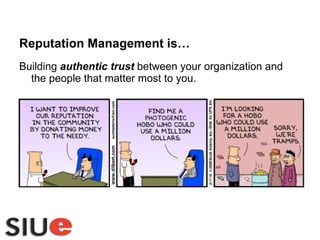
Reputation Management is… Building  authentic   trust  between your organization and the people that matter most to you.
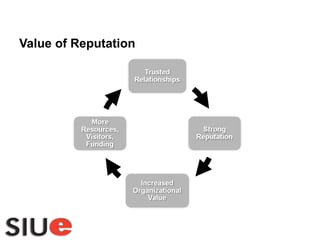
Value of Reputation
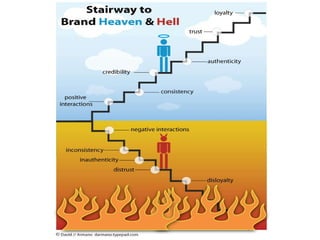
Today’s Relationship Drivers Satisfaction with experiences Consistency Trust Commitment (personal) Transparency (honesty) Sources:  Terry Flynn, Ph.D., McMaster University, DeGroote School of Business David Armano, darmano.typepad.com
The New Rules of Marketing & PR PR is for more than just mainstream media audiences PR is not just about seeing your organization on TV; it’s about seeing you on the Web It’s about helping people move through the decision-making process with great online content It’s authenticity, not spin It’s participation, not propaganda It’s direct communication at the moment and in the way your audience prefers, not one-way interruption  —  Adapted from The New Rules of Marketing & PR
The Link Between Brand and Reputation Brand Promise Defines the experience your customers should have with you Aligns your business operations with the customer’s experience Defines and protects your reputation Reputation = Current perceptions of an organization A variable based on experiences, news, events, actions
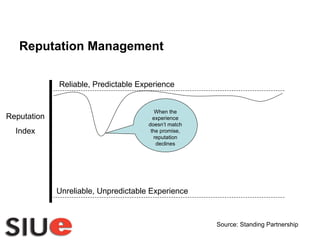
Reputation Management Reliable, Predictable Experience Unreliable, Unpredictable Experience When the experience doesn’t match the promise, reputation declines Reputation Index Source: Standing Partnership
 
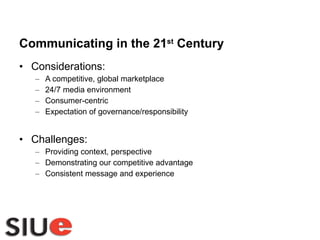
Communicating in the 21 st  Century Considerations: A competitive, global marketplace 24/7 media environment Consumer-centric Expectation of governance/responsibility Challenges: Providing context, perspective Demonstrating our competitive advantage Consistent message and experience
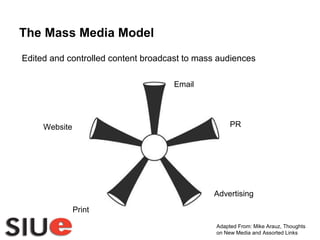
The Mass Media Model Edited and controlled content broadcast to mass audiences  Adapted From: Mike Arauz, Thoughts on New Media and Assorted Links PR Print  Website Advertising Email
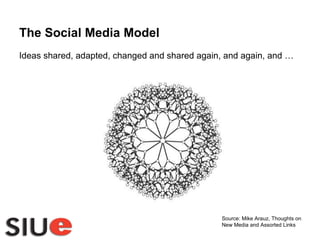
The Social Media Model Ideas shared, adapted, changed and shared again, and again, and … Source: Mike Arauz, Thoughts on New Media and Assorted Links
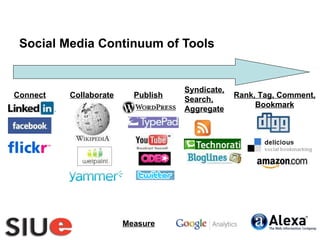
Social Media Continuum of Tools Publish Connect Syndicate, Search, Aggregate Collaborate Rank, Tag, Comment, Bookmark Measure
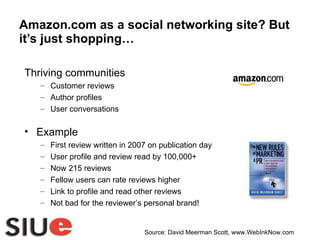
Amazon.com as a social networking site? But it’s just shopping… Thriving communities Customer reviews Author profiles User conversations Example First review written in 2007 on publication day User profile and review read by 100,000+ Now 215 reviews Fellow users can rate reviews higher Link to profile and read other reviews Not bad for the reviewer’s personal brand! Source: David Meerman Scott, www.WebInkNow.com
Social Media Marketing: Simplified You can  buy  attention ( advertising ) You can  beg  for attention from the media ( PR ) You can  bug  people one at a time to get attention ( sales ) Or you can  earn  attention by creating something interesting and valuable and then publishing it online for free: a YouTube video, a blog, a research report, photos, a Twitter stream, an ebook, a Facebook page. Source: David Meerman Scott, www.WebInkNow.com
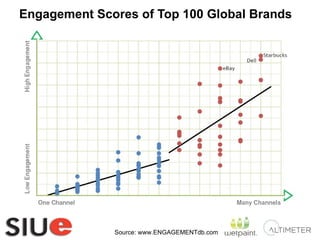
Engagement Scores of Top 100 Global Brands Source: www.ENGAGEMENTdb.com
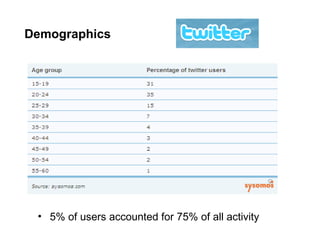
Demographics 5% of users accounted for 75% of all activity
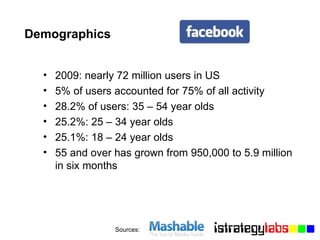
Demographics 2009: nearly 72 million users in US 5% of users accounted for 75% of all activity 28.2% of users: 35 – 54 year olds 25.2%: 25 – 34 year olds 25.1%: 18 – 24 year olds 55 and over has grown from 950,000 to 5.9 million in six months Sources:
What Now?
Using Social Media to Build Reputation  Internal collaboration Direct conversations Relationship building  Thought leadership Instant feedback Community SEO (search engine optimization)
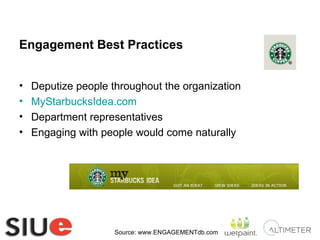
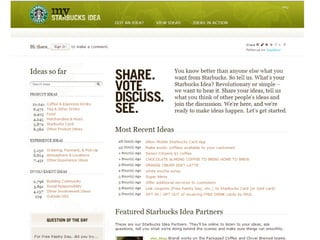
Engagement Best Practices Deputize people throughout the organization MyStarbucksIdea.com Department representatives Engaging with people would come naturally Source: www.ENGAGEMENTdb.com
 
Thought Leadership Special collections Faculty with unique specializations Tracking trends, resource internally
Web Content Fuels Traditional Media Relations More than eight of 10 journalists (84 percent) say they have used or would use blogs as primary or secondary sources for articles. —  2007 Arketi Web Watch Survey  Eighty percent of journalists say they spend more than 20 hours per week online. —  2009 Arketi Web Watch Survey
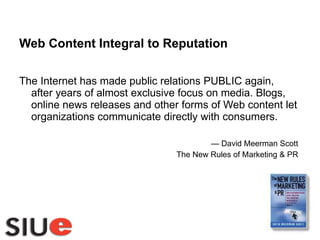
Web Content Integral to Reputation The Internet has made public relations PUBLIC again, after years of almost exclusive focus on media. Blogs, online news releases and other forms of Web content let organizations communicate directly with consumers. —  David Meerman Scott The New Rules of Marketing & PR
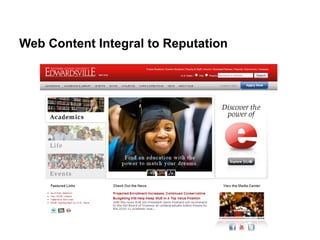
Web Content Integral to Reputation
Reputation Management Trust equity – a reputational insurance policy that creates economic value for your organization Turning relationships into results Customer loyalty Recruiting/retention Increased funding/donations Potential premium pricing Protection against crisis Empowering brand ambassadors
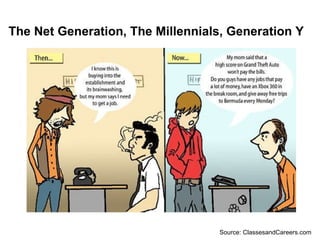
The Net Generation, The Millennials, Generation Y Source: ClassesandCareers.com
Kids born between 1977/80 and 1995/97 Frequently described as  self-absorbed unaccustomed to criticism or loss lacking in work ethic demanding workplace perks Also described as more diverse as any other generation before them innovative: they refuse to do things the "good, old-fashioned" way idealistic creative globally aware The Net Generation, The Millennials, Generation Y
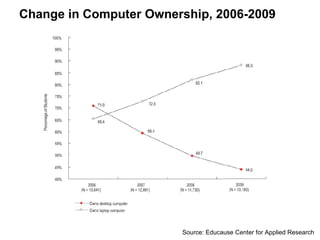
98% own computers 2006-2009 Desktops: ↓ 27% Laptops:  ↑  23 Freshmen are entering school with newer equipment 79% owned laptop <1 year old 52.3% computer <1 year old 67.9% computer <2 years old 17.9% computer >4 years old Source: Educause Center for Applied Research The Net Generation, The Millennials, Generation Y
Change in Computer Ownership, 2006-2009 Source: Educause Center for Applied Research
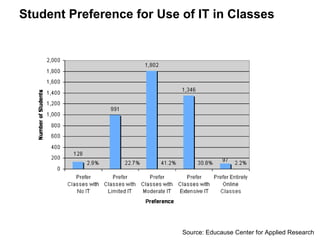
Student Preference for Use of IT in Classes Source: Educause Center for Applied Research
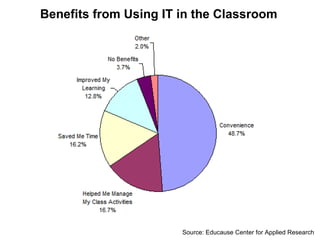
Benefits from Using IT in the Classroom Source: Educause Center for Applied Research
Though tech savvy, students do not possess the IT skills necessary for in and out of classroom academic work Motivation for learning skills is tied to the classroom requirements IT Training is necessary to support learning and problem-solving skills They have confidence in their skills with presentation software, spreadsheets, course management systems, and university library websites, generally rating themselves between fairly skilled and skilled Source: Educause Center for Applied Research The Net Generation, The Millennials, Generation Y
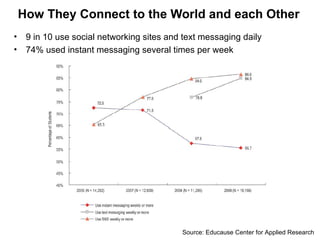
How They Connect to the World and each Other Source: Educause Center for Applied Research 9 in 10 use social networking sites and text messaging daily 74% used instant messaging several times per week
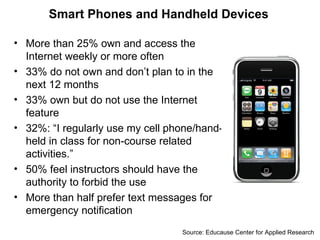
Smart Phones and Handheld Devices Source: Educause Center for Applied Research More than 25% own and access the Internet weekly or more often 33% do not own and don’t plan to in the next 12 months 33% own but do not use the Internet feature 32%: “I regularly use my cell phone/hand-held in class for non-course related activities.” 50% feel instructors should have the authority to forbid the use More than half prefer text messages for emergency notification
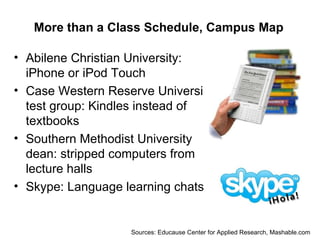
More than a Class Schedule, Campus Map Sources: Educause Center for Applied Research, Mashable.com Abilene Christian University: iPhone or iPod Touch Case Western Reserve University test group: Kindles instead of textbooks Southern Methodist University dean: stripped computers from lecture halls  Skype: Language learning chats
What Now?
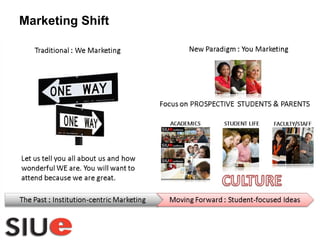
Marketing Shift
Your website is not just a static brochure but rather an interactive “conversation” with your users consisting of three key elements: Findability Usability Personality Communication with an Impact
Search engines Google Yahoo, MSN Ask, Alta Vista, etc.. Social Media FaceBook MySpace  Flickr Other interactive outlets Media Blogs Mobile Findability
Focus the user Plain language, short sentences and bullets Give the user choices, have a conversation  Let the user decide what’s important on your site Facilitate a positive user experience Clear, consistent navigation Distinct value proposition Utilize images and video to tell the story Include multiple media types for various learning styles Make it easy to take the next step Talk with us or schedule a visit Sign up for E-newsletter Connect with us on social media Tell-a-friend! Usability
Communicate the spirit of your company What would you tell a visitor? Create feelings which become thoughts/actions Engage and inspire Represent the people Employees Guests, visitors Suggest related items you offer and link to them Appeal to multiple audiences Depict various demographics in images Showcase a variety of activities Personality
The online relationship begins the second a potential customer hits your homepage. Show customers a reflection of them self. Organize your site with content for each of your distinct buyer personas.  —  David Meerman Scott The New Rules of Marketing & PR Segmenting Your Audiences
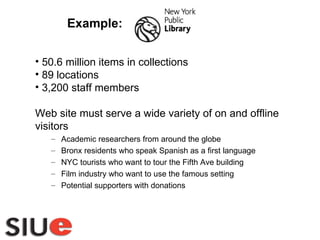
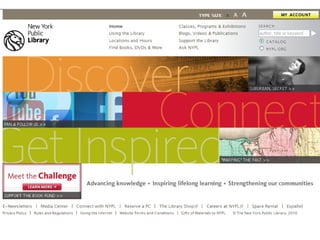
50.6 million items in collections 89 locations 3,200 staff members Web site must serve a wide variety of on and offline visitors  Academic researchers from around the globe Bronx residents who speak Spanish as a first language NYC tourists who want to tour the Fifth Ave building Film industry who want to use the famous setting  Potential supporters with donations Example:
 
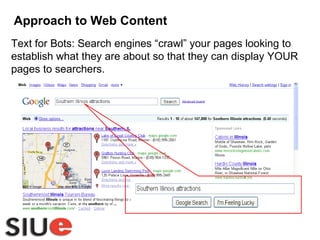
Approach to Web Content Text for Bots: Search engines “crawl” your pages looking to establish what they are about so that they can display YOUR pages to searchers.
Approach to Web Content Content for Humans: Your future guests and visitors read your pages to find out more about your services and facilities, why they should visit and how they can connect with you. What are they looking for? WII-FM Personalization People Stories Real answers Data to substantiate Social proof
Approach to Web Content Messaging: What is your promise to your guests and visitors? Emotions Connections Stories Share ideas Listening is important Invite participation
Recap Reputation management model The new rules Social media integration Millennial Web and technology behavior Your Web presence as a conversation
Questions? Elizabeth Keserauskis [email_address] linkedin.com/in/bethkeserauskis @bethkeserauskis

SIUE Spring Library Colloquium: The Art & Science of Searching, 3-26-10

  • 1.
    The Rules HaveChanged Consumer Behavior on the Web, and How We Can Earn Their Trust
  • 2.
    Objectives Reputation managementmodel The new rules Social media integration Millennial Web and technology behavior Your Web presence as a conversation
  • 3.
    Reputation Management is…Building authentic trust between your organization and the people that matter most to you.
  • 4.
  • 5.
    Today’s Relationship DriversSatisfaction with experiences Consistency Trust Commitment (personal) Transparency (honesty) Sources: Terry Flynn, Ph.D., McMaster University, DeGroote School of Business David Armano, darmano.typepad.com
  • 6.
    The New Rulesof Marketing & PR PR is for more than just mainstream media audiences PR is not just about seeing your organization on TV; it’s about seeing you on the Web It’s about helping people move through the decision-making process with great online content It’s authenticity, not spin It’s participation, not propaganda It’s direct communication at the moment and in the way your audience prefers, not one-way interruption — Adapted from The New Rules of Marketing & PR
  • 7.
    The Link BetweenBrand and Reputation Brand Promise Defines the experience your customers should have with you Aligns your business operations with the customer’s experience Defines and protects your reputation Reputation = Current perceptions of an organization A variable based on experiences, news, events, actions
  • 8.
    Reputation Management Reliable,Predictable Experience Unreliable, Unpredictable Experience When the experience doesn’t match the promise, reputation declines Reputation Index Source: Standing Partnership
  • 9.
  • 10.
    Communicating in the21 st Century Considerations: A competitive, global marketplace 24/7 media environment Consumer-centric Expectation of governance/responsibility Challenges: Providing context, perspective Demonstrating our competitive advantage Consistent message and experience
  • 11.
    The Mass MediaModel Edited and controlled content broadcast to mass audiences Adapted From: Mike Arauz, Thoughts on New Media and Assorted Links PR Print Website Advertising Email
  • 12.
    The Social MediaModel Ideas shared, adapted, changed and shared again, and again, and … Source: Mike Arauz, Thoughts on New Media and Assorted Links
  • 13.
    Social Media Continuumof Tools Publish Connect Syndicate, Search, Aggregate Collaborate Rank, Tag, Comment, Bookmark Measure
  • 14.
    Amazon.com as asocial networking site? But it’s just shopping… Thriving communities Customer reviews Author profiles User conversations Example First review written in 2007 on publication day User profile and review read by 100,000+ Now 215 reviews Fellow users can rate reviews higher Link to profile and read other reviews Not bad for the reviewer’s personal brand! Source: David Meerman Scott, www.WebInkNow.com
  • 15.
    Social Media Marketing:Simplified You can buy attention ( advertising ) You can beg for attention from the media ( PR ) You can bug people one at a time to get attention ( sales ) Or you can earn attention by creating something interesting and valuable and then publishing it online for free: a YouTube video, a blog, a research report, photos, a Twitter stream, an ebook, a Facebook page. Source: David Meerman Scott, www.WebInkNow.com
  • 16.
    Engagement Scores ofTop 100 Global Brands Source: www.ENGAGEMENTdb.com
  • 17.
    Demographics 5% ofusers accounted for 75% of all activity
  • 18.
    Demographics 2009: nearly72 million users in US 5% of users accounted for 75% of all activity 28.2% of users: 35 – 54 year olds 25.2%: 25 – 34 year olds 25.1%: 18 – 24 year olds 55 and over has grown from 950,000 to 5.9 million in six months Sources:
  • 19.
  • 20.
    Using Social Mediato Build Reputation Internal collaboration Direct conversations Relationship building Thought leadership Instant feedback Community SEO (search engine optimization)
  • 21.
    Engagement Best PracticesDeputize people throughout the organization MyStarbucksIdea.com Department representatives Engaging with people would come naturally Source: www.ENGAGEMENTdb.com
  • 22.
  • 23.
    Thought Leadership Specialcollections Faculty with unique specializations Tracking trends, resource internally
  • 24.
    Web Content FuelsTraditional Media Relations More than eight of 10 journalists (84 percent) say they have used or would use blogs as primary or secondary sources for articles. — 2007 Arketi Web Watch Survey Eighty percent of journalists say they spend more than 20 hours per week online. — 2009 Arketi Web Watch Survey
  • 25.
    Web Content Integralto Reputation The Internet has made public relations PUBLIC again, after years of almost exclusive focus on media. Blogs, online news releases and other forms of Web content let organizations communicate directly with consumers. — David Meerman Scott The New Rules of Marketing & PR
  • 26.
    Web Content Integralto Reputation
  • 27.
    Reputation Management Trustequity – a reputational insurance policy that creates economic value for your organization Turning relationships into results Customer loyalty Recruiting/retention Increased funding/donations Potential premium pricing Protection against crisis Empowering brand ambassadors
  • 28.
    The Net Generation,The Millennials, Generation Y Source: ClassesandCareers.com
  • 29.
    Kids born between1977/80 and 1995/97 Frequently described as self-absorbed unaccustomed to criticism or loss lacking in work ethic demanding workplace perks Also described as more diverse as any other generation before them innovative: they refuse to do things the &quot;good, old-fashioned&quot; way idealistic creative globally aware The Net Generation, The Millennials, Generation Y
  • 30.
    98% own computers2006-2009 Desktops: ↓ 27% Laptops: ↑ 23 Freshmen are entering school with newer equipment 79% owned laptop <1 year old 52.3% computer <1 year old 67.9% computer <2 years old 17.9% computer >4 years old Source: Educause Center for Applied Research The Net Generation, The Millennials, Generation Y
  • 31.
    Change in ComputerOwnership, 2006-2009 Source: Educause Center for Applied Research
  • 32.
    Student Preference forUse of IT in Classes Source: Educause Center for Applied Research
  • 33.
    Benefits from UsingIT in the Classroom Source: Educause Center for Applied Research
  • 34.
    Though tech savvy,students do not possess the IT skills necessary for in and out of classroom academic work Motivation for learning skills is tied to the classroom requirements IT Training is necessary to support learning and problem-solving skills They have confidence in their skills with presentation software, spreadsheets, course management systems, and university library websites, generally rating themselves between fairly skilled and skilled Source: Educause Center for Applied Research The Net Generation, The Millennials, Generation Y
  • 35.
    How They Connectto the World and each Other Source: Educause Center for Applied Research 9 in 10 use social networking sites and text messaging daily 74% used instant messaging several times per week
  • 36.
    Smart Phones andHandheld Devices Source: Educause Center for Applied Research More than 25% own and access the Internet weekly or more often 33% do not own and don’t plan to in the next 12 months 33% own but do not use the Internet feature 32%: “I regularly use my cell phone/hand-held in class for non-course related activities.” 50% feel instructors should have the authority to forbid the use More than half prefer text messages for emergency notification
  • 37.
    More than aClass Schedule, Campus Map Sources: Educause Center for Applied Research, Mashable.com Abilene Christian University: iPhone or iPod Touch Case Western Reserve University test group: Kindles instead of textbooks Southern Methodist University dean: stripped computers from lecture halls Skype: Language learning chats
  • 38.
  • 39.
  • 40.
    Your website isnot just a static brochure but rather an interactive “conversation” with your users consisting of three key elements: Findability Usability Personality Communication with an Impact
  • 41.
    Search engines GoogleYahoo, MSN Ask, Alta Vista, etc.. Social Media FaceBook MySpace Flickr Other interactive outlets Media Blogs Mobile Findability
  • 42.
    Focus the userPlain language, short sentences and bullets Give the user choices, have a conversation Let the user decide what’s important on your site Facilitate a positive user experience Clear, consistent navigation Distinct value proposition Utilize images and video to tell the story Include multiple media types for various learning styles Make it easy to take the next step Talk with us or schedule a visit Sign up for E-newsletter Connect with us on social media Tell-a-friend! Usability
  • 43.
    Communicate the spiritof your company What would you tell a visitor? Create feelings which become thoughts/actions Engage and inspire Represent the people Employees Guests, visitors Suggest related items you offer and link to them Appeal to multiple audiences Depict various demographics in images Showcase a variety of activities Personality
  • 44.
    The online relationshipbegins the second a potential customer hits your homepage. Show customers a reflection of them self. Organize your site with content for each of your distinct buyer personas. — David Meerman Scott The New Rules of Marketing & PR Segmenting Your Audiences
  • 45.
    50.6 million itemsin collections 89 locations 3,200 staff members Web site must serve a wide variety of on and offline visitors Academic researchers from around the globe Bronx residents who speak Spanish as a first language NYC tourists who want to tour the Fifth Ave building Film industry who want to use the famous setting Potential supporters with donations Example:
  • 46.
  • 47.
    Approach to WebContent Text for Bots: Search engines “crawl” your pages looking to establish what they are about so that they can display YOUR pages to searchers.
  • 48.
    Approach to WebContent Content for Humans: Your future guests and visitors read your pages to find out more about your services and facilities, why they should visit and how they can connect with you. What are they looking for? WII-FM Personalization People Stories Real answers Data to substantiate Social proof
  • 49.
    Approach to WebContent Messaging: What is your promise to your guests and visitors? Emotions Connections Stories Share ideas Listening is important Invite participation
  • 50.
    Recap Reputation managementmodel The new rules Social media integration Millennial Web and technology behavior Your Web presence as a conversation
  • 51.
    Questions? Elizabeth Keserauskis[email_address] linkedin.com/in/bethkeserauskis @bethkeserauskis

Editor's Notes

  • #8 Brand = The DNA of an organization A foundation for telling your organization’s story Reputation = Current perceptions of an organization A variable based on experiences, news, events, actions
  • #12 We talked at people; the conversation was limited to a one-way dialogue
  • #13 Today, this is how communications is happening. It’s a dialogue between and among individuals who form communities A decentralized sharing of thoughts and ideas The ultimate in word-of-mouth marketing It’s an opportunity to engage in an authentic way with your prospective students, donors, faculty and others It’s a way to listen…and respond
  • #14 CONNECT Linkedin is a business and professional networking site, where members can connect with colleagues and share opportunities and information. Facebook is a general social networking site where members can connect and share photo, messages, and comments. flickr is a photo sharing and photography related networking site. Members can view and comment on photos.   COLLABORATE Wikipedia is an online public encyclopedia where content is submitted by the internet community. wetpaint is a social network and wiki hosting service. Yammer is a social networking and micro blogging service for office colleagues used both privately and internally within organizations.   PUBLISH Wordpress is an open source blog platform where users can design and maintain blogs. TypePad is a paid blog hosting service geared toward non-technical users. YouTube is a video sharing service where users can share and comment on videos.   Odeo is an RSS directory and search service where users can create and share podcasts. twitter is a social networking and micro-blogging service where each “Tweet” is a maximum of 140 characters long.   SYNDICATE, SEARCH, AGGREGATE RSS (Really Simple Syndication) is a method of distributing and updating frequently changing content such as blogs, twitter feeds, and news headlines. Technorati is a search engine used for searching blogs. Bloglines is a web based application used for reading RSS news and blog feeds.   RANK, TAG, COMMENT, BOOKMARK Digg is a social network type news service where users can vote up or down on relevance, known as “digging” and “burying.”   Delicious is a social bookmarking site where users can share web bookmarks.   MEASURE Google Analytics is a service that provides statistics on visitors to specific web pages.   Alexa is a toolbar that compiles data on web browsing behaviors, also ranks web sites by traffic.
  • #20 RACI: Client Project Work John McArthur and Gil Hoffman 2008 TECHNOLOGY CONFERENCE
  • #21 RACI: Client Project Work John McArthur and Gil Hoffman 2008 TECHNOLOGY CONFERENCE
  • #39 RACI: Client Project Work John McArthur and Gil Hoffman 2008 TECHNOLOGY CONFERENCE
  • #41 Findability Search engines Google Yahoo MSN Ask, Alta Vista, etc. Social Media FaceBook MySpace Flickr Other interactive outlets Media Blogs Mobile   Usability Focus the user Whether direct or clever, use plain language, short sentences and bullets Give the user choices, as if having a conversation Let the user decide what’s important on your site Facilitate a positive user experience Clear, consistent navigation across the site Distinct value proposition: try to convey WIFM – what’s in it for the visitor Utilize images and video to tell the story – more than words! Make it easy to take the next step Talk with us or schedule a face-to-face visit Sign up for E-newsletter Download information Connect with us on social media/bookmark the page Tell-a-friend!     Personality Communicate the spirit of the school What would you tell a prospective student who was visiting? Create feelings which become thoughts/actions (with images and minimal text) Engage them and inspire them Represent the people at the institution Faculty/Staff Their fellow students Suggest related items you offer and link to them Appeal to multiple audiences Depict various demographics in images/video Showcase a variety of activities and student life elements Highlight resources and student services Engage parents!
  • #42 Findability Search engines Google Yahoo MSN Ask, Alta Vista, etc. Social Media FaceBook MySpace Flickr Other interactive outlets Media Blogs Mobile   Usability Focus the user Whether direct or clever, use plain language, short sentences and bullets Give the user choices, as if having a conversation Let the user decide what’s important on your site Facilitate a positive user experience Clear, consistent navigation across the site Distinct value proposition: try to convey WIFM – what’s in it for the visitor Utilize images and video to tell the story – more than words! Make it easy to take the next step Talk with us or schedule a face-to-face visit Sign up for E-newsletter Download information Connect with us on social media/bookmark the page Tell-a-friend!     Personality Communicate the spirit of the school What would you tell a prospective student who was visiting? Create feelings which become thoughts/actions (with images and minimal text) Engage them and inspire them Represent the people at the institution Faculty/Staff Their fellow students Suggest related items you offer and link to them Appeal to multiple audiences Depict various demographics in images/video Showcase a variety of activities and student life elements Highlight resources and student services Engage parents!
  • #43 Findability Search engines Google Yahoo MSN Ask, Alta Vista, etc. Social Media FaceBook MySpace Flickr Other interactive outlets Media Blogs Mobile   Usability Focus the user Whether direct or clever, use plain language, short sentences and bullets Give the user choices, as if having a conversation Let the user decide what’s important on your site Facilitate a positive user experience Clear, consistent navigation across the site Distinct value proposition: try to convey WIFM – what’s in it for the visitor Utilize images and video to tell the story – more than words! Make it easy to take the next step Talk with us or schedule a face-to-face visit Sign up for E-newsletter Download information Connect with us on social media/bookmark the page Tell-a-friend!     Personality Communicate the spirit of the school What would you tell a prospective student who was visiting? Create feelings which become thoughts/actions (with images and minimal text) Engage them and inspire them Represent the people at the institution Faculty/Staff Their fellow students Suggest related items you offer and link to them Appeal to multiple audiences Depict various demographics in images/video Showcase a variety of activities and student life elements Highlight resources and student services Engage parents!
  • #44 Findability Search engines Google Yahoo MSN Ask, Alta Vista, etc. Social Media FaceBook MySpace Flickr Other interactive outlets Media Blogs Mobile   Usability Focus the user Whether direct or clever, use plain language, short sentences and bullets Give the user choices, as if having a conversation Let the user decide what’s important on your site Facilitate a positive user experience Clear, consistent navigation across the site Distinct value proposition: try to convey WIFM – what’s in it for the visitor Utilize images and video to tell the story – more than words! Make it easy to take the next step Talk with us or schedule a face-to-face visit Sign up for E-newsletter Download information Connect with us on social media/bookmark the page Tell-a-friend!     Personality Communicate the spirit of the school What would you tell a prospective student who was visiting? Create feelings which become thoughts/actions (with images and minimal text) Engage them and inspire them Represent the people at the institution Faculty/Staff Their fellow students Suggest related items you offer and link to them Appeal to multiple audiences Depict various demographics in images/video Showcase a variety of activities and student life elements Highlight resources and student services Engage parents!
  • #45 Findability Search engines Google Yahoo MSN Ask, Alta Vista, etc. Social Media FaceBook MySpace Flickr Other interactive outlets Media Blogs Mobile   Usability Focus the user Whether direct or clever, use plain language, short sentences and bullets Give the user choices, as if having a conversation Let the user decide what’s important on your site Facilitate a positive user experience Clear, consistent navigation across the site Distinct value proposition: try to convey WIFM – what’s in it for the visitor Utilize images and video to tell the story – more than words! Make it easy to take the next step Talk with us or schedule a face-to-face visit Sign up for E-newsletter Download information Connect with us on social media/bookmark the page Tell-a-friend!     Personality Communicate the spirit of the school What would you tell a prospective student who was visiting? Create feelings which become thoughts/actions (with images and minimal text) Engage them and inspire them Represent the people at the institution Faculty/Staff Their fellow students Suggest related items you offer and link to them Appeal to multiple audiences Depict various demographics in images/video Showcase a variety of activities and student life elements Highlight resources and student services Engage parents!
  • #46 Findability Search engines Google Yahoo MSN Ask, Alta Vista, etc. Social Media FaceBook MySpace Flickr Other interactive outlets Media Blogs Mobile   Usability Focus the user Whether direct or clever, use plain language, short sentences and bullets Give the user choices, as if having a conversation Let the user decide what’s important on your site Facilitate a positive user experience Clear, consistent navigation across the site Distinct value proposition: try to convey WIFM – what’s in it for the visitor Utilize images and video to tell the story – more than words! Make it easy to take the next step Talk with us or schedule a face-to-face visit Sign up for E-newsletter Download information Connect with us on social media/bookmark the page Tell-a-friend!     Personality Communicate the spirit of the school What would you tell a prospective student who was visiting? Create feelings which become thoughts/actions (with images and minimal text) Engage them and inspire them Represent the people at the institution Faculty/Staff Their fellow students Suggest related items you offer and link to them Appeal to multiple audiences Depict various demographics in images/video Showcase a variety of activities and student life elements Highlight resources and student services Engage parents!
  • #48 Bots: Meta tags/data – title, keyword and description tags Content with keyword density for search terms relevant to the page Human readability Hyperlinks to relevant content within your site (a/k/a “cross links”) Hyperlinks from outside websites linking in to your site with specific keywords “ Fresh” and updated content Content for Humans WIFM – Rule #1 Personalization – which means you give them their choice of info People they can connect with – images, video, audio Stories of other students who have done it before and succeeded Real answers to their actual questions Future job outlook and opportunities Data to substantiate your information Social proof (we’ll get to that later) Messaging: Sound hokey? Not really. Content is words on a page. Messaging is more than the words you write… It is your promise to the students and parents It is the logic-based value you can provide It is the emotions are you creating to “connect” with your prospective students It is your opportunity to tell stories and share ideas rather than talk AT your future students Your willingness to listen is important; invite participation where appropriate
  • #49 Content for Humans WIFM – Rule #1 Personalization – which means you give them their choice of info People they can connect with – images, video, audio Stories of other students who have done it before and succeeded Real answers to their actual questions Future job outlook and opportunities Data to substantiate your information Social proof (we’ll get to that later)
  • #50 Messaging: Sound hokey? Not really. Content is words on a page. Messaging is more than the words you write… It is your promise to the students and parents It is the logic-based value you can provide It is the emotions are you creating to “connect” with your prospective students It is your opportunity to tell stories and share ideas rather than talk AT your future students Your willingness to listen is important; invite participation where appropriate