Reasons of liberalization
1.Shortage of oil(only for a week)
2. Low foreign exchange reserves.
3. Burden of national debt.
4. Inflation.
5. balance of payments crisis
Reforms during taken in 1991
Financial sector
Trade sector
Fiscal sector
Industrial sector
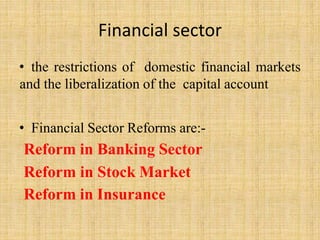
Financial sector
• the restrictions of domestic financial markets
and the liberalization of the capital account
• Financial Sector Reforms are:-
Reform in Banking Sector
Reform in Stock Market
Reform in Insurance
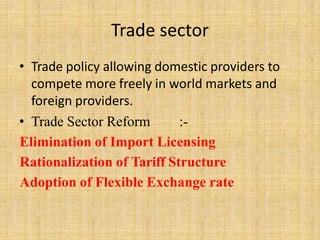
Trade sector
• Trade policy allowing domestic providers to
compete more freely in world markets and
foreign providers.
• Trade Sector Reform :-
Elimination of Import Licensing
Rationalization of Tariff Structure
Adoption of Flexible Exchange rate
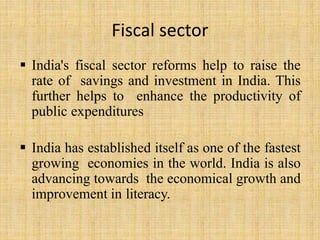
Fiscal sector
 India's fiscal sector reforms help to raise the
rate of savings and investment in India. This
further helps to enhance the productivity of
public expenditures
 India has established itself as one of the fastest
growing economies in the world. India is also
advancing towards the economical growth and
improvement in literacy.
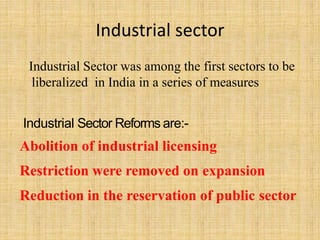
Industrial sector
Industrial Sector was among the first sectors to be
liberalized in India in a series of measures
Industrial Sector Reforms are:-
Abolition of industrial licensing
Restriction were removed on expansion
Reduction in the reservation of public sector
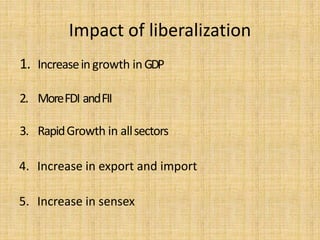
Impact of liberalization
1. Increaseingrowth inGDP
2. MoreFDI andFII
3. RapidGrowth in allsectors
4. Increase in export and import
5. Increase in sensex
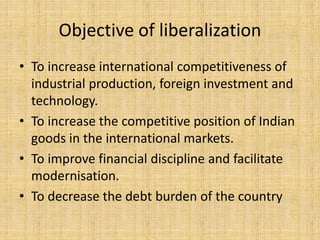
Objective of liberalization
• To increase international competitiveness of
industrial production, foreign investment and
technology.
• To increase the competitive position of Indian
goods in the international markets.
• To improve financial discipline and facilitate
modernisation.
• To decrease the debt burden of the country

liberalization in india

  • 1.
    Reasons of liberalization 1.Shortageof oil(only for a week) 2. Low foreign exchange reserves. 3. Burden of national debt. 4. Inflation. 5. balance of payments crisis
  • 2.
    Reforms during takenin 1991 Financial sector Trade sector Fiscal sector Industrial sector
  • 3.
    Financial sector • therestrictions of domestic financial markets and the liberalization of the capital account • Financial Sector Reforms are:- Reform in Banking Sector Reform in Stock Market Reform in Insurance
  • 4.
    Trade sector • Tradepolicy allowing domestic providers to compete more freely in world markets and foreign providers. • Trade Sector Reform :- Elimination of Import Licensing Rationalization of Tariff Structure Adoption of Flexible Exchange rate
  • 5.
    Fiscal sector  India'sfiscal sector reforms help to raise the rate of savings and investment in India. This further helps to enhance the productivity of public expenditures  India has established itself as one of the fastest growing economies in the world. India is also advancing towards the economical growth and improvement in literacy.
  • 6.
    Industrial sector Industrial Sectorwas among the first sectors to be liberalized in India in a series of measures Industrial Sector Reforms are:- Abolition of industrial licensing Restriction were removed on expansion Reduction in the reservation of public sector
  • 7.
    Impact of liberalization 1.Increaseingrowth inGDP 2. MoreFDI andFII 3. RapidGrowth in allsectors 4. Increase in export and import 5. Increase in sensex
  • 8.
    Objective of liberalization •To increase international competitiveness of industrial production, foreign investment and technology. • To increase the competitive position of Indian goods in the international markets. • To improve financial discipline and facilitate modernisation. • To decrease the debt burden of the country