Jets Plus MET:
                              Now versus Then

                Jay Wacker
                      SLAC

Emerging problems in particle phenomenology
                 April 11, 2010
  with Eder Izaguirre, Ning Bao and Michael Manhart
            arXiv: 1003.3886, 1004.XXXX


                     “I swear it’s right around the corner”
Jets + MET

           Solution to Hierarchy Problem
          If the symmetry commutes with SU(3)C,
                   new colored top partners
                  (note twin Higgs exception)


                       Dark Matter
            Wimp Miracle: DM a thermal relic if
                 mass is 100 GeV to 1 TeV
               Usually requires a dark sector,
          frequently contains new colored particles

       Fewest requirements on spectroscopy
Doesn’t require squeezing in additional states to decay chains
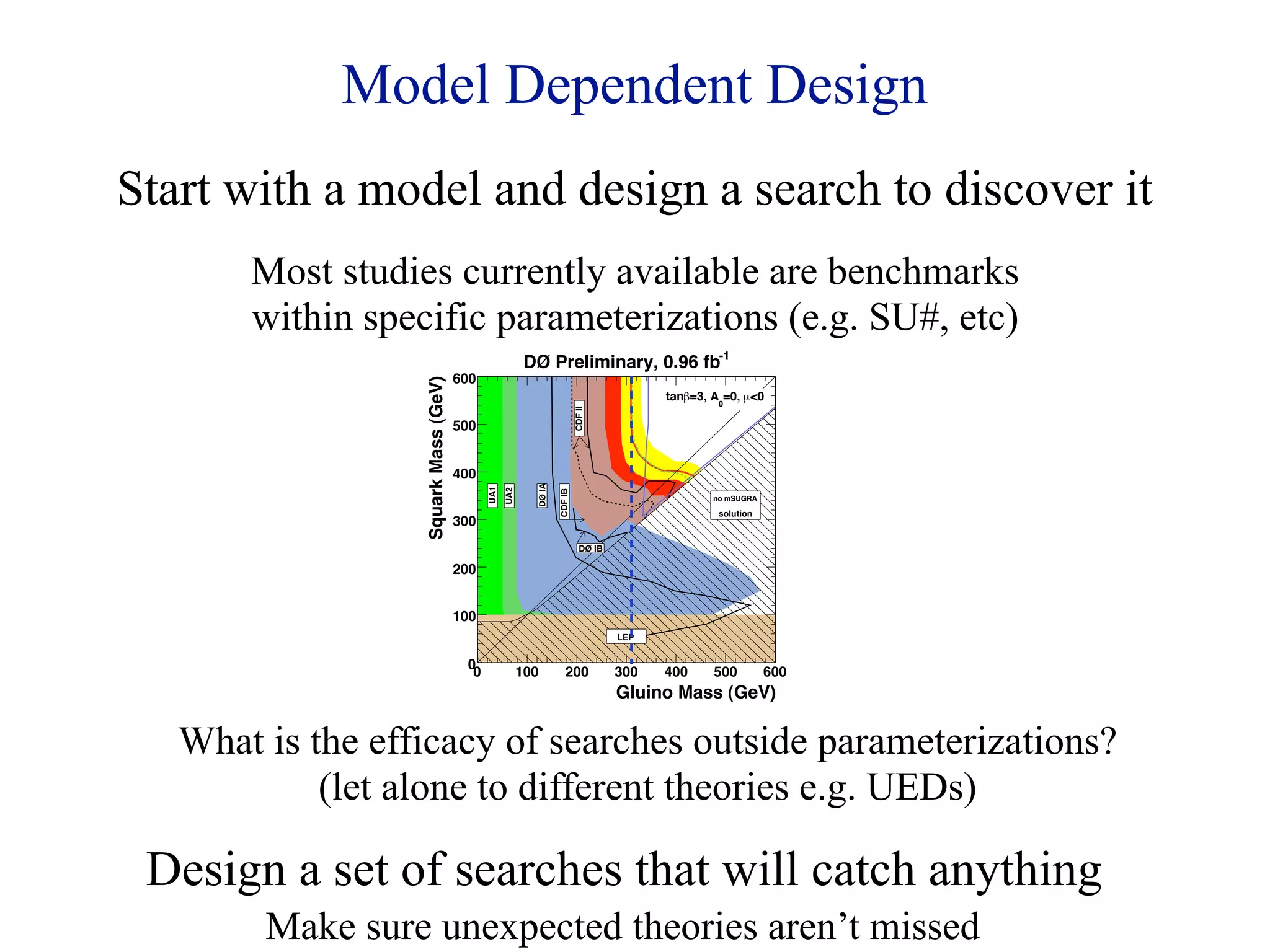
Model Dependent Design
Start with a model and design a search to discover it
       Most studies currently available are benchmarks
       within specific parameterizations (e.g. SU#, etc)
                                                         DØ Preliminary, 0.96 fb-1
                                      600


                  Squark Mass (GeV)
                                                                                           tan!=3, A =0, µ <0
                                                                                                    0


                                                                           CDF II
                                      500


                                      400


                                                          DØ IA
                                            UA1
                                                  UA2


                                                                  CDF IB
                                                                                                   no mSUGRA

                                                                                                    solution
                                      300
                                                                             DØ IB

                                      200


                                      100
                                                                                     LEP


                                       0
                                        0               100          200             300   400     500         600
                                                                                     Gluino Mass (GeV)


   What is the efficacy of searches outside parameterizations?
            (let alone to different theories e.g. UEDs)

 Design a set of searches that will catch anything
        Make sure unexpected theories aren’t missed
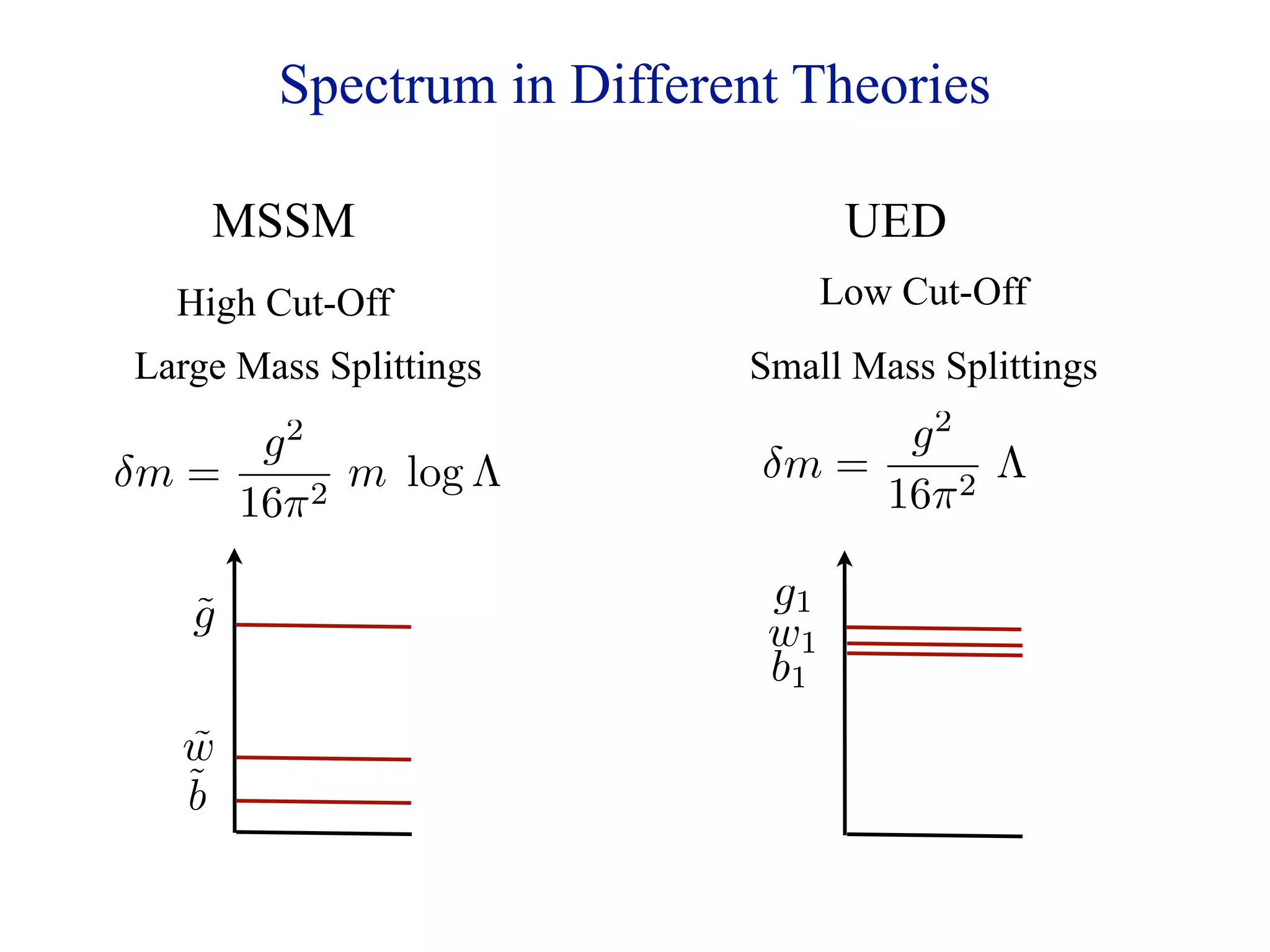
Spectrum in Different Theories

    MSSM                          UED
  High Cut-Off                   Low Cut-Off
Large Mass Splittings      Small Mass Splittings
                                       2
      g  2                        g
δm =       m log Λ          δm =       Λ
     16π 2                       16π 2


   ˜
   g                        g1
                            w1
                            b1
   ˜
   w
   ˜
   b
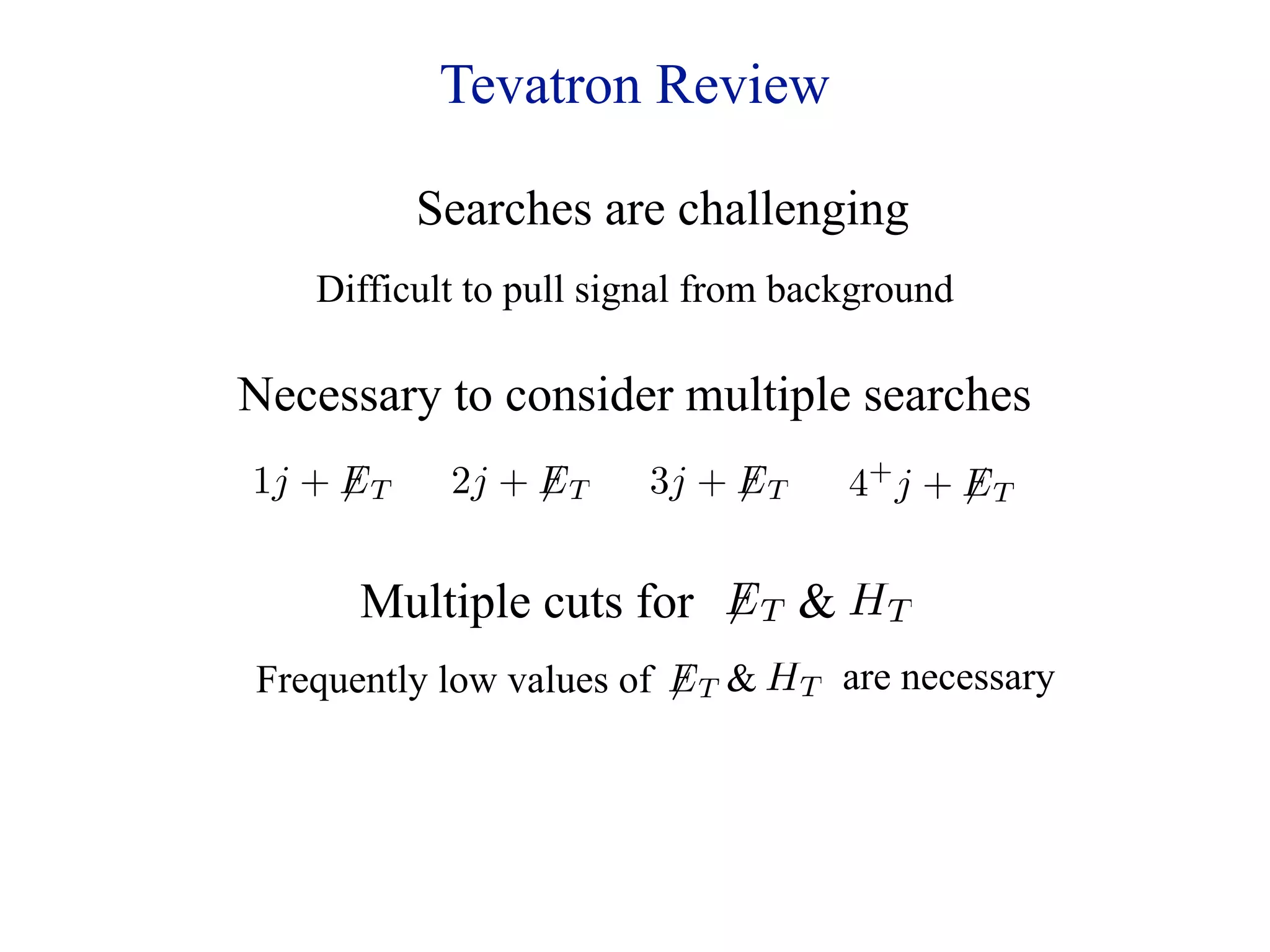
Tevatron Review

            Searches are challenging
    Difficult to pull signal from background

Necessary to consider multiple searches
1j + E T    2j + E T   3j + E T   4+ j + E T


       Multiple cuts for E T  HT
Frequently low values of E T  HT are necessary
Casting a Wide Net
    Kinematics matters more than spin or A-terms
                                                                                                            Alwall, Le Lisanti, JW (0803.0019)
                                                                 Q = mX − mχ    ˜
                                                                   X = g , q , ...
                                                                       ˜ ˜
                                                                                                              Q=0

                                      V.   GLUINO EXCLUSION LIMITS

                                            A.    No Cascade Decays

                                                                          ˜
                                                                          χ
                                                                      m                  
          For the remainder of the paper, we will discuss how model-independent jets + ET searches
      can be used to set limits on the parameters in a particular theory. We will focus specifically


                                                                 =
      on the case of pair-produced gluinos at the Tevatron and begin by considering the simplified
      scenario of a direct decay to the bino. The expected number of jets depends on the relative


  mχ
      mass difference between the gluino and bino. When the mass difference is small, the decay
      jets are very soft and initial-state radiation is important; in this limit, the monojet search

   ˜  is best. When the mass difference is large, the decay jets are hard and well-defined, so
      the multijet search is most effective. The dijet and threejet searches are important in the
      transition between these two limits.
                                                            X
                                                  m
          As an example, let us consider the model spectrum with a 340 GeV gluino decaying
      directly into a 100 GeV bino. In this case, the gluino is heavy and its mass difference with
      the bino is relatively large, so we expect the multijet search to be most effective. Table III
      shows the differential cross section grids for the 1-4+ jet searches for this simulated signal
      point. The colors indicate the significance of the signal over the limits presented in Table II;
      the multijet search has the strongest excesses.


                                                                      Tevatron Gluino
                                                                              
          Previously [28], we obtained exclusion limits by optimizing the ET and HT cuts, which
      involves simulating each mass point beforehand to determine which cuts are most appropri-
      ate. This is effectively like dealing with a 1 × 1 grid, for which a 95% exclusion corresponds

250 GeV                                                                 Sensitivity
                           150

                                                                                                                                    mSugra
                    Bino Mass GeV


                           100

                Out[27]=


                           50                                    X


                            0
                            100             200
                                                      Gluino Mass GeV
                                                             300          400             500


      FIG. 4: The 95% exclusion region for DO at 4 fb−1 assuming 50% systematic error on background.
                                             
                                                                                                                                 mX
                                                  250 GeV


      The exclusion region for a directly decaying gluino is shown in light blue; the worst case scenario
                                                                                500 GeV


      for the cascade decay is shown in dark blue. The dashed line represents the CMSSM points and
      the “X” is the current DO exclusion limit at 2 fb−1 .


                                                            15
Plan of Talk


    Distinguishing Signal from Background
*

       Where the LHC can get to (soon)
542   than 20 GeV. We demand at least 4 jets with |η |
                                                                       pT  100 GeV. The transverse sphericity ST should
                                                Backgrounds
                                                                 543

                                                                 544   ETmiss should be larger than 100 GeV and larger th

                                                                 545   add one more cut against the QCD background: the
                                 Madgraph+Pythia                 546

                                                                 547
                                                                       between the ET       PGS
                                                                                      miss vector and the three highest-p

                                                                       discussed in a dedicated note on QCD background e
                                  (up to 2 → 4 )
                                                                 548   3.2 Backgrounds in Monte Carlo
                                                           4+jetsFigure 16 shows the distributions of E
                                                                 549
                                                                                                                                   miss
                                                                                                                                   T      and Meff

                                                             SM                                  104
                                                               ¯


                                                                         Events / 1fb−1/ 50GeV
                  1000                                                                                                             SU3
                                                              tt±                                                                  SM BG
                                                                                                                                   tt
                                                             W                                   103                               W
    (fb/25 GeV)


                   100                                       Z0                                                                    Z
                                                                                                                                   QCD
                                                             QCD                                 102
                                                                                                                                   single top
                                                                                                                                  ATLAS
                    10

                                                                                                 10
dET
 dσ


                     1


                                                                                                   1
                                                                                                    0   100 200 300 400 500 600 700 800 900 1000
                                                                                                                                 Missing ET [GeV]
                   0.1
                           200      400        600   800
                                                               √1000
                                          ET (GeV)
                                                               s = 14 TeV
                                                                       Figure 16: The ET miss and effective mass distribut

                                                                       for the no-lepton mode with an integrated luminosit
                                                                       (SU3 point). The shaded histogram shows the sum o
                         Matching crucial to getting MET tail vaguely right
                                                                       show the various components.
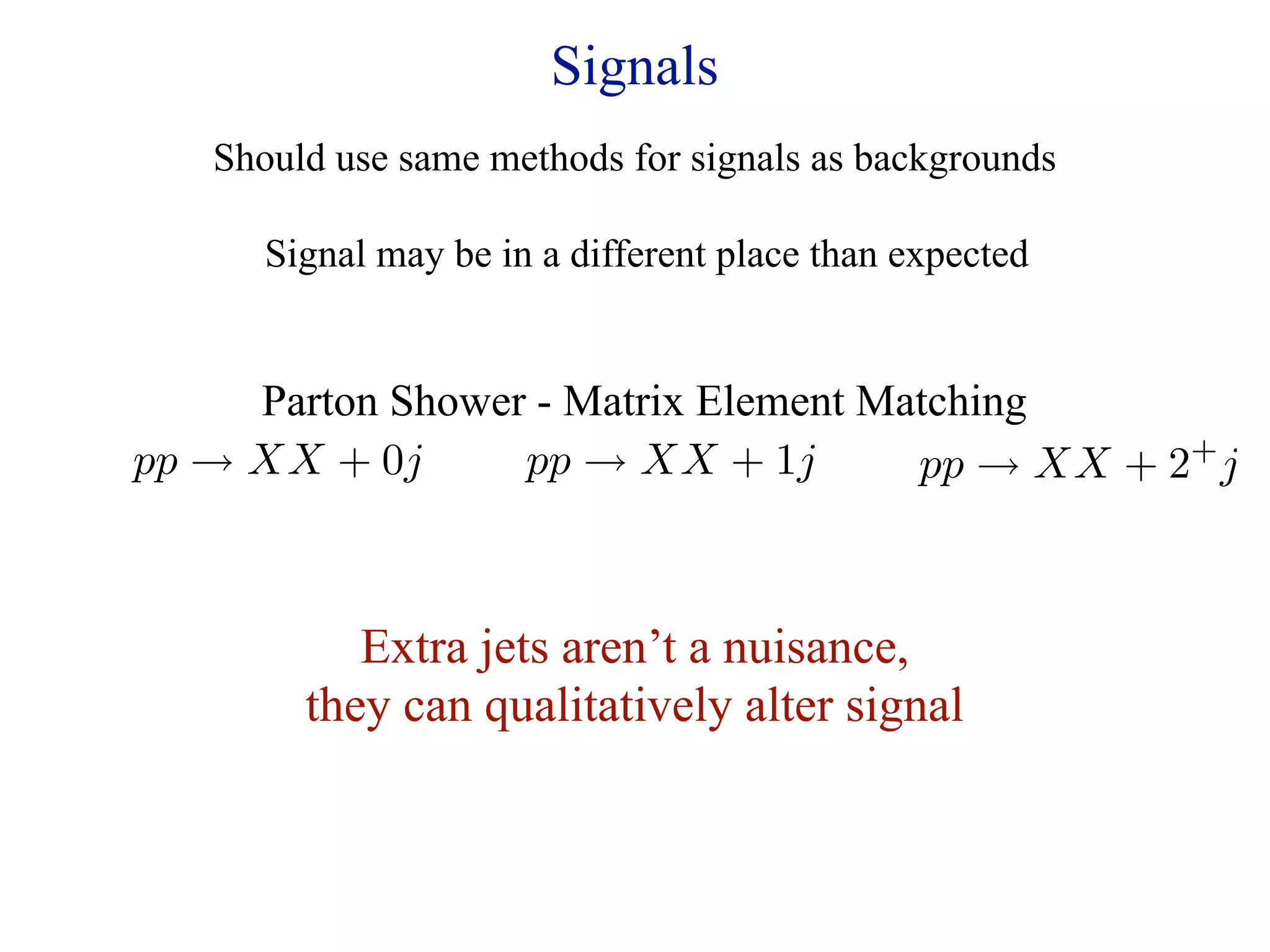
Signals
   Should use same methods for signals as backgrounds

      Signal may be in a different place than expected


     Parton Shower - Matrix Element Matching
pp → XX + 0j      pp → XX + 1j        pp → XX + 2 j
                                                 +


           Extra jets aren’t a nuisance,
        they can qualitatively alter signal
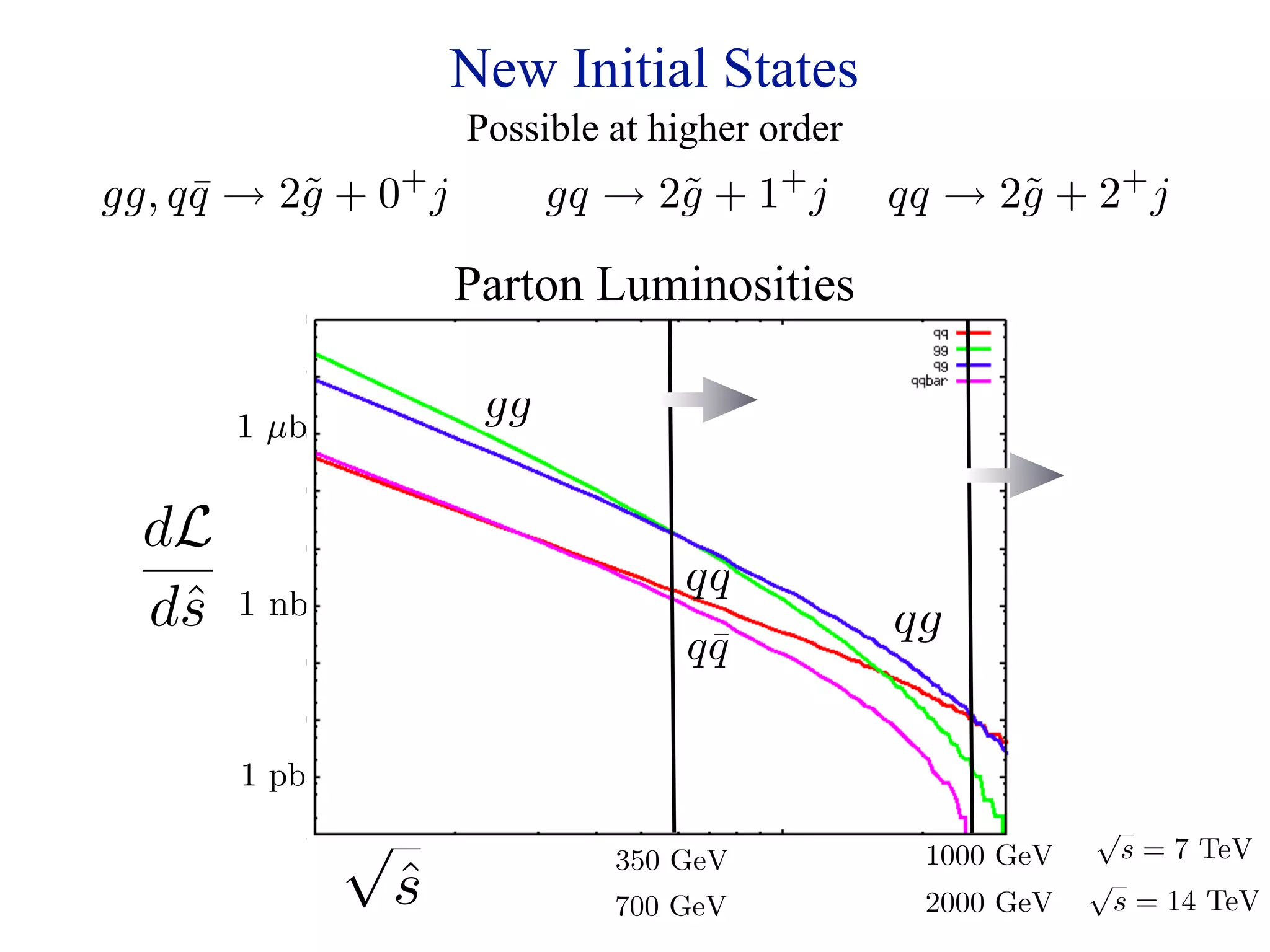
New Initial States
                      Possible at higher order
gg, q q → 2˜ + 0+ j
      ¯    g                gq → 2˜ + 1+ j
                                  g              qq → 2˜ + 2+ j
                                                       g

                      Parton Luminosities

       1 µb
                       gg

  dL
                                   qq
  dˆ
   s   1 nb                                      qg
                                     ¯
                                    qq

       1 pb
              √                350 GeV            1000 GeV
                                                             √
                                                                 s = 7 TeV
                  ˆ
                  s            700 GeV            2000 GeV
                                                             √
                                                                 s = 14 TeV
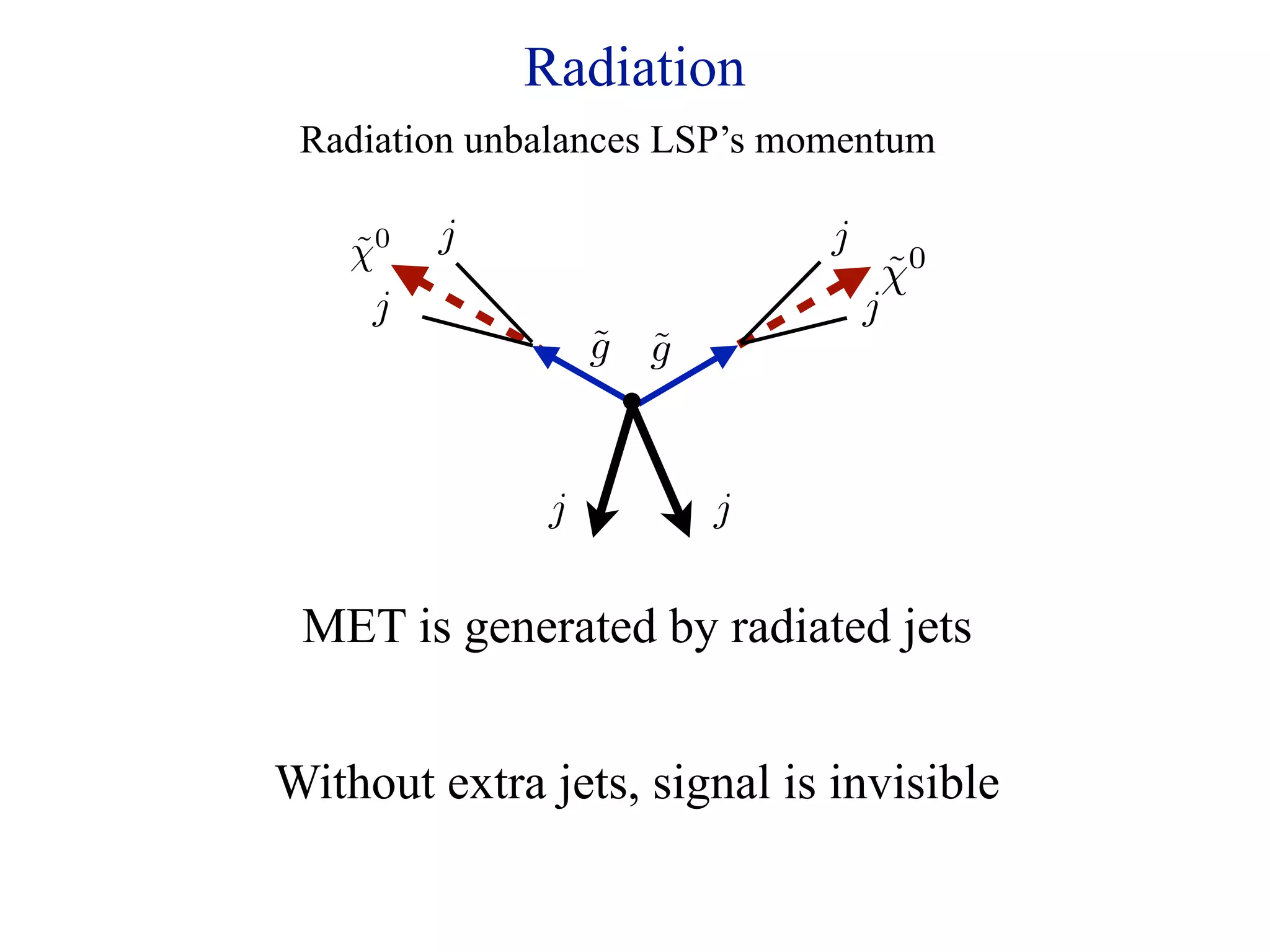
Radiation
 Degenerate spectra require radiation to generate signal


                                 V.   GLUINO EXCLUSION LIMITS

                                       A.    No Cascade Decays

                                                                ˜
                                                               mχ
                                                                                    
     For the remainder of the paper, we will discuss how model-independent jets + ET searches
 can be used to set limits on the parameters in a particular theory. We will focus specifically


                                                        =
 on the case of pair-produced gluinos at the Tevatron and begin by considering the simplified
 scenario of a direct decay to the bino. The expected number of jets depends on the relative


mχ
 mass difference between the gluino and bino. When the mass difference is small, the decay
 jets are very soft and initial-state radiation is important; in this limit, the monojet search

 ˜
 is best. When the mass difference is large, the decay jets are hard and well-defined, so


                                                                                                                   M
 the multijet search is most effective. The dijet and threejet searches are important in the
 transition between these two limits.
                                                  X
                                             m
     As an example, let us consider the model spectrum with a 340 GeV gluino decaying
 directly into a 100 GeV bino. In this case, the gluino is heavy and its mass difference with
 the bino is relatively large, so we expect the multijet search to be most effective. Table III
 shows the differential cross section grids for the 1-4+ jet searches for this simulated signal
 point. The colors indicate the significance of the signal over the limits presented in Table II;
 the multijet search has the strongest excesses.
                                                                         
     Previously [28], we obtained exclusion limits by optimizing the ET and HT cuts, which
 involves simulating each mass point beforehand to determine which cuts are most appropri-
 ate. This is effectively like dealing with a 1 × 1 grid, for which a 95% exclusion corresponds


                      150
               Bino Mass GeV


                                                                                                                                    ···
                      100


                                                                                                                           ˜
                                                                                                                           χ0   ˜
           Out[27]=


                      50                                X


                                                                                                                                g
                                                     mX
                       0

                                               Gluino Mass GeV
                       100             200            300          400           500


 FIG. 4: The 95% exclusion region for DO at 4 fb−1 assuming 50% systematic error on background.
                                        
 The exclusion region for a directly decaying gluino is shown in light blue; the worst case scenario
 for the cascade decay is shown in dark blue. The dashed line represents the CMSSM points and
 the “X” is the current DO exclusion limit at 2 fb−1 .


                                                   15


                                                                                   UED-like Theories
                      Unbalanced momentum set by Q = mg − mχ
                                                      ˜    ˜
                                                                                       j                      ˜
                                                                                                              g        j
                                                                         ˜
                                                                         χ0                                                ˜
                                                                                                                           χ0
                                                                                       j                  ˜
                                                                                                          g            j


                                                     As pT of gluino increases,
                                             Final state jets get harder (and eventually merge),
                                                 but won’t gain significant MET
Radiation
 Radiation unbalances LSP’s momentum

    ˜
    χ0   j                    j
                                      ˜
                                      χ0
     j                            j
                  ˜ ˜
                  g g


              j         j

 MET is generated by radiated jets


Without extra jets, signal is invisible
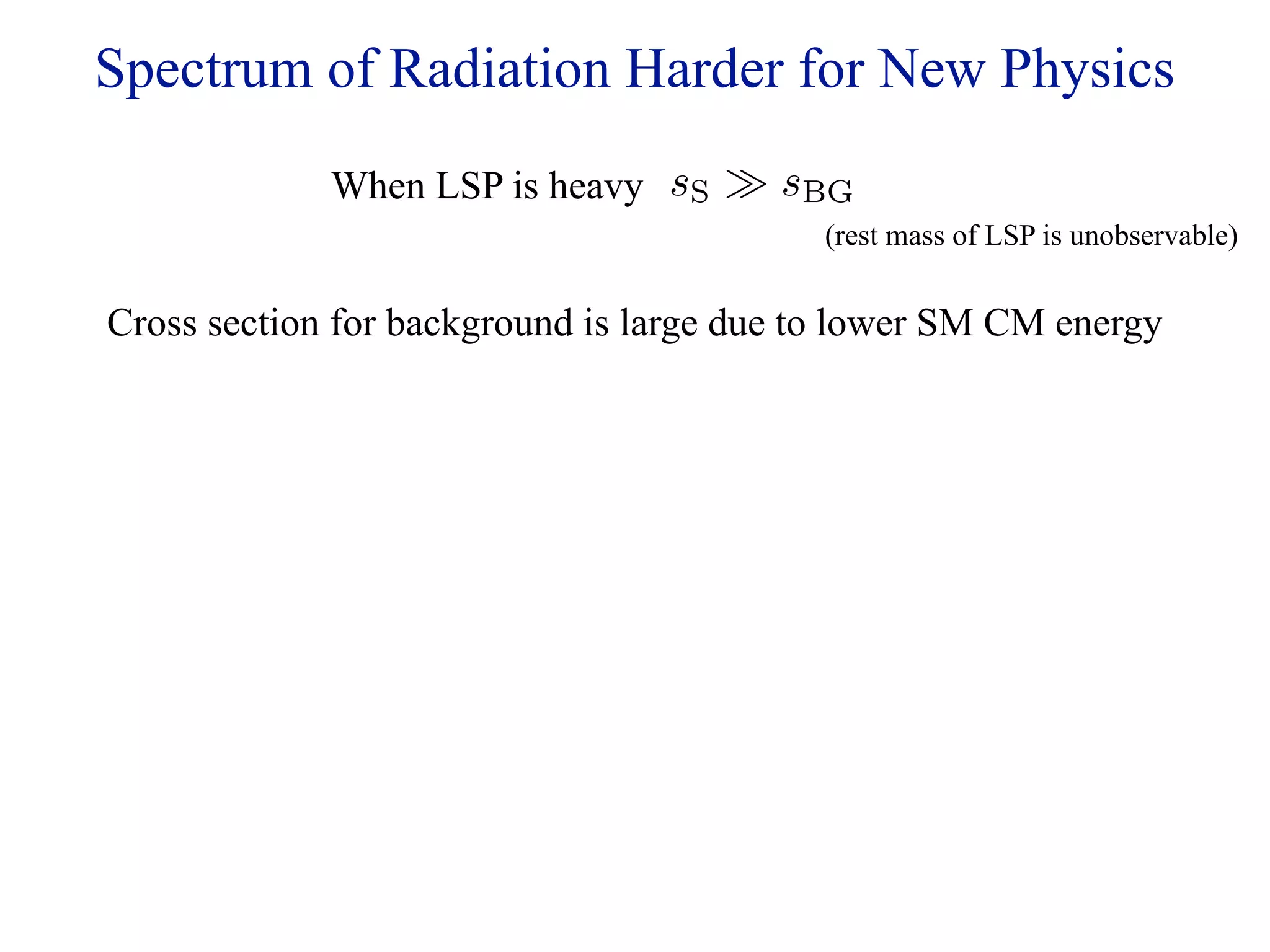
Spectrum of Radiation Harder for New Physics
             When LSP is heavy sS  sBG
                                          (rest mass of LSP is unobservable)


Cross section for background is large due to lower SM CM energy
Spectrum of Radiation Harder for New Physics

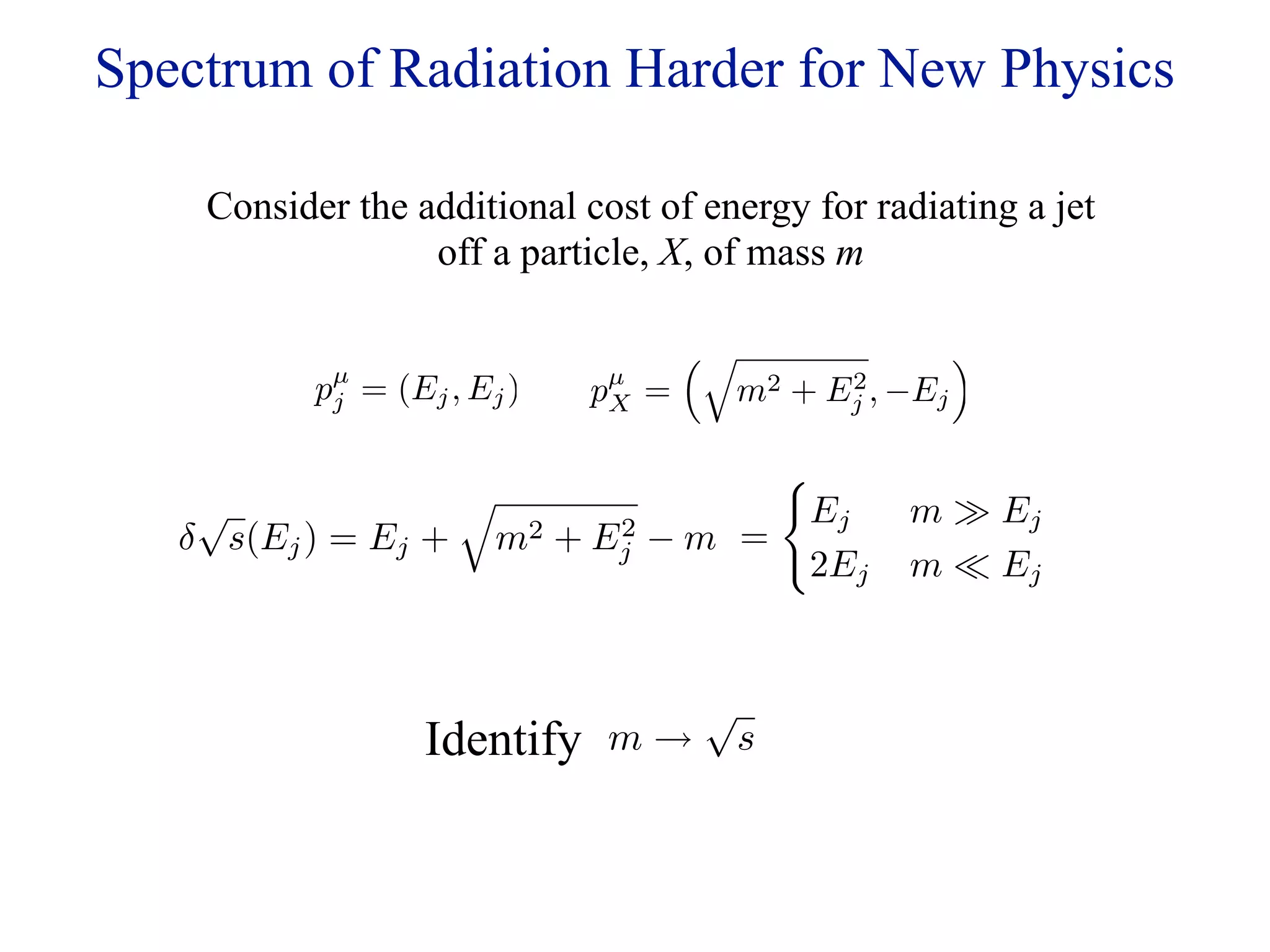
    Consider the additional cost of energy for radiating a jet
                  off a particle, X, of mass m

                                                   
           pµ = (Ej , Ej )
            j                 pµ
                               X   =   m2 + Ej , −Ej
                                             2


    √                            Ej              m  Ej
   δ s(Ej ) = Ej + m2 + E2 − m =
                         j
                                  2Ej             m  Ej


                                      √
                   Identify   m→          s
Spectrum of Radiation Harder for New Physics
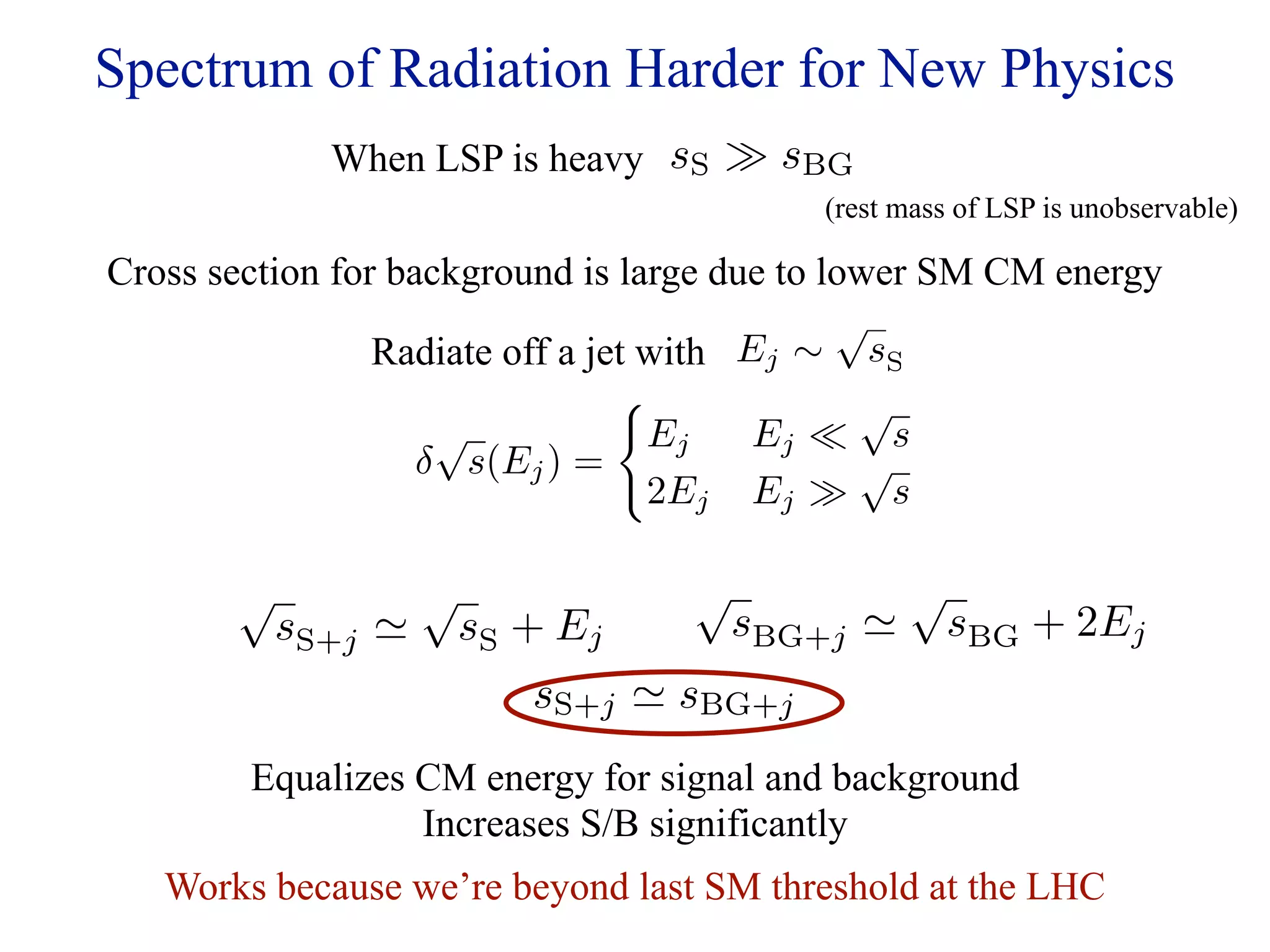
             When LSP is heavy sS  sBG
                                          (rest mass of LSP is unobservable)

Cross section for background is large due to lower SM CM energy
                                              √
                 Radiate off a jet with Ej ∼ sS
                                              √
                     √             Ej    Ej  s
                    δ s(Ej ) =                 √
                                   2Ej Ej  s

       √            √              √             √
           sS+j        sS + Ej        sBG+j        sBG + 2Ej
                           sS+j  sBG+j
        Equalizes CM energy for signal and background
                  Increases S/B significantly
   Works because we’re beyond last SM threshold at the LHC
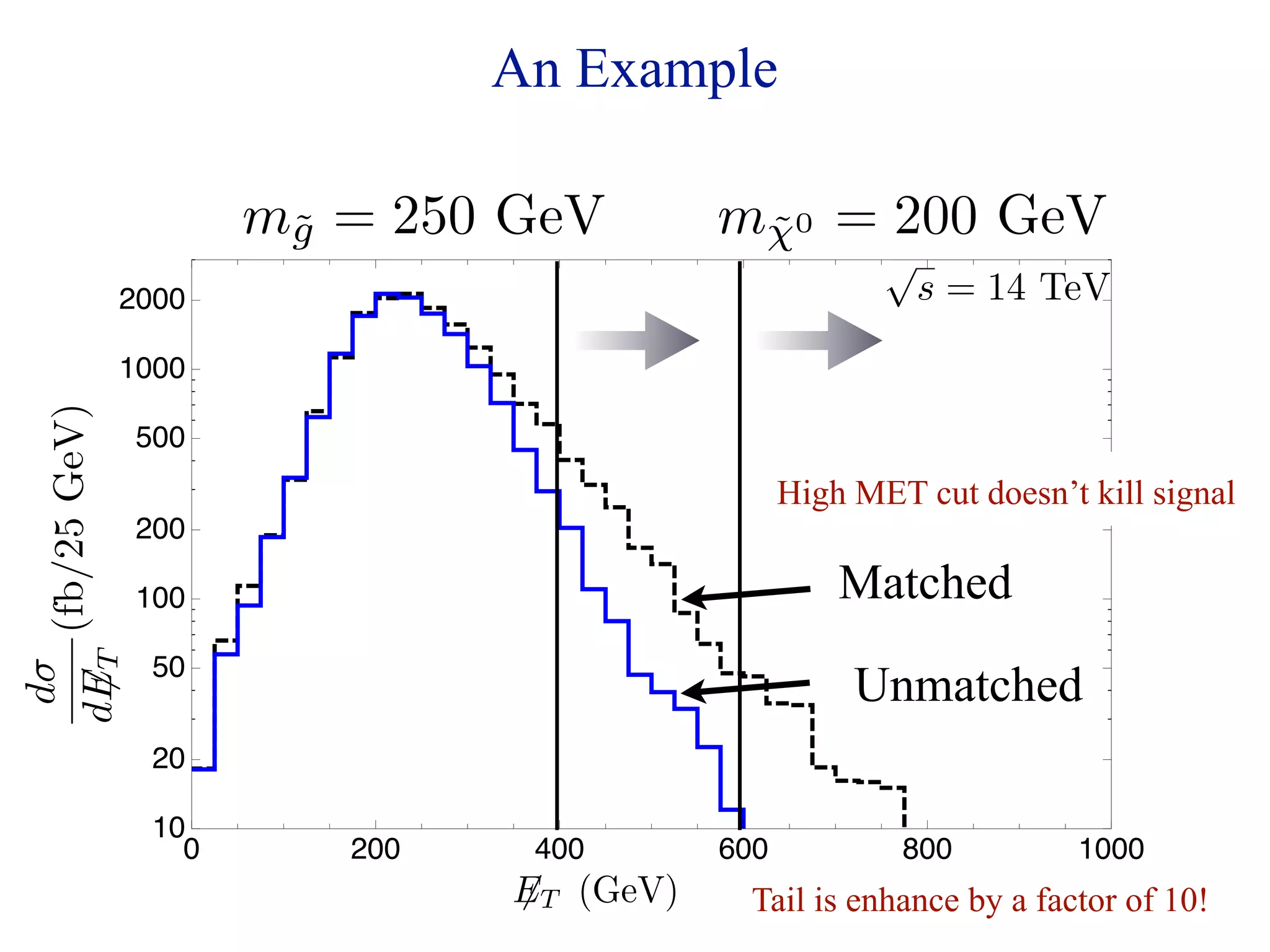
An Example

                        mg = 250 GeV
                         ˜                  mχ0 = 200 GeV
                                             ˜
                                                         √
           2000                                              s = 14 TeV
           1000
    (fb/25 GeV)


             500
                                                  High MET cut doesn’t kill signal
             200

             100                                      Matched
dET


                  50
                                                       Unmatched
 dσ


                  20

                  10
                    0      200    400       600           800          1000
                                 ET (GeV)
                                            Tail is enhance by a factor of 10!
Plan of Talk


    Distinguishing Signal from Background


*      Where the LHC can get to (soon)
Multijet Universality
                   Selection Criteria for Different Jet Multiplicity Searches
                          
                    1j + ET             
                                  2j + ET           
                                               3j + ET         4+ j + ET
                                                                      
              j1   ≥ 400 GeV    ≥ 100 GeV     ≥ 100 GeV       ≥ 100 GeV
              j2    50 GeV     ≥ 50 GeV      ≥ 50 GeV        ≥ 50 GeV
              j3    50 GeV      50 GeV      ≥ 50 GeV        ≥ 50 GeV
              j4    50 GeV      50 GeV       50 GeV        ≥ 50 GeV
 Table 1: The selection criteria for the different jets plus missing energy samples. Jet pT cuts
 in GeV for the different exclusive search channels. The following cuts are applied: |ηj |  2.5,
Never20 GeV, ∆φ(ET , ji) jet multiplicity to significantly enhance discovery
 pT,  found lower  0.2 rad. (i = 1, 2, 3).
                    
                                     Degenerate spectra
 2.1 Classification of Search Channels
                               Light Squarks, Heavy Gluinos
 Discovering new physics in an all-hadronic final state is a challenging prospect in the jet-
 rich environment of the LHC. The QCD and instrumental backgrounds, particularly in
 early running, are a major challenge. In shape variables and ensure that the events
   Tried many different event order to both trigger and search strategies
 are sufficiently distinctive compared to poorly understood backgrounds, the searches
 considered in this article have tighter cuts than the ones considered in the published
 search strategies from ATLAS and CMS. For instance, thethe Tevatron article were
                      Qualitatively different than cuts used in this
                                                         
 initially based on the benchmark ATLAS multijet + ET searches [3]. This article finds
 that requiring a larger missing energy criteria is more effective at separating signal from
 background
      The first step in devising a model-independent, inclusive search strategy is to clas-
14 TeV
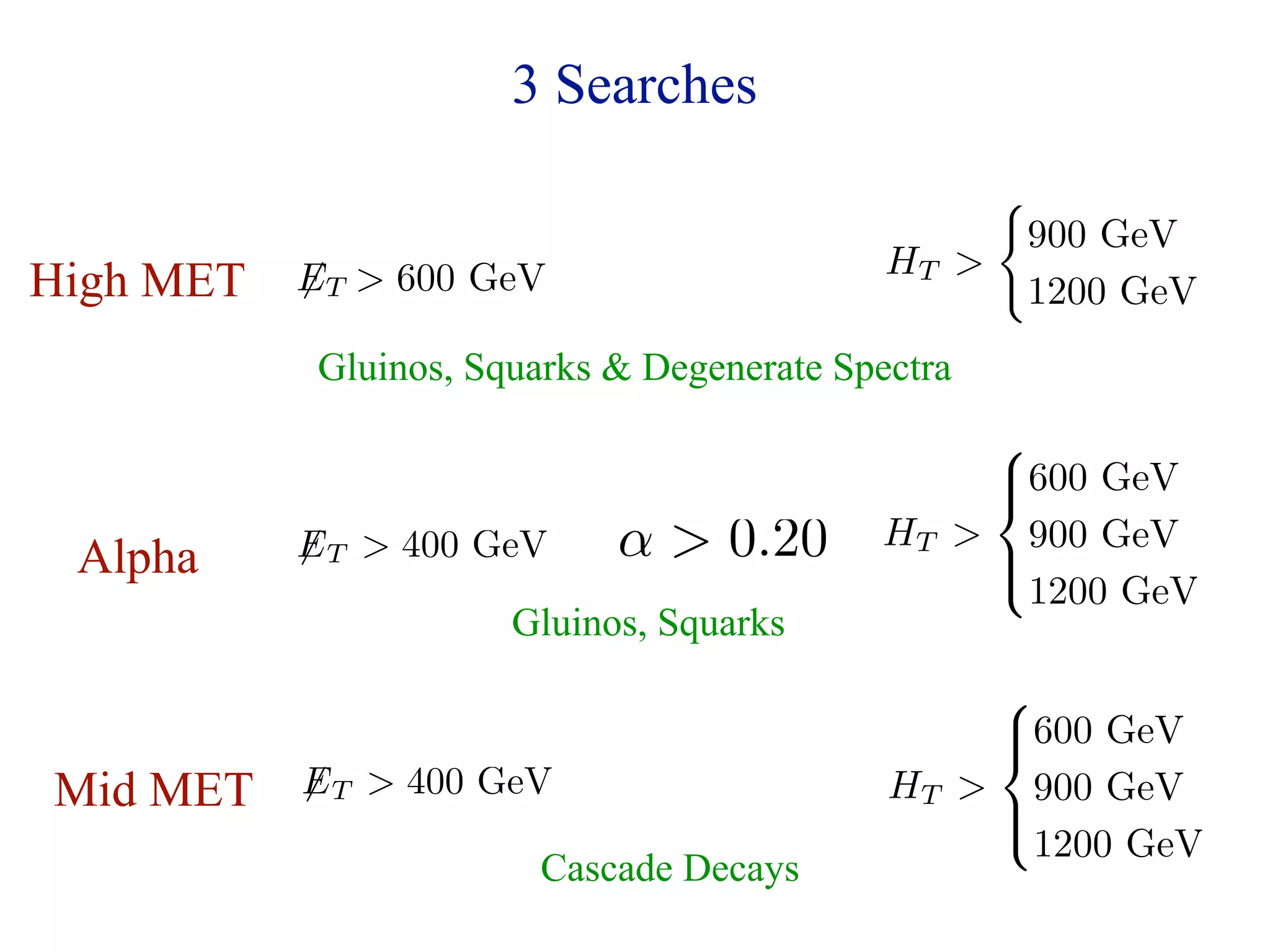
3 Searches
                                                  
                                                   900 GeV
                                             HT 
High MET   ET  600 GeV
                                                  1200 GeV
            Gluinos, Squarks  Degenerate Spectra
                                                
                                                600 GeV
                                                
 Alpha     E T  400 GeV    α  0.20       HT  900 GeV
                                                
                                                
                                                 1200 GeV
                       Gluinos, Squarks
                                                 
                                                 600 GeV
                                                 
Mid MET    E T  400 GeV                    HT  900 GeV
                                                 
                                                 
                                                  1200 GeV
                         Cascade Decays
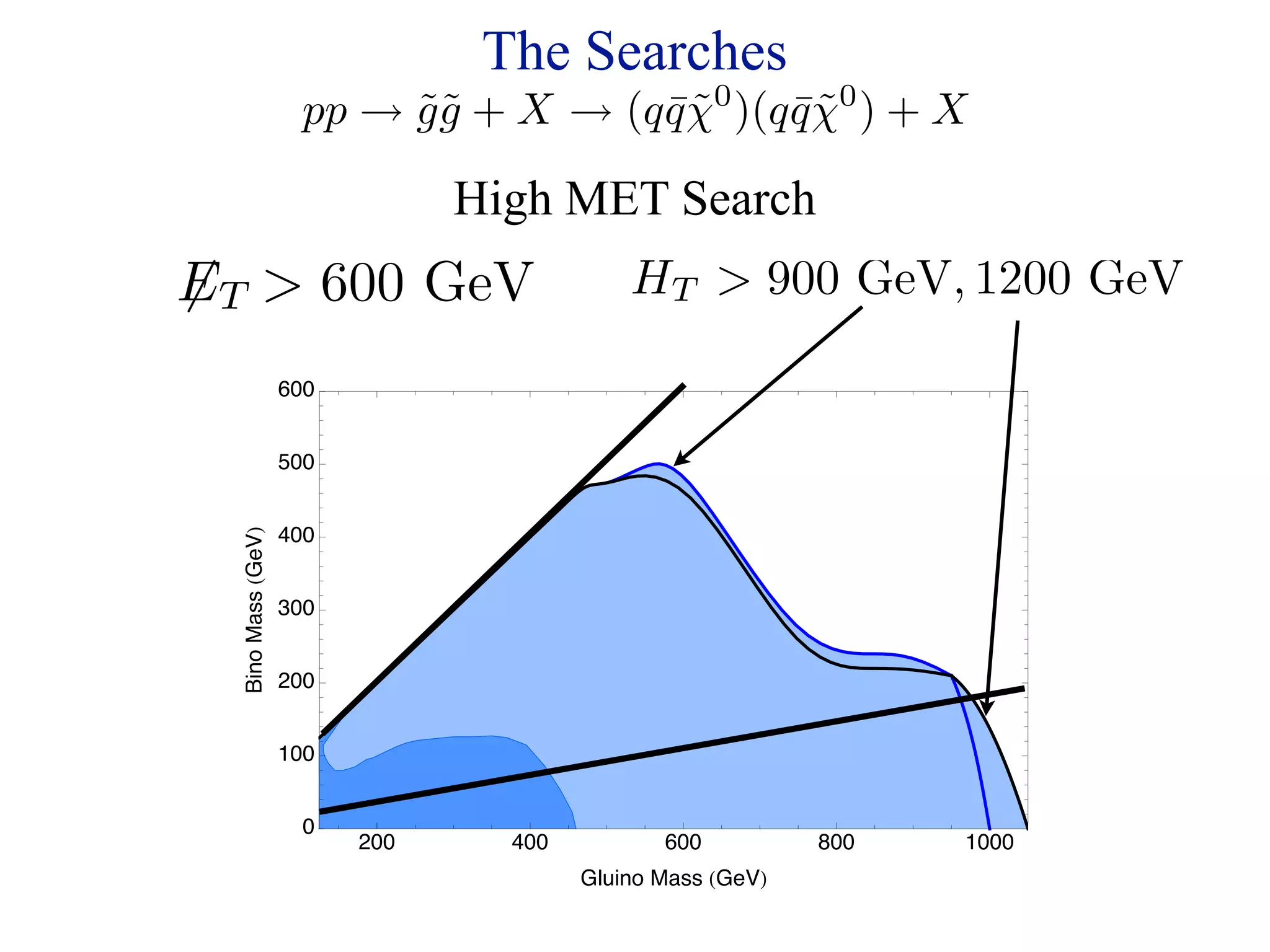
The Searches
          pp → g g + X → (q q χ0 )(q q χ0 ) + X
               ˜˜           ¯˜       ¯˜

                         High MET Search
ET  600 GeV
                                    HT  900 GeV, 1200 GeV

        600


        500


        400
 Bino Mass GeV


        300


        200


        100


          0

                                 Gluino Mass GeV
                   200     400          600          800   1000
ariables, the sensitivity in multijet and ET searches will
ent shape variable, αRTS Alphaintroduced in [24]. αRTS was
                     The , first Variable
              Introduced by L. Randall  D. Tucker-Smith
                                  
                      pT j2                    pT j2
               α
             αRTS   =
                      mj1 j2
                             
                                      pT j1 (1 − cos θj1j2 )

 are the transverse momentumto multijet leading two jets in t
                  Modified by CMS
                                    of the searches
 ant mass between the3 leading and subleading jets, and θj
                      j
     j1
                                                     
 m. αRTS was introduced as an alternative to ET in eli
             
  in dijet + ET searches; j2evaluating Eq. 2.3 for a topology
                         Group to minimize
 al QCD scenario, gives αRT S = 0.5. Fig. 2 shows a αRTS
                       momentum imbalance
 QCD sample and the electroweak 1 SM backgrounds with2
                                      j                    Sj
 hape suggests applying a cut αRTS ≥ 0.55 as an alternati
  
d ET searches. However, the region below 0.5 is where new
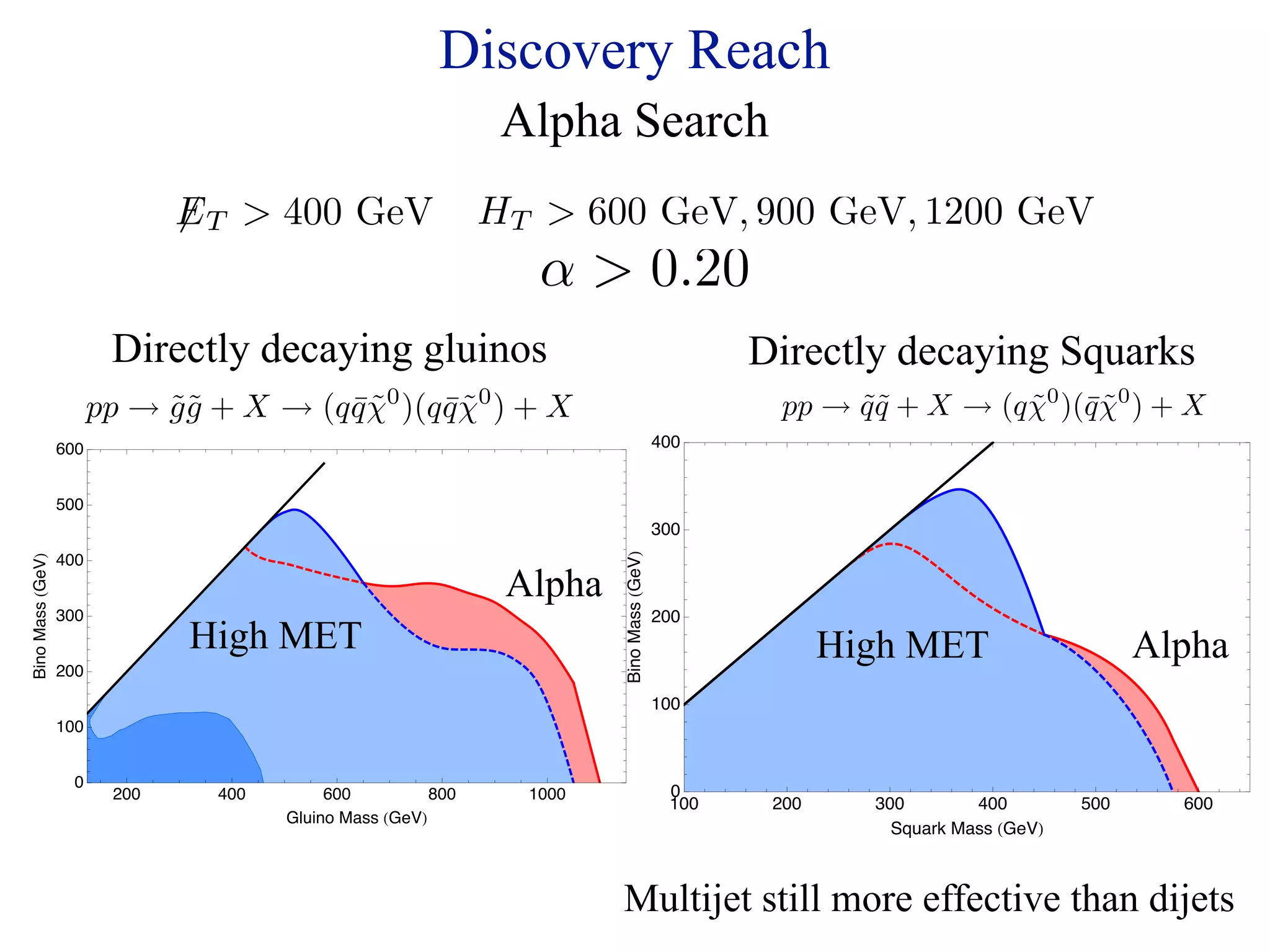
Discovery Reach
                                                      Alpha Search
                     E T  400 GeV                  HT  600 GeV, 900 GeV, 1200 GeV
                                                        α  0.20
              Directly decaying gluinos                                         Directly decaying Squarks
             pp → g g + X → (q q χ0 )(q q χ0 ) + X
                  ˜˜           ¯˜       ¯˜                                       pp → q q + X → (q χ0 )(¯χ0 ) + X
                                                                                      ˜˜           ˜ q˜
       600                                                           400


       500
                                                                     300


                                                              Bino Mass GeV
       400
Bino Mass GeV


                                                      Alpha
       300                                                           200
                     High MET                                                          High MET                      Alpha
       200
                                                                     100
       100


         0

                             Gluino Mass GeV
               200     400        600          800     1000            0

                                                                                           Squark Mass GeV
                                                                       100       200     300        400        500     600


                                                                 Multijet still more effective than dijets
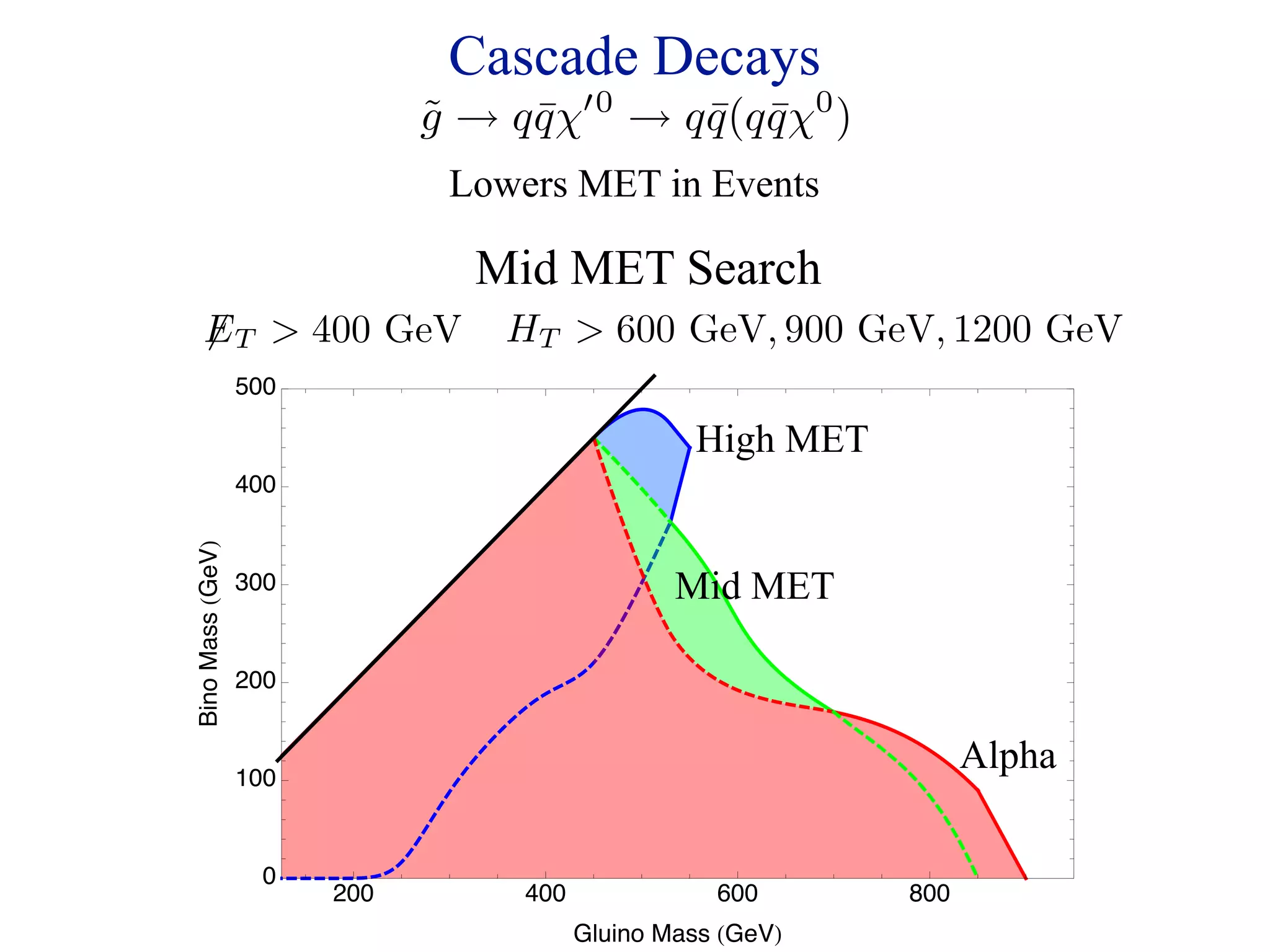
Cascade Decays
                        ˜    ¯
                        g → qqχ    0
                                        → q q (q q χ )
                                            ¯ ¯        0

                         Lowers MET in Events

                          Mid MET Search
    E T  400 GeV          HT  600 GeV, 900 GeV, 1200 GeV
       500

                                            High MET
       400
Bino Mass GeV


       300                                 Mid MET

       200


       100
                                                                 Alpha

         0

                                   Gluino Mass GeV
                  200        400              600          800
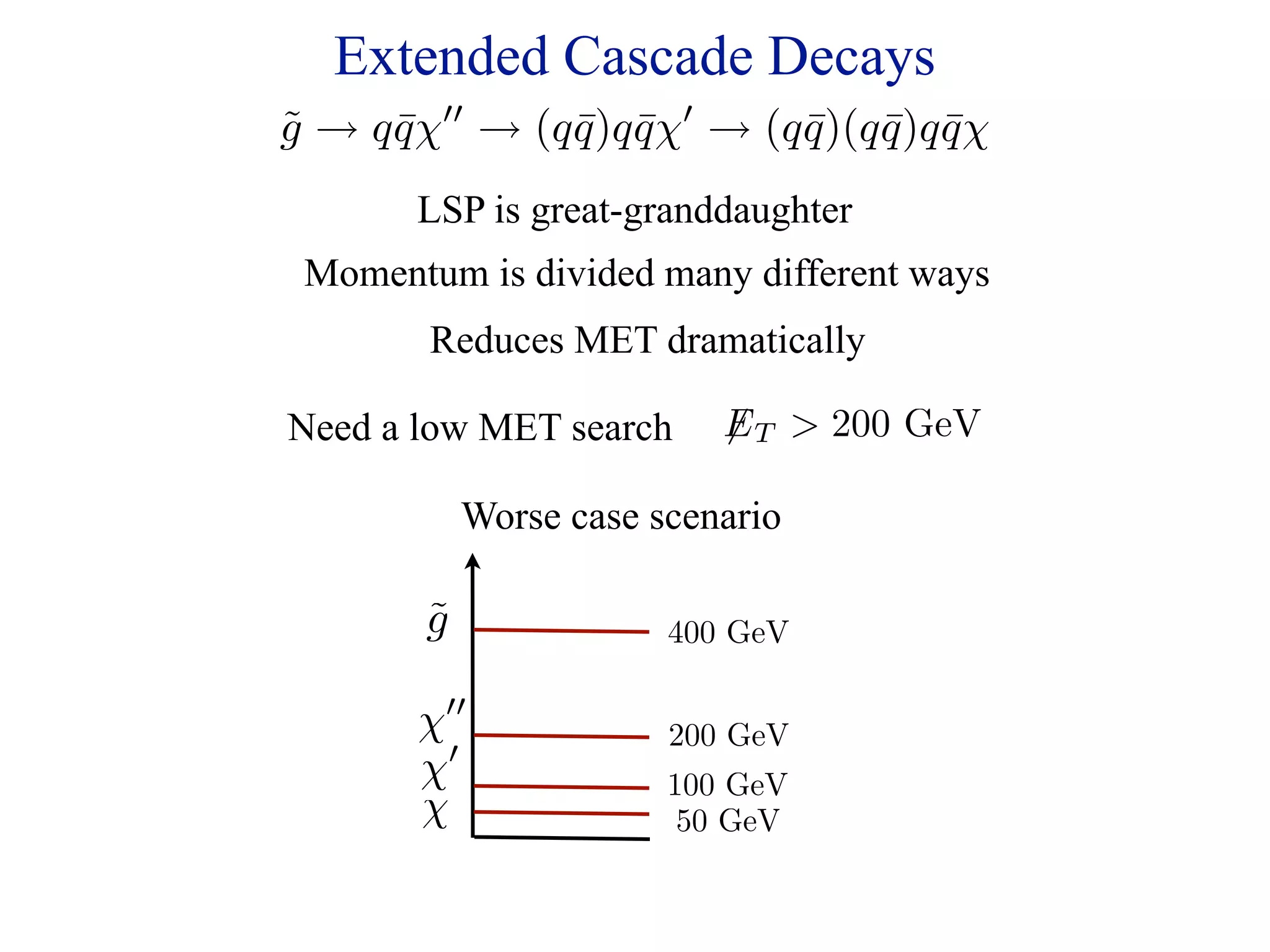
Extended Cascade Decays
g → q q χ → (q q )q q χ → (q q )(q q )q q χ
˜     ¯  
               ¯ ¯       
                             ¯ ¯ ¯
        LSP is great-granddaughter
 Momentum is divided many different ways
         Reduces MET dramatically

Need a low MET search        E T  200 GeV

            Worse case scenario

        ˜
        g               400 GeV

         
        χ               200 GeV
          
        χ               100 GeV
        χ                50 GeV
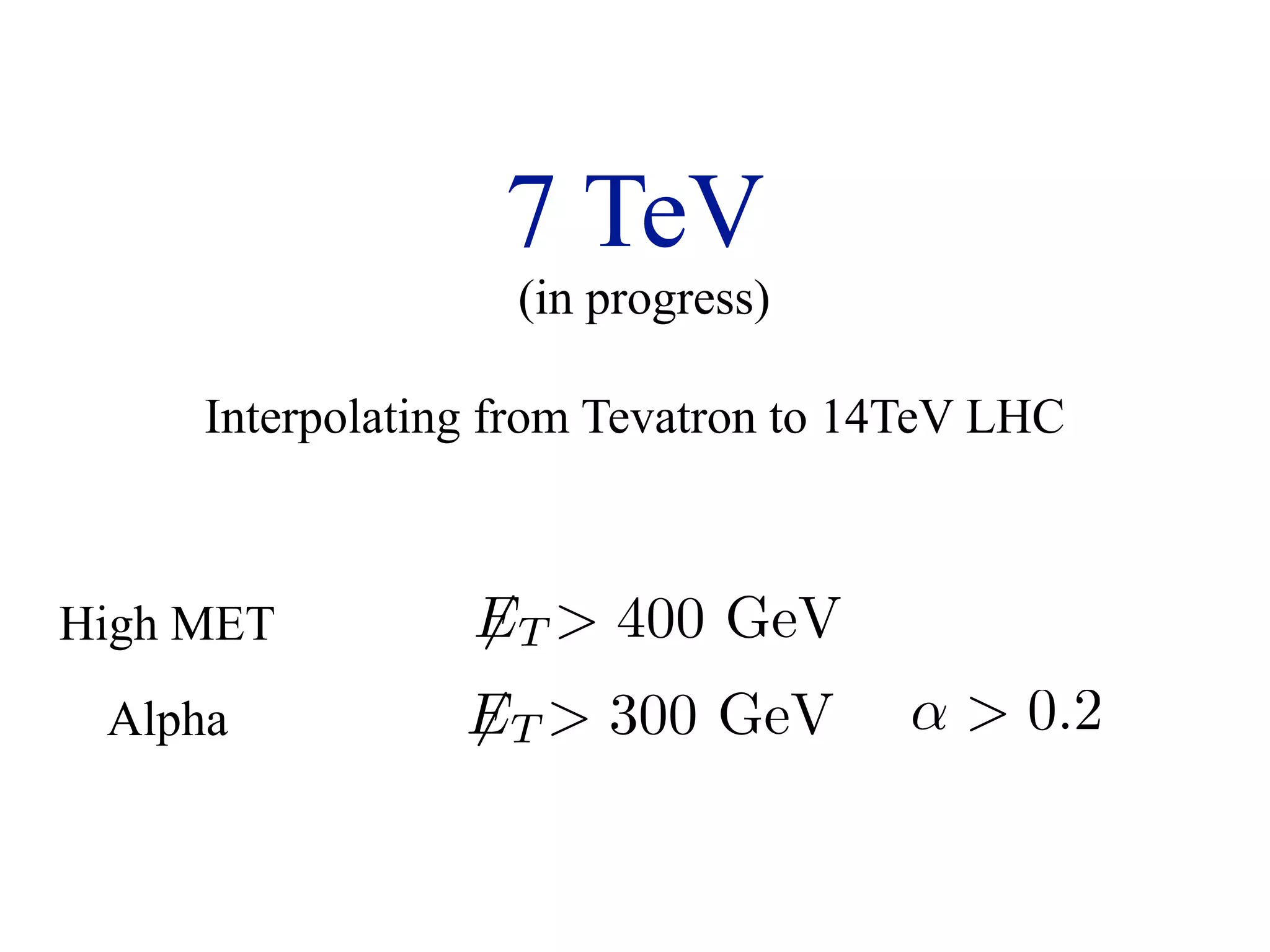
7 TeV
                   (in progress)

     Interpolating from Tevatron to 14TeV LHC


High MET         ET  400 GeV
                 
 Alpha           ET  300 GeV
                                    α  0.2
Direct Gluino Decays
                                pp → g g + X → (q q χ0 )(q q χ0 ) + X
                                V.
                                     ˜˜           ¯˜       ¯˜
                                     GLUINO EXCLUSION LIMITS

                                      A.    No Cascade Decays

                                                                                   
    For the remainder of the paper, we will discuss how model-independent jets + ET searches
can be used to set limits on the parameters in a particular theory. We will focus specifically
on the case of pair-produced gluinos at the Tevatron and begin by considering the simplified
                 400
scenario of a direct decay to the bino. The expected number of jets depends on the relative
mass difference between the gluino and bino. When the mass difference is small, the decay
jets are very soft and initial-state radiation is important; in this limit, the monojet search
is best. When the mass difference is large, the decay jets are hard and well-defined, so
the multijet search is most effective. The dijet and threejet searches are important in the
transition between these two limits.
    As an example, let us consider the model spectrum with a 340 GeV gluino decaying
                 300
directly into a 100 GeV bino. In this case, the gluino is heavy and its mass difference with
the bino is relatively large, so we expect the multijet search to be most effective. Table III
shows the differential cross section grids for the 1-4+ jet searches for this simulated signal
  Bino Mass GeV


point. The colors indicate the significance of the signal over the limits presented in Table II;
the multijet search has the strongest excesses.
                                                                        
    Previously [28], we obtained exclusion limits by optimizing the ET and HT cuts, which
involves simulating each mass point beforehand to determine which cuts are most appropri-
                 200
ate. This is effectively like dealing with a 1 × 1 grid, for which a 95% exclusion corresponds


                     150
              Bino Mass GeV


                 100
                   100


                                                                                                       2σ
          Out[27]=


                     50


                     00
                                                       X

                                                                                                  5σ
                                              Gluino Mass GeV


                                                                   Gluino Mass GeV
                      100
                                     200
                                      200            300
                                                                  400
                                                                  400           500
                                                                                               600      800
FIG. 4: The 95% exclusion region for DO at 4 fb−1 assuming 50% systematic error on background.
                                       
The exclusion region for a directly decaying gluino is shown in light blue; the worst case scenario
for the cascade decay is shown in dark blue. The dashed line represents the CMSSM points and
the “X” is the current DO exclusion limit at 2 fb−1 .


                                                  15


                           Doubling the reach in the next year!
Conclusion
Conclusion

Discovery at the LHC in Jets + MET much easier
               than at the Tevatron

  Matching gets the features of the signal right
          and makes it more visible


     Simple search strategies will provide
             extensive coverage

LHC Jets and MET

  • 1.
    Jets Plus MET: Now versus Then Jay Wacker SLAC Emerging problems in particle phenomenology April 11, 2010 with Eder Izaguirre, Ning Bao and Michael Manhart arXiv: 1003.3886, 1004.XXXX “I swear it’s right around the corner”
  • 2.
    Jets + MET Solution to Hierarchy Problem If the symmetry commutes with SU(3)C, new colored top partners (note twin Higgs exception) Dark Matter Wimp Miracle: DM a thermal relic if mass is 100 GeV to 1 TeV Usually requires a dark sector, frequently contains new colored particles Fewest requirements on spectroscopy Doesn’t require squeezing in additional states to decay chains
  • 3.
    Model Dependent Design Startwith a model and design a search to discover it Most studies currently available are benchmarks within specific parameterizations (e.g. SU#, etc) DØ Preliminary, 0.96 fb-1 600 Squark Mass (GeV) tan!=3, A =0, µ <0 0 CDF II 500 400 DØ IA UA1 UA2 CDF IB no mSUGRA solution 300 DØ IB 200 100 LEP 0 0 100 200 300 400 500 600 Gluino Mass (GeV) What is the efficacy of searches outside parameterizations? (let alone to different theories e.g. UEDs) Design a set of searches that will catch anything Make sure unexpected theories aren’t missed
  • 4.
    Spectrum in DifferentTheories MSSM UED High Cut-Off Low Cut-Off Large Mass Splittings Small Mass Splittings 2 g 2 g δm = m log Λ δm = Λ 16π 2 16π 2 ˜ g g1 w1 b1 ˜ w ˜ b
  • 5.
    Tevatron Review Searches are challenging Difficult to pull signal from background Necessary to consider multiple searches 1j + E T 2j + E T 3j + E T 4+ j + E T Multiple cuts for E T HT Frequently low values of E T HT are necessary
  • 6.
    Casting a WideNet Kinematics matters more than spin or A-terms Alwall, Le Lisanti, JW (0803.0019) Q = mX − mχ ˜ X = g , q , ... ˜ ˜ Q=0 V. GLUINO EXCLUSION LIMITS A. No Cascade Decays ˜ χ m For the remainder of the paper, we will discuss how model-independent jets + ET searches can be used to set limits on the parameters in a particular theory. We will focus specifically = on the case of pair-produced gluinos at the Tevatron and begin by considering the simplified scenario of a direct decay to the bino. The expected number of jets depends on the relative mχ mass difference between the gluino and bino. When the mass difference is small, the decay jets are very soft and initial-state radiation is important; in this limit, the monojet search ˜ is best. When the mass difference is large, the decay jets are hard and well-defined, so the multijet search is most effective. The dijet and threejet searches are important in the transition between these two limits. X m As an example, let us consider the model spectrum with a 340 GeV gluino decaying directly into a 100 GeV bino. In this case, the gluino is heavy and its mass difference with the bino is relatively large, so we expect the multijet search to be most effective. Table III shows the differential cross section grids for the 1-4+ jet searches for this simulated signal point. The colors indicate the significance of the signal over the limits presented in Table II; the multijet search has the strongest excesses. Tevatron Gluino Previously [28], we obtained exclusion limits by optimizing the ET and HT cuts, which involves simulating each mass point beforehand to determine which cuts are most appropri- ate. This is effectively like dealing with a 1 × 1 grid, for which a 95% exclusion corresponds 250 GeV Sensitivity 150 mSugra Bino Mass GeV 100 Out[27]= 50 X 0 100 200 Gluino Mass GeV 300 400 500 FIG. 4: The 95% exclusion region for DO at 4 fb−1 assuming 50% systematic error on background. mX 250 GeV The exclusion region for a directly decaying gluino is shown in light blue; the worst case scenario 500 GeV for the cascade decay is shown in dark blue. The dashed line represents the CMSSM points and the “X” is the current DO exclusion limit at 2 fb−1 . 15
  • 7.
    Plan of Talk Distinguishing Signal from Background * Where the LHC can get to (soon)
  • 8.
    542 than 20 GeV. We demand at least 4 jets with |η | pT 100 GeV. The transverse sphericity ST should Backgrounds 543 544 ETmiss should be larger than 100 GeV and larger th 545 add one more cut against the QCD background: the Madgraph+Pythia 546 547 between the ET PGS miss vector and the three highest-p discussed in a dedicated note on QCD background e (up to 2 → 4 ) 548 3.2 Backgrounds in Monte Carlo 4+jetsFigure 16 shows the distributions of E 549 miss T and Meff SM 104 ¯ Events / 1fb−1/ 50GeV 1000 SU3 tt± SM BG tt W 103 W (fb/25 GeV) 100 Z0 Z QCD QCD 102 single top ATLAS 10 10 dET dσ 1 1 0 100 200 300 400 500 600 700 800 900 1000 Missing ET [GeV] 0.1 200 400 600 800 √1000 ET (GeV) s = 14 TeV Figure 16: The ET miss and effective mass distribut for the no-lepton mode with an integrated luminosit (SU3 point). The shaded histogram shows the sum o Matching crucial to getting MET tail vaguely right show the various components.
  • 9.
    Signals Should use same methods for signals as backgrounds Signal may be in a different place than expected Parton Shower - Matrix Element Matching pp → XX + 0j pp → XX + 1j pp → XX + 2 j + Extra jets aren’t a nuisance, they can qualitatively alter signal
  • 10.
    New Initial States Possible at higher order gg, q q → 2˜ + 0+ j ¯ g gq → 2˜ + 1+ j g qq → 2˜ + 2+ j g Parton Luminosities 1 µb gg dL qq dˆ s 1 nb qg ¯ qq 1 pb √ 350 GeV 1000 GeV √ s = 7 TeV ˆ s 700 GeV 2000 GeV √ s = 14 TeV
  • 11.
    Radiation Degenerate spectrarequire radiation to generate signal V. GLUINO EXCLUSION LIMITS A. No Cascade Decays ˜ mχ For the remainder of the paper, we will discuss how model-independent jets + ET searches can be used to set limits on the parameters in a particular theory. We will focus specifically = on the case of pair-produced gluinos at the Tevatron and begin by considering the simplified scenario of a direct decay to the bino. The expected number of jets depends on the relative mχ mass difference between the gluino and bino. When the mass difference is small, the decay jets are very soft and initial-state radiation is important; in this limit, the monojet search ˜ is best. When the mass difference is large, the decay jets are hard and well-defined, so M the multijet search is most effective. The dijet and threejet searches are important in the transition between these two limits. X m As an example, let us consider the model spectrum with a 340 GeV gluino decaying directly into a 100 GeV bino. In this case, the gluino is heavy and its mass difference with the bino is relatively large, so we expect the multijet search to be most effective. Table III shows the differential cross section grids for the 1-4+ jet searches for this simulated signal point. The colors indicate the significance of the signal over the limits presented in Table II; the multijet search has the strongest excesses. Previously [28], we obtained exclusion limits by optimizing the ET and HT cuts, which involves simulating each mass point beforehand to determine which cuts are most appropri- ate. This is effectively like dealing with a 1 × 1 grid, for which a 95% exclusion corresponds 150 Bino Mass GeV ··· 100 ˜ χ0 ˜ Out[27]= 50 X g mX 0 Gluino Mass GeV 100 200 300 400 500 FIG. 4: The 95% exclusion region for DO at 4 fb−1 assuming 50% systematic error on background. The exclusion region for a directly decaying gluino is shown in light blue; the worst case scenario for the cascade decay is shown in dark blue. The dashed line represents the CMSSM points and the “X” is the current DO exclusion limit at 2 fb−1 . 15 UED-like Theories Unbalanced momentum set by Q = mg − mχ ˜ ˜ j ˜ g j ˜ χ0 ˜ χ0 j ˜ g j As pT of gluino increases, Final state jets get harder (and eventually merge), but won’t gain significant MET
  • 12.
    Radiation Radiation unbalancesLSP’s momentum ˜ χ0 j j ˜ χ0 j j ˜ ˜ g g j j MET is generated by radiated jets Without extra jets, signal is invisible
  • 13.
    Spectrum of RadiationHarder for New Physics When LSP is heavy sS sBG (rest mass of LSP is unobservable) Cross section for background is large due to lower SM CM energy
  • 14.
    Spectrum of RadiationHarder for New Physics Consider the additional cost of energy for radiating a jet off a particle, X, of mass m pµ = (Ej , Ej ) j pµ X = m2 + Ej , −Ej 2 √ Ej m Ej δ s(Ej ) = Ej + m2 + E2 − m = j 2Ej m Ej √ Identify m→ s
  • 15.
    Spectrum of RadiationHarder for New Physics When LSP is heavy sS sBG (rest mass of LSP is unobservable) Cross section for background is large due to lower SM CM energy √ Radiate off a jet with Ej ∼ sS √ √ Ej Ej s δ s(Ej ) = √ 2Ej Ej s √ √ √ √ sS+j sS + Ej sBG+j sBG + 2Ej sS+j sBG+j Equalizes CM energy for signal and background Increases S/B significantly Works because we’re beyond last SM threshold at the LHC
  • 16.
    An Example mg = 250 GeV ˜ mχ0 = 200 GeV ˜ √ 2000 s = 14 TeV 1000 (fb/25 GeV) 500 High MET cut doesn’t kill signal 200 100 Matched dET 50 Unmatched dσ 20 10 0 200 400 600 800 1000 ET (GeV) Tail is enhance by a factor of 10!
  • 17.
    Plan of Talk Distinguishing Signal from Background * Where the LHC can get to (soon)
  • 18.
    Multijet Universality Selection Criteria for Different Jet Multiplicity Searches 1j + ET 2j + ET 3j + ET 4+ j + ET j1 ≥ 400 GeV ≥ 100 GeV ≥ 100 GeV ≥ 100 GeV j2 50 GeV ≥ 50 GeV ≥ 50 GeV ≥ 50 GeV j3 50 GeV 50 GeV ≥ 50 GeV ≥ 50 GeV j4 50 GeV 50 GeV 50 GeV ≥ 50 GeV Table 1: The selection criteria for the different jets plus missing energy samples. Jet pT cuts in GeV for the different exclusive search channels. The following cuts are applied: |ηj | 2.5, Never20 GeV, ∆φ(ET , ji) jet multiplicity to significantly enhance discovery pT, found lower 0.2 rad. (i = 1, 2, 3). Degenerate spectra 2.1 Classification of Search Channels Light Squarks, Heavy Gluinos Discovering new physics in an all-hadronic final state is a challenging prospect in the jet- rich environment of the LHC. The QCD and instrumental backgrounds, particularly in early running, are a major challenge. In shape variables and ensure that the events Tried many different event order to both trigger and search strategies are sufficiently distinctive compared to poorly understood backgrounds, the searches considered in this article have tighter cuts than the ones considered in the published search strategies from ATLAS and CMS. For instance, thethe Tevatron article were Qualitatively different than cuts used in this initially based on the benchmark ATLAS multijet + ET searches [3]. This article finds that requiring a larger missing energy criteria is more effective at separating signal from background The first step in devising a model-independent, inclusive search strategy is to clas-
  • 19.
  • 20.
    3 Searches 900 GeV HT High MET ET 600 GeV 1200 GeV Gluinos, Squarks Degenerate Spectra  600 GeV  Alpha E T 400 GeV α 0.20 HT 900 GeV   1200 GeV Gluinos, Squarks  600 GeV  Mid MET E T 400 GeV HT 900 GeV   1200 GeV Cascade Decays
  • 21.
    The Searches pp → g g + X → (q q χ0 )(q q χ0 ) + X ˜˜ ¯˜ ¯˜ High MET Search ET 600 GeV HT 900 GeV, 1200 GeV 600 500 400 Bino Mass GeV 300 200 100 0 Gluino Mass GeV 200 400 600 800 1000
  • 22.
    ariables, the sensitivityin multijet and ET searches will ent shape variable, αRTS Alphaintroduced in [24]. αRTS was The , first Variable Introduced by L. Randall D. Tucker-Smith pT j2 pT j2 α αRTS = mj1 j2 pT j1 (1 − cos θj1j2 ) are the transverse momentumto multijet leading two jets in t Modified by CMS of the searches ant mass between the3 leading and subleading jets, and θj j j1 m. αRTS was introduced as an alternative to ET in eli in dijet + ET searches; j2evaluating Eq. 2.3 for a topology Group to minimize al QCD scenario, gives αRT S = 0.5. Fig. 2 shows a αRTS momentum imbalance QCD sample and the electroweak 1 SM backgrounds with2 j Sj hape suggests applying a cut αRTS ≥ 0.55 as an alternati d ET searches. However, the region below 0.5 is where new
  • 23.
    Discovery Reach Alpha Search E T 400 GeV HT 600 GeV, 900 GeV, 1200 GeV α 0.20 Directly decaying gluinos Directly decaying Squarks pp → g g + X → (q q χ0 )(q q χ0 ) + X ˜˜ ¯˜ ¯˜ pp → q q + X → (q χ0 )(¯χ0 ) + X ˜˜ ˜ q˜ 600 400 500 300 Bino Mass GeV 400 Bino Mass GeV Alpha 300 200 High MET High MET Alpha 200 100 100 0 Gluino Mass GeV 200 400 600 800 1000 0 Squark Mass GeV 100 200 300 400 500 600 Multijet still more effective than dijets
  • 24.
    Cascade Decays ˜ ¯ g → qqχ 0 → q q (q q χ ) ¯ ¯ 0 Lowers MET in Events Mid MET Search E T 400 GeV HT 600 GeV, 900 GeV, 1200 GeV 500 High MET 400 Bino Mass GeV 300 Mid MET 200 100 Alpha 0 Gluino Mass GeV 200 400 600 800
  • 25.
    Extended Cascade Decays g→ q q χ → (q q )q q χ → (q q )(q q )q q χ ˜ ¯ ¯ ¯ ¯ ¯ ¯ LSP is great-granddaughter Momentum is divided many different ways Reduces MET dramatically Need a low MET search E T 200 GeV Worse case scenario ˜ g 400 GeV χ 200 GeV χ 100 GeV χ 50 GeV
  • 26.
    7 TeV (in progress) Interpolating from Tevatron to 14TeV LHC High MET ET 400 GeV Alpha ET 300 GeV α 0.2
  • 27.
    Direct Gluino Decays pp → g g + X → (q q χ0 )(q q χ0 ) + X V. ˜˜ ¯˜ ¯˜ GLUINO EXCLUSION LIMITS A. No Cascade Decays For the remainder of the paper, we will discuss how model-independent jets + ET searches can be used to set limits on the parameters in a particular theory. We will focus specifically on the case of pair-produced gluinos at the Tevatron and begin by considering the simplified 400 scenario of a direct decay to the bino. The expected number of jets depends on the relative mass difference between the gluino and bino. When the mass difference is small, the decay jets are very soft and initial-state radiation is important; in this limit, the monojet search is best. When the mass difference is large, the decay jets are hard and well-defined, so the multijet search is most effective. The dijet and threejet searches are important in the transition between these two limits. As an example, let us consider the model spectrum with a 340 GeV gluino decaying 300 directly into a 100 GeV bino. In this case, the gluino is heavy and its mass difference with the bino is relatively large, so we expect the multijet search to be most effective. Table III shows the differential cross section grids for the 1-4+ jet searches for this simulated signal Bino Mass GeV point. The colors indicate the significance of the signal over the limits presented in Table II; the multijet search has the strongest excesses. Previously [28], we obtained exclusion limits by optimizing the ET and HT cuts, which involves simulating each mass point beforehand to determine which cuts are most appropri- 200 ate. This is effectively like dealing with a 1 × 1 grid, for which a 95% exclusion corresponds 150 Bino Mass GeV 100 100 2σ Out[27]= 50 00 X 5σ Gluino Mass GeV Gluino Mass GeV 100 200 200 300 400 400 500 600 800 FIG. 4: The 95% exclusion region for DO at 4 fb−1 assuming 50% systematic error on background. The exclusion region for a directly decaying gluino is shown in light blue; the worst case scenario for the cascade decay is shown in dark blue. The dashed line represents the CMSSM points and the “X” is the current DO exclusion limit at 2 fb−1 . 15 Doubling the reach in the next year!
  • 28.
  • 29.
    Conclusion Discovery at theLHC in Jets + MET much easier than at the Tevatron Matching gets the features of the signal right and makes it more visible Simple search strategies will provide extensive coverage