QM/MM methods applied to reaction
                     mechanisms in enzymes
                     Required for credit (7.5 ECTS):
                      Present the method used in
                     one of the papers on the list

                               Appreciated:
           PDF file of slides before presentation (on web site)
              Links to papers you used to prepare slides
              Blog post* summarizing in-class discussion

                       Required for extra credit (2.5 ECTS):
                   Proposal describing improvement to QM/MM
                           *http://proteinsandwavefunctions.blogspot.com/
Monday, January 31, 2011                                                    1
QM/MM methods applied to reaction
                     mechanisms in enzymes
                 Intro + 7 papers in 8 weeks
    6 students: Casper, Anders, Martin, Kasper, Eric, Janus

                    Week 1 (Feb 3rd): Jan - QM/MM Background
                        Week 2 (Feb 10) Jan - Yang paper
                           Week 3 (Feb 17) ? - Paper ?
                           Week 4 (Feb 24) ? - Paper ?
                          Week 5 (March 10) ? - Paper ?
                          Week 6 (March 17) ? - Paper ?
                          Week 7 (March 24) ? - Paper ?
                          Week 8 (March 31) ? - Paper ?
                                       2
Monday, January 31, 2011                                       2
Measured: rate [P]/s
                                    Rate => kcat


       10.1126/science.1088172               3
Monday, January 31, 2011                                3
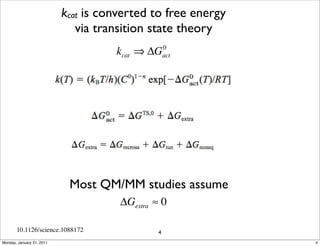
kcat is converted to free energy
                              via transition state theory
                                     kcat ⇒ ΔG     0
                                                   act


                            Most QM/MM studies assume
                                      ΔGextra ≈ 0

       10.1126/science.1088172                 4
Monday, January 31, 2011                                      4
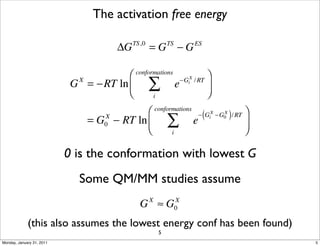
The activation free energy

                                        ΔG   TS,0
                                                    =G −G       TS            ES


                                       ⎛     conformations
                                                                                     ⎞
                            G = −RT ln ⎜
                             X

                                       ⎝
                                                    ∑                e   −GiX / RT
                                                                                     ⎟
                                                                                     ⎠
                                                        i

                                             ⎛          conformations
                                                                               (         )      ⎞
                                                                ∑
                                                                               − GiX −G0 / RT
                                                                                       X
                                 = G − RT ln ⎜
                                    X
                                                                             e                  ⎟
                                             ⎝
                                    0
                                                                 i                              ⎠

                           0 is the conformation with lowest G
                             Some QM/MM studies assume
                                               G ≈G X                X
                                                                     0

             (this also assumes the lowest energy conf has been found)
                                                            5
Monday, January 31, 2011                                                                            5
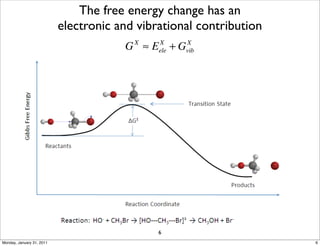
The free energy change has an
                           electronic and vibrational contribution
                                       G ≈ E +G
                                         X    X
                                              ele
                                                    X
                                                    vib


                                              6
Monday, January 31, 2011                                             6
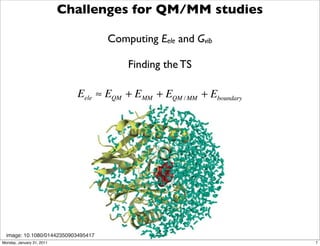
Challenges for QM/MM studies

                                     Computing Eele and Gvib

                                         Finding the TS

                             Eele ≈ EQM + EMM + EQM / MM + Eboundary


                                                7
  image: 10.1080/01442350903495417
Monday, January 31, 2011                                               7
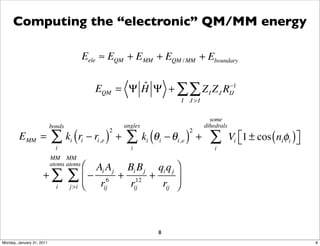
Computing the “electronic” QM/MM energy

                                         Eele ≈ EQM + EMM + EQM / MM + Eboundary


                                             EQM = Ψ H Ψ + ∑ ∑ Z I Z J RIJ
                                                     ˆ                  −1

                                                                                 I   J >I


                                                                                              some
                           bonds                           angles                           dihedrals

                           ∑ k (r − r )                    ∑ k (θ           − θ i,e ) +       ∑         Vi ⎣1 ± cos ( niφi ) ⎦
                                                   2                                 2
        EMM =                      i     i   i,e       +            i   i                                  ⎡                 ⎤
                             i                               i                                  i
                           MM MM
                           atoms atoms
                                        ⎛ Ai A j Bi B j qi q j ⎞
                     +∑            ∑ ⎝ − r 6 + r12 + r ⎟
                                        ⎜
                             i     j >i     ij    ij       ij ⎠


                                                                        8
Monday, January 31, 2011                                                                                                         8
Computing the “electronic” QM/MM energy

                               MM               QM MM                     QM MM
                               atoms
                                       qi       atoms atoms
                                                              ZI qj               ⎛ AI A j BI B j ⎞
                                                                          atoms atoms
       EQM / MM = Ψ            ∑       ri
                                          Ψ +   ∑∑             rIj
                                                                      +   ∑     ∑ ⎝ − r 6 + r12 ⎠
                                                                                  ⎜               ⎟
                                 i                I     j                   I   j      Ij    Ij


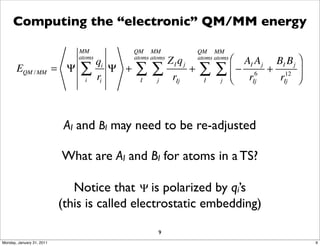
                            AI and BI may need to be re-adjusted

                           What are AI and BI for atoms in a TS?

                              Notice that Ψ is polarized by qi’s
                           (this is called electrostatic embedding)

                                                        9
Monday, January 31, 2011                                                                              9
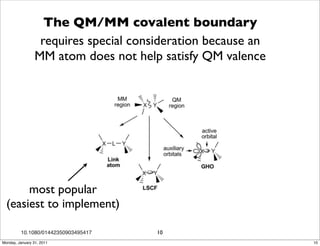
The QM/MM covalent boundary
                  requires special consideration because an
                 MM atom does not help satisfy QM valence


       most popular
  (easiest to implement)

         10.1080/01442350903495417     10
Monday, January 31, 2011                                      10
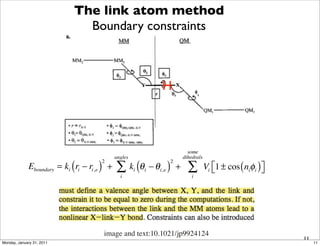
The link atom method
                               Boundary constraints


                                                                   H


                                                                               some
                                              angles                         dihedrals
             Eboundary = ki ( ri − ri,e ) +   ∑ k (θ           − θ i,e ) +     ∑         Vi ⎣1 ± cos ( niφi ) ⎦
                                       2                              2
                                                       i   i                                ⎡                 ⎤
                                                i                                i


                                        image and text:10.1021/jp9924124
                                                                                                                  11
Monday, January 31, 2011                                                                                               11
The link atom method
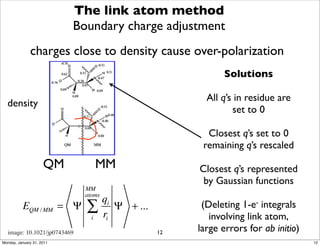
                           Boundary charge adjustment
              charges close to density cause over-polarization
                                                              Solutions

                                                         All q’s in residue are
  density
                                                                set to 0

                                                         Closest q’s set to 0
                                                        remaining q’s rescaled
                     QM            MM                  Closest q’s represented
                                                        by Gaussian functions
                             MM
                             atoms
                                     qi
          EQM / MM = Ψ       ∑       ri
                                        Ψ + ...         (Deleting 1-e- integrals
                               i                          involving link atom,
  image: 10.1021/jp0743469                        12   large errors for ab initio)
Monday, January 31, 2011                                                             12
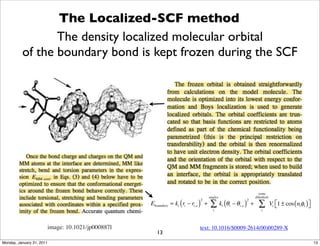
The Localized-SCF method
                 The density localized molecular orbital
          of the boundary bond is kept frozen during the SCF


                                                                                                                        some
                                                                                       angles                         dihedrals
                                                      Eboundary = ki ( ri − ri,e ) +   ∑        ki (θ i − θ i,e ) +     ∑         Vi ⎣1 ± cos ( niφi ) ⎦
                                                                                2                              2
                                                                                                                                     ⎡                 ⎤
                                                                                         i                                i


                           image: 10.1021/jp000887l                             text: 10.1016/S0009-2614(00)00289-X 
                                                         13
Monday, January 31, 2011                                                                                                                                   13
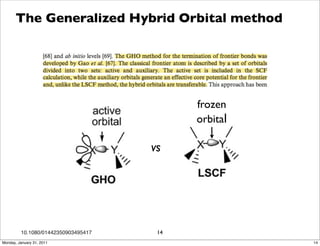
The Generalized Hybrid Orbital method


                                           frozen
                                           orbital

                                     vs


         10.1080/01442350903495417    14
Monday, January 31, 2011                             14
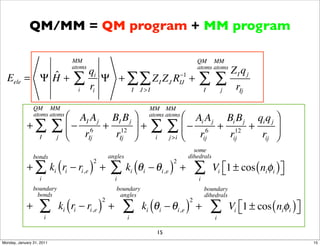
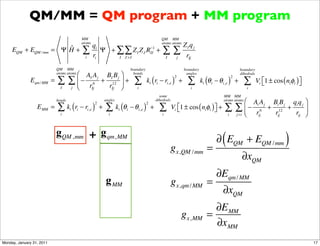
QM/MM = QM program + MM program

                                 MM                                                              QM MM
                                 atoms                                                           atoms atoms
                                         qi                                                                      ZI qj
           ˆ
  Eele = Ψ H +                   ∑       ri
                                            Ψ + ∑ ∑ Z I Z J RIJ +
                                                             −1
                                                                                                 ∑∑                rIj
                                     i          I J >I                                               I       j

                 QM MM                                                      MM MM
                 atoms atoms
                             ⎛ AI A j BI B j ⎞                              atoms atoms
                                                                                           ⎛ Ai A j Bi B j qi q j ⎞
             +∑            ∑ ⎝ − r 6 + r12 ⎠ +
                             ⎜               ⎟                              ∑         ∑ ⎝ − r 6 + r12 + r ⎟
                                                                                           ⎜
                   I       j      Ij    Ij                                    i       j >i     ij    ij       ij ⎠
                                                                                               some
                 bonds                             angles                                    dihedrals
             + ∑ ki ( ri − ri,e ) +                ∑ k (θ                   − θ i,e ) +          ∑       Vi ⎣1 ± cos ( niφi ) ⎦
                                          2                                             2
                                                                i   i                                       ⎡                 ⎤
                   i                                   i                                         i
                 boundary                              boundary                                      boundary
                  bonds                                 angles                                       dihedrals

                   ∑ k (r − r )                            ∑ k (θ                     − θ i,e ) +        ∑       Vi ⎣1 ± cos ( niφi ) ⎦
                                               2                                             2
             +               i   i       i,e       +                    i         i                                 ⎡                 ⎤
                       i                                    i                                            i

                                                                              15
Monday, January 31, 2011                                                                                                                  15
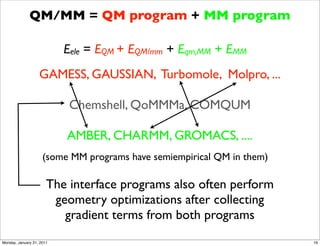
QM/MM = QM program + MM program

                           Eele = EQM + EQM/mm + Eqm,MM + EMM
                   GAMESS, GAUSSIAN, Turbomole, Molpro, ...

                            Chemshell, QoMMMa, COMQUM

                           AMBER, CHARMM, GROMACS, ....
                     (some MM programs have semiempirical QM in them)

                       The interface programs also often perform
                        geometry optimizations after collecting
                          gradient terms from both programs
Monday, January 31, 2011                                                16
QM/MM = QM program + MM program
                                             MM                                                          QM MM
                                             atoms                                                       atoms atoms
                                                         qi                                                                ZI qj
     EQM + EQM / mm           ˆ
                           = ΨH+             ∑           ri
                                                            Ψ + ∑ ∑ Z I Z J RIJ +
                                                                             −1
                                                                                                         ∑∑                 rIj
                                               i                I J >I                                       I     j

                           QM MM                                                  boundary                                 boundary                           boundary
                                     ⎛ AI A j BI B j ⎞
                           atoms atoms                                             bonds                                    angles                            dihedrals

                            ∑      ∑ ⎝ − r 6 + r12 ⎠ +                              ∑ k (r − r )                             ∑ k (θ           − θ i,e ) +       ∑         Vi ⎣1 ± cos ( niφi ) ⎦
                                                                                                                   2                                     2
              Eqm / MM =             ⎜               ⎟                                           i   i       i,e       +              i   i                                  ⎡                 ⎤
                             I     j      Ij    Ij                                   i                                        i                                   i

                                                                                                       some                                       MM MM
                           bonds                                 angles                              dihedrals                                    atoms atoms
                                                                                                                                                                  ⎛ Ai A j Bi B j qi q j ⎞
                            ∑ k (r − r )                         ∑ k (θ           − θ i,e ) +            ∑       Vi ⎣1 ± cos ( niφi ) ⎦ +         ∑          ∑ ⎝ − r 6 + r12 + r ⎟
                                                         2                                   2
                  EMM =            i     i         i,e       +            i   i                                     ⎡                 ⎤                           ⎜
                             i                                     i                                     i                                           i       j >i     ij    ij       ij ⎠


                           gQM , mm                 + g qm, MM
                                                                                                                 gx,QM / mm =
                                                                                                                                                 (
                                                                                                                                              ∂ EQM + EQM / mm                          )
                                                                                                                                                               ∂xQM
                                                                                                                                              ∂Eqm / MM
                                                                 g MM                                            gx,qm / MM =
                                                                                                                                                 ∂xQM
                                                                                                                                            ∂EMM
                                                                                                                       gx, MM             =
                                                                                                                                            ∂x MM
Monday, January 31, 2011                                                                                                                                                                           17
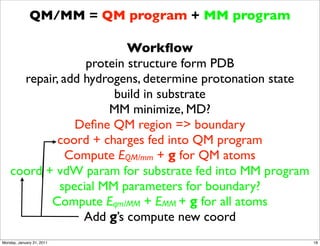
QM/MM = QM program + MM program

                          Workflow
                  protein structure form PDB
      repair, add hydrogens, determine protonation state
                       build in substrate
                      MM minimize, MD?
                Define QM region => boundary
             coord + charges fed into QM program
               Compute EQM/mm + g for QM atoms
    coord + vdW param for substrate fed into MM program
             special MM parameters for boundary?
           Compute Eqm/MM + EMM + g for all atoms
                  Add g’s compute new coord
Monday, January 31, 2011                                   18
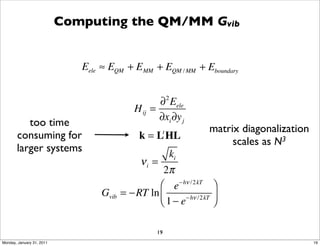
Computing the QM/MM Gvib


                              Eele ≈ EQM + EMM + EQM / MM + Eboundary


                                                   ∂ 2 Eele
                                            H ij =
                                                   ∂xi ∂y j
          too time
                                                                 matrix diagonalization
       consuming for                          k = L HL
                                                    t
                                                                      scales as N3
       larger systems
                                                    ki
                                             νi =
                                                   2π
                                                  ⎛ e− hν /2 kT ⎞
                                  Gvib   = −RT ln ⎜     − hν /2 kT ⎟
                                                  ⎝1− e            ⎠

                                                   19
Monday, January 31, 2011                                                                  19
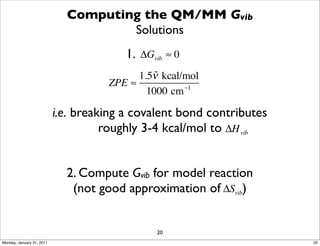
Computing the QM/MM Gvib
                                     Solutions
                                         1. ΔGvib ≈ 0
                                           1.5ν kcal/mol
                                               
                                     ZPE ≈           −1
                                             1000 cm

                           i.e. breaking a covalent bond contributes
                                     roughly 3-4 kcal/mol to ΔH vib


                             2. Compute Gvib for model reaction
                              (not good approximation of ΔSvib)


                                               20
Monday, January 31, 2011                                               20
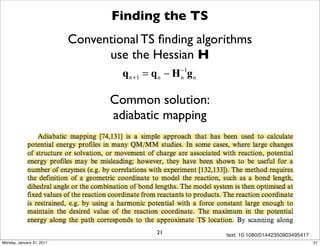
Finding the TS
                           Conventional TS finding algorithms
                                 use the Hessian H
                                                  −1
                                    q n +1 = q n − H g
                                                  n n


                                  Common solution:
                                  adiabatic mapping


                                            21           text: 10.1080/01442350903495417
Monday, January 31, 2011                                                                   21
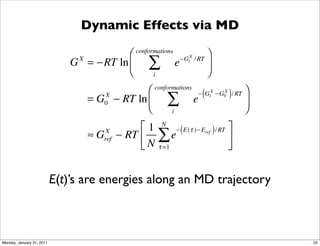
Dynamic Effects via MD

                                         ⎛           conformations
                                                                                     ⎞
                              G = −RT ln ⎜
                                X

                                         ⎝
                                                         ∑           e   −GiX / RT
                                                                                     ⎟
                                                                                     ⎠
                                                           i

                                                ⎛          conformations
                                                                               (         )      ⎞
                                                               ∑
                                                                               − GiX −G0 / RT
                                                                                       X
                                    = G − RT ln ⎜
                                         X
                                                                             e                  ⎟
                                                ⎝
                                         0
                                                                 i                              ⎠
                                                    ⎡ 1 N − ( E (τ )− Eref ) / RT ⎤
                                    ≈G    X
                                         ref   − RT ⎢ ∑ e                         ⎥
                                                    ⎣ N τ =1                      ⎦


                           E(t)’s are energies along an MD trajectory


Monday, January 31, 2011                                                                            22

QM/MM Background

  • 1.
    QM/MM methods appliedto reaction mechanisms in enzymes Required for credit (7.5 ECTS): Present the method used in one of the papers on the list Appreciated: PDF file of slides before presentation (on web site) Links to papers you used to prepare slides Blog post* summarizing in-class discussion Required for extra credit (2.5 ECTS): Proposal describing improvement to QM/MM *http://proteinsandwavefunctions.blogspot.com/ Monday, January 31, 2011 1
  • 2.
    QM/MM methods appliedto reaction mechanisms in enzymes Intro + 7 papers in 8 weeks 6 students: Casper, Anders, Martin, Kasper, Eric, Janus Week 1 (Feb 3rd): Jan - QM/MM Background Week 2 (Feb 10) Jan - Yang paper Week 3 (Feb 17) ? - Paper ? Week 4 (Feb 24) ? - Paper ? Week 5 (March 10) ? - Paper ? Week 6 (March 17) ? - Paper ? Week 7 (March 24) ? - Paper ? Week 8 (March 31) ? - Paper ? 2 Monday, January 31, 2011 2
  • 3.
    Measured: rate [P]/s Rate => kcat 10.1126/science.1088172 3 Monday, January 31, 2011 3
  • 4.
    kcat is convertedto free energy via transition state theory kcat ⇒ ΔG 0 act Most QM/MM studies assume ΔGextra ≈ 0 10.1126/science.1088172 4 Monday, January 31, 2011 4
  • 5.
    The activation freeenergy ΔG TS,0 =G −G TS ES ⎛ conformations ⎞ G = −RT ln ⎜ X ⎝ ∑ e −GiX / RT ⎟ ⎠ i ⎛ conformations ( ) ⎞ ∑ − GiX −G0 / RT X = G − RT ln ⎜ X e ⎟ ⎝ 0 i ⎠ 0 is the conformation with lowest G Some QM/MM studies assume G ≈G X X 0 (this also assumes the lowest energy conf has been found) 5 Monday, January 31, 2011 5
  • 6.
    The free energychange has an electronic and vibrational contribution G ≈ E +G X X ele X vib 6 Monday, January 31, 2011 6
  • 7.
    Challenges for QM/MMstudies Computing Eele and Gvib Finding the TS Eele ≈ EQM + EMM + EQM / MM + Eboundary 7 image: 10.1080/01442350903495417 Monday, January 31, 2011 7
  • 8.
    Computing the “electronic”QM/MM energy Eele ≈ EQM + EMM + EQM / MM + Eboundary EQM = Ψ H Ψ + ∑ ∑ Z I Z J RIJ ˆ −1 I J >I some bonds angles dihedrals ∑ k (r − r ) ∑ k (θ − θ i,e ) + ∑ Vi ⎣1 ± cos ( niφi ) ⎦ 2 2 EMM = i i i,e + i i ⎡ ⎤ i i i MM MM atoms atoms ⎛ Ai A j Bi B j qi q j ⎞ +∑ ∑ ⎝ − r 6 + r12 + r ⎟ ⎜ i j >i ij ij ij ⎠ 8 Monday, January 31, 2011 8
  • 9.
    Computing the “electronic”QM/MM energy MM QM MM QM MM atoms qi atoms atoms ZI qj ⎛ AI A j BI B j ⎞ atoms atoms EQM / MM = Ψ ∑ ri Ψ + ∑∑ rIj + ∑ ∑ ⎝ − r 6 + r12 ⎠ ⎜ ⎟ i I j I j Ij Ij AI and BI may need to be re-adjusted What are AI and BI for atoms in a TS? Notice that Ψ is polarized by qi’s (this is called electrostatic embedding) 9 Monday, January 31, 2011 9
  • 10.
    The QM/MM covalentboundary requires special consideration because an MM atom does not help satisfy QM valence most popular (easiest to implement) 10.1080/01442350903495417 10 Monday, January 31, 2011 10
  • 11.
    The link atommethod Boundary constraints H some angles dihedrals Eboundary = ki ( ri − ri,e ) + ∑ k (θ − θ i,e ) + ∑ Vi ⎣1 ± cos ( niφi ) ⎦ 2 2 i i ⎡ ⎤ i i image and text:10.1021/jp9924124 11 Monday, January 31, 2011 11
  • 12.
    The link atommethod Boundary charge adjustment charges close to density cause over-polarization Solutions All q’s in residue are density set to 0 Closest q’s set to 0 remaining q’s rescaled QM MM Closest q’s represented by Gaussian functions MM atoms qi EQM / MM = Ψ ∑ ri Ψ + ... (Deleting 1-e- integrals i involving link atom, image: 10.1021/jp0743469 12 large errors for ab initio) Monday, January 31, 2011 12
  • 13.
    The Localized-SCF method The density localized molecular orbital of the boundary bond is kept frozen during the SCF some angles dihedrals Eboundary = ki ( ri − ri,e ) + ∑ ki (θ i − θ i,e ) + ∑ Vi ⎣1 ± cos ( niφi ) ⎦ 2 2 ⎡ ⎤ i i image: 10.1021/jp000887l text: 10.1016/S0009-2614(00)00289-X  13 Monday, January 31, 2011 13
  • 14.
    The Generalized HybridOrbital method frozen orbital vs 10.1080/01442350903495417 14 Monday, January 31, 2011 14
  • 15.
    QM/MM = QMprogram + MM program MM QM MM atoms atoms atoms qi ZI qj ˆ Eele = Ψ H + ∑ ri Ψ + ∑ ∑ Z I Z J RIJ + −1 ∑∑ rIj i I J >I I j QM MM MM MM atoms atoms ⎛ AI A j BI B j ⎞ atoms atoms ⎛ Ai A j Bi B j qi q j ⎞ +∑ ∑ ⎝ − r 6 + r12 ⎠ + ⎜ ⎟ ∑ ∑ ⎝ − r 6 + r12 + r ⎟ ⎜ I j Ij Ij i j >i ij ij ij ⎠ some bonds angles dihedrals + ∑ ki ( ri − ri,e ) + ∑ k (θ − θ i,e ) + ∑ Vi ⎣1 ± cos ( niφi ) ⎦ 2 2 i i ⎡ ⎤ i i i boundary boundary boundary bonds angles dihedrals ∑ k (r − r ) ∑ k (θ − θ i,e ) + ∑ Vi ⎣1 ± cos ( niφi ) ⎦ 2 2 + i i i,e + i i ⎡ ⎤ i i i 15 Monday, January 31, 2011 15
  • 16.
    QM/MM = QMprogram + MM program Eele = EQM + EQM/mm + Eqm,MM + EMM GAMESS, GAUSSIAN, Turbomole, Molpro, ... Chemshell, QoMMMa, COMQUM AMBER, CHARMM, GROMACS, .... (some MM programs have semiempirical QM in them) The interface programs also often perform geometry optimizations after collecting gradient terms from both programs Monday, January 31, 2011 16
  • 17.
    QM/MM = QMprogram + MM program MM QM MM atoms atoms atoms qi ZI qj EQM + EQM / mm ˆ = ΨH+ ∑ ri Ψ + ∑ ∑ Z I Z J RIJ + −1 ∑∑ rIj i I J >I I j QM MM boundary boundary boundary ⎛ AI A j BI B j ⎞ atoms atoms bonds angles dihedrals ∑ ∑ ⎝ − r 6 + r12 ⎠ + ∑ k (r − r ) ∑ k (θ − θ i,e ) + ∑ Vi ⎣1 ± cos ( niφi ) ⎦ 2 2 Eqm / MM = ⎜ ⎟ i i i,e + i i ⎡ ⎤ I j Ij Ij i i i some MM MM bonds angles dihedrals atoms atoms ⎛ Ai A j Bi B j qi q j ⎞ ∑ k (r − r ) ∑ k (θ − θ i,e ) + ∑ Vi ⎣1 ± cos ( niφi ) ⎦ + ∑ ∑ ⎝ − r 6 + r12 + r ⎟ 2 2 EMM = i i i,e + i i ⎡ ⎤ ⎜ i i i i j >i ij ij ij ⎠ gQM , mm + g qm, MM gx,QM / mm = ( ∂ EQM + EQM / mm ) ∂xQM ∂Eqm / MM g MM gx,qm / MM = ∂xQM ∂EMM gx, MM = ∂x MM Monday, January 31, 2011 17
  • 18.
    QM/MM = QMprogram + MM program Workflow protein structure form PDB repair, add hydrogens, determine protonation state build in substrate MM minimize, MD? Define QM region => boundary coord + charges fed into QM program Compute EQM/mm + g for QM atoms coord + vdW param for substrate fed into MM program special MM parameters for boundary? Compute Eqm/MM + EMM + g for all atoms Add g’s compute new coord Monday, January 31, 2011 18
  • 19.
    Computing the QM/MMGvib Eele ≈ EQM + EMM + EQM / MM + Eboundary ∂ 2 Eele H ij = ∂xi ∂y j too time matrix diagonalization consuming for k = L HL t scales as N3 larger systems ki νi = 2π ⎛ e− hν /2 kT ⎞ Gvib = −RT ln ⎜ − hν /2 kT ⎟ ⎝1− e ⎠ 19 Monday, January 31, 2011 19
  • 20.
    Computing the QM/MMGvib Solutions 1. ΔGvib ≈ 0 1.5ν kcal/mol  ZPE ≈ −1 1000 cm i.e. breaking a covalent bond contributes roughly 3-4 kcal/mol to ΔH vib 2. Compute Gvib for model reaction (not good approximation of ΔSvib) 20 Monday, January 31, 2011 20
  • 21.
    Finding the TS Conventional TS finding algorithms use the Hessian H −1 q n +1 = q n − H g n n Common solution: adiabatic mapping 21 text: 10.1080/01442350903495417 Monday, January 31, 2011 21
  • 22.
    Dynamic Effects viaMD ⎛ conformations ⎞ G = −RT ln ⎜ X ⎝ ∑ e −GiX / RT ⎟ ⎠ i ⎛ conformations ( ) ⎞ ∑ − GiX −G0 / RT X = G − RT ln ⎜ X e ⎟ ⎝ 0 i ⎠ ⎡ 1 N − ( E (τ )− Eref ) / RT ⎤ ≈G X ref − RT ⎢ ∑ e ⎥ ⎣ N τ =1 ⎦ E(t)’s are energies along an MD trajectory Monday, January 31, 2011 22