Funding focus:
growing financial sustainability in
      the voluntary sector

            ThinkTank, Birmingham
             24th September 2012

Leesa Herbert, Head of Support and Advice, NCVO
Programme
 • Introduction and Learning from the Sustainable
   Funding Beacons programme
 • Panel session 1: Delivering more with less?

 Break 3pm-3.20pm

 •   Panel session 2: Walking the talk
 •   Introducing BIG Assist
 •   Q&A
 •   Drinks Reception and Networking 5pm-6pm
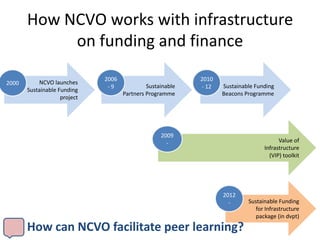
How NCVO works with infrastructure
            on funding and finance
                              2006                          2010
2000        NCVO launches
                               -9             Sustainable   - 12   Sustainable Funding
       Sustainable Funding
                                     Partners Programme            Beacons Programme
                    project


                                                   2009
                                                     -                                  Value of
                                                                                  Infrastructure
                                                                                    (VIP) toolkit


                                                                   2012
                                                                     -      Sustainable Funding
                                                                               for Infrastructure
                                                                               package (in dvpt)

       How can NCVO facilitate peer learning?
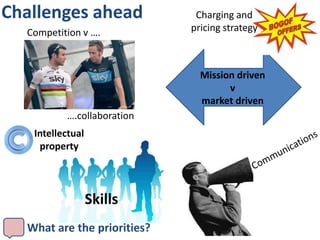
Challenges ahead              Charging and
  Competition v ….           pricing strategy


                               Mission driven
                                     v
                               market driven
          ….collaboration
   Intellectual
    property


                  Skills
  What are the priorities?
What we’ve learnt from the Beacons
   “The project encourages behaviour as a ‘funding beacon’– it raises the bar”

  “The Beacon brand helped us to get a four year grant from the local authority
                 – including for work on sustainable funding”.

    “The Beacon brand signals an element of quality and trust. This has been
       picked up by the local authority and we are taken more seriously”.

  “The programme has given us impetus to think in new and different ways of
   providing support. It’s helped development officers to be proactive rather
     than reactive – they’re enjoying being more creative in how they offer
                                    support.”

  “It’s made us review assumptions about our own sustainability – for example,
                     market testing of new support package.”

   How can NCVO help you to do more with less?
Session 1: Delivering more with less
1.50pm – 3pm

Dave Robinson
Group Development Manager, Nottingham CVS

Will Lindesay
Chief Executive, HVOSS

Marilyn Keats
MKR Consultants (previously CommUNITY Barnet)
Chair: Olof Williamson
Sustainable Funding Manager, NCVO
Session 2: Walking the talk
3.20pm – 4.30pm

Naomi Sampson
Support and Development Manager, T3SC

Helen Black
Chief Executive, CVS South Gloucestershire
Chair: Bill Freeman
Director of Services and Business Development, NAVCA

Lh intro presentation

  • 1.
    Funding focus: growing financialsustainability in the voluntary sector ThinkTank, Birmingham 24th September 2012 Leesa Herbert, Head of Support and Advice, NCVO
  • 2.
    Programme • Introductionand Learning from the Sustainable Funding Beacons programme • Panel session 1: Delivering more with less? Break 3pm-3.20pm • Panel session 2: Walking the talk • Introducing BIG Assist • Q&A • Drinks Reception and Networking 5pm-6pm
  • 3.
    How NCVO workswith infrastructure on funding and finance 2006 2010 2000 NCVO launches -9 Sustainable - 12 Sustainable Funding Sustainable Funding Partners Programme Beacons Programme project 2009 - Value of Infrastructure (VIP) toolkit 2012 - Sustainable Funding for Infrastructure package (in dvpt) How can NCVO facilitate peer learning?
  • 4.
    Challenges ahead Charging and Competition v …. pricing strategy Mission driven v market driven ….collaboration Intellectual property Skills What are the priorities?
  • 5.
    What we’ve learntfrom the Beacons “The project encourages behaviour as a ‘funding beacon’– it raises the bar” “The Beacon brand helped us to get a four year grant from the local authority – including for work on sustainable funding”. “The Beacon brand signals an element of quality and trust. This has been picked up by the local authority and we are taken more seriously”. “The programme has given us impetus to think in new and different ways of providing support. It’s helped development officers to be proactive rather than reactive – they’re enjoying being more creative in how they offer support.” “It’s made us review assumptions about our own sustainability – for example, market testing of new support package.” How can NCVO help you to do more with less?
  • 6.
    Session 1: Deliveringmore with less 1.50pm – 3pm Dave Robinson Group Development Manager, Nottingham CVS Will Lindesay Chief Executive, HVOSS Marilyn Keats MKR Consultants (previously CommUNITY Barnet) Chair: Olof Williamson Sustainable Funding Manager, NCVO
  • 7.
    Session 2: Walkingthe talk 3.20pm – 4.30pm Naomi Sampson Support and Development Manager, T3SC Helen Black Chief Executive, CVS South Gloucestershire Chair: Bill Freeman Director of Services and Business Development, NAVCA

Editor's Notes

  • #2 Intro 1.302minsWelcome and thank you for coming to today’s Funding Focus event. My name is Leesa Herbert, and I’m the Head of the Support and Advice team at NCVO. This team includes the Sustainable Funding project, Funding Central, the Climate Change Unit, the Assist programme (which I’ll talk more about later) and the Value of Infrastructure programme. It’s great to see so many of you here today. We were overwhelmed by interest and had to set up a waiting list for the event, so we know this is a unique opportunity to bring together representatives of all kinds of infrastructure organisations from across England. Today is not about NCVO telling you what we think about infrastructure – rather it’s your chance to hear about the real experience of your peers, and then to meet, discuss and share ideas for how we can all respond to big changes in the way voluntary sector is funded, the way we function, and the services we provide.
  • #3 2 mins KEEP THIS VERY SHORTThis is what today looks like – I’m going to give a brief summary of what we’ve learnt from working with local infrastructure partners through our Sustainable Funding Beacons programmeThen we’re going to have 2 panel sessions, discussing two sides of the coin in terms of voluntary sector supportSession 1 is all about how we can design effective and sustainable funding and finance support services for the frontline – so looking at our external servicesSession 2 will look at how infrastructure organisations can improve their own financial sustainability – so this is looking internally, at our own strategies The first session will be chaired by Olof Williamson, our Sustainable Funding Manager, and the second by Bill Freeman, who I’m sure many of you know as Director of Services and Business Development at NAVCABoth sessions with feature our very own Sustainable Funding Beacons, and I’ll let Olof and Bill introduce them in turnWe won’t take lots of questions during the sessions, as we’ve put aside plenty of time at the end for you to network with the speakers, NCVO staff and each other. I believe there will be some food and even wine for those of you who don’t have to drive home!Finally, throughout this introduction, I’m going to ask you some questions to kick off the discussion for later.
  • #4 5 minsWhen NCVO set up the Sustainable Funding project in 2000, we recognised immediately that we had to work closely with local or specialist partners to reach VCOs across England. Initially, we did this through co-hosted training and events. Since then, our approach has becoming increasingly sophisticated, from the Sustainable Partners programme, where we worked with 16 infrastructure partners, to the Sustainable Funding Beacons. A key tenet of the Beacons programme was that we had to work with the partner. We would not ‘parachute in’ and deliver training and then leave again – we agreed a project plan with the senior management, that fit with the overall strategy of the partner organisation, and that complemented rather than replaced what the partner was already doing. We know that we have as much to learn from our partners as they do from us, and this programme has been about co-delivery and co-production from the start. We insisted that development workers took part in training sessions or in development of new resources. We have also refused requests to speak at events where it’s not clear how it fits with the wider plan.NCVO has also developed the Value of Infrastructure, or VIP, toolkit. This is a unique toolkit specially designed for infrastructure to help you demonstrate impact, something we think is a key element of a sustainable funding strategy. It’s one of many tools out there that will support you to strengthen your organisation and help create robust processes for measuring and communicating impact. As many of you are looking to move to a market-led model, or are charging for your services, you’ll need to be able to show not only how you’re making a difference, but why you’re better than the next person at making that difference, and why you’re doing it more efficiently. This isn’t just about showing funders what you’re doing with their money, but increasingly about showing customers where their money is going. My colleague SakthiSuriyaprakasam is here today. Sakthi delivers our VIP training and was very involved with the development of VIP. She will be very keen to talk to you all in the networking session so please find her at our stand.The Sustainable Funding project absolutely depends on these kind of partnerships with infrastructure to be able to meet our mission across the whole of England. Thanks to our partners, we were involved in 27 events outside London last year, which is quite an achievement for a team of 4 staff, 2 of which are part-time. We know that you are losing capacity and, in many cases, subsidy, to deliver much of your capacity building work, so we would really like to work with you to identify the areas where we can complement what you do, rather than duplicating it. We want to build a new package of support for infrastructure, so we need you tell us how best to do that.
  • #5 5 minsTo finish off, I want to look at some of the big challenges we’re seeing amongst infrastructure organisations, not only through our work with Beacons, but through the VIP programme, and as an infrastructure organisation ourselves.Competition versus collaboration: we’re increasingly encouraged, or sometimes forced, to collaborate. But at the same time we’re competing with some of our collaborators for a space in the market, and we’re facing new competitors from the private sector, or from outside our area. The first step in facing up to this challenge is understanding who those competitors are, what makes them competitors, and what we’ve got that makes us better or different.2. Intellectual property – we’ve seen more and more infrastructure looking to sell similar services, often training products. Suddenly we need to protect all that material that we developed in the past with a grant subsidy – we need to know what’s ours and how much it’s worth.3. Balancing demands of the mission with that of the market – how can we create demand-led products without losing sight of our mission? A good starting point is to review our values and set up decision-making criteria to decide which products and services to sell. This can be a simple checklist that gives an agreed weighting to both mission and profit. This model in itself could be a useful marketing tool.4. Charging and pricing – this is the big one for many of you – how do you start charging for services that were previously free. Two starting points here – one, understand who can and will pay – it’s not always the end user. Two, create a pricing strategy based on thorough market research and then – this is the important bit – communicate that strategy. We’ve seen examples time again of organisations sticking a price on something that was free in the past, with no explanation, then wondering why no one is buying. Your pricing policy absolutely has to be part of a wider process of communication and reengagement with your market, which includes your beneficiaries. 5. Skills – if you’re moving to a different income model, or a different model of delivery, you need to carry out a skills assessment. I’m sure many of you here have done this recently, and may have had to make some tough decisions about what skills you really need in the organisation. If you don’t have the right people for the job, the job won’t get done, and it’s likely that you’re staff won’t be very happy either. Equally, we would always suggests a skills audit as part of an income strategy review – your people are some of your greatest assets. Are you making the most of them?6.Communications – just to ram home the point, if you’re making a major change to how you function, how you interact with your stakeholders, or even how you are staffed, you must communicate this internally and externally, or you’ll find the cracks appear very quickly.You will be dealing with these challenges already, and part of today is about learning how some of you have overcome them. So what are the priorities? Where should NCVO be focusing its resources?
  • #6 5 minsSo what have we learnt from the programme? So far, we’ve found that:There are lots of variations in how local support is delivered – generic functions of a CVS are being split up and there is increased competition from independent consultants or private sector business advisors. Specialist infrastructure, which are often small, sector-specific organisations, are struggling to find a space for themselves in a contracting environment – meaning we all risk the loss of those providers.- NCVO presence as a national body has added value – but works best when complementary rather than ‘we know best’. Audiences have found it particularly useful to get a national perspective on trends in funding and finance policy that the local or specialist partner can translate for a local audience.The NCVO Beacons brand adds value – it can be a sign of quality and credibility, but has also given partners something to aim towards. This has helped partners to gain credibility with funders as well as with their members, but only works where NCVO is a real presence on the ground, not a distant body in London.- On the flip side, it’s been hard to get partners to link up and share learning. This hasn’t been through a lack of willingness, it’s just that people are stretched for time, they’re working with different groups in different areas, and we haven’t yet found the right means to share learning about common problems. We think NCVO, working with NAVCA, has a role to faciliate networking and peer learning through events like today, but are there other or better ways that we can do that? Or is that not something we should be doing?
  • #7 1 minThat’s it from me. We’re now going to hear from our Beacons. We’ve asked them to be as honest as possible about successes as well as difficulties – they are all dealing with similar challenges in different ways. We haven’t asked them to come here with all of the answers, but to give you some food for thought using their experiences over the past year or so.Please enjoy the day, and our first session, which will be chaired by my colleague Olof Williamson.Olof to introduce speakers VERY BRIEFLY>