SBSA 389 SPECIAL TOPICS
The History of Anthropological
Theory
Fall 2020 ELearning
Week Eight: The French School
Dec 7, 9 2020
Claude Lévi-Strauss (1908-2008)
Structuralism
“I hate travels and explorers.
Yet here I am proposing to tell the story of my expeditions.”
Georges Balandier (1920-
2016)
Dynamic anthropology
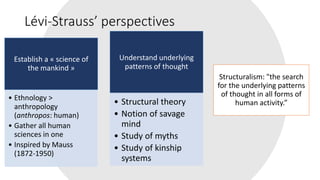
Lévi-Strauss’ perspectives
Establish a « science of
the mankind »
• Ethnology >
anthropology
(anthropos: human)
• Gather all human
sciences in one
• Inspired by Mauss
(1872-1950)
Understand underlying
patterns of thought
• Structural theory
• Notion of savage
mind
• Study of myths
• Study of kinship
systems
Structuralism: "the search
for the underlying patterns
of thought in all forms of
human activity.”
Linguistic inspiration
term: phoneme + morpheme
which meaning depends
on the context
Prononciation of
the term
Composition of the
term
term: signifier (container) + signified (what is contained, the meaning)
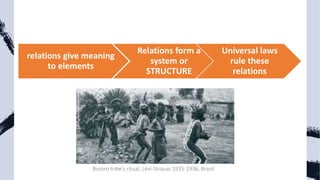
relations give meaning
to elements
Relations form a
system or
STRUCTURE
Universal laws
rule these
relations
Bororo tribe’s ritual, Lévi-Strauss 1935-1936, Brazil
The structural study of kinship
Kinship is a system of communication
System of couples of relationship (husband-wife, father-son…)
Kinship relations are not facts but representations
Passage from nature to culture : circulation of women (alliance theory)
Prohibition of incest: prohibition of consanguineous sexual relations
Group/family A
Group/family B
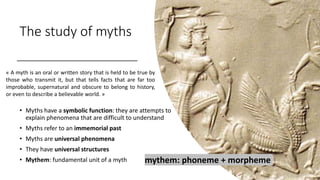
The study of myths
• Myths have a symbolic function: they are attempts to
explain phenomena that are difficult to understand
• Myths refer to an immemorial past
• Myths are universal phenomena
• They have universal structures
• Mythem: fundamental unit of a myth
« A myth is an oral or written story that is held to be true by
those who transmit it, but that tells facts that are far too
improbable, supernatural and obscure to belong to history,
or even to describe a believable world. »
mythem: phoneme + morpheme
Why structuralism?
1950’s : end of the two
world wars /
decolonisation
movements
Countless crimes
perpetruated in the
name of racial
hegemony
Influence of
Enlightement
philosopher Rousseau:
mankind is good by
nature
Northern French village bombed in 1944Nazi extermination camps in
Auschwitz (Poland)
Limits of
structural
anthropology
Omission of the
history of societies:
ahistoricist
anthropology
Perception of
cultures as
immobile
Omission of
changes,
acculturation and
conflicts
Omission of
individual
dynamics
Links &
references
Short video on Lévi-Strauss’ structuralism:
https://www.voicetube.com/v3/videos/45310
Short article on Lévi-Strauss’s sojourn in Brazil:
https://www.theguardian.com/books/booksblog/2015/a
ug/17/tristes-tropiques-by-claude-levi-strauss-
melancholy-anthropology
Lévi-Straussian feminist anthropologist Françoise
Héritier on kinship: https://sms.hypotheses.org/20331
Philippe Descola, Beyond Nature and Culture
Marcel Griaule, Dieu d’eau (God of Water)

Levi Strauss and structuralism

  • 1.
    SBSA 389 SPECIALTOPICS The History of Anthropological Theory Fall 2020 ELearning Week Eight: The French School Dec 7, 9 2020
  • 2.
    Claude Lévi-Strauss (1908-2008) Structuralism “Ihate travels and explorers. Yet here I am proposing to tell the story of my expeditions.”
  • 3.
  • 4.
    Lévi-Strauss’ perspectives Establish a« science of the mankind » • Ethnology > anthropology (anthropos: human) • Gather all human sciences in one • Inspired by Mauss (1872-1950) Understand underlying patterns of thought • Structural theory • Notion of savage mind • Study of myths • Study of kinship systems Structuralism: "the search for the underlying patterns of thought in all forms of human activity.”
  • 5.
    Linguistic inspiration term: phoneme+ morpheme which meaning depends on the context Prononciation of the term Composition of the term term: signifier (container) + signified (what is contained, the meaning)
  • 6.
    relations give meaning toelements Relations form a system or STRUCTURE Universal laws rule these relations Bororo tribe’s ritual, Lévi-Strauss 1935-1936, Brazil
  • 7.
    The structural studyof kinship Kinship is a system of communication System of couples of relationship (husband-wife, father-son…) Kinship relations are not facts but representations Passage from nature to culture : circulation of women (alliance theory) Prohibition of incest: prohibition of consanguineous sexual relations Group/family A Group/family B
  • 8.
    The study ofmyths • Myths have a symbolic function: they are attempts to explain phenomena that are difficult to understand • Myths refer to an immemorial past • Myths are universal phenomena • They have universal structures • Mythem: fundamental unit of a myth « A myth is an oral or written story that is held to be true by those who transmit it, but that tells facts that are far too improbable, supernatural and obscure to belong to history, or even to describe a believable world. » mythem: phoneme + morpheme
  • 9.
    Why structuralism? 1950’s :end of the two world wars / decolonisation movements Countless crimes perpetruated in the name of racial hegemony Influence of Enlightement philosopher Rousseau: mankind is good by nature Northern French village bombed in 1944Nazi extermination camps in Auschwitz (Poland)
  • 10.
    Limits of structural anthropology Omission ofthe history of societies: ahistoricist anthropology Perception of cultures as immobile Omission of changes, acculturation and conflicts Omission of individual dynamics
  • 11.
    Links & references Short videoon Lévi-Strauss’ structuralism: https://www.voicetube.com/v3/videos/45310 Short article on Lévi-Strauss’s sojourn in Brazil: https://www.theguardian.com/books/booksblog/2015/a ug/17/tristes-tropiques-by-claude-levi-strauss- melancholy-anthropology Lévi-Straussian feminist anthropologist Françoise Héritier on kinship: https://sms.hypotheses.org/20331 Philippe Descola, Beyond Nature and Culture Marcel Griaule, Dieu d’eau (God of Water)