Leveraging Meaningful
Use to Reduce Health
Disparities
AN ACTION PLAN
August 2013
Leveraging Meaningful Use to Reduce Health Disparities: An Action Plan | Consumer Partnership For eHealth 2
1875 Connecticut Avenue, NW | Suite 650 | Washington, DC 20009
202.986.2600 | www.NationalPartnership.org
Acknowledgements
Funding from the Markle Foundation provided critical resources for this report.
Leveraging Meaningful Use to Reduce Health Disparities: An Action Plan | Consumer Partnership For eHealth 3
Leveraging Meaningful Use
to Reduce Disparities: An
Action Plan
August 2013*
Executive Summary
The heterogeneity of the United States is growing by
leaps and bounds. We are a nation as diverse as we are
advanced. However, as our nation’s diversity has grown, so
has a parallel increase in health disparities. In recent years
health information technology (health IT) has begun to
offer great promise in addressing and reducing health
disparities by increasing individuals’ access to their own
health information and improving communication and
information flow between providers and patients.
 1
Health
IT allows us to more easily identify the unique needs of all
individuals, and focus particular attention on the unmet
needs of underserved and marginalized populations.
Indeed, if we can make the system work for the most
vulnerable among us, it will work for everyone.
There is perhaps no more immediate opportunity to reduce
health disparities than the Electronic Health Record (EHR)
Incentive Program (commonly known as “Meaningful Use”
or “MU”). However, while the reduction of disparities is one of the stated goals of the
Health Information Technology for Economic and Clinical Health (HITECH) Act, from
which the EHR Incentive Program stems, there has been little actual progress on this
critical issue.
 1 For purposes of brevity, we refer throughout this report to “patient’ and “care,” given that the Meaningful Use incentive program
is rooted in the medical model. It is important to note, however, that meeting the goals of the Triple Aim (healthier populations,
better care, and more affordable health care costs) will require a shift away from an exclusive medical approach toward a more
person- and family-centered approach that emphasizes wellness, prevention, and community-based supports, in addition to
traditional medical interventions. "Patients" and "care" imply a medical model with a focus on episodes of illness and exclusive
dependency on professionals; people with disabilities frequently refer to themselves as "consumers" or merely "persons." Any
effort to improve patient and family engagement must include the use of terminology that also resonates with the numerous
consumer perspectives not adequately reflected by medical model terminology.  
Consumer Partnership for eHealth
CPeH is a coalition of more than
50 consumer, patient, and labor
organizations working at the national,
state, and local levels to advance
private and secure health information
technology (health IT) in ways that
measurably improve the lives of
individuals and their families. The
combined membership of CPeH
represents more than 127 million
Americans.
Leveraging Meaningful Use to Reduce Health Disparities: An Action Plan | Consumer Partnership For eHealth 4
To this end, we have come together to create an
evidence-based action plan for leveraging the EHR
Incentive Program to reduce health disparities. The areas
chosen – data collection and use to identify disparities;
language, literacy, and communication; and care
coordination and planning – were chosen based on an
extensive review of scientific literature. The EHR uses
outlined below reflect what we believe to be realistically
achievable for Stage 3 based on the criteria proposed by
the HIT Policy Committee in November 2012. We have
also identified some critical criteria that might be too
ambitious for Stage 3, but should be listed and
incorporated as early as possible in future stages.
By including the following modest but strategic
requirements, the Health IT Policy Committee, the Office
of the National Coordinator for Health IT, and the Centers
for Medicare & Medicaid Services can enable providers to
meet the HITECH Act’s promise to address health
disparities, not to mention make a positive life-altering
impact for the nation’s underserved and vulnerable
populations.
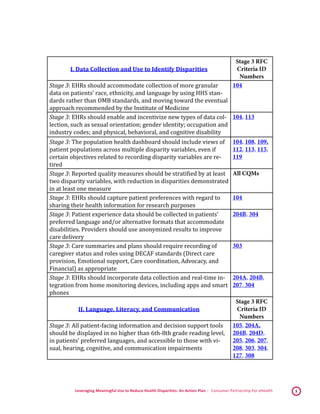
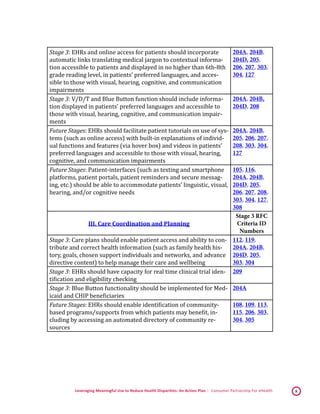
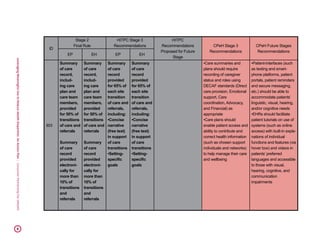
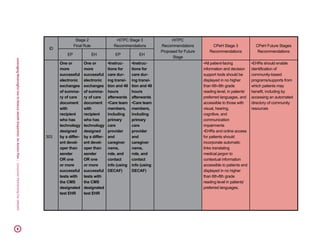
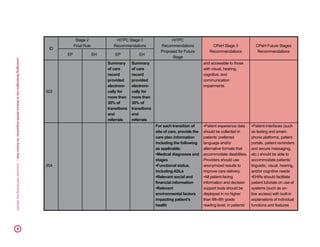
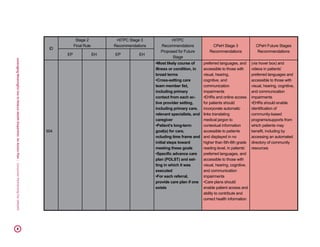
The table below details our recommendations alongside the corresponding Stage 3
criteria as proposed in the HIT Policy Committee’s Request for Comment, released
on November 16, 2012. Evidence-based explanations of these areas of focus can be
found below, and a more detailed chart of recommendations and the Stage 3 criteria
can be found in Appendix A.
"It’s impossible to achieve better health outcomes and significantly reduce health care costs
without tackling health disparities, which are a pervasive and costly problem. We have the
chance to leverage Stage 3 of the Meaningful Use program to make significant progress in
addressing disparities. We must not squander this opportunity. CPeH has created a bold, yet
achievable, path forward for including criteria in Stage 3 that will begin to reduce disparities
and, in doing so, help us achieve patient- and family-centered care, better outcomes, and
lower costs for everyone." Debra L. Ness, National Partnership for Women & Families.
The Collaborators
	 As consumer advocates on
behalf of some of our most
underserved populations, we
are dedicated to ensuring in-
creased health equity, access,
and quality for all populations,
regardless of race, ethnicity,
sex, gender, sexual orienta-
tion, gender identity, language
access, socio-economic status,
or physical, cognitive, mental
and other disabilities. We are
partnering to lend our collec-
tive voices and expertise to
an action plan that fills exist-
ing gaps and helps empower
our nation’s most vulnerable
populations.
Leveraging Meaningful Use to Reduce Health Disparities: An Action Plan | Consumer Partnership For eHealth 5
I. Data Collection and Use to Identify Disparities
Stage 3 RFC
Criteria ID
Numbers
Stage 3: EHRs should accommodate collection of more granular
data on patients’ race, ethnicity, and language by using HHS stan-
dards rather than OMB standards, and moving toward the eventual
approach recommended by the Institute of Medicine
104
Stage 3: EHRs should enable and incentivize new types of data col-
lection, such as sexual orientation; gender identity; occupation and
industry codes; and physical, behavioral, and cognitive disability
104, 113
Stage 3: The population health dashboard should include views of
patient populations across multiple disparity variables, even if
certain objectives related to recording disparity variables are re-
tired
104, 108, 109,
112, 113, 115,
119
Stage 3: Reported quality measures should be stratified by at least
two disparity variables, with reduction in disparities demonstrated
in at least one measure
All CQMs
Stage 3: EHRs should capture patient preferences with regard to
sharing their health information for research purposes
104
Stage 3: Patient experience data should be collected in patients’
preferred language and/or alternative formats that accommodate
disabilities. Providers should use anonymized results to improve
care delivery
204B, 304
Stage 3: Care summaries and plans should require recording of
caregiver status and roles using DECAF standards (Direct care
provision, Emotional support, Care coordination, Advocacy, and
Financial) as appropriate
303
Stage 3: EHRs should incorporate data collection and real-time in-
tegration from home monitoring devices, including apps and smart
phones
204A, 204B,
207, 304
II. Language, Literacy, and Communication
Stage 3 RFC
Criteria ID
Numbers
Stage 3: All patient-facing information and decision support tools
should be displayed in no higher than 6th-8th grade reading level,
in patients’ preferred languages, and accessible to those with vi-
sual, hearing, cognitive, and communication impairments
105, 204A,
204B, 204D,
205, 206, 207,
208, 303, 304,
127, 308
Leveraging Meaningful Use to Reduce Health Disparities: An Action Plan | Consumer Partnership For eHealth 6
Stage 3: EHRs and online access for patients should incorporate
automatic links translating medical jargon to contextual informa-
tion accessible to patients and displayed in no higher than 6th-8th
grade reading level, in patients’ preferred languages, and acces-
sible to those with visual, hearing, cognitive, and communication
impairments
204A, 204B,
204D, 205,
206, 207, 303,
304, 127
Stage 3: V/D/T and Blue Button function should include informa-
tion displayed in patients’ preferred languages and accessible to
those with visual, hearing, cognitive, and communication impair-
ments
204A, 204B,
204D, 208
Future Stages: EHRs should facilitate patient tutorials on use of sys-
tems (such as online access) with built-in explanations of individ-
ual functions and features (via hover box) and videos in patients’
preferred languages and accessible to those with visual, hearing,
cognitive, and communication impairments
204A, 204B,
205, 206, 207,
208, 303, 304,
127
Future Stages: Patient-interfaces (such as texting and smartphone
platforms, patient portals, patient reminders and secure messag-
ing, etc.) should be able to accommodate patients’ linguistic, visual,
hearing, and/or cognitive needs
105, 116,
204A, 204B,
204D, 205,
206, 207, 208,
303, 304, 127,
308
III. Care Coordination and Planning
Stage 3 RFC
Criteria ID
Numbers
Stage 3: Care plans should enable patient access and ability to con-
tribute and correct health information (such as family health his-
tory, goals, chosen support individuals and networks, and advance
directive content) to help manage their care and wellbeing
112, 119,
204A, 204B,
204D, 205,
303, 304
Stage 3: EHRs should have capacity for real time clinical trial iden-
tification and eligibility checking
209
Stage 3: Blue Button functionality should be implemented for Med-
icaid and CHIP beneficiaries
204A
Future Stages: EHRs should enable identification of community-
based programs/supports from which patients may benefit, in-
cluding by accessing an automated directory of community re-
sources
108, 109, 113,
115, 206, 303,
304, 305
Leveraging Meaningful Use to Reduce Health Disparities: An Action Plan | Consumer Partnership For eHealth 7
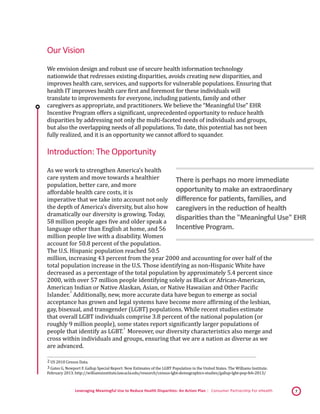
Our Vision
We envision design and robust use of secure health information technology
nationwide that redresses existing disparities, avoids creating new disparities, and
improves health care, services, and supports for vulnerable populations. Ensuring that
health IT improves health care first and foremost for these individuals will
translate to improvements for everyone, including patients, family and other
caregivers as appropriate, and practitioners. We believe the “Meaningful Use” EHR
Incentive Program offers a significant, unprecedented opportunity to reduce health
disparities by addressing not only the multi-faceted needs of individuals and groups,
but also the overlapping needs of all populations. To date, this potential has not been
fully realized, and it is an opportunity we cannot afford to squander.
Introduction: The Opportunity
As we work to strengthen America’s health
care system and move towards a healthier
population, better care, and more
affordable health care costs, it is
imperative that we take into account not only
the depth of America’s diversity, but also how
dramatically our diversity is growing. Today,
58 million people ages five and older speak a
language other than English at home, and 56
million people live with a disability. Women
account for 50.8 percent of the population.
The U.S. Hispanic population reached 50.5
million, increasing 43 percent from the year 2000 and accounting for over half of the
total population increase in the U.S. Those identifying as non-Hispanic White have
decreased as a percentage of the total population by approximately 5.4 percent since
2000, with over 57 million people identifying solely as Black or African-American,
American Indian or Native Alaskan, Asian, or Native Hawaiian and Other Pacific
Islander.
 2
Additionally, new, more accurate data have begun to emerge as social
acceptance has grown and legal systems have become more affirming of the lesbian,
gay, bisexual, and transgender (LGBT) populations. While recent studies estimate
that overall LGBT individuals comprise 3.8 percent of the national population (or
roughly 9 million people), some states report significantly larger populations of
people that identify as LGBT.
 3
Moreover, our diversity characteristics also merge and
cross within individuals and groups, ensuring that we are a nation as diverse as we
are advanced.
 2 US 2010 Census Data. 
 3 Gates G, Newport F. Gallup Special Report: New Estimates of the LGBT Population in the United States. The Williams Institute.
February 2013. http://williamsinstitute.law.ucla.edu/research/census-lgbt-demographics-studies/gallup-lgbt-pop-feb-2013/
There is perhaps no more immediate
opportunity to make an extraordinary
difference for patients, families, and
caregivers in the reduction of health
disparities than the "Meaningful Use" EHR
Incentive Program.
Leveraging Meaningful Use to Reduce Health Disparities: An Action Plan | Consumer Partnership For eHealth 8
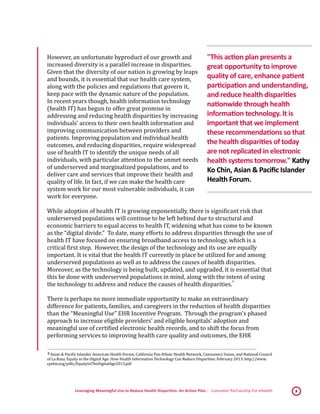
However, an unfortunate byproduct of our growth and
increased diversity is a parallel increase in disparities.
Given that the diversity of our nation is growing by leaps
and bounds, it is essential that our health care system,
along with the policies and regulations that govern it,
keep pace with the dynamic nature of the population.
In recent years though, health information technology
(health IT) has begun to offer great promise in
addressing and reducing health disparities by increasing
individuals’ access to their own health information and
improving communication between providers and
patients. Improving population and individual health
outcomes, and reducing disparities, require widespread
use of health IT to identify the unique needs of all
individuals, with particular attention to the unmet needs
of underserved and marginalized populations, and to
deliver care and services that improve their health and
quality of life. In fact, if we can make the health care
system work for our most vulnerable individuals, it can
work for everyone.
While adoption of health IT is growing exponentially, there is significant risk that
underserved populations will continue to be left behind due to structural and
economic barriers to equal access to health IT, widening what has come to be known
as the “digital divide.” To date, many efforts to address disparities through the use of
health IT have focused on ensuring broadband access to technology, which is a
critical first step. However, the design of the technology and its use are equally
important. It is vital that the health IT currently in place be utilized for and among
underserved populations as well as to address the causes of health disparities.
Moreover, as the technology is being built, updated, and upgraded, it is essential that
this be done with underserved populations in mind, along with the intent of using
the technology to address and reduce the causes of health disparities.
 4
There is perhaps no more immediate opportunity to make an extraordinary
difference for patients, families, and caregivers in the reduction of health disparities
than the “Meaningful Use” EHR Incentive Program. Through the program’s phased
approach to increase eligible providers’ and eligible hospitals’ adoption and
meaningful use of certified electronic health records, and to shift the focus from
performing services to improving health care quality and outcomes, the EHR
 4 Asian & Pacific Islander American Health Forum, California Pan-Ethnic Health Network, Consumers Union, and National Council
of La Raza. Equity in the Digital Age: How Health Information Technology Can Reduce Disparities. February 2013. http://www.
cpehn.org/pdfs/EquityInTheDigitalAge2013.pdf 
"This action plan presents a
great opportunity to improve
quality of care, enhance patient
participation and understanding,
and reduce health disparities
nationwide through health
information technology. It is
important that we implement
these recommendations so that
the health disparities of today
are not replicated in electronic
health systems tomorrow." Kathy
Ko Chin, Asian & Pacific Islander
Health Forum.
Leveraging Meaningful Use to Reduce Health Disparities: An Action Plan | Consumer Partnership For eHealth 9
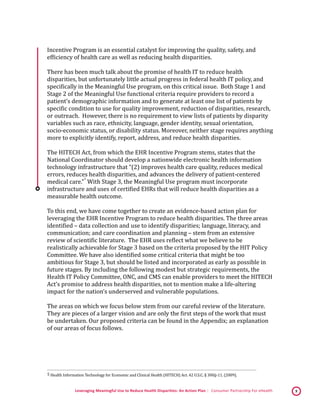
Incentive Program is an essential catalyst for improving the quality, safety, and
efficiency of health care as well as reducing health disparities.
There has been much talk about the promise of health IT to reduce health
disparities, but unfortunately little actual progress in federal health IT policy, and
specifically in the Meaningful Use program, on this critical issue. Both Stage 1 and
Stage 2 of the Meaningful Use functional criteria require providers to record a
patient’s demographic information and to generate at least one list of patients by
specific condition to use for quality improvement, reduction of disparities, research,
or outreach. However, there is no requirement to view lists of patients by disparity
variables such as race, ethnicity, language, gender identity, sexual orientation,
socio-economic status, or disability status. Moreover, neither stage requires anything
more to explicitly identify, report, address, and reduce health disparities.
The HITECH Act, from which the EHR Incentive Program stems, states that the
National Coordinator should develop a nationwide electronic health information
technology infrastructure that “(2) improves health care quality, reduces medical
errors, reduces health disparities, and advances the delivery of patient-centered
medical care.”
 5
With Stage 3, the Meaningful Use program must incorporate
infrastructure and uses of certified EHRs that will reduce health disparities as a
measurable health outcome.
To this end, we have come together to create an evidence-based action plan for
leveraging the EHR Incentive Program to reduce health disparities. The three areas
identified – data collection and use to identify disparities; language, literacy, and
communication; and care coordination and planning – stem from an extensive
review of scientific literature. The EHR uses reflect what we believe to be
realistically achievable for Stage 3 based on the criteria proposed by the HIT Policy
Committee. We have also identified some critical criteria that might be too
ambitious for Stage 3, but should be listed and incorporated as early as possible in
future stages. By including the following modest but strategic requirements, the
Health IT Policy Committee, ONC, and CMS can enable providers to meet the HITECH
Act’s promise to address health disparities, not to mention make a life-altering
impact for the nation’s underserved and vulnerable populations.
The areas on which we focus below stem from our careful review of the literature.
They are pieces of a larger vision and are only the first steps of the work that must
be undertaken. Our proposed criteria can be found in the Appendix; an explanation
of our areas of focus follows.
 5 Health Information Technology for Economic and Clinical Health (HITECH) Act. 42 U.S.C. § 300jj-11. (2009). 
Leveraging Meaningful Use to Reduce Health Disparities: An Action Plan | Consumer Partnership For eHealth 10
I. Data Collection and Use to Identify Disparities
In order to reduce health disparities, they must first be
identified and understood in terms of prevalence, root
causes, and major contributors. Standardized, granular
data collection is foundational to this effort, for which
health IT is an essential tool. Ensuring that EHRs can
capture and record factors pertinent to individuals’ health,
such as sexual orientation, gender identity,
occupation, disability status, environmental factors,
caregiver presence, and race, ethnicity, and language,
ensures that providers see the whole picture surrounding
their patients and are more adequately equipped to
identify and address factors associated with health
disparities. Subsequently, using these data to provide care
that is patient-centered, such as through automated
decision support and reminders, helps to reduce
disparities at the point of care.
Data Collection Standards: Currently, data collection
capabilities of ONC-certified EHRs are based on the
standards created by the Office of Management and
Budget (OMB). These standards provide a minimum set
of categories for race and ethnicity and act as a foundation upon which more
granular race and ethnicity data collection should be built. In a 2009 report, the
Institute of Medicine (IOM) articulated that while the OMB categories “can reveal
important disparities in care, they are not always sufficiently descriptive to target
interventions most effectively.”
 6
The IOM recommended more detailed, granular
data collection reflecting the populations served in different communities.
It may be too far of a leap for certified EHR technology to go directly from our
current OMB standards to those recommended by the IOM. However, the
granularity of IOM’s recommendations should be our guiding light as health IT and
EHR systems continue to develop and be updated. To meet the HITECH Act’s goals
to address health disparities, EHR systems should collect better, more sophisticated
detail beyond the basic OMB standards. As an immediate next step, we propose (as
many others have proposed) advancing from the OMB standards to the more
granular Health and Human Services (HHS) standards. The HHS standards build
upon the OMB standards, adding the type of granularity for Asian and Latino
populations that is used in the American Community Survey (ACS) and Decennial
Census.
 6 Institute of Medicine. Race, Ethnicity, and Language Data: Standardization for Health Care Quality Improvement. August 2009.
http://www.iom.edu/~/media/Files/Report%20Files/2009/RaceEthnicityData/Race%20Ethnicity%20report%20brief%20
FINAL%20for%20web.pdf 
Ensuring that EHRs can capture
and record factors pertinent to
individuals' health, such as sexual
orientation, gender identity,
occupation, disability status,
environmental factors, caregiver
presence, and race, ethnicity
and language, ensures that
providers see the whole picture
surrounding their patients and
are more adequately equipped
to identify and address factors
associated with health disparities.
Leveraging Meaningful Use to Reduce Health Disparities: An Action Plan | Consumer Partnership For eHealth 11
It is equally imperative that data be collected on
disability status and sexual orientation and gender
identity (SOGI). While arguments have been made
that necessary standards do not exist, that simply is
not the case. HHS has, in fact, established standards
for the collection of information on disability status.
 7
These standards consist of six questions and stem
from those used in the ACS, as well as other major
surveys. They define disability “from a functional
perspective”
 8
and are meant to serve as a baseline,
with the potential for additional questions to be
added. And an IOM workshop on SOGI data collection
in EHRs found that many health care facilities around
the country, including hospitals, community health
centers, and managed care organizations, are already
recognizing the LGBT individuals in their patient
populations and implementing efforts to collect and
safeguard important sexual orientation and gender
identity data in their patient records systems.
 9
Such
efforts should be scaled up and standardized,
building on the efforts of organizations such as the
Fenway Institute, which has completed extensive
studies on the matter and has published information on how to gather SOGI data in
clinical settings.
 10
The development of more granular data collection standards for race, ethnicity,
sex, language, and disability status was required under section 4302 of the Patient
Protection and Affordable Care Act for the purpose of data collection in all federal
surveys.
 11
As we continue to reform our health care delivery system, it is imperative
that EHRs are adapted to use the same data collection standards.
Data Collection for Clinical Decision Support (CDS): One essential component of
EHR systems is clinical decision support (CDS), which offers automated
decision-making assistance at the point of care by arming providers with tools such
as condition-specific order sets, clinical guidelines, and diagnostic support. CDS
 7 U.S. Dept. of Health and Human Services. Implementation Guidance on Data Collection Standards for Race, Ethnicity, Sex, Pri-
mary Language, and Disability Status. http://aspe.hhs.gov/datacncl/standards/ACA/4302/index.pdf 
 8 Ibid. 
 9 Institute of Medicine. Sexual Orientation and Gender Identity Data Collection in Electronic Health Records: A Workshop. October
2012. www.iom.edu/lgbtdata
 10 Bradford J, Cahill S, Grasso C, Makadon HJ. How to Gather Data on Sexual Orientation and Gender Identity in Clinical Set-
tings. Fenway Institute. October 2011. http://www.fenwayhealth.org/site/DocServer/Policy_Brief_HowtoGather..._v3_01.09.12.
pdf?docID=9142 
 11 U.S. Dept. of Health and Human Services, Office of Minority Health. Explanation of Data Standards for Race, Ethnicity, Sex,
Primary Language, and Disability. http://minorityhealth.hhs.gov/templates/content.aspx?ID=9228 
"According to the Institute of
Medicine, collecting sexual
orientation and gender identity data
in electronic health records is crucial
to understanding and addressing
the health disparities that affect
the lesbian, gay, bisexual, and
transgender (LGBT) population. The
Disparities Action Plan is a key step
in turning that recommendation into
action to finally end the culture of
'don’t ask, don’t tell' for LGBT people
in our healthcare system." Kellan
Baker, Center for American Progress.
Leveraging Meaningful Use to Reduce Health Disparities: An Action Plan | Consumer Partnership For eHealth 12
offers a unique ability to assist in disparities elimination.
However, because these tools require person-specific data,
more granular data collection of race, ethnicity, language,
disability status, and sexual orientation and gender
identity is all the more vital. Even when access to health
care is universal, disparities may still exist. These may
stem from intentional or unintentional provider bias and
manifest themselves through explicit attitudes or implicit
perceptions and stereotypes, leading to differential clinical
treatment.
 12
Disparities can also stem from not knowing
clinical guidelines for care, which is a gap that CDS can fill.
For example, the care of certain underserved populations,
such as transgender people, is often excluded from
medical training, despite the fact that these populations
may be at increased risk for certain health conditions,
such as depression, suicide, and HIV, and frequently do
not receive appropriate “gendered” preventive screenings
such as Pap tests, mammograms, and prostate exams. This
leads providers to approach encounters with members
of these populations with uncertainty as to how to meet
these patients’ needs, and leads patients to anticipate that their providers might
not know how to best meet their needs.
 13
CDS offers a solution to the problem of a
lack of awareness or training in clinical guidelines to care, such as in the example of
transgender people. However, the assistance that CDS provides is contingent on the
EHR systems capturing critical clinical information, such as patients’ SOGI status.
Data Stratification and Reporting: Solely collecting data is not enough to reduce
disparities. While Stages 1 and 2 of the Meaningful Use functional criteria require
providers to record a patient’s demographic information and to generate at least one
list of patients by specific condition,
 14
they do not require those lists to be stratified
by disparity variables such as race, ethnicity, language, gender identity, sexual
orientation, socio-economic status, or disability status. Providers need to have the
ability to stratify patient data, allowing them to find patterns among patients,
particularly those not readily apparent. Allowing providers to see such patterns can
alert them to health outcome disparities among their patient populations that they
might not have known.
Additionally, Stages 1 and 2 of Meaningful Use require providers to report on a
 12 Sabin J, Nosek BA, Greenwald A, Rivara FP. Physicians' Implicit and Explicit Attitudes about Race by MD Race, Ethnicity, And
Gender. J Health Care Poor Underserved. 2009 Aug;20(3):896–913. 
 13 Poteat T, German D, Kerrigan D. Managing Uncertainty: A Grounded Theory of Stigma in Transgender Health Care Encounters.
Social Science & Medicine, Volume 84, May 2013, Pages 22-29, ISSN 0277-9536, 10.1016/j.socscimed.2013.02.019. 
 14 We recognize that there are certain populations for whom markers of specific conditions are rarely recorded due to the
health care system’s lack of ability to facilitate and/or accommodate this data collection. Such markers would be lacking in
population health dashboards, stratification of disparity variables, and quality measure reporting and stratification. As we further
improve our health care system, we must recognize that this is an area of need that must be met.
"Health information technologies
must integrate and use all health
care and related community
services and support strategies
and tools to overcome health
disparities faced by persons
with all types of disabilities. The
Action Plan incorporates these
necessary strategies and tools,
and thus has great potential to
overcome disparities." Clarke
Ross, American Association on
Health and Disability.
Leveraging Meaningful Use to Reduce Health Disparities: An Action Plan | Consumer Partnership For eHealth 13
number of quality measures. Those reported quality measures should be stratified
by at least two disparity variables, with reduction in disparities demonstrated in at
least one measure.
Patient Generated Health Data: Moreover, data collection should not solely be
restricted to examination rooms, but should include patient-generated health data
collected via smartphones, which are actively bridging the digital divide.
 15
Data from
the Pew Research Center's Internet & American Life Project indicate that while 42
percent of non-Hispanic Whites own smartphones, smartphone ownership increases
to 49 percent for Hispanics and 47 percent for non-Hispanic Blacks.
 16
As smart-
phones serve as platforms for running mobile health applications, which are an
increasing source of patient-generated health data, this provides an important point
of health care access to communities that are often underserved.
II. Language, Literacy, and Communication
Health information technology can be leveraged to
address underlying causes of health inequity such as
health literacy, access to quality information, and
difficulties in communication with providers, but
information and communication platforms must be
made easily accessible and understandable. The
principle of using and making available multiple
formats and channels for all electronic
communications must be a standard requirement for
all patient-facing health IT. All electronic health
information must be available in human readable and
useable formats, including appropriate health literacy
and numeracy levels, languages in addition to English,
and formats appropriate for individuals with visual,
hearing, cognitive, and communication impairments
and physical disabilities. If these requirements are not
explicit, then the implementation of health IT will only
increase disparities experienced by diverse and
underserved patients and communities.
Moreover, ensuring that information and
communication platforms are easily accessible and
understandable is directly aligned with the mission
 15 Smith, A. Smartphone Adoption and Usage. Pew Internet and American Life Project. July 2011. http://pewinternet.org/Re-
ports/2011/Smartphones.aspx 
 16 Rainie, L. Two-thirds of Young Adults and Those with Higher Income are Smartphone Owners. Pew Internet and American Life
Project. September 2012. http://pewinternet.org/~/media/Files/Reports/2012/PIP_Smartphones_Sept12%209%2010%2012.
pdf 
"Health IT holds the promise to
increase access to health care
information; however, such access
will not be possible for many
people with disabilities unless
accessibility features are built
into health information systems
from the beginning. For health
care providers, ready access to
disability status information is
also critical. This Action Plan
presents well-crafted, detailed
recommendations for reaching
these goals." Rhonda Neuhaus,
Disability Rights Education and
Defense Fund.
Leveraging Meaningful Use to Reduce Health Disparities: An Action Plan | Consumer Partnership For eHealth 14
of the National Standards for Culturally and
Linguistically Appropriate Services (CLAS) in Health and
Health Care, which provide a framework for delivering
culturally and linguistically competent care and services.
The CLAS Standards are aligned with the HHS Action
Plan to Reduce Racial and Ethnic Health Disparities and
the National Stakeholder Strategy for Achieving Health
Equity,
 17
and meeting them is fundamental to delivering
genuinely patient- and family- centered care.
Patient Education and Health Information: Studies
have shown that significant disparities exist not only in
access to care, but in the type and quality of care
accessed. Minority populations not only experience
greater barriers to high quality care, but are more likely
to lack a stable, ongoing relationship with a provider.
 18,
 19,
 20
Such disparities can translate to a dearth of education
flowing from the provider to the patient, as well as a lack
of communication from the patient to the provider,
resulting in both providers and patients who are not fully informed and do not have
a full, holistic view of the patient’s needs and treatment and/or care
recommendations. Health IT offers a solution to these problems.
Health IT not only provides consumers with unprecedented access to both their own
health information and health education materials at large, but a route for patients
to communicate with and provide personal, care-informing information to provid-
ers. For example, Blue Button and the View, Download, Transmit (V/D/T)function
of certified EHRs (for Stage 2 of Meaningful Use) are game-changing ways for con-
sumers to access their own health information. However, it is essential that both the
educational materials, along with the media and interfaces that consumers use to re-
ceive health information, be truly effective and offer a meaningful experience. To this
end, education materials, media, interfaces, and other patient-facing tools should be
displayed in patients’ preferred languages, at a reading level no higher than sixth to
eighth grade, accessible to those with visual, hearing, cognitive, and communication
impairments, and use common terminology rather than medical jargon whenever
 17 U.S. Dept. of Health and Human Services, Office of Minority Health. National Standards for Culturally and Linguistically Appro-
priate Services in Health and Health Care: A Blueprint for Advancing and Sustaining CLAS Policy and Practice. April 2013. http://
www.dbhds.virginia.gov/2008CLC/documents/EnhancedCLASStandardsBlueprint.pdf 
 18 Mead H, Cartwright-Smith L, Jones K, Ramos C, Woods K, Siegel B. Racial and Ethnic Disparities in
U.S. Health Care: A Chartbook. Commonwealth Fund. March 2008. http://www.commonwealthfund.org/usr_doc/mead_racial-
ethnicdisparities_chartbook_1111.pdf
 19 Angood P, Armstrong E, Ashton D, Burstin H, Corry M, Delbanco S, Fildes B, Fox D, Gluck P, Gullo S, Howes J, Jolivet R, Laube D,
Lynne D, Main E, Markus A, Mayberry L, Mitchell L, Ness D, Nuzum R, Quinlan J, Sakala C, Salganicoff A. Blueprint for Action: Steps
Toward a High-Quality, High-Value Maternity Care System. Women's Health Issues - January 2010 (Vol. 20, Issue 1, Supplement,
Pages S18-S49, DOI: 10.1016/j.whi.2009.11.007) 
 20 Gaskin G, Longhurst C, Anoshiravani A. Internet Access and Attitudes Toward Online Personal Health Information Among
Detained Youth. Pediatrics. 2012; 130(5): 914-917 
All electronic health information
must be available in human
readable and useable formats,
including appropriate health
literacy and numeracy levels,
languages in addition to English,
and formats appropriate for
individuals with visual, hearing,
cognitive, and communication
impairments and physical
disabilities.
Leveraging Meaningful Use to Reduce Health Disparities: An Action Plan | Consumer Partnership For eHealth 15
possible, with links to explanatory, contextual
information as needed.
 21,
 22,
 23,
 24
Many have expressed concern regarding a dearth of
low-literacy patient education materials. Others have
pointed to the lack of high quality patient education
materials in languages other than English. In fact,
studies have shown that the quality of health
information websites is greatly reduced when
providing information in languages other than English
and on minority health.
 25
Moreover, a great deficiency
exists in patient education materials offered in
alternative formats (such as those for the visually
impaired, for example) and manual languages such as
American Sign Language. Vendors, developers,
providers, patients, advocates, and academics ought to
work together to develop such materials as well as the
mediums, interfaces, and communications platforms
that support them.
Communication Platforms: Beyond the health
information provided to patients, the communication
platforms around which systems are built should facilitate consumers’ ability to
understand how they can be active, engaged members of the health care team.
Using culturally and linguistically competent technology to tailor information to the
unique needs of patients and their caregivers could significantly improve health
equity for populations experiencing health disparities. Since a cornerstone to
patient-centered care is the ability of patients and family caregivers to provide
pertinent information to their providers, it is important that communication not
solely flow from the provider to patients and families, but from the consumers to the
providers as well. This extends to the collection of family health history, for which
the patient is the best source of information, as well as additional sources of
patient-generated health data, which can help inform which (if any) community and
support resources patients and families may benefit from. To that end, platforms and
mediums should be tailored to the patients’ and caregivers’ linguistic and cognitive
 21 Kattlove, J. School-Based Telehealth: An Innovative Approach to Meet the Health Care Needs of California’s Children. The Chil-
dren’s Partnership. Digital Opportunity for Youth Issue Brief. No. 6: October 2009. 
 22 Dutta, M. J., Bodie, G. D., & Basu, A. (2008). Health Disparity and the Racial Divide among the Nation’s Youth: Internet as a Site
for Change. In A. Everett (Ed.), Learning Race and Ethnicity: Youth and Digital Media. The John D. and Catherine T. MacArthur
Foundation Series on Digital Media and Learning (pp. 175-198). Cambridge, MA: The MIT Press. 
 23 Salovey P, Mowad L, Pizarro J, Edlund D, Moret M. Developing Computer Proficiency Among Head Start Parents: An In-Progress
Case Study of a New England CIS Digital Divide Project. The Electronic Journal of Communication. Volume 11: Numbers 3 and 4.
2002. 
 24 Jimison H, Gorman P, Woods S, Nygren P, Walker M, Norris S, et al. Barriers and Drivers of Health Information Technology Use
for the Elderly, Chronically Ill, and Underserved. Evidence Reports/Technology Assessments. 2008;(no. 175):1–1422. 
 25 Dutta, M. J., Bodie, G. D., & Basu, A. (2008). Health Disparity and the Racial Divide among the Nation’s Youth: Internet as a Site
for Change. In A. Everett (Ed.), Learning Race and Ethnicity: Youth and Digital Media. The John D. and Catherine T. MacArthur
Foundation Series on Digital Media and Learning (pp. 175-198). Cambridge, MA: The MIT Press. 
"The Action Plan is a guide to
improving the health quality
of low-income populations,
communities of color, women,
individuals with limited
English proficiency, and other
underserved communities. It
serves as the missing link that
connects the mission of the
HITECH Act with existing laws,
HHS strategies, and advocacy
efforts that support health
equity." Deborah A. Reid,
National Health Law Program.
Leveraging Meaningful Use to Reduce Health Disparities: An Action Plan | Consumer Partnership For eHealth 16
needs in order to facilitate the best information upload possible.
Patient-Provider Communication: When patients encounter barriers in
accessing providers and/or have disjointed care experiences, their ability to
communicate openly, honestly, and in an easily accessible manner with providers is
adversely affected. Research indicates that some underserved populations with the
most health risks have the hardest time communicating with their providers, mostly
due to language issues (irrespective of the availability of interpreter
services), leading to worse health outcomes.
 26,
 27
Health IT, however, could and should
facilitate communication to and from the consumers in their preferred language,
including reminders and secure messaging, thereby improving communication. For
example, secure messaging has been shown to improve health outcomes, treatment
adherence, and patient satisfaction.
 28,
 29
Secure messaging with a built in translation
function allowing patients to receive information in their preferred language could
be the key to improving communication with providers, and lead to improved health
outcomes. Moreover, patients should also be able to provide anonymous feedback on
their care experience (as well as barriers experienced) in their preferred language
and through means such as secure online surveys.
III. Care Coordination and Planning
A lack of coordination and communication
contributes not only to poor quality and
unaffordable care, but health care disparities as well.
 30
Oftentimes, underserved populations and members
of racial and ethnic minority groups suffer from lack
of care coordination more acutely than the general
population.
 31,
 32
While the process of care planning
is driven by human interaction, technology can help
make necessary information more readily available
and actionable, connect all people who have a role
in an individual’s care plan, and provide a shared
 26 Collins KS, Hughes DL, Doty MM, Ives BL, Edwards JN, Tenney K. Diverse Communities, Common Concerns: Assessing Health
Care Quality for Minority Americans, The Commonwealth Fund, March 2002 
 27 Hablamos Juntos and Robert Wood Johnson Foundation. Physician Perspectives on Communication Barriers: Insights from Fo-
cus Groups with Physicians Who Treat Non-English Proficient and Limited English Proficient Patients. March 2004. http://www.
hablamosjuntos.org/pdf_files/lsp.report.final.pdf 
 28 Goldzweig CL, Towfigh AA, Paige NM, et al. Systematic Review: Secure Messaging Between Providers and Patients, and Patients’
Access to Their Own Medical Record: Evidence on Health Outcomes, Satisfaction, Efficiency and Attitudes [Internet]. Washington
(DC): Department of Veterans Affairs (US); 2012 Jul. 
 29 Zhou YY, Kanter MH, Wang JJ, Garrido T. Improved Quality at Kaiser Permanente Through E-Mail Between Physicians and
Patients. Health Affairs. 2013; 32:7. doi: 10.1377/hlthaff.2010.0048 
 30 Lu M, Kotelchuck M, Hogan V, Johnson K, Reyes C. Innovative Strategies to Reduce Disparities in the Quality of Prenatal Care in
Underresourced Settings. Med Care Res Rev. 2010;67:198S. doi: 10.1177/1077558710374324. 
 31 Ibid 
 32 Toomey SL, Chien AT, Elliott MN, Ratner J, Schuster MA. Disparities in Unmet Need for Care Coordination: The National Survey
of Children's Health. Pediatrics. 2013 Feb;131(2):217-24. doi: 10.1542/peds.2012-1535. 
Oftentimes, underserved
populations and members of racial
and ethnic minority groups suffer
from lack of care coordination
more acutely than the general
population.
Leveraging Meaningful Use to Reduce Health Disparities: An Action Plan | Consumer Partnership For eHealth 17
platform for the ongoing maintenance and management of an individual’s care and
wellbeing. Health IT systems should contain a range of information about patient
support systems, including chosen family members, friends, and other key supports
alongside individuals designated by state next-of-kin laws, as it is an important part
of care coordination and planning. This information is sometimes captured in
advanced directives, but many people, particularly members of marginalized
populations, do not have them.
Care plans also offer a place for communication and coordination between not only
the patients, caregivers, and providers, but also community entities offering services
and supports.
 33,
 34
As health care has evolved and advanced, many health conditions
have become chronic, rather than acute, shifting the disease burden from acute care
to primary care providers and community supports and entities. Therefore,
ensuring information sharing and automated connections between health care
providers and community-based agencies has become vital. Moreover, for many
underserved populations, health is more deeply connected to basic survival needs,
such as food, shelter, transportation and community-based services and supports,
than to clinical care.
 35
Individuals experiencing health disparities often have
difficulties accessing the supports and resources necessary to be active and engaged
in their own health and health care. Health IT could be used to connect people, their
providers and the community resources that support them, as well as to coordinate
efforts among them in ways that support health.
The Path Forward
The heterogeneity of the United States is
growing by leaps and bounds. We are a
nation as diverse as we are advanced.
However, while the U.S. is home to the best
doctors, clinicians, and treatments in the
world, many of our communities and
populations lack equitable access to and
experience with the health care system. As
we have learned from the past, retro-fitting is
expensive and, in this case, unnecessary. We
are past the tipping point of EHR adoption
and have the opportunity to build our health IT infrastructure the right way on the
first go-around. This is not an opportunity to be squandered. The recommendations
 33 Calman N, Kitson K, Hauser D. Using Information Technology to Improve Health Quality and Safety in Community Health Cen-
ters. Progress in Community Health Partnerships. 2007;1(no. 1):83–88. 
 34 Kattlove, J. School-Based Telehealth: An Innovative Approach to Meet the Health Care Needs of California’s Children. The Chil-
dren’s Partnership. Digital Opportunity for Youth Issue Brief. No. 6: October 2009. 
 35 Dutta, M. J., Bodie, G. D., & Basu, A. (2008). Health Disparity and the Racial Divide among the Nation’s Youth: Internet as a Site
for Change. In A. Everett (Ed.), Learning Race and Ethnicity: Youth and Digital Media. The John D. and Catherine T. MacArthur
Foundation Series on Digital Media and Learning (pp. 175-198). Cambridge, MA: The MIT Press. 
We are past the tipping point
of EHR adoption and have the
opportunity to build our health IT
infrastructure the right way on the
first go-around.
Leveraging Meaningful Use to Reduce Health Disparities: An Action Plan | Consumer Partnership For eHealth 18
we propose would make a significant impact on the largest cross-section of
underserved populations, comprising well over one fifth of the nation’s
population, while also considering what is feasible for vendors, developers, and
providers. Implementation of these recommended criteria will help reduce health
care disparities and will result in a healthier population, more equitable care, and
the kind of health care system all people need and deserve.
APPENDIX A
Most Immediate Recommendations for Stage 3
In the table that follows, we set forth recommendations for improvements to the
Stage 3 criteria that could begin to make the contribution to reducing health
disparities that the HITECH Act requires of the nation’s health information
technology infrastructure.
 36
To save space and aid readability, the table
abbreviates the Stage 2 and Stage 3 criteria as the HIT Policy Committee set them
out in its Request for Comment published November 26, 2012. The bold criteria
represent core objectives, while the non-bold criteria represent menu objectives.
The elements set forth in the columns labeled “CPeH Stage 3 Recommendations” and
“CPeH Future Stages Recommendations” represent our collective interim
recommendations, for the reasons we have explained above. Some of the
recommendations are relevant to multiple Stage 3 proposals in the HIT Policy
Committee’s Request for Comment, and so we state them at each relevant point for
purposes of clarity.
 36 Health Information Technology for Economic and Clinical Health (HITECH) Act. 42 U.S.C. § 300jj-11. (2009). 
LeveragingMeaningfulUsetoReduceHealthDisparities:AnActionPlan|ConsumerPartnershipForeHealth19
ID
Stage 2
Final Rule
HITPC Stage 3
Recommendations
HITPC
Recommendations
Proposed for Future
Stage
CPeH Stage 3
Recommendations
CPeH Future Stages
Recommendations
EP EH EP EH
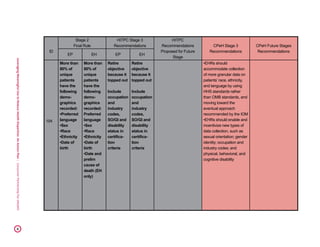
104
More than
80% of
unique
patients
have the
following
demo-
graphics
recorded:
•Preferred
language
•Sex
•Race
•Ethnicity
•Date of
birth
More than
80% of
unique
patients
have the
following
demo-
graphics
recorded:
Preferred
language
•Sex
•Race
•Ethnicity
•Date of
birth
•Date and
prelim
cause of
death (EH
only)
Retire
objective
because it
topped out
Include
occupation
and
industry
codes,
SO/GI and
disability
status in
certifica-
tion
criteria
Retire
objective
because it
topped out
Include
occupation
and
industry
codes,
SO/GI and
disability
status in
certifica-
tion
criteria
•EHRs should
accommodate collection
of more granular data on
patients’ race, ethnicity,
and language by using
HHS standards rather
than OMB standards, and
moving toward the
eventual approach
recommended by the IOM
•EHRs should enable and
incentivize new types of
data collection, such as
sexual orientation; gender
identity; occupation and
industry codes; and
physical, behavioral, and
cognitive disability
LeveragingMeaningfulUsetoReduceHealthDisparities:AnActionPlan|ConsumerPartnershipForeHealth20
ID
Stage 2
Final Rule
HITPC Stage 3
Recommendations
HITPC
Recommendations
Proposed for Future
Stage
CPeH Stage 3
Recommendations
CPeH Future Stages
Recommendations
EP EH EP EH
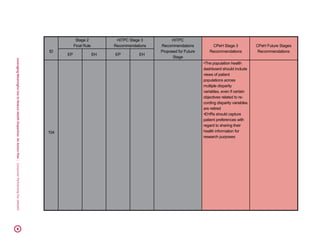
104
•The population health
dashboard should include
views of patient
populations across
multiple disparity
variables, even if certain
objectives related to re-
cording disparity variables
are retired
•EHRs should capture
patient preferences with
regard to sharing their
health information for
research purposes
LeveragingMeaningfulUsetoReduceHealthDisparities:AnActionPlan|ConsumerPartnershipForeHealth21
ID
Stage 2
Final Rule
HITPC Stage 3
Recommendations
HITPC
Recommendations
Proposed for Future
Stage
CPeH Stage 3
Recommendations
CPeH Future Stages
Recommendations
EP EH EP EH
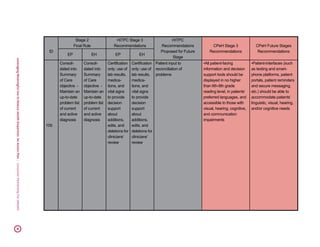
105
Consoli-
dated into
Summary
of Care
objective -
Maintain an
up-to-date
problem list
of current
and active
diagnosis
Consoli-
dated into
Summary
of Care
objective -
Maintain an
up-to-date
problem list
of current
and active
diagnosis
Certification
only: use of
lab results,
medica-
tions, and
vital signs
to provide
decision
support
about
additions,
edits, and
deletions for
clinicians’
review
Certification
only: use of
lab results,
medica-
tions, and
vital signs
to provide
decision
support
about
additions,
edits, and
deletions for
clinicians’
review
Patient input to
reconciliation of
problems
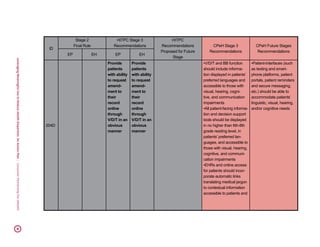
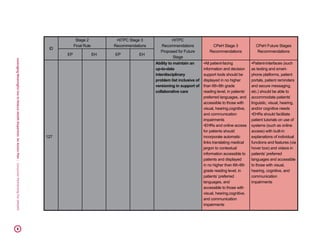
•All patient-facing
information and decision
support tools should be
displayed in no higher
than 6th-8th grade
reading level, in patients’
preferred languages, and
accessible to those with
visual, hearing, cognitive,
and communication
impairments
•Patient-interfaces (such
as texting and smart-
phone platforms, patient
portals, patient reminders
and secure messaging,
etc.) should be able to
accommodate patients’
linguistic, visual, hearing,
and/or cognitive needs
LeveragingMeaningfulUsetoReduceHealthDisparities:AnActionPlan|ConsumerPartnershipForeHealth22
ID
Stage 2
Final Rule
HITPC Stage 3
Recommendations
HITPC
Recommendations
Proposed for Future
Stage
CPeH Stage 3
Recommendations
CPeH Future Stages
Recommendations
EP EH EP EH
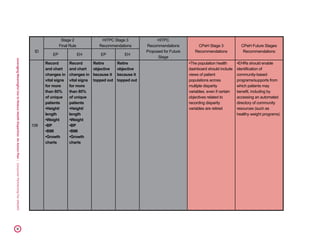
108
Record
and chart
changes in
vital signs
for more
than 80%
of unique
patients
•Height/
length
•Weight
•BP
•BMI
•Growth
charts
Record
and chart
changes in
vital signs
for more
than 80%
of unique
patients
•Height/
length
•Weight
•BP
•BMI
•Growth
charts
Retire
objective
because it
topped out
Retire
objective
because it
topped out
•The population health
dashboard should include
views of patient
populations across
multiple disparity
variables, even if certain
objectives related to
recording disparity
variables are retired
•EHRs should enable
identification of
community-based
programs/supports from
which patients may
benefit, including by
accessing an automated
directory of community
resources (such as
healthy weight programs)
LeveragingMeaningfulUsetoReduceHealthDisparities:AnActionPlan|ConsumerPartnershipForeHealth23
ID
Stage 2
Final Rule
HITPC Stage 3
Recommendations
HITPC
Recommendations
Proposed for Future
Stage
CPeH Stage 3
Recommendations
CPeH Future Stages
Recommendations
EP EH EP EH
109
Record
smoking
status for
80% of all
unique
patients
13 yo and
older
Record
smoking
status for
80% of all
unique
patients
13 yo and
older
Retire
objective
because it
topped out
Retire
objective
because it
topped out
•The population health
dashboard should include
views of patient popula-
tions across multiple
disparity variables, even if
certain objectives related
to recording disparity
variables are retired
•EHRs should enable
identification of communi-
ty-based programs/sup-
ports from which patients
may benefit, including by
accessing an automated
directory of community
resources (such as
smoking cessation pro-
grams)
LeveragingMeaningfulUsetoReduceHealthDisparities:AnActionPlan|ConsumerPartnershipForeHealth24
ID
Stage 2
Final Rule
HITPC Stage 3
Recommendations
HITPC
Recommendations
Proposed for Future
Stage
CPeH Stage 3
Recommendations
CPeH Future Stages
Recommendations
EP EH EP EH
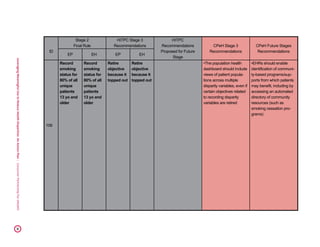
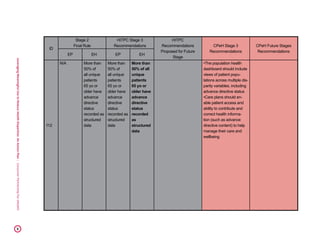
112
N/A More than
50% of
all unique
patients
65 yo or
older have
advance
directive
status
recorded as
structured
data
More than
50% of
all unique
patients
65 yo or
older have
advance
directive
status
recorded as
structured
data
More than
50% of all
unique
patients
65 yo or
older have
advance
directive
status
recorded
as
structured
data
•The population health
dashboard should include
views of patient popu-
lations across multiple dis-
parity variables, including
advance directive status
•Care plans should en-
able patient access and
ability to contribute and
correct health informa-
tion (such as advance
directive content) to help
manage their care and
wellbeing
LeveragingMeaningfulUsetoReduceHealthDisparities:AnActionPlan|ConsumerPartnershipForeHealth25
ID
Stage 2
Final Rule
HITPC Stage 3
Recommendations
HITPC
Recommendations
Proposed for Future
Stage
CPeH Stage 3
Recommendations
CPeH Future Stages
Recommendations
EP EH EP EH
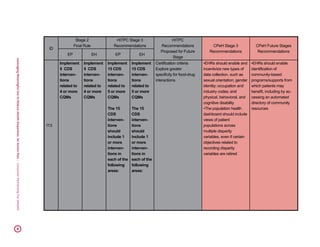
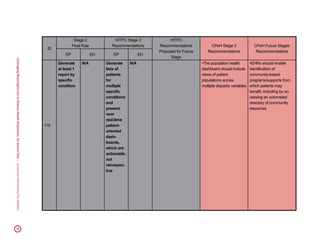
113
Implement
5 CDS
interven-
tions
related to
4 or more
CQMs
Implement
5 CDS
interven-
tions
related to
4 or more
CQMs
Implement
15 CDS
interven-
tions
related to
5 or more
CQMs
The 15
CDS
interven-
tions
should
include 1
or more
interven-
tions in
each of the
following
areas:
Implement
15 CDS
interven-
tions
related to
5 or more
CQMs
The 15
CDS
interven-
tions
should
include 1
or more
interven-
tions in
each of the
following
areas:
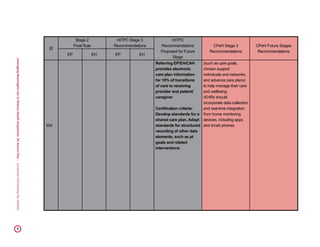
Certification criteria:
Explore greater
specificity for food-drug
interactions.
•EHRs should enable and
incentivize new types of
data collection, such as
sexual orientation; gender
identity; occupation and
industry codes; and
physical, behavioral, and
cognitive disability
•The population health
dashboard should include
views of patient
populations across
multiple disparity
variables, even if certain
objectives related to
recording disparity
variables are retired
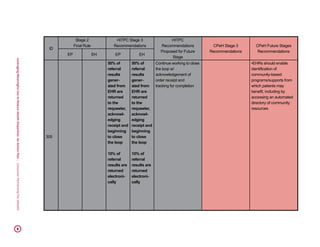
•EHRs should enable
identification of
community-based
programs/supports from
which patients may
benefit, including by ac-
cessing an automated
directory of community
resources
LeveragingMeaningfulUsetoReduceHealthDisparities:AnActionPlan|ConsumerPartnershipForeHealth26
ID
Stage 2
Final Rule
HITPC Stage 3
Recommendations
HITPC
Recommendations
Proposed for Future
Stage
CPeH Stage 3
Recommendations
CPeH Future Stages
Recommendations
EP EH EP EH
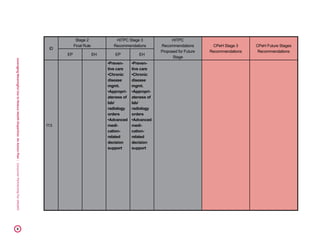
113
•Preven-
tive care
•Chronic
disease
mgmt.
•Appropri-
ateness of
lab/
radiology
orders
•Advanced
medi-
cation-
related
decision
support
•Preven-
tive care
•Chronic
disease
mgmt.
•Appropri-
ateness of
lab/
radiology
orders
•Advanced
medi-
cation-
related
decision
support
LeveragingMeaningfulUsetoReduceHealthDisparities:AnActionPlan|ConsumerPartnershipForeHealth27
ID
Stage 2
Final Rule
HITPC Stage 3
Recommendations
HITPC
Recommendations
Proposed for Future
Stage
CPeH Stage 3
Recommendations
CPeH Future Stages
Recommendations
EP EH EP EH
115
Generate
at least 1
report by
specific
condition
N/A Generate
lists of
patients
for
multiple
specific
conditions
and
present
near
real-time
patient-
oriented
dash-
boards,
which are
actionable,
not
retrospec-
tive
N/A •The population health
dashboard should include
views of patient
populations across
multiple disparity variables
•EHRs should enable
identification of
community-based
programs/supports from
which patients may
benefit, including by ac-
cessing an automated
directory of community
resources
LeveragingMeaningfulUsetoReduceHealthDisparities:AnActionPlan|ConsumerPartnershipForeHealth28
ID
Stage 2
Final Rule
HITPC Stage 3
Recommendations
HITPC
Recommendations
Proposed for Future
Stage
CPeH Stage 3
Recommendations
CPeH Future Stages
Recommendations
EP EH EP EH
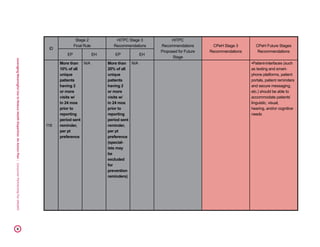
116
More than
10% of all
unique
patients
having 2
or more
visits w/
in 24 mos
prior to
reporting
period sent
reminder,
per pt
preference
N/A More than
20% of all
unique
patients
having 2
or more
visits w/
in 24 mos
prior to
reporting
period sent
reminder,
per pt
preference
(special-
ists may
be
excluded
for
prevention
reminders)
N/A •Patient-interfaces (such
as texting and smart-
phone platforms, patient
portals, patient reminders
and secure messaging,
etc.) should be able to
accommodate patients’
linguistic, visual,
hearing, and/or cognitive
needs
LeveragingMeaningfulUsetoReduceHealthDisparities:AnActionPlan|ConsumerPartnershipForeHealth29
ID
Stage 2
Final Rule
HITPC Stage 3
Recommendations
HITPC
Recommendations
Proposed for Future
Stage
CPeH Stage 3
Recommendations
CPeH Future Stages
Recommendations
EP EH EP EH
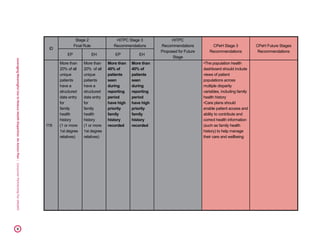
119
More than
20% of all
unique
patients
have a
structured
data entry
for
family
health
history
(1 or more
1st degree
relatives)
More than
20% of all
unique
patients
have a
structured
data entry
for
family
health
history
(1 or more
1st degree
relatives)
More than
40% of
patients
seen
during
reporting
period
have high
priority
family
history
recorded
More than
40% of
patients
seen
during
reporting
period
have high
priority
family
history
recorded
•The population health
dashboard should include
views of patient
populations across
multiple disparity
variables, including family
health history
•Care plans should
enable patient access and
ability to contribute and
correct health information
(such as family health
history) to help manage
their care and wellbeing
LeveragingMeaningfulUsetoReduceHealthDisparities:AnActionPlan|ConsumerPartnershipForeHealth30
ID
Stage 2
Final Rule
HITPC Stage 3
Recommendations
HITPC
Recommendations
Proposed for Future
Stage
CPeH Stage 3
Recommendations
CPeH Future Stages
Recommendations
EP EH EP EH
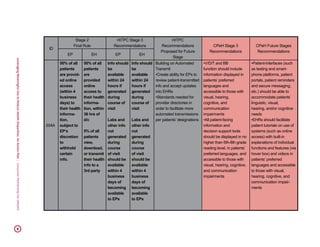
204A
50% of all
patients
are provid-
ed online
access
(within 4
business
days) to
their health
informa-
tion,
subject to
EP’s
discretion
to
withhold
certain
info.
50% of all
patients
are
provided
online
access to
their health
informa-
tion, within
36 hrs of
d/c
5% of all
patients
view,
download,
or transmit
their health
info to a
3rd party
Info should
be
available
within 24
hours if
generated
during
course of
visit
Labs and
other info
not
generated
during
course
of visit
should be
available
within 4
business
days of
becoming
available
to EPs
Info should
be
available
within 24
hours if
generated
during
course of
visit
Labs and
other info
not
generated
during
course
of visit
should be
available
within 4
business
days of
becoming
available
to EPs
Building on Automated
Transmit
•Create ability for EPs to
review patient-transmitted
info and accept updates
into EHRs
•Standards needed for
provider directories in
order to facilitate more
automated transmissions
per patients’ designations
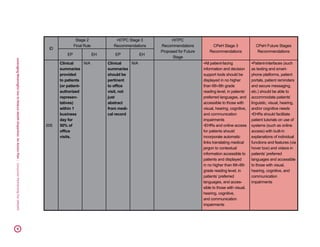
•V/D/T and BB
function should include
information displayed in
patients’ preferred
languages and
accessible to those with
visual, hearing,
cognitive, and
communication
impairments
•All patient-facing
information and
decision support tools
should be displayed in no
higher than 6th-8th grade
reading level, in patients’
preferred languages, and
accessible to those with
visual, hearing, cognitive,
and communication
impairments
•Patient-interfaces (such
as texting and smart-
phone platforms, patient
portals, patient reminders
and secure messaging,
etc.) should be able to
accommodate patients’
linguistic, visual,
hearing, and/or cognitive
needs
•EHRs should facilitate
patient tutorials on use of
systems (such as online
access) with built-in
explanations of individual
functions and features (via
hover box) and videos in
patients’ preferred
languages and accessible
to those with visual,
hearing, cognitive, and
communication impair-
ments
LeveragingMeaningfulUsetoReduceHealthDisparities:AnActionPlan|ConsumerPartnershipForeHealth31
ID
Stage 2
Final Rule
HITPC Stage 3
Recommendations
HITPC
Recommendations
Proposed for Future
Stage
CPeH Stage 3
Recommendations
CPeH Future Stages
Recommendations
EP EH EP EH
204A
5% of all
patients
view,
download,
or transmit
their health
info to a
3rd party
Automated
Transmit
(building on
Blue
Button):
50% of all
patients are
provided
ability to
designate
to whom
and when a
summary of
care
document
is sent to
patient-
designated
recipient
Potential
to increase
both
thresholds
based on
Stage 2
Automated
Transmit
(building on
Blue
Button):
50% of all
patients are
provided
ability to
designate
to whom
and when a
summary of
care
document
is sent to
patient-
designated
recipient
Potential
to increase
both
thresholds
based on
Stage 2
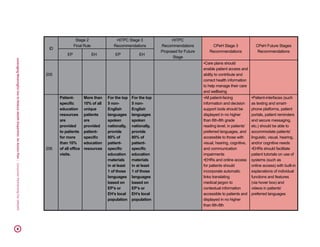
•EHRs and online access
for patients should
incorporate automatic
links translating medical
jargon to contextual
information accessible to
patients and displayed
in no higher than 6th-8th
grade reading level, in
patients’ preferred
languages, and
accessible to those with
visual, hearing,
cognitive, and
communication
impairments
•Care plans should en-
able patient access and
ability to contribute and
correct health information
(such as chosen support
individuals and networks)
to help manage their care
and wellbeing
LeveragingMeaningfulUsetoReduceHealthDisparities:AnActionPlan|ConsumerPartnershipForeHealth32
ID
Stage 2
Final Rule
HITPC Stage 3
Recommendations
HITPC
Recommendations
Proposed for Future
Stage
CPeH Stage 3
Recommendations
CPeH Future Stages
Recommendations
EP EH EP EH
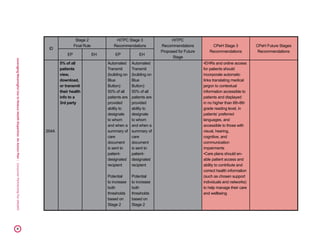
204A
•EHRs should
incorporate data collection
and real-time integration
from home monitoring
devices, including apps
and smart phones
•Blue Button functionality
should be implemented
for Medicaid and CHIP
beneficiaries
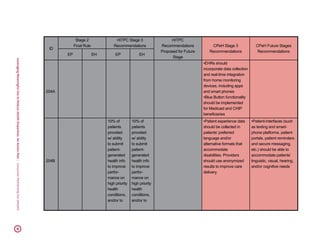
204B
10% of
patients
provided
w/ ability
to submit
patient-
generated
health info
to improve
perfor-
mance on
high priority
health
conditions,
and/or to
10% of
patients
provided
w/ ability
to submit
patient-
generated
health info
to improve
perfor-
mance on
high priority
health
conditions,
and/or to
•Patient experience data
should be collected in
patients’ preferred
language and/or
alternative formats that
accommodate
disabilities. Providers
should use anonymized
results to improve care
delivery.
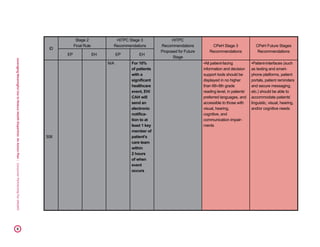
•Patient-interfaces (such
as texting and smart-
phone platforms, patient
portals, patient reminders
and secure messaging,
etc.) should be able to
accommodate patients’
linguistic, visual, hearing,
and/or cognitive needs
LeveragingMeaningfulUsetoReduceHealthDisparities:AnActionPlan|ConsumerPartnershipForeHealth33
ID
Stage 2
Final Rule
HITPC Stage 3
Recommendations
HITPC
Recommendations
Proposed for Future
Stage
CPeH Stage 3
Recommendations
CPeH Future Stages
Recommendations
EP EH EP EH
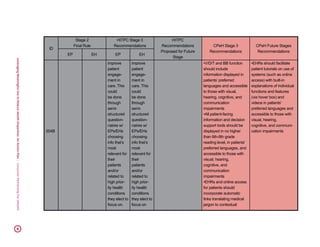
204B
improve
patient
engage-
ment in
care. This
could
be done
through
semi-
structured
question-
naires w/
EPs/EHs
choosing
info that’s
most
relevant for
their
patients
and/or
related to
high prior-
ity health
conditions
they elect to
focus on.
improve
patient
engage-
ment in
care. This
could
be done
through
semi-
structured
question-
naires w/
EPs/EHs
choosing
info that’s
most
relevant for
their
patients
and/or
related to
high prior-
ity health
conditions
they elect to
focus on
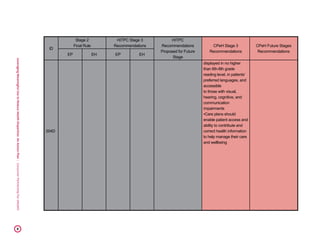
•V/D/T and BB function
should include
information displayed in
patients’ preferred
languages and accessible
to those with visual,
hearing, cognitive, and
communication
impairments
•All patient-facing
information and decision
support tools should be
displayed in no higher
than 6th-8th grade
reading level, in patients’
preferred languages, and
accessible to those with
visual, hearing,
cognitive, and
communication
impairments
•EHRs and online access
for patients should
incorporate automatic
links translating medical
jargon to contextual
•EHRs should facilitate
patient tutorials on use of
systems (such as online
access) with built-in
explanations of individual
functions and features
(via hover box) and
videos in patients’
preferred languages and
accessible to those with
visual, hearing,
cognitive, and communi-
cation impairments
LeveragingMeaningfulUsetoReduceHealthDisparities:AnActionPlan|ConsumerPartnershipForeHealth34
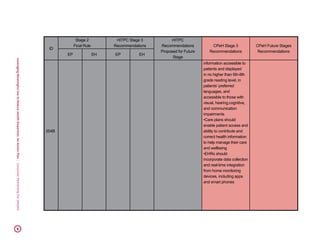
ID
Stage 2
Final Rule
HITPC Stage 3
Recommendations
HITPC
Recommendations
Proposed for Future
Stage
CPeH Stage 3
Recommendations
CPeH Future Stages
Recommendations
EP EH EP EH
204B
information accessible to
patients and displayed
in no higher than 6th-8th
grade reading level, in
patients’ preferred
languages, and
accessible to those with
visual, hearing,cognitive,
and communication
impairments
•Care plans should
enable patient access and
ability to contribute and
correct health information
to help manage their care
and wellbeing
•EHRs should
incorporate data collection
and real-time integration
from home monitoring
devices, including apps
and smart phones
LeveragingMeaningfulUsetoReduceHealthDisparities:AnActionPlan|ConsumerPartnershipForeHealth35
ID
Stage 2
Final Rule
HITPC Stage 3
Recommendations
HITPC
Recommendations
Proposed for Future
Stage
CPeH Stage 3
Recommendations
CPeH Future Stages
Recommendations
EP EH EP EH
204D
Provide
patients
with ability
to request
amend-
ment to
their
record
online
through
V/D/T in an
obvious
manner
Provide
patients
with ability
to request
amend-
ment to
their
record
online
through
V/D/T in an
obvious
manner
•V/D/T and BB function
should include informa-
tion displayed in patients’
preferred languages and
accessible to those with
visual, hearing, cogni-
tive, and communication
impairments
•All patient-facing informa-
tion and decision support
tools should be displayed
in no higher than 6th-8th
grade reading level, in
patients’ preferred lan-
guages, and accessible to
those with visual, hearing,
cognitive, and communi-
cation impairments
•EHRs and online access
for patients should incor-
porate automatic links
translating medical jargon
to contextual information
accessible to patients and
•Patient-interfaces (such
as texting and smart-
phone platforms, patient
portals, patient reminders
and secure messaging,
etc.) should be able to
accommodate patients’
linguistic, visual, hearing,
and/or cognitive needs
LeveragingMeaningfulUsetoReduceHealthDisparities:AnActionPlan|ConsumerPartnershipForeHealth36
ID
Stage 2
Final Rule
HITPC Stage 3
Recommendations
HITPC
Recommendations
Proposed for Future
Stage
CPeH Stage 3
Recommendations
CPeH Future Stages
Recommendations
EP EH EP EH
204D
displayed in no higher
than 6th-8th grade
reading level, in patients’
preferred languages, and
accessible
to those with visual,
hearing, cognitive, and
communication
impairments
•Care plans should
enable patient access and
ability to contribute and
correct health information
to help manage their care
and wellbeing
LeveragingMeaningfulUsetoReduceHealthDisparities:AnActionPlan|ConsumerPartnershipForeHealth37
ID
Stage 2
Final Rule
HITPC Stage 3
Recommendations
HITPC
Recommendations
Proposed for Future
Stage
CPeH Stage 3
Recommendations
CPeH Future Stages
Recommendations
EP EH EP EH
205
Clinical
summaries
provided
to patients
(or patient-
authorized
represen-
tatives)
within 1
business
day for
50% of
office
visits.
N/A Clinical
summaries
should be
pertinent
to office
visit, not
just
abstract
from medi-
cal record
N/A •All patient-facing
information and decision
support tools should be
displayed in no higher
than 6th-8th grade
reading level, in patients’
preferred languages, and
accessible to those with
visual, hearing, cognitive,
and communication
impairments
•EHRs and online access
for patients should
incorporate automatic
links translating medical
jargon to contextual
information accessible to
patients and displayed
in no higher than 6th-8th
grade reading level, in
patients’ preferred
languages, and acces-
sible to those with visual,
hearing, cognitive,
and communication
impairments
•Patient-interfaces (such
as texting and smart-
phone platforms, patient
portals, patient reminders
and secure messaging,
etc.) should be able to
accommodate patients’
linguistic, visual, hearing,
and/or cognitive needs
•EHRs should facilitate
patient tutorials on use of
systems (such as online
access) with built-in
explanations of individual
functions and features (via
hover box) and videos in
patients’ preferred
languages and accessible
to those with visual,
hearing, cognitive, and
communication
impairments
LeveragingMeaningfulUsetoReduceHealthDisparities:AnActionPlan|ConsumerPartnershipForeHealth38
ID
Stage 2
Final Rule
HITPC Stage 3
Recommendations
HITPC
Recommendations
Proposed for Future
Stage
CPeH Stage 3
Recommendations
CPeH Future Stages
Recommendations
EP EH EP EH
205
•Care plans should
enable patient access and
ability to contribute and
correct health information
to help manage their care
and wellbeing
206
Patient-
specific
education
resources
are
provided
to patients
for more
than 10%
of all office
visits.
More than
10% of all
unique
patients
are
provided
patient-
specific
education
resources
For the top
5 non-
English
languages
spoken
nationally,
provide
80% of
patient-
specific
education
materials
in at least
1 of those
languages
based on
EP’s or
EH’s local
population
For the top
5 non-
English
languages
spoken
nationally,
provide
80% of
patient-
specific
education
materials
in at least
1 of those
languages
based on
EP’s or
EH’s local
population
•All patient-facing
information and decision
support tools should be
displayed in no higher
than 6th-8th grade
reading level, in patients’
preferred languages, and
accessible to those with
visual, hearing, cognitive,
and communication
impairments
•EHRs and online access
for patients should
incorporate automatic
links translating
medical jargon to
contextual information
accessible to patients and
displayed in no higher
than 6th-8th
•Patient-interfaces (such
as texting and smart-
phone platforms, patient
portals, patient reminders
and secure messaging,
etc.) should be able to
accommodate patients’
linguistic, visual, hearing,
and/or cognitive needs
•EHRs should facilitate
patient tutorials on use of
systems (such as
online access) with built-in
explanations of individual
functions and features
(via hover box) and
videos in patients’
preferred languages
LeveragingMeaningfulUsetoReduceHealthDisparities:AnActionPlan|ConsumerPartnershipForeHealth39
ID
Stage 2
Final Rule
HITPC Stage 3
Recommendations
HITPC
Recommendations
Proposed for Future
Stage
CPeH Stage 3
Recommendations
CPeH Future Stages
Recommendations
EP EH EP EH
206
grade reading level, in
patients’ preferred
languages, and
accessible to those with
visual, hearing, cognitive,
and communication
impairments
•Patient education and
decision support materials
should include
information regarding
research participation
in languages other than
English and accessible to
those with visual and/or
cognitive impairments
and accessible to those
with visual, hearing, cog-
nitive, and communication
impairments
•EHRs should enable
identification of communi-
ty-based programs/sup-
ports from which patients
may benefit, including by
accessing an automated
directory of community
resources (particularly if
programs/supports exist
in patients’ preferred
languages)
207
5% of all
unique
patients
(or their
authorized
represen-
tative)
seen
during
N/A More than
10% of
patients
use secure
messaging
to commu-
nicate w/
EPs
N/A Create capacity for
electronic episodes of
care (telemetry devices,
etc.) and to do e-referrals
and e-consults
•All patient-facing
information and decision
support tools should be
displayed in no higher
than 6th-8th grade
reading level, in patients’
preferred languages, and
accessible to those with
visual, hearing, cognitive
•Patient-interfaces (such
as texting and smart-
phone platforms, patient
portals, patient reminders
and secure messaging,
etc.) should be able to
accommodate patients’
linguistic, visual, hearing,
and/or cognitive needs
LeveragingMeaningfulUsetoReduceHealthDisparities:AnActionPlan|ConsumerPartnershipForeHealth40
ID
Stage 2
Final Rule
HITPC Stage 3
Recommendations
HITPC
Recommendations
Proposed for Future
Stage
CPeH Stage 3
Recommendations
CPeH Future Stages
Recommendations
EP EH EP EH
207
reporting
period
send a se-
cure mes-
sage using
electronic
messaging
and communication
impairments
•EHRs and online access
for patients should
incorporate automatic
links translating medical
jargon to contextual
information accessible to
patients and displayed
in no higher than 6th-8th
grade reading level, in
patients’ preferred
languages, and
accessible to those with
visual, hearing,
cognitive, and
communication
impairments
•EHRs should
incorporate data collection
and real-time integration
from home monitoring
devices, including apps
and smart phones
•EHRs should facilitate
patient tutorials on use of
systems (such as online
access) with built-in
explanations of individual
functions and features (via
hover box) and videos in
patients’ preferred
languages and accessible
to those with visual,
hearing, cognitive, and
communication
impairments
LeveragingMeaningfulUsetoReduceHealthDisparities:AnActionPlan|ConsumerPartnershipForeHealth41
ID
Stage 2
Final Rule
HITPC Stage 3
Recommendations
HITPC
Recommendations
Proposed for Future
Stage
CPeH Stage 3
Recommendations
CPeH Future Stages
Recommendations
EP EH EP EH
208
Not
included
separately
(in remind-
er objec-
tive)
Not
included
separately
(in reminder
objective)
20% of
patients
have
commu-
nication
prefer-
ences
recorded
20% of
patients
have com-
munication
prefer-
ences
recorded
•V/D/T and BB function
should include
information displayed in
patients’ preferred
languages and accessible
to those with visual,
hearing, cognitive, and
communication
impairments
•All patient-facing
information and decision
support tools should be
displayed in no higher
than 6th-8th grade
reading level, in patients’
preferred languages, and
accessible to those with
visual, hearing,
cognitive, and
communication
impairments
•Patient-interfaces (such
as texting and smart-
phone platforms, patient
portals, patient reminders
and secure messaging,
etc.) should be able to
accommodate patients’
linguistic, visual, hearing,
and/or cognitive needs
•EHRs should facilitate
patient tutorials on use of
systems (such as online
access) with built-in
explanations of individual
functions and features (via
hover box) and videos in
patients’ preferred
languages and accessible
to those with visual,
hearing, cognitive, and
communication
impairments
LeveragingMeaningfulUsetoReduceHealthDisparities:AnActionPlan|ConsumerPartnershipForeHealth42
ID
Stage 2
Final Rule
HITPC Stage 3
Recommendations
HITPC
Recommendations
Proposed for Future
Stage
CPeH Stage 3
Recommendations
CPeH Future Stages
Recommendations
EP EH EP EH
209
Certifica-
tion only:
Capabil-
ity for EHR
to query
research
enrollment
systems
to identify
available
clinical
trials. No
use req.
until future
stages
Certifica-
tion only:
Capabil-
ity for EHR
to query
research
enrollment
systems
to identify
available
clinical
trials. No
use req.
until future
stages
•EHRs should have
capacity for real time
clinical trial identification
and eligibility checking
LeveragingMeaningfulUsetoReduceHealthDisparities:AnActionPlan|ConsumerPartnershipForeHealth43
ID
Stage 2
Final Rule
HITPC Stage 3
Recommendations
HITPC
Recommendations
Proposed for Future
Stage
CPeH Stage 3
Recommendations
CPeH Future Stages
Recommendations
EP EH EP EH
303
Summary
of care
record,
includ-
ing care
plan and
care team
members,
provided
for 50% of
transitions
of care and
referrals
Summary
of care
record
provided
electroni-
cally for
more than
10% of
transitions
and
referrals
Summary
of care
record,
includ-
ing care
plan and
care team
members,
provided
for 50% of
transitions
of care and
referrals
Summary
of care
record
provided
electroni-
cally for
more than
10% of
transitions
and
referrals
Summary
of care
record
provided
for 65% of
each site
transition
of care and
referrals,
including:
•Concise
narrative
(free text)
in support
of care
transitions
•Setting-
specific
goals
Summary
of care
record
provided
for 65% of
each site
transition
of care and
referrals,
including:
•Concise
narrative
(free text)
in support
of care
transitions
•Setting-
specific
goals
•Care summaries and
plans should require
recording of caregiver
status and roles using
DECAF standards (Direct
care provision, Emotional
support, Care
coordination, Advocacy,
and Financial) as
appropriate
•Care plans should
enable patient access and
ability to contribute and
correct health information
(such as chosen support
individuals and networks)
to help manage their care
and wellbeing
•Patient-interfaces (such
as texting and smart-
phone platforms, patient
portals, patient reminders
and secure messaging,
etc.) should be able to
accommodate patients’
linguistic, visual, hearing,
and/or cognitive needs
•EHRs should facilitate
patient tutorials on use of
systems (such as online
access) with built-in expla-
nations of individual
functions and features (via
hover box) and videos in
patients’ preferred
languages and accessible
to those with visual,
hearing, cognitive, and
communication
impairments
LeveragingMeaningfulUsetoReduceHealthDisparities:AnActionPlan|ConsumerPartnershipForeHealth44
ID
Stage 2
Final Rule
HITPC Stage 3
Recommendations
HITPC
Recommendations
Proposed for Future
Stage
CPeH Stage 3
Recommendations
CPeH Future Stages
Recommendations
EP EH EP EH
303
One or
more
successful
electronic
exchanges
of summa-
ry of care
document
with
recipient
who has
technology
designed
by a differ-
ent devel-
oper than
sender
OR one
or more
successful
tests with
the CMS
designated
test EHR
One or
more
successful
electronic
exchanges
of summa-
ry of care
document
with
recipient
who has
technology
designed
by a differ-
ent devel-
oper than
sender
OR one
or more
successful
tests with
the CMS
designated
test EHR
•Instruc-
tions for
care dur-
ing transi-
tion and 48
hours
afterwards
•Care team
members,
including
primary
care
provider
and
caregiver
name,
role, and
contact
info (using
DECAF)
•Instruc-
tions for
care dur-
ing transi-
tion and 48
hours
afterwards
•Care team
members,
including
primary
care
provider
and
caregiver
name,
role, and
contact
info (using
DECAF)
•All patient-facing
information and decision
support tools should be
displayed in no higher
than 6th-8th grade
reading level, in patients’
preferred languages, and
accessible to those with
visual, hearing,
cognitive, and
communication
impairments
•EHRs and online access
for patients should
incorporate automatic
links translating
medical jargon to
contextual information
accessible to patients and
displayed in no higher
than 6th-8th grade
reading level in patients’
preferred languages,
•EHRs should enable
identification of
community-based
programs/supports from
which patients may
benefit, including by
accessing an automated
directory of community
resources
LeveragingMeaningfulUsetoReduceHealthDisparities:AnActionPlan|ConsumerPartnershipForeHealth45
ID
Stage 2
Final Rule
HITPC Stage 3
Recommendations
HITPC
Recommendations
Proposed for Future
Stage
CPeH Stage 3
Recommendations
CPeH Future Stages
Recommendations
EP EH EP EH
303
Summary
of care
record
provided
electroni-
cally for
more than
30% of
transitions
and
referrals
Summary
of care
record
provided
electroni-
cally for
more than
30% of
transitions
and
referrals
and accessible to those
with visual, hearing,
cognitive, and
communication
impairments
304
For each transition of
site of care, provide the
care plan information
including the following
as applicable:
•Medical diagnoses and
stages
•Functional status,
including ADLs
•Relevant social and
financial information
•Relevant
environmental factors
impacting patient’s
health
•Patient experience data
should be collected in
patients’ preferred
language and/or
alternative formats that
accommodate disabilities.
Providers should use
anonymized results to
improve care delivery.
•All patient-facing
information and decision
support tools should be
displayed in no higher
than 6th-8th grade
reading level, in patients’
•Patient-interfaces (such
as texting and smart-
phone platforms, patient
portals, patient reminders
and secure messaging,
etc.) should be able to
accommodate patients’
linguistic, visual, hearing,
and/or cognitive needs
•EHRs should facilitate
patient tutorials on use of
systems (such as on-
line access) with built-in
explanations of individual
functions and features
LeveragingMeaningfulUsetoReduceHealthDisparities:AnActionPlan|ConsumerPartnershipForeHealth46
ID
Stage 2
Final Rule
HITPC Stage 3
Recommendations
HITPC
Recommendations
Proposed for Future
Stage
CPeH Stage 3
Recommendations
CPeH Future Stages
Recommendations
EP EH EP EH
304
•Most likely course of
illness or condition, in
broad terms
•Cross-setting care
team member list,
including primary
contact from each ac-
tive provider setting,
including primary care,
relevant specialists, and
caregiver
•Patient’s long-term
goal(s) for care,
ncluding time frame and
initial steps toward
meeting these goals
•Specific advance care
plan (POLST) and set-
ting in which it was
executed
•For each referral,
provide care plan if one
exists
preferred languages, and
accessible to those with
visual, hearing,
cognitive, and
communication
impairments
•EHRs and online access
for patients should
incorporate automatic
links translating
medical jargon to
contextual information
accessible to patients
and displayed in no
higher than 6th-8th grade
reading level, in patients’
preferred languages, and
accessible to those with
visual, hearing, cognitive,
and communication
impairments
•Care plans should
enable patient access and
ability to contribute and
correct health information
(via hover box) and
videos in patients’
preferred languages and
accessible to those with
visual, hearing, cognitive,
and communication
impairments
•EHRs should enable
identification of
community-based
programs/supports from
which patients may
benefit, including by
accessing an automated
directory of community
resources
LeveragingMeaningfulUsetoReduceHealthDisparities:AnActionPlan|ConsumerPartnershipForeHealth47
ID
Stage 2
Final Rule
HITPC Stage 3
Recommendations
HITPC
Recommendations
Proposed for Future
Stage
CPeH Stage 3
Recommendations
CPeH Future Stages
Recommendations
EP EH EP EH
304
Referring EP/EH/CAH
provides electronic
care plan information
for 10% of transitions
of care to receiving
provider and patient/
caregiver
Certification criteria:
Develop standards for a
shared care plan. Adopt
standards for structured
recording of other data
elements, such as pt
goals and related
interventions
(such as care goals,
chosen support
individuals and networks,
and advance care plans)
to help manage their care
and wellbeing
•EHRs should
incorporate data collection
and real-time integration
from home monitoring
devices, including apps
and smart phones
LeveragingMeaningfulUsetoReduceHealthDisparities:AnActionPlan|ConsumerPartnershipForeHealth48
ID
Stage 2
Final Rule
HITPC Stage 3
Recommendations
HITPC
Recommendations
Proposed for Future
Stage
CPeH Stage 3
Recommendations
CPeH Future Stages
Recommendations
EP EH EP EH
305
50% of
referral
results
gener-
ated from
EHR are
returned
to the
requester,
acknowl-
edging
receipt and
beginning
to close
the loop
10% of
referral
results are
returned
electroni-
cally
50% of
referral
results
gener-
ated from
EHR are
returned
to the
requester,
acknowl-
edging
receipt and
beginning
to close
the loop
10% of
referral
results are
returned
electroni-
cally
Continue working to close
the loop w/
acknowledgement of
order receipt and
tracking for completion
•EHRs should enable
identification of
community-based
programs/supports from
which patients may
benefit, including by
accessing an automated
directory of community
resources
LeveragingMeaningfulUsetoReduceHealthDisparities:AnActionPlan|ConsumerPartnershipForeHealth49
ID
Stage 2
Final Rule
HITPC Stage 3
Recommendations
HITPC
Recommendations
Proposed for Future
Stage
CPeH Stage 3
Recommendations
CPeH Future Stages
Recommendations
EP EH EP EH
127
Ability to maintain an
up-to-date
interdisciplinary
problem list inclusive of
versioning in support of
collaborative care
•All patient-facing
information and decision
support tools should be
displayed in no higher
than 6th-8th grade
reading level, in patients’
preferred languages, and
accessible to those with
visual, hearing,cognitive,
and communication
impairments
•EHRs and online access
for patients should
incorporate automatic
links translating medical
jargon to contextual
information accessible to
patients and displayed
in no higher than 6th-8th
grade reading level, in
patients’ preferred
languages, and
accessible to those with
visual, hearing,cognitive,
and communication
impairments
•Patient-interfaces (such
as texting and smart-
phone platforms, patient
portals, patient reminders
and secure messaging,
etc.) should be able to
accommodate patients’
linguistic, visual, hearing,
and/or cognitive needs
•EHRs should facilitate
patient tutorials on use of
systems (such as online
access) with built-in
explanations of individual
functions and features (via
hover box) and videos in
patients’ preferred
languages and accessible
to those with visual,
hearing, cognitive, and
communication
impairments
LeveragingMeaningfulUsetoReduceHealthDisparities:AnActionPlan|ConsumerPartnershipForeHealth50
ID
Stage 2
Final Rule
HITPC Stage 3
Recommendations
HITPC
Recommendations
Proposed for Future
Stage
CPeH Stage 3
Recommendations
CPeH Future Stages
Recommendations
EP EH EP EH
308
N/A For 10%
of patients
with a
significant
healthcare
event, EH/
CAH will
send an
electronic
notifica-
tion to at
least 1 key
member of
patient’s
care team
within
2 hours
of when
event
occurs
•All patient-facing
information and decision
support tools should be
displayed in no higher
than 6th-8th grade
reading level, in patients’
preferred languages, and
accessible to those with
visual, hearing,
cognitive, and
communication impair-
ments
•Patient-interfaces (such
as texting and smart-
phone platforms, patient
portals, patient reminders
and secure messaging,
etc.) should be able to
accommodate patients’
linguistic, visual, hearing,
and/or cognitive needs

leveraging-meaningful-use-to

  • 1.
    Leveraging Meaningful Use toReduce Health Disparities AN ACTION PLAN August 2013
  • 2.
    Leveraging Meaningful Useto Reduce Health Disparities: An Action Plan | Consumer Partnership For eHealth 2 1875 Connecticut Avenue, NW | Suite 650 | Washington, DC 20009 202.986.2600 | www.NationalPartnership.org Acknowledgements Funding from the Markle Foundation provided critical resources for this report.
  • 3.
    Leveraging Meaningful Useto Reduce Health Disparities: An Action Plan | Consumer Partnership For eHealth 3 Leveraging Meaningful Use to Reduce Disparities: An Action Plan August 2013* Executive Summary The heterogeneity of the United States is growing by leaps and bounds. We are a nation as diverse as we are advanced. However, as our nation’s diversity has grown, so has a parallel increase in health disparities. In recent years health information technology (health IT) has begun to offer great promise in addressing and reducing health disparities by increasing individuals’ access to their own health information and improving communication and information flow between providers and patients.  1 Health IT allows us to more easily identify the unique needs of all individuals, and focus particular attention on the unmet needs of underserved and marginalized populations. Indeed, if we can make the system work for the most vulnerable among us, it will work for everyone. There is perhaps no more immediate opportunity to reduce health disparities than the Electronic Health Record (EHR) Incentive Program (commonly known as “Meaningful Use” or “MU”). However, while the reduction of disparities is one of the stated goals of the Health Information Technology for Economic and Clinical Health (HITECH) Act, from which the EHR Incentive Program stems, there has been little actual progress on this critical issue.  1 For purposes of brevity, we refer throughout this report to “patient’ and “care,” given that the Meaningful Use incentive program is rooted in the medical model. It is important to note, however, that meeting the goals of the Triple Aim (healthier populations, better care, and more affordable health care costs) will require a shift away from an exclusive medical approach toward a more person- and family-centered approach that emphasizes wellness, prevention, and community-based supports, in addition to traditional medical interventions. "Patients" and "care" imply a medical model with a focus on episodes of illness and exclusive dependency on professionals; people with disabilities frequently refer to themselves as "consumers" or merely "persons." Any effort to improve patient and family engagement must include the use of terminology that also resonates with the numerous consumer perspectives not adequately reflected by medical model terminology.   Consumer Partnership for eHealth CPeH is a coalition of more than 50 consumer, patient, and labor organizations working at the national, state, and local levels to advance private and secure health information technology (health IT) in ways that measurably improve the lives of individuals and their families. The combined membership of CPeH represents more than 127 million Americans.
  • 4.
    Leveraging Meaningful Useto Reduce Health Disparities: An Action Plan | Consumer Partnership For eHealth 4 To this end, we have come together to create an evidence-based action plan for leveraging the EHR Incentive Program to reduce health disparities. The areas chosen – data collection and use to identify disparities; language, literacy, and communication; and care coordination and planning – were chosen based on an extensive review of scientific literature. The EHR uses outlined below reflect what we believe to be realistically achievable for Stage 3 based on the criteria proposed by the HIT Policy Committee in November 2012. We have also identified some critical criteria that might be too ambitious for Stage 3, but should be listed and incorporated as early as possible in future stages. By including the following modest but strategic requirements, the Health IT Policy Committee, the Office of the National Coordinator for Health IT, and the Centers for Medicare & Medicaid Services can enable providers to meet the HITECH Act’s promise to address health disparities, not to mention make a positive life-altering impact for the nation’s underserved and vulnerable populations. The table below details our recommendations alongside the corresponding Stage 3 criteria as proposed in the HIT Policy Committee’s Request for Comment, released on November 16, 2012. Evidence-based explanations of these areas of focus can be found below, and a more detailed chart of recommendations and the Stage 3 criteria can be found in Appendix A. "It’s impossible to achieve better health outcomes and significantly reduce health care costs without tackling health disparities, which are a pervasive and costly problem. We have the chance to leverage Stage 3 of the Meaningful Use program to make significant progress in addressing disparities. We must not squander this opportunity. CPeH has created a bold, yet achievable, path forward for including criteria in Stage 3 that will begin to reduce disparities and, in doing so, help us achieve patient- and family-centered care, better outcomes, and lower costs for everyone." Debra L. Ness, National Partnership for Women & Families. The Collaborators As consumer advocates on behalf of some of our most underserved populations, we are dedicated to ensuring in- creased health equity, access, and quality for all populations, regardless of race, ethnicity, sex, gender, sexual orienta- tion, gender identity, language access, socio-economic status, or physical, cognitive, mental and other disabilities. We are partnering to lend our collec- tive voices and expertise to an action plan that fills exist- ing gaps and helps empower our nation’s most vulnerable populations.
  • 5.
    Leveraging Meaningful Useto Reduce Health Disparities: An Action Plan | Consumer Partnership For eHealth 5 I. Data Collection and Use to Identify Disparities Stage 3 RFC Criteria ID Numbers Stage 3: EHRs should accommodate collection of more granular data on patients’ race, ethnicity, and language by using HHS stan- dards rather than OMB standards, and moving toward the eventual approach recommended by the Institute of Medicine 104 Stage 3: EHRs should enable and incentivize new types of data col- lection, such as sexual orientation; gender identity; occupation and industry codes; and physical, behavioral, and cognitive disability 104, 113 Stage 3: The population health dashboard should include views of patient populations across multiple disparity variables, even if certain objectives related to recording disparity variables are re- tired 104, 108, 109, 112, 113, 115, 119 Stage 3: Reported quality measures should be stratified by at least two disparity variables, with reduction in disparities demonstrated in at least one measure All CQMs Stage 3: EHRs should capture patient preferences with regard to sharing their health information for research purposes 104 Stage 3: Patient experience data should be collected in patients’ preferred language and/or alternative formats that accommodate disabilities. Providers should use anonymized results to improve care delivery 204B, 304 Stage 3: Care summaries and plans should require recording of caregiver status and roles using DECAF standards (Direct care provision, Emotional support, Care coordination, Advocacy, and Financial) as appropriate 303 Stage 3: EHRs should incorporate data collection and real-time in- tegration from home monitoring devices, including apps and smart phones 204A, 204B, 207, 304 II. Language, Literacy, and Communication Stage 3 RFC Criteria ID Numbers Stage 3: All patient-facing information and decision support tools should be displayed in no higher than 6th-8th grade reading level, in patients’ preferred languages, and accessible to those with vi- sual, hearing, cognitive, and communication impairments 105, 204A, 204B, 204D, 205, 206, 207, 208, 303, 304, 127, 308
  • 6.
    Leveraging Meaningful Useto Reduce Health Disparities: An Action Plan | Consumer Partnership For eHealth 6 Stage 3: EHRs and online access for patients should incorporate automatic links translating medical jargon to contextual informa- tion accessible to patients and displayed in no higher than 6th-8th grade reading level, in patients’ preferred languages, and acces- sible to those with visual, hearing, cognitive, and communication impairments 204A, 204B, 204D, 205, 206, 207, 303, 304, 127 Stage 3: V/D/T and Blue Button function should include informa- tion displayed in patients’ preferred languages and accessible to those with visual, hearing, cognitive, and communication impair- ments 204A, 204B, 204D, 208 Future Stages: EHRs should facilitate patient tutorials on use of sys- tems (such as online access) with built-in explanations of individ- ual functions and features (via hover box) and videos in patients’ preferred languages and accessible to those with visual, hearing, cognitive, and communication impairments 204A, 204B, 205, 206, 207, 208, 303, 304, 127 Future Stages: Patient-interfaces (such as texting and smartphone platforms, patient portals, patient reminders and secure messag- ing, etc.) should be able to accommodate patients’ linguistic, visual, hearing, and/or cognitive needs 105, 116, 204A, 204B, 204D, 205, 206, 207, 208, 303, 304, 127, 308 III. Care Coordination and Planning Stage 3 RFC Criteria ID Numbers Stage 3: Care plans should enable patient access and ability to con- tribute and correct health information (such as family health his- tory, goals, chosen support individuals and networks, and advance directive content) to help manage their care and wellbeing 112, 119, 204A, 204B, 204D, 205, 303, 304 Stage 3: EHRs should have capacity for real time clinical trial iden- tification and eligibility checking 209 Stage 3: Blue Button functionality should be implemented for Med- icaid and CHIP beneficiaries 204A Future Stages: EHRs should enable identification of community- based programs/supports from which patients may benefit, in- cluding by accessing an automated directory of community re- sources 108, 109, 113, 115, 206, 303, 304, 305
  • 7.
    Leveraging Meaningful Useto Reduce Health Disparities: An Action Plan | Consumer Partnership For eHealth 7 Our Vision We envision design and robust use of secure health information technology nationwide that redresses existing disparities, avoids creating new disparities, and improves health care, services, and supports for vulnerable populations. Ensuring that health IT improves health care first and foremost for these individuals will translate to improvements for everyone, including patients, family and other caregivers as appropriate, and practitioners. We believe the “Meaningful Use” EHR Incentive Program offers a significant, unprecedented opportunity to reduce health disparities by addressing not only the multi-faceted needs of individuals and groups, but also the overlapping needs of all populations. To date, this potential has not been fully realized, and it is an opportunity we cannot afford to squander. Introduction: The Opportunity As we work to strengthen America’s health care system and move towards a healthier population, better care, and more affordable health care costs, it is imperative that we take into account not only the depth of America’s diversity, but also how dramatically our diversity is growing. Today, 58 million people ages five and older speak a language other than English at home, and 56 million people live with a disability. Women account for 50.8 percent of the population. The U.S. Hispanic population reached 50.5 million, increasing 43 percent from the year 2000 and accounting for over half of the total population increase in the U.S. Those identifying as non-Hispanic White have decreased as a percentage of the total population by approximately 5.4 percent since 2000, with over 57 million people identifying solely as Black or African-American, American Indian or Native Alaskan, Asian, or Native Hawaiian and Other Pacific Islander.  2 Additionally, new, more accurate data have begun to emerge as social acceptance has grown and legal systems have become more affirming of the lesbian, gay, bisexual, and transgender (LGBT) populations. While recent studies estimate that overall LGBT individuals comprise 3.8 percent of the national population (or roughly 9 million people), some states report significantly larger populations of people that identify as LGBT.  3 Moreover, our diversity characteristics also merge and cross within individuals and groups, ensuring that we are a nation as diverse as we are advanced.  2 US 2010 Census Data.   3 Gates G, Newport F. Gallup Special Report: New Estimates of the LGBT Population in the United States. The Williams Institute. February 2013. http://williamsinstitute.law.ucla.edu/research/census-lgbt-demographics-studies/gallup-lgbt-pop-feb-2013/ There is perhaps no more immediate opportunity to make an extraordinary difference for patients, families, and caregivers in the reduction of health disparities than the "Meaningful Use" EHR Incentive Program.
  • 8.
    Leveraging Meaningful Useto Reduce Health Disparities: An Action Plan | Consumer Partnership For eHealth 8 However, an unfortunate byproduct of our growth and increased diversity is a parallel increase in disparities. Given that the diversity of our nation is growing by leaps and bounds, it is essential that our health care system, along with the policies and regulations that govern it, keep pace with the dynamic nature of the population. In recent years though, health information technology (health IT) has begun to offer great promise in addressing and reducing health disparities by increasing individuals’ access to their own health information and improving communication between providers and patients. Improving population and individual health outcomes, and reducing disparities, require widespread use of health IT to identify the unique needs of all individuals, with particular attention to the unmet needs of underserved and marginalized populations, and to deliver care and services that improve their health and quality of life. In fact, if we can make the health care system work for our most vulnerable individuals, it can work for everyone. While adoption of health IT is growing exponentially, there is significant risk that underserved populations will continue to be left behind due to structural and economic barriers to equal access to health IT, widening what has come to be known as the “digital divide.” To date, many efforts to address disparities through the use of health IT have focused on ensuring broadband access to technology, which is a critical first step. However, the design of the technology and its use are equally important. It is vital that the health IT currently in place be utilized for and among underserved populations as well as to address the causes of health disparities. Moreover, as the technology is being built, updated, and upgraded, it is essential that this be done with underserved populations in mind, along with the intent of using the technology to address and reduce the causes of health disparities.  4 There is perhaps no more immediate opportunity to make an extraordinary difference for patients, families, and caregivers in the reduction of health disparities than the “Meaningful Use” EHR Incentive Program. Through the program’s phased approach to increase eligible providers’ and eligible hospitals’ adoption and meaningful use of certified electronic health records, and to shift the focus from performing services to improving health care quality and outcomes, the EHR  4 Asian & Pacific Islander American Health Forum, California Pan-Ethnic Health Network, Consumers Union, and National Council of La Raza. Equity in the Digital Age: How Health Information Technology Can Reduce Disparities. February 2013. http://www. cpehn.org/pdfs/EquityInTheDigitalAge2013.pdf  "This action plan presents a great opportunity to improve quality of care, enhance patient participation and understanding, and reduce health disparities nationwide through health information technology. It is important that we implement these recommendations so that the health disparities of today are not replicated in electronic health systems tomorrow." Kathy Ko Chin, Asian & Pacific Islander Health Forum.
  • 9.
    Leveraging Meaningful Useto Reduce Health Disparities: An Action Plan | Consumer Partnership For eHealth 9 Incentive Program is an essential catalyst for improving the quality, safety, and efficiency of health care as well as reducing health disparities. There has been much talk about the promise of health IT to reduce health disparities, but unfortunately little actual progress in federal health IT policy, and specifically in the Meaningful Use program, on this critical issue. Both Stage 1 and Stage 2 of the Meaningful Use functional criteria require providers to record a patient’s demographic information and to generate at least one list of patients by specific condition to use for quality improvement, reduction of disparities, research, or outreach. However, there is no requirement to view lists of patients by disparity variables such as race, ethnicity, language, gender identity, sexual orientation, socio-economic status, or disability status. Moreover, neither stage requires anything more to explicitly identify, report, address, and reduce health disparities. The HITECH Act, from which the EHR Incentive Program stems, states that the National Coordinator should develop a nationwide electronic health information technology infrastructure that “(2) improves health care quality, reduces medical errors, reduces health disparities, and advances the delivery of patient-centered medical care.”  5 With Stage 3, the Meaningful Use program must incorporate infrastructure and uses of certified EHRs that will reduce health disparities as a measurable health outcome. To this end, we have come together to create an evidence-based action plan for leveraging the EHR Incentive Program to reduce health disparities. The three areas identified – data collection and use to identify disparities; language, literacy, and communication; and care coordination and planning – stem from an extensive review of scientific literature. The EHR uses reflect what we believe to be realistically achievable for Stage 3 based on the criteria proposed by the HIT Policy Committee. We have also identified some critical criteria that might be too ambitious for Stage 3, but should be listed and incorporated as early as possible in future stages. By including the following modest but strategic requirements, the Health IT Policy Committee, ONC, and CMS can enable providers to meet the HITECH Act’s promise to address health disparities, not to mention make a life-altering impact for the nation’s underserved and vulnerable populations. The areas on which we focus below stem from our careful review of the literature. They are pieces of a larger vision and are only the first steps of the work that must be undertaken. Our proposed criteria can be found in the Appendix; an explanation of our areas of focus follows.  5 Health Information Technology for Economic and Clinical Health (HITECH) Act. 42 U.S.C. § 300jj-11. (2009). 
  • 10.
    Leveraging Meaningful Useto Reduce Health Disparities: An Action Plan | Consumer Partnership For eHealth 10 I. Data Collection and Use to Identify Disparities In order to reduce health disparities, they must first be identified and understood in terms of prevalence, root causes, and major contributors. Standardized, granular data collection is foundational to this effort, for which health IT is an essential tool. Ensuring that EHRs can capture and record factors pertinent to individuals’ health, such as sexual orientation, gender identity, occupation, disability status, environmental factors, caregiver presence, and race, ethnicity, and language, ensures that providers see the whole picture surrounding their patients and are more adequately equipped to identify and address factors associated with health disparities. Subsequently, using these data to provide care that is patient-centered, such as through automated decision support and reminders, helps to reduce disparities at the point of care. Data Collection Standards: Currently, data collection capabilities of ONC-certified EHRs are based on the standards created by the Office of Management and Budget (OMB). These standards provide a minimum set of categories for race and ethnicity and act as a foundation upon which more granular race and ethnicity data collection should be built. In a 2009 report, the Institute of Medicine (IOM) articulated that while the OMB categories “can reveal important disparities in care, they are not always sufficiently descriptive to target interventions most effectively.”  6 The IOM recommended more detailed, granular data collection reflecting the populations served in different communities. It may be too far of a leap for certified EHR technology to go directly from our current OMB standards to those recommended by the IOM. However, the granularity of IOM’s recommendations should be our guiding light as health IT and EHR systems continue to develop and be updated. To meet the HITECH Act’s goals to address health disparities, EHR systems should collect better, more sophisticated detail beyond the basic OMB standards. As an immediate next step, we propose (as many others have proposed) advancing from the OMB standards to the more granular Health and Human Services (HHS) standards. The HHS standards build upon the OMB standards, adding the type of granularity for Asian and Latino populations that is used in the American Community Survey (ACS) and Decennial Census.  6 Institute of Medicine. Race, Ethnicity, and Language Data: Standardization for Health Care Quality Improvement. August 2009. http://www.iom.edu/~/media/Files/Report%20Files/2009/RaceEthnicityData/Race%20Ethnicity%20report%20brief%20 FINAL%20for%20web.pdf  Ensuring that EHRs can capture and record factors pertinent to individuals' health, such as sexual orientation, gender identity, occupation, disability status, environmental factors, caregiver presence, and race, ethnicity and language, ensures that providers see the whole picture surrounding their patients and are more adequately equipped to identify and address factors associated with health disparities.
  • 11.
    Leveraging Meaningful Useto Reduce Health Disparities: An Action Plan | Consumer Partnership For eHealth 11 It is equally imperative that data be collected on disability status and sexual orientation and gender identity (SOGI). While arguments have been made that necessary standards do not exist, that simply is not the case. HHS has, in fact, established standards for the collection of information on disability status.  7 These standards consist of six questions and stem from those used in the ACS, as well as other major surveys. They define disability “from a functional perspective”  8 and are meant to serve as a baseline, with the potential for additional questions to be added. And an IOM workshop on SOGI data collection in EHRs found that many health care facilities around the country, including hospitals, community health centers, and managed care organizations, are already recognizing the LGBT individuals in their patient populations and implementing efforts to collect and safeguard important sexual orientation and gender identity data in their patient records systems.  9 Such efforts should be scaled up and standardized, building on the efforts of organizations such as the Fenway Institute, which has completed extensive studies on the matter and has published information on how to gather SOGI data in clinical settings.  10 The development of more granular data collection standards for race, ethnicity, sex, language, and disability status was required under section 4302 of the Patient Protection and Affordable Care Act for the purpose of data collection in all federal surveys.  11 As we continue to reform our health care delivery system, it is imperative that EHRs are adapted to use the same data collection standards. Data Collection for Clinical Decision Support (CDS): One essential component of EHR systems is clinical decision support (CDS), which offers automated decision-making assistance at the point of care by arming providers with tools such as condition-specific order sets, clinical guidelines, and diagnostic support. CDS  7 U.S. Dept. of Health and Human Services. Implementation Guidance on Data Collection Standards for Race, Ethnicity, Sex, Pri- mary Language, and Disability Status. http://aspe.hhs.gov/datacncl/standards/ACA/4302/index.pdf   8 Ibid.   9 Institute of Medicine. Sexual Orientation and Gender Identity Data Collection in Electronic Health Records: A Workshop. October 2012. www.iom.edu/lgbtdata  10 Bradford J, Cahill S, Grasso C, Makadon HJ. How to Gather Data on Sexual Orientation and Gender Identity in Clinical Set- tings. Fenway Institute. October 2011. http://www.fenwayhealth.org/site/DocServer/Policy_Brief_HowtoGather..._v3_01.09.12. pdf?docID=9142   11 U.S. Dept. of Health and Human Services, Office of Minority Health. Explanation of Data Standards for Race, Ethnicity, Sex, Primary Language, and Disability. http://minorityhealth.hhs.gov/templates/content.aspx?ID=9228  "According to the Institute of Medicine, collecting sexual orientation and gender identity data in electronic health records is crucial to understanding and addressing the health disparities that affect the lesbian, gay, bisexual, and transgender (LGBT) population. The Disparities Action Plan is a key step in turning that recommendation into action to finally end the culture of 'don’t ask, don’t tell' for LGBT people in our healthcare system." Kellan Baker, Center for American Progress.
  • 12.
    Leveraging Meaningful Useto Reduce Health Disparities: An Action Plan | Consumer Partnership For eHealth 12 offers a unique ability to assist in disparities elimination. However, because these tools require person-specific data, more granular data collection of race, ethnicity, language, disability status, and sexual orientation and gender identity is all the more vital. Even when access to health care is universal, disparities may still exist. These may stem from intentional or unintentional provider bias and manifest themselves through explicit attitudes or implicit perceptions and stereotypes, leading to differential clinical treatment.  12 Disparities can also stem from not knowing clinical guidelines for care, which is a gap that CDS can fill. For example, the care of certain underserved populations, such as transgender people, is often excluded from medical training, despite the fact that these populations may be at increased risk for certain health conditions, such as depression, suicide, and HIV, and frequently do not receive appropriate “gendered” preventive screenings such as Pap tests, mammograms, and prostate exams. This leads providers to approach encounters with members of these populations with uncertainty as to how to meet these patients’ needs, and leads patients to anticipate that their providers might not know how to best meet their needs.  13 CDS offers a solution to the problem of a lack of awareness or training in clinical guidelines to care, such as in the example of transgender people. However, the assistance that CDS provides is contingent on the EHR systems capturing critical clinical information, such as patients’ SOGI status. Data Stratification and Reporting: Solely collecting data is not enough to reduce disparities. While Stages 1 and 2 of the Meaningful Use functional criteria require providers to record a patient’s demographic information and to generate at least one list of patients by specific condition,  14 they do not require those lists to be stratified by disparity variables such as race, ethnicity, language, gender identity, sexual orientation, socio-economic status, or disability status. Providers need to have the ability to stratify patient data, allowing them to find patterns among patients, particularly those not readily apparent. Allowing providers to see such patterns can alert them to health outcome disparities among their patient populations that they might not have known. Additionally, Stages 1 and 2 of Meaningful Use require providers to report on a  12 Sabin J, Nosek BA, Greenwald A, Rivara FP. Physicians' Implicit and Explicit Attitudes about Race by MD Race, Ethnicity, And Gender. J Health Care Poor Underserved. 2009 Aug;20(3):896–913.   13 Poteat T, German D, Kerrigan D. Managing Uncertainty: A Grounded Theory of Stigma in Transgender Health Care Encounters. Social Science & Medicine, Volume 84, May 2013, Pages 22-29, ISSN 0277-9536, 10.1016/j.socscimed.2013.02.019.   14 We recognize that there are certain populations for whom markers of specific conditions are rarely recorded due to the health care system’s lack of ability to facilitate and/or accommodate this data collection. Such markers would be lacking in population health dashboards, stratification of disparity variables, and quality measure reporting and stratification. As we further improve our health care system, we must recognize that this is an area of need that must be met. "Health information technologies must integrate and use all health care and related community services and support strategies and tools to overcome health disparities faced by persons with all types of disabilities. The Action Plan incorporates these necessary strategies and tools, and thus has great potential to overcome disparities." Clarke Ross, American Association on Health and Disability.
  • 13.
    Leveraging Meaningful Useto Reduce Health Disparities: An Action Plan | Consumer Partnership For eHealth 13 number of quality measures. Those reported quality measures should be stratified by at least two disparity variables, with reduction in disparities demonstrated in at least one measure. Patient Generated Health Data: Moreover, data collection should not solely be restricted to examination rooms, but should include patient-generated health data collected via smartphones, which are actively bridging the digital divide.  15 Data from the Pew Research Center's Internet & American Life Project indicate that while 42 percent of non-Hispanic Whites own smartphones, smartphone ownership increases to 49 percent for Hispanics and 47 percent for non-Hispanic Blacks.  16 As smart- phones serve as platforms for running mobile health applications, which are an increasing source of patient-generated health data, this provides an important point of health care access to communities that are often underserved. II. Language, Literacy, and Communication Health information technology can be leveraged to address underlying causes of health inequity such as health literacy, access to quality information, and difficulties in communication with providers, but information and communication platforms must be made easily accessible and understandable. The principle of using and making available multiple formats and channels for all electronic communications must be a standard requirement for all patient-facing health IT. All electronic health information must be available in human readable and useable formats, including appropriate health literacy and numeracy levels, languages in addition to English, and formats appropriate for individuals with visual, hearing, cognitive, and communication impairments and physical disabilities. If these requirements are not explicit, then the implementation of health IT will only increase disparities experienced by diverse and underserved patients and communities. Moreover, ensuring that information and communication platforms are easily accessible and understandable is directly aligned with the mission  15 Smith, A. Smartphone Adoption and Usage. Pew Internet and American Life Project. July 2011. http://pewinternet.org/Re- ports/2011/Smartphones.aspx   16 Rainie, L. Two-thirds of Young Adults and Those with Higher Income are Smartphone Owners. Pew Internet and American Life Project. September 2012. http://pewinternet.org/~/media/Files/Reports/2012/PIP_Smartphones_Sept12%209%2010%2012. pdf  "Health IT holds the promise to increase access to health care information; however, such access will not be possible for many people with disabilities unless accessibility features are built into health information systems from the beginning. For health care providers, ready access to disability status information is also critical. This Action Plan presents well-crafted, detailed recommendations for reaching these goals." Rhonda Neuhaus, Disability Rights Education and Defense Fund.
  • 14.
    Leveraging Meaningful Useto Reduce Health Disparities: An Action Plan | Consumer Partnership For eHealth 14 of the National Standards for Culturally and Linguistically Appropriate Services (CLAS) in Health and Health Care, which provide a framework for delivering culturally and linguistically competent care and services. The CLAS Standards are aligned with the HHS Action Plan to Reduce Racial and Ethnic Health Disparities and the National Stakeholder Strategy for Achieving Health Equity,  17 and meeting them is fundamental to delivering genuinely patient- and family- centered care. Patient Education and Health Information: Studies have shown that significant disparities exist not only in access to care, but in the type and quality of care accessed. Minority populations not only experience greater barriers to high quality care, but are more likely to lack a stable, ongoing relationship with a provider.  18,  19,  20 Such disparities can translate to a dearth of education flowing from the provider to the patient, as well as a lack of communication from the patient to the provider, resulting in both providers and patients who are not fully informed and do not have a full, holistic view of the patient’s needs and treatment and/or care recommendations. Health IT offers a solution to these problems. Health IT not only provides consumers with unprecedented access to both their own health information and health education materials at large, but a route for patients to communicate with and provide personal, care-informing information to provid- ers. For example, Blue Button and the View, Download, Transmit (V/D/T)function of certified EHRs (for Stage 2 of Meaningful Use) are game-changing ways for con- sumers to access their own health information. However, it is essential that both the educational materials, along with the media and interfaces that consumers use to re- ceive health information, be truly effective and offer a meaningful experience. To this end, education materials, media, interfaces, and other patient-facing tools should be displayed in patients’ preferred languages, at a reading level no higher than sixth to eighth grade, accessible to those with visual, hearing, cognitive, and communication impairments, and use common terminology rather than medical jargon whenever  17 U.S. Dept. of Health and Human Services, Office of Minority Health. National Standards for Culturally and Linguistically Appro- priate Services in Health and Health Care: A Blueprint for Advancing and Sustaining CLAS Policy and Practice. April 2013. http:// www.dbhds.virginia.gov/2008CLC/documents/EnhancedCLASStandardsBlueprint.pdf   18 Mead H, Cartwright-Smith L, Jones K, Ramos C, Woods K, Siegel B. Racial and Ethnic Disparities in U.S. Health Care: A Chartbook. Commonwealth Fund. March 2008. http://www.commonwealthfund.org/usr_doc/mead_racial- ethnicdisparities_chartbook_1111.pdf  19 Angood P, Armstrong E, Ashton D, Burstin H, Corry M, Delbanco S, Fildes B, Fox D, Gluck P, Gullo S, Howes J, Jolivet R, Laube D, Lynne D, Main E, Markus A, Mayberry L, Mitchell L, Ness D, Nuzum R, Quinlan J, Sakala C, Salganicoff A. Blueprint for Action: Steps Toward a High-Quality, High-Value Maternity Care System. Women's Health Issues - January 2010 (Vol. 20, Issue 1, Supplement, Pages S18-S49, DOI: 10.1016/j.whi.2009.11.007)   20 Gaskin G, Longhurst C, Anoshiravani A. Internet Access and Attitudes Toward Online Personal Health Information Among Detained Youth. Pediatrics. 2012; 130(5): 914-917  All electronic health information must be available in human readable and useable formats, including appropriate health literacy and numeracy levels, languages in addition to English, and formats appropriate for individuals with visual, hearing, cognitive, and communication impairments and physical disabilities.
  • 15.
    Leveraging Meaningful Useto Reduce Health Disparities: An Action Plan | Consumer Partnership For eHealth 15 possible, with links to explanatory, contextual information as needed.  21,  22,  23,  24 Many have expressed concern regarding a dearth of low-literacy patient education materials. Others have pointed to the lack of high quality patient education materials in languages other than English. In fact, studies have shown that the quality of health information websites is greatly reduced when providing information in languages other than English and on minority health.  25 Moreover, a great deficiency exists in patient education materials offered in alternative formats (such as those for the visually impaired, for example) and manual languages such as American Sign Language. Vendors, developers, providers, patients, advocates, and academics ought to work together to develop such materials as well as the mediums, interfaces, and communications platforms that support them. Communication Platforms: Beyond the health information provided to patients, the communication platforms around which systems are built should facilitate consumers’ ability to understand how they can be active, engaged members of the health care team. Using culturally and linguistically competent technology to tailor information to the unique needs of patients and their caregivers could significantly improve health equity for populations experiencing health disparities. Since a cornerstone to patient-centered care is the ability of patients and family caregivers to provide pertinent information to their providers, it is important that communication not solely flow from the provider to patients and families, but from the consumers to the providers as well. This extends to the collection of family health history, for which the patient is the best source of information, as well as additional sources of patient-generated health data, which can help inform which (if any) community and support resources patients and families may benefit from. To that end, platforms and mediums should be tailored to the patients’ and caregivers’ linguistic and cognitive  21 Kattlove, J. School-Based Telehealth: An Innovative Approach to Meet the Health Care Needs of California’s Children. The Chil- dren’s Partnership. Digital Opportunity for Youth Issue Brief. No. 6: October 2009.   22 Dutta, M. J., Bodie, G. D., & Basu, A. (2008). Health Disparity and the Racial Divide among the Nation’s Youth: Internet as a Site for Change. In A. Everett (Ed.), Learning Race and Ethnicity: Youth and Digital Media. The John D. and Catherine T. MacArthur Foundation Series on Digital Media and Learning (pp. 175-198). Cambridge, MA: The MIT Press.   23 Salovey P, Mowad L, Pizarro J, Edlund D, Moret M. Developing Computer Proficiency Among Head Start Parents: An In-Progress Case Study of a New England CIS Digital Divide Project. The Electronic Journal of Communication. Volume 11: Numbers 3 and 4. 2002.   24 Jimison H, Gorman P, Woods S, Nygren P, Walker M, Norris S, et al. Barriers and Drivers of Health Information Technology Use for the Elderly, Chronically Ill, and Underserved. Evidence Reports/Technology Assessments. 2008;(no. 175):1–1422.   25 Dutta, M. J., Bodie, G. D., & Basu, A. (2008). Health Disparity and the Racial Divide among the Nation’s Youth: Internet as a Site for Change. In A. Everett (Ed.), Learning Race and Ethnicity: Youth and Digital Media. The John D. and Catherine T. MacArthur Foundation Series on Digital Media and Learning (pp. 175-198). Cambridge, MA: The MIT Press.  "The Action Plan is a guide to improving the health quality of low-income populations, communities of color, women, individuals with limited English proficiency, and other underserved communities. It serves as the missing link that connects the mission of the HITECH Act with existing laws, HHS strategies, and advocacy efforts that support health equity." Deborah A. Reid, National Health Law Program.
  • 16.
    Leveraging Meaningful Useto Reduce Health Disparities: An Action Plan | Consumer Partnership For eHealth 16 needs in order to facilitate the best information upload possible. Patient-Provider Communication: When patients encounter barriers in accessing providers and/or have disjointed care experiences, their ability to communicate openly, honestly, and in an easily accessible manner with providers is adversely affected. Research indicates that some underserved populations with the most health risks have the hardest time communicating with their providers, mostly due to language issues (irrespective of the availability of interpreter services), leading to worse health outcomes.  26,  27 Health IT, however, could and should facilitate communication to and from the consumers in their preferred language, including reminders and secure messaging, thereby improving communication. For example, secure messaging has been shown to improve health outcomes, treatment adherence, and patient satisfaction.  28,  29 Secure messaging with a built in translation function allowing patients to receive information in their preferred language could be the key to improving communication with providers, and lead to improved health outcomes. Moreover, patients should also be able to provide anonymous feedback on their care experience (as well as barriers experienced) in their preferred language and through means such as secure online surveys. III. Care Coordination and Planning A lack of coordination and communication contributes not only to poor quality and unaffordable care, but health care disparities as well.  30 Oftentimes, underserved populations and members of racial and ethnic minority groups suffer from lack of care coordination more acutely than the general population.  31,  32 While the process of care planning is driven by human interaction, technology can help make necessary information more readily available and actionable, connect all people who have a role in an individual’s care plan, and provide a shared  26 Collins KS, Hughes DL, Doty MM, Ives BL, Edwards JN, Tenney K. Diverse Communities, Common Concerns: Assessing Health Care Quality for Minority Americans, The Commonwealth Fund, March 2002   27 Hablamos Juntos and Robert Wood Johnson Foundation. Physician Perspectives on Communication Barriers: Insights from Fo- cus Groups with Physicians Who Treat Non-English Proficient and Limited English Proficient Patients. March 2004. http://www. hablamosjuntos.org/pdf_files/lsp.report.final.pdf   28 Goldzweig CL, Towfigh AA, Paige NM, et al. Systematic Review: Secure Messaging Between Providers and Patients, and Patients’ Access to Their Own Medical Record: Evidence on Health Outcomes, Satisfaction, Efficiency and Attitudes [Internet]. Washington (DC): Department of Veterans Affairs (US); 2012 Jul.   29 Zhou YY, Kanter MH, Wang JJ, Garrido T. Improved Quality at Kaiser Permanente Through E-Mail Between Physicians and Patients. Health Affairs. 2013; 32:7. doi: 10.1377/hlthaff.2010.0048   30 Lu M, Kotelchuck M, Hogan V, Johnson K, Reyes C. Innovative Strategies to Reduce Disparities in the Quality of Prenatal Care in Underresourced Settings. Med Care Res Rev. 2010;67:198S. doi: 10.1177/1077558710374324.   31 Ibid   32 Toomey SL, Chien AT, Elliott MN, Ratner J, Schuster MA. Disparities in Unmet Need for Care Coordination: The National Survey of Children's Health. Pediatrics. 2013 Feb;131(2):217-24. doi: 10.1542/peds.2012-1535.  Oftentimes, underserved populations and members of racial and ethnic minority groups suffer from lack of care coordination more acutely than the general population.
  • 17.
    Leveraging Meaningful Useto Reduce Health Disparities: An Action Plan | Consumer Partnership For eHealth 17 platform for the ongoing maintenance and management of an individual’s care and wellbeing. Health IT systems should contain a range of information about patient support systems, including chosen family members, friends, and other key supports alongside individuals designated by state next-of-kin laws, as it is an important part of care coordination and planning. This information is sometimes captured in advanced directives, but many people, particularly members of marginalized populations, do not have them. Care plans also offer a place for communication and coordination between not only the patients, caregivers, and providers, but also community entities offering services and supports.  33,  34 As health care has evolved and advanced, many health conditions have become chronic, rather than acute, shifting the disease burden from acute care to primary care providers and community supports and entities. Therefore, ensuring information sharing and automated connections between health care providers and community-based agencies has become vital. Moreover, for many underserved populations, health is more deeply connected to basic survival needs, such as food, shelter, transportation and community-based services and supports, than to clinical care.  35 Individuals experiencing health disparities often have difficulties accessing the supports and resources necessary to be active and engaged in their own health and health care. Health IT could be used to connect people, their providers and the community resources that support them, as well as to coordinate efforts among them in ways that support health. The Path Forward The heterogeneity of the United States is growing by leaps and bounds. We are a nation as diverse as we are advanced. However, while the U.S. is home to the best doctors, clinicians, and treatments in the world, many of our communities and populations lack equitable access to and experience with the health care system. As we have learned from the past, retro-fitting is expensive and, in this case, unnecessary. We are past the tipping point of EHR adoption and have the opportunity to build our health IT infrastructure the right way on the first go-around. This is not an opportunity to be squandered. The recommendations  33 Calman N, Kitson K, Hauser D. Using Information Technology to Improve Health Quality and Safety in Community Health Cen- ters. Progress in Community Health Partnerships. 2007;1(no. 1):83–88.   34 Kattlove, J. School-Based Telehealth: An Innovative Approach to Meet the Health Care Needs of California’s Children. The Chil- dren’s Partnership. Digital Opportunity for Youth Issue Brief. No. 6: October 2009.   35 Dutta, M. J., Bodie, G. D., & Basu, A. (2008). Health Disparity and the Racial Divide among the Nation’s Youth: Internet as a Site for Change. In A. Everett (Ed.), Learning Race and Ethnicity: Youth and Digital Media. The John D. and Catherine T. MacArthur Foundation Series on Digital Media and Learning (pp. 175-198). Cambridge, MA: The MIT Press.  We are past the tipping point of EHR adoption and have the opportunity to build our health IT infrastructure the right way on the first go-around.
  • 18.
    Leveraging Meaningful Useto Reduce Health Disparities: An Action Plan | Consumer Partnership For eHealth 18 we propose would make a significant impact on the largest cross-section of underserved populations, comprising well over one fifth of the nation’s population, while also considering what is feasible for vendors, developers, and providers. Implementation of these recommended criteria will help reduce health care disparities and will result in a healthier population, more equitable care, and the kind of health care system all people need and deserve. APPENDIX A Most Immediate Recommendations for Stage 3 In the table that follows, we set forth recommendations for improvements to the Stage 3 criteria that could begin to make the contribution to reducing health disparities that the HITECH Act requires of the nation’s health information technology infrastructure.  36 To save space and aid readability, the table abbreviates the Stage 2 and Stage 3 criteria as the HIT Policy Committee set them out in its Request for Comment published November 26, 2012. The bold criteria represent core objectives, while the non-bold criteria represent menu objectives. The elements set forth in the columns labeled “CPeH Stage 3 Recommendations” and “CPeH Future Stages Recommendations” represent our collective interim recommendations, for the reasons we have explained above. Some of the recommendations are relevant to multiple Stage 3 proposals in the HIT Policy Committee’s Request for Comment, and so we state them at each relevant point for purposes of clarity.  36 Health Information Technology for Economic and Clinical Health (HITECH) Act. 42 U.S.C. § 300jj-11. (2009). 
  • 19.
    LeveragingMeaningfulUsetoReduceHealthDisparities:AnActionPlan|ConsumerPartnershipForeHealth19 ID Stage 2 Final Rule HITPCStage 3 Recommendations HITPC Recommendations Proposed for Future Stage CPeH Stage 3 Recommendations CPeH Future Stages Recommendations EP EH EP EH 104 More than 80% of unique patients have the following demo- graphics recorded: •Preferred language •Sex •Race •Ethnicity •Date of birth More than 80% of unique patients have the following demo- graphics recorded: Preferred language •Sex •Race •Ethnicity •Date of birth •Date and prelim cause of death (EH only) Retire objective because it topped out Include occupation and industry codes, SO/GI and disability status in certifica- tion criteria Retire objective because it topped out Include occupation and industry codes, SO/GI and disability status in certifica- tion criteria •EHRs should accommodate collection of more granular data on patients’ race, ethnicity, and language by using HHS standards rather than OMB standards, and moving toward the eventual approach recommended by the IOM •EHRs should enable and incentivize new types of data collection, such as sexual orientation; gender identity; occupation and industry codes; and physical, behavioral, and cognitive disability
  • 20.
    LeveragingMeaningfulUsetoReduceHealthDisparities:AnActionPlan|ConsumerPartnershipForeHealth20 ID Stage 2 Final Rule HITPCStage 3 Recommendations HITPC Recommendations Proposed for Future Stage CPeH Stage 3 Recommendations CPeH Future Stages Recommendations EP EH EP EH 104 •The population health dashboard should include views of patient populations across multiple disparity variables, even if certain objectives related to re- cording disparity variables are retired •EHRs should capture patient preferences with regard to sharing their health information for research purposes
  • 21.
    LeveragingMeaningfulUsetoReduceHealthDisparities:AnActionPlan|ConsumerPartnershipForeHealth21 ID Stage 2 Final Rule HITPCStage 3 Recommendations HITPC Recommendations Proposed for Future Stage CPeH Stage 3 Recommendations CPeH Future Stages Recommendations EP EH EP EH 105 Consoli- dated into Summary of Care objective - Maintain an up-to-date problem list of current and active diagnosis Consoli- dated into Summary of Care objective - Maintain an up-to-date problem list of current and active diagnosis Certification only: use of lab results, medica- tions, and vital signs to provide decision support about additions, edits, and deletions for clinicians’ review Certification only: use of lab results, medica- tions, and vital signs to provide decision support about additions, edits, and deletions for clinicians’ review Patient input to reconciliation of problems •All patient-facing information and decision support tools should be displayed in no higher than 6th-8th grade reading level, in patients’ preferred languages, and accessible to those with visual, hearing, cognitive, and communication impairments •Patient-interfaces (such as texting and smart- phone platforms, patient portals, patient reminders and secure messaging, etc.) should be able to accommodate patients’ linguistic, visual, hearing, and/or cognitive needs
  • 22.
    LeveragingMeaningfulUsetoReduceHealthDisparities:AnActionPlan|ConsumerPartnershipForeHealth22 ID Stage 2 Final Rule HITPCStage 3 Recommendations HITPC Recommendations Proposed for Future Stage CPeH Stage 3 Recommendations CPeH Future Stages Recommendations EP EH EP EH 108 Record and chart changes in vital signs for more than 80% of unique patients •Height/ length •Weight •BP •BMI •Growth charts Record and chart changes in vital signs for more than 80% of unique patients •Height/ length •Weight •BP •BMI •Growth charts Retire objective because it topped out Retire objective because it topped out •The population health dashboard should include views of patient populations across multiple disparity variables, even if certain objectives related to recording disparity variables are retired •EHRs should enable identification of community-based programs/supports from which patients may benefit, including by accessing an automated directory of community resources (such as healthy weight programs)
  • 23.
    LeveragingMeaningfulUsetoReduceHealthDisparities:AnActionPlan|ConsumerPartnershipForeHealth23 ID Stage 2 Final Rule HITPCStage 3 Recommendations HITPC Recommendations Proposed for Future Stage CPeH Stage 3 Recommendations CPeH Future Stages Recommendations EP EH EP EH 109 Record smoking status for 80% of all unique patients 13 yo and older Record smoking status for 80% of all unique patients 13 yo and older Retire objective because it topped out Retire objective because it topped out •The population health dashboard should include views of patient popula- tions across multiple disparity variables, even if certain objectives related to recording disparity variables are retired •EHRs should enable identification of communi- ty-based programs/sup- ports from which patients may benefit, including by accessing an automated directory of community resources (such as smoking cessation pro- grams)
  • 24.
    LeveragingMeaningfulUsetoReduceHealthDisparities:AnActionPlan|ConsumerPartnershipForeHealth24 ID Stage 2 Final Rule HITPCStage 3 Recommendations HITPC Recommendations Proposed for Future Stage CPeH Stage 3 Recommendations CPeH Future Stages Recommendations EP EH EP EH 112 N/A More than 50% of all unique patients 65 yo or older have advance directive status recorded as structured data More than 50% of all unique patients 65 yo or older have advance directive status recorded as structured data More than 50% of all unique patients 65 yo or older have advance directive status recorded as structured data •The population health dashboard should include views of patient popu- lations across multiple dis- parity variables, including advance directive status •Care plans should en- able patient access and ability to contribute and correct health informa- tion (such as advance directive content) to help manage their care and wellbeing
  • 25.
    LeveragingMeaningfulUsetoReduceHealthDisparities:AnActionPlan|ConsumerPartnershipForeHealth25 ID Stage 2 Final Rule HITPCStage 3 Recommendations HITPC Recommendations Proposed for Future Stage CPeH Stage 3 Recommendations CPeH Future Stages Recommendations EP EH EP EH 113 Implement 5 CDS interven- tions related to 4 or more CQMs Implement 5 CDS interven- tions related to 4 or more CQMs Implement 15 CDS interven- tions related to 5 or more CQMs The 15 CDS interven- tions should include 1 or more interven- tions in each of the following areas: Implement 15 CDS interven- tions related to 5 or more CQMs The 15 CDS interven- tions should include 1 or more interven- tions in each of the following areas: Certification criteria: Explore greater specificity for food-drug interactions. •EHRs should enable and incentivize new types of data collection, such as sexual orientation; gender identity; occupation and industry codes; and physical, behavioral, and cognitive disability •The population health dashboard should include views of patient populations across multiple disparity variables, even if certain objectives related to recording disparity variables are retired •EHRs should enable identification of community-based programs/supports from which patients may benefit, including by ac- cessing an automated directory of community resources
  • 26.
    LeveragingMeaningfulUsetoReduceHealthDisparities:AnActionPlan|ConsumerPartnershipForeHealth26 ID Stage 2 Final Rule HITPCStage 3 Recommendations HITPC Recommendations Proposed for Future Stage CPeH Stage 3 Recommendations CPeH Future Stages Recommendations EP EH EP EH 113 •Preven- tive care •Chronic disease mgmt. •Appropri- ateness of lab/ radiology orders •Advanced medi- cation- related decision support •Preven- tive care •Chronic disease mgmt. •Appropri- ateness of lab/ radiology orders •Advanced medi- cation- related decision support
  • 27.
    LeveragingMeaningfulUsetoReduceHealthDisparities:AnActionPlan|ConsumerPartnershipForeHealth27 ID Stage 2 Final Rule HITPCStage 3 Recommendations HITPC Recommendations Proposed for Future Stage CPeH Stage 3 Recommendations CPeH Future Stages Recommendations EP EH EP EH 115 Generate at least 1 report by specific condition N/A Generate lists of patients for multiple specific conditions and present near real-time patient- oriented dash- boards, which are actionable, not retrospec- tive N/A •The population health dashboard should include views of patient populations across multiple disparity variables •EHRs should enable identification of community-based programs/supports from which patients may benefit, including by ac- cessing an automated directory of community resources
  • 28.
    LeveragingMeaningfulUsetoReduceHealthDisparities:AnActionPlan|ConsumerPartnershipForeHealth28 ID Stage 2 Final Rule HITPCStage 3 Recommendations HITPC Recommendations Proposed for Future Stage CPeH Stage 3 Recommendations CPeH Future Stages Recommendations EP EH EP EH 116 More than 10% of all unique patients having 2 or more visits w/ in 24 mos prior to reporting period sent reminder, per pt preference N/A More than 20% of all unique patients having 2 or more visits w/ in 24 mos prior to reporting period sent reminder, per pt preference (special- ists may be excluded for prevention reminders) N/A •Patient-interfaces (such as texting and smart- phone platforms, patient portals, patient reminders and secure messaging, etc.) should be able to accommodate patients’ linguistic, visual, hearing, and/or cognitive needs
  • 29.
    LeveragingMeaningfulUsetoReduceHealthDisparities:AnActionPlan|ConsumerPartnershipForeHealth29 ID Stage 2 Final Rule HITPCStage 3 Recommendations HITPC Recommendations Proposed for Future Stage CPeH Stage 3 Recommendations CPeH Future Stages Recommendations EP EH EP EH 119 More than 20% of all unique patients have a structured data entry for family health history (1 or more 1st degree relatives) More than 20% of all unique patients have a structured data entry for family health history (1 or more 1st degree relatives) More than 40% of patients seen during reporting period have high priority family history recorded More than 40% of patients seen during reporting period have high priority family history recorded •The population health dashboard should include views of patient populations across multiple disparity variables, including family health history •Care plans should enable patient access and ability to contribute and correct health information (such as family health history) to help manage their care and wellbeing
  • 30.
    LeveragingMeaningfulUsetoReduceHealthDisparities:AnActionPlan|ConsumerPartnershipForeHealth30 ID Stage 2 Final Rule HITPCStage 3 Recommendations HITPC Recommendations Proposed for Future Stage CPeH Stage 3 Recommendations CPeH Future Stages Recommendations EP EH EP EH 204A 50% of all patients are provid- ed online access (within 4 business days) to their health informa- tion, subject to EP’s discretion to withhold certain info. 50% of all patients are provided online access to their health informa- tion, within 36 hrs of d/c 5% of all patients view, download, or transmit their health info to a 3rd party Info should be available within 24 hours if generated during course of visit Labs and other info not generated during course of visit should be available within 4 business days of becoming available to EPs Info should be available within 24 hours if generated during course of visit Labs and other info not generated during course of visit should be available within 4 business days of becoming available to EPs Building on Automated Transmit •Create ability for EPs to review patient-transmitted info and accept updates into EHRs •Standards needed for provider directories in order to facilitate more automated transmissions per patients’ designations •V/D/T and BB function should include information displayed in patients’ preferred languages and accessible to those with visual, hearing, cognitive, and communication impairments •All patient-facing information and decision support tools should be displayed in no higher than 6th-8th grade reading level, in patients’ preferred languages, and accessible to those with visual, hearing, cognitive, and communication impairments •Patient-interfaces (such as texting and smart- phone platforms, patient portals, patient reminders and secure messaging, etc.) should be able to accommodate patients’ linguistic, visual, hearing, and/or cognitive needs •EHRs should facilitate patient tutorials on use of systems (such as online access) with built-in explanations of individual functions and features (via hover box) and videos in patients’ preferred languages and accessible to those with visual, hearing, cognitive, and communication impair- ments
  • 31.
    LeveragingMeaningfulUsetoReduceHealthDisparities:AnActionPlan|ConsumerPartnershipForeHealth31 ID Stage 2 Final Rule HITPCStage 3 Recommendations HITPC Recommendations Proposed for Future Stage CPeH Stage 3 Recommendations CPeH Future Stages Recommendations EP EH EP EH 204A 5% of all patients view, download, or transmit their health info to a 3rd party Automated Transmit (building on Blue Button): 50% of all patients are provided ability to designate to whom and when a summary of care document is sent to patient- designated recipient Potential to increase both thresholds based on Stage 2 Automated Transmit (building on Blue Button): 50% of all patients are provided ability to designate to whom and when a summary of care document is sent to patient- designated recipient Potential to increase both thresholds based on Stage 2 •EHRs and online access for patients should incorporate automatic links translating medical jargon to contextual information accessible to patients and displayed in no higher than 6th-8th grade reading level, in patients’ preferred languages, and accessible to those with visual, hearing, cognitive, and communication impairments •Care plans should en- able patient access and ability to contribute and correct health information (such as chosen support individuals and networks) to help manage their care and wellbeing
  • 32.
    LeveragingMeaningfulUsetoReduceHealthDisparities:AnActionPlan|ConsumerPartnershipForeHealth32 ID Stage 2 Final Rule HITPCStage 3 Recommendations HITPC Recommendations Proposed for Future Stage CPeH Stage 3 Recommendations CPeH Future Stages Recommendations EP EH EP EH 204A •EHRs should incorporate data collection and real-time integration from home monitoring devices, including apps and smart phones •Blue Button functionality should be implemented for Medicaid and CHIP beneficiaries 204B 10% of patients provided w/ ability to submit patient- generated health info to improve perfor- mance on high priority health conditions, and/or to 10% of patients provided w/ ability to submit patient- generated health info to improve perfor- mance on high priority health conditions, and/or to •Patient experience data should be collected in patients’ preferred language and/or alternative formats that accommodate disabilities. Providers should use anonymized results to improve care delivery. •Patient-interfaces (such as texting and smart- phone platforms, patient portals, patient reminders and secure messaging, etc.) should be able to accommodate patients’ linguistic, visual, hearing, and/or cognitive needs
  • 33.
    LeveragingMeaningfulUsetoReduceHealthDisparities:AnActionPlan|ConsumerPartnershipForeHealth33 ID Stage 2 Final Rule HITPCStage 3 Recommendations HITPC Recommendations Proposed for Future Stage CPeH Stage 3 Recommendations CPeH Future Stages Recommendations EP EH EP EH 204B improve patient engage- ment in care. This could be done through semi- structured question- naires w/ EPs/EHs choosing info that’s most relevant for their patients and/or related to high prior- ity health conditions they elect to focus on. improve patient engage- ment in care. This could be done through semi- structured question- naires w/ EPs/EHs choosing info that’s most relevant for their patients and/or related to high prior- ity health conditions they elect to focus on •V/D/T and BB function should include information displayed in patients’ preferred languages and accessible to those with visual, hearing, cognitive, and communication impairments •All patient-facing information and decision support tools should be displayed in no higher than 6th-8th grade reading level, in patients’ preferred languages, and accessible to those with visual, hearing, cognitive, and communication impairments •EHRs and online access for patients should incorporate automatic links translating medical jargon to contextual •EHRs should facilitate patient tutorials on use of systems (such as online access) with built-in explanations of individual functions and features (via hover box) and videos in patients’ preferred languages and accessible to those with visual, hearing, cognitive, and communi- cation impairments
  • 34.
    LeveragingMeaningfulUsetoReduceHealthDisparities:AnActionPlan|ConsumerPartnershipForeHealth34 ID Stage 2 Final Rule HITPCStage 3 Recommendations HITPC Recommendations Proposed for Future Stage CPeH Stage 3 Recommendations CPeH Future Stages Recommendations EP EH EP EH 204B information accessible to patients and displayed in no higher than 6th-8th grade reading level, in patients’ preferred languages, and accessible to those with visual, hearing,cognitive, and communication impairments •Care plans should enable patient access and ability to contribute and correct health information to help manage their care and wellbeing •EHRs should incorporate data collection and real-time integration from home monitoring devices, including apps and smart phones
  • 35.
    LeveragingMeaningfulUsetoReduceHealthDisparities:AnActionPlan|ConsumerPartnershipForeHealth35 ID Stage 2 Final Rule HITPCStage 3 Recommendations HITPC Recommendations Proposed for Future Stage CPeH Stage 3 Recommendations CPeH Future Stages Recommendations EP EH EP EH 204D Provide patients with ability to request amend- ment to their record online through V/D/T in an obvious manner Provide patients with ability to request amend- ment to their record online through V/D/T in an obvious manner •V/D/T and BB function should include informa- tion displayed in patients’ preferred languages and accessible to those with visual, hearing, cogni- tive, and communication impairments •All patient-facing informa- tion and decision support tools should be displayed in no higher than 6th-8th grade reading level, in patients’ preferred lan- guages, and accessible to those with visual, hearing, cognitive, and communi- cation impairments •EHRs and online access for patients should incor- porate automatic links translating medical jargon to contextual information accessible to patients and •Patient-interfaces (such as texting and smart- phone platforms, patient portals, patient reminders and secure messaging, etc.) should be able to accommodate patients’ linguistic, visual, hearing, and/or cognitive needs
  • 36.
    LeveragingMeaningfulUsetoReduceHealthDisparities:AnActionPlan|ConsumerPartnershipForeHealth36 ID Stage 2 Final Rule HITPCStage 3 Recommendations HITPC Recommendations Proposed for Future Stage CPeH Stage 3 Recommendations CPeH Future Stages Recommendations EP EH EP EH 204D displayed in no higher than 6th-8th grade reading level, in patients’ preferred languages, and accessible to those with visual, hearing, cognitive, and communication impairments •Care plans should enable patient access and ability to contribute and correct health information to help manage their care and wellbeing
  • 37.
    LeveragingMeaningfulUsetoReduceHealthDisparities:AnActionPlan|ConsumerPartnershipForeHealth37 ID Stage 2 Final Rule HITPCStage 3 Recommendations HITPC Recommendations Proposed for Future Stage CPeH Stage 3 Recommendations CPeH Future Stages Recommendations EP EH EP EH 205 Clinical summaries provided to patients (or patient- authorized represen- tatives) within 1 business day for 50% of office visits. N/A Clinical summaries should be pertinent to office visit, not just abstract from medi- cal record N/A •All patient-facing information and decision support tools should be displayed in no higher than 6th-8th grade reading level, in patients’ preferred languages, and accessible to those with visual, hearing, cognitive, and communication impairments •EHRs and online access for patients should incorporate automatic links translating medical jargon to contextual information accessible to patients and displayed in no higher than 6th-8th grade reading level, in patients’ preferred languages, and acces- sible to those with visual, hearing, cognitive, and communication impairments •Patient-interfaces (such as texting and smart- phone platforms, patient portals, patient reminders and secure messaging, etc.) should be able to accommodate patients’ linguistic, visual, hearing, and/or cognitive needs •EHRs should facilitate patient tutorials on use of systems (such as online access) with built-in explanations of individual functions and features (via hover box) and videos in patients’ preferred languages and accessible to those with visual, hearing, cognitive, and communication impairments
  • 38.
    LeveragingMeaningfulUsetoReduceHealthDisparities:AnActionPlan|ConsumerPartnershipForeHealth38 ID Stage 2 Final Rule HITPCStage 3 Recommendations HITPC Recommendations Proposed for Future Stage CPeH Stage 3 Recommendations CPeH Future Stages Recommendations EP EH EP EH 205 •Care plans should enable patient access and ability to contribute and correct health information to help manage their care and wellbeing 206 Patient- specific education resources are provided to patients for more than 10% of all office visits. More than 10% of all unique patients are provided patient- specific education resources For the top 5 non- English languages spoken nationally, provide 80% of patient- specific education materials in at least 1 of those languages based on EP’s or EH’s local population For the top 5 non- English languages spoken nationally, provide 80% of patient- specific education materials in at least 1 of those languages based on EP’s or EH’s local population •All patient-facing information and decision support tools should be displayed in no higher than 6th-8th grade reading level, in patients’ preferred languages, and accessible to those with visual, hearing, cognitive, and communication impairments •EHRs and online access for patients should incorporate automatic links translating medical jargon to contextual information accessible to patients and displayed in no higher than 6th-8th •Patient-interfaces (such as texting and smart- phone platforms, patient portals, patient reminders and secure messaging, etc.) should be able to accommodate patients’ linguistic, visual, hearing, and/or cognitive needs •EHRs should facilitate patient tutorials on use of systems (such as online access) with built-in explanations of individual functions and features (via hover box) and videos in patients’ preferred languages
  • 39.
    LeveragingMeaningfulUsetoReduceHealthDisparities:AnActionPlan|ConsumerPartnershipForeHealth39 ID Stage 2 Final Rule HITPCStage 3 Recommendations HITPC Recommendations Proposed for Future Stage CPeH Stage 3 Recommendations CPeH Future Stages Recommendations EP EH EP EH 206 grade reading level, in patients’ preferred languages, and accessible to those with visual, hearing, cognitive, and communication impairments •Patient education and decision support materials should include information regarding research participation in languages other than English and accessible to those with visual and/or cognitive impairments and accessible to those with visual, hearing, cog- nitive, and communication impairments •EHRs should enable identification of communi- ty-based programs/sup- ports from which patients may benefit, including by accessing an automated directory of community resources (particularly if programs/supports exist in patients’ preferred languages) 207 5% of all unique patients (or their authorized represen- tative) seen during N/A More than 10% of patients use secure messaging to commu- nicate w/ EPs N/A Create capacity for electronic episodes of care (telemetry devices, etc.) and to do e-referrals and e-consults •All patient-facing information and decision support tools should be displayed in no higher than 6th-8th grade reading level, in patients’ preferred languages, and accessible to those with visual, hearing, cognitive •Patient-interfaces (such as texting and smart- phone platforms, patient portals, patient reminders and secure messaging, etc.) should be able to accommodate patients’ linguistic, visual, hearing, and/or cognitive needs
  • 40.
    LeveragingMeaningfulUsetoReduceHealthDisparities:AnActionPlan|ConsumerPartnershipForeHealth40 ID Stage 2 Final Rule HITPCStage 3 Recommendations HITPC Recommendations Proposed for Future Stage CPeH Stage 3 Recommendations CPeH Future Stages Recommendations EP EH EP EH 207 reporting period send a se- cure mes- sage using electronic messaging and communication impairments •EHRs and online access for patients should incorporate automatic links translating medical jargon to contextual information accessible to patients and displayed in no higher than 6th-8th grade reading level, in patients’ preferred languages, and accessible to those with visual, hearing, cognitive, and communication impairments •EHRs should incorporate data collection and real-time integration from home monitoring devices, including apps and smart phones •EHRs should facilitate patient tutorials on use of systems (such as online access) with built-in explanations of individual functions and features (via hover box) and videos in patients’ preferred languages and accessible to those with visual, hearing, cognitive, and communication impairments
  • 41.
    LeveragingMeaningfulUsetoReduceHealthDisparities:AnActionPlan|ConsumerPartnershipForeHealth41 ID Stage 2 Final Rule HITPCStage 3 Recommendations HITPC Recommendations Proposed for Future Stage CPeH Stage 3 Recommendations CPeH Future Stages Recommendations EP EH EP EH 208 Not included separately (in remind- er objec- tive) Not included separately (in reminder objective) 20% of patients have commu- nication prefer- ences recorded 20% of patients have com- munication prefer- ences recorded •V/D/T and BB function should include information displayed in patients’ preferred languages and accessible to those with visual, hearing, cognitive, and communication impairments •All patient-facing information and decision support tools should be displayed in no higher than 6th-8th grade reading level, in patients’ preferred languages, and accessible to those with visual, hearing, cognitive, and communication impairments •Patient-interfaces (such as texting and smart- phone platforms, patient portals, patient reminders and secure messaging, etc.) should be able to accommodate patients’ linguistic, visual, hearing, and/or cognitive needs •EHRs should facilitate patient tutorials on use of systems (such as online access) with built-in explanations of individual functions and features (via hover box) and videos in patients’ preferred languages and accessible to those with visual, hearing, cognitive, and communication impairments
  • 42.
    LeveragingMeaningfulUsetoReduceHealthDisparities:AnActionPlan|ConsumerPartnershipForeHealth42 ID Stage 2 Final Rule HITPCStage 3 Recommendations HITPC Recommendations Proposed for Future Stage CPeH Stage 3 Recommendations CPeH Future Stages Recommendations EP EH EP EH 209 Certifica- tion only: Capabil- ity for EHR to query research enrollment systems to identify available clinical trials. No use req. until future stages Certifica- tion only: Capabil- ity for EHR to query research enrollment systems to identify available clinical trials. No use req. until future stages •EHRs should have capacity for real time clinical trial identification and eligibility checking
  • 43.
    LeveragingMeaningfulUsetoReduceHealthDisparities:AnActionPlan|ConsumerPartnershipForeHealth43 ID Stage 2 Final Rule HITPCStage 3 Recommendations HITPC Recommendations Proposed for Future Stage CPeH Stage 3 Recommendations CPeH Future Stages Recommendations EP EH EP EH 303 Summary of care record, includ- ing care plan and care team members, provided for 50% of transitions of care and referrals Summary of care record provided electroni- cally for more than 10% of transitions and referrals Summary of care record, includ- ing care plan and care team members, provided for 50% of transitions of care and referrals Summary of care record provided electroni- cally for more than 10% of transitions and referrals Summary of care record provided for 65% of each site transition of care and referrals, including: •Concise narrative (free text) in support of care transitions •Setting- specific goals Summary of care record provided for 65% of each site transition of care and referrals, including: •Concise narrative (free text) in support of care transitions •Setting- specific goals •Care summaries and plans should require recording of caregiver status and roles using DECAF standards (Direct care provision, Emotional support, Care coordination, Advocacy, and Financial) as appropriate •Care plans should enable patient access and ability to contribute and correct health information (such as chosen support individuals and networks) to help manage their care and wellbeing •Patient-interfaces (such as texting and smart- phone platforms, patient portals, patient reminders and secure messaging, etc.) should be able to accommodate patients’ linguistic, visual, hearing, and/or cognitive needs •EHRs should facilitate patient tutorials on use of systems (such as online access) with built-in expla- nations of individual functions and features (via hover box) and videos in patients’ preferred languages and accessible to those with visual, hearing, cognitive, and communication impairments
  • 44.
    LeveragingMeaningfulUsetoReduceHealthDisparities:AnActionPlan|ConsumerPartnershipForeHealth44 ID Stage 2 Final Rule HITPCStage 3 Recommendations HITPC Recommendations Proposed for Future Stage CPeH Stage 3 Recommendations CPeH Future Stages Recommendations EP EH EP EH 303 One or more successful electronic exchanges of summa- ry of care document with recipient who has technology designed by a differ- ent devel- oper than sender OR one or more successful tests with the CMS designated test EHR One or more successful electronic exchanges of summa- ry of care document with recipient who has technology designed by a differ- ent devel- oper than sender OR one or more successful tests with the CMS designated test EHR •Instruc- tions for care dur- ing transi- tion and 48 hours afterwards •Care team members, including primary care provider and caregiver name, role, and contact info (using DECAF) •Instruc- tions for care dur- ing transi- tion and 48 hours afterwards •Care team members, including primary care provider and caregiver name, role, and contact info (using DECAF) •All patient-facing information and decision support tools should be displayed in no higher than 6th-8th grade reading level, in patients’ preferred languages, and accessible to those with visual, hearing, cognitive, and communication impairments •EHRs and online access for patients should incorporate automatic links translating medical jargon to contextual information accessible to patients and displayed in no higher than 6th-8th grade reading level in patients’ preferred languages, •EHRs should enable identification of community-based programs/supports from which patients may benefit, including by accessing an automated directory of community resources
  • 45.
    LeveragingMeaningfulUsetoReduceHealthDisparities:AnActionPlan|ConsumerPartnershipForeHealth45 ID Stage 2 Final Rule HITPCStage 3 Recommendations HITPC Recommendations Proposed for Future Stage CPeH Stage 3 Recommendations CPeH Future Stages Recommendations EP EH EP EH 303 Summary of care record provided electroni- cally for more than 30% of transitions and referrals Summary of care record provided electroni- cally for more than 30% of transitions and referrals and accessible to those with visual, hearing, cognitive, and communication impairments 304 For each transition of site of care, provide the care plan information including the following as applicable: •Medical diagnoses and stages •Functional status, including ADLs •Relevant social and financial information •Relevant environmental factors impacting patient’s health •Patient experience data should be collected in patients’ preferred language and/or alternative formats that accommodate disabilities. Providers should use anonymized results to improve care delivery. •All patient-facing information and decision support tools should be displayed in no higher than 6th-8th grade reading level, in patients’ •Patient-interfaces (such as texting and smart- phone platforms, patient portals, patient reminders and secure messaging, etc.) should be able to accommodate patients’ linguistic, visual, hearing, and/or cognitive needs •EHRs should facilitate patient tutorials on use of systems (such as on- line access) with built-in explanations of individual functions and features
  • 46.
    LeveragingMeaningfulUsetoReduceHealthDisparities:AnActionPlan|ConsumerPartnershipForeHealth46 ID Stage 2 Final Rule HITPCStage 3 Recommendations HITPC Recommendations Proposed for Future Stage CPeH Stage 3 Recommendations CPeH Future Stages Recommendations EP EH EP EH 304 •Most likely course of illness or condition, in broad terms •Cross-setting care team member list, including primary contact from each ac- tive provider setting, including primary care, relevant specialists, and caregiver •Patient’s long-term goal(s) for care, ncluding time frame and initial steps toward meeting these goals •Specific advance care plan (POLST) and set- ting in which it was executed •For each referral, provide care plan if one exists preferred languages, and accessible to those with visual, hearing, cognitive, and communication impairments •EHRs and online access for patients should incorporate automatic links translating medical jargon to contextual information accessible to patients and displayed in no higher than 6th-8th grade reading level, in patients’ preferred languages, and accessible to those with visual, hearing, cognitive, and communication impairments •Care plans should enable patient access and ability to contribute and correct health information (via hover box) and videos in patients’ preferred languages and accessible to those with visual, hearing, cognitive, and communication impairments •EHRs should enable identification of community-based programs/supports from which patients may benefit, including by accessing an automated directory of community resources
  • 47.
    LeveragingMeaningfulUsetoReduceHealthDisparities:AnActionPlan|ConsumerPartnershipForeHealth47 ID Stage 2 Final Rule HITPCStage 3 Recommendations HITPC Recommendations Proposed for Future Stage CPeH Stage 3 Recommendations CPeH Future Stages Recommendations EP EH EP EH 304 Referring EP/EH/CAH provides electronic care plan information for 10% of transitions of care to receiving provider and patient/ caregiver Certification criteria: Develop standards for a shared care plan. Adopt standards for structured recording of other data elements, such as pt goals and related interventions (such as care goals, chosen support individuals and networks, and advance care plans) to help manage their care and wellbeing •EHRs should incorporate data collection and real-time integration from home monitoring devices, including apps and smart phones
  • 48.
    LeveragingMeaningfulUsetoReduceHealthDisparities:AnActionPlan|ConsumerPartnershipForeHealth48 ID Stage 2 Final Rule HITPCStage 3 Recommendations HITPC Recommendations Proposed for Future Stage CPeH Stage 3 Recommendations CPeH Future Stages Recommendations EP EH EP EH 305 50% of referral results gener- ated from EHR are returned to the requester, acknowl- edging receipt and beginning to close the loop 10% of referral results are returned electroni- cally 50% of referral results gener- ated from EHR are returned to the requester, acknowl- edging receipt and beginning to close the loop 10% of referral results are returned electroni- cally Continue working to close the loop w/ acknowledgement of order receipt and tracking for completion •EHRs should enable identification of community-based programs/supports from which patients may benefit, including by accessing an automated directory of community resources
  • 49.
    LeveragingMeaningfulUsetoReduceHealthDisparities:AnActionPlan|ConsumerPartnershipForeHealth49 ID Stage 2 Final Rule HITPCStage 3 Recommendations HITPC Recommendations Proposed for Future Stage CPeH Stage 3 Recommendations CPeH Future Stages Recommendations EP EH EP EH 127 Ability to maintain an up-to-date interdisciplinary problem list inclusive of versioning in support of collaborative care •All patient-facing information and decision support tools should be displayed in no higher than 6th-8th grade reading level, in patients’ preferred languages, and accessible to those with visual, hearing,cognitive, and communication impairments •EHRs and online access for patients should incorporate automatic links translating medical jargon to contextual information accessible to patients and displayed in no higher than 6th-8th grade reading level, in patients’ preferred languages, and accessible to those with visual, hearing,cognitive, and communication impairments •Patient-interfaces (such as texting and smart- phone platforms, patient portals, patient reminders and secure messaging, etc.) should be able to accommodate patients’ linguistic, visual, hearing, and/or cognitive needs •EHRs should facilitate patient tutorials on use of systems (such as online access) with built-in explanations of individual functions and features (via hover box) and videos in patients’ preferred languages and accessible to those with visual, hearing, cognitive, and communication impairments
  • 50.
    LeveragingMeaningfulUsetoReduceHealthDisparities:AnActionPlan|ConsumerPartnershipForeHealth50 ID Stage 2 Final Rule HITPCStage 3 Recommendations HITPC Recommendations Proposed for Future Stage CPeH Stage 3 Recommendations CPeH Future Stages Recommendations EP EH EP EH 308 N/A For 10% of patients with a significant healthcare event, EH/ CAH will send an electronic notifica- tion to at least 1 key member of patient’s care team within 2 hours of when event occurs •All patient-facing information and decision support tools should be displayed in no higher than 6th-8th grade reading level, in patients’ preferred languages, and accessible to those with visual, hearing, cognitive, and communication impair- ments •Patient-interfaces (such as texting and smart- phone platforms, patient portals, patient reminders and secure messaging, etc.) should be able to accommodate patients’ linguistic, visual, hearing, and/or cognitive needs