TAIBAH UNIVERSITY
Faculty of Science
.Department of Math
‫طﯾﺑﺔ‬ ‫ﺟﺎﻣﻌﺔ‬
‫اﻟﺣﺎﺳﺑﺎت‬ ‫وھﻧدﺳﺔ‬ ‫ﻋﻠوم‬ ‫ﻛﻠﯾﺔ‬
‫ﺑﯾﻧﺑﻊ‬
Probability and Statistics for Engineers
STAT 301
Teacher : Dr.Osama Hosam
Second Semester 1435/1436
Chapter 2:
Lesson 1
Eve
nts
Contents
❑Statistical Experiment
❑Sample Space
❑Events
Is some procedure (or process) that we do
and it results in an outcome.
An Experiment
Is an experiment we do not know its exact
outcome in advance but we know the set of
all possible outcomes.
It is also called statistical experiment
A random experiment
Statistical Experiment :
Definition :
The set of all possible outcomes of a
statistical experiment is called the sample
space and is represented by the symbol S.
Each outcome (element or member) of the
sample space S is called a sample point.
The Sample Space:
The sample space of possible outcomes when
a coin is tossed, may be written :
S= {H,T}
where
H and T correspond to "heads" and
"tails," respectively.
The Sample Space (Example 1):
Consider the experiment of tossing a die .
If we are interested in the number that shows
on the top face, the sample space would be :
S1
= {1,2,3,4,5,6 }
The Sample Space (Example 2):
S2
= {even,odd}
If we are interested only in whether the
number is even or odd, the sample space
is
Example 2. illustrates the fact that :
More than one sample space can be used to
describe the outcomes of an experiment.
In this case S1
provides more information
than S2
The Sample Space (Example 2):
It is desirable to use a sample space that
gives the most information concerning the
outcomes of the experiment
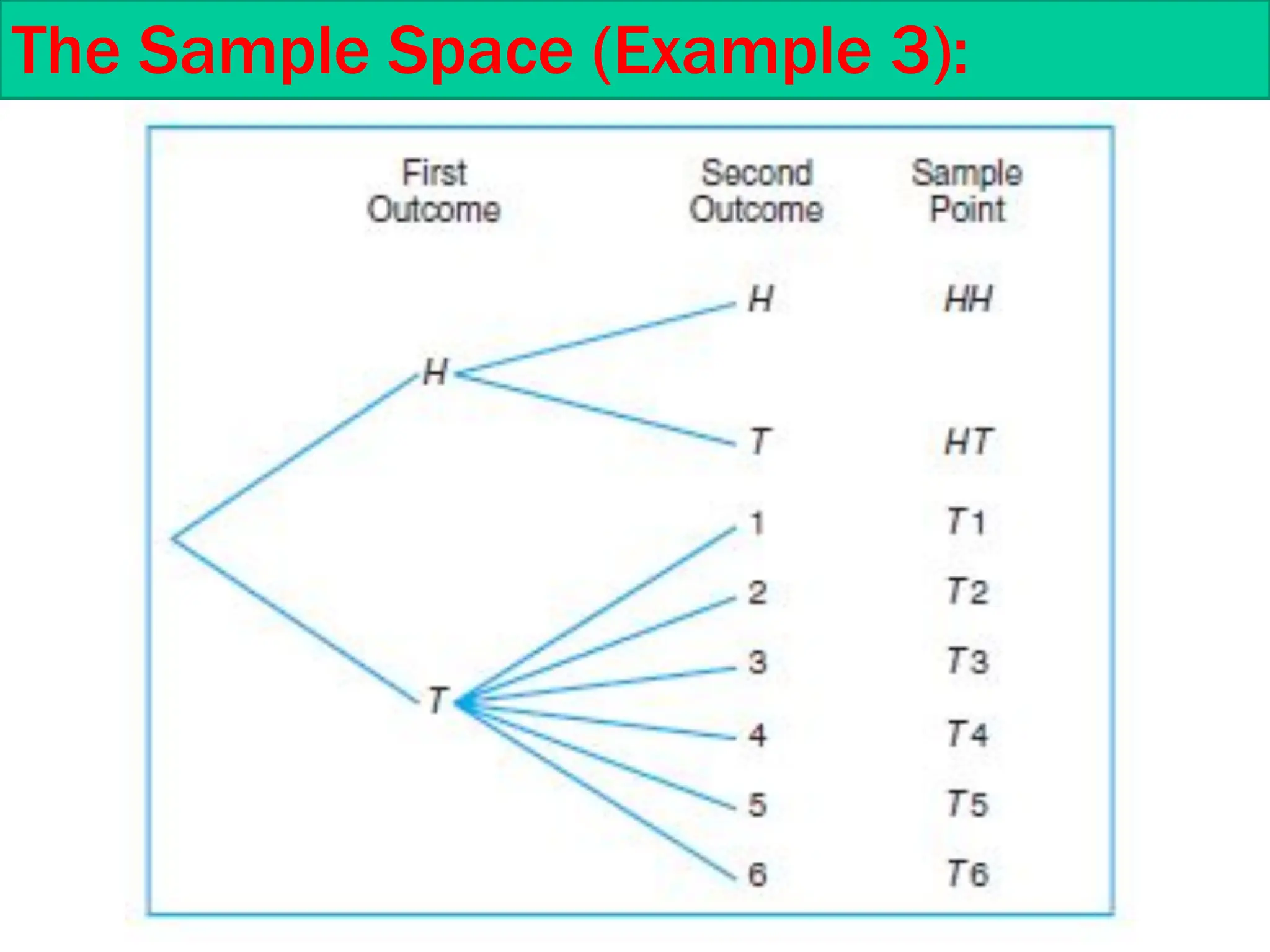
An experiment consists of flipping a coin and
then flipping it a second time if a head occurs.
If a tail occurs on the first, flip, then a die is
tossed once.
The Sample Space (Example 3):
To list the elements of the sample space, we
construct the tree diagram
S= {HH. HT. T1, T2, T3, T4, T5, T6}.
The Sample Space (Example 3):
Sample spaces with a large or infinite number
of sample points are best described by a
statement or Rule Method.
The Sample Space (Example 4):
If the possible outcomes of an experiment are
the set of cities in the world with a. population
over 1 million, our sample space is written
S = {x | x is a city with a population over 1 million},
which reads "S is the set of all x such that x is
a city with a population over 1 million."
An event A is a subset of the sample
space S. That is A⊆S.
We say that an event A occurs if the
outcome (the result) of the experiment
is an element of A.
Events :
Definition
φ⊆S is an event
(φ is called the impossible event)
S⊆S is an event
(S is called the sure event)
Events :
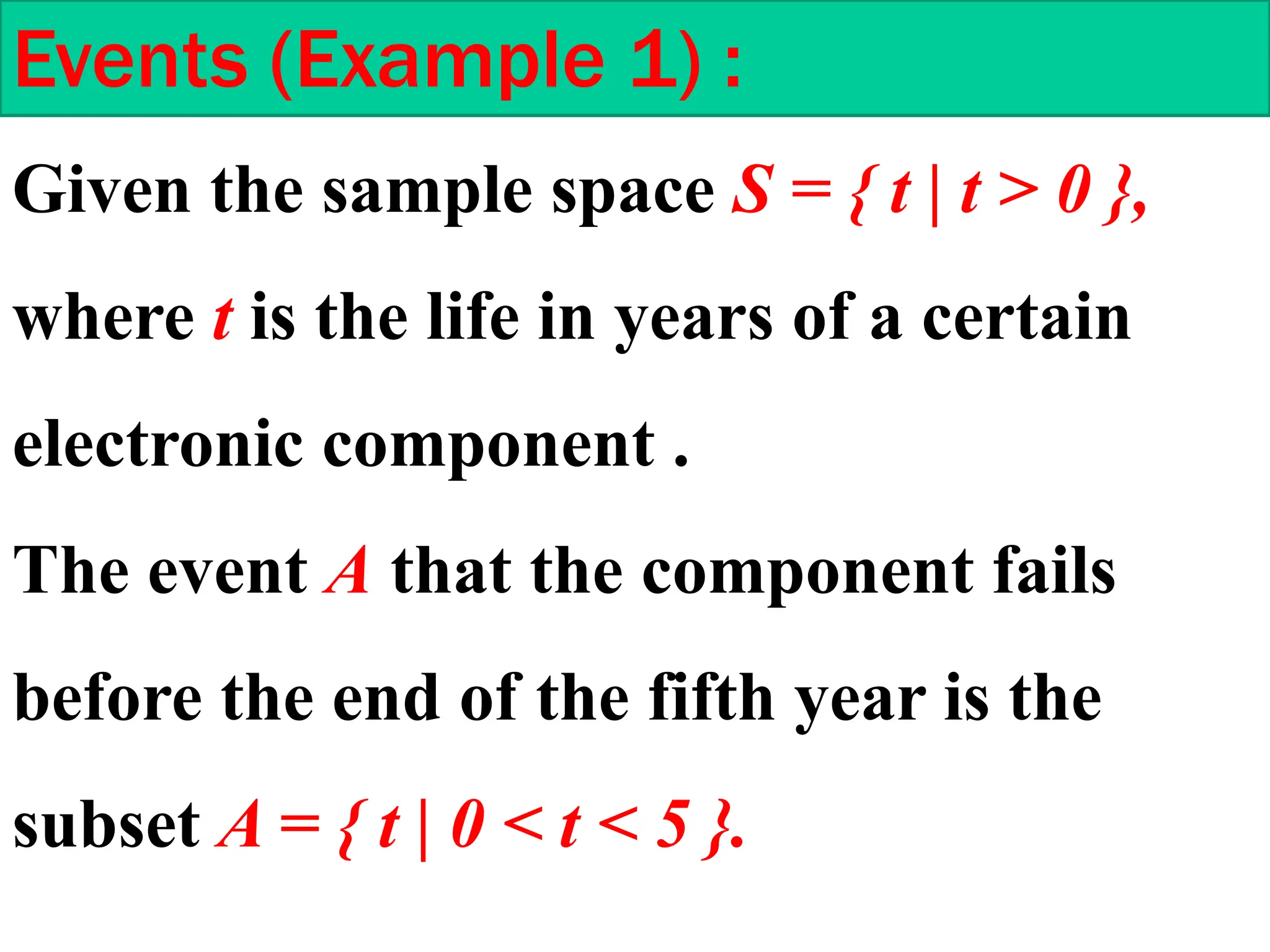
Given the sample space S = { t | t > 0 },
where t is the life in years of a certain
electronic component .
The event A that the component fails
before the end of the fifth year is the
subset A = { t | 0 < t < 5 }.
Events (Example 1) :
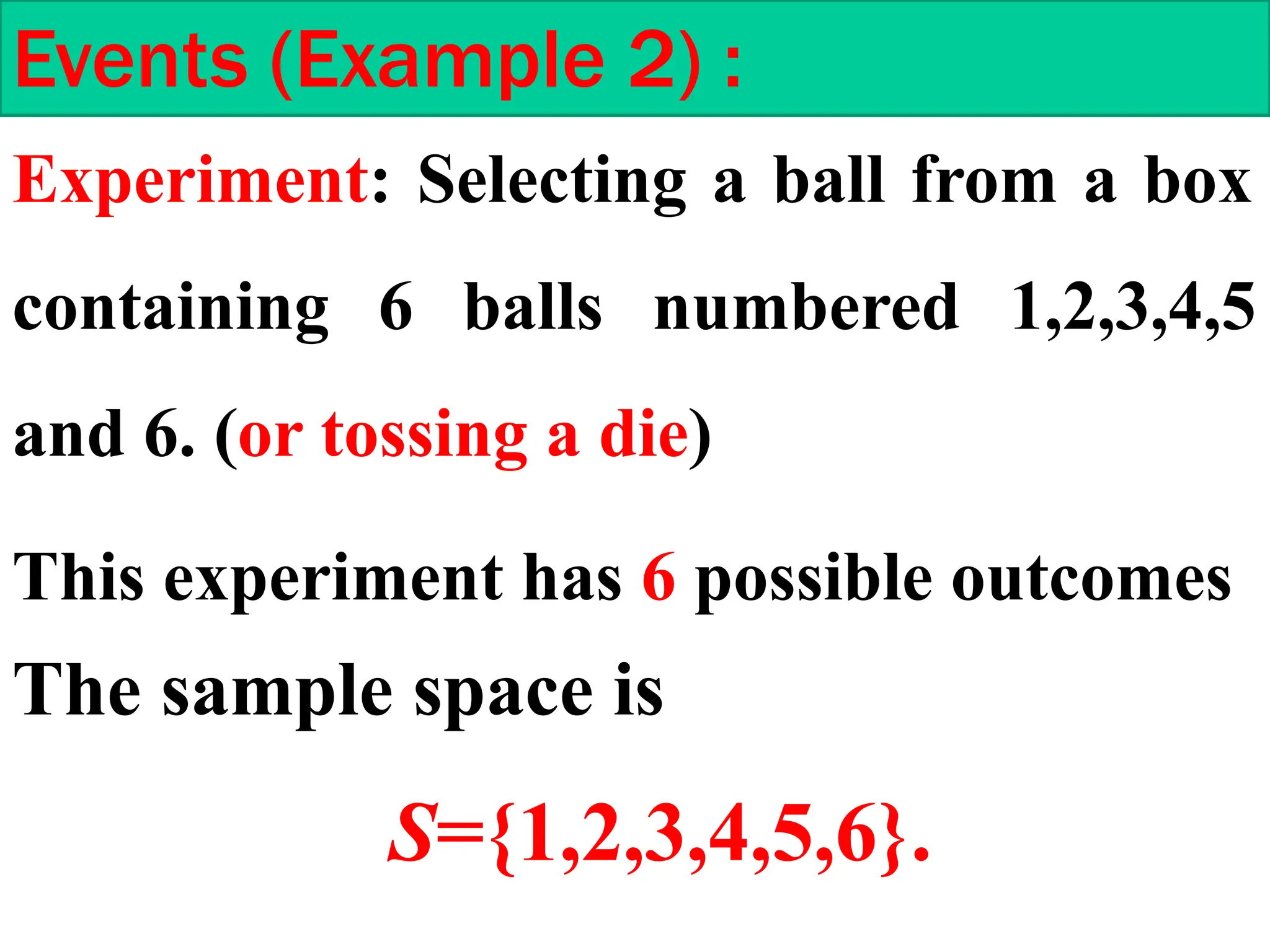
Experiment: Selecting a ball from a box
containing 6 balls numbered 1,2,3,4,5
and 6. (or tossing a die)
Events (Example 2) :
This experiment has 6 possible outcomes
The sample space is
S={1,2,3,4,5,6}.
Events (Example 2) :
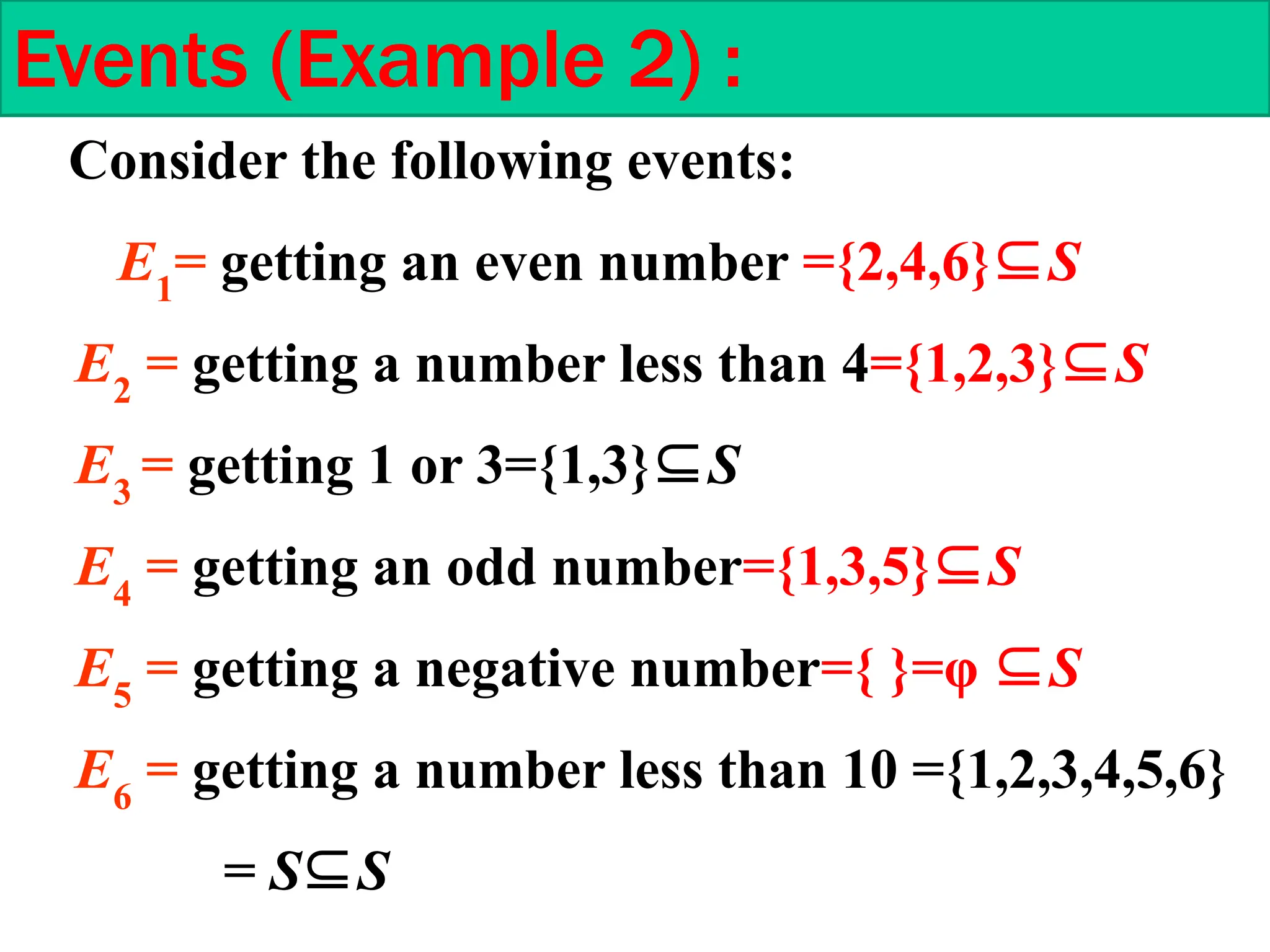
Consider the following events:
E1
= getting an even number ={2,4,6}⊆S
E2
= getting a number less than 4={1,2,3}⊆S
E3
= getting 1 or 3={1,3}⊆S
E4
= getting an odd number={1,3,5}⊆S
E5
= getting a negative number={ }=φ ⊆S
E6
= getting a number less than 10 ={1,2,3,4,5,6}
= S⊆S
Events :
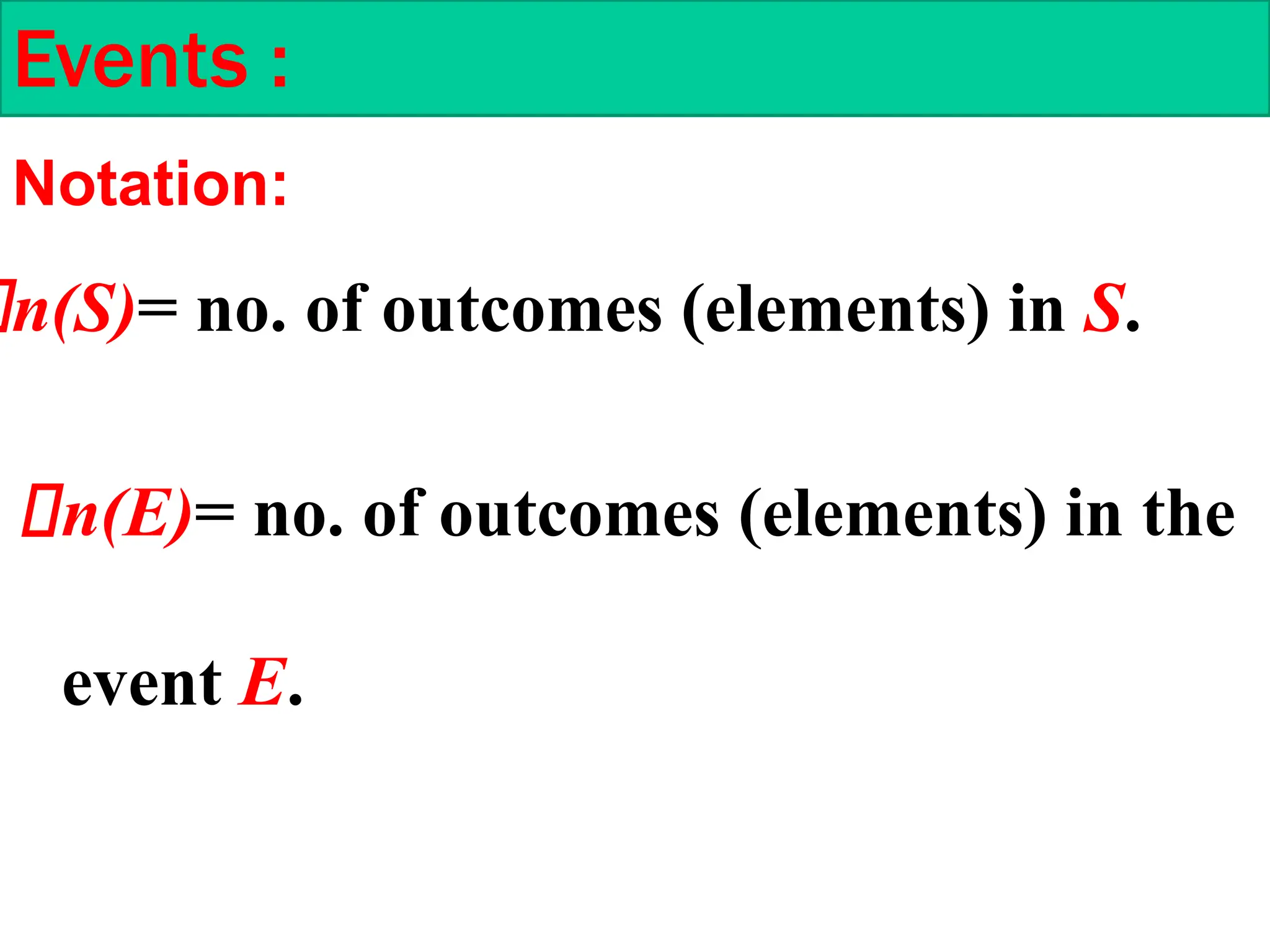
n(S)= no. of outcomes (elements) in S.
n(E)= no. of outcomes (elements) in the
event E.
Notation:
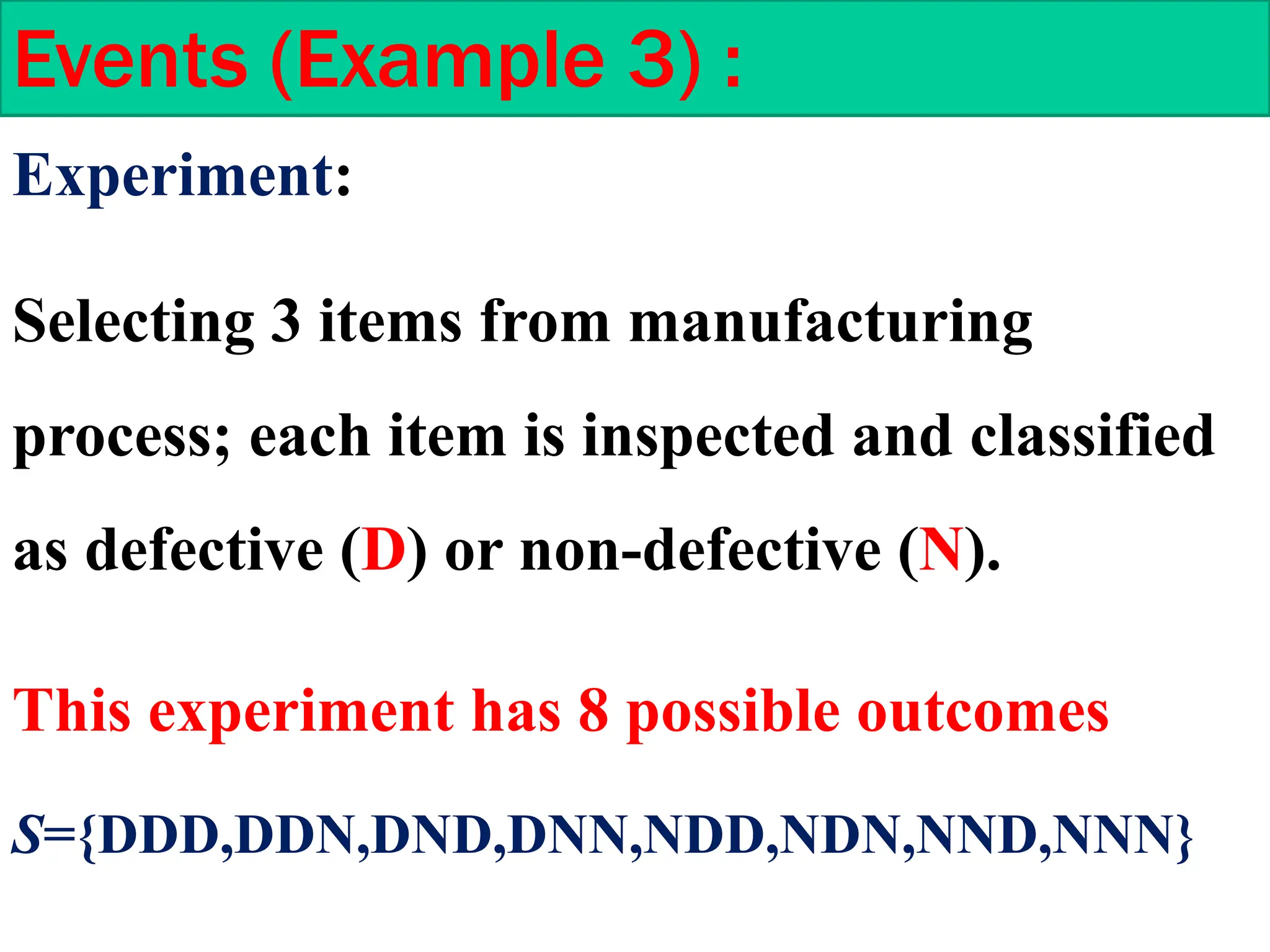
Experiment:
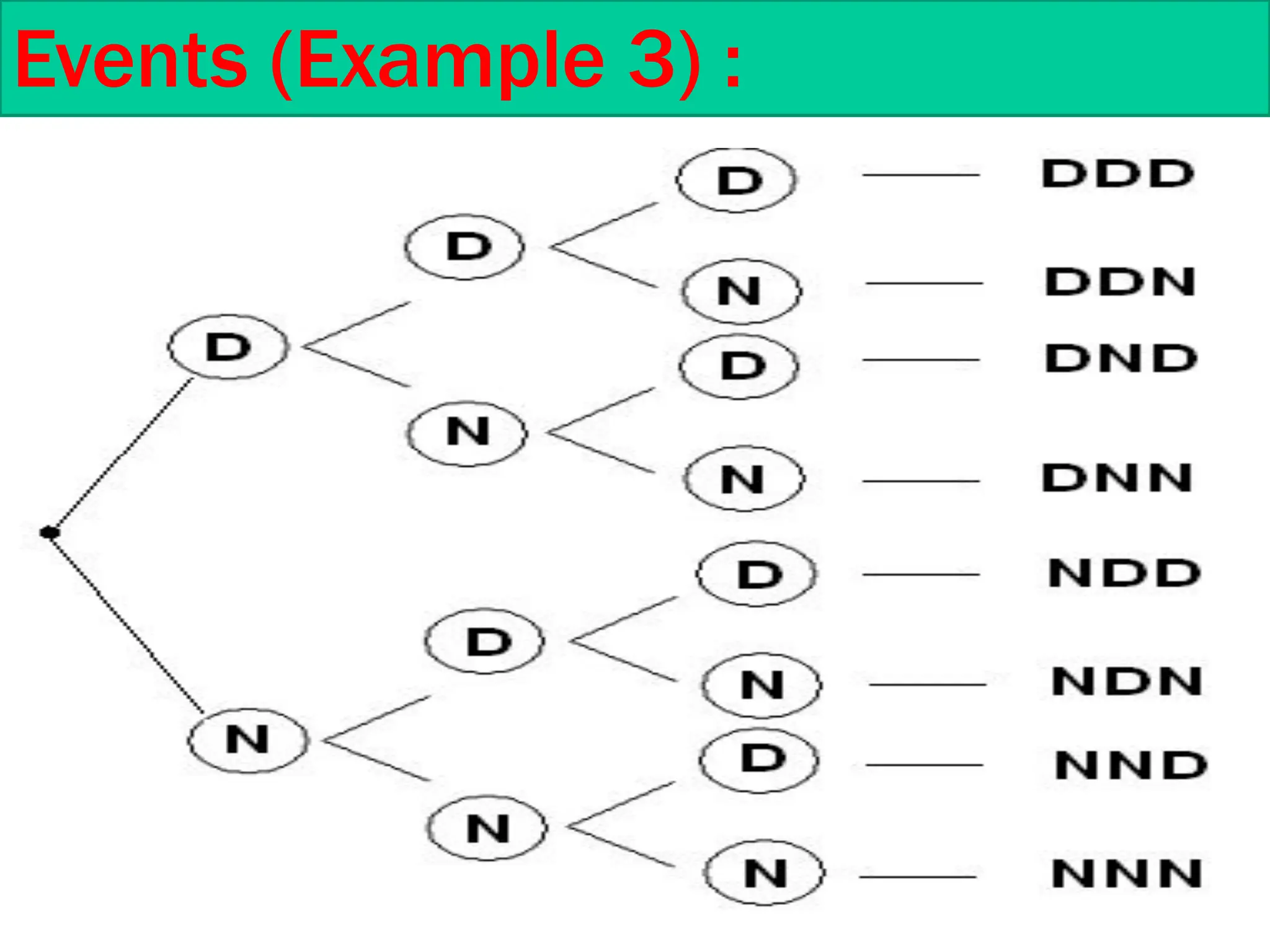
Selecting 3 items from manufacturing
process; each item is inspected and classified
as defective (D) or non-defective (N).
Events (Example 3) :
S={DDD,DDN,DND,DNN,NDD,NDN,NND,NNN}
This experiment has 8 possible outcomes
Events (Example 3) :
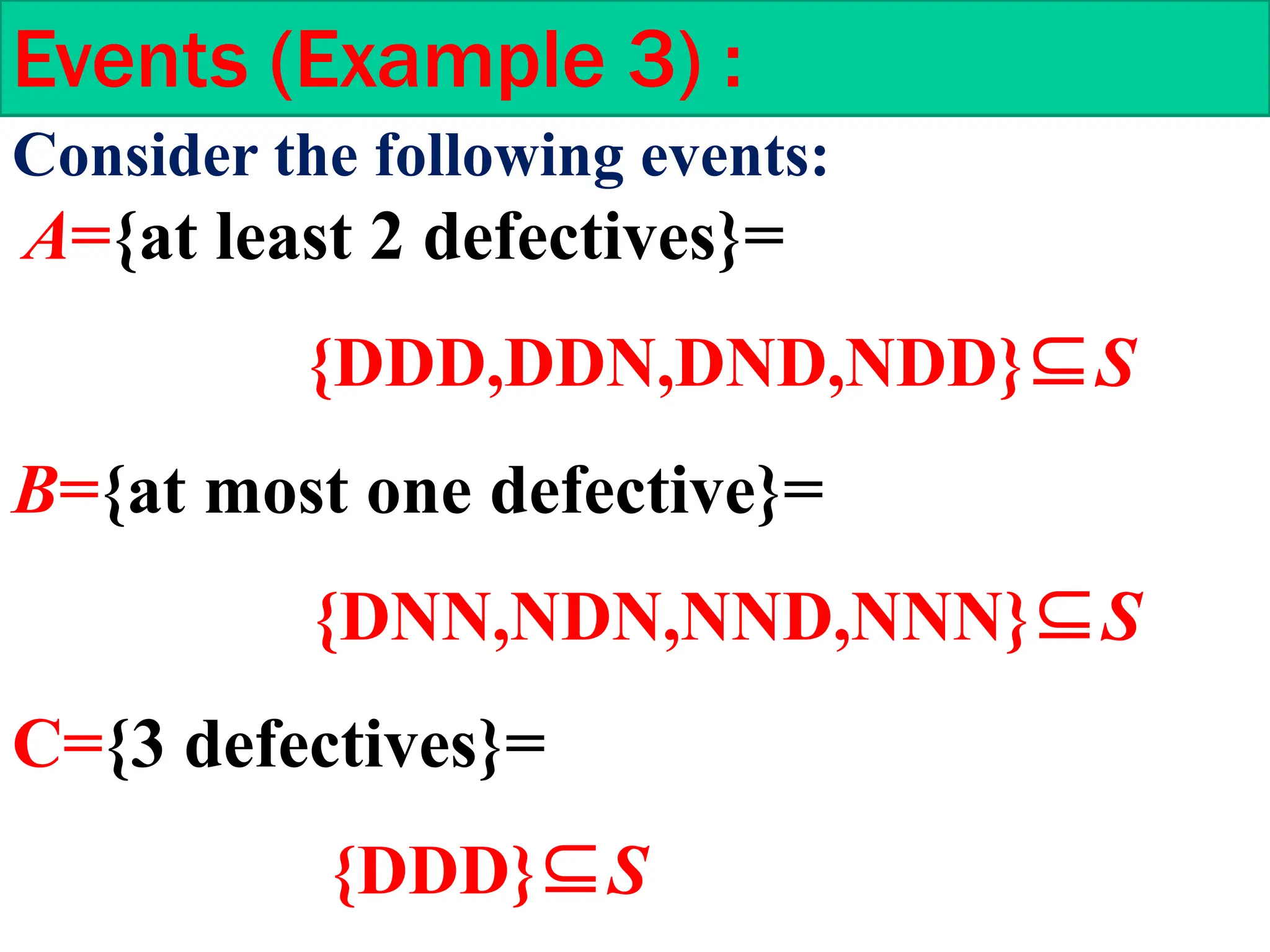
A={at least 2 defectives}=
{DDD,DDN,DND,NDD}⊆S
B={at most one defective}=
{DNN,NDN,NND,NNN}⊆S
C={3 defectives}=
{DDD}⊆S
Consider the following events:
Operations on Events
Contents
❑Complement
❑Intersection
❑Mutually Exclusive
❑Union
Operation on Events (Complement) :
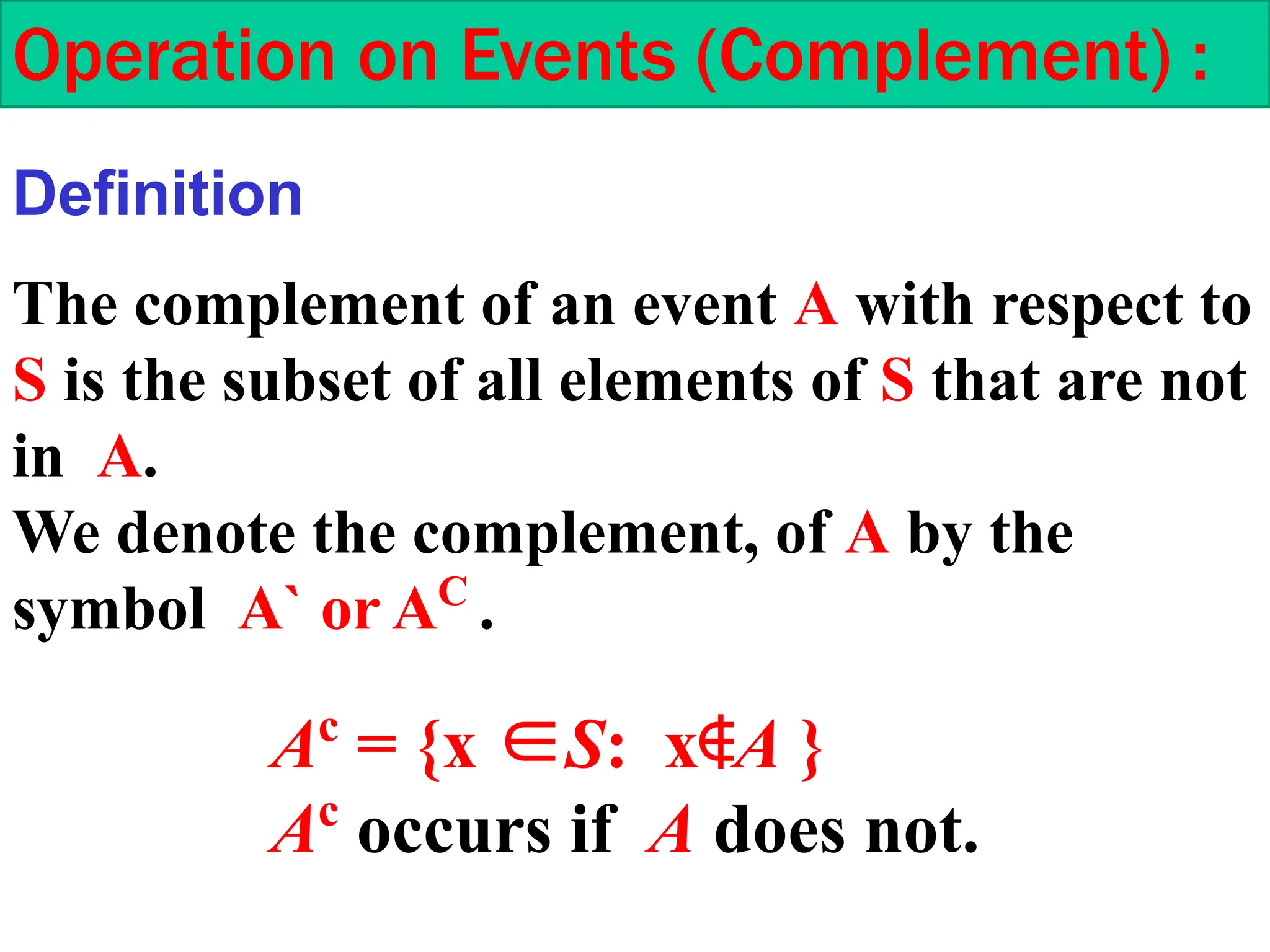
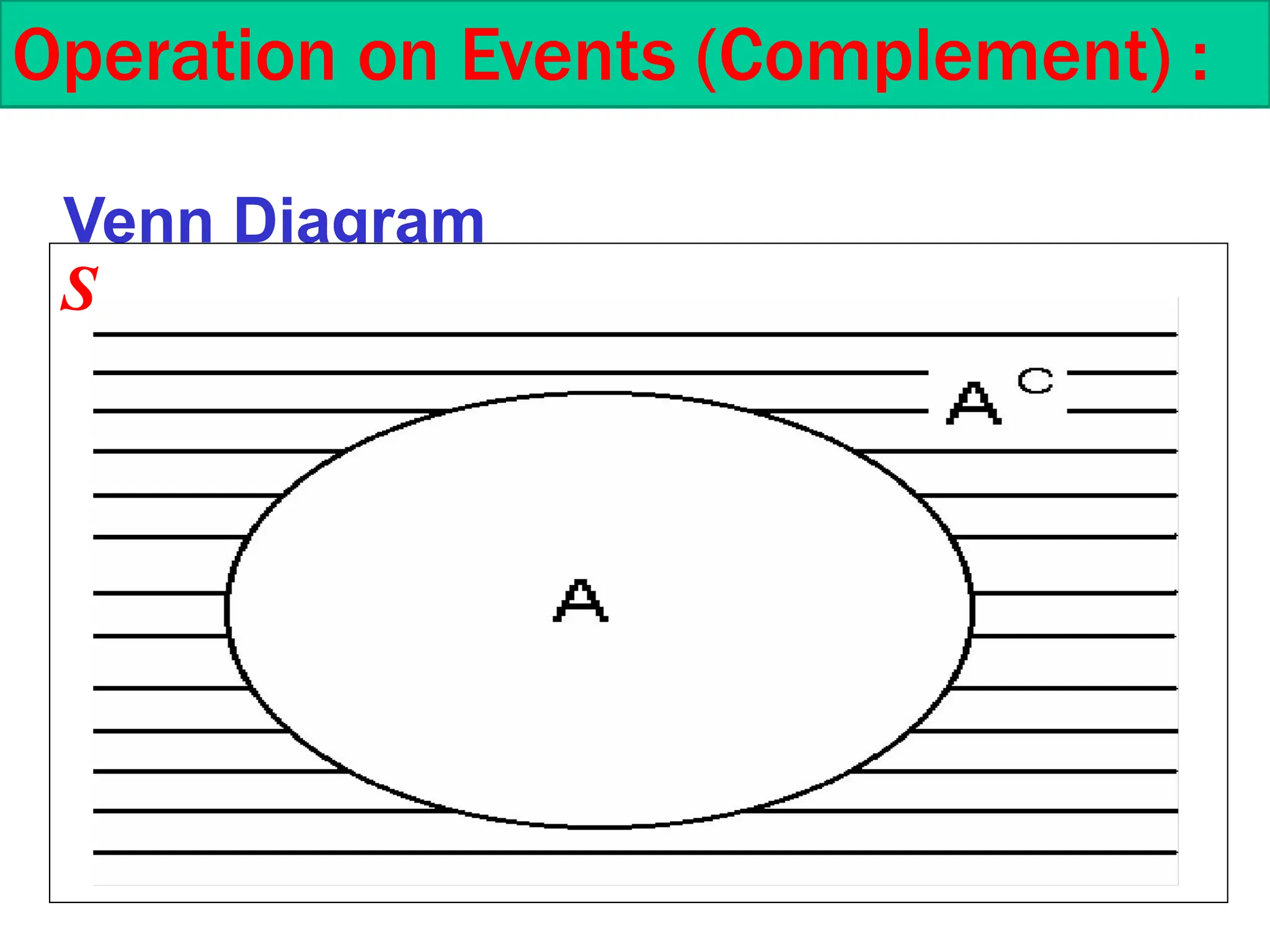
The complement of an event A with respect to
S is the subset of all elements of S that are not
in A.
We denote the complement, of A by the
symbol A` or AC
.
Definition
Ac
= {x ∈S: x∉A }
Ac
occurs if A does not.
Operation on Events (Complement) :
Venn Diagram
S
Operation on Events (Example 1) :
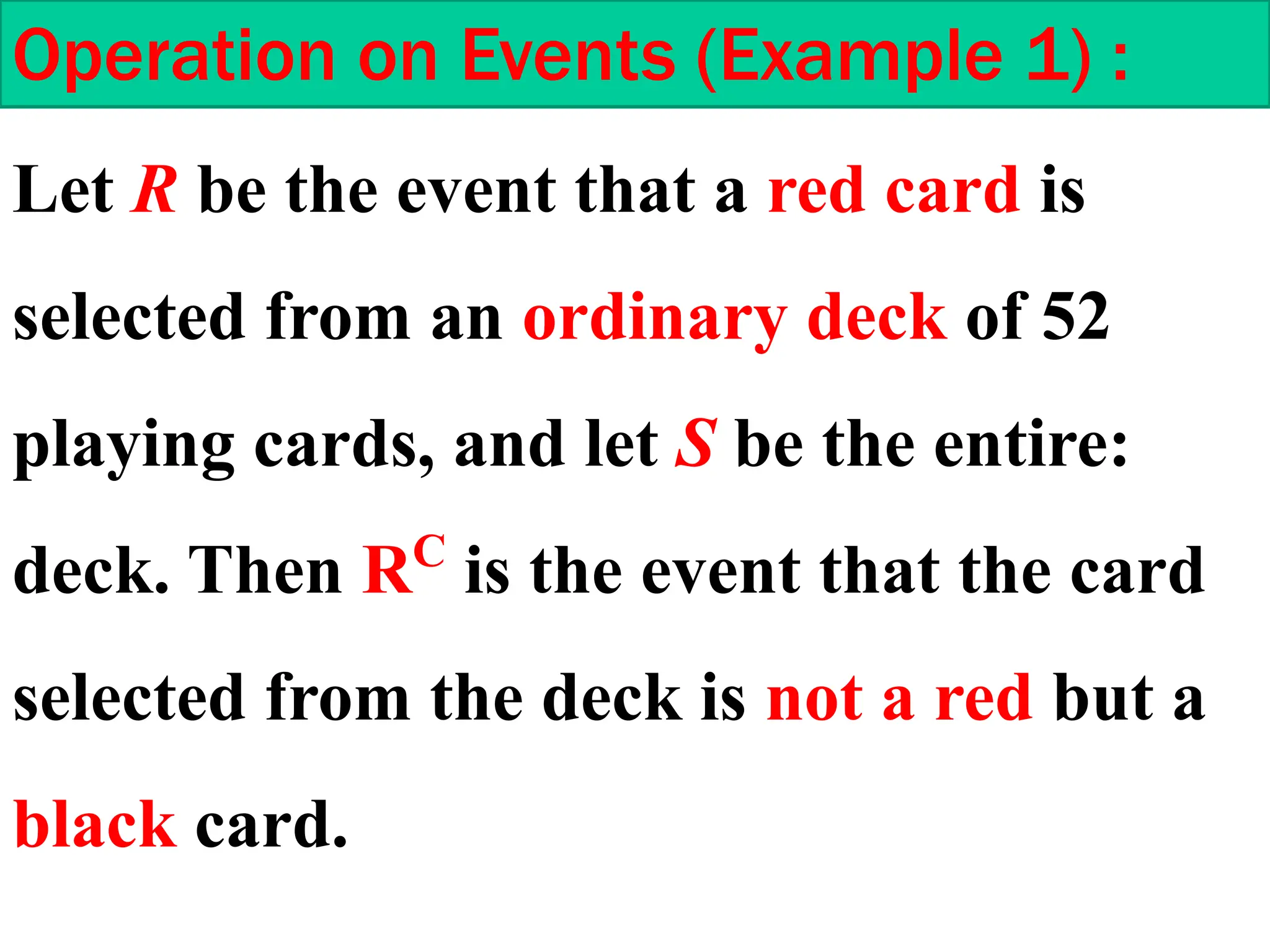
Let R be the event that a red card is
selected from an ordinary deck of 52
playing cards, and let S be the entire:
deck. Then RC
is the event that the card
selected from the deck is not a red but a
black card.
Operation on Events (Example 2) :
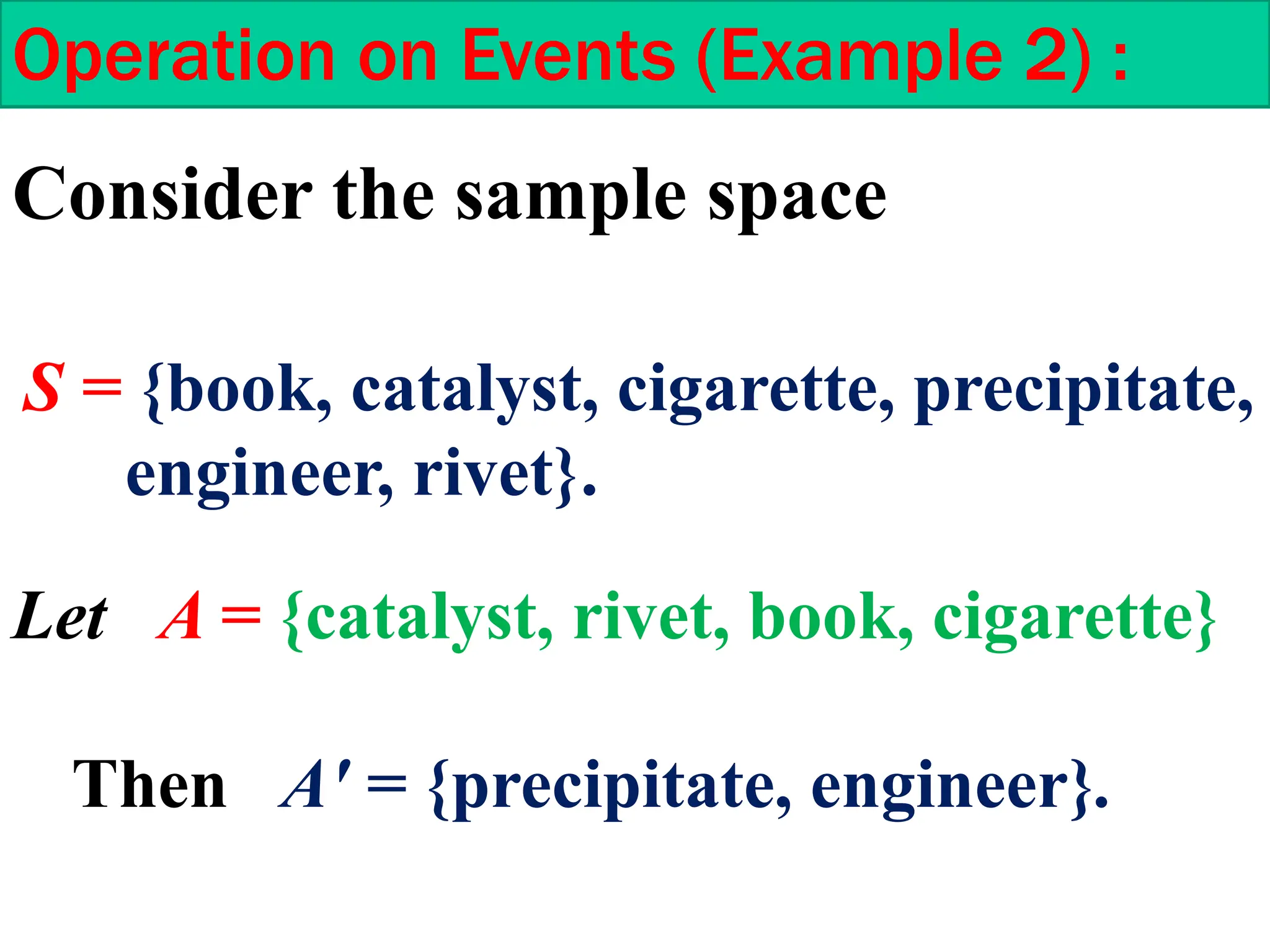
Consider the sample space
S = {book, catalyst, cigarette, precipitate,
engineer, rivet}.
Let A = {catalyst, rivet, book, cigarette}
Then A' = {precipitate, engineer}.
Let A and B be two events defined on the
sample space S.
Operation on Events (Intersection) :
Definition
The intersection of two events A and B
denoted by the symbol A ∩ B,
Is the event containing all elements that are
common to A and B.
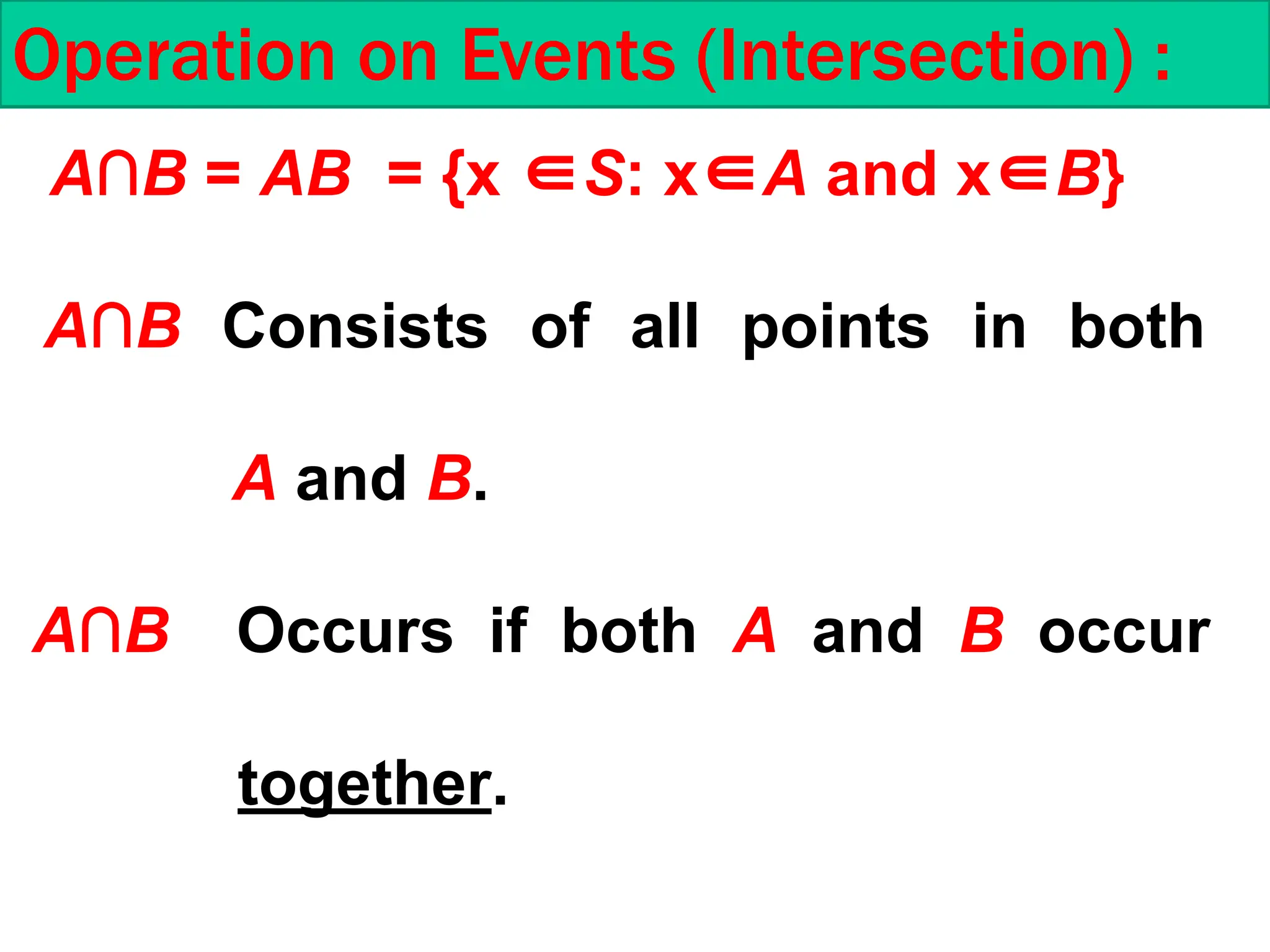
A∩B = AB = {x ∈S: x∈A and x∈B}
A∩B Consists of all points in both
A and B.
A∩B Occurs if both A and B occur
together.
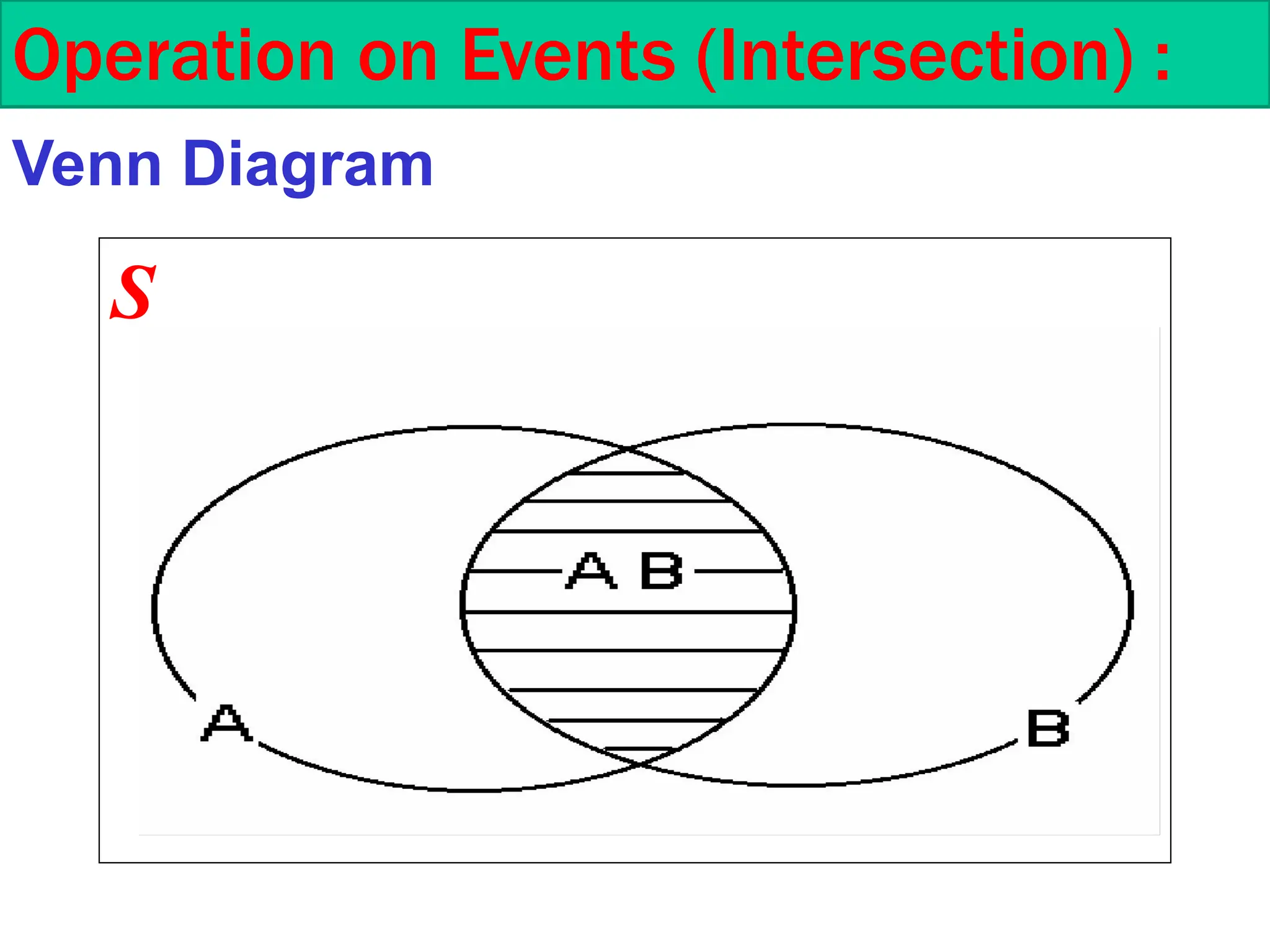
Operation on Events (Intersection) :
S
Operation on Events (Intersection) :
Venn Diagram
Operation on Events (Example 1) :
Let C be the event that a person selected at
random in an Internet cafe is a college
student, and let M be the event that the
person is a male. Then C∩ M is the event of
all male college students in the Internet cafe.
Operation on Events (Example 2) :
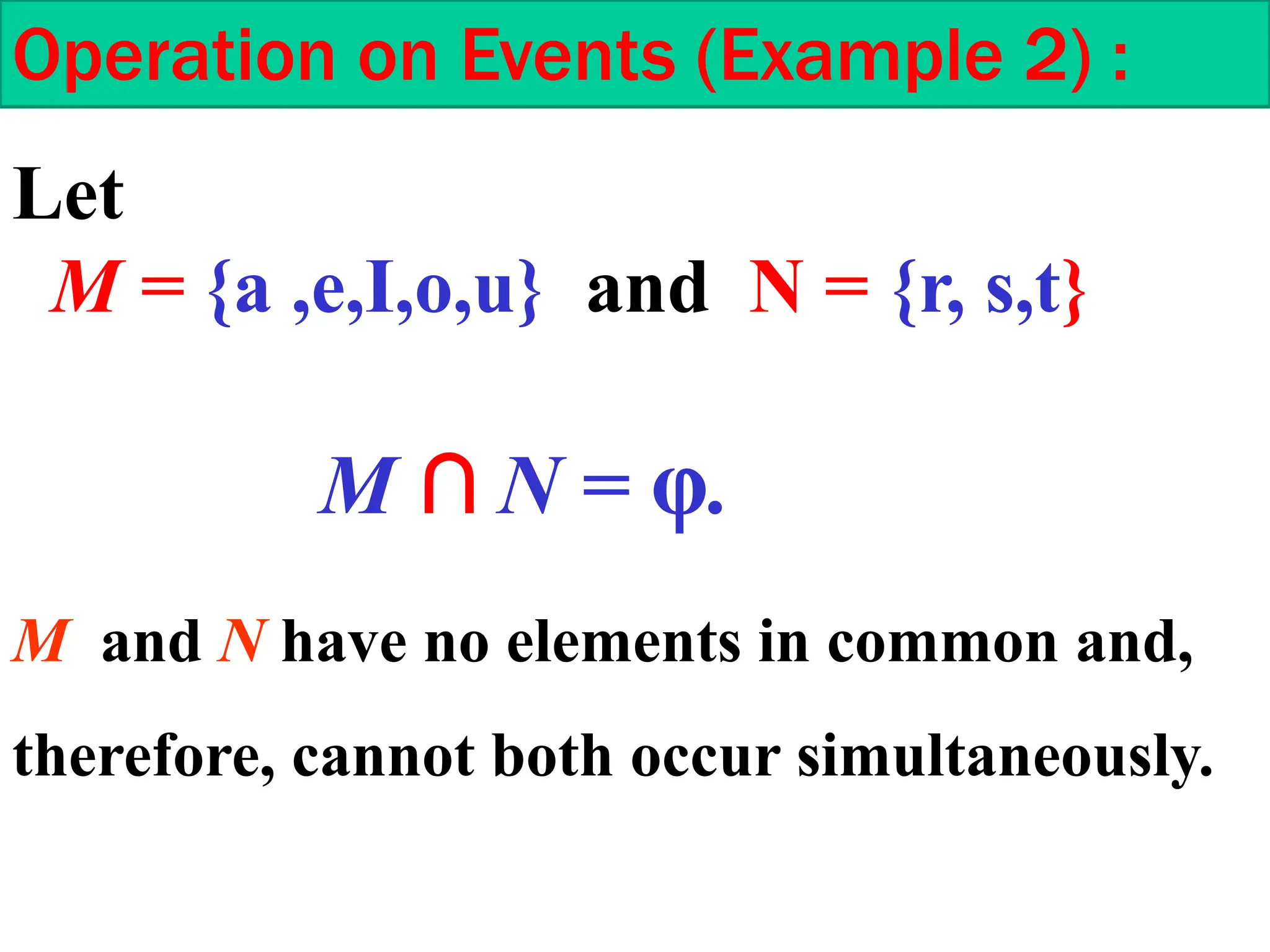
Let
M = {a ,e,I,o,u} and N = {r, s,t}
M ∩ N = φ.
M and N have no elements in common and,
therefore, cannot both occur simultaneously.
Two events A and B are mutually
exclusive (or disjoint) if and only if A∩B
= φ; that is, A and B have no common
elements (they do not occur together).
Mutually Exclusive :
Definition
Mutually Exclusive :
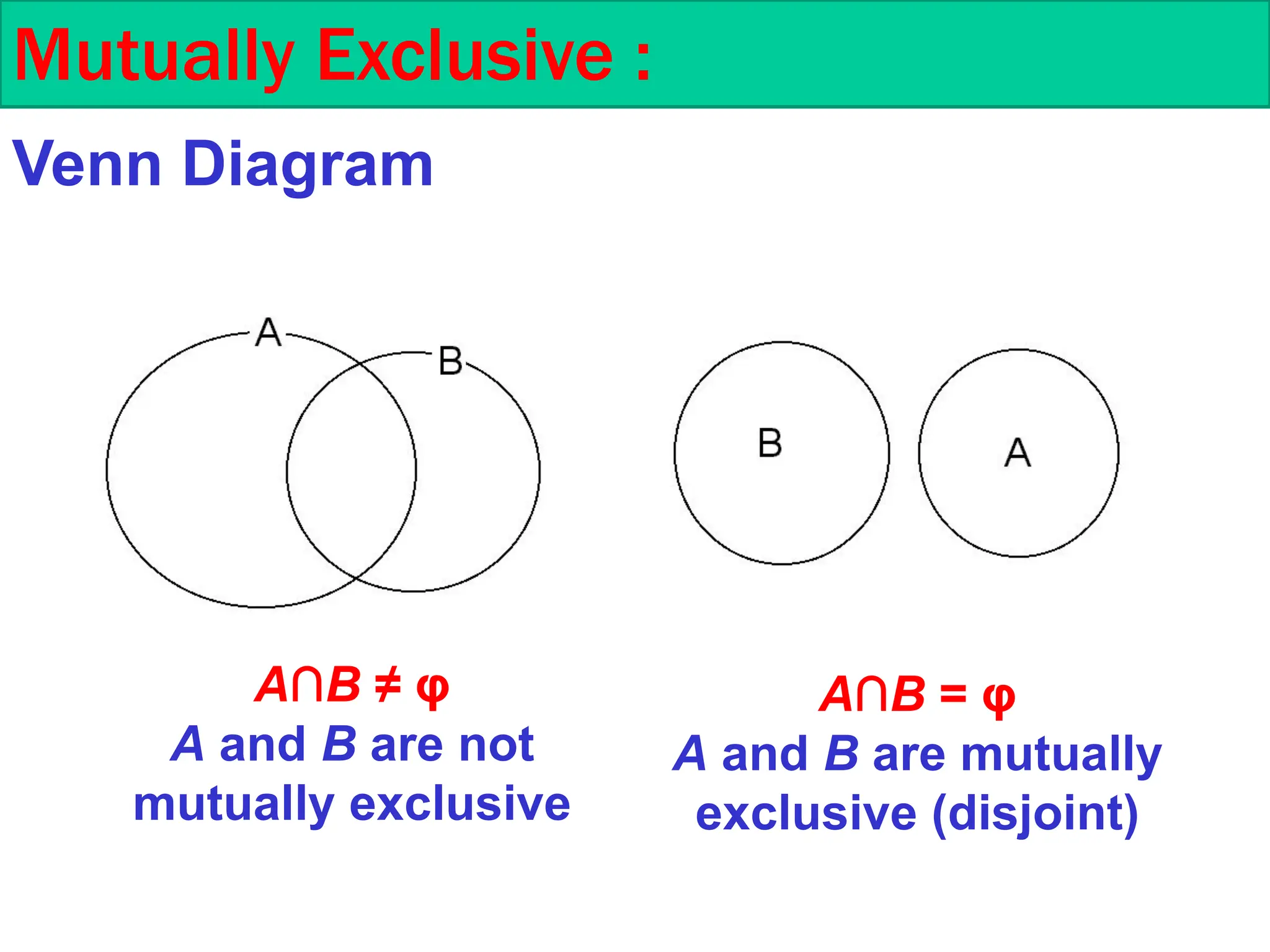
A∩B ≠ φ
A and B are not
mutually exclusive
A∩B = φ
A and B are mutually
exclusive (disjoint)
Venn Diagram
The union of the two events A and B,
denoted by the symbol A ∪ B, is the
event containing all the elements that
belong to A or B or both.
Operation on Events (Union) :
Definition
Operation on Events (Union) :
A∪B = {x ∈S: x∈A or x∈B }
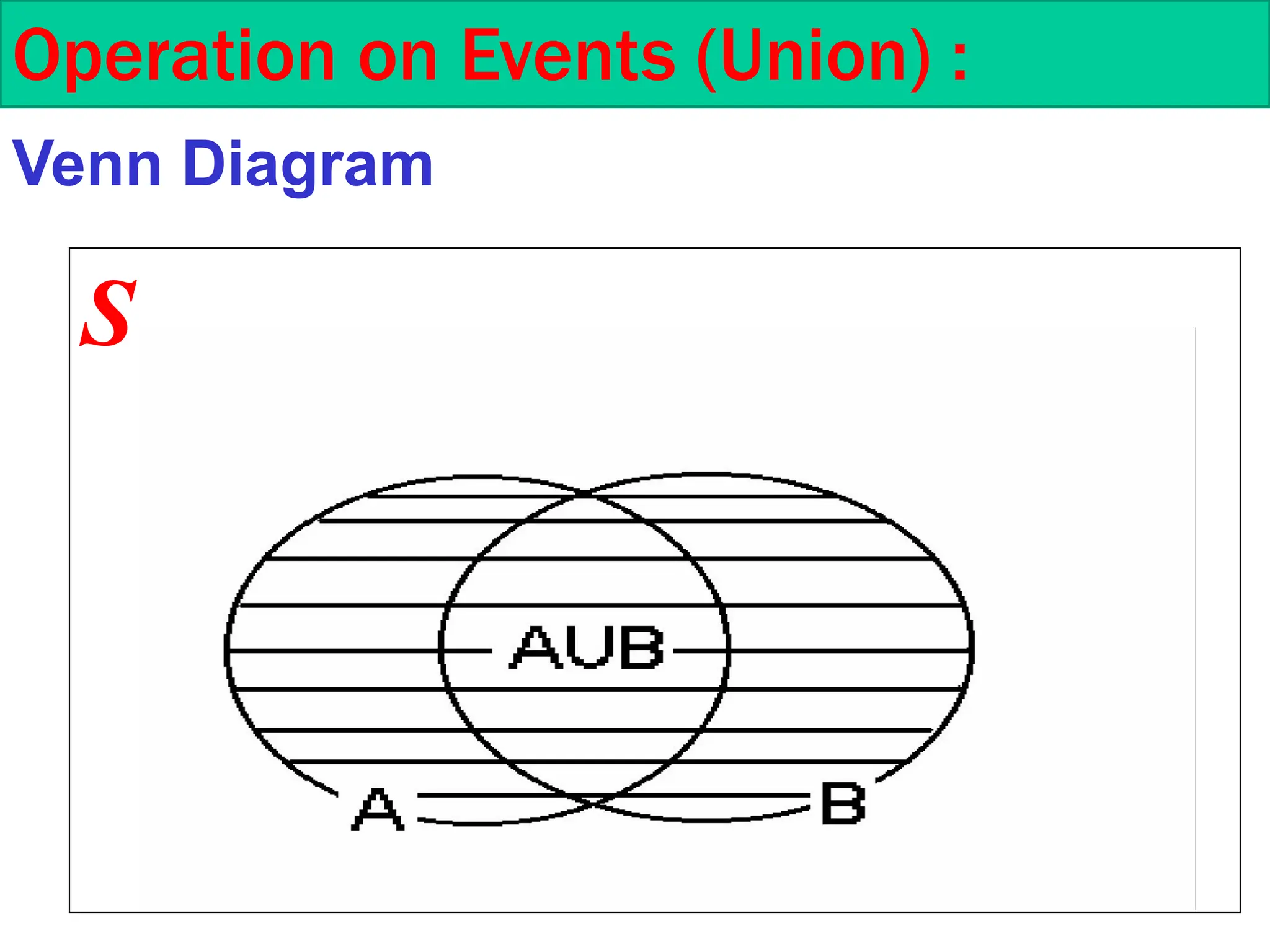
A∪B Consists of all outcomes in A or
in B or in both A and B.
A∪B Occurs if A occurs, or B occurs,
or both A and B occur.
That is A∪B Occurs if at least one of
A and B occurs.
Operation on Events (Union) :
Venn Diagram
S
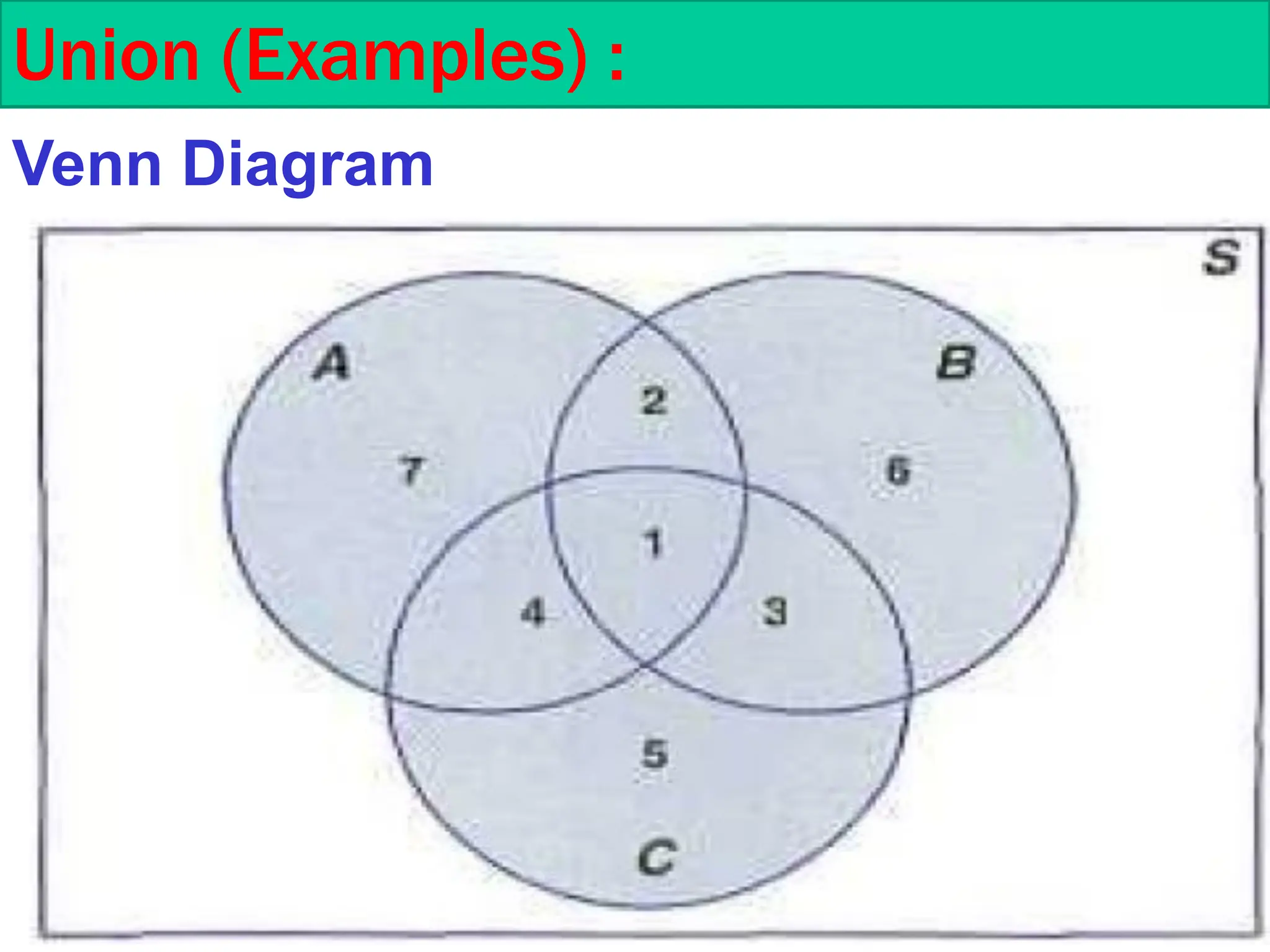
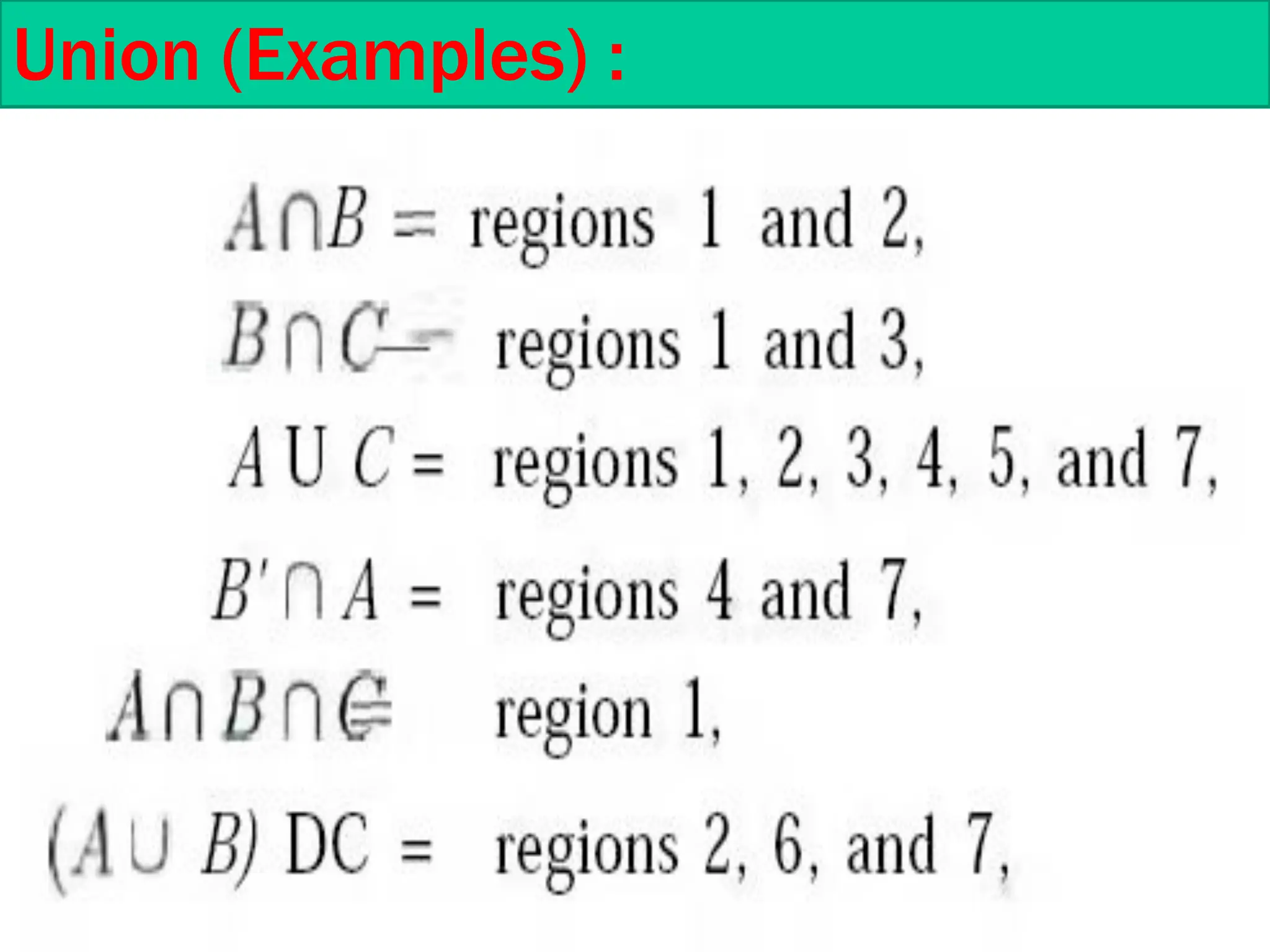
Union (Examples) :
Let A = {a,b,c} and B = {b,c,d,e}
Then A ∪ B = {a,b,c,d,e}.
If M = {x | 3 < x < 9} and V = {y  5 < y < 12},
Then
M ∪ N = [z | 3 < z <
12}.
Union (Examples) :
Venn Diagram
Union (Examples) :
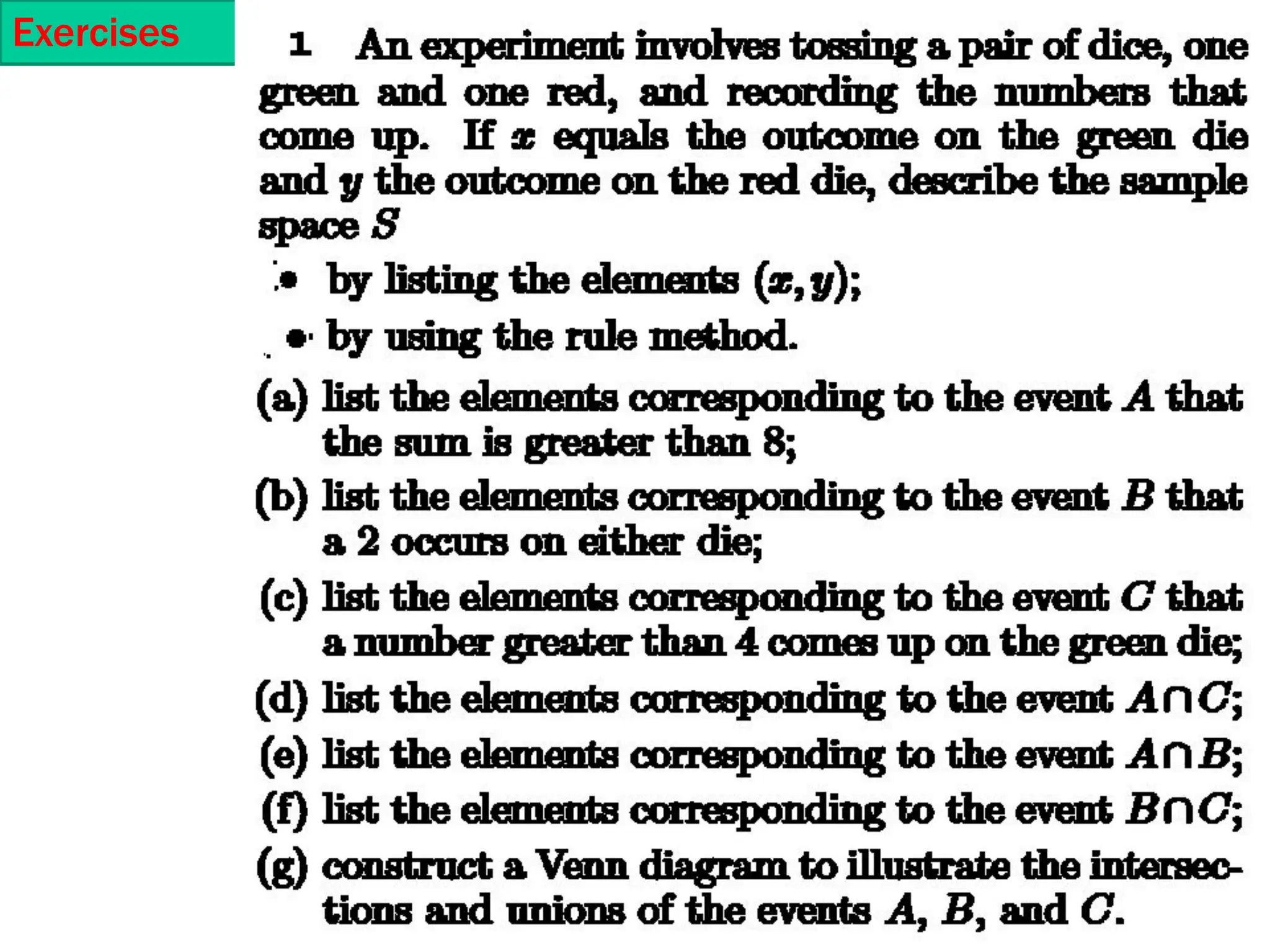
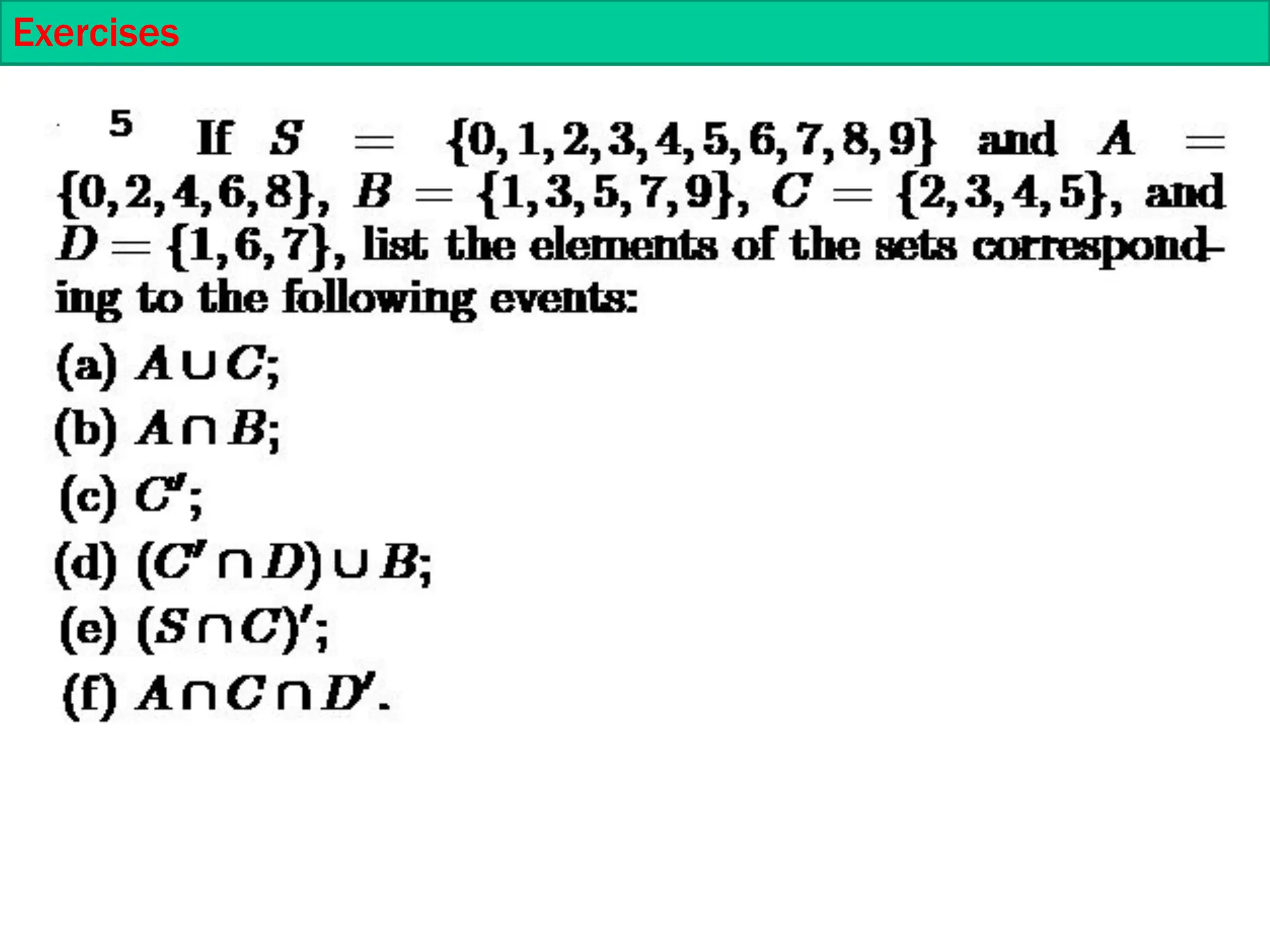
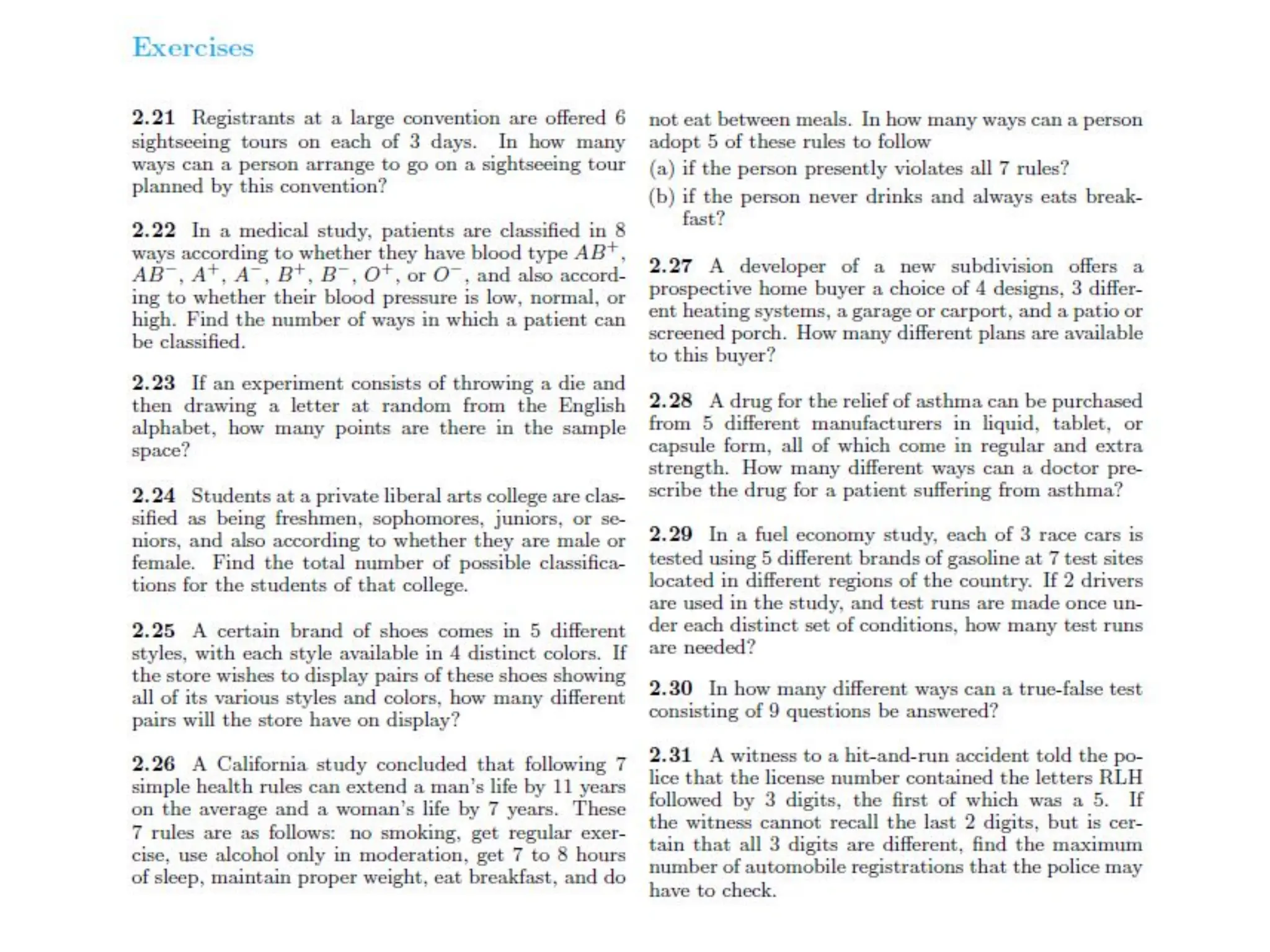
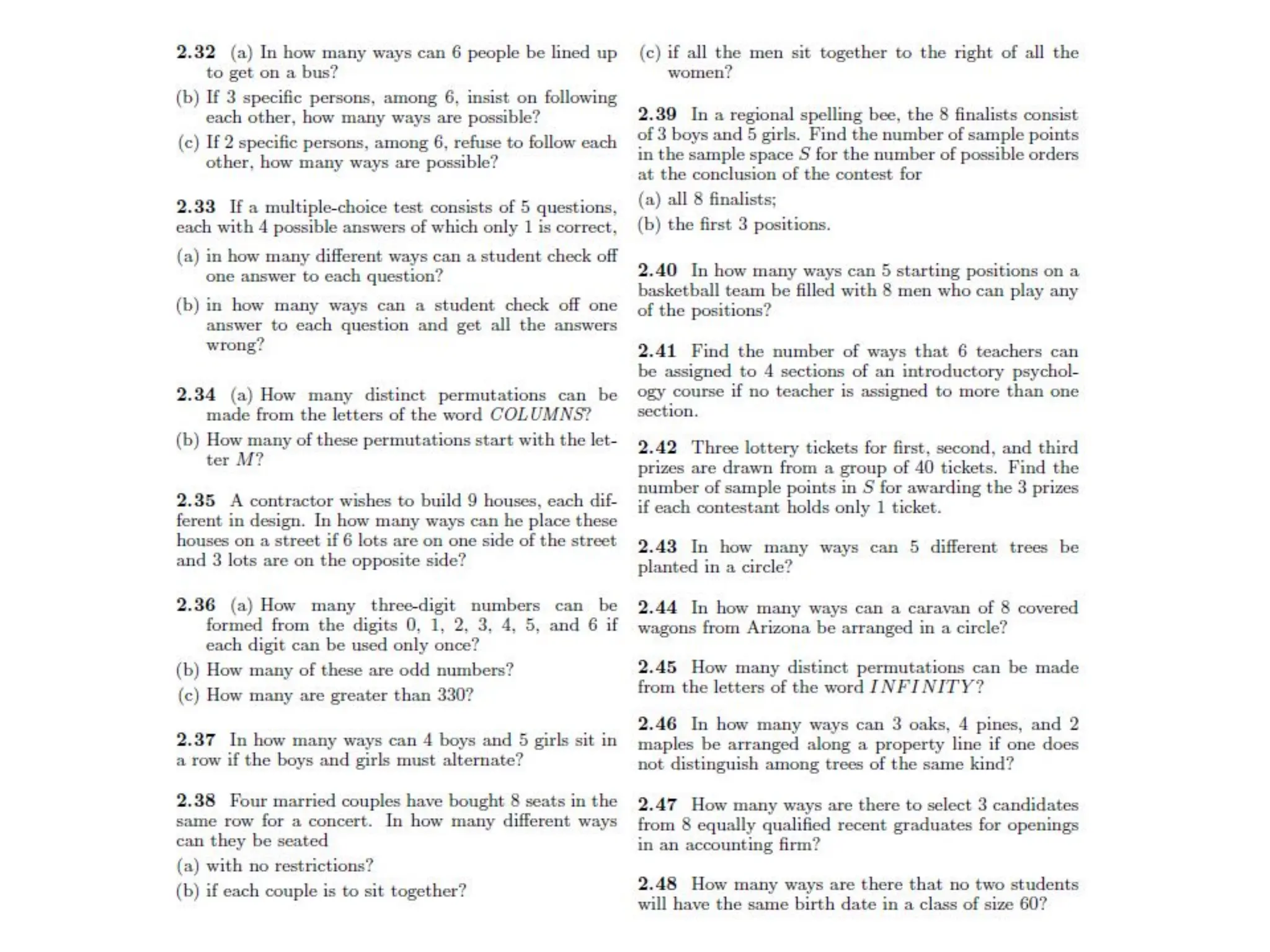
Exercises
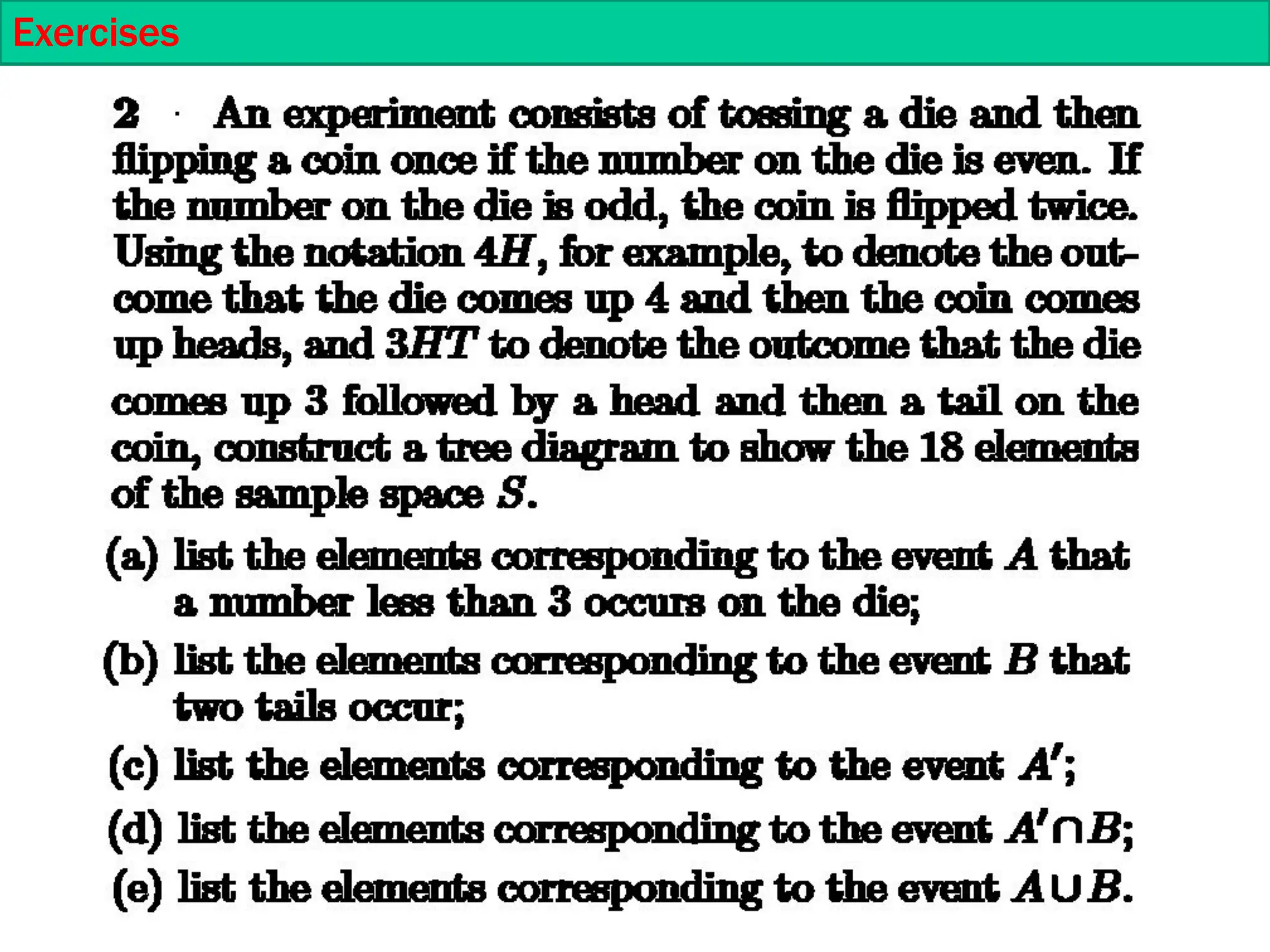
Exercises
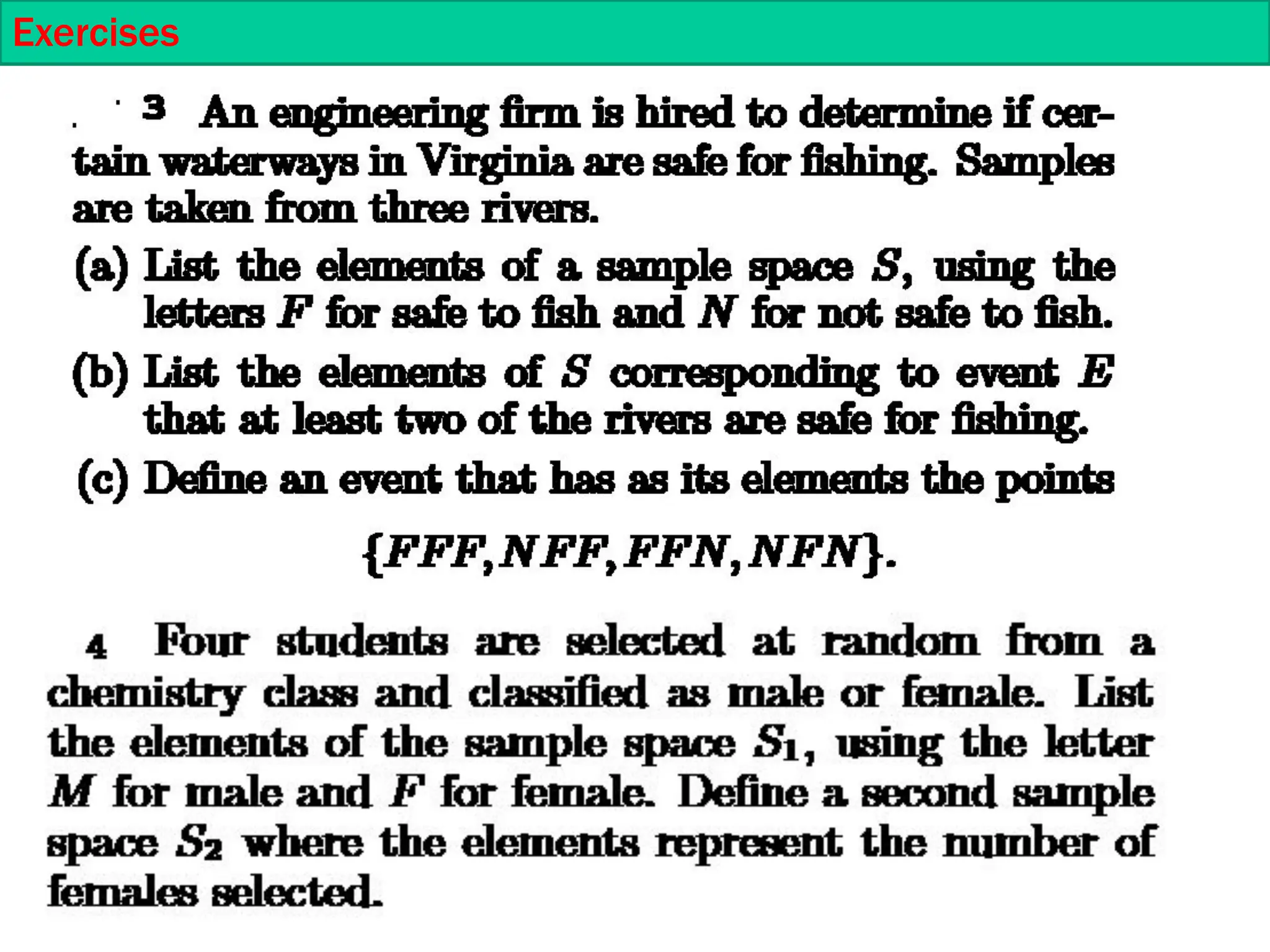
Exercises
Exercises
Counting
Techniques
Contents
❑Multiplication Rule
❑ Permutations
Counting Sample Points:
There are many counting techniques which
can be used to count the number points in the
sample space (or in some events) without
listing each element.
In many cases, we can compute the
probability of an event by using the counting
techniques.
Multiplication Rule:
If an operation can be performed in n1
ways , and if for each of these ways a
second operation can be performed in n2
ways , then the two operations can be
performed together in n1
n2
ways.
Theorem
Multiplication Rule (Example 1):
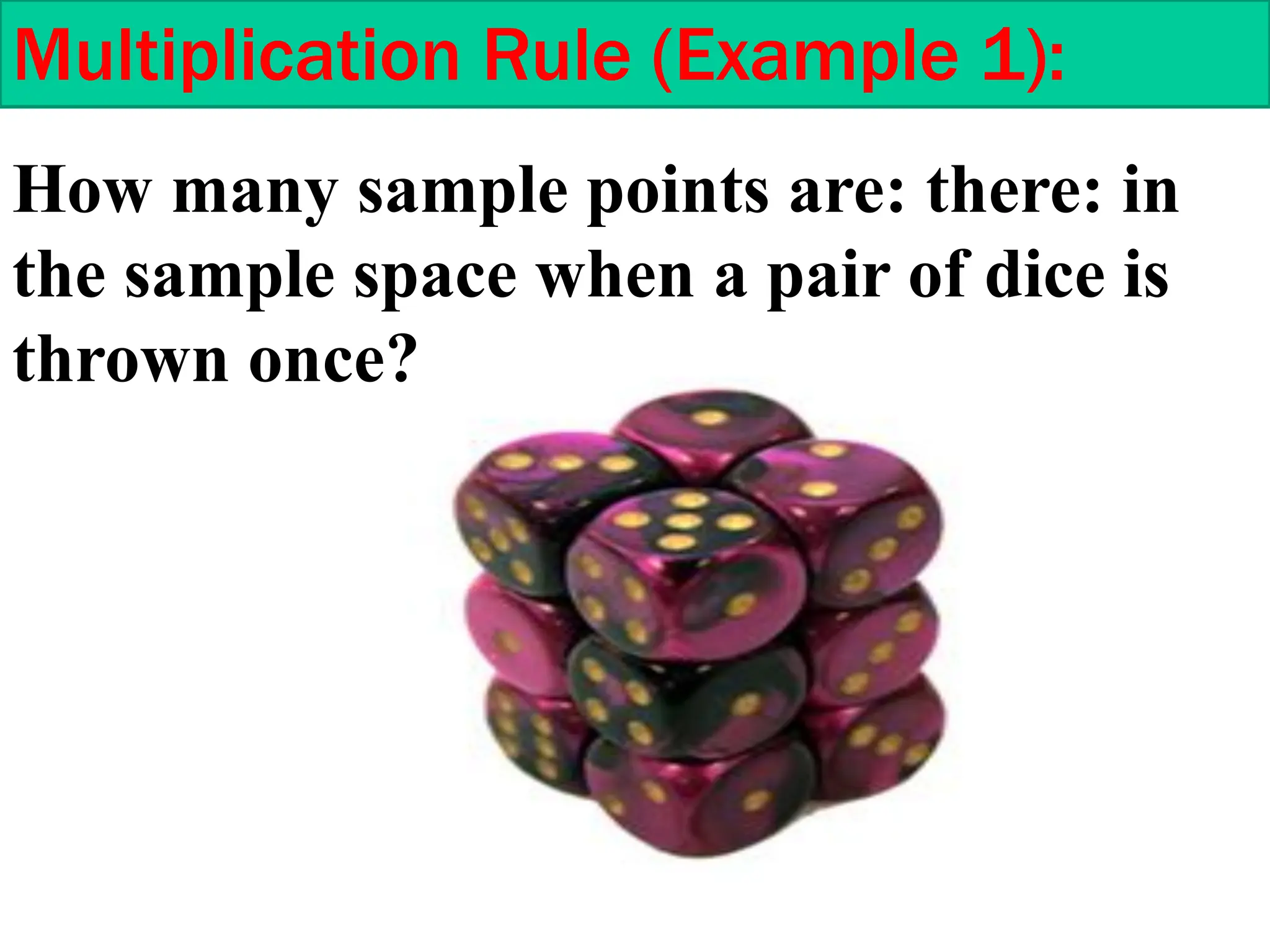
How many sample points are: there: in
the sample space when a pair of dice is
thrown once?
Multiplication Rule (Example 1):
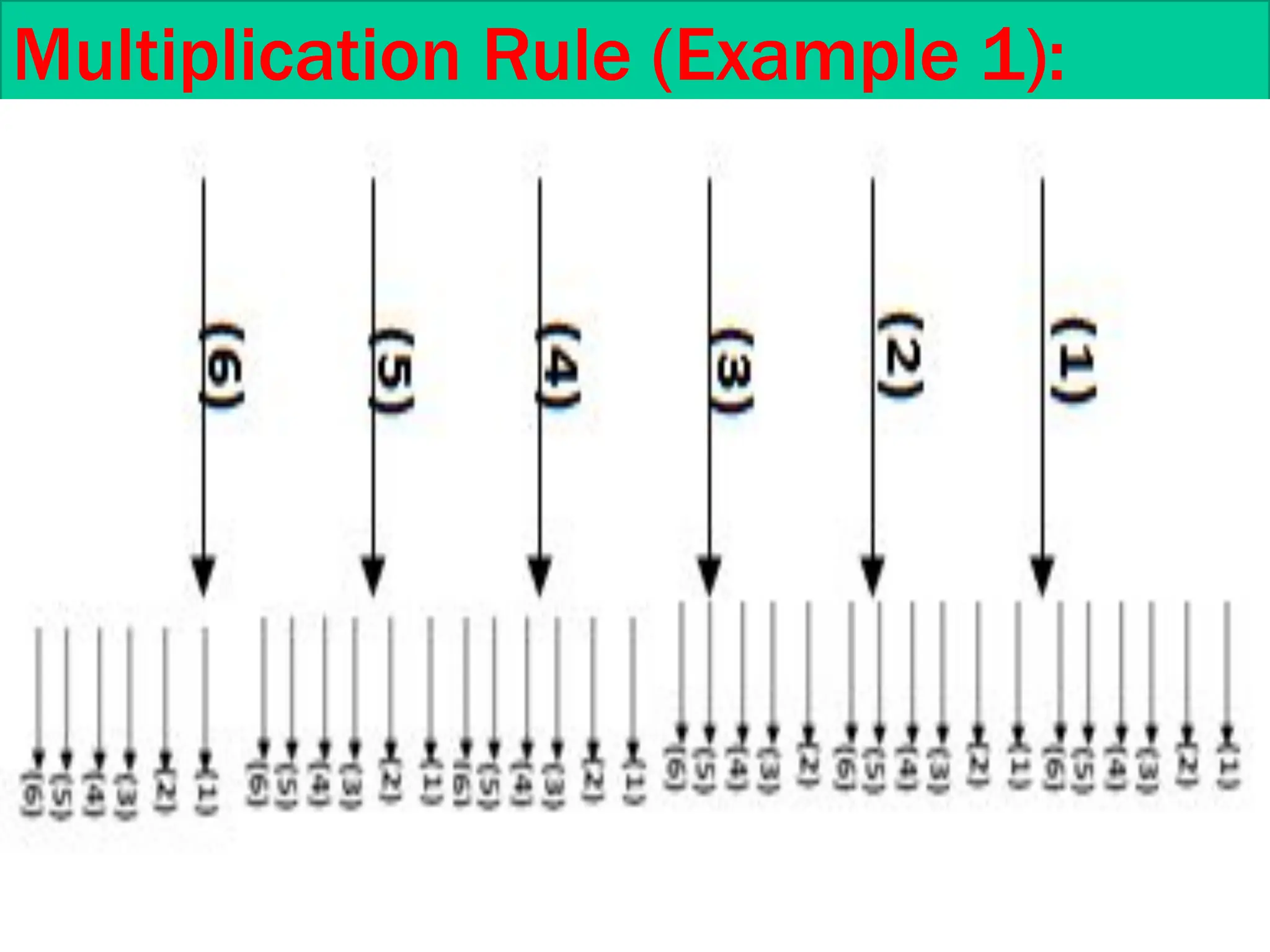
The first die can land in any one of n1
=6
ways. For each of these 6 ways the
second die can also land in n2
=6 ways.
Therefore, the pair of dice can land in:
n1
n2
= (6)(6) = 36 possible ways.
Multiplication Rule (Example 1):
Multiplication Rule:
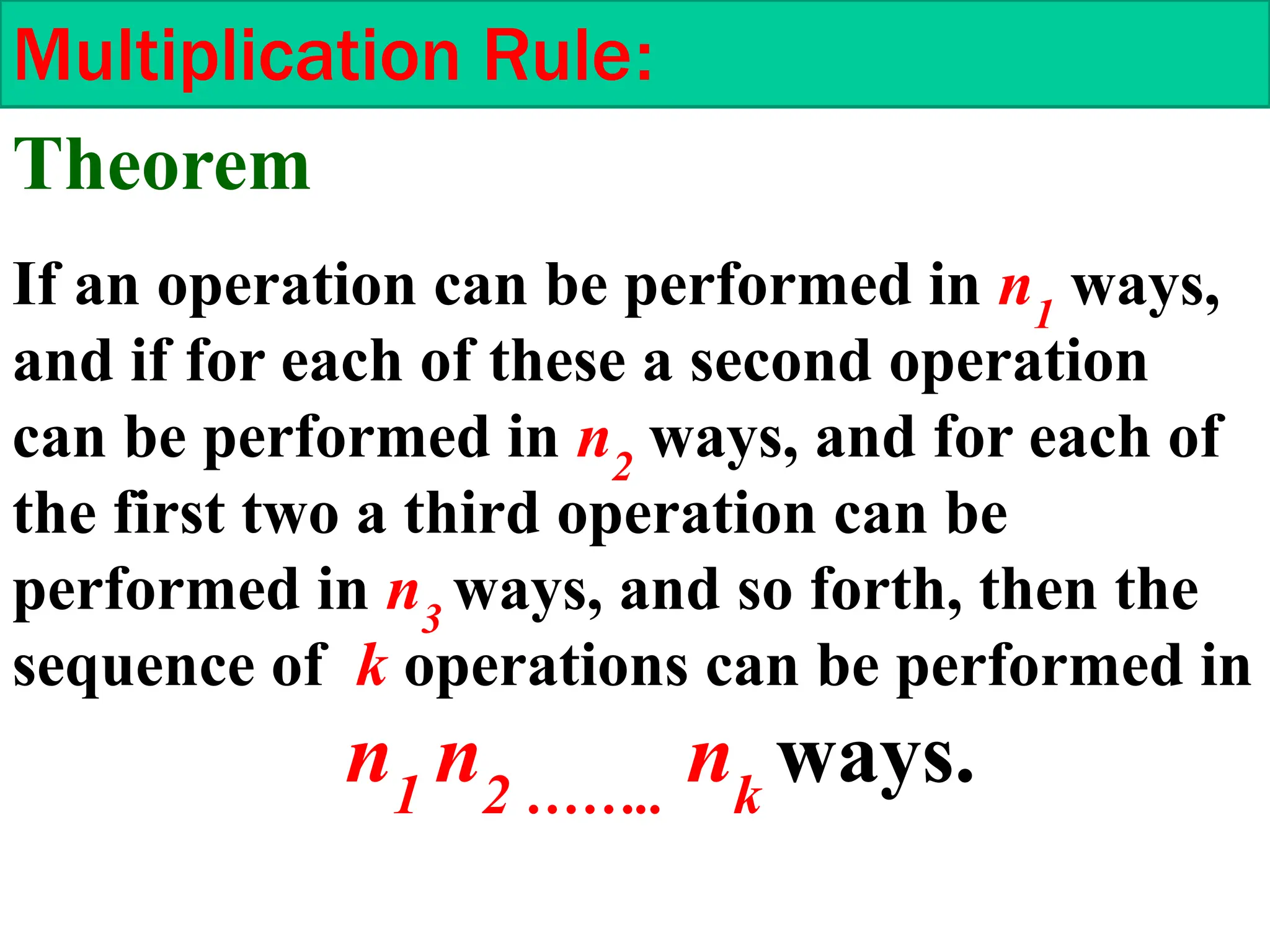
If an operation can be performed in n1
ways,
and if for each of these a second operation
can be performed in n2
ways, and for each of
the first two a third operation can be
performed in n3
ways, and so forth, then the
sequence of k operations can be performed in
n1
n2 ……..
nk
ways.
Theorem
Multiplication Rule (Example 2):
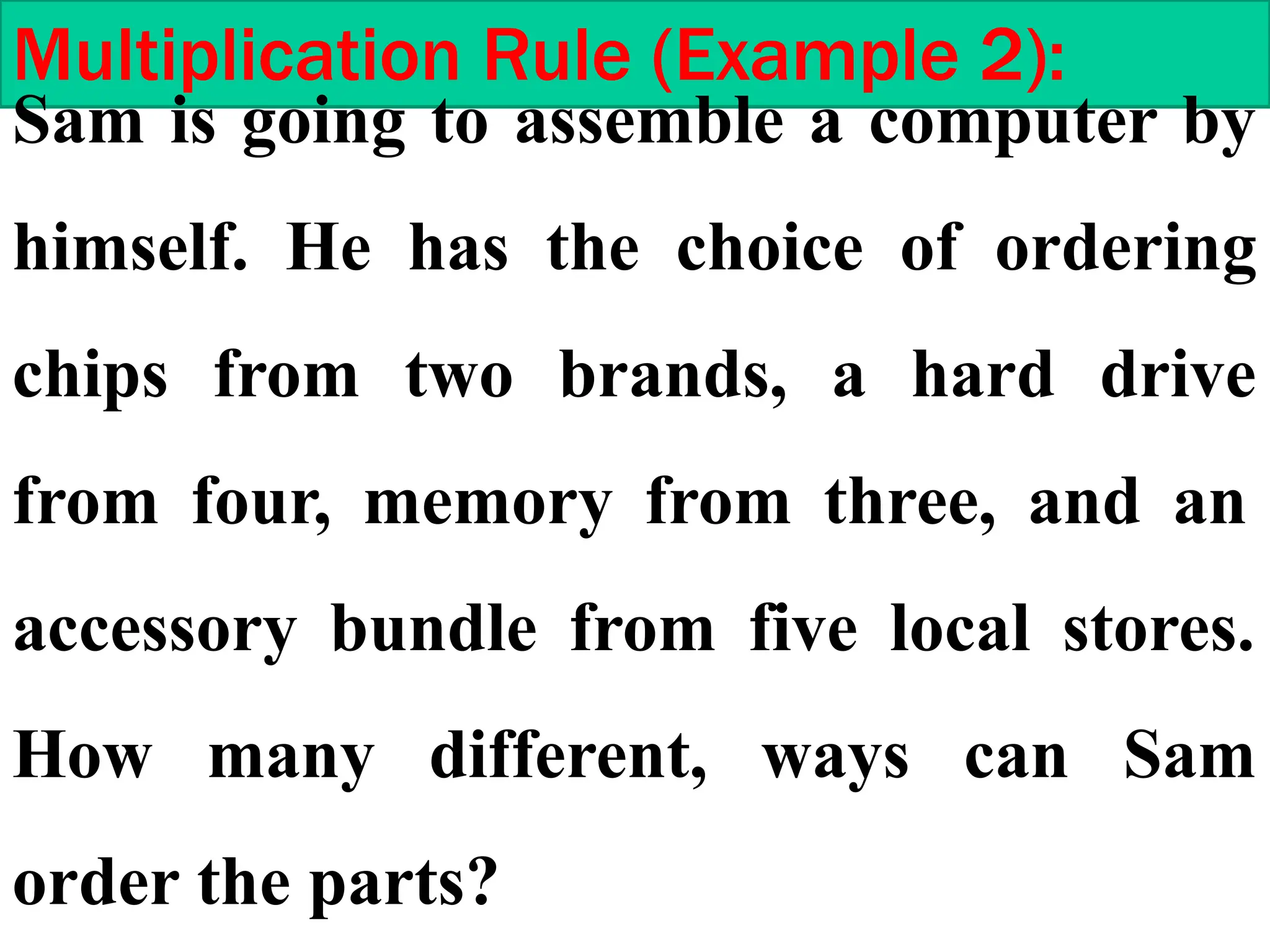
Sam is going to assemble a computer by
himself. He has the choice of ordering
chips from two brands, a hard drive
from four, memory from three, and an
accessory bundle from five local stores.
How many different, ways can Sam
order the parts?
Multiplication Rule (Example 2):
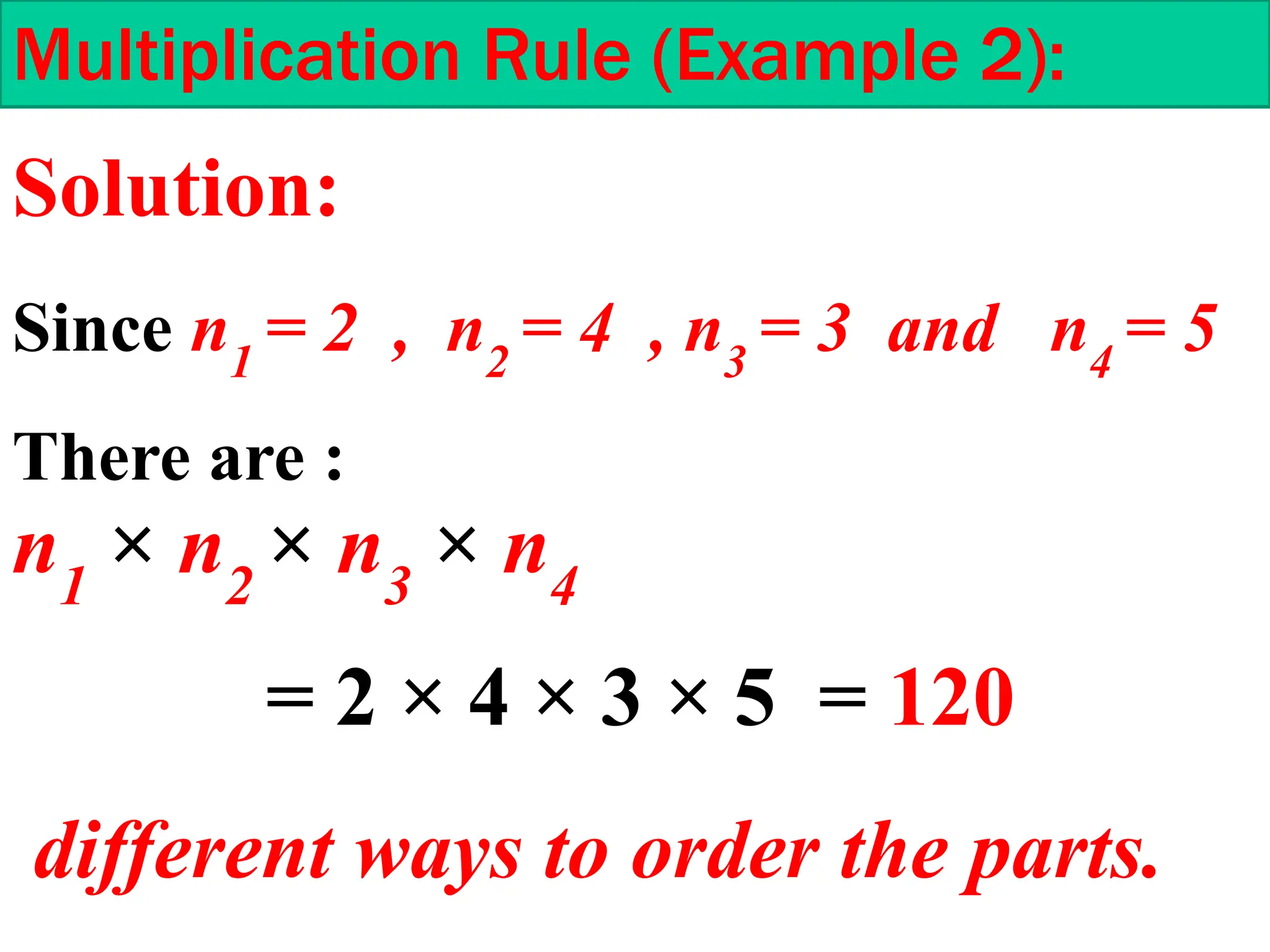
Since n1
= 2 , n2
= 4 , n3
= 3 and n4
= 5
There are :
n1
× n2
× n3
× n4
= 2 × 4 × 3 × 5 = 120
different ways to order the parts.
Solution:
Multiplication Rule (Example 3):
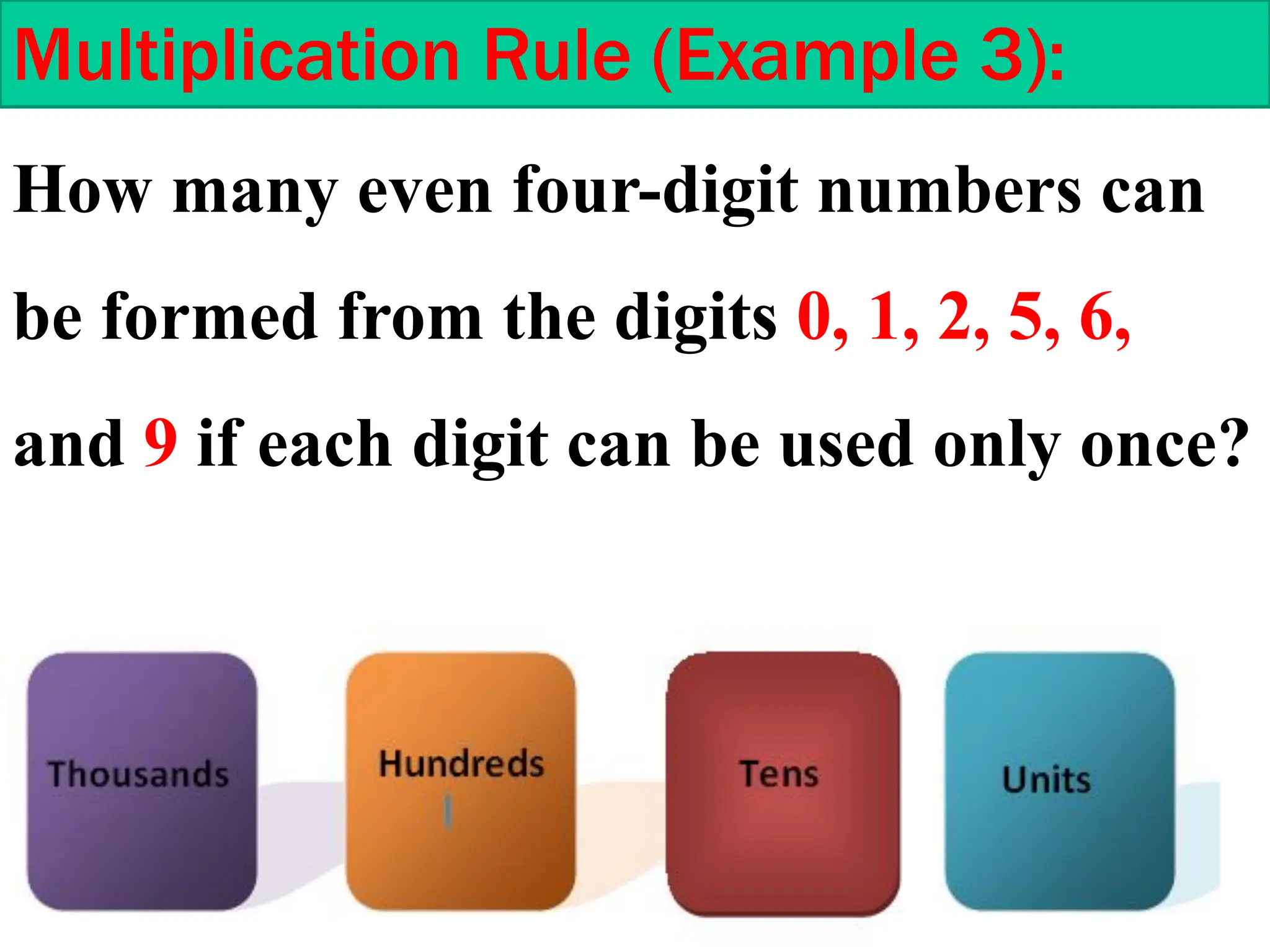
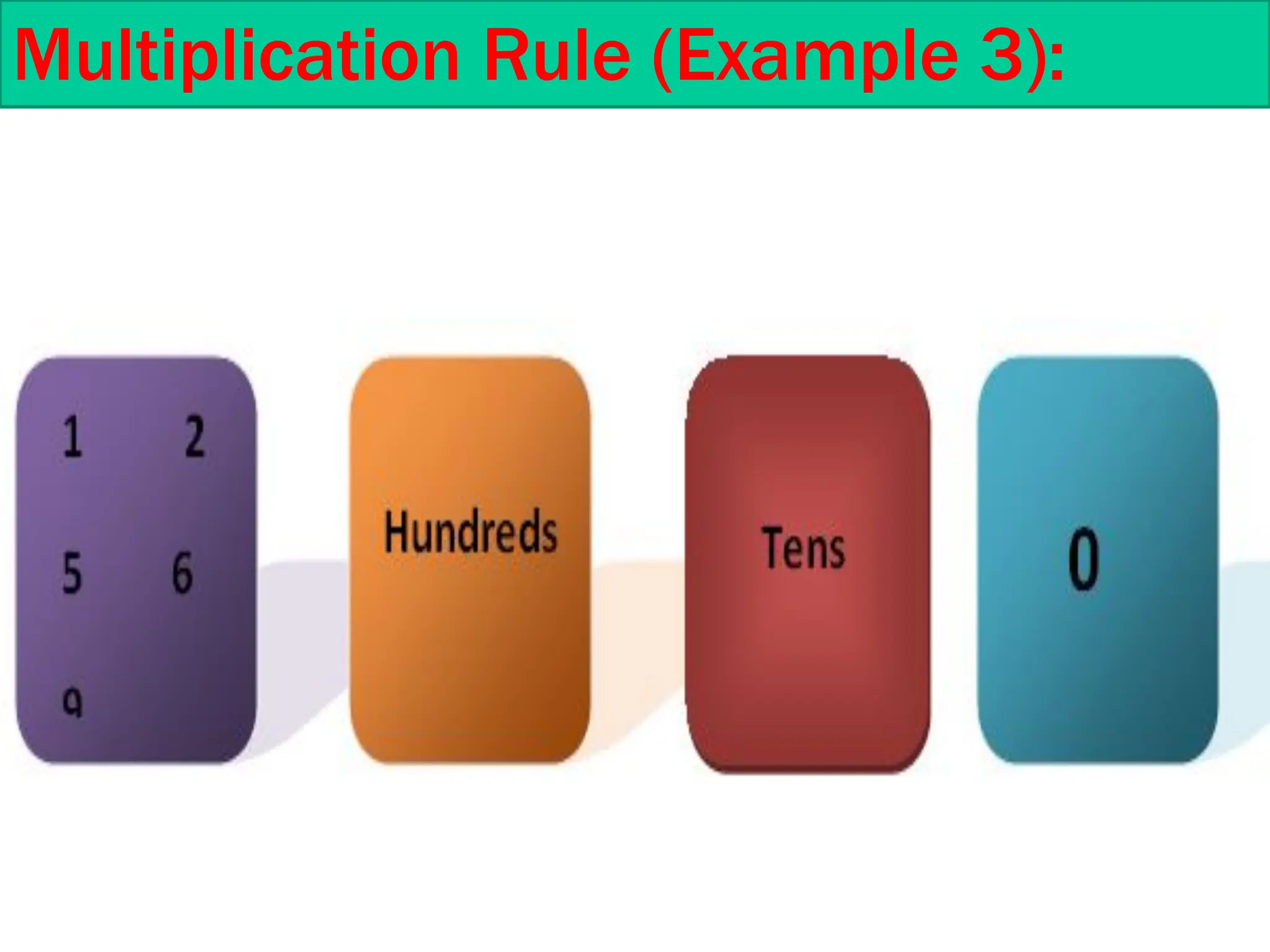
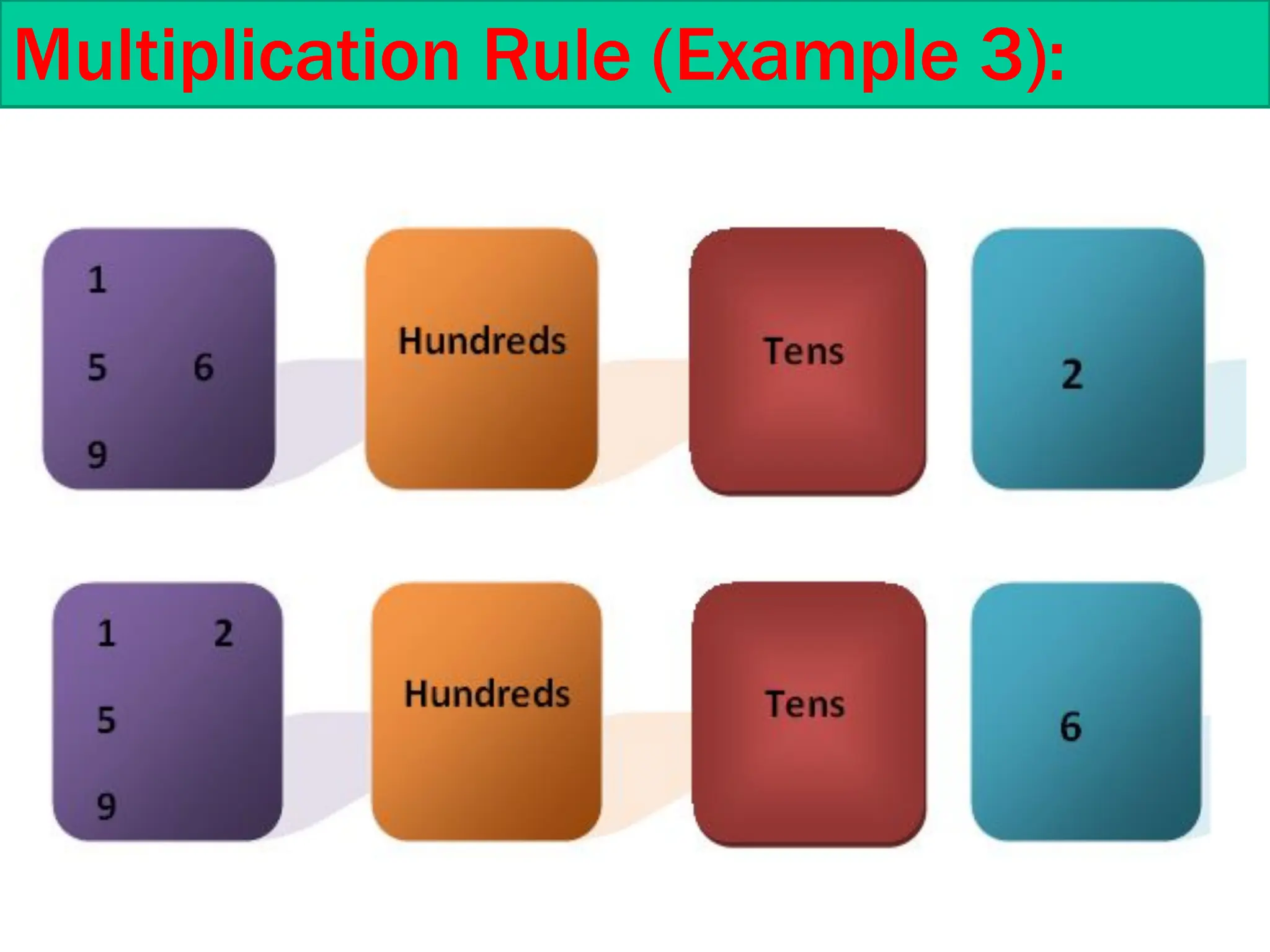
How many even four-digit numbers can
be formed from the digits 0, 1, 2, 5, 6,
and 9 if each digit can be used only once?
Multiplication Rule (Example 3):
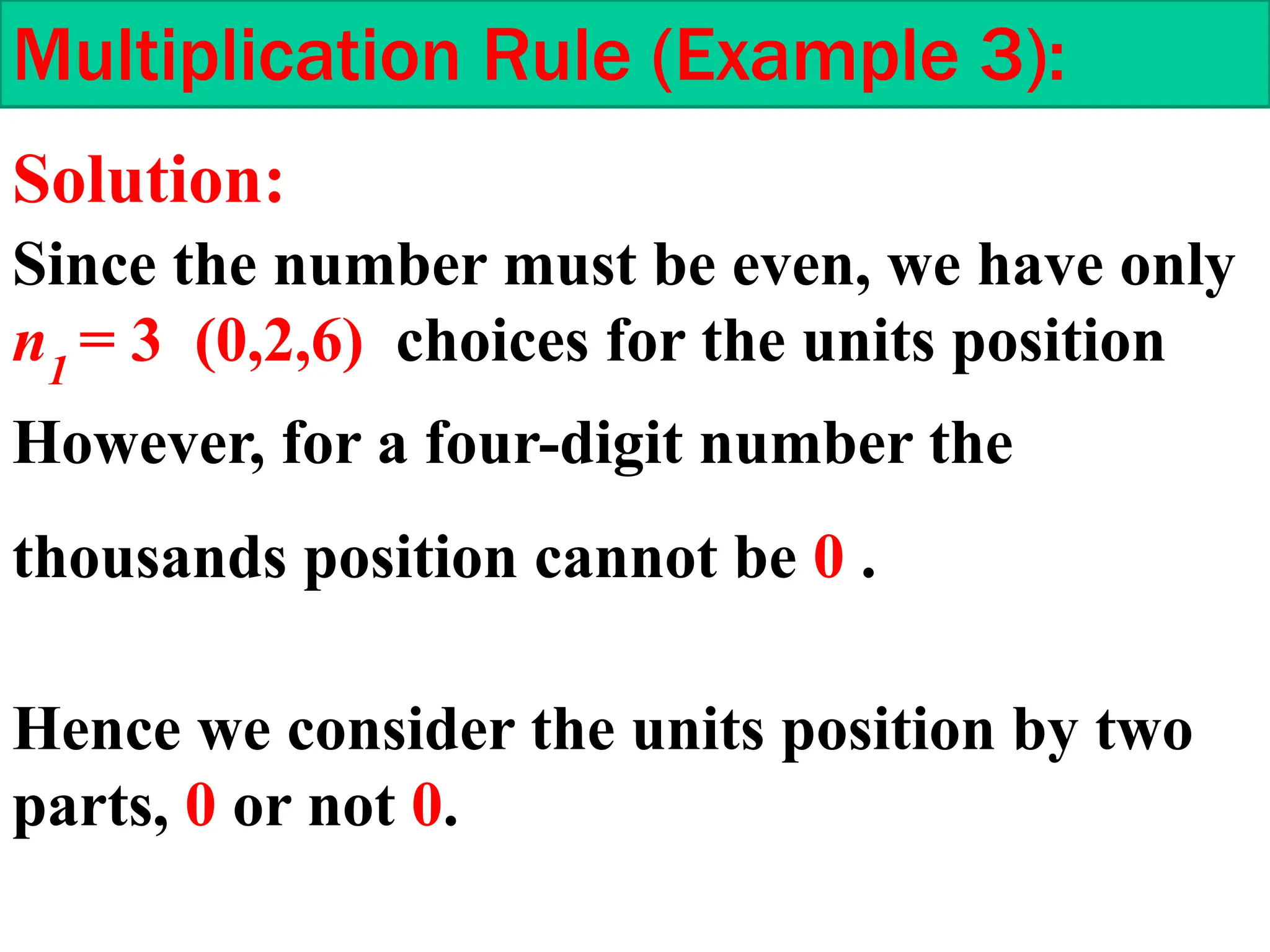
Since the number must be even, we have only
n1
= 3 (0,2,6) choices for the units position
Hence we consider the units position by two
parts, 0 or not 0.
However, for a four-digit number the
thousands position cannot be 0 .
Solution:
Multiplication Rule (Example 3):
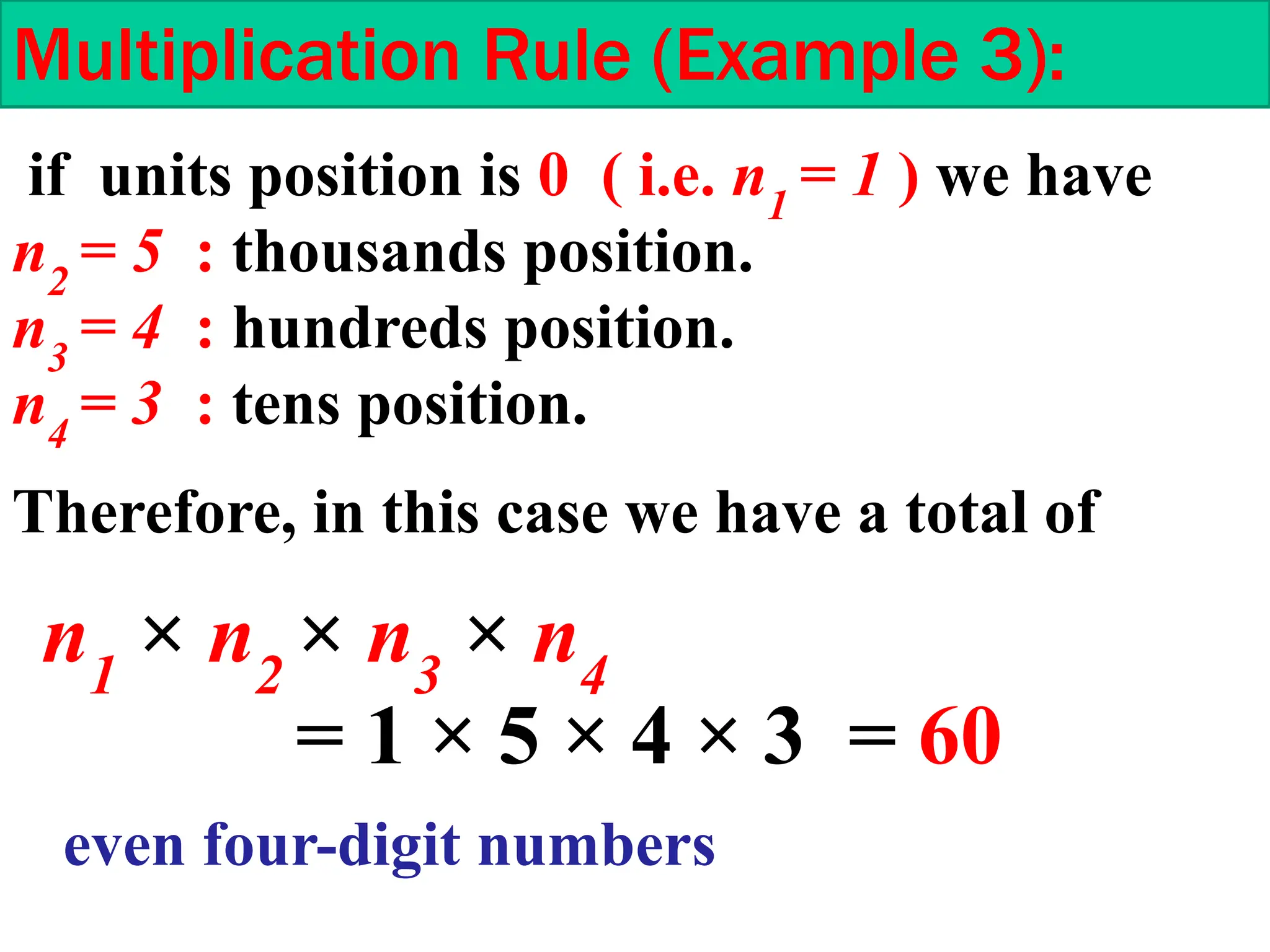
if units position is 0 ( i.e. n1
= 1 ) we have
n2
= 5 : thousands position.
n3
= 4 : hundreds position.
n4
= 3 : tens position.
Therefore, in this case we have a total of
n1
× n2
× n3
× n4
= 1 × 5 × 4 × 3 = 60
even four-digit numbers
Multiplication Rule (Example 3):
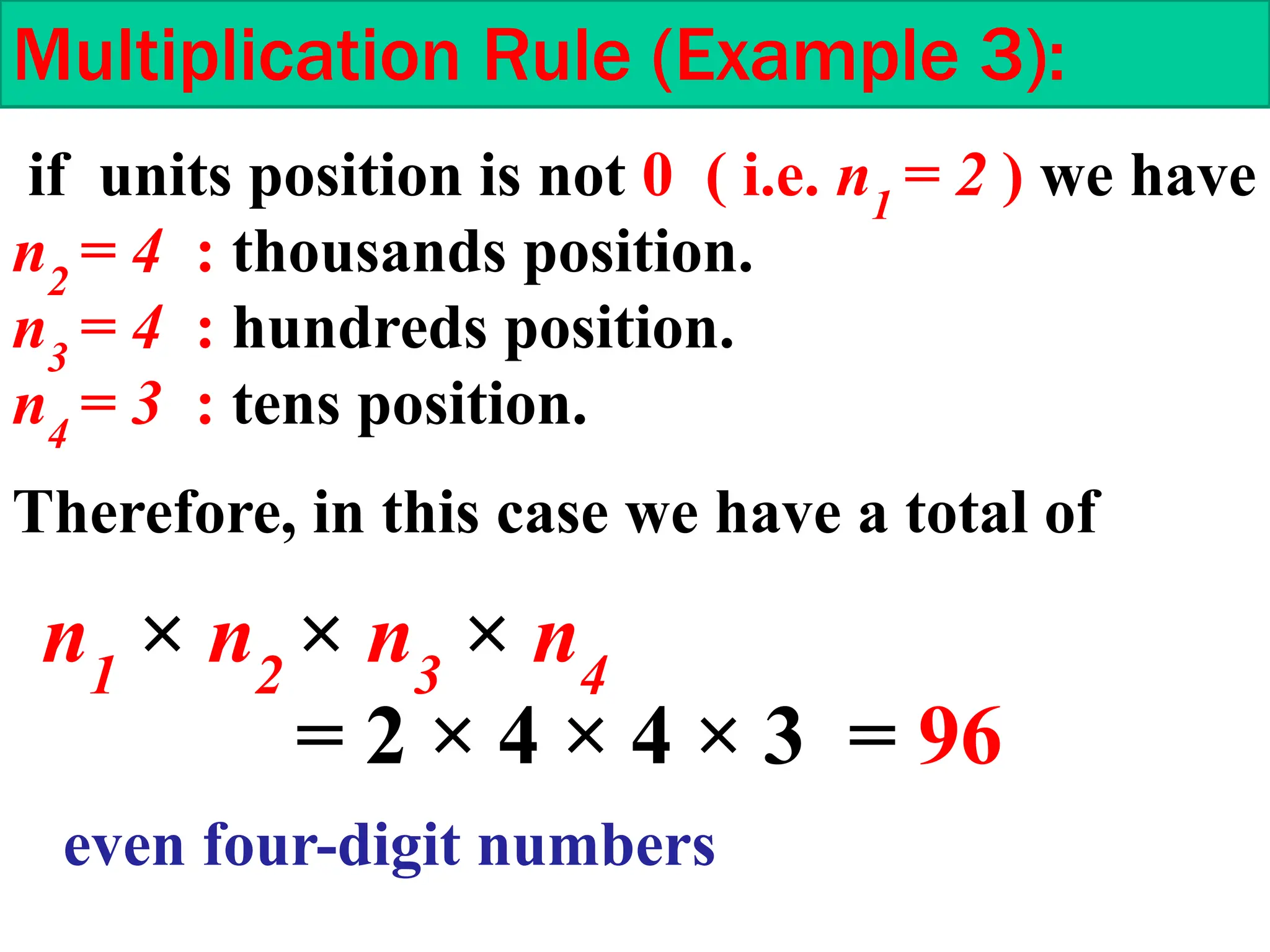
if units position is not 0 ( i.e. n1
= 2 ) we have
n2
= 4 : thousands position.
n3
= 4 : hundreds position.
n4
= 3 : tens position.
Therefore, in this case we have a total of
n1
× n2
× n3
× n4
= 2 × 4 × 4 × 3 = 96
even four-digit numbers
Multiplication Rule (Example 3):
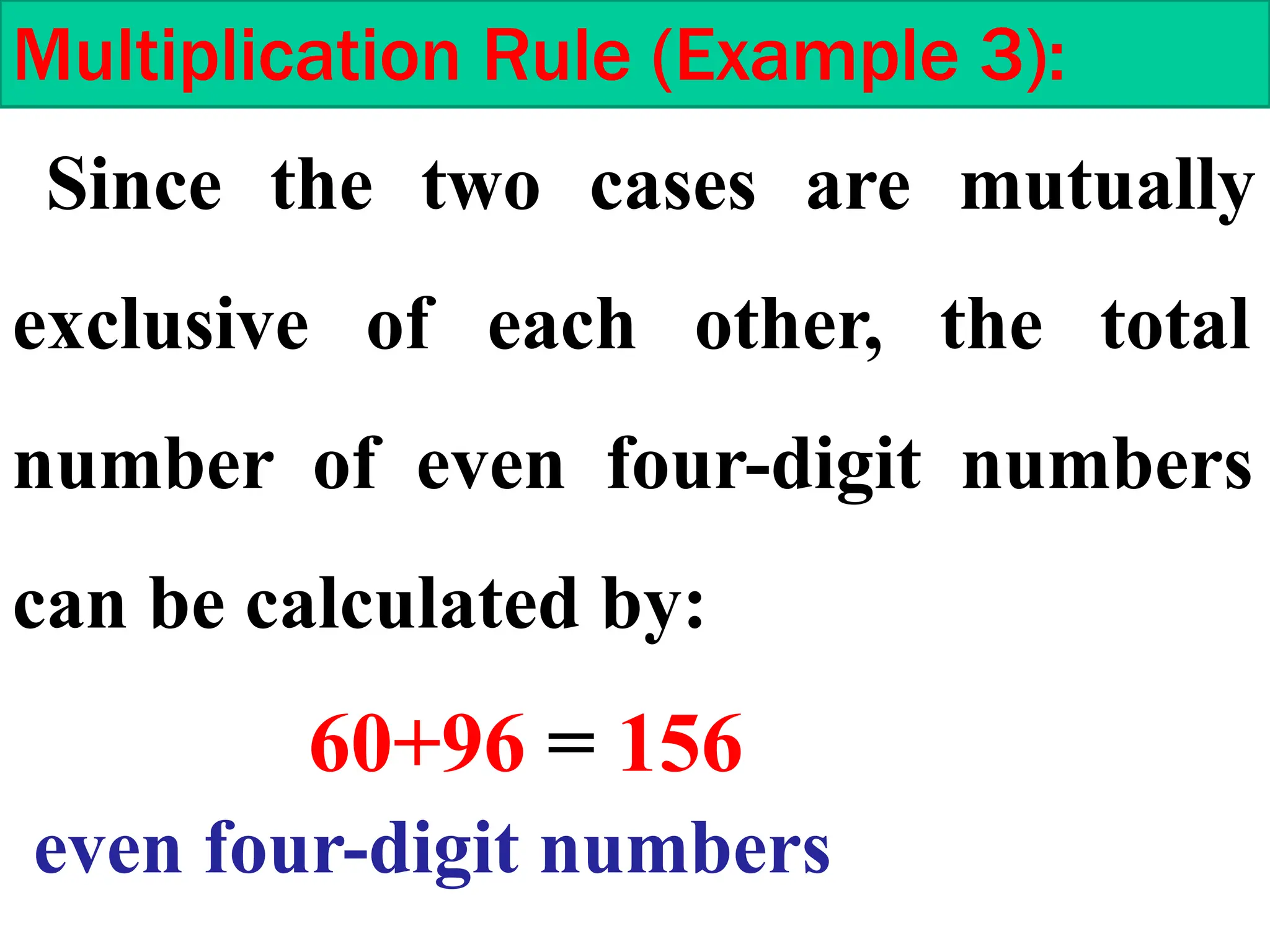
Since the two cases are mutually
exclusive of each other, the total
number of even four-digit numbers
can be calculated by:
60+96 = 156
even four-digit numbers
Permutations:
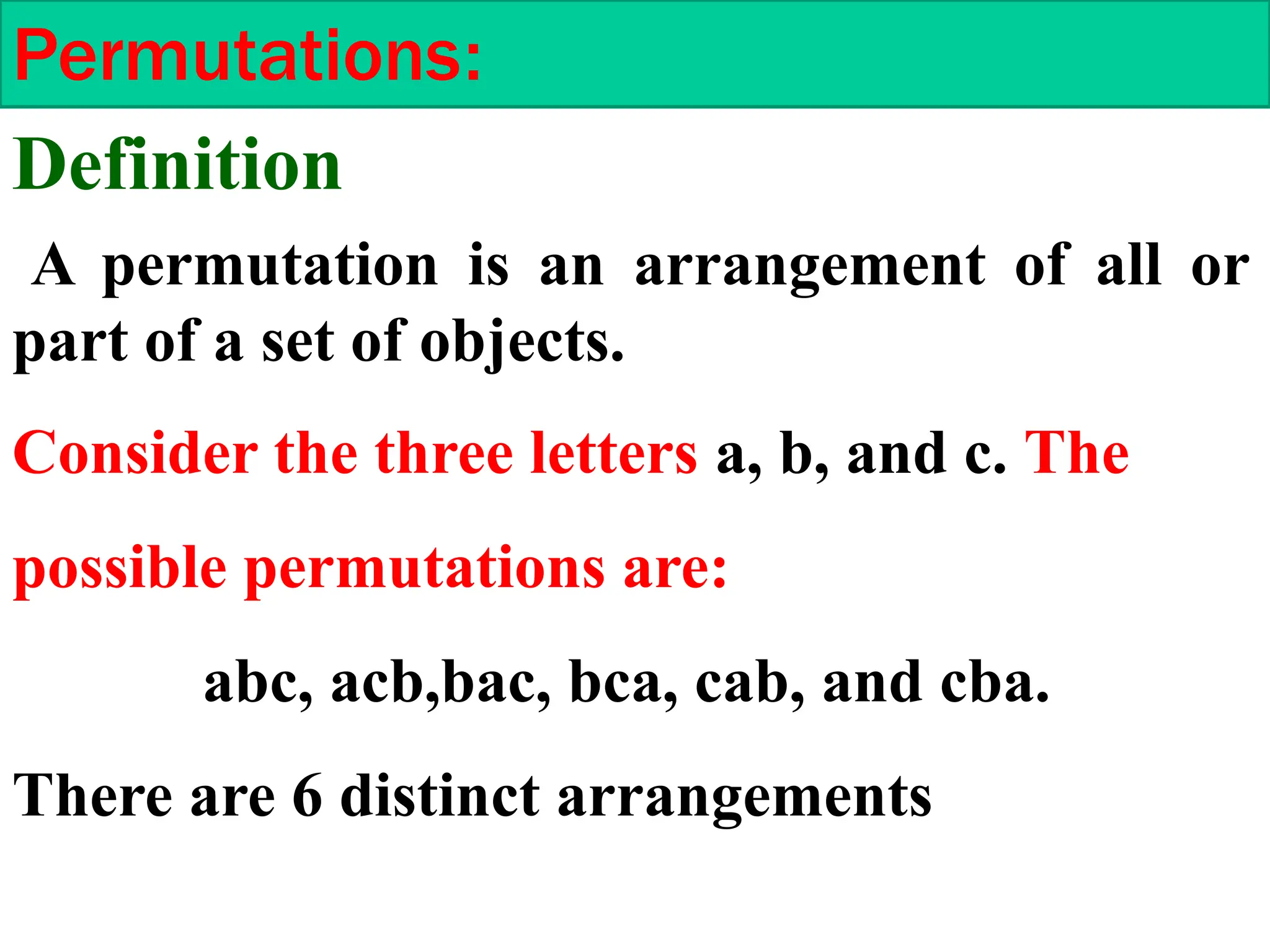
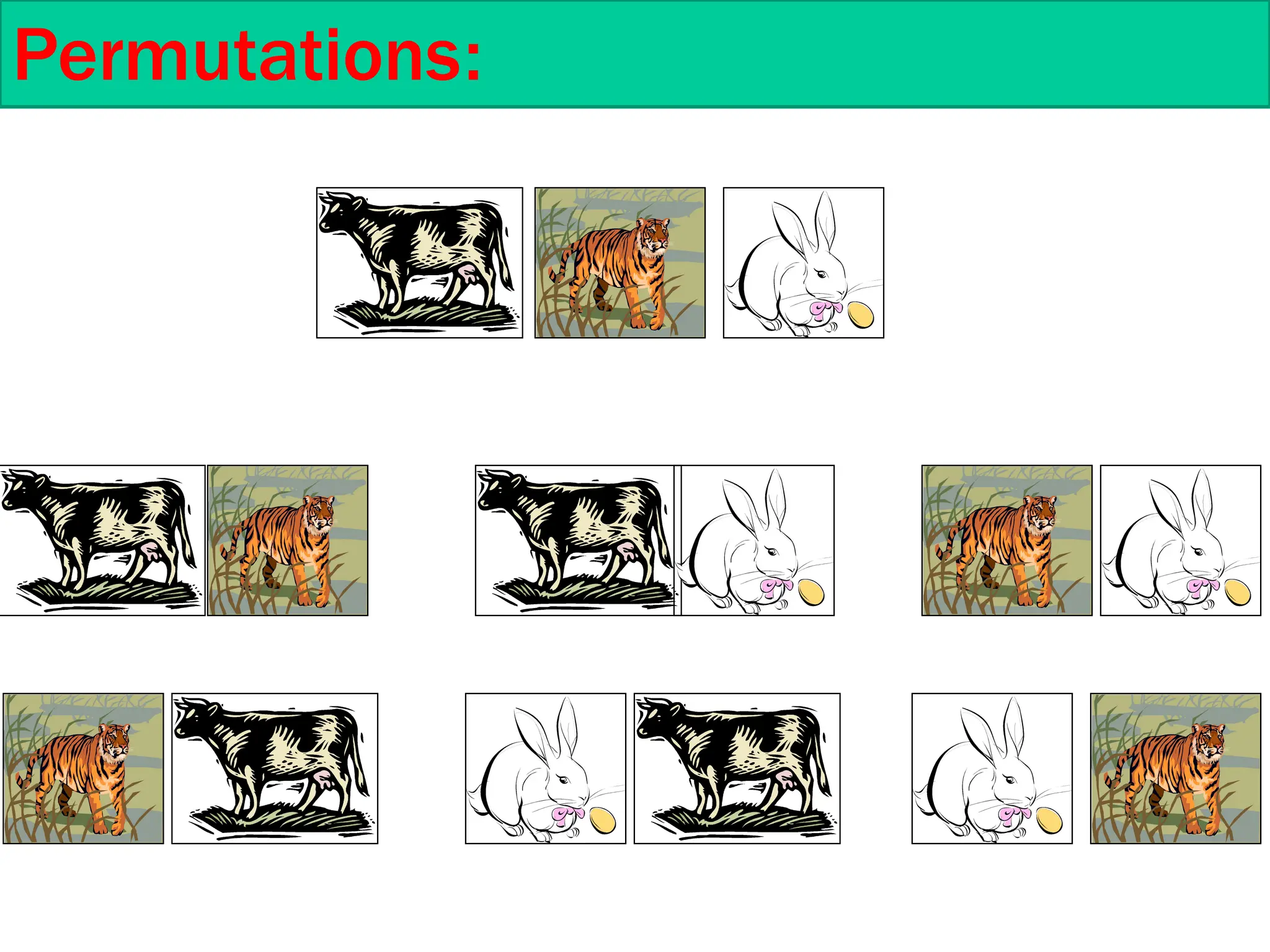
A permutation is an arrangement of all or
part of a set of objects.
Consider the three letters a, b, and c. The
possible permutations are:
abc, acb,bac, bca, cab, and cba.
There are 6 distinct arrangements
Definition
Permutations:
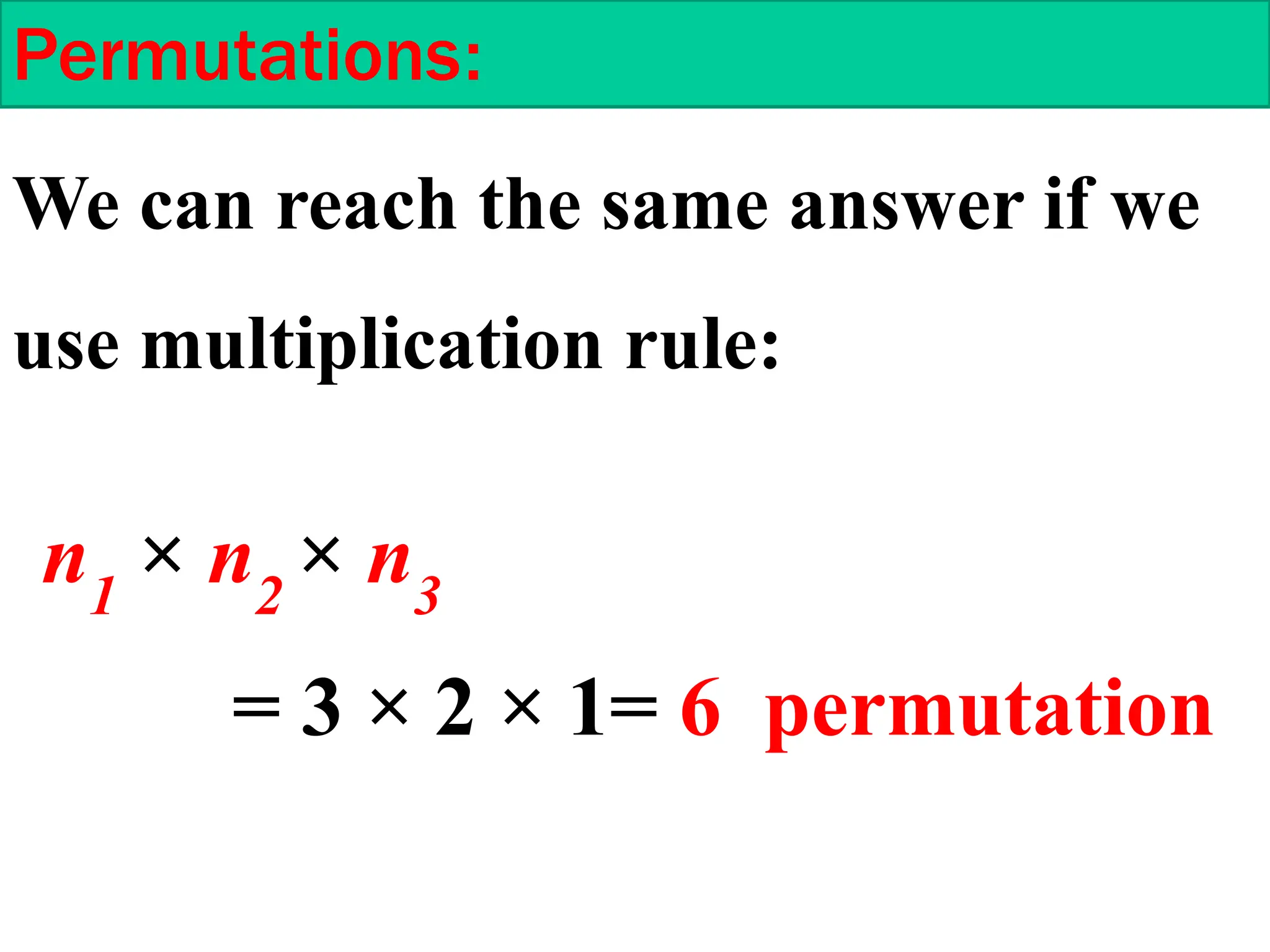
We can reach the same answer if we
use multiplication rule:
n1
× n2
× n3
= 3 × 2 × 1= 6 permutation
Permutations (Factorial):
In general, n distinct objects can be
arranged in
n(n - l)(n - 2) • • • (3)(2)(1) ways.
This product is called factorial and
represents by n!
The number of permutations of n objects
is n!.
Permutations:
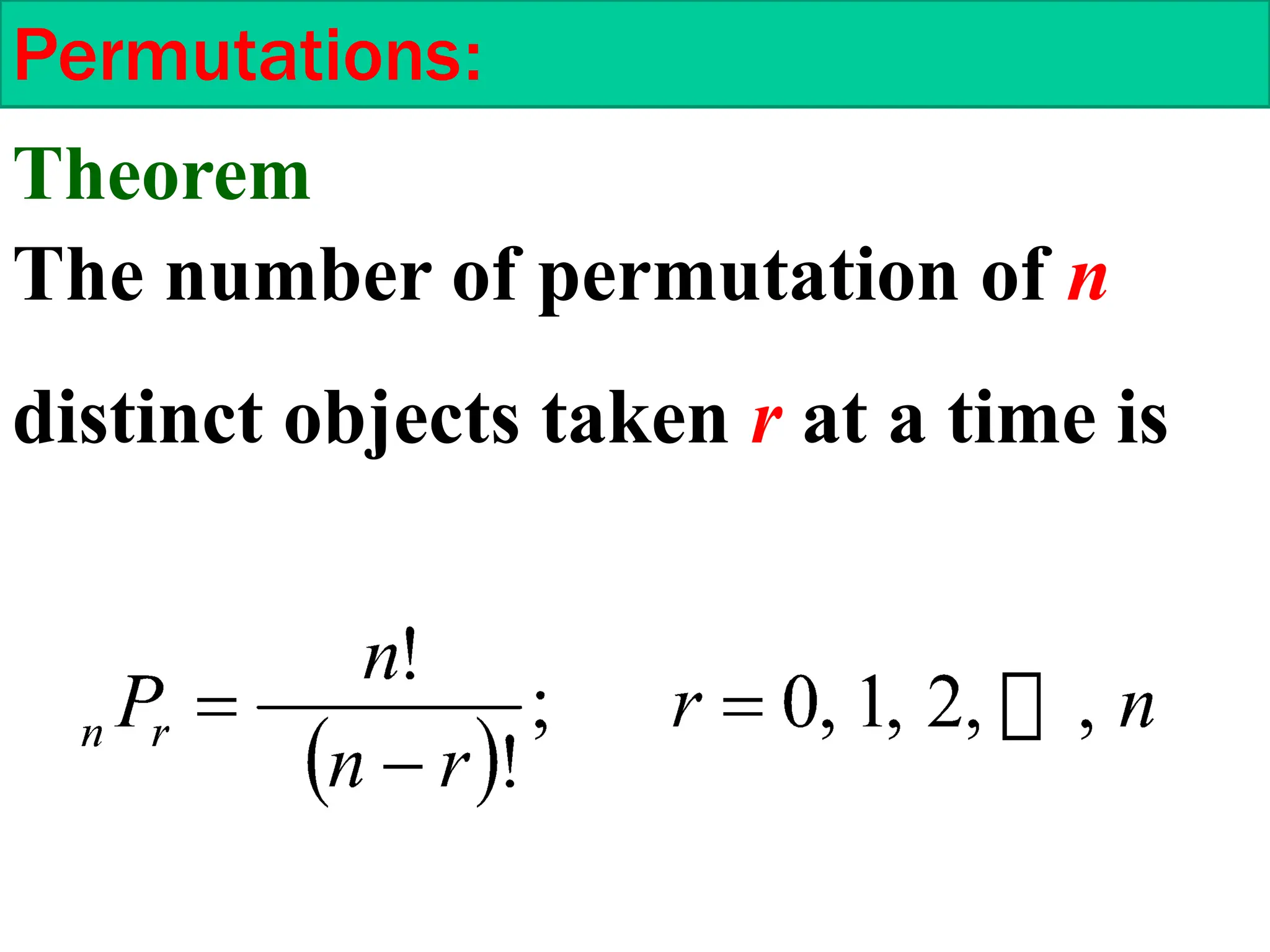
The number of permutation of n
distinct objects taken r at a time is
Theorem
Permutations:
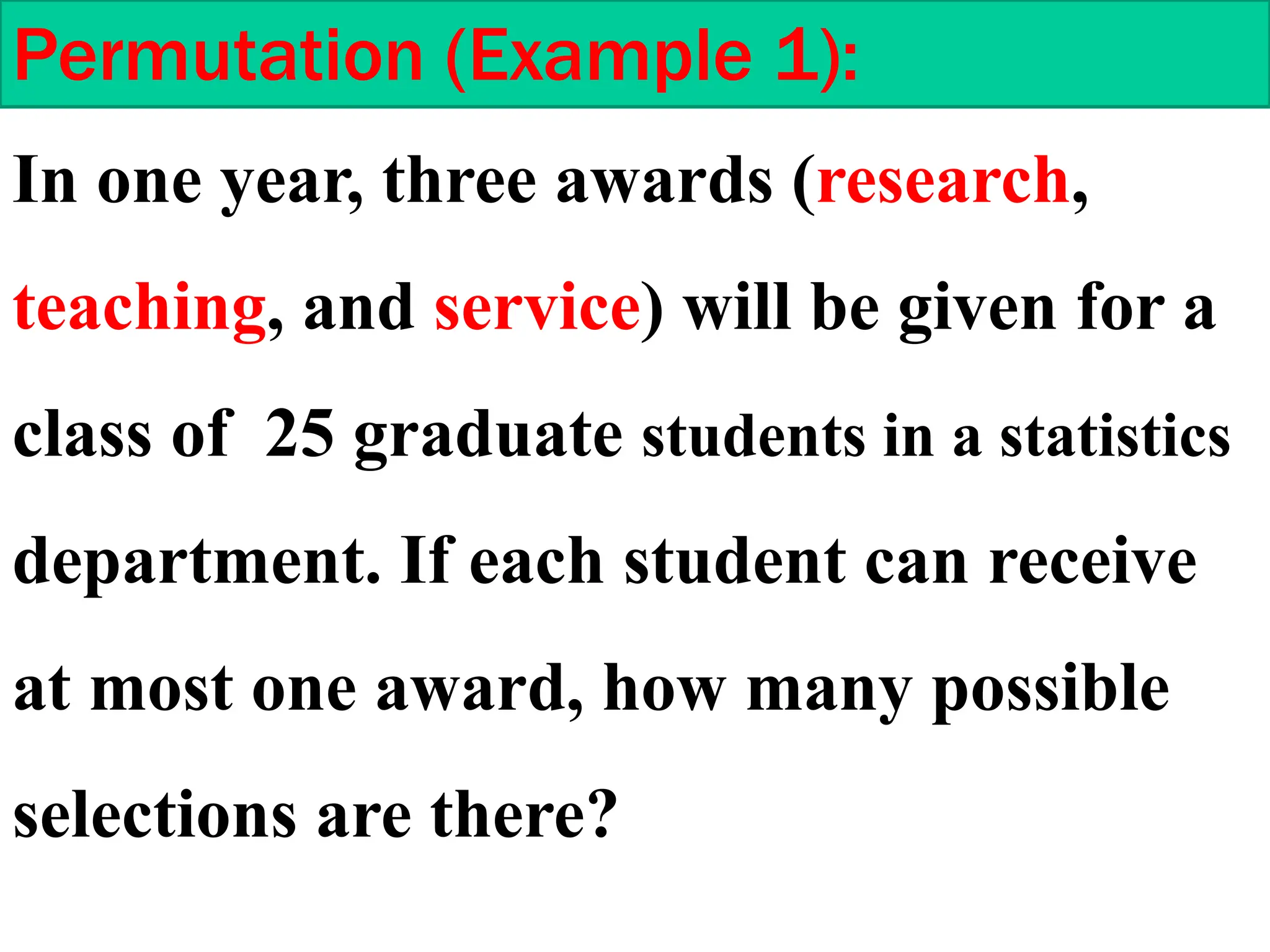
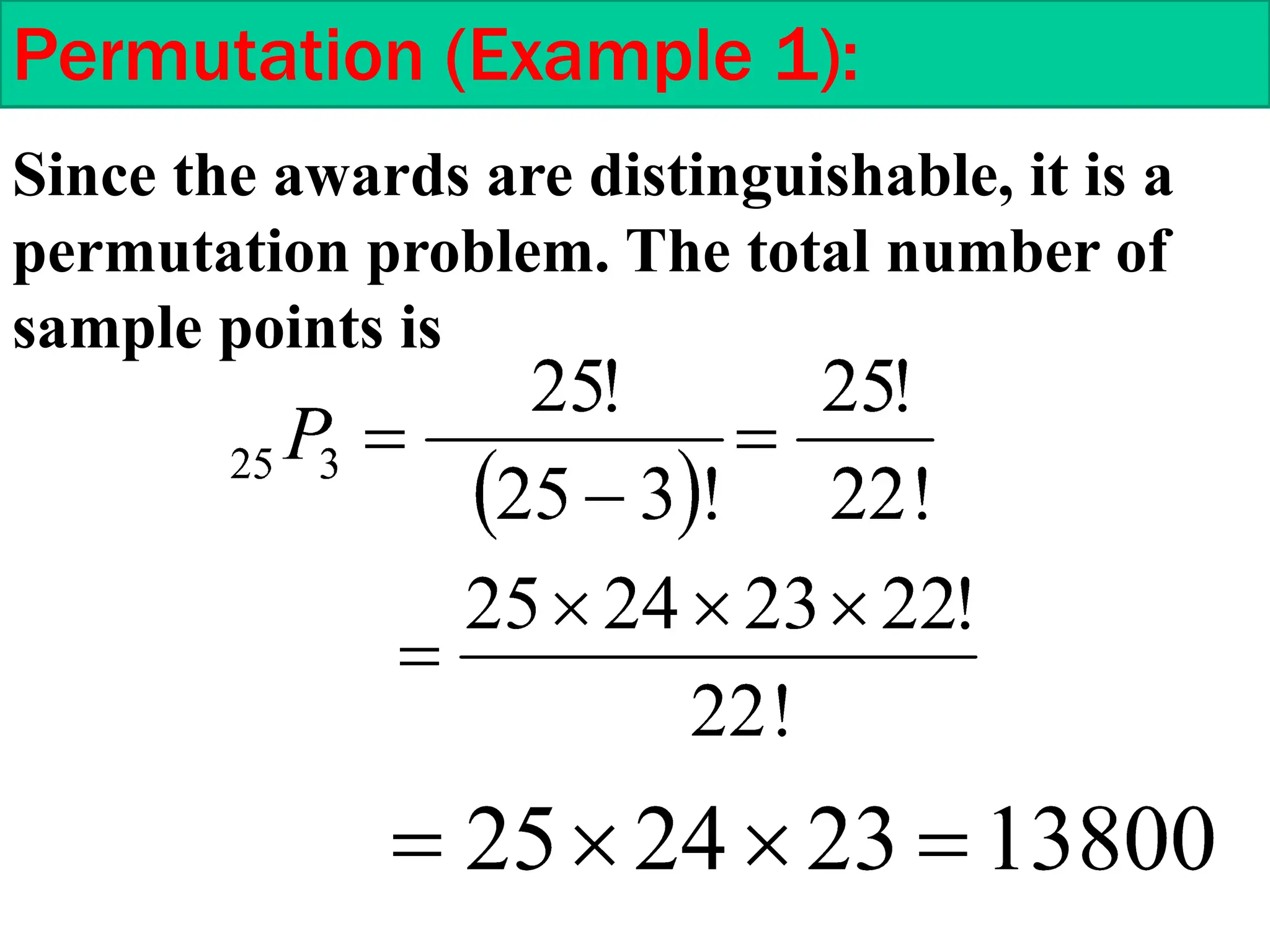
Permutation (Example 1):
In one year, three awards (research,
teaching, and service) will be given for a
class of 25 graduate students in a statistics
department. If each student can receive
at most one award, how many possible
selections are there?
Permutation (Example 1):
Since the awards are distinguishable, it is a
permutation problem. The total number of
sample points is
Permutations (Example 2):
A president and a treasurer are to be chosen
from a student club consisting of 50 people.
How many different choices of officers are
possible if
(a) There are no restrictions;
(b) A will serve only if he is president;
(c) B and C will serve together or not at all:
(d) D and E will not serve together?
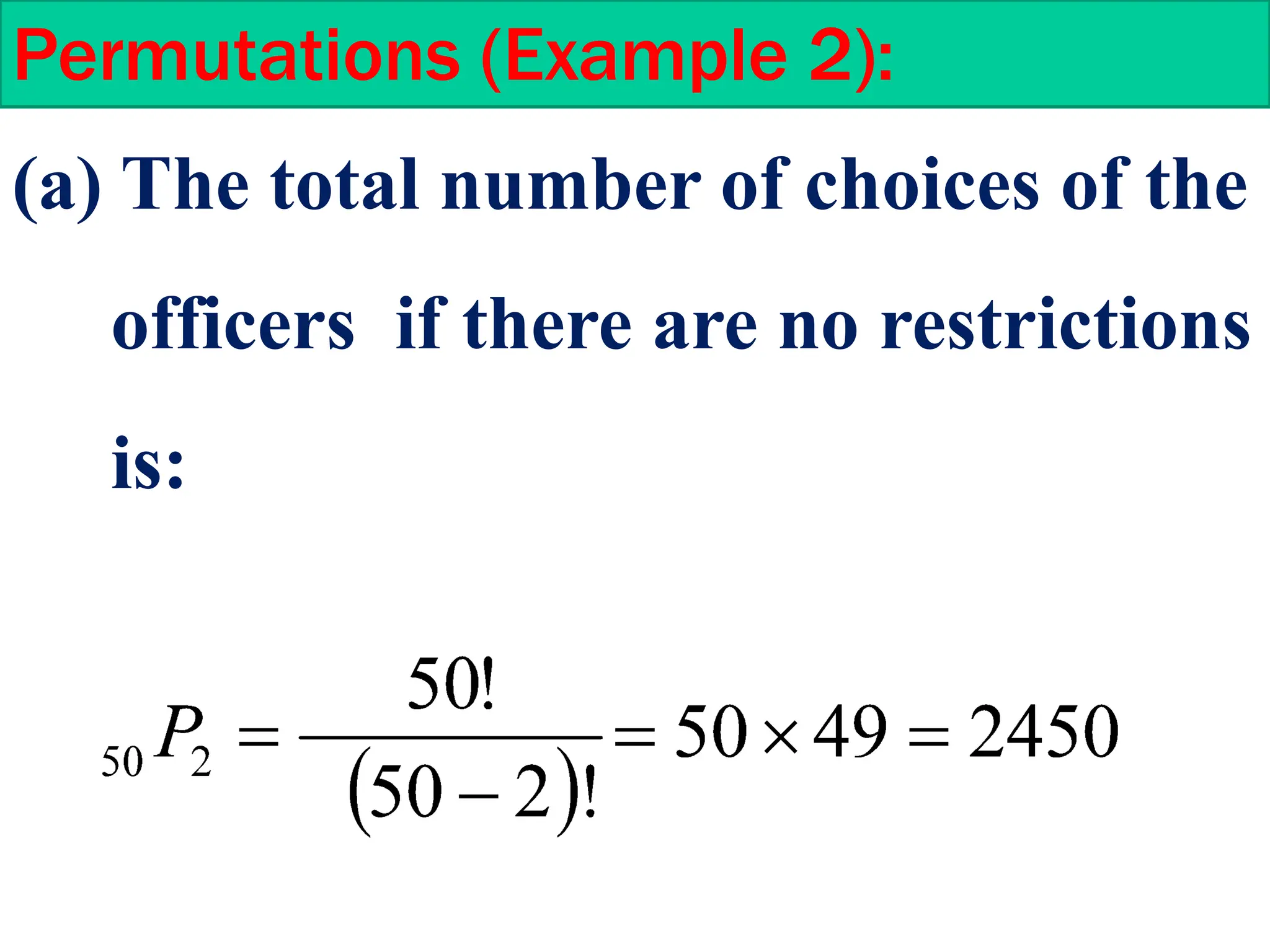
Permutations (Example 2):
(a) The total number of choices of the
officers if there are no restrictions
is:
Permutations (Example 2):
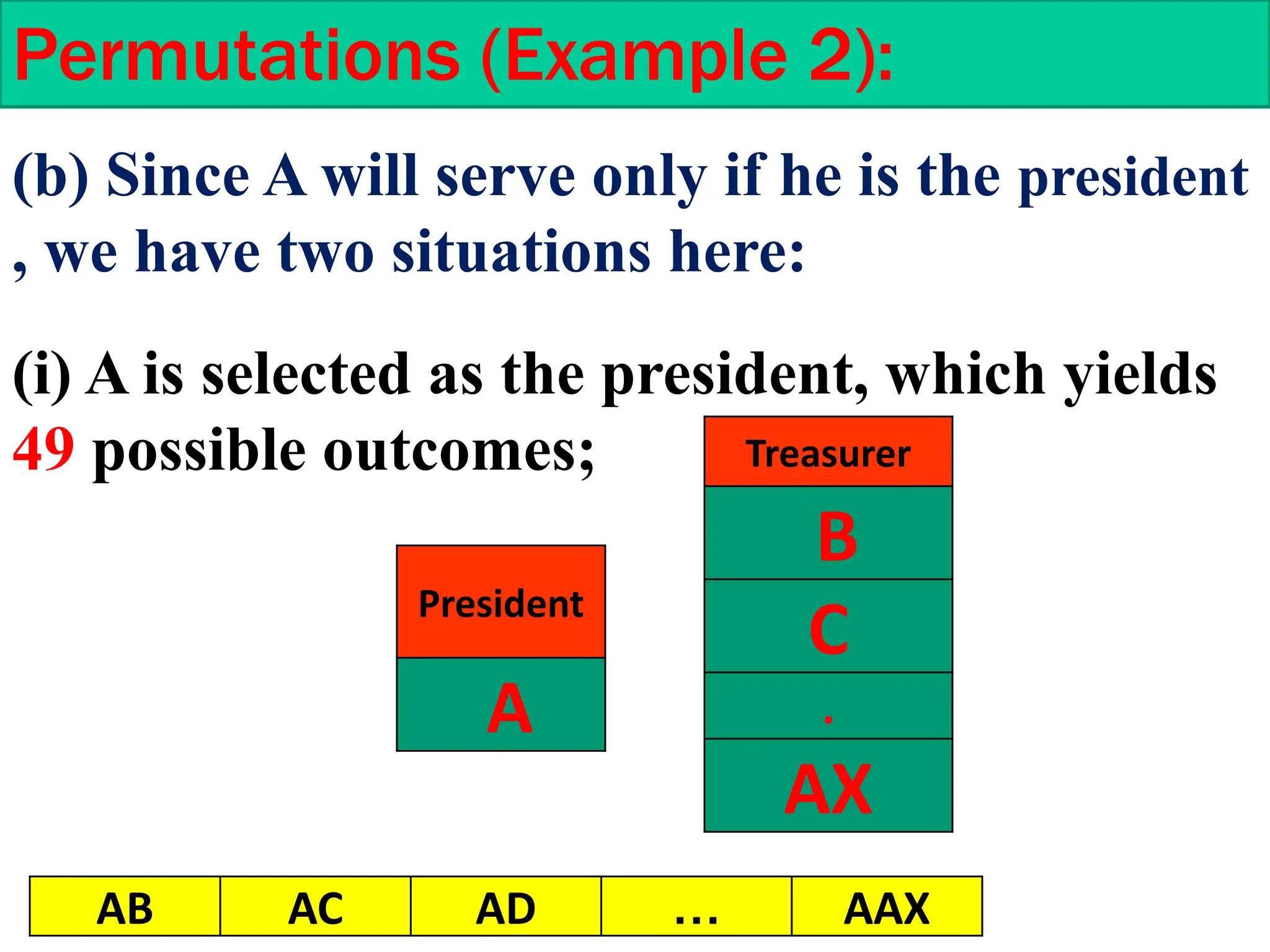
(b) Since A will serve only if he is the president
, we have two situations here:
(i) A is selected as the president, which yields
49 possible outcomes;
President
A
Treasurer
B
C
.
AX
AB AC AD … AAX
Permutations (Example 2):
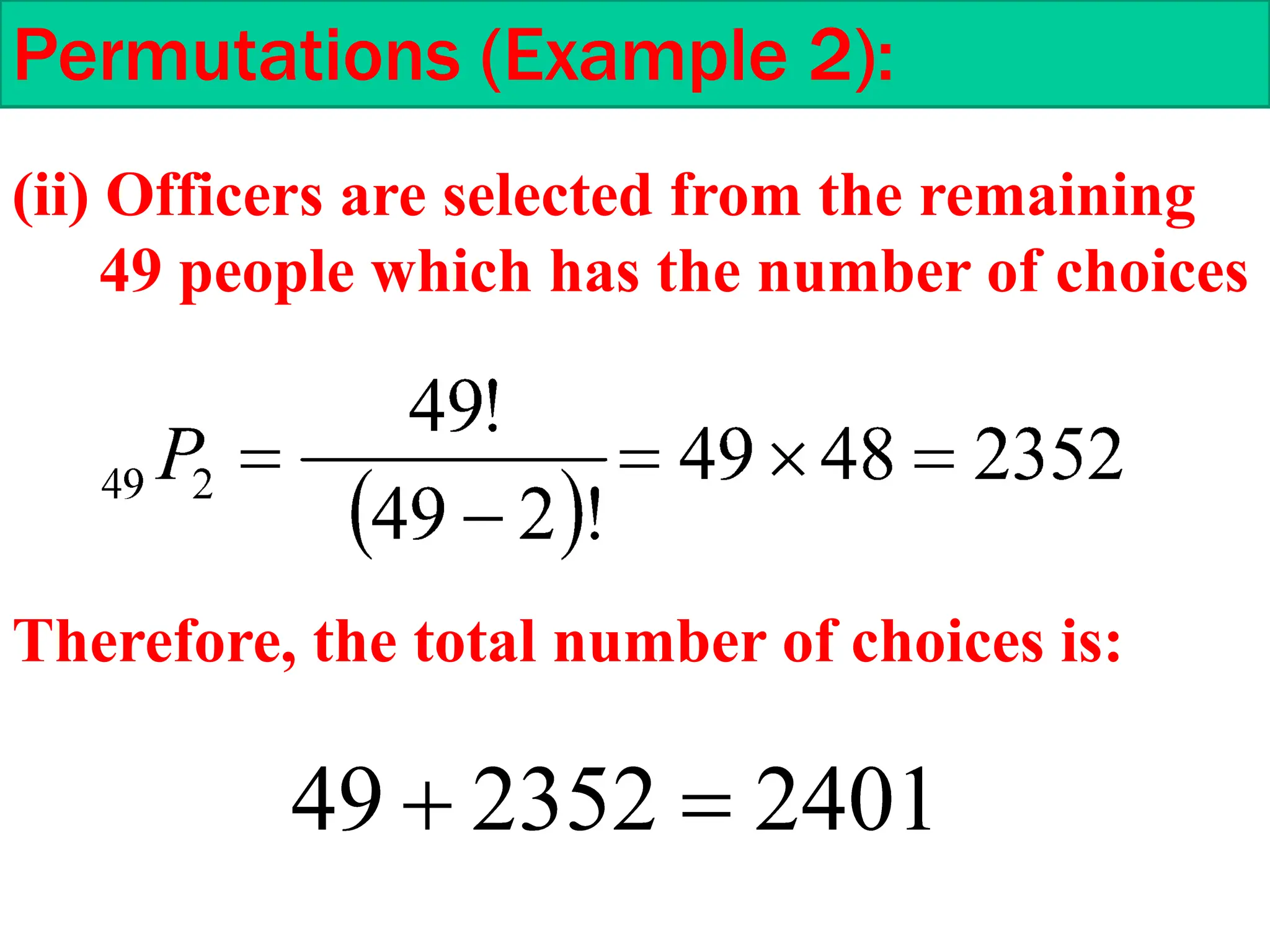
(ii) Officers are selected from the remaining
49 people which has the number of choices
Therefore, the total number of choices is:
Permutations (Example 2):
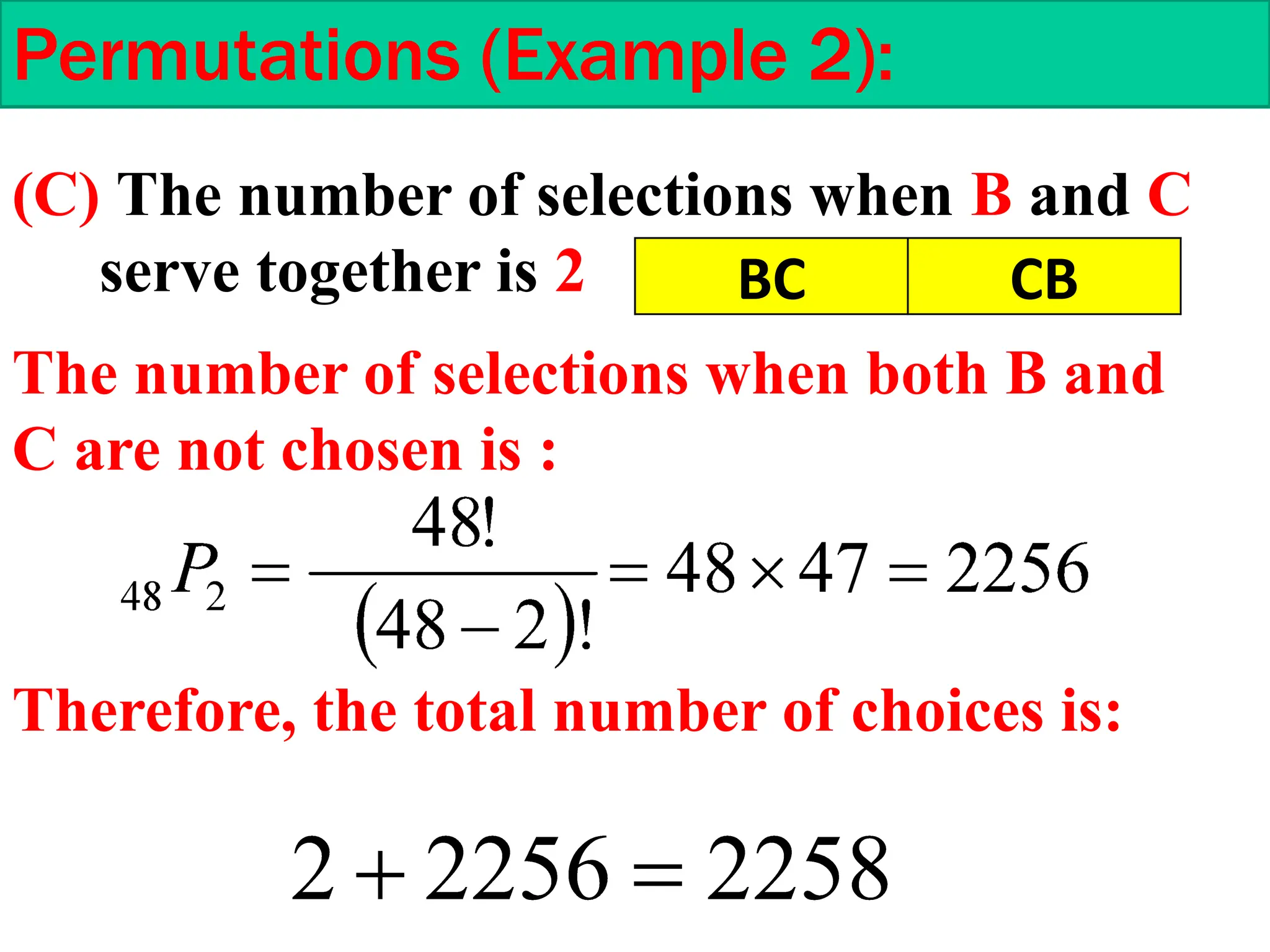
(C) The number of selections when B and C
serve together is 2
The number of selections when both B and
C are not chosen is :
BC CB
Therefore, the total number of choices is:
Permutations (Example 2):
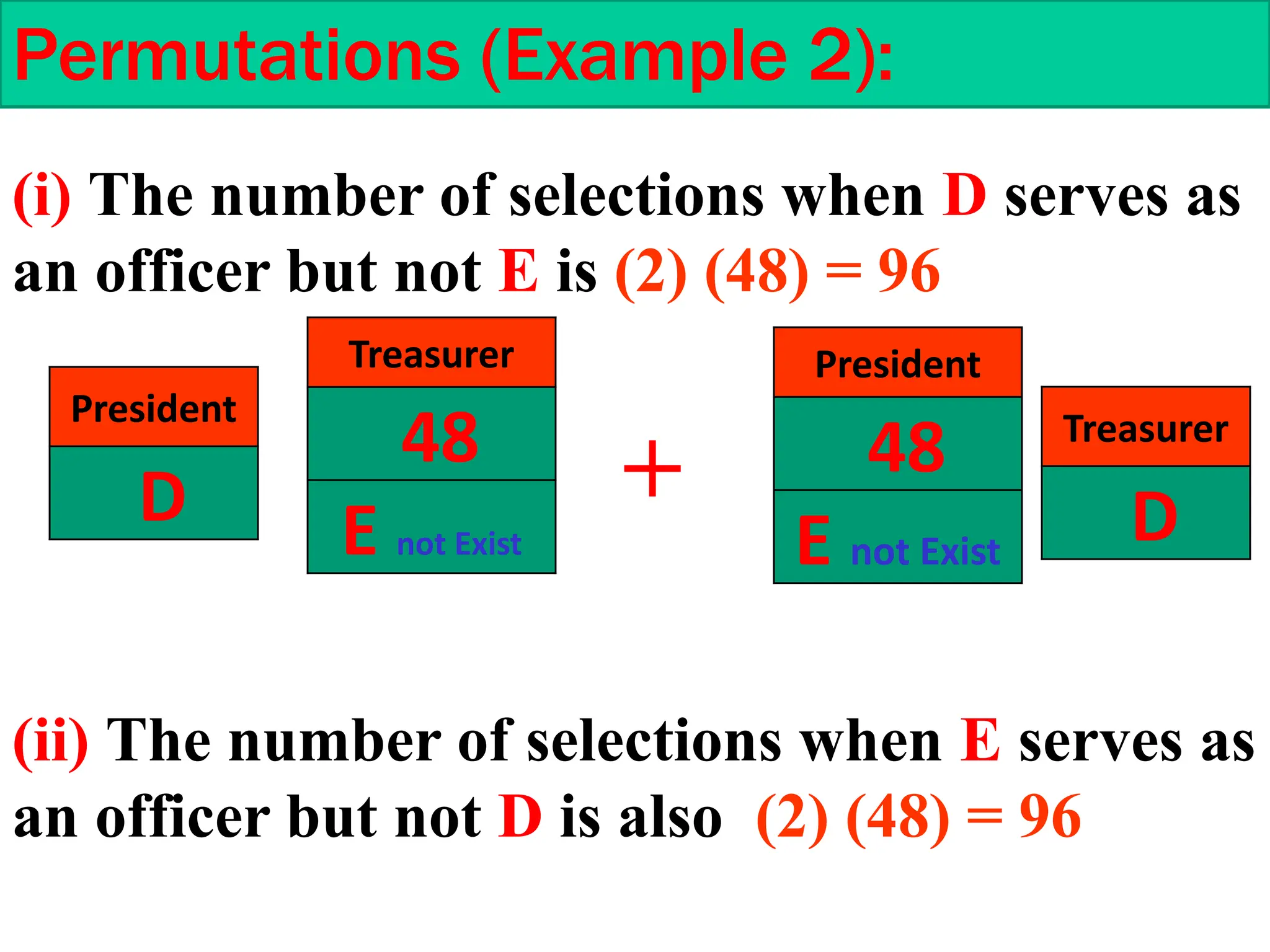
(i) The number of selections when D serves as
an officer but not E is (2) (48) = 96
President
D
Treasurer
48
E not Exist
Treasurer
D
President
48
E not Exist
+
(ii) The number of selections when E serves as
an officer but not D is also (2) (48) = 96
Permutations (Example 2):
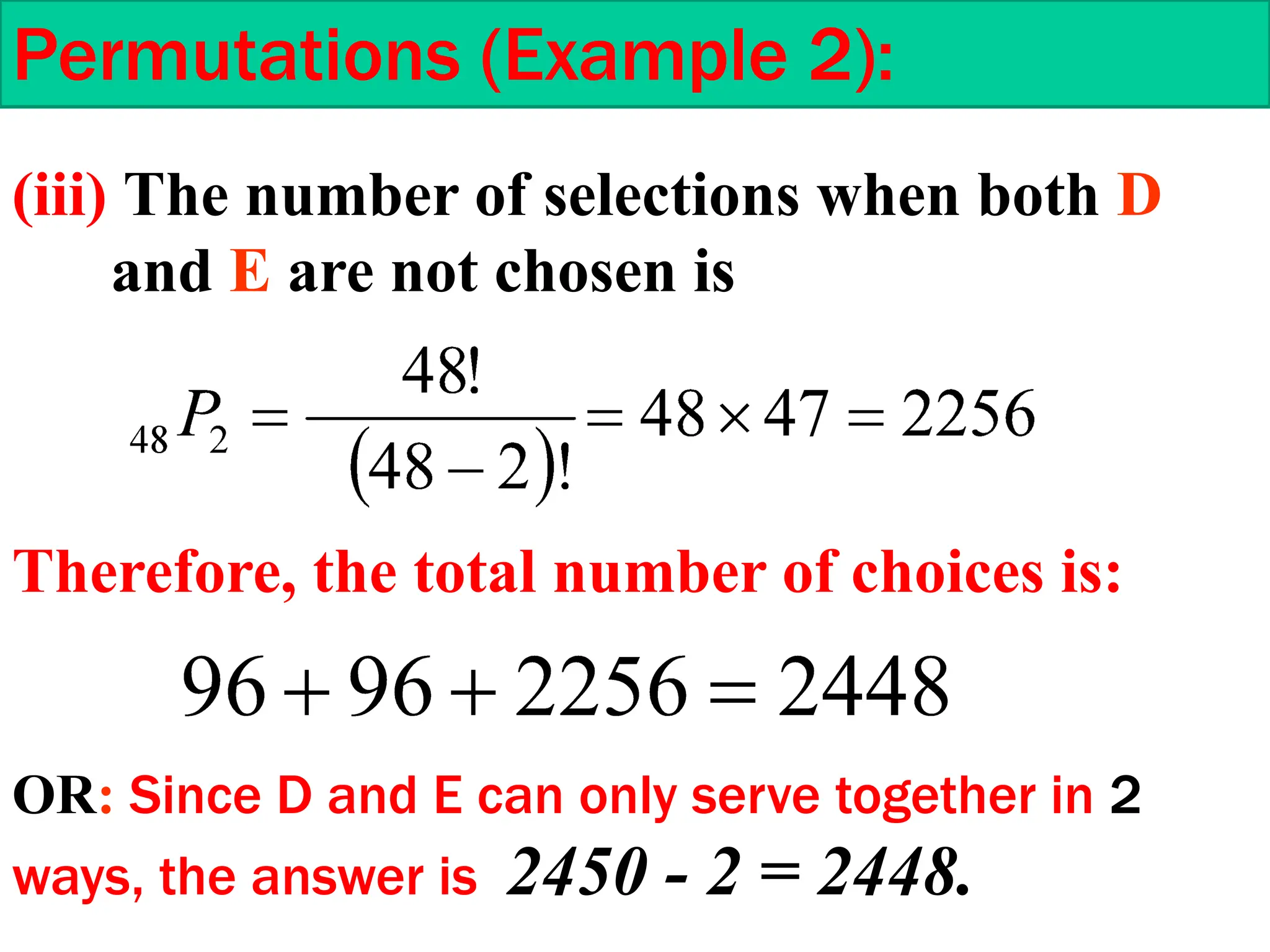
(iii) The number of selections when both D
and E are not chosen is
Therefore, the total number of choices is:
OR: Since D and E can only serve together in 2
ways, the answer is 2450 - 2 = 2448.
Permutations:
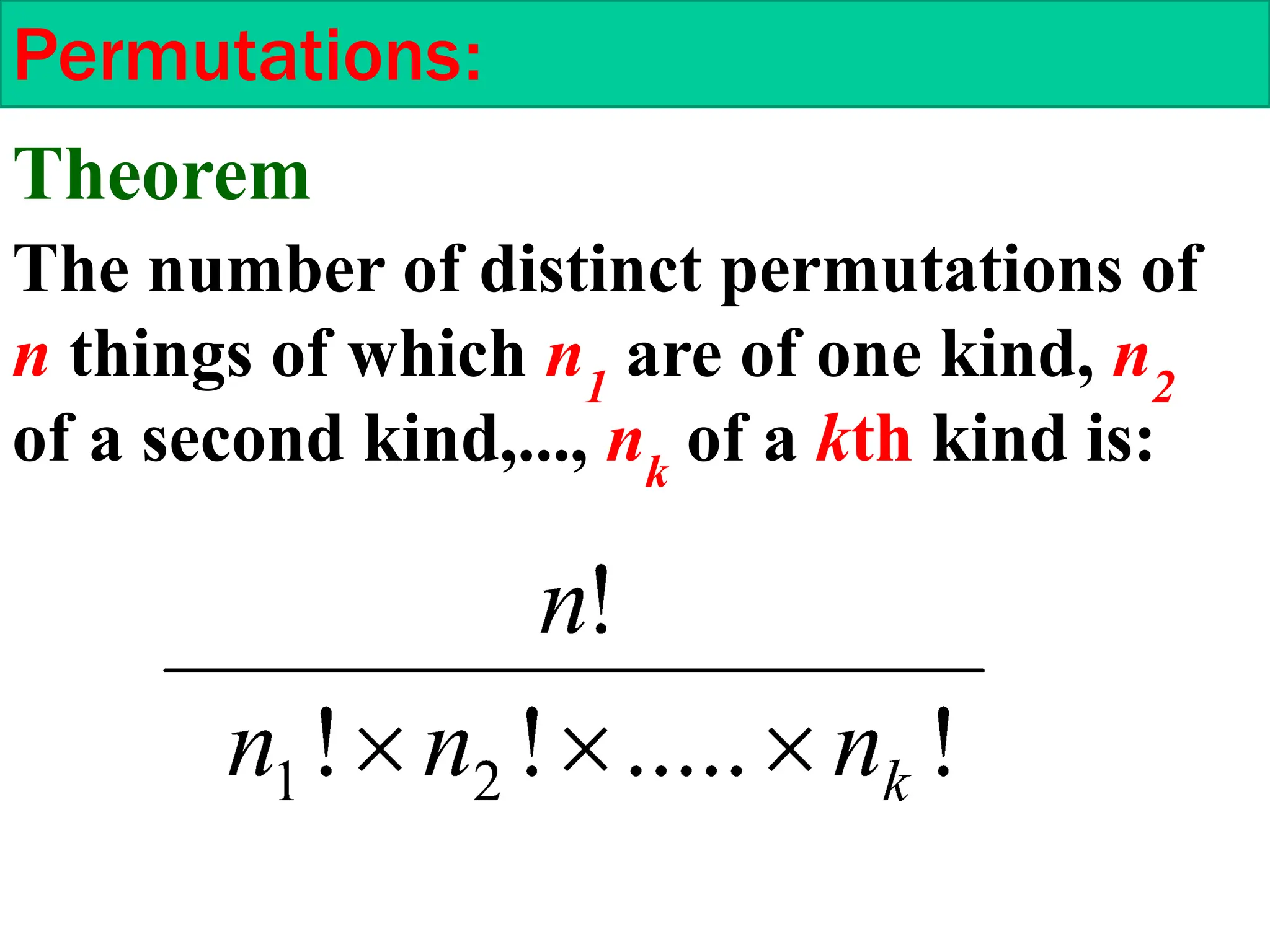
The number of distinct permutations of
n things of which n1
are of one kind, n2
of a second kind,..., nk
of a kth kind is:
Theorem
Permutations (Example 3):
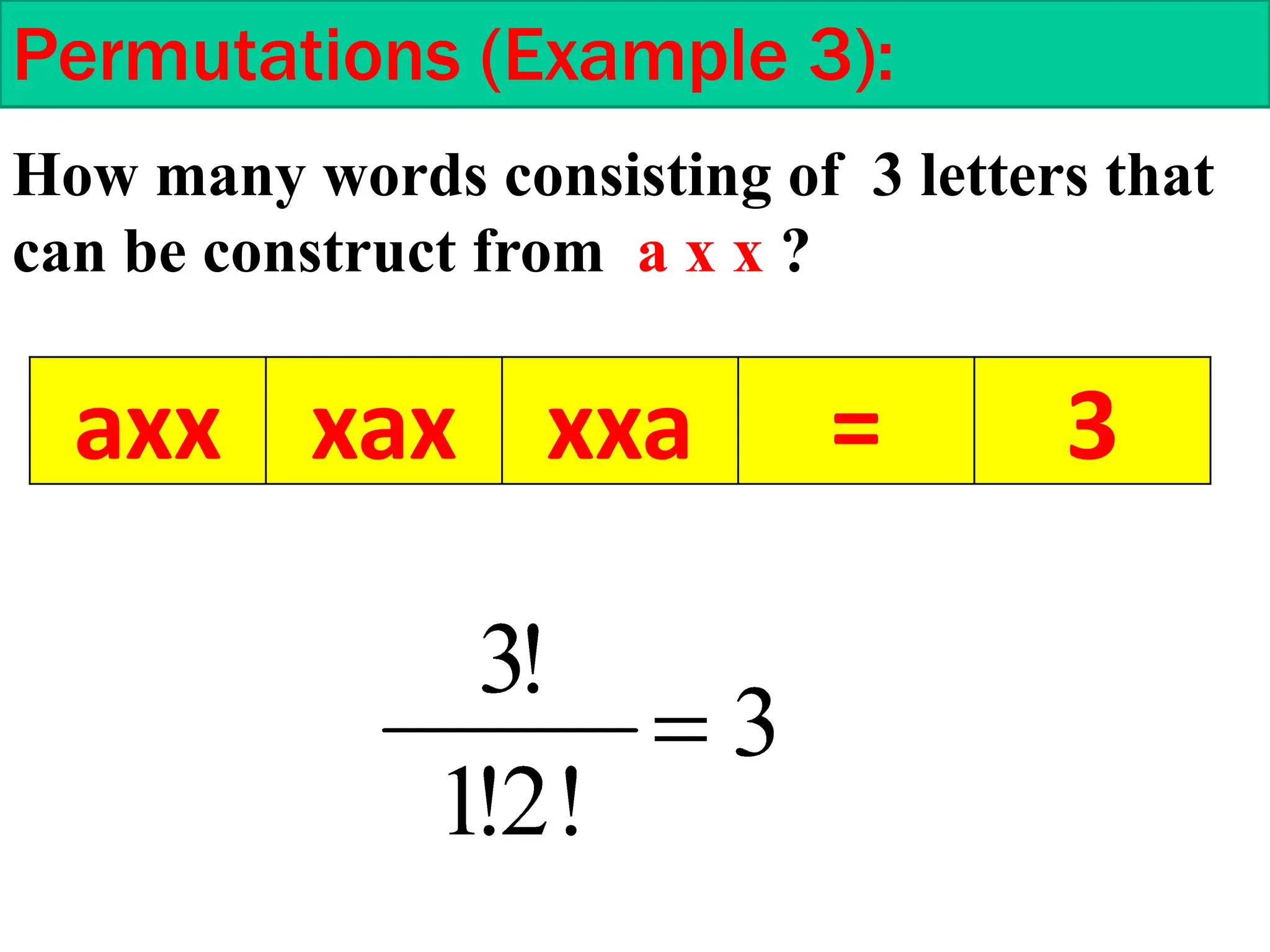
How many words consisting of 3 letters that
can be construct from a x x ?
axx xax xxa = 3
Permutations (Example 4):
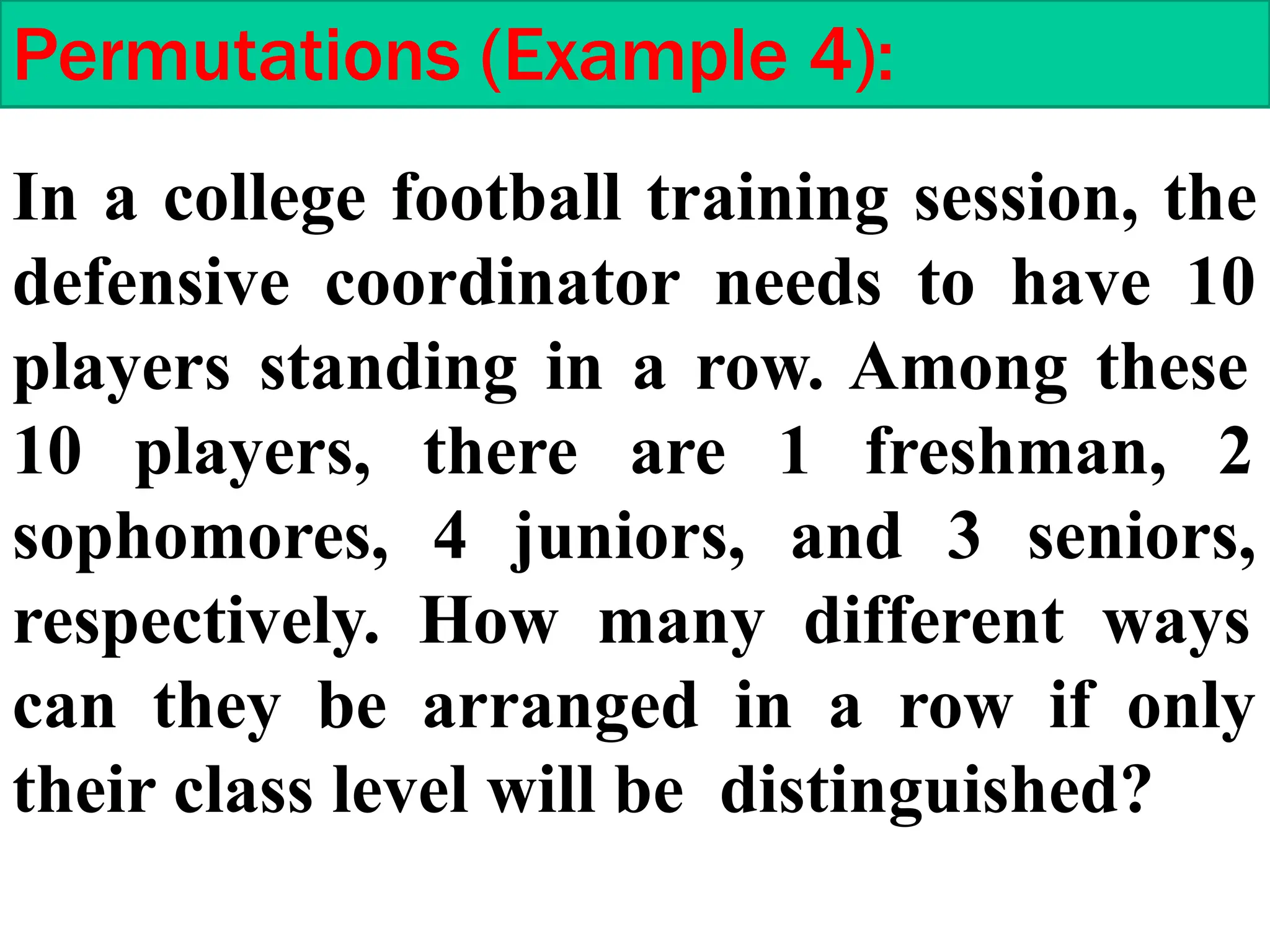
In a college football training session, the
defensive coordinator needs to have 10
players standing in a row. Among these
10 players, there are 1 freshman, 2
sophomores, 4 juniors, and 3 seniors,
respectively. How many different ways
can they be arranged in a row if only
their class level will be distinguished?
Permutations (Example 4):
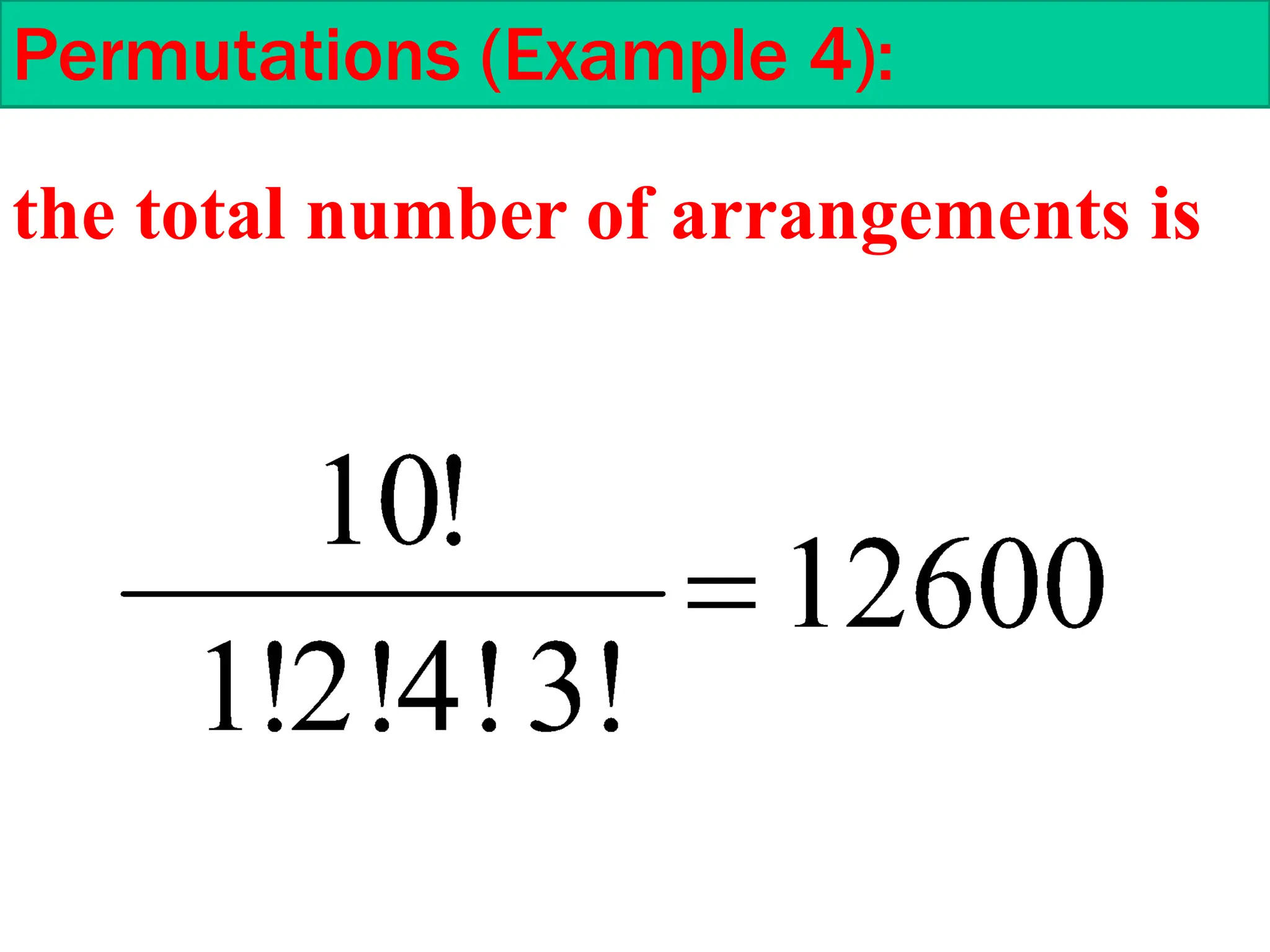
the total number of arrangements is
Permutations :
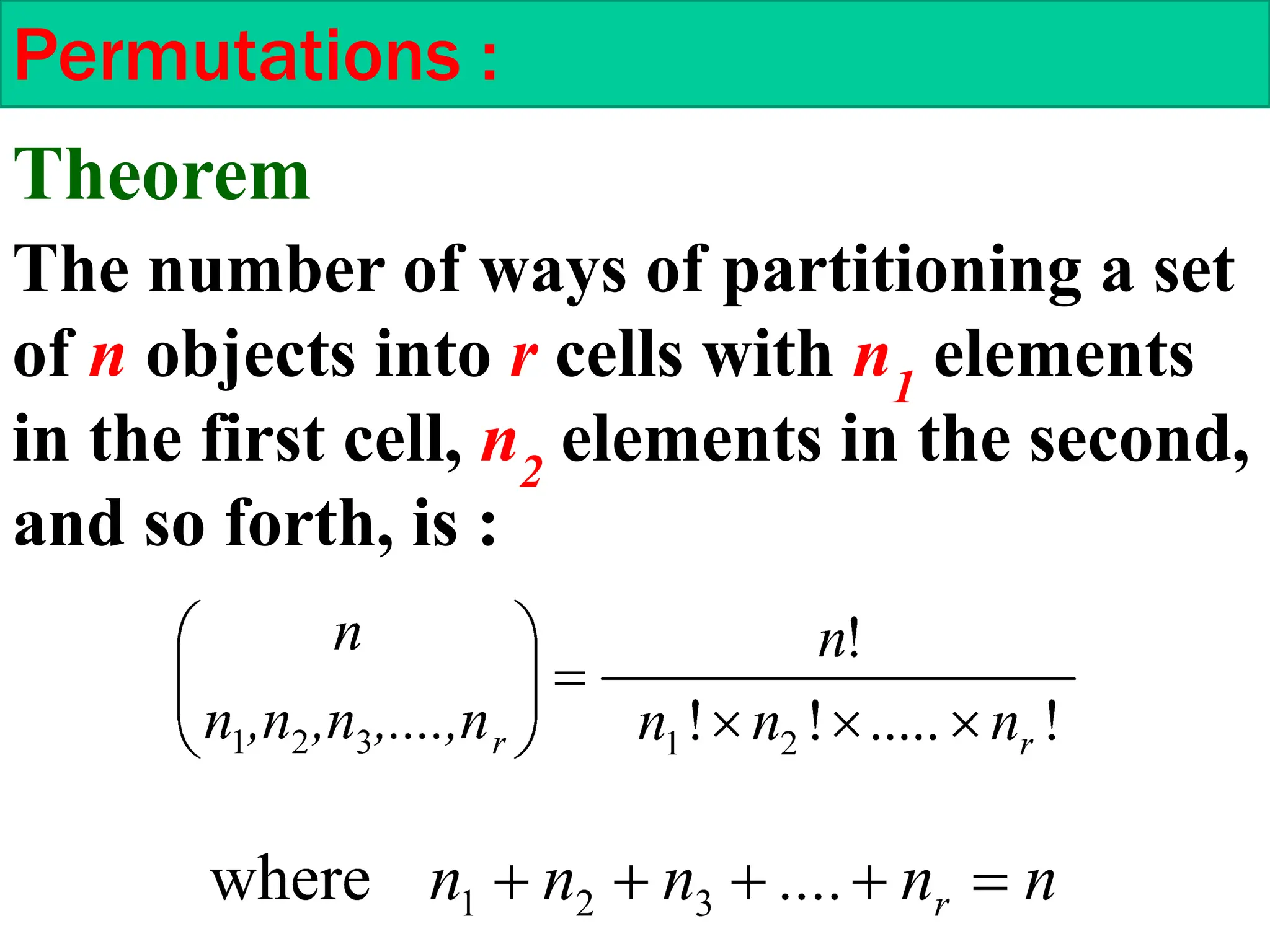
The number of ways of partitioning a set
of n objects into r cells with n1
elements
in the first cell, n2
elements in the second,
and so forth, is :
Theorem
Permutations (Example 5):
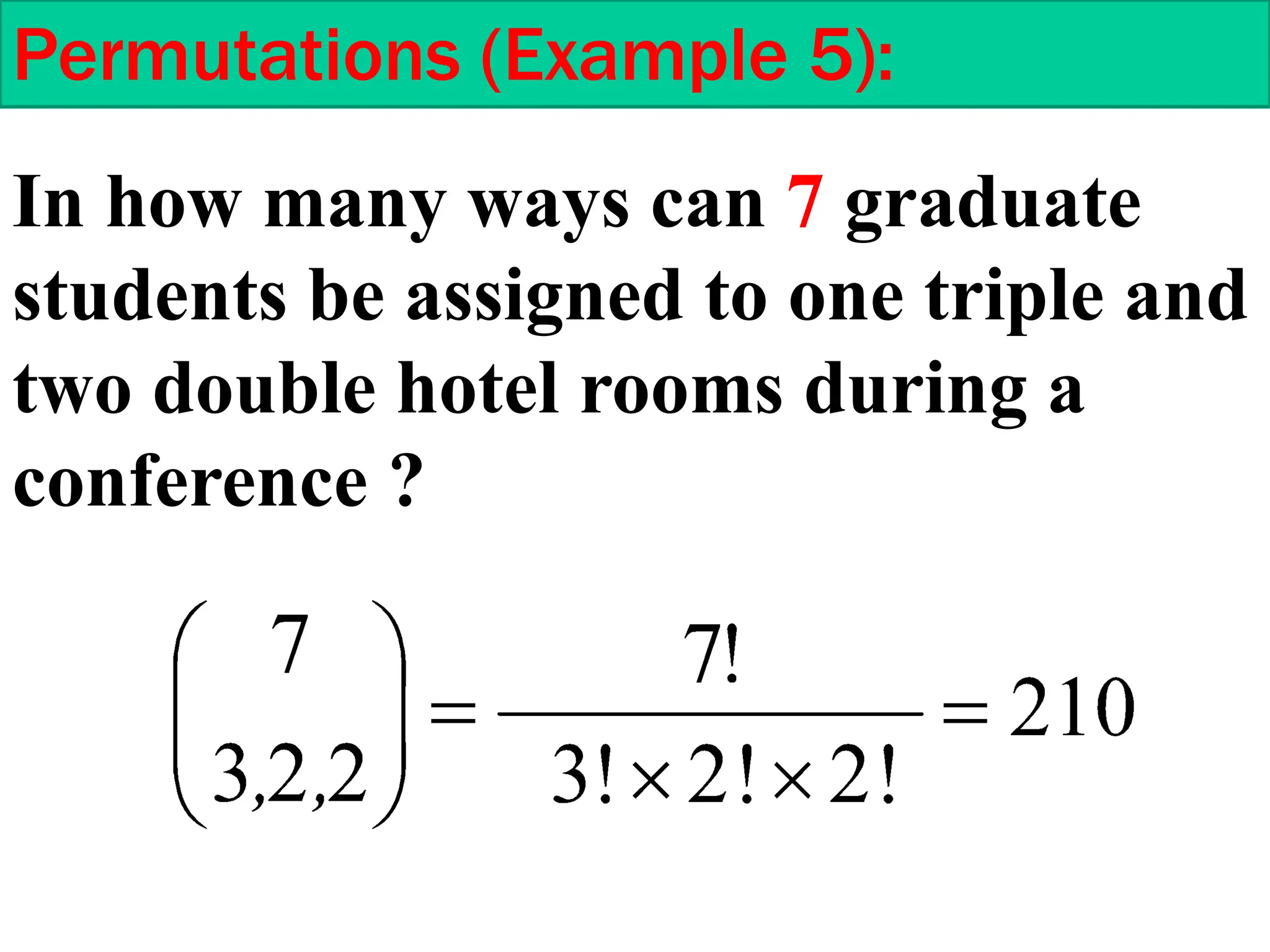
In how many ways can 7 graduate
students be assigned to one triple and
two double hotel rooms during a
conference ?
Combinations:
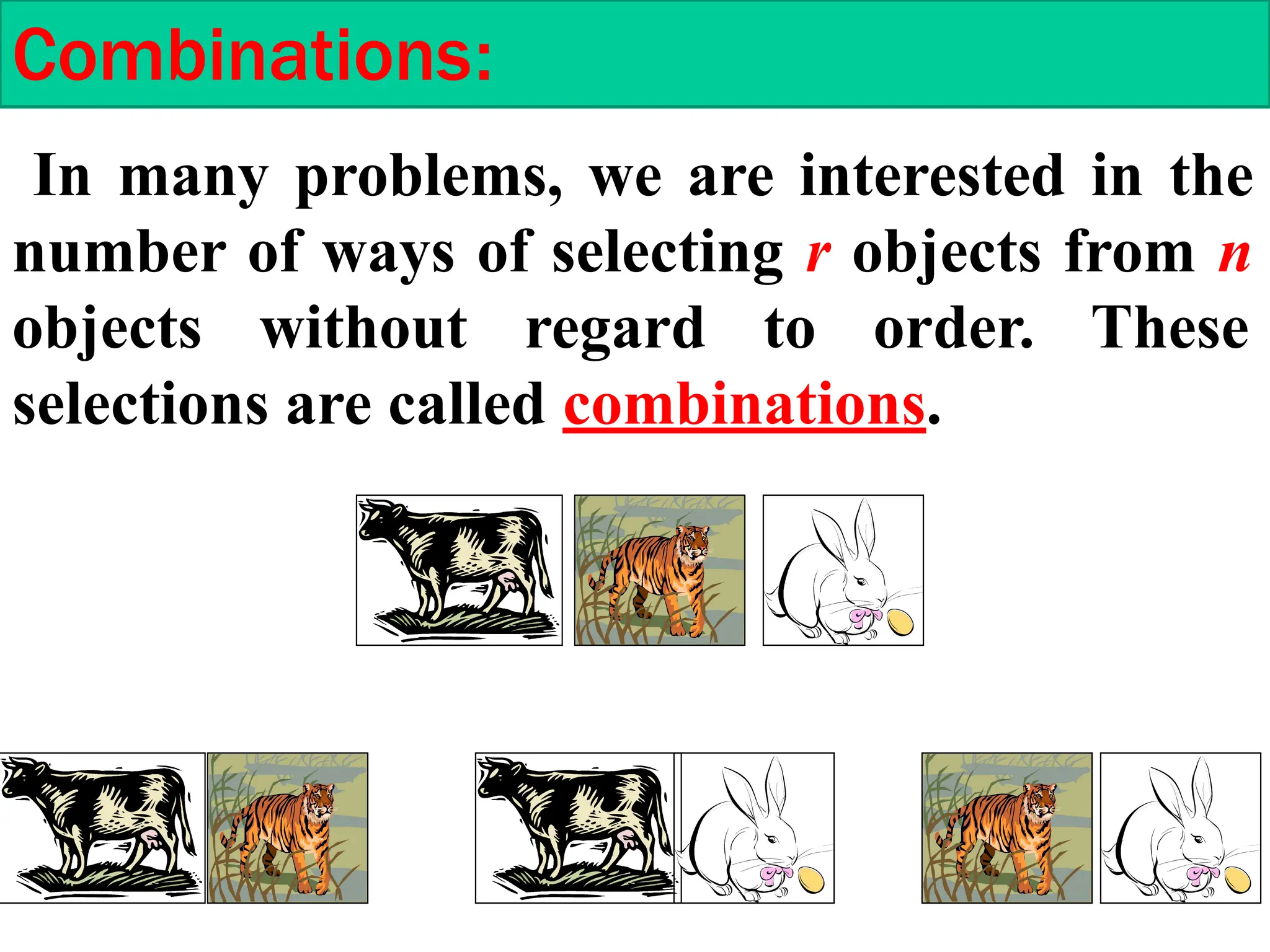
In many problems, we are interested in the
number of ways of selecting r objects from n
objects without regard to order. These
selections are called combinations.
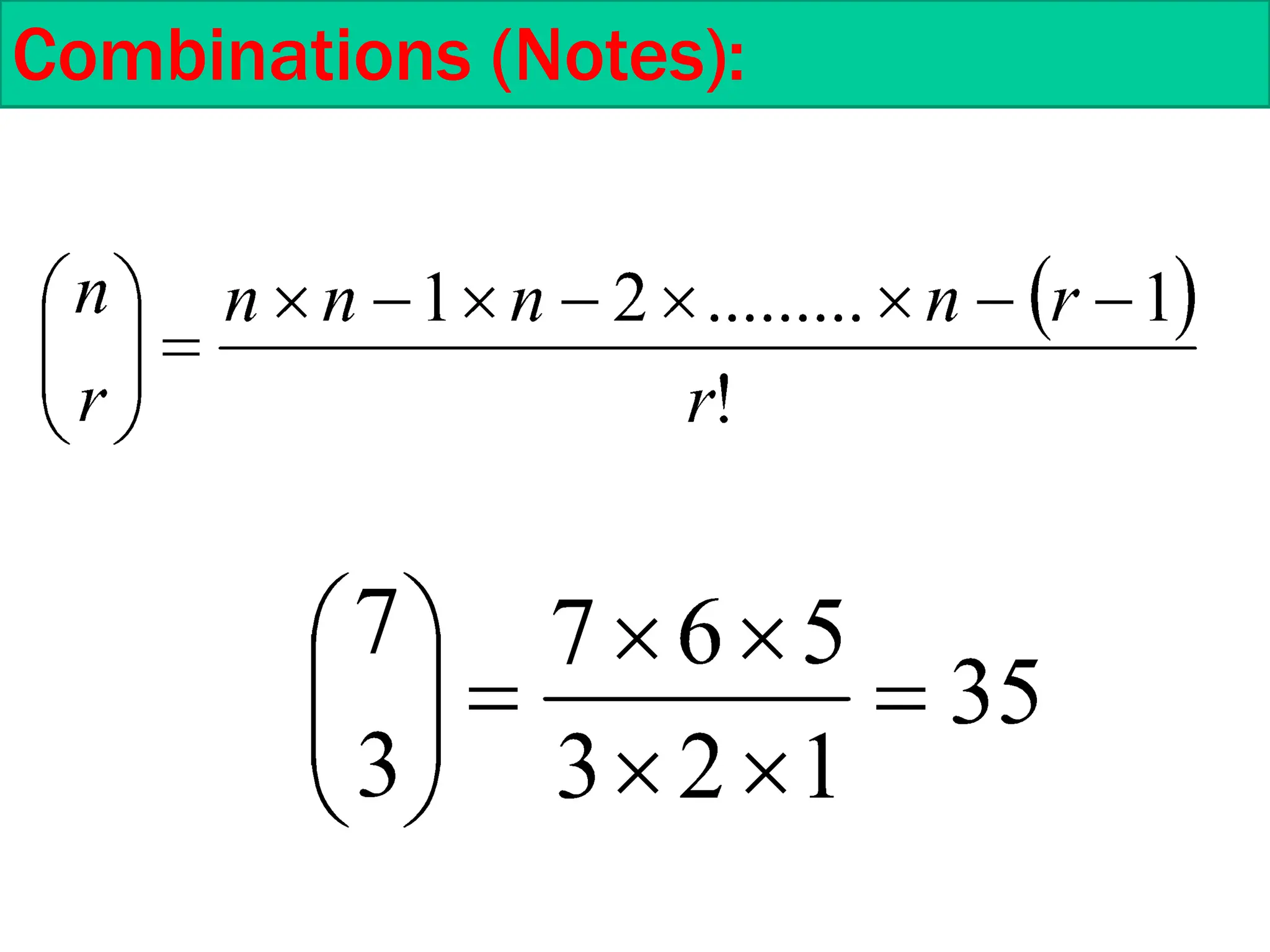
Combinations:
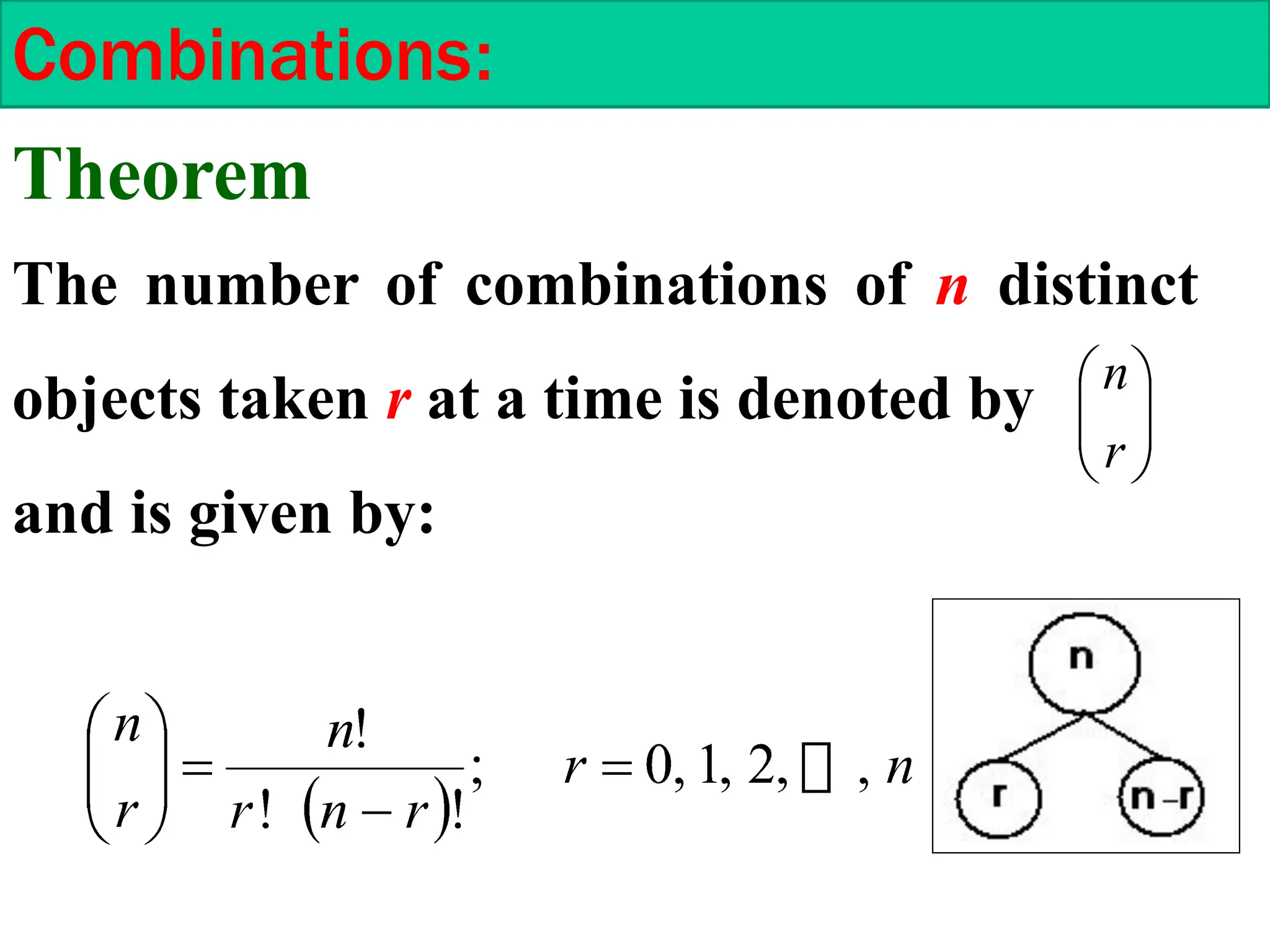
The number of combinations of n distinct
objects taken r at a time is denoted by
and is given by:
Theorem
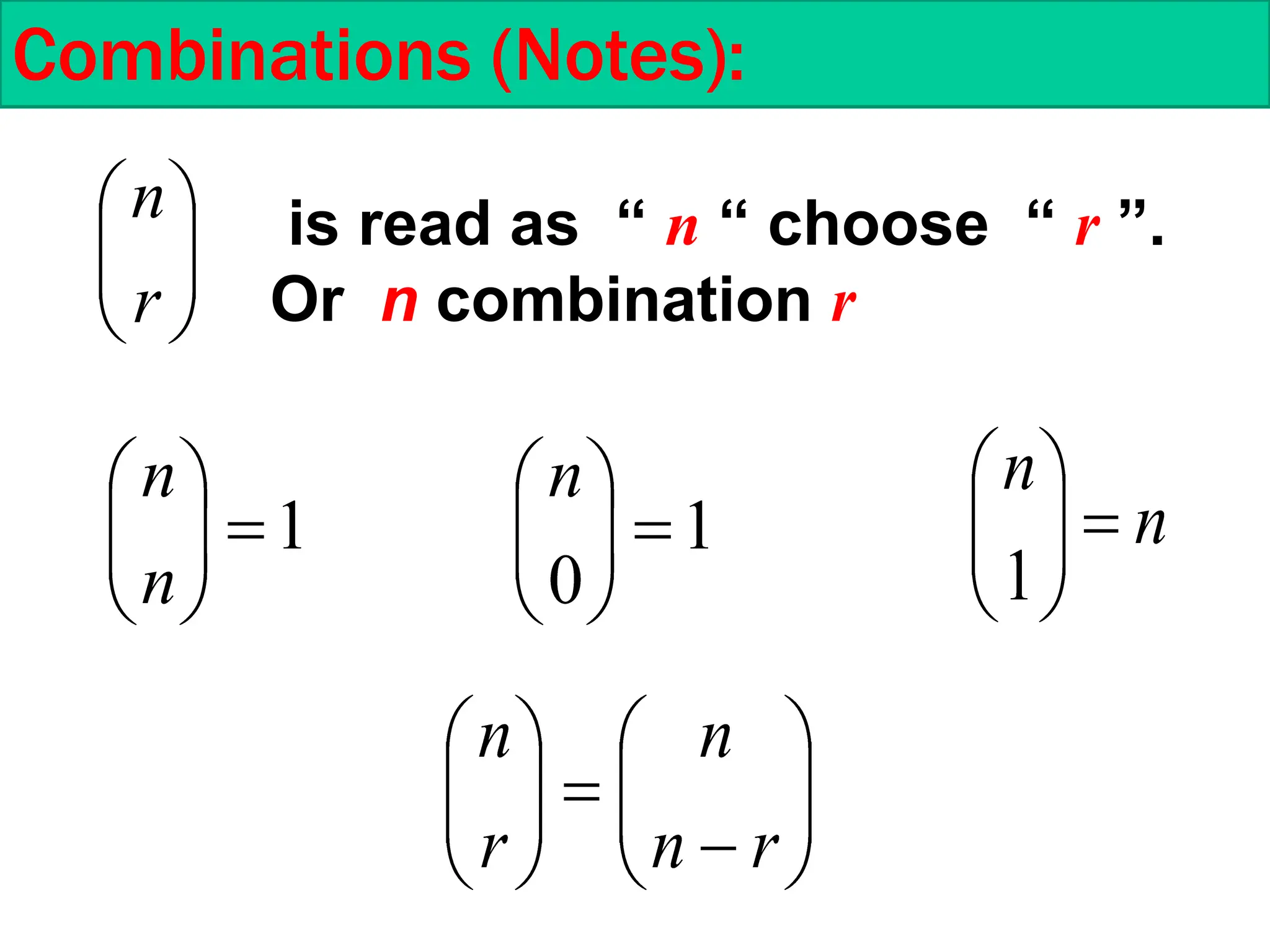
Combinations (Notes):
is read as “ n “ choose “ r ”.
Or n combination r
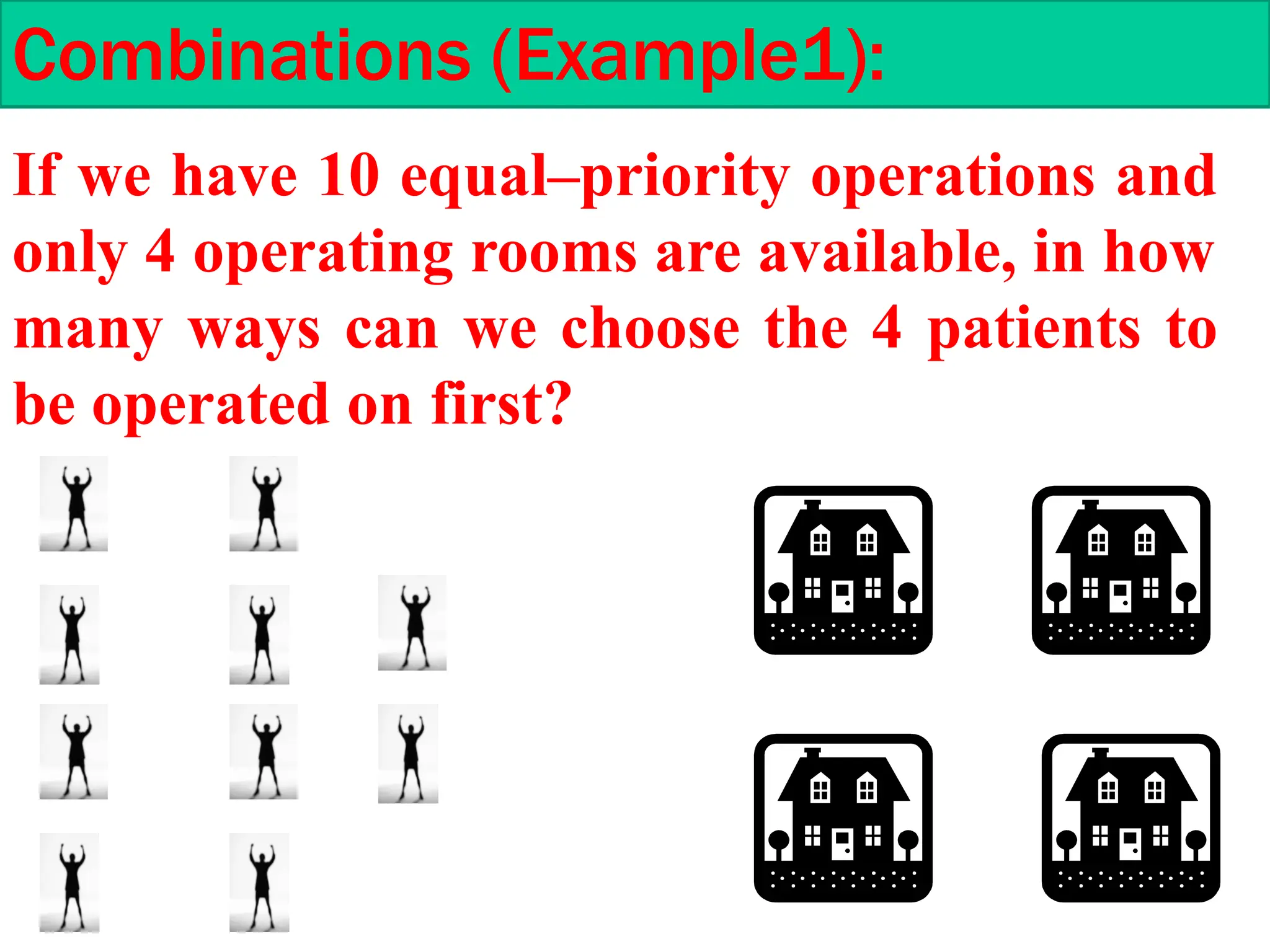
Combinations (Notes):
If we have 10 equal–priority operations and
only 4 operating rooms are available, in how
many ways can we choose the 4 patients to
be operated on first?
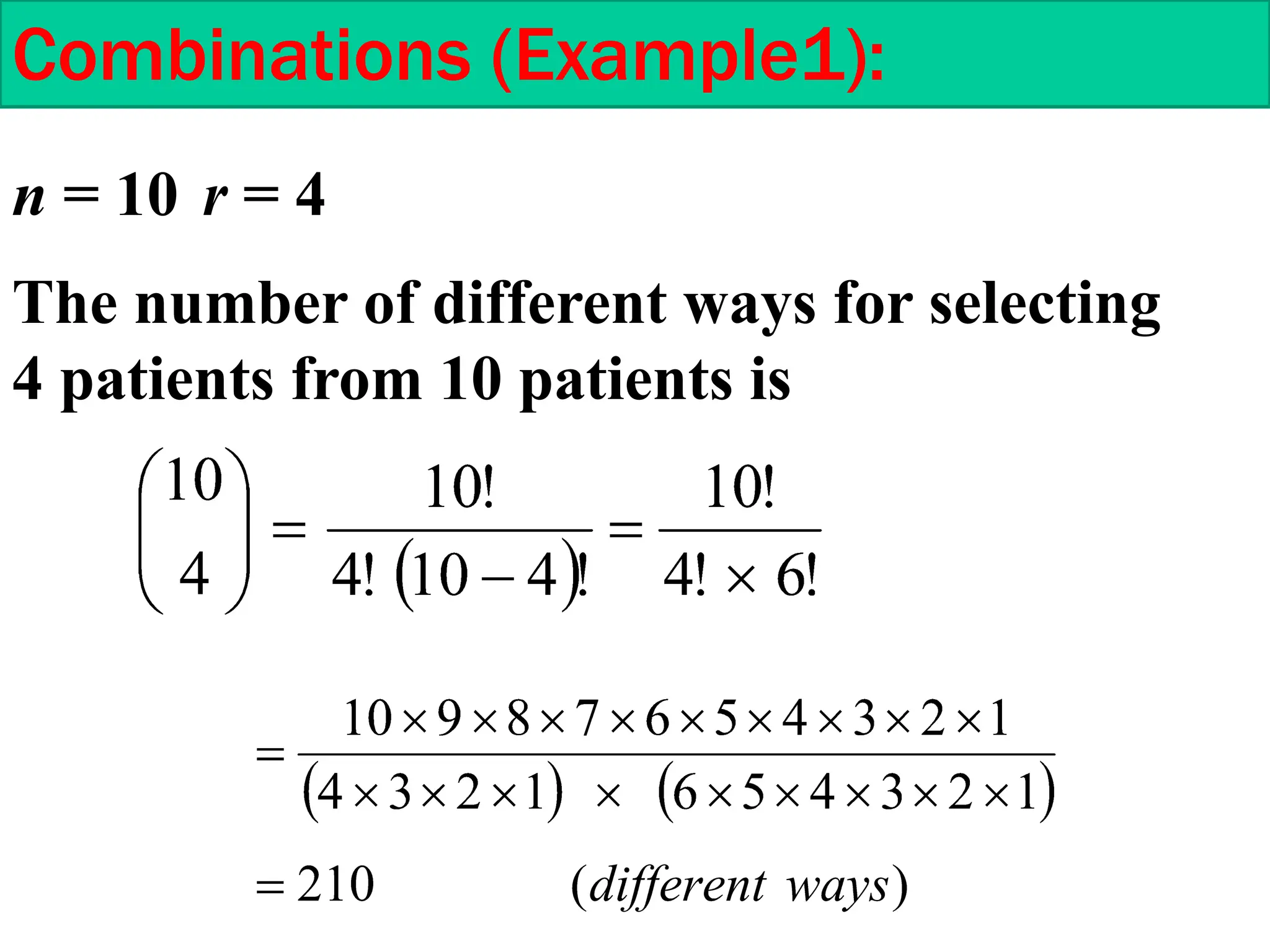
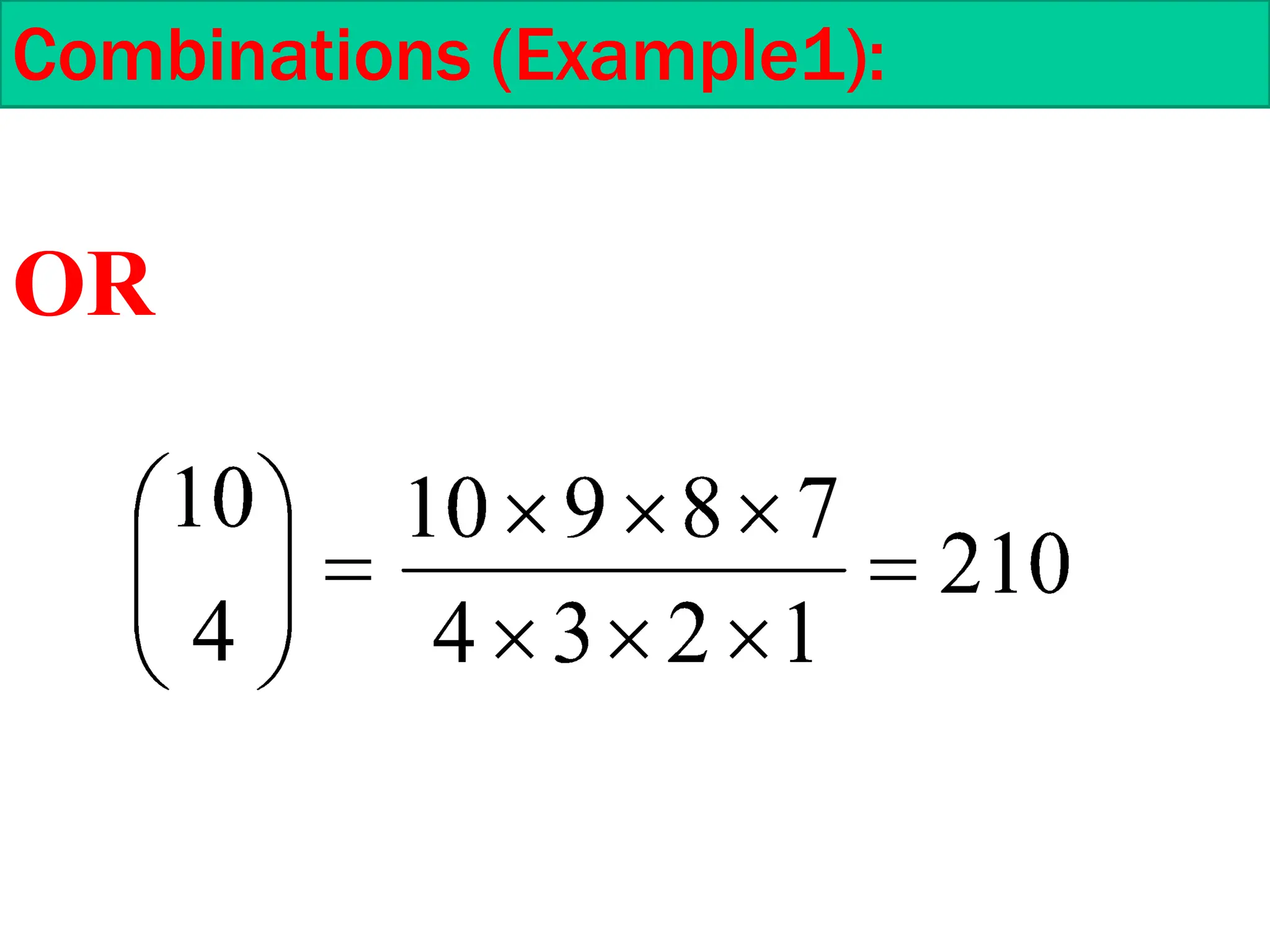
Combinations (Example1):
n = 10 r = 4
The number of different ways for selecting
4 patients from 10 patients is
Combinations (Example1):
OR
Combinations (Example1):
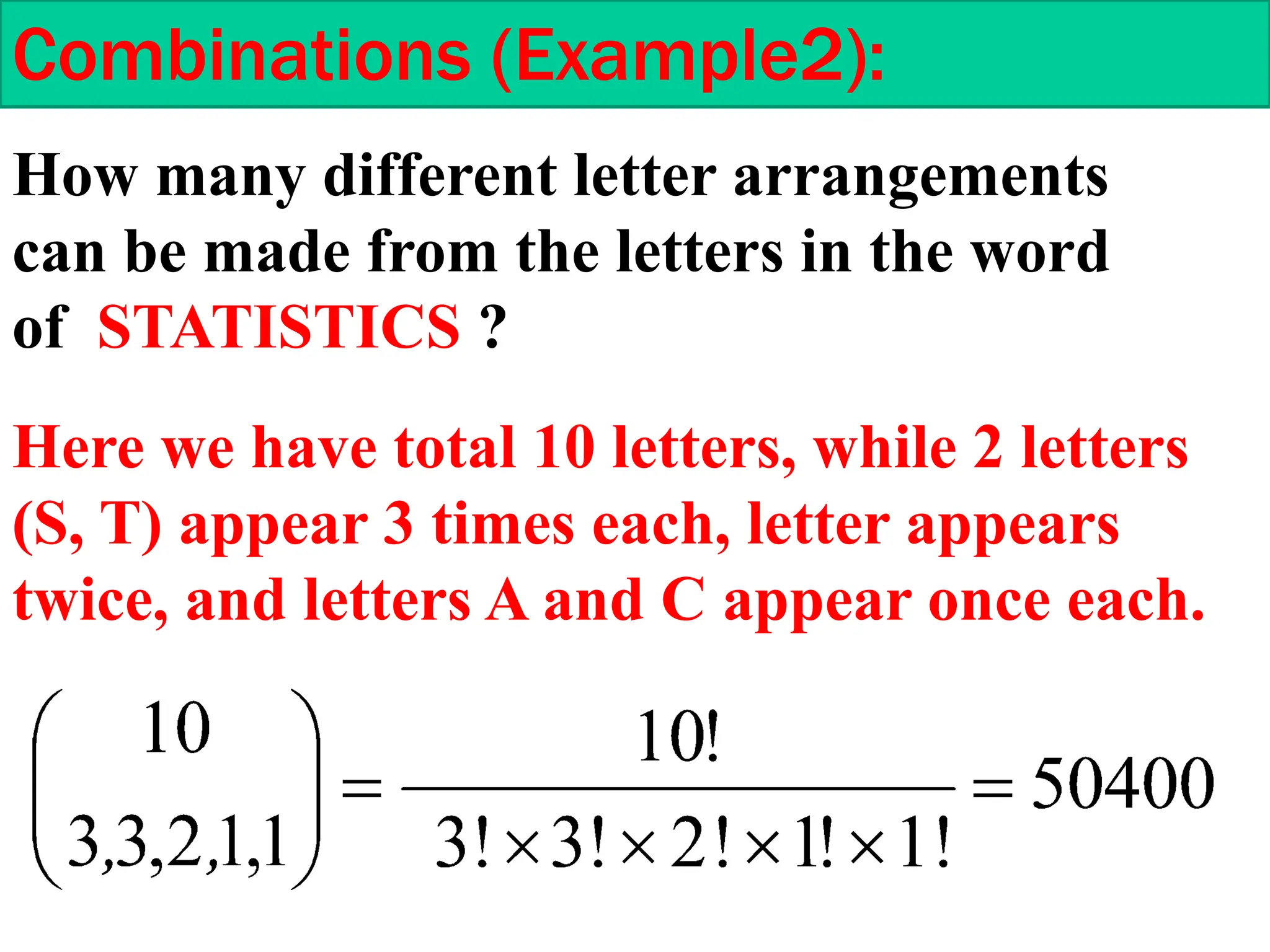
How many different letter arrangements
can be made from the letters in the word
of STATISTICS ?
Combinations (Example2):
Here we have total 10 letters, while 2 letters
(S, T) appear 3 times each, letter appears
twice, and letters A and C appear once each.
Lessonthree Sample space events.pptx.pdf

Lessonthree Sample space events.pptx.pdf

  • 1.
    TAIBAH UNIVERSITY Faculty ofScience .Department of Math ‫طﯾﺑﺔ‬ ‫ﺟﺎﻣﻌﺔ‬ ‫اﻟﺣﺎﺳﺑﺎت‬ ‫وھﻧدﺳﺔ‬ ‫ﻋﻠوم‬ ‫ﻛﻠﯾﺔ‬ ‫ﺑﯾﻧﺑﻊ‬ Probability and Statistics for Engineers STAT 301 Teacher : Dr.Osama Hosam Second Semester 1435/1436
  • 2.
  • 3.
  • 4.
    Is some procedure(or process) that we do and it results in an outcome. An Experiment Is an experiment we do not know its exact outcome in advance but we know the set of all possible outcomes. It is also called statistical experiment A random experiment Statistical Experiment :
  • 5.
    Definition : The setof all possible outcomes of a statistical experiment is called the sample space and is represented by the symbol S. Each outcome (element or member) of the sample space S is called a sample point. The Sample Space:
  • 6.
    The sample spaceof possible outcomes when a coin is tossed, may be written : S= {H,T} where H and T correspond to "heads" and "tails," respectively. The Sample Space (Example 1):
  • 7.
    Consider the experimentof tossing a die . If we are interested in the number that shows on the top face, the sample space would be : S1 = {1,2,3,4,5,6 } The Sample Space (Example 2): S2 = {even,odd} If we are interested only in whether the number is even or odd, the sample space is
  • 8.
    Example 2. illustratesthe fact that : More than one sample space can be used to describe the outcomes of an experiment. In this case S1 provides more information than S2 The Sample Space (Example 2): It is desirable to use a sample space that gives the most information concerning the outcomes of the experiment
  • 9.
    An experiment consistsof flipping a coin and then flipping it a second time if a head occurs. If a tail occurs on the first, flip, then a die is tossed once. The Sample Space (Example 3): To list the elements of the sample space, we construct the tree diagram S= {HH. HT. T1, T2, T3, T4, T5, T6}.
  • 10.
    The Sample Space(Example 3):
  • 11.
    Sample spaces witha large or infinite number of sample points are best described by a statement or Rule Method. The Sample Space (Example 4): If the possible outcomes of an experiment are the set of cities in the world with a. population over 1 million, our sample space is written S = {x | x is a city with a population over 1 million}, which reads "S is the set of all x such that x is a city with a population over 1 million."
  • 12.
    An event Ais a subset of the sample space S. That is A⊆S. We say that an event A occurs if the outcome (the result) of the experiment is an element of A. Events : Definition
  • 13.
    φ⊆S is anevent (φ is called the impossible event) S⊆S is an event (S is called the sure event) Events :
  • 14.
    Given the samplespace S = { t | t > 0 }, where t is the life in years of a certain electronic component . The event A that the component fails before the end of the fifth year is the subset A = { t | 0 < t < 5 }. Events (Example 1) :
  • 15.
    Experiment: Selecting aball from a box containing 6 balls numbered 1,2,3,4,5 and 6. (or tossing a die) Events (Example 2) : This experiment has 6 possible outcomes The sample space is S={1,2,3,4,5,6}.
  • 16.
    Events (Example 2): Consider the following events: E1 = getting an even number ={2,4,6}⊆S E2 = getting a number less than 4={1,2,3}⊆S E3 = getting 1 or 3={1,3}⊆S E4 = getting an odd number={1,3,5}⊆S E5 = getting a negative number={ }=φ ⊆S E6 = getting a number less than 10 ={1,2,3,4,5,6} = S⊆S
  • 17.
    Events : n(S)= no.of outcomes (elements) in S. n(E)= no. of outcomes (elements) in the event E. Notation:
  • 18.
    Experiment: Selecting 3 itemsfrom manufacturing process; each item is inspected and classified as defective (D) or non-defective (N). Events (Example 3) : S={DDD,DDN,DND,DNN,NDD,NDN,NND,NNN} This experiment has 8 possible outcomes
  • 19.
  • 20.
    Events (Example 3): A={at least 2 defectives}= {DDD,DDN,DND,NDD}⊆S B={at most one defective}= {DNN,NDN,NND,NNN}⊆S C={3 defectives}= {DDD}⊆S Consider the following events:
  • 21.
  • 22.
  • 23.
    Operation on Events(Complement) : The complement of an event A with respect to S is the subset of all elements of S that are not in A. We denote the complement, of A by the symbol A` or AC . Definition Ac = {x ∈S: x∉A } Ac occurs if A does not.
  • 24.
    Operation on Events(Complement) : Venn Diagram S
  • 25.
    Operation on Events(Example 1) : Let R be the event that a red card is selected from an ordinary deck of 52 playing cards, and let S be the entire: deck. Then RC is the event that the card selected from the deck is not a red but a black card.
  • 26.
    Operation on Events(Example 2) : Consider the sample space S = {book, catalyst, cigarette, precipitate, engineer, rivet}. Let A = {catalyst, rivet, book, cigarette} Then A' = {precipitate, engineer}.
  • 27.
    Let A andB be two events defined on the sample space S. Operation on Events (Intersection) : Definition The intersection of two events A and B denoted by the symbol A ∩ B, Is the event containing all elements that are common to A and B.
  • 28.
    A∩B = AB= {x ∈S: x∈A and x∈B} A∩B Consists of all points in both A and B. A∩B Occurs if both A and B occur together. Operation on Events (Intersection) :
  • 29.
    S Operation on Events(Intersection) : Venn Diagram
  • 30.
    Operation on Events(Example 1) : Let C be the event that a person selected at random in an Internet cafe is a college student, and let M be the event that the person is a male. Then C∩ M is the event of all male college students in the Internet cafe.
  • 31.
    Operation on Events(Example 2) : Let M = {a ,e,I,o,u} and N = {r, s,t} M ∩ N = φ. M and N have no elements in common and, therefore, cannot both occur simultaneously.
  • 32.
    Two events Aand B are mutually exclusive (or disjoint) if and only if A∩B = φ; that is, A and B have no common elements (they do not occur together). Mutually Exclusive : Definition
  • 33.
    Mutually Exclusive : A∩B≠ φ A and B are not mutually exclusive A∩B = φ A and B are mutually exclusive (disjoint) Venn Diagram
  • 34.
    The union ofthe two events A and B, denoted by the symbol A ∪ B, is the event containing all the elements that belong to A or B or both. Operation on Events (Union) : Definition
  • 35.
    Operation on Events(Union) : A∪B = {x ∈S: x∈A or x∈B } A∪B Consists of all outcomes in A or in B or in both A and B. A∪B Occurs if A occurs, or B occurs, or both A and B occur. That is A∪B Occurs if at least one of A and B occurs.
  • 36.
    Operation on Events(Union) : Venn Diagram S
  • 37.
    Union (Examples) : LetA = {a,b,c} and B = {b,c,d,e} Then A ∪ B = {a,b,c,d,e}. If M = {x | 3 < x < 9} and V = {y 5 < y < 12}, Then M ∪ N = [z | 3 < z < 12}.
  • 38.
  • 39.
  • 40.
  • 41.
  • 42.
  • 43.
  • 44.
  • 45.
  • 46.
    Counting Sample Points: Thereare many counting techniques which can be used to count the number points in the sample space (or in some events) without listing each element. In many cases, we can compute the probability of an event by using the counting techniques.
  • 47.
    Multiplication Rule: If anoperation can be performed in n1 ways , and if for each of these ways a second operation can be performed in n2 ways , then the two operations can be performed together in n1 n2 ways. Theorem
  • 48.
    Multiplication Rule (Example1): How many sample points are: there: in the sample space when a pair of dice is thrown once?
  • 49.
    Multiplication Rule (Example1): The first die can land in any one of n1 =6 ways. For each of these 6 ways the second die can also land in n2 =6 ways. Therefore, the pair of dice can land in: n1 n2 = (6)(6) = 36 possible ways.
  • 50.
  • 51.
    Multiplication Rule: If anoperation can be performed in n1 ways, and if for each of these a second operation can be performed in n2 ways, and for each of the first two a third operation can be performed in n3 ways, and so forth, then the sequence of k operations can be performed in n1 n2 …….. nk ways. Theorem
  • 52.
    Multiplication Rule (Example2): Sam is going to assemble a computer by himself. He has the choice of ordering chips from two brands, a hard drive from four, memory from three, and an accessory bundle from five local stores. How many different, ways can Sam order the parts?
  • 53.
    Multiplication Rule (Example2): Since n1 = 2 , n2 = 4 , n3 = 3 and n4 = 5 There are : n1 × n2 × n3 × n4 = 2 × 4 × 3 × 5 = 120 different ways to order the parts. Solution:
  • 54.
    Multiplication Rule (Example3): How many even four-digit numbers can be formed from the digits 0, 1, 2, 5, 6, and 9 if each digit can be used only once?
  • 55.
    Multiplication Rule (Example3): Since the number must be even, we have only n1 = 3 (0,2,6) choices for the units position Hence we consider the units position by two parts, 0 or not 0. However, for a four-digit number the thousands position cannot be 0 . Solution:
  • 56.
    Multiplication Rule (Example3): if units position is 0 ( i.e. n1 = 1 ) we have n2 = 5 : thousands position. n3 = 4 : hundreds position. n4 = 3 : tens position. Therefore, in this case we have a total of n1 × n2 × n3 × n4 = 1 × 5 × 4 × 3 = 60 even four-digit numbers
  • 57.
  • 58.
    Multiplication Rule (Example3): if units position is not 0 ( i.e. n1 = 2 ) we have n2 = 4 : thousands position. n3 = 4 : hundreds position. n4 = 3 : tens position. Therefore, in this case we have a total of n1 × n2 × n3 × n4 = 2 × 4 × 4 × 3 = 96 even four-digit numbers
  • 59.
  • 60.
    Multiplication Rule (Example3): Since the two cases are mutually exclusive of each other, the total number of even four-digit numbers can be calculated by: 60+96 = 156 even four-digit numbers
  • 61.
    Permutations: A permutation isan arrangement of all or part of a set of objects. Consider the three letters a, b, and c. The possible permutations are: abc, acb,bac, bca, cab, and cba. There are 6 distinct arrangements Definition
  • 62.
    Permutations: We can reachthe same answer if we use multiplication rule: n1 × n2 × n3 = 3 × 2 × 1= 6 permutation
  • 63.
    Permutations (Factorial): In general,n distinct objects can be arranged in n(n - l)(n - 2) • • • (3)(2)(1) ways. This product is called factorial and represents by n! The number of permutations of n objects is n!.
  • 64.
    Permutations: The number ofpermutation of n distinct objects taken r at a time is Theorem
  • 65.
  • 66.
    Permutation (Example 1): Inone year, three awards (research, teaching, and service) will be given for a class of 25 graduate students in a statistics department. If each student can receive at most one award, how many possible selections are there?
  • 67.
    Permutation (Example 1): Sincethe awards are distinguishable, it is a permutation problem. The total number of sample points is
  • 68.
    Permutations (Example 2): Apresident and a treasurer are to be chosen from a student club consisting of 50 people. How many different choices of officers are possible if (a) There are no restrictions; (b) A will serve only if he is president; (c) B and C will serve together or not at all: (d) D and E will not serve together?
  • 69.
    Permutations (Example 2): (a)The total number of choices of the officers if there are no restrictions is:
  • 70.
    Permutations (Example 2): (b)Since A will serve only if he is the president , we have two situations here: (i) A is selected as the president, which yields 49 possible outcomes; President A Treasurer B C . AX AB AC AD … AAX
  • 71.
    Permutations (Example 2): (ii)Officers are selected from the remaining 49 people which has the number of choices Therefore, the total number of choices is:
  • 72.
    Permutations (Example 2): (C)The number of selections when B and C serve together is 2 The number of selections when both B and C are not chosen is : BC CB Therefore, the total number of choices is:
  • 73.
    Permutations (Example 2): (i)The number of selections when D serves as an officer but not E is (2) (48) = 96 President D Treasurer 48 E not Exist Treasurer D President 48 E not Exist + (ii) The number of selections when E serves as an officer but not D is also (2) (48) = 96
  • 74.
    Permutations (Example 2): (iii)The number of selections when both D and E are not chosen is Therefore, the total number of choices is: OR: Since D and E can only serve together in 2 ways, the answer is 2450 - 2 = 2448.
  • 75.
    Permutations: The number ofdistinct permutations of n things of which n1 are of one kind, n2 of a second kind,..., nk of a kth kind is: Theorem
  • 76.
    Permutations (Example 3): Howmany words consisting of 3 letters that can be construct from a x x ? axx xax xxa = 3
  • 77.
    Permutations (Example 4): Ina college football training session, the defensive coordinator needs to have 10 players standing in a row. Among these 10 players, there are 1 freshman, 2 sophomores, 4 juniors, and 3 seniors, respectively. How many different ways can they be arranged in a row if only their class level will be distinguished?
  • 78.
    Permutations (Example 4): thetotal number of arrangements is
  • 79.
    Permutations : The numberof ways of partitioning a set of n objects into r cells with n1 elements in the first cell, n2 elements in the second, and so forth, is : Theorem
  • 80.
    Permutations (Example 5): Inhow many ways can 7 graduate students be assigned to one triple and two double hotel rooms during a conference ?
  • 81.
    Combinations: In many problems,we are interested in the number of ways of selecting r objects from n objects without regard to order. These selections are called combinations.
  • 82.
    Combinations: The number ofcombinations of n distinct objects taken r at a time is denoted by and is given by: Theorem
  • 83.
    Combinations (Notes): is readas “ n “ choose “ r ”. Or n combination r
  • 84.
  • 85.
    If we have10 equal–priority operations and only 4 operating rooms are available, in how many ways can we choose the 4 patients to be operated on first? Combinations (Example1):
  • 86.
    n = 10r = 4 The number of different ways for selecting 4 patients from 10 patients is Combinations (Example1):
  • 87.
  • 88.
    How many differentletter arrangements can be made from the letters in the word of STATISTICS ? Combinations (Example2): Here we have total 10 letters, while 2 letters (S, T) appear 3 times each, letter appears twice, and letters A and C appear once each.