Lessons Learned

 Corporate Finance
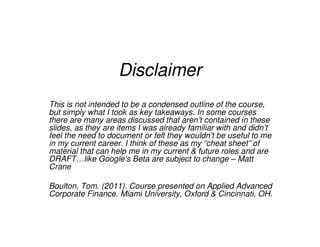
Disclaimer
This is not intended to be a condensed outline of the course,
but simply what I took as key takeaways. In some courses
there are many areas discussed that aren’t contained in these
slides, as they are items I was already familiar with and didn’t
feel the need to document or felt they wouldn’t be useful to me
in my current career. I think of these as my “cheat sheet” of
material that can help me in my current & future roles and are
DRAFT…like Google’s Beta are subject to change – Matt
Crane

Boulton, Tom. (2011). Course presented on Applied Advanced
Corporate Finance. Miami University, Oxford & Cincinnati, OH.
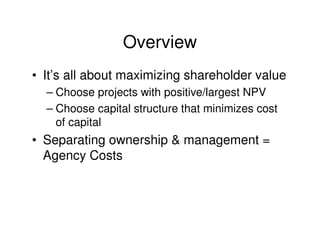
Overview
• It’s all about maximizing shareholder value
  – Choose projects with positive/largest NPV
  – Choose capital structure that minimizes cost
    of capital
• Separating ownership & management =
  Agency Costs
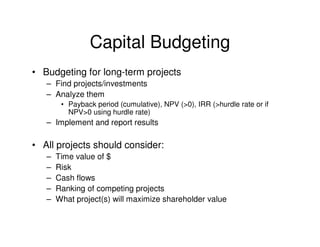
Capital Budgeting
• Budgeting for long-term projects
   – Find projects/investments
   – Analyze them
        • Payback period (cumulative), NPV (>0), IRR (>hurdle rate or if
          NPV>0 using hurdle rate)
   – Implement and report results

• All projects should consider:
   –   Time value of $
   –   Risk
   –   Cash flows
   –   Ranking of competing projects
   –   What project(s) will maximize shareholder value
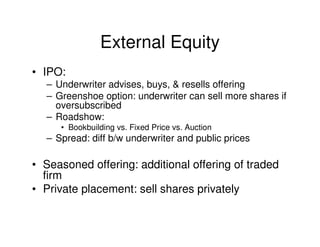
External Equity
• IPO:
  – Underwriter advises, buys, & resells offering
  – Greenshoe option: underwriter can sell more shares if
    oversubscribed
  – Roadshow:
     • Bookbuilding vs. Fixed Price vs. Auction
  – Spread: diff b/w underwriter and public prices

• Seasoned offering: additional offering of traded
  firm
• Private placement: sell shares privately
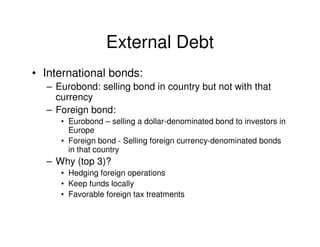
External Debt
• International bonds:
  – Eurobond: selling bond in country but not with that
    currency
  – Foreign bond:
     • Eurobond – selling a dollar-denominated bond to investors in
       Europe
     • Foreign bond - Selling foreign currency-denominated bonds
       in that country
  – Why (top 3)?
     • Hedging foreign operations
     • Keep funds locally
     • Favorable foreign tax treatments
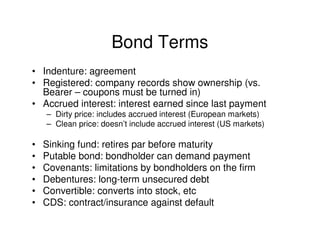
Bond Terms
• Indenture: agreement
• Registered: company records show ownership (vs.
  Bearer – coupons must be turned in)
• Accrued interest: interest earned since last payment
    – Dirty price: includes accrued interest (European markets)
    – Clean price: doesn’t include accrued interest (US markets)

•   Sinking fund: retires par before maturity
•   Putable bond: bondholder can demand payment
•   Covenants: limitations by bondholders on the firm
•   Debentures: long-term unsecured debt
•   Convertible: converts into stock, etc
•   CDS: contract/insurance against default
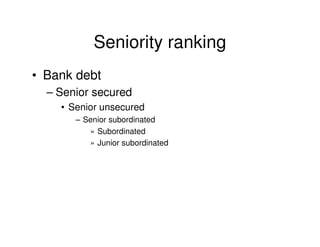
Seniority ranking
• Bank debt
  – Senior secured
    • Senior unsecured
       – Senior subordinated
          » Subordinated
          » Junior subordinated
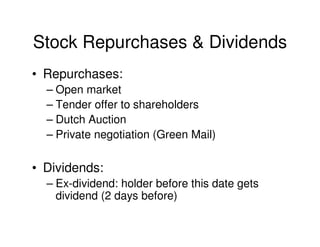
Stock Repurchases & Dividends
• Repurchases:
  – Open market
  – Tender offer to shareholders
  – Dutch Auction
  – Private negotiation (Green Mail)

• Dividends:
  – Ex-dividend: holder before this date gets
    dividend (2 days before)
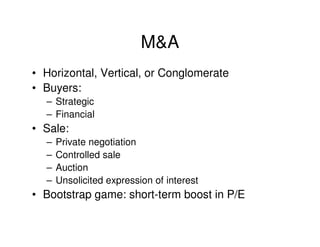
M&A
• Horizontal, Vertical, or Conglomerate
• Buyers:
  – Strategic
  – Financial
• Sale:
  –   Private negotiation
  –   Controlled sale
  –   Auction
  –   Unsolicited expression of interest
• Bootstrap game: short-term boost in P/E
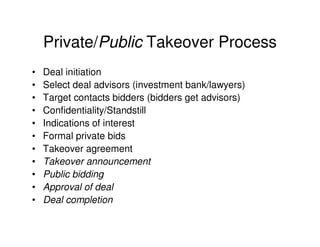
Private/Public Takeover Process
•   Deal initiation
•   Select deal advisors (investment bank/lawyers)
•   Target contacts bidders (bidders get advisors)
•   Confidentiality/Standstill
•   Indications of interest
•   Formal private bids
•   Takeover agreement
•   Takeover announcement
•   Public bidding
•   Approval of deal
•   Deal completion
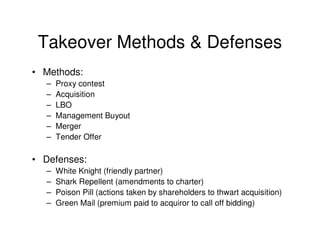
Takeover Methods & Defenses
• Methods:
  –   Proxy contest
  –   Acquisition
  –   LBO
  –   Management Buyout
  –   Merger
  –   Tender Offer

• Defenses:
  –   White Knight (friendly partner)
  –   Shark Repellent (amendments to charter)
  –   Poison Pill (actions taken by shareholders to thwart acquisition)
  –   Green Mail (premium paid to acquiror to call off bidding)
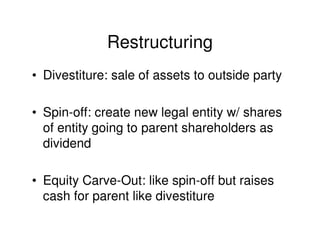
Restructuring
• Divestiture: sale of assets to outside party

• Spin-off: create new legal entity w/ shares
  of entity going to parent shareholders as
  dividend

• Equity Carve-Out: like spin-off but raises
  cash for parent like divestiture
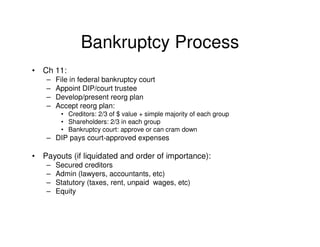
Bankruptcy Process
•   Ch 11:
     –   File in federal bankruptcy court
     –   Appoint DIP/court trustee
     –   Develop/present reorg plan
     –   Accept reorg plan:
          • Creditors: 2/3 of $ value + simple majority of each group
          • Shareholders: 2/3 in each group
          • Bankruptcy court: approve or can cram down
     – DIP pays court-approved expenses

•   Payouts (if liquidated and order of importance):
     –   Secured creditors
     –   Admin (lawyers, accountants, etc)
     –   Statutory (taxes, rent, unpaid wages, etc)
     –   Equity

Lessons learned corporate finance - s5

  • 1.
  • 2.
    Disclaimer This is notintended to be a condensed outline of the course, but simply what I took as key takeaways. In some courses there are many areas discussed that aren’t contained in these slides, as they are items I was already familiar with and didn’t feel the need to document or felt they wouldn’t be useful to me in my current career. I think of these as my “cheat sheet” of material that can help me in my current & future roles and are DRAFT…like Google’s Beta are subject to change – Matt Crane Boulton, Tom. (2011). Course presented on Applied Advanced Corporate Finance. Miami University, Oxford & Cincinnati, OH.
  • 3.
    Overview • It’s allabout maximizing shareholder value – Choose projects with positive/largest NPV – Choose capital structure that minimizes cost of capital • Separating ownership & management = Agency Costs
  • 4.
    Capital Budgeting • Budgetingfor long-term projects – Find projects/investments – Analyze them • Payback period (cumulative), NPV (>0), IRR (>hurdle rate or if NPV>0 using hurdle rate) – Implement and report results • All projects should consider: – Time value of $ – Risk – Cash flows – Ranking of competing projects – What project(s) will maximize shareholder value
  • 5.
    External Equity • IPO: – Underwriter advises, buys, & resells offering – Greenshoe option: underwriter can sell more shares if oversubscribed – Roadshow: • Bookbuilding vs. Fixed Price vs. Auction – Spread: diff b/w underwriter and public prices • Seasoned offering: additional offering of traded firm • Private placement: sell shares privately
  • 6.
    External Debt • Internationalbonds: – Eurobond: selling bond in country but not with that currency – Foreign bond: • Eurobond – selling a dollar-denominated bond to investors in Europe • Foreign bond - Selling foreign currency-denominated bonds in that country – Why (top 3)? • Hedging foreign operations • Keep funds locally • Favorable foreign tax treatments
  • 7.
    Bond Terms • Indenture:agreement • Registered: company records show ownership (vs. Bearer – coupons must be turned in) • Accrued interest: interest earned since last payment – Dirty price: includes accrued interest (European markets) – Clean price: doesn’t include accrued interest (US markets) • Sinking fund: retires par before maturity • Putable bond: bondholder can demand payment • Covenants: limitations by bondholders on the firm • Debentures: long-term unsecured debt • Convertible: converts into stock, etc • CDS: contract/insurance against default
  • 8.
    Seniority ranking • Bankdebt – Senior secured • Senior unsecured – Senior subordinated » Subordinated » Junior subordinated
  • 9.
    Stock Repurchases &Dividends • Repurchases: – Open market – Tender offer to shareholders – Dutch Auction – Private negotiation (Green Mail) • Dividends: – Ex-dividend: holder before this date gets dividend (2 days before)
  • 10.
    M&A • Horizontal, Vertical,or Conglomerate • Buyers: – Strategic – Financial • Sale: – Private negotiation – Controlled sale – Auction – Unsolicited expression of interest • Bootstrap game: short-term boost in P/E
  • 11.
    Private/Public Takeover Process • Deal initiation • Select deal advisors (investment bank/lawyers) • Target contacts bidders (bidders get advisors) • Confidentiality/Standstill • Indications of interest • Formal private bids • Takeover agreement • Takeover announcement • Public bidding • Approval of deal • Deal completion
  • 12.
    Takeover Methods &Defenses • Methods: – Proxy contest – Acquisition – LBO – Management Buyout – Merger – Tender Offer • Defenses: – White Knight (friendly partner) – Shark Repellent (amendments to charter) – Poison Pill (actions taken by shareholders to thwart acquisition) – Green Mail (premium paid to acquiror to call off bidding)
  • 13.
    Restructuring • Divestiture: saleof assets to outside party • Spin-off: create new legal entity w/ shares of entity going to parent shareholders as dividend • Equity Carve-Out: like spin-off but raises cash for parent like divestiture
  • 14.
    Bankruptcy Process • Ch 11: – File in federal bankruptcy court – Appoint DIP/court trustee – Develop/present reorg plan – Accept reorg plan: • Creditors: 2/3 of $ value + simple majority of each group • Shareholders: 2/3 in each group • Bankruptcy court: approve or can cram down – DIP pays court-approved expenses • Payouts (if liquidated and order of importance): – Secured creditors – Admin (lawyers, accountants, etc) – Statutory (taxes, rent, unpaid wages, etc) – Equity