Prayer
Loving Father,
Come be with us today
Fill our hearts with joy
Fill our minds with learning
Fill our lessons with fun
Fill our friendships with kindness
Fill our school with love
Help us grow in love and kindness more like Jesus everyday
Amen.
TYPES OF SPEECH
STYLES
TYPES OF SPEECH
STYLES
1) Frozen style
2) Formal style
3) Consultative style
4) Casual style
5) Intimate style
1) FROZEN STYLE
 Also known as fixed speech
 It is the most formal communicative style that is
often used in respectful situation or formal
ceremony
 As most highly formal style, it uses the complex
grammatical sentence structure and vocabulary
known only to experts in a particular field
 It invites the reader to enter into a personal
experience of creative discovery such as literary
2) FORMAL
STYLE
– Most often seen in writing than in speaking
– This speech style is expected to be presented in
complete sentences with specific word usage
– Its usually elaborate complex sentences and noun
phrases are well structured, logically sequenced, and
strongly coherent
3) CONSULTATIVE
STYLE
–It is unplanned speech
–This speech style uses listener participation and
feedback
–The two defining features of this style are:
(a)the speaker supplies background information
(b)the listener participates continuously
–Less appropriate for writing
4) CASUAL OR INFORMAL
STYLE
– This style is used in conversations between friends
and insiders who have something to share and
have shared background information
– There is free and easy participation of both
speaker and listener
– The use of language is general
4) CASUAL OR INFORMAL
STYLE
– A simple greeting with those you know well
might probably be the causal:
– “Hi”
– “Hey”
– “What’s up?”
– “How is it going?”
– “How do you do?”
– “Nice to meet you, Mr./Mrs./Ms., Dr., Rev.”
– “ Will you please excuse me for a moment?”
– “Excuse me”
4) CASUAL OR INFORMAL
STYLE
allows the use of slang, profanity, and
unconventional English words
– The diction or vocabulary is informal (colloquial)
– Some of the vocabulary used only in casual
situations are:
– “dude” (a person)
– “freaking out” (getting scared)
– “nope” (no)
– “puke” (throw up)
4) CASUAL OR INFORMAL
STYLE
– Its casual language uses words or phrases
that are shortened like:
– “I’m doin’ it my way” (doing)
– “Lemme go!” (let me go)
– “Watcha gonna do?” (What are you going to
do?)
– “Whassup?” (What’s up?)
5) INTIMATE
STYLE
– This style is used in conversations between
people who are very close and know each other
quite well because having a maximum of
shared background information
– It is characterized by an economy of words,
with a high incidence of significant nonverbal
communication, such as gesture, facial
expression, eye contact and so on.
1) It is also known as fixed
speech.
a) Frozen Speech
b) Formal Speech
c) Consultative Speech
d) Intimate Speech
e) Casual/ Informal Speech
2) It is the type of speech
style that uses formal words
and expressions.
a) Frozen Speech
b) Formal Speech
c) Consultative Speech
d) Intimate Speech
e) Casual/ Informal Speech
3) This speech style uses
listener participation and
feedback.
a) Frozen Speech
b) Formal Speech
c) Consultative Speech
d) Intimate Speech
e) Casual/ Informal Speech
4) This style is used in conversations
between people who are very close and
know each other quite well.
a) Frozen Speech
b) Formal Speech
c) Consultative Speech
d) Intimate Speech
e) Casual/ Informal Speech
5) This style is used in conversations
between friends and insiders who have
something to share and have shared
background information.
a) Frozen Speech
b) Formal Speech
c) Consultative Speech
d) Intimate Speech
e) Casual/ Informal Speech
6) Frozen speech is the most______
__________style that is often used in
respectful situation or formal
ceremony.
a) formal communicative
b) fixed speech
c) complex grammar
d) creative discovery
7) The following sentences describes
casual or informal style EXCEPT ONE.
Which is it?
a) Casual or informal style have ellipsis,
allows the use of slang, profanity, and
unconventional English words.
b) This speech style uses listener participation
and feedback
c) A simple greeting with those you know
well.
d) Its casual language uses words or phrases
that are shortened like “I’m doin’ it my way”
8) In consultative speech style,
the speaker______ background
information while the listener
______ continuously.
a) sends; receives
b) gives; receives
c) supplies; participates
d) produces; share
9) Which one is an example of
Formal Speech Style?
a) Use of simplified grammar
b) When a student recites in class
c) Weddings
d) Job Interview
10) Which one is an example of
Consultative Speech Style?
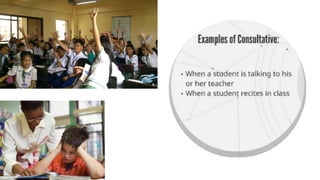
a) When a student recites in class
b) Use of simplified grammar
c) Weddings
d) Job Interview
(16-
20)
(10-15)
WHAT ARE THE
TYPES OF SPEECH
STYLES?
GIVE ONE EXAMPLE FOR EACH
TYPES OF
SPEECH STYLE.
(excluding those given in the choices
before)

Lesson_3-_Communicative_Styles.pptx

  • 1.
    Prayer Loving Father, Come bewith us today Fill our hearts with joy Fill our minds with learning Fill our lessons with fun Fill our friendships with kindness Fill our school with love Help us grow in love and kindness more like Jesus everyday Amen.
  • 2.
  • 10.
    TYPES OF SPEECH STYLES 1)Frozen style 2) Formal style 3) Consultative style 4) Casual style 5) Intimate style
  • 11.
    1) FROZEN STYLE Also known as fixed speech  It is the most formal communicative style that is often used in respectful situation or formal ceremony  As most highly formal style, it uses the complex grammatical sentence structure and vocabulary known only to experts in a particular field  It invites the reader to enter into a personal experience of creative discovery such as literary
  • 13.
    2) FORMAL STYLE – Mostoften seen in writing than in speaking – This speech style is expected to be presented in complete sentences with specific word usage – Its usually elaborate complex sentences and noun phrases are well structured, logically sequenced, and strongly coherent
  • 15.
    3) CONSULTATIVE STYLE –It isunplanned speech –This speech style uses listener participation and feedback –The two defining features of this style are: (a)the speaker supplies background information (b)the listener participates continuously –Less appropriate for writing
  • 17.
    4) CASUAL ORINFORMAL STYLE – This style is used in conversations between friends and insiders who have something to share and have shared background information – There is free and easy participation of both speaker and listener – The use of language is general
  • 18.
    4) CASUAL ORINFORMAL STYLE – A simple greeting with those you know well might probably be the causal: – “Hi” – “Hey” – “What’s up?” – “How is it going?” – “How do you do?” – “Nice to meet you, Mr./Mrs./Ms., Dr., Rev.” – “ Will you please excuse me for a moment?” – “Excuse me”
  • 19.
    4) CASUAL ORINFORMAL STYLE allows the use of slang, profanity, and unconventional English words – The diction or vocabulary is informal (colloquial) – Some of the vocabulary used only in casual situations are: – “dude” (a person) – “freaking out” (getting scared) – “nope” (no) – “puke” (throw up)
  • 20.
    4) CASUAL ORINFORMAL STYLE – Its casual language uses words or phrases that are shortened like: – “I’m doin’ it my way” (doing) – “Lemme go!” (let me go) – “Watcha gonna do?” (What are you going to do?) – “Whassup?” (What’s up?)
  • 22.
    5) INTIMATE STYLE – Thisstyle is used in conversations between people who are very close and know each other quite well because having a maximum of shared background information – It is characterized by an economy of words, with a high incidence of significant nonverbal communication, such as gesture, facial expression, eye contact and so on.
  • 24.
    1) It isalso known as fixed speech. a) Frozen Speech b) Formal Speech c) Consultative Speech d) Intimate Speech e) Casual/ Informal Speech
  • 25.
    2) It isthe type of speech style that uses formal words and expressions. a) Frozen Speech b) Formal Speech c) Consultative Speech d) Intimate Speech e) Casual/ Informal Speech
  • 26.
    3) This speechstyle uses listener participation and feedback. a) Frozen Speech b) Formal Speech c) Consultative Speech d) Intimate Speech e) Casual/ Informal Speech
  • 27.
    4) This styleis used in conversations between people who are very close and know each other quite well. a) Frozen Speech b) Formal Speech c) Consultative Speech d) Intimate Speech e) Casual/ Informal Speech
  • 28.
    5) This styleis used in conversations between friends and insiders who have something to share and have shared background information. a) Frozen Speech b) Formal Speech c) Consultative Speech d) Intimate Speech e) Casual/ Informal Speech
  • 29.
    6) Frozen speechis the most______ __________style that is often used in respectful situation or formal ceremony. a) formal communicative b) fixed speech c) complex grammar d) creative discovery
  • 30.
    7) The followingsentences describes casual or informal style EXCEPT ONE. Which is it? a) Casual or informal style have ellipsis, allows the use of slang, profanity, and unconventional English words. b) This speech style uses listener participation and feedback c) A simple greeting with those you know well. d) Its casual language uses words or phrases that are shortened like “I’m doin’ it my way”
  • 31.
    8) In consultativespeech style, the speaker______ background information while the listener ______ continuously. a) sends; receives b) gives; receives c) supplies; participates d) produces; share
  • 32.
    9) Which oneis an example of Formal Speech Style? a) Use of simplified grammar b) When a student recites in class c) Weddings d) Job Interview
  • 33.
    10) Which oneis an example of Consultative Speech Style? a) When a student recites in class b) Use of simplified grammar c) Weddings d) Job Interview
  • 34.
    (16- 20) (10-15) WHAT ARE THE TYPESOF SPEECH STYLES? GIVE ONE EXAMPLE FOR EACH TYPES OF SPEECH STYLE. (excluding those given in the choices before)