Cambodia’s rich cultural heritage went through a crisis
during the Khmer Rouge regime. An effort to recreate culture
from scratch proved damaging for many aspects of Khmer
culture.
Many artworks were destroyed, including musical
instruments.
Musicians were killed.
All art forms have suffered.
It was during 1979, after the Pol Pot regime was
toppled, that efforts to recover what remains of Khmer culture
began.
Cambodia’s rich cultural heritage went through a crisis
during the Khmer Rouge regime. An effort to recreate culture
from scratch proved damaging for many aspects of Khmer
culture.
Many artworks were destroyed, including musical
instruments.
Musicians were killed.
All art forms have suffered.
It was during 1979, after the Pol Pot regime was
toppled, that efforts to recover what remains of Khmer culture
began.
Cambodia, also known as Kampuchea, is a country
located in the southern portion of the Indochina Peninsula in
Southeast Asia. It is bordered by South Vietnam to the east,
the Gulf of Siam to the southwest, Thailand to the northwest,
and Laos to the north. Cambodia has been subject the
intense pressures of its two neighbors, Thailand and Vietnam.
Both have established protectorates over Cambodia at various
times. Cambodia’s ancient name is “Kambuja”.
The music of Cambodia is derived both from traditions
of the ancient Khmer Empire and from the Western popular
scene.
Traditional music is highly influenced by ancient and Hindu forms.
It can be heard at a number of occasions---spiritual rites,
weddings, Buddhist festivals, and performances of shadow
theater. It is the heart and soul of the people. They have choruses
with orchestras.
Cambodian music has the people’s expression emphasized
on gong, drum ensembles, and free-reed mouth organs. It has
Thai influence and has undergone heavy Westernization.
Cambodian music has the following elements and
characteristics:
Musical Elements Characteristics
Rhythm Uses mostly duple meter
Melody Uses pentatonic scale or the
seven- tone scale
Timbre Vocal-nasal
Form Vocal-Strophic
Instrumental-Three-part form
Harmony and Texture Heterophony (simultaneous
variation of a single melodic
line)
Musical
Ensembles
There are three Classical Khmer ensembles namely:
1. Pinpeat – plays ceremonial music of the former royal
courts
2. Phleng kar – plays the songs of wedding ceremonies
3. Mahori – involves secular entertainment music, also
originated from the royal courts, that is played by a string-based
ensemble. The term mahori is shared with Thai music and the
instrumentation is often identical, although the songs are not.
Musical
Instruments
Traditional Cambodian musical instruments are the
musical instruments used in the traditional and classical music
of Cambodia. They comprise a wide range of wind, string, and
percussion instrument, used by both the Khmer majority as well
as the nation’s ethnic minorities. Basically Thailand and
Cambodia have the same musical instruments though they vary
in names and size.
The Pinpeat ensemble accompanies the court music of
Cambodia. It is closely similar to Thailand. This ensemble is also
used in masked plays, dances, religious ceremonies, and
shadow plays.
The Pinpeat ensemble includes the following
instruments:
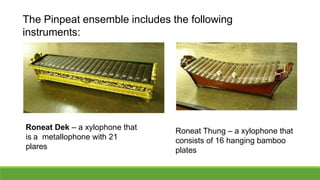
Roneat Dek – a xylophone that
is a metallophone with 21
plares
Roneat Thung – a xylophone that
consists of 16 hanging bamboo
plates
Roneat Ek – a hanging
xylophone consisting of 21
bamboo plates
Sralay – a double – or
quadruple- reed oboe with seven
holes tuned in heptatonic scale
Samphor – a barrel
drum, beaten with
hands or sticks
Skor Thom – barrel
drums tuned in fourths
and fifths
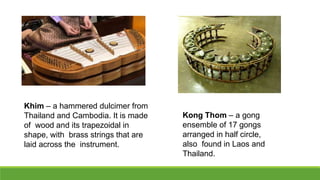
Khim – a hammered dulcimer from
Thailand and Cambodia. It is made
of wood and its trapezoidal in
shape, with brass strings that are
laid across the instrument.
Kong Thom – a gong
ensemble of 17 gongs
arranged in half circle,
also found in Laos and
Thailand.
Khloy – a bamboo-length
flute with seven playing
holes
Takhe – a two –
stringed harp/zither
with twelve frets
Two Khmer– a two
–
stringe
d
can
b
e
divers
e
fiddle
found
name
s
whic
h
with
and
forms all over
Southeast
Asia

LESSON-3-CAMBODIAN PINPEAT.pptx

  • 2.
    Cambodia’s rich culturalheritage went through a crisis during the Khmer Rouge regime. An effort to recreate culture from scratch proved damaging for many aspects of Khmer culture. Many artworks were destroyed, including musical instruments. Musicians were killed. All art forms have suffered. It was during 1979, after the Pol Pot regime was toppled, that efforts to recover what remains of Khmer culture began.
  • 3.
    Cambodia’s rich culturalheritage went through a crisis during the Khmer Rouge regime. An effort to recreate culture from scratch proved damaging for many aspects of Khmer culture. Many artworks were destroyed, including musical instruments. Musicians were killed. All art forms have suffered. It was during 1979, after the Pol Pot regime was toppled, that efforts to recover what remains of Khmer culture began.
  • 4.
    Cambodia, also knownas Kampuchea, is a country located in the southern portion of the Indochina Peninsula in Southeast Asia. It is bordered by South Vietnam to the east, the Gulf of Siam to the southwest, Thailand to the northwest, and Laos to the north. Cambodia has been subject the intense pressures of its two neighbors, Thailand and Vietnam. Both have established protectorates over Cambodia at various times. Cambodia’s ancient name is “Kambuja”. The music of Cambodia is derived both from traditions of the ancient Khmer Empire and from the Western popular scene.
  • 5.
    Traditional music ishighly influenced by ancient and Hindu forms. It can be heard at a number of occasions---spiritual rites, weddings, Buddhist festivals, and performances of shadow theater. It is the heart and soul of the people. They have choruses with orchestras. Cambodian music has the people’s expression emphasized on gong, drum ensembles, and free-reed mouth organs. It has Thai influence and has undergone heavy Westernization.
  • 6.
    Cambodian music hasthe following elements and characteristics: Musical Elements Characteristics Rhythm Uses mostly duple meter Melody Uses pentatonic scale or the seven- tone scale Timbre Vocal-nasal Form Vocal-Strophic Instrumental-Three-part form Harmony and Texture Heterophony (simultaneous variation of a single melodic line)
  • 7.
    Musical Ensembles There are threeClassical Khmer ensembles namely: 1. Pinpeat – plays ceremonial music of the former royal courts 2. Phleng kar – plays the songs of wedding ceremonies 3. Mahori – involves secular entertainment music, also originated from the royal courts, that is played by a string-based ensemble. The term mahori is shared with Thai music and the instrumentation is often identical, although the songs are not.
  • 8.
    Musical Instruments Traditional Cambodian musicalinstruments are the musical instruments used in the traditional and classical music of Cambodia. They comprise a wide range of wind, string, and percussion instrument, used by both the Khmer majority as well as the nation’s ethnic minorities. Basically Thailand and Cambodia have the same musical instruments though they vary in names and size. The Pinpeat ensemble accompanies the court music of Cambodia. It is closely similar to Thailand. This ensemble is also used in masked plays, dances, religious ceremonies, and shadow plays.
  • 9.
    The Pinpeat ensembleincludes the following instruments: Roneat Dek – a xylophone that is a metallophone with 21 plares Roneat Thung – a xylophone that consists of 16 hanging bamboo plates
  • 10.
    Roneat Ek –a hanging xylophone consisting of 21 bamboo plates Sralay – a double – or quadruple- reed oboe with seven holes tuned in heptatonic scale
  • 11.
    Samphor – abarrel drum, beaten with hands or sticks Skor Thom – barrel drums tuned in fourths and fifths
  • 12.
    Khim – ahammered dulcimer from Thailand and Cambodia. It is made of wood and its trapezoidal in shape, with brass strings that are laid across the instrument. Kong Thom – a gong ensemble of 17 gongs arranged in half circle, also found in Laos and Thailand.
  • 13.
    Khloy – abamboo-length flute with seven playing holes Takhe – a two – stringed harp/zither with twelve frets Two Khmer– a two – stringe d can b e divers e fiddle found name s whic h with and forms all over Southeast Asia