ENGLISH FOR ACEDEMIC AND
PROFESSIONAL PURPOSES
Renee Rose A. Cunnani
English Teacher
1st
Semester Quarter 2
Topic:
Gathers Manifestoes and
Analyze the Arguments
Used by the Writers
Renee Rose A. Cunnani
English Teacher
Objectives
At the end of this module, the learner should be
able to:
1.Identify the concept of argumentative writing;
2. Gather manifestoes and analyze the arguments
used by the writers; and
3. Create arguments with supporting evidences.
1. Are you convinced with the statement
in the image? Why or Why not?
2. If you were the person in the image,
how are you going to convince others
to have the same views as yours?
Renee Rose A. Cunnani
English Teacher
Lesson Proper
Argument- In academic
writing, this is usually a main
idea, often called a “claim” or
“thesis statement,” backed up
with evidence that supports
the idea. Renee Rose A. Cunnani
English Teacher
Renee Rose A. Cunnani
English Teacher
Example:
“Wearing face masks helps prevent
COVID-19.”
Manifesto refers to a public
declaration of intentions, goals, or
beliefs by an individual or group.
Renee Rose A. Cunnani
English Teacher
Example: “We will promote a clean and
green campus by organizing monthly
clean-up drives.”
Argumentative writing. A kind of writing where
the students establish a position in a given
topic and then use evidence to persuade the
audience to see things from their point of view.
To write a great argumentative, the students
first have to investigate several sides of the
argument, which allows them to make an
educated stance.
Renee Rose A. Cunnani
English Teacher
Example: An essay arguing
that banning plastic bags
reduces ocean pollution.
Renee Rose A. Cunnani
English Teacher
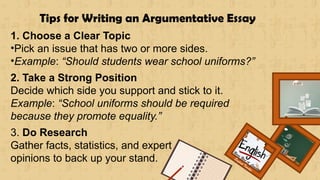
Tips for Writing an Argumentative Essay
1. Choose a Clear Topic
•Pick an issue that has two or more sides.
•Example: “Should students wear school uniforms?”
2. Take a Strong Position
Decide which side you support and stick to it.
Example: “School uniforms should be required
because they promote equality.”
3. Do Research
Gather facts, statistics, and expert
opinions to back up your stand.
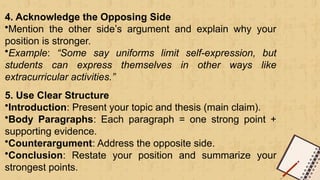
4. Acknowledge the Opposing Side
•Mention the other side’s argument and explain why your
position is stronger.
•Example: “Some say uniforms limit self-expression, but
students can express themselves in other ways like
extracurricular activities.”
5. Use Clear Structure
•Introduction: Present your topic and thesis (main claim).
•Body Paragraphs: Each paragraph = one strong point +
supporting evidence.
•Counterargument: Address the opposite side.
•Conclusion: Restate your position and summarize your
strongest points.
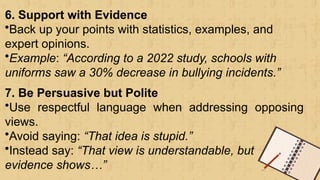
6. Support with Evidence
•Back up your points with statistics, examples, and
expert opinions.
•Example: “According to a 2022 study, schools with
uniforms saw a 30% decrease in bullying incidents.”
7. Be Persuasive but Polite
•Use respectful language when addressing opposing
views.
•Avoid saying: “That idea is stupid.”
•Instead say: “That view is understandable, but
evidence shows…”
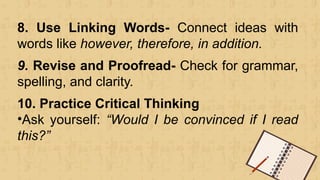
8. Use Linking Words- Connect ideas with
words like however, therefore, in addition.
9. Revise and Proofread- Check for grammar,
spelling, and clarity.
10. Practice Critical Thinking
•Ask yourself: “Would I be convinced if I read
this?”
Activity 4. Complete Me
Direction: Let us sum up what you have
learned from our lesson by
completing the given phrases
below.
Renee Rose A. Cunnani
English Teacher
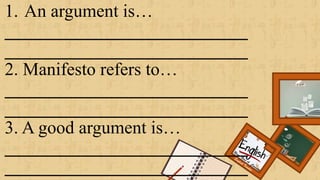
1. An argument is…
___________________________
___________________________
2. Manifesto refers to…
___________________________
___________________________
3. A good argument is…
___________________________
___________________________
Renee Rose A. Cunnani
English Teacher
…. End….
Renee Rose A. Cunnani
English Teacher

EAPP-Argumentative-Writing-LESSON-3-.pptx

  • 1.
    ENGLISH FOR ACEDEMICAND PROFESSIONAL PURPOSES Renee Rose A. Cunnani English Teacher
  • 2.
    1st Semester Quarter 2 Topic: GathersManifestoes and Analyze the Arguments Used by the Writers Renee Rose A. Cunnani English Teacher
  • 3.
    Objectives At the endof this module, the learner should be able to: 1.Identify the concept of argumentative writing; 2. Gather manifestoes and analyze the arguments used by the writers; and 3. Create arguments with supporting evidences.
  • 5.
    1. Are youconvinced with the statement in the image? Why or Why not? 2. If you were the person in the image, how are you going to convince others to have the same views as yours? Renee Rose A. Cunnani English Teacher
  • 6.
    Lesson Proper Argument- Inacademic writing, this is usually a main idea, often called a “claim” or “thesis statement,” backed up with evidence that supports the idea. Renee Rose A. Cunnani English Teacher
  • 7.
    Renee Rose A.Cunnani English Teacher Example: “Wearing face masks helps prevent COVID-19.”
  • 8.
    Manifesto refers toa public declaration of intentions, goals, or beliefs by an individual or group. Renee Rose A. Cunnani English Teacher Example: “We will promote a clean and green campus by organizing monthly clean-up drives.”
  • 9.
    Argumentative writing. Akind of writing where the students establish a position in a given topic and then use evidence to persuade the audience to see things from their point of view. To write a great argumentative, the students first have to investigate several sides of the argument, which allows them to make an educated stance. Renee Rose A. Cunnani English Teacher Example: An essay arguing that banning plastic bags reduces ocean pollution.
  • 10.
    Renee Rose A.Cunnani English Teacher Tips for Writing an Argumentative Essay 1. Choose a Clear Topic •Pick an issue that has two or more sides. •Example: “Should students wear school uniforms?” 2. Take a Strong Position Decide which side you support and stick to it. Example: “School uniforms should be required because they promote equality.” 3. Do Research Gather facts, statistics, and expert opinions to back up your stand.
  • 11.
    4. Acknowledge theOpposing Side •Mention the other side’s argument and explain why your position is stronger. •Example: “Some say uniforms limit self-expression, but students can express themselves in other ways like extracurricular activities.” 5. Use Clear Structure •Introduction: Present your topic and thesis (main claim). •Body Paragraphs: Each paragraph = one strong point + supporting evidence. •Counterargument: Address the opposite side. •Conclusion: Restate your position and summarize your strongest points.
  • 12.
    6. Support withEvidence •Back up your points with statistics, examples, and expert opinions. •Example: “According to a 2022 study, schools with uniforms saw a 30% decrease in bullying incidents.” 7. Be Persuasive but Polite •Use respectful language when addressing opposing views. •Avoid saying: “That idea is stupid.” •Instead say: “That view is understandable, but evidence shows…”
  • 13.
    8. Use LinkingWords- Connect ideas with words like however, therefore, in addition. 9. Revise and Proofread- Check for grammar, spelling, and clarity. 10. Practice Critical Thinking •Ask yourself: “Would I be convinced if I read this?”
  • 14.
    Activity 4. CompleteMe Direction: Let us sum up what you have learned from our lesson by completing the given phrases below. Renee Rose A. Cunnani English Teacher
  • 15.
    1. An argumentis… ___________________________ ___________________________ 2. Manifesto refers to… ___________________________ ___________________________ 3. A good argument is… ___________________________ ___________________________ Renee Rose A. Cunnani English Teacher
  • 16.
    …. End…. Renee RoseA. Cunnani English Teacher

Editor's Notes

  • #6 -to prove it is valid.