Practice II: Tamagni & Sampietro
LESSON PLANNING 3: ANIMALS and HABITATS
NAMES: Cielo Sampietro & Gala Tamagni
DATE: August the 27th 2015
CLASS: Salita verde 5 años
LENGTH OF LESSON: 1 hour (13:15 to 14:15)
MATERIALS: Flashcards (Animals- Habitats), Three construction papers, tape, and
photocopies.
CLASS DESCRIPTION: There are 31 students in this group, all between 5 and 6
years old. They have English classes 4 times a week for an hour and most of them
have been studying English for about 2 years. As the English class is the first one
they have it is crucial to develop an active warm up; the main tool for this is the use
of songs as a daily routine in which they do not only sing and get engage but also
use their body.
Practice II: Tamagni & Sampietro
AIMS:
GRAMMATICAL STRUCTURES:
• Verb to be : There is/ are/ Present Simple ----> e.g.: It is big
and grey/ There are trees/ It is a wet place
• Can/ Can’t: Actions ----> e.g.: Can it fly?
• Have got/ Has got ----> e.g.: It has got a big brown mane
• Certain specific verbs and adjectives (that children already
know or identify): live/like, big, small, fat, wild, pet.
LEARNING AIMS: we expect to reinforce the knowledge the children already have as
regards animals, actions and physical characteristics as well as review what we
have seen on lesson 1 and 2. Also we expect to introduce the concept of “habitat”
and the description of the six habitats that we choose: Ocean, Farm and Jungle. In
addition, we expect the children to recognise which specific animals that live in
these specific places and why they live in there.
VOCABULARY:
• The introduction and review of vocabulary related to the animal world;
adjectives, nouns, verbs. Plus, we will add three main habitats (Ocean,
Jungle and Farm) and the vocabulary related to them: trees, water, sand,
rocks, etc.
PRONUNCIATION: As the children do not read or completely write yet, it is
extremely important to be focused on their pronunciation. They can actually
identify certain letters and the sound of them, by repeating how the words are
pronounced they can certainly reproduce them very well. For example, they are
able identify and pronounce perfectly the word Monday as it begins with the “M
sound” and they can do that with almost any word.
Practice II: Tamagni & Sampietro
LEARNING OUTCOMES: we expect the children to understand, identify and
pronounce the new vocabulary, relate the name of each animal with particular
physical characteristics as well as predict where each animal lives and the name
of the places. We expect the children to identify and mention the main
differences and similarities between the three habitats.
ANTICIPATED PROBLEMS:
• Usually most of the children get easily distracted and the main reason is that
they really love chatting. When a little group starts to talk it makes the other
students lose their attention or sometimes get bored/sleepy.
POSSIBLE SOLUTIONS:
• It is really important to keep the children active, entertained and motivated
i.e. make them ALL participate in the activities in order to avoid boredom or
distraction.
• It is also fundamental to identify which students usually cause distraction
(talk, bother their partners) and ask them to change places (sit somewhere
else).
PROCEDURES:
STAGE 1: WARM UP
At the beginning of the class the children are asked to form and sit in a circle in
order to follow the daily routine of singing song and reciting poems to: say “Hello”,
Practice II: Tamagni & Sampietro
The Weather, Days of the Week, Feelings and Prayers to God. Usually when the class
is on Monday the students are asked to talk about their weekend. This stage takes
around 20 minutes.
DESCRIPTION: At the beginning of the class the children are asked to form and sit
in a circle in order to follow the daily routine of singing song and reciting poems to:
say “Hello”, The Weather, Days of the Week, Feelings and Prayers to God. Usually
when the class is on Monday the students are asked to talk about their weekend.
This stage takes around 20 minutes.
ACTIVITIES:
First Activity: First of all, as it is extremely necessary, we will review all the animals
that we have seen as well as distinguish between wild animals and pets.
Now is time to introduce habitats. We will bring to the class three images of
different animals habitats: Jungle, Ocean, and Farm. After introducing the habitats
one by one and asking the children to repeat them, we will start to talk about which
animals they think they live in those places. In addition, we will ask them to
recognise similarities and differences of the habitats already mentioned. TIMING:
20 MINUTES
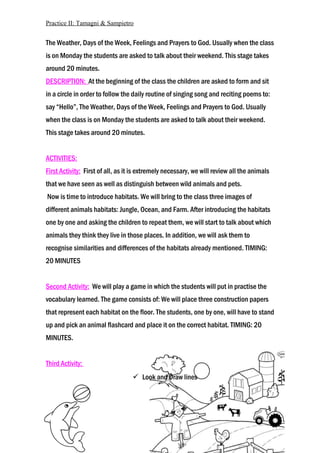
Second Activity: We will play a game in which the students will put in practise the
vocabulary learned. The game consists of: We will place three construction papers
that represent each habitat on the floor. The students, one by one, will have to stand
up and pick an animal flashcard and place it on the correct habitat. TIMING: 20
MINUTES.
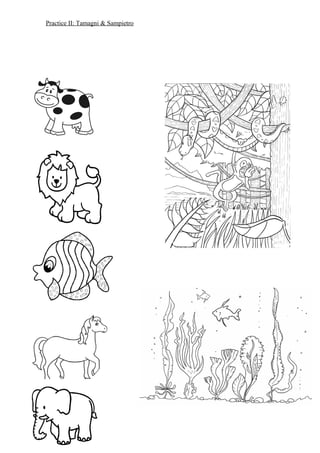
Third Activity:
 Look and Draw lines
Practice II: Tamagni & Sampietro
CLOSSING THE LESSON: Usually when every lesson is finished, the students sing
the Goodbye song and wait until the next teacher comes. We will sing with them this
song:
“This is the way we say Goodbye, we say Goodbye, We Goodbye
This is the way we say Goodbye, we say Goodbye to you
And you and you and you”
LESSON PLAN 4:
DATE: August the 28th 2015
NAMES: Cielo Sampietro & Gala Tamagni
CLASS: Salita verde 5 años
LENGTH OF LESSON: 1 hour (14:15 to 15:15)
MATERIALS: Flashcards (Animals- Habitats), CD, CD player, books.
CLASS DESCRIPTION: There are 31 students in this group, all between 5 and 6
years old. They have English classes 4 times a week for an hour and most of them
have been studying English for about 2 years. As the English class is the first one
they have it is crucial to develop an active warm up; the main tool for this is the use
of songs as a daily routine in which they do not only sing and get engage but also
use their body.
AIMS:
Practice II: Tamagni & Sampietro
GRAMMATICAL STRUCTURES:
• Verb to be : There is/ are/ Present Simple ----> e.g.: It is big
and grey/ There are trees/ It is a wet place
• Can/ Can’t: Actions ----> e.g.: Can it fly?
• Have got/ Has got ----> e.g.: It has got a big brown mane
• Certain specific verbs and adjectives (that children already
know or identify): live/like, big, small, fat, wild, pet.
LEARNING AIMS: we expect to reinforce the knowledge the children already have as
regards animals, actions and physical characteristics as well as review what we
have seen on the previous lessons. Also we expect the children to learn a song as
well as do some activities from their course book to engage the concepts we have
been seeing. Especially we will revise actions that specific animals can perform
through the song and use of body language.
VOCABULARY:
• The introduction and review of vocabulary related to the animal world;
adjectives, nouns, verbs. Plus, we will revise the main actions animal can
perform: Jump, Swim and Fly.
PRONUNCIATION: As the children do not read or completely write yet, it is
extremely important to be focused on their pronunciation. They can actually
identify certain letters and the sound of them, by repeating how the words are
pronounced they can certainly reproduce them very well. For example, they are
able identify and pronounce perfectly the word Monday as it begins with the “M
sound” and they can do that with almost any word.
LEARNING OUTCOMES: we expect the children to understand, identify and
pronounce the new vocabulary, relate the name of each animal with particular
physical characteristics as well as predict where each animal lives and can do.
Practice II: Tamagni & Sampietro
ANTICIPATED PROBLEMS:
• Usually most of the children get easily distracted and the main reason is that
they really love chatting. When a little group starts to talk it makes the other
students lose their attention or sometimes get bored/sleepy.
• On Fridays the children have gym classes an hour before the English class,
so they tend to be even more distracted and tired than usual.
POSSIBLE SOLUTIONS:
• It is really important to keep the children active, entertained and motivated
i.e. make them ALL participate in the activities in order to avoid boredom or
distraction.
• It is also fundamental to identify which students usually cause distraction
(talk, bother their partners) and ask them to change places (sit somewhere
else).
PROCEDURES:
STAGE 1: WARM UP
At the beginning of the class the children are asked to form and sit in a circle in
order to follow the daily routine of singing song and reciting poems to: say “Hello”,
The Weather and Days of the Week. This stage takes around 20 minutes.
“Are you ready to say Hello? Hello to everyone, and How are you Today? We come to
our circle time to laugh and sing and play.
And you are up you are up
Practice II: Tamagni & Sampietro
And when you are down you are down
And when you re only half way up you are neither up nor down
Now roll your hands so slowly and roll them all so fast
Give our hands a clap clap clap and put it on your lap tap tap”
“Mister Weatherman, Mister Weatherman what’s the weather like?
What’s the weather like?
What’s the weather like Today?
What is like?”
“There are seven days, there seven days, there seven days in a week
There are seven days, there seven days, there seven days in a week
Sunday, Monday, Tuesday, Wednesday
Thursday, Friday, Saturday
Sunday, Monday, Tuesday, Wednesday
Thursday, Friday, Saturday”
ACTIVITIES:
First Activity: First of all, as it is extremely necessary, we will review all the animals
and habitats that we have seen. But, the review will be focused on the new animals
that the children learnt and on those which appear on the book’s activities. TIMING:
15 MINUTES
Second Activity: We will star with an activity from the children’s course book. First
we will learn all together a song related to animals. We will ask the children to do
Practice II: Tamagni & Sampietro
the activities: a listening comprehension (listen and point), listen and tick and listen
and write the number. TIMING: 20 MINUTES.
Third Activity: If we have time we will ask the children to finish a colouring activity
from the previous class. TIMING: 20 MINUTES.
CLOSSING THE LESSON: Usually when every lesson is finished, the students sing
the Goodbye song and wait until the next teacher comes. We will sing with them this
song:
“This is the way we say Goodbye, we say Goodbye, We Goodbye
This is the way we say Goodbye, we say Goodbye to you
And you and you and you”
LESSON PLAN 5:
DATE: September the 3rd 2015
NAMES: Cielo Sampietro & Gala Tamagni
CLASS: Salita verde 5 años
LENGTH OF LESSON: 1 hour (13:15 to 14:15)
MATERIALS: Flashcards, Short Story Book, constructor paper, glue.
CLASS DESCRIPTION: There are 31 students in this group, all between 5 and 6
years old. They have English classes 4 times a week for an hour and most of them
have been studying English for about 2 years. As the English class is the first one
they have it is crucial to develop an active warm up; the main tool for this is the use
Practice II: Tamagni & Sampietro
of songs as a daily routine in which they do not only sing and get engage but also
use their body.
AIMS:
GRAMMATICAL STRUCTURES:
• Verb to be : There is/ are/ Present Simple ----> e.g.: It is big
and grey/ There are trees/ It is a wet place
• Can/ Can’t: Actions ----> e.g.: Can it fly?
• Have got/ Has got ----> e.g.: It has got a big brown mane
• Certain specific verbs and adjectives (that children already
know or identify): live/like, big, small, fat, wild, pet.
LEARNING AIMS: we expect to reinforce the knowledge the children already have as
regards animals, habitats, actions and physical characteristics as well as review
what we have seen on lesson 1, 2, 3 and 4.
VOCABULARY:
• The introduction and review of vocabulary related to the animal world;
adjectives, nouns, verbs. Plus, we will add the three main habitats (Ocean,
Jungle and Farm) that we have seen and the vocabulary related to them:
trees, water, sand, rocks, etc.
PRONUNCIATION: As the children do not read or completely write yet, it is
extremely important to be focused on their pronunciation. They can actually
identify certain letters and the sound of them, by repeating how the words are
pronounced they can certainly reproduce them very well. For example, they are
able identify and pronounce perfectly the word Monday as it begins with the “M
sound” and they can do that with almost any word.
Practice II: Tamagni & Sampietro
LEARNING OUTCOMES: we expect the children to understand, identify and
pronounce the new vocabulary, relate the name of each animal with particular
physical characteristics as well as predict where each animal lives and the name
of the places. We expect the children to identify and mention the main
differences and similarities between the three habitats.
ANTICIPATED PROBLEMS:
• Usually most of the children get easily distracted and the main reason is that
they really love chatting. When a little group starts to talk it makes the other
students lose their attention or sometimes get bored/sleepy.
POSSIBLE SOLUTIONS:
• It is really important to keep the children active, entertained and motivated
i.e. make them ALL participate in the activities in order to avoid boredom or
distraction.
• It is also fundamental to identify which students usually cause distraction
(talk, bother their partners) and ask them to change places (sit somewhere
else).
STAGE 1: WARM UP
At the beginning of the class the children are asked to form and sit in a circle in
order to follow the daily routine of singing song and reciting poems to: say “Hello”,
The Weather, Days of the Week, Feelings and Prayers to God. Usually when the class
is on Monday the students are asked to talk about their weekend. This stage takes
around 20 minutes.
Practice II: Tamagni & Sampietro
First activity: We will make a short review as regards animals and habitats with
flashcards. The point is introducing some characters related to a story tale.
Second activity: We will read a story to the children called “Bubba: where do
animals live?” This is a really useful book as it has many animals and it is divided in
habitats. It is also an interactive book as it has games the children can play.
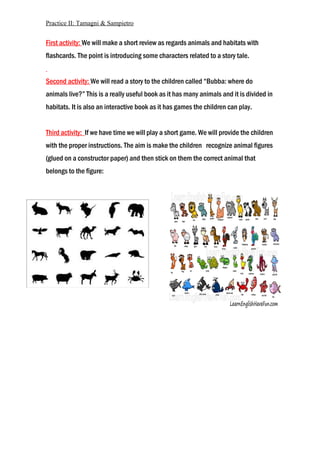
Third activity: If we have time we will play a short game. We will provide the children
with the proper instructions. The aim is make the children recognize animal figures
(glued on a constructor paper) and then stick on them the correct animal that
belongs to the figure:

Lesson Plans 3-4-5

  • 1.
    Practice II: Tamagni& Sampietro LESSON PLANNING 3: ANIMALS and HABITATS NAMES: Cielo Sampietro & Gala Tamagni DATE: August the 27th 2015 CLASS: Salita verde 5 años LENGTH OF LESSON: 1 hour (13:15 to 14:15) MATERIALS: Flashcards (Animals- Habitats), Three construction papers, tape, and photocopies. CLASS DESCRIPTION: There are 31 students in this group, all between 5 and 6 years old. They have English classes 4 times a week for an hour and most of them have been studying English for about 2 years. As the English class is the first one they have it is crucial to develop an active warm up; the main tool for this is the use of songs as a daily routine in which they do not only sing and get engage but also use their body.
  • 2.
    Practice II: Tamagni& Sampietro AIMS: GRAMMATICAL STRUCTURES: • Verb to be : There is/ are/ Present Simple ----> e.g.: It is big and grey/ There are trees/ It is a wet place • Can/ Can’t: Actions ----> e.g.: Can it fly? • Have got/ Has got ----> e.g.: It has got a big brown mane • Certain specific verbs and adjectives (that children already know or identify): live/like, big, small, fat, wild, pet. LEARNING AIMS: we expect to reinforce the knowledge the children already have as regards animals, actions and physical characteristics as well as review what we have seen on lesson 1 and 2. Also we expect to introduce the concept of “habitat” and the description of the six habitats that we choose: Ocean, Farm and Jungle. In addition, we expect the children to recognise which specific animals that live in these specific places and why they live in there. VOCABULARY: • The introduction and review of vocabulary related to the animal world; adjectives, nouns, verbs. Plus, we will add three main habitats (Ocean, Jungle and Farm) and the vocabulary related to them: trees, water, sand, rocks, etc. PRONUNCIATION: As the children do not read or completely write yet, it is extremely important to be focused on their pronunciation. They can actually identify certain letters and the sound of them, by repeating how the words are pronounced they can certainly reproduce them very well. For example, they are able identify and pronounce perfectly the word Monday as it begins with the “M sound” and they can do that with almost any word.
  • 3.
    Practice II: Tamagni& Sampietro LEARNING OUTCOMES: we expect the children to understand, identify and pronounce the new vocabulary, relate the name of each animal with particular physical characteristics as well as predict where each animal lives and the name of the places. We expect the children to identify and mention the main differences and similarities between the three habitats. ANTICIPATED PROBLEMS: • Usually most of the children get easily distracted and the main reason is that they really love chatting. When a little group starts to talk it makes the other students lose their attention or sometimes get bored/sleepy. POSSIBLE SOLUTIONS: • It is really important to keep the children active, entertained and motivated i.e. make them ALL participate in the activities in order to avoid boredom or distraction. • It is also fundamental to identify which students usually cause distraction (talk, bother their partners) and ask them to change places (sit somewhere else). PROCEDURES: STAGE 1: WARM UP At the beginning of the class the children are asked to form and sit in a circle in order to follow the daily routine of singing song and reciting poems to: say “Hello”,
  • 4.
    Practice II: Tamagni& Sampietro The Weather, Days of the Week, Feelings and Prayers to God. Usually when the class is on Monday the students are asked to talk about their weekend. This stage takes around 20 minutes. DESCRIPTION: At the beginning of the class the children are asked to form and sit in a circle in order to follow the daily routine of singing song and reciting poems to: say “Hello”, The Weather, Days of the Week, Feelings and Prayers to God. Usually when the class is on Monday the students are asked to talk about their weekend. This stage takes around 20 minutes. ACTIVITIES: First Activity: First of all, as it is extremely necessary, we will review all the animals that we have seen as well as distinguish between wild animals and pets. Now is time to introduce habitats. We will bring to the class three images of different animals habitats: Jungle, Ocean, and Farm. After introducing the habitats one by one and asking the children to repeat them, we will start to talk about which animals they think they live in those places. In addition, we will ask them to recognise similarities and differences of the habitats already mentioned. TIMING: 20 MINUTES Second Activity: We will play a game in which the students will put in practise the vocabulary learned. The game consists of: We will place three construction papers that represent each habitat on the floor. The students, one by one, will have to stand up and pick an animal flashcard and place it on the correct habitat. TIMING: 20 MINUTES. Third Activity:  Look and Draw lines
  • 5.
  • 6.
    Practice II: Tamagni& Sampietro CLOSSING THE LESSON: Usually when every lesson is finished, the students sing the Goodbye song and wait until the next teacher comes. We will sing with them this song: “This is the way we say Goodbye, we say Goodbye, We Goodbye This is the way we say Goodbye, we say Goodbye to you And you and you and you” LESSON PLAN 4: DATE: August the 28th 2015 NAMES: Cielo Sampietro & Gala Tamagni CLASS: Salita verde 5 años LENGTH OF LESSON: 1 hour (14:15 to 15:15) MATERIALS: Flashcards (Animals- Habitats), CD, CD player, books. CLASS DESCRIPTION: There are 31 students in this group, all between 5 and 6 years old. They have English classes 4 times a week for an hour and most of them have been studying English for about 2 years. As the English class is the first one they have it is crucial to develop an active warm up; the main tool for this is the use of songs as a daily routine in which they do not only sing and get engage but also use their body. AIMS:
  • 7.
    Practice II: Tamagni& Sampietro GRAMMATICAL STRUCTURES: • Verb to be : There is/ are/ Present Simple ----> e.g.: It is big and grey/ There are trees/ It is a wet place • Can/ Can’t: Actions ----> e.g.: Can it fly? • Have got/ Has got ----> e.g.: It has got a big brown mane • Certain specific verbs and adjectives (that children already know or identify): live/like, big, small, fat, wild, pet. LEARNING AIMS: we expect to reinforce the knowledge the children already have as regards animals, actions and physical characteristics as well as review what we have seen on the previous lessons. Also we expect the children to learn a song as well as do some activities from their course book to engage the concepts we have been seeing. Especially we will revise actions that specific animals can perform through the song and use of body language. VOCABULARY: • The introduction and review of vocabulary related to the animal world; adjectives, nouns, verbs. Plus, we will revise the main actions animal can perform: Jump, Swim and Fly. PRONUNCIATION: As the children do not read or completely write yet, it is extremely important to be focused on their pronunciation. They can actually identify certain letters and the sound of them, by repeating how the words are pronounced they can certainly reproduce them very well. For example, they are able identify and pronounce perfectly the word Monday as it begins with the “M sound” and they can do that with almost any word. LEARNING OUTCOMES: we expect the children to understand, identify and pronounce the new vocabulary, relate the name of each animal with particular physical characteristics as well as predict where each animal lives and can do.
  • 8.
    Practice II: Tamagni& Sampietro ANTICIPATED PROBLEMS: • Usually most of the children get easily distracted and the main reason is that they really love chatting. When a little group starts to talk it makes the other students lose their attention or sometimes get bored/sleepy. • On Fridays the children have gym classes an hour before the English class, so they tend to be even more distracted and tired than usual. POSSIBLE SOLUTIONS: • It is really important to keep the children active, entertained and motivated i.e. make them ALL participate in the activities in order to avoid boredom or distraction. • It is also fundamental to identify which students usually cause distraction (talk, bother their partners) and ask them to change places (sit somewhere else). PROCEDURES: STAGE 1: WARM UP At the beginning of the class the children are asked to form and sit in a circle in order to follow the daily routine of singing song and reciting poems to: say “Hello”, The Weather and Days of the Week. This stage takes around 20 minutes. “Are you ready to say Hello? Hello to everyone, and How are you Today? We come to our circle time to laugh and sing and play. And you are up you are up
  • 9.
    Practice II: Tamagni& Sampietro And when you are down you are down And when you re only half way up you are neither up nor down Now roll your hands so slowly and roll them all so fast Give our hands a clap clap clap and put it on your lap tap tap” “Mister Weatherman, Mister Weatherman what’s the weather like? What’s the weather like? What’s the weather like Today? What’s the weather like Today? What is like?” “There are seven days, there seven days, there seven days in a week There are seven days, there seven days, there seven days in a week Sunday, Monday, Tuesday, Wednesday Thursday, Friday, Saturday Sunday, Monday, Tuesday, Wednesday Thursday, Friday, Saturday” ACTIVITIES: First Activity: First of all, as it is extremely necessary, we will review all the animals and habitats that we have seen. But, the review will be focused on the new animals that the children learnt and on those which appear on the book’s activities. TIMING: 15 MINUTES Second Activity: We will star with an activity from the children’s course book. First we will learn all together a song related to animals. We will ask the children to do
  • 10.
    Practice II: Tamagni& Sampietro the activities: a listening comprehension (listen and point), listen and tick and listen and write the number. TIMING: 20 MINUTES. Third Activity: If we have time we will ask the children to finish a colouring activity from the previous class. TIMING: 20 MINUTES. CLOSSING THE LESSON: Usually when every lesson is finished, the students sing the Goodbye song and wait until the next teacher comes. We will sing with them this song: “This is the way we say Goodbye, we say Goodbye, We Goodbye This is the way we say Goodbye, we say Goodbye to you And you and you and you” LESSON PLAN 5: DATE: September the 3rd 2015 NAMES: Cielo Sampietro & Gala Tamagni CLASS: Salita verde 5 años LENGTH OF LESSON: 1 hour (13:15 to 14:15) MATERIALS: Flashcards, Short Story Book, constructor paper, glue. CLASS DESCRIPTION: There are 31 students in this group, all between 5 and 6 years old. They have English classes 4 times a week for an hour and most of them have been studying English for about 2 years. As the English class is the first one they have it is crucial to develop an active warm up; the main tool for this is the use
  • 11.
    Practice II: Tamagni& Sampietro of songs as a daily routine in which they do not only sing and get engage but also use their body. AIMS: GRAMMATICAL STRUCTURES: • Verb to be : There is/ are/ Present Simple ----> e.g.: It is big and grey/ There are trees/ It is a wet place • Can/ Can’t: Actions ----> e.g.: Can it fly? • Have got/ Has got ----> e.g.: It has got a big brown mane • Certain specific verbs and adjectives (that children already know or identify): live/like, big, small, fat, wild, pet. LEARNING AIMS: we expect to reinforce the knowledge the children already have as regards animals, habitats, actions and physical characteristics as well as review what we have seen on lesson 1, 2, 3 and 4. VOCABULARY: • The introduction and review of vocabulary related to the animal world; adjectives, nouns, verbs. Plus, we will add the three main habitats (Ocean, Jungle and Farm) that we have seen and the vocabulary related to them: trees, water, sand, rocks, etc. PRONUNCIATION: As the children do not read or completely write yet, it is extremely important to be focused on their pronunciation. They can actually identify certain letters and the sound of them, by repeating how the words are pronounced they can certainly reproduce them very well. For example, they are able identify and pronounce perfectly the word Monday as it begins with the “M sound” and they can do that with almost any word.
  • 12.
    Practice II: Tamagni& Sampietro LEARNING OUTCOMES: we expect the children to understand, identify and pronounce the new vocabulary, relate the name of each animal with particular physical characteristics as well as predict where each animal lives and the name of the places. We expect the children to identify and mention the main differences and similarities between the three habitats. ANTICIPATED PROBLEMS: • Usually most of the children get easily distracted and the main reason is that they really love chatting. When a little group starts to talk it makes the other students lose their attention or sometimes get bored/sleepy. POSSIBLE SOLUTIONS: • It is really important to keep the children active, entertained and motivated i.e. make them ALL participate in the activities in order to avoid boredom or distraction. • It is also fundamental to identify which students usually cause distraction (talk, bother their partners) and ask them to change places (sit somewhere else). STAGE 1: WARM UP At the beginning of the class the children are asked to form and sit in a circle in order to follow the daily routine of singing song and reciting poems to: say “Hello”, The Weather, Days of the Week, Feelings and Prayers to God. Usually when the class is on Monday the students are asked to talk about their weekend. This stage takes around 20 minutes.
  • 13.
    Practice II: Tamagni& Sampietro First activity: We will make a short review as regards animals and habitats with flashcards. The point is introducing some characters related to a story tale. Second activity: We will read a story to the children called “Bubba: where do animals live?” This is a really useful book as it has many animals and it is divided in habitats. It is also an interactive book as it has games the children can play. Third activity: If we have time we will play a short game. We will provide the children with the proper instructions. The aim is make the children recognize animal figures (glued on a constructor paper) and then stick on them the correct animal that belongs to the figure: