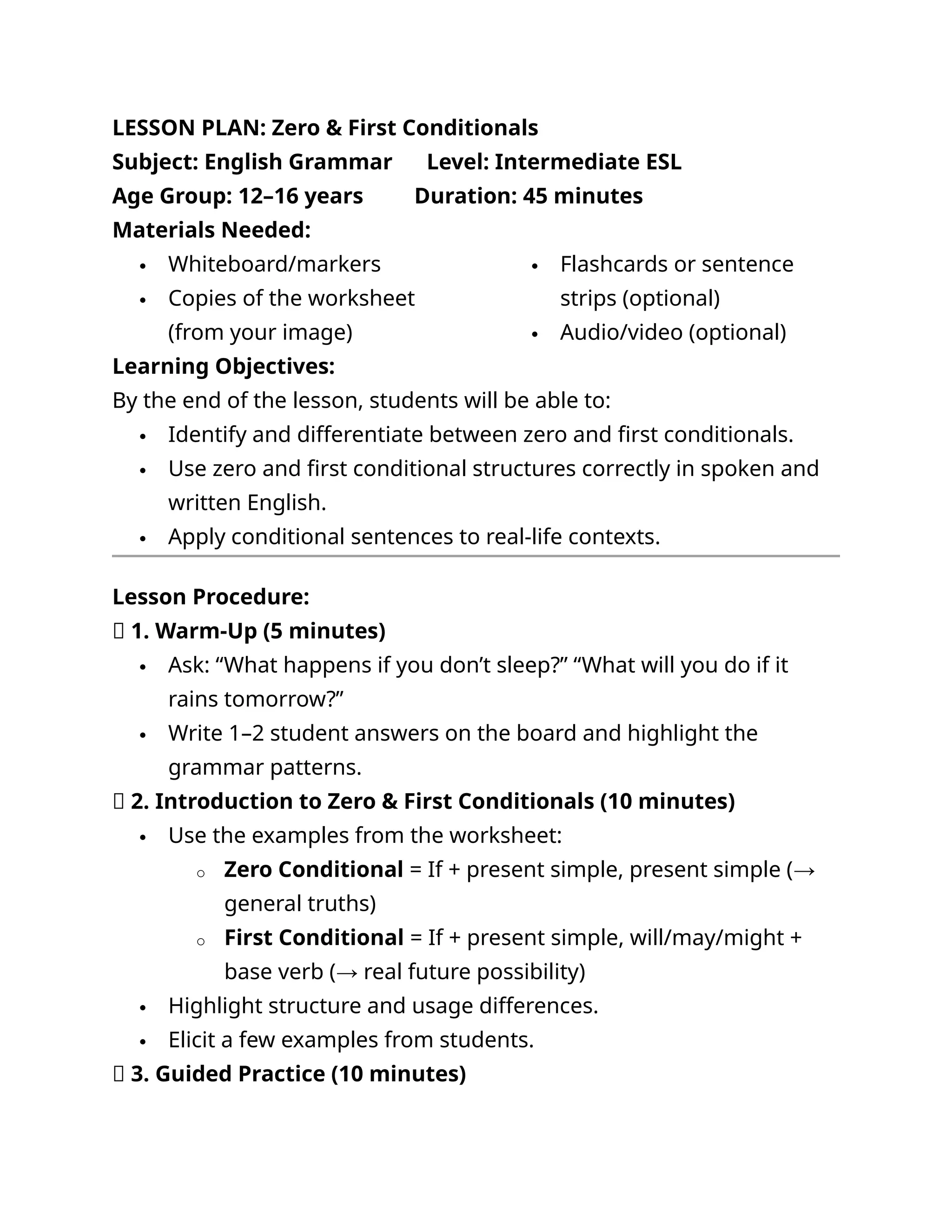
LESSON PLAN: Zero & First Conditionals
Subject: English Grammar Level: Intermediate ESL
Age Group: 12–16 years Duration: 45 minutes
Materials Needed:
 Whiteboard/markers
 Copies of the worksheet
(from your image)
 Flashcards or sentence
strips (optional)
 Audio/video (optional)
Learning Objectives:
By the end of the lesson, students will be able to:
 Identify and differentiate between zero and first conditionals.
 Use zero and first conditional structures correctly in spoken and
written English.
 Apply conditional sentences to real-life contexts.
Lesson Procedure:
🔹 1. Warm-Up (5 minutes)
 Ask: “What happens if you don’t sleep?” “What will you do if it
rains tomorrow?”
 Write 1–2 student answers on the board and highlight the
grammar patterns.
🔹 2. Introduction to Zero & First Conditionals (10 minutes)
 Use the examples from the worksheet:
o Zero Conditional = If + present simple, present simple (→
general truths)
o First Conditional = If + present simple, will/may/might +
base verb (→ real future possibility)
 Highlight structure and usage differences.
 Elicit a few examples from students.
🔹 3. Guided Practice (10 minutes)
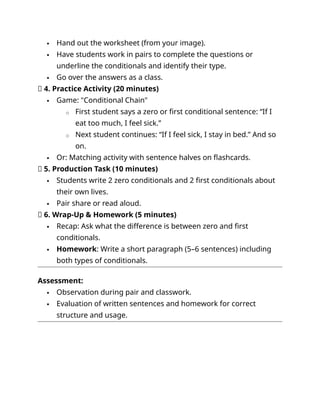
 Hand out the worksheet (from your image).
 Have students work in pairs to complete the questions or
underline the conditionals and identify their type.
 Go over the answers as a class.
🔹 4. Practice Activity (20 minutes)
 Game: "Conditional Chain"
o First student says a zero or first conditional sentence: “If I
eat too much, I feel sick.”
o Next student continues: “If I feel sick, I stay in bed.” And so
on.
 Or: Matching activity with sentence halves on flashcards.
🔹 5. Production Task (10 minutes)
 Students write 2 zero conditionals and 2 first conditionals about
their own lives.
 Pair share or read aloud.
🔹 6. Wrap-Up & Homework (5 minutes)
 Recap: Ask what the difference is between zero and first
conditionals.
 Homework: Write a short paragraph (5–6 sentences) including
both types of conditionals.
Assessment:
 Observation during pair and classwork.
 Evaluation of written sentences and homework for correct
structure and usage.

LESSON PLAN TO TEACH STUDENTS OF AVERAGE

  • 1.
    LESSON PLAN: Zero& First Conditionals Subject: English Grammar Level: Intermediate ESL Age Group: 12–16 years Duration: 45 minutes Materials Needed:  Whiteboard/markers  Copies of the worksheet (from your image)  Flashcards or sentence strips (optional)  Audio/video (optional) Learning Objectives: By the end of the lesson, students will be able to:  Identify and differentiate between zero and first conditionals.  Use zero and first conditional structures correctly in spoken and written English.  Apply conditional sentences to real-life contexts. Lesson Procedure: 🔹 1. Warm-Up (5 minutes)  Ask: “What happens if you don’t sleep?” “What will you do if it rains tomorrow?”  Write 1–2 student answers on the board and highlight the grammar patterns. 🔹 2. Introduction to Zero & First Conditionals (10 minutes)  Use the examples from the worksheet: o Zero Conditional = If + present simple, present simple (→ general truths) o First Conditional = If + present simple, will/may/might + base verb (→ real future possibility)  Highlight structure and usage differences.  Elicit a few examples from students. 🔹 3. Guided Practice (10 minutes)
  • 2.
     Hand outthe worksheet (from your image).  Have students work in pairs to complete the questions or underline the conditionals and identify their type.  Go over the answers as a class. 🔹 4. Practice Activity (20 minutes)  Game: "Conditional Chain" o First student says a zero or first conditional sentence: “If I eat too much, I feel sick.” o Next student continues: “If I feel sick, I stay in bed.” And so on.  Or: Matching activity with sentence halves on flashcards. 🔹 5. Production Task (10 minutes)  Students write 2 zero conditionals and 2 first conditionals about their own lives.  Pair share or read aloud. 🔹 6. Wrap-Up & Homework (5 minutes)  Recap: Ask what the difference is between zero and first conditionals.  Homework: Write a short paragraph (5–6 sentences) including both types of conditionals. Assessment:  Observation during pair and classwork.  Evaluation of written sentences and homework for correct structure and usage.