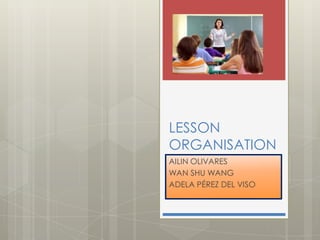
LESSON
ORGANISATION
AILIN OLIVARES
WAN SHU WANG
ADELA PÉREZ DEL VISO
LESSON ORGANISATION or
STRUCTURE
 Lessons: Easily recognized.
 Distinguishable from other kinds of speech
events (trials, meetings, debates, etc).
 Need to optimize the amount of learning that
takes place in the time available.
 Peculiar characteristics: A) structure. B)
typical use of language.
 Sequences- The momentum of a lesson.
LESSON ORGANISATION
Importance of English Lesson
organization or “structure”.
Openings.
Sequencing.
Pacing.
Closure.
OPENINGS
 Definition. Timing: 5 minutes.
 Every stage: Clear boundaries.
 Changes in location, voice tone, quality or
volume, change in the organization
 OPENINGS: Lesson beginnings. Variety of
purposes.
 Many necessary decisions of the teacher.
 Conscious and unconscious decisions
 DECISIONS TO BE MADE:
 Describe the goals of a lesson
 What sts. are expected to do (I will do/ you
will do/ we will do).
 Begin activity w or w.o. explanation.
 Present the funny characteristic of the activity.
 Do something to capture their interest.
 Give a short quiz at the beginning.
 Procedures the t. uses to focus the sts
attention on the learning aims of the lesson.
Relate to
the last
lesson
Assess
relevant kn.
Prepare
sts.to what
follows.
Allow
tuning- in
time
Reduce the
disruptcion
Structure- Openings.
 A VIDEO: Jim Knight and his recommendations.
 “Pace and structure in Lesson Planning”.
 (from “Teaching Channel” in you tube:
 http://video.search.yahoo.com/video/play?p=pace+and+structu
re+of+a+class&vid=716eb07f9fd670c018cbb11fe3b5d2fc&l=1
4%3A59&turl=http%3A%2F%2Fts2.mm.bing.net%2Fth%3Fid
%3DVN.608016053226311213%26pid%3D15.1&rurl=http%3A
%2F%2Fwww.youtube.com%2Fwatch%3Fv%3D65U1FFULh3
U&tit=Pace+and+Structure+in+Lesson+Planning&c=0&sigr=11
ag2isa8&sigt=115kpkko8&ct=p&pstcat=travel&age=0&hsimp=
yhs-
yhsifmclone1&hspart=Babylon&type=br112dm1bs01ts604ts60
8ts913af120524&tt=b
 Analysis of the overall goals and the content
of a lesson.
 Plan a sequence of activities to attain those
goals.
 Stablish a kind of format or script for the
lesson which represents the sequence of
activities that make up the lesson.
Sequencing
According to Wong – Fillmore (1985) a
typical lesson format is…
Taking turns to
read
Principles for second and foreign
language teaching
From To
Simple activities Complex activities
Receptive skills Productive skills
Study and practice a grammar
rule
Use it
Accuracy-focused activities Fluency-focused activities
Mechanical or form-based
activities
Meaningful-based activities
Situational Language
Teaching
(Hubbard et al. 1983)
1 – Presentation
2 – Controlled practice
3 – Free practice
4 – Checking
5 – Furthur practice
Communicative
Language Teaching
(Littlewood, 1986)
1 – Pre-communicative
activities. (Accuracy-
based)
2 – Comminicative
activities. (Fluency-
based)
Example
 A dialogue which introduces the functions
and vocabulary to be practiced in the
class.
 Then, we focus on the functional
expressions.
 Fluency-based activities as practice.
As regards the skills…
Receptive: Reading
1 – Pre-reading
activities
2 - While-reading
activities
3 – Post-reading
activities
 Productive: Writing
 Process Approach
1 – Pre-writing
activities
2 – Drafting activities
3 – Revising activities
Transitions
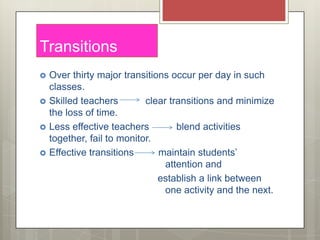
 Over thirty major transitions occur per day in such
classes.
 Skilled teachers clear transitions and minimize
the loss of time.
 Less effective teachers blend activities
together, fail to monitor.
 Effective transitions maintain students’
attention and
establish a link between
one activity and the next.
Pacing
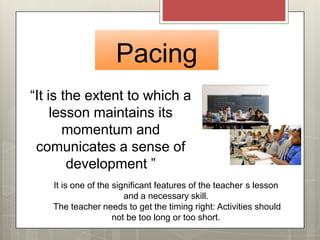
“It is the extent to which a
lesson maintains its
momentum and
comunicates a sense of
development ”
It is one of the significant features of the teacher s lesson
and a necessary skill.
The teacher needs to get the timing right: Activities should
not be too long or too short.
Some strategies
 Avoid needless or over-lenghty explanations or
instructions.
 Use variety.
 Avoid predictable and repetitive activities.
 Select activities of a appropriate level of difficulty.
 Set a goal and time limit.
 Monitor performance to ensure the time provided is the
adequate .
It is made by the concluding
parts that serve to:
• Reinforce
• Integrate and review
• Prepare for further learning
Closure
 Summarize what has been seen.
 Review key points.
 Relate the lesson to certain goals.
 Point out links between lessons.
 Relate to real-world needs.
 Make links to new knowledge.
 Praise students for their acomplishments
Some strategies
These can be used as
reinforcement activities or as an
assessment of student learning.
Follow-up
activities
Sources
 Richards and Lockhart. (2007). Reflective Teaching Second
Language Classrooms.
 Youtube: Pace and structure in Lesson Planning. Teaching
Channel. Retrieved from:
http://video.search.yahoo.com/video/play?p=pace+and+
structure+of+a+class&vid=716eb07f9fd670c018cbb11fe3b5
d2fc&l=14%3A59&turl=http%3A%2F%2Fts2.mm.bing.net%2Ft
h%3Fid%3DVN.608016053226311213%26pid%3D15.1&rurl=htt
p%3A%2F%2Fwww.youtube.com%2Fwatch%3Fv%3D65U1FF
ULh3U&tit=Pace+and+Structure+in+Lesson+Planning&c=0&s
igr=11ag2isa8&sigt=115kpkko8&ct=p&pstcat=travel&age=0
&hsimp=yhs-
yhsifmclone1&hspart=Babylon&type=br112dm1bs01ts604ts6
08ts913af120524&tt=b

LESSON ORGANISATION. OPENING. SEQUENCING. PACING. CLOSING

  • 1.
  • 2.
    LESSON ORGANISATION or STRUCTURE Lessons: Easily recognized.  Distinguishable from other kinds of speech events (trials, meetings, debates, etc).  Need to optimize the amount of learning that takes place in the time available.  Peculiar characteristics: A) structure. B) typical use of language.  Sequences- The momentum of a lesson.
  • 3.
    LESSON ORGANISATION Importance ofEnglish Lesson organization or “structure”. Openings. Sequencing. Pacing. Closure.
  • 4.
    OPENINGS  Definition. Timing:5 minutes.  Every stage: Clear boundaries.  Changes in location, voice tone, quality or volume, change in the organization  OPENINGS: Lesson beginnings. Variety of purposes.  Many necessary decisions of the teacher.  Conscious and unconscious decisions
  • 5.
     DECISIONS TOBE MADE:  Describe the goals of a lesson  What sts. are expected to do (I will do/ you will do/ we will do).  Begin activity w or w.o. explanation.  Present the funny characteristic of the activity.  Do something to capture their interest.  Give a short quiz at the beginning.
  • 6.
     Procedures thet. uses to focus the sts attention on the learning aims of the lesson. Relate to the last lesson Assess relevant kn. Prepare sts.to what follows. Allow tuning- in time Reduce the disruptcion
  • 7.
    Structure- Openings.  AVIDEO: Jim Knight and his recommendations.  “Pace and structure in Lesson Planning”.  (from “Teaching Channel” in you tube:  http://video.search.yahoo.com/video/play?p=pace+and+structu re+of+a+class&vid=716eb07f9fd670c018cbb11fe3b5d2fc&l=1 4%3A59&turl=http%3A%2F%2Fts2.mm.bing.net%2Fth%3Fid %3DVN.608016053226311213%26pid%3D15.1&rurl=http%3A %2F%2Fwww.youtube.com%2Fwatch%3Fv%3D65U1FFULh3 U&tit=Pace+and+Structure+in+Lesson+Planning&c=0&sigr=11 ag2isa8&sigt=115kpkko8&ct=p&pstcat=travel&age=0&hsimp= yhs- yhsifmclone1&hspart=Babylon&type=br112dm1bs01ts604ts60 8ts913af120524&tt=b
  • 8.
     Analysis ofthe overall goals and the content of a lesson.  Plan a sequence of activities to attain those goals.  Stablish a kind of format or script for the lesson which represents the sequence of activities that make up the lesson. Sequencing
  • 9.
    According to Wong– Fillmore (1985) a typical lesson format is… Taking turns to read
  • 10.
    Principles for secondand foreign language teaching From To Simple activities Complex activities Receptive skills Productive skills Study and practice a grammar rule Use it Accuracy-focused activities Fluency-focused activities Mechanical or form-based activities Meaningful-based activities
  • 11.
    Situational Language Teaching (Hubbard etal. 1983) 1 – Presentation 2 – Controlled practice 3 – Free practice 4 – Checking 5 – Furthur practice Communicative Language Teaching (Littlewood, 1986) 1 – Pre-communicative activities. (Accuracy- based) 2 – Comminicative activities. (Fluency- based)
  • 12.
    Example  A dialoguewhich introduces the functions and vocabulary to be practiced in the class.  Then, we focus on the functional expressions.  Fluency-based activities as practice.
  • 13.
    As regards theskills… Receptive: Reading 1 – Pre-reading activities 2 - While-reading activities 3 – Post-reading activities  Productive: Writing  Process Approach 1 – Pre-writing activities 2 – Drafting activities 3 – Revising activities
  • 14.
    Transitions  Over thirtymajor transitions occur per day in such classes.  Skilled teachers clear transitions and minimize the loss of time.  Less effective teachers blend activities together, fail to monitor.  Effective transitions maintain students’ attention and establish a link between one activity and the next.
  • 15.
    Pacing “It is theextent to which a lesson maintains its momentum and comunicates a sense of development ” It is one of the significant features of the teacher s lesson and a necessary skill. The teacher needs to get the timing right: Activities should not be too long or too short.
  • 16.
    Some strategies  Avoidneedless or over-lenghty explanations or instructions.  Use variety.  Avoid predictable and repetitive activities.  Select activities of a appropriate level of difficulty.  Set a goal and time limit.  Monitor performance to ensure the time provided is the adequate .
  • 17.
    It is madeby the concluding parts that serve to: • Reinforce • Integrate and review • Prepare for further learning Closure
  • 18.
     Summarize whathas been seen.  Review key points.  Relate the lesson to certain goals.  Point out links between lessons.  Relate to real-world needs.  Make links to new knowledge.  Praise students for their acomplishments Some strategies
  • 19.
    These can beused as reinforcement activities or as an assessment of student learning. Follow-up activities
  • 20.
    Sources  Richards andLockhart. (2007). Reflective Teaching Second Language Classrooms.  Youtube: Pace and structure in Lesson Planning. Teaching Channel. Retrieved from: http://video.search.yahoo.com/video/play?p=pace+and+ structure+of+a+class&vid=716eb07f9fd670c018cbb11fe3b5 d2fc&l=14%3A59&turl=http%3A%2F%2Fts2.mm.bing.net%2Ft h%3Fid%3DVN.608016053226311213%26pid%3D15.1&rurl=htt p%3A%2F%2Fwww.youtube.com%2Fwatch%3Fv%3D65U1FF ULh3U&tit=Pace+and+Structure+in+Lesson+Planning&c=0&s igr=11ag2isa8&sigt=115kpkko8&ct=p&pstcat=travel&age=0 &hsimp=yhs- yhsifmclone1&hspart=Babylon&type=br112dm1bs01ts604ts6 08ts913af120524&tt=b