
Starter Task
What associations are brought to mind when you think about Newcastle?
Starter Task
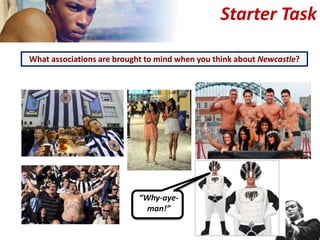
What associations are brought to mind when you think about Newcastle?
“Why-aye-
man!”
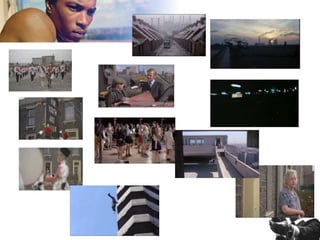
Look at the pictures on your handout and:
Write a short paragraph answer to this question:
How is the North represented in Get Carter?
(You must cite specific examples from the film to support your points)
What does this mise-en-scene tell us about Newcastle/Gateshead in the late
1960’s/early 70’s?
Starter Task
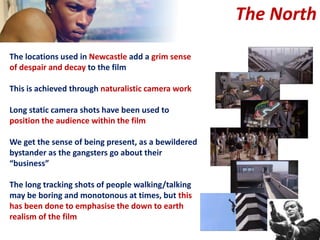
The locations used in Newcastle add a grim sense
of despair and decay to the film
This is achieved through naturalistic camera work
Long static camera shots have been used to
position the audience within the film
We get the sense of being present, as a bewildered
bystander as the gangsters go about their
“business”
The long tracking shots of people walking/talking
may be boring and monotonous at times, but this
has been done to emphasise the down to earth
realism of the film
The North
Learning Objectives
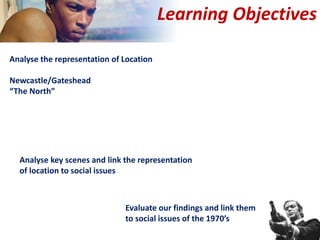
Analyse the representation of Location
Newcastle/Gateshead
“The North”
Analyse key scenes and link the representation
of location to social issues
Evaluate our findings and link them
to social issues of the 1970’s
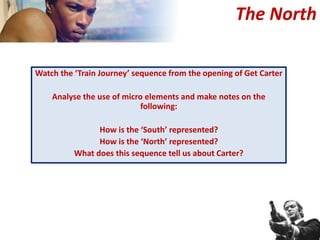
Watch the ‘Train Journey’ sequence from the opening of Get Carter
Analyse the use of micro elements and make notes on the
following:
How is the ‘South’ represented?
How is the ‘North’ represented?
What does this sequence tell us about Carter?
The North
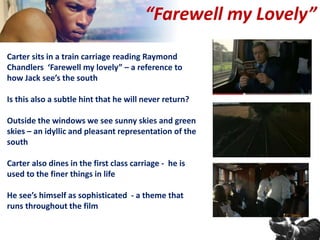
Carter sits in a train carriage reading Raymond
Chandlers ‘Farewell my lovely” – a reference to
how Jack see’s the south
Is this also a subtle hint that he will never return?
Outside the windows we see sunny skies and green
skies – an idyllic and pleasant representation of the
south
Carter also dines in the first class carriage - he is
used to the finer things in life
He see’s himself as sophisticated - a theme that
runs throughout the film
“Farewell my Lovely”
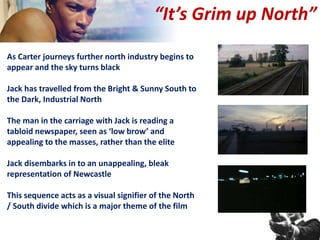
As Carter journeys further north industry begins to
appear and the sky turns black
Jack has travelled from the Bright & Sunny South to
the Dark, Industrial North
The man in the carriage with Jack is reading a
tabloid newspaper, seen as ‘low brow’ and
appealing to the masses, rather than the elite
Jack disembarks in to an unappealing, bleak
representation of Newcastle
This sequence acts as a visual signifier of the North
/ South divide which is a major theme of the film
“It’s Grim up North”
Watch the following sequence and makes notes on
the representation of location
Consider:
Characters
Settings
Use of the Micro elements
Pub
Rather than emphasising the warmth and good humour
conventionally associated with Northern Urban life, Hodges
represents Newcastle as a cold, sinister landscape
The people are suspicious and unfriendly
When Jack enters the Bar he is immediately framed above
the others
Jack clearly see’s himself as better than the locals and looks
down upon them
His request of a pint in ‘a tall glass’ informs us of Jack’s
perception of himself as more sophisticated than the locals
The Six-fingered man at the bar is also a visual signifier of the
northerners lower status – they are genetically inferior
PUB
Learning Objectives
Analyse the representation of Location
Newcastle/Gateshead
“The North”
Analyse key scenes and link the representation
of location to social issues
Evaluate our findings and link them
to social issues of the 1970’s
Marching Band
Watch the following sequence and makes notes on
the following:
What does the Marching band potentially
represent?
By cutting between Carter & Edna, what comment
is Mike Hodges making?
What does the mise-en-scene tell us about
Newcastle?
Marching Band
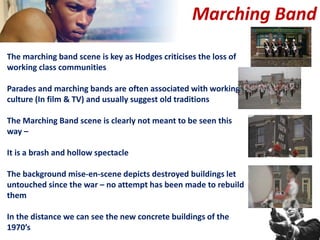
The marching band scene is key as Hodges criticises the loss of
working class communities
Parades and marching bands are often associated with working
culture (In film & TV) and usually suggest old traditions
The Marching Band scene is clearly not meant to be seen this
way –
It is a brash and hollow spectacle
The background mise-en-scene depicts destroyed buildings let
untouched since the war – no attempt has been made to rebuild
them
In the distance we can see the new concrete buildings of the
1970’s
Marching Band
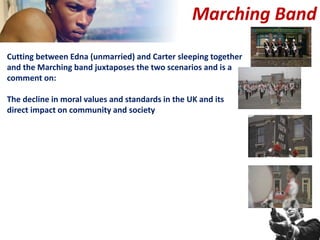
Cutting between Edna (unmarried) and Carter sleeping together
and the Marching band juxtaposes the two scenarios and is a
comment on:
The decline in moral values and standards in the UK and its
direct impact on community and society
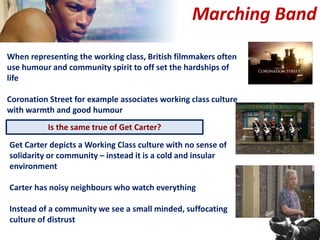
When representing the working class, British filmmakers often
use humour and community spirit to off set the hardships of
life
Coronation Street for example associates working class culture
with warmth and good humour
Marching Band
Is the same true of Get Carter?
Get Carter depicts a Working Class culture with no sense of
solidarity or community – instead it is a cold and insular
environment
Carter has noisy neighbours who watch everything
Instead of a community we see a small minded, suffocating
culture of distrust
Exam Practice
How is ‘The North’ represented in
Get Carter?
Complete an analysis of ‘The North’
Include:
Train sequence
The Pub Sequence
The Marching Band Scene
Your work should take the
form of a poster or mind map
that you and other students
can use when you revise for
your exam
Lesson 6   representation of location

Lesson 6 representation of location

  • 2.
    Starter Task What associationsare brought to mind when you think about Newcastle?
  • 3.
    Starter Task What associationsare brought to mind when you think about Newcastle? “Why-aye- man!”
  • 4.
    Look at thepictures on your handout and: Write a short paragraph answer to this question: How is the North represented in Get Carter? (You must cite specific examples from the film to support your points) What does this mise-en-scene tell us about Newcastle/Gateshead in the late 1960’s/early 70’s? Starter Task
  • 5.
    The locations usedin Newcastle add a grim sense of despair and decay to the film This is achieved through naturalistic camera work Long static camera shots have been used to position the audience within the film We get the sense of being present, as a bewildered bystander as the gangsters go about their “business” The long tracking shots of people walking/talking may be boring and monotonous at times, but this has been done to emphasise the down to earth realism of the film The North
  • 6.
    Learning Objectives Analyse therepresentation of Location Newcastle/Gateshead “The North” Analyse key scenes and link the representation of location to social issues Evaluate our findings and link them to social issues of the 1970’s
  • 7.
    Watch the ‘TrainJourney’ sequence from the opening of Get Carter Analyse the use of micro elements and make notes on the following: How is the ‘South’ represented? How is the ‘North’ represented? What does this sequence tell us about Carter? The North
  • 8.
    Carter sits ina train carriage reading Raymond Chandlers ‘Farewell my lovely” – a reference to how Jack see’s the south Is this also a subtle hint that he will never return? Outside the windows we see sunny skies and green skies – an idyllic and pleasant representation of the south Carter also dines in the first class carriage - he is used to the finer things in life He see’s himself as sophisticated - a theme that runs throughout the film “Farewell my Lovely”
  • 9.
    As Carter journeysfurther north industry begins to appear and the sky turns black Jack has travelled from the Bright & Sunny South to the Dark, Industrial North The man in the carriage with Jack is reading a tabloid newspaper, seen as ‘low brow’ and appealing to the masses, rather than the elite Jack disembarks in to an unappealing, bleak representation of Newcastle This sequence acts as a visual signifier of the North / South divide which is a major theme of the film “It’s Grim up North”
  • 10.
    Watch the followingsequence and makes notes on the representation of location Consider: Characters Settings Use of the Micro elements Pub
  • 11.
    Rather than emphasisingthe warmth and good humour conventionally associated with Northern Urban life, Hodges represents Newcastle as a cold, sinister landscape The people are suspicious and unfriendly When Jack enters the Bar he is immediately framed above the others Jack clearly see’s himself as better than the locals and looks down upon them His request of a pint in ‘a tall glass’ informs us of Jack’s perception of himself as more sophisticated than the locals The Six-fingered man at the bar is also a visual signifier of the northerners lower status – they are genetically inferior PUB
  • 12.
    Learning Objectives Analyse therepresentation of Location Newcastle/Gateshead “The North” Analyse key scenes and link the representation of location to social issues Evaluate our findings and link them to social issues of the 1970’s
  • 13.
    Marching Band Watch thefollowing sequence and makes notes on the following: What does the Marching band potentially represent? By cutting between Carter & Edna, what comment is Mike Hodges making? What does the mise-en-scene tell us about Newcastle?
  • 14.
    Marching Band The marchingband scene is key as Hodges criticises the loss of working class communities Parades and marching bands are often associated with working culture (In film & TV) and usually suggest old traditions The Marching Band scene is clearly not meant to be seen this way – It is a brash and hollow spectacle The background mise-en-scene depicts destroyed buildings let untouched since the war – no attempt has been made to rebuild them In the distance we can see the new concrete buildings of the 1970’s
  • 15.
    Marching Band Cutting betweenEdna (unmarried) and Carter sleeping together and the Marching band juxtaposes the two scenarios and is a comment on: The decline in moral values and standards in the UK and its direct impact on community and society
  • 16.
    When representing theworking class, British filmmakers often use humour and community spirit to off set the hardships of life Coronation Street for example associates working class culture with warmth and good humour Marching Band Is the same true of Get Carter? Get Carter depicts a Working Class culture with no sense of solidarity or community – instead it is a cold and insular environment Carter has noisy neighbours who watch everything Instead of a community we see a small minded, suffocating culture of distrust
  • 17.
    Exam Practice How is‘The North’ represented in Get Carter? Complete an analysis of ‘The North’ Include: Train sequence The Pub Sequence The Marching Band Scene Your work should take the form of a poster or mind map that you and other students can use when you revise for your exam