Persona Doll Approach
Enabling children, adults and communities to develop
positive values and unlearn prejudice
Module 1 Beginning With Self
Course Outline:
 Lesson 1: An anti-bias approach
 Lesson 2: Understanding identity
 Lesson 3: Understanding discrimination
 Lesson 4: Values and attitudes
 Lesson 5: Emotional literacy and empathy
Welcome to lesson 5 which should take you about 30 minutes to complete. At the
end of the lesson we will ask you to answer a short self-evaluation quiz so that you
can test your own knowledge.
Lesson 5 Emotional Literacy and Empathy
Upon completion of this lesson, we expect that you will be
able to:
• Define and understand the concepts of emotional
literacy and empathy ;
and
• Explore ways to support children’s emotional literacy
and development of empathy.
Learning Objectives
Introducing Emotional Literacy
Let’s think
about our
emotional
literacy
An important aspect of anti-bias work is:
• to raise children’s awareness of their own
and other people’s feelings;
and
• how their actions affect other people.
Emotional literacy, also known as emotional
intelligence, is:
• the ability to name, understand and express
feelings and emotions;
as well as
• understand other people’s feelings and
emotions.
If we are to understand the feelings and emotions of children we
first need to get in touch with our own feelings and emotions.
 Complete the following activity by looking at the pictures
provided in the link below. How does it make you feel?
 http://pdt.qjar.co/questions/reflecting-on-own-feelings-and-
emotions/
 Now that you have finished this activity, think about the
feelings that you identified?
• Which pictures made you feel happy? Which made you feel
angry, sad or scared?
• Did any picture evoke strong feelings?
• Did any picture make you feel uncomfortable?
• Did you have more than one feeling about any picture?
We all have a variety of feelings and emotions. We have also all
had different life experiences, and some of these pictures may
have evoked strong emotions which have stayed with us for many
years.
 Getting in touch with our own feelings can help us to
understand the impact of bias and discrimination.
 We also need to be able to understand what children are
saying when they describe their feelings and emotions.
Let’s find out about
how you feel
Reflecting on Own Feelings and Emotions
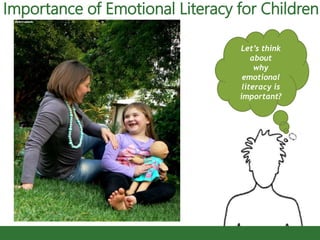
Importance of Emotional Literacy for Children
Let’s think
about
why
emotional
literacy is
important?
Importance of Emotional Literacy for Children
Let’s think
about
why
emotional
literacy is
important?
Why do you think emotional literacy is an important
part of young children’s development?
Emotional literacy helps children to better understand
and communicate with other people about their feelings
and emotions. Children who are not emotionally literate
will find it hard to understand their own feelings.
 Read more about emotional literacy by following the
link to the supporting document “Emotional literacy”.
 The first emotion that children understand is usually
happiness, followed by anger, sadness and fear.
Children need to be helped to increase their emotional
literacy vocabulary so that they can better distinguish
between feelings and emotions. In this same reading,
you will find a list of words that are commonly used for
feelings and emotions - with translations into other
languages.
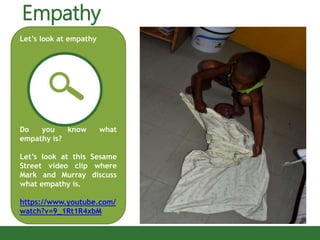
Let’s look at empathy
Do you know what
empathy is?
Let’s look at this Sesame
Street video clip where
Mark and Murray discuss
what empathy is.
https://www.youtube.com/
watch?v=9_1Rt1R4xbM
Empathy
Promoting Empathy
Let’s think
about
recognising
the feelings
of others
Recognising the feelings of others is an important
part of emotional literacy.
• Being able to feel with another person;
• To imagine yourself in the same situation; and
• Know how that person must feel,
is called empathy.
To experience empathy a child needs to:
• Understand her own feelings and emotions;
• Be aware of the other person’s feelings and
emotions; and Tell the difference between the
two.
She also needs to have the words to name the feeling
or emotion.
 Read more about empathy by following the link to
the supporting document “Promoting empathy”.
Let’s look at:
How a Persona Doll story helps children to explore and
understand feelings and to develop feelings of empathy.
Using Persona Dolls to Teach
Emotional Literacy and Empathy
 Follow the link and view the video.
 https://www.youtube.com/watch?v=AjTBHGE6KqY
 After viewing the video, click on the link button to deepen your knowledge about
what you saw on the video. Complete all the activities provided for you.
 Have you completed all the activities? Click on the YES button before moving on.
Using Persona Dolls to Teach
Emotional Literacy and Empathy
• I pledge from this day onward to do my best to
interrupt prejudice and to stop those who, because
of hate, would hurt, harass, or violate the civil rights
of anyone.
• I will try at all times to be aware of my own biases
against people who are different from myself.
• I will ask questions about cultures, religions, and
races that I don't understand.
• I will speak out against anyone who mocks, seeks to
intimidate, or actually hurts someone of a different
race, religion, ethnic group, or sexual orientation.
• I will reach out to support those who are targets of
harassment.
• I will think about specific ways my school, other
students, and my community can promote respect for
people and create a prejudice-free zone.
• I firmly believe that one person can make a
difference and that no person can be an "innocent
bystander" when it comes to opposing hate.
The pledge:
 You can make a copy of the
pledge and display it in a
prominent page. Follow the
link to the supporting
document: “Pledge against
bias and discrimination”.
Pledge Against Bias
• One of the ways to commit to
the anti-bias approach is to
take a pledge or promise to
challenge bias and
discrimination.
End of lesson quiz
We have come to the end of Lesson 5 and it is important to check on
what you have learned in this lesson. This on-line quiz will assess your
knowledge on the topics covered in this lesson.
Let’s reflect on what you have learned in this lesson
 How did you do?
 If you did not get all the answers correct, try again. Once you have a score of
5 you can move on to the next module.
Let’s reflect on what you have learned in this lesson by clicking on the
icon below:
End of lesson quiz
CONGRATULATIONS!
You have now come to the end of module 1. We hope you have
enjoyed the course.
End of Module One
If you have chosen to be assessed and receive
certification for this Module, you will need to
complete Assignment Module1.
 Follow the link to the assignment and read the
instructions carefully.
If you have chosen not to be assessed you can
move on to Module 2.
Module 1 Assignment
End of Module One

Lesson 5

  • 1.
    Persona Doll Approach Enablingchildren, adults and communities to develop positive values and unlearn prejudice
  • 2.
    Module 1 BeginningWith Self Course Outline:  Lesson 1: An anti-bias approach  Lesson 2: Understanding identity  Lesson 3: Understanding discrimination  Lesson 4: Values and attitudes  Lesson 5: Emotional literacy and empathy
  • 3.
    Welcome to lesson5 which should take you about 30 minutes to complete. At the end of the lesson we will ask you to answer a short self-evaluation quiz so that you can test your own knowledge. Lesson 5 Emotional Literacy and Empathy
  • 4.
    Upon completion ofthis lesson, we expect that you will be able to: • Define and understand the concepts of emotional literacy and empathy ; and • Explore ways to support children’s emotional literacy and development of empathy. Learning Objectives
  • 5.
    Introducing Emotional Literacy Let’sthink about our emotional literacy An important aspect of anti-bias work is: • to raise children’s awareness of their own and other people’s feelings; and • how their actions affect other people. Emotional literacy, also known as emotional intelligence, is: • the ability to name, understand and express feelings and emotions; as well as • understand other people’s feelings and emotions.
  • 6.
    If we areto understand the feelings and emotions of children we first need to get in touch with our own feelings and emotions.  Complete the following activity by looking at the pictures provided in the link below. How does it make you feel?  http://pdt.qjar.co/questions/reflecting-on-own-feelings-and- emotions/  Now that you have finished this activity, think about the feelings that you identified? • Which pictures made you feel happy? Which made you feel angry, sad or scared? • Did any picture evoke strong feelings? • Did any picture make you feel uncomfortable? • Did you have more than one feeling about any picture? We all have a variety of feelings and emotions. We have also all had different life experiences, and some of these pictures may have evoked strong emotions which have stayed with us for many years.  Getting in touch with our own feelings can help us to understand the impact of bias and discrimination.  We also need to be able to understand what children are saying when they describe their feelings and emotions. Let’s find out about how you feel Reflecting on Own Feelings and Emotions
  • 7.
    Importance of EmotionalLiteracy for Children Let’s think about why emotional literacy is important?
  • 8.
    Importance of EmotionalLiteracy for Children Let’s think about why emotional literacy is important? Why do you think emotional literacy is an important part of young children’s development? Emotional literacy helps children to better understand and communicate with other people about their feelings and emotions. Children who are not emotionally literate will find it hard to understand their own feelings.  Read more about emotional literacy by following the link to the supporting document “Emotional literacy”.  The first emotion that children understand is usually happiness, followed by anger, sadness and fear. Children need to be helped to increase their emotional literacy vocabulary so that they can better distinguish between feelings and emotions. In this same reading, you will find a list of words that are commonly used for feelings and emotions - with translations into other languages.
  • 9.
    Let’s look atempathy Do you know what empathy is? Let’s look at this Sesame Street video clip where Mark and Murray discuss what empathy is. https://www.youtube.com/ watch?v=9_1Rt1R4xbM Empathy
  • 10.
    Promoting Empathy Let’s think about recognising thefeelings of others Recognising the feelings of others is an important part of emotional literacy. • Being able to feel with another person; • To imagine yourself in the same situation; and • Know how that person must feel, is called empathy. To experience empathy a child needs to: • Understand her own feelings and emotions; • Be aware of the other person’s feelings and emotions; and Tell the difference between the two. She also needs to have the words to name the feeling or emotion.  Read more about empathy by following the link to the supporting document “Promoting empathy”.
  • 11.
    Let’s look at: Howa Persona Doll story helps children to explore and understand feelings and to develop feelings of empathy. Using Persona Dolls to Teach Emotional Literacy and Empathy
  • 12.
     Follow thelink and view the video.  https://www.youtube.com/watch?v=AjTBHGE6KqY  After viewing the video, click on the link button to deepen your knowledge about what you saw on the video. Complete all the activities provided for you.  Have you completed all the activities? Click on the YES button before moving on. Using Persona Dolls to Teach Emotional Literacy and Empathy
  • 13.
    • I pledgefrom this day onward to do my best to interrupt prejudice and to stop those who, because of hate, would hurt, harass, or violate the civil rights of anyone. • I will try at all times to be aware of my own biases against people who are different from myself. • I will ask questions about cultures, religions, and races that I don't understand. • I will speak out against anyone who mocks, seeks to intimidate, or actually hurts someone of a different race, religion, ethnic group, or sexual orientation. • I will reach out to support those who are targets of harassment. • I will think about specific ways my school, other students, and my community can promote respect for people and create a prejudice-free zone. • I firmly believe that one person can make a difference and that no person can be an "innocent bystander" when it comes to opposing hate. The pledge:  You can make a copy of the pledge and display it in a prominent page. Follow the link to the supporting document: “Pledge against bias and discrimination”. Pledge Against Bias • One of the ways to commit to the anti-bias approach is to take a pledge or promise to challenge bias and discrimination.
  • 14.
    End of lessonquiz We have come to the end of Lesson 5 and it is important to check on what you have learned in this lesson. This on-line quiz will assess your knowledge on the topics covered in this lesson. Let’s reflect on what you have learned in this lesson
  • 15.
     How didyou do?  If you did not get all the answers correct, try again. Once you have a score of 5 you can move on to the next module. Let’s reflect on what you have learned in this lesson by clicking on the icon below: End of lesson quiz
  • 16.
    CONGRATULATIONS! You have nowcome to the end of module 1. We hope you have enjoyed the course. End of Module One
  • 17.
    If you havechosen to be assessed and receive certification for this Module, you will need to complete Assignment Module1.  Follow the link to the assignment and read the instructions carefully. If you have chosen not to be assessed you can move on to Module 2. Module 1 Assignment
  • 18.