LESSON 4:
PSYCHOLOGICAL
CONSTRUCTION OF
THE SELF
Learning Objectives:
• Defineanddescribethedifferent
psychologicalconceptsofself;
• Differentiatethevariousconceptsoftheself
andidentifytheirrelationship;
• Explainhowtheconceptsofself-influence
behavior;
• Applyconceptsofselfinone’slifetodevelop
self-awarenessandself-understanding.
Right Handedness or Left Handedness:
Does it Reflect Ones Personality?
Some research has suggested that left-
handers have unique qualities over their right-
handed counterparts. For example, they are
believed to be more creative and more athletic
and to have better memories.
It is believed that left-handers were more
prone to mental disorders and pressured
students to switch hands.
Theories of Self Development
Psychologists have a unique way of looking
at self for it attempts to explain it in a personal
and cognitive context.
One view states that self developed
following a developmental order of learning.
Another view states that self developed in
constant struggle between desires against
social expectation. Still another view states that
self is a product of cognitive development
brought by constant interaction of people in
the society.
Who is Sigmund Freud?
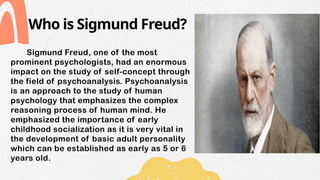
Sigmund Freud, one of the most
prominent psychologists, had an enormous
impact on the study of self-concept through
the field of psychoanalysis. Psychoanalysis
is an approach to the study of human
psychology that emphasizes the complex
reasoning process of human mind. He
emphasized the importance of early
childhood socialization as it is very vital in
the development of basic adult personality
which can be established as early as 5 or 6
years old.
Freud's Psychosexual Theory
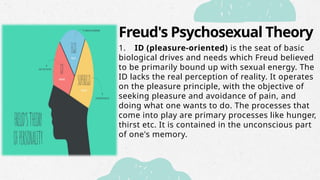
1. ID (pleasure-oriented) is the seat of basic
biological drives and needs which Freud believed
to be primarily bound up with sexual energy. The
ID lacks the real perception of reality. It operates
on the pleasure principle, with the objective of
seeking pleasure and avoidance of pain, and
doing what one wants to do. The processes that
come into play are primary processes like hunger,
thirst etc. It is contained in the unconscious part
of one's memory.
Freud's Psychosexual Theory
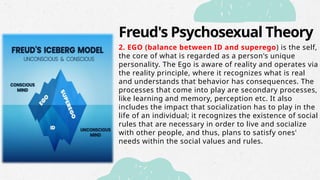
2. EGO (balance between ID and superego) is the self,
the core of what is regarded as a person's unique
personality. The Ego is aware of reality and operates via
the reality principle, where it recognizes what is real
and understands that behavior has consequences. The
processes that come into play are secondary processes,
like learning and memory, perception etc. It also
includes the impact that socialization has to play in the
life of an individual; it recognizes the existence of social
rules that are necessary in order to live and socialize
with other people, and thus, plans to satisfy ones'
needs within the social values and rules.
Freud's Psychosexual Theory
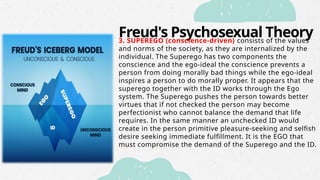
3. SUPEREGO (conscience-driven) consists of the values
and norms of the society, as they are internalized by the
individual. The Superego has two components the
conscience and the ego-ideal the conscience prevents a
person from doing morally bad things while the ego-ideal
inspires a person to do morally proper. It appears that the
superego together with the ID works through the Ego
system. The Superego pushes the person towards better
virtues that if not checked the person may become
perfectionist who cannot balance the demand that life
requires. In the same manner an unchecked ID would
create in the person primitive pleasure-seeking and selfish
desire seeking immediate fulfillment. It is the EGO that

must compromise the demand of the Superego and the ID.
Freud's Psychosexual Theory
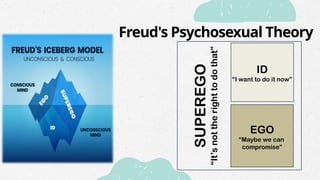
ID
“I want to do it now”
EGO
“Maybe we can
compromise”
SUPEREGO
“It’s
not
the
right
to
do
that”
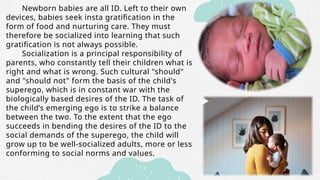
Newborn babies are all ID. Left to their own
devices, babies seek insta gratification in the
form of food and nurturing care. They must
therefore be socialized into learning that such
gratification is not always possible.
Socialization is a principal responsibility of
parents, who constantly tell their children what is
right and what is wrong. Such cultural "should"
and "should not" form the basis of the child's
superego, which is in constant war with the
biologically based desires of the ID. The task of
the child’s emerging ego is to strike a balance
between the two. To the extent that the ego
succeeds in bending the desires of the ID to the
social demands of the superego, the child will
grow up to be well-socialized adults, more or less
conforming to social norms and values.
For instance, according to
Freud, an infant who is severely
punished during toilet training
may become fixated at that
stage of development and for
the rest of his or her life,
engage in compulsive hand-
washing and other efforts to
remain clean (Freud, 1929)
First assumption the
outstanding characteristic of
people is plasticity that is people
have the flexibility to learn a
variety of behavior in varied
situations. Bandura attests that
people can learn through direct
experiences by observing others.
Bandura likewise points out the
idea that reinforcement can be
vicarious. People can be reinforced
by observing another person
receive a reward. The indirect
reinforcements account for a good
bit of people's learning.
People have the competence to
regulate their lives. People can make
transitory events into relative
consistent ways of evaluating and
regulating their social and cultural
environment. Without this capacity,
people would just react to sensory
experience and would lack the ability
to anticipate events, create new
ideas on the internal standard to
evaluate present experiences.
Third assumption social
cognitive theory takes an
argentic perspective,
meaning people have the
competence to exercise
control over the nature and
quality of their lives. People
are the producers and
products of social system.
Albert Bandura Social Cognitive Theory
Social cognitive theory anchors on several basic assumptions.
First assumption the
outstanding characteristic of people is
plasticity that is people have the
flexibility to learn a variety of behavior
in varied situations. Bandura attests
that people can learn through direct
experiences by observing others.
Bandura likewise points out the idea
that reinforcement can be vicarious.
People can be reinforced by observing
another person receive a reward. The
indirect reinforcements account for a
good bit of people's learning.
Second assumption is that
people have the competence
to regulate their lives. People
can make transitory events
into relative consistent ways
of evaluating and regulating
their social and cultural
environment. Without this
capacity, people would just
react to sensory experience
and would lack the ability to
anticipate events, create new
ideas on the internal
standard to evaluate present
experiences.
Third assumption social
cognitive theory takes an
argentic perspective,
meaning people have the
competence to exercise
control over the nature and
quality of their lives. People
are the producers and
products of social system.
Albert Bandura Social Cognitive Theory
Social cognitive theory anchors on several basic assumptions.
First assumption the
outstanding characteristic of people is
plasticity that is people have the
flexibility to learn a variety of behavior
in varied situations. Bandura attests
that people can learn through direct
experiences by observing others.
Bandura likewise points out the idea
that reinforcement can be vicarious.
People can be reinforced by observing
another person receive a reward. The
indirect reinforcements account for a
good bit of people's learning.
Second assumption is that people
have the competence to regulate their
lives. People can make transitory
events into relative consistent ways of
evaluating and regulating their social
and cultural environment. Without
this capacity, people would just react
to sensory experience and would lack
the ability to anticipate events, create
new ideas on the internal standard to
evaluate present experiences.
Third assumption social cognitive
theory takes an argentic
perspective, meaning people
have the competence to exercise
control over the nature and
quality of their lives. People are
the producers and products of
social system. An important part
of triadic reciprocal causation
model is self- efficacy. People's
action is generally enhanced
when they have high self-efficacy
meaning that they can perform
those behaviors that can bring
desired performance in specific
situations.
Albert Bandura Social Cognitive Theory
Social cognitive theory anchors on several basic assumptions.
Fourth assumption - people
regulate their action
through the external and
internal factors. External
factor includes people's
physical and social
environment, while internal
factor includes self-
observation, judgmental
process and self-reaction.
Fifth assumption when people
discover themselves in an unclear
situation they typically try to regulate
their behavior through moral agency
which includes redefining behavior,
disregarding or distorting the
consequences of the behavior and
doing away with responsibility for
their actions. (Feist, Feist& Roberts,
2013)
Albert Bandura Social Cognitive Theory
Social cognitive theory anchors on several basic assumptions.
Fourth assumption - people regulate
their action through the external and
internal factors. External factor
includes people's physical and social
environment, while internal factor
includes self-observation, judgmental
process and self-reaction.
Fifth assumption when people
discover themselves in an
unclear situation they
typically try to regulate their
behavior through moral
agency which includes
redefining behavior,
disregarding or distorting the
consequences of the behavior
and doing away with
responsibility for their
actions. (Feist, Feist& Roberts,
2013)
Albert Bandura Social Cognitive Theory
Social cognitive theory anchors on several basic assumptions.
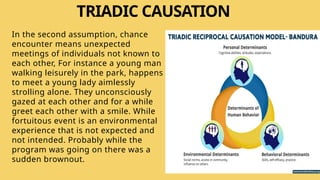
TRIADIC CAUSATION
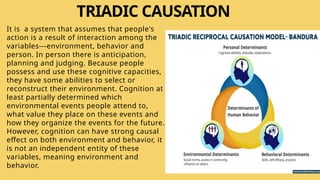
It is a system that assumes that people's
action is a result of interaction among the
variables---environment, behavior and
person. In person there is anticipation,
planning and judging. Because people
possess and use these cognitive capacities,
they have some abilities to select or
reconstruct their environment. Cognition at
least partially determined which
environmental events people attend to,
what value they place on these events and
how they organize the events for the future.
However, cognition can have strong causal
effect on both environment and behavior, it
is not an independent entity of these
variables, meaning environment and
behavior.
TRIADIC CAUSATION
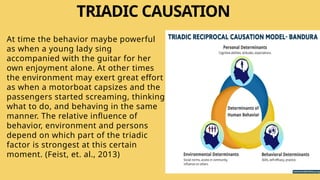
At time the behavior maybe powerful
as when a young lady sing
accompanied with the guitar for her
own enjoyment alone. At other times
the environment may exert great effort
as when a motorboat capsizes and the
passengers started screaming, thinking
what to do, and behaving in the same
manner. The relative influence of
behavior, environment and persons
depend on which part of the triadic
factor is strongest at this certain
moment. (Feist, et. al., 2013)
TRIADIC CAUSATION
In the second assumption, chance
encounter means unexpected
meetings of individuals not known to
each other, For instance a young man
walking leisurely in the park, happens
to meet a young lady aimlessly
strolling alone. They unconsciously
gazed at each other and for a while
greet each other with a smile. While
fortuitous event is an environmental
experience that is not expected and
not intended. Probably while the
program was going on there was a
sudden brownout.
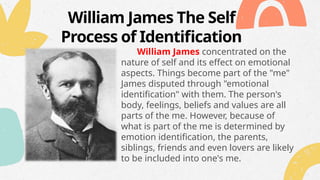
William James The Self
Process of Identification
William James concentrated on the
nature of self and its effect on emotional
aspects. Things become part of the "me"
James disputed through "emotional
identification" with them. The person's
body, feelings, beliefs and values are all
parts of the me. However, because of
what is part of the me is determined by
emotion identification, the parents,
siblings, friends and even lovers are likely
to be included into one's me.
William James The Self
Process of Identification
James' concepts of the identification process
show in his belief of the unchanging nature of
the self. He attests that due to the ever-
changing nature of life as reflected in the
social relationship and material possessions,
and the unreality and reconstructive nature of
one' memory, the objective self is not
permanent like diamond. It is constantly
changing because a person is dealing with
shifting materials. This implies that the self
today is different even for a little from the self
of yesterday. (Franzoi, 2006)
The Real Self and Ideal
Self
Carl Rogers was a humanistic
psychologist who agreed with Abraham
Maslow's Self Actualization but went
further with the assumption that for a
person to "grow" he must need an
environment that can provide him with
genuineness or openness and self-
disclosure. He believes that a person has
one basic motive, that is, the desire to
self-actualize, to reach his highest
potential and achieve his level of
humanness. Roger believes that a
person, to be self-actualized must be in
a state of congruence.
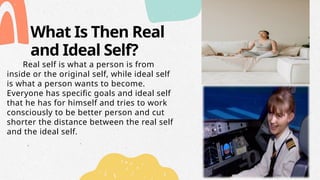
What Is Then Real
and Ideal Self?
Real self is what a person is from
inside or the original self, while ideal self
is what a person wants to become.
Everyone has specific goals and ideal self
that he has for himself and tries to work
consciously to be better person and cut
shorter the distance between the real self
and the ideal self.
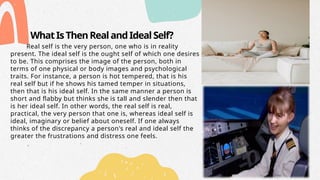
WhatIsThenRealandIdealSelf?
Real self is the very person, one who is in reality
present. The ideal self is the ought self of which one desires
to be. This comprises the image of the person, both in
terms of one physical or body images and psychological
traits. For instance, a person is hot tempered, that is his
real self but if he shows his tamed temper in situations,
then that is his ideal self. In the same manner a person is
short and flabby but thinks she is tall and slender then that
is her ideal self. In other words, the real self is real,
practical, the very person that one is, whereas ideal self is
ideal, imaginary or belief about oneself. If one always
thinks of the discrepancy a person's real and ideal self the
greater the frustrations and distress one feels.
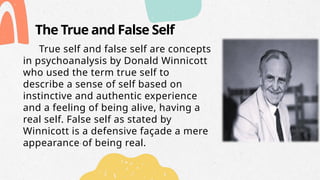
The True and False Self
True self and false self are concepts
in psychoanalysis by Donald Winnicott
who used the term true self to
describe a sense of self based on
instinctive and authentic experience
and a feeling of being alive, having a
real self. False self as stated by
Winnicott is a defensive façade a mere
appearance of being real.
The True and False Self
False self or social mask serves many adaptive
purposes. People used to utilize aspect of the false self in
variety of social Accordingly, Winnicott says that everyone
wears social mask or false harmoniously mask that
empowers prep wears or in wide varieties of interpersonal
nature. People show different sides of themselves to
others and significant others like family, friends,
professional colleagues and acquaintances. It is important
to be aware of these different social masks and use them
to help people manage their lives in a balanced and
integrated manner wit to help people manage balance,
people are endangered of feeling disconnected from
themselves and others. A clear understanding of people
selves would enable them to develop a strong integrated
identity.
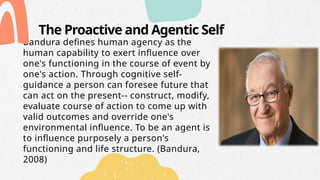
The Proactive and Agentic Self
Bandura defines human agency as the
human capability to exert influence over
one's functioning in the course of event by
one's action. Through cognitive self-
guidance a person can foresee future that
can act on the present-- construct, modify,
evaluate course of action to come up with
valid outcomes and override one's
environmental influence. To be an agent is
to influence purposely a person's
functioning and life structure. (Bandura,
2008)
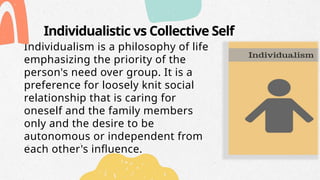
Individualistic vs Collective Self
Individualism is a philosophy of life
emphasizing the priority of the
person's need over group. It is a
preference for loosely knit social
relationship that is caring for
oneself and the family members
only and the desire to be
autonomous or independent from
each other's influence.
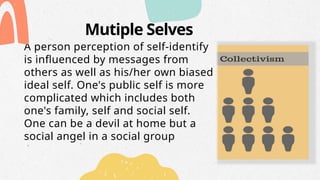
Individualistic vs Collective Self
In contrast, there is another
perspective called collectivism which
represents preference for a tightly knit
social framework-in which a person
can expect their family and other
relatives of the social group to look
after them in exchanged for
unquestioned loyalty. The loyalty of the
family is highly stressed.
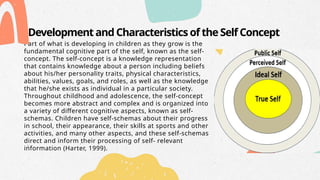
Mutiple Selves
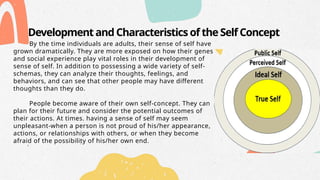
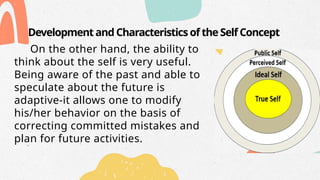
A person perception of self-identify
is influenced by messages from
others as well as his/her own biased
ideal self. One's public self is more
complicated which includes both
one's family, self and social self.
One can be a devil at home but a
social angel in a social group
True Self
Ideal Self
Perceived Self
Public Self
Development and Characteristics of the Self Concept
Part of what is developing in children as they grow is the
fundamental cognitive part of the self, known as the self-
concept. The self-concept is a knowledge representation
that contains knowledge about a person including beliefs
about his/her personality traits, physical characteristics,
abilities, values, goals, and roles, as well as the knowledge
that he/she exists as individual in a particular society.
Throughout childhood and adolescence, the self-concept
becomes more abstract and complex and is organized into
a variety of different cognitive aspects, known as self-
schemas. Children have self-schemas about their progress
in school, their appearance, their skills at sports and other
activities, and many other aspects, and these self-schemas
direct and inform their processing of self- relevant
information (Harter, 1999).
Development and Characteristics of the Self Concept
By the time individuals are adults, their sense of self have
grown dramatically. They are more exposed on how their genes
and social experience play vital roles in their development of
sense of self. In addition to possessing a wide variety of self-
schemas, they can analyze their thoughts, feelings, and
behaviors, and can see that other people may have different
thoughts than they do.
People become aware of their own self-concept. They can
plan for their future and consider the potential outcomes of
their actions. At times. having a sense of self may seem
unpleasant-when a person is not proud of his/her appearance,
actions, or relationships with others, or when they become
afraid of the possibility of his/her own end.
Development and Characteristics of the Self Concept
On the other hand, the ability to
think about the self is very useful.
Being aware of the past and able to
speculate about the future is
adaptive-it allows one to modify
his/her behavior on the basis of
correcting committed mistakes and
plan for future activities.
Thank you
very much!

LESSON-4.pptx Understanding the self....

  • 1.
  • 2.
    Learning Objectives: • Defineanddescribethedifferent psychologicalconceptsofself; •Differentiatethevariousconceptsoftheself andidentifytheirrelationship; • Explainhowtheconceptsofself-influence behavior; • Applyconceptsofselfinone’slifetodevelop self-awarenessandself-understanding.
  • 3.
    Right Handedness orLeft Handedness: Does it Reflect Ones Personality? Some research has suggested that left- handers have unique qualities over their right- handed counterparts. For example, they are believed to be more creative and more athletic and to have better memories. It is believed that left-handers were more prone to mental disorders and pressured students to switch hands.
  • 4.
    Theories of SelfDevelopment Psychologists have a unique way of looking at self for it attempts to explain it in a personal and cognitive context. One view states that self developed following a developmental order of learning. Another view states that self developed in constant struggle between desires against social expectation. Still another view states that self is a product of cognitive development brought by constant interaction of people in the society.
  • 5.
    Who is SigmundFreud? Sigmund Freud, one of the most prominent psychologists, had an enormous impact on the study of self-concept through the field of psychoanalysis. Psychoanalysis is an approach to the study of human psychology that emphasizes the complex reasoning process of human mind. He emphasized the importance of early childhood socialization as it is very vital in the development of basic adult personality which can be established as early as 5 or 6 years old.
  • 6.
    Freud's Psychosexual Theory 1.ID (pleasure-oriented) is the seat of basic biological drives and needs which Freud believed to be primarily bound up with sexual energy. The ID lacks the real perception of reality. It operates on the pleasure principle, with the objective of seeking pleasure and avoidance of pain, and doing what one wants to do. The processes that come into play are primary processes like hunger, thirst etc. It is contained in the unconscious part of one's memory.
  • 7.
    Freud's Psychosexual Theory 2.EGO (balance between ID and superego) is the self, the core of what is regarded as a person's unique personality. The Ego is aware of reality and operates via the reality principle, where it recognizes what is real and understands that behavior has consequences. The processes that come into play are secondary processes, like learning and memory, perception etc. It also includes the impact that socialization has to play in the life of an individual; it recognizes the existence of social rules that are necessary in order to live and socialize with other people, and thus, plans to satisfy ones' needs within the social values and rules.
  • 8.
    Freud's Psychosexual Theory 3.SUPEREGO (conscience-driven) consists of the values and norms of the society, as they are internalized by the individual. The Superego has two components the conscience and the ego-ideal the conscience prevents a person from doing morally bad things while the ego-ideal inspires a person to do morally proper. It appears that the superego together with the ID works through the Ego system. The Superego pushes the person towards better virtues that if not checked the person may become perfectionist who cannot balance the demand that life requires. In the same manner an unchecked ID would create in the person primitive pleasure-seeking and selfish desire seeking immediate fulfillment. It is the EGO that must compromise the demand of the Superego and the ID.
  • 9.
    Freud's Psychosexual Theory ID “Iwant to do it now” EGO “Maybe we can compromise” SUPEREGO “It’s not the right to do that”
  • 10.
    Newborn babies areall ID. Left to their own devices, babies seek insta gratification in the form of food and nurturing care. They must therefore be socialized into learning that such gratification is not always possible. Socialization is a principal responsibility of parents, who constantly tell their children what is right and what is wrong. Such cultural "should" and "should not" form the basis of the child's superego, which is in constant war with the biologically based desires of the ID. The task of the child’s emerging ego is to strike a balance between the two. To the extent that the ego succeeds in bending the desires of the ID to the social demands of the superego, the child will grow up to be well-socialized adults, more or less conforming to social norms and values.
  • 11.
    For instance, accordingto Freud, an infant who is severely punished during toilet training may become fixated at that stage of development and for the rest of his or her life, engage in compulsive hand- washing and other efforts to remain clean (Freud, 1929)
  • 12.
    First assumption the outstandingcharacteristic of people is plasticity that is people have the flexibility to learn a variety of behavior in varied situations. Bandura attests that people can learn through direct experiences by observing others. Bandura likewise points out the idea that reinforcement can be vicarious. People can be reinforced by observing another person receive a reward. The indirect reinforcements account for a good bit of people's learning. People have the competence to regulate their lives. People can make transitory events into relative consistent ways of evaluating and regulating their social and cultural environment. Without this capacity, people would just react to sensory experience and would lack the ability to anticipate events, create new ideas on the internal standard to evaluate present experiences. Third assumption social cognitive theory takes an argentic perspective, meaning people have the competence to exercise control over the nature and quality of their lives. People are the producers and products of social system. Albert Bandura Social Cognitive Theory Social cognitive theory anchors on several basic assumptions.
  • 13.
    First assumption the outstandingcharacteristic of people is plasticity that is people have the flexibility to learn a variety of behavior in varied situations. Bandura attests that people can learn through direct experiences by observing others. Bandura likewise points out the idea that reinforcement can be vicarious. People can be reinforced by observing another person receive a reward. The indirect reinforcements account for a good bit of people's learning. Second assumption is that people have the competence to regulate their lives. People can make transitory events into relative consistent ways of evaluating and regulating their social and cultural environment. Without this capacity, people would just react to sensory experience and would lack the ability to anticipate events, create new ideas on the internal standard to evaluate present experiences. Third assumption social cognitive theory takes an argentic perspective, meaning people have the competence to exercise control over the nature and quality of their lives. People are the producers and products of social system. Albert Bandura Social Cognitive Theory Social cognitive theory anchors on several basic assumptions.
  • 14.
    First assumption the outstandingcharacteristic of people is plasticity that is people have the flexibility to learn a variety of behavior in varied situations. Bandura attests that people can learn through direct experiences by observing others. Bandura likewise points out the idea that reinforcement can be vicarious. People can be reinforced by observing another person receive a reward. The indirect reinforcements account for a good bit of people's learning. Second assumption is that people have the competence to regulate their lives. People can make transitory events into relative consistent ways of evaluating and regulating their social and cultural environment. Without this capacity, people would just react to sensory experience and would lack the ability to anticipate events, create new ideas on the internal standard to evaluate present experiences. Third assumption social cognitive theory takes an argentic perspective, meaning people have the competence to exercise control over the nature and quality of their lives. People are the producers and products of social system. An important part of triadic reciprocal causation model is self- efficacy. People's action is generally enhanced when they have high self-efficacy meaning that they can perform those behaviors that can bring desired performance in specific situations. Albert Bandura Social Cognitive Theory Social cognitive theory anchors on several basic assumptions.
  • 15.
    Fourth assumption -people regulate their action through the external and internal factors. External factor includes people's physical and social environment, while internal factor includes self- observation, judgmental process and self-reaction. Fifth assumption when people discover themselves in an unclear situation they typically try to regulate their behavior through moral agency which includes redefining behavior, disregarding or distorting the consequences of the behavior and doing away with responsibility for their actions. (Feist, Feist& Roberts, 2013) Albert Bandura Social Cognitive Theory Social cognitive theory anchors on several basic assumptions.
  • 16.
    Fourth assumption -people regulate their action through the external and internal factors. External factor includes people's physical and social environment, while internal factor includes self-observation, judgmental process and self-reaction. Fifth assumption when people discover themselves in an unclear situation they typically try to regulate their behavior through moral agency which includes redefining behavior, disregarding or distorting the consequences of the behavior and doing away with responsibility for their actions. (Feist, Feist& Roberts, 2013) Albert Bandura Social Cognitive Theory Social cognitive theory anchors on several basic assumptions.
  • 17.
    TRIADIC CAUSATION It isa system that assumes that people's action is a result of interaction among the variables---environment, behavior and person. In person there is anticipation, planning and judging. Because people possess and use these cognitive capacities, they have some abilities to select or reconstruct their environment. Cognition at least partially determined which environmental events people attend to, what value they place on these events and how they organize the events for the future. However, cognition can have strong causal effect on both environment and behavior, it is not an independent entity of these variables, meaning environment and behavior.
  • 18.
    TRIADIC CAUSATION At timethe behavior maybe powerful as when a young lady sing accompanied with the guitar for her own enjoyment alone. At other times the environment may exert great effort as when a motorboat capsizes and the passengers started screaming, thinking what to do, and behaving in the same manner. The relative influence of behavior, environment and persons depend on which part of the triadic factor is strongest at this certain moment. (Feist, et. al., 2013)
  • 19.
    TRIADIC CAUSATION In thesecond assumption, chance encounter means unexpected meetings of individuals not known to each other, For instance a young man walking leisurely in the park, happens to meet a young lady aimlessly strolling alone. They unconsciously gazed at each other and for a while greet each other with a smile. While fortuitous event is an environmental experience that is not expected and not intended. Probably while the program was going on there was a sudden brownout.
  • 20.
    William James TheSelf Process of Identification William James concentrated on the nature of self and its effect on emotional aspects. Things become part of the "me" James disputed through "emotional identification" with them. The person's body, feelings, beliefs and values are all parts of the me. However, because of what is part of the me is determined by emotion identification, the parents, siblings, friends and even lovers are likely to be included into one's me.
  • 21.
    William James TheSelf Process of Identification James' concepts of the identification process show in his belief of the unchanging nature of the self. He attests that due to the ever- changing nature of life as reflected in the social relationship and material possessions, and the unreality and reconstructive nature of one' memory, the objective self is not permanent like diamond. It is constantly changing because a person is dealing with shifting materials. This implies that the self today is different even for a little from the self of yesterday. (Franzoi, 2006)
  • 22.
    The Real Selfand Ideal Self Carl Rogers was a humanistic psychologist who agreed with Abraham Maslow's Self Actualization but went further with the assumption that for a person to "grow" he must need an environment that can provide him with genuineness or openness and self- disclosure. He believes that a person has one basic motive, that is, the desire to self-actualize, to reach his highest potential and achieve his level of humanness. Roger believes that a person, to be self-actualized must be in a state of congruence.
  • 23.
    What Is ThenReal and Ideal Self? Real self is what a person is from inside or the original self, while ideal self is what a person wants to become. Everyone has specific goals and ideal self that he has for himself and tries to work consciously to be better person and cut shorter the distance between the real self and the ideal self.
  • 24.
    WhatIsThenRealandIdealSelf? Real self isthe very person, one who is in reality present. The ideal self is the ought self of which one desires to be. This comprises the image of the person, both in terms of one physical or body images and psychological traits. For instance, a person is hot tempered, that is his real self but if he shows his tamed temper in situations, then that is his ideal self. In the same manner a person is short and flabby but thinks she is tall and slender then that is her ideal self. In other words, the real self is real, practical, the very person that one is, whereas ideal self is ideal, imaginary or belief about oneself. If one always thinks of the discrepancy a person's real and ideal self the greater the frustrations and distress one feels.
  • 25.
    The True andFalse Self True self and false self are concepts in psychoanalysis by Donald Winnicott who used the term true self to describe a sense of self based on instinctive and authentic experience and a feeling of being alive, having a real self. False self as stated by Winnicott is a defensive façade a mere appearance of being real.
  • 26.
    The True andFalse Self False self or social mask serves many adaptive purposes. People used to utilize aspect of the false self in variety of social Accordingly, Winnicott says that everyone wears social mask or false harmoniously mask that empowers prep wears or in wide varieties of interpersonal nature. People show different sides of themselves to others and significant others like family, friends, professional colleagues and acquaintances. It is important to be aware of these different social masks and use them to help people manage their lives in a balanced and integrated manner wit to help people manage balance, people are endangered of feeling disconnected from themselves and others. A clear understanding of people selves would enable them to develop a strong integrated identity.
  • 27.
    The Proactive andAgentic Self Bandura defines human agency as the human capability to exert influence over one's functioning in the course of event by one's action. Through cognitive self- guidance a person can foresee future that can act on the present-- construct, modify, evaluate course of action to come up with valid outcomes and override one's environmental influence. To be an agent is to influence purposely a person's functioning and life structure. (Bandura, 2008)
  • 28.
    Individualistic vs CollectiveSelf Individualism is a philosophy of life emphasizing the priority of the person's need over group. It is a preference for loosely knit social relationship that is caring for oneself and the family members only and the desire to be autonomous or independent from each other's influence.
  • 29.
    Individualistic vs CollectiveSelf In contrast, there is another perspective called collectivism which represents preference for a tightly knit social framework-in which a person can expect their family and other relatives of the social group to look after them in exchanged for unquestioned loyalty. The loyalty of the family is highly stressed.
  • 30.
    Mutiple Selves A personperception of self-identify is influenced by messages from others as well as his/her own biased ideal self. One's public self is more complicated which includes both one's family, self and social self. One can be a devil at home but a social angel in a social group
  • 31.
  • 32.
    Development and Characteristicsof the Self Concept Part of what is developing in children as they grow is the fundamental cognitive part of the self, known as the self- concept. The self-concept is a knowledge representation that contains knowledge about a person including beliefs about his/her personality traits, physical characteristics, abilities, values, goals, and roles, as well as the knowledge that he/she exists as individual in a particular society. Throughout childhood and adolescence, the self-concept becomes more abstract and complex and is organized into a variety of different cognitive aspects, known as self- schemas. Children have self-schemas about their progress in school, their appearance, their skills at sports and other activities, and many other aspects, and these self-schemas direct and inform their processing of self- relevant information (Harter, 1999).
  • 33.
    Development and Characteristicsof the Self Concept By the time individuals are adults, their sense of self have grown dramatically. They are more exposed on how their genes and social experience play vital roles in their development of sense of self. In addition to possessing a wide variety of self- schemas, they can analyze their thoughts, feelings, and behaviors, and can see that other people may have different thoughts than they do. People become aware of their own self-concept. They can plan for their future and consider the potential outcomes of their actions. At times. having a sense of self may seem unpleasant-when a person is not proud of his/her appearance, actions, or relationships with others, or when they become afraid of the possibility of his/her own end.
  • 34.
    Development and Characteristicsof the Self Concept On the other hand, the ability to think about the self is very useful. Being aware of the past and able to speculate about the future is adaptive-it allows one to modify his/her behavior on the basis of correcting committed mistakes and plan for future activities.
  • 35.