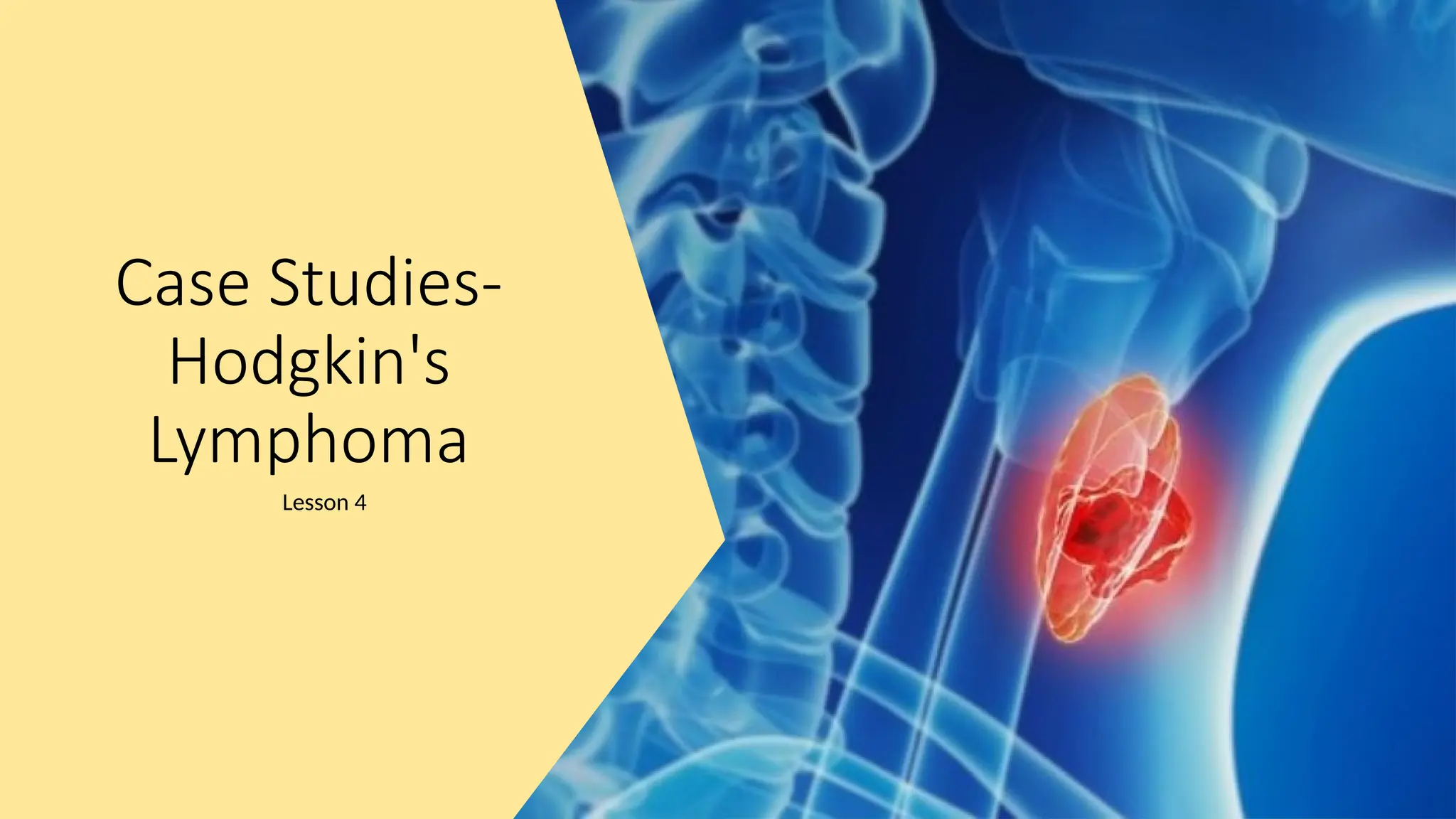
Case Studies-
Hodgkin's
Lymphoma
Lesson 4
To Start
• Answer these questions based on last lesson's activity
• Which condition causes swelling through a build up of fluid due to a
blockage in the lymph capillaries?
• Which condition is cause by a mutation in B-lymphocytes?
• Which condition is due to an infections, causing lymph nodes to
swell?
Aims-
• To identify a relevant case study for either Hodgins's lymphoma
• You will be able to identify the key symptoms that led to diagnosis of
the condition
• You will be able to discuss the suggested treatments for the condition
and relate these to the case study chosen
• You will be able to describe the treatments given to the patient and
why, and how these treatments restored normal function
The Bigger
Picture
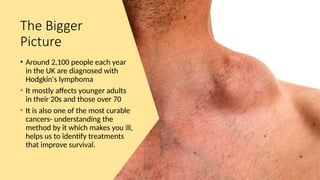
• Around 2,100 people each year
in the UK are diagnosed with
Hodgkin's lymphoma
• It mostly affects younger adults
in their 20s and those over 70
• It is also one of the most curable
cancers- understanding the
method by it which makes you ill,
helps us to identify treatments
that improve survival.
Hodgkin's lymphoma-
Task 1
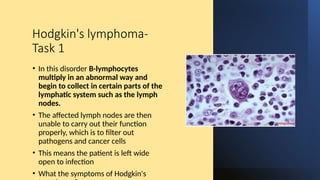
• In this disorder B-lymphocytes
multiply in an abnormal way and
begin to collect in certain parts of the
lymphatic system such as the lymph
nodes.
• The affected lymph nodes are then
unable to carry out their function
properly, which is to filter out
pathogens and cancer cells
• This means the patient is left wide
open to infection
• What the symptoms of Hodgkin's
Symptoms of Hodgkin’s lymphoma- obtained
from NHS.uk website
• Painless swelling of the lymph nodes, usually in the neck, armpit or groin
• These swelling are caused by a blood up of abnormal B-lymphocytes
• Other symptoms may include
• Night sweats
• Weight loss (unintentional)
• A high temperature
• A persistent cough or feeling of breathlessness
• Persistent itching of skin all over the body
• Increased risks of infections
• Persistent tiredness or fatigue
Stages of Hodkin's lymphoma
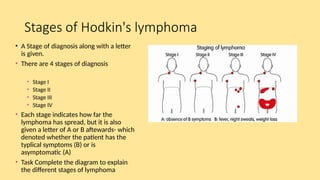
• A Stage of diagnosis along with a letter
is given.
• There are 4 stages of diagnosis
• Stage I
• Stage II
• Stage III
• Stage IV
• Each stage indicates how far the
lymphoma has spread, but it is also
given a letter of A or B aftewards- which
denoted whether the patient has the
typlical symptoms (B) or is
asymptomatic (A)
• Task Complete the diagram to explain
the different stages of lymphoma
Treatments for Hodgkin's Lymphoma
• Treatments will come with side effects, some of which are extreme
• Treatments include
• Chemotherapy
• Radiotherapy
• Steroid medication usually in combination with chemotherapy
• Immune Therapy & Targeted Therapy
• Rituximab
• Brentuximab vedotin
• Stem cell and bone marrow
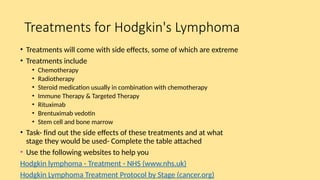
• Task- find out the side effects of these treatments and at what
stage they would be used- Complete the table attached
• Use the following websites to help you
Hodgkin lymphoma - Treatment - NHS (www.nhs.uk)
Hodgkin Lymphoma Treatment Protocol by Stage (cancer.org)
Chemotherapy
• This treatment can be given at any stage,
although in early stages it is given through a
vein- intravenously. In later stages if the
lymphoma is not treatable it may be given in
pill form
• Tiredness, nausea, hair loss, infections,
anaemia, bruising and bleeding, sore mouth,
loss of appetite, skin and nail changes,
memory and concentration problems, sleep
problems
• Chemo drugs- target cells that are in a state
of division and damage the DNA so much that
the cell apotoses
Radiotherapy
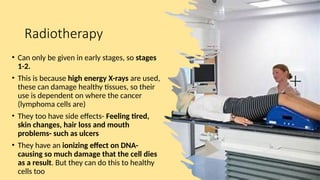
• Can only be given in early stages, so stages
1-2.
• This is because high energy X-rays are used,
these can damage healthy tissues, so their
use is dependent on where the cancer
(lymphoma cells are)
• They too have side effects- Feeling tired,
skin changes, hair loss and mouth
problems- such as ulcers
• They have an ionizing effect on DNA-
causing so much damage that the cell dies
as a result. But they can do this to healthy
cells too
Steroids
• These are given alongside
chemotherapy drugs to
increase the potency of these
drugs and reduce some of the
side effects
• They also have side effects,
causing bloating, increased
appetite and weight gain and
thirst.
Rituximab- A immune
therapy drug
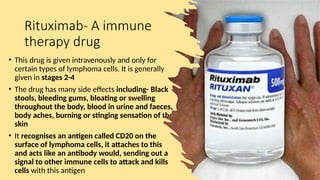
• This drug is given intravenously and only for
certain types of lymphoma cells. It is generally
given in stages 2-4
• The drug has many side effects including- Black
stools, bleeding gums, bloating or swelling
throughout the body, blood in urine and faeces,
body aches, burning or stinging sensation of the
skin
• It recognises an antigen called CD20 on the
surface of lymphoma cells, it attaches to this
and acts like an antibody would, sending out a
signal to other immune cells to attack and kills
cells with this antigen
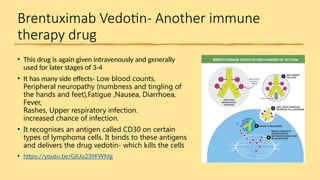
Brentuximab Vedotin- Another immune
therapy drug
• This drug is again given intravenously and generally
used for later stages of 3-4
• It has many side effects- Low blood counts,
Peripheral neuropathy (numbness and tingling of
the hands and feet),Fatigue ,Nausea, Diarrhoea,
Fever,
Rashes, Upper respiratory infection.​
increased chance of infection.
• It recognises an antigen called CD30 on certain
types of lymphoma cells. It binds to these antigens
and delivers the drug vedotin- which kills the cells
• https://youtu.be/GIUu239FWMg
Stem cell- therapies
• These are used when other treatments
fail- strong chemotherapy drugs are used
to wipe out existing lymphoma cells and
stem cells from a donor are used
• These are Transplanted in to the bone
marrow and will produce normal cells
without the mutation
• Side effects here are due to a lack of
immunity after the chemotherapy wipes
out the immune system.
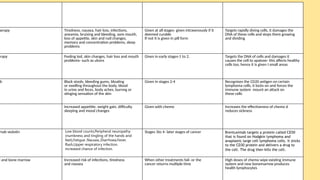
ment Side Effects Stage of Cancer they are given
at
What they do
herapy Tiredness, nausea, hair loss, infections,
aneamia, bruising and bleeding, sore mouth,
loss of appetite, skin and nail changes,
memory and concentration problems, sleep
problems
Given at all stages- given intravenously if it
deemed curable
If not it is given in pill form
Targets rapidly diving cells, it damages the
DNA of these cells and stops them growing
and dividing
erapy Feeling ted, skin changes, hair loss and mouth
problems- such as ulcers
Given in early stages-1 to 2. Targets the DNA of cells and damages it
causes the cell to apatose- this affects healthy
cells too, hence it is given I small areas
b Black stools, bleeding gums, bloating
or swelling throughout the body, blood
in urine and feces, body aches, burnng or
stinging sensation of the skin
Given in stages 2-4 Recognises the CD20 antigen on certain
lymphoma cells, it locks on and forces the
immune system mount an attack on
these cells
Increased appetitie, weight gain, difficulty
sleeping and mood changes
Given with chemo Increases the effectiveness of chemo d
reduces sickness
mab vedotin Stages 3to 4- later stages of cancer Brentuximab targets a protein called CD30
that is found on Hodgkin lymphoma and
anaplastic large cell lymphoma cells. it sticks
to the CD30 protein and delivers a drug to
the cell. The drug then kills the cell.
l and bone marrow Increased risk of infections, tiredness
and nausea
When other treatments fail- or the
cancer returns multiple time
High doses of chemo wipe existing immune
system and new bonemarrow produces
health lymphocytes
Low blood counts,Peripheral neuropathy
(numbness and tingling of the hands and
feet),Fatigue ,Nausea.,Diarrhoea.Fever.
Rash,Upper respiratory infection.
increased chance of infection.
Example Case Studies
• Go to Logan's story-
Logan's Stage 2A Classical Hodgkin's Lym
phoma Story - The Patient Story
• How old was Logan when diagnosed and
what were her first symptoms?
• What diagnostic tests did she have- how
was the diagnosis of 2A reached? What
does the A mean?
• What was the treatment she had? Again
find out ABVD refers to
Case Study- a little more complicated!
• Fabiola's story spans 2013-2016- go to
Fabiola's Stage 2BX Relapsed Hodgkin's Lymphoma Story - Th
e Patient Story
• What were her initial symptoms ? She was diagnosed with
stage 2BX- what does B refer to? What does X refer to?
• What were the diagnostic tests that are referred to initially?
• She has her initial treatment starting 2014- what was this?
Again explain ABVD
• In 2015- what did scans and blood tests reveal?
• She then has what is termed IGEV chemo- what does this
refer to and why did she have it?
• Following her stem cell transplant she has Brentuximab-
from your study- what kind of lymphoma cells does this
indicate and how does Brentuximab work?
• Did it work?
Example Case Study- a bit more complicated
• Read Moe's story at
Moe's Stage 2B Relapsed Classical Hodgkin's Lymphoma
Story - The Patient Story
• At what age was Moe diagnosed and what were his
initial symptoms?
• He was diagnosed with 2B- what does this mean?
• What scan and diagnostic tests did he have?
• What was his initial treatment- explain ABVD chemo and
how many sessions he had
• What did follow up scans show- why did Moe then need
a different type of chemo?
• Why was his spleen removed?
• In the end what did Moe have and was this successul?
Example Case studies
• Follow the time line of Danielle's story-
Danielle's Stage 2 Classical Hodgkin's Lympho
ma Story - The Patient Story
• Explain what her initial symptoms were
• What diagnostic tests did she have? How did
this lead to a stage 2 diagnosis?
• What treatments did she have? Find out
what ABVD chemotherapy is
• What side effects did she suffer from?
• Did she recover?
Evaluation
of
Lymphoma
Treatments
Think – was does success
look like ?
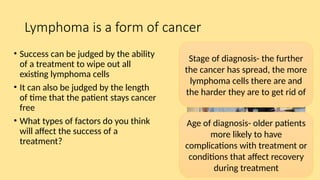
Lymphoma is a form of cancer
• Success can be judged by the ability
of a treatment to wipe out all
existing lymphoma cells
• It can also be judged by the length
of time that the patient stays cancer
free
• What types of factors do you think
will affect the success of a
treatment?
Stage of diagnosis- the further
the cancer has spread, the more
lymphoma cells there are and
the harder they are to get rid of
Age of diagnosis- older patients
more likely to have
complications with treatment or
conditions that affect recovery
during treatment
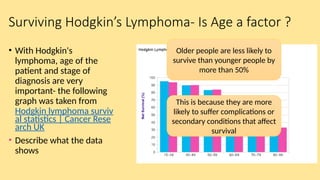
Surviving Hodgkin’s Lymphoma- Is Age a factor ?
• With Hodgkin's
lymphoma, age of the
patient and stage of
diagnosis are very
important- the following
graph was taken from
Hodgkin lymphoma surviv
al statistics | Cancer Rese
arch UK
• Describe what the data
shows
Older people are less likely to
survive than younger people by
more than 50%
This is because they are more
likely to suffer complications or
secondary conditions that affect
survival
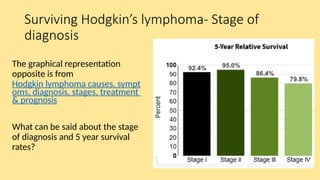
Surviving Hodgkin’s lymphoma- Stage of
diagnosis
The graphical representation
opposite is from
Hodgkin lymphoma causes, sympt
oms, diagnosis, stages, treatment
& prognosis
What can be said about the stage
of diagnosis and 5 year survival
rates?
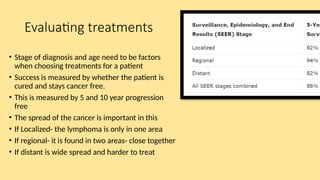
Evaluating treatments
• Stage of diagnosis and age need to be factors
when choosing treatments for a patient
• Success is measured by whether the patient is
cured and stays cancer free.
• This is measured by 5 and 10 year progression
free
• The spread of the cancer is important in this
• If Localized- the lymphoma is only in one area
• If regional- it is found in two areas- close together
• If distant is wide spread and harder to treat
Radiotherapy and Chemotherapy
• These both kill lymphoma cells in similar ways- use the following sites
to help you identify if these treatments are most successful
independently or combined
• Chemotherapy or Combined Modality Therapy for Early-stage Hodgki
n Lymphoma | Anticancer Research
• Combined modality treatment: Outcome in patients with Hodgkin's ly
mphoma - PubMed (nih.gov)
• Treatment of Hodgkin Lymphoma – New and Developing Therapies an
d Their Potential Role in Standard of Care - touchONCOLOGY
Evaluating Chemotherapy- study 1-
Chemotherapy or Combined Modality Therap
y for Early-stage Hodgkin Lymphoma | Antica
ncer Research
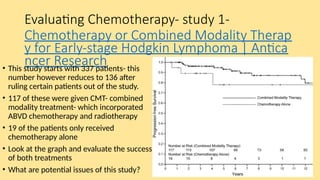
• This study starts with 337 patients- this
number however reduces to 136 after
ruling certain patients out of the study.
• 117 of these were given CMT- combined
modality treatment- which incorporated
ABVD chemotherapy and radiotherapy
• 19 of the patients only received
chemotherapy alone
• Look at the graph and evaluate the success
of both treatments
• What are potential issues of this study?
Study 2-
Combined modality treatment: Outcome in p
atients with Hodgkin's lymphoma- PubMed
• This study spans 10 years and looks at a patient cohort of 126 patients- most of whom were in
the region of 25 (although range was 12-68) and patients ranged in stage from stage I to IV.
• 51- patients received CMT- had chemo and radiotherapy
• 64- patients ABVD or similar chemotherapy alone
• 10 patients- radiotherapy alone
• The 25 patients with early stages- all achieved a complete response with CMT- with only 2
relapsing
• The 26 patients with advanced stages- 25 achieved a complete response with 1 patient who
relapsed.
• Of 30 patients with early stages on chemo alone- 9 relapsed. (4 local and 5 distant)
• Of remaining 34 with advanced stages- 8 relapsed (5 local, 3 distant)
• Of 10 patients on radiotherapy alone- 4 developed a distant relapse (widespread)
Other treatments- Brentuximab-
Treatment of Hodgkin Lymphoma – New and Developing Therapies and Their Potential Role i
n Standard of Care-
touchONCOLOGY
• Look at the extract from this paper and
evaluate the use of Brentuximab using these
extracts
• What group of patients was the drug used
on?
• Overall response rate-is the percentage of
patients who had improvements to the
cancer following this treatment (might not
have all gone)
• Complete Remission- is the percentage of
patients who had no detectable cancer
following this treatment
• With this in mind- do the results of this study
suggest that Brentuximab alone could cure a
patient?
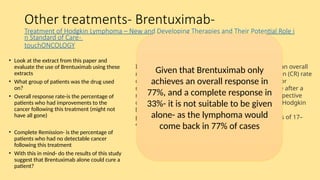
In the pivotal phase II trial of brentuximab vedotin, an overall
response rate (ORR) of 72% and a complete remission (CR) rate
of 33% were reported in 102 patients with relapsed or
refractory Hodgkin lymphoma following ASCT failure after a
median of 3 years follow-up. Similarly, several retrospective
cohort analyses in patients with relapsed/refractory Hodgkin
lymphoma, mostly those included in named patient
programmes, reported ORRs of 60–81% and CR rates of 17–
45% with brentuximab vedotin
Given that Brentuximab only
achieves an overall response in
77%, and a complete response in
33%- it is not suitable to be given
alone- as the lymphoma would
come back in 77% of cases

Lesson 4- Case Study Hodgkins /lymphatics(5).pptx

  • 1.
  • 2.
    To Start • Answerthese questions based on last lesson's activity • Which condition causes swelling through a build up of fluid due to a blockage in the lymph capillaries? • Which condition is cause by a mutation in B-lymphocytes? • Which condition is due to an infections, causing lymph nodes to swell?
  • 3.
    Aims- • To identifya relevant case study for either Hodgins's lymphoma • You will be able to identify the key symptoms that led to diagnosis of the condition • You will be able to discuss the suggested treatments for the condition and relate these to the case study chosen • You will be able to describe the treatments given to the patient and why, and how these treatments restored normal function
  • 4.
    The Bigger Picture • Around2,100 people each year in the UK are diagnosed with Hodgkin's lymphoma • It mostly affects younger adults in their 20s and those over 70 • It is also one of the most curable cancers- understanding the method by it which makes you ill, helps us to identify treatments that improve survival.
  • 5.
    Hodgkin's lymphoma- Task 1 •In this disorder B-lymphocytes multiply in an abnormal way and begin to collect in certain parts of the lymphatic system such as the lymph nodes. • The affected lymph nodes are then unable to carry out their function properly, which is to filter out pathogens and cancer cells • This means the patient is left wide open to infection • What the symptoms of Hodgkin's
  • 6.
    Symptoms of Hodgkin’slymphoma- obtained from NHS.uk website • Painless swelling of the lymph nodes, usually in the neck, armpit or groin • These swelling are caused by a blood up of abnormal B-lymphocytes • Other symptoms may include • Night sweats • Weight loss (unintentional) • A high temperature • A persistent cough or feeling of breathlessness • Persistent itching of skin all over the body • Increased risks of infections • Persistent tiredness or fatigue
  • 7.
    Stages of Hodkin'slymphoma • A Stage of diagnosis along with a letter is given. • There are 4 stages of diagnosis • Stage I • Stage II • Stage III • Stage IV • Each stage indicates how far the lymphoma has spread, but it is also given a letter of A or B aftewards- which denoted whether the patient has the typlical symptoms (B) or is asymptomatic (A) • Task Complete the diagram to explain the different stages of lymphoma
  • 8.
    Treatments for Hodgkin'sLymphoma • Treatments will come with side effects, some of which are extreme • Treatments include • Chemotherapy • Radiotherapy • Steroid medication usually in combination with chemotherapy • Immune Therapy & Targeted Therapy • Rituximab • Brentuximab vedotin • Stem cell and bone marrow • Task- find out the side effects of these treatments and at what stage they would be used- Complete the table attached • Use the following websites to help you Hodgkin lymphoma - Treatment - NHS (www.nhs.uk) Hodgkin Lymphoma Treatment Protocol by Stage (cancer.org)
  • 9.
    Chemotherapy • This treatmentcan be given at any stage, although in early stages it is given through a vein- intravenously. In later stages if the lymphoma is not treatable it may be given in pill form • Tiredness, nausea, hair loss, infections, anaemia, bruising and bleeding, sore mouth, loss of appetite, skin and nail changes, memory and concentration problems, sleep problems • Chemo drugs- target cells that are in a state of division and damage the DNA so much that the cell apotoses
  • 10.
    Radiotherapy • Can onlybe given in early stages, so stages 1-2. • This is because high energy X-rays are used, these can damage healthy tissues, so their use is dependent on where the cancer (lymphoma cells are) • They too have side effects- Feeling tired, skin changes, hair loss and mouth problems- such as ulcers • They have an ionizing effect on DNA- causing so much damage that the cell dies as a result. But they can do this to healthy cells too
  • 11.
    Steroids • These aregiven alongside chemotherapy drugs to increase the potency of these drugs and reduce some of the side effects • They also have side effects, causing bloating, increased appetite and weight gain and thirst.
  • 12.
    Rituximab- A immune therapydrug • This drug is given intravenously and only for certain types of lymphoma cells. It is generally given in stages 2-4 • The drug has many side effects including- Black stools, bleeding gums, bloating or swelling throughout the body, blood in urine and faeces, body aches, burning or stinging sensation of the skin • It recognises an antigen called CD20 on the surface of lymphoma cells, it attaches to this and acts like an antibody would, sending out a signal to other immune cells to attack and kills cells with this antigen
  • 13.
    Brentuximab Vedotin- Anotherimmune therapy drug • This drug is again given intravenously and generally used for later stages of 3-4 • It has many side effects- Low blood counts, Peripheral neuropathy (numbness and tingling of the hands and feet),Fatigue ,Nausea, Diarrhoea, Fever, Rashes, Upper respiratory infection.​ increased chance of infection. • It recognises an antigen called CD30 on certain types of lymphoma cells. It binds to these antigens and delivers the drug vedotin- which kills the cells • https://youtu.be/GIUu239FWMg
  • 14.
    Stem cell- therapies •These are used when other treatments fail- strong chemotherapy drugs are used to wipe out existing lymphoma cells and stem cells from a donor are used • These are Transplanted in to the bone marrow and will produce normal cells without the mutation • Side effects here are due to a lack of immunity after the chemotherapy wipes out the immune system.
  • 15.
    ment Side EffectsStage of Cancer they are given at What they do herapy Tiredness, nausea, hair loss, infections, aneamia, bruising and bleeding, sore mouth, loss of appetite, skin and nail changes, memory and concentration problems, sleep problems Given at all stages- given intravenously if it deemed curable If not it is given in pill form Targets rapidly diving cells, it damages the DNA of these cells and stops them growing and dividing erapy Feeling ted, skin changes, hair loss and mouth problems- such as ulcers Given in early stages-1 to 2. Targets the DNA of cells and damages it causes the cell to apatose- this affects healthy cells too, hence it is given I small areas b Black stools, bleeding gums, bloating or swelling throughout the body, blood in urine and feces, body aches, burnng or stinging sensation of the skin Given in stages 2-4 Recognises the CD20 antigen on certain lymphoma cells, it locks on and forces the immune system mount an attack on these cells Increased appetitie, weight gain, difficulty sleeping and mood changes Given with chemo Increases the effectiveness of chemo d reduces sickness mab vedotin Stages 3to 4- later stages of cancer Brentuximab targets a protein called CD30 that is found on Hodgkin lymphoma and anaplastic large cell lymphoma cells. it sticks to the CD30 protein and delivers a drug to the cell. The drug then kills the cell. l and bone marrow Increased risk of infections, tiredness and nausea When other treatments fail- or the cancer returns multiple time High doses of chemo wipe existing immune system and new bonemarrow produces health lymphocytes Low blood counts,Peripheral neuropathy (numbness and tingling of the hands and feet),Fatigue ,Nausea.,Diarrhoea.Fever. Rash,Upper respiratory infection. increased chance of infection.
  • 16.
    Example Case Studies •Go to Logan's story- Logan's Stage 2A Classical Hodgkin's Lym phoma Story - The Patient Story • How old was Logan when diagnosed and what were her first symptoms? • What diagnostic tests did she have- how was the diagnosis of 2A reached? What does the A mean? • What was the treatment she had? Again find out ABVD refers to
  • 17.
    Case Study- alittle more complicated! • Fabiola's story spans 2013-2016- go to Fabiola's Stage 2BX Relapsed Hodgkin's Lymphoma Story - Th e Patient Story • What were her initial symptoms ? She was diagnosed with stage 2BX- what does B refer to? What does X refer to? • What were the diagnostic tests that are referred to initially? • She has her initial treatment starting 2014- what was this? Again explain ABVD • In 2015- what did scans and blood tests reveal? • She then has what is termed IGEV chemo- what does this refer to and why did she have it? • Following her stem cell transplant she has Brentuximab- from your study- what kind of lymphoma cells does this indicate and how does Brentuximab work? • Did it work?
  • 18.
    Example Case Study-a bit more complicated • Read Moe's story at Moe's Stage 2B Relapsed Classical Hodgkin's Lymphoma Story - The Patient Story • At what age was Moe diagnosed and what were his initial symptoms? • He was diagnosed with 2B- what does this mean? • What scan and diagnostic tests did he have? • What was his initial treatment- explain ABVD chemo and how many sessions he had • What did follow up scans show- why did Moe then need a different type of chemo? • Why was his spleen removed? • In the end what did Moe have and was this successul?
  • 19.
    Example Case studies •Follow the time line of Danielle's story- Danielle's Stage 2 Classical Hodgkin's Lympho ma Story - The Patient Story • Explain what her initial symptoms were • What diagnostic tests did she have? How did this lead to a stage 2 diagnosis? • What treatments did she have? Find out what ABVD chemotherapy is • What side effects did she suffer from? • Did she recover?
  • 20.
  • 21.
    Lymphoma is aform of cancer • Success can be judged by the ability of a treatment to wipe out all existing lymphoma cells • It can also be judged by the length of time that the patient stays cancer free • What types of factors do you think will affect the success of a treatment? Stage of diagnosis- the further the cancer has spread, the more lymphoma cells there are and the harder they are to get rid of Age of diagnosis- older patients more likely to have complications with treatment or conditions that affect recovery during treatment
  • 22.
    Surviving Hodgkin’s Lymphoma-Is Age a factor ? • With Hodgkin's lymphoma, age of the patient and stage of diagnosis are very important- the following graph was taken from Hodgkin lymphoma surviv al statistics | Cancer Rese arch UK • Describe what the data shows Older people are less likely to survive than younger people by more than 50% This is because they are more likely to suffer complications or secondary conditions that affect survival
  • 23.
    Surviving Hodgkin’s lymphoma-Stage of diagnosis The graphical representation opposite is from Hodgkin lymphoma causes, sympt oms, diagnosis, stages, treatment & prognosis What can be said about the stage of diagnosis and 5 year survival rates?
  • 24.
    Evaluating treatments • Stageof diagnosis and age need to be factors when choosing treatments for a patient • Success is measured by whether the patient is cured and stays cancer free. • This is measured by 5 and 10 year progression free • The spread of the cancer is important in this • If Localized- the lymphoma is only in one area • If regional- it is found in two areas- close together • If distant is wide spread and harder to treat
  • 25.
    Radiotherapy and Chemotherapy •These both kill lymphoma cells in similar ways- use the following sites to help you identify if these treatments are most successful independently or combined • Chemotherapy or Combined Modality Therapy for Early-stage Hodgki n Lymphoma | Anticancer Research • Combined modality treatment: Outcome in patients with Hodgkin's ly mphoma - PubMed (nih.gov) • Treatment of Hodgkin Lymphoma – New and Developing Therapies an d Their Potential Role in Standard of Care - touchONCOLOGY
  • 26.
    Evaluating Chemotherapy- study1- Chemotherapy or Combined Modality Therap y for Early-stage Hodgkin Lymphoma | Antica ncer Research • This study starts with 337 patients- this number however reduces to 136 after ruling certain patients out of the study. • 117 of these were given CMT- combined modality treatment- which incorporated ABVD chemotherapy and radiotherapy • 19 of the patients only received chemotherapy alone • Look at the graph and evaluate the success of both treatments • What are potential issues of this study?
  • 27.
    Study 2- Combined modalitytreatment: Outcome in p atients with Hodgkin's lymphoma- PubMed • This study spans 10 years and looks at a patient cohort of 126 patients- most of whom were in the region of 25 (although range was 12-68) and patients ranged in stage from stage I to IV. • 51- patients received CMT- had chemo and radiotherapy • 64- patients ABVD or similar chemotherapy alone • 10 patients- radiotherapy alone • The 25 patients with early stages- all achieved a complete response with CMT- with only 2 relapsing • The 26 patients with advanced stages- 25 achieved a complete response with 1 patient who relapsed. • Of 30 patients with early stages on chemo alone- 9 relapsed. (4 local and 5 distant) • Of remaining 34 with advanced stages- 8 relapsed (5 local, 3 distant) • Of 10 patients on radiotherapy alone- 4 developed a distant relapse (widespread)
  • 28.
    Other treatments- Brentuximab- Treatmentof Hodgkin Lymphoma – New and Developing Therapies and Their Potential Role i n Standard of Care- touchONCOLOGY • Look at the extract from this paper and evaluate the use of Brentuximab using these extracts • What group of patients was the drug used on? • Overall response rate-is the percentage of patients who had improvements to the cancer following this treatment (might not have all gone) • Complete Remission- is the percentage of patients who had no detectable cancer following this treatment • With this in mind- do the results of this study suggest that Brentuximab alone could cure a patient? In the pivotal phase II trial of brentuximab vedotin, an overall response rate (ORR) of 72% and a complete remission (CR) rate of 33% were reported in 102 patients with relapsed or refractory Hodgkin lymphoma following ASCT failure after a median of 3 years follow-up. Similarly, several retrospective cohort analyses in patients with relapsed/refractory Hodgkin lymphoma, mostly those included in named patient programmes, reported ORRs of 60–81% and CR rates of 17– 45% with brentuximab vedotin Given that Brentuximab only achieves an overall response in 77%, and a complete response in 33%- it is not suitable to be given alone- as the lymphoma would come back in 77% of cases