LESSON 3: ELEMENTARY SCIENCE
CURRICULUM PHYSICS, EARTH AND
SPACE SCIENCE
JOHN PATRICK L. ARCITE
LEARNING ACTIVITIES
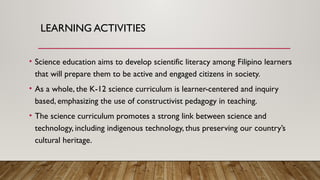
• Science education aims to develop scientific literacy among Filipino learners
that will prepare them to be active and engaged citizens in society.
• As a whole, the K-12 science curriculum is learner-centered and inquiry
based, emphasizing the use of constructivist pedagogy in teaching.
• The science curriculum promotes a strong link between science and
technology, including indigenous technology, thus preserving our country’s
cultural heritage.
LEARNING ACTIVITIES
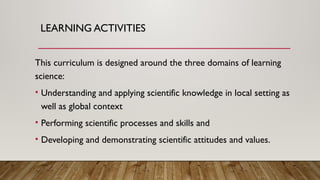
This curriculum is designed around the three domains of learning
science:
• Understanding and applying scientific knowledge in local setting as
well as global context
• Performing scientific processes and skills and
• Developing and demonstrating scientific attitudes and values.
LEARNING ACTIVITIES
The acquisition of theses domains is facilitated using the following
approaches:
• Multi/interdisciplinary approach
• Science-technology-society approach
• Contextual learning
• Problem/issue-based learning
• Inquiry-based approach
LEARNING ACTIVITIES
• Organizing the curriculum around situations and problems that challenge the
learners curiosity motivates them to learn and appreciate science.
• The aim of the K-12 science curriculum is for the learners to demonstrate
understanding of basic science concepts and application of science-inquiry skills.
• They exhibit scientific attitudes and values to solve problems critically, innovate
beneficial products, protect the environment, and conserve resources, enhance
the integrity and wellness of people that involve science, tech, and env.
ACTIVITY
What does a 21st
-century science classroom look like? List down
below the features of the science curriculum you wish to see and
explore in the school.What do you think the teacher and
students are like inside the classroom to manifest such features?
Write in the corresponding column below.
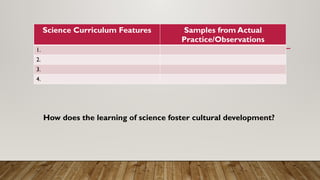
Science Curriculum Features Samples from Actual
Practice/Observations
1.
2.
3.
4.
How does the learning of science foster cultural development?

Lesson-3 Science Teaching in Elementarys

  • 1.
    LESSON 3: ELEMENTARYSCIENCE CURRICULUM PHYSICS, EARTH AND SPACE SCIENCE JOHN PATRICK L. ARCITE
  • 2.
    LEARNING ACTIVITIES • Scienceeducation aims to develop scientific literacy among Filipino learners that will prepare them to be active and engaged citizens in society. • As a whole, the K-12 science curriculum is learner-centered and inquiry based, emphasizing the use of constructivist pedagogy in teaching. • The science curriculum promotes a strong link between science and technology, including indigenous technology, thus preserving our country’s cultural heritage.
  • 3.
    LEARNING ACTIVITIES This curriculumis designed around the three domains of learning science: • Understanding and applying scientific knowledge in local setting as well as global context • Performing scientific processes and skills and • Developing and demonstrating scientific attitudes and values.
  • 4.
    LEARNING ACTIVITIES The acquisitionof theses domains is facilitated using the following approaches: • Multi/interdisciplinary approach • Science-technology-society approach • Contextual learning • Problem/issue-based learning • Inquiry-based approach
  • 5.
    LEARNING ACTIVITIES • Organizingthe curriculum around situations and problems that challenge the learners curiosity motivates them to learn and appreciate science. • The aim of the K-12 science curriculum is for the learners to demonstrate understanding of basic science concepts and application of science-inquiry skills. • They exhibit scientific attitudes and values to solve problems critically, innovate beneficial products, protect the environment, and conserve resources, enhance the integrity and wellness of people that involve science, tech, and env.
  • 6.
    ACTIVITY What does a21st -century science classroom look like? List down below the features of the science curriculum you wish to see and explore in the school.What do you think the teacher and students are like inside the classroom to manifest such features? Write in the corresponding column below.
  • 7.
    Science Curriculum FeaturesSamples from Actual Practice/Observations 1. 2. 3. 4. How does the learning of science foster cultural development?