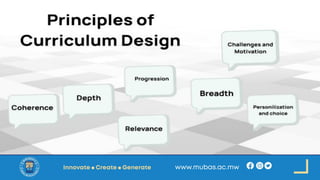
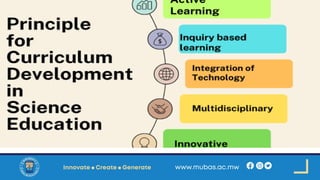
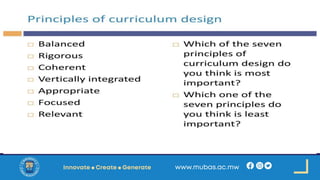
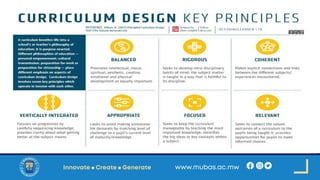
Principles of CurriculumDefined
•Fundamental guidelines that shape the design,
development, implementation, and evaluation of
educational programs.
•These principles ensure that the curriculum is relevant,
effective, and aligned with educational goals.
5.
SOURCES OF CURRICULUMPRINCIPLES
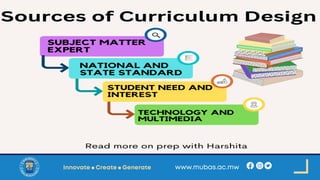
1. SUBJECT MATTER EXPERTS:
• Individuals who possess specialised knowledge and expertise in a particular subject or
field.
• Teachers, professors, researchers, or professionals who work in a specific industry or
sector.
• Provide valuable input on what content should be included in a curriculum, as well as
how it should be taught.
• Also help educators stay up-to-date with the latest developments and trends in their
field, ensuring that the curriculum is current and relevant.
6.
SOURCES OF CURRICULUMPRINCIPLES
2. NATIONAL AND STATE STANDARDS:
• National and state standards provide guidelines for what students should know
and be able to do in a particular subject area at each grade level.
• Educators can use these standards to guide their curriculum design and ensure
that they are preparing students for academic success.
• By aligning their curriculum with national and state standards, educators can
ensure that their students are meeting the same academic benchmarks as
students in other schools and districts.
7.
SOURCES OF CURRICULUMPRINCIPLES
3. STUDENT NEEDS AND INTERESTS:
• Effective curriculum design takes into account the needs and interests of
students.
• This includes their academic abilities, learning styles, and cultural
backgrounds.
• By designing a curriculum that meets the needs and interests of
students, educators can increase engagement and improve learning
outcomes.
8.
SOURCES OF CURRICULUMPRINCIPLES
4. PEDAGOGICAL THEORIES AND MODELS:
• Pedagogical theories and models provide guidance on how to effectively
teach a particular subject or set of subjects.
• For example, the constructivist approach emphasizes active learning and
problem-solving, while the behaviorist approach emphasizes repetition and
reinforcement.
• Educators can use these theories and models to guide their curriculum
design and instructional practices. By selecting a pedagogical approach that
aligns with their goals and objectives, educators can ensure that their
curriculum is effective and engaging.
9.
SOURCES OF CURRICULUMPRINCIPLES
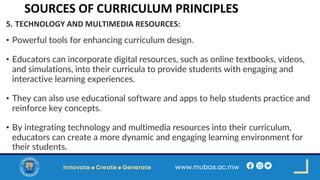
5. TECHNOLOGY AND MULTIMEDIA RESOURCES:
• Powerful tools for enhancing curriculum design.
• Educators can incorporate digital resources, such as online textbooks, videos,
and simulations, into their curricula to provide students with engaging and
interactive learning experiences.
• They can also use educational software and apps to help students practice and
reinforce key concepts.
• By integrating technology and multimedia resources into their curriculum,
educators can create a more dynamic and engaging learning environment for
their students.
11.
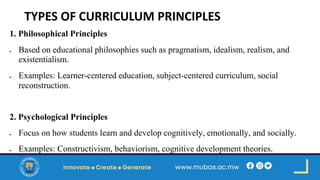
TYPES OF CURRICULUMPRINCIPLES
1. Philosophical Principles
• Based on educational philosophies such as pragmatism, idealism, realism, and
existentialism.
• Examples: Learner-centered education, subject-centered curriculum, social
reconstruction.
2. Psychological Principles
• Focus on how students learn and develop cognitively, emotionally, and socially.
• Examples: Constructivism, behaviorism, cognitive development theories.
12.
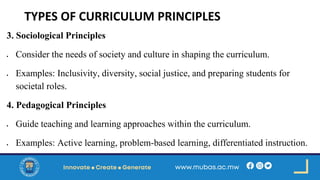
TYPES OF CURRICULUMPRINCIPLES
3. Sociological Principles
• Consider the needs of society and culture in shaping the curriculum.
• Examples: Inclusivity, diversity, social justice, and preparing students for
societal roles.
4. Pedagogical Principles
• Guide teaching and learning approaches within the curriculum.
• Examples: Active learning, problem-based learning, differentiated instruction.
13.
TYPES OF CURRICULUMPRINCIPLES
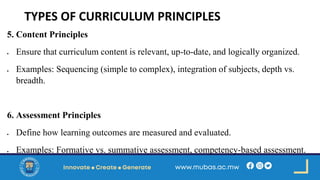
5. Content Principles
• Ensure that curriculum content is relevant, up-to-date, and logically organized.
• Examples: Sequencing (simple to complex), integration of subjects, depth vs.
breadth.
6. Assessment Principles
• Define how learning outcomes are measured and evaluated.
• Examples: Formative vs. summative assessment, competency-based assessment.
14.
TYPES OF CURRICULUMPRINCIPLES
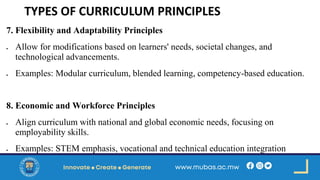
7. Flexibility and Adaptability Principles
• Allow for modifications based on learners' needs, societal changes, and
technological advancements.
• Examples: Modular curriculum, blended learning, competency-based education.
8. Economic and Workforce Principles
• Align curriculum with national and global economic needs, focusing on
employability skills.
• Examples: STEM emphasis, vocational and technical education integration
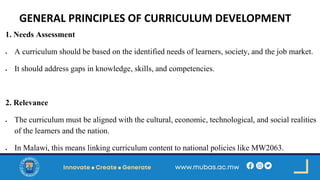
GENERAL PRINCIPLES OFCURRICULUM DEVELOPMENT
1. Needs Assessment
• A curriculum should be based on the identified needs of learners, society, and the job market.
• It should address gaps in knowledge, skills, and competencies.
2. Relevance
• The curriculum must be aligned with the cultural, economic, technological, and social realities
of the learners and the nation.
• In Malawi, this means linking curriculum content to national policies like MW2063.
22.
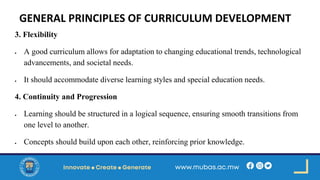
GENERAL PRINCIPLES OFCURRICULUM DEVELOPMENT
3. Flexibility
• A good curriculum allows for adaptation to changing educational trends, technological
advancements, and societal needs.
• It should accommodate diverse learning styles and special education needs.
4. Continuity and Progression
• Learning should be structured in a logical sequence, ensuring smooth transitions from
one level to another.
• Concepts should build upon each other, reinforcing prior knowledge.
23.
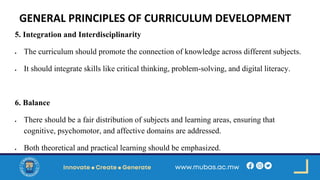
GENERAL PRINCIPLES OFCURRICULUM DEVELOPMENT
5. Integration and Interdisciplinarity
• The curriculum should promote the connection of knowledge across different subjects.
• It should integrate skills like critical thinking, problem-solving, and digital literacy.
6. Balance
• There should be a fair distribution of subjects and learning areas, ensuring that
cognitive, psychomotor, and affective domains are addressed.
• Both theoretical and practical learning should be emphasized.
24.
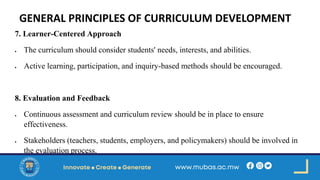
GENERAL PRINCIPLES OFCURRICULUM DEVELOPMENT
7. Learner-Centered Approach
• The curriculum should consider students' needs, interests, and abilities.
• Active learning, participation, and inquiry-based methods should be encouraged.
8. Evaluation and Feedback
• Continuous assessment and curriculum review should be in place to ensure
effectiveness.
• Stakeholders (teachers, students, employers, and policymakers) should be involved in
the evaluation process.
25.
GENERAL PRINCIPLES OFCURRICULUM DEVELOPMENT
9. Resource Availability
• The curriculum should be designed with available human, material, and financial resources in
mind.
• Open Educational Resources (OER) and digital learning tools can enhance accessibility and
affordability.
10. Equity and Inclusivity
• The curriculum should provide equal learning opportunities for all, including marginalized
groups, people with disabilities, and students from different socio-economic backgrounds.
• Gender sensitivity should be considered
26.
KEY PLAYERS INTHE CURRICULUM DEVELOPMENT PROCESS
1. Government Agencies and Policy Makers
• Ministry of Education – Sets national education policies, standards, and regulations.
• Curriculum Development Institutions (e.g., Malawi Institute of Education - MIE) – Designs
and reviews curricula.
• Education Regulatory Bodies (e.g., Malawi National Examinations Board - MANEB) –
Ensures alignment with assessment and certification standards.
2. Educational Institutions
• Universities and Colleges – Provide expertise in curriculum research and teacher training.
• Schools and Technical Institutions – Implement the curriculum and provide feedback on its
effectiveness.
27.
KEY PLAYERS INTHE CURRICULUM DEVELOPMENT PROCESS
3. Teachers and Educators
• Classroom Teachers – Deliver the curriculum and assess student learning
outcomes
• Teacher Trainers – Prepare educators for effective curriculum delivery.
4. Industry and Employers
• Private Sector Representatives – Ensure curricula align with job market
needs and industry requirements.
• Professional Bodies and Associations – Offer insights into competency-
based curriculum development.
28.
KEY PLAYERS INTHE CURRICULUM DEVELOPMENT PROCESS
5. Parents and Guardians
• Support learning at home and provide feedback on curriculum
relevance.
6. Students and Learners
• Their needs, abilities, and interests shape curriculum design.
29.
KEY PLAYERS INTHE CURRICULUM DEVELOPMENT PROCESS
7. International and Non-Governmental Organizations (NGOs)
• UNESCO, UNICEF, World Bank, and NGOs – Provide
technical and financial support for curriculum innovation.
8. Researchers and Educational Experts
• Conduct studies to improve and update curriculum
effectiveness