Lesson 3
AI in the Enterprise
2
Legal Disclaimers
No license (express or implied, by estoppel or otherwise) to any intellectual property rights is granted by
this document.
Intel disclaims all express and implied warranties, including without limitation, the implied warranties of
merchantability, fitness for a particular purpose, and non-infringement, as well as any warranty arising
from course of performance, course of dealing, or usage in trade.
Copies of documents which have an order number and are referenced in this document may be obtained
by calling 1-800-548-4725 or by visiting www.intel.com/design/literature.htm.
Intel and the Intel logo are trademarks of Intel Corporation in the U.S. and/or other countries.
*Other names and brands may be claimed as the property of others
Copyright © 2018 Intel Corporation. All rights reserved.
3
Learning Objectives
• Identify the steps in the data science workflow
• Identify the key roles and skill sets within the field of AI
• Describe the different ways to structure an AI team
• Identify common data science misconceptions
• Identify the components of model maintenance after deployment
You will be able to:
5
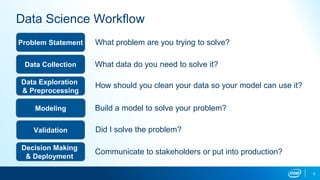
Data Science Workflow
Problem Statement
Data Collection
Data Exploration
& Preprocessing
Modeling
Validation
Decision Making
& Deployment
What problem are you trying to solve?
What data do you need to solve it?
How should you clean your data so your model can use it?
Build a model to solve your problem?
Did I solve the problem?
Communicate to stakeholders or put into production?
6
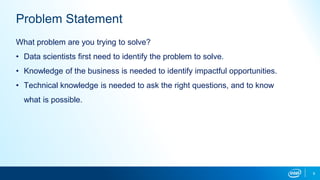
Problem Statement
What problem are you trying to solve?
• Data scientists first need to identify the problem to solve.
• Knowledge of the business is needed to identify impactful opportunities.
• Technical knowledge is needed to ask the right questions, and to know
what is possible.
7
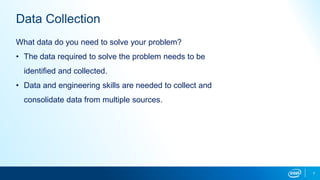
Data Collection
What data do you need to solve your problem?
• The data required to solve the problem needs to be
identified and collected.
• Data and engineering skills are needed to collect and
consolidate data from multiple sources.
8
Data Exploration and Preprocessing
How should you clean your data so your model can use it?
• Data needs to be cleaned and processed so that it’s in a
usable format for modeling.
• Exploration is required to identify important elements within
the data and to identify any data quality issues.
• Data, engineering, and statistics skills are needed to
appropriately process the data and make inferences.
9
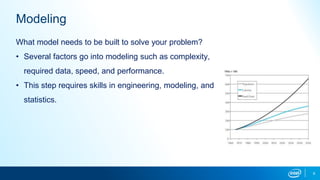
Modeling
What model needs to be built to solve your problem?
• Several factors go into modeling such as complexity,
required data, speed, and performance.
• This step requires skills in engineering, modeling, and
statistics.
10
Validation
Did the problem get sufficiently solved?
• Validation is required to ensure the original problem was
solved.
• Model performance needs to be accurately measured.
• Statistics and modeling skills, as well as domain
knowledge, are needed to make sure the results align
with the business problem.
11
Decision Making and Deployment
Communicate to stakeholders or put into production.
• A business decision needs to be made, or a product
needs to be put into production, so the business can
see value from the project.
• This requires domain knowledge, as well as
communication and storytelling skills.
• Engineering skills are needed to integrate code into
back-end software systems.
13
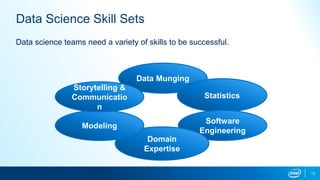
Data Science Skill Sets
Data science teams need a variety of skills to be successful.
Data Munging
Statistics
Software
Engineering
Domain
Expertise
Modeling
Storytelling &
Communicatio
n
14
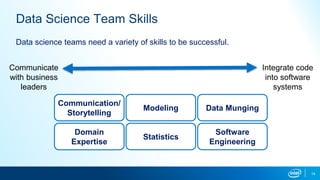
Data Science Team Skills
Communicate
with business
leaders
Integrate code
into software
systems
Communication/
Storytelling
Domain
Expertise
Modeling
Statistics
Data Munging
Software
Engineering
Data science teams need a variety of skills to be successful.
15
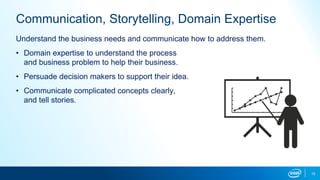
Communication, Storytelling, Domain Expertise
Understand the business needs and communicate how to address them.
• Domain expertise to understand the process
and business problem to help their business.
• Persuade decision makers to support their idea.
• Communicate complicated concepts clearly,
and tell stories.
16
Modeling and Statistics
Use data to make predictions via models, and using
statistics to assess the validity of those predictions.
• Work with a variety of modeling techniques,
from regression to DL.
• Use statistics to assess the performance of
one model vs. another.
• Design experiments and perform A/B testing.
17
Data Munging/Software Engineering
Transform messy data into clean, usable data, as well as
building software systems to deploy their models.
• Raw data can be messy and unstructured.
• Data must be manipulated and stored in
databases before it can be used.
• Models need to be deployed.
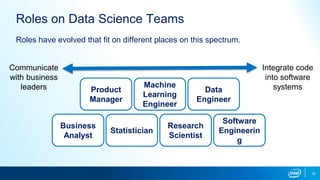
Roles have evolved that fit on different places on this spectrum.
19
Roles on Data Science Teams
Product
Manager
Statistician
Machine
Learning
Engineer
Research
Scientist
Data
Engineer
Software
Engineerin
g
Business
Analyst
Communicate
with business
leaders
Integrate code
into software
systems
20
Business Analysts
Business analysts interact with decision-makers.
• Create reports and provide insights.
• Create dashboards displaying key product KPIs.
• Perform analysis to determine business impact of
a new product/feature.
• Excel*, PowerBI* and Tableau* are examples of
tools used.
*Other names and brands may be claimed as the property of others.
21
Product Managers
Product Managers get requirements from business.
• Translate business ideas into product ideas.
• Determine feasibility of solving business problems.
• Consider impact of new product or model on key
business metrics.
• Prioritize projects and tasks.
• Examples of tools used: Microsoft Project*,
Trello*, and JIRA*.
*Other names and brands may be claimed as the property of others.
22
Statisticians
Statisticians determine the validity of models.
• Applies statistical concepts to determine amount
of data required.
• Explores outliers and trends.
• Determines if results are statistically significant.
• Examples of tools used: R*, SAS*, Python*.
*Other names and brands may be claimed as the property of others.
23
Machine Learning Engineers
Machine learning engineers solve problems involving large amounts of
high-dimensional data.
• Apply machine learning techniques.
• Focused on the engineering that makes
models accurate and fast.
• Examples of tools used: Python*, R*,
and MATLAB*.
*Other names and brands may be claimed as the property of others.
24
Research Scientists
Research scientists work on problems in bleeding-
edge fields.
• Work on the toughest problems in big data and
machine learning.
• Expert at a particular sub-discipline.
• Understand how algorithms work under the hood.
• Can be part of a separate research team,
interfacing with data science team when
necessary.
• Examples of tools used: Python*, MATLAB*, R*,
C++, and Java*.
*Other names and brands may be claimed as the property of others.
25
Data Engineers
Data engineers build data ingestion, storage, and
infrastructure.
• Databases experts.
• Know the tradeoffs between speed, reliability, and
size.
• Automate data cleaning.
• Build ETL (extract, transform, load) pipelines to
make data available on a regular cadence.
• Examples of tools used: Java*, SQL, and noSQL.
*Other names and brands may be claimed as the property of others.
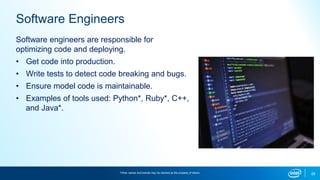
26
Software Engineers
Software engineers are responsible for
optimizing code and deploying.
• Get code into production.
• Write tests to detect code breaking and bugs.
• Ensure model code is maintainable.
• Examples of tools used: Python*, Ruby*, C++,
and Java*.
*Other names and brands may be claimed as the property of others.
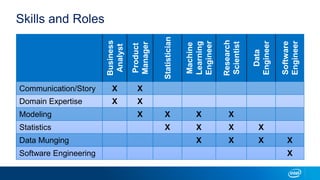
Skills and Roles
Business
Analyst
Product
Manager
Statistician
Machine
Learning
Engineer
Research
Scientist
Data
Engineer
Software
Engineer
Communication/Story X X
Domain Expertise X X
Modeling X X X X
Statistics X X X X
Data Munging X X X X
Software Engineering X
29
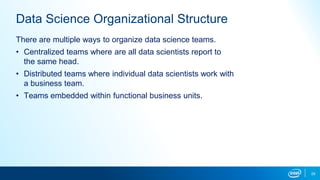
Data Science Organizational Structure
There are multiple ways to organize data science teams.
• Centralized teams where are all data scientists report to
the same head.
• Distributed teams where individual data scientists work with
a business team.
• Teams embedded within functional business units.
30
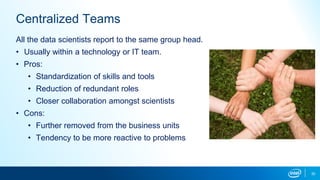
Centralized Teams
All the data scientists report to the same group head.
• Usually within a technology or IT team.
• Pros:
• Standardization of skills and tools
• Reduction of redundant roles
• Closer collaboration amongst scientists
• Cons:
• Further removed from the business units
• Tendency to be more reactive to problems
31
Distributed Teams
Distributed teams are where individual data scientists sit within a particular
team within a business unit.
• Pros:
• Closer access to the business, domain experts, and end users
• More likely to come up with solutions to immediate business
problems
• Cons:
• Destandardization of tools and skills throughout the organization
• Less communication and collaboration between data scientists
32
Additional Team Structures
There are multiple hybrid ways to organize data science teams.
• Some examples include:
• Full data science teams can be embedded
within a business function.
• Data science centers of excellence can be
created for the company.
34
Misconception #1: Data Science “Unicorn”
Data Scientists who are experts in all areas are called “unicorns”.
• Successful teams contain people with a diverse array of
skillsets and backgrounds.
• Some excel at communication, while others may excel at
statistics.
• Successful teams have experts in the three main areas:
business, science, and engineering.
35
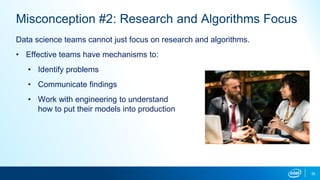
Misconception #2: Research and Algorithms Focus
Data science teams cannot just focus on research and algorithms.
• Effective teams have mechanisms to:
• Identify problems
• Communicate findings
• Work with engineering to understand
how to put their models into production
36
Misconception #3: Complex and Advanced Systems
The most complicated solution isn’t always the best.
• Teams tend to be more successful when they start simple
and then move on to more complex modeling techniques.
• Complex models may be more accurate, but are less
interpretable, more likely to fail in unpredictable ways, and
harder to maintain.
• Starting simple also ensures that what the team is building
aligns with business needs.
37
Misconception #4: Industry Differences
The underlying modeling and data analysis techniques are
largely transferable between industries.
• Domain expertise is required to understand which data
is relevant and which problems are most important to
solve.
• The techniques used to clean data, store it, and
extract useful insights and modeling remain very similar.
38
Misconception #5: Projects Begin Well-Defined
Data Science projects are often exploratory and
experimental in nature.
• It may not be clear how hard the problem is to
solve until investing time exploring the data.
• Product Managers must actively work with both
the team and the business stakeholders to
manage expectations.
39
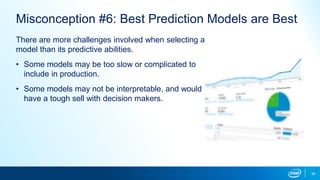
Misconception #6: Best Prediction Models are Best
There are more challenges involved when selecting a
model than its predictive abilities.
• Some models may be too slow or complicated to
include in production.
• Some models may not be interpretable, and would
have a tough sell with decision makers.
41
After Deploying a Model
Once a model is deployed, relevant teams must monitor and manage
the model for it to be useful.
• Business Intelligence teams should build reports/dashboards
displaying model results.
• Business teams (e.g. operations, merchandising) or customers
should use model outputs.
• Data Science teams must update model at appropriate cadence
(for example, monthly).
42
Business Intelligence Team
The business intelligence team monitors how model
predictions are changing over time.
• Monitor model usage and output.
• Develop key performance indicators and
dashboards.
• Visualizations should align with the needs of the
functional teams (for example, operations) that will
be using the model.
43
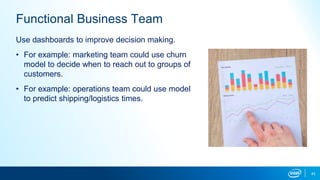
Functional Business Team
Use dashboards to improve decision making.
• For example: marketing team could use churn
model to decide when to reach out to groups of
customers.
• For example: operations team could use model
to predict shipping/logistics times.
44
Data Science Team
Monitor model to ensure continued validity and usefulness.
• For example: changes in marketing may lead to different types of
customers coming in the door, making the old model of customer
behavior less accurate.
• Depending on how fast the business conditions are changing, the data
science team should update model with appropriate frequency.
• Retraining models with new data.
45
Learning Objectives Recap
In this lesson, we worked to:
• Identify the steps in the data science workflow
• Identify the key roles and skill sets within the field of AI
• Describe the different ways to structure an AI team
• Identify common data science misconceptions
• Identify the components of model maintenance after deployment
Sources for images used in this presentation
(listed by slide number)
20 https://www.pexels.com/photo/adult-brainstorming-business-chair-515167/
22 https://www.pexels.com/photo/blue-screen-of-death-in-silver-black-laptop-177598/
31 https://www.pexels.com/photo/ground-group-growth-hands-461049/
33 https://www.pexels.com/photo/yellow-blue-and-red-plastic-gameboard-toy-209712/
34 https://www.pexels.com/photo/adult-agreement-beard-beverage-618550/
38 https://www.pexels.com/photo/blue-and-green-pie-chart-97080/
39 https://www.pexels.com/photo/arrows-box-business-chalk-533189/

Lesson 3 ai in the enterprise

  • 1.
    Lesson 3 AI inthe Enterprise
  • 2.
    2 Legal Disclaimers No license(express or implied, by estoppel or otherwise) to any intellectual property rights is granted by this document. Intel disclaims all express and implied warranties, including without limitation, the implied warranties of merchantability, fitness for a particular purpose, and non-infringement, as well as any warranty arising from course of performance, course of dealing, or usage in trade. Copies of documents which have an order number and are referenced in this document may be obtained by calling 1-800-548-4725 or by visiting www.intel.com/design/literature.htm. Intel and the Intel logo are trademarks of Intel Corporation in the U.S. and/or other countries. *Other names and brands may be claimed as the property of others Copyright © 2018 Intel Corporation. All rights reserved.
  • 3.
    3 Learning Objectives • Identifythe steps in the data science workflow • Identify the key roles and skill sets within the field of AI • Describe the different ways to structure an AI team • Identify common data science misconceptions • Identify the components of model maintenance after deployment You will be able to:
  • 5.
    5 Data Science Workflow ProblemStatement Data Collection Data Exploration & Preprocessing Modeling Validation Decision Making & Deployment What problem are you trying to solve? What data do you need to solve it? How should you clean your data so your model can use it? Build a model to solve your problem? Did I solve the problem? Communicate to stakeholders or put into production?
  • 6.
    6 Problem Statement What problemare you trying to solve? • Data scientists first need to identify the problem to solve. • Knowledge of the business is needed to identify impactful opportunities. • Technical knowledge is needed to ask the right questions, and to know what is possible.
  • 7.
    7 Data Collection What datado you need to solve your problem? • The data required to solve the problem needs to be identified and collected. • Data and engineering skills are needed to collect and consolidate data from multiple sources.
  • 8.
    8 Data Exploration andPreprocessing How should you clean your data so your model can use it? • Data needs to be cleaned and processed so that it’s in a usable format for modeling. • Exploration is required to identify important elements within the data and to identify any data quality issues. • Data, engineering, and statistics skills are needed to appropriately process the data and make inferences.
  • 9.
    9 Modeling What model needsto be built to solve your problem? • Several factors go into modeling such as complexity, required data, speed, and performance. • This step requires skills in engineering, modeling, and statistics.
  • 10.
    10 Validation Did the problemget sufficiently solved? • Validation is required to ensure the original problem was solved. • Model performance needs to be accurately measured. • Statistics and modeling skills, as well as domain knowledge, are needed to make sure the results align with the business problem.
  • 11.
    11 Decision Making andDeployment Communicate to stakeholders or put into production. • A business decision needs to be made, or a product needs to be put into production, so the business can see value from the project. • This requires domain knowledge, as well as communication and storytelling skills. • Engineering skills are needed to integrate code into back-end software systems.
  • 13.
    13 Data Science SkillSets Data science teams need a variety of skills to be successful. Data Munging Statistics Software Engineering Domain Expertise Modeling Storytelling & Communicatio n
  • 14.
    14 Data Science TeamSkills Communicate with business leaders Integrate code into software systems Communication/ Storytelling Domain Expertise Modeling Statistics Data Munging Software Engineering Data science teams need a variety of skills to be successful.
  • 15.
    15 Communication, Storytelling, DomainExpertise Understand the business needs and communicate how to address them. • Domain expertise to understand the process and business problem to help their business. • Persuade decision makers to support their idea. • Communicate complicated concepts clearly, and tell stories.
  • 16.
    16 Modeling and Statistics Usedata to make predictions via models, and using statistics to assess the validity of those predictions. • Work with a variety of modeling techniques, from regression to DL. • Use statistics to assess the performance of one model vs. another. • Design experiments and perform A/B testing.
  • 17.
    17 Data Munging/Software Engineering Transformmessy data into clean, usable data, as well as building software systems to deploy their models. • Raw data can be messy and unstructured. • Data must be manipulated and stored in databases before it can be used. • Models need to be deployed.
  • 19.
    Roles have evolvedthat fit on different places on this spectrum. 19 Roles on Data Science Teams Product Manager Statistician Machine Learning Engineer Research Scientist Data Engineer Software Engineerin g Business Analyst Communicate with business leaders Integrate code into software systems
  • 20.
    20 Business Analysts Business analystsinteract with decision-makers. • Create reports and provide insights. • Create dashboards displaying key product KPIs. • Perform analysis to determine business impact of a new product/feature. • Excel*, PowerBI* and Tableau* are examples of tools used. *Other names and brands may be claimed as the property of others.
  • 21.
    21 Product Managers Product Managersget requirements from business. • Translate business ideas into product ideas. • Determine feasibility of solving business problems. • Consider impact of new product or model on key business metrics. • Prioritize projects and tasks. • Examples of tools used: Microsoft Project*, Trello*, and JIRA*. *Other names and brands may be claimed as the property of others.
  • 22.
    22 Statisticians Statisticians determine thevalidity of models. • Applies statistical concepts to determine amount of data required. • Explores outliers and trends. • Determines if results are statistically significant. • Examples of tools used: R*, SAS*, Python*. *Other names and brands may be claimed as the property of others.
  • 23.
    23 Machine Learning Engineers Machinelearning engineers solve problems involving large amounts of high-dimensional data. • Apply machine learning techniques. • Focused on the engineering that makes models accurate and fast. • Examples of tools used: Python*, R*, and MATLAB*. *Other names and brands may be claimed as the property of others.
  • 24.
    24 Research Scientists Research scientistswork on problems in bleeding- edge fields. • Work on the toughest problems in big data and machine learning. • Expert at a particular sub-discipline. • Understand how algorithms work under the hood. • Can be part of a separate research team, interfacing with data science team when necessary. • Examples of tools used: Python*, MATLAB*, R*, C++, and Java*. *Other names and brands may be claimed as the property of others.
  • 25.
    25 Data Engineers Data engineersbuild data ingestion, storage, and infrastructure. • Databases experts. • Know the tradeoffs between speed, reliability, and size. • Automate data cleaning. • Build ETL (extract, transform, load) pipelines to make data available on a regular cadence. • Examples of tools used: Java*, SQL, and noSQL. *Other names and brands may be claimed as the property of others.
  • 26.
    26 Software Engineers Software engineersare responsible for optimizing code and deploying. • Get code into production. • Write tests to detect code breaking and bugs. • Ensure model code is maintainable. • Examples of tools used: Python*, Ruby*, C++, and Java*. *Other names and brands may be claimed as the property of others.
  • 27.
  • 29.
    29 Data Science OrganizationalStructure There are multiple ways to organize data science teams. • Centralized teams where are all data scientists report to the same head. • Distributed teams where individual data scientists work with a business team. • Teams embedded within functional business units.
  • 30.
    30 Centralized Teams All thedata scientists report to the same group head. • Usually within a technology or IT team. • Pros: • Standardization of skills and tools • Reduction of redundant roles • Closer collaboration amongst scientists • Cons: • Further removed from the business units • Tendency to be more reactive to problems
  • 31.
    31 Distributed Teams Distributed teamsare where individual data scientists sit within a particular team within a business unit. • Pros: • Closer access to the business, domain experts, and end users • More likely to come up with solutions to immediate business problems • Cons: • Destandardization of tools and skills throughout the organization • Less communication and collaboration between data scientists
  • 32.
    32 Additional Team Structures Thereare multiple hybrid ways to organize data science teams. • Some examples include: • Full data science teams can be embedded within a business function. • Data science centers of excellence can be created for the company.
  • 34.
    34 Misconception #1: DataScience “Unicorn” Data Scientists who are experts in all areas are called “unicorns”. • Successful teams contain people with a diverse array of skillsets and backgrounds. • Some excel at communication, while others may excel at statistics. • Successful teams have experts in the three main areas: business, science, and engineering.
  • 35.
    35 Misconception #2: Researchand Algorithms Focus Data science teams cannot just focus on research and algorithms. • Effective teams have mechanisms to: • Identify problems • Communicate findings • Work with engineering to understand how to put their models into production
  • 36.
    36 Misconception #3: Complexand Advanced Systems The most complicated solution isn’t always the best. • Teams tend to be more successful when they start simple and then move on to more complex modeling techniques. • Complex models may be more accurate, but are less interpretable, more likely to fail in unpredictable ways, and harder to maintain. • Starting simple also ensures that what the team is building aligns with business needs.
  • 37.
    37 Misconception #4: IndustryDifferences The underlying modeling and data analysis techniques are largely transferable between industries. • Domain expertise is required to understand which data is relevant and which problems are most important to solve. • The techniques used to clean data, store it, and extract useful insights and modeling remain very similar.
  • 38.
    38 Misconception #5: ProjectsBegin Well-Defined Data Science projects are often exploratory and experimental in nature. • It may not be clear how hard the problem is to solve until investing time exploring the data. • Product Managers must actively work with both the team and the business stakeholders to manage expectations.
  • 39.
    39 Misconception #6: BestPrediction Models are Best There are more challenges involved when selecting a model than its predictive abilities. • Some models may be too slow or complicated to include in production. • Some models may not be interpretable, and would have a tough sell with decision makers.
  • 41.
    41 After Deploying aModel Once a model is deployed, relevant teams must monitor and manage the model for it to be useful. • Business Intelligence teams should build reports/dashboards displaying model results. • Business teams (e.g. operations, merchandising) or customers should use model outputs. • Data Science teams must update model at appropriate cadence (for example, monthly).
  • 42.
    42 Business Intelligence Team Thebusiness intelligence team monitors how model predictions are changing over time. • Monitor model usage and output. • Develop key performance indicators and dashboards. • Visualizations should align with the needs of the functional teams (for example, operations) that will be using the model.
  • 43.
    43 Functional Business Team Usedashboards to improve decision making. • For example: marketing team could use churn model to decide when to reach out to groups of customers. • For example: operations team could use model to predict shipping/logistics times.
  • 44.
    44 Data Science Team Monitormodel to ensure continued validity and usefulness. • For example: changes in marketing may lead to different types of customers coming in the door, making the old model of customer behavior less accurate. • Depending on how fast the business conditions are changing, the data science team should update model with appropriate frequency. • Retraining models with new data.
  • 45.
    45 Learning Objectives Recap Inthis lesson, we worked to: • Identify the steps in the data science workflow • Identify the key roles and skill sets within the field of AI • Describe the different ways to structure an AI team • Identify common data science misconceptions • Identify the components of model maintenance after deployment
  • 47.
    Sources for imagesused in this presentation (listed by slide number) 20 https://www.pexels.com/photo/adult-brainstorming-business-chair-515167/ 22 https://www.pexels.com/photo/blue-screen-of-death-in-silver-black-laptop-177598/ 31 https://www.pexels.com/photo/ground-group-growth-hands-461049/ 33 https://www.pexels.com/photo/yellow-blue-and-red-plastic-gameboard-toy-209712/ 34 https://www.pexels.com/photo/adult-agreement-beard-beverage-618550/ 38 https://www.pexels.com/photo/blue-and-green-pie-chart-97080/ 39 https://www.pexels.com/photo/arrows-box-business-chalk-533189/

Editor's Notes

  • #6 Walk through each step in the workflow. Highlight that we’ll be going into more depth in the various steps throughout the course. Segway into the next slide with the fact that there are a wide range of skills needed throughout this workflow