
Slide content created by Joseph B. Mosca, Monmouth University.
Copyright © Houghton Mifflin Company. All rights reserved.
Traditional and
Contemporary
Issues and
Challenges
Presented by:
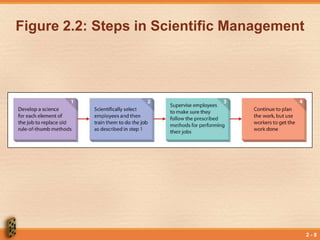
DR RHEA LOWELLA S. FISER,RPsy, RPm, CSIOP
2
2 - 2
Traditional and Contemporary Issues and
Challenges
The role of theory and history in
management:
– Theory is a conceptual framework for
organizing knowledge and providing a
blueprint for action.
– History: Understanding the historical
context of management provides a sense
of heritage and can help managers avoid
the mistakes of others.
2 - 3
The Practice of Management Can Be Traced
Back Thousands of Years
• The Egyptians used management
functions of planning, organizing, and
controlling when they constructed the
pyramids.
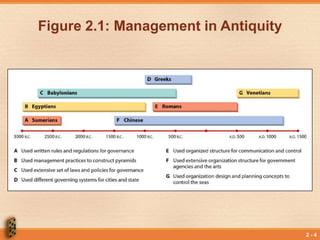
• Observe the next slide Figure 2.1, it will
illustrate a few of the most important
management breakthroughs and
practices over the last 4000 years:
2 - 4
Figure 2.1: Management in Antiquity
2 - 5
The Three Traditional Management
Perspectives
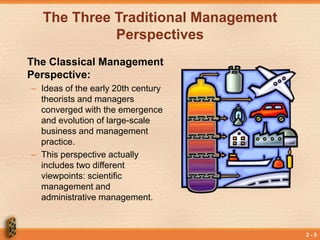
The Classical Management
Perspective:
– Ideas of the early 20th century
theorists and managers
converged with the emergence
and evolution of large-scale
business and management
practice.
– This perspective actually
includes two different
viewpoints: scientific
management and
administrative management.
2 - 6
Scientific Management
• Concerned with
improving the
performance of
individual workers.
• Frederick Taylor
developed this
system, which he
believed would lead
to a more efficient
and productive work
force.
2 - 7
Steps in Scientific Management
1. Develop a science for each element of the
job.
2. Scientifically select employees and then
train them to do the job.
3. Supervise employees to make sure they
follow prescribed methods.
Continue to plan the work, but use workers
to get the work done. (see Figure 2.2)
2 - 8
Figure 2.2: Steps in Scientific Management
Copyright © Houghton Mifflin Company. All rights reserved. 2 - 9
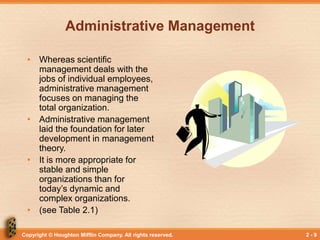
Administrative Management
• Whereas scientific
management deals with the
jobs of individual employees,
administrative management
focuses on managing the
total organization.
• Administrative management
laid the foundation for later
development in management
theory.
• It is more appropriate for
stable and simple
organizations than for
today’s dynamic and
complex organizations.
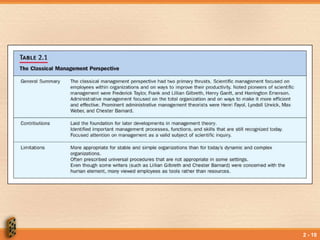
• (see Table 2.1)
2 - 10
2 - 11
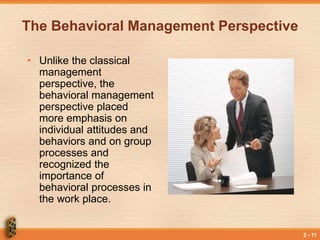
The Behavioral Management Perspective
• Unlike the classical
management
perspective, the
behavioral management
perspective placed
more emphasis on
individual attitudes and
behaviors and on group
processes and
recognized the
importance of
behavioral processes in
the work place.
2 - 12
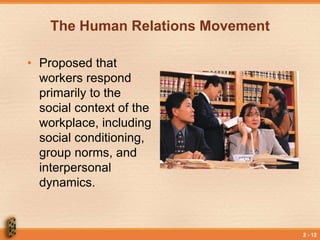
The Human Relations Movement
• Proposed that
workers respond
primarily to the
social context of the
workplace, including
social conditioning,
group norms, and
interpersonal
dynamics.
2 - 13
Organizational Behavior
• Human behavior in organizations is
complex.
• The field of organizational behavior
draws from a broad, interdisciplinary
base of psychology, sociology,
anthropology, economics, and medicine.
• There are two theories on how
employees behave:
2 - 14
Behavioral Theory on How Employees Behave
Toward Work
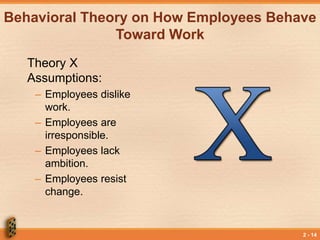
Theory X
Assumptions:
– Employees dislike
work.
– Employees are
irresponsible.
– Employees lack
ambition.
– Employees resist
change.
Copyright © Houghton Mifflin Company. All rights reserved. 2 - 15
Another Theory on How Employees Behave
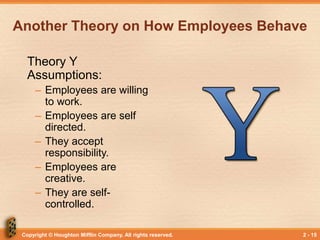
Theory Y
Assumptions:
– Employees are willing
to work.
– Employees are self
directed.
– They accept
responsibility.
– Employees are
creative.
– They are self-
controlled.
2 - 16
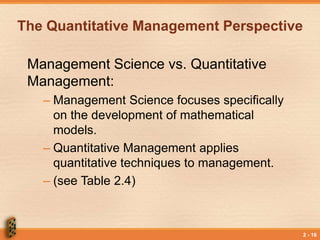
The Quantitative Management Perspective
Management Science vs. Quantitative
Management:
– Management Science focuses specifically
on the development of mathematical
models.
– Quantitative Management applies
quantitative techniques to management.
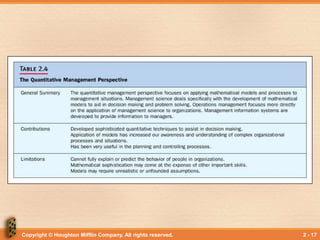
– (see Table 2.4)
Copyright © Houghton Mifflin Company. All rights reserved. 2 - 17
2 - 18
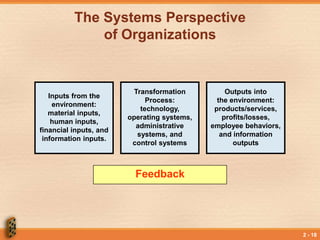
The Systems Perspective
of Organizations
Inputs from the
environment:
material inputs,
human inputs,
financial inputs, and
information inputs.
Transformation
Process:
technology,
operating systems,
administrative
systems, and
control systems
Outputs into
the environment:
products/services,
profits/losses,
employee behaviors,
and information
outputs
Feedback
2 - 19
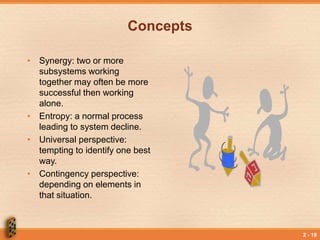
Concepts
• Synergy: two or more
subsystems working
together may often be more
successful then working
alone.
• Entropy: a normal process
leading to system decline.
• Universal perspective:
tempting to identify one best
way.
• Contingency perspective:
depending on elements in
that situation.
2 - 20
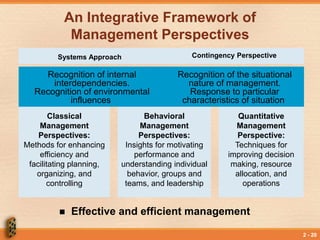
An Integrative Framework of
Management Perspectives
 Effective and efficient management
Classical
Management
Perspectives:
Methods for enhancing
efficiency and
facilitating planning,
organizing, and
controlling
Behavioral
Management
Perspectives:
Insights for motivating
performance and
understanding individual
behavior, groups and
teams, and leadership
Quantitative
Management
Perspective:
Techniques for
improving decision
making, resource
allocation, and
operations
Contingency PerspectiveSystems Approach
Recognition of the situational
nature of management.
Response to particular
characteristics of situation.
Recognition of internal
interdependencies.
Recognition of environmental
influences.
2 - 21
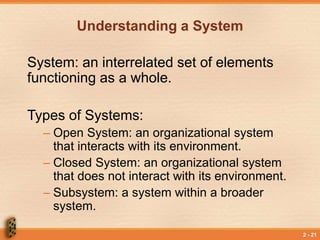
Understanding a System
System: an interrelated set of elements
functioning as a whole.
Types of Systems:
– Open System: an organizational system
that interacts with its environment.
– Closed System: an organizational system
that does not interact with its environment.
– Subsystem: a system within a broader
system.
2 - 22
Operations Management
• Operations
management
techniques are
generally concerned
with helping the
organization
produce products or
services more
efficiently.
2 - 23
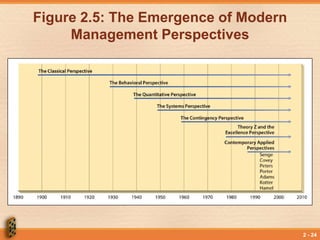
Integrating Perspectives for Managers
• A complete understanding of
management requires an appreciation
of, classical, behavioral, and
quantitative approaches.
• The systems and contingency
perspectives can help managers
integrate the three approaches and
enlarge understanding of all three.
• (see Figure 2.5)
2 - 24
Figure 2.5: The Emergence of Modern
Management Perspectives
DR RHEA LOWELLA S. FISER, RPSY, RPm, CSIOP
09951100143
rheasantillan@live.com
Thank you

Lesson 2 Traditional and Contemporary Issues and Challenges

  • 1.
    Slide content createdby Joseph B. Mosca, Monmouth University. Copyright © Houghton Mifflin Company. All rights reserved. Traditional and Contemporary Issues and Challenges Presented by: DR RHEA LOWELLA S. FISER,RPsy, RPm, CSIOP 2
  • 2.
    2 - 2 Traditionaland Contemporary Issues and Challenges The role of theory and history in management: – Theory is a conceptual framework for organizing knowledge and providing a blueprint for action. – History: Understanding the historical context of management provides a sense of heritage and can help managers avoid the mistakes of others.
  • 3.
    2 - 3 ThePractice of Management Can Be Traced Back Thousands of Years • The Egyptians used management functions of planning, organizing, and controlling when they constructed the pyramids. • Observe the next slide Figure 2.1, it will illustrate a few of the most important management breakthroughs and practices over the last 4000 years:
  • 4.
    2 - 4 Figure2.1: Management in Antiquity
  • 5.
    2 - 5 TheThree Traditional Management Perspectives The Classical Management Perspective: – Ideas of the early 20th century theorists and managers converged with the emergence and evolution of large-scale business and management practice. – This perspective actually includes two different viewpoints: scientific management and administrative management.
  • 6.
    2 - 6 ScientificManagement • Concerned with improving the performance of individual workers. • Frederick Taylor developed this system, which he believed would lead to a more efficient and productive work force.
  • 7.
    2 - 7 Stepsin Scientific Management 1. Develop a science for each element of the job. 2. Scientifically select employees and then train them to do the job. 3. Supervise employees to make sure they follow prescribed methods. Continue to plan the work, but use workers to get the work done. (see Figure 2.2)
  • 8.
    2 - 8 Figure2.2: Steps in Scientific Management
  • 9.
    Copyright © HoughtonMifflin Company. All rights reserved. 2 - 9 Administrative Management • Whereas scientific management deals with the jobs of individual employees, administrative management focuses on managing the total organization. • Administrative management laid the foundation for later development in management theory. • It is more appropriate for stable and simple organizations than for today’s dynamic and complex organizations. • (see Table 2.1)
  • 10.
  • 11.
    2 - 11 TheBehavioral Management Perspective • Unlike the classical management perspective, the behavioral management perspective placed more emphasis on individual attitudes and behaviors and on group processes and recognized the importance of behavioral processes in the work place.
  • 12.
    2 - 12 TheHuman Relations Movement • Proposed that workers respond primarily to the social context of the workplace, including social conditioning, group norms, and interpersonal dynamics.
  • 13.
    2 - 13 OrganizationalBehavior • Human behavior in organizations is complex. • The field of organizational behavior draws from a broad, interdisciplinary base of psychology, sociology, anthropology, economics, and medicine. • There are two theories on how employees behave:
  • 14.
    2 - 14 BehavioralTheory on How Employees Behave Toward Work Theory X Assumptions: – Employees dislike work. – Employees are irresponsible. – Employees lack ambition. – Employees resist change.
  • 15.
    Copyright © HoughtonMifflin Company. All rights reserved. 2 - 15 Another Theory on How Employees Behave Theory Y Assumptions: – Employees are willing to work. – Employees are self directed. – They accept responsibility. – Employees are creative. – They are self- controlled.
  • 16.
    2 - 16 TheQuantitative Management Perspective Management Science vs. Quantitative Management: – Management Science focuses specifically on the development of mathematical models. – Quantitative Management applies quantitative techniques to management. – (see Table 2.4)
  • 17.
    Copyright © HoughtonMifflin Company. All rights reserved. 2 - 17
  • 18.
    2 - 18 TheSystems Perspective of Organizations Inputs from the environment: material inputs, human inputs, financial inputs, and information inputs. Transformation Process: technology, operating systems, administrative systems, and control systems Outputs into the environment: products/services, profits/losses, employee behaviors, and information outputs Feedback
  • 19.
    2 - 19 Concepts •Synergy: two or more subsystems working together may often be more successful then working alone. • Entropy: a normal process leading to system decline. • Universal perspective: tempting to identify one best way. • Contingency perspective: depending on elements in that situation.
  • 20.
    2 - 20 AnIntegrative Framework of Management Perspectives  Effective and efficient management Classical Management Perspectives: Methods for enhancing efficiency and facilitating planning, organizing, and controlling Behavioral Management Perspectives: Insights for motivating performance and understanding individual behavior, groups and teams, and leadership Quantitative Management Perspective: Techniques for improving decision making, resource allocation, and operations Contingency PerspectiveSystems Approach Recognition of the situational nature of management. Response to particular characteristics of situation. Recognition of internal interdependencies. Recognition of environmental influences.
  • 21.
    2 - 21 Understandinga System System: an interrelated set of elements functioning as a whole. Types of Systems: – Open System: an organizational system that interacts with its environment. – Closed System: an organizational system that does not interact with its environment. – Subsystem: a system within a broader system.
  • 22.
    2 - 22 OperationsManagement • Operations management techniques are generally concerned with helping the organization produce products or services more efficiently.
  • 23.
    2 - 23 IntegratingPerspectives for Managers • A complete understanding of management requires an appreciation of, classical, behavioral, and quantitative approaches. • The systems and contingency perspectives can help managers integrate the three approaches and enlarge understanding of all three. • (see Figure 2.5)
  • 24.
    2 - 24 Figure2.5: The Emergence of Modern Management Perspectives
  • 25.
    DR RHEA LOWELLAS. FISER, RPSY, RPm, CSIOP 09951100143 rheasantillan@live.com Thank you