EXPANDING UNIVERSE
EDWIN HUBBLE (
1929 )
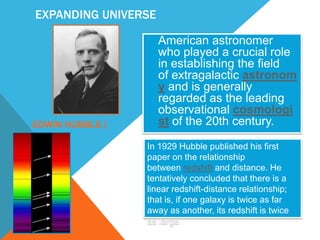
American astronomer
who played a crucial role
in establishing the field
of extragalactic astronom
y and is generally
regarded as the leading
observational cosmologi
st of the 20th century.
In 1929 Hubble published his first
paper on the relationship
between redshift and distance. He
tentatively concluded that there is a
linear redshift-distance relationship;
that is, if one galaxy is twice as far
away as another, its redshift is twice
as large.
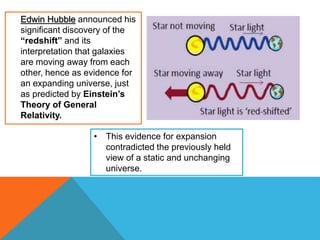
Edwin Hubble announced his
significant discovery of the
“redshift” and its
interpretation that galaxies
are moving away from each
other, hence as evidence for
an expanding universe, just
as predicted by Einstein’s
Theory of General
Relativity.
• This evidence for expansion
contradicted the previously held
view of a static and unchanging
universe.
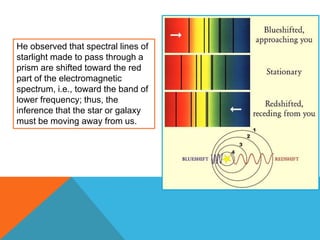
He observed that spectral lines of
starlight made to pass through a
prism are shifted toward the red
part of the electromagnetic
spectrum, i.e., toward the band of
lower frequency; thus, the
inference that the star or galaxy
must be moving away from us.
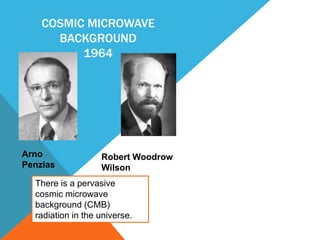
COSMIC MICROWAVE
BACKGROUND
1964
Arno
Penzias
Robert Woodrow
Wilson
There is a pervasive
cosmic microwave
background (CMB)
radiation in the universe.
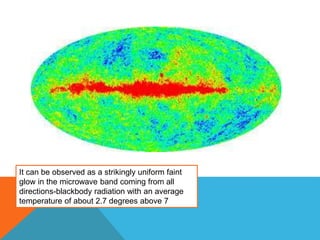
It can be observed as a strikingly uniform faint
glow in the microwave band coming from all
directions-blackbody radiation with an average
temperature of about 2.7 degrees above 7
COSMIC MICROWAVE BACKGROUND EXPLAINED
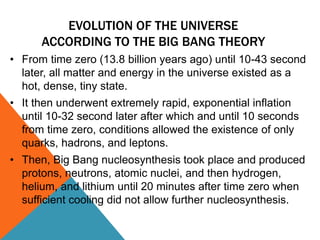
EVOLUTION OF THE UNIVERSE
ACCORDING TO THE BIG BANG THEORY
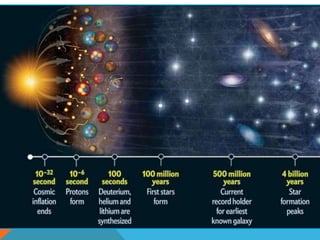
• From time zero (13.8 billion years ago) until 10-43 second
later, all matter and energy in the universe existed as a
hot, dense, tiny state.
• It then underwent extremely rapid, exponential inflation
until 10-32 second later after which and until 10 seconds
from time zero, conditions allowed the existence of only
quarks, hadrons, and leptons.
• Then, Big Bang nucleosynthesis took place and produced
protons, neutrons, atomic nuclei, and then hydrogen,
helium, and lithium until 20 minutes after time zero when
sufficient cooling did not allow further nucleosynthesis.
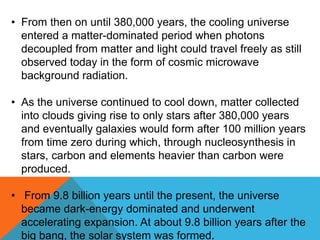
• From then on until 380,000 years, the cooling universe
entered a matter-dominated period when photons
decoupled from matter and light could travel freely as still
observed today in the form of cosmic microwave
background radiation.
• As the universe continued to cool down, matter collected
into clouds giving rise to only stars after 380,000 years
and eventually galaxies would form after 100 million years
from time zero during which, through nucleosynthesis in
stars, carbon and elements heavier than carbon were
produced.
• From 9.8 billion years until the present, the universe
became dark-energy dominated and underwent
accelerating expansion. At about 9.8 billion years after the
big bang, the solar system was formed.
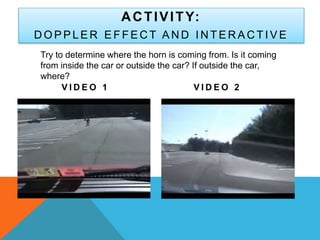
V I D E O 1 V I D E O 2
ACTIVITY:
D O P P L E R E F F E C T A N D I N T E R A C T I V E
Try to determine where the horn is coming from. Is it coming
from inside the car or outside the car? If outside the car,
where?
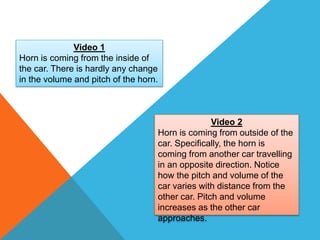
Video 1
Horn is coming from the inside of
the car. There is hardly any change
in the volume and pitch of the horn.
Video 2
Horn is coming from outside of the
car. Specifically, the horn is
coming from another car travelling
in an opposite direction. Notice
how the pitch and volume of the
car varies with distance from the
other car. Pitch and volume
increases as the other car
approaches.
ASSESMENT:
Directions; Write your output in MS Word.
Font; Arial, Size; 14, Justify.
1.Explain the concept of the redshift theory
and how it was used as an evidence for an
expanding universe (10 pts.)
2.Explain the origin and evolution of the
universe according to the Big Bang
theory(10 pts.)
ASSIGNMENT:
Directions:Write your output in MS Word.
Font; Arial, Size; 14, Justify.
Research about large scale and small properties
of the solar system.

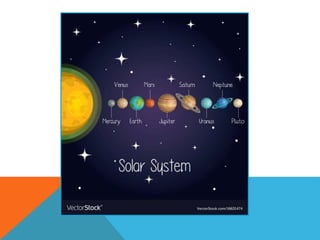
Lesson 2: Solar System

  • 3.
    EXPANDING UNIVERSE EDWIN HUBBLE( 1929 ) American astronomer who played a crucial role in establishing the field of extragalactic astronom y and is generally regarded as the leading observational cosmologi st of the 20th century. In 1929 Hubble published his first paper on the relationship between redshift and distance. He tentatively concluded that there is a linear redshift-distance relationship; that is, if one galaxy is twice as far away as another, its redshift is twice as large.
  • 4.
    Edwin Hubble announcedhis significant discovery of the “redshift” and its interpretation that galaxies are moving away from each other, hence as evidence for an expanding universe, just as predicted by Einstein’s Theory of General Relativity. • This evidence for expansion contradicted the previously held view of a static and unchanging universe.
  • 5.
    He observed thatspectral lines of starlight made to pass through a prism are shifted toward the red part of the electromagnetic spectrum, i.e., toward the band of lower frequency; thus, the inference that the star or galaxy must be moving away from us.
  • 6.
    COSMIC MICROWAVE BACKGROUND 1964 Arno Penzias Robert Woodrow Wilson Thereis a pervasive cosmic microwave background (CMB) radiation in the universe.
  • 7.
    It can beobserved as a strikingly uniform faint glow in the microwave band coming from all directions-blackbody radiation with an average temperature of about 2.7 degrees above 7
  • 8.
  • 9.
    EVOLUTION OF THEUNIVERSE ACCORDING TO THE BIG BANG THEORY • From time zero (13.8 billion years ago) until 10-43 second later, all matter and energy in the universe existed as a hot, dense, tiny state. • It then underwent extremely rapid, exponential inflation until 10-32 second later after which and until 10 seconds from time zero, conditions allowed the existence of only quarks, hadrons, and leptons. • Then, Big Bang nucleosynthesis took place and produced protons, neutrons, atomic nuclei, and then hydrogen, helium, and lithium until 20 minutes after time zero when sufficient cooling did not allow further nucleosynthesis.
  • 11.
    • From thenon until 380,000 years, the cooling universe entered a matter-dominated period when photons decoupled from matter and light could travel freely as still observed today in the form of cosmic microwave background radiation. • As the universe continued to cool down, matter collected into clouds giving rise to only stars after 380,000 years and eventually galaxies would form after 100 million years from time zero during which, through nucleosynthesis in stars, carbon and elements heavier than carbon were produced. • From 9.8 billion years until the present, the universe became dark-energy dominated and underwent accelerating expansion. At about 9.8 billion years after the big bang, the solar system was formed.
  • 12.
    V I DE O 1 V I D E O 2 ACTIVITY: D O P P L E R E F F E C T A N D I N T E R A C T I V E Try to determine where the horn is coming from. Is it coming from inside the car or outside the car? If outside the car, where?
  • 13.
    Video 1 Horn iscoming from the inside of the car. There is hardly any change in the volume and pitch of the horn. Video 2 Horn is coming from outside of the car. Specifically, the horn is coming from another car travelling in an opposite direction. Notice how the pitch and volume of the car varies with distance from the other car. Pitch and volume increases as the other car approaches.
  • 14.
    ASSESMENT: Directions; Write youroutput in MS Word. Font; Arial, Size; 14, Justify. 1.Explain the concept of the redshift theory and how it was used as an evidence for an expanding universe (10 pts.) 2.Explain the origin and evolution of the universe according to the Big Bang theory(10 pts.)
  • 15.
    ASSIGNMENT: Directions:Write your outputin MS Word. Font; Arial, Size; 14, Justify. Research about large scale and small properties of the solar system.