Higher Education Department
Sacred Heart College
Lucena City
S.Y. 2017 – 2018
Lesson Guide in Language Literary Arts X
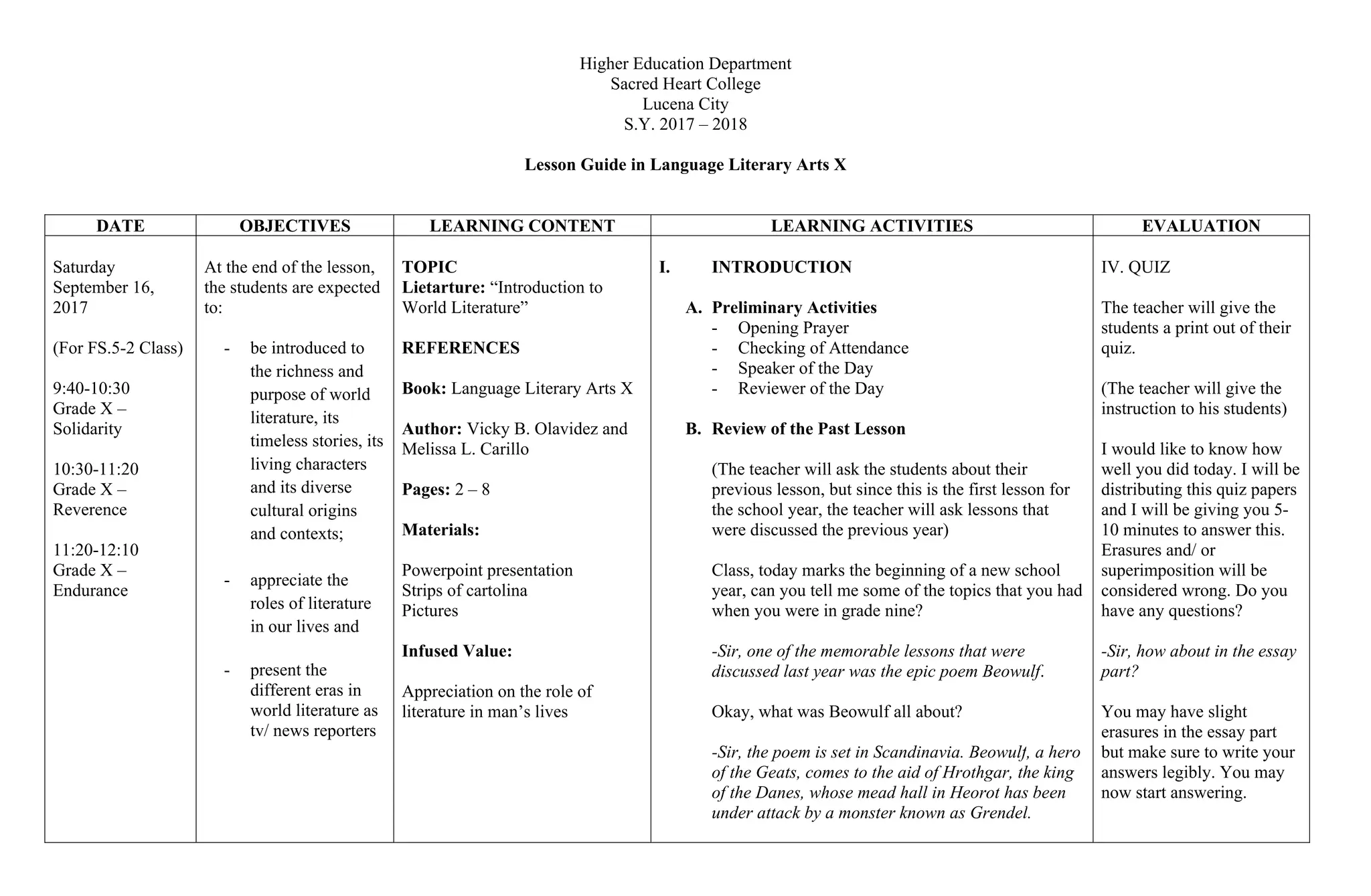
DATE OBJECTIVES LEARNING CONTENT LEARNING ACTIVITIES EVALUATION
Saturday
September 16,
2017
(For FS.5-2 Class)
9:40-10:30
Grade X –
Solidarity
10:30-11:20
Grade X –
Reverence
11:20-12:10
Grade X –
Endurance
At the end of the lesson,
the students are expected
to:
- be introduced to
the richness and
purpose of world
literature, its
timeless stories, its
living characters
and its diverse
cultural origins
and contexts;
- appreciate the
roles of literature
in our lives and
- present the
different eras in
world literature as
tv/ news reporters
TOPIC
Lietarture: “Introduction to
World Literature”
REFERENCES
Book: Language Literary Arts X
Author: Vicky B. Olavidez and
Melissa L. Carillo
Pages: 2 – 8
Materials:
Powerpoint presentation
Strips of cartolina
Pictures
Infused Value:
Appreciation on the role of
literature in man’s lives
I. INTRODUCTION
A. Preliminary Activities
- Opening Prayer
- Checking of Attendance
- Speaker of the Day
- Reviewer of the Day
B. Review of the Past Lesson
(The teacher will ask the students about their
previous lesson, but since this is the first lesson for
the school year, the teacher will ask lessons that
were discussed the previous year)
Class, today marks the beginning of a new school
year, can you tell me some of the topics that you had
when you were in grade nine?
-Sir, one of the memorable lessons that were
discussed last year was the epic poem Beowulf.
Okay, what was Beowulf all about?
-Sir, the poem is set in Scandinavia. Beowulf, a hero
of the Geats, comes to the aid of Hrothgar, the king
of the Danes, whose mead hall in Heorot has been
under attack by a monster known as Grendel.
IV. QUIZ
The teacher will give the
students a print out of their
quiz.
(The teacher will give the
instruction to his students)
I would like to know how
well you did today. I will be
distributing this quiz papers
and I will be giving you 5-
10 minutes to answer this.
Erasures and/ or
superimposition will be
considered wrong. Do you
have any questions?
-Sir, how about in the essay
part?
You may have slight
erasures in the essay part
but make sure to write your
answers legibly. You may
now start answering.
DATE OBJECTIVES LEARNING CONTENT LEARNING ACTIVITIES EVALUATION
After Beowulf slays him, Grendel's mother attacks
the hall and is then also defeated.
Correct! I really believe that your previous teacher
had taught the lesson very well. How about other
topics? What did you discuss?
-Sir, we also discussed the Passionate Shepherd to
his love and the Nymph’s reply to the Shepherd.
Yes! I can still remember those lovely poems. How
about lessons in grammar?
-Sir, we had a deeper understanding on the lesson
Parallelism because when we were in Grade Eight,
we had an introductory lesson about it.
Okay, so I assume that you can write sentences with
parallel structures, I’ll confirm that as I check your
essays.
C. Motivation
Class, we are going to have an activity entitled
“Who am I?” I am going to ask questions and all you
have to do is to answer my questions. Is that clear?
-Yes, Sir!
Okay, let us begin. First, this is something that is
created with imagination and skill and that is
beautiful or something that expresses important
ideas or feelings. Also, these are works created by
artists: paintings, sculptures, etc., that are created to
be beautiful or to express important ideas or
feelings.
What’s the answer?
Identification: Write the
correct answer on the space
provided before each
number.
______ 1. This came
from the Latin word
litera which means,
acquaintance with
letters
______ 2. According to
him, Literature is the
body of written works
produced in a
particular language,
country or age.
______ 3. This is
sometimes used to
refer to the sum total
of the world’s national
literatures, but usually
it refers to the
circulation of works
into the wider world
beyond their country
of origin.
______ 4. This is
derived from two
streams – one coming
from Palestine in the
East, and the other,
from Greece in the
West.
______ 5. During the
14th
and 15th
centuries
a great change began
to take place in the
DATE OBJECTIVES LEARNING CONTENT LEARNING ACTIVITIES EVALUATION
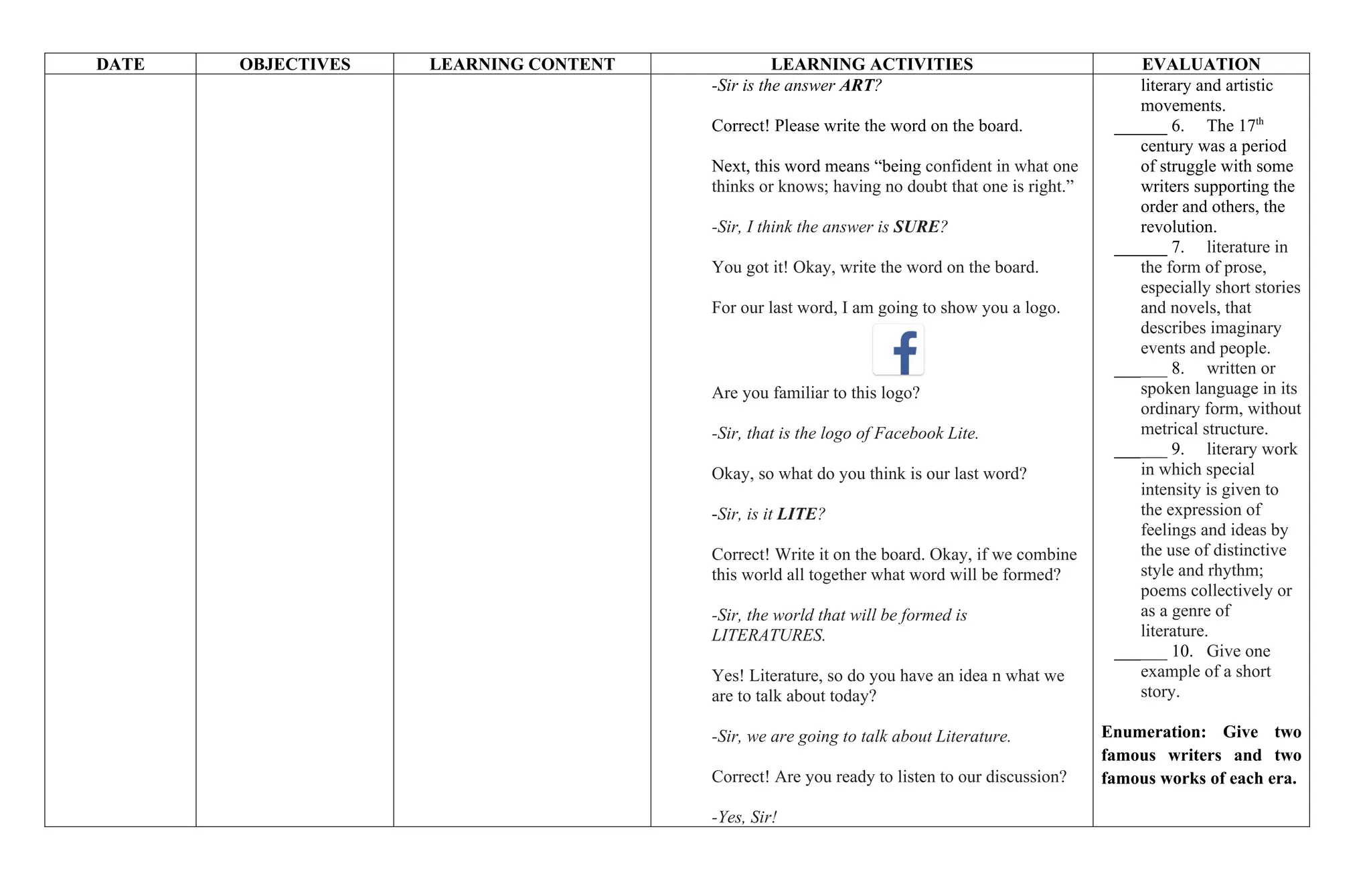
-Sir is the answer ART?
Correct! Please write the word on the board.
Next, this word means “being confident in what one
thinks or knows; having no doubt that one is right.”
-Sir, I think the answer is SURE?
You got it! Okay, write the word on the board.
For our last word, I am going to show you a logo.
Are you familiar to this logo?
-Sir, that is the logo of Facebook Lite.
Okay, so what do you think is our last word?
-Sir, is it LITE?
Correct! Write it on the board. Okay, if we combine
this world all together what word will be formed?
-Sir, the world that will be formed is
LITERATURES.
Yes! Literature, so do you have an idea n what we
are to talk about today?
-Sir, we are going to talk about Literature.
Correct! Are you ready to listen to our discussion?
-Yes, Sir!
literary and artistic
movements.
______ 6. The 17th
century was a period
of struggle with some
writers supporting the
order and others, the
revolution.
______ 7. literature in
the form of prose,
especially short stories
and novels, that
describes imaginary
events and people.
______ 8. written or
spoken language in its
ordinary form, without
metrical structure.
______ 9. literary work
in which special
intensity is given to
the expression of
feelings and ideas by
the use of distinctive
style and rhythm;
poems collectively or
as a genre of
literature.
______ 10. Give one
example of a short
story.
Enumeration: Give two
famous writers and two
famous works of each era.
DATE OBJECTIVES LEARNING CONTENT LEARNING ACTIVITIES EVALUATION
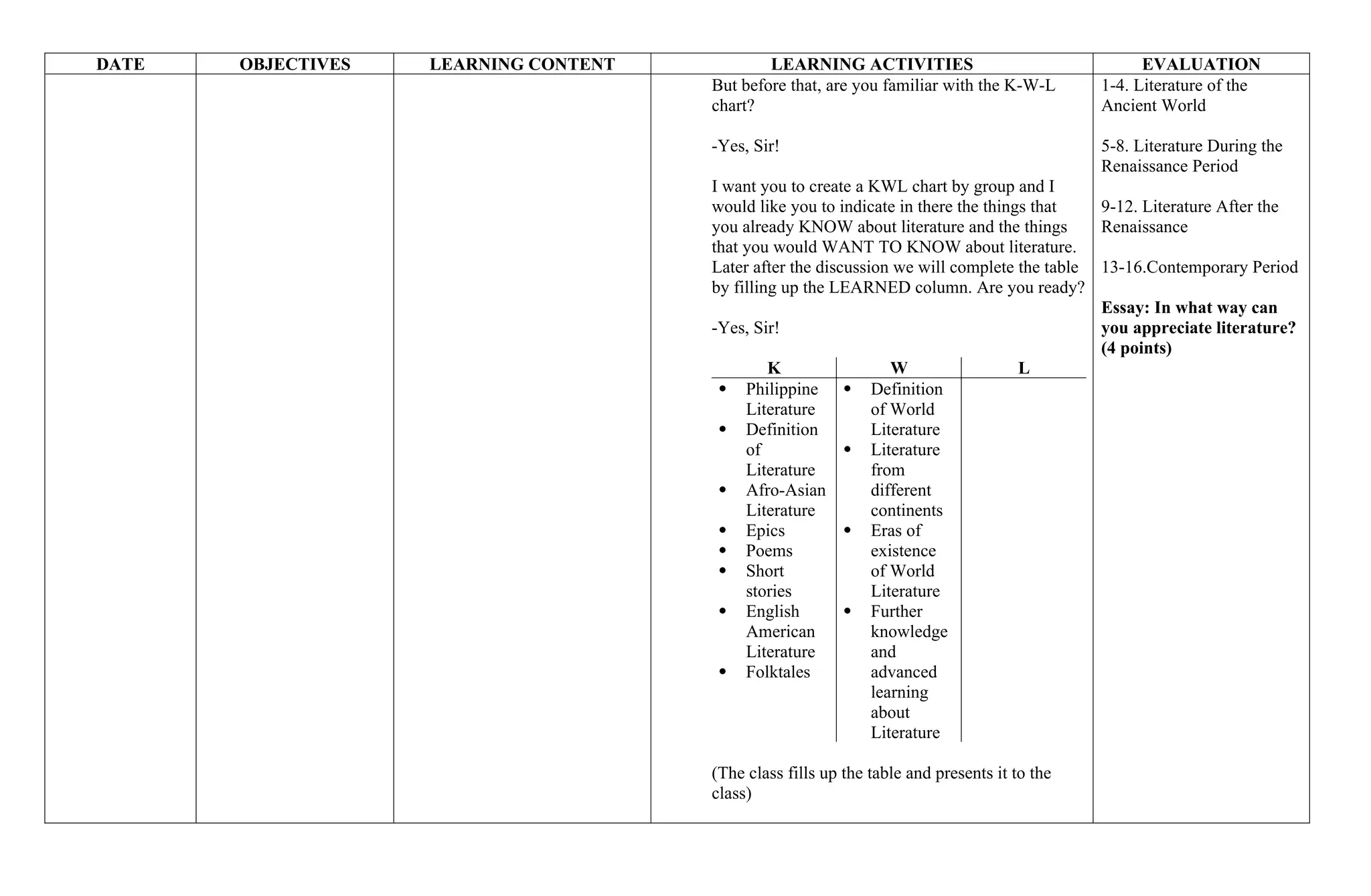
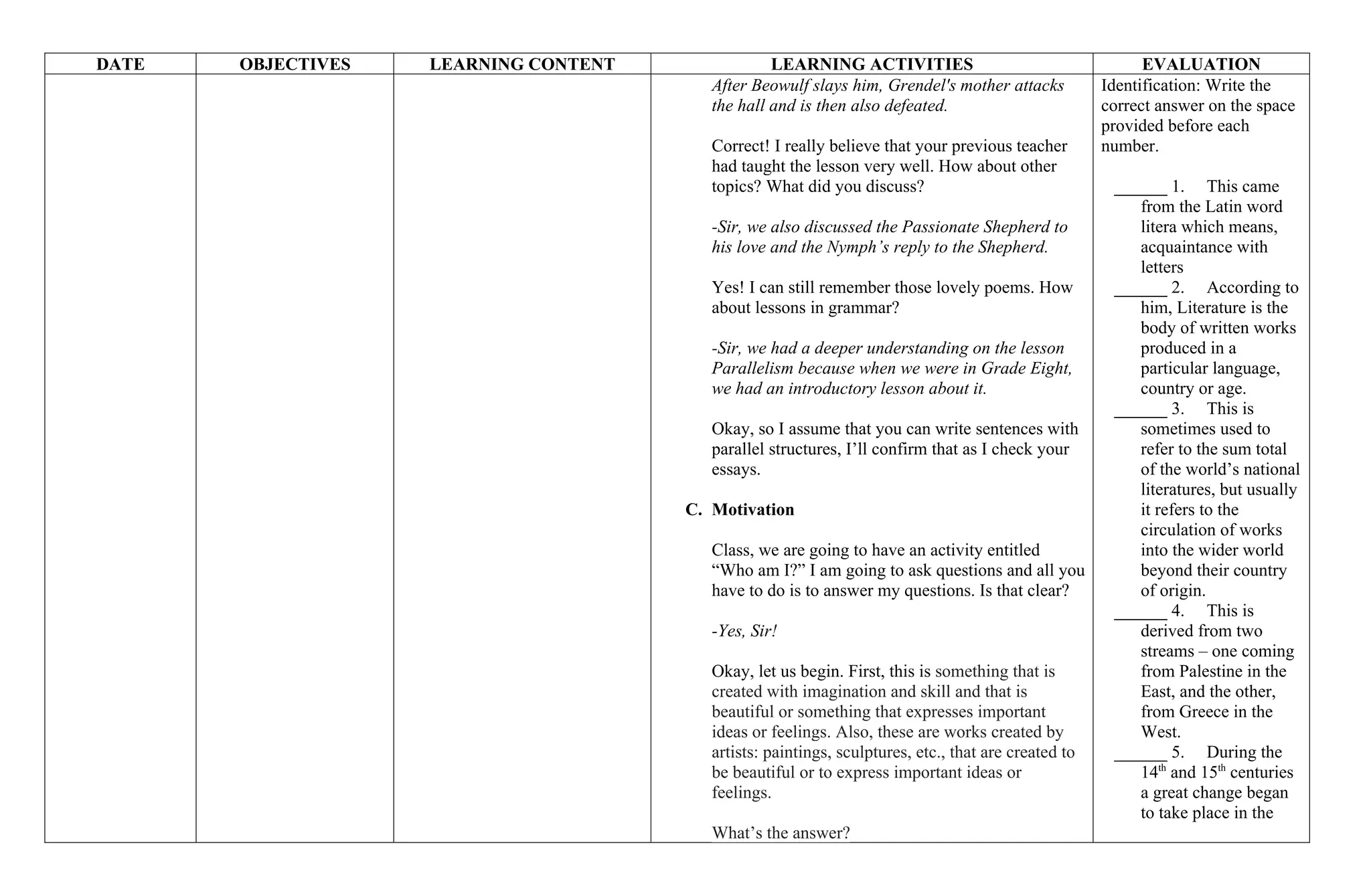
But before that, are you familiar with the K-W-L
chart?
-Yes, Sir!
I want you to create a KWL chart by group and I
would like you to indicate in there the things that
you already KNOW about literature and the things
that you would WANT TO KNOW about literature.
Later after the discussion we will complete the table
by filling up the LEARNED column. Are you ready?
-Yes, Sir!
K W L
 Philippine
Literature
 Definition
of
Literature
 Afro-Asian
Literature
 Epics
 Poems
 Short
stories
 English
American
Literature
 Folktales
 Definition
of World
Literature
 Literature
from
different
continents
 Eras of
existence
of World
Literature
 Further
knowledge
and
advanced
learning
about
Literature
(The class fills up the table and presents it to the
class)
1-4. Literature of the
Ancient World
5-8. Literature During the
Renaissance Period
9-12. Literature After the
Renaissance
13-16.Contemporary Period
Essay: In what way can
you appreciate literature?
(4 points)
DATE OBJECTIVES LEARNING CONTENT LEARNING ACTIVITIES EVALUATION
II. INTERACTION
Now, I want you to silently read the first paragraph
in page 4 of your textman, then, I will ask questions
in relation to the paragraph that you have read. Is
that clear?
-Yes, Sir!
Okay, the term Literature came from what word and
what does this word mean?
-Sir, Literature comes from the Latin word “Litera”
which literally means an acquaintance with letters.
Correct! If we are to base the definition of Literature
from Webster, what does literature mean? Who can
give me the first definition?
-Sir, the first definition according to Webster is
writings in prose or verse; writings having
excellence of form or expression and expressing
ideas of permanent or universal interest;
Correct! How about the second definition?
-Sir, the second definition of Literature according to
Webster is the body of written works produced in a
particular language, country or age.
Correct! We also have 2 forms of literature, which is
fiction and non-fiction. Can you still recall the
definitions of the two and can you give me examples
of them?
-Sir, Fiction are written works that are products of
the imaginative and creative mind and examples of
DATE OBJECTIVES LEARNING CONTENT LEARNING ACTIVITIES EVALUATION
such are fairy tales, myths, and legends.
Correct! How about non-fiction?
-Sir these are written works that are true and based
on real events, The examples of non-fiction are
biography of a person of interest, and news.
Well explained! But also, aside from the forms of
literature, we also have the genres of literature, I
know that you are very familiar with these. Class,
this time we will have an activity entitled “Pass the
Ball!” I will play a song and I will pass this ball, be
sure to pass it to the person next to you and when the
music stops, the person who is holding the ball shall
answer my question. Are you ready?
-Yes, Sir!
The different genres of literature are Prose, Poetry,
Drama, and Speech. Who can give me examples of
Prose?
-Sir, a prose may be short stories, essays, novels,
and the like.
Correct! Who can give me titles of such examples
that were cited?
-Sir, an example of a short story is the “Scent of an
Apple in the Philippine Literatur”. An example of an
essay is “Of Studies by Sir Francis Bacon”, and an
example of a Novel is “Dekada 70’” by Lualhati
Bautista.
Correct! Who can give me examples of poems or
poetry?
DATE OBJECTIVES LEARNING CONTENT LEARNING ACTIVITIES EVALUATION
-Sir, examples of poems are “Trees” by Joyce
Kilmer, “The Road Not Taken” by Robert Frost,
“The raven:, and “Anabelle Lee” by William
Shakespeare.
Correct, The Raven and Anabelle Lee are one of the
famous works of Shakespeare, I can really see that
you have learned a lot from English-American
Literature from last year. Okay, who can give me
examples of Drama?
-Sir, an example of Drama are plays like Phantom
of the Opera and Les Miserables.
Correct! The last one, is speech, therefore it is done
by a person who intends to speak in front of a
crowd, a best example of speech is the State of the
Nation address delivered by the president annually.
The main coverage of English 10 is World
Literature, and the definition of World Literature is
provided in page 4 of your textman, who wants to
volunteer in reading the definition? Yes, Diether?
-Sir, World Literature is sometimes used to refer to
the sum total of the world’s national literatures, but
usually it refers to the circulation of works into the
wider world beyond their country of origin. Often
used in the past primarily for masterpieces
of Western European literature, world literature
today is increasingly seen in a global context.
Class this time, I will divide you into four groups,
For your activity you will creatively present the
different eras of World Literature as if you are TV
newscasters and reporters, this will measure your
creativity. Are you ready?
DATE OBJECTIVES LEARNING CONTENT LEARNING ACTIVITIES EVALUATION
-Yes, Sir!
Class, please be reminded of your tasks for the
newscasting:
Group 1: Literature of the Ancient World
Group 2: Literature during the Renaissance Period
Group 3: Literature after the Renaissance
Group 4: Contemporary Literature
Class, another thing, please be guided by this rubric
for scoring
Creativity 15
Organization 10
Participation 10
Audience Impact 5
TOTAL 40 points
(In between and after the each presentation, the
teacher supplies few details to make the lesson more
understandable)
Group 1: Literature of the Ancient World.
Classical literature is derived from two streams –
one coming from Palestine in the East, and the other,
from Greece in the West. From the Hebrews of the
ancient Palestine comes the idea of a personal God
and a moral code inspired by this God. From the
Greeks comes man’s tradition of extolling and
glorifying life and nature.
Group 2: Literature during the Renaissance Period.
During the 14th
and 15th
centuries presents a great
change as it began to take place in the literary and
artistic movements. Stimulated by the study of the
classical literature and art, it originated in Italy and
passed to France, Germany, England and other parts
of Europe.
DATE OBJECTIVES LEARNING CONTENT LEARNING ACTIVITIES EVALUATION
Group 3: Literature after the Renaissance
The years after the Renaissance saw great
economic, social and ideological changes. The
revolution started in England then France and later
spread all over Europe. Literature changed from the
exuberance of the Renaissance to the restraint of the
17th
century, the pseudo-classicism of the 18th
century, the romanticism of the first half of the 19th
century and the realism of the second half of that
century.
Group 4: Contemporary Literature
Most 20th
century writers have done away with
lengthy descriptions. Their works display symbolism
which means that the real meaning of story is
contained not in the literal comprehension, but in
what the plot and the characters stand for. The
writers have pricked the people’s collective
conscience and emphasized moral obligations to the
world they live in.
III. INTEGRATION
A. Value Infusion
Class I really appreciate your effort in doing the
activity. Everyone deserves a satisfactory rating for
the exerted effort. But now, I would like each one of
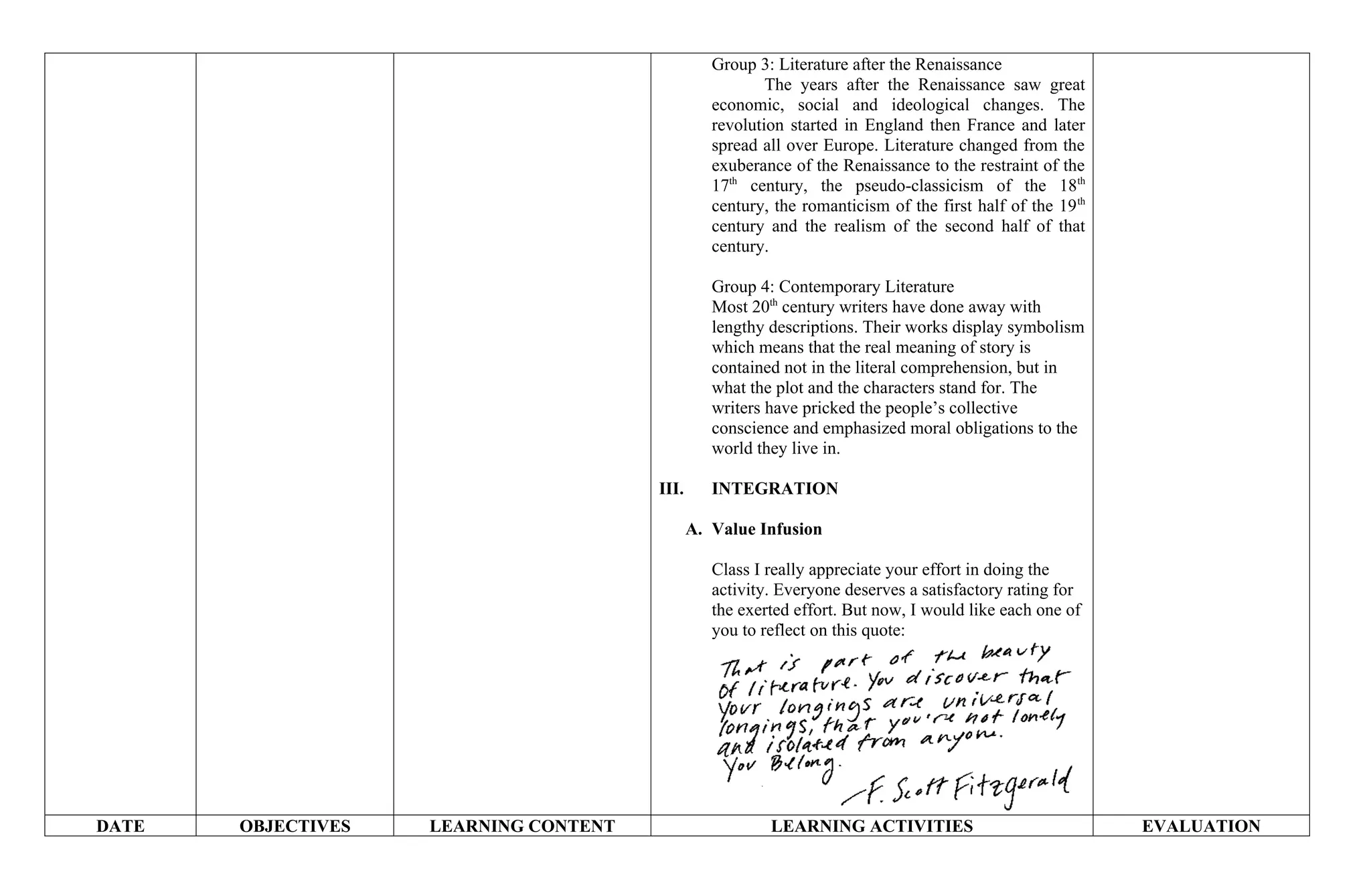
you to reflect on this quote:
DATE OBJECTIVES LEARNING CONTENT LEARNING ACTIVITIES EVALUATION
What does Sir, Scott Fitzgerald mean?
-Sir, I guess since Literature focuses on the
emotions and feelings of the writer, when we try to
read poems about love, we tend to fall in love a bit
more, we get to realize that there are other people
who can understand our feelings, that the things that
we cannot express can be seen in books, in essays,
and in poems in literature.
Correct! When we read works, when we watch
plays, dramas and the like we are watching it
together with our heart, because literature is part of
us, literature is part of being human. Who wants to
add, other insights?
-Sir, aside from love, when I am sad, when I
experience disappointments, I tend to read
quotations that will boost up my emotions, from
being sad to a bit happy, I know that by reading
such, I will feel better, I will be okay, that I will
function again to the fullest of what I can be.
Precisely, some in this class may not be avid readers
and unaware that literature is present almost
everywhere and anytime. When we watch movies,
its literature, when we listen to songs and we are
able to relate to the heartbreak that the singer is
experiencing, its literature.
B. Generalization
Let us go back to the K-W-L chart that you made
earlier. Now, I want you to indicate the learning that
you had gained from our lesson.
Are you ready?
DATE OBJECTIVES LEARNING CONTENT LEARNING ACTIVITIES EVALUATION
-Yes, Sir!
K W L
 Philippine
Literature
 Definition
of
Literature
 Afro-Asian
Literature
 Epics
 Poems
 Short
stories
 English
American
Literature
 Folktales
 Definition
of World
Literature
 Literature
from
different
continents
 Eras of
existence
of World
Literature
 Further
knowledge
and
advanced
learning
about
Literature
 Definition
of World
Literature
 Literature
of the
Ancient
World
 Literature
During and
after the
Renaissanc
e Period
 Contempor
ary
Literature
 Concepts
in
Literature
Okay, Very Good! It seems that you really learned a
lot from today’s discussion.
Agreement:
1. Read the synopsis of the Lightning Thief and Sea of
Monsters indicated on your textman.
2. Answer the remaining activities on your textman
Prepared by: Submitted to:
Leeroi Christian Q. Rubio Mrs. Jennifer R. Malelang
Pre-Service Teacher Pre-Service Teacher’s Formator
Lesson 1AA Intro to Lit Lesson Plan.docx

  • 1.
    Higher Education Department SacredHeart College Lucena City S.Y. 2017 – 2018 Lesson Guide in Language Literary Arts X DATE OBJECTIVES LEARNING CONTENT LEARNING ACTIVITIES EVALUATION Saturday September 16, 2017 (For FS.5-2 Class) 9:40-10:30 Grade X – Solidarity 10:30-11:20 Grade X – Reverence 11:20-12:10 Grade X – Endurance At the end of the lesson, the students are expected to: - be introduced to the richness and purpose of world literature, its timeless stories, its living characters and its diverse cultural origins and contexts; - appreciate the roles of literature in our lives and - present the different eras in world literature as tv/ news reporters TOPIC Lietarture: “Introduction to World Literature” REFERENCES Book: Language Literary Arts X Author: Vicky B. Olavidez and Melissa L. Carillo Pages: 2 – 8 Materials: Powerpoint presentation Strips of cartolina Pictures Infused Value: Appreciation on the role of literature in man’s lives I. INTRODUCTION A. Preliminary Activities - Opening Prayer - Checking of Attendance - Speaker of the Day - Reviewer of the Day B. Review of the Past Lesson (The teacher will ask the students about their previous lesson, but since this is the first lesson for the school year, the teacher will ask lessons that were discussed the previous year) Class, today marks the beginning of a new school year, can you tell me some of the topics that you had when you were in grade nine? -Sir, one of the memorable lessons that were discussed last year was the epic poem Beowulf. Okay, what was Beowulf all about? -Sir, the poem is set in Scandinavia. Beowulf, a hero of the Geats, comes to the aid of Hrothgar, the king of the Danes, whose mead hall in Heorot has been under attack by a monster known as Grendel. IV. QUIZ The teacher will give the students a print out of their quiz. (The teacher will give the instruction to his students) I would like to know how well you did today. I will be distributing this quiz papers and I will be giving you 5- 10 minutes to answer this. Erasures and/ or superimposition will be considered wrong. Do you have any questions? -Sir, how about in the essay part? You may have slight erasures in the essay part but make sure to write your answers legibly. You may now start answering.
  • 2.
    DATE OBJECTIVES LEARNINGCONTENT LEARNING ACTIVITIES EVALUATION After Beowulf slays him, Grendel's mother attacks the hall and is then also defeated. Correct! I really believe that your previous teacher had taught the lesson very well. How about other topics? What did you discuss? -Sir, we also discussed the Passionate Shepherd to his love and the Nymph’s reply to the Shepherd. Yes! I can still remember those lovely poems. How about lessons in grammar? -Sir, we had a deeper understanding on the lesson Parallelism because when we were in Grade Eight, we had an introductory lesson about it. Okay, so I assume that you can write sentences with parallel structures, I’ll confirm that as I check your essays. C. Motivation Class, we are going to have an activity entitled “Who am I?” I am going to ask questions and all you have to do is to answer my questions. Is that clear? -Yes, Sir! Okay, let us begin. First, this is something that is created with imagination and skill and that is beautiful or something that expresses important ideas or feelings. Also, these are works created by artists: paintings, sculptures, etc., that are created to be beautiful or to express important ideas or feelings. What’s the answer? Identification: Write the correct answer on the space provided before each number. ______ 1. This came from the Latin word litera which means, acquaintance with letters ______ 2. According to him, Literature is the body of written works produced in a particular language, country or age. ______ 3. This is sometimes used to refer to the sum total of the world’s national literatures, but usually it refers to the circulation of works into the wider world beyond their country of origin. ______ 4. This is derived from two streams – one coming from Palestine in the East, and the other, from Greece in the West. ______ 5. During the 14th and 15th centuries a great change began to take place in the
  • 3.
    DATE OBJECTIVES LEARNINGCONTENT LEARNING ACTIVITIES EVALUATION -Sir is the answer ART? Correct! Please write the word on the board. Next, this word means “being confident in what one thinks or knows; having no doubt that one is right.” -Sir, I think the answer is SURE? You got it! Okay, write the word on the board. For our last word, I am going to show you a logo. Are you familiar to this logo? -Sir, that is the logo of Facebook Lite. Okay, so what do you think is our last word? -Sir, is it LITE? Correct! Write it on the board. Okay, if we combine this world all together what word will be formed? -Sir, the world that will be formed is LITERATURES. Yes! Literature, so do you have an idea n what we are to talk about today? -Sir, we are going to talk about Literature. Correct! Are you ready to listen to our discussion? -Yes, Sir! literary and artistic movements. ______ 6. The 17th century was a period of struggle with some writers supporting the order and others, the revolution. ______ 7. literature in the form of prose, especially short stories and novels, that describes imaginary events and people. ______ 8. written or spoken language in its ordinary form, without metrical structure. ______ 9. literary work in which special intensity is given to the expression of feelings and ideas by the use of distinctive style and rhythm; poems collectively or as a genre of literature. ______ 10. Give one example of a short story. Enumeration: Give two famous writers and two famous works of each era.
  • 4.
    DATE OBJECTIVES LEARNINGCONTENT LEARNING ACTIVITIES EVALUATION But before that, are you familiar with the K-W-L chart? -Yes, Sir! I want you to create a KWL chart by group and I would like you to indicate in there the things that you already KNOW about literature and the things that you would WANT TO KNOW about literature. Later after the discussion we will complete the table by filling up the LEARNED column. Are you ready? -Yes, Sir! K W L  Philippine Literature  Definition of Literature  Afro-Asian Literature  Epics  Poems  Short stories  English American Literature  Folktales  Definition of World Literature  Literature from different continents  Eras of existence of World Literature  Further knowledge and advanced learning about Literature (The class fills up the table and presents it to the class) 1-4. Literature of the Ancient World 5-8. Literature During the Renaissance Period 9-12. Literature After the Renaissance 13-16.Contemporary Period Essay: In what way can you appreciate literature? (4 points)
  • 5.
    DATE OBJECTIVES LEARNINGCONTENT LEARNING ACTIVITIES EVALUATION II. INTERACTION Now, I want you to silently read the first paragraph in page 4 of your textman, then, I will ask questions in relation to the paragraph that you have read. Is that clear? -Yes, Sir! Okay, the term Literature came from what word and what does this word mean? -Sir, Literature comes from the Latin word “Litera” which literally means an acquaintance with letters. Correct! If we are to base the definition of Literature from Webster, what does literature mean? Who can give me the first definition? -Sir, the first definition according to Webster is writings in prose or verse; writings having excellence of form or expression and expressing ideas of permanent or universal interest; Correct! How about the second definition? -Sir, the second definition of Literature according to Webster is the body of written works produced in a particular language, country or age. Correct! We also have 2 forms of literature, which is fiction and non-fiction. Can you still recall the definitions of the two and can you give me examples of them? -Sir, Fiction are written works that are products of the imaginative and creative mind and examples of DATE OBJECTIVES LEARNING CONTENT LEARNING ACTIVITIES EVALUATION
  • 6.
    such are fairytales, myths, and legends. Correct! How about non-fiction? -Sir these are written works that are true and based on real events, The examples of non-fiction are biography of a person of interest, and news. Well explained! But also, aside from the forms of literature, we also have the genres of literature, I know that you are very familiar with these. Class, this time we will have an activity entitled “Pass the Ball!” I will play a song and I will pass this ball, be sure to pass it to the person next to you and when the music stops, the person who is holding the ball shall answer my question. Are you ready? -Yes, Sir! The different genres of literature are Prose, Poetry, Drama, and Speech. Who can give me examples of Prose? -Sir, a prose may be short stories, essays, novels, and the like. Correct! Who can give me titles of such examples that were cited? -Sir, an example of a short story is the “Scent of an Apple in the Philippine Literatur”. An example of an essay is “Of Studies by Sir Francis Bacon”, and an example of a Novel is “Dekada 70’” by Lualhati Bautista. Correct! Who can give me examples of poems or poetry? DATE OBJECTIVES LEARNING CONTENT LEARNING ACTIVITIES EVALUATION
  • 7.
    -Sir, examples ofpoems are “Trees” by Joyce Kilmer, “The Road Not Taken” by Robert Frost, “The raven:, and “Anabelle Lee” by William Shakespeare. Correct, The Raven and Anabelle Lee are one of the famous works of Shakespeare, I can really see that you have learned a lot from English-American Literature from last year. Okay, who can give me examples of Drama? -Sir, an example of Drama are plays like Phantom of the Opera and Les Miserables. Correct! The last one, is speech, therefore it is done by a person who intends to speak in front of a crowd, a best example of speech is the State of the Nation address delivered by the president annually. The main coverage of English 10 is World Literature, and the definition of World Literature is provided in page 4 of your textman, who wants to volunteer in reading the definition? Yes, Diether? -Sir, World Literature is sometimes used to refer to the sum total of the world’s national literatures, but usually it refers to the circulation of works into the wider world beyond their country of origin. Often used in the past primarily for masterpieces of Western European literature, world literature today is increasingly seen in a global context. Class this time, I will divide you into four groups, For your activity you will creatively present the different eras of World Literature as if you are TV newscasters and reporters, this will measure your creativity. Are you ready? DATE OBJECTIVES LEARNING CONTENT LEARNING ACTIVITIES EVALUATION
  • 8.
    -Yes, Sir! Class, pleasebe reminded of your tasks for the newscasting: Group 1: Literature of the Ancient World Group 2: Literature during the Renaissance Period Group 3: Literature after the Renaissance Group 4: Contemporary Literature Class, another thing, please be guided by this rubric for scoring Creativity 15 Organization 10 Participation 10 Audience Impact 5 TOTAL 40 points (In between and after the each presentation, the teacher supplies few details to make the lesson more understandable) Group 1: Literature of the Ancient World. Classical literature is derived from two streams – one coming from Palestine in the East, and the other, from Greece in the West. From the Hebrews of the ancient Palestine comes the idea of a personal God and a moral code inspired by this God. From the Greeks comes man’s tradition of extolling and glorifying life and nature. Group 2: Literature during the Renaissance Period. During the 14th and 15th centuries presents a great change as it began to take place in the literary and artistic movements. Stimulated by the study of the classical literature and art, it originated in Italy and passed to France, Germany, England and other parts of Europe. DATE OBJECTIVES LEARNING CONTENT LEARNING ACTIVITIES EVALUATION
  • 9.
    Group 3: Literatureafter the Renaissance The years after the Renaissance saw great economic, social and ideological changes. The revolution started in England then France and later spread all over Europe. Literature changed from the exuberance of the Renaissance to the restraint of the 17th century, the pseudo-classicism of the 18th century, the romanticism of the first half of the 19th century and the realism of the second half of that century. Group 4: Contemporary Literature Most 20th century writers have done away with lengthy descriptions. Their works display symbolism which means that the real meaning of story is contained not in the literal comprehension, but in what the plot and the characters stand for. The writers have pricked the people’s collective conscience and emphasized moral obligations to the world they live in. III. INTEGRATION A. Value Infusion Class I really appreciate your effort in doing the activity. Everyone deserves a satisfactory rating for the exerted effort. But now, I would like each one of you to reflect on this quote: DATE OBJECTIVES LEARNING CONTENT LEARNING ACTIVITIES EVALUATION
  • 10.
    What does Sir,Scott Fitzgerald mean? -Sir, I guess since Literature focuses on the emotions and feelings of the writer, when we try to read poems about love, we tend to fall in love a bit more, we get to realize that there are other people who can understand our feelings, that the things that we cannot express can be seen in books, in essays, and in poems in literature. Correct! When we read works, when we watch plays, dramas and the like we are watching it together with our heart, because literature is part of us, literature is part of being human. Who wants to add, other insights? -Sir, aside from love, when I am sad, when I experience disappointments, I tend to read quotations that will boost up my emotions, from being sad to a bit happy, I know that by reading such, I will feel better, I will be okay, that I will function again to the fullest of what I can be. Precisely, some in this class may not be avid readers and unaware that literature is present almost everywhere and anytime. When we watch movies, its literature, when we listen to songs and we are able to relate to the heartbreak that the singer is experiencing, its literature. B. Generalization Let us go back to the K-W-L chart that you made earlier. Now, I want you to indicate the learning that you had gained from our lesson. Are you ready? DATE OBJECTIVES LEARNING CONTENT LEARNING ACTIVITIES EVALUATION
  • 11.
    -Yes, Sir! K WL  Philippine Literature  Definition of Literature  Afro-Asian Literature  Epics  Poems  Short stories  English American Literature  Folktales  Definition of World Literature  Literature from different continents  Eras of existence of World Literature  Further knowledge and advanced learning about Literature  Definition of World Literature  Literature of the Ancient World  Literature During and after the Renaissanc e Period  Contempor ary Literature  Concepts in Literature Okay, Very Good! It seems that you really learned a lot from today’s discussion. Agreement: 1. Read the synopsis of the Lightning Thief and Sea of Monsters indicated on your textman. 2. Answer the remaining activities on your textman Prepared by: Submitted to: Leeroi Christian Q. Rubio Mrs. Jennifer R. Malelang Pre-Service Teacher Pre-Service Teacher’s Formator