Lesson 10 Intermediate Mario Santiago   Business English IV Past Modals
Contents Past modals Vocabulary related to marketing  Expressions used to product development and marketing Objectives By the end of this lesson you:  Will be able to use the different forms of past modals. Will be able to express your point of view on product development and innovation processes.
Innovation As you know, there are companies that have been in the market for a long time. Procter and Gamble, for example, has had a history of at least 100 years old, and they have endured many different changes, not only in its infrastructure but also in the way the manage to develop their new products. From producing cheap soaps and candles in a little factory, they are now one of the most recognized companies around the world. How is it that some companies manage to survive the change of times? According to Peter Drucker, a  famous management consultant, successful innovation is a necessary step into the life of any business, no matter if it is big or small. However, the innovation process does not come as if by magic. In some situations it requires more than the good will of the employees because, most of the times, the innovation process is hidden under a critical situation.  Lesson 10
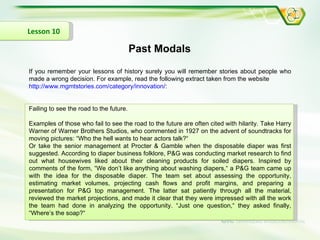
Past Modals If you remember your lessons of history surely you will remember stories about people who made a wrong decision. For example, read the following extract taken from the website  http://www.mgmtstories.com/category/innovation/ : Failing to see the road to the future.  Examples of those who fail to see the road to the future are often cited with hilarity. Take Harry Warner of Warner Brothers Studios, who commented in 1927 on the advent of soundtracks for moving pictures: “Who the hell wants to hear actors talk?“ Or take the senior management at Procter & Gamble when the disposable diaper was first suggested. According to diaper business folklore, P&G was conducting market research to find out what housewives liked about their cleaning products for soiled diapers. Inspired by comments of the form, “We don’t like anything about washing diapers,“ a P&G team came up with the idea for the disposable diaper. The team set about assessing the opportunity, estimating market volumes, projecting cash flows and profit margins, and preparing a presentation for P&G top management. The latter sat patiently through all the material, reviewed the market projections, and made it clear that they were impressed with all the work the team had done in analyzing the opportunity. “Just one question,“ they asked finally, “Where’s the soap?“ Lesson 10
If you noticed these people were wrong at the beginning, because they couldn’t see what was coming before them. However, once the movies with sound were a complete hit, or the diapers were sold in high numbers, surely the managers of both companies would have said something like this:  I  should have listened  before.  We  shouldn’t have rejected  the idea without considering it first.  They  should have done  a better market research.  The managers of P&G  must have reconsidered  their final decision because they finally accepted the proposal. As you can see there are some verbs that can be used to talk about situations that we regret they never happened. In a sense, the modal verbs in past tense  are going to be used to express regrets, deductions, possibilities and, in general, to convey the idea that an action from the past-that never happened- is needed in the present.  Past Modals Lesson 10
could have +  past participle : it’s going to be used for  situations that were possible  but never happened.  Past Modals There are different modal verbs that can be used in past tense:  I  could have  finished  this job before you left. ( but I didn’t )  She  could have  brought  her umbrella with her. (  but she forgot it in her house ) Tavita and Jamal  could have  studied  in London.  ( but they preferred to study in USA )  should have +  past participle : it’s going to be used for r ecommendations that never took place .  Samuel  should have  studied  before taking that exam . ( but he didn’t and he failed ) Karla  shouldn't have  left  the door open. (  Now the dog is running in the backyard ) I  should have  listen  to you about fixing my car (  Now my car is broken in the middle of the street .) Lesson 10
Must have +  participle : it’s going to be used to speculate about  obligations that were/ weren’t never fulfilled .  Past Modals They  must have  made  something wrong in school. ( They were expelled ) Jillian  must have  studied  English before. ( She spoke it really good )  He  must have   brought  the bread. ( There is a bag from the bakery )  Would have +  participle:  it’s used for  an imaginary situation  that didn’t happen. They  would have  come  with a very good explanation for the failure of the diaper.  (  But they didn’t and they rejected the product ) The release of the new product  would have  been  difficult without your help.  (But it was really easy) They  would have  sen t the information by now.  ( But it hasn’t arrived) Lesson 10

Lesson 10

  • 1.
    Lesson 10 IntermediateMario Santiago Business English IV Past Modals
  • 2.
    Contents Past modalsVocabulary related to marketing Expressions used to product development and marketing Objectives By the end of this lesson you: Will be able to use the different forms of past modals. Will be able to express your point of view on product development and innovation processes.
  • 3.
    Innovation As youknow, there are companies that have been in the market for a long time. Procter and Gamble, for example, has had a history of at least 100 years old, and they have endured many different changes, not only in its infrastructure but also in the way the manage to develop their new products. From producing cheap soaps and candles in a little factory, they are now one of the most recognized companies around the world. How is it that some companies manage to survive the change of times? According to Peter Drucker, a famous management consultant, successful innovation is a necessary step into the life of any business, no matter if it is big or small. However, the innovation process does not come as if by magic. In some situations it requires more than the good will of the employees because, most of the times, the innovation process is hidden under a critical situation. Lesson 10
  • 4.
    Past Modals Ifyou remember your lessons of history surely you will remember stories about people who made a wrong decision. For example, read the following extract taken from the website http://www.mgmtstories.com/category/innovation/ : Failing to see the road to the future. Examples of those who fail to see the road to the future are often cited with hilarity. Take Harry Warner of Warner Brothers Studios, who commented in 1927 on the advent of soundtracks for moving pictures: “Who the hell wants to hear actors talk?“ Or take the senior management at Procter & Gamble when the disposable diaper was first suggested. According to diaper business folklore, P&G was conducting market research to find out what housewives liked about their cleaning products for soiled diapers. Inspired by comments of the form, “We don’t like anything about washing diapers,“ a P&G team came up with the idea for the disposable diaper. The team set about assessing the opportunity, estimating market volumes, projecting cash flows and profit margins, and preparing a presentation for P&G top management. The latter sat patiently through all the material, reviewed the market projections, and made it clear that they were impressed with all the work the team had done in analyzing the opportunity. “Just one question,“ they asked finally, “Where’s the soap?“ Lesson 10
  • 5.
    If you noticedthese people were wrong at the beginning, because they couldn’t see what was coming before them. However, once the movies with sound were a complete hit, or the diapers were sold in high numbers, surely the managers of both companies would have said something like this: I should have listened before. We shouldn’t have rejected the idea without considering it first. They should have done a better market research. The managers of P&G must have reconsidered their final decision because they finally accepted the proposal. As you can see there are some verbs that can be used to talk about situations that we regret they never happened. In a sense, the modal verbs in past tense are going to be used to express regrets, deductions, possibilities and, in general, to convey the idea that an action from the past-that never happened- is needed in the present. Past Modals Lesson 10
  • 6.
    could have + past participle : it’s going to be used for situations that were possible but never happened. Past Modals There are different modal verbs that can be used in past tense: I could have finished this job before you left. ( but I didn’t ) She could have brought her umbrella with her. ( but she forgot it in her house ) Tavita and Jamal could have studied in London. ( but they preferred to study in USA ) should have + past participle : it’s going to be used for r ecommendations that never took place . Samuel should have studied before taking that exam . ( but he didn’t and he failed ) Karla shouldn't have left the door open. ( Now the dog is running in the backyard ) I should have listen to you about fixing my car ( Now my car is broken in the middle of the street .) Lesson 10
  • 7.
    Must have + participle : it’s going to be used to speculate about obligations that were/ weren’t never fulfilled . Past Modals They must have made something wrong in school. ( They were expelled ) Jillian must have studied English before. ( She spoke it really good ) He must have brought the bread. ( There is a bag from the bakery ) Would have + participle: it’s used for an imaginary situation that didn’t happen. They would have come with a very good explanation for the failure of the diaper. ( But they didn’t and they rejected the product ) The release of the new product would have been difficult without your help. (But it was really easy) They would have sen t the information by now. ( But it hasn’t arrived) Lesson 10

Editor's Notes

  • #2 http://www.youtube.com/watch?v=NKXCUGGajJM&feature=related http://www.youtube.com/watch?v=ziOG_GHNVq0&feature=related
  • #4 http://www.youtube.com/user/ericssonmultimedia?v=OrUgP7fbd8A&feature=pyv&ad=5422240356&kw=innovation&gclid=CNWqq-KG8aMCFQUiawod8EEiBw