ALCOHOL &
OTHER DRUGSY E A R 9 H P E
WEEK 1 – CL ASSIFICATION OF DRUGS
LEARNING GOALS
• Define what a drug is.
• Identify the seven general categories of psychoactive drugs.
• Identify influences on drug choices.
SUCCESS CRITERIA
• I will be able to define what a drug is.
• I will be able to identify the seven general categories of
psychoactive drugs and list effects and examples of each.
• I will be able to identify factors that influence adolescent drug
choices.
QUIZ
What do you already know
about this topic?
What is a drug?
Write your own definition. Fill at
least 2 lines in your book or on
your computer.
WHAT IS A DRUG?
The World Health Organisation defines a drug as:
A drug is any substance, except food and
which when taken into the body, changes the
way the body works.
CLASSIFYING DRUGS
Drugs can be classified in many ways, for
example:
• Source of the substance (synthetic or plant)
• Legal status (legal or illegal)
• Risk status (safe or dangerous)
• Use (medical or other)
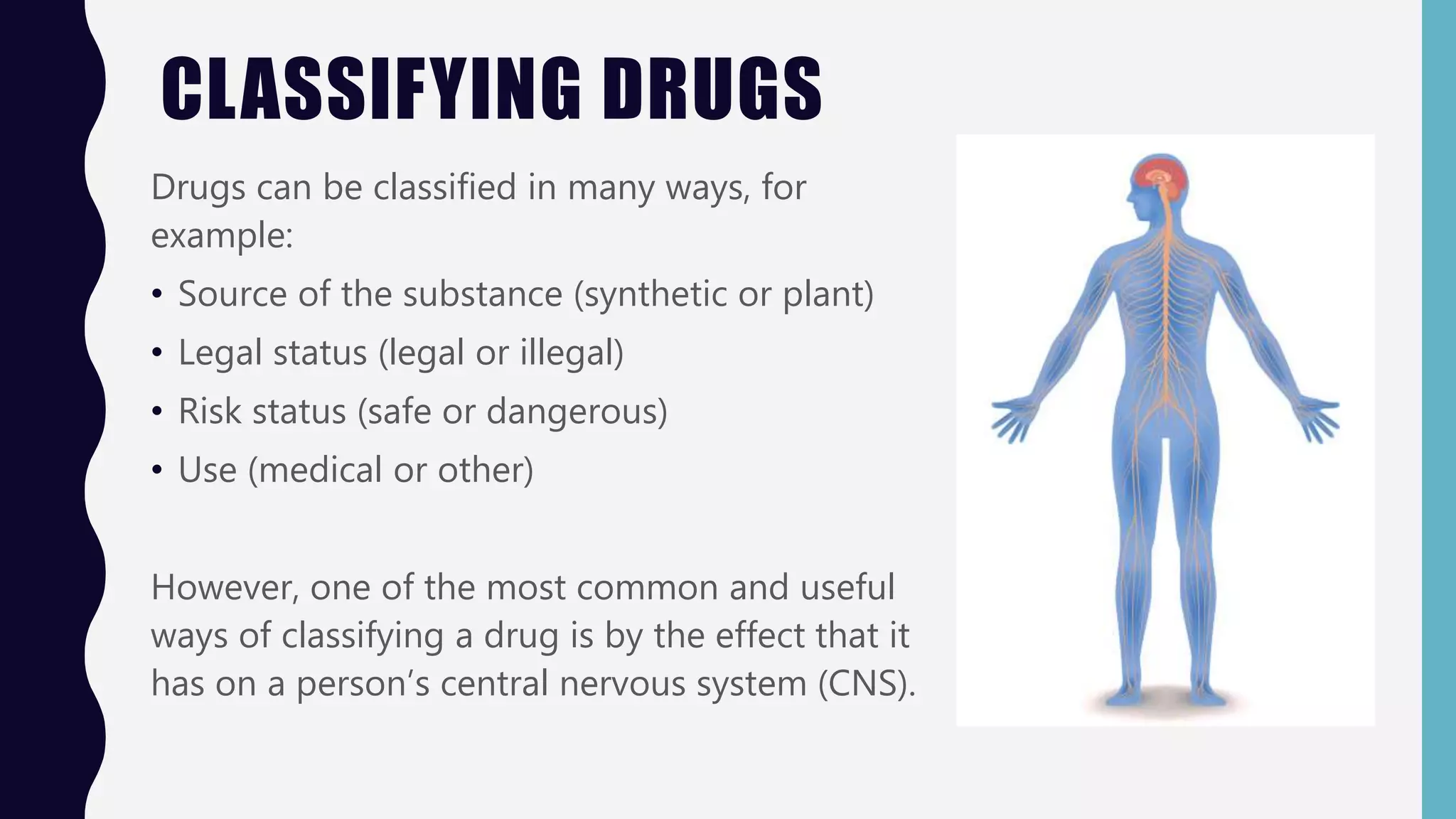
However, one of the most common and useful
ways of classifying a drug is by the effect that it
has on a person’s central nervous system (CNS).
CLASSIFICATION OF DRUGS
The Alcohol and Drug Foundation (ADF) classifies drugs into
seven general categories:
1. Stimulants
2. Depressants
3. Opioids
4. Psychedelics
5. Cannabinoids
6. Dissociatives
7. Empathogens
CLASSIFYING DRUGS
Type of Drug Definition Effects on the
body
Examples of
drugs
Street
Names
Depressant
Stimulant
Psychedelics
Opioids
Cannabanoids
1. Go to Moodle
2. Download the “Week 1 - Classifying Drugs Table”
3. Continue through the PowerPoint slides and complete your
table.
Click
Me!
FOR MORE INFORMATION…
For more information on the
different types of drugs, you can
visit the following website:
https://adf.org.au/drug-facts/#wheel
Click on the names of the different
drugs on the outside of the drug
wheel to view more information.
1. STIMULANTS
Stimulants are a class of drugs that speed up the
messages between the brain and the body. They
can make a person feel more awake, alert,
confident or energetic.
Large doses of stimulants can cause over-
stimulation, causing anxiety, panic, seizures,
headaches, stomach cramps, aggression and
paranoia. Long-term use of strong stimulants can
also cause a number of adverse effects (ADF,
2020).
Examples:
• Caffeine
• Nicotine (in tobacco)
• Amphetamines
TRUE
Stimulants speed up processes between the brain and
body?
QUICK QUIZ
FALSE
2. DEPRESSANTS
Depressant substances reduce arousal and
stimulation. They do not necessarily make a person
feel depressed. They affect the central nervous
system, slowing down the messages between the
brain and the body.
They can affect concentration and coordination. They
slow down the person’s ability to respond to
unexpected situations. In small doses they can cause
a person to feel more relaxed and less inhibited
(ADF, 2020).
Examples:
• Alcohol
• Benzodiazepines – commonly prescribed by
doctors to relieve stress and anxiety.
TRUE
Depressants speed up processes between the brain and
body?
QUICK QUIZ
FALSE
3. OPIOIDS
Opioids include any drug that acts on opioid receptors in the brain.
Opioids depress the central nervous system, and slow down
messages between the brain and the rest of the body. This causes
breathing and heart rate to slow down. Opioid receptors also
stimulate the release of dopamine, which leads to sensations of
pleasure and pain relief (ADF, 2020).
Examples:
• Codeine
• Fetanyl
• Oxycodone
• Heroin
TRUE
Codeine is an example of an opioid and is commonly
used to provide pain relief?
QUICK QUIZ
FALSE
4. PSYCHEDELICS
Psychedelics (also known as hallucinogens) are a class of
psychoactive substances that produce changes in perception, mood
and cognitive processes. Psychedelics affect all the senses, altering a
person’s thinking, sense of time and emotions. They can also cause a
person to hallucinate—seeing or hearing things that do not exist or
are distorted (ADF, 2020).
Examples:
• LSD (acid)
• Psilocybin (Magic mushrooms)
TRUE
Psychedelics and hallucinogens are not the same thing.
QUICK QUIZ
FALSE
5. CANNABINOIDS
The three types of cannabinoids that people use are recreational,
medicinal and synthetic. The two main cannabinoids are delta-9-
tetrahydrocannabinol (THC) and cannabidiol (CBD). THC is the chemical
that is responsible for the psychoactive effects of cannabis – makes a
person ‘high’.
Cannabinoids produce their effects by interacting with specific receptors,
located within different parts of the central nervous system. Cannabinoids
can affect mood, memory, sleep and appetite (ADF, 2020).
Examples:
• Cannabis (dried leaves and flowers of cannabis plant)
• Hemp (fibre of the cannabis plant)
• Medicinal cannabinoids
TRUE
The cannabinoid THC is the chemical that is responsible
for making a person ‘high’?
QUICK QUIZ
FALSE
6. DISSOCIATIVES
Dissociatives (also referred to as 'dissociative anaesthetics') are
a class of psychedelic drug. This class of drug is characterised
by distorted sensory perceptions and feelings of disconnection
or detachment from the environment and self. The word
dissociative means detached from reality (ADF, 2020).
Examples:
• Ketamine (used in surgery)
• PCP
• Nitrous Oxide (nangs)
TRUE
Dissociative drugs do not make a person feel detached
from their environment.
QUICK QUIZ
FALSE
7. EMPATHOGENS
Empathogens increase an individual’s feeling of empathy towards
others and increase feelings of being socially accepted by and
connected to others. They can increase friendliness and playfulness,
but can also cause mood swings, dehydration and depression.
Empathogens cause the release of dopamine and serotonin in the
brain. Serotonin controls mood, appetite and sleep, and can make
you feel relaxed (ADF, 2020).
Examples:
• MDMA (Ecstasy)
• PMA
TRUE
MDMA is an example of an empathogen.
QUICK QUIZ
FALSE

Lesson 1 what is a drug

  • 1.
    ALCOHOL & OTHER DRUGSYE A R 9 H P E WEEK 1 – CL ASSIFICATION OF DRUGS
  • 2.
    LEARNING GOALS • Definewhat a drug is. • Identify the seven general categories of psychoactive drugs. • Identify influences on drug choices. SUCCESS CRITERIA • I will be able to define what a drug is. • I will be able to identify the seven general categories of psychoactive drugs and list effects and examples of each. • I will be able to identify factors that influence adolescent drug choices.
  • 3.
    QUIZ What do youalready know about this topic? What is a drug? Write your own definition. Fill at least 2 lines in your book or on your computer.
  • 4.
    WHAT IS ADRUG? The World Health Organisation defines a drug as: A drug is any substance, except food and which when taken into the body, changes the way the body works.
  • 5.
    CLASSIFYING DRUGS Drugs canbe classified in many ways, for example: • Source of the substance (synthetic or plant) • Legal status (legal or illegal) • Risk status (safe or dangerous) • Use (medical or other) However, one of the most common and useful ways of classifying a drug is by the effect that it has on a person’s central nervous system (CNS).
  • 6.
    CLASSIFICATION OF DRUGS TheAlcohol and Drug Foundation (ADF) classifies drugs into seven general categories: 1. Stimulants 2. Depressants 3. Opioids 4. Psychedelics 5. Cannabinoids 6. Dissociatives 7. Empathogens
  • 7.
    CLASSIFYING DRUGS Type ofDrug Definition Effects on the body Examples of drugs Street Names Depressant Stimulant Psychedelics Opioids Cannabanoids 1. Go to Moodle 2. Download the “Week 1 - Classifying Drugs Table” 3. Continue through the PowerPoint slides and complete your table. Click Me!
  • 8.
    FOR MORE INFORMATION… Formore information on the different types of drugs, you can visit the following website: https://adf.org.au/drug-facts/#wheel Click on the names of the different drugs on the outside of the drug wheel to view more information.
  • 9.
    1. STIMULANTS Stimulants area class of drugs that speed up the messages between the brain and the body. They can make a person feel more awake, alert, confident or energetic. Large doses of stimulants can cause over- stimulation, causing anxiety, panic, seizures, headaches, stomach cramps, aggression and paranoia. Long-term use of strong stimulants can also cause a number of adverse effects (ADF, 2020). Examples: • Caffeine • Nicotine (in tobacco) • Amphetamines
  • 10.
    TRUE Stimulants speed upprocesses between the brain and body? QUICK QUIZ FALSE
  • 11.
    2. DEPRESSANTS Depressant substancesreduce arousal and stimulation. They do not necessarily make a person feel depressed. They affect the central nervous system, slowing down the messages between the brain and the body. They can affect concentration and coordination. They slow down the person’s ability to respond to unexpected situations. In small doses they can cause a person to feel more relaxed and less inhibited (ADF, 2020). Examples: • Alcohol • Benzodiazepines – commonly prescribed by doctors to relieve stress and anxiety.
  • 12.
    TRUE Depressants speed upprocesses between the brain and body? QUICK QUIZ FALSE
  • 13.
    3. OPIOIDS Opioids includeany drug that acts on opioid receptors in the brain. Opioids depress the central nervous system, and slow down messages between the brain and the rest of the body. This causes breathing and heart rate to slow down. Opioid receptors also stimulate the release of dopamine, which leads to sensations of pleasure and pain relief (ADF, 2020). Examples: • Codeine • Fetanyl • Oxycodone • Heroin
  • 14.
    TRUE Codeine is anexample of an opioid and is commonly used to provide pain relief? QUICK QUIZ FALSE
  • 15.
    4. PSYCHEDELICS Psychedelics (alsoknown as hallucinogens) are a class of psychoactive substances that produce changes in perception, mood and cognitive processes. Psychedelics affect all the senses, altering a person’s thinking, sense of time and emotions. They can also cause a person to hallucinate—seeing or hearing things that do not exist or are distorted (ADF, 2020). Examples: • LSD (acid) • Psilocybin (Magic mushrooms)
  • 16.
    TRUE Psychedelics and hallucinogensare not the same thing. QUICK QUIZ FALSE
  • 17.
    5. CANNABINOIDS The threetypes of cannabinoids that people use are recreational, medicinal and synthetic. The two main cannabinoids are delta-9- tetrahydrocannabinol (THC) and cannabidiol (CBD). THC is the chemical that is responsible for the psychoactive effects of cannabis – makes a person ‘high’. Cannabinoids produce their effects by interacting with specific receptors, located within different parts of the central nervous system. Cannabinoids can affect mood, memory, sleep and appetite (ADF, 2020). Examples: • Cannabis (dried leaves and flowers of cannabis plant) • Hemp (fibre of the cannabis plant) • Medicinal cannabinoids
  • 18.
    TRUE The cannabinoid THCis the chemical that is responsible for making a person ‘high’? QUICK QUIZ FALSE
  • 19.
    6. DISSOCIATIVES Dissociatives (alsoreferred to as 'dissociative anaesthetics') are a class of psychedelic drug. This class of drug is characterised by distorted sensory perceptions and feelings of disconnection or detachment from the environment and self. The word dissociative means detached from reality (ADF, 2020). Examples: • Ketamine (used in surgery) • PCP • Nitrous Oxide (nangs)
  • 20.
    TRUE Dissociative drugs donot make a person feel detached from their environment. QUICK QUIZ FALSE
  • 21.
    7. EMPATHOGENS Empathogens increasean individual’s feeling of empathy towards others and increase feelings of being socially accepted by and connected to others. They can increase friendliness and playfulness, but can also cause mood swings, dehydration and depression. Empathogens cause the release of dopamine and serotonin in the brain. Serotonin controls mood, appetite and sleep, and can make you feel relaxed (ADF, 2020). Examples: • MDMA (Ecstasy) • PMA
  • 22.
    TRUE MDMA is anexample of an empathogen. QUICK QUIZ FALSE