Unit 1
Getting to Know One’s Self
Personal Development
1
How well do you know
yourself?
CENTRAL QUESTION
2
3
Taking a Look at Oneself
Lesson 1
Unit 1| Getting to Know One’s Self
Personal Development
3
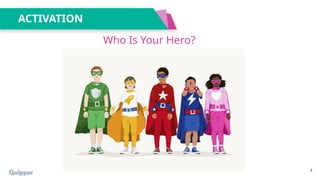
Who Is Your Hero?
ACTIVATION
4
The factors that influence self-
concept and self-esteem are the
following:
● the way individuals compare
themselves to others
● the extent to which they identify
with other people
● the way others react to them
MINDSET MATTERS
5
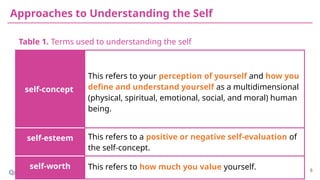
self-concept
This refers to your perception of yourself and how you
define and understand yourself as a multidimensional
(physical, spiritual, emotional, social, and moral) human
being.
self-esteem This refers to a positive or negative self-evaluation of
the self-concept.
self-worth This refers to how much you value yourself.
Approaches to Understanding the Self
Table 1. Terms used to understanding the self
6
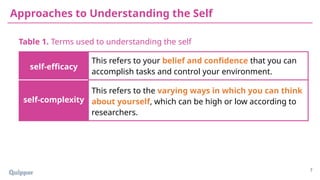
self-efficacy
This refers to your belief and confidence that you can
accomplish tasks and control your environment.
self-complexity
This refers to the varying ways in which you can think
about yourself, which can be high or low according to
researchers.
Approaches to Understanding the Self
Table 1. Terms used to understanding the self
7
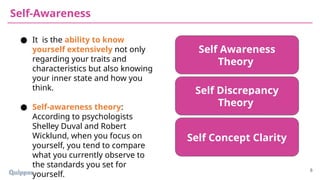
Self-Awareness
● It is the ability to know
yourself extensively not only
regarding your traits and
characteristics but also knowing
your inner state and how you
think.
● Self-awareness theory:
According to psychologists
Shelley Duval and Robert
Wicklund, when you focus on
yourself, you tend to compare
what you currently observe to
the standards you set for
yourself.
Self Awareness
Theory
Self Discrepancy
Theory
Self Concept Clarity
8
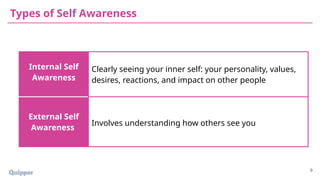
Internal Self
Awareness
Clearly seeing your inner self: your personality, values,
desires, reactions, and impact on other people
External Self
Awareness
Involves understanding how others see you
Types of Self Awareness
9
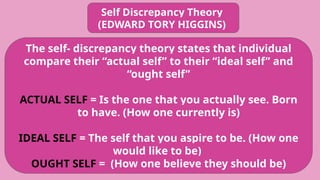
Self Discrepancy Theory
(EDWARD TORY HIGGINS)
The self- discrepancy theory states that individual
compare their “actual self” to their “ideal self” and
“ought self”
ACTUAL SELF = Is the one that you actually see. Born
to have. (How one currently is)
IDEAL SELF = The self that you aspire to be. (How one
would like to be)
OUGHT SELF = (How one believe they should be)
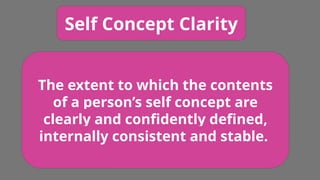
Self Concept Clarity
The extent to which the contents
of a person’s self concept are
clearly and confidently defined,
internally consistent and stable.
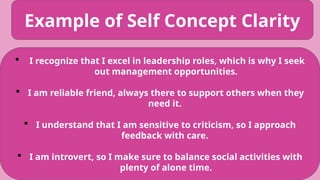
Example of Self Concept Clarity
 I recognize that I excel in leadership roles, which is why I seek
out management opportunities.
 I am reliable friend, always there to support others when they
need it.
 I understand that I am sensitive to criticism, so I approach
feedback with care.
 I am introvert, so I make sure to balance social activities with
plenty of alone time.
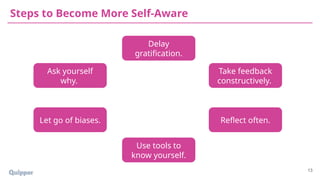
Steps to Become More Self-Aware
Ask yourself
why.
Delay
gratification.
Take feedback
constructively.
Let go of biases. Reflect often.
Use tools to
know yourself.
13
PERSONAL EFFECTIVENESS
Personal Effectiveness means making use of all the
personal resources – talents, skills, energy and time,
to enable you to achieve life goals.
 Our personal effectiveness depends on our innate
characteristics – talent and experience accumulated
to be identified and then developed to be used in a
particular subject area. (science, literature, sports,
politics etc.)
EXPERIENCE – includes knowledge and skills that we
acquire in the process of cognitive and practical
activities.
KNOWLEDGE– required for setting goals, defining an
action plan to achieve them and risk assessment.
SKILLS– determine whether real actions are performed
in accordance with the plan. If the same ability is used
many times in the same situation, then it becomes a
habit that runs automatically, subsconsciously.
SKILLS THAT WILL
INCREASE THE EFFECIENCY
OF A PERSON
16
1. DETERMINATION = It allows you to focus only on
achieving a specific goal without being distracted by less
important things, it may developed by having self
discipline.
2. SELF - CONFIDENCE =It is manifested in speech,
appearance, dressing, and physical condition. To develop
it, you need to learn yourself and your capabilities, gain
positive attitude and believe to yourself.
SKILLS THAT WILL
INCREASE THE EFFECIENCY
OF A PERSON
17
3. PERSISTENCE= It makes you keep moving forward
regardless of emerging obstacles or problems.
4. Managing Stress = It helps combat stress that arises in
daily life from the environment and other people.
SKILLS THAT WILL
INCREASE THE EFFECIENCY
OF A PERSON
18
5. Problem Solving Skills = They help cope with the
problems encountered with a lack of experience.
6. Creativity= It allows you to find extraordinary ways to
carry out a specific action no one has tried to use.
7. Generating Ideas=it helps you achieve goals using
new, original, unconventional idea.
BUILD ON YOUR STRENGTHS AND WORK ON YOUR
WEAKNESSES
Most failures emanate from weaknesses that are not
recognized or probably recognized but not given
appropriate attention or remedy.
This could be weakness in communication, personality or
ability. Instead of giving self-pity, TAKE ACTION,
-Instead of simply focusing on your weakness, recognize
your talents and abilities, build on them, utilize them to
your greatest advantage.
END

LESSON 1 - PER.DEV. hvgfsxzscdzfesvvvvvvv

  • 1.
    Unit 1 Getting toKnow One’s Self Personal Development 1
  • 2.
    How well doyou know yourself? CENTRAL QUESTION 2
  • 3.
    3 Taking a Lookat Oneself Lesson 1 Unit 1| Getting to Know One’s Self Personal Development 3
  • 4.
    Who Is YourHero? ACTIVATION 4
  • 5.
    The factors thatinfluence self- concept and self-esteem are the following: ● the way individuals compare themselves to others ● the extent to which they identify with other people ● the way others react to them MINDSET MATTERS 5
  • 6.
    self-concept This refers toyour perception of yourself and how you define and understand yourself as a multidimensional (physical, spiritual, emotional, social, and moral) human being. self-esteem This refers to a positive or negative self-evaluation of the self-concept. self-worth This refers to how much you value yourself. Approaches to Understanding the Self Table 1. Terms used to understanding the self 6
  • 7.
    self-efficacy This refers toyour belief and confidence that you can accomplish tasks and control your environment. self-complexity This refers to the varying ways in which you can think about yourself, which can be high or low according to researchers. Approaches to Understanding the Self Table 1. Terms used to understanding the self 7
  • 8.
    Self-Awareness ● It isthe ability to know yourself extensively not only regarding your traits and characteristics but also knowing your inner state and how you think. ● Self-awareness theory: According to psychologists Shelley Duval and Robert Wicklund, when you focus on yourself, you tend to compare what you currently observe to the standards you set for yourself. Self Awareness Theory Self Discrepancy Theory Self Concept Clarity 8
  • 9.
    Internal Self Awareness Clearly seeingyour inner self: your personality, values, desires, reactions, and impact on other people External Self Awareness Involves understanding how others see you Types of Self Awareness 9
  • 10.
    Self Discrepancy Theory (EDWARDTORY HIGGINS) The self- discrepancy theory states that individual compare their “actual self” to their “ideal self” and “ought self” ACTUAL SELF = Is the one that you actually see. Born to have. (How one currently is) IDEAL SELF = The self that you aspire to be. (How one would like to be) OUGHT SELF = (How one believe they should be)
  • 11.
    Self Concept Clarity Theextent to which the contents of a person’s self concept are clearly and confidently defined, internally consistent and stable.
  • 12.
    Example of SelfConcept Clarity  I recognize that I excel in leadership roles, which is why I seek out management opportunities.  I am reliable friend, always there to support others when they need it.  I understand that I am sensitive to criticism, so I approach feedback with care.  I am introvert, so I make sure to balance social activities with plenty of alone time.
  • 13.
    Steps to BecomeMore Self-Aware Ask yourself why. Delay gratification. Take feedback constructively. Let go of biases. Reflect often. Use tools to know yourself. 13
  • 14.
    PERSONAL EFFECTIVENESS Personal Effectivenessmeans making use of all the personal resources – talents, skills, energy and time, to enable you to achieve life goals.  Our personal effectiveness depends on our innate characteristics – talent and experience accumulated to be identified and then developed to be used in a particular subject area. (science, literature, sports, politics etc.)
  • 15.
    EXPERIENCE – includesknowledge and skills that we acquire in the process of cognitive and practical activities. KNOWLEDGE– required for setting goals, defining an action plan to achieve them and risk assessment. SKILLS– determine whether real actions are performed in accordance with the plan. If the same ability is used many times in the same situation, then it becomes a habit that runs automatically, subsconsciously.
  • 16.
    SKILLS THAT WILL INCREASETHE EFFECIENCY OF A PERSON 16 1. DETERMINATION = It allows you to focus only on achieving a specific goal without being distracted by less important things, it may developed by having self discipline. 2. SELF - CONFIDENCE =It is manifested in speech, appearance, dressing, and physical condition. To develop it, you need to learn yourself and your capabilities, gain positive attitude and believe to yourself.
  • 17.
    SKILLS THAT WILL INCREASETHE EFFECIENCY OF A PERSON 17 3. PERSISTENCE= It makes you keep moving forward regardless of emerging obstacles or problems. 4. Managing Stress = It helps combat stress that arises in daily life from the environment and other people.
  • 18.
    SKILLS THAT WILL INCREASETHE EFFECIENCY OF A PERSON 18 5. Problem Solving Skills = They help cope with the problems encountered with a lack of experience. 6. Creativity= It allows you to find extraordinary ways to carry out a specific action no one has tried to use. 7. Generating Ideas=it helps you achieve goals using new, original, unconventional idea.
  • 19.
    BUILD ON YOURSTRENGTHS AND WORK ON YOUR WEAKNESSES Most failures emanate from weaknesses that are not recognized or probably recognized but not given appropriate attention or remedy. This could be weakness in communication, personality or ability. Instead of giving self-pity, TAKE ACTION, -Instead of simply focusing on your weakness, recognize your talents and abilities, build on them, utilize them to your greatest advantage.
  • 20.

Editor's Notes

  • #2 Teacher’s Script: Call a learner to read the question on the slide. Follow up with the following questions: How about the people around you? How well do they know you?
  • #4 Teacher’s Script: Provide the following instructions to the class: Think of your favorite hero or role model. Once you have chosen, list the top three qualities or strengths and the top three limitations or weaknesses of your chosen hero or role model. Afterward, list your strengths and weaknesses. Compare your similarities and differences with those of your chosen hero or role model. Ask the following questions to process the activity: How do you see the strengths and weaknesses of your hero or role model? How are you able to distinguish your strengths and weaknesses? How does recognizing your strengths and weaknesses help you?
  • #6 Teacher’s Script: Present to the class the various approaches to understanding one's self. Discuss each term shown on the slide. Provide real-life examples so learners can understand the differences between them. Explain that the following are the varying ways in which we can understand ourselves better: self-concept – One of the propositions about self-concept that directly affects self-esteem is that what you know about yourself is primarily a product of your relationships with others. The self-concept has three basic components: physical characteristics – “I am fair-skinned”; “I am chubby.” personality traits – “I am trustworthy”; “I am outgoing.” social identity – “I am Leni’s daughter”; “I am a Muslim.” self-esteem – Self-concept is greatly associated with self-esteem, which is the value that you put on what you know about yourself. self-worth – Your high or low self-esteem may also affect your self-worth, which refers to how much you value yourself.
  • #7 Teacher’s Script: Define the remaining terms and provide real-life examples. self-efficacy – This refers to your belief and confidence that you can accomplish tasks and control your environment. This can also be influenced by high or low self-esteem. self-complexity – This refers to the varying ways in which you can think about yourself, which can be high or low according to researchers. Varying factors determine how you are different or unique from others and how you evaluate yourself against others. Ask this question: How does your role model or hero help you develop your self-concept and self-esteem?
  • #8 Teacher’s Script: Discuss the concept of self-awareness. Present the three different theories or approaches for self-awareness. self-awareness theory: This states that when you focus on yourself, there is a tendency to compare what you currently observe to the standards you set for yourself. self-discrepancy theory: When there is a mismatch between your ideal self and your actual self, this becomes a source of distress for you and is likely to affect your self-esteem. In the same way, if the ideal self is consistent with the actual self, you react positively. In effect, highly self-aware people feel more pressure to live up to their ideals than those who do not know themselves well enough. self-concept clarity: This helps you and your desire to become self-aware by providing a more stable view of your positive traits. This creates higher self-esteem and less vulnerability to the stress caused by inconsistencies between the actual self and the ideal self.
  • #9 Teacher’s Script: Discuss the two types of self-awareness and provide real-life examples: Internal self awareness refers to clearly seeing your inner self: your personality, values, desires, reactions, and impact on other people External self awareness involves understanding how others see you Explain that the goal here is to reach a balance of both types of awareness: to know one’s self well and to receive feedback on how others see them.
  • #13 Teacher’s Script: “Self-awareness is important at any stage in your life. Here are some ways to become more self-aware, which will increase your chances of success in relationships and other aspects of life.”