Ecosystem
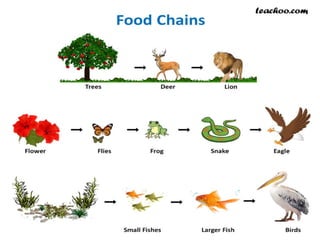
Food chain
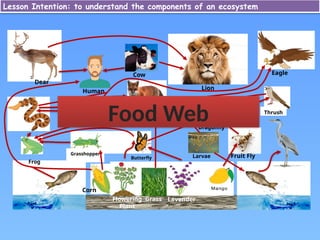
Food web
Lesson Intention: to understand the components of an ecosystem
28/11/2024
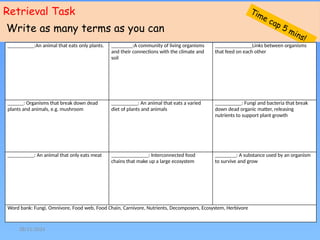
Retrieval Task
Write as many terms as you can
Time cap 5 mins!
__________:An animal that eats only plants. ________:A community of living organisms
and their connections with the climate and
soil
______________Links between organisms
that feed on each other
______: Organisms that break down dead
plants and animals, e.g. mushroom
__________: An animal that eats a varied
diet of plants and animals
__________: Fungi and bacteria that break
down dead organic matter, releasing
nutrients to support plant growth
__________: An animal that only eats meat ______________: Interconnected food
chains that make up a large ecosystem
________: A substance used by an organism
to survive and grow
Word bank: Fungi, Omnivore, Food web, Food Chain, Carnivore, Nutrients, Decomposers, Ecosystem, Herbivore
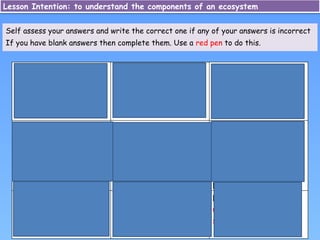
Herbivore: An animal
that eats only plants
Ecosystem: A community
of living organisms, and
their connections with
the climate and soil
Food chain: Links
between organisms that
feed on each other
Fungi: Organisms that
break down dead plants
and animals; e.g.
mushrooms
Omnivore: An animal
that eats a varied diet
of plants and animals
Decomposers: Fungi and
bacteria that break
down dead organic
matter, releasing
nutrients to support
plant growth
Carnivore: An animal
that only eats meat
Food web:
Interconnected food
chains that make up a
large ecosystem
Nutrients: A substance
used by an organism to
survive and grow
Self assess your answers and write the correct one if any of your answers is incorrect
If you have blank answers then complete them. Use a red pen to do this.
Lesson Intention: to understand the components of an ecosystem
Ecosystem - An ecosystem is a community of living
organisms (plants, animals and microbes) in a particular area.
Thursday 28 November 2024
Lesson Intention: to understand the components of an ecosystem
The main
components of
an ecosystem
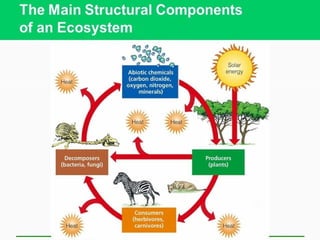
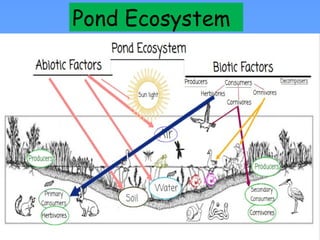
• Abiotic Factors:
Non-living elements like
sunlight, water, soil,
minerals, climate, and other
physical and chemical factors.
• Biotic Factors
Living organisms such as
plants, animals, and
microorganisms. They are also
called producers, consumers
and decomposers
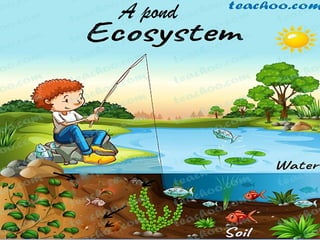
Example: A Pond Ecosystem
Aa
A pond
Pond Ecosystem
Butterfly
Rat
Snake
Fish Fish
Heron
Grass Lavender
Flowering
Plant
Grasshopper
Cow
Corn
Eagle
Dragonfly
Fruit Fly
Thrush
Lion
Fox
Dear
Human
Larvae
Frog
Food Web
Lesson Intention: to understand the components of an ecosystem
Cow
Grass Lavender
Flowering
Plant
Corn
Butterfly
Eagle
Dragonfly
Fruit Fly
Thrush
Lion
Fox
Rat
Dear
Snake
Grasshopper
Fish Fish
Human
Frog
Heron
Larvae
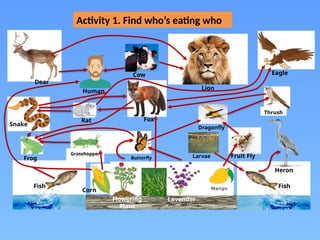
Activity 1. Find who’s eating who
Dear
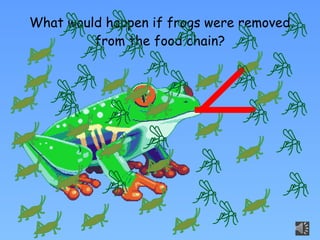
What would happen if frogs were removed
from the food chain?
What do you think?
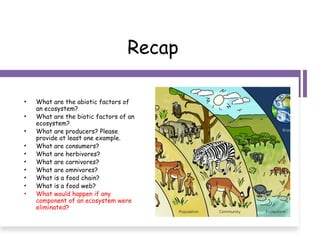
Recap
• What are the abiotic factors of
an ecosystem?
• What are the biotic factors of an
ecosystem?
• What are producers? Please
provide at least one example.
• What are consumers?
• What are herbivores?
• What are carnivores?
• What are omnivores?
• What is a food chain?
• What is a food web?
• What would happen if any
component of an ecosystem were
eliminated?
Home
Activities
• Observe the diverse bird species that visit your lawn or nearby park. Try to
capture their essence in a picture or drawing, and don't forget to note their
local names in your notebook. This will help you build a personal connection
with the birds you observe.
• If you have a hula hoop at home, throw it randomly in your home garden to
count slow-moving living organisms like ants, snails, earthworms, slugs, etc.,
take pictures or draw their diagrams and write local names on your notebook.
• Your role in documenting the local biodiversity is very important. Take
pictures or draw diagrams of your favourite plants in your home garden and
write their names in your notebook.
• Can you make a food chain of your garden's living organisms? Share your
findings with the class or group. This will help everyone learn from each
other's observations and understand the biodiversity in different areas.
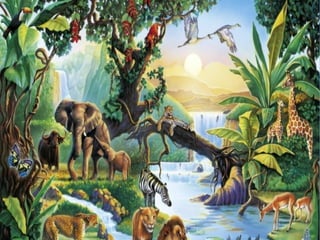
Ecosystem?
• A biological community of interacting organisms
and their physical environment.
• a natural system that comprises a community of
plants and animals that interact with each other
and their physical environment.
• The term `eco' refers to a part of the world
and `system' refers to the co-ordinating units.
An ecosystem is a community of organisms and
their physical environment interacting together.
Australian Museum, https://www.coolgeography.co.uk/

Lesson 1 ecosystem biotic and abiotic factor

  • 1.
    Ecosystem Food chain Food web LessonIntention: to understand the components of an ecosystem
  • 2.
    28/11/2024 Retrieval Task Write asmany terms as you can Time cap 5 mins! __________:An animal that eats only plants. ________:A community of living organisms and their connections with the climate and soil ______________Links between organisms that feed on each other ______: Organisms that break down dead plants and animals, e.g. mushroom __________: An animal that eats a varied diet of plants and animals __________: Fungi and bacteria that break down dead organic matter, releasing nutrients to support plant growth __________: An animal that only eats meat ______________: Interconnected food chains that make up a large ecosystem ________: A substance used by an organism to survive and grow Word bank: Fungi, Omnivore, Food web, Food Chain, Carnivore, Nutrients, Decomposers, Ecosystem, Herbivore
  • 3.
    Herbivore: An animal thateats only plants Ecosystem: A community of living organisms, and their connections with the climate and soil Food chain: Links between organisms that feed on each other Fungi: Organisms that break down dead plants and animals; e.g. mushrooms Omnivore: An animal that eats a varied diet of plants and animals Decomposers: Fungi and bacteria that break down dead organic matter, releasing nutrients to support plant growth Carnivore: An animal that only eats meat Food web: Interconnected food chains that make up a large ecosystem Nutrients: A substance used by an organism to survive and grow Self assess your answers and write the correct one if any of your answers is incorrect If you have blank answers then complete them. Use a red pen to do this. Lesson Intention: to understand the components of an ecosystem
  • 4.
    Ecosystem - Anecosystem is a community of living organisms (plants, animals and microbes) in a particular area. Thursday 28 November 2024 Lesson Intention: to understand the components of an ecosystem
  • 5.
    The main components of anecosystem • Abiotic Factors: Non-living elements like sunlight, water, soil, minerals, climate, and other physical and chemical factors. • Biotic Factors Living organisms such as plants, animals, and microorganisms. They are also called producers, consumers and decomposers
  • 7.
    Example: A PondEcosystem Aa A pond
  • 8.
  • 10.
    Butterfly Rat Snake Fish Fish Heron Grass Lavender Flowering Plant Grasshopper Cow Corn Eagle Dragonfly FruitFly Thrush Lion Fox Dear Human Larvae Frog Food Web Lesson Intention: to understand the components of an ecosystem
  • 11.
  • 12.
  • 13.
    What would happenif frogs were removed from the food chain?
  • 14.
  • 15.
    Recap • What arethe abiotic factors of an ecosystem? • What are the biotic factors of an ecosystem? • What are producers? Please provide at least one example. • What are consumers? • What are herbivores? • What are carnivores? • What are omnivores? • What is a food chain? • What is a food web? • What would happen if any component of an ecosystem were eliminated?
  • 16.
    Home Activities • Observe thediverse bird species that visit your lawn or nearby park. Try to capture their essence in a picture or drawing, and don't forget to note their local names in your notebook. This will help you build a personal connection with the birds you observe. • If you have a hula hoop at home, throw it randomly in your home garden to count slow-moving living organisms like ants, snails, earthworms, slugs, etc., take pictures or draw their diagrams and write local names on your notebook. • Your role in documenting the local biodiversity is very important. Take pictures or draw diagrams of your favourite plants in your home garden and write their names in your notebook. • Can you make a food chain of your garden's living organisms? Share your findings with the class or group. This will help everyone learn from each other's observations and understand the biodiversity in different areas.
  • 18.
    Ecosystem? • A biologicalcommunity of interacting organisms and their physical environment. • a natural system that comprises a community of plants and animals that interact with each other and their physical environment. • The term `eco' refers to a part of the world and `system' refers to the co-ordinating units. An ecosystem is a community of organisms and their physical environment interacting together. Australian Museum, https://www.coolgeography.co.uk/