Two types
Step down : the output voltage is less
than the input voltage
Step Up : the output voltage is greater
than the input voltage
dc to dc converter ( DC choppers)
It is a variable voltage
dc source obtained from
a fixed voltage dc
source.
Some uses of dc chopper :
•Traction motor control
•Regenerating braking
•Voltage regulators
Step Down DC
choppers
VS
Choppe
r
VS
t
VS
VO
t
R VO
VS
t1 t2
T
The output dc
voltage is given by


1
t
0
S
O dt
V
T
1
V
S
1
O V
T
t
V 
T
t
K 1
 Is known as
duty cycle
S
O KV
V 
The output dc voltage can be controlled by varying
K
t1 t2
t1 t2
VBE
t
VO
t
VS
t1 t2
T
The output dc voltage
can be controlled by
varying K
Step Down DC
choppers Two types:
1. Constant frequency operation
: The chopping period T is kept
constant whereas the ON time
t1 is varied. Thus the width of
the pulse is varied and such
control is known as Pulse width
modulation (PWM) control.
2. Variable frequency operation :
The chopping period T is varied
whereas either the ON time t1 or
the OFF time t2 is kept constant.
This is known as frequency
modulation.
VO
t
VS
t1 t2
T
VO
t
VS
t1 t2
T
VO
t
VS
t1 t2
T
Step Down DC choppers : RL LOAD
VS
t
VS
VO
t
t1
VS
t2
T
VBE
t
VO
VS
Choppe
r
R
L
E
V
E
dt
di
L
Ri 















 t
L
R
t
L
R
e
R
E
V
e
I
t
i 1
)
( 1
i
t
I1
I2
For static RL
load, E=0
For DC motor
load, E=Back emf
During time t1 Chopper is
ON
Solving
,
Diode is OFF
Step Down DC choppers : RL LOAD
VS
t
VS
VO
t
t1
VS
t2
T
VBE
t
VO
VS
Choppe
r
R
L
E
0


 E
dt
di
L
Ri
i
t
I1
I2
During time t2 Chopper in OFF
Solving
,
Diode is ON












 t
L
R
t
L
R
e
R
E
e
I
t
i 1
)
( 2
Step Down DC choppers : RL LOAD
VS
t
VS
t1 t2
T
i
t
I1
I2
During time t2












 t
L
R
t
L
R
e
R
E
e
I
t
i 1
)
( 2
During time t1
1
2
2
2
2
1
)
( I
e
R
E
e
I
t
i
t
L
R
t
L
R
t
t




























 t
L
R
t
L
R
e
R
E
V
e
I
t
i 1
)
( 1
2
1
1
1
1
1
)
( I
e
R
E
V
e
I
t
i
t
L
R
t
L
R
t
t
















Step Down DC choppers : RL LOAD












 2
2
1
2
1
t
L
R
t
L
R
e
R
E
e
I
I













 1
1
1
1
2
t
L
R
t
L
R
e
R
E
V
e
I
I
Solving
,
R
E
e
e
R
V
I
T
t
t
L
R














1
1
1
1
1
R
E
e
e
R
V
I
T
t
t
L
R
















1
1
1
1
2
R
E
e
e
R
V
I K
KT
L
R














1
1
1
R
E
e
e
R
V
I K
KT
L
R













 

1
1
2
Step Down DC choppers : RL LOAD
R
E
e
e
R
V
I K
KT
L
R














1
1
1
R
E
e
e
R
V
I K
KT
L
R













 

1
1
2
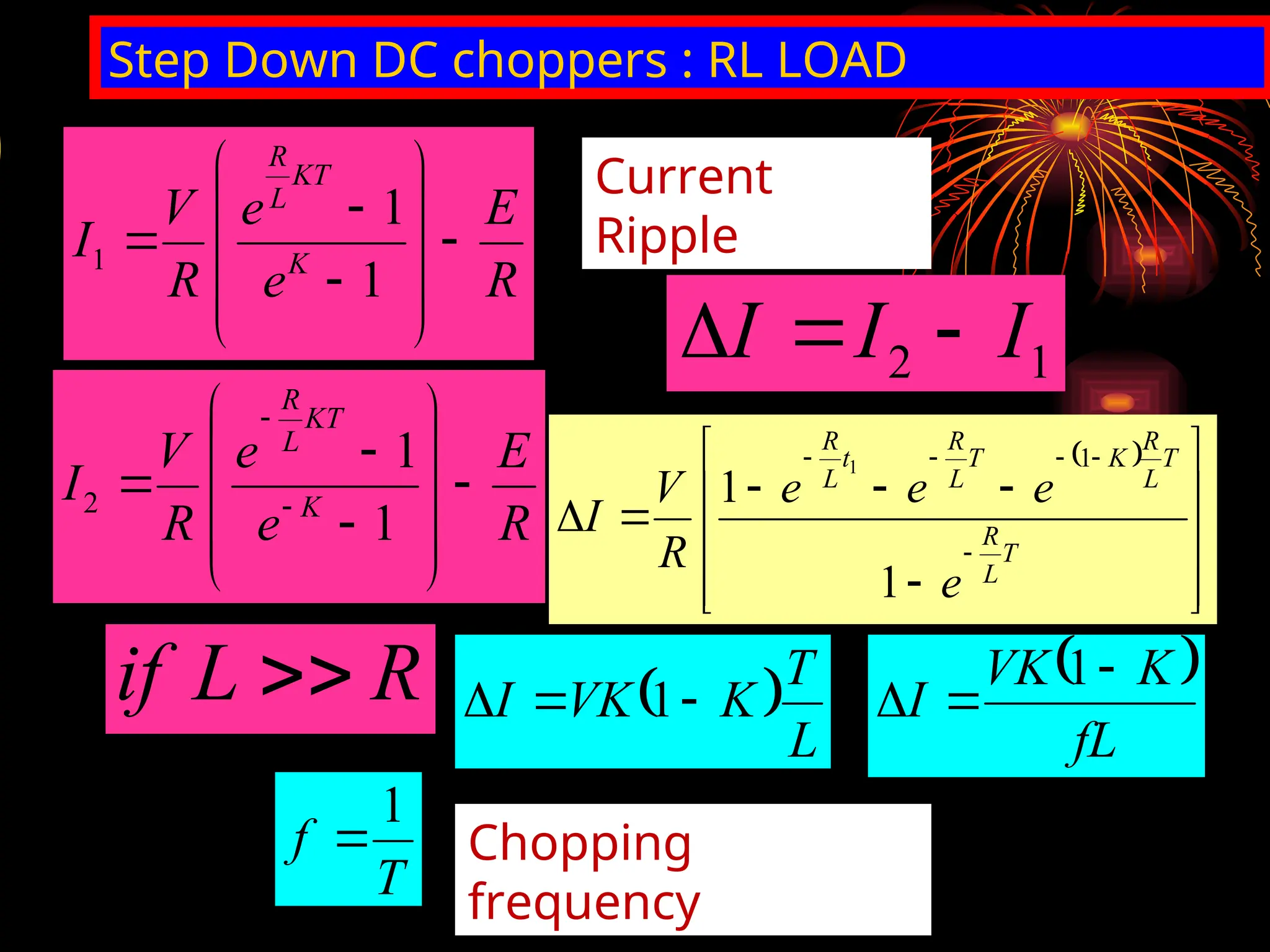
Current
Ripple
1
2 I
I
I 


 





















T
L
R
T
L
R
K
T
L
R
t
L
R
e
e
e
e
R
V
I
1
1
1
1
R
L
if   
L
T
K
VK
I 

 1
 
fL
K
VK
I



1
T
f
1
 Chopping
frequency
Step Up DC choppers
VS
Choppe
r
R VO
L D1
C
i
t
t1 t2
I2
I1
i
For the period t1 chopper is ON
and energy is stored in the
inductor, so the inductor current is
increasing.
For the period t2 chopper is OFF and
energy is released from the inductor,
so the inductor current is decreasing.
When the chopper is ON, voltage across the inductor is given
by
S
V
L 
dt
di
S
1
V
t
ΔI
L 
L
t
V
ΔI 1
S

When the chopper is OFF, the output voltage is given by
2
S
t
ΔI
L
V 

O
v
2
1
S
S
t
t
V
V 

O
v
Step Up DC choppers
VS
Choppe
r
R VO
L D1
i
i
t
t1 t2
I2
I1
T
v0
t
t1 t2
VS
2
t
ΔI
L
The output voltage is given
by
2
S
O
t
ΔI
L
V
V 

2
1
S
S
O
t
t
V
V
V 











2
1
S
O
t
t
1
V
V







 

2
2
1
S
O
t
t
t
V
V









1
S
O
t
-
T
T
V
V













T
t
-
1
1
V
V
1
S
O







K
-
1
1
V
V S
O
Voltage
Regulators
It converts unregulated voltages to regulated
voltage
Dc chopper
Variable K
unregulate
d dc
voltage
regulated
dc voltage
A dc chopper can be used as a
regulator
-
+
Vr
Switch Mode Regulators
Buck Regulator:
Basically step down
chopper, the output voltage
is less than the input
voltage.
Boost Regulator:
Basically step up chopper,
the output voltage is greater
than the input voltage.
Buck-Boost Regulator:
The output voltage may less
than or more than the input
voltage based on inductor
energy transfer..
Cuk Regulator:
The output voltage may be
less than or more than the
input voltage, based on
capacitor energy transfer.
VS
Choppe
r R
L
C
VO
Buck Regulator:
Basically step down chopper, the output voltage is less than the input
voltage.
i
t
t1 t2
I2
I1
dt
di
L
V
V o
s 

1
o
s
t
ΔI
L
V
V 

1
o
s
t
L
V
V
I



2
o
t
ΔI
L
V  2
o
t
L
V
I 
 1
o
s
2
o
t
L
V
V
t
L
V
I




VS
Choppe
r
R
L
C
K
VO
Buck Regulator:
Basically step down chopper, the output voltage is less than the input
voltage.
i
t
t1 t2
I2
I1
1
o
s
2
o
t
L
V
V
t
L
V
I




KT
t1 
 T
K
1
t2 

s
1
s
o KV
T
t
V
V 

Buck Regulator:
Basically step down chopper, the output voltage is less than the input
voltage.
1
o
s
t
L
V
V
I



2
o
t
L
V
I 

o
s
1
V
V
IL
t



o
2
V
IL
t


o
S
o
2
1
V
-
V
IL
V
IL
t
t





f
1
T 

Buck Regulator: Ripple current
o
S
o
2
1
V
-
V
IL
V
IL
t
t





f
1
T 

 
fL
K
1
K
V
ΔI S 

Numerical
Example
S
o KV
V 
A buck regulator has input voltage 12V. The required
load voltage is 5V. The ripple current is 0.8 A. If the
chopping frequency is 25kHz, Calculate the value of
the inductor.
%
67
.
41
12
5



S
o
V
V
K
 
fL
K
1
K
V
ΔI S 

 
I
f
K
1
K
V
L S



0.8
*
25000
.41)
-
.41(1
*
12
L  H

83
.
145

VS
Choppe
r
R
L
C
VO
Buck Boost
Regulator
iL
t
t1 t2
I2
I1
dt
di
L
Vs 
1
s
t
ΔI
L
V 
1
s
t
L
V
I 

2
o
t
ΔI
L
V 
 2
o
t
L
V
I 


1
s
2
o
t
L
V
t
L
V
I 



VS
Choppe
r
R
L
C
K
VO
i
t
t1 t2
I2
I1
2
o
1
s
t
L
V
t
L
V
I 



KT
t1 
 T
K
1
t2 

K
1
KV
V s
o



VS Choppe
r
Cuk Regulator
load
Chopper if OFF, L1 and C1 is charged through
diode
C1
C2
L1 L2
Chopper if ON, L1 is charged through
chopper
C1 is discharged through chopper and charging C2 and
L2.
Also current flows through load but in opposite direction
K
1
KV
V s
o




Lession 5 DC choppers.ppt is for understanding voltage reulators

  • 1.
    Two types Step down: the output voltage is less than the input voltage Step Up : the output voltage is greater than the input voltage dc to dc converter ( DC choppers) It is a variable voltage dc source obtained from a fixed voltage dc source. Some uses of dc chopper : •Traction motor control •Regenerating braking •Voltage regulators
  • 2.
    Step Down DC choppers VS Choppe r VS t VS VO t RVO VS t1 t2 T The output dc voltage is given by   1 t 0 S O dt V T 1 V S 1 O V T t V  T t K 1  Is known as duty cycle S O KV V  The output dc voltage can be controlled by varying K t1 t2 t1 t2 VBE t
  • 3.
    VO t VS t1 t2 T The outputdc voltage can be controlled by varying K Step Down DC choppers Two types: 1. Constant frequency operation : The chopping period T is kept constant whereas the ON time t1 is varied. Thus the width of the pulse is varied and such control is known as Pulse width modulation (PWM) control. 2. Variable frequency operation : The chopping period T is varied whereas either the ON time t1 or the OFF time t2 is kept constant. This is known as frequency modulation. VO t VS t1 t2 T VO t VS t1 t2 T VO t VS t1 t2 T
  • 4.
    Step Down DCchoppers : RL LOAD VS t VS VO t t1 VS t2 T VBE t VO VS Choppe r R L E V E dt di L Ri                  t L R t L R e R E V e I t i 1 ) ( 1 i t I1 I2 For static RL load, E=0 For DC motor load, E=Back emf During time t1 Chopper is ON Solving , Diode is OFF
  • 5.
    Step Down DCchoppers : RL LOAD VS t VS VO t t1 VS t2 T VBE t VO VS Choppe r R L E 0    E dt di L Ri i t I1 I2 During time t2 Chopper in OFF Solving , Diode is ON              t L R t L R e R E e I t i 1 ) ( 2
  • 6.
    Step Down DCchoppers : RL LOAD VS t VS t1 t2 T i t I1 I2 During time t2              t L R t L R e R E e I t i 1 ) ( 2 During time t1 1 2 2 2 2 1 ) ( I e R E e I t i t L R t L R t t                              t L R t L R e R E V e I t i 1 ) ( 1 2 1 1 1 1 1 ) ( I e R E V e I t i t L R t L R t t                
  • 7.
    Step Down DCchoppers : RL LOAD              2 2 1 2 1 t L R t L R e R E e I I               1 1 1 1 2 t L R t L R e R E V e I I Solving , R E e e R V I T t t L R               1 1 1 1 1 R E e e R V I T t t L R                 1 1 1 1 2 R E e e R V I K KT L R               1 1 1 R E e e R V I K KT L R                 1 1 2
  • 8.
    Step Down DCchoppers : RL LOAD R E e e R V I K KT L R               1 1 1 R E e e R V I K KT L R                 1 1 2 Current Ripple 1 2 I I I                           T L R T L R K T L R t L R e e e e R V I 1 1 1 1 R L if    L T K VK I    1   fL K VK I    1 T f 1  Chopping frequency
  • 9.
    Step Up DCchoppers VS Choppe r R VO L D1 C i t t1 t2 I2 I1 i For the period t1 chopper is ON and energy is stored in the inductor, so the inductor current is increasing. For the period t2 chopper is OFF and energy is released from the inductor, so the inductor current is decreasing. When the chopper is ON, voltage across the inductor is given by S V L  dt di S 1 V t ΔI L  L t V ΔI 1 S  When the chopper is OFF, the output voltage is given by 2 S t ΔI L V   O v 2 1 S S t t V V   O v
  • 10.
    Step Up DCchoppers VS Choppe r R VO L D1 i i t t1 t2 I2 I1 T v0 t t1 t2 VS 2 t ΔI L The output voltage is given by 2 S O t ΔI L V V   2 1 S S O t t V V V             2 1 S O t t 1 V V           2 2 1 S O t t t V V          1 S O t - T T V V              T t - 1 1 V V 1 S O        K - 1 1 V V S O
  • 11.
    Voltage Regulators It converts unregulatedvoltages to regulated voltage Dc chopper Variable K unregulate d dc voltage regulated dc voltage A dc chopper can be used as a regulator - + Vr
  • 12.
    Switch Mode Regulators BuckRegulator: Basically step down chopper, the output voltage is less than the input voltage. Boost Regulator: Basically step up chopper, the output voltage is greater than the input voltage. Buck-Boost Regulator: The output voltage may less than or more than the input voltage based on inductor energy transfer.. Cuk Regulator: The output voltage may be less than or more than the input voltage, based on capacitor energy transfer.
  • 13.
    VS Choppe r R L C VO Buck Regulator: Basicallystep down chopper, the output voltage is less than the input voltage. i t t1 t2 I2 I1 dt di L V V o s   1 o s t ΔI L V V   1 o s t L V V I    2 o t ΔI L V  2 o t L V I   1 o s 2 o t L V V t L V I    
  • 14.
    VS Choppe r R L C K VO Buck Regulator: Basically stepdown chopper, the output voltage is less than the input voltage. i t t1 t2 I2 I1 1 o s 2 o t L V V t L V I     KT t1   T K 1 t2   s 1 s o KV T t V V  
  • 15.
    Buck Regulator: Basically stepdown chopper, the output voltage is less than the input voltage. 1 o s t L V V I    2 o t L V I   o s 1 V V IL t    o 2 V IL t   o S o 2 1 V - V IL V IL t t      f 1 T  
  • 16.
    Buck Regulator: Ripplecurrent o S o 2 1 V - V IL V IL t t      f 1 T     fL K 1 K V ΔI S  
  • 17.
    Numerical Example S o KV V  Abuck regulator has input voltage 12V. The required load voltage is 5V. The ripple current is 0.8 A. If the chopping frequency is 25kHz, Calculate the value of the inductor. % 67 . 41 12 5    S o V V K   fL K 1 K V ΔI S     I f K 1 K V L S    0.8 * 25000 .41) - .41(1 * 12 L  H  83 . 145 
  • 18.
    VS Choppe r R L C VO Buck Boost Regulator iL t t1 t2 I2 I1 dt di L Vs 1 s t ΔI L V  1 s t L V I   2 o t ΔI L V   2 o t L V I    1 s 2 o t L V t L V I    
  • 19.
  • 20.
    VS Choppe r Cuk Regulator load Chopperif OFF, L1 and C1 is charged through diode C1 C2 L1 L2 Chopper if ON, L1 is charged through chopper C1 is discharged through chopper and charging C2 and L2. Also current flows through load but in opposite direction K 1 KV V s o   