Copyright ‫س‬ Oracle Corporation, 1999. All rights reserved.
17
Writing Executable
Statements
17-2 Copyright ‫س‬ Oracle Corporation, 1999. All rights reserved.
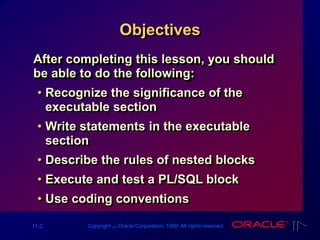
Objectives
After completing this lesson, you should
be able to do the following:
• Recognize the significance of the
executable section
• Write statements in the executable
section
• Describe the rules of nested blocks
• Execute and test a PL/SQL block
• Use coding conventions
17-3 Copyright ‫س‬ Oracle Corporation, 1999. All rights reserved.
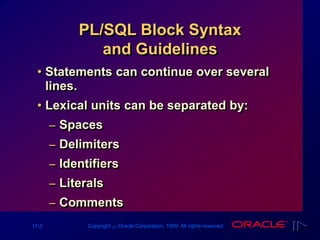
PL/SQL Block Syntax
and Guidelines
• Statements can continue over several
lines.
• Lexical units can be separated by:
– Spaces
– Delimiters
– Identifiers
– Literals
– Comments
17-4 Copyright ‫س‬ Oracle Corporation, 1999. All rights reserved.
PL/SQL Block Syntax
and Guidelines
Identifiers
• Can contain up to 30 characters
• Cannot contain reserved words unless
enclosed in double quotation marks
• Must begin with an alphabetic character
• Should not have the same name as a
database table column name
17-5 Copyright ‫س‬ Oracle Corporation, 1999. All rights reserved.
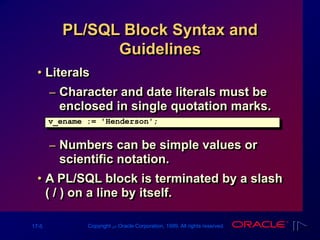
PL/SQL Block Syntax and
Guidelines
• Literals
– Character and date literals must be
enclosed in single quotation marks.
– Numbers can be simple values or
scientific notation.
• A PL/SQL block is terminated by a slash
( / ) on a line by itself.
v_ename := 'Henderson';
17-6 Copyright ‫س‬ Oracle Corporation, 1999. All rights reserved.
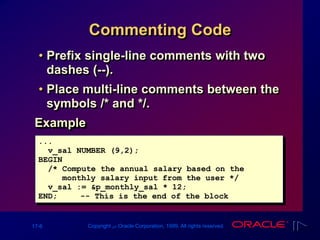
Commenting Code
• Prefix single-line comments with two
dashes (--).
• Place multi-line comments between the
symbols /* and */.
Example
...
v_sal NUMBER (9,2);
BEGIN
/* Compute the annual salary based on the
monthly salary input from the user */
v_sal := &p_monthly_sal * 12;
END; -- This is the end of the block
17-7 Copyright ‫س‬ Oracle Corporation, 1999. All rights reserved.
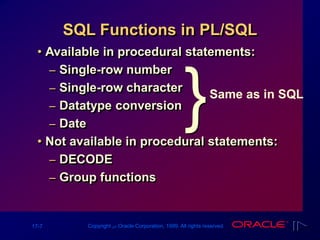
SQL Functions in PL/SQL
• Available in procedural statements:
– Single-row number
– Single-row character
– Datatype conversion
– Date
• Not available in procedural statements:
– DECODE
– Group functions
Same as in SQL
}
17-8 Copyright ‫س‬ Oracle Corporation, 1999. All rights reserved.
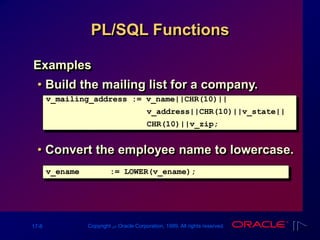
PL/SQL Functions
Examples
• Build the mailing list for a company.
• Convert the employee name to lowercase.
v_mailing_address := v_name||CHR(10)||
v_address||CHR(10)||v_state||
CHR(10)||v_zip;
v_ename := LOWER(v_ename);
17-9 Copyright ‫س‬ Oracle Corporation, 1999. All rights reserved.
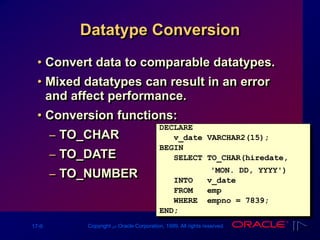
Datatype Conversion
• Convert data to comparable datatypes.
• Mixed datatypes can result in an error
and affect performance.
• Conversion functions:
– TO_CHAR
– TO_DATE
– TO_NUMBER
DECLARE
v_date VARCHAR2(15);
BEGIN
SELECT TO_CHAR(hiredate,
'MON. DD, YYYY')
INTO v_date
FROM emp
WHERE empno = 7839;
END;
17-10 Copyright ‫س‬ Oracle Corporation, 1999. All rights reserved.
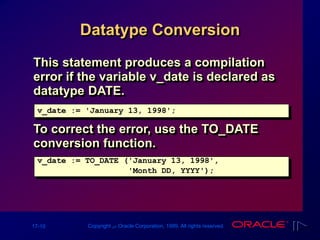
Datatype Conversion
This statement produces a compilation
error if the variable v_date is declared as
datatype DATE.
v_date := 'January 13, 1998';
v_date := TO_DATE ('January 13, 1998',
'Month DD, YYYY');
To correct the error, use the TO_DATE
conversion function.
17-11 Copyright ‫س‬ Oracle Corporation, 1999. All rights reserved.
Nested Blocks
and Variable Scope
• Statements can be nested wherever an
executable statement is allowed.
• A nested block becomes a statement.
• An exception section can contain
nested blocks.
• The scope of an object is the region of
the program that can refer to the object.
17-12 Copyright ‫س‬ Oracle Corporation, 1999. All rights reserved.
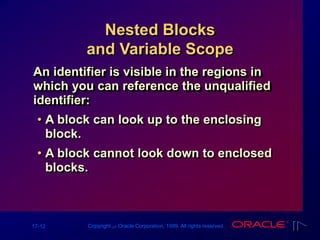
Nested Blocks
and Variable Scope
An identifier is visible in the regions in
which you can reference the unqualified
identifier:
• A block can look up to the enclosing
block.
• A block cannot look down to enclosed
blocks.
17-13 Copyright ‫س‬ Oracle Corporation, 1999. All rights reserved.
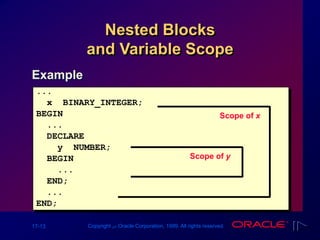
Nested Blocks
and Variable Scope
...
x BINARY_INTEGER;
BEGIN
...
DECLARE
y NUMBER;
BEGIN
...
END;
...
END;
Scope of x
Scope of y
Example
17-14 Copyright ‫س‬ Oracle Corporation, 1999. All rights reserved.
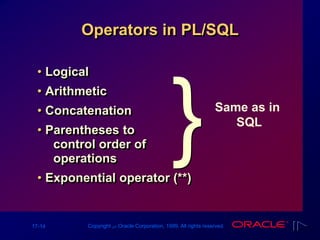
Operators in PL/SQL
• Logical
• Arithmetic
• Concatenation
• Parentheses to
control order of
operations
• Exponential operator (**)
Same as in
SQL
17-15 Copyright ‫س‬ Oracle Corporation, 1999. All rights reserved.
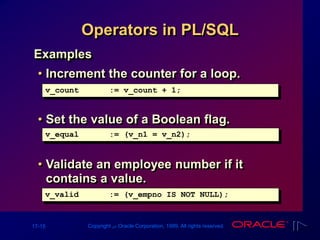
Examples
• Increment the counter for a loop.
• Set the value of a Boolean flag.
• Validate an employee number if it
contains a value.
Operators in PL/SQL
v_count := v_count + 1;
v_equal := (v_n1 = v_n2);
v_valid := (v_empno IS NOT NULL);
17-16 Copyright ‫س‬ Oracle Corporation, 1999. All rights reserved.
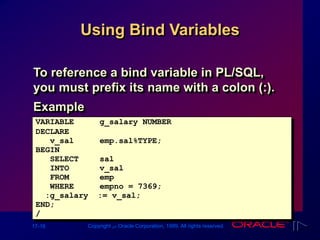
Using Bind Variables
To reference a bind variable in PL/SQL,
you must prefix its name with a colon (:).
Example
VARIABLE g_salary NUMBER
DECLARE
v_sal emp.sal%TYPE;
BEGIN
SELECT sal
INTO v_sal
FROM emp
WHERE empno = 7369;
:g_salary := v_sal;
END;
/
17-17 Copyright ‫س‬ Oracle Corporation, 1999. All rights reserved.
Programming Guidelines
Make code maintenance easier by:
• Documenting code with comments
• Developing a case convention for the
code
• Developing naming conventions for
identifiers and other objects
• Enhancing readability by indenting
17-18 Copyright ‫س‬ Oracle Corporation, 1999. All rights reserved.
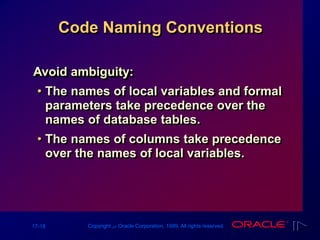
Code Naming Conventions
Avoid ambiguity:
• The names of local variables and formal
parameters take precedence over the
names of database tables.
• The names of columns take precedence
over the names of local variables.
17-19 Copyright ‫س‬ Oracle Corporation, 1999. All rights reserved.
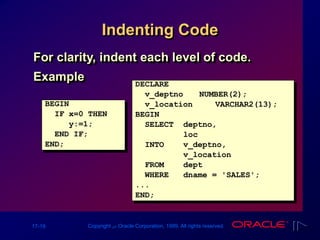
Indenting Code
For clarity, indent each level of code.
Example
BEGIN
IF x=0 THEN
y:=1;
END IF;
END;
DECLARE
v_deptno NUMBER(2);
v_location VARCHAR2(13);
BEGIN
SELECT deptno,
loc
INTO v_deptno,
v_location
FROM dept
WHERE dname = 'SALES';
...
END;
17-20 Copyright ‫س‬ Oracle Corporation, 1999. All rights reserved.
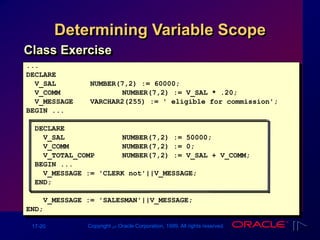
Determining Variable Scope
Class Exercise
...
DECLARE
V_SAL NUMBER(7,2) := 60000;
V_COMM NUMBER(7,2) := V_SAL * .20;
V_MESSAGE VARCHAR2(255) := ' eligible for commission';
BEGIN ...
DECLARE
V_SAL NUMBER(7,2) := 50000;
V_COMM NUMBER(7,2) := 0;
V_TOTAL_COMP NUMBER(7,2) := V_SAL + V_COMM;
BEGIN ...
V_MESSAGE := 'CLERK not'||V_MESSAGE;
END;
V_MESSAGE := 'SALESMAN'||V_MESSAGE;
END;
17-21 Copyright ‫س‬ Oracle Corporation, 1999. All rights reserved.
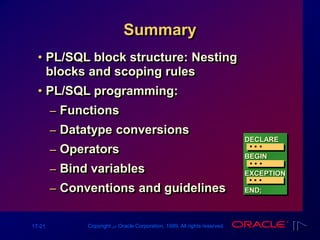
Summary
• PL/SQL block structure: Nesting
blocks and scoping rules
• PL/SQL programming:
– Functions
– Datatype conversions
– Operators
– Bind variables
– Conventions and guidelines
DECLARE
BEGIN
EXCEPTION
END;
17-22 Copyright ‫س‬ Oracle Corporation, 1999. All rights reserved.
Practice Overview
• Reviewing scoping and nesting rules
• Developing and testing PL/SQL blocks

Les17[1] Writing Executable Statements

  • 1.
    Copyright ‫س‬ OracleCorporation, 1999. All rights reserved. 17 Writing Executable Statements
  • 2.
    17-2 Copyright ‫س‬Oracle Corporation, 1999. All rights reserved. Objectives After completing this lesson, you should be able to do the following: • Recognize the significance of the executable section • Write statements in the executable section • Describe the rules of nested blocks • Execute and test a PL/SQL block • Use coding conventions
  • 3.
    17-3 Copyright ‫س‬Oracle Corporation, 1999. All rights reserved. PL/SQL Block Syntax and Guidelines • Statements can continue over several lines. • Lexical units can be separated by: – Spaces – Delimiters – Identifiers – Literals – Comments
  • 4.
    17-4 Copyright ‫س‬Oracle Corporation, 1999. All rights reserved. PL/SQL Block Syntax and Guidelines Identifiers • Can contain up to 30 characters • Cannot contain reserved words unless enclosed in double quotation marks • Must begin with an alphabetic character • Should not have the same name as a database table column name
  • 5.
    17-5 Copyright ‫س‬Oracle Corporation, 1999. All rights reserved. PL/SQL Block Syntax and Guidelines • Literals – Character and date literals must be enclosed in single quotation marks. – Numbers can be simple values or scientific notation. • A PL/SQL block is terminated by a slash ( / ) on a line by itself. v_ename := 'Henderson';
  • 6.
    17-6 Copyright ‫س‬Oracle Corporation, 1999. All rights reserved. Commenting Code • Prefix single-line comments with two dashes (--). • Place multi-line comments between the symbols /* and */. Example ... v_sal NUMBER (9,2); BEGIN /* Compute the annual salary based on the monthly salary input from the user */ v_sal := &p_monthly_sal * 12; END; -- This is the end of the block
  • 7.
    17-7 Copyright ‫س‬Oracle Corporation, 1999. All rights reserved. SQL Functions in PL/SQL • Available in procedural statements: – Single-row number – Single-row character – Datatype conversion – Date • Not available in procedural statements: – DECODE – Group functions Same as in SQL }
  • 8.
    17-8 Copyright ‫س‬Oracle Corporation, 1999. All rights reserved. PL/SQL Functions Examples • Build the mailing list for a company. • Convert the employee name to lowercase. v_mailing_address := v_name||CHR(10)|| v_address||CHR(10)||v_state|| CHR(10)||v_zip; v_ename := LOWER(v_ename);
  • 9.
    17-9 Copyright ‫س‬Oracle Corporation, 1999. All rights reserved. Datatype Conversion • Convert data to comparable datatypes. • Mixed datatypes can result in an error and affect performance. • Conversion functions: – TO_CHAR – TO_DATE – TO_NUMBER DECLARE v_date VARCHAR2(15); BEGIN SELECT TO_CHAR(hiredate, 'MON. DD, YYYY') INTO v_date FROM emp WHERE empno = 7839; END;
  • 10.
    17-10 Copyright ‫س‬Oracle Corporation, 1999. All rights reserved. Datatype Conversion This statement produces a compilation error if the variable v_date is declared as datatype DATE. v_date := 'January 13, 1998'; v_date := TO_DATE ('January 13, 1998', 'Month DD, YYYY'); To correct the error, use the TO_DATE conversion function.
  • 11.
    17-11 Copyright ‫س‬Oracle Corporation, 1999. All rights reserved. Nested Blocks and Variable Scope • Statements can be nested wherever an executable statement is allowed. • A nested block becomes a statement. • An exception section can contain nested blocks. • The scope of an object is the region of the program that can refer to the object.
  • 12.
    17-12 Copyright ‫س‬Oracle Corporation, 1999. All rights reserved. Nested Blocks and Variable Scope An identifier is visible in the regions in which you can reference the unqualified identifier: • A block can look up to the enclosing block. • A block cannot look down to enclosed blocks.
  • 13.
    17-13 Copyright ‫س‬Oracle Corporation, 1999. All rights reserved. Nested Blocks and Variable Scope ... x BINARY_INTEGER; BEGIN ... DECLARE y NUMBER; BEGIN ... END; ... END; Scope of x Scope of y Example
  • 14.
    17-14 Copyright ‫س‬Oracle Corporation, 1999. All rights reserved. Operators in PL/SQL • Logical • Arithmetic • Concatenation • Parentheses to control order of operations • Exponential operator (**) Same as in SQL
  • 15.
    17-15 Copyright ‫س‬Oracle Corporation, 1999. All rights reserved. Examples • Increment the counter for a loop. • Set the value of a Boolean flag. • Validate an employee number if it contains a value. Operators in PL/SQL v_count := v_count + 1; v_equal := (v_n1 = v_n2); v_valid := (v_empno IS NOT NULL);
  • 16.
    17-16 Copyright ‫س‬Oracle Corporation, 1999. All rights reserved. Using Bind Variables To reference a bind variable in PL/SQL, you must prefix its name with a colon (:). Example VARIABLE g_salary NUMBER DECLARE v_sal emp.sal%TYPE; BEGIN SELECT sal INTO v_sal FROM emp WHERE empno = 7369; :g_salary := v_sal; END; /
  • 17.
    17-17 Copyright ‫س‬Oracle Corporation, 1999. All rights reserved. Programming Guidelines Make code maintenance easier by: • Documenting code with comments • Developing a case convention for the code • Developing naming conventions for identifiers and other objects • Enhancing readability by indenting
  • 18.
    17-18 Copyright ‫س‬Oracle Corporation, 1999. All rights reserved. Code Naming Conventions Avoid ambiguity: • The names of local variables and formal parameters take precedence over the names of database tables. • The names of columns take precedence over the names of local variables.
  • 19.
    17-19 Copyright ‫س‬Oracle Corporation, 1999. All rights reserved. Indenting Code For clarity, indent each level of code. Example BEGIN IF x=0 THEN y:=1; END IF; END; DECLARE v_deptno NUMBER(2); v_location VARCHAR2(13); BEGIN SELECT deptno, loc INTO v_deptno, v_location FROM dept WHERE dname = 'SALES'; ... END;
  • 20.
    17-20 Copyright ‫س‬Oracle Corporation, 1999. All rights reserved. Determining Variable Scope Class Exercise ... DECLARE V_SAL NUMBER(7,2) := 60000; V_COMM NUMBER(7,2) := V_SAL * .20; V_MESSAGE VARCHAR2(255) := ' eligible for commission'; BEGIN ... DECLARE V_SAL NUMBER(7,2) := 50000; V_COMM NUMBER(7,2) := 0; V_TOTAL_COMP NUMBER(7,2) := V_SAL + V_COMM; BEGIN ... V_MESSAGE := 'CLERK not'||V_MESSAGE; END; V_MESSAGE := 'SALESMAN'||V_MESSAGE; END;
  • 21.
    17-21 Copyright ‫س‬Oracle Corporation, 1999. All rights reserved. Summary • PL/SQL block structure: Nesting blocks and scoping rules • PL/SQL programming: – Functions – Datatype conversions – Operators – Bind variables – Conventions and guidelines DECLARE BEGIN EXCEPTION END;
  • 22.
    17-22 Copyright ‫س‬Oracle Corporation, 1999. All rights reserved. Practice Overview • Reviewing scoping and nesting rules • Developing and testing PL/SQL blocks