PL/SQL
Block , Declaring variables ,Flow of Control and Exception Handling
Part 1
About PL/SQL
• PL/SQL: Stands for “Procedural Language” extension to SQL.
• Is Oracle Corporation's standard data access language for relational
databases
• Seamlessly integrates procedural constructs with SQL
About PL/SQL
• Provides a block structure for executable units of code.
Maintenance of code is made easier with such a well- defined
structure.
• Provides procedural constructs such as:
- Variables, constants, and data types
- Control structures such as conditional statements and loops
- Reusable program units that are written once and executed many
times
Benefits of PL/SQL
Benefits of PL/SQL
• Integration of procedural constructs with SQL
• Improved performance
• Exception handling
PL/SQL Block
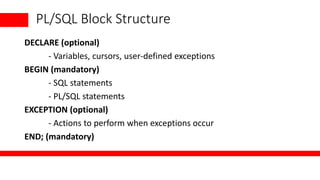
PL/SQL Block Structure
DECLARE (optional)
- Variables, cursors, user-defined exceptions
BEGIN (mandatory)
- SQL statements
- PL/SQL statements
EXCEPTION (optional)
- Actions to perform when exceptions occur
END; (mandatory)
Block Types
• Anonymous
• Procedure
• Function
Anonymous
[Declare]
Begin
--Statements
[Exception]
End
Procedure
PROCEDUER name
IS
Begin
--Statements
[Exception]
End
Function
FUNCTION name
RETURN
Begin
--Statements
RETURN value
[Exception]
End
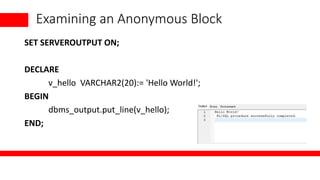
Examining an Anonymous Block
SET SERVEROUTPUT ON;
DECLARE
v_hello VARCHAR2(20):= 'Hello World!';
BEGIN
dbms_output.put_line(v_hello);
END;
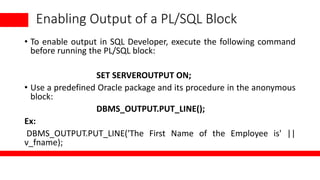
Enabling Output of a PL/SQL Block
• To enable output in SQL Developer, execute the following command
before running the PL/SQL block:
SET SERVEROUTPUT ON;
• Use a predefined Oracle package and its procedure in the anonymous
block:
DBMS_OUTPUT.PUT_LINE();
Ex:
DBMS_OUTPUT.PUT_LINE('The First Name of the Employee is' ||
v_fname);
Declaring PL/SQL Variables
Use of Variables
Variables can be used for:
• Temporary storage of data
• Manipulation of stored values
• Reusability
Requirements for Variable Names
A variable name:
• Must start with a letter
• Can include letters or numbers
• Can include special characters (such as $,_, and #)
• Must contain no more than 30 characters
• Must not include reserved words
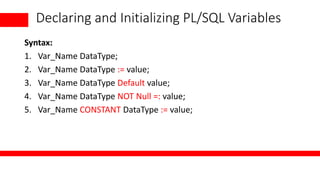
Declaring and Initializing PL/SQL Variables
Syntax:
1. Var_Name DataType;
2. Var_Name DataType := value;
3. Var_Name DataType Default value;
4. Var_Name DataType NOT Null =: value;
5. Var_Name CONSTANT DataType := value;
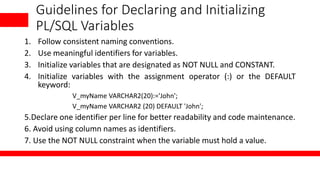
Guidelines for Declaring and Initializing
PL/SQL Variables
1. Follow consistent naming conventions.
2. Use meaningful identifiers for variables.
3. Initialize variables that are designated as NOT NULL and CONSTANT.
4. Initialize variables with the assignment operator (:) or the DEFAULT
keyword:
V_myName VARCHAR2(20):='John';
V_myName VARCHAR2 (20) DEFAULT 'John';
5.Declare one identifier per line for better readability and code maintenance.
6. Avoid using column names as identifiers.
7. Use the NOT NULL constraint when the variable must hold a value.
Declaring Variables
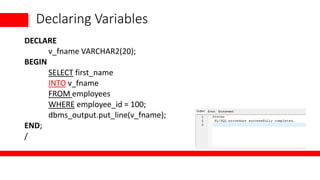
DECLARE
v_fname VARCHAR2(20);
BEGIN
SELECT first_name
INTO v_fname
FROM employees
WHERE employee_id = 100;
dbms_output.put_line(v_fname);
END;
/
Declaring Variables
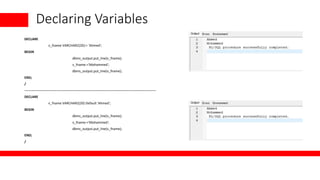
DECLARE
v_fname VARCHAR2(20):= 'Ahmed';
BEGIN
dbms_output.put_line(v_fname);
v_fname:='Mohammed';
dbms_output.put_line(v_fname);
END;
/
---------------------------------------------------------------------------------------------------------------------
DECLARE
v_fname VARCHAR2(20) Default 'Ahmed';
BEGIN
dbms_output.put_line(v_fname);
v_fname:='Mohammed';
dbms_output.put_line(v_fname);
END;
/
Declaring Variables
DECLARE
v_fname VARCHAR2(20);
BEGIN
dbms_output.put_line(v_fname);
END;
/
---------------------------------------------------------------------------------------------------------------------
DECLARE
v_fname VARCHAR2(20) NOT NULL :='Ahmed';
BEGIN
dbms_output.put_line(v_fname);
END;
/
Declaring Variables
DECLARE
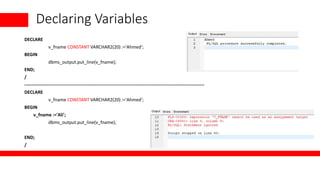
v_fname CONSTANT VARCHAR2(20) :='Ahmed';
BEGIN
dbms_output.put_line(v_fname);
END;
/
---------------------------------------------------------------------------------------------------------------------
DECLARE
v_fname CONSTANT VARCHAR2(20) :='Ahmed';
BEGIN
v_fname :='Ali';
dbms_output.put_line(v_fname);
END;
/
%TYPE Attribute
Is used to declare a variable according to:
• A database column definition
• Another declared variables
prefixed with:
• The database table and column name
• The name of the declared variable
%TYPE Attribute
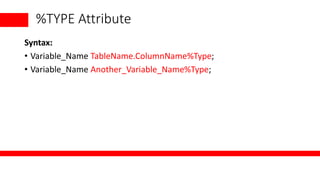
Syntax:
• Variable_Name TableName.ColumnName%Type;
• Variable_Name Another_Variable_Name%Type;
%TYPE Attribute
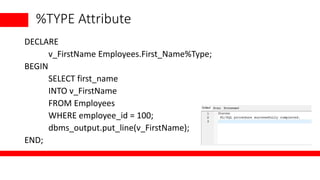
DECLARE
v_FirstName Employees.First_Name%Type;
BEGIN
SELECT first_name
INTO v_FirstName
FROM Employees
WHERE employee_id = 100;
dbms_output.put_line(v_FirstName);
END;
%TYPE Attribute
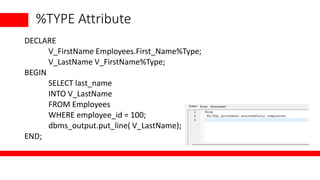
DECLARE
V_FirstName Employees.First_Name%Type;
V_LastName V_FirstName%Type;
BEGIN
SELECT last_name
INTO V_LastName
FROM Employees
WHERE employee_id = 100;
dbms_output.put_line( V_LastName);
END;
Bind Variables
Bind variables are:
• Created in the environment
• Also called host variables
• Created with the VARIABLE keyword*
• Used in SQL statements and PL/SQL blocks
• Accessed even after the PL/SQL block is executed
• Referenced with a preceding colon
• Values can be output using the PRINT command.
Using AUTOPRINT with Bind Variables
Use the SET AUTOPRINT ON command to automatically display the
bind variables used in a successful PL/SQL block.
Bind Variables
SET AUTOPRINT ON;
VARIABLE b_result NUMBER
BEGIN
SELECT SALARY INTO :b_result
FROM employees
WHERE employee_id = 144;
END;
/
PRINT b_result
IF Statement
Simple IF Statement
IF condition THEN
Statements
End IF;
Simple IF Statement
DECLARE
v_MyNumber Number :=18;
BEGIN
IF v_MyNumber > 0
THEN
dbms_output.put_line('It is +');
End IF;
END;
/
IF THEN ELSE Statement
IF condition THEN
Statements
ELSE
Statements
End IF;
IF THEN ELSE Statement
DECLARE
v_MyNumber Number :=-18;
BEGIN
IF v_MyNumber > 0
THEN
dbms_output.put_line('It is +');
ELSE
dbms_output.put_line('It is -');
End IF;
END;
/
IF THEN ELSE Statement
IF condition THEN
Statements
ELSEIF condition THEN
Statements
ELSE
Statements
End IF;
IF THEN ELSE Statement
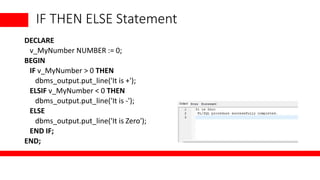
DECLARE
v_MyNumber NUMBER := 0;
BEGIN
IF v_MyNumber > 0 THEN
dbms_output.put_line('It is +');
ELSIF v_MyNumber < 0 THEN
dbms_output.put_line('It is -');
ELSE
dbms_output.put_line('It is Zero');
END IF;
END;
Case Statement
Case Expression
CASE
WHEN expression1 THEN result1
WHEN expression2 THEN result2
…..
[ELSE result]
END;
Case Statement
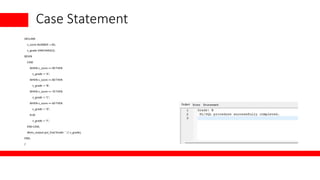
DECLARE
v_score NUMBER := 85;
v_grade VARCHAR2(2);
BEGIN
CASE
WHEN v_score >= 90 THEN
v_grade := 'A';
WHEN v_score >= 80 THEN
v_grade := 'B';
WHEN v_score >= 70 THEN
v_grade := 'C';
WHEN v_score >= 60 THEN
v_grade := 'D';
ELSE
v_grade := 'F';
END CASE;
dbms_output.put_line('Grade: ' || v_grade);
END;
/
Iterative Control
Loop Statements
Iterative Control: Loop Statements
• Loops repeat a statement (or a sequence of statements) multiple
times.
• There are three loop types:
1. Basic loop
2. WHILE loop
3. FOR loop
Basic Loops
LOOP
Statements
Exit [When condition];
END LOOP;
Basic Loops
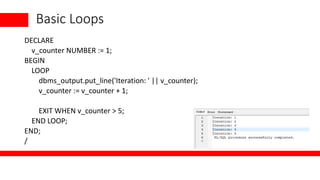
DECLARE
v_counter NUMBER := 1;
BEGIN
LOOP
dbms_output.put_line('Iteration: ' || v_counter);
v_counter := v_counter + 1;
EXIT WHEN v_counter > 5;
END LOOP;
END;
/
Basic Loops
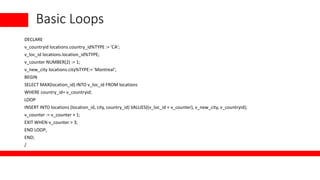
DECLARE
v_countryid locations.country_id%TYPE := 'CA';
v_loc_id locations.location_id%TYPE;
v_counter NUMBER(2) := 1;
v_new_city locations.city%TYPE:= 'Montreal';
BEGIN
SELECT MAX(location_id) INTO v_loc_id FROM locations
WHERE country_id= v_countryid;
LOOP
INSERT INTO locations (location_id, city, country_id) VALUES((v_loc_id + v_counter), v_new_city, v_countryid);
v_counter := v_counter + 1;
EXIT WHEN v_counter > 3;
END LOOP;
END;
/
While Loop
While Condition
LOOP
Statement1;
Statement2;
……
END LOOP;
While Loop
DECLARE
v_countryid locations.country_id%TYPE:= 'CA';
v_loc_id locations.location_id%TYPE;
v_new_city locations.city%TYPE:= 'Montreal';
v_counter NUMBER:= 1;
BEGIN
SELECT MAX(location_id) INTO v_loc_id FROM locations
WHERE country_id = v_countryid;
WHILE v_counter <= 3 LOOP
INSERT INTO locations (location_id, city, country_id)
VALUES((v_loc_id + v_counter), v_new_city, v_countryid);
v_counter := v_counter + 1;
END LOOP;
END;
/

Pl-sql blocks and block types and variablesdeclaring.pptx

  • 1.
    PL/SQL Block , Declaringvariables ,Flow of Control and Exception Handling Part 1
  • 2.
    About PL/SQL • PL/SQL:Stands for “Procedural Language” extension to SQL. • Is Oracle Corporation's standard data access language for relational databases • Seamlessly integrates procedural constructs with SQL
  • 3.
    About PL/SQL • Providesa block structure for executable units of code. Maintenance of code is made easier with such a well- defined structure. • Provides procedural constructs such as: - Variables, constants, and data types - Control structures such as conditional statements and loops - Reusable program units that are written once and executed many times
  • 4.
    Benefits of PL/SQL Benefitsof PL/SQL • Integration of procedural constructs with SQL • Improved performance • Exception handling
  • 5.
  • 6.
    PL/SQL Block Structure DECLARE(optional) - Variables, cursors, user-defined exceptions BEGIN (mandatory) - SQL statements - PL/SQL statements EXCEPTION (optional) - Actions to perform when exceptions occur END; (mandatory)
  • 7.
    Block Types • Anonymous •Procedure • Function Anonymous [Declare] Begin --Statements [Exception] End Procedure PROCEDUER name IS Begin --Statements [Exception] End Function FUNCTION name RETURN Begin --Statements RETURN value [Exception] End
  • 8.
    Examining an AnonymousBlock SET SERVEROUTPUT ON; DECLARE v_hello VARCHAR2(20):= 'Hello World!'; BEGIN dbms_output.put_line(v_hello); END;
  • 9.
    Enabling Output ofa PL/SQL Block • To enable output in SQL Developer, execute the following command before running the PL/SQL block: SET SERVEROUTPUT ON; • Use a predefined Oracle package and its procedure in the anonymous block: DBMS_OUTPUT.PUT_LINE(); Ex: DBMS_OUTPUT.PUT_LINE('The First Name of the Employee is' || v_fname);
  • 10.
  • 11.
    Use of Variables Variablescan be used for: • Temporary storage of data • Manipulation of stored values • Reusability
  • 12.
    Requirements for VariableNames A variable name: • Must start with a letter • Can include letters or numbers • Can include special characters (such as $,_, and #) • Must contain no more than 30 characters • Must not include reserved words
  • 13.
    Declaring and InitializingPL/SQL Variables Syntax: 1. Var_Name DataType; 2. Var_Name DataType := value; 3. Var_Name DataType Default value; 4. Var_Name DataType NOT Null =: value; 5. Var_Name CONSTANT DataType := value;
  • 14.
    Guidelines for Declaringand Initializing PL/SQL Variables 1. Follow consistent naming conventions. 2. Use meaningful identifiers for variables. 3. Initialize variables that are designated as NOT NULL and CONSTANT. 4. Initialize variables with the assignment operator (:) or the DEFAULT keyword: V_myName VARCHAR2(20):='John'; V_myName VARCHAR2 (20) DEFAULT 'John'; 5.Declare one identifier per line for better readability and code maintenance. 6. Avoid using column names as identifiers. 7. Use the NOT NULL constraint when the variable must hold a value.
  • 15.
    Declaring Variables DECLARE v_fname VARCHAR2(20); BEGIN SELECTfirst_name INTO v_fname FROM employees WHERE employee_id = 100; dbms_output.put_line(v_fname); END; /
  • 16.
    Declaring Variables DECLARE v_fname VARCHAR2(20):='Ahmed'; BEGIN dbms_output.put_line(v_fname); v_fname:='Mohammed'; dbms_output.put_line(v_fname); END; / --------------------------------------------------------------------------------------------------------------------- DECLARE v_fname VARCHAR2(20) Default 'Ahmed'; BEGIN dbms_output.put_line(v_fname); v_fname:='Mohammed'; dbms_output.put_line(v_fname); END; /
  • 17.
  • 18.
    Declaring Variables DECLARE v_fname CONSTANTVARCHAR2(20) :='Ahmed'; BEGIN dbms_output.put_line(v_fname); END; / --------------------------------------------------------------------------------------------------------------------- DECLARE v_fname CONSTANT VARCHAR2(20) :='Ahmed'; BEGIN v_fname :='Ali'; dbms_output.put_line(v_fname); END; /
  • 19.
    %TYPE Attribute Is usedto declare a variable according to: • A database column definition • Another declared variables prefixed with: • The database table and column name • The name of the declared variable
  • 20.
    %TYPE Attribute Syntax: • Variable_NameTableName.ColumnName%Type; • Variable_Name Another_Variable_Name%Type;
  • 21.
    %TYPE Attribute DECLARE v_FirstName Employees.First_Name%Type; BEGIN SELECTfirst_name INTO v_FirstName FROM Employees WHERE employee_id = 100; dbms_output.put_line(v_FirstName); END;
  • 22.
    %TYPE Attribute DECLARE V_FirstName Employees.First_Name%Type; V_LastNameV_FirstName%Type; BEGIN SELECT last_name INTO V_LastName FROM Employees WHERE employee_id = 100; dbms_output.put_line( V_LastName); END;
  • 23.
    Bind Variables Bind variablesare: • Created in the environment • Also called host variables • Created with the VARIABLE keyword* • Used in SQL statements and PL/SQL blocks • Accessed even after the PL/SQL block is executed • Referenced with a preceding colon • Values can be output using the PRINT command.
  • 24.
    Using AUTOPRINT withBind Variables Use the SET AUTOPRINT ON command to automatically display the bind variables used in a successful PL/SQL block.
  • 25.
    Bind Variables SET AUTOPRINTON; VARIABLE b_result NUMBER BEGIN SELECT SALARY INTO :b_result FROM employees WHERE employee_id = 144; END; / PRINT b_result
  • 26.
  • 27.
    Simple IF Statement IFcondition THEN Statements End IF;
  • 28.
    Simple IF Statement DECLARE v_MyNumberNumber :=18; BEGIN IF v_MyNumber > 0 THEN dbms_output.put_line('It is +'); End IF; END; /
  • 29.
    IF THEN ELSEStatement IF condition THEN Statements ELSE Statements End IF;
  • 30.
    IF THEN ELSEStatement DECLARE v_MyNumber Number :=-18; BEGIN IF v_MyNumber > 0 THEN dbms_output.put_line('It is +'); ELSE dbms_output.put_line('It is -'); End IF; END; /
  • 31.
    IF THEN ELSEStatement IF condition THEN Statements ELSEIF condition THEN Statements ELSE Statements End IF;
  • 32.
    IF THEN ELSEStatement DECLARE v_MyNumber NUMBER := 0; BEGIN IF v_MyNumber > 0 THEN dbms_output.put_line('It is +'); ELSIF v_MyNumber < 0 THEN dbms_output.put_line('It is -'); ELSE dbms_output.put_line('It is Zero'); END IF; END;
  • 33.
  • 34.
    Case Expression CASE WHEN expression1THEN result1 WHEN expression2 THEN result2 ….. [ELSE result] END;
  • 35.
    Case Statement DECLARE v_score NUMBER:= 85; v_grade VARCHAR2(2); BEGIN CASE WHEN v_score >= 90 THEN v_grade := 'A'; WHEN v_score >= 80 THEN v_grade := 'B'; WHEN v_score >= 70 THEN v_grade := 'C'; WHEN v_score >= 60 THEN v_grade := 'D'; ELSE v_grade := 'F'; END CASE; dbms_output.put_line('Grade: ' || v_grade); END; /
  • 36.
  • 37.
    Iterative Control: LoopStatements • Loops repeat a statement (or a sequence of statements) multiple times. • There are three loop types: 1. Basic loop 2. WHILE loop 3. FOR loop
  • 38.
  • 39.
    Basic Loops DECLARE v_counter NUMBER:= 1; BEGIN LOOP dbms_output.put_line('Iteration: ' || v_counter); v_counter := v_counter + 1; EXIT WHEN v_counter > 5; END LOOP; END; /
  • 40.
    Basic Loops DECLARE v_countryid locations.country_id%TYPE:= 'CA'; v_loc_id locations.location_id%TYPE; v_counter NUMBER(2) := 1; v_new_city locations.city%TYPE:= 'Montreal'; BEGIN SELECT MAX(location_id) INTO v_loc_id FROM locations WHERE country_id= v_countryid; LOOP INSERT INTO locations (location_id, city, country_id) VALUES((v_loc_id + v_counter), v_new_city, v_countryid); v_counter := v_counter + 1; EXIT WHEN v_counter > 3; END LOOP; END; /
  • 41.
  • 42.
    While Loop DECLARE v_countryid locations.country_id%TYPE:='CA'; v_loc_id locations.location_id%TYPE; v_new_city locations.city%TYPE:= 'Montreal'; v_counter NUMBER:= 1; BEGIN SELECT MAX(location_id) INTO v_loc_id FROM locations WHERE country_id = v_countryid; WHILE v_counter <= 3 LOOP INSERT INTO locations (location_id, city, country_id) VALUES((v_loc_id + v_counter), v_new_city, v_countryid); v_counter := v_counter + 1; END LOOP; END; /