CHAPTER # 10
GEOMETRICAL OPTICS.
MY TOPICS ARE:
1. LENSES
2. REAL & VIRTUAL IMAGE
3. RULES FOR IMAGE
FORMATION
GEOMETRICAL OPTICS
• Geometrical Optics also called Ray
Optics is a branch of optics that deals
with the study of propogation of light as
rays and behaviourral Petterns of light
when passing through any medium.
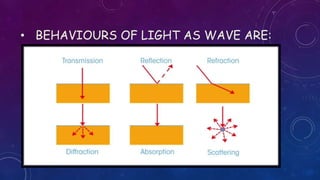
• BEHAVIOURS OF LIGHT AS WAVE ARE:
LENS :
• Lens a transparent material such as
glass bounded by two surfaces at
least one of which is curved is
calked a LENS .
• It has Tedency to Refract the
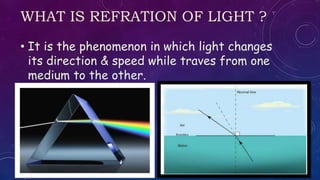
WHAT IS REFRATION OF LIGHT ?
• It is the phenomenon in which light changes
its direction & speed while traves from one
medium to the other.
TERMS RELATED TO LENS :
1. Optical Center: The center of the lens is called
Optical center.
2. Principal Axis: A straight line joining the center of
curvature of two sperical surfaces of lens is called
Principal Axis .
3. Center of Curvature: The center of the sphere
from which a curved surface is obtained is called
Center of Curvature Denoted by “C”
4. Pole : The points where the principal axis
meet the two surfaces of lens.
• The Distance between two poles of lens is
thickness of lens.
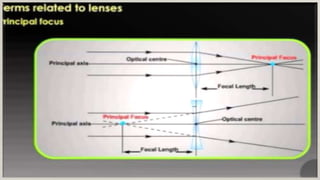
5. Focal Point : It is a point in a focal plane at
which all the light rays when coming from a
direction and passing through the lens meet
together.
6. Focal Length : It is a distance of principal
focus from Optical centers Denoted By ‘f’
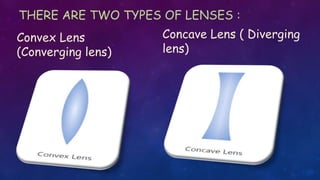
THERE ARE TWO TYPES OF LENSES :
Convex Lens
(Converging lens)
Concave Lens ( Diverging
lens)
CONVEX LENS:
• The Convex lenses are thicker in the center & thinner
at the edges.
• It is also called converging lens because it
converges the parallel beam of light passing
through it.
• The focal length of convex lens is taken to be
positive.
• Convex lens can form both Real and Virtual images.
When the object is placed with in the focal length
of lens it produces a virtual image and at other
positions it forms a Real and Inverted image
KINDS OF CONVEX LENS:
• Bicovex :- A lens in which both sides are convex.
• Plano-convex :- A lens in which one side is convex
and the other is plano.
• Concavo-convex :- A lens where one side is
convex & the other concave.
CONCAVE LENS:
• The Concave lenses are thinner at the center
& thicker at the edges.
• It is also called diverging lens because it
diverges the parallel beam of light passing
through it.
• The focal length of concave lesn is taken to
be negative.
• It forms a Virtual and Erect image always.
KINDS OF CONCAVE LENS:
• Biconcave :- A lens in which both sides are
concave.
• Plano-concave :- A lens in which one side is concave
and the other is plano .
• Convexo-concave :- A lens where one side is
concave & the other concave.
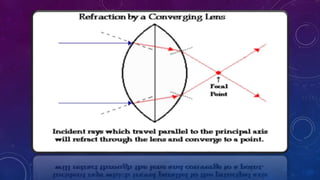
REFRACTION FOR CONVERGING
LENS
• It is a refracting law that when light travels
from rare to Denser medium it move toward
normal line and when light travel from Denser to
Rare medium it move away from normal line.
• This Law is also applied to converging and
Diverging lens.
REFRACTION FOR DIVERGING
LENSES
USES OF LENS:
• Lenses are used in various imaging device like
telescope, binoculars and cameras.
• They are also used as visual aids, in glasses
to correct defects of vision such as myopia
and hypermetropia.
WHAT IS IMAGE ??
• IN OPTICS AN IMAGE IS
DEFINED AS THE
COLLECTION OF FOCUS
POINTS OF LIGHT RAYS
COMING FROM AN OBJECT.
• THERE ARE TWO TYPES OF
IMAGE.
1. REAL IMAGE
2. VIRTUAL IMAGE
REAL IMAGE
• If the rays of light actually intersect each
other after passing through the lens, then
the image is called the Real Image .
• A real image is always Inverted
• It can be obtained on screen.
• Real image found in only convex lens.
VIRTUAL IMAGE
• If the rays of light appear to intersect each
other after passing through a lines, then
image is called Virtual Image.
• It is always Erect.
• Virtual image can’t be obtained on screen.
• Virtual image can be found in Convex lens, &
concave lens
GRAPHICAL CONSTRUCTION OF IMAGES BY
USING RAY DIAGRAMS
• In order to understand the principle of image
formation, we make use of graphic constructions,
We known thar an object seatters light falling on
it in all direction but for the purpose of locating
its image only those rays are considered which
pass through the lens.
• In the following we use ray diagrams to determine
the location anf size of the image.
• Lets consider three rays.
1. The ray 1 leaving the Tip of the object
parallel to the axis is refracted by the lens
so that it passes through the principal focus
F on the other side of the lens.
2. The ray 2 passing through the principal
focus F emerges from the lens parallel to
the axis.
3. The ray 3 passing through the object
center of the lens remain unchanged in the
direction.
WHEN CONVEX LENS FO REAL
IMAGE
WHEN IMAGE IS FORM BY CONCAVE
LENS
IMAGE FORMATION OF CONVEX LENS
lenses introduction.pptx

lenses introduction.pptx

  • 2.
  • 3.
    MY TOPICS ARE: 1.LENSES 2. REAL & VIRTUAL IMAGE 3. RULES FOR IMAGE FORMATION
  • 4.
    GEOMETRICAL OPTICS • GeometricalOptics also called Ray Optics is a branch of optics that deals with the study of propogation of light as rays and behaviourral Petterns of light when passing through any medium.
  • 5.
    • BEHAVIOURS OFLIGHT AS WAVE ARE:
  • 8.
    LENS : • Lensa transparent material such as glass bounded by two surfaces at least one of which is curved is calked a LENS . • It has Tedency to Refract the
  • 9.
    WHAT IS REFRATIONOF LIGHT ? • It is the phenomenon in which light changes its direction & speed while traves from one medium to the other.
  • 11.
    TERMS RELATED TOLENS : 1. Optical Center: The center of the lens is called Optical center. 2. Principal Axis: A straight line joining the center of curvature of two sperical surfaces of lens is called Principal Axis . 3. Center of Curvature: The center of the sphere from which a curved surface is obtained is called Center of Curvature Denoted by “C”
  • 12.
    4. Pole :The points where the principal axis meet the two surfaces of lens. • The Distance between two poles of lens is thickness of lens. 5. Focal Point : It is a point in a focal plane at which all the light rays when coming from a direction and passing through the lens meet together. 6. Focal Length : It is a distance of principal focus from Optical centers Denoted By ‘f’
  • 14.
    THERE ARE TWOTYPES OF LENSES : Convex Lens (Converging lens) Concave Lens ( Diverging lens)
  • 15.
    CONVEX LENS: • TheConvex lenses are thicker in the center & thinner at the edges. • It is also called converging lens because it converges the parallel beam of light passing through it. • The focal length of convex lens is taken to be positive. • Convex lens can form both Real and Virtual images. When the object is placed with in the focal length of lens it produces a virtual image and at other positions it forms a Real and Inverted image
  • 17.
    KINDS OF CONVEXLENS: • Bicovex :- A lens in which both sides are convex. • Plano-convex :- A lens in which one side is convex and the other is plano. • Concavo-convex :- A lens where one side is convex & the other concave.
  • 18.
    CONCAVE LENS: • TheConcave lenses are thinner at the center & thicker at the edges. • It is also called diverging lens because it diverges the parallel beam of light passing through it. • The focal length of concave lesn is taken to be negative. • It forms a Virtual and Erect image always.
  • 20.
    KINDS OF CONCAVELENS: • Biconcave :- A lens in which both sides are concave. • Plano-concave :- A lens in which one side is concave and the other is plano . • Convexo-concave :- A lens where one side is concave & the other concave.
  • 21.
    REFRACTION FOR CONVERGING LENS •It is a refracting law that when light travels from rare to Denser medium it move toward normal line and when light travel from Denser to Rare medium it move away from normal line. • This Law is also applied to converging and Diverging lens.
  • 23.
  • 24.
    USES OF LENS: •Lenses are used in various imaging device like telescope, binoculars and cameras. • They are also used as visual aids, in glasses to correct defects of vision such as myopia and hypermetropia.
  • 27.
    WHAT IS IMAGE?? • IN OPTICS AN IMAGE IS DEFINED AS THE COLLECTION OF FOCUS POINTS OF LIGHT RAYS COMING FROM AN OBJECT. • THERE ARE TWO TYPES OF IMAGE. 1. REAL IMAGE 2. VIRTUAL IMAGE
  • 28.
    REAL IMAGE • Ifthe rays of light actually intersect each other after passing through the lens, then the image is called the Real Image . • A real image is always Inverted • It can be obtained on screen. • Real image found in only convex lens.
  • 30.
    VIRTUAL IMAGE • Ifthe rays of light appear to intersect each other after passing through a lines, then image is called Virtual Image. • It is always Erect. • Virtual image can’t be obtained on screen. • Virtual image can be found in Convex lens, & concave lens
  • 32.
    GRAPHICAL CONSTRUCTION OFIMAGES BY USING RAY DIAGRAMS • In order to understand the principle of image formation, we make use of graphic constructions, We known thar an object seatters light falling on it in all direction but for the purpose of locating its image only those rays are considered which pass through the lens. • In the following we use ray diagrams to determine the location anf size of the image. • Lets consider three rays.
  • 33.
    1. The ray1 leaving the Tip of the object parallel to the axis is refracted by the lens so that it passes through the principal focus F on the other side of the lens. 2. The ray 2 passing through the principal focus F emerges from the lens parallel to the axis. 3. The ray 3 passing through the object center of the lens remain unchanged in the direction.
  • 34.
    WHEN CONVEX LENSFO REAL IMAGE
  • 35.
    WHEN IMAGE ISFORM BY CONCAVE LENS
  • 36.
    IMAGE FORMATION OFCONVEX LENS