Lenses
Class 10 Science – Light: Reflection
and Refraction
Introduction to Lenses
• Lenses are transparent optical devices that
converge or diverge light rays.
• Two Types:
• • Convex Lens (Converging)
• • Concave Lens (Diverging)
Types of Lenses
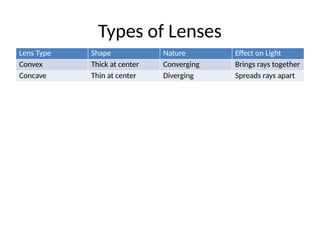
Lens Type Shape Nature Effect on Light
Convex Thick at center Converging Brings rays together
Concave Thin at center Diverging Spreads rays apart
Key Terms
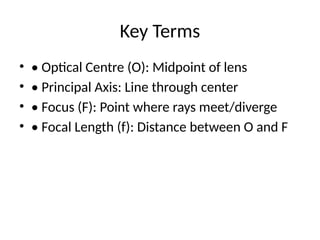
• • Optical Centre (O): Midpoint of lens
• • Principal Axis: Line through center
• • Focus (F): Point where rays meet/diverge
• • Focal Length (f): Distance between O and F
Ray Diagrams – Convex Lens
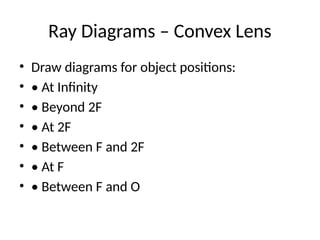
• Draw diagrams for object positions:
• • At Infinity
• • Beyond 2F
• • At 2F
• • Between F and 2F
• • At F
• • Between F and O
Ray Diagrams – Concave Lens
• Draw for object placed anywhere.
• Image is always virtual, erect, and diminished.
• Use two rays:
• • Parallel to axis
• • Through optical center
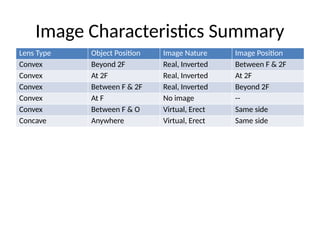
Image Characteristics Summary
Lens Type Object Position Image Nature Image Position
Convex Beyond 2F Real, Inverted Between F & 2F
Convex At 2F Real, Inverted At 2F
Convex Between F & 2F Real, Inverted Beyond 2F
Convex At F No image --
Convex Between F & O Virtual, Erect Same side
Concave Anywhere Virtual, Erect Same side
Lens Formula
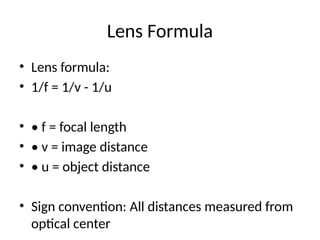
• Lens formula:
• 1/f = 1/v - 1/u
• • f = focal length
• • v = image distance
• • u = object distance
• Sign convention: All distances measured from
optical center
Power of a Lens
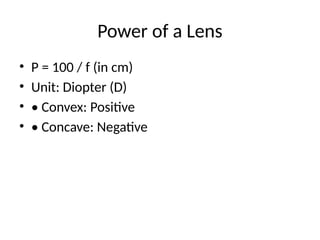
• P = 100 / f (in cm)
• Unit: Diopter (D)
• • Convex: Positive
• • Concave: Negative
Uses of Lenses
• Convex:
• • Magnifying glass
• • Camera lenses
• • Human eye
• Concave:
• • Spectacles for myopia
• • Peepholes in doors
Recap
• • Types of lenses and properties
• • Image formation and ray diagrams
• • Lens formula and power
• • Real-life uses
Thank You
• Any Questions? 😊

Ch-9 Reflection and Refraction Lenses_Class10_Science.pptx

  • 1.
    Lenses Class 10 Science– Light: Reflection and Refraction
  • 2.
    Introduction to Lenses •Lenses are transparent optical devices that converge or diverge light rays. • Two Types: • • Convex Lens (Converging) • • Concave Lens (Diverging)
  • 3.
    Types of Lenses LensType Shape Nature Effect on Light Convex Thick at center Converging Brings rays together Concave Thin at center Diverging Spreads rays apart
  • 4.
    Key Terms • •Optical Centre (O): Midpoint of lens • • Principal Axis: Line through center • • Focus (F): Point where rays meet/diverge • • Focal Length (f): Distance between O and F
  • 5.
    Ray Diagrams –Convex Lens • Draw diagrams for object positions: • • At Infinity • • Beyond 2F • • At 2F • • Between F and 2F • • At F • • Between F and O
  • 6.
    Ray Diagrams –Concave Lens • Draw for object placed anywhere. • Image is always virtual, erect, and diminished. • Use two rays: • • Parallel to axis • • Through optical center
  • 7.
    Image Characteristics Summary LensType Object Position Image Nature Image Position Convex Beyond 2F Real, Inverted Between F & 2F Convex At 2F Real, Inverted At 2F Convex Between F & 2F Real, Inverted Beyond 2F Convex At F No image -- Convex Between F & O Virtual, Erect Same side Concave Anywhere Virtual, Erect Same side
  • 8.
    Lens Formula • Lensformula: • 1/f = 1/v - 1/u • • f = focal length • • v = image distance • • u = object distance • Sign convention: All distances measured from optical center
  • 9.
    Power of aLens • P = 100 / f (in cm) • Unit: Diopter (D) • • Convex: Positive • • Concave: Negative
  • 10.
    Uses of Lenses •Convex: • • Magnifying glass • • Camera lenses • • Human eye • Concave: • • Spectacles for myopia • • Peepholes in doors
  • 11.
    Recap • • Typesof lenses and properties • • Image formation and ray diagrams • • Lens formula and power • • Real-life uses
  • 12.
    Thank You • AnyQuestions? 😊