LENSE
S
What is Lenses?
Lenses are smoothly
curved transparent
materials, usually
made of glass that
refract light.
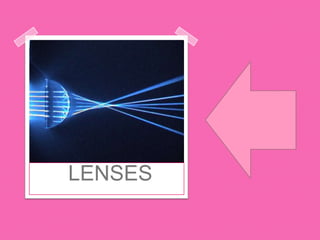
LENSES
The degree of
bending depends
on the curvature
and index of
refraction of the
lens.
Two Main Types of Lenses
CONVEX
( Converging Lens)
CONCAVE
( Diverging Lens)
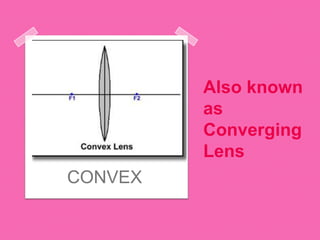
Also known
as
Converging
Lens
CONVEX
Convex Lens
It is thick in middle and
thin at the edges.
 Lens such that a beam
of light passing through it
is brought to a point or
focus.
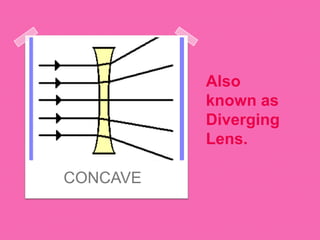
Also
known as
Diverging
Lens.
CONCAVE
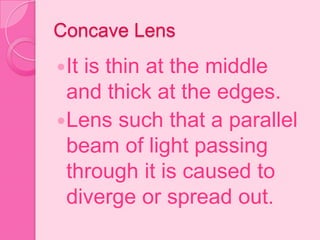
Concave Lens
It is thin at the middle
and thick at the edges.
Lens such that a parallel
beam of light passing
through it is caused to
diverge or spread out.
Different Kinds
of Eye Defects
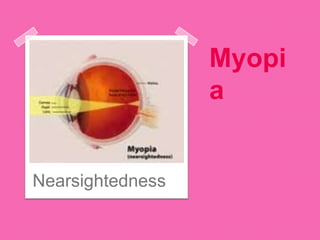
Myopia
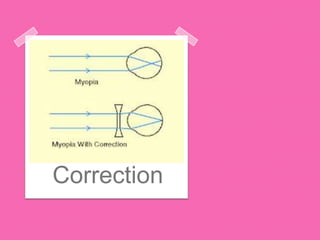
 (nearsightedness) This is a defect of
vision in which far objects appear
blurred but near objects are seen
clearly. The image is focused in front
of the retina rather than on it usually
because the eyeball is too long or the
refractive power of the eye’s lens too
strong. Myopia can be corrected by
wearing glasses/contacts with
concave lenses these help to focus
the image on the retina.
Myopi
a
Nearsightedness
Correction
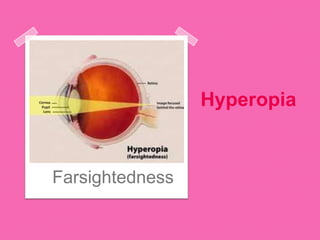
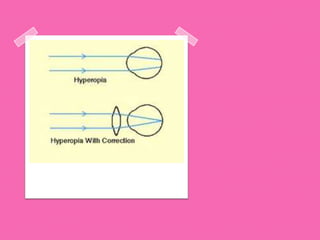
Hyperopia
 (farsightedness) This is a defect of
vision in which there is difficulty with
near vision but far objects can be seen
easily. The image is focused behind
the retina rather than upon it. This
occurs when the eyeball is too short or
the refractive power of the lens is too
weak. Hyperopia can be corrected by
wearing glasses/contacts that contain
convex lenses.
Hyperopia
Farsightedness
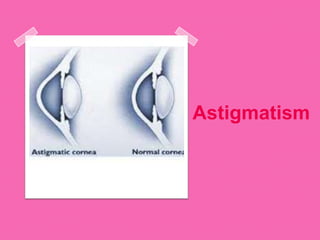
Astigmatism
 This defect is when the light rays do not all
come to a single focal point on the retina,
instead some focus on the retina and some
focus in front of or behind it. This is usually
caused by a non-uniform curvature of the
cornea. A typical symptom of astigmatism is if
you are looking at a pattern of lines placed at
various angles and the lines running in one
direction appear sharp whilst those in other
directions appear blurred. Astigmatism can
usually be corrected by using a special
spherical cylindrical lens; this is placed in the
out-of-focus axis.
Astigmatism
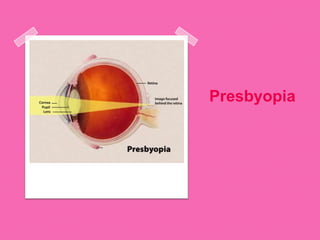
Presbyopia
 Presbyopia is part of aging. When
someone gets into their forties, and is
caused by the hardening of the
crystalline lenses in the eye. People
with this will find that their arms are
“getting shorter” as they have to hold
reading material farther and farther
away.
Presbyopia
Strabismus
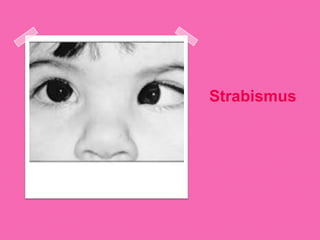
 Strabismus, more commonly known
as crossed-eyes, is when the two eyes
do not look toward the same object
together. One eye is normal, while the
other one points in some other
direction. Strabismus can be corrected
with prisms. The prisms bend the light
so the light goes to the correct spot.
Strabismus
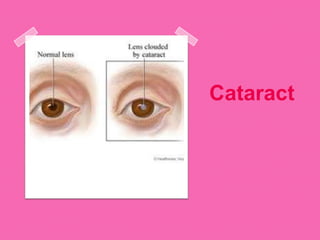
Cataract
 A cataract is when the lens of the eye
or its capsule is opaque. It is the
leading cause of blindness in the
world. The word “cataract” means
waterfall. For someone with a serious
cataract, it's like seeing through a
waterfall to them.
Cataract
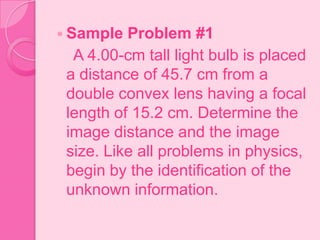
 Sample Problem #1
A 4.00-cm tall light bulb is placed
a distance of 45.7 cm from a
double convex lens having a focal
length of 15.2 cm. Determine the
image distance and the image
size. Like all problems in physics,
begin by the identification of the
unknown information.
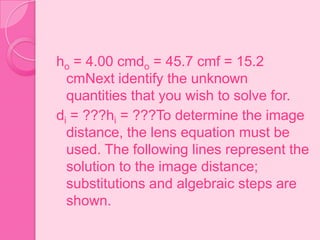
ho = 4.00 cmdo = 45.7 cmf = 15.2
cmNext identify the unknown
quantities that you wish to solve for.
di = ???hi = ???To determine the image
distance, the lens equation must be
used. The following lines represent the
solution to the image distance;
substitutions and algebraic steps are
shown.
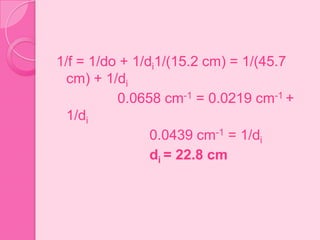
1/f = 1/do + 1/di1/(15.2 cm) = 1/(45.7
cm) + 1/di
0.0658 cm-1 = 0.0219 cm-1 +
1/di
0.0439 cm-1 = 1/di
di = 22.8 cm

Lenses

  • 1.
  • 2.
    What is Lenses? Lensesare smoothly curved transparent materials, usually made of glass that refract light.
  • 3.
  • 4.
    The degree of bendingdepends on the curvature and index of refraction of the lens.
  • 5.
    Two Main Typesof Lenses CONVEX ( Converging Lens) CONCAVE ( Diverging Lens)
  • 6.
  • 7.
    Convex Lens It isthick in middle and thin at the edges.  Lens such that a beam of light passing through it is brought to a point or focus.
  • 8.
  • 9.
    Concave Lens It isthin at the middle and thick at the edges. Lens such that a parallel beam of light passing through it is caused to diverge or spread out.
  • 10.
  • 11.
    Myopia  (nearsightedness) Thisis a defect of vision in which far objects appear blurred but near objects are seen clearly. The image is focused in front of the retina rather than on it usually because the eyeball is too long or the refractive power of the eye’s lens too strong. Myopia can be corrected by wearing glasses/contacts with concave lenses these help to focus the image on the retina.
  • 12.
  • 13.
  • 14.
    Hyperopia  (farsightedness) Thisis a defect of vision in which there is difficulty with near vision but far objects can be seen easily. The image is focused behind the retina rather than upon it. This occurs when the eyeball is too short or the refractive power of the lens is too weak. Hyperopia can be corrected by wearing glasses/contacts that contain convex lenses.
  • 15.
  • 17.
    Astigmatism  This defectis when the light rays do not all come to a single focal point on the retina, instead some focus on the retina and some focus in front of or behind it. This is usually caused by a non-uniform curvature of the cornea. A typical symptom of astigmatism is if you are looking at a pattern of lines placed at various angles and the lines running in one direction appear sharp whilst those in other directions appear blurred. Astigmatism can usually be corrected by using a special spherical cylindrical lens; this is placed in the out-of-focus axis.
  • 18.
  • 19.
    Presbyopia  Presbyopia ispart of aging. When someone gets into their forties, and is caused by the hardening of the crystalline lenses in the eye. People with this will find that their arms are “getting shorter” as they have to hold reading material farther and farther away.
  • 20.
  • 21.
    Strabismus  Strabismus, morecommonly known as crossed-eyes, is when the two eyes do not look toward the same object together. One eye is normal, while the other one points in some other direction. Strabismus can be corrected with prisms. The prisms bend the light so the light goes to the correct spot.
  • 22.
  • 23.
    Cataract  A cataractis when the lens of the eye or its capsule is opaque. It is the leading cause of blindness in the world. The word “cataract” means waterfall. For someone with a serious cataract, it's like seeing through a waterfall to them.
  • 24.
  • 25.
     Sample Problem#1 A 4.00-cm tall light bulb is placed a distance of 45.7 cm from a double convex lens having a focal length of 15.2 cm. Determine the image distance and the image size. Like all problems in physics, begin by the identification of the unknown information.
  • 26.
    ho = 4.00cmdo = 45.7 cmf = 15.2 cmNext identify the unknown quantities that you wish to solve for. di = ???hi = ???To determine the image distance, the lens equation must be used. The following lines represent the solution to the image distance; substitutions and algebraic steps are shown.
  • 27.
    1/f = 1/do+ 1/di1/(15.2 cm) = 1/(45.7 cm) + 1/di 0.0658 cm-1 = 0.0219 cm-1 + 1/di 0.0439 cm-1 = 1/di di = 22.8 cm