SPINNING WHEELS
And the creation of the Lemon Hill Community Hub
Outline
Project Proposal
Mission Statement
Our Vision
Project Logistics
Budget
Theories of Poverty & Strategies
Relevant Data
Site Visit Research
Concluding Thought
Strengths and Weaknesses of Proposal
Conclusion
Project Proposal
Building a community bike collective with:
◦ Non-profit bike shop
◦ Low-cost bicycle repair and sales of used bikes
◦ Fellowship: employment program for teens
◦ Community classes
◦ Youth after-school bicycle safety class
◦ Weekend classes for all ages
◦ Organizing for safer/better transportation
Mission Statement
◦Spinning Wheels believes that everyone in the community
should have access to affordable and safe transportation and
we work to empower youth through skills training and
mentoring
Our Vision
◦Cultivation of skilled and capable individuals.
◦Emergence of a “Community-Based Space hub”
◦Emergence of political knowledge and activism among
people involved in Spinning Wheels.
◦Stronger community ties and collaboration.
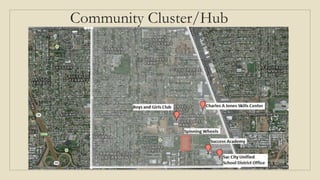
Community Cluster/Hub
Introduction to Spinning Wheels
◦ Community Context
◦ Diverse neighborhood with large youth population
◦ Issues of poverty, gang violence, safety & transportation access
◦ Project
◦ Spinning Wheels and the Lemon Hill Community Hub
◦ Focuses on youth development, access to safe and affordable transit,
builds on existing community assets
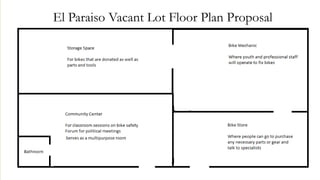
El Paraiso Vacant Lot Floor Plan Proposal
Project Logistics
◦ 1. Cleaning up El Paraiso Vacant Lot
◦ 2. Spinning Wheels Building
◦ Bike shop area
◦ Large mechanic space, small storefront for sales
◦ Bike storage
◦ Community Meeting Space
◦ 3. Paved area for classes
Budget
◦ Non-profit model
◦ Funding sources
◦ Grants, private fundraising
◦ Revenue from fixing bikes, selling new parts and accessories, selling used bicycles (that were donated and
fixed up)
◦ Overview of costs
◦ One-time start-up costs: vacant lot clean-up, building bike shop
◦ Day-to-day: Staff salaries, building maintenance, program costs
◦ Staffing Model
◦ 1 Full-time Executive Director
◦ 1 Part-time Mechanic and Bike-shop Manager
◦ 2-4 Paid youth staff
◦ Volunteers!!
Theories of Poverty
◦ (Culture of Poverty)
◦ Transmitted Deprivation Cycle: transmitted gang culture
◦ Misdistribution of Resources and Opportunity: poor funding for
schools and public transportation system
◦ Institutional Malfunctioning: inability of larger political institutions to
take action in neighborhood
◦ Structural Class Conflict: history of capitalist exploitation and
marginalization of neighborhood
Strategies
◦ Developing skills: bike maintenance skills, entrepreneurial skills,
communication skills
◦ Developing a business: accessing local assets- local market and local
capital
◦ Developing community: collective empowerment, accountability,
collaboration, communication
◦ Developing political engagement: collective action, leverage and
activism, participation
Strategies Cont: Building Strong Ties
◦ Connecting to UC Davis bicycle community
◦ Bringing in skilled volunteers with bike knowledge and bicycle
donations
◦ Creation of Lemon Hill Community Cluster
◦ Boys & Girls Club
◦ Charles A. Jones Skills Center
◦ Local schools and churches
RELEVANT DATA
Supporting Evidence From Census Demographic Data
sup
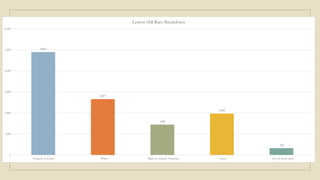
4,894
2,657
1446
1,969
322
0
1,000
2,000
3,000
4,000
5,000
6,000
Hispanic or Latino White Black or African American Asian Two or more races
Lemon Hill Race Breakdown
0
5
10
15
20
25
0-9 10-19 20-29 30-39 40-49 50-59 60-69 70-79 80+
PERCENTOFTOTALPOPULATION
AGE GROUPS
Breakdown of Population by Age
Percent
0%
10%
20%
30%
40%
50%
60%
70%
80%
White Black or African American Asian Some other race Hispanic or Latino
Percentage of People in Poverty by Race
CT 44.01 CT 46.01
0
500
1,000
1,500
2,000
2,500
3,000
3,500
4,000
4,500
5,000
2002 2003 2004 2005 2006 2007 2008 2009 2010 2011
EMPLOYED RESIDENTS AREA JOBS
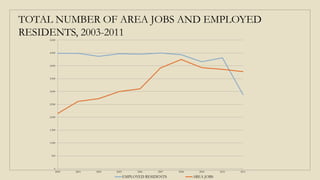
TOTAL NUMBER OF AREA JOBS AND EMPLOYED
RESIDENTS, 2003-2011
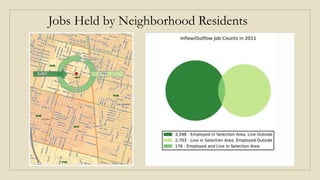
Jobs Held by Neighborhood Residents
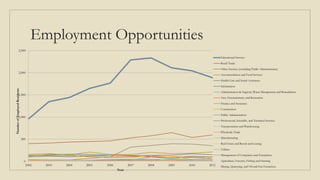
Employment Opportunities
0
500
1,000
1,500
2,000
2,500
2002 2003 2004 2005 2006 2007 2008 2009 2010 2011
NumberofEmployedResidents
Year
Educational Services
Retail Trade
Other Services (excluding Public Administration)
Accommodation and Food Services
Health Care and Social Assistance
Information
Administration & Support, Waste Management and Remediation
Arts, Entertainment, and Recreation
Finance and Insurance
Construction
Public Administration
Professional, Scientific, and Technical Services
Transportation and Warehousing
Wholesale Trade
Manufacturing
Real Estate and Rental and Leasing
Utilities
Management of Companies and Enterprises
Agriculture, Forestry, Fishing and Hunting
Mining, Quarrying, and Oil and Gas Extraction
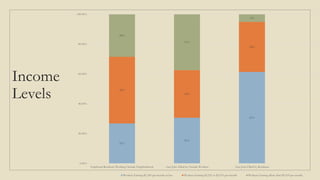
Income
Levels
27%
31%
61%
45%
32%
34%
28%
37%
5%
0.00%
20.00%
40.00%
60.00%
80.00%
100.00%
Employed Residents Working Outside Neighborhood Area Jobs Filled by Outside Workers Area Jobs Filled by Residents
Workers Earning $1,250 per month or less Workers Earning $1,251 to $3,333 per month Workers Earning More than $3,333 per month
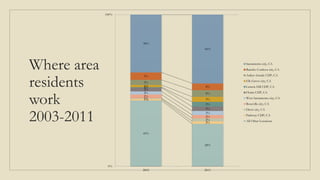
Where area
residents
work
2003-2011
43%
28%
1%
2%
1%
2%
2%
2%
2%
3%
2%
3%
0%
3%
1%
3%
3%
4%
5%
4%
38%
45%
0%
100%
2003 2011
Sacramento city, CA
Rancho Cordova city, CA
Arden-Arcade CDP, CA
Elk Grove city, CA
Lemon Hill CDP, CA
Florin CDP, CA
West Sacramento city, CA
Roseville city, CA
Davis city, CA
Parkway CDP, CA
All Other Locations
SITE VISIT
RESEARCH
Boys and Girls Club, Charles A Jones Skills Center, Fruitridge Community
Center, Public Schools etc.
Boys and Girls Club
◦Assets
◦ service children ages 6-18
◦ provides gang prevention program
◦ comprehensive facility
◦Barriers
◦ transportation for nearby kids
◦ gang activity in the area
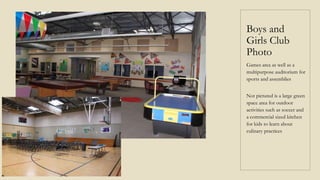
Boys and
Girls Club
Photo
Games area as well as a
multipurpose auditorium for
sports and assemblies
Not pictured is a large green
space area for outdoor
activities such as soccer and
a commercial sized kitchen
for kids to learn about
culinary practices
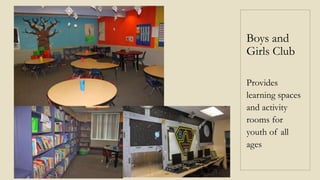
Boys and
Girls Club
Provides
learning spaces
and activity
rooms for
youth of all
ages
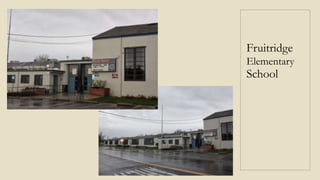
Fruitridge
Elementary
School
CONCLUDING
THOUGHTS
Expected Outcomes
Micro:
◦ After-school programs for engagement
◦ Elimination of gang violence
◦ Soft and hard skills-building for youth
◦ Access to affordable bicycles and repair
Macro:
◦ Greater social mobility
◦ Stronger community ties
◦ Interconnected community development hub
◦ Community Activism
Proposal Weaknesses
◦ Building necessary infrastructure would take time and money
◦ Currently lack of transportation infrastructure
◦ Would create a limited number of jobs
◦ Fair amount of capital investment involved (tools, etc.)
◦ Could be difficult to access adequate funding for start-up
Proposal Strengths
◦ Develops skills of youth in neighborhood
◦ Familiarizes youth with running a business
◦ Actually create paid positions for youth
◦ Proposal works to address multiple challenges in neighborhood
◦ Transportation access, need for institutions supporting youth, safer streets and neighborhood,
getting people engaged in community
◦ Building on and utilizing the already existing assets of the community
◦ Draws on the knowledge and resources of the strong UC Davis bicycling
community
◦ Because it is a business it has the potential to bring in dollars from the greater
Sacramento community
In Conclusion
◦ An analytical response to our collection of both in-person qualitative
data and census demographic quantitative data
◦ Census data was useful for framing our perceptions and questions
◦ Our site visits was the catalyst and gave us the information we needed
to create our proposal
◦ Inherent need for both types of data

Lemon Hill

  • 1.
    SPINNING WHEELS And thecreation of the Lemon Hill Community Hub
  • 2.
    Outline Project Proposal Mission Statement OurVision Project Logistics Budget Theories of Poverty & Strategies Relevant Data Site Visit Research Concluding Thought Strengths and Weaknesses of Proposal Conclusion
  • 3.
    Project Proposal Building acommunity bike collective with: ◦ Non-profit bike shop ◦ Low-cost bicycle repair and sales of used bikes ◦ Fellowship: employment program for teens ◦ Community classes ◦ Youth after-school bicycle safety class ◦ Weekend classes for all ages ◦ Organizing for safer/better transportation
  • 4.
    Mission Statement ◦Spinning Wheelsbelieves that everyone in the community should have access to affordable and safe transportation and we work to empower youth through skills training and mentoring
  • 5.
    Our Vision ◦Cultivation ofskilled and capable individuals. ◦Emergence of a “Community-Based Space hub” ◦Emergence of political knowledge and activism among people involved in Spinning Wheels. ◦Stronger community ties and collaboration.
  • 6.
  • 7.
    Introduction to SpinningWheels ◦ Community Context ◦ Diverse neighborhood with large youth population ◦ Issues of poverty, gang violence, safety & transportation access ◦ Project ◦ Spinning Wheels and the Lemon Hill Community Hub ◦ Focuses on youth development, access to safe and affordable transit, builds on existing community assets
  • 10.
    El Paraiso VacantLot Floor Plan Proposal
  • 11.
    Project Logistics ◦ 1.Cleaning up El Paraiso Vacant Lot ◦ 2. Spinning Wheels Building ◦ Bike shop area ◦ Large mechanic space, small storefront for sales ◦ Bike storage ◦ Community Meeting Space ◦ 3. Paved area for classes
  • 12.
    Budget ◦ Non-profit model ◦Funding sources ◦ Grants, private fundraising ◦ Revenue from fixing bikes, selling new parts and accessories, selling used bicycles (that were donated and fixed up) ◦ Overview of costs ◦ One-time start-up costs: vacant lot clean-up, building bike shop ◦ Day-to-day: Staff salaries, building maintenance, program costs ◦ Staffing Model ◦ 1 Full-time Executive Director ◦ 1 Part-time Mechanic and Bike-shop Manager ◦ 2-4 Paid youth staff ◦ Volunteers!!
  • 13.
    Theories of Poverty ◦(Culture of Poverty) ◦ Transmitted Deprivation Cycle: transmitted gang culture ◦ Misdistribution of Resources and Opportunity: poor funding for schools and public transportation system ◦ Institutional Malfunctioning: inability of larger political institutions to take action in neighborhood ◦ Structural Class Conflict: history of capitalist exploitation and marginalization of neighborhood
  • 14.
    Strategies ◦ Developing skills:bike maintenance skills, entrepreneurial skills, communication skills ◦ Developing a business: accessing local assets- local market and local capital ◦ Developing community: collective empowerment, accountability, collaboration, communication ◦ Developing political engagement: collective action, leverage and activism, participation
  • 15.
    Strategies Cont: BuildingStrong Ties ◦ Connecting to UC Davis bicycle community ◦ Bringing in skilled volunteers with bike knowledge and bicycle donations ◦ Creation of Lemon Hill Community Cluster ◦ Boys & Girls Club ◦ Charles A. Jones Skills Center ◦ Local schools and churches
  • 16.
    RELEVANT DATA Supporting EvidenceFrom Census Demographic Data sup
  • 17.
    4,894 2,657 1446 1,969 322 0 1,000 2,000 3,000 4,000 5,000 6,000 Hispanic or LatinoWhite Black or African American Asian Two or more races Lemon Hill Race Breakdown
  • 18.
    0 5 10 15 20 25 0-9 10-19 20-2930-39 40-49 50-59 60-69 70-79 80+ PERCENTOFTOTALPOPULATION AGE GROUPS Breakdown of Population by Age Percent
  • 19.
    0% 10% 20% 30% 40% 50% 60% 70% 80% White Black orAfrican American Asian Some other race Hispanic or Latino Percentage of People in Poverty by Race CT 44.01 CT 46.01
  • 22.
    0 500 1,000 1,500 2,000 2,500 3,000 3,500 4,000 4,500 5,000 2002 2003 20042005 2006 2007 2008 2009 2010 2011 EMPLOYED RESIDENTS AREA JOBS TOTAL NUMBER OF AREA JOBS AND EMPLOYED RESIDENTS, 2003-2011
  • 23.
    Jobs Held byNeighborhood Residents
  • 24.
    Employment Opportunities 0 500 1,000 1,500 2,000 2,500 2002 20032004 2005 2006 2007 2008 2009 2010 2011 NumberofEmployedResidents Year Educational Services Retail Trade Other Services (excluding Public Administration) Accommodation and Food Services Health Care and Social Assistance Information Administration & Support, Waste Management and Remediation Arts, Entertainment, and Recreation Finance and Insurance Construction Public Administration Professional, Scientific, and Technical Services Transportation and Warehousing Wholesale Trade Manufacturing Real Estate and Rental and Leasing Utilities Management of Companies and Enterprises Agriculture, Forestry, Fishing and Hunting Mining, Quarrying, and Oil and Gas Extraction
  • 25.
    Income Levels 27% 31% 61% 45% 32% 34% 28% 37% 5% 0.00% 20.00% 40.00% 60.00% 80.00% 100.00% Employed Residents WorkingOutside Neighborhood Area Jobs Filled by Outside Workers Area Jobs Filled by Residents Workers Earning $1,250 per month or less Workers Earning $1,251 to $3,333 per month Workers Earning More than $3,333 per month
  • 26.
    Where area residents work 2003-2011 43% 28% 1% 2% 1% 2% 2% 2% 2% 3% 2% 3% 0% 3% 1% 3% 3% 4% 5% 4% 38% 45% 0% 100% 2003 2011 Sacramentocity, CA Rancho Cordova city, CA Arden-Arcade CDP, CA Elk Grove city, CA Lemon Hill CDP, CA Florin CDP, CA West Sacramento city, CA Roseville city, CA Davis city, CA Parkway CDP, CA All Other Locations
  • 27.
    SITE VISIT RESEARCH Boys andGirls Club, Charles A Jones Skills Center, Fruitridge Community Center, Public Schools etc.
  • 28.
    Boys and GirlsClub ◦Assets ◦ service children ages 6-18 ◦ provides gang prevention program ◦ comprehensive facility ◦Barriers ◦ transportation for nearby kids ◦ gang activity in the area
  • 30.
    Boys and Girls Club Photo Gamesarea as well as a multipurpose auditorium for sports and assemblies Not pictured is a large green space area for outdoor activities such as soccer and a commercial sized kitchen for kids to learn about culinary practices
  • 31.
    Boys and Girls Club Provides learningspaces and activity rooms for youth of all ages
  • 32.
  • 33.
  • 34.
    Expected Outcomes Micro: ◦ After-schoolprograms for engagement ◦ Elimination of gang violence ◦ Soft and hard skills-building for youth ◦ Access to affordable bicycles and repair Macro: ◦ Greater social mobility ◦ Stronger community ties ◦ Interconnected community development hub ◦ Community Activism
  • 35.
    Proposal Weaknesses ◦ Buildingnecessary infrastructure would take time and money ◦ Currently lack of transportation infrastructure ◦ Would create a limited number of jobs ◦ Fair amount of capital investment involved (tools, etc.) ◦ Could be difficult to access adequate funding for start-up
  • 36.
    Proposal Strengths ◦ Developsskills of youth in neighborhood ◦ Familiarizes youth with running a business ◦ Actually create paid positions for youth ◦ Proposal works to address multiple challenges in neighborhood ◦ Transportation access, need for institutions supporting youth, safer streets and neighborhood, getting people engaged in community ◦ Building on and utilizing the already existing assets of the community ◦ Draws on the knowledge and resources of the strong UC Davis bicycling community ◦ Because it is a business it has the potential to bring in dollars from the greater Sacramento community
  • 37.
    In Conclusion ◦ Ananalytical response to our collection of both in-person qualitative data and census demographic quantitative data ◦ Census data was useful for framing our perceptions and questions ◦ Our site visits was the catalyst and gave us the information we needed to create our proposal ◦ Inherent need for both types of data

Editor's Notes

  • #4 We are proposing a community bike collective called Spinning Wheels, to be built on the El Paraiso vacant lot in the southeast corner of our neighborhood. The project takes a multi-pronged approach that focuses on youth engagement and skill development as well as improving affordable and active transportation for the whole community. The heart of the project would be running a non-profit bike shop that would do both bicycle repairs and used bicycle sales. The shop would offer low-cost used bicycles and bicycle repair to the area. An integral part of the bike shop would be a program to employ youth in the neighborhood. We envision a fellowship to employment program that would train teenagers in bicycle mechanics, business management and sales skills. We would have a small staff that would run the bike shop and fellowship program. Because the number of youth who could actually be employed would be fairly small, in order to extend engagement in the youth community, we would offer after-school classes that teach bicycle safety and bike-fixing skills. The other key aspect of Spinning Wheels would be to engage the entire Lemon Hill community around issues of transportation access and safe neighborhood transportation. This could involve organizing the community to push for installation of bike lanes, better bus transit service, or traffic calming measures such as speed bumps.
  • #5 It is important to us to have a mission statement that speaks to all of our goals so that the public knows what we are about and can get involved.
  • #6 Our vision for this project is multi-layered. Firstly, we hope that the project cultivates skilled and capable individuals. Secondly, we hope to see the emergence of a “Community-Based Space hub,” a collaborative cluster of community-oriented people, projects and institutions. We thirdly hope to see an emergence of political knowledge and activism among people involved in Spinning Wheels, that those involved will feel empowered to protest the injustices in their neighborhood and push for change. We lastly hope that our project eventually results in stronger community ties and collaboration.
  • #7 Cluster Theory (from our google mash-up) Cluster of community-oriented organizations and institutions. There are also a lot of schools in this area.
  • #8 Our neighborhood has specific characteristics that have lead us to choosing a bike collective for our proposal. We  have a diverse neighborhood that we will talk about more in detail later. We many assets that we would like the youth to utilize and hope that our collect addresses so of the barriers we discovered through our census investigation and our site visits.
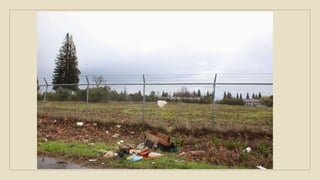
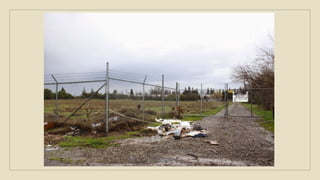
  • #9 This is the vacant lot we chose. As you noticed from the map above it is located in a hub of youth and community development making it an ideal location for Spinning wheels.
  • #10 This is an additional picture of our vacant lot. You can see that there is some work that needs to be, trash that needs to be picked up but there is definitely a lot of potential. There is enough space to create our building but also host classes that actually get people on bikes and have room to ride around.
  • #11 (use this slide with the previous slide as a visual to explain the infrastructure)
  • #12 As part of the bike collective, we propose a building that would have four distinct parts to its design. There would be a bike shop area with a large space for bicycle mechanic work a small sales area with bikes on display. There would be a sizeable storage area for donated bicycles and bikes being serviced. Finally, there would be a community meeting space with tables, chairs and large whiteboards. This space could be utilized as a classroom and a place for community organizing.  
  • #13 Our budget has four main pieces. We understand that our neighborhood is financially not well off which is why we aim to get funding from more than just the revenue of the bike shop if we are to be successful in accomplishing all of our goals.
  • #14 Our project relies on the entire spectrum of poverty theories. In a large structural sense, the marginalization that Lemon Hill individuals face is historically predicated on capitalist exploitation of individuals and land, otherwise known as “structural class conflict” which has led to a misdistribution of resources and opportunities. And although these are important to look at, they are difficult to address because of the sheer complexity of those processes.  Our project more closely addresses the theories of institutional malfunctioning and the transmitted deprivation cycle, which help explain both why local infrastructure is lacking, and why local residents are unable to interact with and embrace the scarce resources that are available.
  • #15 We believe that social change can and should happen through a variety of developmental devices. Our project attempts to cultivate different levels of development. We hope to develop skills among young people, like bike maintenance skills and entrepreneurial skills. We hope to develop a non-profit business, by accessing the local market and local human and financial capital. We hope to develop a sense of community among those involved, by facilitating collective empowerment, accountability and social leverage. We lastly hope to develop a desire among young people for political engagement, by highlighting the stake they have in local and regional politics and development. To accomplish these forms of development, we rely on a synthesis of market-based and social goals, inspiring social innovation by incentivizing sweat equity, and using business strategies as an instrument for individual and social development.
  • #16 Because our neighborhood is close to UC Davis which is an extremely bike friendly community we aim to partner with the college to encourage bike use in our neighborhood and hopefully work out a program that sends used bikes to Spinning Wheels to be worked on and distributed into the Lemon Hill community. Through Our site visit we found that there is something of a cluster of development centers such as the Boys and Girls Club (we will talk about later), the Charles A. Jones Skills center and other local schools and churches. This inspired choice of location but also the goal of using these assets and working with them to create strong ties instead of starting from the ground up and creating a project that stands alone.
  • #18 (As shown in lab assignment 1) Hispanic or Latino people make up greater than ⅓ of the  total population Shows a highly diverse population
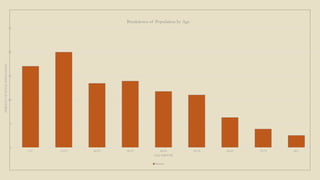
  • #19 (As shown in lab  assignment 1) The neighborhood is primarily made up of youth between the ages of 0-19 making up nearly 38% of the total population. Roughly 12 % of the population is older than sixty which reaffirms the fact that younger populations of people primarily inhabit the area.
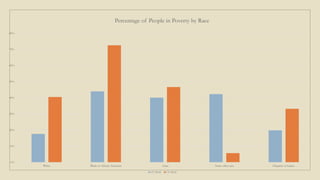
  • #20 (As shown in lab assignment 1) Although African Americans make up a small percentage of the total population, they also represent the group with the largest levels of poverty in both census tracts within our neighborhood.  The census tract 46.01 which represents our southern region of the census tract has higher overall levels of poverty and also respectively contain more people. Census tract 46.01 has higher overall percentages of people in poverty but that is correlated to their denser population.
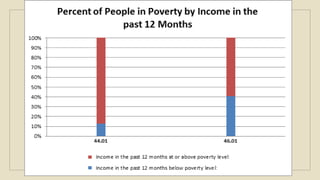
  • #21 (As shown in lab assignment 1) Within census tract 46.01, 40% (3,133individual) of the people have lived below poverty within the last year. It is important to note that these numbers are based off of the U.S Census Bureau’s definition of poverty which does not necessarily represent the total number of people in poverty. In fact, more people in the neighborhood are experiencing poverty but it doesn’t reflect the national definition so they are excluded. Census tract 44.01 has roughly 12% (689 individual people) of people living below the poverty level which is a high number considering the total population is smaller on a representative scale than tract 46.01
  • #22 (As shown in lab assignment 2) Overall, area jobs has been steadily increasing since 2002, hitting its peak in 2008 before steadily dropping off. The number of employed residents in the neighborhood has remained steady with a slow decline until 2010 when it dropped dramatically from roughly 4,300 to 2,800 people. The unemployment rate in Lemon Hill is 22% which is twice the level of Sacramento county, posing a huge problem for residents in the area.
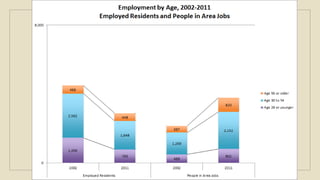
  • #23 (As shown in lab assignment 2) The main industry located in the neighborhood is education which has to do with the number of elementary schools located in the area as well as the vocational school. In 2009-2010, there was a dramatic decrease in the number of area jobs, dropping from 4,200 jobs to 2,800. Although the population of youth has been increasing, their ability to obtain jobs has decreased from 1,456 in 2002 to 783 in 2011
  • #24 (As shown in lab assignment 2) Looking at the inflow outflow chart it becomes apparent that there are very few residents who live and work in the neighborhood. There are a variety of reasons why that is that you will see in the upcoming slides. The important thing to take from this slide is the low number of residents working in the neighborhood and the amount that come in to work and the amount that leave. Clearly there are jobs in the neighborhood but what kind of jobs we will look at shortly.
  • #25 (As shown in lab 2) Both tracts saw their highest employment in public administration and health care. This distribution was fairly even with both health and public administration employing about 12% of the residents in each tract. This is vastly different than the distribution of area jobs which sees the highest employment in retail trade and the educational sector.
  • #26 (as shown in lab assignment 2) 28% of residents who took jobs outside of the neighborhood made more than $3,333 a month while only 5% those working in the neighborhood made that amount on average. 27% of residents who lived in the neighborhood but worked outside made $1,250 a month or less, but 61% of residents who filled area jobs made $1,250 or less a month.
  • #27 (As shown in lab assignment 2) From 2003 to 2011 there has been growth in residents working in Sacramento from 38% to 45%. There has been a decrease in residents working in “all other locations” from 43% to 28% which indicates a higher concentration of workers in Sacramento City in 2011 than in 2003.
  • #29 The Boys and Girls Club only captures kids into their early teens. They are equipped to facilitate kids from the ages of 6-18 but it was stated that they very rarely see kids past the ages of 13-14. On our site visit we noticed that the majority of the schools were near the Boys and Girls Club but there was no way of bussing kids directly from school to the Boys and Girls Club facility which is where the idea for Spinning Wheels began to emerge. We recognized that barriers such as lack of bike lanes and the high cost of a new bike  prevent kids from biking between the two locations. This is why we are proposing a multi-pronged idea that would allow older teens a space to learn new skills, empower them to fight for a bike safe community and provide bikes for those who cannot afford a new one.
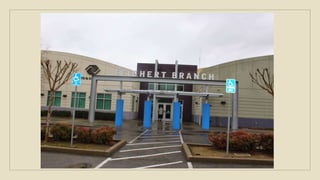
  • #30 This is the entrance to the Boys and Girls Club which is located in the southeast corner of our neighborhood.
  • #31 It is a large facility that offers a variety of spaces to encourage academics and fun.
  • #32 There is plenty of space for kids of all ages to get help with school work and focus on literacy. The computer room decorated like space is by far the most popular location with lines out the door on busy days. There are classrooms catered specifically to wee ones and a teen room (not pictured) so that every age group feels like they have a special space to do homework or just hang out with friends and be a kid.
  • #33 This is one of the local schools nearby our lot and development hub we are focusing on.
  • #35 Vision as multi-layered: Micro and Macro level Engage at the individual, community and regional level.
  • #36 We have addressed potential weaknesses of our proposal Limited transportation infrastructure: bike lanes and safe streets for utilizing bikes as transportation The capitol is potentially prone vandalism or theft
  • #37 The strengths outweigh the weaknesses because of the expected human agency that could be gained through youth development and engagement. There are a multitude of potential resources located in the surrounding area. It is also rare to find projects that target multiple levels of issues and assets, and this proposal does just that.
  • #38 Ta daa!