PROSPECTIVELY IDENTIFYING
MEDICAID-ELIGIBLE ADULTS WITH
HIGH HEALTH CARE NEEDS
LINDSEY LEININGER, PH.D.
UNIVERSITY OF ILLINOIS AT CHICAGO
NASHP’S 26TH ANNUAL STATE HEALTH POLICY CONFERENCE
OCTOBER 11, 2013
SEATTLE, WASHINGTON

(joint work with Laura Wherry and Marguerite Burns)
Leininger

1

Acknowledgements
Funding from the Robert Wood Johnson
Foundation State Health Access Reform Evaluation
(SHARE) initiative (Leininger), Robert Wood
Johnson Foundation Health and Society Scholars
(Wherry), and National Institute of Mental Health
(NIMH) K01-MH902338 (Burns) is very gratefully
acknowledged.

Leininger

1
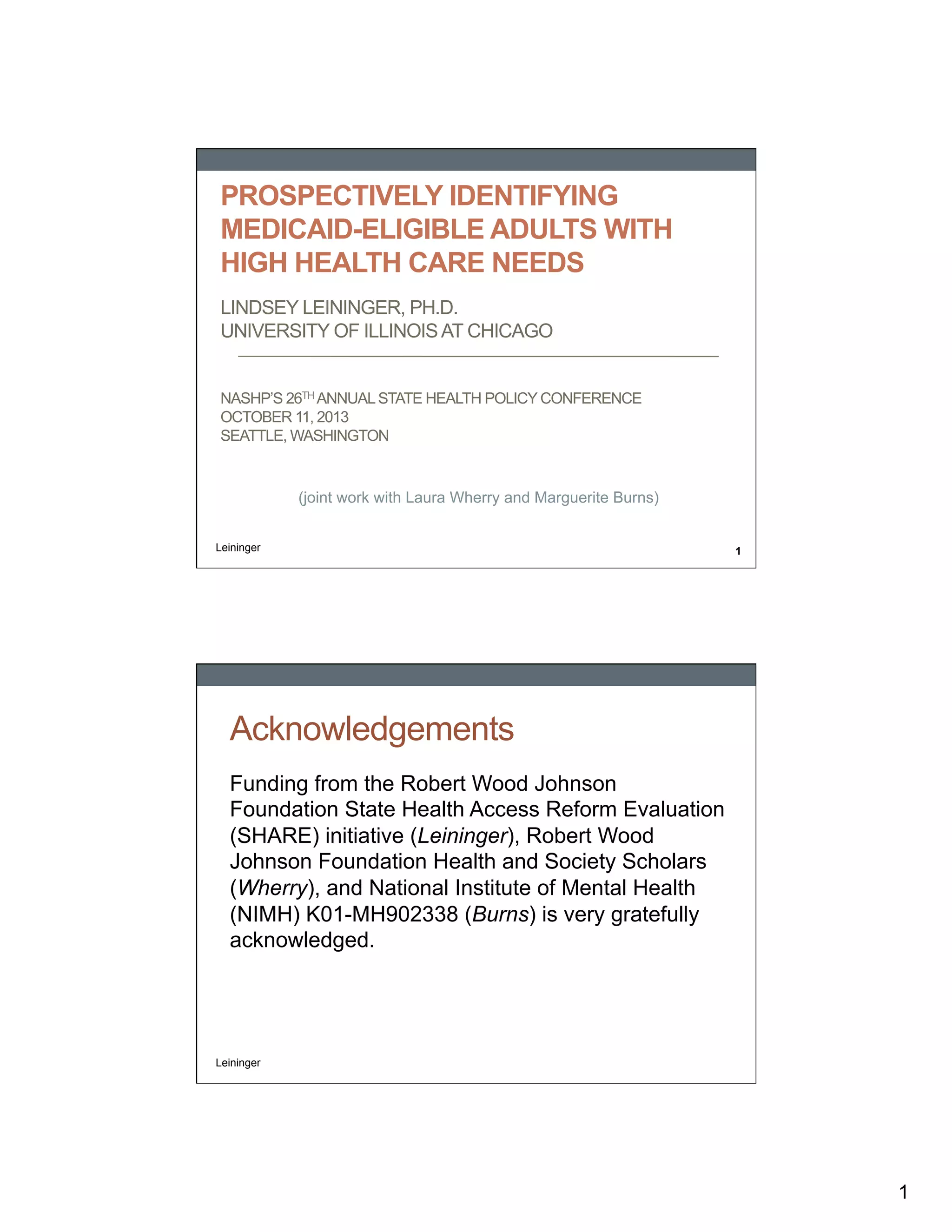
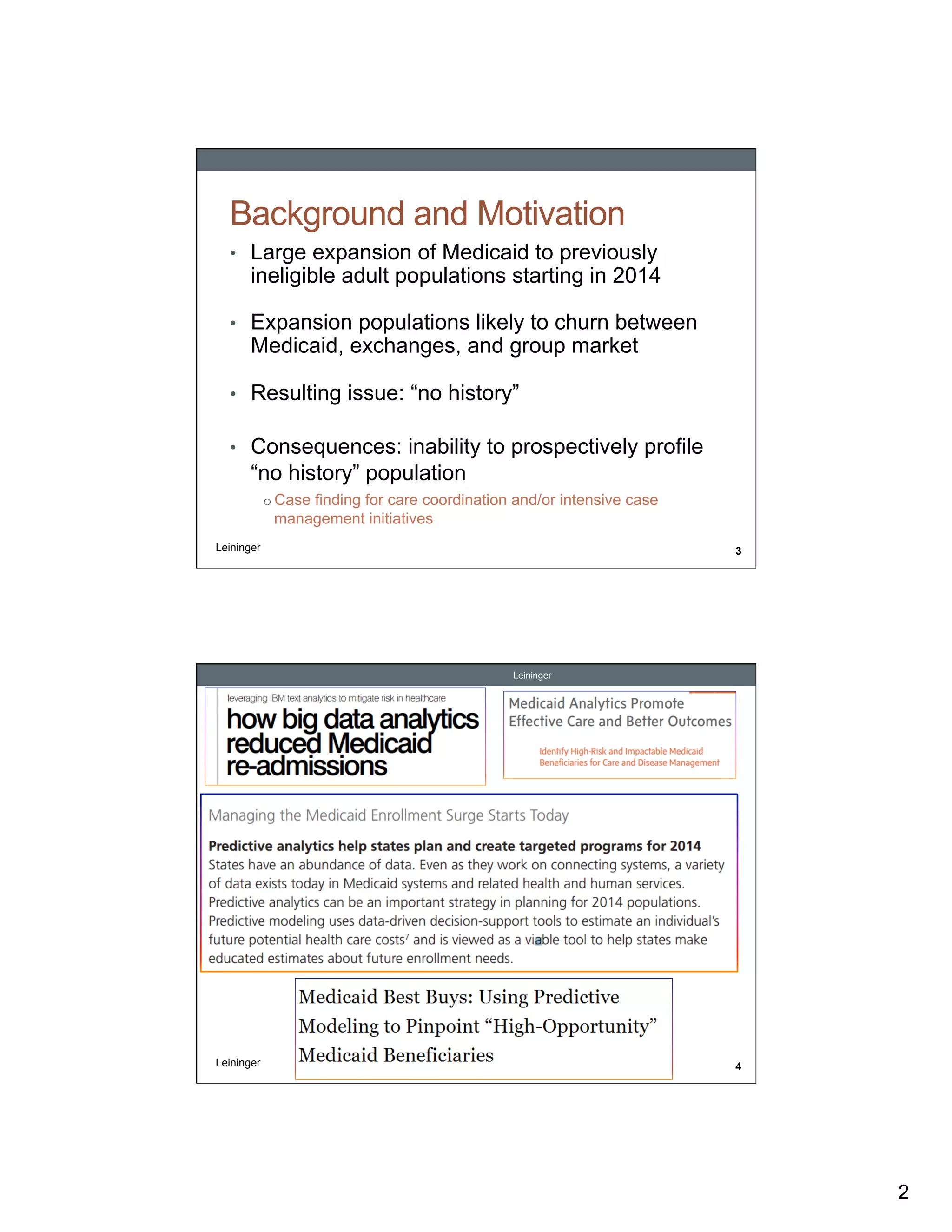
Background and Motivation
•  Large expansion of Medicaid to previously

ineligible adult populations starting in 2014

•  Expansion populations likely to churn between

Medicaid, exchanges, and group market

•  Resulting issue: “no history”
•  Consequences: inability to prospectively profile

“no history” population
o  Case finding for care coordination and/or intensive case

management initiatives
Leininger

3

Leininger

Leininger

4

2
Leininger

Can Self-Reported Health Measures
Serve as an Alternative for the “NoHistory” Population?
•  Necessary condition #1: Measures must be
predictive
•  Necessary condition #2: Insurers have
desire and ability to collect information

Leininger

5

Leininger

The Wisconsin Case Study
•  Recent pilot data collection effort among newly

eligible adults in Medicaid

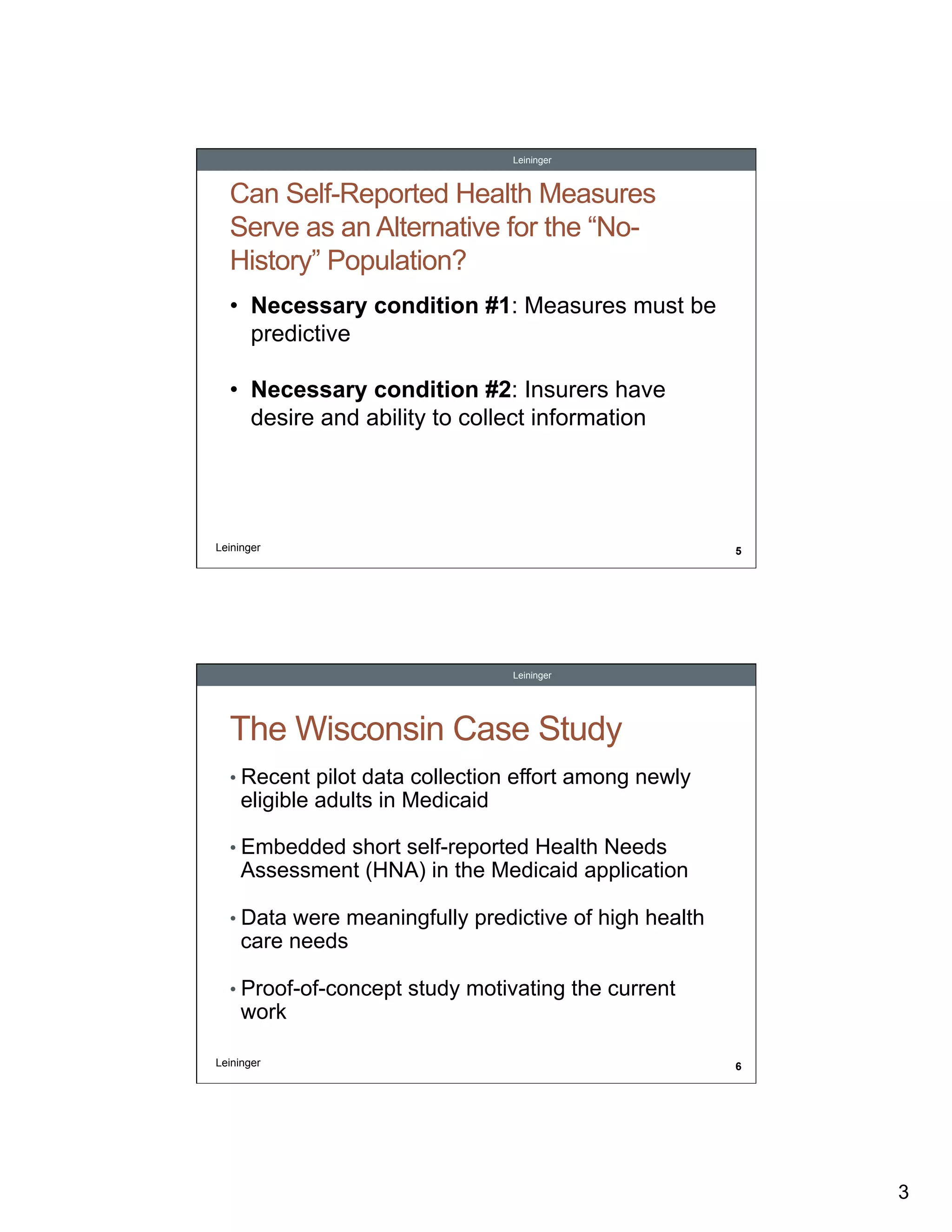
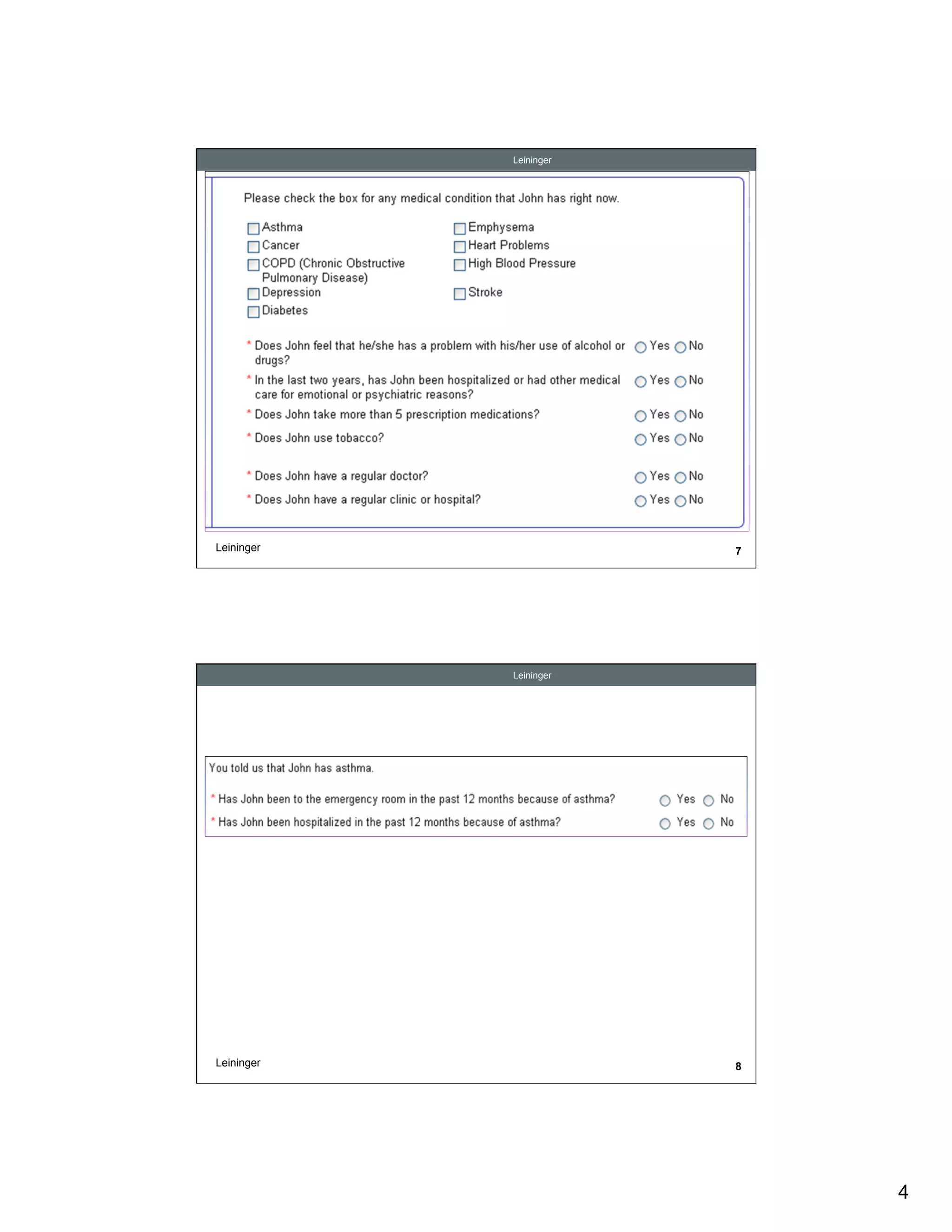
•  Embedded short self-reported Health Needs

Assessment (HNA) in the Medicaid application

•  Data were meaningfully predictive of high health

care needs

•  Proof-of-concept study motivating the current

work

Leininger

6

3
Leininger

Leininger

7

Leininger

Leininger

8

4
Leininger

Innovation
•  Contribute new knowledge regarding a key question:
o Which measures should be included in an HNA designed

to be predictive of high need?
•  Test performance of multiple dimensions of self-reported

measures using a nationally representative sample of
ACA expansion population
•  Examine outcomes of interest to state Medicaid agencies

to identify “high opportunity” Medicaid beneficiaries

Leininger

9

Leininger

Data, Sample, and Outcome Measures
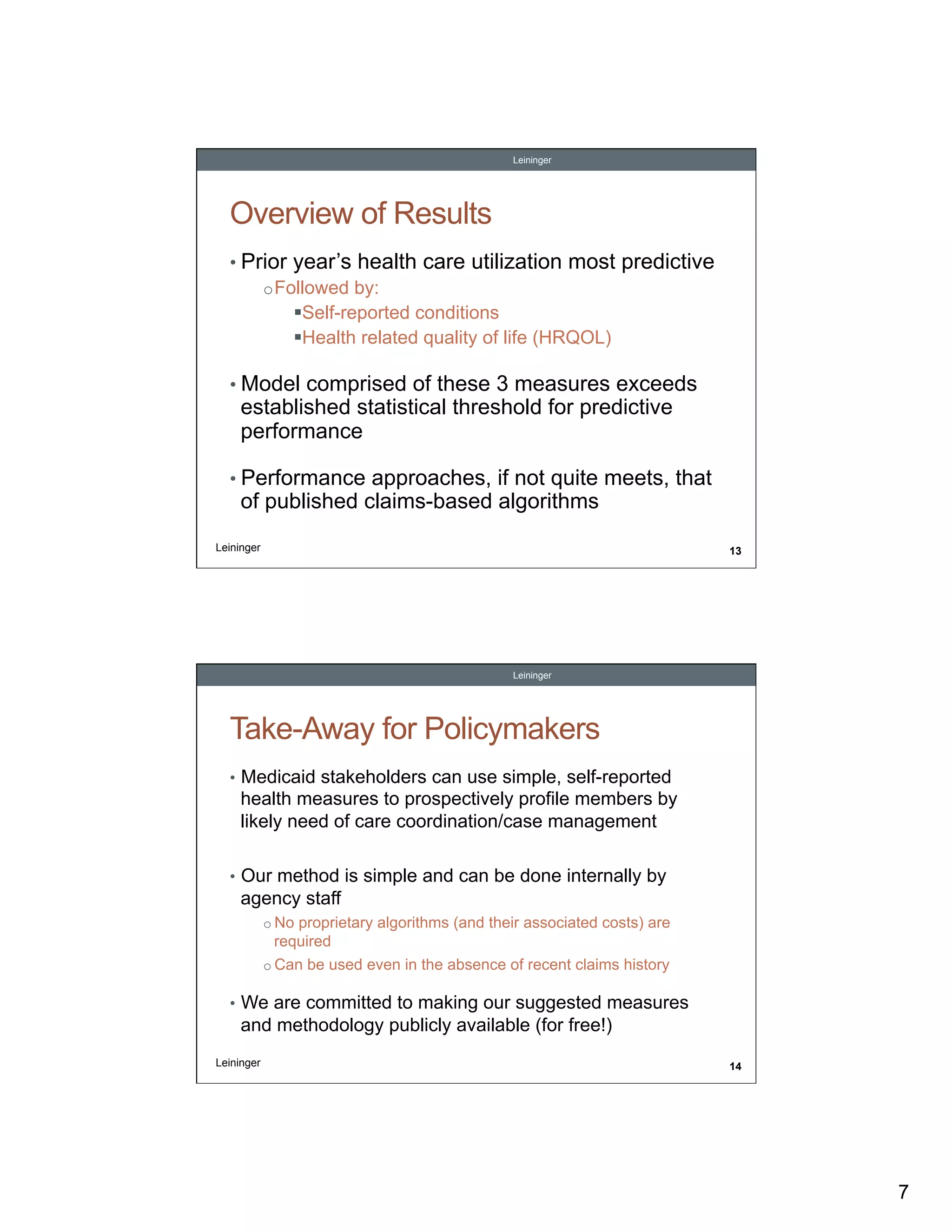
•  1997-2008 rounds of National Health Interview
Survey (NHIS) linked with 1998-2009 rounds of
the Medical Expenditure Panel Survey (MEPS)
•  Sample chosen to approximate the ACA adult
Medicaid expansion population
o  n = 6,615 adults ages 19-64 with family incomes
<138% FPL

•  Outcome measures: any inpatient visit; top ER
utilization decile (2+); top cost decile
Leininger

10

5
Leininger

Study Design

Leininger

11

Leininger

Predictors
•  Baseline: sociodemographic characteristics collected as

part of the Medicaid application
•  Candidate Domains:

o Presence of health conditions
o Mental health
o Access to care
o Health-related behaviors
o Health-related quality of life
o Prior year’s medical care utilization
Leininger

12

6
Leininger

Overview of Results
•  Prior year’s health care utilization most predictive
o Followed by:
! Self-reported conditions
! Health related quality of life (HRQOL)
•  Model comprised of these 3 measures exceeds

established statistical threshold for predictive
performance

•  Performance approaches, if not quite meets, that

of published claims-based algorithms

Leininger

13

Leininger

Take-Away for Policymakers
•  Medicaid stakeholders can use simple, self-reported

health measures to prospectively profile members by
likely need of care coordination/case management
•  Our method is simple and can be done internally by

agency staff
o  No proprietary algorithms (and their associated costs) are

required
o  Can be used even in the absence of recent claims history

•  We are committed to making our suggested measures

and methodology publicly available (for free!)
Leininger

14

7
Leininger

Supporting Slides

Leininger

15

Leininger

Leininger

16

8
Leininger

Leininger

17

9

Leininger nashp

  • 1.
    PROSPECTIVELY IDENTIFYING MEDICAID-ELIGIBLE ADULTSWITH HIGH HEALTH CARE NEEDS LINDSEY LEININGER, PH.D. UNIVERSITY OF ILLINOIS AT CHICAGO NASHP’S 26TH ANNUAL STATE HEALTH POLICY CONFERENCE OCTOBER 11, 2013 SEATTLE, WASHINGTON (joint work with Laura Wherry and Marguerite Burns) Leininger 1 Acknowledgements Funding from the Robert Wood Johnson Foundation State Health Access Reform Evaluation (SHARE) initiative (Leininger), Robert Wood Johnson Foundation Health and Society Scholars (Wherry), and National Institute of Mental Health (NIMH) K01-MH902338 (Burns) is very gratefully acknowledged. Leininger 1
  • 2.
    Background and Motivation • Large expansion of Medicaid to previously ineligible adult populations starting in 2014 •  Expansion populations likely to churn between Medicaid, exchanges, and group market •  Resulting issue: “no history” •  Consequences: inability to prospectively profile “no history” population o  Case finding for care coordination and/or intensive case management initiatives Leininger 3 Leininger Leininger 4 2
  • 3.
    Leininger Can Self-Reported HealthMeasures Serve as an Alternative for the “NoHistory” Population? •  Necessary condition #1: Measures must be predictive •  Necessary condition #2: Insurers have desire and ability to collect information Leininger 5 Leininger The Wisconsin Case Study •  Recent pilot data collection effort among newly eligible adults in Medicaid •  Embedded short self-reported Health Needs Assessment (HNA) in the Medicaid application •  Data were meaningfully predictive of high health care needs •  Proof-of-concept study motivating the current work Leininger 6 3
  • 4.
  • 5.
    Leininger Innovation •  Contribute newknowledge regarding a key question: o Which measures should be included in an HNA designed to be predictive of high need? •  Test performance of multiple dimensions of self-reported measures using a nationally representative sample of ACA expansion population •  Examine outcomes of interest to state Medicaid agencies to identify “high opportunity” Medicaid beneficiaries Leininger 9 Leininger Data, Sample, and Outcome Measures •  1997-2008 rounds of National Health Interview Survey (NHIS) linked with 1998-2009 rounds of the Medical Expenditure Panel Survey (MEPS) •  Sample chosen to approximate the ACA adult Medicaid expansion population o  n = 6,615 adults ages 19-64 with family incomes <138% FPL •  Outcome measures: any inpatient visit; top ER utilization decile (2+); top cost decile Leininger 10 5
  • 6.
    Leininger Study Design Leininger 11 Leininger Predictors •  Baseline:sociodemographic characteristics collected as part of the Medicaid application •  Candidate Domains: o Presence of health conditions o Mental health o Access to care o Health-related behaviors o Health-related quality of life o Prior year’s medical care utilization Leininger 12 6
  • 7.
    Leininger Overview of Results • Prior year’s health care utilization most predictive o Followed by: ! Self-reported conditions ! Health related quality of life (HRQOL) •  Model comprised of these 3 measures exceeds established statistical threshold for predictive performance •  Performance approaches, if not quite meets, that of published claims-based algorithms Leininger 13 Leininger Take-Away for Policymakers •  Medicaid stakeholders can use simple, self-reported health measures to prospectively profile members by likely need of care coordination/case management •  Our method is simple and can be done internally by agency staff o  No proprietary algorithms (and their associated costs) are required o  Can be used even in the absence of recent claims history •  We are committed to making our suggested measures and methodology publicly available (for free!) Leininger 14 7
  • 8.
  • 9.