Sorting in Arrays
CourseCode: CSC 2106
Dept. of Computer Science
Faculty of Science and Technology
Lecturer No: 4.1 Week No: 3 Semester: Summer’25
Lecturer: Dr. Mohammad Rabiul Islam. Email: rabiul.islam@aiub.edu
Course Title: Data Structure (Theory)
2.
Lecture Outline
1. Sorting:Definition and example
2. Bubble Sort
3. Selection Sort
4. Insertion Sort [next class]
3.
Sorting
Definition and example
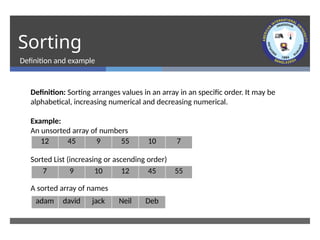
Definition:Sorting arranges values in an array in an specific order. It may be
alphabetical, increasing numerical and decreasing numerical.
Example:
An unsorted array of numbers
Sorted List (increasing or ascending order)
A sorted array of names
12 45 9 55 10 7
7 9 10 12 45 55
adam david jack Neil Deb
4.
Sorting
Applications
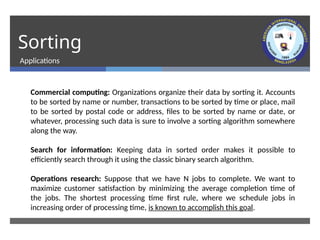
Commercial computing: Organizationsorganize their data by sorting it. Accounts
to be sorted by name or number, transactions to be sorted by time or place, mail
to be sorted by postal code or address, files to be sorted by name or date, or
whatever, processing such data is sure to involve a sorting algorithm somewhere
along the way.
Search for information: Keeping data in sorted order makes it possible to
efficiently search through it using the classic binary search algorithm.
Operations research: Suppose that we have N jobs to complete. We want to
maximize customer satisfaction by minimizing the average completion time of
the jobs. The shortest processing time first rule, where we schedule jobs in
increasing order of processing time, is known to accomplish this goal.
5.
Sorting
Applications
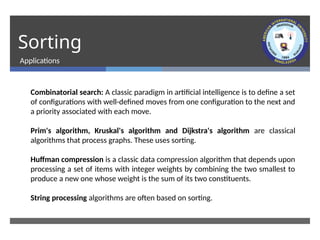
Combinatorial search: Aclassic paradigm in artificial intelligence is to define a set
of configurations with well-defined moves from one configuration to the next and
a priority associated with each move.
Prim's algorithm, Kruskal's algorithm and Dijkstra's algorithm are classical
algorithms that process graphs. These uses sorting.
Huffman compression is a classic data compression algorithm that depends upon
processing a set of items with integer weights by combining the two smallest to
produce a new one whose weight is the sum of its two constituents.
String processing algorithms are often based on sorting.
6.
Sorting
Bubble Sort
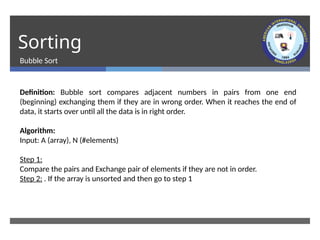
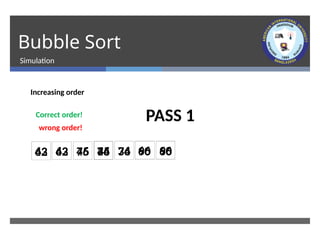
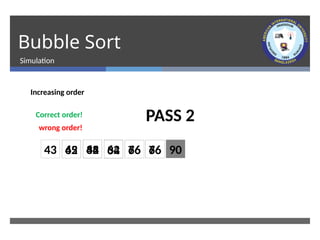
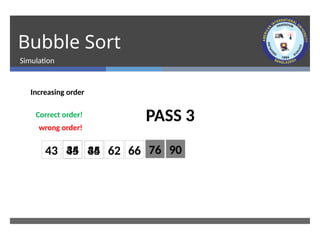
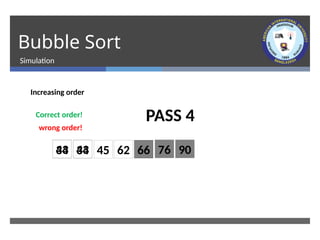
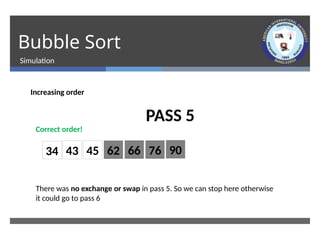
Definition: Bubblesort compares adjacent numbers in pairs from one end
(beginning) exchanging them if they are in wrong order. When it reaches the end of
data, it starts over until all the data is in right order.
Algorithm:
Input: A (array), N (#elements)
Step 1:
Compare the pairs and Exchange pair of elements if they are not in order.
Step 2: . If the array is unsorted and then go to step 1
7.
Bubble Sort
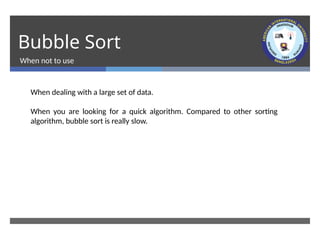
When notto use
When dealing with a large set of data.
When you are looking for a quick algorithm. Compared to other sorting
algorithm, bubble sort is really slow.
8.
Bubble Sort
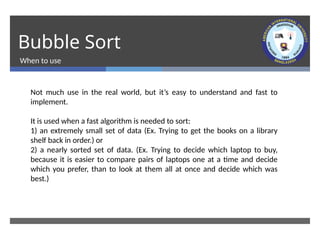
When touse
Not much use in the real world, but it’s easy to understand and fast to
implement.
It is used when a fast algorithm is needed to sort:
1) an extremely small set of data (Ex. Trying to get the books on a library
shelf back in order.) or
2) a nearly sorted set of data. (Ex. Trying to decide which laptop to buy,
because it is easier to compare pairs of laptops one at a time and decide
which you prefer, than to look at them all at once and decide which was
best.)
Sorting
Selection Sort
Selection sort:Locate smallest element in array. Interchange it with element in
position 0. Locate next smallest element in array. Interchange it with element in
position 1. Continue until all elements are arranged in order.
Algorithm:
Input: A (array), N (#elements)
Step 1: Find the smallest element from the positions starting at index to . Swap
the smallest element with the element at index .
Step 2: . If go to step 1
15.
Selection Sort
Simulation
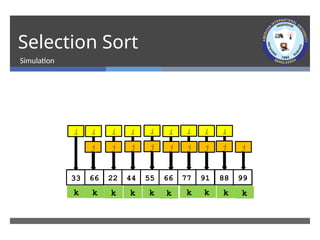
33
11 2266 33 77 91
33 66 22 99 77 11 91 55 88 44
88 99
91
44 55 77
66
i i i i i i i i i
j j
j j j j j j j
k k k k k k k k k k
16.
Selection Sort
Conclusion
More efficientthan Bubble Sort, since fewer exchanges.
An array with N elements needs exactly N-1 selections for fixing index 0 to N-2
Check: What will happen if a sorted array is given as input to Bubble Sort and
Selection Sort? You can think in terms of number of comparisons required for the
both algorithms.
Books
“Schaum's Outlineof Data Structures with C++”. By John R. Hubbard
“Data Structures and Program Design”, Robert L. Kruse, 3rd
Edition, 1996.
“Data structures, algorithms and performance”, D. Wood, Addison-Wesley, 1993
“Advanced Data Structures”, Peter Brass, Cambridge University Press, 2008
“Data Structures and Algorithm Analysis”, Edition 3.2 (C++ Version), Clifford A.
Shaffer, Virginia Tech, Blacksburg, VA 24061 January 2, 2012
“C++ Data Structures”, Nell Dale and David Teague, Jones and Bartlett Publishers,
2001.
“Data Structures and Algorithms with Object-Oriented Design Patterns in C++”,
Bruno R. Preiss,
![Lecture Outline
1. Sorting: Definition and example
2. Bubble Sort
3. Selection Sort
4. Insertion Sort [next class]](https://image.slidesharecdn.com/lecture04-250815003550-52308c62/85/Lecture_04-1-DataStructxure-3-1-pptx-2-320.jpg)