Analysis OF Algorithm
Bubble Sort
Learning outcomes
• What is sorting?
• What is bubble sort?
What is Sorting?
• Sorting is a process of arranging the values of array in a
particular order.
• A process that organizes a collection of data into either
ascending or descending order
• An array can be sorted in two orders:
 Ascending Order
 Descending Order
Data Structure
• Ascending Order
• In ascending order, the smallest value is stored in the first element
of array, second smallest value is stored in the second element and
so on. The largest value is stored in the last element.
• Descending Order
• In descending order, the largest value is stored in the first element
of arrays, second largest value is stored in the second element and
so on. The smallest value is stored in the last element.
Data Structure
Arrangement of Element Can Be
Bubble Sort Algorithm
• Bubble Sort is a simple algorithm which is used to sort a
given set of (N) elements.
• Bubble sort is also known as exchange sort.
• This sorting algorithm is comparison based algorithm in
which each pair of adjacent elements is compared and
elements are swapped if they are not in order.
• If we have total (N) elements, then we need to repeat this
process for (N-1) times.
Data Structure
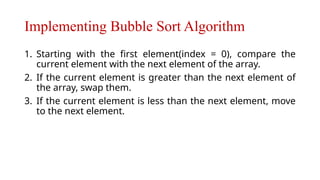
Implementing Bubble Sort Algorithm
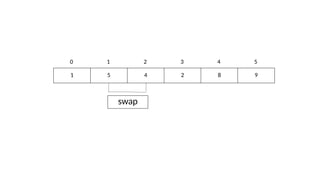
1. Starting with the first element(index = 0), compare the
current element with the next element of the array.
2. If the current element is greater than the next element of
the array, swap them.
3. If the current element is less than the next element, move
to the next element.
Data Structure
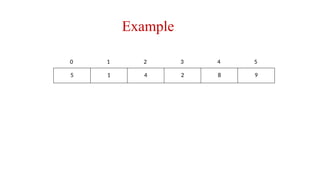
5 1 4 2 8 9
0 1 2 3 4 5
Data Structure
Example
swap
5 1 4 2 8 9
0 1 2 3 4 5
Data Structure
swap
1 5 4 2 8 9
0 1 2 3 4 5
Data Structure
swap
1 5 4 2 8 9
0 1 2 3 4 5
Data Structure
1 4 5 2 8 9
0 1 2 3 4 5
Data Structure
swap
1 4 5 2 8 9
0 1 2 3 4 5
Data Structure
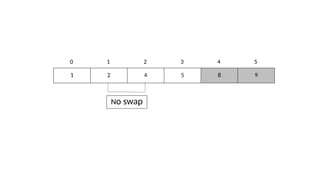
No swap
1 4 2 5 8 9
0 1 2 3 4 5
Data Structure
No swap
1 4 2 5 8 9
0 1 2 3 4 5
Data Structure
1 4 2 5 8 9
0 1 2 3 4 5
No swap
Data Structure
1 4 2 5 8 9
0 1 2 3 4 5
swap
Data Structure
1 2 4 5 8 9
0 1 2 3 4 5
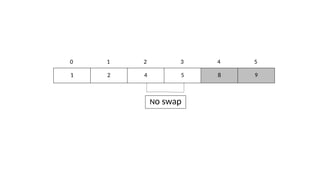
No swap
Data Structure
1 2 4 5 8 9
0 1 2 3 4 5
No swap
Data Structure
1 2 4 5 8 9
0 1 2 3 4 5
Data Structure
1 2 4 5 8 9
0 1 2 3 4 5
No swap
Data Structure
1 2 4 5 8 9
0 1 2 3 4 5
No swap
Data Structure
1 2 4 5 8 9
0 1 2 3 4 5
No swap
Data Structure
1 2 4 5 8 9
0 1 2 3 4 5
No swap
Data Structure
1 2 4 5 8 9
0 1 2 3 4 5
No swap
Data Structure
1 2 4 5 8 9
0 1 2 3 4 5
No swap
Data Structure
• The Sorted List:
1 2 4 5 8 9
0 1 2 3 4 5
1 2 4 5 8 9
0 1 2 3 4 5
Data Structure
Visual Representation
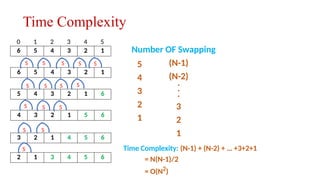
Time Complexity
Number OF Swapping
(N-1)
(N-2)
.
.
.
3
2
1
Time Complexity: (N-1) + (N-2) + … +3+2+1
= N(N-1)/2
= O(N2
)
6 5 4 3 2 1
6 5 4 3 2 1
5 4 3 2 1 6
4 3 2 1 5 6
3 2 1 4 5 6
2 1 3 4 5 6
0 1 2 3 4 5
S S S S S 5
4
3
2
1
S S
S S
S S S
S S
S
Code snippet
#include<iostream>
using namespace std;
int main() {
int size,i,j,temp;
cout<<"Enter The size of array:n"; cin>>size;
int arr[size]; cout<<"Enter The Elements:n";
for(i=0;i<size;i++){ cin>>arr[i]; }
cout<<"Before Sorting:"<<endl;
for(i=0;i<size;i++){ cout<<arr[i]<<"t"; }
Data Structure
Code snippet
for(i=0;i<size;i++){
for(j=0;j<size-1;j++){
if(arr[j]>arr[j+1]){
temp=arr[j];
arr[j]=arr[j+1];
arr[j+1]=temp; }
cout<<"n After Sorting:"<<endl;
for(i=0;i<size;i++)
cout<<arr[i]<<"t";
}
Data Structure
Thank You!!!

Chapter #4 (Bubble Sort jfdkjffdfdf).pptx

  • 1.
  • 2.
  • 3.
    Learning outcomes • Whatis sorting? • What is bubble sort?
  • 4.
    What is Sorting? •Sorting is a process of arranging the values of array in a particular order. • A process that organizes a collection of data into either ascending or descending order • An array can be sorted in two orders:  Ascending Order  Descending Order Data Structure
  • 5.
    • Ascending Order •In ascending order, the smallest value is stored in the first element of array, second smallest value is stored in the second element and so on. The largest value is stored in the last element. • Descending Order • In descending order, the largest value is stored in the first element of arrays, second largest value is stored in the second element and so on. The smallest value is stored in the last element. Data Structure Arrangement of Element Can Be
  • 6.
    Bubble Sort Algorithm •Bubble Sort is a simple algorithm which is used to sort a given set of (N) elements. • Bubble sort is also known as exchange sort. • This sorting algorithm is comparison based algorithm in which each pair of adjacent elements is compared and elements are swapped if they are not in order. • If we have total (N) elements, then we need to repeat this process for (N-1) times. Data Structure
  • 7.
    Implementing Bubble SortAlgorithm 1. Starting with the first element(index = 0), compare the current element with the next element of the array. 2. If the current element is greater than the next element of the array, swap them. 3. If the current element is less than the next element, move to the next element. Data Structure
  • 8.
    5 1 42 8 9 0 1 2 3 4 5 Data Structure Example
  • 9.
    swap 5 1 42 8 9 0 1 2 3 4 5 Data Structure
  • 10.
    swap 1 5 42 8 9 0 1 2 3 4 5 Data Structure
  • 11.
    swap 1 5 42 8 9 0 1 2 3 4 5 Data Structure
  • 12.
    1 4 52 8 9 0 1 2 3 4 5 Data Structure
  • 13.
    swap 1 4 52 8 9 0 1 2 3 4 5 Data Structure
  • 14.
    No swap 1 42 5 8 9 0 1 2 3 4 5 Data Structure
  • 15.
    No swap 1 42 5 8 9 0 1 2 3 4 5 Data Structure
  • 16.
    1 4 25 8 9 0 1 2 3 4 5 No swap Data Structure
  • 17.
    1 4 25 8 9 0 1 2 3 4 5 swap Data Structure
  • 18.
    1 2 45 8 9 0 1 2 3 4 5 No swap Data Structure
  • 19.
    1 2 45 8 9 0 1 2 3 4 5 No swap Data Structure
  • 20.
    1 2 45 8 9 0 1 2 3 4 5 Data Structure
  • 21.
    1 2 45 8 9 0 1 2 3 4 5 No swap Data Structure
  • 22.
    1 2 45 8 9 0 1 2 3 4 5 No swap Data Structure
  • 23.
    1 2 45 8 9 0 1 2 3 4 5 No swap Data Structure
  • 24.
    1 2 45 8 9 0 1 2 3 4 5 No swap Data Structure
  • 25.
    1 2 45 8 9 0 1 2 3 4 5 No swap Data Structure
  • 26.
    1 2 45 8 9 0 1 2 3 4 5 No swap Data Structure
  • 27.
    • The SortedList: 1 2 4 5 8 9 0 1 2 3 4 5 1 2 4 5 8 9 0 1 2 3 4 5 Data Structure
  • 28.
  • 29.
    Time Complexity Number OFSwapping (N-1) (N-2) . . . 3 2 1 Time Complexity: (N-1) + (N-2) + … +3+2+1 = N(N-1)/2 = O(N2 ) 6 5 4 3 2 1 6 5 4 3 2 1 5 4 3 2 1 6 4 3 2 1 5 6 3 2 1 4 5 6 2 1 3 4 5 6 0 1 2 3 4 5 S S S S S 5 4 3 2 1 S S S S S S S S S S
  • 30.
    Code snippet #include<iostream> using namespacestd; int main() { int size,i,j,temp; cout<<"Enter The size of array:n"; cin>>size; int arr[size]; cout<<"Enter The Elements:n"; for(i=0;i<size;i++){ cin>>arr[i]; } cout<<"Before Sorting:"<<endl; for(i=0;i<size;i++){ cout<<arr[i]<<"t"; } Data Structure
  • 31.
  • 32.