Heart Disease, Hypertension,
and Stroke
Psychological Issues in
     Advanced and Terminal
     Illness
   Average life expectancy in North America is
    76 years.

   Leading causes of death in adults are
    chronic illness

   What are the leading causes of death
    across the life span?
Mortality Rates
        Leading causes of death
   < 1 year
       congenital abnormalities;
       sudden infant death syndrome (SIDS)
   Children > 1 year old
       Accidents (40% of all deaths)
       Cancer (especially leukemia)
   Adolescence
       Unintentional injury
       Homicide
       AIDS
Mortality Rates
        Leading causes of death
   Middle age
       Sudden death due to heart attack or stroke
       Cancer
   Elderly
       Heart disease
       Cancer
       Stroke
Why do women live longer
than men?
Potential Reasons for Gender
      Differences in Mortality
   Females are more hardy
   Males engage in riskier behaviours (factor after
    birth and infancy)
   Men engage in riskier sports
   Males tend to hold high stress or higher risk jobs
   Men tend to have poorer health habits (e.g., drink
    more alcohol)
   Social support may be more protective in women
Risk Factors
   Family history
   Marital status (adds 10 yrs in men; 4 yrs in
    women)
   Economic status
   Body weight
   Exercise
   Alcohol (add 2 years if drink 1-3 drinks/day)
Risk Factors - continued
   Smoking
   Disposition (add 2 yrs if reasoned, practical)
   Education
   Environment (add 4 yrs if rural)
   Sleep (more than 9 hours subtract 5 years)
   Temperature (add 2 yrs if thermostat is <
    68)
   Health care – regular check ups add 3 yrs
How do people adapt to
chronic illness?
Adapting Under Good
Circumstances
   First concern upon hearing diagnosis is
    fears about mortality.
   Optimistic but tentative about plans
   May try to normalize activities
       Risk is they may over-extend
   May have feelings of helplessness
       Risk is to become overly dependent
Three Themes of Adaptation
   Find meaning: why illness happened or
    rethink priorities
   Gain sense of control
       control symptoms and treatment
   Restore self-esteem
       Often by comparison with worse off others
Adapting Under Bad
Circumstances
   Relapse seen as a bad sign with poor
    prognosis
   Re-focuses one on the illness
   Need to undergo the coping process
    again but likely less hopeful than
    before.
Heart Disease
   Due to narrowing or blocking of the
    coronary arteries.
   Angina pectoris
       painful cramp in chest, arm, neck, or back due
        to brief blockage of oxygenated blood to the
        heart.
       More often during exercise, stress, cold
        temperature, digesting large fat meal.
       Little or no permanent damage
Heart Disease
   Myocardium
       Muscle tissue around the heart
   Myocardium infarction (heart attack)
       Prolonged blockage of blood to an area of the
        heart resulting in muscle tissue damage.
   Symptoms of a heart attack
       Pressure in chest, fullness, squeezing pain.
       Pain spreading to shoulders, neck, or arms
       Lightheadedness, fainting, sweating, nausea
Who Is At Risk of Heart
     Disease?
   Prevalence increases with age, particularly
    after 45 years of age
   Prior to 50s, 60s, men at greater risk than
    women but increases in women after
    menopause.
   More women than men are likely to die
    from a heart attack
   Blacks at higher risk, Asians at lower risk
Heart Disease Risk Factors
   High blood pressure
   Family history
   Cigarette smoking
   High LDL and total cholesterol levels
   Physical inactivity
   Diabetes
   Obesity
   Stress
Why high blood pressure a
     risk factor?
   Heart has to work harder.
   Since heart muscle is working harder, it
    can become enlarged.
   Wear and tear on the arterial wall can
    increase the likelihood of lipid and calcium
    deposits adhering to the arterial wall. This
    leads to hardening of the arteries.
Type A Behaviours
   Hostile, cynical
   Judgmental (opinionated)
   Competitive
   Time urgent
   Uses gestures while talking
   Nodding of head while others are talking
   Intense
Physiological Reactivity
   Physiological and cardiovascular reactivity
    to acute stress (“hot reactors”).
       Exaggerated increases in blood pressure,
        heart rate, catecholamines, corticosteroids
   High levels of these hormones can
    damage heart and blood vessels
   Presence of epinephrine (a
    catecholamine) increases the formation of
    clots.
Effects of Stress On Cardiac
Risk
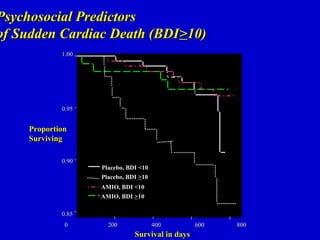
Psychosocial Predictors
of Sudden Cardiac Death (BDI>10)
            1.00


            0.95


    Proportion
    Surviving

            0.90
                   Placebo, BDI <10
                   Placebo, BDI >10
                   AMIO, BDI <10
                   AMIO, BDI >10

            0.85
             0       200              400        600   800
                              Survival in days
When do heart attacks occur?
   Less likely during sleep.
   Among the employed, more often on a
    Monday between 6 and 11 am.
       In part due to waking and becoming active
        shortly after dreaming which increases BP.
       In part because of circadian rhythm effects,
        increases in arousal hormones and blood
        pressure.
Medical Treatment
   Initial treatment may involve clot-dissolving
    medication and close monitoring
   Balloon angioplasty
       Tiny balloon is inserted into blocked vessel and
        inflated to open blood vessel
   Bypass surgery
       Use grafted vessel (e.g., piece from leg) to
        bypass blockage in artery to the heart
Medical Treatment
   Medications (e.g., beta blockers, calcium
    channel blockers) to protect heart and
    improve function.
   Risk management
       Control of high blood pressure
       Control of lipid abnormalities
Rehabilitation
   Promote recovery and reduce risk of
    another attack

   Heart disease is chronic condition
    requiring ongoing management.
Rehabilitation Includes:
   Exercise
       Physiological and psychological benefits
   Weight management
   Smoking cessation
   Lipid and BP management include dietary
    changes to control lipids
   Reduce excessive alcohol intake
   Stress management
Rehabilitation
   Exercise is the key component but:
       50% drop-out rate within first 6 months
   For those who continue benefits include:
       Improved self concept, perceived health,
        sexual activity, involvement in social activities.
   Those who stop are more likely to:
       Smoke, have poorer cardiac function, have
        higher body weight, be more sedentary,
        experience greater anxiety and depression.
Symptoms of a Stroke
   Sudden
       weakness or numbness of the face, arm, or leg
        (usually on one side of the body)
       dimness or loss of vision (usually one eye)
       Loss of speech or trouble talking or
        understanding speech
       Unexplained, severe headache
       Dizziness, unsteadiness, or sudden fall
What is a stroke?

   Tissue damage to area of the brain due to
    disruption in blood supply, depriving that
    area of the brain of oxygen.
Causes of Strokes
1.    Infarction – blockage in cerebral artery
      that cuts off or reduces blood supply
     a)   Thrombosis – blood clot
     b)   Embolus – piece of plaque becomes lodged
          in the artery.
2.    Hemorrhage – happens suddenly. Less
      frequent than infarction but more
      damaging and more likely to cause death.
Stroke Risk Factors
   Rare up to age 55, than risk increases
    sharply with age (doubling with each
    decade).
   More common in men but women more
    likely to die from them.
   Rates highest among blacks and lowest
    among Asians.
   Family history
Stroke Risk Factors
   High blood pressure
   Cigarette smoking
   Heart disease, diabetes, and their risk
    factors such as obesity and physical
    inactivity.
   High red blood cell count (making the
    blood thicker and likelier to clot).
   Mini-strokes – transient ischemic attacks
    (TIA)
Effects of a Stroke
   Some motor, sensory, cognitive, or speech
    impairment usually occurs
   Limitations may be permanent but lessen
    in severity over time.
   Younger patients recover better
   Impairments caused by hemorrhages
    more easily overcome than those caused
    by infarctions.
Effects of Stroke
   Motor impairments often due to paralysis
    on one side of the body (side opposite to
    brain damage).
       After about 6 weeks of rehab about 50% of
        patients can perform independently (many with
        cane or walker).
   Language, learning, memory, and
    perception problems depend on location of
    the injury.
Effects of Stroke
   Left-hemisphere damage more commonly
    associated with language problems called
    aphasia.
       Receptive aphasia – difficulty understanding
        verbal information.
       Expressive aphasia – difficulty producing and
        using language.
   Damage to right side of brain often
    associated with difficulties in visual
    processing and emotions.
Psychosocial Aspects of
     Stroke
   Denial is common
       Unclear whether psychological or physiological
        basis.
       This ambiguity also applies to depression
        when it occurs after a stroke.
   Less than ½ of the patients return to work
    following a stroke.

Lecture9 terminalillness heartdiesease_stroke.ppt

  • 1.
  • 2.
    Psychological Issues in Advanced and Terminal Illness  Average life expectancy in North America is 76 years.  Leading causes of death in adults are chronic illness  What are the leading causes of death across the life span?
  • 3.
    Mortality Rates Leading causes of death  < 1 year  congenital abnormalities;  sudden infant death syndrome (SIDS)  Children > 1 year old  Accidents (40% of all deaths)  Cancer (especially leukemia)  Adolescence  Unintentional injury  Homicide  AIDS
  • 4.
    Mortality Rates Leading causes of death  Middle age  Sudden death due to heart attack or stroke  Cancer  Elderly  Heart disease  Cancer  Stroke
  • 5.
    Why do womenlive longer than men?
  • 6.
    Potential Reasons forGender Differences in Mortality  Females are more hardy  Males engage in riskier behaviours (factor after birth and infancy)  Men engage in riskier sports  Males tend to hold high stress or higher risk jobs  Men tend to have poorer health habits (e.g., drink more alcohol)  Social support may be more protective in women
  • 7.
    Risk Factors  Family history  Marital status (adds 10 yrs in men; 4 yrs in women)  Economic status  Body weight  Exercise  Alcohol (add 2 years if drink 1-3 drinks/day)
  • 8.
    Risk Factors -continued  Smoking  Disposition (add 2 yrs if reasoned, practical)  Education  Environment (add 4 yrs if rural)  Sleep (more than 9 hours subtract 5 years)  Temperature (add 2 yrs if thermostat is < 68)  Health care – regular check ups add 3 yrs
  • 9.
    How do peopleadapt to chronic illness?
  • 10.
    Adapting Under Good Circumstances  First concern upon hearing diagnosis is fears about mortality.  Optimistic but tentative about plans  May try to normalize activities  Risk is they may over-extend  May have feelings of helplessness  Risk is to become overly dependent
  • 11.
    Three Themes ofAdaptation  Find meaning: why illness happened or rethink priorities  Gain sense of control  control symptoms and treatment  Restore self-esteem  Often by comparison with worse off others
  • 12.
    Adapting Under Bad Circumstances  Relapse seen as a bad sign with poor prognosis  Re-focuses one on the illness  Need to undergo the coping process again but likely less hopeful than before.
  • 13.
    Heart Disease  Due to narrowing or blocking of the coronary arteries.  Angina pectoris  painful cramp in chest, arm, neck, or back due to brief blockage of oxygenated blood to the heart.  More often during exercise, stress, cold temperature, digesting large fat meal.  Little or no permanent damage
  • 14.
    Heart Disease  Myocardium  Muscle tissue around the heart  Myocardium infarction (heart attack)  Prolonged blockage of blood to an area of the heart resulting in muscle tissue damage.  Symptoms of a heart attack  Pressure in chest, fullness, squeezing pain.  Pain spreading to shoulders, neck, or arms  Lightheadedness, fainting, sweating, nausea
  • 15.
    Who Is AtRisk of Heart Disease?  Prevalence increases with age, particularly after 45 years of age  Prior to 50s, 60s, men at greater risk than women but increases in women after menopause.  More women than men are likely to die from a heart attack  Blacks at higher risk, Asians at lower risk
  • 16.
    Heart Disease RiskFactors  High blood pressure  Family history  Cigarette smoking  High LDL and total cholesterol levels  Physical inactivity  Diabetes  Obesity  Stress
  • 17.
    Why high bloodpressure a risk factor?  Heart has to work harder.  Since heart muscle is working harder, it can become enlarged.  Wear and tear on the arterial wall can increase the likelihood of lipid and calcium deposits adhering to the arterial wall. This leads to hardening of the arteries.
  • 18.
    Type A Behaviours  Hostile, cynical  Judgmental (opinionated)  Competitive  Time urgent  Uses gestures while talking  Nodding of head while others are talking  Intense
  • 19.
    Physiological Reactivity  Physiological and cardiovascular reactivity to acute stress (“hot reactors”).  Exaggerated increases in blood pressure, heart rate, catecholamines, corticosteroids  High levels of these hormones can damage heart and blood vessels  Presence of epinephrine (a catecholamine) increases the formation of clots.
  • 20.
    Effects of StressOn Cardiac Risk
  • 21.
    Psychosocial Predictors of SuddenCardiac Death (BDI>10) 1.00 0.95 Proportion Surviving 0.90 Placebo, BDI <10 Placebo, BDI >10 AMIO, BDI <10 AMIO, BDI >10 0.85 0 200 400 600 800 Survival in days
  • 22.
    When do heartattacks occur?  Less likely during sleep.  Among the employed, more often on a Monday between 6 and 11 am.  In part due to waking and becoming active shortly after dreaming which increases BP.  In part because of circadian rhythm effects, increases in arousal hormones and blood pressure.
  • 23.
    Medical Treatment  Initial treatment may involve clot-dissolving medication and close monitoring  Balloon angioplasty  Tiny balloon is inserted into blocked vessel and inflated to open blood vessel  Bypass surgery  Use grafted vessel (e.g., piece from leg) to bypass blockage in artery to the heart
  • 24.
    Medical Treatment  Medications (e.g., beta blockers, calcium channel blockers) to protect heart and improve function.  Risk management  Control of high blood pressure  Control of lipid abnormalities
  • 25.
    Rehabilitation  Promote recovery and reduce risk of another attack  Heart disease is chronic condition requiring ongoing management.
  • 26.
    Rehabilitation Includes:  Exercise  Physiological and psychological benefits  Weight management  Smoking cessation  Lipid and BP management include dietary changes to control lipids  Reduce excessive alcohol intake  Stress management
  • 27.
    Rehabilitation  Exercise is the key component but:  50% drop-out rate within first 6 months  For those who continue benefits include:  Improved self concept, perceived health, sexual activity, involvement in social activities.  Those who stop are more likely to:  Smoke, have poorer cardiac function, have higher body weight, be more sedentary, experience greater anxiety and depression.
  • 28.
    Symptoms of aStroke  Sudden  weakness or numbness of the face, arm, or leg (usually on one side of the body)  dimness or loss of vision (usually one eye)  Loss of speech or trouble talking or understanding speech  Unexplained, severe headache  Dizziness, unsteadiness, or sudden fall
  • 29.
    What is astroke?  Tissue damage to area of the brain due to disruption in blood supply, depriving that area of the brain of oxygen.
  • 30.
    Causes of Strokes 1. Infarction – blockage in cerebral artery that cuts off or reduces blood supply a) Thrombosis – blood clot b) Embolus – piece of plaque becomes lodged in the artery. 2. Hemorrhage – happens suddenly. Less frequent than infarction but more damaging and more likely to cause death.
  • 31.
    Stroke Risk Factors  Rare up to age 55, than risk increases sharply with age (doubling with each decade).  More common in men but women more likely to die from them.  Rates highest among blacks and lowest among Asians.  Family history
  • 32.
    Stroke Risk Factors  High blood pressure  Cigarette smoking  Heart disease, diabetes, and their risk factors such as obesity and physical inactivity.  High red blood cell count (making the blood thicker and likelier to clot).  Mini-strokes – transient ischemic attacks (TIA)
  • 33.
    Effects of aStroke  Some motor, sensory, cognitive, or speech impairment usually occurs  Limitations may be permanent but lessen in severity over time.  Younger patients recover better  Impairments caused by hemorrhages more easily overcome than those caused by infarctions.
  • 34.
    Effects of Stroke  Motor impairments often due to paralysis on one side of the body (side opposite to brain damage).  After about 6 weeks of rehab about 50% of patients can perform independently (many with cane or walker).  Language, learning, memory, and perception problems depend on location of the injury.
  • 35.
    Effects of Stroke  Left-hemisphere damage more commonly associated with language problems called aphasia.  Receptive aphasia – difficulty understanding verbal information.  Expressive aphasia – difficulty producing and using language.  Damage to right side of brain often associated with difficulties in visual processing and emotions.
  • 36.
    Psychosocial Aspects of Stroke  Denial is common  Unclear whether psychological or physiological basis.  This ambiguity also applies to depression when it occurs after a stroke.  Less than ½ of the patients return to work following a stroke.

Editor's Notes

  • #4 SIDS is higher in lower class urban environments, when mother smoked during pregnancy, and when baby is put to sleep lying on his/her stomach or side. Accidents due to accidental poisoning, injuries, or falls. Later the main cause of death dues to accidents is automobile accidents. Remember that leukemia strikes the bone marrow producing an excessive amount of white blood cells, resulting in severe anemia and other complications.
  • #5 When asked how they would like to die, most say sudden death. By the way, in women under the age of menopause, breast cancer remains the number one cause of premature deaths.
  • #6 More fit – more males are conceived but more female fetuses are born. This trend persist in infancy so that more male babies are likely to die. Thus, females may be more hardy.
  • #7 More fit – more males are conceived but more female fetuses are born. This trend persist in infancy so that more male babies are likely to die. Thus, females may be more hardy. Essentially, no one really knows why there is the female advantage. Conflicting reports on social support since marriage appears to benefit men more than women. All of these factors may operate to increase the mortality rates in men.
  • #13 30%-40% of stroke victims have another stroke within five years.
  • #22 High scores on the Beck Depression Inventory in the placebo group was associated with a 2-times greater risk of mortality over 2 –years follow-up. Irvine J, Basinski A, Baker B, Jandciu S, Paquette M, Cairns J, Connolly S, Gent M, Roberts R, Dorian P. Depression and risk of sudden cardiac death after acute myocardial infarction: Testing for the confounding effects of fatigue. Psychosomatic Medicine, 1999; 61: 729 -737
  • #33 TIAs may occur one or more times before a stroke.
  • #36 The difficulty with emotions can be either managing their own emotions or understanding those of others.