Lecture 1 – Overview
Overview
Introduction to Parallel Computing
CIS 410/510
Department of Computer and Information Science
Lecture 1 – Overview
Outline
 Course Overview
❍ What is CIS 410/510?
❍ What is expected of you?
❍ What will you learn in CIS 410/510?
 Parallel Computing
❍ What is it?
❍ What motivates it?
❍ Trends that shape the field
❍ Large-scale problems and high-performance
❍ Parallel architecture types
❍ Scalable parallel computing and performance
2
Introduction to Parallel Computing, University of Oregon, IPCC
Lecture 1 – Overview
How did the idea for CIS 410/510 originate?
 There has never been an undergraduate course in parallel
computing in the CIS Department at UO
 Only 1 course taught at the graduate level (CIS 631)
 Goal is to bring parallel computing education in CIS
undergraduate curriculum, start at senior level
❍ CIS 410/510 (Spring 2014, “experimental” course)
❍ CIS 431/531 (Spring 2015, “new” course)
 CIS 607 – Parallel Computing Course Development
❍ Winter 2014 seminar to plan undergraduate course
❍ Develop 410/510 materials, exercises, labs, …
 Intel gave a generous donation ($100K) to the effort
 NSF and IEEE are spearheading a curriculum initiative for
undergraduate education in parallel processing
http://www.cs.gsu.edu/~tcpp/curriculum/
3
Introduction to Parallel Computing, University of Oregon, IPCC
Lecture 1 – Overview
Who’s involved?
 Instructor
❍ Allen D. Malony
◆ scalable parallel computing
◆ parallel performance analysis
◆ taught CIS 631 for the last 10 years
 Faculty colleagues and course co-designers
❍ Boyana Norris
◆ Automated software analysis and transformation
◆ Performance analysis and optimization
❍ Hank Childs
◆ Large-scale, parallel scientific visualization
◆ Visualization of large data sets
 Intel scientists
❍ Michael McCool, James Reinders, Bob MacKay
 Graduate students doing research in parallel computing
4
Introduction to Parallel Computing, University of Oregon, IPCC
Lecture 1 – Overview
Intel Partners
 James Reinders
❍ Director, Software Products
❍ Multi-core Evangelist
 Michael McCool
❍ Software architect
❍ Former Chief scientist, RapidMind
❍ Adjunct Assoc. Professor, University of Waterloo
 Arch Robison
❍ Architect of Threading Building Blocks
❍ Former lead developers of KAI C++
 David MacKay
❍ Manager of software product consulting team
5
Introduction to Parallel Computing, University of Oregon, IPCC
Lecture 1 – Overview
CIS 410/510 Graduate Assistants
 Daniel Ellsworth
❍ 3rd year Ph.D. student
❍ Research advisor (Prof. Malony)
❍ Large-scale online system introspection
 David Poliakoff
❍ 2nd year Ph.D. student
❍ Research advisor (Prof. Malony)
❍ Compiler-based performance analysis
 Brandon Hildreth
❍ 1st year Ph.D. student
❍ Research advisor (Prof. Malony)
❍ Automated performance experimentation
6
Introduction to Parallel Computing, University of Oregon, IPCC
Lecture 1 – Overview
Required Course Book
 “Structured Parallel Programming: Patterns for Efficient
Computation,” Michael McCool,
Arch Robinson, James Reinders,
1st edition, Morgan Kaufmann,
ISBN: 978-0-12-415993-8, 2012
http://parallelbook.com/
 Presents parallel programming
from a point of view of patterns
relevant to parallel computation
❍ Map, Collectives, Data
reorganization, Stencil and recurrence,
Fork-Join, Pipeline
 Focuses on the use of shared
memory parallel programming
languages and environments
❍ Intel Thread Building Blocks (TBB)
❍ Intel Cilk Plus
7
Introduction to Parallel Computing, University of Oregon, IPCC
Lecture 1 – Overview
Reference Textbooks
 Introduction to Parallel Computing, A. Grama,
A. Gupta, G. Karypis, V. Kumar, Addison Wesley,
2nd Ed., 2003
❍ Lecture slides from authors online
❍ Excellent reference list at end
❍ Used for CIS 631 before
❍ Getting old for latest hardware
 Designing and Building Parallel Programs,
Ian Foster, Addison Wesley, 1995.
❍ Entire book is online!!!
❍ Historical book, but very informative
 Patterns for Parallel Programming T. Mattson,
B. Sanders, B. Massingill, Addison Wesley, 2005.
❍ Targets parallel programming
❍ Pattern language approach to parallel
program design and development
❍ Excellent references
8
Introduction to Parallel Computing, University of Oregon, IPCC
Lecture 1 – Overview
What do you mean by experimental course?
 Given that this is the first offering of parallel
computing in the undergraduate curriculum, we
want to evaluate how well it worked
 We would like to receive feedback from students
throughout the course
❍ Lecture content and understanding
❍ Parallel programming learning experience
❍ Book and other materials
 Your experiences will help to update the course for
it debut offering in (hopefully) Spring 2015
9
Introduction to Parallel Computing, University of Oregon, IPCC
Lecture 1 – Overview
Course Plan
 Organize the course so that cover main areas of
parallel computing in the lectures
❍ Architecture (1 week)
❍ Performance models and analysis (1 week)
❍ Programming patterns (paradigms) (3 weeks)
❍ Algorithms (2 weeks)
❍ Tools (1 week)
❍ Applications (1 week)
❍ Special topics (1 week)
 Augment lecture with a programming lab
❍ Students will take the lab with the course
◆graded assignments and term project will be posted
❍ Targeted specifically to shared memory parallelism
10
Introduction to Parallel Computing, University of Oregon, IPCC
Lecture 1 – Overview
Lectures
 Book and online materials are you main sources for
broader and deeper background in parallel computing
 Lectures should be more interactive
❍ Supplement other sources of information
❍ Covers topics of more priority
❍ Intended to give you some of my perspective
❍ Will provide online access to lecture slides
 Lectures will complement programming component,
but intended to cover other parallel computing aspects
 Try to arrange a guest lecture or 2 during quarter
11
Introduction to Parallel Computing, University of Oregon, IPCC
Lecture 1 – Overview
Parallel Programming Lab
 Set up in the IPCC classroom
❍ Daniel Ellsworth and David Poliakoff leading the lab
 Shared memory parallel programming (everyone)
❍ Cilk Plus ( http://www.cilkplus.org/ )
◆ extension to the C and C++ languages to support data and task parallelism
❍ Thread Building Blocks (TBB)
(https://www.threadingbuildingblocks.org/ )
◆ C++ template library for task parallelism
❍ OpenMP (http://openmp.org/wp/ )
◆ C/C++ and Fortran directive-based parallelism
 Distributed memory message passing (graduate)
❍ MPI (http://en.wikipedia.org/wiki/Message_Passing_Interface )
◆ library for message communication on scalable parallel systems
12
Introduction to Parallel Computing, University of Oregon, IPCC
Lecture 1 – Overview
WOPR (What Operational Parallel Resource)
 WOPR was built from whole cloth
❍ Constructed by UO graduate students
 Built Next Unit of Computing (NUC)
cluster with Intel funds
❍ 16x Intel NUC
◆Haswell i5 CPU (2 cores, hyperthreading)
◆Intel HD 4000 GPU (OpenCL programmable)
◆1 GigE, 16 GB memory, 240 GB mSATA
◆16x Logitech keyboard and mouse
❍ 16x ViewSonic 22” monitor
❍ Dell Edge GigE switch
❍ Dell head node
13
Introduction to Parallel Computing, University of Oregon, IPCC
Lecture 1 – Overview
Other Parallel Resources – Mist Cluster
 Distributed memory cluster
 16 8-core nodes
❍ 2x quad-core Pentium Xeon (2.33 GHz)
❍ 16 Gbyte memory
❍ 160 Gbyte disk
 Dual Gigabit ethernet adaptors
 Master node (same specs)
 Gigabit ethernet switch
 mist.nic.uoregon.edu
14
Introduction to Parallel Computing, University of Oregon, IPCC
Lecture 1 – Overview
Other Parallel Resources – ACISS Cluster
 Applied Computational Instrument for Scientific Synthesis
❍ NSF MRI R2 award (2010)
 Basic nodes (1,536 total cores)
❍ 128 ProLiant SL390 G7
❍ Two Intel X5650 2.66 GHz
6-core CPUs per node
❍ 72GB DDR3 RAM per basic node
 Fat nodes (512 total cores)
❍ 16 ProLiant DL 580 G7
❍ Four Intel X7560 2.266 GHz
8-core CPUs per node
❍ 384GB DDR3 per fat node
 GPU nodes (624 total cores, 156 GPUs)
 52 ProLiant SL390 G7 nodes, 3 NVidia M2070 GPUs (156 total GPUs)
 Two Intel X5650 2.66 GHz 6-core CPUs per node (624 total cores)
 72GB DDR3 per GPU node
 ACISS has 2672 total cores
 ACISS is located in the UO Computing Center
15
Introduction to Parallel Computing, University of Oregon, IPCC
Lecture 1 – Overview
Course Assignments
 Homework
❍ Exercises primarily to prepare for midterm
 Parallel programming lab
❍ Exercises for parallel programming patterns
❍ Program using Cilk Plus, Thread Building Blocks, OpenMP
❍ Graduate students will also do assignments with MPI
 Team term project
❍ Programming, presentation, paper
❍ Graduate students distributed across teams
 Research summary paper (graduate students)
 Midterm exam later in the 7th week of the quarter
 No final exam
❍ Team project presentations during final period
16
Introduction to Parallel Computing, University of Oregon, IPCC
Lecture 1 – Overview
Parallel Programming Term Project
 Major programming project for the course
❍ Non-trivial parallel application
❍ Include performance analysis
❍ Use NUC cluster and possibly Mist and ACISS clusters
 Project teams
❍ 5 person teams, 6 teams (depending on enrollment)
❍ Will try our best to balance skills
❍ Have 1 graduate student per team
 Project dates
❍ Proposal due end of 4th week)
❍ Project talk during last class
❍ Project due at the end of the term
 Need to get system accounts!!!
17
Introduction to Parallel Computing, University of Oregon, IPCC
Lecture 1 – Overview
Term Paper (for graduate students)
 Investigate parallel computing topic of interest
❍ More in depth review
❍ Individual choice
❍ Summary of major points
 Requires minimum of ten references
❍ Book and other references has a large bibliography
❍ Google Scholar, Keywords: parallel computing
❍ NEC CiteSeer Scientific Literature Digital Library
 Paper abstract and references due by 3rd week
 Final term paper due at the end of the term
 Individual work
18
Introduction to Parallel Computing, University of Oregon, IPCC
Lecture 1 – Overview
Grading
 Undergraduate
❍ 5% homework
❍ 10% pattern programming labs
❍ 20% programming assignments
❍ 30% midterm exam
❍ 35% project
 Graduate
❍ 15% programming assignments
❍ 30% midterm exam
❍ 35% project
❍ 20% research paper
19
Introduction to Parallel Computing, University of Oregon, IPCC
Lecture 1 – Overview
Overview
 Broad/Old field of computer science concerned with:
❍ Architecture, HW/SW systems, languages, programming
paradigms, algorithms, and theoretical models
❍ Computing in parallel
 Performance is the raison d’être for parallelism
❍ High-performance computing
❍ Drives computational science revolution
 Topics of study
❍ Parallel architectures
❍ Parallel programming
❍ Parallel algorithms
20
 Parallel performance
models and tools
 Parallel applications
Introduction to Parallel Computing, University of Oregon, IPCC
Lecture 1 – Overview
What will you get out of CIS 410/510?
 In-depth understanding of parallel computer design
 Knowledge of how to program parallel computer
systems
 Understanding of pattern-based parallel
programming
 Exposure to different forms parallel algorithms
 Practical experience using a parallel cluster
 Background on parallel performance modeling
 Techniques for empirical performance analysis
 Fun and new friends
21
Introduction to Parallel Computing, University of Oregon, IPCC
Lecture 1 – Overview
Parallel Processing – What is it?
 A parallel computer is a computer system that uses
multiple processing elements simultaneously in a
cooperative manner to solve a computational problem
 Parallel processing includes techniques and
technologies that make it possible to compute in
parallel
❍ Hardware, networks, operating systems, parallel libraries,
languages, compilers, algorithms, tools, …
 Parallel computing is an evolution of serial computing
❍ Parallelism is natural
❍ Computing problems differ in level / type of parallelism
 Parallelism is all about performance! Really?
22
Introduction to Parallel Computing, University of Oregon, IPCC
Lecture 1 – Overview
Concurrency
 Consider multiple tasks to be executed in a computer
 Tasks are concurrent with respect to each if
❍ They can execute at the same time (concurrent execution)
❍ Implies that there are no dependencies between the tasks
 Dependencies
❍ If a task requires results produced by other tasks in order to
execute correctly, the task’s execution is dependent
❍ If two tasks are dependent, they are not concurrent
❍ Some form of synchronization must be used to enforce
(satisfy) dependencies
 Concurrency is fundamental to computer science
❍ Operating systems, databases, networking, …
23
Introduction to Parallel Computing, University of Oregon, IPCC
Lecture 1 – Overview
Concurrency and Parallelism
 Concurrent is not the same as parallel! Why?
 Parallel execution
❍ Concurrent tasks actually execute at the same time
❍ Multiple (processing) resources have to be available
 Parallelism = concurrency + “parallel” hardware
❍ Both are required
❍ Find concurrent execution opportunities
❍ Develop application to execute in parallel
❍ Run application on parallel hardware
 Is a parallel application a concurrent application?
 Is a parallel application run with one processor
parallel? Why or why not?
24
Introduction to Parallel Computing, University of Oregon, IPCC
Lecture 1 – Overview
Parallelism
 There are granularities of parallelism (parallel
execution) in programs
❍ Processes, threads, routines, statements, instructions, …
❍ Think about what are the software elements that execute
concurrently
 These must be supported by hardware resources
❍ Processors, cores, … (execution of instructions)
❍ Memory, DMA, networks, … (other associated operations)
❍ All aspects of computer architecture offer opportunities for
parallel hardware execution
 Concurrency is a necessary condition for parallelism
❍ Where can you find concurrency?
❍ How is concurrency expressed to exploit parallel systems?
25
Introduction to Parallel Computing, University of Oregon, IPCC
Lecture 1 – Overview
Why use parallel processing?
 Two primary reasons (both performance related)
❍ Faster time to solution (response time)
❍ Solve bigger computing problems (in same time)
 Other factors motivate parallel processing
❍ Effective use of machine resources
❍ Cost efficiencies
❍ Overcoming memory constraints
 Serial machines have inherent limitations
❍ Processor speed, memory bottlenecks, …
 Parallelism has become the future of computing
 Performance is still the driving concern
 Parallelism = concurrency + parallel HW + performance
26
Introduction to Parallel Computing, University of Oregon, IPCC
Lecture 1 – Overview
Perspectives on Parallel Processing
 Parallel computer architecture
❍ Hardware needed for parallel execution?
❍ Computer system design
 (Parallel) Operating system
❍ How to manage systems aspects in a parallel computer
 Parallel programming
❍ Libraries (low-level, high-level)
❍ Languages
❍ Software development environments
 Parallel algorithms
 Parallel performance evaluation
 Parallel tools
❍ Performance, analytics, visualization, …
27
Introduction to Parallel Computing, University of Oregon, IPCC
Lecture 1 – Overview
Why study parallel computing today?
 Computing architecture
❍ Innovations often drive to novel programming models
 Technological convergence
❍ The “killer micro” is ubiquitous
❍ Laptops and supercomputers are fundamentally similar!
❍ Trends cause diverse approaches to converge
 Technological trends make parallel computing inevitable
❍ Multi-core processors are here to stay!
❍ Practically every computing system is operating in parallel
 Understand fundamental principles and design tradeoffs
❍ Programming, systems support, communication, memory, …
❍ Performance
 Parallelism is the future of computing
28
Introduction to Parallel Computing, University of Oregon, IPCC
Lecture 1 – Overview
Inevitability of Parallel Computing
 Application demands
❍ Insatiable need for computing cycles
 Technology trends
❍ Processor and memory
 Architecture trends
 Economics
 Current trends:
❍ Today’s microprocessors have multiprocessor support
❍ Servers and workstations available as multiprocessors
❍ Tomorrow’s microprocessors are multiprocessors
❍ Multi-core is here to stay and #cores/processor is growing
❍ Accelerators (GPUs, gaming systems)
29
Introduction to Parallel Computing, University of Oregon, IPCC
Lecture 1 – Overview
Application Characteristics
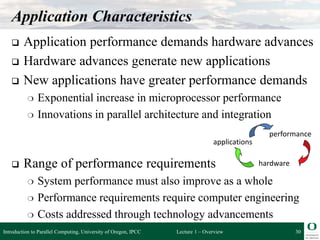
 Application performance demands hardware advances
 Hardware advances generate new applications
 New applications have greater performance demands
❍ Exponential increase in microprocessor performance
❍ Innovations in parallel architecture and integration
 Range of performance requirements
❍ System performance must also improve as a whole
❍ Performance requirements require computer engineering
❍ Costs addressed through technology advancements
applications
performance
hardware
30
Introduction to Parallel Computing, University of Oregon, IPCC
Lecture 1 – Overview
Broad Parallel Architecture Issues
 Resource allocation
❍ How many processing elements?
❍ How powerful are the elements?
❍ How much memory?
 Data access, communication, and synchronization
❍ How do the elements cooperate and communicate?
❍ How are data transmitted between processors?
❍ What are the abstractions and primitives for cooperation?
 Performance and scalability
❍ How does it all translate into performance?
❍ How does it scale?
31
Introduction to Parallel Computing, University of Oregon, IPCC
Lecture 1 – Overview
Leveraging Moore’s Law
 More transistors = more parallelism opportunities
 Microprocessors
❍ Implicit parallelism
◆pipelining
◆multiple functional units
◆superscalar
❍ Explicit parallelism
◆SIMD instructions
◆long instruction works
32
Introduction to Parallel Computing, University of Oregon, IPCC
Lecture 1 – Overview
What’s Driving Parallel Computing Architecture?
von Neumann bottleneck!!
(memory wall)
33
Introduction to Parallel Computing, University of Oregon, IPCC
Lecture 1 – Overview
Microprocessor Transitor Counts (1971-2011)
34
Introduction to Parallel Computing, University of Oregon, IPCC
Lecture 1 – Overview
What has happened in the last several years?
 Processing chip manufacturers increased processor
performance by increasing CPU clock frequency
❍ Riding Moore’s law
 Until the chips got too hot!
❍ Greater clock frequency  greater electrical power
❍ Pentium 4 heat sink  Frying an egg on a Pentium 4
 Add multiple cores to add performance
❍ Keep clock frequency same or reduced
❍ Keep lid on power requirements
35
Introduction to Parallel Computing, University of Oregon, IPCC
Lecture 1 – Overview 36
Power Density Growth
Figure courtesy of Pat Gelsinger, Intel Developer Forum, Spring 2004
Introduction to Parallel Computing, University of Oregon, IPCC
Lecture 1 – Overview
What’s Driving Parallel Computing Architecture?
37
Introduction to Parallel Computing, University of Oregon, IPCC
Lecture 1 – Overview
What’s Driving Parallel Computing Architecture?
38
power wall
Introduction to Parallel Computing, University of Oregon, IPCC
Lecture 1 – Overview
Classifying Parallel Systems – Flynn’s Taxonomy
 Distinguishes multi-processor computer architectures
along the two independent dimensions
❍ Instruction and Data
❍ Each dimension can have one state: Single or Multiple
 SISD: Single Instruction, Single Data
❍ Serial (non-parallel) machine
 SIMD: Single Instruction, Multiple Data
❍ Processor arrays and vector machines
 MISD: Multiple Instruction, Single Data (weird)
 MIMD: Multiple Instruction, Multiple Data
❍ Most common parallel computer systems
39
Introduction to Parallel Computing, University of Oregon, IPCC
Lecture 1 – Overview
Parallel Architecture Types
 Instruction-Level Parallelism
❍ Parallelism captured in instruction processing
 Vector processors
❍ Operations on multiple data stored in vector registers
 Shared-memory Multiprocessor (SMP)
❍ Multiple processors sharing memory
❍ Symmetric Multiprocessor (SMP)
 Multicomputer
❍ Multiple computer connect via network
❍ Distributed-memory cluster
 Massively Parallel Processor (MPP)
40
Introduction to Parallel Computing, University of Oregon, IPCC
Lecture 1 – Overview
Phases of Supercomputing (Parallel) Architecture
 Phase 1 (1950s): sequential instruction execution
 Phase 2 (1960s): sequential instruction issue
❍ Pipeline execution, reservations stations
❍ Instruction Level Parallelism (ILP)
 Phase 3 (1970s): vector processors
❍ Pipelined arithmetic units
❍ Registers, multi-bank (parallel) memory systems
 Phase 4 (1980s): SIMD and SMPs
 Phase 5 (1990s): MPPs and clusters
❍ Communicating sequential processors
 Phase 6 (>2000): many cores, accelerators, scale, …
41
Introduction to Parallel Computing, University of Oregon, IPCC
Lecture 1 – Overview
Performance Expectations
 If each processor is rated at k MFLOPS and there are
p processors, we should expect to see k*p MFLOPS
performance? Correct?
 If it takes 100 seconds on 1 processor, it should take
10 seconds on 10 processors? Correct?
 Several causes affect performance
❍ Each must be understood separately
❍ But they interact with each other in complex ways
◆solution to one problem may create another
◆one problem may mask another
 Scaling (system, problem size) can change conditions
 Need to understand performance space
42
Introduction to Parallel Computing, University of Oregon, IPCC
Lecture 1 – Overview
Scalability
 A program can scale up to use many processors
❍ What does that mean?
 How do you evaluate scalability?
 How do you evaluate scalability goodness?
 Comparative evaluation
❍ If double the number of processors, what to expect?
❍ Is scalability linear?
 Use parallel efficiency measure
❍ Is efficiency retained as problem size increases?
 Apply performance metrics
43
Introduction to Parallel Computing, University of Oregon, IPCC
Lecture 1 – Overview
Top 500 Benchmarking Methodology
 Listing of the world’s 500 most powerful computers
 Yardstick for high-performance computing (HPC)
❍ Rmax : maximal performance Linpack benchmark
◆dense linear system of equations (Ax = b)
 Data listed
❍ Rpeak : theoretical peak performance
❍ Nmax : problem size needed to achieve Rmax
❍ N1/2 : problem size needed to achieve 1/2 of Rmax
❍ Manufacturer and computer type
❍ Installation site, location, and year
 Updated twice a year at SC and ISC conferences
44
Introduction to Parallel Computing, University of Oregon, IPCC
Lecture 1 – Overview 45
Top 10 (November 2013)
Different architectures
Introduction to Parallel Computing, University of Oregon, IPCC
Lecture 1 – Overview 46
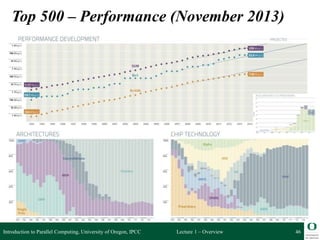
Top 500 – Performance (November 2013)
Introduction to Parallel Computing, University of Oregon, IPCC
Lecture 1 – Overview
#1: NUDT Tiahne-2 (Milkyway-2)
 Compute Nodes have 3.432 Tflop/s per node
❍ 16,000 nodes
❍ 32000 Intel Xeon CPU
❍ 48000 Intel Xeon Phi
 Operations Nodes
❍ 4096 FT CPUs
 Proprietary interconnect
❍ TH2 express
 1PB memory
❍ Host memory only
 Global shared parallel storage is 12.4 PB
 Cabinets: 125+13+24 =162
❍ Compute, communication, storage
❍ ~750 m2
47
Introduction to Parallel Computing, University of Oregon, IPCC
Lecture 1 – Overview
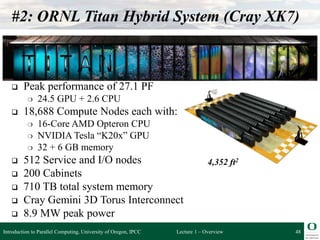
#2: ORNL Titan Hybrid System (Cray XK7)
 Peak performance of 27.1 PF
❍ 24.5 GPU + 2.6 CPU
 18,688 Compute Nodes each with:
❍ 16-Core AMD Opteron CPU
❍ NVIDIA Tesla “K20x” GPU
❍ 32 + 6 GB memory
 512 Service and I/O nodes
 200 Cabinets
 710 TB total system memory
 Cray Gemini 3D Torus Interconnect
 8.9 MW peak power
48
4,352 ft2
Introduction to Parallel Computing, University of Oregon, IPCC
Lecture 1 – Overview
#3: LLNL Sequoia (IBM BG/Q)
 Compute card
❍ 16-core PowerPC
A2 processor
❍ 16 GB DDR3
 Compute node has
98,304 cards
 Total system size:
❍ 1,572,864
processing cores
❍ 1.5 PB memory
 5-dimensional
torus
interconnection
network
 Area of 3,000 ft2
49
Introduction to Parallel Computing, University of Oregon, IPCC
Lecture 1 – Overview
#4: RIKEN K Computer
 80,000 CPUs
❍ SPARC64 VIIIfx
❍ 640,000 cores
 800 water-cooled racks
 5D mesh/torus interconnect (Tofu)
❍ 12 links between node
❍ 12x higher scalability than 3D torus
50
Introduction to Parallel Computing, University of Oregon, IPCC
Lecture 1 – Overview
Contemporary HPC Architectures
51
Date System Location Comp Comm Peak
(PF)
Power
(MW)
2009 Jaguar; Cray XT5 ORNL AMD 6c Seastar2 2.3 7.0
2010 Tianhe-1A NSC Tianjin Intel + NVIDIA Proprietary 4.7 4.0
2010 Nebulae NSCS
Shenzhen
Intel + NVIDIA IB 2.9 2.6
2010 Tsubame 2 TiTech Intel + NVIDIA IB 2.4 1.4
2011 K Computer RIKEN/Kobe SPARC64 VIIIfx Tofu 10.5 12.7
2012 Titan; Cray XK6 ORNL AMD + NVIDIA Gemini 27 9
2012 Mira; BlueGeneQ ANL SoC Proprietary 10 3.9
2012 Sequoia; BlueGeneQ LLNL SoC Proprietary 20 7.9
2012 Blue Waters; Cray NCSA/UIUC AMD + (partial)
NVIDIA
Gemini 11.6
2013 Stampede TACC Intel + MIC IB 9.5 5
2013 Tianhe-2 NSCC-GZ
(Guangzhou)
Intel + MIC Proprietary 54 ~20
Introduction to Parallel Computing, University of Oregon, IPCC
Lecture 1 – Overview
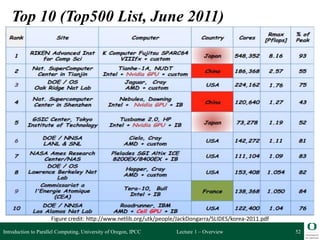
Top 10 (Top500 List, June 2011)
Figure credit: http://www.netlib.org/utk/people/JackDongarra/SLIDES/korea-2011.pdf
52
Introduction to Parallel Computing, University of Oregon, IPCC
Lecture 1 – Overview
Japanese K Computer (#1 in June 2011)
53
Introduction to Parallel Computing, University of Oregon, IPCC
Lecture 1 – Overview
Top 500 Top 10 (2006)
54
Introduction to Parallel Computing, University of Oregon, IPCC
Lecture 1 – Overview
Top 500 Linpack Benchmark List (June 2002)
∑
55
Introduction to Parallel Computing, University of Oregon, IPCC
Lecture 1 – Overview
Japanese Earth Simulator
 World’s fastest supercomputer!!! (2002)
❍ 640 NEC SX-6 nodes
◆8 vector processors
❍ 5104 total processors
❍ Single stage crossbar
◆~2900 meters of cables
❍ 10 TB memory
❍ 700 TB disk space
❍ 1.6 PB mass storage
❍ 40 Tflops peak performance
❍ 35.6 Tflops Linpack performance
56
Introduction to Parallel Computing, University of Oregon, IPCC
Lecture 1 – Overview
Prof. Malony and colleagues at Japanese ES
Mitsuhisa Sato
Barbara Chapman
Matthias Müller
57
Introduction to Parallel Computing, University of Oregon, IPCC
Lecture 1 – Overview
Performance Development in Top 500
Figure credit: http://www.netlib.org/utk/people/JackDongarra/SLIDES/korea-2011.pdf
58
Introduction to Parallel Computing, University of Oregon, IPCC
Lecture 1 – Overview
Exascale Initiative
 Exascale machines are targeted for 2019
 What are the potential differences and problems?
???
59
Introduction to Parallel Computing, University of Oregon, IPCC
Lecture 1 – Overview
Major Changes to Software and Algorithms
 What were we concerned about before and now?
 Must rethink the design for exascale
❍ Data movement is expensive (Why?)
❍ Flops per second are cheap (Why?)
 Need to reduce communication and sychronization
 Need to develop fault-resilient algorithms
 How do with deal with massive parallelism?
 Software must adapt to the hardware (autotuning)
60
Introduction to Parallel Computing, University of Oregon, IPCC
Lecture 1 – Overview
Supercomputing and Computational Science
 By definition, a supercomputer is of a class of
computer systems that are the most powerful
computing platforms at that time
 Computational science has always lived at the leading
(and bleeding) edge of supercomputing technology
 “Most powerful” depends on performance criteria
❍ Performance metrics related to computational algorithms
❍ Benchmark “real” application codes
 Where does the performance come from?
❍ More powerful processors
❍ More processors (cores)
❍ Better algorithms
61
Introduction to Parallel Computing, University of Oregon, IPCC
Lecture 1 – Overview
Computational Science
 Traditional scientific methodology
❍ Theoretical science
◆Formal systems and theoretical models
◆Insight through abstraction, reasoning through proofs
❍ Experimental science
◆Real system and empirical models
◆Insight from observation, reasoning from experiment design
 Computational science
❍ Emerging as a principal means of scientific research
❍ Use of computational methods to model scientific problems
◆Numerical analysis plus simulation methods
◆Computer science tools
❍ Study and application of these solution techniques
62
Introduction to Parallel Computing, University of Oregon, IPCC
Lecture 1 – Overview
Computational Challenges
 Computational science thrives on computer power
❍ Faster solutions
❍ Finer resolution
❍ Bigger problems
❍ Improved interaction
❍ BETTER SCIENCE!!!
 How to get more computer power?
❍ Scalable parallel computing
 Computational science also thrives better integration
❍ Couple computational resources
❍ Grid computing
63
Introduction to Parallel Computing, University of Oregon, IPCC
Lecture 1 – Overview
Scalable Parallel Computing
 Scalability in parallel architecture
❍ Processor numbers
❍ Memory architecture
❍ Interconnection network
❍ Avoid critical architecture bottlenecks
 Scalability in computational problem
❍ Problem size
❍ Computational algorithms
◆Computation to memory access ratio
◆Computation to communication ration
 Parallel programming models and tools
 Performance scalability
64
Introduction to Parallel Computing, University of Oregon, IPCC
Lecture 1 – Overview
Next Lectures
 Parallel computer architectures
 Parallel performance models
65
CIS 410/510: Parallel Computing, University of Oregon, Spring 2014

lecture-1-overview.pptx

  • 1.
    Lecture 1 –Overview Overview Introduction to Parallel Computing CIS 410/510 Department of Computer and Information Science
  • 2.
    Lecture 1 –Overview Outline  Course Overview ❍ What is CIS 410/510? ❍ What is expected of you? ❍ What will you learn in CIS 410/510?  Parallel Computing ❍ What is it? ❍ What motivates it? ❍ Trends that shape the field ❍ Large-scale problems and high-performance ❍ Parallel architecture types ❍ Scalable parallel computing and performance 2 Introduction to Parallel Computing, University of Oregon, IPCC
  • 3.
    Lecture 1 –Overview How did the idea for CIS 410/510 originate?  There has never been an undergraduate course in parallel computing in the CIS Department at UO  Only 1 course taught at the graduate level (CIS 631)  Goal is to bring parallel computing education in CIS undergraduate curriculum, start at senior level ❍ CIS 410/510 (Spring 2014, “experimental” course) ❍ CIS 431/531 (Spring 2015, “new” course)  CIS 607 – Parallel Computing Course Development ❍ Winter 2014 seminar to plan undergraduate course ❍ Develop 410/510 materials, exercises, labs, …  Intel gave a generous donation ($100K) to the effort  NSF and IEEE are spearheading a curriculum initiative for undergraduate education in parallel processing http://www.cs.gsu.edu/~tcpp/curriculum/ 3 Introduction to Parallel Computing, University of Oregon, IPCC
  • 4.
    Lecture 1 –Overview Who’s involved?  Instructor ❍ Allen D. Malony ◆ scalable parallel computing ◆ parallel performance analysis ◆ taught CIS 631 for the last 10 years  Faculty colleagues and course co-designers ❍ Boyana Norris ◆ Automated software analysis and transformation ◆ Performance analysis and optimization ❍ Hank Childs ◆ Large-scale, parallel scientific visualization ◆ Visualization of large data sets  Intel scientists ❍ Michael McCool, James Reinders, Bob MacKay  Graduate students doing research in parallel computing 4 Introduction to Parallel Computing, University of Oregon, IPCC
  • 5.
    Lecture 1 –Overview Intel Partners  James Reinders ❍ Director, Software Products ❍ Multi-core Evangelist  Michael McCool ❍ Software architect ❍ Former Chief scientist, RapidMind ❍ Adjunct Assoc. Professor, University of Waterloo  Arch Robison ❍ Architect of Threading Building Blocks ❍ Former lead developers of KAI C++  David MacKay ❍ Manager of software product consulting team 5 Introduction to Parallel Computing, University of Oregon, IPCC
  • 6.
    Lecture 1 –Overview CIS 410/510 Graduate Assistants  Daniel Ellsworth ❍ 3rd year Ph.D. student ❍ Research advisor (Prof. Malony) ❍ Large-scale online system introspection  David Poliakoff ❍ 2nd year Ph.D. student ❍ Research advisor (Prof. Malony) ❍ Compiler-based performance analysis  Brandon Hildreth ❍ 1st year Ph.D. student ❍ Research advisor (Prof. Malony) ❍ Automated performance experimentation 6 Introduction to Parallel Computing, University of Oregon, IPCC
  • 7.
    Lecture 1 –Overview Required Course Book  “Structured Parallel Programming: Patterns for Efficient Computation,” Michael McCool, Arch Robinson, James Reinders, 1st edition, Morgan Kaufmann, ISBN: 978-0-12-415993-8, 2012 http://parallelbook.com/  Presents parallel programming from a point of view of patterns relevant to parallel computation ❍ Map, Collectives, Data reorganization, Stencil and recurrence, Fork-Join, Pipeline  Focuses on the use of shared memory parallel programming languages and environments ❍ Intel Thread Building Blocks (TBB) ❍ Intel Cilk Plus 7 Introduction to Parallel Computing, University of Oregon, IPCC
  • 8.
    Lecture 1 –Overview Reference Textbooks  Introduction to Parallel Computing, A. Grama, A. Gupta, G. Karypis, V. Kumar, Addison Wesley, 2nd Ed., 2003 ❍ Lecture slides from authors online ❍ Excellent reference list at end ❍ Used for CIS 631 before ❍ Getting old for latest hardware  Designing and Building Parallel Programs, Ian Foster, Addison Wesley, 1995. ❍ Entire book is online!!! ❍ Historical book, but very informative  Patterns for Parallel Programming T. Mattson, B. Sanders, B. Massingill, Addison Wesley, 2005. ❍ Targets parallel programming ❍ Pattern language approach to parallel program design and development ❍ Excellent references 8 Introduction to Parallel Computing, University of Oregon, IPCC
  • 9.
    Lecture 1 –Overview What do you mean by experimental course?  Given that this is the first offering of parallel computing in the undergraduate curriculum, we want to evaluate how well it worked  We would like to receive feedback from students throughout the course ❍ Lecture content and understanding ❍ Parallel programming learning experience ❍ Book and other materials  Your experiences will help to update the course for it debut offering in (hopefully) Spring 2015 9 Introduction to Parallel Computing, University of Oregon, IPCC
  • 10.
    Lecture 1 –Overview Course Plan  Organize the course so that cover main areas of parallel computing in the lectures ❍ Architecture (1 week) ❍ Performance models and analysis (1 week) ❍ Programming patterns (paradigms) (3 weeks) ❍ Algorithms (2 weeks) ❍ Tools (1 week) ❍ Applications (1 week) ❍ Special topics (1 week)  Augment lecture with a programming lab ❍ Students will take the lab with the course ◆graded assignments and term project will be posted ❍ Targeted specifically to shared memory parallelism 10 Introduction to Parallel Computing, University of Oregon, IPCC
  • 11.
    Lecture 1 –Overview Lectures  Book and online materials are you main sources for broader and deeper background in parallel computing  Lectures should be more interactive ❍ Supplement other sources of information ❍ Covers topics of more priority ❍ Intended to give you some of my perspective ❍ Will provide online access to lecture slides  Lectures will complement programming component, but intended to cover other parallel computing aspects  Try to arrange a guest lecture or 2 during quarter 11 Introduction to Parallel Computing, University of Oregon, IPCC
  • 12.
    Lecture 1 –Overview Parallel Programming Lab  Set up in the IPCC classroom ❍ Daniel Ellsworth and David Poliakoff leading the lab  Shared memory parallel programming (everyone) ❍ Cilk Plus ( http://www.cilkplus.org/ ) ◆ extension to the C and C++ languages to support data and task parallelism ❍ Thread Building Blocks (TBB) (https://www.threadingbuildingblocks.org/ ) ◆ C++ template library for task parallelism ❍ OpenMP (http://openmp.org/wp/ ) ◆ C/C++ and Fortran directive-based parallelism  Distributed memory message passing (graduate) ❍ MPI (http://en.wikipedia.org/wiki/Message_Passing_Interface ) ◆ library for message communication on scalable parallel systems 12 Introduction to Parallel Computing, University of Oregon, IPCC
  • 13.
    Lecture 1 –Overview WOPR (What Operational Parallel Resource)  WOPR was built from whole cloth ❍ Constructed by UO graduate students  Built Next Unit of Computing (NUC) cluster with Intel funds ❍ 16x Intel NUC ◆Haswell i5 CPU (2 cores, hyperthreading) ◆Intel HD 4000 GPU (OpenCL programmable) ◆1 GigE, 16 GB memory, 240 GB mSATA ◆16x Logitech keyboard and mouse ❍ 16x ViewSonic 22” monitor ❍ Dell Edge GigE switch ❍ Dell head node 13 Introduction to Parallel Computing, University of Oregon, IPCC
  • 14.
    Lecture 1 –Overview Other Parallel Resources – Mist Cluster  Distributed memory cluster  16 8-core nodes ❍ 2x quad-core Pentium Xeon (2.33 GHz) ❍ 16 Gbyte memory ❍ 160 Gbyte disk  Dual Gigabit ethernet adaptors  Master node (same specs)  Gigabit ethernet switch  mist.nic.uoregon.edu 14 Introduction to Parallel Computing, University of Oregon, IPCC
  • 15.
    Lecture 1 –Overview Other Parallel Resources – ACISS Cluster  Applied Computational Instrument for Scientific Synthesis ❍ NSF MRI R2 award (2010)  Basic nodes (1,536 total cores) ❍ 128 ProLiant SL390 G7 ❍ Two Intel X5650 2.66 GHz 6-core CPUs per node ❍ 72GB DDR3 RAM per basic node  Fat nodes (512 total cores) ❍ 16 ProLiant DL 580 G7 ❍ Four Intel X7560 2.266 GHz 8-core CPUs per node ❍ 384GB DDR3 per fat node  GPU nodes (624 total cores, 156 GPUs)  52 ProLiant SL390 G7 nodes, 3 NVidia M2070 GPUs (156 total GPUs)  Two Intel X5650 2.66 GHz 6-core CPUs per node (624 total cores)  72GB DDR3 per GPU node  ACISS has 2672 total cores  ACISS is located in the UO Computing Center 15 Introduction to Parallel Computing, University of Oregon, IPCC
  • 16.
    Lecture 1 –Overview Course Assignments  Homework ❍ Exercises primarily to prepare for midterm  Parallel programming lab ❍ Exercises for parallel programming patterns ❍ Program using Cilk Plus, Thread Building Blocks, OpenMP ❍ Graduate students will also do assignments with MPI  Team term project ❍ Programming, presentation, paper ❍ Graduate students distributed across teams  Research summary paper (graduate students)  Midterm exam later in the 7th week of the quarter  No final exam ❍ Team project presentations during final period 16 Introduction to Parallel Computing, University of Oregon, IPCC
  • 17.
    Lecture 1 –Overview Parallel Programming Term Project  Major programming project for the course ❍ Non-trivial parallel application ❍ Include performance analysis ❍ Use NUC cluster and possibly Mist and ACISS clusters  Project teams ❍ 5 person teams, 6 teams (depending on enrollment) ❍ Will try our best to balance skills ❍ Have 1 graduate student per team  Project dates ❍ Proposal due end of 4th week) ❍ Project talk during last class ❍ Project due at the end of the term  Need to get system accounts!!! 17 Introduction to Parallel Computing, University of Oregon, IPCC
  • 18.
    Lecture 1 –Overview Term Paper (for graduate students)  Investigate parallel computing topic of interest ❍ More in depth review ❍ Individual choice ❍ Summary of major points  Requires minimum of ten references ❍ Book and other references has a large bibliography ❍ Google Scholar, Keywords: parallel computing ❍ NEC CiteSeer Scientific Literature Digital Library  Paper abstract and references due by 3rd week  Final term paper due at the end of the term  Individual work 18 Introduction to Parallel Computing, University of Oregon, IPCC
  • 19.
    Lecture 1 –Overview Grading  Undergraduate ❍ 5% homework ❍ 10% pattern programming labs ❍ 20% programming assignments ❍ 30% midterm exam ❍ 35% project  Graduate ❍ 15% programming assignments ❍ 30% midterm exam ❍ 35% project ❍ 20% research paper 19 Introduction to Parallel Computing, University of Oregon, IPCC
  • 20.
    Lecture 1 –Overview Overview  Broad/Old field of computer science concerned with: ❍ Architecture, HW/SW systems, languages, programming paradigms, algorithms, and theoretical models ❍ Computing in parallel  Performance is the raison d’être for parallelism ❍ High-performance computing ❍ Drives computational science revolution  Topics of study ❍ Parallel architectures ❍ Parallel programming ❍ Parallel algorithms 20  Parallel performance models and tools  Parallel applications Introduction to Parallel Computing, University of Oregon, IPCC
  • 21.
    Lecture 1 –Overview What will you get out of CIS 410/510?  In-depth understanding of parallel computer design  Knowledge of how to program parallel computer systems  Understanding of pattern-based parallel programming  Exposure to different forms parallel algorithms  Practical experience using a parallel cluster  Background on parallel performance modeling  Techniques for empirical performance analysis  Fun and new friends 21 Introduction to Parallel Computing, University of Oregon, IPCC
  • 22.
    Lecture 1 –Overview Parallel Processing – What is it?  A parallel computer is a computer system that uses multiple processing elements simultaneously in a cooperative manner to solve a computational problem  Parallel processing includes techniques and technologies that make it possible to compute in parallel ❍ Hardware, networks, operating systems, parallel libraries, languages, compilers, algorithms, tools, …  Parallel computing is an evolution of serial computing ❍ Parallelism is natural ❍ Computing problems differ in level / type of parallelism  Parallelism is all about performance! Really? 22 Introduction to Parallel Computing, University of Oregon, IPCC
  • 23.
    Lecture 1 –Overview Concurrency  Consider multiple tasks to be executed in a computer  Tasks are concurrent with respect to each if ❍ They can execute at the same time (concurrent execution) ❍ Implies that there are no dependencies between the tasks  Dependencies ❍ If a task requires results produced by other tasks in order to execute correctly, the task’s execution is dependent ❍ If two tasks are dependent, they are not concurrent ❍ Some form of synchronization must be used to enforce (satisfy) dependencies  Concurrency is fundamental to computer science ❍ Operating systems, databases, networking, … 23 Introduction to Parallel Computing, University of Oregon, IPCC
  • 24.
    Lecture 1 –Overview Concurrency and Parallelism  Concurrent is not the same as parallel! Why?  Parallel execution ❍ Concurrent tasks actually execute at the same time ❍ Multiple (processing) resources have to be available  Parallelism = concurrency + “parallel” hardware ❍ Both are required ❍ Find concurrent execution opportunities ❍ Develop application to execute in parallel ❍ Run application on parallel hardware  Is a parallel application a concurrent application?  Is a parallel application run with one processor parallel? Why or why not? 24 Introduction to Parallel Computing, University of Oregon, IPCC
  • 25.
    Lecture 1 –Overview Parallelism  There are granularities of parallelism (parallel execution) in programs ❍ Processes, threads, routines, statements, instructions, … ❍ Think about what are the software elements that execute concurrently  These must be supported by hardware resources ❍ Processors, cores, … (execution of instructions) ❍ Memory, DMA, networks, … (other associated operations) ❍ All aspects of computer architecture offer opportunities for parallel hardware execution  Concurrency is a necessary condition for parallelism ❍ Where can you find concurrency? ❍ How is concurrency expressed to exploit parallel systems? 25 Introduction to Parallel Computing, University of Oregon, IPCC
  • 26.
    Lecture 1 –Overview Why use parallel processing?  Two primary reasons (both performance related) ❍ Faster time to solution (response time) ❍ Solve bigger computing problems (in same time)  Other factors motivate parallel processing ❍ Effective use of machine resources ❍ Cost efficiencies ❍ Overcoming memory constraints  Serial machines have inherent limitations ❍ Processor speed, memory bottlenecks, …  Parallelism has become the future of computing  Performance is still the driving concern  Parallelism = concurrency + parallel HW + performance 26 Introduction to Parallel Computing, University of Oregon, IPCC
  • 27.
    Lecture 1 –Overview Perspectives on Parallel Processing  Parallel computer architecture ❍ Hardware needed for parallel execution? ❍ Computer system design  (Parallel) Operating system ❍ How to manage systems aspects in a parallel computer  Parallel programming ❍ Libraries (low-level, high-level) ❍ Languages ❍ Software development environments  Parallel algorithms  Parallel performance evaluation  Parallel tools ❍ Performance, analytics, visualization, … 27 Introduction to Parallel Computing, University of Oregon, IPCC
  • 28.
    Lecture 1 –Overview Why study parallel computing today?  Computing architecture ❍ Innovations often drive to novel programming models  Technological convergence ❍ The “killer micro” is ubiquitous ❍ Laptops and supercomputers are fundamentally similar! ❍ Trends cause diverse approaches to converge  Technological trends make parallel computing inevitable ❍ Multi-core processors are here to stay! ❍ Practically every computing system is operating in parallel  Understand fundamental principles and design tradeoffs ❍ Programming, systems support, communication, memory, … ❍ Performance  Parallelism is the future of computing 28 Introduction to Parallel Computing, University of Oregon, IPCC
  • 29.
    Lecture 1 –Overview Inevitability of Parallel Computing  Application demands ❍ Insatiable need for computing cycles  Technology trends ❍ Processor and memory  Architecture trends  Economics  Current trends: ❍ Today’s microprocessors have multiprocessor support ❍ Servers and workstations available as multiprocessors ❍ Tomorrow’s microprocessors are multiprocessors ❍ Multi-core is here to stay and #cores/processor is growing ❍ Accelerators (GPUs, gaming systems) 29 Introduction to Parallel Computing, University of Oregon, IPCC
  • 30.
    Lecture 1 –Overview Application Characteristics  Application performance demands hardware advances  Hardware advances generate new applications  New applications have greater performance demands ❍ Exponential increase in microprocessor performance ❍ Innovations in parallel architecture and integration  Range of performance requirements ❍ System performance must also improve as a whole ❍ Performance requirements require computer engineering ❍ Costs addressed through technology advancements applications performance hardware 30 Introduction to Parallel Computing, University of Oregon, IPCC
  • 31.
    Lecture 1 –Overview Broad Parallel Architecture Issues  Resource allocation ❍ How many processing elements? ❍ How powerful are the elements? ❍ How much memory?  Data access, communication, and synchronization ❍ How do the elements cooperate and communicate? ❍ How are data transmitted between processors? ❍ What are the abstractions and primitives for cooperation?  Performance and scalability ❍ How does it all translate into performance? ❍ How does it scale? 31 Introduction to Parallel Computing, University of Oregon, IPCC
  • 32.
    Lecture 1 –Overview Leveraging Moore’s Law  More transistors = more parallelism opportunities  Microprocessors ❍ Implicit parallelism ◆pipelining ◆multiple functional units ◆superscalar ❍ Explicit parallelism ◆SIMD instructions ◆long instruction works 32 Introduction to Parallel Computing, University of Oregon, IPCC
  • 33.
    Lecture 1 –Overview What’s Driving Parallel Computing Architecture? von Neumann bottleneck!! (memory wall) 33 Introduction to Parallel Computing, University of Oregon, IPCC
  • 34.
    Lecture 1 –Overview Microprocessor Transitor Counts (1971-2011) 34 Introduction to Parallel Computing, University of Oregon, IPCC
  • 35.
    Lecture 1 –Overview What has happened in the last several years?  Processing chip manufacturers increased processor performance by increasing CPU clock frequency ❍ Riding Moore’s law  Until the chips got too hot! ❍ Greater clock frequency  greater electrical power ❍ Pentium 4 heat sink  Frying an egg on a Pentium 4  Add multiple cores to add performance ❍ Keep clock frequency same or reduced ❍ Keep lid on power requirements 35 Introduction to Parallel Computing, University of Oregon, IPCC
  • 36.
    Lecture 1 –Overview 36 Power Density Growth Figure courtesy of Pat Gelsinger, Intel Developer Forum, Spring 2004 Introduction to Parallel Computing, University of Oregon, IPCC
  • 37.
    Lecture 1 –Overview What’s Driving Parallel Computing Architecture? 37 Introduction to Parallel Computing, University of Oregon, IPCC
  • 38.
    Lecture 1 –Overview What’s Driving Parallel Computing Architecture? 38 power wall Introduction to Parallel Computing, University of Oregon, IPCC
  • 39.
    Lecture 1 –Overview Classifying Parallel Systems – Flynn’s Taxonomy  Distinguishes multi-processor computer architectures along the two independent dimensions ❍ Instruction and Data ❍ Each dimension can have one state: Single or Multiple  SISD: Single Instruction, Single Data ❍ Serial (non-parallel) machine  SIMD: Single Instruction, Multiple Data ❍ Processor arrays and vector machines  MISD: Multiple Instruction, Single Data (weird)  MIMD: Multiple Instruction, Multiple Data ❍ Most common parallel computer systems 39 Introduction to Parallel Computing, University of Oregon, IPCC
  • 40.
    Lecture 1 –Overview Parallel Architecture Types  Instruction-Level Parallelism ❍ Parallelism captured in instruction processing  Vector processors ❍ Operations on multiple data stored in vector registers  Shared-memory Multiprocessor (SMP) ❍ Multiple processors sharing memory ❍ Symmetric Multiprocessor (SMP)  Multicomputer ❍ Multiple computer connect via network ❍ Distributed-memory cluster  Massively Parallel Processor (MPP) 40 Introduction to Parallel Computing, University of Oregon, IPCC
  • 41.
    Lecture 1 –Overview Phases of Supercomputing (Parallel) Architecture  Phase 1 (1950s): sequential instruction execution  Phase 2 (1960s): sequential instruction issue ❍ Pipeline execution, reservations stations ❍ Instruction Level Parallelism (ILP)  Phase 3 (1970s): vector processors ❍ Pipelined arithmetic units ❍ Registers, multi-bank (parallel) memory systems  Phase 4 (1980s): SIMD and SMPs  Phase 5 (1990s): MPPs and clusters ❍ Communicating sequential processors  Phase 6 (>2000): many cores, accelerators, scale, … 41 Introduction to Parallel Computing, University of Oregon, IPCC
  • 42.
    Lecture 1 –Overview Performance Expectations  If each processor is rated at k MFLOPS and there are p processors, we should expect to see k*p MFLOPS performance? Correct?  If it takes 100 seconds on 1 processor, it should take 10 seconds on 10 processors? Correct?  Several causes affect performance ❍ Each must be understood separately ❍ But they interact with each other in complex ways ◆solution to one problem may create another ◆one problem may mask another  Scaling (system, problem size) can change conditions  Need to understand performance space 42 Introduction to Parallel Computing, University of Oregon, IPCC
  • 43.
    Lecture 1 –Overview Scalability  A program can scale up to use many processors ❍ What does that mean?  How do you evaluate scalability?  How do you evaluate scalability goodness?  Comparative evaluation ❍ If double the number of processors, what to expect? ❍ Is scalability linear?  Use parallel efficiency measure ❍ Is efficiency retained as problem size increases?  Apply performance metrics 43 Introduction to Parallel Computing, University of Oregon, IPCC
  • 44.
    Lecture 1 –Overview Top 500 Benchmarking Methodology  Listing of the world’s 500 most powerful computers  Yardstick for high-performance computing (HPC) ❍ Rmax : maximal performance Linpack benchmark ◆dense linear system of equations (Ax = b)  Data listed ❍ Rpeak : theoretical peak performance ❍ Nmax : problem size needed to achieve Rmax ❍ N1/2 : problem size needed to achieve 1/2 of Rmax ❍ Manufacturer and computer type ❍ Installation site, location, and year  Updated twice a year at SC and ISC conferences 44 Introduction to Parallel Computing, University of Oregon, IPCC
  • 45.
    Lecture 1 –Overview 45 Top 10 (November 2013) Different architectures Introduction to Parallel Computing, University of Oregon, IPCC
  • 46.
    Lecture 1 –Overview 46 Top 500 – Performance (November 2013) Introduction to Parallel Computing, University of Oregon, IPCC
  • 47.
    Lecture 1 –Overview #1: NUDT Tiahne-2 (Milkyway-2)  Compute Nodes have 3.432 Tflop/s per node ❍ 16,000 nodes ❍ 32000 Intel Xeon CPU ❍ 48000 Intel Xeon Phi  Operations Nodes ❍ 4096 FT CPUs  Proprietary interconnect ❍ TH2 express  1PB memory ❍ Host memory only  Global shared parallel storage is 12.4 PB  Cabinets: 125+13+24 =162 ❍ Compute, communication, storage ❍ ~750 m2 47 Introduction to Parallel Computing, University of Oregon, IPCC
  • 48.
    Lecture 1 –Overview #2: ORNL Titan Hybrid System (Cray XK7)  Peak performance of 27.1 PF ❍ 24.5 GPU + 2.6 CPU  18,688 Compute Nodes each with: ❍ 16-Core AMD Opteron CPU ❍ NVIDIA Tesla “K20x” GPU ❍ 32 + 6 GB memory  512 Service and I/O nodes  200 Cabinets  710 TB total system memory  Cray Gemini 3D Torus Interconnect  8.9 MW peak power 48 4,352 ft2 Introduction to Parallel Computing, University of Oregon, IPCC
  • 49.
    Lecture 1 –Overview #3: LLNL Sequoia (IBM BG/Q)  Compute card ❍ 16-core PowerPC A2 processor ❍ 16 GB DDR3  Compute node has 98,304 cards  Total system size: ❍ 1,572,864 processing cores ❍ 1.5 PB memory  5-dimensional torus interconnection network  Area of 3,000 ft2 49 Introduction to Parallel Computing, University of Oregon, IPCC
  • 50.
    Lecture 1 –Overview #4: RIKEN K Computer  80,000 CPUs ❍ SPARC64 VIIIfx ❍ 640,000 cores  800 water-cooled racks  5D mesh/torus interconnect (Tofu) ❍ 12 links between node ❍ 12x higher scalability than 3D torus 50 Introduction to Parallel Computing, University of Oregon, IPCC
  • 51.
    Lecture 1 –Overview Contemporary HPC Architectures 51 Date System Location Comp Comm Peak (PF) Power (MW) 2009 Jaguar; Cray XT5 ORNL AMD 6c Seastar2 2.3 7.0 2010 Tianhe-1A NSC Tianjin Intel + NVIDIA Proprietary 4.7 4.0 2010 Nebulae NSCS Shenzhen Intel + NVIDIA IB 2.9 2.6 2010 Tsubame 2 TiTech Intel + NVIDIA IB 2.4 1.4 2011 K Computer RIKEN/Kobe SPARC64 VIIIfx Tofu 10.5 12.7 2012 Titan; Cray XK6 ORNL AMD + NVIDIA Gemini 27 9 2012 Mira; BlueGeneQ ANL SoC Proprietary 10 3.9 2012 Sequoia; BlueGeneQ LLNL SoC Proprietary 20 7.9 2012 Blue Waters; Cray NCSA/UIUC AMD + (partial) NVIDIA Gemini 11.6 2013 Stampede TACC Intel + MIC IB 9.5 5 2013 Tianhe-2 NSCC-GZ (Guangzhou) Intel + MIC Proprietary 54 ~20 Introduction to Parallel Computing, University of Oregon, IPCC
  • 52.
    Lecture 1 –Overview Top 10 (Top500 List, June 2011) Figure credit: http://www.netlib.org/utk/people/JackDongarra/SLIDES/korea-2011.pdf 52 Introduction to Parallel Computing, University of Oregon, IPCC
  • 53.
    Lecture 1 –Overview Japanese K Computer (#1 in June 2011) 53 Introduction to Parallel Computing, University of Oregon, IPCC
  • 54.
    Lecture 1 –Overview Top 500 Top 10 (2006) 54 Introduction to Parallel Computing, University of Oregon, IPCC
  • 55.
    Lecture 1 –Overview Top 500 Linpack Benchmark List (June 2002) ∑ 55 Introduction to Parallel Computing, University of Oregon, IPCC
  • 56.
    Lecture 1 –Overview Japanese Earth Simulator  World’s fastest supercomputer!!! (2002) ❍ 640 NEC SX-6 nodes ◆8 vector processors ❍ 5104 total processors ❍ Single stage crossbar ◆~2900 meters of cables ❍ 10 TB memory ❍ 700 TB disk space ❍ 1.6 PB mass storage ❍ 40 Tflops peak performance ❍ 35.6 Tflops Linpack performance 56 Introduction to Parallel Computing, University of Oregon, IPCC
  • 57.
    Lecture 1 –Overview Prof. Malony and colleagues at Japanese ES Mitsuhisa Sato Barbara Chapman Matthias Müller 57 Introduction to Parallel Computing, University of Oregon, IPCC
  • 58.
    Lecture 1 –Overview Performance Development in Top 500 Figure credit: http://www.netlib.org/utk/people/JackDongarra/SLIDES/korea-2011.pdf 58 Introduction to Parallel Computing, University of Oregon, IPCC
  • 59.
    Lecture 1 –Overview Exascale Initiative  Exascale machines are targeted for 2019  What are the potential differences and problems? ??? 59 Introduction to Parallel Computing, University of Oregon, IPCC
  • 60.
    Lecture 1 –Overview Major Changes to Software and Algorithms  What were we concerned about before and now?  Must rethink the design for exascale ❍ Data movement is expensive (Why?) ❍ Flops per second are cheap (Why?)  Need to reduce communication and sychronization  Need to develop fault-resilient algorithms  How do with deal with massive parallelism?  Software must adapt to the hardware (autotuning) 60 Introduction to Parallel Computing, University of Oregon, IPCC
  • 61.
    Lecture 1 –Overview Supercomputing and Computational Science  By definition, a supercomputer is of a class of computer systems that are the most powerful computing platforms at that time  Computational science has always lived at the leading (and bleeding) edge of supercomputing technology  “Most powerful” depends on performance criteria ❍ Performance metrics related to computational algorithms ❍ Benchmark “real” application codes  Where does the performance come from? ❍ More powerful processors ❍ More processors (cores) ❍ Better algorithms 61 Introduction to Parallel Computing, University of Oregon, IPCC
  • 62.
    Lecture 1 –Overview Computational Science  Traditional scientific methodology ❍ Theoretical science ◆Formal systems and theoretical models ◆Insight through abstraction, reasoning through proofs ❍ Experimental science ◆Real system and empirical models ◆Insight from observation, reasoning from experiment design  Computational science ❍ Emerging as a principal means of scientific research ❍ Use of computational methods to model scientific problems ◆Numerical analysis plus simulation methods ◆Computer science tools ❍ Study and application of these solution techniques 62 Introduction to Parallel Computing, University of Oregon, IPCC
  • 63.
    Lecture 1 –Overview Computational Challenges  Computational science thrives on computer power ❍ Faster solutions ❍ Finer resolution ❍ Bigger problems ❍ Improved interaction ❍ BETTER SCIENCE!!!  How to get more computer power? ❍ Scalable parallel computing  Computational science also thrives better integration ❍ Couple computational resources ❍ Grid computing 63 Introduction to Parallel Computing, University of Oregon, IPCC
  • 64.
    Lecture 1 –Overview Scalable Parallel Computing  Scalability in parallel architecture ❍ Processor numbers ❍ Memory architecture ❍ Interconnection network ❍ Avoid critical architecture bottlenecks  Scalability in computational problem ❍ Problem size ❍ Computational algorithms ◆Computation to memory access ratio ◆Computation to communication ration  Parallel programming models and tools  Performance scalability 64 Introduction to Parallel Computing, University of Oregon, IPCC
  • 65.
    Lecture 1 –Overview Next Lectures  Parallel computer architectures  Parallel performance models 65 CIS 410/510: Parallel Computing, University of Oregon, Spring 2014