CSE513: Parallel Runtimes for Modern Processors © Vivek Kumar
Lecture 02: Introduction to
Parallel Programming
Vivek Kumar
Computer Science and Engineering
IIIT Delhi
vivekk@iiitd.ac.in
CSE513: Parallel Runtimes for Modern Processors © Vivek Kumar
Lecture 02: Introduction to Parallel Programming
Today’s Lecture
● Processor technology trend
● Thread operations
o Creation and termination
● Mutual exclusion
1
CSE513: Parallel Runtimes for Modern Processors © Vivek Kumar
Lecture 02: Introduction to Parallel Programming
Processor Technology Trend
2
● Moore’s law (1964)
o Area of transistors halves roughly every two years
§ I.e., Total transistors on processor chip gets doubled
roughly every two years
● Dennard scaling (1974)
o Power for fixed chip area remains almost constant
even with transistors becoming smaller (power density
remains constant)
§ Supply voltage was scaled down proportionally with
frequency as transistors shrank
● No more free lunch!
o Thermal wall hit around 2004
§ Heat dissipation
§ Leakage current
o Power is proportional to cube of frequency
§ Power = C x V2 x f and V ∝ f
• Power ∝ f3
§ It restricts frequency growth, but opens up multicore era
CSE513: Parallel Runtimes for Modern Processors © Vivek Kumar
Lecture 02: Introduction to Parallel Programming
Multicore Saves Power
● Nowadays (post Dennard Scaling)
o Power ~ (Capacitance) * (Voltage)2 * (Frequency)
§ Maximum Frequency is capped by Voltage
o Power is proportional to (Frequency)3
● Baseline example: single 1GHz core with power P
o Option A: Increase clock frequency to 2GHz
§ Power = 8P
o Option B: Use 2 cores at 1 GHz each
§ Power = 2P
● Option B delivers same performance as Option A with 4x less
power … provided software can be decomposed to run in
parallel !!
3
Source: https://wiki.rice.edu/confluence/download/attachments/4435861/comp322-s16-lec1-slides.pdf?version=1&modificationDate=1452732285045&api=v2
CSE513: Parallel Runtimes for Modern Processors © Vivek Kumar
Lecture 02: Introduction to Parallel Programming
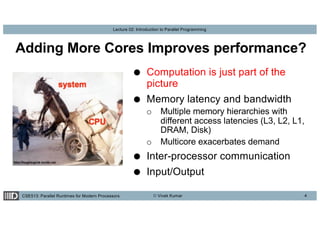
Adding More Cores Improves performance?
4
● Computation is just part of the
picture
● Memory latency and bandwidth
o Multiple memory hierarchies with
different access latencies (L3, L2, L1,
DRAM, Disk)
o Multicore exacerbates demand
● Inter-processor communication
● Input/Output
CSE513: Parallel Runtimes for Modern Processors © Vivek Kumar
Lecture 02: Introduction to Parallel Programming
Today’s Lecture
● Processor technology trend
● Thread operations
o Creation and termination
● Mutual exclusion
5
CSE513: Parallel Runtimes for Modern Processors © Vivek Kumar
Lecture 02: Introduction to Parallel Programming
Thread – A Lightweight Process
● Processes are heavyweight
o Personal address space (allocated
memory)
o Communication across process always
requires help from Operating System
● Threads are lightweight
o Share resources inside the parent process
(code, data and files)
§ Easy to communicate across sibling threads!
o They have their own personal stack (local
variables, caller-callee relationship between
function)
§ Each thread is assigned a different job in the
program
● A process can have one or more threads
6
CSE513: Parallel Runtimes for Modern Processors © Vivek Kumar
Lecture 02: Introduction to Parallel Programming
Thread Creation in Linux
7
//Asynchronously invoke func in a new thread
int pthread_create(
//returned identifier for the new thread
pthread_t *thread,
//specifies the size of thread’s stack and
//how the thread should be scheduled by OS
const pthread_attr_t *attr,
//routine executed after creation
void *(*func)(void *),
//a single argument passed to func
void *arg
) //returns error status
CSE513: Parallel Runtimes for Modern Processors © Vivek Kumar
Lecture 02: Introduction to Parallel Programming
Waiting for Thread Termination in Linux
8
//Suspend execution of calling thread until thread
//terminates
int pthread_join(
//identifier of thread to wait for
pthread_t thread,
//terminating thread’s status (NULL to ignore)
void **status
) //returns error status
CSE513: Parallel Runtimes for Modern Processors © Vivek Kumar
Lecture 02: Introduction to Parallel Programming
Fibonacci Program
9
Disclaimer to Algorithms Police
This recursive program is a poor way to
compute the nth Fibonacci number, but it
provides a good didactic example.
Can we write a parallel
version of this code
using Pthreads?
Source: http://classes.engineering.wustl.edu/cse539/web/lectures/lec01_intro.pdf
CSE513: Parallel Runtimes for Modern Processors © Vivek Kumar
Lecture 02: Introduction to Parallel Programming
Fibonacci Execution
10
Key idea for parallelization
The calculations of fib(n-1) and
fib(n-2) can be executed
simultaneously without mutual interference.
DAG Source: http://www.cs.ucsb.edu/projects/jicos/tutorial/fibonacci/index.html
CSE513: Parallel Runtimes for Modern Processors © Vivek Kumar
Lecture 02: Introduction to Parallel Programming
Pthread Implementation of Fibonacci
11
Source: http://classes.engineering.wustl.edu/cse539/web/lectures/lec01_intro.pdf
CSE513: Parallel Runtimes for Modern Processors © Vivek Kumar
Lecture 02: Introduction to Parallel Programming
Pthread Implementation of Fibonacci
12
Source: http://classes.engineering.wustl.edu/cse539/web/lectures/lec01_intro.pdf
Original code
CSE513: Parallel Runtimes for Modern Processors © Vivek Kumar
Lecture 02: Introduction to Parallel Programming
Pthread Implementation of Fibonacci
13
Source: http://classes.engineering.wustl.edu/cse539/web/lectures/lec01_intro.pdf
Structure for
thread arguments
CSE513: Parallel Runtimes for Modern Processors © Vivek Kumar
Lecture 02: Introduction to Parallel Programming
Pthread Implementation of Fibonacci
14
Source: http://classes.engineering.wustl.edu/cse539/web/lectures/lec01_intro.pdf
Function called
when thread is
created
CSE513: Parallel Runtimes for Modern Processors © Vivek Kumar
Lecture 02: Introduction to Parallel Programming
Pthread Implementation of Fibonacci
15
Source: http://classes.engineering.wustl.edu/cse539/web/lectures/lec01_intro.pdf
No point in creating
thread if there isn’t
enough to do
CSE513: Parallel Runtimes for Modern Processors © Vivek Kumar
Lecture 02: Introduction to Parallel Programming
Pthread Implementation of Fibonacci
16
Source: http://classes.engineering.wustl.edu/cse539/web/lectures/lec01_intro.pdf
Marshal input
argument to thread
CSE513: Parallel Runtimes for Modern Processors © Vivek Kumar
Lecture 02: Introduction to Parallel Programming
Pthread Implementation of Fibonacci
17
Source: http://classes.engineering.wustl.edu/cse539/web/lectures/lec01_intro.pdf
Create thread to execute
fib(n–1).
CSE513: Parallel Runtimes for Modern Processors © Vivek Kumar
Lecture 02: Introduction to Parallel Programming
Pthread Implementation of Fibonacci
18
Source: http://classes.engineering.wustl.edu/cse539/web/lectures/lec01_intro.pdf
Main program
executes fib(n–2)
in parallel.
CSE513: Parallel Runtimes for Modern Processors © Vivek Kumar
Lecture 02: Introduction to Parallel Programming
Pthread Implementation of Fibonacci
19
Source: http://classes.engineering.wustl.edu/cse539/web/lectures/lec01_intro.pdf
Block until the
auxiliary thread
finishes.
CSE513: Parallel Runtimes for Modern Processors © Vivek Kumar
Lecture 02: Introduction to Parallel Programming
Pthread Implementation of Fibonacci
20
Source: http://classes.engineering.wustl.edu/cse539/web/lectures/lec01_intro.pdf
Add the results
together to produce
the final output.
CSE513: Parallel Runtimes for Modern Processors © Vivek Kumar
Lecture 02: Introduction to Parallel Programming
Today’s Lecture
● Processor technology trend
● Thread operations
o Creation and termination
● Mutual exclusion
21
CSE513: Parallel Runtimes for Modern Processors © Vivek Kumar
Lecture 02: Introduction to Parallel Programming
Mutual Exclusion
● Critical section: a block of code that access shared
modifiable data or resource that should be operated on by
only one thread at a time
● Mutual exclusion: a property that ensures that a critical
section is only executed by a thread at a time.
o Otherwise it results in a race condition!
22
Acknowledgement: Slides adopted from the companion slides for the book "The Art of Multiprocessor
Programming” by Maurice Herlihy and Nir Shavit
CSE513: Parallel Runtimes for Modern Processors © Vivek Kumar
Lecture 02: Introduction to Parallel Programming
Threads
23
time
● A thread A is (formally) a sequence
a0, a1, ... of events
o Notation: a0 è a1 indicates order
a0 a1 a2 …
Acknowledgement: Slides adopted from the companion slides for the book "The Art of Multiprocessor
Programming” by Maurice Herlihy and Nir Shavit
CSE513: Parallel Runtimes for Modern Processors © Vivek Kumar
Lecture 02: Introduction to Parallel Programming
Example Thread Events
24
● Assign to shared variable
● Assign to local variable
● Invoke method
● Return from method
● Lots of other things …
Acknowledgement: Slides adopted from the companion slides for the book "The Art of Multiprocessor
Programming” by Maurice Herlihy and Nir Shavit
CSE513: Parallel Runtimes for Modern Processors © Vivek Kumar
Lecture 02: Introduction to Parallel Programming
Concurrency
25
time
time
● Thread A
● Thread B
Acknowledgement: Slides adopted from the companion slides for the book "The Art of Multiprocessor
Programming” by Maurice Herlihy and Nir Shavit
CSE513: Parallel Runtimes for Modern Processors © Vivek Kumar
Lecture 02: Introduction to Parallel Programming
Interleavings
26
time
● Events of two or more threads
o Interleaved
o Not necessarily independent (why?)
Acknowledgement: Slides adopted from the companion slides for the book "The Art of Multiprocessor
Programming” by Maurice Herlihy and Nir Shavit
CSE513: Parallel Runtimes for Modern Processors © Vivek Kumar
Lecture 02: Introduction to Parallel Programming
Critical Sections and Mutual Exclusion
● Critical section is the code (block of code) that should be
executed by only one thread at a time
● Mutex locks enforce mutual exclusion in Pthreads
o Mutex lock states: locked and unlocked
o Only one thread can lock a mutex lock at any particular time
● Using mutex locks
o Request lock before executing critical section
o Enter critical section when lock granted
o Release lock when leaving critical section
27
CSE513: Parallel Runtimes for Modern Processors © Vivek Kumar
Lecture 02: Introduction to Parallel Programming
Pthread Mutex Locks
● Initialize the mutex variable (statically)
o pthread_mutex_t mutex = PTHREAD_MUTEX_INITIALIZER;
● Lock the mutex
o pthread_mutex_lock(&mutex);
● Unlock the mutex
o pthread_mutex_unlock(&mutex);
28
CSE513: Parallel Runtimes for Modern Processors © Vivek Kumar
Lecture 02: Introduction to Parallel Programming
Condition Variables for Synchronization
● Using a condition variable
o thread can block itself until a condition becomes true
§ thread locks a mutex
§ tests a predicate defined on a shared variable
if predicate is false, then wait on the condition variable
waiting on condition variable unlocks associated mutex
o when some thread makes a predicate true
§ that thread can signal the condition variable to either
wake one waiting thread
wake all waiting threads
§ when thread releases the mutex, it is passed to first waiter
29
Source: https://www.clear.rice.edu/comp422/lecture-notes/comp422-2016-Lecture8-Pthreads.pdf
CSE513: Parallel Runtimes for Modern Processors © Vivek Kumar
Lecture 02: Introduction to Parallel Programming
Pthread Condition Variable APIs
/* initialize or destroy a condition variable */
int pthread_cond_init(pthread_cond_t *cond,
const pthread_condattr_t *attr);
int pthread_cond_destroy(pthread_cond_t *cond);
/* block until a condition is true */
int pthread_cond_wait(pthread_cond_t *cond, pthread_mutex_ *mutex);
/* signal one or all waiting threads that condition is true */
int pthread_cond_signal(pthread_cond_t *cond);
int pthread_cond_broadcast(pthread_cond_t *cond);
30
Source: https://www.clear.rice.edu/comp422/lecture-notes/comp422-2016-Lecture8-Pthreads.pdf
CSE513: Parallel Runtimes for Modern Processors © Vivek Kumar
Wait/Notify Sequence in Pthread
1. pthread_mutex_lock(&mutex);
2. while(task_queue_size() == 0)
3. pthread_cond_wait(&cond, &mutex);
4. }
5. task = pop_task_queue();
6. pthread_mutex_unlock(&mutex);
7. execute_task (task);
Consumer(s) Producer
1. pthread_mutex_lock(&mutex);
2. int queue_size = task_queue_size();
3. push_task_queue(&task);
4. if(queue_size == 0) {
5. pthread_cond_broadcast(&cond);
6. }
7. pthread_mutex_unlock(&mutex);
© Vivek Kumar 31
CSE513: Parallel Runtimes for Modern Processors © Vivek Kumar
Wait/Notify Sequence in Pthread
1. pthread_mutex_lock(&mutex);
2. while(task_queue_size() == 0)
3. pthread_cond_wait(&cond, &mutex);
4. }
5. task = pop_task_queue();
6. pthread_mutex_unlock(&mutex);
7. execute_task (task);
1. pthread_mutex_lock(&mutex);
2. int queue_size = task_queue_size();
3. push_task_queue(&task);
4. if(queue_size == 0) {
5. pthread_cond_broadcast(&cond);
6. }
7. pthread_mutex_unlock(&mutex);
Consumer
Thread
Mutex lock
© Vivek Kumar 32
CSE513: Parallel Runtimes for Modern Processors © Vivek Kumar
Wait/Notify Sequence in Pthread
1. pthread_mutex_lock(&mutex);
2. while(task_queue_size() == 0)
3. pthread_cond_wait(&cond, &mutex);
4. }
5. task = pop_task_queue();
6. pthread_mutex_unlock(&mutex);
7. execute_task (task);
1. pthread_mutex_lock(&mutex);
2. int queue_size = task_queue_size();
3. push_task_queue(&task);
4. if(queue_size == 0) {
5. pthread_cond_broadcast(&cond);
6. }
7. pthread_mutex_unlock(&mutex);
Consumer
Thread
Mutex lock
© Vivek Kumar 33
CSE513: Parallel Runtimes for Modern Processors © Vivek Kumar
Wait/Notify Sequence in Pthread
1. pthread_mutex_lock(&mutex);
2. while(task_queue_size() == 0)
3. pthread_cond_wait(&cond, &mutex);
4. }
5. task = pop_task_queue();
6. pthread_mutex_unlock(&mutex);
7. execute_task (task);
1. pthread_mutex_lock(&mutex);
2. int queue_size = task_queue_size();
3. push_task_queue(&task);
4. if(queue_size == 0) {
5. pthread_cond_broadcast(&cond);
6. }
7. pthread_mutex_unlock(&mutex);
Consumer
Thread
Mutex lock
© Vivek Kumar 34
CSE513: Parallel Runtimes for Modern Processors © Vivek Kumar
Wait/Notify Sequence in Pthread
1. pthread_mutex_lock(&mutex);
2. while(task_queue_size() == 0)
3. pthread_cond_wait(&cond, &mutex);
4. }
5. task = pop_task_queue();
6. pthread_mutex_unlock(&mutex);
7. execute_task (task);
1. pthread_mutex_lock(&mutex);
2. int queue_size = task_queue_size();
3. push_task_queue(&task);
4. if(queue_size == 0) {
5. pthread_cond_broadcast(&cond);
6. }
7. pthread_mutex_unlock(&mutex);
Consumer
Thread
Mutex lock
Producer
Thread
© Vivek Kumar 35
CSE513: Parallel Runtimes for Modern Processors © Vivek Kumar
Wait/Notify Sequence in Pthread
1. pthread_mutex_lock(&mutex);
2. while(task_queue_size() == 0)
3. pthread_cond_wait(&cond, &mutex);
4. }
5. task = pop_task_queue();
6. pthread_mutex_unlock(&mutex);
7. execute_task (task);
1. pthread_mutex_lock(&mutex);
2. int queue_size = task_queue_size();
3. push_task_queue(&task);
4. if(queue_size == 0) {
5. pthread_cond_broadcast(&cond);
6. }
7. pthread_mutex_unlock(&mutex);
Consumer
Thread
Mutex lock
Producer
Thread
© Vivek Kumar 36
CSE513: Parallel Runtimes for Modern Processors © Vivek Kumar
Wait/Notify Sequence in Pthread
1. pthread_mutex_lock(&mutex);
2. while(task_queue_size() == 0)
3. pthread_cond_wait(&cond, &mutex);
4. }
5. task = pop_task_queue();
6. pthread_mutex_unlock(&mutex);
7. execute_task (task);
1. pthread_mutex_lock(&mutex);
2. int queue_size = task_queue_size();
3. push_task_queue(&task);
4. if(queue_size == 0) {
5. pthread_cond_broadcast(&cond);
6. }
7. pthread_mutex_unlock(&mutex);
Consumer
Thread
Mutex lock
Producer
Thread
© Vivek Kumar 37
CSE513: Parallel Runtimes for Modern Processors © Vivek Kumar
Wait/Notify Sequence in Pthread
1. pthread_mutex_lock(&mutex);
2. while(task_queue_size() == 0)
3. pthread_cond_wait(&cond, &mutex);
4. }
5. task = pop_task_queue();
6. pthread_mutex_unlock(&mutex);
7. execute_task (task);
1. pthread_mutex_lock(&mutex);
2. int queue_size = task_queue_size();
3. push_task_queue(&task);
4. if(queue_size == 0) {
5. pthread_cond_broadcast(&cond);
6. }
7. pthread_mutex_unlock(&mutex);
Consumer
Thread
Mutex lock
Producer
Thread
© Vivek Kumar 38
CSE513: Parallel Runtimes for Modern Processors © Vivek Kumar
Wait/Notify Sequence in Pthread
1. pthread_mutex_lock(&mutex);
2. while(task_queue_size() == 0)
3. pthread_cond_wait(&cond, &mutex);
4. }
5. task = pop_task_queue();
6. pthread_mutex_unlock(&mutex);
7. execute_task (task);
1. pthread_mutex_lock(&mutex);
2. int queue_size = task_queue_size();
3. push_task_queue(&task);
4. if(queue_size == 0) {
5. pthread_cond_broadcast(&cond);
6. }
7. pthread_mutex_unlock(&mutex);
Consumer
Thread
Mutex lock
Producer
Thread
© Vivek Kumar 39
CSE513: Parallel Runtimes for Modern Processors © Vivek Kumar
Wait/Notify Sequence in Pthread
1. pthread_mutex_lock(&mutex);
2. while(task_queue_size() == 0)
3. pthread_cond_wait(&cond, &mutex);
4. }
5. task = pop_task_queue();
6. pthread_mutex_unlock(&mutex);
7. execute_task (task);
1. pthread_mutex_lock(&mutex);
2. int queue_size = task_queue_size();
3. push_task_queue(&task);
4. if(queue_size == 0) {
5. pthread_cond_broadcast(&cond);
6. }
7. pthread_mutex_unlock(&mutex);
Consumer
Thread
Mutex lock
Producer
Thread
© Vivek Kumar 40
CSE513: Parallel Runtimes for Modern Processors © Vivek Kumar
Wait/Notify Sequence in Pthread
1. pthread_mutex_lock(&mutex);
2. while(task_queue_size() == 0)
3. pthread_cond_wait(&cond, &mutex);
4. }
5. task = pop_task_queue();
6. pthread_mutex_unlock(&mutex);
7. execute_task (task);
1. pthread_mutex_lock(&mutex);
2. int queue_size = task_queue_size();
3. push_task_queue(&task);
4. if(queue_size == 0) {
5. pthread_cond_broadcast(&cond);
6. }
7. pthread_mutex_unlock(&mutex);
Consumer
Thread
Mutex lock
Producer
Thread
© Vivek Kumar 41
CSE513: Parallel Runtimes for Modern Processors © Vivek Kumar
Lecture 02: Introduction to Parallel Programming
Reminders about this Course!
● No lecture recordings will be provided
● No help will be provided on project group formation
● You should not open-source the course projects after the
course is over
● You should learn C/C++ on your own
● We will strictly follow IIITD plagiarism policy
So, plan accordingly. Registering to this course means you
are agreeing to all these requirements
42
CSE513: Parallel Runtimes for Modern Processors © Vivek Kumar
Lecture 02: Introduction to Parallel Programming
Next Lecture 03
● Productivity in parallel programming
43

lec02_parallel_programming.pdfghhbjjjhjb

  • 1.
    CSE513: Parallel Runtimesfor Modern Processors © Vivek Kumar Lecture 02: Introduction to Parallel Programming Vivek Kumar Computer Science and Engineering IIIT Delhi vivekk@iiitd.ac.in
  • 2.
    CSE513: Parallel Runtimesfor Modern Processors © Vivek Kumar Lecture 02: Introduction to Parallel Programming Today’s Lecture ● Processor technology trend ● Thread operations o Creation and termination ● Mutual exclusion 1
  • 3.
    CSE513: Parallel Runtimesfor Modern Processors © Vivek Kumar Lecture 02: Introduction to Parallel Programming Processor Technology Trend 2 ● Moore’s law (1964) o Area of transistors halves roughly every two years § I.e., Total transistors on processor chip gets doubled roughly every two years ● Dennard scaling (1974) o Power for fixed chip area remains almost constant even with transistors becoming smaller (power density remains constant) § Supply voltage was scaled down proportionally with frequency as transistors shrank ● No more free lunch! o Thermal wall hit around 2004 § Heat dissipation § Leakage current o Power is proportional to cube of frequency § Power = C x V2 x f and V ∝ f • Power ∝ f3 § It restricts frequency growth, but opens up multicore era
  • 4.
    CSE513: Parallel Runtimesfor Modern Processors © Vivek Kumar Lecture 02: Introduction to Parallel Programming Multicore Saves Power ● Nowadays (post Dennard Scaling) o Power ~ (Capacitance) * (Voltage)2 * (Frequency) § Maximum Frequency is capped by Voltage o Power is proportional to (Frequency)3 ● Baseline example: single 1GHz core with power P o Option A: Increase clock frequency to 2GHz § Power = 8P o Option B: Use 2 cores at 1 GHz each § Power = 2P ● Option B delivers same performance as Option A with 4x less power … provided software can be decomposed to run in parallel !! 3 Source: https://wiki.rice.edu/confluence/download/attachments/4435861/comp322-s16-lec1-slides.pdf?version=1&modificationDate=1452732285045&api=v2
  • 5.
    CSE513: Parallel Runtimesfor Modern Processors © Vivek Kumar Lecture 02: Introduction to Parallel Programming Adding More Cores Improves performance? 4 ● Computation is just part of the picture ● Memory latency and bandwidth o Multiple memory hierarchies with different access latencies (L3, L2, L1, DRAM, Disk) o Multicore exacerbates demand ● Inter-processor communication ● Input/Output
  • 6.
    CSE513: Parallel Runtimesfor Modern Processors © Vivek Kumar Lecture 02: Introduction to Parallel Programming Today’s Lecture ● Processor technology trend ● Thread operations o Creation and termination ● Mutual exclusion 5
  • 7.
    CSE513: Parallel Runtimesfor Modern Processors © Vivek Kumar Lecture 02: Introduction to Parallel Programming Thread – A Lightweight Process ● Processes are heavyweight o Personal address space (allocated memory) o Communication across process always requires help from Operating System ● Threads are lightweight o Share resources inside the parent process (code, data and files) § Easy to communicate across sibling threads! o They have their own personal stack (local variables, caller-callee relationship between function) § Each thread is assigned a different job in the program ● A process can have one or more threads 6
  • 8.
    CSE513: Parallel Runtimesfor Modern Processors © Vivek Kumar Lecture 02: Introduction to Parallel Programming Thread Creation in Linux 7 //Asynchronously invoke func in a new thread int pthread_create( //returned identifier for the new thread pthread_t *thread, //specifies the size of thread’s stack and //how the thread should be scheduled by OS const pthread_attr_t *attr, //routine executed after creation void *(*func)(void *), //a single argument passed to func void *arg ) //returns error status
  • 9.
    CSE513: Parallel Runtimesfor Modern Processors © Vivek Kumar Lecture 02: Introduction to Parallel Programming Waiting for Thread Termination in Linux 8 //Suspend execution of calling thread until thread //terminates int pthread_join( //identifier of thread to wait for pthread_t thread, //terminating thread’s status (NULL to ignore) void **status ) //returns error status
  • 10.
    CSE513: Parallel Runtimesfor Modern Processors © Vivek Kumar Lecture 02: Introduction to Parallel Programming Fibonacci Program 9 Disclaimer to Algorithms Police This recursive program is a poor way to compute the nth Fibonacci number, but it provides a good didactic example. Can we write a parallel version of this code using Pthreads? Source: http://classes.engineering.wustl.edu/cse539/web/lectures/lec01_intro.pdf
  • 11.
    CSE513: Parallel Runtimesfor Modern Processors © Vivek Kumar Lecture 02: Introduction to Parallel Programming Fibonacci Execution 10 Key idea for parallelization The calculations of fib(n-1) and fib(n-2) can be executed simultaneously without mutual interference. DAG Source: http://www.cs.ucsb.edu/projects/jicos/tutorial/fibonacci/index.html
  • 12.
    CSE513: Parallel Runtimesfor Modern Processors © Vivek Kumar Lecture 02: Introduction to Parallel Programming Pthread Implementation of Fibonacci 11 Source: http://classes.engineering.wustl.edu/cse539/web/lectures/lec01_intro.pdf
  • 13.
    CSE513: Parallel Runtimesfor Modern Processors © Vivek Kumar Lecture 02: Introduction to Parallel Programming Pthread Implementation of Fibonacci 12 Source: http://classes.engineering.wustl.edu/cse539/web/lectures/lec01_intro.pdf Original code
  • 14.
    CSE513: Parallel Runtimesfor Modern Processors © Vivek Kumar Lecture 02: Introduction to Parallel Programming Pthread Implementation of Fibonacci 13 Source: http://classes.engineering.wustl.edu/cse539/web/lectures/lec01_intro.pdf Structure for thread arguments
  • 15.
    CSE513: Parallel Runtimesfor Modern Processors © Vivek Kumar Lecture 02: Introduction to Parallel Programming Pthread Implementation of Fibonacci 14 Source: http://classes.engineering.wustl.edu/cse539/web/lectures/lec01_intro.pdf Function called when thread is created
  • 16.
    CSE513: Parallel Runtimesfor Modern Processors © Vivek Kumar Lecture 02: Introduction to Parallel Programming Pthread Implementation of Fibonacci 15 Source: http://classes.engineering.wustl.edu/cse539/web/lectures/lec01_intro.pdf No point in creating thread if there isn’t enough to do
  • 17.
    CSE513: Parallel Runtimesfor Modern Processors © Vivek Kumar Lecture 02: Introduction to Parallel Programming Pthread Implementation of Fibonacci 16 Source: http://classes.engineering.wustl.edu/cse539/web/lectures/lec01_intro.pdf Marshal input argument to thread
  • 18.
    CSE513: Parallel Runtimesfor Modern Processors © Vivek Kumar Lecture 02: Introduction to Parallel Programming Pthread Implementation of Fibonacci 17 Source: http://classes.engineering.wustl.edu/cse539/web/lectures/lec01_intro.pdf Create thread to execute fib(n–1).
  • 19.
    CSE513: Parallel Runtimesfor Modern Processors © Vivek Kumar Lecture 02: Introduction to Parallel Programming Pthread Implementation of Fibonacci 18 Source: http://classes.engineering.wustl.edu/cse539/web/lectures/lec01_intro.pdf Main program executes fib(n–2) in parallel.
  • 20.
    CSE513: Parallel Runtimesfor Modern Processors © Vivek Kumar Lecture 02: Introduction to Parallel Programming Pthread Implementation of Fibonacci 19 Source: http://classes.engineering.wustl.edu/cse539/web/lectures/lec01_intro.pdf Block until the auxiliary thread finishes.
  • 21.
    CSE513: Parallel Runtimesfor Modern Processors © Vivek Kumar Lecture 02: Introduction to Parallel Programming Pthread Implementation of Fibonacci 20 Source: http://classes.engineering.wustl.edu/cse539/web/lectures/lec01_intro.pdf Add the results together to produce the final output.
  • 22.
    CSE513: Parallel Runtimesfor Modern Processors © Vivek Kumar Lecture 02: Introduction to Parallel Programming Today’s Lecture ● Processor technology trend ● Thread operations o Creation and termination ● Mutual exclusion 21
  • 23.
    CSE513: Parallel Runtimesfor Modern Processors © Vivek Kumar Lecture 02: Introduction to Parallel Programming Mutual Exclusion ● Critical section: a block of code that access shared modifiable data or resource that should be operated on by only one thread at a time ● Mutual exclusion: a property that ensures that a critical section is only executed by a thread at a time. o Otherwise it results in a race condition! 22 Acknowledgement: Slides adopted from the companion slides for the book "The Art of Multiprocessor Programming” by Maurice Herlihy and Nir Shavit
  • 24.
    CSE513: Parallel Runtimesfor Modern Processors © Vivek Kumar Lecture 02: Introduction to Parallel Programming Threads 23 time ● A thread A is (formally) a sequence a0, a1, ... of events o Notation: a0 è a1 indicates order a0 a1 a2 … Acknowledgement: Slides adopted from the companion slides for the book "The Art of Multiprocessor Programming” by Maurice Herlihy and Nir Shavit
  • 25.
    CSE513: Parallel Runtimesfor Modern Processors © Vivek Kumar Lecture 02: Introduction to Parallel Programming Example Thread Events 24 ● Assign to shared variable ● Assign to local variable ● Invoke method ● Return from method ● Lots of other things … Acknowledgement: Slides adopted from the companion slides for the book "The Art of Multiprocessor Programming” by Maurice Herlihy and Nir Shavit
  • 26.
    CSE513: Parallel Runtimesfor Modern Processors © Vivek Kumar Lecture 02: Introduction to Parallel Programming Concurrency 25 time time ● Thread A ● Thread B Acknowledgement: Slides adopted from the companion slides for the book "The Art of Multiprocessor Programming” by Maurice Herlihy and Nir Shavit
  • 27.
    CSE513: Parallel Runtimesfor Modern Processors © Vivek Kumar Lecture 02: Introduction to Parallel Programming Interleavings 26 time ● Events of two or more threads o Interleaved o Not necessarily independent (why?) Acknowledgement: Slides adopted from the companion slides for the book "The Art of Multiprocessor Programming” by Maurice Herlihy and Nir Shavit
  • 28.
    CSE513: Parallel Runtimesfor Modern Processors © Vivek Kumar Lecture 02: Introduction to Parallel Programming Critical Sections and Mutual Exclusion ● Critical section is the code (block of code) that should be executed by only one thread at a time ● Mutex locks enforce mutual exclusion in Pthreads o Mutex lock states: locked and unlocked o Only one thread can lock a mutex lock at any particular time ● Using mutex locks o Request lock before executing critical section o Enter critical section when lock granted o Release lock when leaving critical section 27
  • 29.
    CSE513: Parallel Runtimesfor Modern Processors © Vivek Kumar Lecture 02: Introduction to Parallel Programming Pthread Mutex Locks ● Initialize the mutex variable (statically) o pthread_mutex_t mutex = PTHREAD_MUTEX_INITIALIZER; ● Lock the mutex o pthread_mutex_lock(&mutex); ● Unlock the mutex o pthread_mutex_unlock(&mutex); 28
  • 30.
    CSE513: Parallel Runtimesfor Modern Processors © Vivek Kumar Lecture 02: Introduction to Parallel Programming Condition Variables for Synchronization ● Using a condition variable o thread can block itself until a condition becomes true § thread locks a mutex § tests a predicate defined on a shared variable if predicate is false, then wait on the condition variable waiting on condition variable unlocks associated mutex o when some thread makes a predicate true § that thread can signal the condition variable to either wake one waiting thread wake all waiting threads § when thread releases the mutex, it is passed to first waiter 29 Source: https://www.clear.rice.edu/comp422/lecture-notes/comp422-2016-Lecture8-Pthreads.pdf
  • 31.
    CSE513: Parallel Runtimesfor Modern Processors © Vivek Kumar Lecture 02: Introduction to Parallel Programming Pthread Condition Variable APIs /* initialize or destroy a condition variable */ int pthread_cond_init(pthread_cond_t *cond, const pthread_condattr_t *attr); int pthread_cond_destroy(pthread_cond_t *cond); /* block until a condition is true */ int pthread_cond_wait(pthread_cond_t *cond, pthread_mutex_ *mutex); /* signal one or all waiting threads that condition is true */ int pthread_cond_signal(pthread_cond_t *cond); int pthread_cond_broadcast(pthread_cond_t *cond); 30 Source: https://www.clear.rice.edu/comp422/lecture-notes/comp422-2016-Lecture8-Pthreads.pdf
  • 32.
    CSE513: Parallel Runtimesfor Modern Processors © Vivek Kumar Wait/Notify Sequence in Pthread 1. pthread_mutex_lock(&mutex); 2. while(task_queue_size() == 0) 3. pthread_cond_wait(&cond, &mutex); 4. } 5. task = pop_task_queue(); 6. pthread_mutex_unlock(&mutex); 7. execute_task (task); Consumer(s) Producer 1. pthread_mutex_lock(&mutex); 2. int queue_size = task_queue_size(); 3. push_task_queue(&task); 4. if(queue_size == 0) { 5. pthread_cond_broadcast(&cond); 6. } 7. pthread_mutex_unlock(&mutex); © Vivek Kumar 31
  • 33.
    CSE513: Parallel Runtimesfor Modern Processors © Vivek Kumar Wait/Notify Sequence in Pthread 1. pthread_mutex_lock(&mutex); 2. while(task_queue_size() == 0) 3. pthread_cond_wait(&cond, &mutex); 4. } 5. task = pop_task_queue(); 6. pthread_mutex_unlock(&mutex); 7. execute_task (task); 1. pthread_mutex_lock(&mutex); 2. int queue_size = task_queue_size(); 3. push_task_queue(&task); 4. if(queue_size == 0) { 5. pthread_cond_broadcast(&cond); 6. } 7. pthread_mutex_unlock(&mutex); Consumer Thread Mutex lock © Vivek Kumar 32
  • 34.
    CSE513: Parallel Runtimesfor Modern Processors © Vivek Kumar Wait/Notify Sequence in Pthread 1. pthread_mutex_lock(&mutex); 2. while(task_queue_size() == 0) 3. pthread_cond_wait(&cond, &mutex); 4. } 5. task = pop_task_queue(); 6. pthread_mutex_unlock(&mutex); 7. execute_task (task); 1. pthread_mutex_lock(&mutex); 2. int queue_size = task_queue_size(); 3. push_task_queue(&task); 4. if(queue_size == 0) { 5. pthread_cond_broadcast(&cond); 6. } 7. pthread_mutex_unlock(&mutex); Consumer Thread Mutex lock © Vivek Kumar 33
  • 35.
    CSE513: Parallel Runtimesfor Modern Processors © Vivek Kumar Wait/Notify Sequence in Pthread 1. pthread_mutex_lock(&mutex); 2. while(task_queue_size() == 0) 3. pthread_cond_wait(&cond, &mutex); 4. } 5. task = pop_task_queue(); 6. pthread_mutex_unlock(&mutex); 7. execute_task (task); 1. pthread_mutex_lock(&mutex); 2. int queue_size = task_queue_size(); 3. push_task_queue(&task); 4. if(queue_size == 0) { 5. pthread_cond_broadcast(&cond); 6. } 7. pthread_mutex_unlock(&mutex); Consumer Thread Mutex lock © Vivek Kumar 34
  • 36.
    CSE513: Parallel Runtimesfor Modern Processors © Vivek Kumar Wait/Notify Sequence in Pthread 1. pthread_mutex_lock(&mutex); 2. while(task_queue_size() == 0) 3. pthread_cond_wait(&cond, &mutex); 4. } 5. task = pop_task_queue(); 6. pthread_mutex_unlock(&mutex); 7. execute_task (task); 1. pthread_mutex_lock(&mutex); 2. int queue_size = task_queue_size(); 3. push_task_queue(&task); 4. if(queue_size == 0) { 5. pthread_cond_broadcast(&cond); 6. } 7. pthread_mutex_unlock(&mutex); Consumer Thread Mutex lock Producer Thread © Vivek Kumar 35
  • 37.
    CSE513: Parallel Runtimesfor Modern Processors © Vivek Kumar Wait/Notify Sequence in Pthread 1. pthread_mutex_lock(&mutex); 2. while(task_queue_size() == 0) 3. pthread_cond_wait(&cond, &mutex); 4. } 5. task = pop_task_queue(); 6. pthread_mutex_unlock(&mutex); 7. execute_task (task); 1. pthread_mutex_lock(&mutex); 2. int queue_size = task_queue_size(); 3. push_task_queue(&task); 4. if(queue_size == 0) { 5. pthread_cond_broadcast(&cond); 6. } 7. pthread_mutex_unlock(&mutex); Consumer Thread Mutex lock Producer Thread © Vivek Kumar 36
  • 38.
    CSE513: Parallel Runtimesfor Modern Processors © Vivek Kumar Wait/Notify Sequence in Pthread 1. pthread_mutex_lock(&mutex); 2. while(task_queue_size() == 0) 3. pthread_cond_wait(&cond, &mutex); 4. } 5. task = pop_task_queue(); 6. pthread_mutex_unlock(&mutex); 7. execute_task (task); 1. pthread_mutex_lock(&mutex); 2. int queue_size = task_queue_size(); 3. push_task_queue(&task); 4. if(queue_size == 0) { 5. pthread_cond_broadcast(&cond); 6. } 7. pthread_mutex_unlock(&mutex); Consumer Thread Mutex lock Producer Thread © Vivek Kumar 37
  • 39.
    CSE513: Parallel Runtimesfor Modern Processors © Vivek Kumar Wait/Notify Sequence in Pthread 1. pthread_mutex_lock(&mutex); 2. while(task_queue_size() == 0) 3. pthread_cond_wait(&cond, &mutex); 4. } 5. task = pop_task_queue(); 6. pthread_mutex_unlock(&mutex); 7. execute_task (task); 1. pthread_mutex_lock(&mutex); 2. int queue_size = task_queue_size(); 3. push_task_queue(&task); 4. if(queue_size == 0) { 5. pthread_cond_broadcast(&cond); 6. } 7. pthread_mutex_unlock(&mutex); Consumer Thread Mutex lock Producer Thread © Vivek Kumar 38
  • 40.
    CSE513: Parallel Runtimesfor Modern Processors © Vivek Kumar Wait/Notify Sequence in Pthread 1. pthread_mutex_lock(&mutex); 2. while(task_queue_size() == 0) 3. pthread_cond_wait(&cond, &mutex); 4. } 5. task = pop_task_queue(); 6. pthread_mutex_unlock(&mutex); 7. execute_task (task); 1. pthread_mutex_lock(&mutex); 2. int queue_size = task_queue_size(); 3. push_task_queue(&task); 4. if(queue_size == 0) { 5. pthread_cond_broadcast(&cond); 6. } 7. pthread_mutex_unlock(&mutex); Consumer Thread Mutex lock Producer Thread © Vivek Kumar 39
  • 41.
    CSE513: Parallel Runtimesfor Modern Processors © Vivek Kumar Wait/Notify Sequence in Pthread 1. pthread_mutex_lock(&mutex); 2. while(task_queue_size() == 0) 3. pthread_cond_wait(&cond, &mutex); 4. } 5. task = pop_task_queue(); 6. pthread_mutex_unlock(&mutex); 7. execute_task (task); 1. pthread_mutex_lock(&mutex); 2. int queue_size = task_queue_size(); 3. push_task_queue(&task); 4. if(queue_size == 0) { 5. pthread_cond_broadcast(&cond); 6. } 7. pthread_mutex_unlock(&mutex); Consumer Thread Mutex lock Producer Thread © Vivek Kumar 40
  • 42.
    CSE513: Parallel Runtimesfor Modern Processors © Vivek Kumar Wait/Notify Sequence in Pthread 1. pthread_mutex_lock(&mutex); 2. while(task_queue_size() == 0) 3. pthread_cond_wait(&cond, &mutex); 4. } 5. task = pop_task_queue(); 6. pthread_mutex_unlock(&mutex); 7. execute_task (task); 1. pthread_mutex_lock(&mutex); 2. int queue_size = task_queue_size(); 3. push_task_queue(&task); 4. if(queue_size == 0) { 5. pthread_cond_broadcast(&cond); 6. } 7. pthread_mutex_unlock(&mutex); Consumer Thread Mutex lock Producer Thread © Vivek Kumar 41
  • 43.
    CSE513: Parallel Runtimesfor Modern Processors © Vivek Kumar Lecture 02: Introduction to Parallel Programming Reminders about this Course! ● No lecture recordings will be provided ● No help will be provided on project group formation ● You should not open-source the course projects after the course is over ● You should learn C/C++ on your own ● We will strictly follow IIITD plagiarism policy So, plan accordingly. Registering to this course means you are agreeing to all these requirements 42
  • 44.
    CSE513: Parallel Runtimesfor Modern Processors © Vivek Kumar Lecture 02: Introduction to Parallel Programming Next Lecture 03 ● Productivity in parallel programming 43