1
11
1
1
Scope of the Course
 To discuss various aspects of watershed &
it t I t t d W t h dits management – Integrated Watershed
Management Approach.
 Watershed – ideal unit for multi-disciplinary
planning & management of land & water resources –
ensure continuous benefits – sustainable way
 Watershed Management (WM)–
– Sustainable Management of entire land &
resources.
22
Prof. T I Eldho, Department of Civil Engineering, IIT Bombay
Course Objectives
 To discuss various aspects of watershed
development and management – resources:
technological, social, ecological,
environmental, sustainable issues.
 Focus - technical aspects of WM;
perspectives on land & water management;
l lanalyze complex issues in water
management and on specific knowledge on
i f WMissues of WM.
33
Prof. T I Eldho, Department of Civil Engineering, IIT Bombay
Course Objectives..j
 Course will be very useful to
– Undergraduate & post-graduateUndergraduate & post graduate
students,
T h NGO’ Fi ld E i– Teachers, NGO’s, Field Engineers
and Practitioners.
– Number of field problems will be
discussed to illustratediscussed to illustrate
the concepts clearly.
44
Prof. T I Eldho, Department of Civil Engineering, IIT Bombay
Course Modules -10 (40L)
 1) Introduction and Basic Concepts - 3
Course Modules -10 (40L)
 2) Sustainable Watershed Approach &
Watershed Management Practices - 4g
 3) Integrated Watershed Management - 4
4) W t h d M d li 7 4) Watershed Modeling - 7
 5) Social Aspects of Watershed
Management - 3
P f T I Eldh D t t f Ci il E i i IIT B b
55
Prof. T I Eldho, Department of Civil Engineering, IIT Bombay
Course Modules – 10 (40L)Course Modules – 10 (40L)
 6) Use of modern techniques in
watershed management -5
 7) Management of Water Quality 4 7) Management of Water Quality -4
 8) Storm Water and Flood
Management -4
9) D ht M t 3 9) Drought Management -3
 10) Water Conservation and Recycling -3
66
) y g
Prof. T I Eldho, Department of Civil Engineering, IIT Bombay
References
 1) Allam, Gamal Ibrahim Y., Decision Support System for
Integrated Watershed Management, Colorado State
University, 1994.
 2) Am Soc Of Agri Engr Hydrologic Modeling of Small 2) Am. Soc. Of Agri. Engr., Hydrologic Modeling of Small
Watersheds, Am. Soc. Agri. Eng., Michigan, 1982.
 3) American Soc. of Civil Engr., Watershed Management,
American Soc. of Civil Engineers, New York, 1975.g , ,
 4) Black Peter E., Watershed Hydrology, Prentice Hall,
London, 1991.
 5) Michael A.M., Irrigation Engineering, Vikas Pub.
h 1992house, 1992.
 6) Rajesh Rajora, Integrated Watershed Management,
Rawat Publication, New Delhi, 1998.
7) Heathcote I W Integrated Watershed Management 7) Heathcote, I.W., Integrated Watershed Management-
Principles and Practice, Jown Wiley & Sons, London,
1998.
77Prof. T I Eldho, Department of Civil Engineering, IIT Bombay
References…
 8) Murty, J.V.S. Watershed Management, New Age
Intl., New Delhi 1998.
 9) Gopal Iyer, K., & Roy U.N., (Eds.), Watershed
Management & Sustainable Development, Kanishka
Publishers, New Delhi, 2005., ,
 10) Purandare, A.P., Jaiswal A.K., Watersheds
Development in India, NIRD, Hyderabad, 1995.
 11) Vir Singh Raj Watershed Planning and 11) Vir Singh, Raj , Watershed Planning and
Management, Yash Publishing House, Bikaner, 2000.
 12) Paul A. Debarry., Watershed, Processes,
Assessment & Management Wiley London 2004Assessment & Management, Wiley, London, 2004.
88
Prof. T I Eldho, Department of Civil Engineering, IIT Bombay
Module 1 (L1 L3)Module 1 – (L1-L3)
 Introduction and Basic Concepts
 Concept of watershed, introduction to
watershed management differentwatershed management, different
stakeholders and their relative
importance, watershed management
policies and decision making.policies and decision making.
99
Prof. T I Eldho, Department of Civil Engineering, IIT Bombay
L1L1– Introduction to Watershed
Management
 Topics Covered Topics Covered
 Concept of Watershed; Watershed Approach;Concept of Watershed; Watershed Approach;
C t h d bl I t d ti tC t h d bl I t d ti tCommon watershed problems; Introduction toCommon watershed problems; Introduction to
Watershed Management (WM)Watershed Management (WM)-- WM necessity &WM necessity &
principles; Case Studyprinciples; Case Studyprinciples; Case Study.principles; Case Study.
 Keywords:Keywords: Watershed management, Concepts,Watershed management, Concepts,
Characteristics, Deterioration, Necessity, Principles.Characteristics, Deterioration, Necessity, Principles.
1010
Prof. T I Eldho, Department of Civil Engineering, IIT Bombay
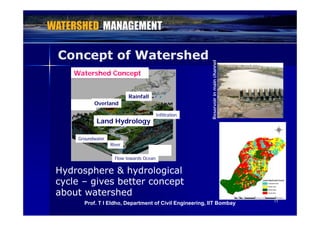
Concept of WatershedConcept of Watershed
elel
pp
mainchannemainchanne
Watershed Concept
servoirinmservoirinm
Rainfall
Overland
ResRes
Land Hydrology
Groundwater
Infiltration
River
Groundwater
Flow towards Ocean
Hydrosphere & hydrologicalHydrosphere & hydrological
cyclecycle –– gives better conceptgives better concept
b t t h db t t h d
1111
Prof. T I Eldho, Department of Civil Engineering, IIT Bombay
about watershedabout watershed
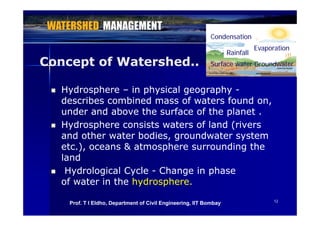
Condensation
Concept of WatershedConcept of Watershed
Evaporation
Condensation
Rainfall
S f t G d t
H d hH d h i h i l hi h i l h
Concept of Watershed..Concept of Watershed.. Surface water Groundwater
 HydrosphereHydrosphere –– in physical geographyin physical geography --
describes combined mass of waters found on,describes combined mass of waters found on,
under and above the surface of the planetunder and above the surface of the planetunder and above the surface of the planet .under and above the surface of the planet .
 Hydrosphere consists waters of land (riversHydrosphere consists waters of land (rivers
and other water bodies, groundwater systemand other water bodies, groundwater systemand other water bodies, groundwater systemand other water bodies, groundwater system
etc.), oceans & atmosphere surrounding theetc.), oceans & atmosphere surrounding the
landland
 Hydrological CycleHydrological Cycle -- Change in phaseChange in phase
of water in theof water in the hydrosphere.hydrosphere.
1212
Prof. T I Eldho, Department of Civil Engineering, IIT Bombay
Concept of Watershed..Concept of Watershed..
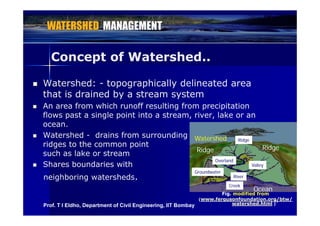
 Watershed:Watershed: -- topographically delineated areatopographically delineated area
pp
p g p yp g p y
that is drained by a stream systemthat is drained by a stream system
 An area from which runoff resulting from precipitationAn area from which runoff resulting from precipitation
fl t i l i t i t t i l kfl t i l i t i t t i l kflows past a single point into a stream, river, lake or anflows past a single point into a stream, river, lake or an
ocean.ocean.
 WatershedWatershed -- drains from surroundingdrains from surrounding Watershed Rid
gg
ridges to the common pointridges to the common point
such as lake or streamsuch as lake or stream
 Shares boundaries withShares boundaries with
RidgeRidge
Watershed
Valley
Overland
Ridge
 Shares boundaries withShares boundaries with
neighboring watershedsneighboring watersheds.. River
Ocean
River
Creek
Valley
Groundwater
1313
Fig. modified from
(www.fergusonfoundation.org/btw/
watershed.html )
Prof. T I Eldho, Department of Civil Engineering, IIT Bombay
Ocean
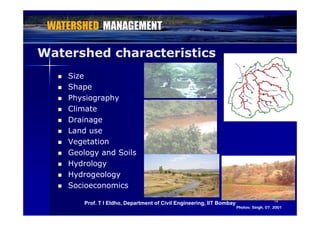
Watershed characteristics
 Size
 Shape Shape
 Physiography
 Climate
 Drainage
 Land use
 Vegetation
 Geology and Soils
 Hydrology Hydrology
 Hydrogeology
 Socioeconomics
1414
Photos: Singh, 07. 2001Photos: Singh, 07. 2001
Prof. T I Eldho, Department of Civil Engineering, IIT Bombay
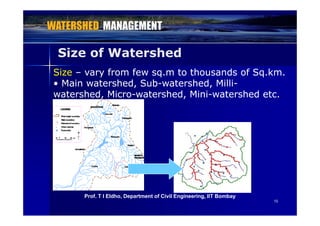
Size of Watershed
SizeSize –– vary from few sq.m to thousands of Sq.km.vary from few sq.m to thousands of Sq.km.
•• Main watershed, SubMain watershed, Sub--watershed, Milliwatershed, Milli--,, ,,
watershed, Microwatershed, Micro--watershed, Miniwatershed, Mini--watershed etc.watershed etc.
1515
Prof. T I Eldho, Department of Civil Engineering, IIT Bombay
Watershed ApproachWatershed Approach
 Watershed approachWatershed approach -- appropriate to solveappropriate to solve
various resources problemsvarious resources problems -- for planning,for planning,
i l t ti & ti l t ti & timplementation & managementimplementation & management
 Managing Land & WaterManaging Land & Water -- watershed scale,watershed scale,g gg g ,,
appropriateappropriate-- environmentally, financially &environmentally, financially &
sociallysocially
–– Environmental scaleEnvironmental scale -- watershed defined by naturalwatershed defined by natural
hydrologyhydrology -- Resources becomes a focal point inResources becomes a focal point in
order to understand factors that contributes theorder to understand factors that contributes the
problem.problem.
1616Prof. T I Eldho, Department of Civil Engineering, IIT Bombay
Watershed ApproachWatershed Approach contd..contd..
 Financial and social benefits ofFinancial and social benefits of
watershed approachwatershed approachpppp
 Core of watershed approachCore of watershed approach -- better understandingbetter understanding
of environmental factors.of environmental factors.of environmental factors.of environmental factors.
 Tasks such as modeling, monitoring & reportingTasks such as modeling, monitoring & reporting
under watershed frameworkunder watershed framework -- saves time andsaves time and
moneymoneymoney.money.
 People’s participationPeople’s participation --pillar of watershed approachpillar of watershed approach --
gives sense of ownership; greater public involvementgives sense of ownership; greater public involvement
& ensures sustainability of interventions planned.& ensures sustainability of interventions planned.
1717Prof. T I Eldho, Department of Civil Engineering, IIT Bombay
Watershed
Watershed DeteriorationWatershed Deterioration Soil erosion
Watershed
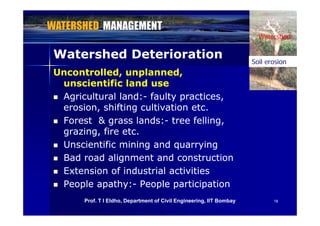
Uncontrolled, unplanned,Uncontrolled, unplanned,
unscientific land useunscientific land use
Soil erosion
 Agricultural land:Agricultural land:-- faulty practices,faulty practices,
erosion, shifting cultivation etc.erosion, shifting cultivation etc.
 Forest & grass lands:Forest & grass lands:-- tree felling,tree felling,
grazing, fire etc.grazing, fire etc.
 Unscientific mining and quarryingUnscientific mining and quarrying
 Bad road alignment and constructionBad road alignment and construction
 Extension of industrial activitiesExtension of industrial activities
 People apathy:People apathy:-- People participationPeople participation
1818Prof. T I Eldho, Department of Civil Engineering, IIT Bombay
Watershed DeteriorationWatershed Deterioration-- ConsequencesConsequencesqq
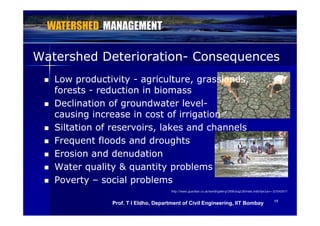
 Low productivityLow productivity -- agriculture, grasslands,agriculture, grasslands,
f tf t d ti i bid ti i biforestsforests -- reduction in biomassreduction in biomass
 Declination of groundwater levelDeclination of groundwater level--
causing increase in cost of irrigationcausing increase in cost of irrigationcausing increase in cost of irrigationcausing increase in cost of irrigation
 Siltation of reservoirs, lakes and channelsSiltation of reservoirs, lakes and channels
F eq ent floods and d o ghtsF eq ent floods and d o ghts Frequent floods and droughtsFrequent floods and droughts
 Erosion and denudationErosion and denudation
W t lit & tit blW t lit & tit bl Water quality & quantity problemsWater quality & quantity problems
 PovertyPoverty –– social problemssocial problems
1919
http://www.guardian.co.uk/world/gallery/2008/aug/28/india.india?picture=337042017
Prof. T I Eldho, Department of Civil Engineering, IIT Bombay
Typical Watershed ProblemsTypical Watershed Problems
 Physical problemsPhysical problems
–– steep slope, bad lands, soil erosion...steep slope, bad lands, soil erosion...steep slope, bad lands, soil erosion...steep slope, bad lands, soil erosion...
 Resource use problemsResource use problems
–– shifting cultivation, fire,shifting cultivation, fire,shifting cultivation, fire,shifting cultivation, fire,
deforestation etc.deforestation etc.
 End problemsEnd problems End problemsEnd problems
–– reduced yield, flood, droughtreduced yield, flood, drought
 SocioSocio--economic and other problemseconomic and other problems
–– poverty, migration etc.poverty, migration etc.
2020Prof. T I Eldho, Department of Civil Engineering, IIT Bombay
Watershed ComplicationsWatershed Complications
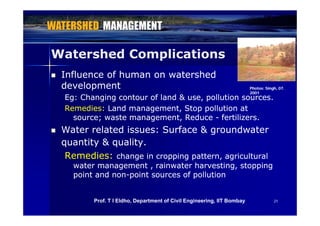
 Influence of human on watershedInfluence of human on watershed
developmentdevelopment Ph t Si h 07Ph t Si h 07developmentdevelopment
Eg: Changing contour of land & use, pollution sources.Eg: Changing contour of land & use, pollution sources.
Remedies:Remedies: Land management, Stop pollution atLand management, Stop pollution at
Photos: Singh, 07.Photos: Singh, 07.
20012001
source; waste management, Reducesource; waste management, Reduce -- fertilizers.fertilizers.
 Water related issues: Surface & groundwaterWater related issues: Surface & groundwater
& l& lquantity & quality.quantity & quality.
Remedies:Remedies: change in cropping pattern, agriculturalchange in cropping pattern, agricultural
water management rainwater harvesting stoppingwater management rainwater harvesting stoppingwater management , rainwater harvesting, stoppingwater management , rainwater harvesting, stopping
point and nonpoint and non--point sources of pollutionpoint sources of pollution
2121Prof. T I Eldho, Department of Civil Engineering, IIT Bombay
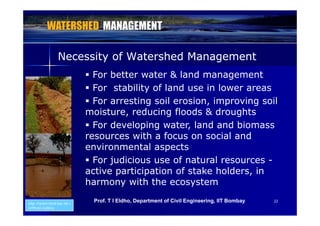
Necessity of Watershed ManagementNecessity of Watershed Managementy gy g
ļ‚§ For better water & land management
ļ‚§ For stability of land use in lower areasļ‚§ For stability of land use in lower areas
ļ‚§ For arresting soil erosion, improving soil
moisture reducing floods & droughtsmoisture, reducing floods & droughts
ļ‚§ For developing water, land and biomass
resources with a focus on social andresources with a focus on social and
environmental aspects
ļ‚§ For judicious use of natural resources -j
active participation of stake holders, in
harmony with the ecosystem
2222
http://watershed.kar.nic.i
n/Photo Gallery
Prof. T I Eldho, Department of Civil Engineering, IIT Bombay
Principles of Watershed ManagementPrinciples of Watershed Management
 Utilizes land according to capabilityUtilizes land according to capability
 Maintain adequate vegetative cover forMaintain adequate vegetative cover for
control of soil erosioncontrol of soil erosion
 Conserve maximum possible rainwaterConserve maximum possible rainwater
at places where it fallsat places where it falls Contour farmingContour farmingat places where it fallsat places where it falls -- Contour farmingContour farming
 Drain out excess water with a safeDrain out excess water with a safe
velocity to avoid soil erosion and store itvelocity to avoid soil erosion and store itvelocity to avoid soil erosion and store itvelocity to avoid soil erosion and store it
for future usefor future use
 Preventing erosion & to increasePreventing erosion & to increase
groundwater rechargegroundwater recharge
 Overall management of the availableOverall management of the available
resources in a sustainable wayresources in a sustainable way
2323
resources in a sustainable wayresources in a sustainable way
Prof. T I Eldho, Department of Civil Engineering, IIT Bombay
Case study: Upper Lake WMCase study: Upper Lake WM
(Ref: Nandi P.K.Nandi P.K. Management of Upper Lake Watershed.Management of Upper Lake Watershed. First InteragencyFirst Interagency
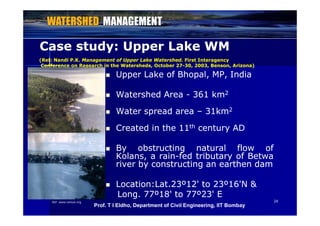
 UpperUpper LakeLake ofof Bhopal,Bhopal, MP,MP, IndiaIndia
(Ref: Nandi P.K.Nandi P.K. Management of Upper Lake Watershed.Management of Upper Lake Watershed. First InteragencyFirst Interagency
Conference on Research in the Watersheds, October 27Conference on Research in the Watersheds, October 27--30, 2003, Benson, Arizona)30, 2003, Benson, Arizona)
 WatershedWatershed AreaArea -- 361361 kmkm22
 WaterWater spreadspread areaarea –– 3131kmkm22 WaterWater spreadspread areaarea 3131kmkm
 CreatedCreated inin thethe 1111thth centurycentury ADAD
 ByBy obstructingobstructing naturalnatural flowflow ofof
Kolans,Kolans, aa rainrain--fedfed tributarytributary ofof BetwaBetwa
riverriver byby constructingconstructing anan earthenearthen damdamriverriver byby constructingconstructing anan earthenearthen damdam
 LocationLocation::LatLat..2323ºº1212'' toto 2323ºº1616'N'N &&
2424
LongLong.. 7777ĀŗĀŗ1818'' toto 7777ĀŗĀŗ2323'' EE
Ref: www.ramsar.org
Prof. T I Eldho, Department of Civil Engineering, IIT Bombay
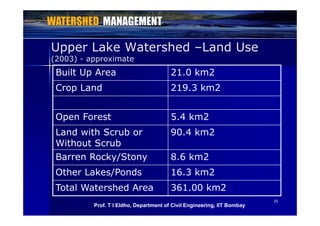
Upper Lake Watershed –Land Use
(2003) - approximate( ) pp
Built Up Area 21.0 km2
Crop Land 219 3 km2Crop Land 219.3 km2
Open Forest 5.4 km2
Land with Scrub or 90.4 km2
Without Scrub
Barren Rocky/Stony 8.6 km2
Other Lakes/Ponds 16.3 km2
Total Watershed Area 361.00 km2
2525
Total Watershed Area 361.00 km2
Prof. T I Eldho, Department of Civil Engineering, IIT Bombay
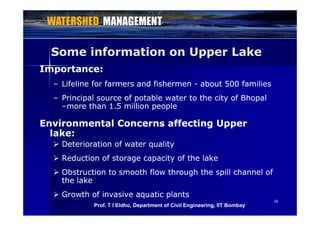
Some information on Upper LakeSome information on Upper Lake
ImportanceImportance::
–– LifelineLifeline forfor farmersfarmers andand fishermenfishermen -- aboutabout 500500 familiesfamilies
–– Principal source of potable water to the city of BhopalPrincipal source of potable water to the city of Bhopal
––more than 1.5 million peoplemore than 1.5 million people
Environmental Concerns affecting UpperEnvironmental Concerns affecting Upper
lake:lake:
 DeteriorationDeterioration ofof waterwater qualityquality
 Reduction of storage capacity of the lakeReduction of storage capacity of the lake
 Obstruction to smooth flow through the spill channel ofObstruction to smooth flow through the spill channel of
the lakethe lake
2626
 Growth of invasive aquatic plantsGrowth of invasive aquatic plants
Prof. T I Eldho, Department of Civil Engineering, IIT Bombay
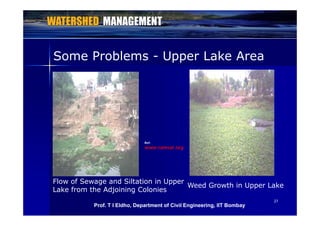
Some Problems - Upper Lake Areapp
Ref:
www.ramsar.org
Flow of Sewage and Siltation in Upper
Lake from the Adjoining Colonies
Weed Growth in Upper Lake
2727
Lake from the Adjoining Colonies
Prof. T I Eldho, Department of Civil Engineering, IIT Bombay
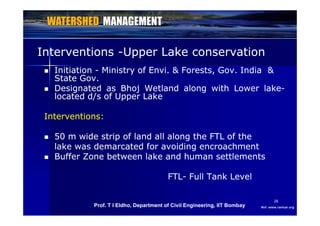
InterventionsInterventions --Upper Lake conservationUpper Lake conservation
 InitiationInitiation -- Ministry of Envi. & Forests, Gov. India &Ministry of Envi. & Forests, Gov. India &
State Gov.State Gov.
DesignatedDesignated asas BhojBhoj WetlandWetland alongalong withwith LowerLower lakelake DesignatedDesignated asas BhojBhoj WetlandWetland alongalong withwith LowerLower lakelake--
locatedlocated d/sd/s ofof UpperUpper LakeLake
Interventions:Interventions:
 50 m wide strip of land all along the FTL of the50 m wide strip of land all along the FTL of the 50 m wide strip of land all along the FTL of the50 m wide strip of land all along the FTL of the
lake was demarcated for avoiding encroachmentlake was demarcated for avoiding encroachment
 Buffer Zone between lake and human settlementsBuffer Zone between lake and human settlements
FTLFTL-- Full Tank LevelFull Tank Level
2828
Ref: www.ramsar.orgProf. T I Eldho, Department of Civil Engineering, IIT Bombay
InterventionsInterventions
 Intensive plantation in buffer zoneIntensive plantation in buffer zone
(1 7 million plants/ 10 km(1 7 million plants/ 10 km22 ))(1.7 million plants/ 10 km(1.7 million plants/ 10 km22 ))
 Construction of 73 Check damsConstruction of 73 Check dams
across 28 inlet channelsacross 28 inlet channelsacross 28 inlet channelsacross 28 inlet channels
 Development of sewerageDevelopment of sewerage Development of sewerageDevelopment of sewerage
system for managing 35 MLD domestic sewagesystem for managing 35 MLD domestic sewage
 Solid waste management PracticesSolid waste management Practices Solid waste management PracticesSolid waste management Practices
 Organic farming instead of inorganic fertilizersOrganic farming instead of inorganic fertilizers
2929
Prof. T I Eldho, Department of Civil Engineering, IIT Bombay
Stakeholder ParticipationStakeholder Participation
 Well Coordinated awareness programsWell Coordinated awareness programs
 Reforestation of watershed areaReforestation of watershed area
through participation ofthrough participation of
farmersfarmers
 Participation of political, religious leaders,Participation of political, religious leaders,Participation of political, religious leaders,Participation of political, religious leaders,
district/city administration, local people,district/city administration, local people,
NGOs, schools / collegesNGOs, schools / collegesNGOs, schools / collegesNGOs, schools / colleges
 Promotion of organic farming in the watershedPromotion of organic farming in the watershed
through participation of farmersthrough participation of farmers
3030
g p pg p p
Prof. T I Eldho, Department of Civil Engineering, IIT Bombay
Results of ImplementationsResults of Implementations
 Reduced sedimentation due toReduced sedimentation due to
construction of silt traps andconstruction of silt traps andconstruction of silt traps andconstruction of silt traps and
plantationplantation
General ambience of the areaGeneral ambience of the area General ambience of the areaGeneral ambience of the area
improved due to buffer zoneimproved due to buffer zone
 Ample job opportunities for theAmple job opportunities for the
local peoplelocal people
 No significant deterioration of theNo significant deterioration of the
water qualitywater quality
3131
Prof. T I Eldho, Department of Civil Engineering, IIT Bombay
WM Case Study– Lessons Learned
 Necessity of Integrated Watershed Approach
I t f ti ti Importance of conservation practices –
necessity of buffer zone
Overall environmental management Overall environmental management
 Necessity of legal framework to control
anthropogenic activitiesanthropogenic activities
 Necessity of long term management plans
 People’s participation success of the project People s participation- success of the project.
3232
Prof. T I Eldho, Department of Civil Engineering, IIT Bombay
Tutorial – Questions?.
 A) Discuss watershed concept within
the perspective of holisticthe perspective of holistic
development of an area.
 B) Illustrate important watershed B) Illustrate important watershed
characteristics.
C) Describe watershed deterioration C) Describe watershed deterioration
and its consequences.
D) Wh h i D) What are the important water
related problems in a watershed?.
3333
Prof. T I Eldho, Department of Civil Engineering, IIT Bombay
Self Evaluation – Questions?.Q
 A) What is a watershed?. What is the
importance of watershed based approach inimportance of watershed based approach in
water management?.
 B) Discuss watershed approach – planning B) Discuss watershed approach planning,
implementation & management.
 C) What are the important principles of C) What are the important principles of
watershed management?.
 D) Discuss watershed management as a) g
part of sustainable development.
3434
Prof. T I Eldho, Department of Civil Engineering, IIT Bombay
Assignment – Questions?.g Q
 A) Discuss the water management in a
watershed as a part of hydrologic cycle?watershed as a part of hydrologic cycle?.
 B) What are the typical watershed related
problems?problems?.
 C) Discuss the necessity of watershed
management by considering variousmanagement by considering various
problems in an arid zone watershed?.
 D) With the help of a case study, show the) p y,
importance of people participation in
Watershed Management?.
3535
Prof. T I Eldho, Department of Civil Engineering, IIT Bombay
Unsolved Problem!.Unsolved Problem!.
 In your locality, identify your watershed area.In your locality, identify your watershed area.
List out the sources of water for the areaList out the sources of water for the areaList out the sources of water for the area.List out the sources of water for the area.
 Identify the nature of your watershed.Identify the nature of your watershed.
 List out the water problems of your areaList out the water problems of your area List out the water problems of your area.List out the water problems of your area.
 Develop a plan presenting how will you applyDevelop a plan presenting how will you apply
the principles of watershed management to yourthe principles of watershed management to yourp p o a d a ag o youp p o a d a ag o you
area?.area?.
 List out both short term and long term benefitsList out both short term and long term benefits
from the interventions of your plan.from the interventions of your plan.
3636
Prof. T I Eldho, Department of Civil Engineering, IIT Bombay
ReferencesReferences
 Vir Singh, Raj , ā€œWatershed Planning and
Managementā€, Yash Publishing House,g , g ,
Bikaner, 2000.
 Murty, J.V.S. ā€œWatershed Managementā€,
New Age Intl New Delhi 1998New Age Intl., New Delhi 1998.
 Black Peter E., ā€œWatershed Hydrologyā€,
Prentice Hall, London, 1991.
 Nandi P.K. ā€œNandi P.K. ā€œManagement of Upper LakeManagement of Upper Lake
Watershedā€.Watershedā€. First Interagency Conference onFirst Interagency Conference on
Research in the Watersheds, October 27Research in the Watersheds, October 27--30,30,,, ,,
2003, Benson, Arizona.2003, Benson, Arizona.
 http://www.tucson.ars.ag.gov/icrw/Proceedihttp://www.tucson.ars.ag.gov/icrw/Proceedi
ngs/Nandi pdfngs/Nandi pdf
3737
ngs/Nandi.pdfngs/Nandi.pdf
Prof. T I Eldho, Department of Civil Engineering, IIT Bombay
Dr. T. I. EldhoDr. T. I. Eldho
Professor,Professor,
Department of Civil Engineering,Department of Civil Engineering,p g gp g g
Indian Institute of Technology Bombay,Indian Institute of Technology Bombay,
Mumbai, India, 400 076.Mumbai, India, 400 076.
Email:Email: eldho@iitb.ac.ineldho@iitb.ac.in
3838
Email:Email: eldho@iitb.ac.ineldho@iitb.ac.in
Phone: (022)Phone: (022) –– 25767339; Fax: 2576730225767339; Fax: 25767302
http://www.http://www.civil.iitb.ac.incivil.iitb.ac.in

Lecture01 wsm

  • 1.
  • 2.
    Scope of theCourse  To discuss various aspects of watershed & it t I t t d W t h dits management – Integrated Watershed Management Approach.  Watershed – ideal unit for multi-disciplinary planning & management of land & water resources – ensure continuous benefits – sustainable way  Watershed Management (WM)– – Sustainable Management of entire land & resources. 22 Prof. T I Eldho, Department of Civil Engineering, IIT Bombay
  • 3.
    Course Objectives  Todiscuss various aspects of watershed development and management – resources: technological, social, ecological, environmental, sustainable issues.  Focus - technical aspects of WM; perspectives on land & water management; l lanalyze complex issues in water management and on specific knowledge on i f WMissues of WM. 33 Prof. T I Eldho, Department of Civil Engineering, IIT Bombay
  • 4.
    Course Objectives..j  Coursewill be very useful to – Undergraduate & post-graduateUndergraduate & post graduate students, T h NGO’ Fi ld E i– Teachers, NGO’s, Field Engineers and Practitioners. – Number of field problems will be discussed to illustratediscussed to illustrate the concepts clearly. 44 Prof. T I Eldho, Department of Civil Engineering, IIT Bombay
  • 5.
    Course Modules -10(40L)  1) Introduction and Basic Concepts - 3 Course Modules -10 (40L)  2) Sustainable Watershed Approach & Watershed Management Practices - 4g  3) Integrated Watershed Management - 4 4) W t h d M d li 7 4) Watershed Modeling - 7  5) Social Aspects of Watershed Management - 3 P f T I Eldh D t t f Ci il E i i IIT B b 55 Prof. T I Eldho, Department of Civil Engineering, IIT Bombay
  • 6.
    Course Modules –10 (40L)Course Modules – 10 (40L)  6) Use of modern techniques in watershed management -5  7) Management of Water Quality 4 7) Management of Water Quality -4  8) Storm Water and Flood Management -4 9) D ht M t 3 9) Drought Management -3  10) Water Conservation and Recycling -3 66 ) y g Prof. T I Eldho, Department of Civil Engineering, IIT Bombay
  • 7.
    References  1) Allam,Gamal Ibrahim Y., Decision Support System for Integrated Watershed Management, Colorado State University, 1994.  2) Am Soc Of Agri Engr Hydrologic Modeling of Small 2) Am. Soc. Of Agri. Engr., Hydrologic Modeling of Small Watersheds, Am. Soc. Agri. Eng., Michigan, 1982.  3) American Soc. of Civil Engr., Watershed Management, American Soc. of Civil Engineers, New York, 1975.g , ,  4) Black Peter E., Watershed Hydrology, Prentice Hall, London, 1991.  5) Michael A.M., Irrigation Engineering, Vikas Pub. h 1992house, 1992.  6) Rajesh Rajora, Integrated Watershed Management, Rawat Publication, New Delhi, 1998. 7) Heathcote I W Integrated Watershed Management 7) Heathcote, I.W., Integrated Watershed Management- Principles and Practice, Jown Wiley & Sons, London, 1998. 77Prof. T I Eldho, Department of Civil Engineering, IIT Bombay
  • 8.
    References…  8) Murty,J.V.S. Watershed Management, New Age Intl., New Delhi 1998.  9) Gopal Iyer, K., & Roy U.N., (Eds.), Watershed Management & Sustainable Development, Kanishka Publishers, New Delhi, 2005., ,  10) Purandare, A.P., Jaiswal A.K., Watersheds Development in India, NIRD, Hyderabad, 1995.  11) Vir Singh Raj Watershed Planning and 11) Vir Singh, Raj , Watershed Planning and Management, Yash Publishing House, Bikaner, 2000.  12) Paul A. Debarry., Watershed, Processes, Assessment & Management Wiley London 2004Assessment & Management, Wiley, London, 2004. 88 Prof. T I Eldho, Department of Civil Engineering, IIT Bombay
  • 9.
    Module 1 (L1L3)Module 1 – (L1-L3)  Introduction and Basic Concepts  Concept of watershed, introduction to watershed management differentwatershed management, different stakeholders and their relative importance, watershed management policies and decision making.policies and decision making. 99 Prof. T I Eldho, Department of Civil Engineering, IIT Bombay
  • 10.
    L1L1– Introduction toWatershed Management  Topics Covered Topics Covered  Concept of Watershed; Watershed Approach;Concept of Watershed; Watershed Approach; C t h d bl I t d ti tC t h d bl I t d ti tCommon watershed problems; Introduction toCommon watershed problems; Introduction to Watershed Management (WM)Watershed Management (WM)-- WM necessity &WM necessity & principles; Case Studyprinciples; Case Studyprinciples; Case Study.principles; Case Study.  Keywords:Keywords: Watershed management, Concepts,Watershed management, Concepts, Characteristics, Deterioration, Necessity, Principles.Characteristics, Deterioration, Necessity, Principles. 1010 Prof. T I Eldho, Department of Civil Engineering, IIT Bombay
  • 11.
    Concept of WatershedConceptof Watershed elel pp mainchannemainchanne Watershed Concept servoirinmservoirinm Rainfall Overland ResRes Land Hydrology Groundwater Infiltration River Groundwater Flow towards Ocean Hydrosphere & hydrologicalHydrosphere & hydrological cyclecycle –– gives better conceptgives better concept b t t h db t t h d 1111 Prof. T I Eldho, Department of Civil Engineering, IIT Bombay about watershedabout watershed
  • 12.
    Condensation Concept of WatershedConceptof Watershed Evaporation Condensation Rainfall S f t G d t H d hH d h i h i l hi h i l h Concept of Watershed..Concept of Watershed.. Surface water Groundwater  HydrosphereHydrosphere –– in physical geographyin physical geography -- describes combined mass of waters found on,describes combined mass of waters found on, under and above the surface of the planetunder and above the surface of the planetunder and above the surface of the planet .under and above the surface of the planet .  Hydrosphere consists waters of land (riversHydrosphere consists waters of land (rivers and other water bodies, groundwater systemand other water bodies, groundwater systemand other water bodies, groundwater systemand other water bodies, groundwater system etc.), oceans & atmosphere surrounding theetc.), oceans & atmosphere surrounding the landland  Hydrological CycleHydrological Cycle -- Change in phaseChange in phase of water in theof water in the hydrosphere.hydrosphere. 1212 Prof. T I Eldho, Department of Civil Engineering, IIT Bombay
  • 13.
    Concept of Watershed..Conceptof Watershed..  Watershed:Watershed: -- topographically delineated areatopographically delineated area pp p g p yp g p y that is drained by a stream systemthat is drained by a stream system  An area from which runoff resulting from precipitationAn area from which runoff resulting from precipitation fl t i l i t i t t i l kfl t i l i t i t t i l kflows past a single point into a stream, river, lake or anflows past a single point into a stream, river, lake or an ocean.ocean.  WatershedWatershed -- drains from surroundingdrains from surrounding Watershed Rid gg ridges to the common pointridges to the common point such as lake or streamsuch as lake or stream  Shares boundaries withShares boundaries with RidgeRidge Watershed Valley Overland Ridge  Shares boundaries withShares boundaries with neighboring watershedsneighboring watersheds.. River Ocean River Creek Valley Groundwater 1313 Fig. modified from (www.fergusonfoundation.org/btw/ watershed.html ) Prof. T I Eldho, Department of Civil Engineering, IIT Bombay Ocean
  • 14.
    Watershed characteristics  Size Shape Shape  Physiography  Climate  Drainage  Land use  Vegetation  Geology and Soils  Hydrology Hydrology  Hydrogeology  Socioeconomics 1414 Photos: Singh, 07. 2001Photos: Singh, 07. 2001 Prof. T I Eldho, Department of Civil Engineering, IIT Bombay
  • 15.
    Size of Watershed SizeSize–– vary from few sq.m to thousands of Sq.km.vary from few sq.m to thousands of Sq.km. •• Main watershed, SubMain watershed, Sub--watershed, Milliwatershed, Milli--,, ,, watershed, Microwatershed, Micro--watershed, Miniwatershed, Mini--watershed etc.watershed etc. 1515 Prof. T I Eldho, Department of Civil Engineering, IIT Bombay
  • 16.
    Watershed ApproachWatershed Approach Watershed approachWatershed approach -- appropriate to solveappropriate to solve various resources problemsvarious resources problems -- for planning,for planning, i l t ti & ti l t ti & timplementation & managementimplementation & management  Managing Land & WaterManaging Land & Water -- watershed scale,watershed scale,g gg g ,, appropriateappropriate-- environmentally, financially &environmentally, financially & sociallysocially –– Environmental scaleEnvironmental scale -- watershed defined by naturalwatershed defined by natural hydrologyhydrology -- Resources becomes a focal point inResources becomes a focal point in order to understand factors that contributes theorder to understand factors that contributes the problem.problem. 1616Prof. T I Eldho, Department of Civil Engineering, IIT Bombay
  • 17.
    Watershed ApproachWatershed Approachcontd..contd..  Financial and social benefits ofFinancial and social benefits of watershed approachwatershed approachpppp  Core of watershed approachCore of watershed approach -- better understandingbetter understanding of environmental factors.of environmental factors.of environmental factors.of environmental factors.  Tasks such as modeling, monitoring & reportingTasks such as modeling, monitoring & reporting under watershed frameworkunder watershed framework -- saves time andsaves time and moneymoneymoney.money.  People’s participationPeople’s participation --pillar of watershed approachpillar of watershed approach -- gives sense of ownership; greater public involvementgives sense of ownership; greater public involvement & ensures sustainability of interventions planned.& ensures sustainability of interventions planned. 1717Prof. T I Eldho, Department of Civil Engineering, IIT Bombay
  • 18.
    Watershed Watershed DeteriorationWatershed DeteriorationSoil erosion Watershed Uncontrolled, unplanned,Uncontrolled, unplanned, unscientific land useunscientific land use Soil erosion  Agricultural land:Agricultural land:-- faulty practices,faulty practices, erosion, shifting cultivation etc.erosion, shifting cultivation etc.  Forest & grass lands:Forest & grass lands:-- tree felling,tree felling, grazing, fire etc.grazing, fire etc.  Unscientific mining and quarryingUnscientific mining and quarrying  Bad road alignment and constructionBad road alignment and construction  Extension of industrial activitiesExtension of industrial activities  People apathy:People apathy:-- People participationPeople participation 1818Prof. T I Eldho, Department of Civil Engineering, IIT Bombay
  • 19.
    Watershed DeteriorationWatershed Deterioration--ConsequencesConsequencesqq  Low productivityLow productivity -- agriculture, grasslands,agriculture, grasslands, f tf t d ti i bid ti i biforestsforests -- reduction in biomassreduction in biomass  Declination of groundwater levelDeclination of groundwater level-- causing increase in cost of irrigationcausing increase in cost of irrigationcausing increase in cost of irrigationcausing increase in cost of irrigation  Siltation of reservoirs, lakes and channelsSiltation of reservoirs, lakes and channels F eq ent floods and d o ghtsF eq ent floods and d o ghts Frequent floods and droughtsFrequent floods and droughts  Erosion and denudationErosion and denudation W t lit & tit blW t lit & tit bl Water quality & quantity problemsWater quality & quantity problems  PovertyPoverty –– social problemssocial problems 1919 http://www.guardian.co.uk/world/gallery/2008/aug/28/india.india?picture=337042017 Prof. T I Eldho, Department of Civil Engineering, IIT Bombay
  • 20.
    Typical Watershed ProblemsTypicalWatershed Problems  Physical problemsPhysical problems –– steep slope, bad lands, soil erosion...steep slope, bad lands, soil erosion...steep slope, bad lands, soil erosion...steep slope, bad lands, soil erosion...  Resource use problemsResource use problems –– shifting cultivation, fire,shifting cultivation, fire,shifting cultivation, fire,shifting cultivation, fire, deforestation etc.deforestation etc.  End problemsEnd problems End problemsEnd problems –– reduced yield, flood, droughtreduced yield, flood, drought  SocioSocio--economic and other problemseconomic and other problems –– poverty, migration etc.poverty, migration etc. 2020Prof. T I Eldho, Department of Civil Engineering, IIT Bombay
  • 21.
    Watershed ComplicationsWatershed Complications Influence of human on watershedInfluence of human on watershed developmentdevelopment Ph t Si h 07Ph t Si h 07developmentdevelopment Eg: Changing contour of land & use, pollution sources.Eg: Changing contour of land & use, pollution sources. Remedies:Remedies: Land management, Stop pollution atLand management, Stop pollution at Photos: Singh, 07.Photos: Singh, 07. 20012001 source; waste management, Reducesource; waste management, Reduce -- fertilizers.fertilizers.  Water related issues: Surface & groundwaterWater related issues: Surface & groundwater & l& lquantity & quality.quantity & quality. Remedies:Remedies: change in cropping pattern, agriculturalchange in cropping pattern, agricultural water management rainwater harvesting stoppingwater management rainwater harvesting stoppingwater management , rainwater harvesting, stoppingwater management , rainwater harvesting, stopping point and nonpoint and non--point sources of pollutionpoint sources of pollution 2121Prof. T I Eldho, Department of Civil Engineering, IIT Bombay
  • 22.
    Necessity of WatershedManagementNecessity of Watershed Managementy gy g ļ‚§ For better water & land management ļ‚§ For stability of land use in lower areasļ‚§ For stability of land use in lower areas ļ‚§ For arresting soil erosion, improving soil moisture reducing floods & droughtsmoisture, reducing floods & droughts ļ‚§ For developing water, land and biomass resources with a focus on social andresources with a focus on social and environmental aspects ļ‚§ For judicious use of natural resources -j active participation of stake holders, in harmony with the ecosystem 2222 http://watershed.kar.nic.i n/Photo Gallery Prof. T I Eldho, Department of Civil Engineering, IIT Bombay
  • 23.
    Principles of WatershedManagementPrinciples of Watershed Management  Utilizes land according to capabilityUtilizes land according to capability  Maintain adequate vegetative cover forMaintain adequate vegetative cover for control of soil erosioncontrol of soil erosion  Conserve maximum possible rainwaterConserve maximum possible rainwater at places where it fallsat places where it falls Contour farmingContour farmingat places where it fallsat places where it falls -- Contour farmingContour farming  Drain out excess water with a safeDrain out excess water with a safe velocity to avoid soil erosion and store itvelocity to avoid soil erosion and store itvelocity to avoid soil erosion and store itvelocity to avoid soil erosion and store it for future usefor future use  Preventing erosion & to increasePreventing erosion & to increase groundwater rechargegroundwater recharge  Overall management of the availableOverall management of the available resources in a sustainable wayresources in a sustainable way 2323 resources in a sustainable wayresources in a sustainable way Prof. T I Eldho, Department of Civil Engineering, IIT Bombay
  • 24.
    Case study: UpperLake WMCase study: Upper Lake WM (Ref: Nandi P.K.Nandi P.K. Management of Upper Lake Watershed.Management of Upper Lake Watershed. First InteragencyFirst Interagency  UpperUpper LakeLake ofof Bhopal,Bhopal, MP,MP, IndiaIndia (Ref: Nandi P.K.Nandi P.K. Management of Upper Lake Watershed.Management of Upper Lake Watershed. First InteragencyFirst Interagency Conference on Research in the Watersheds, October 27Conference on Research in the Watersheds, October 27--30, 2003, Benson, Arizona)30, 2003, Benson, Arizona)  WatershedWatershed AreaArea -- 361361 kmkm22  WaterWater spreadspread areaarea –– 3131kmkm22 WaterWater spreadspread areaarea 3131kmkm  CreatedCreated inin thethe 1111thth centurycentury ADAD  ByBy obstructingobstructing naturalnatural flowflow ofof Kolans,Kolans, aa rainrain--fedfed tributarytributary ofof BetwaBetwa riverriver byby constructingconstructing anan earthenearthen damdamriverriver byby constructingconstructing anan earthenearthen damdam  LocationLocation::LatLat..2323ĀŗĀŗ1212'' toto 2323ĀŗĀŗ1616'N'N && 2424 LongLong.. 7777ĀŗĀŗ1818'' toto 7777ĀŗĀŗ2323'' EE Ref: www.ramsar.org Prof. T I Eldho, Department of Civil Engineering, IIT Bombay
  • 25.
    Upper Lake Watershed–Land Use (2003) - approximate( ) pp Built Up Area 21.0 km2 Crop Land 219 3 km2Crop Land 219.3 km2 Open Forest 5.4 km2 Land with Scrub or 90.4 km2 Without Scrub Barren Rocky/Stony 8.6 km2 Other Lakes/Ponds 16.3 km2 Total Watershed Area 361.00 km2 2525 Total Watershed Area 361.00 km2 Prof. T I Eldho, Department of Civil Engineering, IIT Bombay
  • 26.
    Some information onUpper LakeSome information on Upper Lake ImportanceImportance:: –– LifelineLifeline forfor farmersfarmers andand fishermenfishermen -- aboutabout 500500 familiesfamilies –– Principal source of potable water to the city of BhopalPrincipal source of potable water to the city of Bhopal ––more than 1.5 million peoplemore than 1.5 million people Environmental Concerns affecting UpperEnvironmental Concerns affecting Upper lake:lake:  DeteriorationDeterioration ofof waterwater qualityquality  Reduction of storage capacity of the lakeReduction of storage capacity of the lake  Obstruction to smooth flow through the spill channel ofObstruction to smooth flow through the spill channel of the lakethe lake 2626  Growth of invasive aquatic plantsGrowth of invasive aquatic plants Prof. T I Eldho, Department of Civil Engineering, IIT Bombay
  • 27.
    Some Problems -Upper Lake Areapp Ref: www.ramsar.org Flow of Sewage and Siltation in Upper Lake from the Adjoining Colonies Weed Growth in Upper Lake 2727 Lake from the Adjoining Colonies Prof. T I Eldho, Department of Civil Engineering, IIT Bombay
  • 28.
    InterventionsInterventions --Upper LakeconservationUpper Lake conservation  InitiationInitiation -- Ministry of Envi. & Forests, Gov. India &Ministry of Envi. & Forests, Gov. India & State Gov.State Gov. DesignatedDesignated asas BhojBhoj WetlandWetland alongalong withwith LowerLower lakelake DesignatedDesignated asas BhojBhoj WetlandWetland alongalong withwith LowerLower lakelake-- locatedlocated d/sd/s ofof UpperUpper LakeLake Interventions:Interventions:  50 m wide strip of land all along the FTL of the50 m wide strip of land all along the FTL of the 50 m wide strip of land all along the FTL of the50 m wide strip of land all along the FTL of the lake was demarcated for avoiding encroachmentlake was demarcated for avoiding encroachment  Buffer Zone between lake and human settlementsBuffer Zone between lake and human settlements FTLFTL-- Full Tank LevelFull Tank Level 2828 Ref: www.ramsar.orgProf. T I Eldho, Department of Civil Engineering, IIT Bombay
  • 29.
    InterventionsInterventions  Intensive plantationin buffer zoneIntensive plantation in buffer zone (1 7 million plants/ 10 km(1 7 million plants/ 10 km22 ))(1.7 million plants/ 10 km(1.7 million plants/ 10 km22 ))  Construction of 73 Check damsConstruction of 73 Check dams across 28 inlet channelsacross 28 inlet channelsacross 28 inlet channelsacross 28 inlet channels  Development of sewerageDevelopment of sewerage Development of sewerageDevelopment of sewerage system for managing 35 MLD domestic sewagesystem for managing 35 MLD domestic sewage  Solid waste management PracticesSolid waste management Practices Solid waste management PracticesSolid waste management Practices  Organic farming instead of inorganic fertilizersOrganic farming instead of inorganic fertilizers 2929 Prof. T I Eldho, Department of Civil Engineering, IIT Bombay
  • 30.
    Stakeholder ParticipationStakeholder Participation Well Coordinated awareness programsWell Coordinated awareness programs  Reforestation of watershed areaReforestation of watershed area through participation ofthrough participation of farmersfarmers  Participation of political, religious leaders,Participation of political, religious leaders,Participation of political, religious leaders,Participation of political, religious leaders, district/city administration, local people,district/city administration, local people, NGOs, schools / collegesNGOs, schools / collegesNGOs, schools / collegesNGOs, schools / colleges  Promotion of organic farming in the watershedPromotion of organic farming in the watershed through participation of farmersthrough participation of farmers 3030 g p pg p p Prof. T I Eldho, Department of Civil Engineering, IIT Bombay
  • 31.
    Results of ImplementationsResultsof Implementations  Reduced sedimentation due toReduced sedimentation due to construction of silt traps andconstruction of silt traps andconstruction of silt traps andconstruction of silt traps and plantationplantation General ambience of the areaGeneral ambience of the area General ambience of the areaGeneral ambience of the area improved due to buffer zoneimproved due to buffer zone  Ample job opportunities for theAmple job opportunities for the local peoplelocal people  No significant deterioration of theNo significant deterioration of the water qualitywater quality 3131 Prof. T I Eldho, Department of Civil Engineering, IIT Bombay
  • 32.
    WM Case Study–Lessons Learned  Necessity of Integrated Watershed Approach I t f ti ti Importance of conservation practices – necessity of buffer zone Overall environmental management Overall environmental management  Necessity of legal framework to control anthropogenic activitiesanthropogenic activities  Necessity of long term management plans  People’s participation success of the project People s participation- success of the project. 3232 Prof. T I Eldho, Department of Civil Engineering, IIT Bombay
  • 33.
    Tutorial – Questions?. A) Discuss watershed concept within the perspective of holisticthe perspective of holistic development of an area.  B) Illustrate important watershed B) Illustrate important watershed characteristics. C) Describe watershed deterioration C) Describe watershed deterioration and its consequences. D) Wh h i D) What are the important water related problems in a watershed?. 3333 Prof. T I Eldho, Department of Civil Engineering, IIT Bombay
  • 34.
    Self Evaluation –Questions?.Q  A) What is a watershed?. What is the importance of watershed based approach inimportance of watershed based approach in water management?.  B) Discuss watershed approach – planning B) Discuss watershed approach planning, implementation & management.  C) What are the important principles of C) What are the important principles of watershed management?.  D) Discuss watershed management as a) g part of sustainable development. 3434 Prof. T I Eldho, Department of Civil Engineering, IIT Bombay
  • 35.
    Assignment – Questions?.gQ  A) Discuss the water management in a watershed as a part of hydrologic cycle?watershed as a part of hydrologic cycle?.  B) What are the typical watershed related problems?problems?.  C) Discuss the necessity of watershed management by considering variousmanagement by considering various problems in an arid zone watershed?.  D) With the help of a case study, show the) p y, importance of people participation in Watershed Management?. 3535 Prof. T I Eldho, Department of Civil Engineering, IIT Bombay
  • 36.
    Unsolved Problem!.Unsolved Problem!. In your locality, identify your watershed area.In your locality, identify your watershed area. List out the sources of water for the areaList out the sources of water for the areaList out the sources of water for the area.List out the sources of water for the area.  Identify the nature of your watershed.Identify the nature of your watershed.  List out the water problems of your areaList out the water problems of your area List out the water problems of your area.List out the water problems of your area.  Develop a plan presenting how will you applyDevelop a plan presenting how will you apply the principles of watershed management to yourthe principles of watershed management to yourp p o a d a ag o youp p o a d a ag o you area?.area?.  List out both short term and long term benefitsList out both short term and long term benefits from the interventions of your plan.from the interventions of your plan. 3636 Prof. T I Eldho, Department of Civil Engineering, IIT Bombay
  • 37.
    ReferencesReferences  Vir Singh,Raj , ā€œWatershed Planning and Managementā€, Yash Publishing House,g , g , Bikaner, 2000.  Murty, J.V.S. ā€œWatershed Managementā€, New Age Intl New Delhi 1998New Age Intl., New Delhi 1998.  Black Peter E., ā€œWatershed Hydrologyā€, Prentice Hall, London, 1991.  Nandi P.K. ā€œNandi P.K. ā€œManagement of Upper LakeManagement of Upper Lake Watershedā€.Watershedā€. First Interagency Conference onFirst Interagency Conference on Research in the Watersheds, October 27Research in the Watersheds, October 27--30,30,,, ,, 2003, Benson, Arizona.2003, Benson, Arizona.  http://www.tucson.ars.ag.gov/icrw/Proceedihttp://www.tucson.ars.ag.gov/icrw/Proceedi ngs/Nandi pdfngs/Nandi pdf 3737 ngs/Nandi.pdfngs/Nandi.pdf Prof. T I Eldho, Department of Civil Engineering, IIT Bombay
  • 38.
    Dr. T. I.EldhoDr. T. I. Eldho Professor,Professor, Department of Civil Engineering,Department of Civil Engineering,p g gp g g Indian Institute of Technology Bombay,Indian Institute of Technology Bombay, Mumbai, India, 400 076.Mumbai, India, 400 076. Email:Email: eldho@iitb.ac.ineldho@iitb.ac.in 3838 Email:Email: eldho@iitb.ac.ineldho@iitb.ac.in Phone: (022)Phone: (022) –– 25767339; Fax: 2576730225767339; Fax: 25767302 http://www.http://www.civil.iitb.ac.incivil.iitb.ac.in