Lecture 8
External Memory
1
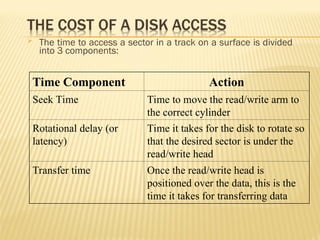
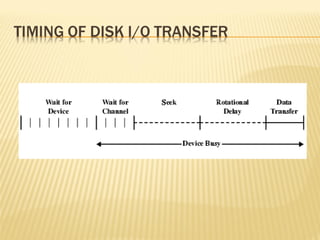
 The time to access a sector in a track on a surface is divided
into 3 components:
Time Component Action
Seek Time Time to move the read/write arm to
the correct cylinder
Rotational delay (or
latency)
Time it takes for the disk to rotate so
that the desired sector is under the
read/write head
Transfer time Once the read/write head is
positioned over the data, this is the
time it takes for transferring data
 Seek time is the time required to move the arm to the
correct cylinder.
 Largest in cost.
 Difficult quantity to pin down
 Startup time
 Time taken to traverse the tracks
 Settling time (positioning head over track until track
identification)
 The smaller the disk the lesser the seek time
 31/2 inch (8.9 cm) in diameter common size
 It is usually impossible to know exactly how
many tracks will be traversed in every seek
 Manufacturer’s specifications for disk drives
often list this figure as the average seek time for
the drives.
 Most hard disks today have s under 10 ms, and
high-performance disks have s as low as 7.5 ms.
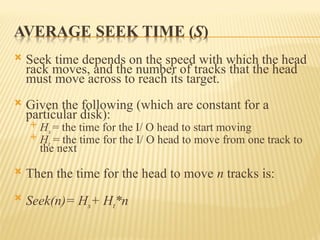
 Seek time depends on the speed with which the head
rack moves, and the number of tracks that the head
must move across to reach its target.
 Given the following (which are constant for a
particular disk):
 Hs = the time for the I/ O head to start moving
 Ht = the time for the I/ O head to move from one track to
the next
 Then the time for the head to move n tracks is:
 Seek(n)= Hs+ Ht*n
 The rotational delay is the time required for the addressed area of the
disk to rotate into a position where it is accessible by the read/write
head.
 Maximum rotational delay is the time it takes to do a full rotation (as the
relevant part of the disk may have just passed the head when the request
arrived).
 Most rotating storage devices rotate at a constant angular rate (constant
number of revolutions per second).
 The maximum rotational delay is simply the reciprocal of the rotational
speed
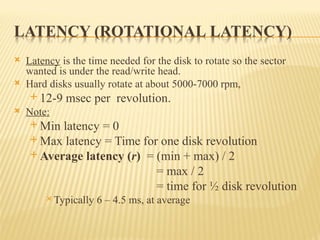
 Latency is the time needed for the disk to rotate so the sector
wanted is under the read/write head.
 Hard disks usually rotate at about 5000-7000 rpm,
 12-9 msec per revolution.
 Note:
 Min latency = 0
 Max latency = Time for one disk revolution
 Average latency (r) = (min + max) / 2
= max / 2
= time for ½ disk revolution
 Typically 6 – 4.5 ms, at average
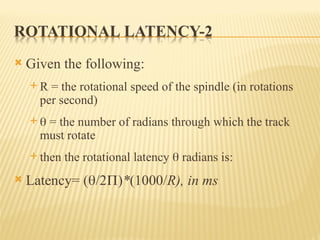
 Given the following:
 R = the rotational speed of the spindle (in rotations
per second)
  = the number of radians through which the track
must rotate
 then the rotational latency  radians is:
 Latency= (/2)*(1000/R), in ms
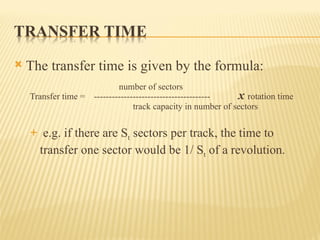
 The transfer time is given by the formula:
number of sectors
Transfer time = --------------------------------------- x rotation time
track capacity in number of sectors
 e.g. if there are St sectors per track, the time to
transfer one sector would be 1/ St of a revolution.
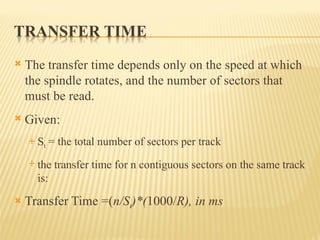
 The transfer time depends only on the speed at which
the spindle rotates, and the number of sectors that
must be read.
 Given:
 St = the total number of sectors per track
 the transfer time for n contiguous sectors on the same track
is:
 Transfer Time =(n/St)*(1000/R), in ms
 Optical storage
 CD-ROM
 CD-Recordable (CD-R)
 CD-R/W
 DVD
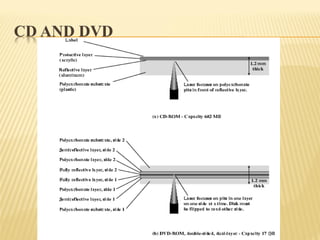
 Compact disk originally for audio, but now used as computer storage
device.
 Disk formed from polycarbonate
 Digital information is imprinted as a series of microscopic pits on the
surface.
 Done by high-intensity laser to create a master disk.
 Master used to create die to stamp out copies.
 Then coated with highly reflective coat, usually aluminium or gold.
 Clear acrylic – top coat to protect against dust and scratches.
 Finally label on acrylic.
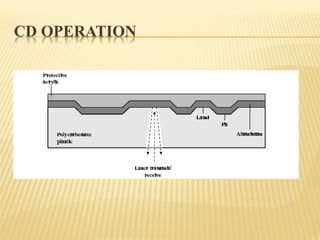
 Read by low –powered laser reflected through
clear polycarbonate.
 Intensity is different for pits and lands
 detected and converted into digital signal.
 Pits rough – low intensity
 Lands smooth – high intensity
 Contains single spiral track, from near centre to
outer edge of the disk.
 Same length sectors
 Constant packing density
 for
 Easy to mass produce inexpensively
 Removable
 against
 Expensive for small runs
 Slower than magnetic disk
 Read only
 CD-Recordable (CD-R)
 Write Once Read Many (WORM)
 Medium includes dye layer.
 Dye used to change reflectivity and is activated by a
high-intensity laser.
 Compatible with CD-ROM drives or CD drives
 CD-RW
 Erasable
 Mostly CD-ROM drive compatible
 Phase change
 Disk uses material with two different reflectivities in
different phase states
 A beam of laser light can change the material from one phase to another
 Digital Versatile Disk
 Will read computer disks and play video disks
 Multi-layer
 Very high capacity
 Magnetic Tape
 No direct access, but very fast sequential access.
 Resistant to different environmental conditions.
 Easy to transport, store, cheaper than disk.
 Before it was widely used to store application
data; nowadays, it’s mostly used for backups or
archives.
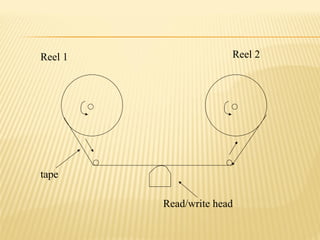
 A sequence of bits are stored on magnetic tape.
 For storage, the tape is wound on a reel.
 To access the data, the tape is unwound from one
reel to another.
 As the tape passes the head, bits of data are read
from or written onto the tape.
Reel 1 Reel 2
tape
Read/write head
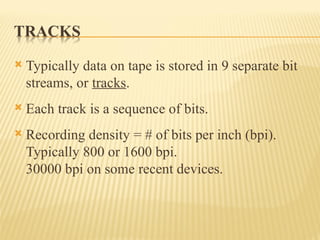
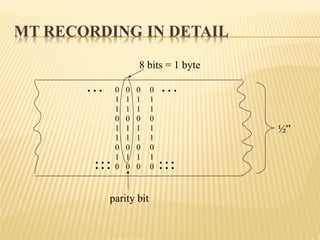
 Typically data on tape is stored in 9 separate bit
streams, or tracks.
 Each track is a sequence of bits.
 Recording density = # of bits per inch (bpi).
Typically 800 or 1600 bpi.
30000 bpi on some recent devices.
½”
0
1
1
0
1
1
0
1
0
0
1
1
0
1
1
0
1
0
0
1
1
0
1
1
0
1
0
0
1
1
0
1
1
0
1
0
…
… …
… …
…
parity bit
8 bits = 1 byte
…
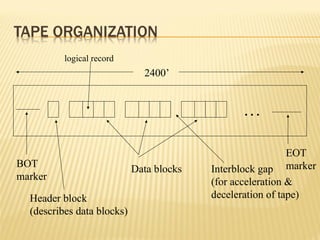
2400’
logical record
BOT
marker
Header block
(describes data blocks)
Data blocks Interblock gap
(for acceleration &
deceleration of tape)
EOT
marker

Lecture 8 - External Memory Of a computer architecture

  • 1.
  • 2.
     The timeto access a sector in a track on a surface is divided into 3 components: Time Component Action Seek Time Time to move the read/write arm to the correct cylinder Rotational delay (or latency) Time it takes for the disk to rotate so that the desired sector is under the read/write head Transfer time Once the read/write head is positioned over the data, this is the time it takes for transferring data
  • 4.
     Seek timeis the time required to move the arm to the correct cylinder.  Largest in cost.  Difficult quantity to pin down  Startup time  Time taken to traverse the tracks  Settling time (positioning head over track until track identification)  The smaller the disk the lesser the seek time  31/2 inch (8.9 cm) in diameter common size
  • 5.
     It isusually impossible to know exactly how many tracks will be traversed in every seek  Manufacturer’s specifications for disk drives often list this figure as the average seek time for the drives.  Most hard disks today have s under 10 ms, and high-performance disks have s as low as 7.5 ms.
  • 6.
     Seek timedepends on the speed with which the head rack moves, and the number of tracks that the head must move across to reach its target.  Given the following (which are constant for a particular disk):  Hs = the time for the I/ O head to start moving  Ht = the time for the I/ O head to move from one track to the next  Then the time for the head to move n tracks is:  Seek(n)= Hs+ Ht*n
  • 7.
     The rotationaldelay is the time required for the addressed area of the disk to rotate into a position where it is accessible by the read/write head.  Maximum rotational delay is the time it takes to do a full rotation (as the relevant part of the disk may have just passed the head when the request arrived).  Most rotating storage devices rotate at a constant angular rate (constant number of revolutions per second).  The maximum rotational delay is simply the reciprocal of the rotational speed
  • 8.
     Latency isthe time needed for the disk to rotate so the sector wanted is under the read/write head.  Hard disks usually rotate at about 5000-7000 rpm,  12-9 msec per revolution.  Note:  Min latency = 0  Max latency = Time for one disk revolution  Average latency (r) = (min + max) / 2 = max / 2 = time for ½ disk revolution  Typically 6 – 4.5 ms, at average
  • 9.
     Given thefollowing:  R = the rotational speed of the spindle (in rotations per second)   = the number of radians through which the track must rotate  then the rotational latency  radians is:  Latency= (/2)*(1000/R), in ms
  • 10.
     The transfertime is given by the formula: number of sectors Transfer time = --------------------------------------- x rotation time track capacity in number of sectors  e.g. if there are St sectors per track, the time to transfer one sector would be 1/ St of a revolution.
  • 11.
     The transfertime depends only on the speed at which the spindle rotates, and the number of sectors that must be read.  Given:  St = the total number of sectors per track  the transfer time for n contiguous sectors on the same track is:  Transfer Time =(n/St)*(1000/R), in ms
  • 13.
     Optical storage CD-ROM  CD-Recordable (CD-R)  CD-R/W  DVD
  • 14.
     Compact diskoriginally for audio, but now used as computer storage device.  Disk formed from polycarbonate  Digital information is imprinted as a series of microscopic pits on the surface.  Done by high-intensity laser to create a master disk.  Master used to create die to stamp out copies.  Then coated with highly reflective coat, usually aluminium or gold.  Clear acrylic – top coat to protect against dust and scratches.  Finally label on acrylic.
  • 15.
     Read bylow –powered laser reflected through clear polycarbonate.  Intensity is different for pits and lands  detected and converted into digital signal.  Pits rough – low intensity  Lands smooth – high intensity
  • 17.
     Contains singlespiral track, from near centre to outer edge of the disk.  Same length sectors  Constant packing density
  • 18.
     for  Easyto mass produce inexpensively  Removable  against  Expensive for small runs  Slower than magnetic disk  Read only
  • 19.
     CD-Recordable (CD-R) Write Once Read Many (WORM)  Medium includes dye layer.  Dye used to change reflectivity and is activated by a high-intensity laser.  Compatible with CD-ROM drives or CD drives  CD-RW  Erasable  Mostly CD-ROM drive compatible  Phase change  Disk uses material with two different reflectivities in different phase states  A beam of laser light can change the material from one phase to another
  • 20.
     Digital VersatileDisk  Will read computer disks and play video disks  Multi-layer  Very high capacity
  • 22.
  • 23.
     No directaccess, but very fast sequential access.  Resistant to different environmental conditions.  Easy to transport, store, cheaper than disk.  Before it was widely used to store application data; nowadays, it’s mostly used for backups or archives.
  • 24.
     A sequenceof bits are stored on magnetic tape.  For storage, the tape is wound on a reel.  To access the data, the tape is unwound from one reel to another.  As the tape passes the head, bits of data are read from or written onto the tape.
  • 25.
    Reel 1 Reel2 tape Read/write head
  • 26.
     Typically dataon tape is stored in 9 separate bit streams, or tracks.  Each track is a sequence of bits.  Recording density = # of bits per inch (bpi). Typically 800 or 1600 bpi. 30000 bpi on some recent devices.
  • 27.
  • 28.
    … 2400’ logical record BOT marker Header block (describesdata blocks) Data blocks Interblock gap (for acceleration & deceleration of tape) EOT marker