Book Title
Edition
Chapter 1 Lecture
© 2012 Pearson Education, Inc.
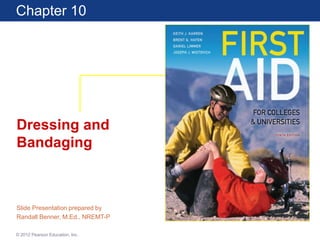
Chapter 10
Dressing and
Bandaging
Slide Presentation prepared by
Randall Benner, M.Ed., NREMT-P
Learning Objectives
• Identify the various types of dressings and
bandages.
• Demonstrate how to apply various types of
bandages to different parts of the body.
• Describe the basic principles of dressing and
bandaging wounds.
• Demonstrate how to apply a pressure bandage,
and how to use a sling.
© 2012 Pearson Education, Inc.
Dressings
• A dressing is a sterile covering for a wound
• All open wounds should be covered to
– Prevent infection
– Control bleeding
– Prevent further injury
• Large or deep wounds should always be
cleaned and treated at a medical facility; don’t
try to clean them yourself.
• Note: A dressing is a sterile wound covering; a
bandage holds a dressing in place.
© 2012 Pearson Education, Inc.
Dressings
• Dressings should be
– Sterile (microorganism- and spore-free)
– Aseptic (bacteria-free)
– Held in place with a bandage firmly enough to control
bleeding, but not stop circulation (i.e., not too tight)
– Larger than the wound
– Soft, thick, and compressible
– Most are porous, allowing air to circulate
– Ideally, layered, lint-free, gauzy, and somewhat bulky
– Always placed against the wound and held by
bandage; the bandage should never directly touch the
wound
© 2012 Pearson Education, Inc.
Types of Commercial Dressings
• Occlusive: have an airtight and waterproof seal;
used for specific types of chest wounds
• Compress: thick, bulky, usually sterile, intended
to stop bleeding
• Trauma: larger area, thick, sterile, absorbent;
used for more serious or widespread injury
• Adhesive strips: combination sterile dressing
and bandage, individually packaged; used for
small wounds
• Adhesive tape: commonly unsterile, comes in
varying-width rolls, not applied directly to
wounds; holds dressings in place
© 2012 Pearson Education, Inc.
Types of Commercial Dressings
• Gauze pads: used in various dressings, may
have coating to prevent sticking; the portion
applied to a wound should be sterile
• Special pads: commonly used for larger-area
trauma; also called multitrauma pads
• Bandage compresses: special dressing used to
cover wounds and help control heavy bleeding
© 2012 Pearson Education, Inc.
Bandages
• The most common type is an adhesive strip
(Band-Aid)
• Bandages must
– Hold a dressing in place over a wound.
– Create pressure that controls bleeding.
– Help keep the edges of a wound closed.
– Secure a splint to an injured body part.
– Provide support for an injured body part.
– Help prevent or reduce swelling.
© 2012 Pearson Education, Inc.
Bandages
• The most common mistakes are applying
bandages too tightly or too loosely
• Signs that a bandage is too tight
– Nearby skin becomes pale or a bluish color
– Nearby fingernails/toenails develop a bluish tinge
– Skin beyond the bandage is cold, tingling, or numb
– If you press on the nail bed and let go, it does not
quickly turn pink again
– The victim cannot move their fingers or toes
© 2012 Pearson Education, Inc.
Types of Bandages
• Triangular
– Unbleached cotton, cut in triangle shape
– Easy to apply
– Can be used on most parts of the body
• Cravat
– A folded triangular bandage
• Roller
– Made from gauze-like material
– Comes in different widths, making it flexible
– Most popular is self-adhering (nonelastic) and form-
fitting
© 2012 Pearson Education, Inc.
Triangular and Cravat Bandages
© 2012 Pearson Education, Inc.
Dressing and Bandaging Principles
• Handle carefully to prevent contamination.
• Don’t apply bandages until bleeding has
stopped.
• Don’t remove original dressing if blood soaks
through.
• Ensure that the dressing completely covers the
wound.
• Do not place bandages directly on wounds (only
sterile dressings).
• Bandage wounds snugly but not tightly.
© 2012 Pearson Education, Inc.
Dressing and Bandaging Principles
• Bandages should not be loose; dressing and
bandage should not slip or shift.
• Ensure that there are no loose ends that could
catch on things.
• Cover all edges of the dressing with the
bandage.
• Leave tips of fingers and toes exposed when
bandaging arms and legs.
• Bandage a body part in the position it should
remain.
• Never use a circular bandage around a victim’s
neck.
© 2012 Pearson Education, Inc.
Improvising Dressings and Bandages
• Some situations require improvisation.
• No hard-and-fast rules; use adaptability and
creativity.
• Use materials on hand and methods you can
best adapt.
• Use materials that are as clean as possible.
• Never touch the wound directly.
• Control bleeding.
© 2012 Pearson Education, Inc.
Improvising
• In an emergency can use if clean
– Handkerchief
– Washcloth or towel
– Sheet or pillowcase
– Sanitary napkin
– Plastic wrap can be used as part of an occlusive
dressing
• Never use
– Elastic bandages
– Fluffy cotton or cotton balls
– Paper towels, toilet tissue, or other materials cling
when wet
© 2012 Pearson Education, Inc.
Special Dressing and Bandages
• Pressure dressings
– Apply snugly enough to create pressure on wound.
• Slings
– Used to support injuries of shoulder, arm, or rib.
– If available, use a triangular bandage.
© 2012 Pearson Education, Inc.
Summary
• A dressing is a sterile cover for a wound.
• The ideal dressing is sterile, gauzy, and layered.
• Never use materials that could cling to, shred
on, or disintegrate over a wound as a dressing.
• A bandage holds a dressing in place and does
not touch the wound.
• Bandages should not be too tight or too loose.
© 2012 Pearson Education, Inc.

Lecture 7_M10_KARR120_10E_PPT_C10.ppt

  • 1.
    Book Title Edition Chapter 1Lecture © 2012 Pearson Education, Inc. Chapter 10 Dressing and Bandaging Slide Presentation prepared by Randall Benner, M.Ed., NREMT-P
  • 2.
    Learning Objectives • Identifythe various types of dressings and bandages. • Demonstrate how to apply various types of bandages to different parts of the body. • Describe the basic principles of dressing and bandaging wounds. • Demonstrate how to apply a pressure bandage, and how to use a sling. © 2012 Pearson Education, Inc.
  • 3.
    Dressings • A dressingis a sterile covering for a wound • All open wounds should be covered to – Prevent infection – Control bleeding – Prevent further injury • Large or deep wounds should always be cleaned and treated at a medical facility; don’t try to clean them yourself. • Note: A dressing is a sterile wound covering; a bandage holds a dressing in place. © 2012 Pearson Education, Inc.
  • 4.
    Dressings • Dressings shouldbe – Sterile (microorganism- and spore-free) – Aseptic (bacteria-free) – Held in place with a bandage firmly enough to control bleeding, but not stop circulation (i.e., not too tight) – Larger than the wound – Soft, thick, and compressible – Most are porous, allowing air to circulate – Ideally, layered, lint-free, gauzy, and somewhat bulky – Always placed against the wound and held by bandage; the bandage should never directly touch the wound © 2012 Pearson Education, Inc.
  • 5.
    Types of CommercialDressings • Occlusive: have an airtight and waterproof seal; used for specific types of chest wounds • Compress: thick, bulky, usually sterile, intended to stop bleeding • Trauma: larger area, thick, sterile, absorbent; used for more serious or widespread injury • Adhesive strips: combination sterile dressing and bandage, individually packaged; used for small wounds • Adhesive tape: commonly unsterile, comes in varying-width rolls, not applied directly to wounds; holds dressings in place © 2012 Pearson Education, Inc.
  • 6.
    Types of CommercialDressings • Gauze pads: used in various dressings, may have coating to prevent sticking; the portion applied to a wound should be sterile • Special pads: commonly used for larger-area trauma; also called multitrauma pads • Bandage compresses: special dressing used to cover wounds and help control heavy bleeding © 2012 Pearson Education, Inc.
  • 7.
    Bandages • The mostcommon type is an adhesive strip (Band-Aid) • Bandages must – Hold a dressing in place over a wound. – Create pressure that controls bleeding. – Help keep the edges of a wound closed. – Secure a splint to an injured body part. – Provide support for an injured body part. – Help prevent or reduce swelling. © 2012 Pearson Education, Inc.
  • 8.
    Bandages • The mostcommon mistakes are applying bandages too tightly or too loosely • Signs that a bandage is too tight – Nearby skin becomes pale or a bluish color – Nearby fingernails/toenails develop a bluish tinge – Skin beyond the bandage is cold, tingling, or numb – If you press on the nail bed and let go, it does not quickly turn pink again – The victim cannot move their fingers or toes © 2012 Pearson Education, Inc.
  • 9.
    Types of Bandages •Triangular – Unbleached cotton, cut in triangle shape – Easy to apply – Can be used on most parts of the body • Cravat – A folded triangular bandage • Roller – Made from gauze-like material – Comes in different widths, making it flexible – Most popular is self-adhering (nonelastic) and form- fitting © 2012 Pearson Education, Inc.
  • 10.
    Triangular and CravatBandages © 2012 Pearson Education, Inc.
  • 11.
    Dressing and BandagingPrinciples • Handle carefully to prevent contamination. • Don’t apply bandages until bleeding has stopped. • Don’t remove original dressing if blood soaks through. • Ensure that the dressing completely covers the wound. • Do not place bandages directly on wounds (only sterile dressings). • Bandage wounds snugly but not tightly. © 2012 Pearson Education, Inc.
  • 12.
    Dressing and BandagingPrinciples • Bandages should not be loose; dressing and bandage should not slip or shift. • Ensure that there are no loose ends that could catch on things. • Cover all edges of the dressing with the bandage. • Leave tips of fingers and toes exposed when bandaging arms and legs. • Bandage a body part in the position it should remain. • Never use a circular bandage around a victim’s neck. © 2012 Pearson Education, Inc.
  • 13.
    Improvising Dressings andBandages • Some situations require improvisation. • No hard-and-fast rules; use adaptability and creativity. • Use materials on hand and methods you can best adapt. • Use materials that are as clean as possible. • Never touch the wound directly. • Control bleeding. © 2012 Pearson Education, Inc.
  • 14.
    Improvising • In anemergency can use if clean – Handkerchief – Washcloth or towel – Sheet or pillowcase – Sanitary napkin – Plastic wrap can be used as part of an occlusive dressing • Never use – Elastic bandages – Fluffy cotton or cotton balls – Paper towels, toilet tissue, or other materials cling when wet © 2012 Pearson Education, Inc.
  • 15.
    Special Dressing andBandages • Pressure dressings – Apply snugly enough to create pressure on wound. • Slings – Used to support injuries of shoulder, arm, or rib. – If available, use a triangular bandage. © 2012 Pearson Education, Inc.
  • 16.
    Summary • A dressingis a sterile cover for a wound. • The ideal dressing is sterile, gauzy, and layered. • Never use materials that could cling to, shred on, or disintegrate over a wound as a dressing. • A bandage holds a dressing in place and does not touch the wound. • Bandages should not be too tight or too loose. © 2012 Pearson Education, Inc.