1
Lecture
Oct 19, 2006
Creativity- Can it be Engineered?
2
Present at all stages of the Process e.g., Consider Process
front end
Identifying Customer Needs
Establishing Target Specs
Analysis of Competitive products
Concept generation
Concept selection
Spec Refinement
Economic Analysis
Project Planning
Here we do the concept generation as part of a seamless
process after contextual information has been generated.
Creativity
3
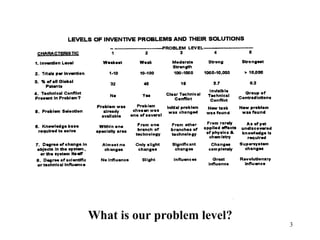
What is our problem level?
4
Where to look for Breakthroughs
Developed World
• Rapidly evolving underlying or enabling technology (Computers, Biotech)
• Clearly recognizable problem with current products (e.g. air bags, traffic congestion,
personal device profusion)
• Bottleneck products (clothes dryers)
• Bottleneck parts (e.g. batteries)
Developing World
• Niche areas in developing countries which have not gotten attention
• Exploit diffusion lag of new technologies into developing countries
• Breakthrough in Product Development Process?
• Product which serve areas of rapid social/economic change (meet new needs)
• Other
• Involving NGOs effectively
• 100% barrier
5
• How would you classify Micro-lending?
6
“The formulation of a problem is far more
essential than its solution which may be
merely a matter of mathematical or
experimental skill”
- Albert Einstein
Ask what problem you are trying to solve!
7
8
Trial and Error
• What major industry still
roughly depends on “Trial
and Error?”
• Is Trial and Error
appropriate for Developing
World Products?
9
Creativity- The Idea Generation Process
10
What drives your “A hah”
Process
• Association?
• Necessity?
• Showers, commutes?
• Explaining the problem to others?
• Conversation?
• Random?
• Other
11
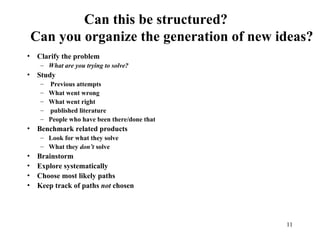
Can this be structured?
Can you organize the generation of new ideas?
• Clarify the problem
– What are you trying to solve?
• Study
– Previous attempts
– What went wrong
– What went right
– published literature
– People who have been there/done that
• Benchmark related products
– Look for what they solve
– What they don’t solve
• Brainstorm
• Explore systematically
• Choose most likely paths
• Keep track of paths not chosen
12
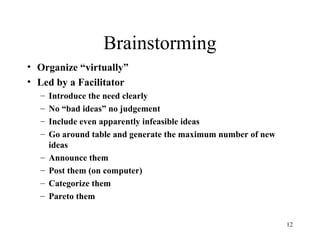
Brainstorming
• Organize “virtually”
• Led by a Facilitator
– Introduce the need clearly
– No “bad ideas” no judgement
– Include even apparently infeasible ideas
– Go around table and generate the maximum number of new
ideas
– Announce them
– Post them (on computer)
– Categorize them
– Pareto them
13
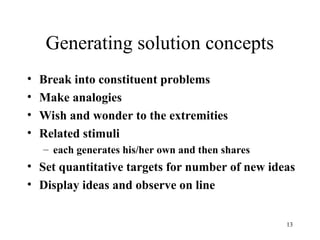
Generating solution concepts
• Break into constituent problems
• Make analogies
• Wish and wonder to the extremities
• Related stimuli
– each generates his/her own and then shares
• Set quantitative targets for number of new ideas
• Display ideas and observe on line
14
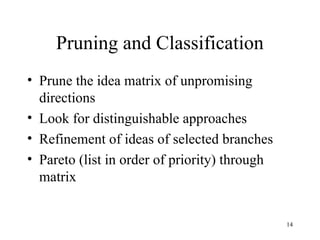
Pruning and Classification
• Prune the idea matrix of unpromising
directions
• Look for distinguishable approaches
• Refinement of ideas of selected branches
• Pareto (list in order of priority) through
matrix
15
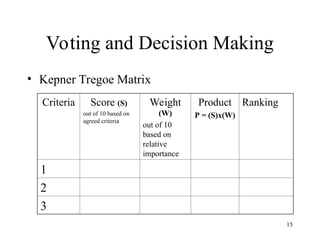
Voting and Decision Making
• Kepner Tregoe Matrix
Criteria Score (S)
out of 10 based on
agreed criteria
Weight
(W)
out of 10
based on
relative
importance
Product
P = (S)x(W)
Ranking
1
2
3
16
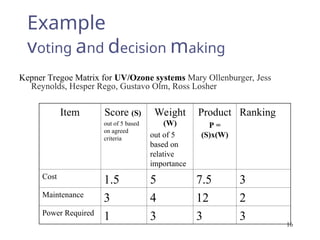
Example
voting and decision making
Kepner Tregoe Matrix for UV/Ozone systems Mary Ollenburger, Jess
Reynolds, Hesper Rego, Gustavo Olm, Ross Losher
Item Score (S)
out of 5 based
on agreed
criteria
Weight
(W)
out of 5
based on
relative
importance
Product
P =
(S)x(W)
Ranking
Cost
1.5 5 7.5 3
Maintenance
3 4 12 2
Power Required
1 3 3 3
17
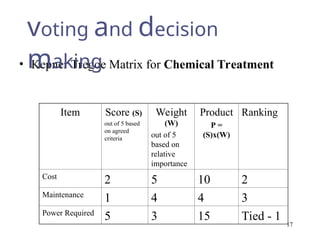
• Kepner Tregoe Matrix for Chemical Treatment
Item Score (S)
out of 5 based
on agreed
criteria
Weight
(W)
out of 5
based on
relative
importance
Product
P =
(S)x(W)
Ranking
Cost
2 5 10 2
Maintenance
1 4 4 3
Power Required
5 3 15 Tied - 1
voting and decision
making
18
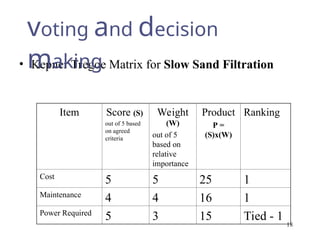
• Kepner Tregoe Matrix for Slow Sand Filtration
Item Score (S)
out of 5 based
on agreed
criteria
Weight
(W)
out of 5
based on
relative
importance
Product
P =
(S)x(W)
Ranking
Cost
5 5 25 1
Maintenance
4 4 16 1
Power Required
5 3 15 Tied - 1
voting and decision
making
19
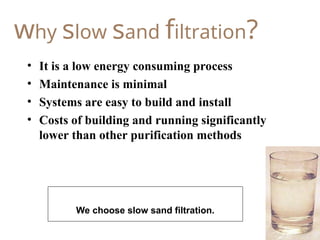
why slow sand filtration?
• It is a low energy consuming process
• Maintenance is minimal
• Systems are easy to build and install
• Costs of building and running significantly
lower than other purification methods
We choose slow sand filtration.
20
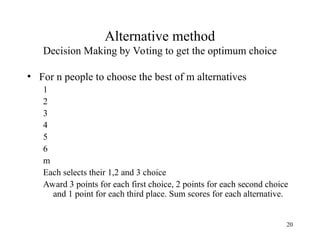
Alternative method
Decision Making by Voting to get the optimum choice
• For n people to choose the best of m alternatives
1
2
3
4
5
6
m
Each selects their 1,2 and 3 choice
Award 3 points for each first choice, 2 points for each second choice
and 1 point for each third place. Sum scores for each alternative.
21
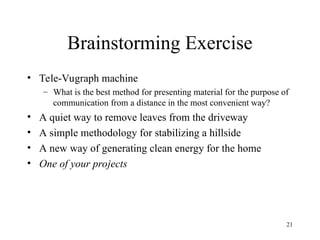
Brainstorming Exercise
• Tele-Vugraph machine
– What is the best method for presenting material for the purpose of
communication from a distance in the most convenient way?
• A quiet way to remove leaves from the driveway
• A simple methodology for stabilizing a hillside
• A new way of generating clean energy for the home
• One of your projects
22
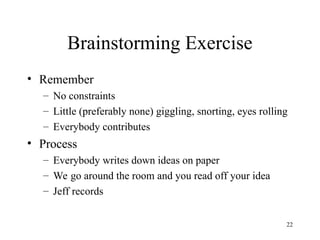
Brainstorming Exercise
• Remember
– No constraints
– Little (preferably none) giggling, snorting, eyes rolling
– Everybody contributes
• Process
– Everybody writes down ideas on paper
– We go around the room and you read off your idea
– Jeff records
23
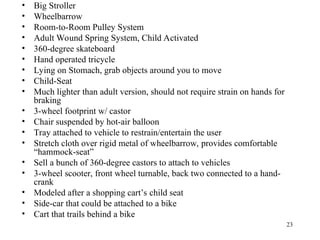
• Big Stroller
• Wheelbarrow
• Room-to-Room Pulley System
• Adult Wound Spring System, Child Activated
• 360-degree skateboard
• Hand operated tricycle
• Lying on Stomach, grab objects around you to move
• Child-Seat
• Much lighter than adult version, should not require strain on hands for
braking
• 3-wheel footprint w/ castor
• Chair suspended by hot-air balloon
• Tray attached to vehicle to restrain/entertain the user
• Stretch cloth over rigid metal of wheelbarrow, provides comfortable
“hammock-seat”
• Sell a bunch of 360-degree castors to attach to vehicles
• 3-wheel scooter, front wheel turnable, back two connected to a hand-
crank
• Modeled after a shopping cart’s child seat
• Side-car that could be attached to a bike
• Cart that trails behind a bike
24
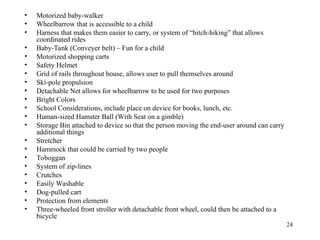
• Motorized baby-walker
• Wheelbarrow that is accessible to a child
• Harness that makes them easier to carry, or system of “hitch-hiking” that allows
coordinated rides
• Baby-Tank (Conveyer belt) – Fun for a child
• Motorized shopping carts
• Safety Helmet
• Grid of rails throughout house, allows user to pull themselves around
• Ski-pole propulsion
• Detachable Net allows for wheelbarrow to be used for two purposes
• Bright Colors
• School Considerations, include place on device for books, lunch, etc.
• Human-sized Hamster Ball (With Seat on a gimble)
• Storage Bin attached to device so that the person moving the end-user around can carry
additional things
• Stretcher
• Hammock that could be carried by two people
• Toboggan
• System of zip-lines
• Crutches
• Easily Washable
• Dog-pulled cart
• Protection from elements
• Three-wheeled front stroller with detachable front wheel, could then be attached to a
bicycle
25
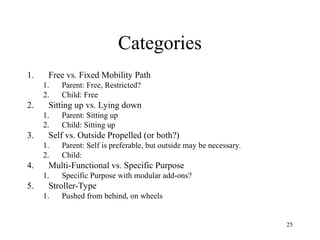
Categories
1. Free vs. Fixed Mobility Path
1. Parent: Free, Restricted?
2. Child: Free
2. Sitting up vs. Lying down
1. Parent: Sitting up
2. Child: Sitting up
3. Self vs. Outside Propelled (or both?)
1. Parent: Self is preferable, but outside may be necessary.
2. Child:
4. Multi-Functional vs. Specific Purpose
1. Specific Purpose with modular add-ons?
5. Stroller-Type
1. Pushed from behind, on wheels
26
Next Weeks lecture subject
Architecture!
27
28
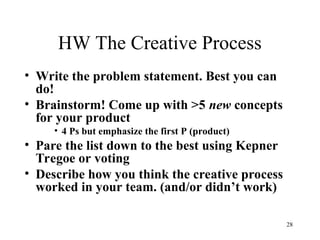
HW The Creative Process
• Write the problem statement. Best you can
do!
• Brainstorm! Come up with >5 new concepts
for your product
• 4 Ps but emphasize the first P (product)
• Pare the list down to the best using Kepner
Tregoe or voting
• Describe how you think the creative process
worked in your team. (and/or didn’t work)

Lecture 7-creativity thinking product.ppt

  • 1.
  • 2.
    2 Present at allstages of the Process e.g., Consider Process front end Identifying Customer Needs Establishing Target Specs Analysis of Competitive products Concept generation Concept selection Spec Refinement Economic Analysis Project Planning Here we do the concept generation as part of a seamless process after contextual information has been generated. Creativity
  • 3.
    3 What is ourproblem level?
  • 4.
    4 Where to lookfor Breakthroughs Developed World • Rapidly evolving underlying or enabling technology (Computers, Biotech) • Clearly recognizable problem with current products (e.g. air bags, traffic congestion, personal device profusion) • Bottleneck products (clothes dryers) • Bottleneck parts (e.g. batteries) Developing World • Niche areas in developing countries which have not gotten attention • Exploit diffusion lag of new technologies into developing countries • Breakthrough in Product Development Process? • Product which serve areas of rapid social/economic change (meet new needs) • Other • Involving NGOs effectively • 100% barrier
  • 5.
    5 • How wouldyou classify Micro-lending?
  • 6.
    6 “The formulation ofa problem is far more essential than its solution which may be merely a matter of mathematical or experimental skill” - Albert Einstein Ask what problem you are trying to solve!
  • 7.
  • 8.
    8 Trial and Error •What major industry still roughly depends on “Trial and Error?” • Is Trial and Error appropriate for Developing World Products?
  • 9.
    9 Creativity- The IdeaGeneration Process
  • 10.
    10 What drives your“A hah” Process • Association? • Necessity? • Showers, commutes? • Explaining the problem to others? • Conversation? • Random? • Other
  • 11.
    11 Can this bestructured? Can you organize the generation of new ideas? • Clarify the problem – What are you trying to solve? • Study – Previous attempts – What went wrong – What went right – published literature – People who have been there/done that • Benchmark related products – Look for what they solve – What they don’t solve • Brainstorm • Explore systematically • Choose most likely paths • Keep track of paths not chosen
  • 12.
    12 Brainstorming • Organize “virtually” •Led by a Facilitator – Introduce the need clearly – No “bad ideas” no judgement – Include even apparently infeasible ideas – Go around table and generate the maximum number of new ideas – Announce them – Post them (on computer) – Categorize them – Pareto them
  • 13.
    13 Generating solution concepts •Break into constituent problems • Make analogies • Wish and wonder to the extremities • Related stimuli – each generates his/her own and then shares • Set quantitative targets for number of new ideas • Display ideas and observe on line
  • 14.
    14 Pruning and Classification •Prune the idea matrix of unpromising directions • Look for distinguishable approaches • Refinement of ideas of selected branches • Pareto (list in order of priority) through matrix
  • 15.
    15 Voting and DecisionMaking • Kepner Tregoe Matrix Criteria Score (S) out of 10 based on agreed criteria Weight (W) out of 10 based on relative importance Product P = (S)x(W) Ranking 1 2 3
  • 16.
    16 Example voting and decisionmaking Kepner Tregoe Matrix for UV/Ozone systems Mary Ollenburger, Jess Reynolds, Hesper Rego, Gustavo Olm, Ross Losher Item Score (S) out of 5 based on agreed criteria Weight (W) out of 5 based on relative importance Product P = (S)x(W) Ranking Cost 1.5 5 7.5 3 Maintenance 3 4 12 2 Power Required 1 3 3 3
  • 17.
    17 • Kepner TregoeMatrix for Chemical Treatment Item Score (S) out of 5 based on agreed criteria Weight (W) out of 5 based on relative importance Product P = (S)x(W) Ranking Cost 2 5 10 2 Maintenance 1 4 4 3 Power Required 5 3 15 Tied - 1 voting and decision making
  • 18.
    18 • Kepner TregoeMatrix for Slow Sand Filtration Item Score (S) out of 5 based on agreed criteria Weight (W) out of 5 based on relative importance Product P = (S)x(W) Ranking Cost 5 5 25 1 Maintenance 4 4 16 1 Power Required 5 3 15 Tied - 1 voting and decision making
  • 19.
    19 why slow sandfiltration? • It is a low energy consuming process • Maintenance is minimal • Systems are easy to build and install • Costs of building and running significantly lower than other purification methods We choose slow sand filtration.
  • 20.
    20 Alternative method Decision Makingby Voting to get the optimum choice • For n people to choose the best of m alternatives 1 2 3 4 5 6 m Each selects their 1,2 and 3 choice Award 3 points for each first choice, 2 points for each second choice and 1 point for each third place. Sum scores for each alternative.
  • 21.
    21 Brainstorming Exercise • Tele-Vugraphmachine – What is the best method for presenting material for the purpose of communication from a distance in the most convenient way? • A quiet way to remove leaves from the driveway • A simple methodology for stabilizing a hillside • A new way of generating clean energy for the home • One of your projects
  • 22.
    22 Brainstorming Exercise • Remember –No constraints – Little (preferably none) giggling, snorting, eyes rolling – Everybody contributes • Process – Everybody writes down ideas on paper – We go around the room and you read off your idea – Jeff records
  • 23.
    23 • Big Stroller •Wheelbarrow • Room-to-Room Pulley System • Adult Wound Spring System, Child Activated • 360-degree skateboard • Hand operated tricycle • Lying on Stomach, grab objects around you to move • Child-Seat • Much lighter than adult version, should not require strain on hands for braking • 3-wheel footprint w/ castor • Chair suspended by hot-air balloon • Tray attached to vehicle to restrain/entertain the user • Stretch cloth over rigid metal of wheelbarrow, provides comfortable “hammock-seat” • Sell a bunch of 360-degree castors to attach to vehicles • 3-wheel scooter, front wheel turnable, back two connected to a hand- crank • Modeled after a shopping cart’s child seat • Side-car that could be attached to a bike • Cart that trails behind a bike
  • 24.
    24 • Motorized baby-walker •Wheelbarrow that is accessible to a child • Harness that makes them easier to carry, or system of “hitch-hiking” that allows coordinated rides • Baby-Tank (Conveyer belt) – Fun for a child • Motorized shopping carts • Safety Helmet • Grid of rails throughout house, allows user to pull themselves around • Ski-pole propulsion • Detachable Net allows for wheelbarrow to be used for two purposes • Bright Colors • School Considerations, include place on device for books, lunch, etc. • Human-sized Hamster Ball (With Seat on a gimble) • Storage Bin attached to device so that the person moving the end-user around can carry additional things • Stretcher • Hammock that could be carried by two people • Toboggan • System of zip-lines • Crutches • Easily Washable • Dog-pulled cart • Protection from elements • Three-wheeled front stroller with detachable front wheel, could then be attached to a bicycle
  • 25.
    25 Categories 1. Free vs.Fixed Mobility Path 1. Parent: Free, Restricted? 2. Child: Free 2. Sitting up vs. Lying down 1. Parent: Sitting up 2. Child: Sitting up 3. Self vs. Outside Propelled (or both?) 1. Parent: Self is preferable, but outside may be necessary. 2. Child: 4. Multi-Functional vs. Specific Purpose 1. Specific Purpose with modular add-ons? 5. Stroller-Type 1. Pushed from behind, on wheels
  • 26.
    26 Next Weeks lecturesubject Architecture!
  • 27.
  • 28.
    28 HW The CreativeProcess • Write the problem statement. Best you can do! • Brainstorm! Come up with >5 new concepts for your product • 4 Ps but emphasize the first P (product) • Pare the list down to the best using Kepner Tregoe or voting • Describe how you think the creative process worked in your team. (and/or didn’t work)

Editor's Notes

  • #13 Vugraph= generate light, generate image, generate communication, display